SMART goals are clear, structured goals that help people turn broad intentions into specific workplace outcomes. SMART stands for Specific, Measurable, Achievable, Relevant, and Time-bound. Instead of saying, “I want to improve my performance,” a SMART goal explains what will improve, how progress will be measured, why it matters, and when it should be completed.
The framework is widely used because it removes confusion from goal setting. It helps employees, managers, and teams agree on what success looks like before the work begins.
Where the SMART Framework Comes From
The SMART acronym was not invented by a productivity blogger. It first appeared in the November 1981 issue of Management Review, in an article by consultant George T. Doran titled “There’s a S.M.A.R.T. Way to Write Management’s Goals and Objectives.” Doran’s original letters stood for Specific, Measurable, Assignable, Realistic, and Time-related, not the “Achievable” and “Relevant” most people use today. He also noted that not every objective needs to hit all five criteria perfectly, since the framework was meant as a writing aid, not a rigid rulebook.
That history matters because it explains why you’ll see slightly different versions of SMART across companies and templates. The version used in this guide (Specific, Measurable, Achievable, Relevant, Time-bound) is the most common in modern performance management, and it’s the one we’ll use throughout.
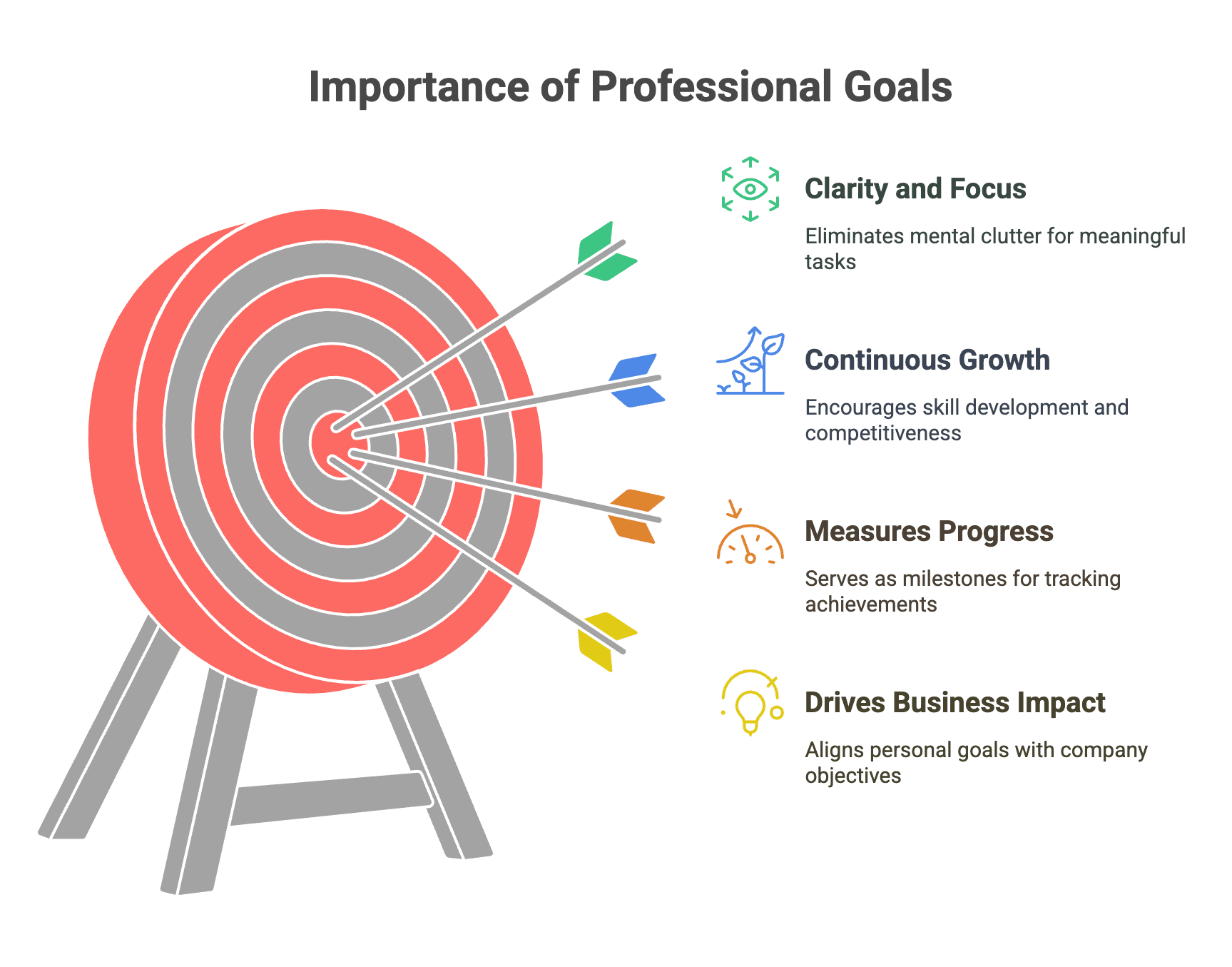
Why Are Professional Goals in the Workplace Important?
Professional goals are not just a routine exercise—they are essential for driving career growth and achieving success. Here’s why setting clear goals matters:
Provides Clarity and Focus: Defined goals eliminate mental clutter, allowing you to channel your energy into meaningful tasks and priorities.
Fuels Continuous Growth: Clear objectives encourage ongoing skill development and knowledge enhancement, ensuring you stay competitive in your industry.
Measures Progress: Goals serve as milestones that help you track achievements, keeping you motivated and committed to consistent effort.
Drives Business Impact: When personal ambitions align with company objectives, they contribute to organizational growth and success.
Performance Goals – Focus on achieving definite results, such as increasing sales by 20%.
Skill Development Goals – Target personal growth, like mastering a new programming language.
Work-Life Balance Goals – Harmonize personal and professional life, for instance ensuring flexible work hours.
Process-Oriented Goals – Improve workflows or systems, for example, deliver projects 10% faster.
What Are Some SMART Goal Examples for Work in 2026?
The best SMART goals are practical, role-specific, and measurable. Use the examples below as starting points, then adjust the numbers, timelines, and outcomes based on your team’s priorities.
SMART Goals for Managers
1. Improve team productivity Increase the team’s project completion rate by 15% by the end of Q2 by reviewing workload every Monday, removing blockers, and tracking weekly progress in the project management system.
2. Improve one-on-one meeting consistency Hold bi-weekly one-on-one meetings with every direct report for the next six months to discuss priorities, feedback, challenges, and development goals.
3. Reduce employee turnover risk Identify top retention risks within the team by the end of the quarter and create individual development or support plans for at least three employees.
4. Improve feedback quality Provide documented performance feedback to every team member at least once a month for the next two quarters to improve clarity, accountability, and coaching.
5. Strengthen team collaboration Launch one cross-functional project by the end of Q3 and schedule monthly alignment meetings to reduce communication gaps between departments.
SMART Goals for Employees
6. Improve time management Reduce missed deadlines by 25% over the next quarter by planning weekly priorities every Monday and updating task status every Friday.
7. Build a new skill Complete one role-relevant certification by September 30 and apply the learning to at least one active project. For employees using SMART goals to support long-term career growth, these individual development plan templates and examples can help connect short-term goals with broader development plans.
8. Improve communication Share a weekly project update with the manager and key stakeholders every Friday for the next three months to improve visibility and reduce follow-up questions.
9. Increase work quality Reduce revision requests by 20% by the end of Q2 by using a pre-submission checklist for every major deliverable.
10. Improve cross-functional collaboration Participate in at least two cross-functional initiatives this quarter and document learnings that can improve future teamwork.
SMART Goals for Sales
11. Increase qualified pipeline Generate 30 qualified leads per month for the next quarter through targeted outreach, referrals, and follow-up campaigns.
12. Improve conversion rate Increase demo-to-opportunity conversion rate from 25% to 32% by the end of Q3 by improving discovery calls and using a standardized follow-up process.
13. Improve follow-up discipline Follow up with 100% of qualified prospects within 24 hours of the first meeting for the next 90 days.
14. Increase upsell revenue Identify upsell opportunities in 20 existing accounts by the end of the quarter and schedule at least 10 expansion conversations.
15. Improve CRM hygiene Update all active opportunities in the CRM every Friday for the next quarter to improve forecasting accuracy and sales visibility.
SMART Goals for Marketing
16. Increase organic traffic Increase organic blog traffic by 20% over the next six months by updating 10 high-potential articles and publishing four new SEO-focused posts each month.
17. Improve lead quality Increase marketing-qualified leads from target accounts by 15% by the end of Q3 through segmented campaigns and improved lead scoring.
18. Improve email engagement Increase newsletter click-through rate from 2.5% to 4% within three months by testing subject lines, improving article placement, and segmenting audiences by interest.
19. Grow webinar registrations Generate 300 webinar registrations by the event date through email campaigns, LinkedIn promotion, partner outreach, and retargeting ads.
20. Improve content conversions Increase demo requests from blog traffic by 10% in the next quarter by adding relevant CTAs to the top 20 performing blog pages.
SMART Goals for HR
21. Improve onboarding completion Increase new hire onboarding completion from 75% to 95% within the next quarter by automating reminders and tracking completion weekly.
22. Improve employee engagement survey participation Increase employee survey participation to 80% by the next engagement cycle through manager reminders, anonymous participation options, and clearer communication.
23. Reduce time-to-hire Reduce average time-to-hire from 45 days to 35 days by the end of Q3 by improving screening workflows and interview scheduling.
24. Improve performance review completion Achieve 95% performance review completion by the review deadline by sending automated reminders and giving managers weekly completion reports.
25. Strengthen learning participation Increase employee participation in learning programs by 20% within six months by launching role-based learning paths and tracking course completion.
SMART Goals for Performance Reviews
Performance reviews work best when the goals being evaluated were written as SMART goals from the start. Vague goals lead to vague, subjective reviews. Here are goals written specifically for review-cycle use, organized by common review categories.
Communication Reply to internal messages within one business day for the full review period, and share one written project update in the team’s weekly meeting every week this quarter.
Quality of work Reduce revision requests on submitted deliverables by 20% this review cycle by using a pre-submission checklist on every major task.
Productivity Increase completed tasks per sprint by 15% over the next two review cycles by blocking two hours of focused work time each morning.
Professional development Complete one role-relevant certification before the next review date and apply at least one new skill from it to a live project.
Leadership readiness Lead one cross-functional initiative from kickoff to completion before the next review cycle, and document what worked and what didn’t for future reference.
Use these as a starting point in a self-review or manager review, and adjust the numbers to match your actual role and workload.
SMART Goals for Engineering/Product
26. Reduce bug resolution time Reduce average priority-two bug resolution time from five days to three days by the end of the quarter through triage reviews and clearer ownership.
27. Improve sprint predictability Complete at least 85% of planned sprint work for the next three sprints by improving estimation and reducing unplanned work.
28. Improve product release quality Reduce post-release defects by 20% over the next two releases by improving QA coverage and adding release-readiness checklists.
29. Improve product discovery Conduct 12 customer interviews by the end of Q2 and convert findings into at least five prioritized product improvements.
30. Improve documentation quality Update documentation for the top 10 most-used product features by the end of the quarter to reduce support tickets and improve user adoption.
31. Improve system performance Reduce average page load time by 30% within four months by identifying performance bottlenecks and optimizing high-traffic workflows.
32. Improve roadmap alignment Review product roadmap priorities with sales, customer success, and support once a month for the next two quarters to improve alignment with customer needs.
How Do You Set SMART Goals for Work in 2026?
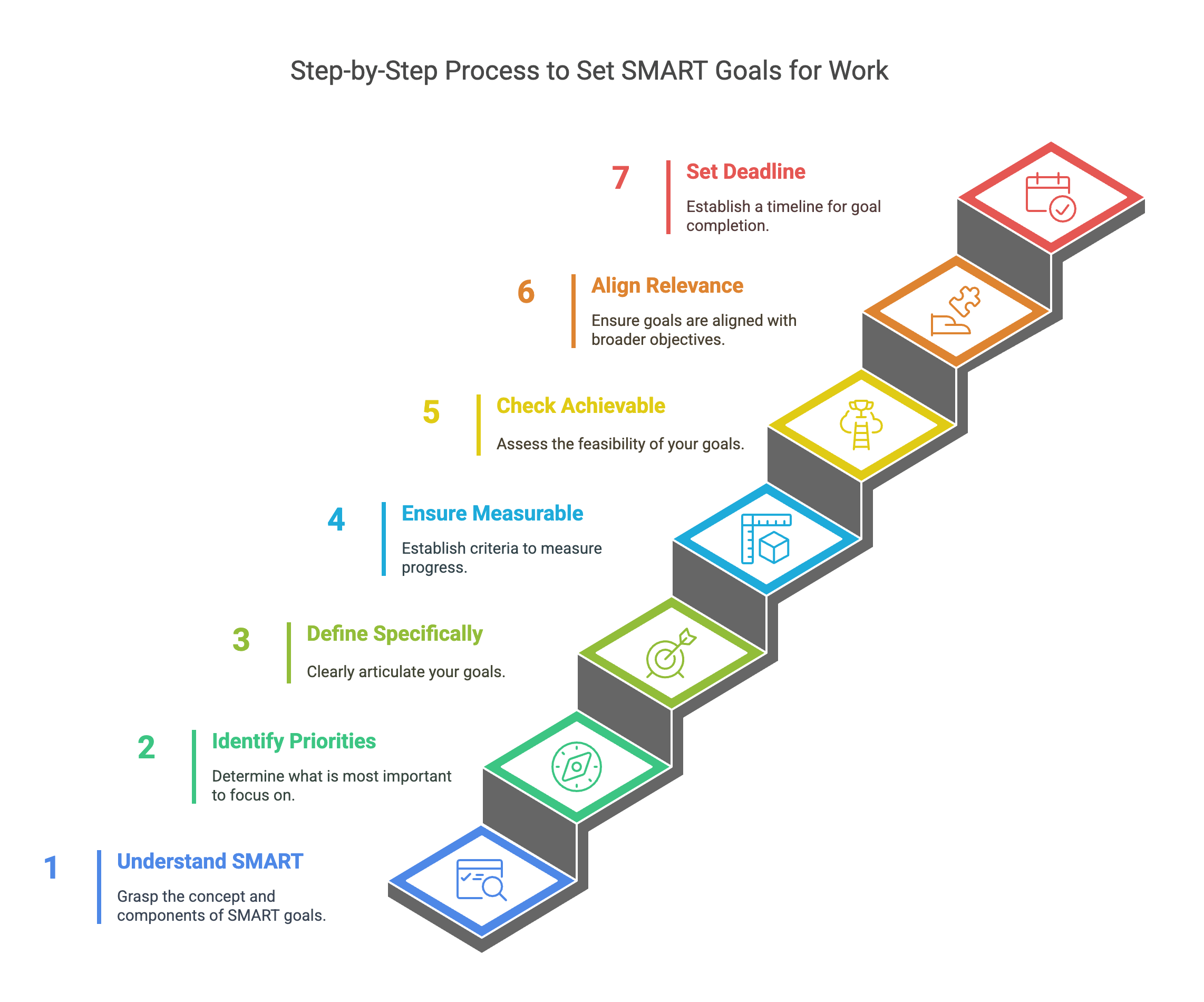
Here is a detailed guide on how to understand and set SMART goals:
Step 1 – Know What SMART Goals Are
SMART is an acronym for:
Specific – Goals should be clear and definite.
Measurable – Need to have specific criteria for assessing progress.
Relevant – Goals need to be connected with larger organizational or career objectives.
Time-bound – Need to have a timeframe to complete them.
Instead of working on objectives like, “Improve my technical skills,” set a SMART goal like, “Complete a project management certification by June 2026 to enhance my leadership abilities.”
Step 2 – Identify Your Priorities
Before setting goals, decide what matters most in your role this year. Focus on the responsibilities, outcomes, and skills that will have the biggest impact on your performance and long-term growth.
According to Gallup‘s ongoing engagement research, only about half of employees strongly agree that they know what is expected of them at work. Separate Gallup analysis has found that employees who can clearly link their individual goals to the organization’s goals are roughly 3.5 times more likely to be engaged. Source: Human Capital Institute, citing Gallup research
Step 3 – Define Your Goals Specifically
Clearly define every point of your goal so that nothing is vague. Answer the “who, what, when, where, and why. Being specific leaves no room for ambiguity. If you need a more structured starting point, these goal-setting templates can help turn broad ideas into clearer, more actionable goals. For instance, instead of saying, “exceed customer base,” focus on a goal like, “onboarding 50 new clients by July 2026”
Step 4 – Make Sure Your Goals Are Measurable
Make your goals specific by creating metrics or using KPIs. Measurable goals are easier to follow up. These outcomes often feed directly into structured performance reviews. For example, instead of saying, “increase productivity”, focus on increasing productivity by 15% by June 2026. Regular follow-ups help maintain momentum, track progress, and identify potential hurdles early.
Step 5 – Check Goals Are Achievable
Stretching yourself is wonderful, but overly ambitious goals may lead to burnout. Consider your resources, skills, and time constraints before framing objectives.
Step 6 – Align Goals with Relevance
Every objective should help towards either personal or organizational success. Align your goals with your organization’s mission or team results.
Step 7 – Deadline Setting or Specific Time-bound Goal
A set deadline will make objectives more urgent and accountable. For example, “To launch a product marketing campaign within the next 30 days, with an anticipated conversion of 10%.”
What Are the Differences Between SMART Goals, OKRs, and KPIs?
SMART goals, OKRs, and KPIs are related, but they are not the same. SMART goals help you write clear goals. OKRs help teams align around ambitious priorities. KPIs track ongoing performance.
Asana explains the difference clearly: OKRs are used to set and achieve ambitious goals, while KPIs monitor ongoing performance.
Objective: Improve customer retention. KR: Reduce churn by 10%
KPIs
Tracking ongoing business performance
Metric tracked over time
Monthly recurring revenue, retention rate, NPS
When to use SMART goals
Use SMART goals when employees need clarity on what to do, how success will be measured, and when the goal is due.
When to use OKRs
Use OKRs when teams need to align around bigger priorities and track progress toward ambitious outcomes.
When to use KPIs
Use KPIs when leaders need to monitor ongoing business health, such as revenue, retention, productivity, or customer satisfaction.
Why Do SMART Goals Still Matter at Work?
SMART goals remain useful because workplace priorities are changing faster than ever. Employees need clarity, managers need visibility, and leaders need a way to connect daily work with business outcomes.
Research from Dr. Gail Matthews, a psychology professor at Dominican University of California, tested this directly. In a study of 267 professionals split into groups with different levels of written commitment and accountability, participants who only thought about their goals accomplished 43% of them. Participants who wrote their goals down, made a written action plan, shared their commitment with a friend, and sent that friend weekly progress updates accomplished 76% of them.
That is why SMART goals work best when they are not created once and forgotten. They should be reviewed regularly, discussed in one-on-ones, and connected to performance conversations.
What Are the Common SMART Goal Mistakes to Avoid?
1. Making the goal too vague
A goal like “improve leadership skills” sounds positive, but it does not give the employee a clear direction. A stronger version would define the skill, action, and timeline.
2. Choosing the wrong metric
Not every metric reflects meaningful progress. Choose a metric that actually connects to the outcome you want.
3. Setting too many goals
Too many goals can dilute focus. It is better to set a few meaningful goals and review them consistently.
4. Ignoring relevance
A goal should connect to the employee’s role, career path, team priorities, or business outcomes. If the goal feels disconnected, motivation drops.
5. Forgetting to review progress
SMART goals need check-ins. Without regular reviews, goals can become outdated or lose urgency.
How Can You Turn SMART Goals Into Better Work Outcomes?
SMART goals work best when they are treated as an ongoing part of how work gets planned, measured, and improved. Clear goals help employees stay focused, make better decisions, and contribute more consistently to meaningful business outcom
To move from goal setting to consistent execution across teams, you can request a demo and see how goals, feedback, and performance connect in one system.
FAQs
What is a SMART goal example for a performance review?
A strong example is “Reduce customer response time from 24 hours to 12 hours by the end of Q3 by using a shared ticketing dashboard and setting daily response targets.” It names the metric, the target number, and the deadline, which is what separates a SMART goal from a general intention like “respond to customers faster.”
How many SMART goals should an employee have at once?
Most managers recommend two to four active goals per review period. More than that tends to dilute focus and makes it harder to track progress on any single goal properly.
What is the difference between a SMART goal and a KPI?
A SMART goal is a specific target with a deadline, written for an individual or a team. A KPI is an ongoing metric used to monitor performance over time, without a fixed endpoint. A SMART goal might aim to increase a KPI, such as customer satisfaction score, by a set amount within a set window.
Can SMART goals be used for soft skills like communication or leadership?
Yes, as long as the soft skill is tied to an observable behavior and a measure. Instead of “improve communication,” a SMART version would be “share a written project update every Friday for the next quarter” or “lead one team meeting per month for the next six months.”
How often should SMART goals be reviewed?
Most organizations review progress monthly or at each check-in, even if the formal goal deadline is quarterly or annual. Regular check-ins are what the Dominican University research above found made the biggest difference in actual completion rates.
What happens if a SMART goal isn’t achieved by the deadline?
A missed goal isn’t automatically a failure. Use the review conversation to look at what got in the way, whether the original target was realistic, and whether the goal should be adjusted, extended, or replaced going into the next cycle.
Srikant Chellappa is the Co-Founder and CEO at Engagedly and is a passionate entrepreneur and people leader. He is an author, producer/director of 6 feature films, a music album with his band Manchester Underground, and is the host of The People Strategy Leaders Podcast.

















 Performance