A 15Five alternative is any performance management platform that helps companies run continuous feedback, goal tracking, and employee reviews without relying on 15Five’s specific feature set. Companies typically look at alternatives when they need broader talent management capabilities, tighter integrations, more advanced analytics, or pricing that better fits a growing headcount. Below is an updated, fact-checked look at the ten platforms most commonly evaluated against 15Five in 2026, along with what each one actually charges according to its own website.
Performance management tools play a pivotal role in enhancing employee performance and overall organizational productivity. These tools facilitate continuous feedback, goal setting, performance reviews, and employee engagement, all of which matter for keeping a workforce motivated and productive. By implementing a strong performance management system, companies can align individual objectives with organizational goals, close performance gaps, and build a culture of continuous improvement.
Why Companies Might Seek Alternatives to 15Five
Companies usually start evaluating alternatives to 15Five for one of a few reasons: they need functionality that goes beyond check-ins and reviews (like learning management or talent mobility), they want deeper analytics and reporting, they need better integration with their existing HRIS, or they’ve simply outgrown the platform’s pricing model as headcount scales. As the performance management market keeps evolving, new entrants and AI-driven platforms are giving buyers more to compare than ever before.
This article breaks down the leading 15Five alternatives for 2026, evaluated on features, verified pricing, user experience, and what makes each one different, so you can find the right fit for your organization.
Criteria for Evaluation
Features
The core functionality that matters most in a performance management platform includes:
Performance Reviews – structured, recurring assessments of employee performance
Goal Setting and OKR Tracking – tools for setting, monitoring, and cascading individual and team goals
Feedback Mechanisms – continuous, real-time feedback between employees and managers
Employee Engagement – surveys and sentiment tools that track satisfaction over time
Analytics and Reporting – dashboards that turn performance data into decisions
Integration Capabilities – clean connections to existing HRIS, Slack, Teams, and productivity tools
User Experience
Intuitive design that reduces the learning curve for managers and employees
Mobile and web accessibility
Customization to match how the organization actually runs reviews and goals
Support and training resources, including onboarding help and documentation
Unique Selling Points (USPs)
What separates one platform from another usually comes down to how deep the AI capabilities go, how the platform is priced, how it’s reviewed by real users, and how well it fits mid-market versus enterprise needs.
Top 10 Excellent Alternatives to 15Five You Should Consider
Here are 10 excellent alternatives to BambooHR worth considering:
Engagedly
Lattice
Betterworks
Culture Amp
Paycor Talent Development (formerly 7Geese)
Leapsome
Trakstar
Zoho People
BambooHR
Reflektive (PeopleFluent)
1. Engagedly
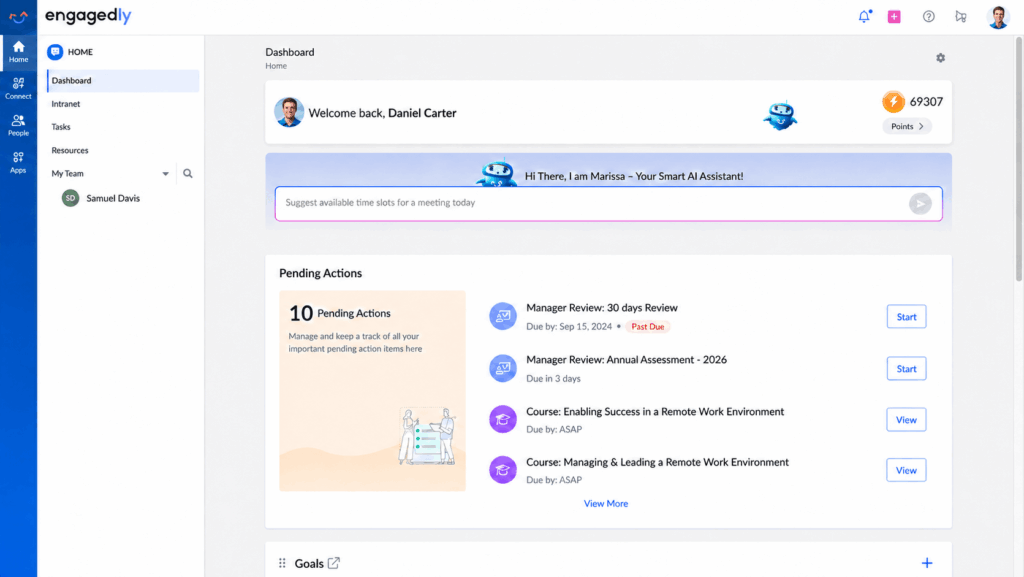
Engagedly is an AI talent management platform built to help organizations connect performance, engagement, learning, growth, and recognition in one unified experience. Powered by Marissa, its AI SuperAgent, Engagedly helps leaders turn people strategy into intelligent actions, reduce talent silos, and drive measurable business outcomes. Trusted by organizations worldwide, Engagedly supports stronger engagement, better retention, and the development of high performing teams.
Key features:
Customizable performance review cycles with 9-box calibration
Benefits: All-in-one suite that covers performance, engagement, learning, and talent mobility without needing separate vendors; highly customizable workflows; AI-driven insights through Marissa.
Pricing:
Manage Performance: $5-$8/user/month
Learn & Grow: $3-$5/user/month
Recognize & Reward: $2/user/month
Engage & Listen: $2/user/month
Talent Mobility: $2/user/month
Mentoring Suite (add-on): $8/user/month
Manage Compensation (add-on): $10/user/month
2. Lattice
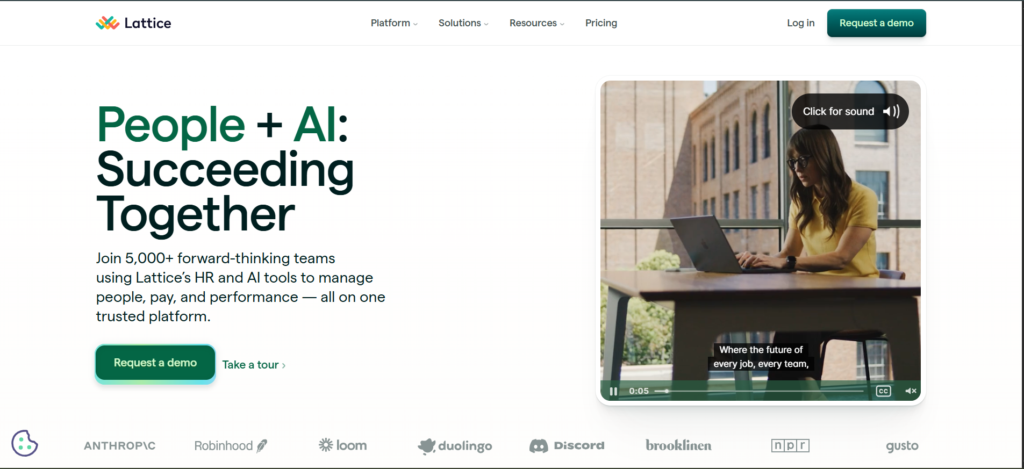
Lattice connects performance management to business outcomes through an integrated approach to reviews, goals, and engagement.
Key features:
Performance reviews, talent reviews, PIPs, and succession planning
Goals and OKRs tied to cascading business priorities
Engagement surveys with AI-powered trend analysis
An AI HR agent that answers questions and coaches managers in the flow of work
Benefits: Used by companies like Discord, Duolingo, and Robinhood; strong analytics layer included with every base product; dedicated human support on every contract.
Pricing:
Foundations bundle (most popular): $13/seat/month
Performance: $10/seat/month
Goals & OKRs: $8/seat/month
Engagement: $4/seat/month
Compensation add-on: +$6/seat/month
Grow add-on: +$4/seat/month
Enterprise: custom pricing
Minimum annual agreement: $4,000
3. Betterworks
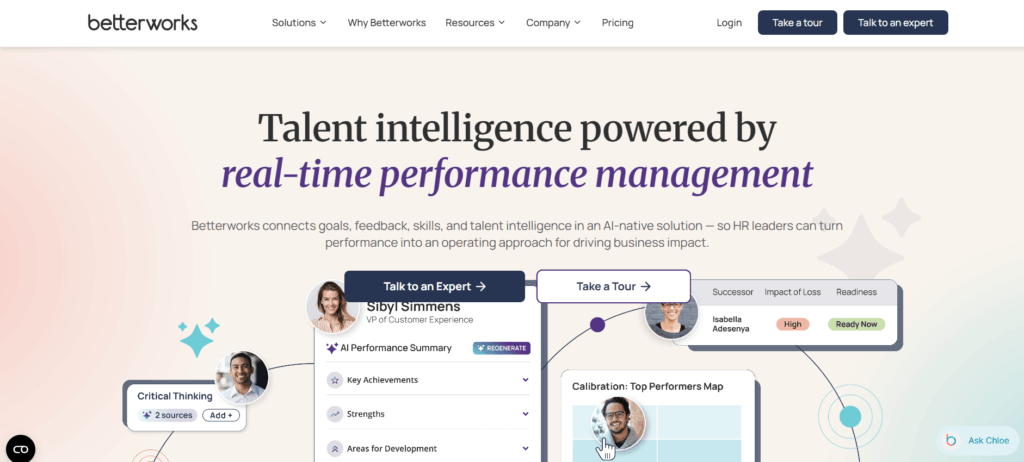
Betterworks is a performance management platform focused on goal alignment, continuous conversations, and AI-assisted talent decisions.
Key features:
Goals & OKRs
Performance reviews with calibration tools
Competency frameworks
Generative AI features that surface coaching and development insights
User experience: Betterworks integrates into the tools employees already use, like email, calendars, and messaging apps, so performance conversations happen in the flow of work rather than in a separate portal.
USP: Betterworks stands out for how it ties goal alignment directly to talent decisions like calibration and succession planning, rather than treating goals as a standalone module.
Pricing: Visit their platform page for pricing details.
Performance reviews, including 360-degree feedback
Goal setting
Benchmarking against industry data
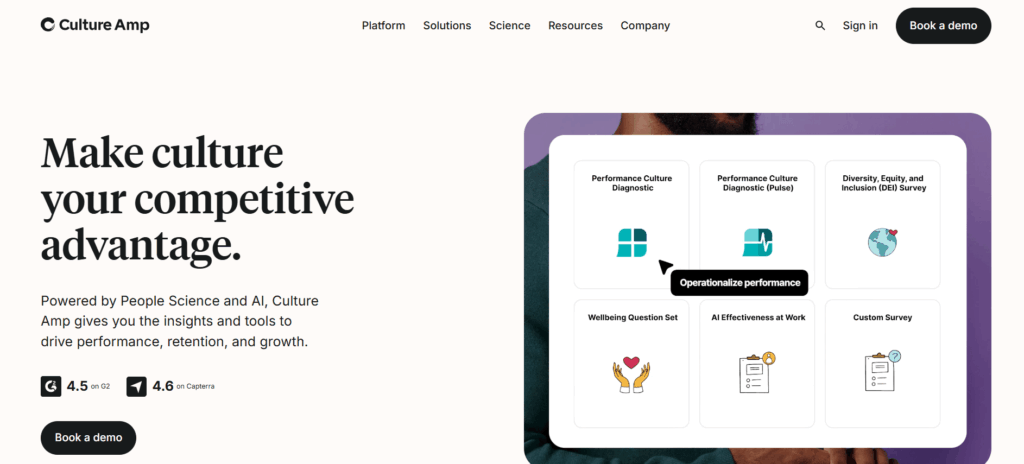
User experience: Culture Amp is generally praised for ease of implementation and an intuitive interface that surfaces actionable insights without heavy configuration.
USP: Culture Amp’s data-driven approach to company culture makes it a strong fit for organizations that want engagement analytics as central as performance reviews, not an afterthought.
Pricing: Visit their platform page for pricing details.
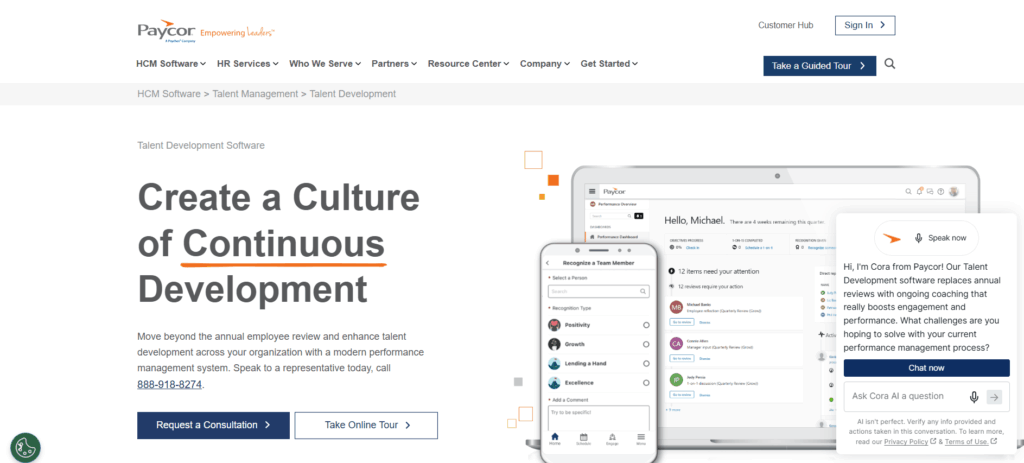
5. Paycor Talent Development (formerly 7Geese)
7Geese, once a standalone OKR and performance management tool, was acquired by Paycor in 2020 and has since been folded into Paycor’s HCM suite as Paycor Talent Development. It’s worth noting for anyone still comparing “7Geese” directly, since the product no longer exists as an independent platform.
Key features:
OKR-driven goal tracking
Agile performance reviews
Continuous feedback
1-on-1s
Values-based recognition
People analytics
Integration within the broader Paycor HCM platform
User experience: Because it now sits inside Paycor’s full HR and payroll suite, existing Paycor customers get a more unified experience, though standalone buyers will be evaluating the whole HCM platform rather than a single point solution.
USP: For companies already running or considering Paycor for payroll and core HR, folding in talent development avoids a second vendor relationship entirely.
Pricing: Visit their platform page for pricing details.
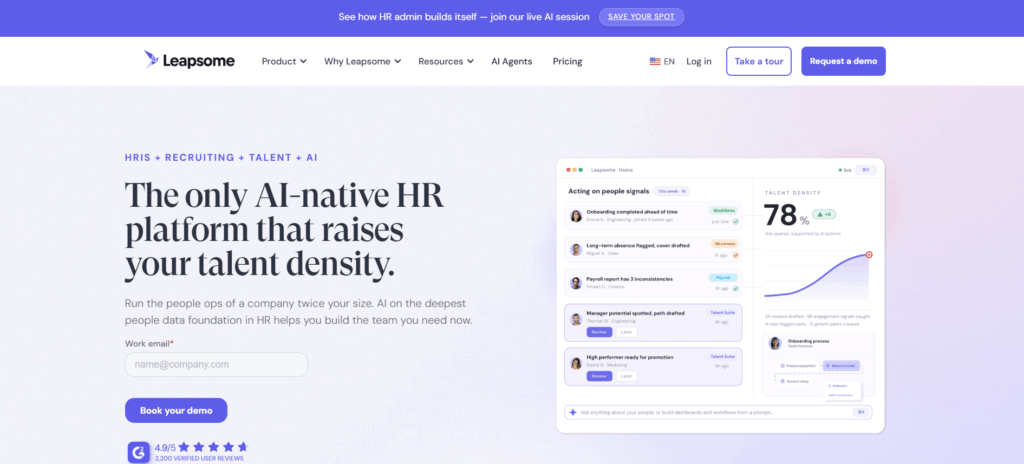
6. Leapsome
Leapsome is a people enablement platform that bundles HRIS, performance reviews, goals, engagement surveys, and learning into one modular system.
Key features:
Performance reviews with calibration
Goals & OKRs
Engagement and pulse surveys
Learning module
AI Agents that can draft reviews, summarize meetings, and answer policy questions
User experience: Leapsome’s modular design means teams can start with the modules they need, such as Reviews and Goals, and add HRIS, Learning, or Compensation as they scale, all inside one connected platform.
USP: Leapsome’s combination of HRIS and Talent Suite in one connected platform appeals to teams that want performance data and core HR data living in the same system rather than synced across tools.
Pricing: Pricing depends on the number of employees, contract length, and modules purchased.
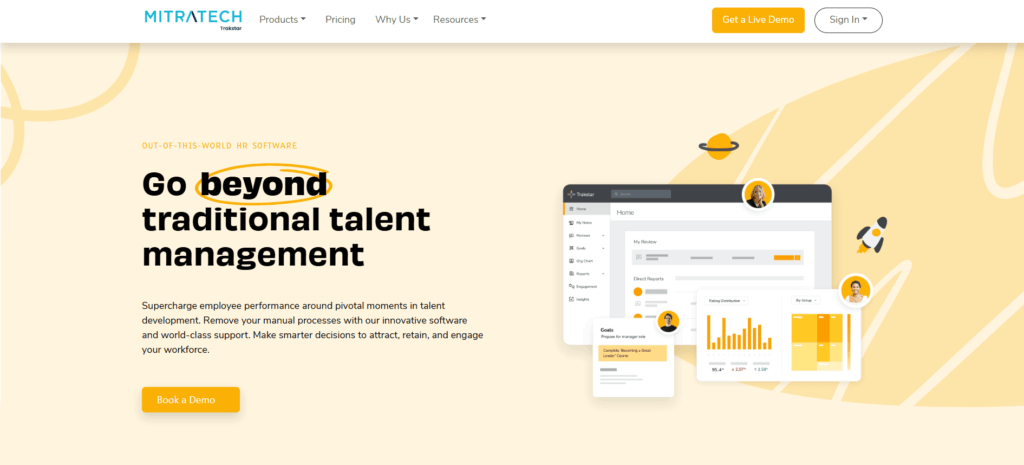
7. Trakstar
Trakstar is a performance management platform, now owned by Mitratech, offering reviews, goal tracking, 360 feedback, and engagement surveys.
Key features:
Customizable appraisal forms
SMART goal setting
Flexible review workflows
360-degree and multi-rater feedback
User experience: Trakstar is generally described as straightforward to set up, with a visually simple interface geared toward HR teams that want fast implementation over heavy customization.
USP: Trakstar’s modular structure, where Perform, Hire, and Learn can be purchased separately, lets buyers pay only for the pieces of talent management they actually need.
Pricing: Trakstar does not publish pricing publicly. Visit their platform page for pricing details.
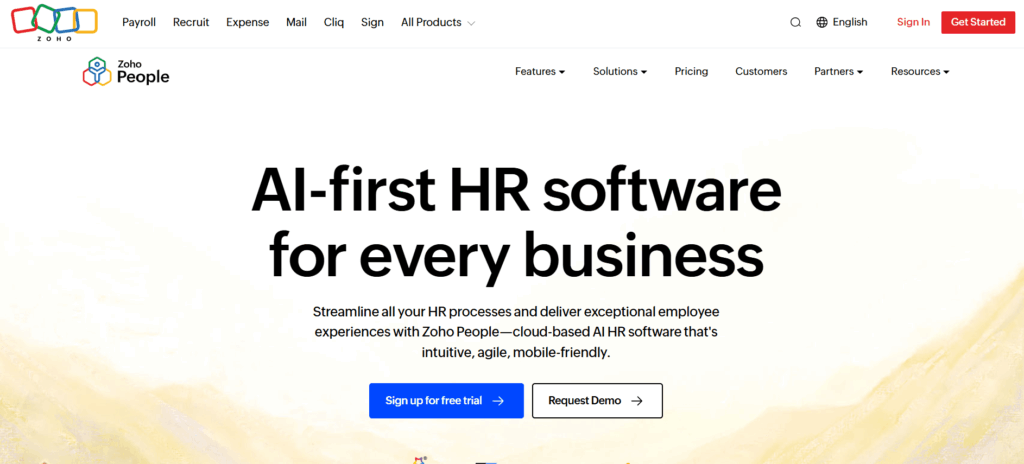
8. Zoho People
Zoho People is a cloud-based HR management platform that includes performance management as part of a broader HR suite, integrating tightly with the rest of the Zoho ecosystem.
Key features:
Performance appraisals
Goal and OKR tracking
360-degree feedback
Employee database management
Compensation management and advanced HR analytics in higher tiers
User experience: Zoho People’s interface is functional and integrates naturally with other Zoho apps, which makes it a comfortable choice for organizations already using Zoho CRM, Books, or other Zoho products.
USP: Zoho People’s biggest differentiator is being part of the wider Zoho suite, which makes it an efficient option for teams that want HR, performance, and business software under one vendor.
Pricing: Visit their platform page for pricing details.
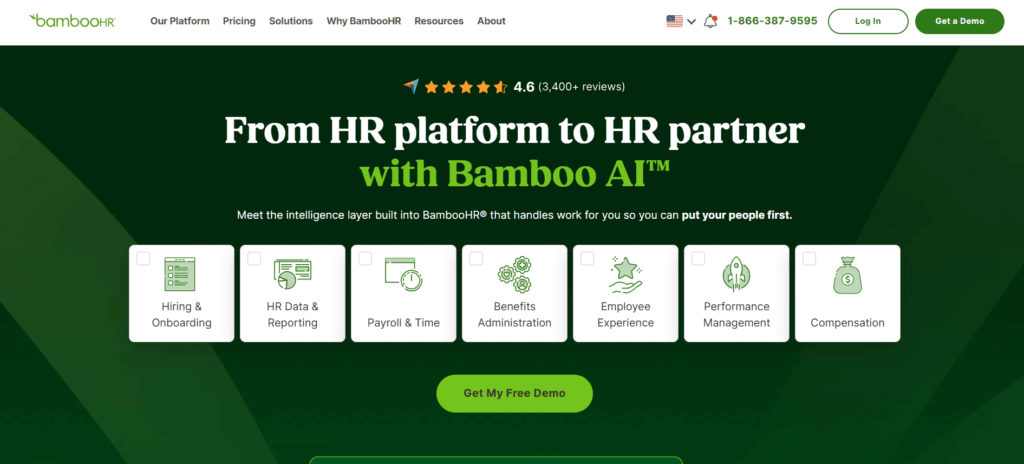
9. BambooHR
BambooHR is an all-in-one HR platform that includes performance management, feedback, and goal-setting as part of its broader HR suite.
Key features:
360-degree review cycles
Structured 1-on-1s
Goal tracking
Employee community and recognition tools
Compensation planning with salary benchmarking in higher tiers
User experience: BambooHR is consistently rated as easy to use, with a clean interface that simplifies core HR and performance workflows for small and midsize teams.
USP: BambooHR’s advantage is publishing real starting prices, which makes it one of the easier platforms on this list to budget for without a sales call.
Pricing: BambooHR’s plans start at $10 per employee/month, with Pro at $17 and Elite at $25. Companies with 25 or fewer employees pay a flat rate starting at $250/month.
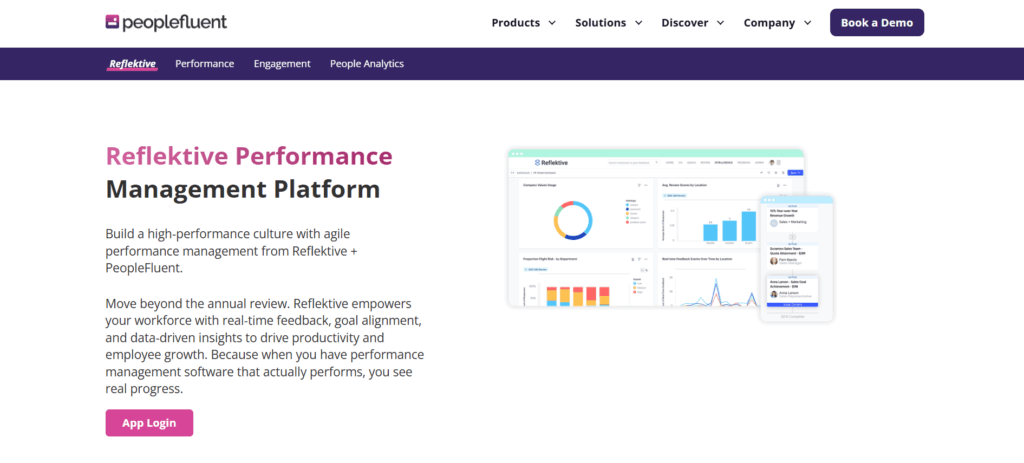
10. Reflektive (PeopleFluent)
Reflektive was once a standalone continuous performance management platform, and it’s now operated under PeopleFluent, part of the Learning Technologies Group. It’s included here because many buyers still search for it by its original name.
Key features:
Agile performance reviews, including 360-degree and peer reviews
Goal and OKR alignment
1-on-1s
Real-time feedback through Slack, Teams, and Outlook
Engagement and people analytics
User experience: Reflektive integrates into email and chat tools, which its own data shows drives significantly more feedback activity than portal-only tools.
USP: Reflektive’s workflow-embedded design, giving and requesting feedback directly from Slack or Outlook, remains one of its more distinctive features even under its new ownership.
Pricing: PeopleFluent does not publish Reflektive pricing publicly. Visit their platform page for pricing details.
Conclusion
Performance management platforms in 2026 span a wide range, from AI-native systems like Engagedly and Lattice to broader HR suites like BambooHR and Zoho People that bundle performance management into an all-in-one platform. Some vendors that were previously independent, like 7Geese and Reflektive, are now part of larger HCM providers, which is worth knowing before you request a demo under an old name. When comparing options, weigh functionality, verified pricing, and user experience against what your organization actually needs today and where it’s headed. For a deeper look at how continuous feedback fits into the bigger picture, Engagedly’s guide to performance management system examples and its breakdown of the employee performance review process are both useful next reads.
Ready to see how an AI-powered talent management platform compares to 15Five in practice?Request a demo of Engagedly and see how Marissa AI, performance reviews, OKRs, and learning come together in one platform.
Frequently Asked Questions (FAQs)
What should you look for in a performance management platform besides 15Five?
A strong performance management platform should support continuous feedback, structured performance reviews, and clear goal alignment. Beyond basic check-ins, look for OKR or KPI tracking with real-time progress updates, 360-degree feedback capabilities, engagement surveys with sentiment analysis, advanced analytics and reporting dashboards, and solid HRIS and payroll integrations. Modern tools increasingly offer AI-driven insights to reduce bias and improve decision-making. Prioritize ease of use, mobile accessibility, and scalability so adoption holds up as your team grows.
Why do companies switch from 15Five to other performance tools?
Organizations often explore alternatives when they need deeper analytics, broader talent management features, or tighter system integrations. Common reasons include wanting integrated learning management or employee recognition, more advanced OKR tracking with predictive insights, better alignment with industry-specific workflows, and cost scalability as the team grows. As performance management shifts toward continuous, data-driven models, companies increasingly want a unified ecosystem rather than a standalone check-in tool.
How do AI-powered performance management systems improve employee outcomes?
AI-powered performance management systems use automation and analytics to improve fairness, alignment, and development. These platforms can detect performance trends and engagement risks early, suggest SMART goals aligned with company objectives, reduce review bias through structured evaluations, and recommend personalized learning paths. By turning performance data into actionable insight, AI-driven systems help leaders shift from reactive annual reviews to proactive talent development.
What is the difference between goal tracking tools and full performance management software?
Goal tracking tools mainly focus on setting and monitoring objectives, like OKRs or KPIs. Full performance management software goes further, adding performance reviews and calibration, continuous feedback and manager check-ins, employee engagement surveys, recognition and development planning, and workforce reporting and analytics. If your organization wants strategic alignment plus long-term employee growth, a full performance management platform offers more than a standalone goal-tracking tool.
Which type of organization benefits most from switching performance management software?
Mid-sized and scaling organizations tend to benefit most from upgrading their performance management systems. As teams grow, spreadsheets and manual reviews become inconsistent and hard to maintain. Companies going through rapid hiring, remote workforce expansion, or leadership development typically need automated workflows, structured review cycles, real-time goal visibility, and integrated engagement analytics. Moving to a unified platform can streamline HR operations, improve manager effectiveness, and support sustainable growth through better talent decisions.
Jeevithan K is a Senior Solutions Consultant at Engagedly with extensive experience in HR technology, customer success, product implementation, onboarding, and training. He specializes in helping organizations adopt B2B SaaS and enterprise AI solutions effectively. His expertise also includes project management, account management, process improvement, and translating complex product capabilities into practical solutions that deliver meaningful value for customers.














 Innovative