AI in performance reviews means using machine learning or generative AI software to help managers and HR teams gather feedback, summarize it, draft review language, and spot patterns across goals and ratings. It’s built for managers, HR teams, and employees who want reviews that are faster, more consistent, and better documented. It supports human judgment and does not replace it, and several US states now attach notice and oversight rules when AI influences employment decisions.
If you only have a minute, here’s the short version.
Managers are already using AI for reviews, often without telling employees.
Used well, it saves time and sharpens feedback. Used carelessly, it makes feedback generic and can raise legal questions.
The safest setup keeps a person in charge of every rating, tells employees what the AI does, and follows your state’s rules.
How Common Is AI in Performance Reviews in 2026?
Common, and often invisible to employees. Depending on the survey, between a third and nearly four in five US managers have used AI to prepare feedback or reviews, and few employees say anyone told them.
Three recent data points show the picture:
A Highwire survey of 1,034 U.S. professionals found that 78% of managers used AI to help prepare feedback or reviews in the past year, while only 16% of employees said they were told AI played a role in their latest review.
A Headway survey of 1,000 managers found that 33% had used AI to write feedback or prepare a review, down from 41% in a similar survey a year earlier.
The gap between 33% and 78% is wide. The likely reasons are different samples and different definitions of “using AI,” so treat each number as directional. What the surveys agree on is the disclosure gap and the quality risk, since 34% of employees in the Highwire data said feedback felt more generic after AI entered the process.
That mix of real time savings and real trust risk is why the rest of this guide focuses on using AI without losing the human part of the review.
How AI Is Used in Performance Reviews Today
AI in performance reviews refers to the use of artificial intelligence to support employee evaluations, feedback analysis, review writing, goal tracking, and development planning.
In simple terms, AI helps managers and HR teams make sense of performance data faster.
Instead of relying only on memory, annual review notes, or scattered feedback, AI can bring together information from multiple sources such as goals, peer feedback, manager notes, self-assessments, recognition, learning activity, and past review data.
The goal is not to replace managers. The goal is to help managers run more consistent, evidence-based, and development-focused conversations.
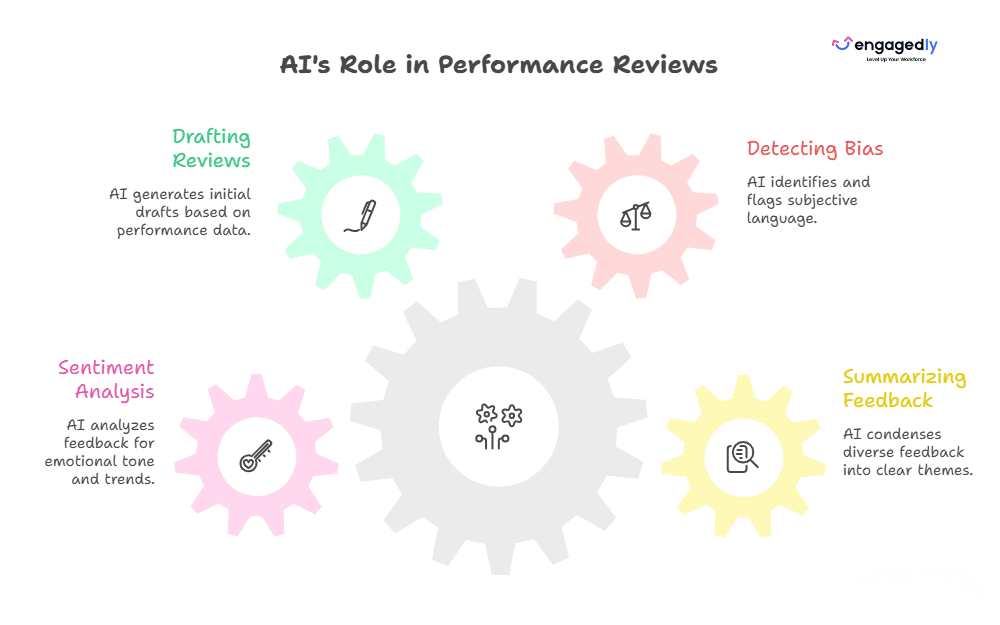
Today, AI is most commonly used to summarize feedback from multiple sources, draft first versions of reviews, identify patterns in manager feedback, detect biased language, analyze sentiment, suggest development areas, and connect performance trends to goals or learning plans.
AIHR notes that AI in performance reviews is commonly used for bias detection, goal tracking, performance assessment, and review drafting. It can improve consistency and reduce manual work, but still requires human oversight to keep reviews accurate and useful.
That distinction matters. AI can organize information and surface patterns, but managers still need to add context, judgment, empathy, and accountability.
A good AI-supported review process should help answer questions like:
Is the review language fair, specific, and evidence-based?
What should the employee focus on next?
When used well, AI can make performance reviews less subjective and less time-consuming. When used poorly, it can make reviews feel automated, opaque, or unfair.
Key Use Cases
AI can support performance reviews in several practical ways. The strongest use cases are the ones that reduce administrative work while improving the quality of feedback.
Managers often collect feedback from several places: peer reviews, manager notes, self-evaluations, 360-degree feedback, project updates, customer comments, and recognition data. Reviewing all of that manually can take hours and still leave room for missed patterns.
One of AI’s most useful roles in performance reviews is turning scattered feedback into clear, usable themes.
For example, it may identify that an employee is consistently praised for collaboration but receives repeated feedback about delayed follow-ups. It can also group comments by strengths, improvement areas, behaviors, and impact.
This helps managers prepare for reviews with better context.
Instead of starting from a blank page, they can begin with a structured summary and then validate it with their own observations.
AIHR explains that AI can gather and condense feedback from multiple sources, including managers, peers, customers, and self-assessments, to create a more complete view of employee performance.
Example: AI might summarize feedback like this:
“Across peer and manager feedback, the employee is consistently recognized for strong collaboration and problem-solving. The most common improvement theme is timeliness of stakeholder updates during cross-functional projects.”
This kind of summary gives managers a clearer starting point for the conversation.
Detecting Bias in Reviews
Another valuable use case for AI in performance reviews is identifying review language that is biased, vague, or difficult to act on.
Performance reviews are often shaped by human bias, even when managers have good intentions. Recency bias, inconsistent standards, and personality-based judgments can all influence how feedback is written and interpreted. Over time, these patterns make reviews less fair and less useful.
AI can help by flagging language that may be too subjective, overly broad, or potentially biased before the review is finalized.
For example, it may surface phrases such as:
“not leadership material”
“too emotional”
“not a culture fit”
“lacks executive presence”
“needs to be more aggressive”
These kinds of statements are often too vague to be useful and too subjective to be fair. They describe impressions, not observable behaviors, which makes them harder for employees to understand and harder for managers to justify.
A stronger review focuses on specific actions instead of personality judgments.
Instead of: “She is not assertive enough.” Use: “She can improve by sharing recommendations earlier in planning discussions and supporting them with data.”
This makes the feedback more specific, more actionable, and easier to apply.
Used well, AI can help managers catch unclear or loaded language early and reframe feedback in a way that is more consistent, evidence-based, and fair.
However, AI is not automatically unbiased. If the model is trained on biased historical review data, it can reinforce the same patterns it is supposed to catch.
This is why bias detection should be treated as a review aid, not a final judgment. AI can flag risk, but managers and HR still need to decide what fair feedback actually looks like.
Drafting Reviews
For managers staring at a blank review form, AI is often most useful as a drafting assistant.
This is especially useful for managers who lead large teams or struggle to turn notes into clear, balanced feedback. AI can take inputs such as goals, feedback notes, project outcomes, and past check-ins, then create a first draft of a review.
AI is most useful at the drafting stage, not the decision stage. Managers still need to review, refine, and contextualize every draft before it is shared.
A good AI-generated draft should help managers:
organize feedback
reduce blank-page effort
create clearer review language
balance strengths and development areas
connect feedback to goals
suggest next steps
For example, a manager might enter:
“Employee met 4 of 5 goals, led onboarding project, received positive peer feedback for collaboration, but missed two reporting deadlines.”
AI might draft:
“Over the past review cycle, you made strong contributions to the onboarding project and were consistently recognized by peers for collaboration. One development area is improving reporting consistency, especially when deadlines are shared across stakeholders.”
The manager should then edit the draft with specific examples, context, and agreed next steps.
How to Write a Performance Review With AI in 6 Steps
A good AI draft depends on what you feed it. This workflow keeps the manager in control.
Gather real inputs first. Pull goal results, peer feedback, 1:1 notes, and project outcomes from the whole review period, not just the last few weeks.
Use an approved tool. Don’t paste names, ratings, or leave and health details into a public chatbot unless your company has approved it.
Prompt with facts and ban inventions. Tell the AI to use only what you provide.
Edit every sentence. AI can write confident lines that aren’t true, so check each claim against your notes and add the specific examples only you know.
Run a language check. Ask the AI to flag vague or personality-based phrases, then decide yourself what to change.
Tell the employee how AI was used. Invite them to add context or correct anything before the review is final.
Three Prompts You Can Copy
Prompt for a first draft
Write a mid-year performance review for a [role] using only the facts I paste below. Do not invent examples, metrics, or quotes. Keep the tone direct and fair, separate strengths from development areas, and end with two next steps.
Prompt for a language check
Review this draft for vague, personality-based, or loaded language. List each phrase, explain why it may be unclear or unfair, and suggest a behavior-based rewrite. Do not change anything else.
Prompt for a development plan
Based on these three development areas, suggest one specific goal and one learning activity for each. Keep each goal measurable and tied to the next 90 days.
Sentiment Analysis
Sentiment analysis uses AI to identify tone, themes, and emotional patterns across feedback.
In performance reviews, this can help HR teams understand whether feedback is positive, negative, neutral, or mixed. It can also surface themes that may not be obvious when reading individual comments.
For example, sentiment analysis may show that employees in one department receive mostly positive feedback on collaboration but negative feedback on workload and manager support.
At an individual level, sentiment analysis can help identify patterns in review comments, peer feedback, and engagement survey responses.
It can help answer questions like:
Is feedback mostly constructive or overly negative?
Are certain teams receiving more critical feedback than others?
Are employees consistently raising concerns about workload?
Are managers using supportive or punitive language?
Are performance conversations improving over time?
This can make performance reviews more useful at both individual and organizational levels.
However, sentiment analysis should be used carefully. Tone is contextual. A comment may sound negative because it describes a real performance issue, not because the feedback process is unfair.
AI can identify patterns, but HR and managers need to interpret them responsibly
AI can improve performance reviews when it is used to support better conversations, not replace them.
The biggest benefits are speed, consistency, visibility, and stronger development planning.
1. Less manual work for managers
Managers often spend significant time collecting notes, reviewing feedback, and drafting reviews. AI can reduce this administrative load by summarizing information and preparing first drafts.
This gives managers more time to focus on coaching and follow-up.
AI can help standardize how reviews are written and structured.
For example, it can prompt managers to include specific examples, connect feedback to goals, and avoid vague language. This can reduce inconsistencies between managers and teams.
3. Better use of performance data
AI can analyze multiple data points instead of relying only on memory.
This is important because traditional reviews often suffer from recency bias, where managers overfocus on what happened most recently rather than the entire review period.
AI can help bring older feedback, completed goals, recognition, and development progress back into the conversation.
4. Faster feedback cycles
AI can support more continuous performance management by analyzing feedback and progress throughout the year.
Instead of waiting for annual reviews, managers can identify patterns earlier and coach employees in real time.
5. Stronger development planning
AI can help connect performance gaps to learning recommendations, coaching plans, and career development paths.
For example, if an employee repeatedly receives feedback about presentation skills, AI can suggest relevant learning resources or development goals.
6. Better visibility for HR and leadership
AI can help HR teams spot broader performance trends across teams, roles, or departments.
This can help answer questions like:
Which teams need more manager support?
Where are skill gaps emerging?
Are review ratings consistent across departments?
Are high performers getting enough development opportunities?
Are certain groups receiving less actionable feedback?
This makes performance reviews more valuable for workforce planning and talent decisions.
Additional Risks & Challenges to Be Aware of in 2026
Along with the usual concerns around bias and oversight, organizations also need to account for a newer set of risks as AI becomes more embedded in performance reviews. These challenges are less about whether AI can support reviews and more about whether it can do so fairly, transparently, and responsibly at scale.
1. Bias in training data
AI systems learn from historical performance data, and that data is not always neutral. If past reviews reflect biased manager behavior, uneven access to opportunity, or inconsistent standards across teams, AI can inherit and repeat those patterns.
Without regular auditing, this can reinforce existing inequalities rather than reduce them.
2. Uneven access and AI fluency
Not every employee has the same level of comfort with AI tools, digital systems, or workplace technology. Some employees may know how to use AI to improve documentation, feedback, or self-assessments, while others may have less exposure or support.
If performance systems assume equal access and equal AI fluency, they risk rewarding familiarity with tools instead of actual performance.
3. Black-box decision making
One of the biggest risks in AI-supported reviews is opacity. When AI surfaces recommendations, patterns, or warnings without explaining how it reached them, employees and managers may struggle to trust the output.
If people cannot understand how conclusions are reached, it becomes harder to challenge errors, identify bias, or explain decisions fairly.
4. Privacy and compliance risk
Performance reviews often involve sensitive employee data, including feedback history, development needs, performance concerns, and manager observations. Introducing AI into that process increases the need for stronger data controls.
Organizations need clear policies around what data is collected, how it is used, who can access it, how long it is stored, and whether employees have visibility into that process. This is especially important in regions with stricter privacy and employment regulations.
Some state laws now add notice and recordkeeping duties on top of this. Colorado’s updated law, effective January 1, 2027, requires employers to keep compliance records for three years.
5. Over-reliance on automation
AI can make reviews faster, but speed should not come at the cost of judgment. When managers rely too heavily on AI-generated summaries or drafts, reviews can become generic, impersonal, and disconnected from real day-to-day performance.
The more AI handles the thinking, the easier it becomes for managers to disengage from the quality of the conversation itself.
6. Employee trust and fairness perception
Even if an AI system is technically sound, employees still need to believe the process is fair. If AI feels opaque, overly influential, or difficult to question, trust in the review process can erode quickly.
In performance management, employee perception matters almost as much as technical accuracy. If people do not trust the process, they are less likely to trust the outcome.
7. Model drift over time
AI systems can become less reliable as business priorities, performance expectations, and organizational norms evolve. A model trained on outdated review data may continue reinforcing standards that no longer reflect how performance should be evaluated today.
Without periodic review and retraining, AI can drift out of alignment with current expectations and create poor recommendations that look credible on the surface.
8. Hidden AI use
When managers use AI without telling anyone, employees fill the gap with suspicion. In the same Highwire research, about 40% of employees either suspected AI was used or weren’t sure. Unclear AI use also creates legal exposure in places like Illinois, where notice is required when AI influences certain employment decisions.
9. Generic feedback
AI drafts tend to sound alike, and generic feedback doesn’t help anyone improve. It’s also hard to defend if a rating is challenged. The fix is simple. Require every AI-assisted review to include at least two specific examples written by the manager.
Best Practices for Using AI in Reviews
AI works best when it improves the quality of performance conversations. It should not make reviews colder, more automated, or harder to understand.
Use these best practices to keep AI-supported reviews fair and useful.
1. Keep managers accountable
AI can suggest, summarize, or draft. Managers should still own the final review.
Every AI-generated review should be checked for accuracy, context, tone, and fairness before it is shared with an employee.
2. Be transparent with employees
Employees should know when AI is being used in the review process.
Explain what the AI does, what data it uses, and what decisions remain with managers or HR.
Transparency builds trust.
Here’s a plain-language notice you can adapt.
“Our review process uses an AI tool to help summarize feedback and draft review language. Your manager reviews and edits every review and makes all rating, pay, and promotion decisions. The tool uses [list data types]. If you want to add context or correct anything, tell your manager or HR within [number] days.”
Have legal review the wording before you roll it out, because notice requirements differ by state.
3. Use AI for patterns, not final judgments
AI is useful for identifying trends across feedback, goals, and review notes. It should not be the final authority on ratings, promotions, compensation, or performance improvement decisions.
4. Audit for bias regularly
Review AI outputs for patterns across demographic groups, teams, managers, locations, and roles.
If the system consistently produces less specific feedback for certain groups, flags certain employees more often, or mirrors biased historical patterns, it needs review.
5. Train managers on AI literacy
Managers need to understand what AI can and cannot do.
Training should cover:
how to interpret AI summaries
how to edit AI-generated drafts
how to spot bias
how to protect employee data
how to explain AI-supported feedback to employees
6. Use specific examples
AI-generated feedback can become generic if it is not grounded in real examples.
Managers should add specific projects, outcomes, behaviors, and context.
7. Give employees a chance to respond
Employees should be able to clarify, challenge, or add context to AI-supported feedback.
This is especially important when reviews influence promotions, compensation, or development plans.
8. Connect feedback to development
AI should not only identify performance gaps. It should help managers turn those gaps into useful development plans.
A good review should end with clear goals, learning support, and follow-up actions.
AI Tools for Performance Reviews in 2026
AI performance review tools generally fall into two categories: dedicated performance management platforms and general AI writing tools.
Dedicated platforms are usually better for structured, compliant, and scalable review processes because they connect AI to goals, feedback, 360 reviews, development plans, and performance data.
General AI tools can help with drafting or rewriting feedback, but they require more caution because they may not have the same governance, privacy controls, or HR-specific workflows.
Here are common types of AI tools used for performance reviews in 2026:
1. Performance management platforms with AI
These tools support structured review cycles, goal tracking, feedback, calibration, and AI-assisted review writing. The strongest performance review tools connect AI to structured workflows instead of treating review writing as a standalone task.
They are best for organizations that want one system for performance reviews, feedback, and development.
Examples include platforms such as Engagedly, Betterworks, Lattice, 15Five, Leapsome, and Culture Amp.
2. 360-degree feedback tools with AI summaries
These tools collect feedback from managers, peers, direct reports, and stakeholders, then use AI to summarize themes.
Using AI in Performance Reviews Legal? US Rules to Know in 2026
There’s no blanket US ban on using AI in performance reviews. But a growing set of state and local rules adds notice, anti-discrimination, and human oversight duties when AI influences employment decisions. Most of them focus on hiring, promotion, discipline, and termination rather than on drafting review text, so how you use the tool matters more than whether you use it.
This is general information and not legal advice, so check with employment counsel for the states where your people work.
Requires notice when AI is used to influence or facilitate covered decisions, including promotion, discipline, and terms of employment. State rules on how to give notice were proposed in May 2026 and withdrawn in June, with no new timeline yet.
Applies state anti-discrimination law to tools that make or facilitate employment decisions. Regulators can consider anti-bias testing, or the lack of it, in complaints.
Replaced the original Colorado AI Act. Requires notice before covered AI-assisted decisions and three years of records. Tools an individual uses to summarize or organize information for human review are excluded.
Mass-layoff AI disclosure from October 1, 2026, broader duties from October 1, 2027
Employers must tell the state whether AI contributed to a WARN-level mass layoff. Later duties cover disclosing automated tools that interact directly with employees.
Covers automated tools used in hiring and promotion. Requires an independent bias audit within the past year, a public summary, and notice. A December 2025 state comptroller audit called enforcement ineffective, which puts pressure on the city to enforce more actively.
There’s no single federal AI employment law. A December 2025 executive order set out to challenge state AI laws it views as burdensome, and a Justice Department AI task force followed in January 2026. As of September 1, the task force had not initiated litigation against a state AI law. A bipartisan federal discussion draft released in June 2026 would also leave state authority over employment-related AI in place. Until Congress or the courts change things, state obligations still apply, so waiting for federal preemption is a risky plan.
If you have employees in the EU, the dates moved. The Digital Omnibus on AI, in force since July 27, 2026, pushed high-risk obligations, which cover many employment tools, from August 2, 2026 to December 2, 2027. The requirements were delayed, not removed, so documentation and human oversight are still worth starting now.
The Practical Takeaway
If AI only helps a manager organize notes and the manager makes every decision, your exposure is lower. If AI scores, ranks, or recommends ratings, promotions, discipline, or terminations, treat it as a regulated tool. Give notice, keep a human reviewer who can genuinely disagree with the tool, and keep records.
What to Do in the Next 90 Days
You don’t need a perfect AI policy to get started. You need a clear one that people actually follow. A practical 90-day plan looks like this.
Days 1 to 30. List every AI feature in your HR and performance tools, including features inside platforms you already pay for. Note which ones summarize, which ones score or rank, and which ones recommend decisions.
Days 31 to 60. Write a one-page rule set covering approved tools, what data can be entered, who signs off on each review, and how employees are told. Draft your notice language and have counsel review it.
Days 61 to 90. Train managers to edit AI drafts, check one review cycle’s language for patterns by team and manager, and set up a record of who approved what.
Then put the dates that matter on a shared calendar. Colorado’s law and California’s privacy rules start on January 1, 2027, and California’s SB 947 starts on July 1, 2027.
AI will keep changing, and so will the rules. The teams that do well will treat AI as a drafting and pattern-spotting assistant and keep people responsible for the decisions.
Frequently Asked Questions
Can AI write performance reviews?
Yes, AI can draft a review from the notes, goals, and feedback you give it, but a manager should always edit and own the final version. It works best at turning scattered input into a clear first draft. It can’t know context you didn’t provide, and it can state things confidently that aren’t true, so check every claim against your own records.
Is it legal to use AI in performance reviews in the US?
There’s no blanket ban, but state and local laws add duties in some places. Illinois requires notice when AI influences covered employment decisions, California regulates automated decision systems under its civil rights rules, and Colorado’s updated law starts January 1, 2027. These laws focus mostly on hiring, promotion, discipline, and termination, so a tool that only summarizes feedback for a manager carries less risk than one that scores or ranks people. Ask employment counsel about your states.
Do I have to tell employees that AI was used in their review?
In Illinois, you do when AI is used to influence or facilitate covered employment decisions, and Colorado will require notice before certain AI-assisted decisions from January 1, 2027. Even where the law doesn’t require it, telling employees is the safer move. In one 2026 survey, only 16% of employees said they were told AI played a role in their review, and that gap is exactly what erodes trust.
Is it safe to paste employee information into ChatGPT or other public AI tools?
Only if your company has approved the tool and its data terms. Performance reviews contain sensitive details such as ratings, development concerns, and sometimes health or leave information. Use a company-approved tool with clear privacy controls, remove names and sensitive details where you can, and check your own policy first.
Does AI make performance reviews less biased?
It can help, but it doesn’t remove bias on its own. AI can flag vague or loaded language and bring older feedback back into view, which helps with recency bias. It can also repeat patterns from biased past reviews if it was trained on them, so audit the output by team, manager, and demographic group, and keep a person responsible for the final call.
How much time can AI save on performance reviews?
In a December 2025 Gartner survey of 1,622 respondents, managers who used AI saved an average of four hours across the performance management process. Your results will vary with team size and how much editing the drafts need. Put the time you save back into the review conversation rather than just finishing faster.
Can AI decide raises, promotions, or terminations?
Does the EU AI Act apply to my US company’s performance reviews?
It can, if you have employees in the EU. AI used to evaluate workers is treated as high risk, but the high-risk deadline moved from August 2, 2026 to December 2, 2027 under the Digital Omnibus. Start documentation and human oversight now, because the requirements were delayed and not removed.
Srikant Chellappa is the Co-Founder and CEO at Engagedly and is a passionate entrepreneur and people leader. He is an author, producer/director of 6 feature films, a music album with his band Manchester Underground, and is the host of The People Strategy Leaders Podcast.

















 Performance