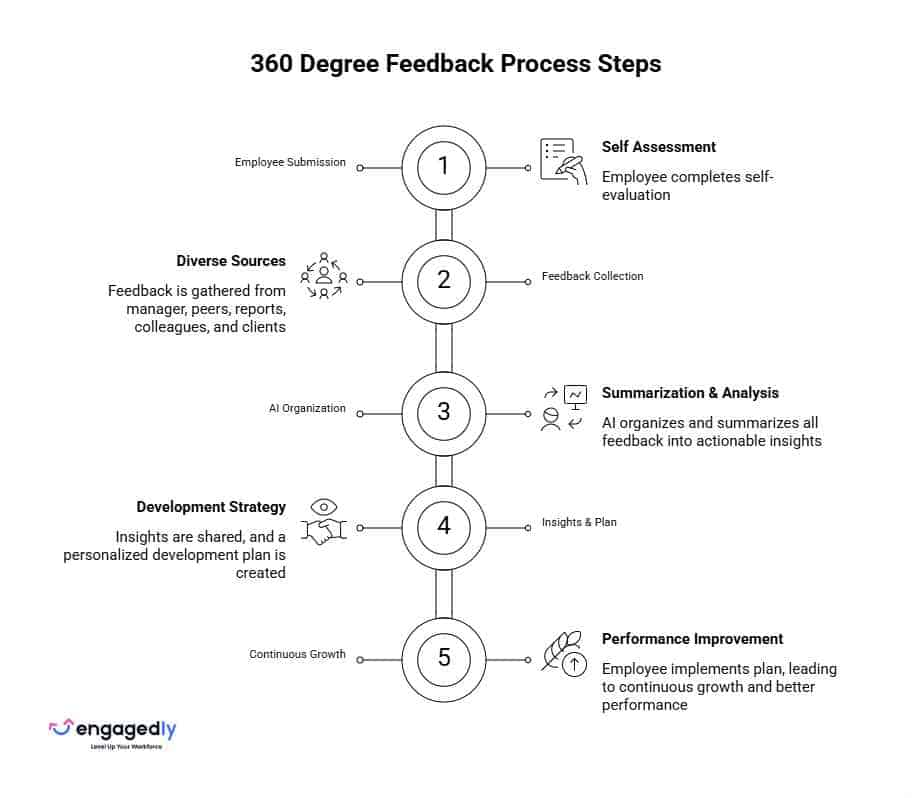
360 degree feedback is a performance evaluation method where an employee receives input from everyone around them, not just their manager. That means peers, direct reports, cross functional partners, and sometimes clients or vendors all weigh in. The goal is simple. One person’s view of your work is never the full picture, so 360 feedback fills in the blind spots that a single manager review always misses.
When companies first roll this out, plenty of employees are skeptical. Some think it’s just extra paperwork. Others assume it will turn into a popularity contest instead of an honest evaluation. That skepticism is fair if the program is built badly. But when it’s done right, 360 feedback is one of the most reliable ways to figure out how someone actually performs day to day, not just how they look on paper.
Here’s everything you need to know about 360 degree feedback in 2026, including what changed with AI, what the latest data says, and how to actually make the process work.
What Is 360 Degree Feedback?
360 degree feedback is feedback an employee receives about their performance from multiple sources at once. Instead of relying only on a manager’s opinion, the process pulls in perspectives from peers, direct reports, cross functional collaborators, and sometimes external stakeholders like vendors or customers.
Traditional performance reviews put the entire evaluation in one person’s hands, the manager. That setup is convenient, but it’s also narrow. Managers see a fraction of what an employee actually does day to day. As people move up the ladder, they typically get less direct feedback too, since fewer people feel comfortable being candid with someone senior. 360 feedback closes that gap by giving both managers and the people around an employee a structured way to share what they see.
Why 360 Degree Feedback Still Matters
The short answer is that managers alone don’t have enough visibility to fairly judge performance, and the data backs this up.
A widely cited Software Advice study surveyed around 300 US based employees and found some revealing patterns.
Key findings from that survey:
37 percent of employees say they have one on one meetings with their manager once a month or less
31 percent find those one on ones minimally or not at all productive
19 percent are minimally or not at all confident their manager has enough information to fairly assess their performance
Half of employees say coworkers, not managers, have the best insight into their day to day performance
As Brian Westfall, senior market researcher for Software Advice, put it, a manager’s perspective is inherently limited because it’s a single point of view. Combining multiple perspectives creates a more accurate picture of how someone is actually doing, which gives both managers and employees more confidence in the result.
AI hasn’t replaced 360 feedback, it’s changed how the feedback gets collected, summarized, and acted on. The biggest shift is the move away from a once a year event toward a continuous loop that managers and employees can actually keep up with.
A few real changes worth knowing about:
AI can now synthesize peer, customer, and manager feedback into a rolling digest surfaced weekly or monthly instead of waiting for a formal cycle, which leads to faster coaching interventions and clearer development actions
Review drafting assisted by AI can cut the time managers spend writing summaries by 30 to 60 percent, while improving consistency in language across teams
There’s a catch worth mentioning. AI should aggregate and summarize feedback, not generate it. If raters start leaning on AI to write their comments for them, the feedback loses the specificity that makes 360 reviews useful in the first place. The best 2026 implementations treat AI as an assistant that organizes human input, not a replacement for the human input itself.
A good 360 degree feedback process still needs these core elements to work, AI or no AI.
Reviewer anonymity
Customized feedback templates
Customizable feedback cycles
A clear connection between feedback and actual development plans, not just a report that sits unread
Engagedly’s Multirater or 360 Degree Feedback module covers all of the above and gives HR administrators full control over the cycle, so once it’s set up, the process runs without constant manual oversight.
Benefits Of 360 Feedback
Feedback from multiple sources. A single reviewer brings a single set of biases. Pulling in feedback from managers, peers, and direct reports doesn’t eliminate bias entirely, but it spreads it out so no single skewed opinion dominates the final picture.
A realistic view of how you’re perceived. Most people carry an idealized version of themselves in their head. Multi rater feedback shows the gap between that self image and how colleagues actually experience working with you, and that gap is often where the real growth opportunity sits.
Clearer development priorities. 360 feedback tends to surface specific patterns, not vague impressions, which makes it easier to identify what someone should actually work on next.
Accuracy isn’t guaranteed. Feedback can be shaped by incomplete information, personal bias, or a rater simply not understanding an employee’s full scope of responsibilities.
No built in guardrails on content. Without clear parameters, some employees end up flooded with negative feedback while others get vague, unhelpful comments that don’t point to any real action.
Anonymity isn’t always protected. Some organizations strip anonymity in the name of transparency, but this usually backfires. Without anonymity, people tend to write what they think the recipient wants to hear instead of what’s actually true.
AI generated or low effort feedback. This is a newer problem in 2026. When raters use AI tools to quickly draft their comments, feedback can end up generic and detached from specific behavior, which defeats the purpose of collecting it from multiple people in the first place.
The Right Time For 360 Degree Feedback
There’s no universal schedule that works for every organization. Some run it annually, some monthly, some twice a year. What matters more than frequency is setting a clear timeline in advance for designing the survey, distributing it, and analyzing results.
Standard performance reviews can work fine on an annual or semiannual cadence since they’re tied to specific goals and outcomes. 360 feedback is different because its value comes from ongoing development, not a single checkpoint. If the goal is genuinely helping employees grow, running it twice a year tends to strike the right balance between frequency and survey fatigue.
Implementing 360 Feedback Software
Start with a clear process. The most common mistake organizations make is running a 360 program because it’s trendy, not because they have a specific goal in mind. Before launching one, get clear on what you actually want to learn from it.
Protect confidentiality. Don’t undercut your own program by removing anonymity. People need to feel safe being honest, or the entire exercise becomes a formality.
Set clear feedback parameters. Without ground rules, feedback quickly turns vague or unhelpful. Give raters guidance on tone, specificity, and what to avoid before the cycle starts.
Decide your sources carefully. Some organizations stick to peer feedback. Others bring in managers, direct reports, and even external clients or vendors. The more sources involved, the more important it is to keep everyone aligned on the process and expectations.
Choosing The Right 360 Feedback Software For Your Company
Simplicity. Any tool you roll out for the first time should be intuitive enough that employees don’t need formal training to use it. Test a free trial with a small group before committing.
Customization. You can go with an off the shelf tool used broadly across industries, or one flexible enough to adapt as your organization’s needs shift. Given how quickly workplace needs change, flexibility tends to age better.
Security. 360 feedback data is sensitive by nature, since it includes candid input from managers, peers, and direct reports. Ask vendors directly how your data is protected and where it’s stored. Data protection requirements vary by country, so make sure the platform complies with the regulations that apply to your organization.
AI capabilities, used responsibly. By 2026, this has become a real differentiator. Look for platforms that use AI to summarize feedback, catch rating bias, and surface trends, without letting AI generate the actual comments on a rater’s behalf.
Support and guidance. No matter how intuitive a tool is, good vendors walk your team through the full setup and ongoing use. Strong documentation and responsive support make a measurable difference in adoption.
360 Degree Feedback Best Practice Guidelines
Evaluate how the work gets done, not just the outcome. Outcomes don’t always reflect the effort or approach behind them. Identify the specific skills and behaviors you want employees to demonstrate, and assess against those directly.
Make criticism constructive. This is where reviews go wrong most often. Set ground rules in advance for what counts as fair, useful criticism.
Example of good criticism:
John isn’t very punctual, but he consistently completes all his assigned tasks on time
Example of bad criticism:
John is never on time and spends most of his day doing nothing
The first example gives John something to actually work with. The second offers nothing but a negative impression.
Review consistently, not just once a year. If feedback only shows up occasionally, employees start assuming everything is fine between cycles. When a full review finally happens and surfaces real issues, it feels like an ambush, and that damages trust rather than building it.
End on a supportive note. Even when a review surfaces real problems, managers need to pair that feedback with a concrete plan forward. The goal of any review is to motivate improvement, not leave someone demoralized.
Don’t exempt leadership from the process. Managers, directors, and even the CEO benefit from 360 feedback just as much as anyone else. Leaders who never get honest feedback have no reliable way to know if their own approach is actually working.
Final Thoughts
360 degree feedback isn’t a trend that’s fading, it’s becoming more central to how organizations evaluate and develop people. The core idea hasn’t changed since the concept first caught on. One perspective is never enough to fairly judge someone’s performance. What has changed is the tooling around it, with AI now helping summarize feedback faster, catch bias across raters, and turn scattered comments into a continuous coaching loop instead of a once a year event.
None of that works without the fundamentals though. Anonymity, clear feedback guidelines, consistent cycles, and a real plan for acting on what comes in. Get those right, and 360 feedback becomes one of the most reliable tools you have for building a culture where people actually grow instead of just getting judged.
If you’re ready to bring structured, unbiased, multi rater feedback into your organization, Engagedly’s 360 Degree Feedback module handles the entire cycle for you, from anonymity and custom templates to AI powered insights that turn feedback into real development plans.
Request a demo to see how it fits into your performance process.
Frequently Asked Questions
What is 360 degree feedback in simple terms?
It’s a way of evaluating an employee’s performance using input from multiple people around them, including managers, peers, and direct reports, instead of relying on just one manager’s opinion.
How often should 360 feedback be conducted?
Twice a year tends to work well for most organizations, since it’s frequent enough to support ongoing development without overwhelming employees or raters with survey fatigue.
Is 360 degree feedback still relevant in 2026?
Yes. Market data shows continued growth in adoption, and current research shows employees still don’t trust that managers alone have enough visibility to fairly assess their performance.
Can AI replace 360 degree feedback?
No. AI can help summarize and organize feedback and catch bias patterns across raters, but the actual input still needs to come from real people who work directly with the employee being reviewed.
What’s the biggest risk with 360 feedback programs?
Losing anonymity. Once raters feel their comments can be traced back to them, honesty tends to disappear, and the whole program loses its value.
Jeevithan K is a Senior Solutions Consultant at Engagedly with extensive experience in HR technology, customer success, product implementation, onboarding, and training. He specializes in helping organizations adopt B2B SaaS and enterprise AI solutions effectively. His expertise also includes project management, account management, process improvement, and translating complex product capabilities into practical solutions that deliver meaningful value for customers.

















 Innovative