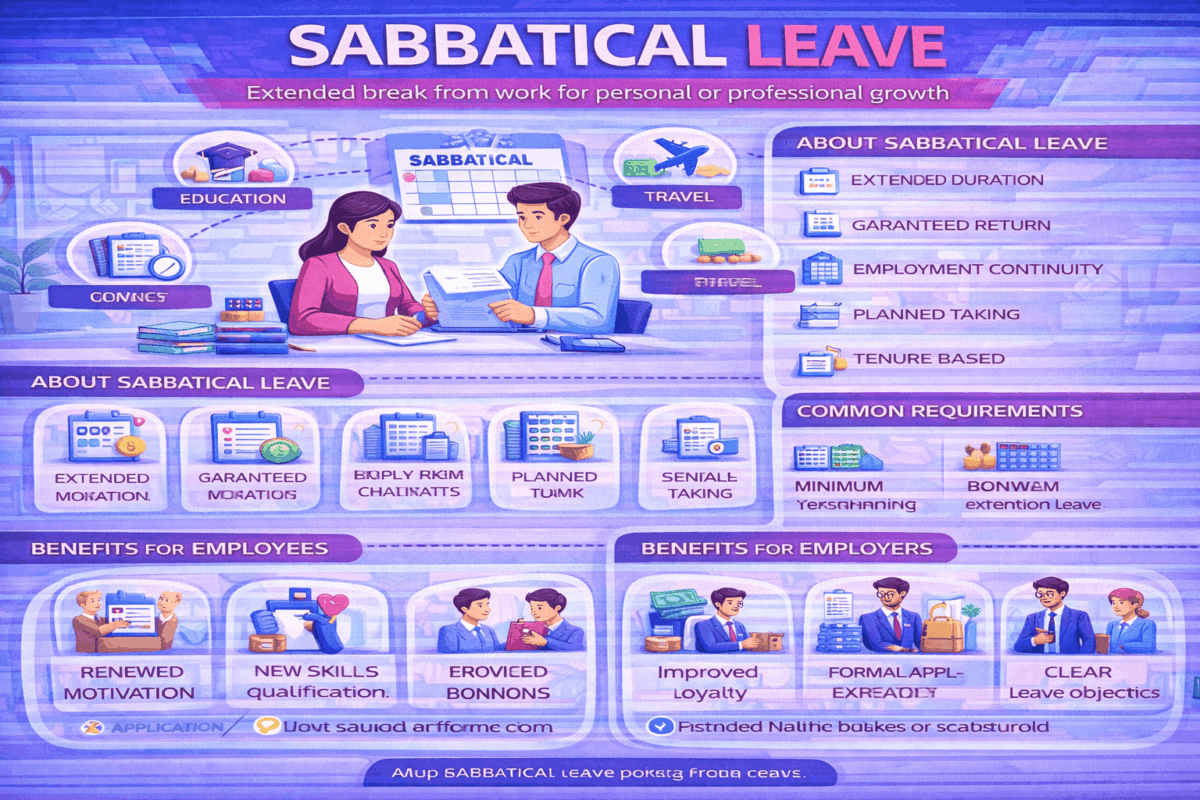
Sabbatical leave is an extended break from work that employees take after completing a certain period of service with an organization. Unlike regular vacation or casual leave, a sabbatical usually lasts several months and is granted for personal growth, research, education, travel, or recovery from burnout.
In most cases, the employee remains officially employed during a sabbatical and returns to work after the agreed period.
Sabbatical leave has become more common as organizations focus on employee wellbeing, retention, and long term engagement.
What Is Sabbatical Leave?
Sabbatical leave is a structured, long term leave of absence offered by an employer. It is typically granted after an employee completes a defined tenure, such as five or seven years of continuous service.
Employees may use sabbatical leave to:
- Pursue higher education or certifications
- Conduct research
- Travel or relocate temporarily
- Volunteer or engage in social work
- Focus on personal development
- Recover from professional burnout
The key difference between a sabbatical and regular leave is duration. Sabbaticals usually last from three months to one year.
Is Sabbatical Leave Paid?
Sabbatical leave may be paid, partially paid, or unpaid depending on company policy.
Some organizations offer fully paid sabbaticals as a retention strategy. Others provide partial pay or benefits continuation during unpaid leave.
Policies typically clarify:
- Whether salary continues during leave
- Whether benefits such as health insurance remain active
- How the sabbatical affects bonuses or incentives
Clear documentation prevents misunderstandings before the leave begins.
Who Is Eligible for Sabbatical Leave?
Eligibility rules vary across organizations.
Common requirements include:
- Minimum years of continuous service
- Strong performance history
- Formal application and approval process
- Clear leave plan outlining purpose and duration
Because sabbaticals require workforce planning, companies may limit how many employees can take leave at the same time.
Sabbatical Leave vs Career Break
Although the terms are often confused, they are not identical.
A sabbatical leave usually means the employee remains employed and has a guaranteed return to their role or an equivalent position.
A career break may require resignation, depending on company policy.
In short:
- Sabbatical leave maintains employment continuity
- Career break may not
Understanding this distinction helps HR teams design clear leave policies.
Benefits of Sabbatical Leave for Employees
Sabbatical leave offers several advantages.
Employees often return with:
- Renewed motivation
- New skills or qualifications
- Broader perspective
- Reduced burnout
- Stronger engagement
Extended time away allows individuals to reset without permanently leaving their organization.
Benefits of Sabbatical Leave for Employers
While granting long term leave requires planning, it can strengthen retention.
Organizations benefit through:
- Improved employee loyalty
- Reduced turnover costs
- Strong employer branding
- Knowledge expansion when employees return with new expertise
- Increased long term engagement
Replacing experienced talent often costs more than supporting a temporary leave.
Forward thinking companies view sabbaticals as an investment rather than a disruption.
How Sabbatical Leave Works in Practice
A typical sabbatical process includes:
Application
The employee submits a formal request detailing the purpose, duration, and proposed return date.
Review and Approval
Leadership and HR assess business impact and confirm eligibility.
Transition Planning
Responsibilities are reassigned temporarily to maintain operations.
Leave Period
The employee takes time off according to the agreed terms.
Reentry
Upon return, HR and managers reintegrate the employee into the team.
Structured planning ensures minimal disruption.
Legal Considerations
In most countries, sabbatical leave is not legally mandated. It is offered at the employer’s discretion.
However, employment contracts should clearly outline:
- Job protection during leave
- Impact on seniority
- Benefits continuation
- Conditions for early return
Clear policy reduces legal and operational risk.
Common Challenges
Despite its advantages, sabbatical leave presents challenges.
Organizations may face:
- Temporary workload imbalances
- Planning complexity
- Budget considerations
- Uncertainty around role changes during absence
To manage these challenges, companies should define eligibility criteria, approval processes, and clear documentation standards.
Frequently Asked Questions
What is sabbatical leave?
Sabbatical leave is an extended leave of absence granted after a defined period of service, allowing employees to take time off while remaining employed.
How long does sabbatical leave last?
It typically ranges from three months to one year, depending on company policy.
Is sabbatical leave paid?
It may be fully paid, partially paid, or unpaid based on organizational rules.
Can an employer refuse sabbatical leave?
Yes. Since sabbaticals are discretionary, approval depends on policy and business needs.
Does an employee return to the same job after a sabbatical?
In most cases, yes. Policies often guarantee return to the same or an equivalent role.
Final Thoughts
Sabbatical leave reflects a shift in how organizations approach long term employment.
Instead of losing experienced employees to burnout or career shifts, companies create structured opportunities for extended rest and growth.
For employees, it offers time to reset and expand personal or professional horizons.
For employers, it strengthens retention and builds a culture that values sustainable careers.
When managed with clear policy and thoughtful planning, sabbatical leave supports both individual wellbeing and organizational stability.

 Innovative