Talent acquisition is the long term, strategic process of identifying, attracting, hiring, and retaining skilled employees who align with an organization’s goals and culture.
Unlike traditional recruiting, which often focuses on filling immediate vacancies, talent acquisition looks ahead. It builds a sustainable pipeline of high quality candidates to support future growth, innovation, and workforce planning.
If recruiting is reactive, talent acquisition is proactive. It connects hiring with business strategy, workforce analytics, employer branding, and long term capability building.
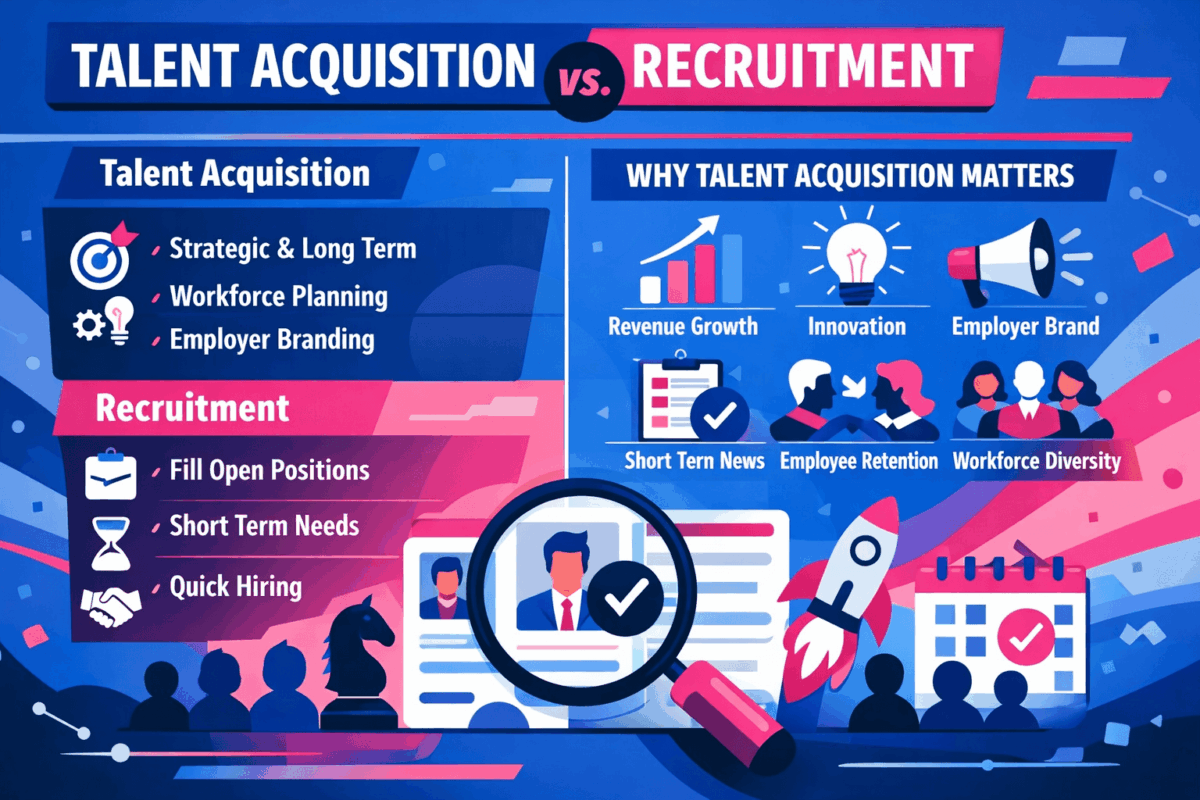
Talent Acquisition vs. Recruitment
Many people use these terms interchangeably. They are related, but not the same.
Recruitment
- Focuses on filling open roles
- Short term and role specific
- Often transactional
Talent Acquisition
- Focuses on building future workforce capability
- Long term and strategic
- Involves workforce planning, branding, analytics, and candidate experience
Organizations scaling rapidly or operating in competitive talent markets rely heavily on structured talent acquisition strategies.
Why Talent Acquisition Matters
Strong talent acquisition impacts far more than hiring speed.
It influences:
- Revenue growth
- Innovation capacity
- Employer brand strength
- Employee retention
- Workforce diversity
- Leadership pipeline development
Companies with structured hiring strategies consistently report stronger retention and better performance outcomes because hiring decisions are aligned with long term objectives.
Poor talent acquisition, on the other hand, leads to high turnover, cultural misalignment, and productivity loss.
The Talent Acquisition Process
Top ranking resources usually list a high level hiring flow. Let’s go deeper and make it more practical.
1. Workforce Planning
This is where strategy begins.
HR and leadership analyze:
- Business growth projections
- Skill gaps
- Succession planning needs
- Emerging capabilities such as AI, digital skills, or compliance expertise
Data driven workforce planning reduces reactive hiring.
2. Employer Branding
Candidates research companies before applying. Your reputation matters.
Strong employer branding includes:
- Career page clarity
- Authentic employee stories
- Transparent culture messaging
- Consistent communication on social platforms
- Clear value proposition
Talent acquisition teams work closely with marketing to shape how the organization is perceived.
3. Sourcing and Talent Pipeline Development
Modern sourcing goes beyond job boards.
It includes:
- Talent communities
- Campus recruiting
- Referral programs
- Social sourcing
- AI powered candidate discovery
- Internal mobility programs
Building pipelines reduces dependency on urgent hiring.
4. Candidate Screening and Assessment
Structured assessments improve hiring quality.
Best practices include:
- Skills based screening
- Behavioral interviews
- Structured evaluation scorecards
- AI assisted resume screening
- Bias reduction mechanisms
Data driven assessments lead to stronger performance outcomes.
5. Interviewing and Selection
Consistency is key.
Leading organizations:
- Use competency frameworks
- Train hiring managers
- Standardize interview questions
- Track interviewer feedback quality
This reduces subjectivity and improves candidate experience.
6. Offer Management and Negotiation
Competitive markets require agility.
Talent acquisition teams must understand:
- Market compensation benchmarks
- Candidate expectations
- Flexible work preferences
- Benefits trends
Speed often determines success at this stage.
7. Onboarding and Integration
Talent acquisition does not end at offer acceptance.
A strong onboarding process:
- Reduces early attrition
- Accelerates productivity
- Improves engagement
Strategic teams collaborate with HR, managers, and learning teams to ensure smooth transitions.
Modern Trends in Talent Acquisition
The landscape is evolving quickly. Here are the major shifts shaping the field:
AI and Automation
AI tools assist with:
- Resume screening
- Candidate matching
- Chatbot communication
- Interview scheduling
- Predictive hiring analytics
AI improves speed and reduces administrative workload while allowing recruiters to focus on strategic decisions.
Skills Based Hiring
More organizations are prioritizing demonstrated skills over degrees. This expands access to diverse talent pools and supports internal mobility.
Data Driven Hiring Decisions
Metrics now drive talent acquisition strategy.
Common KPIs include:
- Time to hire
- Quality of hire
- Cost per hire
- Candidate experience score
- Offer acceptance rate
- Diversity hiring metrics
Data transparency improves accountability and performance.
Internal Talent Mobility
Forward thinking companies look internally before hiring externally. Structured career pathing and development programs reduce hiring costs and improve retention.
Key Talent Acquisition Metrics
If you cannot measure it, you cannot improve it.
Important metrics include:
- Time to Fill: Days from job posting to offer acceptance
- Time to Hire: Days from candidate application to offer
- Quality of Hire: Performance and retention of new hires
- Cost per Hire: Total hiring cost divided by number of hires
- Candidate Experience Score: Feedback from applicants
- Diversity Hiring Rate: Representation metrics across roles
Advanced teams combine these metrics with performance management data to assess long term hiring success.
Talent Acquisition Best Practices
- Align hiring strategy with business goals
- Build long term talent pipelines
- Invest in employer branding
- Use structured interviews
- Reduce bias through standardized processes
- Measure hiring quality, not just speed
- Integrate onboarding with performance management
Strategic hiring is not about volume. It is about precision and future readiness.
Frequently Asked Questions
What is the difference between HR and talent acquisition?
HR covers a wide range of employee lifecycle activities including payroll, compliance, engagement, and performance. Talent acquisition focuses specifically on attracting and hiring employees.
Is talent acquisition only for large companies?
No. Small and mid sized organizations benefit significantly from structured hiring processes, especially when scaling.
How does AI impact talent acquisition?
AI supports screening, sourcing, and predictive analytics. It improves speed and reduces administrative effort but should complement human decision making.
What makes a strong talent acquisition strategy?
Clear workforce planning, strong employer branding, structured assessments, data driven metrics, and integration with performance management systems.
 Innovative