A light rhythm beats a packed calendar. Start with a weekly habit such as a kudos wall or two good things stand-up, add a monthly activity such as a walk and talk or lunch swap, and finish each quarter with something bigger such as superlatives or a video montage.
You can also anchor activities to dates that already exist. Employee Appreciation Day falls on the first Friday of March in the US, and World Gratitude Day is on September 21. Mapping these alongside review cycles and other people events in an HR calendar helps you avoid clashes and keep the pace steady.
Fun gratitude activities for employees are short, low-pressure moments where colleagues thank each other for specific things, such as a kudos wall, a team walk, or a playful awards round. Their purpose is to make appreciation a regular habit instead of an annual event. No single activity guarantees higher engagement or lower turnover, and results depend on how sincere, specific, and frequent the thanks feels to your people.
Most lists of fun activities for employees stop at trivia and bingo. Those are fine for a Friday afternoon, but they rarely tell anyone that their work mattered. This guide focuses on activities where the fun is simply the delivery method for real appreciation, along with how to choose them, run them, and tell whether they are working.
Why Gratitude Activities Are Worth Your Time
Do gratitude activities make a real difference at work? They can, when the thanks is genuine and frequent. Recognition is one of the cheapest tools a manager has, and most teams are not using it often enough.
How to Pick the Right Gratitude Activity for Your Team
The right activity matches your team’s size, working style, and comfort with the spotlight. A game that works for 12 people in one room can feel forced across 400 people on three continents.
Before you commit, run each idea through these questions.
Does it push people to name specific work, not just say “thanks for everything”?
Can everyone join, including remote, shift-based, and introverted colleagues?
Can it run in 15 minutes or less?
Can it repeat without heavy planning?
Does the thanks actually reach the person being thanked?
These fit into a stand-up, a Friday wrap-up, or a lull between meetings.
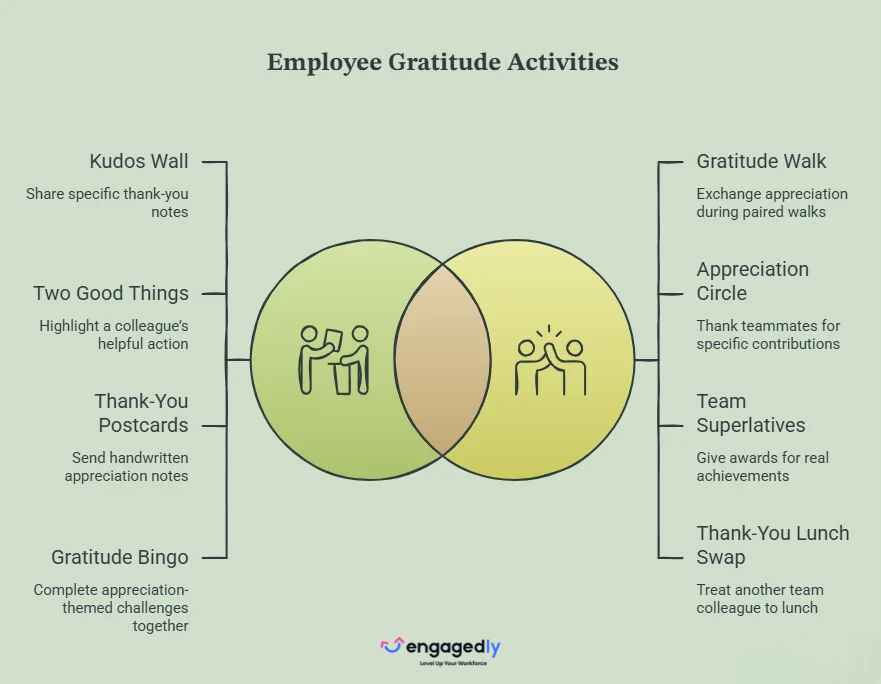
Kudos Wall
Set up a physical board or a shared channel where anyone can post a short thank-you. The rule is that every note names a person and one specific thing they did. Review the wall at the end of each month and read a few aloud at your team meeting.
Two Good Things Stand-Up
Once a week, each person shares one thing a colleague did that helped them. It takes about five minutes for a team of eight. Because the prompt is specific, people stop giving vague praise and start noticing real contributions.
Thank-You Postcards
Keep a stack of blank cards in the office or mail them to remote staff. Each person writes one card a week to someone outside their immediate team. A handwritten note stays on a desk far longer than a chat message does.
Gratitude Bingo
Create a bingo card with squares such as “thanked someone from another department” or “thanked someone for helping me learn something.” Players complete squares over two weeks, and a full row earns a small treat. It adds a light game element to something people might otherwise forget to do.
Team Gratitude Activities for the Office
When you have more time, these activities build stronger relationships alongside the appreciation.
Gratitude Walk and Talk
Pair people up for a 15 minute walk. Each person shares one thing they appreciate about the other’s work this month and one thing they learned from them. Rotate pairs each time so colleagues who rarely speak get a turn.
Appreciation Circle
Close a monthly meeting by passing a small object around the circle. Whoever holds it thanks one person for something specific. Let people pass if they prefer, because forced public emotion is the fastest way to kill this one.
Team Superlatives
Invent playful awards such as “Calmest in a Crisis” or “Best Rescue Mission” and base each one on a real event from the past quarter. Make sure everyone eventually earns a title so it never turns into a popularity contest.
Thank-You Lunch Swap
Draw names and have each person treat a colleague from another team to coffee or lunch. The only condition is that they open with a specific thank-you. This is also a quiet way to strengthen the cross-team ties that many organizations struggle with, as covered in our look at common teamwork challenges every team encounters.
Gratitude Activities for Remote and Hybrid Teams
Remote employees often miss the casual hallway thanks that in-office teams get for free, so these activities make appreciation visible on purpose.
Kudos Channel With Weekly Prompts
Create a dedicated channel and post a prompt every Monday, such as “Who made your week easier?” Managers should post first so others feel safe following. Pin the best messages so new joiners can see what good thanks looks like.
Appreciation Video Montage
Ask each person to record a 10 second clip thanking a teammate or the whole team, then stitch the clips together for your next all-hands. It works well for milestones such as a product launch or a project handover.
Mystery Gratitude Buddy
Assign each person a secret buddy for a quarter. The buddy sends one specific thank-you a week without revealing who they are, and the identities are revealed at the end. Keep the pairing across time zones where you can, since that is where isolation tends to be highest.
Virtual Coffee With a Thank-You Twist
Randomly pair colleagues for a 15 minute video chat. The only agenda is to share one thing you appreciate about each other’s work. It is simple, cheap, and easy to repeat monthly.
Quick Comparison of Activities
Activity
Time needed
Cost
Best for
Kudos wall
5 minutes a week
Free
Any team size
Two good things stand-up
5 minutes
Free
Small and mid-size teams
Thank-you postcards
10 minutes
Low
Hybrid and remote teams
Gratitude walk and talk
15 to 20 minutes
Free
Office teams
Team superlatives
20 minutes
Free to low
Quarterly team meetings
Mystery gratitude buddy
5 minutes a week
Free
Distributed teams
Turn Fun Moments Into a Real Recognition Habit
Can gratitude activities work on their own? They help, but they fade if appreciation lives only in events. The strongest approach pairs the fun with the everyday systems your people already use.
Here are four ways to connect the two.
Make thanks timely and specific. A tool built for real-time feedback lets colleagues and managers send praise right after the work happens, instead of waiting for the next team event. Using the situation, behavior, and impact structure from our guide on the importance of SBI when giving feedback keeps that praise concrete.
Recognize progress, not just finish lines. When your team tracks OKRs and goals, you can celebrate meaningful milestones along the way, which helps people feel their effort counts before the quarter ends.
Notice who is being missed. Talent analytics can help you see which teams or individuals rarely receive recognition, so quiet contributors do not slip through the cracks.
Common Mistakes That Make Gratitude Feel Fake
Well-meant programs go wrong in predictable ways. Watch for these.
Forcing public sharing. Some people love the spotlight and some dread it, so always offer a private option.
Using generic praise. “Great job, team” teaches no one what to repeat.
Recognizing the same people. Loud, visible work gets thanked far more often than steady, behind-the-scenes work.
Making it mandatory and after hours. Fun that people have to attend on their own time is not fun.
Running one big event and stopping. A single party cannot replace a weekly habit.
Letting managers opt out. If leaders stay on the sidelines, the activity reads as a task for the team, not a value of the company.
How to Tell If Your Gratitude Activities Are Working
No universal benchmark tells you whether a gratitude program is succeeding, so track a few simple signals against your own baseline over a quarter or two.
Participation, such as how many people send or receive at least one thank-you each month.
Spread, such as whether recognition reaches every team or clusters in a few.
Pulse survey results, such as a question asking whether people feel recognized for their work in the last week.
Trends in engagement scores and voluntary turnover over time, keeping in mind that many other factors move those numbers too.
Open comments about which activities people enjoy and which feel awkward.
If the numbers stay flat, change the format before you give up on the idea. Gratitude is part of culture, and our white paper on steps to change company culture offers a practical way to approach that kind of shift.
Final Thoughts
The best fun activities for employees are the ones that leave people feeling seen. Keep them short, make the thanks specific, involve managers, and repeat them often enough that appreciation becomes part of how your team works, not a special occasion.
If you want to back these activities with everyday feedback, goals, and reviews, request a demo of Engagedly and we will walk you through how it can fit your team.
A Simple Year-Round Gratitude Rhythm
A light rhythm beats a packed calendar. Start with a weekly habit such as a kudos wall or two good things stand-up, add a monthly activity such as a walk and talk or lunch swap, and finish each quarter with something bigger such as superlatives or a video montage.
You can also anchor activities to dates that already exist. Employee Appreciation Day falls on the first Friday of March in the US, and World Gratitude Day is on September 21. Mapping these alongside review cycles and other people events in an HR calendar helps you avoid clashes and keep the pace steady.
What are some fun gratitude activities for employees?
Popular options include a kudos wall, a two good things stand-up, thank-you postcards, gratitude walks, team superlatives, and virtual coffee chats with a thank-you prompt. The best choice depends on your team size, whether people work remotely, and how comfortable they are with public praise.
How often should we run gratitude activities?
Short habits work best weekly, while larger activities suit a monthly or quarterly schedule. Gallup suggests that recognition should happen roughly every seven days, so a small weekly practice paired with an occasional bigger event is a sensible starting point.
What are low-cost gratitude ideas for small budgets?
Kudos walls, stand-up shout-outs, walk and talk pairs, and handwritten notes cost almost nothing. A mystery gratitude buddy program also runs on time and goodwill alone. Spend money only where it adds meaning, such as a personalized note or a team lunch after a hard project.
How do you run gratitude activities for remote teams?
Use a dedicated chat channel with a weekly prompt, record short video thank-you clips, and pair people across time zones for short video chats. Make sure managers take part first, and give people a private way to send thanks if they do not want to post publicly.
Do gratitude activities improve retention?
There is evidence that recognition and retention are linked. Gallup found that employees who do not feel adequately recognized are twice as likely to say they will quit within a year. Still, that is a survey association, and gratitude activities work best alongside fair pay, good management, and growth opportunities.
Jeevithan K is a Senior Solutions Consultant at Engagedly with extensive experience in HR technology, customer success, product implementation, onboarding, and training. He specializes in helping organizations adopt B2B SaaS and enterprise AI solutions effectively. His expertise also includes project management, account management, process improvement, and translating complex product capabilities into practical solutions that deliver meaningful value for customers.






 Innovative