Meetings are essential for team alignment, decision-making, and project execution — but without a clear agenda, they often become unfocused and unproductive.. Without proper coordination and planning, meetings become a waste of time, causing frustration among team members and a loss of goals.
Research shows that bad meetings cost US firms about $37 billion a year, underlining the critical need for better meeting management.
The creation ofan effective staff meeting agenda is more than listing the discussion points. It’s about developing a strategic approach that ensures every minute you spend in meetings generates value for your team. Understanding the key elements of a successful agenda can turn meetings from time losers to strong organizational success drivers.
This comprehensive guide will cover how to establish and implement an effective staff meeting agenda that leads to results. You will discover tested strategies for structuring meetings, find the essential components that should be included in each agenda, and understand how to increase team engagement.
What is the Staff Meeting Agenda?
The staff meeting agenda is a structured document that sets out the main topics, objectives, and discussion points for team meetings. Let’s understand its main elements and its role in managing successful meetings.
1. Strategic Framework
A staff meeting agenda is a detailed plan that the attendees follow to ensure that topic flow is strategic and meetings are purposeful. It defines responsibility through such factors as stating time slots for each subject, who will be speaking, and making the expectations known about the outcomes expected from the meeting. This system helps prevent slippages in terms of efficiency and guarantees that everyone pays optimal attention to all potential problem areas.
2. Communication Instrument
The agenda serves as a medium of communication prior to the meeting since it enables the participants to prepare adequately for the meeting. It shall notify members of the teamof the topics ahead of time to help them gather relevant data and derive basic issues.This training ensures more productive negotiation and better decision-making during the meeting.
3. Documentation Support
In addition to direct discussions, the agenda serves as a reference document for monitoring decisions and the performance of duties. This provides a clear record of the discussion actions that groups may want to use after the meeting to guide their actions. This documentation helps to keep the responsibility and follow-up of major tasks.
4. Meeting Management System
The agenda serves as an efficient time management schedule, which regulates the speed and orientation of the meeting. It prevents discussions from going outside the circuit and helps to maintain meetings in their specified time slot. This approach is systematic, and the time of everyone involved is considered, and work is carried out effectively.
Benefits of a Well-Structured Meeting Agenda
Understanding the benefits of a well-organized staff meeting agenda can help teams increase their efficiency and bring value to organizations.
1. Productivity Growth
Office workers are only productive for 31% of their work day. A structured agenda helps here by allowing attendees to focus on important topics and avoid time-consuming, unplanned contact lines. This ensures an effective decision-making process while allowing participants to focus on discussions. The clear structure also ensures that the meetings meet the intended objectives without undue delay.
2. Time Optimization
Adequate agenda planning should ensure that meetings begin and end on time, respecting participants’ valuable time. It should also contribute to allocating sufficient time for each consultation point based on its importance and complexity. This systematic approach does not produce meeting exceedances and is efficient with time management.
3. Strengthening Communication
The program sets up a structure of who should participate and guarantees that all voices will be heard. It makes the information flow very clear by breaking the topics in a very logical manner. This organization promotes active engagement and significant contributions from all participants.
4. Strategic Alignment
A well-planned agenda keeps the team members focused on organizational objectives and priorities. This helps totrack progress in key initiatives while preserving the clarity of team responsibilities. The agenda-based meetings make it possible to constantly monitor the action points, and keep the dynamics of important projects.
Main Components of the Staff Meeting Agenda
Effective staff meeting requires organization and professional determination of how the meeting will be conducted and the aim of the meeting.
1. Title and Details of the Meeting
Each staff meeting should start with basic information, including the title of the meeting, date, start time and end time, and place (physical or virtual platforms such as Zoom / Teams), as well as a full list of participants with their roles. For virtual meetings, the meeting includes a link and the necessary access codes.
2. Clear Meeting Objective
72% of respondents in a survey felt that a clear meeting agenda is key for a successful meeting. Indicate the specific purpose and desired results of the meeting in advance. Your aim must be to identify the decisions to be taken and what you want to achieve.
For example, instead of “Q1 performance talks,” write “Review Q1 Sales Metrics and Decide on Q2 strategy adjustments.” This helps participants to understand what they must prepare and what decisions they will make.
3. Topics and Points of Discussion
List all cases to be dealt with, classified as priority. Each subject should have a specific, descriptive title, subject of discussion, or the necessary materials or the statement of the presenter, as well as the expected result (whether it be a decision, update, or point of action). This structured approach ensures that everyone knows what to expect and how to prepare.
4. Time Allocation
An average meeting lasts anywhere between 31 to 60 minutes. Give realistic time blocks to each item on the agenda to maintain the flow of meetings and ensure that all subjects receive adequate attention.
Break off the schedule in specific segments, such as Welcome and Updates (5 minutes), Q1 Performance Review (20 minutes), Team Challenges Discussion (15 minutes), and Next Steps Planning (10 minutes).
5. Review of Previous Action Items
Before diving into new topics, spend 5 minutes reviewing what was assigned at the last meeting. Who was responsible? What is the status? This creates continuity and accountability without requiring a separate follow-up meeting.
6. Points of Action and Responsibilities
Add a comprehensive section to track existing and new tasks. List pending action points from previous meetings, new tasks to be assigned, clear responsibility for each task, specific deadlines, and established follow-up mechanisms to ensure accountability and follow-up.
7. Time for Questions and Answers
Reserve time at the end of the meeting for questions, clarifications, team feedback, and additional discussion points. This gives participants space to raise concerns or topics that were not fully covered during the main agenda.
8. Supported Materials
Provide all relevant documents necessary for effective participation, including comments from previous meetings, reports or data for consultation, presentation slides, project updates, and all necessary reading material. Ensure that all material is easily accessible to participants.
Best Practices for Setting Up a Staff Meeting Agenda
Creating an effective staff meeting agenda requires careful planning and attention to detail. Here are the main practices for ensuring that meetings are productive and meaningful.
1. Involvement of Planning Participants
Request items on the agenda from team members three days before the meeting to ensure full coverage. Find active input on discussion topics, confirm the availability of key presenters, and gather feedback on time allocation for complex topics. Share a draft agenda for team evaluation, incorporate relevant suggestions to create buy-in, and ensure that all key topics are included.
2. Establishing Realistic Objectives
Each meeting focuses on 3-4 key aspects to maintain effectiveness. Ensure that each item on the agenda has a clear and feasible outcome in line with the team’s objectives. Consider the group’s capacity and work efficiency when planning discussions and choosing shorter, targeted meetings instead of long sessions that can lead to reduced commitment and productivity.
3. Effectively Prioritizes Topics
Structure your agenda to address critical decisions and high-energy points at the beginning of the meeting when participants are most alert. Group-related topics together for better flow and understanding. Plan complex discussions during peak team energy periods and maintain a balance between updates and interactive discussions to maintain high commitment during the meeting.
4. Divide the Agenda in Advance
Send the full agenda package at least 48 hours before the meeting to allow sufficient preparation time. Includes all supporting documents, mark the required pre-meeting preparation, and indicate which topics should be reviewed in advance. Send reminder notifications with the attached agenda to make sure everyone is prepared and ready to contribute.
5. Create Time Buffers
Develop flexibility in your agenda by adding small breaks between key topics and early buffer inclusion for unexpected discussions. Plan for possible technical issues in virtual meetings, give time for a smooth transition between presenters and make sure important decisions are not rushed due to time pressure.
6. Structure for Maximum Engagement
Start meetings with a short check-in or icebreaker to set a positive tone. Alternate between updates and interactive discussions to maintain attention. Includes variety in presentation styles, plans for active participation through different commitment methods, and always ends up with clear steps and action elements to maintain momentum.
How to Run a Staff Meeting (Practical Tips)
Writing a strong agenda is step one. Running the meeting well is step two. Here is what actually works:
Start on time, every time
Starting late punishes the people who showed up when they were supposed to. It also sends a message that the meeting’s own time limits do not really matter. Build the habit of starting at the scheduled time and late arrivals can catch up.
Assign a facilitator and a note-taker
These do not need to be the same person – and for most meetings, they should not be. The facilitator manages the flow, keeps discussions on track, and ensures everyone is heard. The note-taker captures decisions and action items in real time so nothing gets lost after the meeting ends.
Use the parking lot technique
When a valuable but off-topic discussion comes up, do not shut it down – park it. Maintain a visible “parking lot” list of topics that came up but were not on the agenda. At the end of the meeting, decide as a group whether each parked item needs a follow-up meeting or can be handled asynchronously.
Keep to the time blocks
If a discussion is still going when its time block ends, make a decision as a group:
Call it and move on, scheduling a follow-up for that specific topic
Briefly extend it and cut time from a lower-priority item
Escalate it to a separate decision-maker outside the meeting
What you should not do is let one item absorb the entire meeting while other items get skipped.
Close every meeting with a recap of action items
Before adjourning, spend five minutes reading back every action item that was assigned during the meeting. Confirm the owner and deadline for each one out loud. This reduces misunderstandings significantly and makes follow-up much easier.
Send a follow-up within 24 hours
Share meeting notes, a summary of decisions made, and the full action item log with every attendee (and anyone who was invited but could not attend) within 24 hours. The longer you wait, the more context fades.
Ask for feedback on the meeting itself
Periodically ask your team whether the meeting format is working. A simple post-meeting survey with two or three questions – Was this meeting necessary? Was the agenda clear? What would you change? – surfaces friction before it becomes resentment.
Common Mistakes to Avoid
Understanding common traps in the staff meeting agenda ensures more efficient meetings and better results.
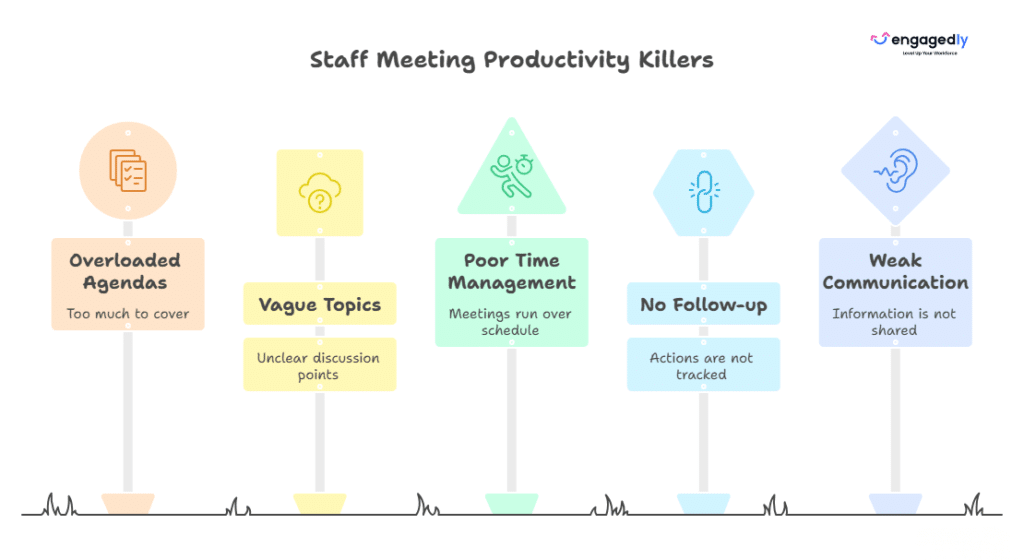
1. Overloading the Agenda
Around 50% of the time in a meeting was considered time wasted by employees. Attempting to cover too many topics in one session creates discussions at the surface level and poor results. This includes dealing with multiple complex issues, not enough time for a good discussion, planning back-to-back items without interruptions, and including items that can be handled more efficiently via email or other communication channels.
2. Unclear Agenda Items
Bad clarity on the agenda leads to confusion and a waste of time. This includes the use of vague or generic theme descriptions, the non-specification of the desired results for each discussion point, the lack of key context that participants need to prepare, and the failure to indicate the required pre-meeting preparation or material assessment.
3. Bad Time Management
Ineffective time allocation can derail even well-planned meetings. Common issues include not assigning specific time slots to items, allowing discussions about assigned time to run, starting late or ending late, and running through important topics due to poor planning or insufficient time allocation.
4. Insufficient Follow-Up Planning
Failure to plan action after the meeting reduces the effectiveness of the measures. This does not include recording action items and owners, missing deadlines for assigned tasks, failureto document important decisions taken during the meeting, and failureto keep track of the progress of previous meetings.
5. Communication Problems
Poor communication around the agenda confuses and reduces the effectiveness of meetings. This means that the agenda is not shared sufficiently in advance, the key stakeholders are not included in the distribution lists, necessary supporting documents are not included, and new participants or team members are not provided with adequate context.
Staff Meeting Agenda Template
Below is a general-purpose staff meeting agenda template you can copy, download, and customize. It works for most recurring team meetings.
Pre-meeting prep: Each team member reviews their task list and notes any blockers before joining.
Monthly Staff Meeting Agenda
Best for: Whole-team monthly alignment, performance reviews, and planning
Recommended length: 60 to 90 minutes
Agenda:
Monthly Staff Meeting – [Month, Year]Objective: Review last month’s performance metrics, address team challenges, and set goals and priorities for the coming month.
Welcome and Announcements (5 min) – Manager/Facilitator
Company updates, personnel changes, key news
KPI and Performance Review (20 min) – Department Leads
Review of key metrics against targets
What worked, what did not, and why
Project Status Updates (20 min) – Project Owners
Progress on active initiatives
Risks or timeline changes
Team Challenges and Solutions (15 min) – All
Open discussion on recurring friction points
Collaborative input on fixes or process changes
Goals for Next Month (15 min) – Facilitator + Leads
Set measurable priorities for each team or department
Assign owners to key objectives
Action Items and Deadlines (5 min) – Facilitator
Q&A (5 min) – All
Pre-meeting prep: Department leads prepare a brief update (5 slides or fewer) covering their team’s metrics and project status.
All-Hands Meeting Agenda
Best for: Company-wide meetings covering strategy, culture, and organizational updates
Recommended length: 60 minutes
Agenda:
All-Hands Meeting – [Quarter/Date]Objective: Align all staff on company direction, celebrate wins, address pressing questions, and reinforce team culture.
Welcome and Framing (5 min) – CEO/Executive Lead
Purpose of the meeting and what to expect
Company Update: Performance and Strategy (15 min) – Leadership
Progress against annual goals
Any major strategic shifts or announcements
Department Spotlights (15 min) – Department Leads
2 to 3 minutes each: what their team is working on and any cross-team dependencies
Culture and Recognition (10 min) – People/HR Lead
Shoutouts, new hires, team milestones, values spotlights
Looking Ahead: Priorities for the Next Quarter (10 min) – Executive Lead
What matters most in the coming quarter and why
Open Q&A (15 min) – All
Live questions submitted anonymously or by hand
Note: For all-hands meetings with 50+ attendees, collect questions in advance using a tool like Slido or a shared Google Form. This prevents the Q&A from being dominated by a small group.
Department Meeting Agenda
Best for: Team-level functional meetings (marketing, engineering, finance, operations, etc.)
Recommended length: 45 to 60 minutes
Agenda:
[Department Name] Meeting – [Date]Objective: Align on active projects, address internal priorities, and resolve any department-specific blockers.
Action Item Review (5 min) – Department Lead
Status check on previously assigned tasks
Active Projects and Priorities (20 min) – Project Owners
Progress updates for each major initiative
Timeline status: on track, at risk, delayed
Resource and Capacity Check (10 min) – Department Lead
Workload distribution
Upcoming deadlines that may strain capacity
Internal Challenges or Process Issues (10 min) – All
What is creating friction within the team?
What process could be improved?
Upcoming Deadlines and Deliverables (5 min) – All
What is due in the next two weeks?
Action Items Recap (5 min) – Facilitator
Next Meeting Date Confirmed (2 min)
Project Kickoff Meeting Agenda
Best for: Launching a new project, aligning stakeholders, and establishing team norms
Recommended length: 60 to 90 minutes
Agenda:
Project Kickoff: [Project Name] – [Date]Objective: Align all stakeholders on project scope, roles, timeline, and communication protocols before work begins.
Introductions (5 min) – Facilitator
Who is in the room and what is their role on this project
Project Overview and Business Context (10 min) – Project Sponsor or Lead
Why this project exists
What problem it solves and what success looks like
Scope, Goals, and Deliverables (15 min) – Project Manager
What is in scope and what is explicitly out of scope
Key deliverables and milestones
Definition of done
Roles and Responsibilities (10 min) – Project Manager
Who owns what
RACI or responsibility matrix walkthrough (if applicable)
Timeline and Key Milestones (10 min) – Project Manager
High-level project schedule
Critical dependencies and deadlines
Risk and Assumption Review (10 min) – All
What risks have already been identified?
What assumptions are we making?
Communication and Working Norms (10 min) – Facilitator
Meeting cadence going forward
Primary communication channels
How decisions will be made and documented
Open Questions and Action Items (10 min) – All
Next Steps and First Sprint (5 min) – Project Manager
Pre-meeting prep: Project manager shares the project brief and any available background documents at least 48 hours before the kickoff.
Conclusion
The creation ofan effective staff meeting agenda is essential to maintain productive team discussions and achieve significant results. The above models and best practices provide a solid basis for the effective structure of meetings. By implementing these tools, you can transform your meetings from time-consuming obligations into valuable collaborative sessions.
Start by selecting the template that best suits your team’s needs, then customize it to meet specific requirements. Remember that a well-planned agenda shows respect for each other’s time and helps you stay focused on important objectives.
If you’re looking to make meetings more structured, outcome-driven, and aligned with team goals, it may be worth requesting a demo to see how teams are operationalizing this at scale.
Frequently Asked Questions (FAQs)
What is a staff meeting agenda?
A staff meeting agenda is a structured document that outlines what will be discussed during a meeting and what outcomes are expected. A typical staff meeting agenda includes:
• Meeting objective and purpose • Discussion topics in priority order • Time allocation for each agenda item • Assigned presenters or topic owners • Action items and responsibilities • Questions, feedback, and next steps Using a clear agenda helps teams stay focused, improve participation, and make meetings more productive.
Why is a staff meeting agenda important?
A staff meeting agenda improves meeting effectiveness by providing structure and direction before discussions begin.
Key benefits include: • Keeps discussions focused on priorities • Reduces time wasted on unrelated topics • Helps participants prepare in advance • Improves decision-making and accountability • Ensures meetings start and end on time • Creates clear ownership for follow-up actions Teams that consistently use agendas often experience better collaboration and more productive meetings.
What should be included in a staff meeting agenda?
An effective staff meeting agenda should contain the information participants need to prepare and contribute.
Include: • Meeting title, date, time, and location • Clear meeting objective • Discussion topics and priorities • Time assigned to each topic • Presenter or discussion owner • Review of previous action items • New action items and deadlines • Q&A or open discussion section • Supporting documents or reference materials These elements help ensure meetings result in decisions, alignment, and measurable progress.
How far in advance should a meeting agenda be shared?
Most organizations should distribute meeting agendas at least 24 to 48 hours before the meeting.
Sharing agendas early allows participants to: • Review discussion topics • Gather relevant data and updates • Prepare questions or recommendations • Complete required pre-work • Contribute more effectively during discussions For strategic planning sessions or leadership meetings, sharing the agenda several days in advance may be even more beneficial.
How do you create an effective staff meeting agenda?
Creating an effective staff meeting agenda starts with defining a clear purpose and expected outcomes.
Follow these steps: • Identify the meeting objective • Prioritize the most important topics • Assign owners to agenda items • Allocate realistic time blocks • Include action item reviews from previous meetings • Share the agenda before the meeting • Reserve time for questions and discussion • Document decisions and next steps
A well-structured agenda helps teams stay organized and achieve better results from every meeting.
What are common mistakes to avoid when creating a meeting agenda?
Several common mistakes can make meetings less productive, even when an agenda exists.
Avoid: • Including too many discussion topics • Using vague agenda item descriptions • Failing to define meeting objectives • Not assigning time limits to topics • Skipping action item reviews • Forgetting to document decisions • Sharing the agenda too late • Excluding supporting materials
Keeping agendas concise, specific, and action-oriented helps prevent these issues.
Gabby Davis is the Lead Trainer for the US Division of the Customer Experience Team. She develops and implements processes and collaterals related to the client onboarding experience and guides clients across all tiers through the initial implementation of Engagedly as well as Mentoring Complete. She is passionate about delivering stellar client experiences and ensuring high adoption rates of the Engagedly product through engaging and impactful training and onboarding.













 Performance
 Learning
 Recognize &
 Engage &
 Talent
 Innovative
 Product
 Learning
 Other
Other Featured