











Running 360 degree feedback in a manufacturing company is differs from running it in a desk-based office.
A corporate employee can usually open an email, complete a survey from a laptop, and move on.
On the plant floor, employees may work rotating shifts, share devices, have limited access to corporate email, or rarely overlap with the managers and colleagues they are being asked to evaluate. Teams may also work across multiple languages, sites, and job types.
Then there is the biggest challenge: trust.
If an operator believes their feedback about a supervisor can be traced back to them, especially in a small crew, the quality of that feedback can fall quickly.
That means manufacturers need more than a basic survey tool.
The right 360 degree feedback software for manufacturing should make multi-rater feedback easy to access, protect confidentiality, support different employee groups, produce reports managers can understand, and – most importantly – turn feedback into development.
We compared 10 platforms based on their 360-feedback capabilities, manufacturing and frontline fit, accessibility, development workflows, reporting, integrations, and pricing transparency.
Best 360 degree feedback software for manufacturing at a glance
| Software | Strong fit for | Frontline accessibility | Development connection | Pricing |
| Engagedly | Mixed frontline and office workforces | Strong mobile capabilities | Strong | Custom |
| Spidergap | Leadership and supervisor development | Link/web-based | Strong development planning | From $1,099/year |
| Qualtrics 360 | Large global programs and advanced analytics | Moderate | Strong | Custom |
| Cornerstone | Skills, learning, and workforce development | Moderate | Strong | Custom |
| SAP SuccessFactors | Large SAP environments | Mobile supported | Strong | Custom |
| UKG Pro | Organizations already using UKG | Strong | Strong | Custom |
| PerformYard | Flexible performance and 360 workflows | Moderate | Good | Custom |
| Primalogik | SMB and mid-market organizations | Moderate | Good | Custom |
| Trakstar Perform | Structured multi-rater reviews | Moderate | Good | Custom |
| AssessTEAM | Budget-conscious and job-based teams | Mobile apps | Moderate | From $2/user/month annually |
What is 360 degree feedback in manufacturing?
360-degree feedback, also called multi-rater feedback, collects structured feedback about an employee from multiple people they work with.
Depending on the process, those reviewers may include:
- Managers
- Peers
- Direct reports
- Employees from other departments
- Project collaborators
- Vendors or external stakeholders
- The employee themselves
Unlike a traditional performance review, where a manager provides most of the evaluation, a 360 review creates a broader picture of how someone works with the people around them.
That can be especially valuable in manufacturing.
A plant supervisor, for example, may be viewed very differently by:
- Their plant manager
- Maintenance teams
- Operators reporting to them
- Quality teams
- Production planning
- HR
Considering all those perspectives can reveal strengths or development gaps a single manager may miss.
360 feedback is commonly used for areas such as leadership, communication, coaching, collaboration, accountability, problem-solving, and people management.
Why 360 feedback is different in manufacturing
The methodology is the same across industries.
The environment is not.
Frontline employees may not have desk access
Many manufacturing employees spend most of their day on a production floor rather than at a computer.
If completing feedback requires logging into a complicated desktop system, participation becomes harder.
Employees work different shifts
A night-shift technician may collaborate regularly with people they rarely meet face-to-face.
Multi-rater feedback can capture those working relationships that a direct manager does not always observe.
Supervisor spans can be large
A frontline supervisor may manage significantly more employees than a typical office manager.
The feedback process therefore needs to be simple enough that it does not create another major administrative burden.
Manufacturing workforces can be multilingual
Large manufacturers may operate across countries, plants, and employee populations speaking different languages.
Language accessibility can have a direct impact on whether employees understand the questions well enough to provide useful feedback.
Confidentiality matters
Upward feedback becomes much less useful if employees do not feel safe giving it.
Manufacturers should pay particular attention to anonymity settings, visibility controls, rater groups, and what happens when only a small number of employees respond.
1. Engagedly
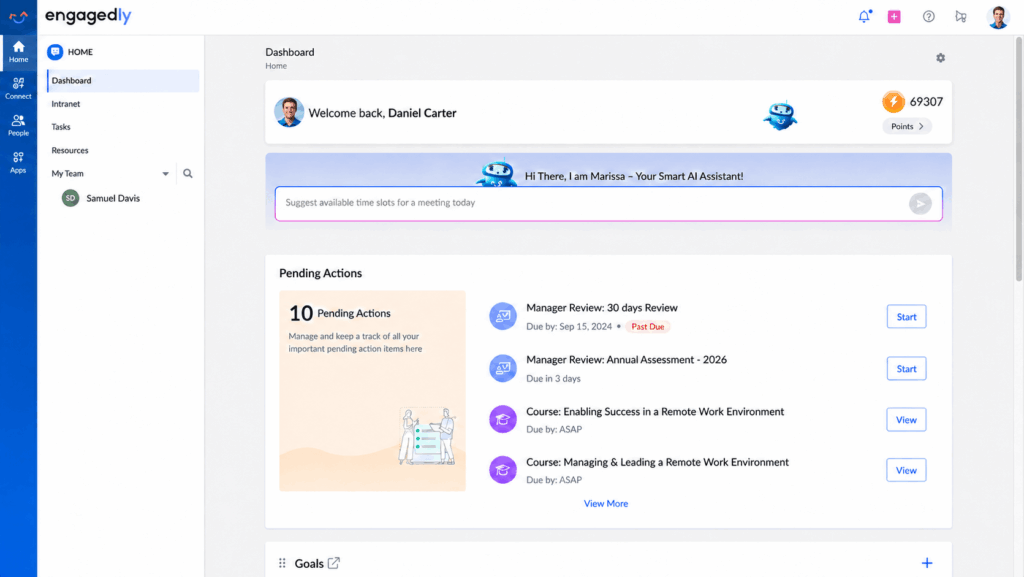
Engagedly, an Energage company, is an AI talent management platform powered by insights from the Top Workplaces Institute. It is built to help organizations connect performance, engagement, learning, growth, and recognition in one unified experience.
Powered by Marissa, its AI SuperAgent, Engagedly helps leaders turn people strategy into intelligent actions, reduce talent silos, and drive measurable business outcomes. Trusted by organizations worldwide, Engagedly supports stronger engagement, better retention, and the development of high-performing teams.
Its 360 Feedback module supports configurable feedback cycles, different reviewer groups, customizable templates, external reviewers, anonymity settings, reporting, mobile access, and AI-assisted feedback summaries. Engagedly also allows organizations to take results further through development plans and mentoring workflows.
For manufacturing companies, the broader platform is particularly relevant because 360 feedback does not have to operate as a standalone process. Feedback can become part of a wider employee-development strategy involving performance, learning, skills, goals, mentoring, and career development.
Key features
- 360-degree and multi-rater feedback
- Manager, peer, direct-report, and self-feedback
- External reviewers
- Configurable feedback templates
- Competency-based assessments
- Anonymity settings
- Multiple simultaneous feedback cycles
- Mobile access
- Spider-chart reporting
- AI-powered feedback summaries with Marissa AI
- Individual Development Plans
- Mentoring
- Performance reviews
- Goals and OKRs
- Learning
- Skills assessments
Engagedly’s manufacturing offering also supports mobile learning, skills assessments, check-ins, real-time feedback, surveys, goals, mentoring, and development for mixed desk and deskless workforces.
Why manufacturing companies may consider Engagedly
Feedback can lead directly to development
One of the challenges with 360 programs is what happens after the report is delivered.
Engagedly allows organizations to identify development needs from feedback and then use Individual Development Plans, learning, goals, or mentoring to address them.
For example, if feedback consistently shows that a newly promoted production supervisor needs to improve coaching skills, HR can move from identifying the problem to creating a development plan around it.
It supports both performance and development
Manufacturers do not necessarily need separate systems for 360 feedback, performance reviews, goals, learning, and development.
For organizations trying to consolidate talent processes, having those capabilities connected can make workforce-development data easier to act on.
Mobile accessibility
Engagedly includes mobile accessibility for 360 feedback and also supports mobile employee experiences across its manufacturing solution.
That becomes more important when employees do not work primarily from corporate laptops.
AI can reduce the reading burden
Marissa AI can summarize 360-degree feedback, helping HR teams and managers interpret large volumes of written comments.
This can become useful when organizations run feedback programs across a large supervisor or leadership population.
What to consider
Engagedly covers significantly more than 360 feedback.
Organizations that only want to run a small number of standalone leadership assessments may prefer a specialized 360 tool.
The broader capabilities make more sense when feedback needs to connect with performance, learning, employee development, or wider talent processes.
Pricing
Engagedly uses custom pricing based on organizational requirements and the products selected.
Strong fit for: Manufacturers that want 360 feedback connected with performance management, learning, skills, mentoring, and employee development.
Editor’s note: Engagedly is our platform, so we have greater product knowledge of it than the other platforms included in this comparison. The platforms below should be evaluated against your own workforce, existing technology, feedback objectives, budget, and implementation requirements.
2. Spidergap

Spidergap specializes in 360-degree feedback rather than trying to provide an entire HR suite.
Its product is centered around collecting multi-rater feedback, making the results easy to understand, and helping recipients convert feedback into practical development priorities.
That makes it particularly relevant for manufacturers running targeted programs for plant managers, supervisors, high-potential employees, or leadership teams.
Key features
- Customizable 360 questionnaires
- Feedback reports
- Personal development plans
- Anonymous feedback
- Flexible feedback collection
- Translation into 100+ languages on its Starter plan
- Organization branding
- Multiple assessments during a license period
- SSO on higher plans
Spidergap’s pricing is based primarily on the number of people receiving feedback rather than everyone providing it. Its Starter plan currently begins at $1,099 per year for 10 feedback recipients.
Why manufacturers may consider Spidergap
Designed specifically around 360 feedback
Companies running a focused leadership-development program may not need an entire talent-management suite.
Spidergap provides a more specialized option.
Strong multilingual support
Its published Starter plan includes translation into more than 100 languages, which can be useful for organizations operating across countries and employee populations.
Development-focused reporting
Rather than treating the assessment as the endpoint, Spidergap includes personal development planning as part of the feedback experience.
What to consider
Spidergap is primarily a 360 feedback platform.
It does not replace a broader performance-management, LMS, workforce-management, or talent-management system.
Organizations planning large-scale frontline programs should also test how raters without regular workplace email or system access will participate.
Pricing
Spidergap currently lists:
- Starter: $1,099/year for 10 feedback recipients
- Pro: $2,199/year for 10 feedback recipients
- Enterprise: Custom pricing
Additional recipient pricing varies by tier.
Strong fit for: Manufacturers running dedicated manager, supervisor, or leadership 360 programs.
3. Qualtrics 360 Development
Qualtrics approaches 360 feedback through the broader lens of employee experience, research, analytics, and development.
Its 360 Development Feedback product collects multi-source feedback and connects the results with development interventions and learning resources.
That makes it more appropriate for large organizations requiring sophisticated analytics and global feedback programs than manufacturers simply looking to replace a basic review form.
Key capabilities
- Multi-source feedback
- Development-focused reporting
- Employee-experience analytics
- Large-scale program administration
- Feedback analysis
- Development interventions
- Enterprise reporting
- Integration with the wider Qualtrics employee-experience platform
Why manufacturers may consider Qualtrics
Analytical depth
Organizations with dedicated people analytics or employee-experience teams may value the depth available through the Qualtrics ecosystem.
Enterprise scalability
Qualtrics is designed for large programs rather than only small leadership cohorts.
Feedback can connect to development
The current Qualtrics offering emphasizes turning 360 results into personalized development rather than stopping at measurement.
What to consider
Qualtrics can be more sophisticated than necessary for organizations with a relatively simple 360 program.
Manufacturers should also evaluate the actual frontline response experience if many raters are deskless employees.
Pricing
Custom quote.
Strong fit for: Large manufacturers running sophisticated, global employee-listening and leadership-development programs.
4. Cornerstone
Cornerstone is best known for learning, skills, and workforce development.
That creates an interesting use case for manufacturers because the value of 360 feedback often comes from what organizations do with the development gaps they uncover.
Cornerstone supports performance and multi-rater approaches alongside learning and skills. Its published guidance specifically recommends using 360-degree reviews to establish competency baselines for leadership development.
Key capabilities
- Performance management
- Multi-rater assessments
- Competency assessments
- Skills
- Learning management
- Leadership development
- Development planning
- Talent and succession capabilities
- Workforce-readiness intelligence
Why manufacturers may consider Cornerstone
Strong connection between assessment and learning
If a feedback exercise identifies a development gap, Cornerstone’s broader strength is its ability to connect employee development with learning.
Skills are central to the platform
That matters in manufacturing environments facing changing technical requirements, retirements, reskilling, and succession challenges.
Suitable for enterprise development programs
Large manufacturers running structured learning and leadership-development programs may find more value in Cornerstone than in a standalone 360 tool.
What to consider
If 360 feedback is the primary requirement, Cornerstone may provide significantly more technology than the organization needs.
Manufacturers should also evaluate the specific workflow required for frontline participation rather than assuming that broader enterprise functionality guarantees frontline adoption.
Pricing
Custom quote.
Strong fit for: Manufacturers where 360 feedback is part of a larger learning, skills, and workforce-development strategy.
5. SAP SuccessFactors
SAP SuccessFactors 360 Reviews is part of the Performance & Goals environment and is designed to combine self-feedback with input from colleagues and external participants.
The platform supports multiple rater categories, anonymous input, automated workflows, detailed reports, competency feedback, and development-oriented insights. SAP’s current documentation also includes AI-assisted writing and AI-assisted insights for 360 reviews.
For manufacturers already running SAP, the strongest reason to consider SuccessFactors is usually ecosystem alignment.
Key features
- 360 Reviews
- Self-feedback
- Peer and upward feedback
- External participants
- Anonymous feedback
- Competency assessments
- Automated reminders and workflows
- Detailed 360 reports
- Gap analysis
- Blind-spot reporting
- AI-assisted feedback insights
- Development goals
- Mobile support
SAP’s detailed 360 report can include graphical summaries, gap analysis, hidden strengths, blind spots, and ranking views.
Why manufacturers may consider SAP SuccessFactors
Strong fit for existing SAP environments
Organizations already using SAP across HR or enterprise operations may prefer extending the existing ecosystem rather than introducing another platform.
Enterprise-grade configuration
Large multinational manufacturers often need more control over roles, workflows, permissions, and reporting than smaller companies.
Feedback connects with development
Current SuccessFactors functionality can use 360 insights to support development goals and broader performance processes.
What to consider
Configuration can be considerably more complex than implementing a dedicated 360 application.
Smaller organizations or manufacturers without an existing SAP footprint may find lighter systems easier to deploy.
Pricing
Custom quote.
Strong fit for: Large manufacturers already using SAP SuccessFactors or other SAP systems.
6. UKG Pro

UKG is particularly relevant to manufacturing because many organizations already use it for HR, payroll, time, attendance, scheduling, and workforce management.
UKG’s current talent-management platform supports ongoing feedback, coaching, goals, performance reviews, learning, and development. Its performance workflows can incorporate peer feedback, and UKG’s AI-assisted self-review feature can use an employee’s existing goals, competencies, and feedback to help draft review comments.
Key capabilities
- Performance reviews
- Peer feedback
- Ongoing feedback
- Goals
- Coaching and development
- Check-ins
- Learning
- Succession
- Workforce analytics
- Mobile workforce capabilities
- Payroll
- Time and attendance
- Scheduling
Why manufacturers may consider UKG
Strong broader frontline ecosystem
UKG combines talent processes with many of the workforce-management systems hourly employees already use.
Existing adoption matters
If employees already use UKG for schedules, time, or HR information, expanding within the same environment can reduce technology fragmentation.
Performance connects with broader workforce information
Manufacturers can manage performance and development in the context of a larger HR and workforce platform.
What to consider
Organizations primarily looking for a specialist 360-assessment platform should evaluate whether UKG provides the depth of rater configuration and reporting they require.
The business case becomes stronger when the company already uses or plans to use other UKG products.
Pricing
Custom quote.
Strong fit for: Manufacturers already using UKG for HR, payroll, time, scheduling, or workforce management.
7. PerformYard
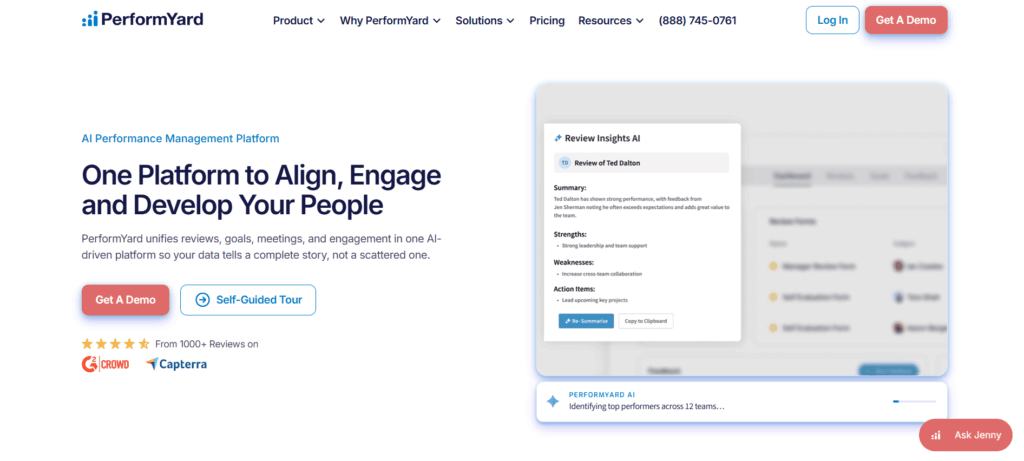
PerformYard is a dedicated performance-management platform with configurable 360 feedback.
Its 360 functionality supports peer reviews, upward feedback, self-assessments, anonymous feedback options, customizable questions, multi-stage workflows, automated reminders, and integration with broader performance-review cycles.
That flexibility can make it useful for manufacturers where different employee groups require different review processes.
Key features
- 360 feedback
- Peer reviews
- Upward feedback
- Self-assessments
- Anonymous feedback options
- Custom questions
- Configurable workflows
- Performance reviews
- Continuous feedback
- Goals
- One-on-ones
- Reporting
- AI-assisted summaries and workflows
Why manufacturers may consider PerformYard
Highly configurable
Organizations can create different processes for different roles or employee populations.
360 feedback sits within performance management
Feedback does not have to operate as an isolated survey.
It can become part of regular reviews, goals, and performance conversations.
Administrative automation
Automated reminders and completion tracking can reduce the manual work associated with coordinating many reviewers.
What to consider
PerformYard is a performance platform rather than a manufacturing workforce-management or frontline-operations system.
Manufacturers requiring extensive learning, certification, scheduling, or frontline communication capabilities will need those elsewhere.
Pricing
PerformYard currently uses custom pricing. Confirm the latest quote directly with the vendor.
Strong fit for: Manufacturers that want configurable 360 feedback within a dedicated performance-management platform.
8. Primalogik

Primalogik combines 360-degree feedback with performance reviews, goals and OKRs, instant feedback, and employee engagement tools.
Its positioning is simpler than many large enterprise platforms, making it particularly relevant to smaller and mid-size manufacturers that want multi-rater feedback without implementing a broad HCM suite.
Key capabilities
- 360-degree feedback
- Performance reviews
- Goals and OKRs
- Instant feedback
- Employee surveys
- Reporting
- Performance-management workflows
Why manufacturers may consider Primalogik
Straightforward performance suite
Companies can combine 360 feedback with more traditional employee-performance processes without adding a large enterprise platform.
Development-oriented use
Primalogik itself recommends keeping 360 feedback focused on professional development rather than directly tying it to salary or promotion decisions.
Suitable for smaller programs
The platform can make more sense for SMB and mid-market organizations than complex enterprise suites.
What to consider
Organizations requiring extensive learning, skills intelligence, frontline operations, or workforce-management functionality will likely need additional technology.
Pricing
Contact Primalogik for current pricing.
Strong fit for: Small and mid-market manufacturers that want 360 feedback and broader performance management without implementing enterprise HCM.
9. Trakstar Perform
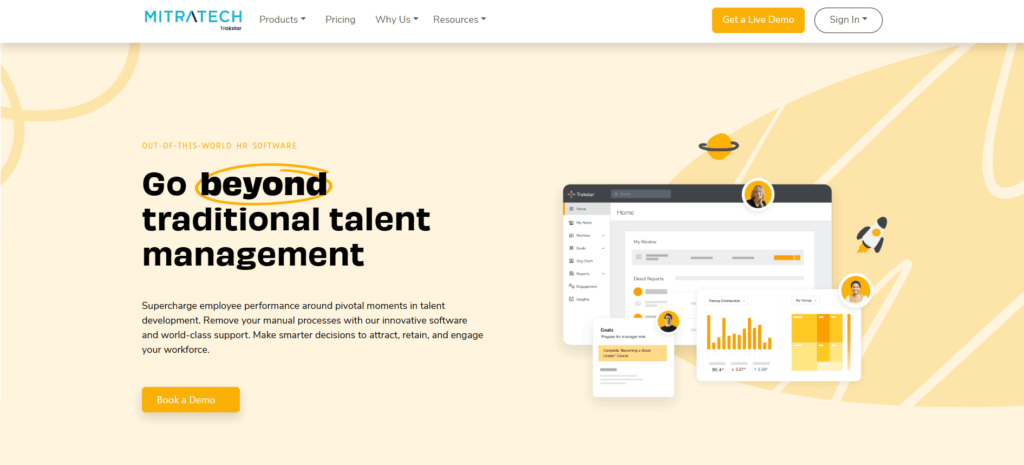
Trakstar Perform includes 360-Rater Feedback as part of its broader performance-management environment.
Managers can collect additional feedback from employees, managers, direct reports, and external respondents. Administrators can also configure feedback as anonymous; when full anonymity is enabled, Trakstar says administrators, managers, and Trakstar itself cannot identify which reviewer submitted which feedback.
Key features
- 360-Rater Feedback
- Anonymous feedback options
- Internal raters
- External respondents
- Performance reviews
- Goals
- Manager workflows
- Employee feedback sharing controls
- Reporting
- Review administration
Why manufacturers may consider Trakstar
Feedback works within performance reviews
360 input can become additional context for the employee’s broader evaluation rather than living in a separate assessment system.
External reviewers are supported
This can be useful for roles that collaborate with contractors, customers, or partners outside the organization.
Configurable anonymity
Organizations can control whether multi-rater feedback is anonymous or identifiable.
What to consider
Trakstar’s 360 workflow is closely tied to the manager and performance-review process.
Organizations looking primarily for standalone leadership-development assessments may prefer a dedicated 360 platform.
Manufacturers should also test the experience for deskless workers before a wide frontline rollout.
Pricing
Custom quote.
Strong fit for: Manufacturers looking for structured performance reviews with multi-rater feedback built into the process.
10. AssessTEAM
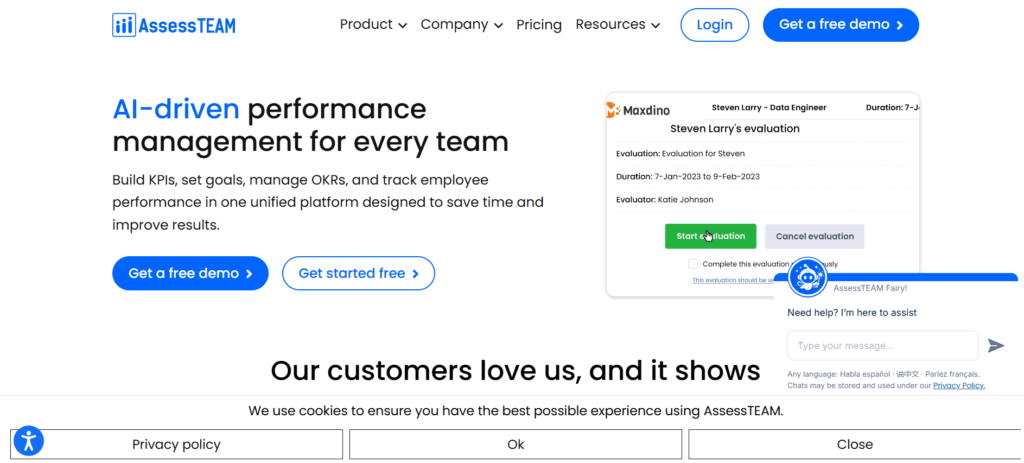
AssessTEAM takes a different approach from many platforms in this list.
Its employee-evaluation product combines KPI-based performance assessment with 360-degree feedback, mobile apps, goals, and job-based evaluation.
That can appeal to smaller manufacturers, maintenance teams, field operations, or other environments where organizations want a relatively inexpensive performance platform.
Key features
- 360-degree feedback
- KPI-based employee evaluations
- Continuous feedback
- AI-assisted KPI creation
- Goal setting
- Mobile apps for iOS and Android
- Employee directory
- Project-performance evaluation on higher plans
- Time tracking on higher plans
AssessTEAM publishes its pricing and currently lists its Evaluations plan at $2 per user per month when billed annually, with no minimum user count.
Why manufacturers may consider AssessTEAM
Low entry cost
Its published pricing makes it one of the easier platforms to budget for.
Mobile apps
Employees can access the platform through iOS and Android apps.
Job and KPI orientation
Manufacturers that prefer structured role- or KPI-based evaluations may find this approach useful.
What to consider
AssessTEAM does not offer the same depth of talent development, learning, skills management, or enterprise analytics available in larger platforms.
It may be better suited to relatively straightforward evaluation programs.
Pricing
When billed annually, AssessTEAM currently lists:
- Evaluations: $2/user/month
- Time Tracking: $3/user/month
- Profitability: $4/user/month
The company states that there is no minimum user count and recommends contacting sales for organizations with more than 100 employees.
Strong fit for: Smaller manufacturers or job-based teams that want affordable employee evaluations and 360 feedback.
What should manufacturers look for in 360 feedback software?
Choosing a platform is easier when you evaluate the workflow rather than the feature list.
Here are the areas that matter most.
1. Frontline access
Start by asking the vendor to demonstrate the feedback experience as an employee, not as an HR administrator.
Can a frontline worker complete the feedback comfortably from a mobile device?
How many steps does it take?
Does it require a company email address?
Do not assume a product is frontline-friendly simply because it has a mobile app.
Test the actual workflow.
2. Confidentiality controls
For upward feedback in particular, trust matters.
Ask:
- Can feedback be anonymous?
- Who can see individual responses?
- Can administrators identify reviewers?
- Can results be grouped by rater category?
- What happens when only one or two people in a group respond?
- Can specific rater groups be hidden?
Manufacturers with small shifts or crews should test these scenarios before rollout.
3. Role-specific competency frameworks
A maintenance supervisor and HR director should not automatically receive the same 360 questionnaire.
Look for software that lets you evaluate employees against competencies relevant to their roles.
For a production supervisor, that might include:
- Safety leadership
- Coaching
- Communication
- Accountability
- Conflict management
- Shift handoffs
- Problem-solving
- Team development
For senior leaders, the competency model may look completely different.
4. Language accessibility
Do not look only at how many languages the interface supports.
Ask whether:
- Questions can be translated
- Instructions can be translated
- Reports are available in different languages
- Open-ended comments can be handled effectively across languages
Employees need to understand the nuance of a question if you want useful feedback.
5. Simple reporting
A 40-page report is not automatically a good report.
Employees should be able to identify:
Where am I strongest?
Where do others see me differently from how I see myself?
What behaviors need attention?
What should I do next?
Reports that answer those questions clearly are more useful than reports filled with charts but no direction.
6. Connection to employee development
This is where manufacturers should pay particularly close attention.
Ask what happens when the feedback process identifies a development gap.
Can you:
- Create an Individual Development Plan?
- Assign learning?
- Create a goal?
- Connect an employee with a mentor?
- Build a coaching plan?
- Reassess the competency later?
The more manual work HR has to do after a 360 cycle, the greater the risk that results will never turn into meaningful development.
7. Administration at scale
One person’s 360 may involve five to ten reviewers.
Now multiply that across 100 supervisors.
The administrative workload grows quickly.
Look for:
- Automatic reminders
- Rater nomination workflows
- Completion tracking
- Bulk administration
- Reusable templates
- Automated reports
- AI-assisted summarization
- HR dashboards
The system should reduce administrative work rather than simply digitizing it.
360 feedback vs. performance reviews in manufacturing
These processes are related, but they are not the same.
| 360 Feedback | Performance Review | |
| Primary purpose | Development and broader perspective | Evaluate performance |
| Feedback sources | Manager, peers, reports, self, others | Usually manager + employee |
| Best for evaluating | Behaviors and competencies | Results and overall performance |
| Anonymity | Often useful | Usually not anonymous |
| Development focus | High | Varies |
| Typical frequency | Periodic | Annual, semiannual, or continuous |
| Common use | Leadership and development | Performance and talent decisions |
For example:
A performance review might answer:
Did this production supervisor hit their team’s quality, safety, attendance, and output targets?
A 360 review might answer:
How effectively does this supervisor communicate, coach employees, resolve problems, build trust, and collaborate with other functions?
Manufacturers often gain more value by using the two approaches together rather than trying to make one replace the other.
How to choose the right 360 feedback software for your manufacturing company
Start with four questions.
Who will receive 360 feedback?
If you’re only assessing senior leaders and plant managers, a specialist platform such as Spidergap may be enough.
If you want feedback to become part of a broader employee-performance and development process, platforms such as Engagedly, PerformYard, or a larger HCM system may make more sense.
Who will provide feedback?
This is particularly important in manufacturing.
If most raters are corporate employees with laptops, nearly any cloud-based platform can handle the basic workflow.
If many raters are operators, technicians, or shift workers, test mobile access much more carefully.
What should happen after the assessment?
If the answer is:
“The employee receives a report.”
you are only solving half of the problem.
Decide whether the feedback should lead to:
- Coaching
- Learning
- Development goals
- Mentoring
- Skill development
- Succession planning
- Follow-up assessments
Then evaluate platforms based on that workflow.
What systems do you already use?
Manufacturers already using SAP or UKG may benefit from evaluating the capabilities available within their existing technology environment first.
That could reduce integrations, additional vendors, and administrative complexity.
But existing-vendor convenience should not be the only deciding factor.
Make sure the actual feedback experience meets your needs.
Best practices for running 360 feedback in manufacturing
Software matters, but process design matters just as much.
Start with supervisors and managers
For many manufacturers, frontline leadership is a practical first use case.
Supervisors sit between HR, operations, and frontline workers, so gaps in communication or leadership are often highly visible to the people around them.
Explain exactly how feedback will be used
Employees should understand:
- Why you’re running the assessment
- Who will see their responses
- Whether responses are anonymous
- How the results will be used
- Whether feedback affects pay or promotions
Ambiguity undermines trust.
Do not collect feedback from people who barely work together
More raters do not automatically produce better results.
Choose reviewers who have enough interaction with the employee to observe the behaviors being assessed.
Keep the questionnaire focused
Employees are much more likely to provide useful feedback on 25 thoughtful questions than 80 repetitive ones.
Every question should connect to a competency or behavior that matters.
Give managers support when reviewing the report
Feedback can be difficult to interpret.
Managers should help employees separate:
- Consistent patterns
- One-off opinions
- Genuine blind spots
- Existing strengths
- Actionable development opportunities
Always create a follow-up plan
A good 360 conversation should end with two or three clear development priorities.
Those priorities can then become goals, training, coaching, mentoring, or development-plan activities.
That is where the actual value of the process begins.
Frequently asked questions about 360 feedback software for manufacturing
What is 360 degree feedback software?
The software can manage reviewer selection, questionnaires, reminders, confidentiality, reporting, and development workflows.
What is the best 360 degree feedback software for manufacturing?
Engagedly is worth considering when 360 feedback needs to connect with performance, skills, learning, mentoring, and employee development.
Spidergap is designed specifically around 360 assessments and leadership development.
Qualtrics provides advanced enterprise analytics.
SAP SuccessFactors and UKG may make more sense for organizations already using those ecosystems.
PerformYard, Primalogik, Trakstar, and AssessTEAM provide additional options for organizations with different performance-management requirements and budgets.
Can frontline manufacturing workers participate in 360 feedback?
However, participation becomes much easier when the software supports mobile-friendly workflows and does not require employees to spend significant time at a desktop computer.
Manufacturers should test the employee experience with actual frontline users before rolling out a large program.
How can manufacturers keep 360 feedback anonymous?
For small teams, also consider how feedback is grouped and what happens when only a very small number of people respond.
Employees should understand the anonymity rules before providing feedback.
Should 360 feedback be anonymous?
Upward and peer feedback is often anonymized to encourage employees to provide candid responses.
Manager feedback does not always need to be anonymous.
Organizations should decide the rules before launching the program and communicate them clearly.
Should 360 feedback affect compensation?
If employees believe every response could directly affect someone’s compensation or promotion, they may begin rating strategically instead of candidly.
Organizations that intend to use multi-rater feedback in employment decisions should design and communicate the process carefully.
How often should manufacturers conduct 360 feedback?
A full assessment may be conducted annually or as part of a specific leadership-development program.
The right frequency depends on the purpose, employee population, and ability to act on the results.
Running assessments more frequently does not create more value if employees do not have enough time to act on the previous feedback.
Can 360 feedback identify future supervisors and leaders?
Feedback from managers, peers, and direct reports can show how employees are perceived across competencies such as communication, leadership, collaboration, accountability, and coaching.
However, 360 feedback should normally be considered alongside performance data, skills, experience, aspirations, and other talent information rather than used as the only succession criterion.
What is the difference between 360 feedback and employee surveys?
360 feedback evaluates an individual by collecting feedback from people who work with them.
They serve different purposes.