











Ask a plant manager how good work gets recognized, and you may hear familiar examples: a safety milestone banner near the entrance, a pizza lunch after a strong quarter, or a service award handed out after 10 years.
Those occasions deserve recognition.
But they can miss the employee who spotted a bearing about to fail on the night shift, alerted a supervisor, and helped prevent a much bigger production problem.
That is the recognition gap in manufacturing.
Recognition can arrive too late, too broadly, or only for major milestones. Across plants and shifts, that gap can take several forms:
- Visibility: Day shift employees have more contact with leadership, while night and weekend crews receive less attention.
- Access: Recognition shared through email or an intranet may never reach frontline employees who rarely use either.
- Process: Supervisors put off acknowledging good work when it requires forms, approvals, or HR involvement.
- Consistency: One plant recognizes contributions regularly, while another relies on occasional events.
A team celebration can acknowledge a strong result. Individual recognition tells employees what they did well and why it mattered.
That is where employee recognition software for manufacturing can help. It makes it easier to acknowledge good work when it happens and share it across plants and shifts.
A supervisor should be able to recognize someone from the floor using a phone, without submitting an HR request or waiting for the next company meeting. Employees should also be able to recognize colleagues and choose rewards they value.
The right platform gives HR visibility into how recognition is distributed, helping leaders answer a bigger question:
Who is being recognized, and who is consistently being overlooked?
Here are 10 employee recognition software platforms worth considering for manufacturing teams in 2026.
Best Employee Recognition Software for Manufacturing: Quick Comparison
| Platform | Best for | Frontline access | Rewards & recognition | Pricing |
| Engagedly | Connecting recognition with performance, learning, goals, and engagement | Mobile-friendly | Points, praise, badges and milestones | Quote-based/modules vary |
| Achievers | Large, distributed manufacturing workforces | Strong mobile support | Global marketplace, social recognition and milestones | Custom quote |
| Workhuman | Enterprise recognition and workforce insights | Mobile access | Monetary/social recognition and global rewards | Custom quote |
| Awardco | Manufacturers prioritizing reward choice | Mobile-friendly | Large Amazon Business-powered reward network | Custom quote |
| O.C. Tanner | Service awards and career milestones | Mobile and digital access | Symbolic awards, milestones and rewards | Custom quote |
| Nectar | Mid-market recognition and engagement programs | Mobile-friendly | Peer recognition, rewards and challenges | Custom quote |
| Guusto | Frontline workers without corporate email | SMS, QR, print and mobile | Rewards, milestones and recognition | Free tier; paid plans available |
| Kudos | Values-based employee recognition | Mobile-friendly | Recognition, rewards and milestones | Custom quote |
| Terryberry | Digital recognition plus physical awards | Mobile-first options | Recognition, symbolic awards and incentives | Custom quote |
| Bonusly | Simple peer-to-peer recognition | Mobile app | Points, rewards and automated milestones | Free; paid plans available |
What Should Manufacturers Look for in Employee Recognition Software?
Manufacturing environments have different requirements from desk-based organizations. Before comparing platforms, consider these questions.
1. Can frontline employees access it easily?
Employees should not need a laptop or corporate email address every time they want to participate.
Look for mobile access, employee-ID login, SMS, QR codes, kiosks, shared-device support, or other frontline-friendly options.
2. Can managers recognize employees in real time?
Recognition works better when it happens close to the contribution.
A supervisor should be able to recognize an employee after a safety improvement, production milestone, customer win, training achievement, or example of strong teamwork without completing a lengthy process.
3. Can recognition work across multiple plants and shifts?
A manufacturing company should be able to identify whether recognition is concentrated among particular locations, departments, managers, or shifts.
This becomes especially important for night and weekend employees who may have less interaction with senior leadership.
4. Does the platform support meaningful rewards?
Consider gift cards, merchandise, physical rewards, experiences, company rewards, charitable donations, and locally relevant options.
Reward availability can matter considerably for geographically distributed workforces.
5. Can it handle different types of recognition?
Manufacturers may need several programs, including:
- Peer-to-peer recognition
- Manager recognition
- Safety achievements
- Production milestones
- Values-based recognition
- Service anniversaries
- Training completion
- Employee-of-the-month programs
- Spot awards
A platform that supports several programs can reduce the need to manage separate processes.
6. Can you measure participation?
HR teams should be able to understand who is receiving recognition, which managers are participating, and whether certain teams or locations are being overlooked.
1. Engagedly
Best for: Manufacturers that want recognition connected with performance, learning, goals, and employee engagement.
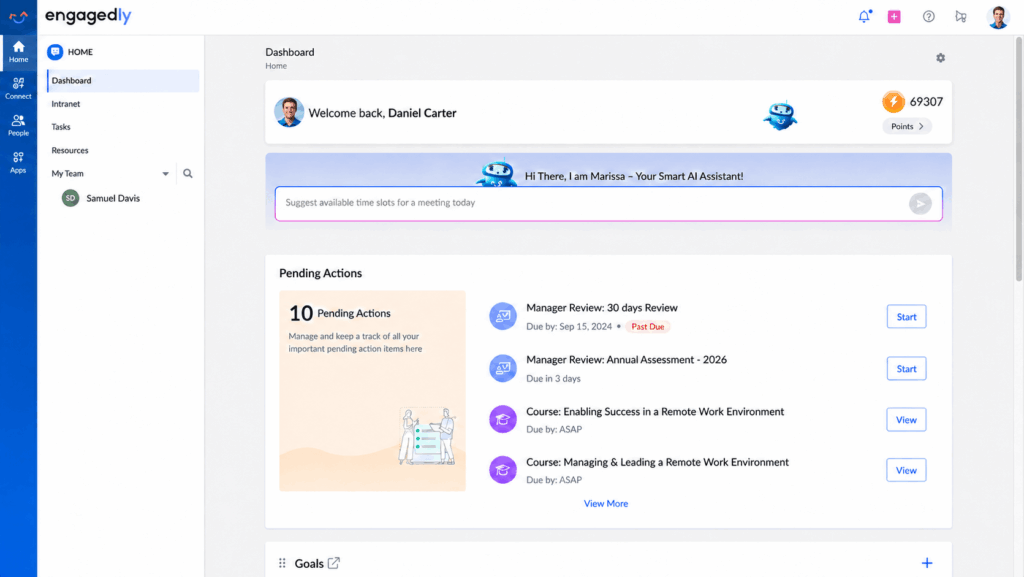
Engagedly, an Energage company, is an AI-powered talent management platform built to connect performance, engagement, learning, growth, and recognition in one unified experience. Powered by Marissa, its AI SuperAgent, and insights from Top Workplaces Institute, Engagedly helps organizations turn people strategies into intelligent actions and measurable business outcomes.
For manufacturers, Engagedly takes a broader approach to employee recognition by connecting it with other aspects of the employee experience rather than treating it as an isolated rewards tool. Employees and managers can use recognition alongside performance management, goals and OKRs, learning, feedback, surveys, and development programs.
For example, employees can be recognized for training new operators, consistently demonstrating company values, achieving production goals, or completing important development milestones. These activities can also inform performance and development conversations, giving HR teams a more connected view of employee contributions, growth, and engagement across plants and shifts.
This integrated approach helps manufacturers reduce talent silos, strengthen employee engagement, support retention, and build high-performing teams.
Key features
- Peer-to-peer recognition
- Manager-to-employee recognition
- Public praise and feedback
- Points-based rewards
- Badges and gamification
- Milestone recognition
- Mobile access
- Recognition tied to organizational values
- Performance management
- Goals and OKRs
- Learning management
- Employee surveys and feedback
- 360-degree feedback
Where Engagedly stands out
The primary advantage is integration. Recognition can operate as part of a broader talent strategy rather than becoming another standalone application employees need to remember to use.
This may be especially valuable for manufacturing organizations already looking to improve performance management, frontline learning, employee feedback, or goal alignment.
Considerations
Manufacturers that only want a lightweight rewards application may find a dedicated recognition platform simpler.
Companies primarily focused on extremely large reward catalogs or highly customized physical service awards may also want to compare specialist vendors.
Pricing
Engagedly offers modular pricing based on employee count and selected products. Organizations should request pricing based on their workforce size and required modules.
2. Achievers
Best for: Large manufacturers with distributed or global workforces.
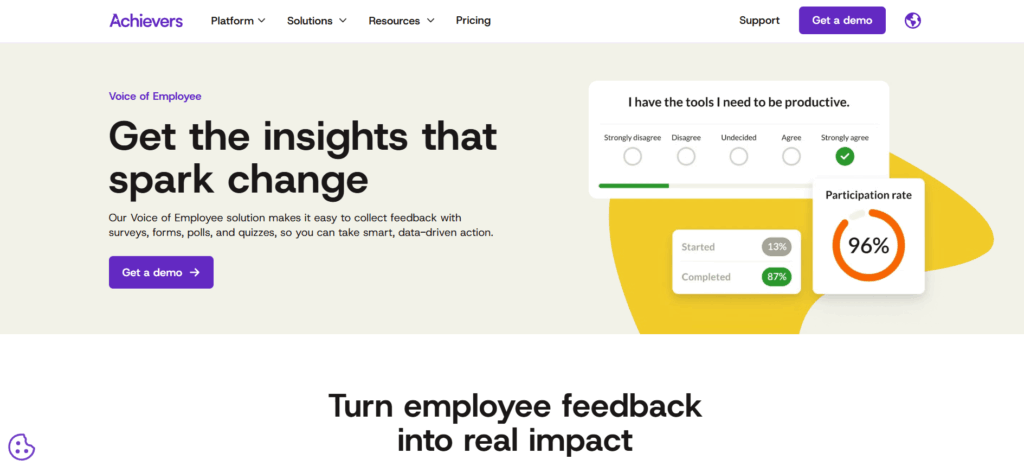
Achievers is an established employee recognition platform designed for organizations running recognition programs at scale.
Its platform supports both monetary and non-monetary recognition, employee milestones, nomination programs, global rewards, mobile access, and analytics.
For manufacturing companies with employees spread across numerous sites or countries, the ability to deliver a relatively consistent recognition experience across different locations can be particularly valuable.
Achievers also offers integrations with major HCM platforms, which can simplify administration for larger organizations.
Key features
- Peer and manager recognition
- Monetary and non-monetary awards
- Global rewards marketplace
- Service anniversaries
- Employee milestones
- Nomination-based awards
- Mobile and desktop access
- Recognition newsfeed
- Analytics and reporting
- HCM integrations
- Multi-language support
Where Achievers stands out
Its scale and global capabilities make it particularly relevant to manufacturers managing large employee populations across regions.
Considerations
The platform is primarily positioned toward larger organizations. Smaller manufacturers may find simpler tools easier to implement and manage.
Pricing
Achievers provides custom pricing based on organizational requirements.
3. Workhuman

Best for: Large enterprises looking for recognition combined with deeper workforce insights.
Workhuman is one of the more established enterprise recognition platforms and focuses heavily on social recognition, rewards, employee connection, and recognition data.
Employees can recognize colleagues while organizations manage award budgets, approvals, program participation, and global reward distribution.
Workhuman also connects recognition with performance conversations and uses recognition data to generate workforce insights.
That can make the platform particularly relevant to large manufacturers that want recognition data to provide more than participation metrics.
Key features
- Peer-to-peer recognition
- Monetary and non-monetary awards
- Social recognition feeds
- Global employee rewards
- Service milestones
- Recognition analytics
- Award approval workflows
- Budget management
- Microsoft Teams and Slack integrations
- Workday integration
- Performance conversations
- Recognition-based workforce insights
Where Workhuman stands out
Workhuman is particularly strong when recognition is expected to become a substantial enterprise program rather than a lightweight HR initiative.
Considerations
Its enterprise orientation can make implementation and program governance more involved than with simpler recognition tools.
Organizations should also assess the overall recognition and rewards budget required to drive participation.
Pricing
Pricing is provided through consultation with Workhuman.
4. Awardco

Best for: Manufacturers that want employees to have a wide choice of rewards.
Awardco places considerable emphasis on the rewards experience.
Its integration with Amazon Business gives employees access to a large range of merchandise and other reward options while Awardco promotes zero markup on Amazon Business rewards.
That breadth can be useful in manufacturing environments where employee preferences can vary significantly across roles, locations, age groups, and shifts.
The platform can also support different recognition programs, including employee achievements, service milestones, incentives, and peer recognition.
Key features
- Peer and manager recognition
- Amazon Business reward integration
- Merchandise and gift-card rewards
- Zero-markup Amazon Business rewards
- Employee milestones
- Service awards
- Incentive programs
- Approval workflows
- Recognition budgets
- Reporting and analytics
- Global reward options
Where Awardco stands out
Reward flexibility is the main differentiator.
Rather than limiting employees to a small curated catalog, manufacturers can provide substantially more choice.
Considerations
Companies whose priority is deeper talent management, learning, performance management, or employee listening may need additional platforms alongside Awardco.
Pricing
Awardco provides custom pricing based on plan and program requirements.
5. O.C. Tanner
Best for: Manufacturers with long-tenure workforces and established service-award programs.
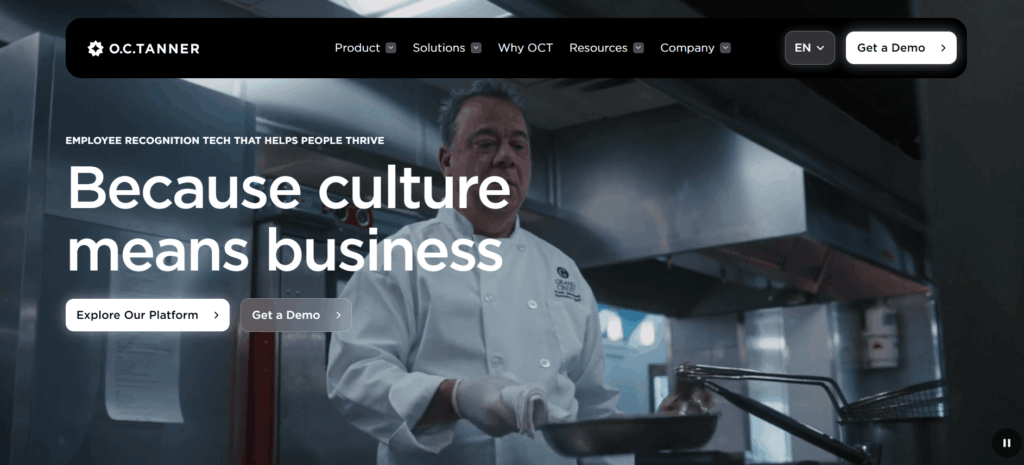
O.C. Tanner has a particularly strong focus on career milestones, symbolic recognition, and service awards.
That can make it relevant for established manufacturing companies where employees frequently remain with the organization for 10, 20, or even 30 years.
Its Culture Cloud platform combines digital recognition with anniversary programs, personalized awards, employee celebrations, global fulfillment, and physical recognition experiences.
Key features
- Peer and manager recognition
- Employee service awards
- Career anniversary programs
- Personalized Yearbooks
- Custom symbolic awards
- Social recognition feed
- Reward points
- Global award fulfillment
- Employee milestone automation
- Recognition analytics
Where O.C. Tanner stands out
O.C. Tanner offers considerably more depth around major career milestones and symbolic awards than many software-first recognition tools.
Considerations
Organizations primarily looking for quick, lightweight peer recognition may not require the depth of its service-award ecosystem.
Manufacturers should compare the complete program cost rather than looking only at software fees.
Pricing
O.C. Tanner provides customized pricing based on program scope and services.
6. Nectar
Best for: Mid-market organizations looking for straightforward recognition and rewards.
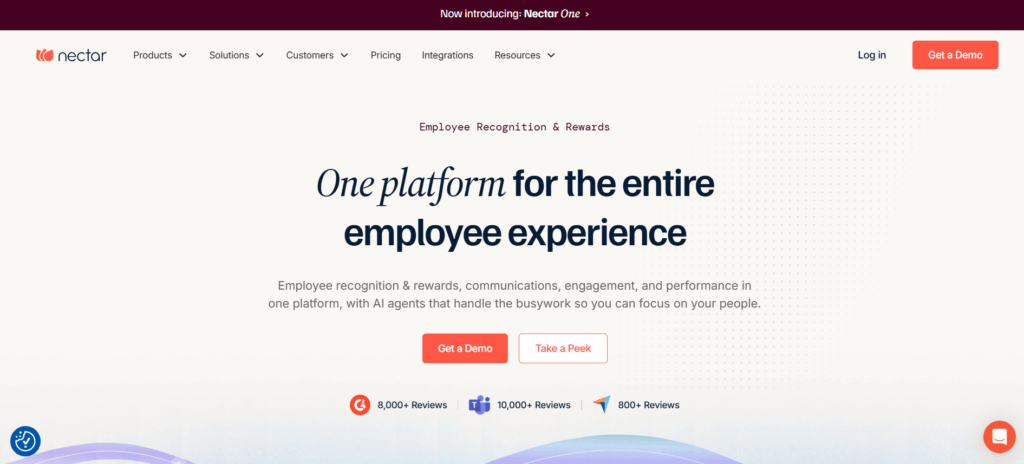
Nectar provides employee recognition, rewards, engagement, and communication capabilities within one platform.
Employees can recognize colleagues based on company values, while managers can automate milestones and create challenges around organizational priorities.
For manufacturers, challenges can potentially be used to reinforce behaviors around safety, wellness, training, or other internal initiatives.
Combining recognition with employee communications may also be useful for organizations trying to improve engagement among distributed teams.
Key features
- Peer-to-peer recognition
- Manager recognition
- Values-based recognition
- Employee rewards
- Company swag
- Milestone automation
- Employee challenges
- Internal communications
- Mobile access
- Participation reporting
- Recognition analytics
Where Nectar stands out
It provides a practical middle ground between lightweight recognition applications and large enterprise recognition platforms.
Considerations
Companies requiring highly advanced workforce analytics or complex global reward programs may find enterprise platforms more suitable.
Pricing
Nectar currently provides customized pricing depending on the products and program configuration selected.
7. Guusto

Best for: Frontline manufacturing teams with limited access to corporate email or HR systems.
Guusto is particularly relevant when accessibility is the biggest obstacle to employee recognition.
The platform supports recognition through email, SMS, mobile, QR codes, and printable rewards. Employees can therefore receive recognition even when they do not have a corporate email account or regularly use company software.
That flexibility can be useful for production workers, contractors, warehouse employees, technicians, and other deskless roles.
Guusto also takes a somewhat different approach to pricing by distinguishing between employees who send recognition and those who primarily receive it.
Key features
- Employee rewards
- Peer-to-peer recognition
- Manager recognition
- SMS delivery
- QR-code rewards
- Printable rewards
- Mobile app
- Employee milestones
- Recognition automation
- Social recognition feeds
- Budget controls
- Recognition reporting
Where Guusto stands out
Its multiple recognition delivery methods make it one of the more interesting options for workers who do not regularly access corporate systems.
Considerations
Organizations looking for a broader talent management suite covering performance, learning, goals, succession planning, and other HR processes will need additional tools.
Pricing
Guusto offers a free option. Its Lite plan starts at $150 per month, while higher tiers use sender and recipient seat pricing with minimum monthly commitments.
8. Kudos

Best for: Organizations that want recognition strongly connected to company values and culture.
Kudos focuses on helping organizations make recognition meaningful rather than simply increasing the number of recognition messages employees send.
Recognition can be connected to company values, while employees can access rewards including merchandise, gift cards, experiences, charitable options, and other locally relevant choices.
For manufacturers trying to reinforce specific behaviors or cultural principles across multiple facilities, values-based recognition can provide a consistent framework.
Key features
- Peer recognition
- Manager recognition
- Values-based recognition
- Employee rewards
- Social recognition
- Employee milestones
- Recognition analytics
- Multi-language support
- Mobile access
- Configurable reward catalogs
Where Kudos stands out
Its culture-oriented approach can work well for companies where the objective is reinforcing behaviors and organizational values rather than simply distributing points.
Considerations
Manufacturers focused primarily on safety incentives, physical service awards, or deeply integrated talent management may prefer platforms specializing in those areas.
Pricing
Kudos uses custom pricing based on organizational requirements.
9. Terryberry
Best for: Manufacturers that want to combine digital recognition with physical awards.
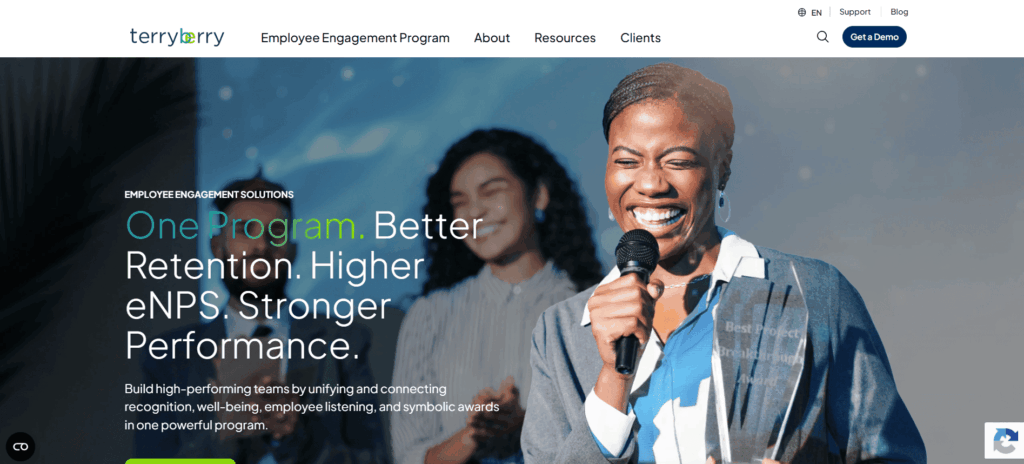
Terryberry combines modern employee recognition software with a long history of creating physical and symbolic employee awards.
Employees can participate through digital recognition programs while organizations can also provide physical awards for service anniversaries, career achievements, safety milestones, or other significant contributions.
This combination can suit manufacturing environments where tangible recognition continues to carry importance alongside digital recognition.
Key features
- Peer and manager recognition
- Mobile recognition
- Employee service awards
- Custom physical awards
- Symbolic recognition
- Safety incentive programs
- Employee milestones
- Reward options
- Recognition program support
- Employee engagement capabilities
Where Terryberry stands out
Its combination of software and physical recognition gives manufacturers more flexibility in designing programs for both everyday achievements and major milestones.
Considerations
Organizations looking primarily for advanced talent analytics or performance-management integration may need additional HR technology.
Pricing
Terryberry provides customized pricing based on the recognition programs and services selected.
10. Bonusly

Best for: Organizations that want a simple peer-to-peer recognition program that can be launched quickly.
Bonusly provides a straightforward recognition model in which employees can recognize peers and award points that can later be redeemed for rewards.
Its relatively simple interface and integrations with common workplace tools can make adoption easier for organizations that do not need a complex enterprise recognition program.
Bonusly also includes automated milestone celebrations, mobile applications, analytics, and HRIS integrations on its paid plans.
Key features
- Peer-to-peer recognition
- Points-based rewards
- Automated milestones
- Recognition analytics
- Mobile apps
- HRIS integrations
- Microsoft Teams integration
- Slack integration
- Employee announcements on higher tiers
- Recognition and engagement tools
Where Bonusly stands out
Simplicity is its biggest advantage. Organizations can implement a basic recognition program without building a highly complex recognition infrastructure.
Considerations
Manufacturers with large populations of employees who do not use company email, Slack, Teams, or other digital workplace tools should carefully test frontline access before rollout.
Pricing
Bonusly offers a free plan for up to eight users. Its Team plan is currently listed at $5 per user per month, with custom pricing available for larger organizations.
Which Employee Recognition Software Is Best for Manufacturing?
There is no single platform that is the right fit for every manufacturer.
The best choice depends primarily on how your workforce works and what you want recognition to accomplish.
| If your priority is… | Platforms worth considering |
| Connecting recognition with performance, learning and goals | Engagedly |
| Large-scale global recognition | Achievers, Workhuman |
| Extensive employee reward choice | Awardco |
| Long-service and career milestone recognition | O.C. Tanner, Terryberry |
| Reaching employees without corporate email | Guusto |
| Mid-market recognition and engagement | Nectar |
| Values-based culture recognition | Kudos |
| Simple peer-to-peer recognition | Bonusly |
Manufacturers should avoid selecting software based solely on the size of the reward catalog or the number of recognition features.
The more important question is whether employees and supervisors will actually use the platform across every shift and location.
How to Choose Employee Recognition Software for Manufacturing
Start with frontline accessibility
Before comparing reward catalogs or analytics dashboards, determine how employees will access the platform.
If most operators do not have corporate email accounts or company laptops, test the frontline experience during the product demonstration.
Ask vendors to demonstrate exactly how a production employee would:
- Log in.
- Recognize a colleague.
- Receive recognition.
- Redeem a reward.
- Check their recognition history.
Do not rely solely on an administrator demonstration.
Look at recognition across shifts
Recognition can easily become concentrated among employees who work during traditional office hours.
Ask whether reporting can identify participation differences across locations, departments, managers, and employee groups.
This can help HR identify plants or teams where recognition is not happening consistently.
Decide what you want to recognize
Different programs may require different capabilities.
A manufacturer might want to recognize:
- Safe working behaviors
- Continuous improvement ideas
- Training achievements
- Production milestones
- Quality improvements
- Teamwork
- Leadership
- Company values
- Customer service
- Career milestones
Define these use cases before evaluating software.
Understand the complete cost
Recognition software typically includes two separate costs:
Platform cost: What you pay for the technology.
Reward budget: What you allocate for employee rewards.
There may also be implementation, fulfillment, shipping, integration, or program-management costs.
Ask each vendor to provide the expected annual cost based on your workforce size and expected reward usage.
Run a pilot before expanding company-wide
For a multi-plant organization, consider starting with one facility, department, or business unit.
Measure:
- Employee participation
- Manager participation
- Recognition frequency
- Reward redemption
- Mobile adoption
- Recognition across shifts
- Employee feedback
These insights can help improve the program before expanding it across the organization.
Why Employee Recognition Is Different in Manufacturing
Manufacturing recognition programs face challenges that are less common in desk-based workplaces.
Employees are spread across shifts
Leadership may regularly interact with the day shift while having far less visibility into evenings, nights, and weekends.
Digital recognition can help make achievements visible beyond the employee’s immediate shift.
Many employees are deskless
Production employees may not use email, Slack, Microsoft Teams, or a company laptop during their working day.
Recognition therefore needs to be available through channels employees can realistically access.
Recognition needs to happen quickly
A supervisor who sees an employee prevent a safety issue or solve a production problem should be able to recognize that contribution while it is still relevant.
If the process requires paperwork or HR approval, recognition is more likely to be delayed or forgotten.
Plants can develop different recognition cultures
One facility may have managers who recognize employees frequently while another may rarely do so.
Centralized recognition software can give HR better visibility into these differences.
Final Thoughts
The best employee recognition software for manufacturing is not necessarily the platform with the biggest rewards catalog or the longest feature list.
It is the platform employees and supervisors can realistically use across plants, production lines, locations, and shifts.
Achievers and Workhuman provide extensive capabilities for large enterprise recognition programs. Awardco is notable for reward choice, while O.C. Tanner and Terryberry are particularly relevant for organizations with established service-award programs. Guusto offers flexible options for reaching employees without traditional corporate accounts, while Nectar, Kudos, and Bonusly provide different approaches to everyday employee recognition.
For manufacturers that want recognition to connect with performance management, learning, goals, feedback, and employee development, Engagedly offers a broader talent-management approach rather than treating recognition as a standalone program.
Whichever platform you choose, start with one question:
Can every employee – from the corporate office to the night shift on the plant floor – participate easily?
If the answer is no, even the most feature-rich recognition platform is unlikely to deliver the participation you need.
FAQs About Employee Recognition Software for Manufacturing
What is employee recognition software for manufacturing?
The most appropriate option depends on whether an organization prioritizes performance reviews, OKRs, employee engagement, manager development, learning, or broader talent management.
What is the best employee recognition software for manufacturing?
Engagedly is worth considering when recognition needs to connect with performance management, learning, goals, feedback, and employee engagement.
Achievers and Workhuman are designed for larger enterprise programs, while Guusto provides flexible options for reaching frontline employees. Awardco emphasizes employee reward choice, and O.C. Tanner and Terryberry provide strong service-award capabilities.
How can manufacturers recognize employees without company email addresses?
Mobile apps
SMS
QR codes
Employee-ID authentication
Printable reward codes
Shared devices
Manager-assisted recognition
The correct approach depends on how employees already access workplace technology.
Can recognition software work across multiple manufacturing plants?
Many recognition platforms allow organizations to manage employees across multiple locations and provide centralized reporting.
Manufacturers should look for reporting that can segment recognition activity by location, department, manager, or employee group to identify participation gaps.
Can employee recognition software be used for safety programs?
Manufacturers can use recognition programs to reinforce safe behaviors, safety improvements, reporting, training completion, and other safety-related achievements.
However, recognition should complement – not replace – formal safety management, training, reporting, and compliance processes.
Should manufacturers use monetary or non-monetary recognition?
Non-monetary recognition such as public praise can make achievements visible and reinforce desired behaviors, while rewards can provide additional tangible value.
The appropriate balance depends on workforce preferences, budget, culture, and the type of achievement being recognized.
How much does employee recognition software cost?
Some platforms charge per employee per month, while enterprise vendors provide custom quotes. Organizations may also need a separate budget for gift cards, merchandise, service awards, or other employee rewards.
Manufacturers should compare the total annual program cost, not only the software subscription.
What metrics should manufacturers track?
Recognition participation rate
Recognition frequency
Percentage of employees receiving recognition
Manager participation
Peer-to-peer recognition activity
Reward redemption rate
Recognition by location
Recognition by department
Recognition across shifts
Recognition tied to company values
These metrics help HR determine whether recognition is reaching the workforce consistently.