Lattice vs Culture Amp is a comparison between two of the most recognized employee experience platforms on the market today. Lattice is built primarily around performance management, goal tracking, and AI-driven talent development, while Culture Amp is built around engagement surveys, people science, and organizational feedback. Both platforms have expanded into each other’s territory over the past year, so the real difference in 2026 comes down to which capability your organization wants to lead with.
Employee experience and performance are closely linked, and both drive innovation, retention, and business growth. Global employee engagement fell to just 20% in 2025, down from a peak of 23% in 2022, and low engagement now costs the world economy roughly $10 trillion a year in lost productivity, according to Gallup’s 2026 State of the Global Workplace report. That kind of gap is exactly why HR leaders keep comparing platforms like Lattice and Culture Amp before they commit budget to one.
This guide breaks down Lattice vs. Culture Amp for 2026, covering features, official pricing, ratings, and the biggest platform changes from the past year, so you can make a decision based on what each vendor actually offers today, not what they offered a year ago.
Lattice vs. Culture Amp: Market Snapshot
The employee engagement software category keeps growing as more companies formalize their people strategy. The global market was valued at USD 1,049.9 million in 2024 and is projected to reach USD 2,608.3 million by 2030, growing at a CAGR of 16.4% from 2025 to 2030, according to Grand View Research. That growth is why the two vendors keep adding AI features and overlapping into each other’s core categories.
Both platforms share a similar set of building blocks:
Goal-Setting and OKR Alignment: Both platforms let organizations set Objectives and Key Results so employees stay aligned with company priorities. Engagedly’s own OKRs and Goals module works on the same principle, tying individual goals to business outcomes.
Integrations: Both connect with HRIS tools, Slack, and Microsoft Teams to keep workflows in one place.
Performance Benchmarks: Both surface performance metrics that flag where an employee or team needs support.
Pulse and Engagement Surveys: Both run customizable surveys that feed into action plans.
Data-Driven Decision Making: Both provide analytics dashboards for HR teams to track outcomes in real time.
Structured Review Processes: Both automate review cycles to cut down on administrative work.
What Is Lattice?
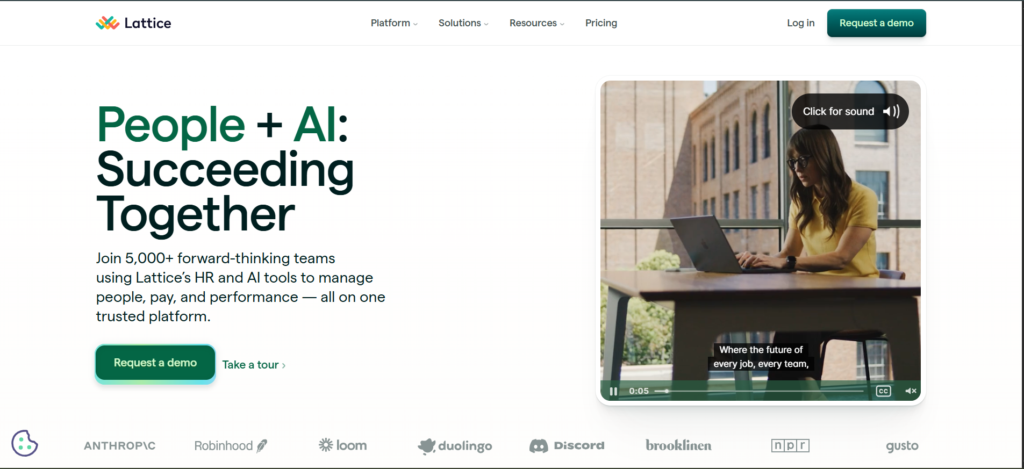
Lattice launched in 2015 and grew into one of the leading performance management platforms on the market. Its stated mission is to help organizations connect people strategy to business strategy, and it now brands itself as a “People + AI platform.” In 2026, Lattice made its biggest structural change since launch: it discontinued its HRIS and payroll products to refocus entirely on its Talent Suite. Payroll access ended March 31, 2026, and HRIS access ended July 31, 2026, following a new partnership that connects Lattice’s Talent Suite with Workday HCM. This means Lattice now positions itself as a performance and engagement layer that sits on top of an existing HRIS rather than a full HR system of record.
Lattice Features in 2026
Lattice’s current platform is organized around a few core products:
Performance Reviews, Talent Reviews, and PIPs: Customizable review templates, calibration tools, and structured performance improvement plans for managers.
Goals & OKRs: Cascading goals tied to business outcomes, with progress tracking and integrations like Jira and Salesforce.
Engagement: Pulse surveys, onboarding and exit surveys, eNPS, and AI-based trend analysis.
Grow and Compensation: Career tracks, individual development plans, and comp planning tools sold as add-ons.
AI Agent: An AI layer that answers HR questions, summarizes reviews, and coaches managers directly inside the flow of work.
1:1s, Feedback, and Updates: Manager tools bundled into every core product.
Lattice Pricing (2026)
According to Lattice’s own pricing page, the platform is sold in modular, per-seat packages billed annually, with a minimum annual commitment of $4,000. Its most popular package, Foundations, includes 1:1s, weekly updates, feedback, and Q&A boards for $13 per seat per month. The individual products break down as follows:
Performance: $10/seat/month
Goals & OKRs: $8/seat/month (also available unbundled at $8/month)
Engagement: $4/seat/month
Compensation (add-on): +$6/seat/month
Grow (add-on): +$4/seat/month
Enterprise: Custom pricing based on seats and scale
Lattice bills only in USD, on an annual basis, and there is no published free trial.
What Is Culture Amp?
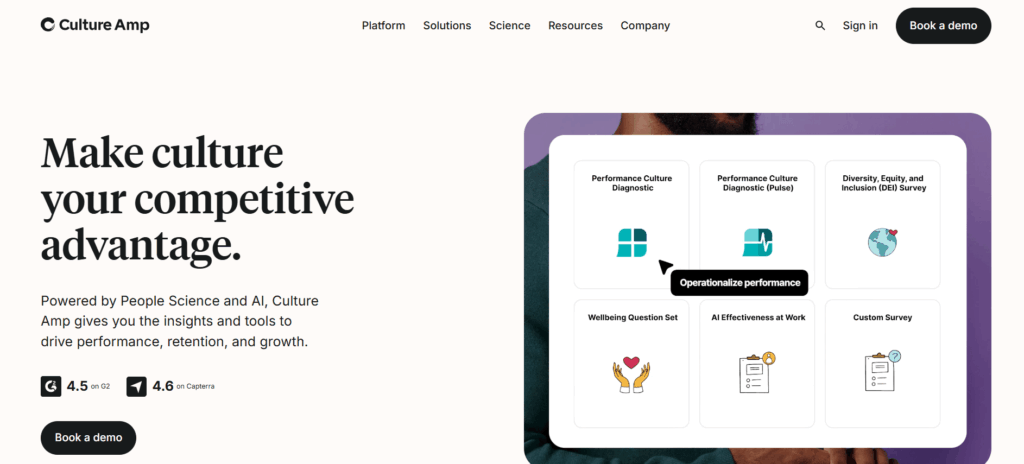
Culture Amp was founded in 2009 in Melbourne as an anonymous employee feedback tool and has since grown into a full people science and performance platform. Its mission centers on helping organizations build more engaged, inclusive workplaces using data and behavioral science.
In 2026, Culture Amp streamlined its product lineup around two core pillars, Engage and Perform, with AI Coach now built into both rather than sold as a separate add-on. The Performance Culture Quadrant, a newer diagnostic survey, was also added to the Engage suite this year.
Culture Amp Features in 2026
Engage: Customizable surveys for engagement, DEI, onboarding, and exit, plus benchmarking against Culture Amp’s dataset.
Perform: Continuous feedback, performance reviews and calibration, 1-on-1 conversations, goal management, and 360-degree effectiveness surveys.
AI Coach: Built into both Engage and Perform, it turns survey and performance data into instant insights and manager coaching, comparable in spirit to Engagedly’s Real-Time Feedback tools.
People Science Consulting: An add-on service pairing customers with I/O psychologists for change management and program design.
Every plan includes: SSO and encryption, HRIS integrations, Slack and Microsoft Teams integrations, multilingual support, and SOC 2 and GDPR compliance.
Culture Amp Pricing (2026)
Culture Amp does not publish per-seat dollar pricing on its official site. According to Culture Amp’s own plans and pricing page, pricing depends on the number of employees, product chosen, and service tier, with every plan billed annually and priced through a custom quote. Visit their platform page for pricing details rather than relying on third-party estimates.
Lattice vs. Culture Amp: Features Compared
Lattice and Culture Amp are both cloud-based platforms that help managers and employees improve performance and engagement, but they still take different starting points:
Lattice leads with performance management: reviews, goals, succession planning, and continuous feedback, now wrapped in an AI Agent.
Culture Amp leads with engagement and people science: surveys, benchmarking, DEI insights, and AI Coach guidance for managers.
Both platforms have converged more this year than in the past. Lattice added deeper AI coaching for managers, and Culture Amp folded performance tools directly into its core Perform product. If your organization wants a single platform for performance, goals, engagement, learning, and recognition without stitching modules together, it’s worth comparing both against a platform like Engagedly’s Performance Reviews suite, which combines these areas natively.
Published per-seat pricing starting at $4/seat/month
Quote-based, not published
Best For
Growing organizations focused on performance
Organizations prioritizing engagement and DEI
What Changed in 2026
A few updates are worth flagging if you last compared these platforms in 2025:
Lattice exited HRIS and payroll to focus entirely on its Talent Suite, partnering with Workday for core HR administration.
Lattice added an AI Agent that answers HR questions and coaches managers directly inside reviews and 1:1s.
Culture Amp consolidated its product lineup around Engage and Perform, with AI Coach now bundled into both instead of sold separately.
Culture Amp launched the Performance Culture Quadrant, a new diagnostic survey inside Engage.
None of these changes shift the fundamental positioning: Lattice is still the performance-first platform, and Culture Amp is still the engagement-first platform.
Lattice vs. Culture Amp: Final Verdict, Which Platform Wins in 2026?
The choice still comes down to what your organization wants to solve first:
Choose Lattice if performance management, goal tracking, and structured reviews are the priority, especially now that its AI Agent is built directly into that workflow.
Choose Culture Amp if engagement, DEI, and people science are the priority, and you want AI Coach guidance layered on top of survey data.
Conclusion
Lattice and Culture Amp are both strong, established leaders in the employee experience space, but each one asks you to compromise somewhere. Lattice narrowed its scope this year by exiting HRIS entirely, and Culture Amp still doesn’t publish transparent pricing. Engagedly was built to avoid that tradeoff altogether, combining performance management, engagement, learning, recognition, and talent mobility on one platform. If you want a closer look at how the category stacks up beyond just these two vendors, our breakdown of the best employee engagement software for 2026 and the top performance management software for 2026 cover a wider set of options side by side.
With Engagedly, there is no need to choose between performance and engagement. From advanced customization and AI-powered insights to a unified employee experience, our platform helps you design the future of work today.
Ready to see it for yourself? Request a demo and find out how Engagedly compares to Lattice and Culture Amp for your team.
FAQs
What data privacy and security features are offered by Lattice vs. Culture Amp?
Both platforms publish SOC 2 compliance, SSO, and encryption as standard across their plans. Lattice details its certifications on its trust center, while Culture Amp lists GDPR, CCPA, and SOC 2 as part of every plan.
Do smaller organizations benefit from using Lattice vs Culture Amp?
Lattice’s modular pricing lets smaller teams start with a single product like Engagement at $4/seat/month, though the $4,000 annual minimum applies regardless of headcount. Culture Amp does not publish a small-business price point, so smaller teams will need to request a quote directly.
Does Lattice vs Culture Amp support hybrid or remote work environments?
Yes. Both are cloud-based platforms built for distributed teams. Lattice’s 1:1 and Updates tools are aimed specifically at remote manager-employee communication, while Culture Amp’s pulse surveys are designed to capture sentiment across dispersed teams.
Which is better suited to international teams?
Culture Amp’s benchmarking data and multilingual platform are built for cross-regional insight across global teams. Lattice also supports international teams through customizable workflows, though its now-discontinued HRIS was always US-only, so international organizations relying on Lattice for HR administration will need a separate system of record going forward.
Gabby Davis is the Lead Trainer for the US Division of the Customer Experience Team. She develops and implements processes and collaterals related to the client onboarding experience and guides clients across all tiers through the initial implementation of Engagedly as well as Mentoring Complete. She is passionate about delivering stellar client experiences and ensuring high adoption rates of the Engagedly product through engaging and impactful training and onboarding.
















 Performance