A 360 degree review is a feedback process where an employee receives input on their skills and behavior from the people around them, including managers, peers, direct reports, and sometimes clients. Unlike a performance review, it does not judge output or targets. It focuses on how a person works, communicates, and leads. Done well, it builds self awareness. Done badly, without preparation, it creates confusion and anxiety that undoes any benefit the process was supposed to deliver.
Most employees have sat through a performance review at some point. Far fewer have been part of a 360 degree review, and that gap in familiarity is exactly why preparation matters so much. If your team walks into the process without knowing what it is, why it’s happening, or what happens to their answers afterward, you will get guarded, generic feedback instead of the honest input that makes the whole exercise worthwhile.
Here’s what actually needs to happen before you launch one.
Why 2026 Is a Different Moment for This Conversation
Employee engagement worldwide fell to just 20 percent in 2025, the lowest level Gallup has recorded in over a decade, according to Gallup’s State of the Global Workplace 2026 report. In the US specifically, engagement sits at an 11 year low. That single data point changes how you should be framing a 360 review to your team right now. People are more skeptical of feedback processes than they were five years ago, not less, because so many of them have watched surveys and reviews go nowhere.
There’s a second shift happening at the same time. Manager engagement has dropped even faster than individual contributor engagement, falling from 31 percent in 2022 to 22 percent in 2025, according to analysis from UNLEASH. That matters here because managers are usually the ones both giving and receiving 360 feedback. If your managers are burned out or disengaged, they need more support going into this process, not less.
None of this means 360 reviews are less valuable in 2026. It means the preparation step you’re about to run isn’t optional anymore. It’s the difference between feedback that actually gets used and another survey people fill out on autopilot.
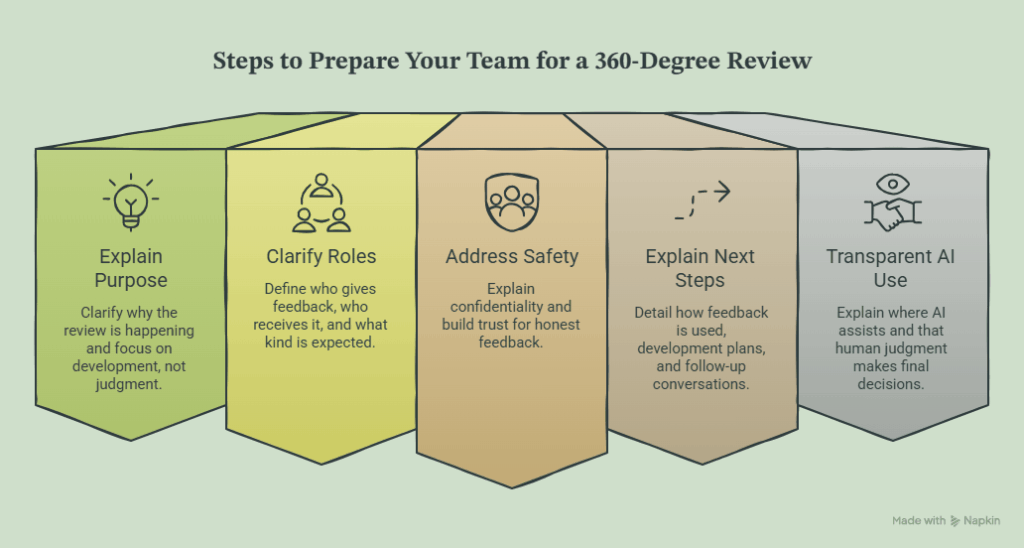
Step 1: Explain the Purpose of the Review
The first thing your team needs is a straight answer to a simple question. Why is this happening now?
Maybe leadership wants a sharper picture of employees’ skills. Maybe your current feedback channels, like annual reviews or one on one check ins, aren’t surfacing enough. Maybe you’re rolling this out ahead of a promotion cycle or a leadership development program. Whatever the reason, say it out loud, in plain language, to the whole team before the process starts.
Vague or absent explanations are what breed suspicion. If people are left to guess why they’re suddenly being asked to rate their coworkers, they’ll assume the worst version of the story, usually that it’s tied to layoffs or hidden performance scoring. A short, honest explanation shuts that down before it starts.
Step 2: Clarify Everyone’s Role
Picture being told there’s a 360 review coming up with zero context on what you’re actually supposed to do in it. Are you being reviewed? Are you reviewing someone else? Both? That ambiguity alone is enough to make people anxious before a single question has even been asked.
Every employee needs to know exactly where they stand in the process.
If they’re being reviewed, tell them plainly that the process is designed around growth, not judgment. There should be no personal attacks and no scorecard tied to compensation unless you’ve explicitly said otherwise. It’s development focused feedback on their skills, not a verdict on their worth as an employee.
If they’re doing the reviewing, they need clarity on a few specific things before they write a single word. Make sure the following points are communicated up front:
Whether the feedback is anonymous or attributed
Whether they’ll face any consequence for giving honest, critical feedback
What kind of feedback is expected, meaning specific and behavior based rather than vague impressions
How much time they’re expected to spend on it and by when
Address Anonymity and Psychological Safety Directly
This is the part most companies underexplain, and it’s usually the actual source of anxiety in the room. People don’t hesitate to give feedback because they lack opinions. They hesitate because they’re not sure it’s safe to share them.
Tell your team clearly whether responses are anonymous, aggregated, or visible to the subject with names attached. If it’s anonymous, explain how that anonymity is actually protected, for example whether a minimum number of respondents is required before results are shared so no one can guess who said what. If names are attached, be upfront about that too, because pretending otherwise damages trust the moment someone finds out.
Multi rater feedback works because it captures different vantage points on the same person. That only happens if people trust the system enough to be candid.
Step 3: Explain What Happens to the Feedback
Your team also needs to know what happens once the surveys are submitted. This is where a lot of otherwise well designed 360 processes fall apart, not because the questions were bad, but because nobody explained the back end.
Answer these questions clearly before the review goes live:
Will the raw feedback go to the employee directly, or will a manager or HR partner summarize it first
Will it feed into a formal development plan
Will it ever be linked to compensation or promotion decisions
Will it simply sit in a file for reference, and if so, why run the process at all
If feedback disappears into a black hole after collection, people stop taking it seriously the next time around. Set expectations for what a good outcome looks like, whether that’s a coaching conversation, a personal development plan, or a follow up check in a set number of weeks later.
How AI Fits Into the 2026 Review Process
AI has moved from a nice to have to a standard part of how organizations run performance and feedback cycles. According to SHRM’s State of AI in HR 2026 report, 46 percent of organizations expect to use AI in HR this year, and performance management is one of the most common areas of adoption among small and midsize organizations specifically.
In a 360 review context, this usually shows up in a few practical ways. AI tools now commonly summarize themes across dozens of individual responses so a manager isn’t left manually parsing thirty open text answers. Some systems flag biased or vague language before a review is submitted, prompting the reviewer to give more specific, behavior based feedback instead. Others connect the resulting themes to existing development plans or learning resources automatically.
The data on how employees respond to this is worth sharing with your team directly, because it tends to ease resistance. Employees working inside AI enabled performance systems reported satisfaction of 89 percent, compared with just 40 percent in organizations without AI support, according to Forbes’ reporting on Betterworks’ 2026 State of Performance Enablement data. The gap suggests that when AI is used to organize and structure feedback rather than replace human judgment, people actually experience the process as fairer and more consistent, not less personal.
If your organization is using AI anywhere in the 360 process, whether to summarize responses, catch biased phrasing, or generate a first draft of a development summary, say so plainly before the review starts. Employees deserve to know a tool is reading their words, even if a human still makes every final call.
Common Mistakes That Undermine a 360 Review Before It Starts
A few patterns show up again and again in organizations that run these reviews poorly. Watch for these specifically:
Launching the review with a generic company wide email and no live conversation or Q&A session
Letting managers opt out of giving their own feedback while requiring it from everyone else
Failing to train reviewers on what specific, actionable feedback actually looks like
Promising anonymity without a real mechanism to protect it
Running the review once and never closing the loop on what changed as a result
Each of these is preventable with a short prep session before the survey link goes out. That prep session is the actual work of “preparing your team.” Everything else is downstream of it.
Final Thoughts
A 360 degree review is only as good as the groundwork laid before it opens. The feedback itself rarely fails. What fails is everything around it, meaning unclear intent, unclear roles, unclear next steps. Fix those three things and you’ve done most of the work already.
Treat the prep conversation as seriously as the review itself. Tell people why it’s happening, tell them exactly what part they’re playing, tell them what happens to their words once they hit submit, and be upfront about where AI touches the process. None of that requires a big production. It requires one honest conversation before the survey link goes out.
Get that part right, and the review stops feeling like a compliance exercise and starts doing what it was actually built to do, which is help people see themselves a little more clearly and grow from it.
If you’re planning your next 360 degree feedback cycle and want a system that actually makes this preparation easier instead of harder, request a demo to see how the process can run from survey to development plan in one place
Frequently Asked Questions
What is the difference between a 360 degree review and a performance review?
A performance review evaluates an employee’s output against goals, targets, or job responsibilities, usually conducted by a manager alone. A 360 degree review evaluates an employee’s skills, behaviors, and working style through feedback from multiple sources, including peers, direct reports, managers, and sometimes clients. It’s a development tool, not a scorecard.
Is 360 degree feedback usually anonymous?
It depends on the organization, but most 360 processes use some form of anonymity, often aggregating responses from a minimum group size before sharing results so individual reviewers can’t be identified. Always confirm the specific rules with your HR team before assuming how your organization handles it.
How long should a 360 degree review process take?
Most cycles run between two and four weeks from survey launch to results delivery, including time for reviewers to complete their responses, feedback compilation, and a follow up conversation with the employee. Rushing this timeline tends to produce shallow, rushed responses.
Who should be included as a reviewer in a 360 process?
A good rule of thumb is including the employee’s direct manager, two to four peers who work closely with them, one or two direct reports if applicable, and a self assessment from the employee themselves. Including reviewers who barely interact with the person tends to produce vague, low value feedback.
Can 360 degree feedback affect pay or promotion decisions?
It can, but only if the organization has explicitly designed it that way and communicated that upfront. Many organizations deliberately keep 360 feedback separate from compensation decisions specifically to encourage more honest participation. Confirm this directly with your team before launching so no one is caught off guard later.
How is AI used in 360 degree feedback today?
AI is most commonly used to summarize themes across large volumes of open text feedback, flag vague or biased language before submission, and connect resulting insights to existing development or learning plans. It’s generally used to support managers and HR teams rather than replace their judgment.
Jeevithan K is a Senior Solutions Consultant at Engagedly with extensive experience in HR technology, customer success, product implementation, onboarding, and training. He specializes in helping organizations adopt B2B SaaS and enterprise AI solutions effectively. His expertise also includes project management, account management, process improvement, and translating complex product capabilities into practical solutions that deliver meaningful value for customers.













 Performance
 Learning
 Recognize &
 Engage &
 Talent