Performance reviews, feedback, and regular manager conversations may cover your organization’s needs today. As those needs grow, you may want to connect performance with learning, career development, employee engagement, or succession planning.
That is a useful starting point for evaluating Small Improvements alternatives.
Small Improvements brings together reviews, 360 degree feedback, 1:1 meetings, objectives, praise, and pulse surveys. Its focused approach can suit teams that want a straightforward way to manage performance.
Other organizations may need more detailed goals and OKRs, broader employee listening, manager coaching, or learning and talent development. Some may prefer performance management within their existing HRIS to reduce the number of systems they maintain.
In this guide, we compare 10 Small Improvements alternatives across:
Performance reviews
Goals and OKRs
Continuous feedback
360-degree feedback
Employee engagement
Manager development
Learning and talent development
AI capabilities
Pricing
Ideal use cases
The goal is not to identify one platform that is universally better than Small Improvements. Instead, it is to show where each alternative differs so you can determine which approach fits your organization.
Small Improvements Alternatives: Quick Comparison
Platform
Best suited for
Key differentiator
Engagedly
Connecting performance with broader talent development
Performance, goals, learning, engagement, recognition, and talent development in one platform
Lattice
Structured mid-market performance management
Combines performance, goals, engagement, compensation, and career development
15Five
Manager effectiveness and continuous performance
Strong focus on check-ins, manager habits, coaching, and continuous feedback
Leapsome
Consolidating multiple talent and HR processes
Performance, engagement, learning, compensation, and HRIS capabilities
Culture Amp
Employee listening and people analytics
Deep engagement, benchmarking, performance, and manager insights
PerformYard
Highly configurable performance processes
Flexible review cycles, forms, goals, feedback, and talent workflows
Workleap
Connecting performance with team engagement
Performance, surveys, recognition, goals, meetings, and people insights
BambooHR
Combining performance with core HR
Performance management inside a broader HRIS
Betterworks
Enterprise goals and performance management
Strong emphasis on OKRs, calibration, performance, and talent intelligence
Profit.co
Structured OKR and KPI programs
Deep goal cascading, KPIs, and strategy execution
Features, packages, and pricing can change. Organizations should verify current details directly with each vendor before purchasing.
What Does Small Improvements Offer?
Before comparing alternatives, it helps to understand what Small Improvements is designed to do.
Small Improvements focuses primarily on the conversations and processes surrounding employee performance.
Its current platform includes:
Performance reviews
360-degree feedback
Anytime feedback
1:1 meetings
Goals and objectives
Pulse surveys
Praise and recognition
AI-assisted review and objective workflows
The platform also emphasizes customization. Administrators can adjust review processes, terminology, visibility, and other elements while keeping the employee experience relatively lightweight.
Small Improvements Pricing
Small Improvements currently offers three main plans:
Plan
Price
Main focus
Launch
$3/user/month
Performance reviews and praise
Grow
$6/user/month
Adds 360 feedback, objectives, 1:1s, and pulse surveys
Elevate
$9/user/month
Adds the complete feature set, integrations, and customization
Plans are billed annually, and minimum pricing applies to Grow and Elevate. A 30-day free trial is available.
That relatively straightforward pricing is one reason Small Improvements can appeal to growing companies that do not want an enterprise-level talent system.
Why Do Companies Look for Small Improvements Alternatives?
Searching for an alternative does not necessarily mean there is something wrong with Small Improvements.
Often, the company’s requirements have simply changed.
Broader talent-management requirements
Small Improvements deliberately focuses on performance, feedback, goals, meetings, and employee listening.
An organization may eventually want to connect those processes with:
Learning management
Career paths
Skills
Succession planning
Talent mobility
Compensation
Rewards
Workforce planning
A broader talent platform may make more sense once these processes become interconnected.
More sophisticated goals and OKRs
Small Improvements supports objectives, including cascading objectives and AI-supported objective creation.
But companies running organization-wide OKR or KPI programs may want more advanced alignment, weighting, strategy mapping, or reporting.
Deeper employee listening
Pulse surveys can be enough for many organizations.
Companies running mature employee-listening programs, however, may need larger benchmark datasets, lifecycle surveys, advanced segmentation, retention analytics, and more sophisticated action planning.
Greater manager enablement
Some organizations want performance software to actively develop managers rather than simply facilitate reviews and 1:1s.
That can involve coaching, manager training, nudges, AI-generated recommendations, and structured development programs.
Performance management inside a wider HR platform
Other organizations want fewer separate systems.
Instead of connecting performance software to an HRIS, they may prefer performance management, employee records, onboarding, payroll, and other HR workflows within the same platform.
What Should You Look for in a Small Improvements Alternative?
Before comparing vendors, define what you want to change.
If Small Improvements already handles your reviews, feedback, and 1:1s effectively, replacing it with another platform offering exactly the same capabilities may create unnecessary work.
Consider these areas instead.
1. Performance-management depth
Evaluate whether the platform supports the performance processes you actually use, including:
Annual reviews
Focal reviews
Anniversary reviews
Continuous feedback
360-degree feedback
Calibration
9-box assessments
Competencies
Development plans
2. Goals and OKRs
If goals are becoming more important, look beyond basic goal tracking.
Consider:
Cascading goals
Weighted goals
Company-to-individual alignment
OKR reporting
Goal discussions
KPI support
Integration with reviews
3. Manager experience
Managers determine whether performance management becomes useful or simply another HR exercise.
Evaluate how easily a manager can:
Prepare for a 1:1
Give feedback
Write a review
Understand goal progress
Identify development needs
Follow up after a review
4. Employee development
Performance reviews should ideally influence what happens next.
If employee development is becoming a priority, evaluate whether review outcomes can connect with:
Development plans
Learning
Skills
Career paths
Mentoring
Internal mobility
Succession planning
5. Employee listening
If pulse surveys are no longer enough, compare survey libraries, benchmarks, lifecycle surveys, segmentation, comment analysis, and action-planning capabilities.
6. Total platform cost
Small Improvements starts at a relatively accessible price, so alternatives can become considerably more expensive.
Compare:
Per-user pricing
Annual minimums
Implementation fees
Add-ons
Required modules
Support costs
Integration costs
1. Engagedly
Best for: Organizations that want to connect performance management with broader employee development and talent-management processes.
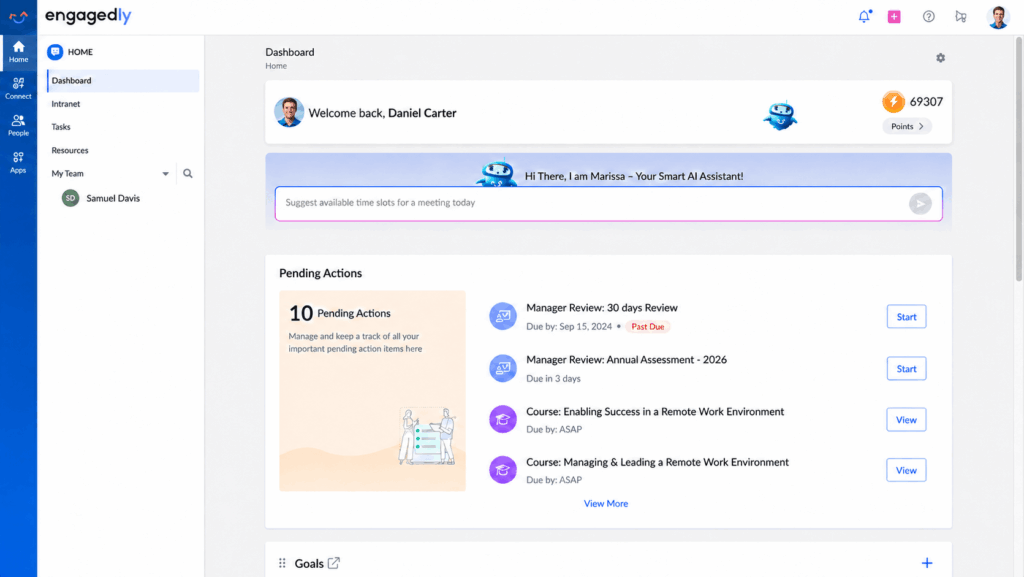
Engagedly, an Energage company, is an AI-powered talent management platform informed by insights from the Top Workplaces Institute. It connects performance reviews, goals and OKRs, 360-degree feedback, learning, employee engagement, recognition, talent mobility, and development in one unified experience.
Compared with Small Improvements, which focuses primarily on performance and feedback workflows, Engagedly extends those capabilities into learning, individual development plans, career growth, succession planning, recognition, and broader talent development. Powered by Marissa, its AI SuperAgent, Engagedly helps leaders turn people strategy into intelligent actions, reduce talent silos, and drive stronger engagement, retention, and team development.
Key features
Performance reviews
Advanced calibration
Goals and OKRs
360-degree feedback
Continuous feedback
Individual development plans
Learning management
Employee engagement
Recognition and rewards
Talent mobility
Marissa™ AI
Strengths
Engagedly can make sense for organizations that want performance data to influence what happens after the review.
For example, goals, feedback, performance outcomes, development plans, and learning can form part of the same broader talent-management process.
Considerations
The additional functionality can be unnecessary for companies that only need straightforward reviews, 1:1s, feedback, and objectives.
Engagedly also has a $7,500 annual minimum, making Small Improvements potentially more accessible for smaller organizations. Engagedly’s Performance Suite currently lists at 5–8 per user per month, billed annually.
Best fit: Mid-market and enterprise organizations looking to connect performance management with learning and wider talent development.
2. Lattice
Best for: Growing organizations that want more structured performance and people-management processes.
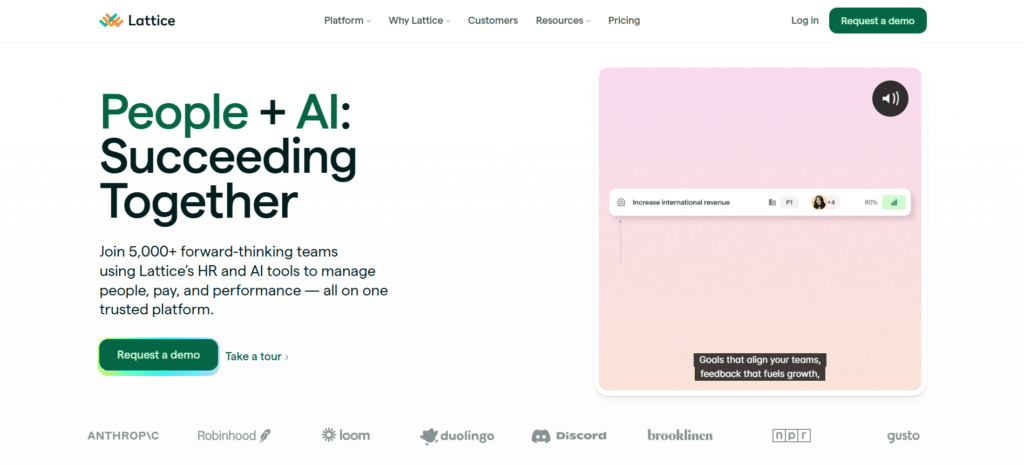
Lattice combines performance reviews, goals and OKRs, engagement, compensation, career development, and people analytics.
Like Small Improvements, it supports performance conversations beyond the annual review. The difference is that Lattice extends further into structured talent and people-management processes.
Key features
Performance reviews
Goals and OKRs
Calibration
Continuous feedback
1:1 meetings
Engagement surveys
Career development
Compensation
People analytics
AI-supported workflows
Strengths
Lattice provides a broader framework for organizations formalizing performance, career development, engagement, and compensation.
This can become useful as an HR team grows and needs more standardized processes across departments.
Considerations
That broader feature set can introduce more complexity and cost than a focused platform such as Small Improvements.
Organizations primarily seeking simple review cycles and feedback may not need the additional modules.
Best fit: Mid-market organizations moving from lightweight performance management toward more structured talent processes.
3. 15Five
Best for: Organizations that want performance management to revolve around stronger managers and frequent conversations.
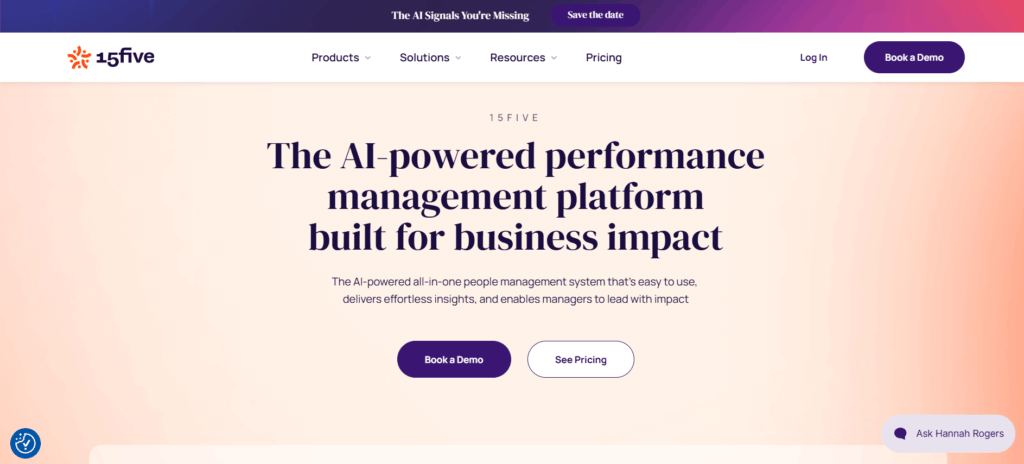
15Five combines reviews, goals, engagement, 1:1s, continuous feedback, career development, and manager enablement.
Its philosophy places particular emphasis on manager effectiveness and regular performance conversations.
Key features
Performance reviews
Weekly check-ins
1:1 meetings
360-degree feedback
Goals and OKRs
Engagement surveys
Career paths
Manager development
AI-assisted performance workflows
Strengths
15Five is worth considering when the primary goal is not simply running better review cycles but changing how managers communicate with employees throughout the year.
Its check-ins, manager tools, and development offerings support that continuous rhythm.
Considerations
That approach may create more process than organizations want if they prefer Small Improvements’ flexible, lighter model.
Advanced manager-development offerings can also increase overall costs.
15Five currently lists Perform at $11/user/month and its Total Platform at $16/user/month, billed annually.
Best fit: Organizations investing heavily in manager effectiveness and continuous performance conversations.
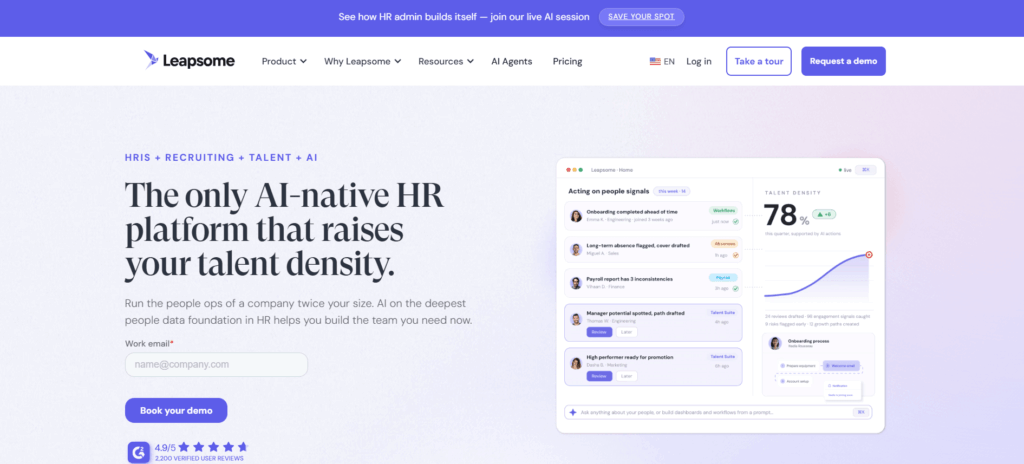
4. Leapsome
Best for: Organizations looking to combine performance, engagement, learning, and broader HR workflows.
Leapsome provides a wider people-enablement platform covering performance management, goals, surveys, learning, compensation, and HRIS functionality.
That makes it substantially broader than Small Improvements.
Key features
Performance reviews
360-degree feedback
Goals and OKRs
Engagement surveys
Learning paths
Employee development
Compensation
HRIS capabilities
AI features
Strengths
Leapsome can reduce the need for separate systems when an organization wants performance management and learning to work together.
That is particularly relevant when review outcomes need to translate directly into employee-development activity.
Considerations
Organizations only looking for reviews, feedback, objectives, and 1:1s may find the wider platform unnecessary.
Pricing is also quote-based, making direct comparison with Small Improvements’ published pricing less straightforward.
Best fit: Growing and mid-market organizations looking to consolidate several talent and HR processes.
5. Culture Amp
Best for: Organizations that need deeper employee listening, benchmarking, and performance analytics.
Culture Amp combines employee engagement, performance management, development, people analytics, and AI-supported manager tools.
Small Improvements includes pulse surveys and recently added capabilities such as eNPS, while Culture Amp places substantially greater emphasis on employee listening and benchmarking.
Key features
Engagement surveys
Benchmarking
Performance reviews
Calibration
Continuous feedback
Goals
1:1 conversations
Development plans
People analytics
AI Coach
Strengths
Culture Amp’s main differentiation is the depth of its employee-experience and people-science capabilities.
It can be particularly useful when HR needs to connect engagement data with manager effectiveness and performance.
Considerations
Companies mainly looking for straightforward performance reviews, feedback, objectives, and pulse surveys may find Small Improvements simpler.
Culture Amp uses quote-based annual pricing rather than Small Improvements’ transparent per-user tiers.
Best fit: Organizations with mature employee-listening programs that want performance and engagement analyzed together.
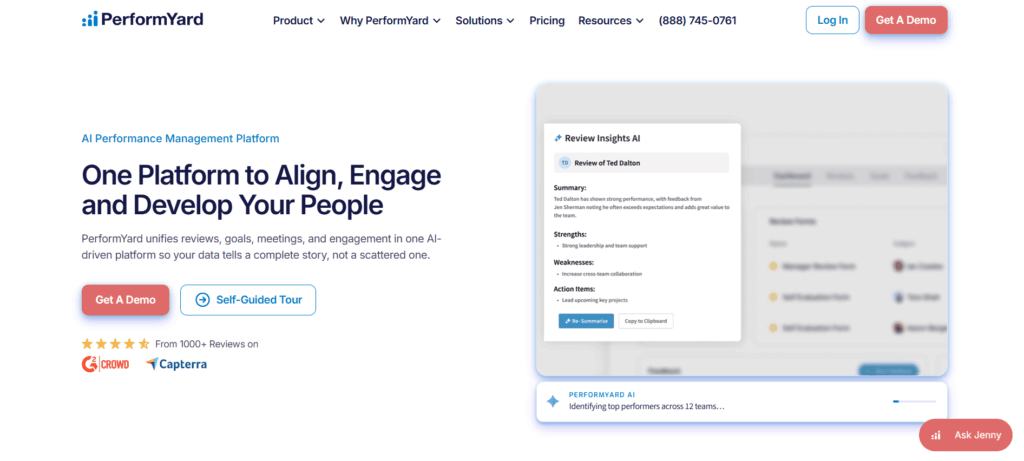
6. PerformYard
Best for: Organizations that want greater control over how performance-management workflows are configured.
PerformYard focuses heavily on performance management and talent development, with flexibility around reviews, goals, feedback, meetings, engagement, competencies, coaching, succession, and compensation.
Key features
Configurable performance reviews
Goal management
Continuous feedback
Meetings
Engagement surveys
Competencies
Coaching
Succession planning
Compensation
AI functionality
Strengths
PerformYard is especially relevant for organizations with an established performance-management process that they want the software to accommodate.
Its flexibility can support more specialized workflows than companies may need when first adopting performance-management software.
Considerations
Organizations that value the minimalist approach of Small Improvements may find greater configurability brings additional administrative decisions.
PerformYard currently prices its Performance and Talent Development offerings in the 5–15 per person/month range, depending on employee count and selected products.
Best fit: Organizations with specific or increasingly sophisticated performance-review and talent workflows.
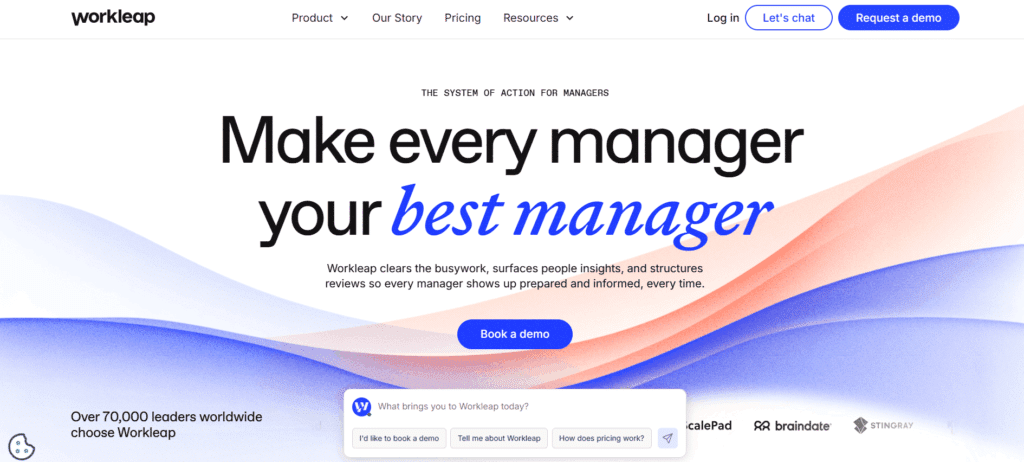
7. Workleap
Best for: Organizations looking to connect employee engagement, team health, and performance management.
Workleap brings together performance reviews, engagement surveys, recognition, goals, meetings, people analytics, and AI-supported insights.
That creates a different emphasis from Small Improvements: performance management is closely connected to team experience and broader people insights.
Key features
Performance reviews
360-degree feedback
Goals and OKRs
Engagement surveys
Recognition
Meetings
Action plans
Career paths
People analytics
AI-powered analysis
Strengths
Workleap may appeal to HR teams that want engagement and manager insights to sit alongside performance-management workflows rather than operating as separate processes.
Considerations
Its pricing structure is quite different from Small Improvements.
Workleap currently lists its Standard package from $4,999 annually and Pro from $11,999 annually, with custom pricing for larger organizations.
That makes total cost dependent heavily on company size and requirements.
Best fit: Growing organizations that want performance management closely connected with engagement and team health.
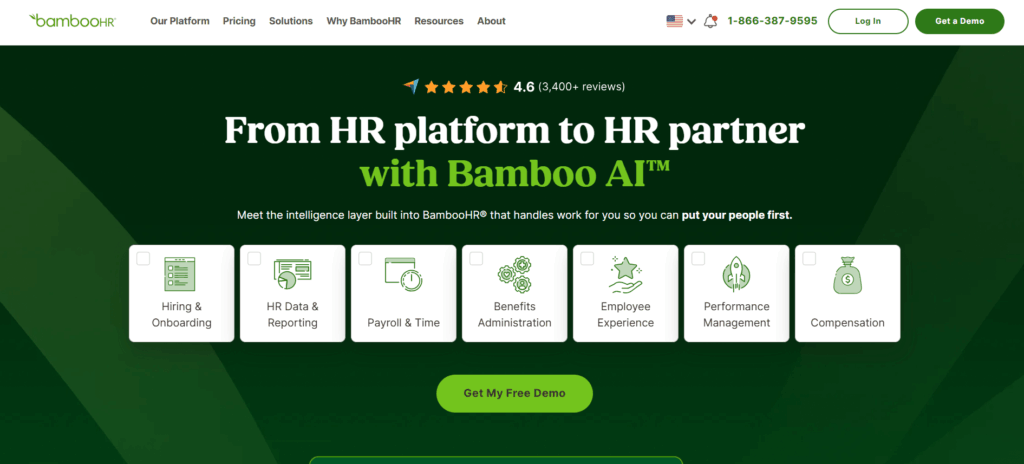
8. BambooHR
Best for: Organizations that want performance management inside their core HR system.
BambooHR differs from Small Improvements because performance management is only one part of a much broader HRIS.
The platform also handles employee records, workflows, reporting, hiring, onboarding, time-off processes, and other HR operations.
Key features
Performance reviews
360-degree reviews
1:1 meetings
Goal tracking
Employee records
HR reporting
Recognition and rewards
Hiring and onboarding
Core HR workflows
Strengths
The primary benefit is consolidation.
An organization already using—or planning to adopt—BambooHR can manage employee information and performance workflows without maintaining a dedicated standalone performance platform.
Considerations
Companies happy with their existing HRIS may not benefit from changing systems simply to consolidate performance management.
BambooHR’s Pro plan, which includes performance management, currently starts at $17 per employee per month for organizations with more than 25 employees.
Best fit: Small and midsize organizations prioritizing HRIS consolidation over specialized performance-management software.
9. Betterworks
Best for: Larger organizations with more structured goals, OKRs, calibration, and enterprise performance processes.
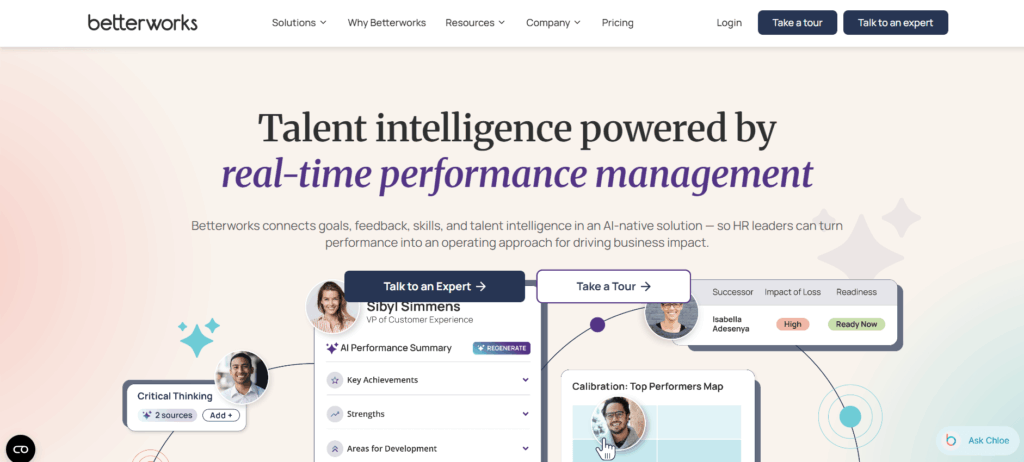
Betterworks focuses on performance management through goals, OKRs, feedback, conversations, calibration, and talent intelligence.
Compared with Small Improvements, it generally targets more structured enterprise performance programs.
Key features
Performance reviews
Goals and OKRs
1:1 conversations
Feedback
Calibration
Talent intelligence
Development planning
AI-assisted workflows
Strengths
Betterworks can make sense when goal alignment and calibration become central to how performance is managed across multiple departments or organizational levels.
Its approach is particularly relevant to larger companies running formal OKR programs.
Considerations
The enterprise orientation can introduce more complexity than smaller teams need.
Betterworks currently lists Performance at $8/user/month and Performance + Talent Intelligence at $9/user/month, with implementation charged separately.
Best fit: Larger organizations moving toward structured enterprise goal and performance-management programs.
10. Profit.co
Best for: Organizations that want deeper OKR, KPI, and strategy-execution capabilities.
Profit.co approaches performance management from an OKR and strategy perspective.
It combines goal alignment with performance reviews, KPIs, 360-degree feedback, competencies, and strategic planning.
Key features
OKRs
KPIs
Goal cascading
Weighted scoring
Performance reviews
360-degree feedback
Competencies
Balanced scorecards
Strategy execution
Strengths
Profit.co is particularly relevant when objectives have evolved beyond individual goal tracking into a company-wide management framework.
Organizations can structure goals around measurable business outcomes, KPIs, and broader strategic priorities.
Considerations
That depth can create more configuration and learning requirements than Small Improvements’ simpler Objectives feature.
Companies where reviews and manager conversations matter more than formal OKRs may not need that additional complexity.
Best fit: Organizations operating mature OKR, KPI, or strategy-execution programs.
Which Small Improvements Alternative Fits Your Requirements?
The right alternative depends largely on what you want to add or change.
Priority
Platforms worth evaluating
Broader talent management
Engagedly, Leapsome
Structured performance management
Lattice, PerformYard
Manager effectiveness
15Five, Engagedly
Employee listening and engagement
Culture Amp, Workleap
Learning + performance
Engagedly, Leapsome
Performance inside an HRIS
BambooHR
Enterprise goals and calibration
Betterworks
Advanced OKRs and KPIs
Profit.co
Simple reviews and feedback
Small Improvements may still be a strong fit
That final row is important.
Switching software should solve an actual limitation.
If your organization needs straightforward performance reviews, feedback, 1:1s, objectives, praise, and pulse surveys, Small Improvements may continue to meet those requirements well.
If the organization is moving into learning, succession, sophisticated employee listening, enterprise OKRs, manager development, or broader talent management, another platform may provide a closer fit.
Small Improvements vs. Engagedly
Small Improvements and Engagedly overlap across several core performance-management capabilities, but they take different approaches.
Area
Small Improvements
Engagedly
Primary focus
Focused performance and feedback platform
Broader talent management platform
Performance reviews
Yes
Yes
360 feedback
Yes
Yes
Goals/Objectives
Yes
Yes
1:1 meetings
Yes
Yes
Pulse/engagement surveys
Yes
Yes
Recognition
Praise
Recognition and rewards
Learning management
No dedicated LMS
Yes
Talent mobility/succession
Limited
Yes
Pricing approach
3–9/user/month tiers
Modular suites; Performance 5–8/user/month with annual minimum
Small Improvements may be a better fit for organizations that intentionally want a focused performance-management platform without adopting additional talent modules.
Engagedly becomes more relevant when organizations want performance reviews and goals to connect with learning, employee development, recognition, engagement, career growth, and succession planning.
The decision therefore comes down less to whether one tool has performance reviews and more to how much of the employee-development lifecycle you want one platform to manage.
Final Thoughts
Small Improvements occupies a useful position in the performance-management market.
It provides reviews, feedback, objectives, 1:1s, praise, and employee listening without trying to become a complete HR or talent platform. For many small and midsize organizations, that focus may be exactly what they need.
Alternatives become more relevant when the requirements expand.
15Five places greater emphasis on manager effectiveness. Culture Amp and Workleap go deeper into employee engagement and people insights. PerformYard emphasizes configurable performance processes, while Betterworks and Profit.co support more structured goal and OKR programs.
BambooHR is worth considering when the priority is bringing performance management into the core HRIS.
Platforms such as Engagedly and Leapsome take a broader talent-management approach by connecting performance with additional employee-development processes.
For organizations specifically looking to connect performance reviews, goals, feedback, learning, engagement, recognition, and longer-term employee development, Engagedly is one option worth including in the evaluation.
Frequently Asked Questions About Small Improvements Alternatives
What are the main Small Improvements alternatives?
Common Small Improvements alternatives include Engagedly, Lattice, 15Five, Leapsome, Culture Amp, PerformYard, Workleap, BambooHR, Betterworks, and Profit.co.
The most relevant alternative depends on what you need beyond Small Improvements, such as deeper OKRs, employee listening, manager development, learning, talent management, or core HR functionality.
What is Small Improvements used for?
Small Improvements is a performance-management platform for reviews, 360-degree feedback, ongoing feedback, 1:1 meetings, objectives, pulse surveys, and employee praise. The company positions the platform primarily for organizations with approximately 50 to 750 employees.
How much does Small Improvements cost?
Small Improvements currently starts at $3 per user per month for Launch.
Grow costs $6 per user per month, while Elevate costs $9 per user per month, billed annually. Grow and Elevate are subject to minimum pricing.
What is a good Small Improvements alternative for broader talent management?
Engagedly and Leapsome are worth evaluating when an organization wants to go beyond performance reviews and feedback into areas such as learning, development, engagement, and broader talent-management processes.
Which Small Improvements alternatives are strongest for employee engagement?
Culture Amp and Workleap place substantial emphasis on employee engagement and people insights. Engagedly, Lattice, 15Five, and Leapsome also combine engagement capabilities with broader performance-management functionality.
Which Small Improvements alternatives support OKRs?
Platforms including Engagedly, Lattice, 15Five, Leapsome, Betterworks, and Profit.co support goals or OKR-related workflows.
Betterworks and Profit.co are particularly relevant when organizations need more structured goal alignment or company-wide OKR programs.
What is a Small Improvements alternative with an LMS?
Engagedly and Leapsome combine performance management with learning capabilities.
This can help organizations connect development opportunities identified during performance reviews with training and employee-development activities.
Is Small Improvements suitable for large enterprises?
Small Improvements explicitly positions itself primarily for organizations with 50 to 750 employees.
Larger organizations with complex global performance processes, sophisticated calibration, succession, or broader HCM requirements may therefore also evaluate platforms such as Betterworks, Engagedly, Culture Amp, or enterprise HCM systems.
What should you compare during a Small Improvements alternative demo?
Ask every shortlisted vendor to demonstrate the same real-world workflow:
Create an employee objective → conduct a 1:1 → request peer feedback → complete a performance review → identify a development need → determine what happens next.
Then compare: Number of steps Manager experience Employee experience Automation Reporting AI assistance Development follow-through Administrative effort This gives a much clearer picture than simply comparing feature checklists.
Gabby Davis is the Lead Trainer for the US Division of the Customer Experience Team. She develops and implements processes and collaterals related to the client onboarding experience and guides clients across all tiers through the initial implementation of Engagedly as well as Mentoring Complete. She is passionate about delivering stellar client experiences and ensuring high adoption rates of the Engagedly product through engaging and impactful training and onboarding.















 Performance