












Dealing with angry employees means staying calm, listening before you respond, and finding the real problem behind the outburst. Anger at work is usually a signal about workload, fairness, or communication, not just a bad attitude. This guide gives US managers and HR teams a practical way to de-escalate, document, and follow up, plus a few legal watch-outs. It is general guidance, not legal advice, so run serious cases past HR or employment counsel.
Anger rarely comes out of nowhere. Gallup’s 2026 report found that only 32% of US employees are engaged at work, compared with a global average of 20% (data collected January to December 2025). That leaves a lot of people who feel unheard long before they raise their voice.
The cost is real too. Gallup estimates that low engagement cost the world economy about $10 trillion in lost productivity last year, or roughly 9% of global GDP. A frustrated employee who gets mishandled is a fast route to disengagement, and eventually to resignation.
Why Do Employees Get Angry at Work?
Employees usually get angry because of something specific that feels unfair, unclear, or ignored. Anger is often the last stage of frustration that built up quietly. Common triggers include the following.
- Heavy workloads and burnout
- Pay, promotion, or favoritism concerns
- Unclear expectations or last-minute changes
- Conflict with a coworker or manager
- Feeling unheard after raising an issue before
- Personal stress that spills into work
Knowing the trigger changes your response. An employee angry about workload needs a different conversation than one angry about a teammate.
Signs an Employee Is Angry, Even When They Stay Quiet
Not everyone yells. Watch for these quieter signals.
- Sudden silence in meetings or short, clipped replies
- Eye rolling, sighing, or crossed arms
- Sarcasm in chat or email
- Pulling back from the team or missing deadlines
- Repeated complaints about the same issue
Catching these early gives you a chance to talk before it becomes an outburst.
How To Deal With Angry Employees As A Manager
Here are 8 tips on how to deal with angry employees as a manager. Hopefully, you’ll never have to use them!
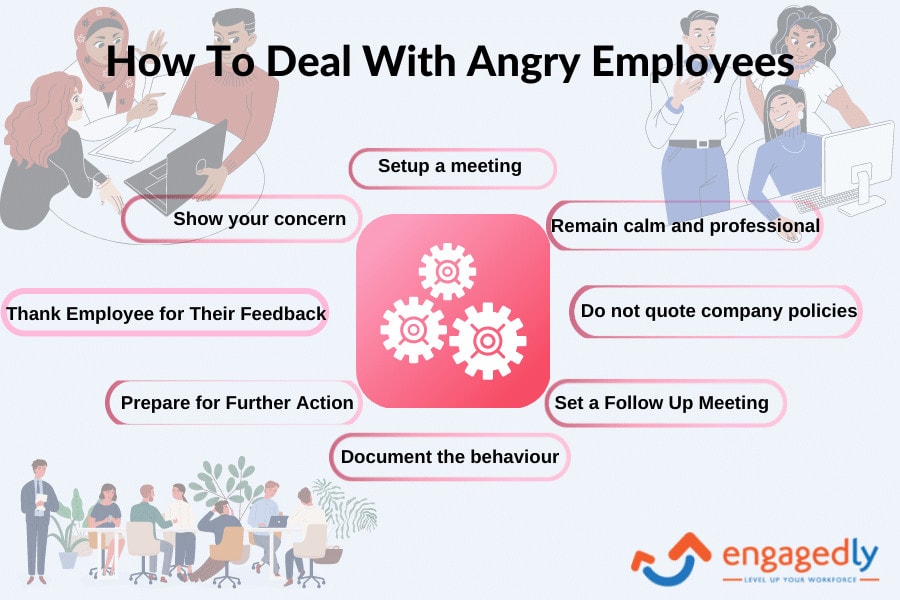
1. Remain calm and professional
Usually, managers also tend to lose their cool when the employees behave in an irate manner. But managers cannot lose their cool and behave irrationally. Staff at the workplace observe how the managers handle the anger directed at them and if the manager loses his cool, it might have an unpleasant effect on the entire workplace.
Avoid yelling and swearing. Remain calm and deal with the situation like a professional.
Here is a simple way to keep the conversation steady.
- Lower your voice and slow your pace
- Keep your posture open and your hands visible
- Pause for a breath before you answer
- Offer a short script such as “I want to understand this. Let’s find a quiet place to talk.”
If you feel your own temper rising, it is fine to say, “Let’s take ten minutes and pick this up at 2 pm.” Delaying a conversation is better than escalating it.
2. Hold Off on Quoting Policy
When people are angry they do not care about the policies. Telling them that their issue will not be solved because it is against the company policy just worsens the situation instead of helping it.
Try to establish an agreement about something. Find something that you both can agree on, for example, “William, I think we can agree that we both want this project to be done correctly by the month-end. Do you agree?” Aligning discussions with clear OKRs and goals helps keep conversations focused and constructive.
Policy still matters, just not in the first five minutes. Acknowledge the emotion first, then bring up policy later when the employee can hear it. A good bridge is “I hear you. Once I understand the full picture, we can look at what options we have.
3. Show your concern
Stay calm and listen to them. Using 360-degree feedback can provide broader insights into underlying concerns. Show your concern and tell them that you will do your best to solve the problem that they face. Don’t act like you don’t care about their concerns.
Acknowledge the feeling without agreeing that the behavior was fine. Try “I can see this really frustrated you. Tell me what happened.” Then listen without interrupting. Repeat back what you heard so they know it landed. Avoid promising a specific result. Promise a next step instead, such as “I’ll look into this and get back to you by Thursday.
4. Document the behavior
Document the behavior of your employee. In the document, describe the incident where the employee displayed anger and explain why the employee’s behavior was inappropriate. Also, observe and document the impact on their co-workers.
Keep your notes factual and specific. Write down the following.
- Date, time, and location
- What was said or done, in plain words, not opinions
- Who witnessed it
- What you said in response
- Any agreed next steps
Avoid labels like “hostile” or “unstable.” Stick to what you saw and heard. Store notes where HR can access them, and follow your company’s recordkeeping policy.
5. Thank Employees for Their Feedback
Employee feedback is an opportunity for an organization to make changes. Even though it can be a bit hard to thank an employee for their negative feedback, it is important to show them that their feedback is taken into consideration. You can use it constructively to fine-tune the processes.
6. Setup a meeting
Never address the issue in front of the team. Wait until the employee has cooled down, then invite them to a private one-on-one. Choose a quiet space or a private video call, and silence your phone.
Here is a simple structure for the conversation.
- Open with the goal, for example “I want to work this out with you.”
- Describe the behavior briefly and how it affected others
- Invite their side and listen without interrupting
- Agree on what needs to change, from both of you
- Confirm next steps and a follow-up date
Keep it focused on one incident. Dragging in old complaints makes people defensive.
7. Set a Follow-Up Meeting
If there are frequent employee outbursts, then it must be taken into consideration and a follow-up plan should be set up to understand their concerns. Moreover, if you promised something to the employee in the last meeting, then it is crucial to follow up with them. It also reinforces their trust in the employer. Continuous real-time feedback helps prevent issues from escalating.
Put the follow-up on the calendar before the first meeting ends. Send a short written recap afterward so everyone remembers the same thing. If you promised to check on something, do it, because broken follow-through is one of the fastest ways to lose trust.
8. Prepare for Further Action
Sometimes it can get tough to deal with employees with behavioral issues. Managers or HR professionals often have to face employees with anger issues, and even after guiding them or helping them loosen up, the situation does not change. In such cases, it becomes important to terminate them for the good of the team.
Toxicity spreads fast, and therefore, to save other team members from facing trouble, it is sometimes useful to let go of toxic employees.
Talk to the employee behind closed doors about the inappropriate behavior. Show them what you’ve documented and explain to them the impact of their inappropriate behavior on their co-workers.
Be clear and calm about what happens next. Explain that repeated behavior may lead to formal steps under your company’s policy, such as a written warning, a performance plan, or further action. Follow your standard progressive process and involve HR early, so the response is consistent and fair.
Termination should be the last step, not the first. In the US, most employment is at-will, which generally allows ending employment for lawful reasons, but exceptions exist for discrimination, retaliation, and some contracts. Talk to HR or counsel before acting.
When Anger Becomes a Safety or Legal Issue
Most angry moments are about frustration, not danger. A few situations need a different response.
- Threats or violence. If someone threatens harm or you feel unsafe, separate people, contact security or call 911, and notify HR. Do not try to handle it alone.
- Complaints about harassment or discrimination. If the anger comes with a complaint like this, take it seriously, document it, and start your investigation process. Never retaliate.
- Group complaints about pay or working conditions. Under Section 7 of the National Labor Relations Act, many private-sector employees acting together to raise concerns about wages, hours, or conditions are legally protected. Disciplining someone for the complaint itself can create risk, so talk to HR or counsel first.
- Medical or mental health factors. If anger seems tied to a health issue, speak with HR about your obligations, including possible accommodations.
Rules vary by state and by situation, so treat this as a starting point and confirm with a qualified employment attorney.
Special Considerations in Remote / Hybrid Teams
When part or all of your team is remote or hybrid, dealing with anger requires adjustments. Here are things to keep in mind:
- Watch for non-verbal cues
In video calls or chat, employees may show frustration by silence, reduced participation, or abrupt responses. Don’t wait for overt displays of anger — check in early if you sense these signals. - Set clear boundaries for communication
Encourage employees to express concerns early (via video chat, phone, or text) instead of letting them build up. Make virtual “office hours” available so people can talk things through. - Ensure reliable and inclusive tech setups
Frustrations often stem from tech issues (poor internet, audio/video lag). Validate and support employees’ remote working setups to reduce cause for irritation. - Emphasize psychological safety remotely
Foster an environment where employees feel safe sharing concerns without fear. Remind the team that it’s okay to admit mistakes or express dissatisfaction. - Use follow-ups and written summaries
After a heated remote interaction, send a summary of what was discussed and agreed next steps. This helps avoid misinterpretation and ensures accountability. - Move heated chats to a call
Tone gets lost in Slack, Teams, and email. If a thread turns tense, stop typing and say “Let’s hop on a quick call.” Sensitive conversations belong on video or by phone, not in a public channel.
How To Prevent Angry Outbursts Before They Start
The best way to handle angry employees is to give frustration somewhere to go earlier. A few habits help.
- Hold regular one-on-ones where employees can raise concerns
- Check workloads often, especially during busy seasons
- Set clear expectations and explain changes early
- Recognize good work so people feel seen
- Run stay interviews and short pulse surveys to catch issues quietly (link to your stay interview questions post)
- Give managers training on difficult conversations
Tools that support continuous feedback and regular check-ins make this easier to sustain across a team. You can see how Engagedly’s performance and feedback tools handle this.
Conclusion
In conclusion, handling angry employees requires calm, empathy, and professionalism. By addressing concerns thoughtfully and following up, managers can resolve issues while maintaining a positive work environment. In cases where behavior doesn’t improve, taking further action may be necessary to protect team morale. If you’re looking to build a more responsive and supportive workplace, it’s worth requesting a demo to see how structured feedback and performance tools can help.
Frequently Asked Questions (FAQs)
Why do employees get angry at work?
Employee anger at work usually develops from unresolved frustration, stress, or workplace conflict.
Common causes include:
heavy workload and burnout
lack of recognition or support
unclear expectations or poor communication
conflicts with colleagues or managers
perceived unfair treatment or policy issues
For example, an employee who consistently works overtime without recognition may eventually express frustration during meetings. Similarly, communication breakdowns or unresolved team conflicts can trigger emotional reactions. When managers understand these underlying causes, they can address the root issue rather than reacting only to the emotional outburst.
What should a manager do when an employee is angry?
Managers should respond to angry employees with calmness, professionalism, and a focus on understanding the underlying concern.
Effective responses include:
staying calm and avoiding defensive reactions
listening carefully without interrupting
acknowledging the employee’s concern
discussing possible solutions or next steps
For example, if an employee raises their voice during a meeting, the manager should not react emotionally. Instead, they can acknowledge the frustration and suggest discussing the issue privately. Handling the situation calmly helps defuse tension and prevents the conflict from affecting the broader team.
How do you prevent workplace anger?
Preventing employee anger starts with creating an environment where concerns are addressed early.
Managers can reduce frustration by:
encouraging open communication and feedback
addressing employee concerns promptly
setting clear expectations and responsibilities
recognizing employee contributions regularly
maintaining a supportive work environment
For example, regular 1:1 conversations allow managers to detect frustration before it escalates into visible anger. When employees feel heard and supported, they are less likely to let issues build up. Proactive communication is one of the most effective ways to prevent workplace conflict and emotional outbursts.
How do you manage angry remote employees?
Handling anger in remote or hybrid teams requires paying attention to subtle communication cues.
Managers should:
watch for signs such as silence, abrupt messages, or reduced participation
check in privately when frustration appears
encourage employees to raise concerns early
clarify expectations and next steps after discussions
For example, if an employee suddenly stops contributing during video meetings or responds abruptly in chat channels, it may signal frustration. Managers should address these signals early with a private conversation to understand the issue. Remote environments require more proactive communication because emotional signals are harder to detect than in physical workplaces.
When should HR take formal action for employee anger issues?
HR intervention becomes necessary when anger crosses into disruptive or harmful workplace behavior.
Formal action may be required when:
repeated outbursts disrupt team productivity
behavior intimidates or harms colleagues
prior feedback and coaching fail to improve behavior
workplace policies are violated
In such cases, managers should document incidents and discuss the behavior privately with the employee. HR may then implement corrective measures such as formal warnings, performance improvement plans, or behavioral coaching. If the behavior continues despite intervention, stronger disciplinary action may be necessary to protect team morale and workplace safety.
