












Traditional performance appraisal methods are structured, manager-led evaluation techniques used to formally assess employee performance, usually once or twice a year. The most common ones are the graphic rating scale, checklist, ranking, paired comparison, critical incidents, grading, essay appraisal, forced distribution, confidential report, and Management by Objectives (MBO). Each one trades off simplicity against depth, and most organizations still use at least one of them alongside newer, continuous feedback practices.
Every manager has been there: end-of-year review season rolls around, and suddenly you’re trying to summarize twelve months of work in a single conversation. It feels rushed. It often is.
That’s the paradox at the heart of traditional performance appraisals. They’ve been the standard in HR for decades – and for good reason. They bring structure, documentation, and a common language for evaluating performance. But they also have real limitations that modern organizations are starting to feel.
Before you decide whether to keep them, replace them, or supplement them, it helps to actually understand what they are and how each one works.
This guide covers all the major traditional performance appraisal methods – what they involve, where they shine, and where they fall short.
What Is Performance Appraisal?
A performance appraisal is a formal, structured process through which an organization evaluates an employee’s job performance over a set period – typically quarterly or annually. It’s not just a review meeting. Done well, it covers goal progress, strengths, development needs, and how the individual’s work connects to broader organizational objectives. Aligning employees with clear OKRs and goals makes performance conversations more objective and measurable.
Most appraisals serve four core purposes:
- Measuring actual performance against expectations
- Identifying areas for growth and skill development
- Informing decisions around promotions, compensation, and training
- Creating a documented record of employee performance over time
These appraisal methods refer specifically to structured, supervisor-led evaluation techniques that have been in practice since the early 20th century. They follow a hierarchical model – a manager evaluates an employee – and typically happen on a fixed schedule.
The catch is that most employees don’t feel these reviews work. Only 14% of employees strongly agree that their performance reviews actually inspire them to improve, according to Gallup’s research on performance reviews. And 81% of HR leaders say they’re still reworking their performance management systems because the current process isn’t producing better outcomes, per Gartner. That doesn’t mean traditional methods should be abandoned. It means they need trained evaluators and the right method matched to the right situation.
Common Traditional Methods
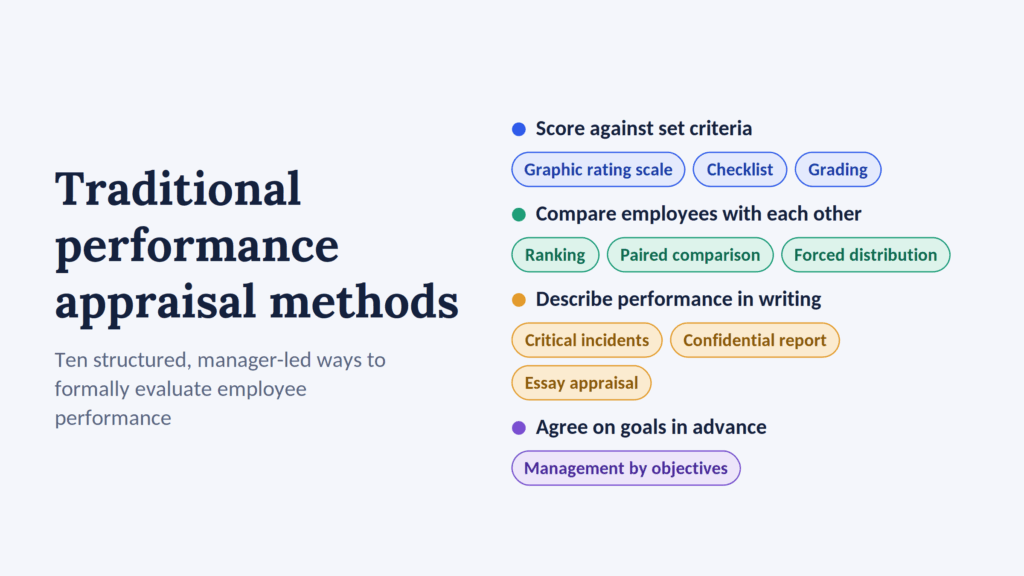
Traditional performance appraisal methods give organizations structured ways to evaluate employee performance, document progress, and support decisions around promotions, compensation, and development.
While many modern organizations now use continuous feedback systems, traditional appraisal methods are still widely used because they create consistency, accountability, and measurable evaluation frameworks.
Below are the most common traditional performance appraisal methods, along with how they work, their advantages, limitations, and where they fit best.
1. Graphic Rating Scale Method
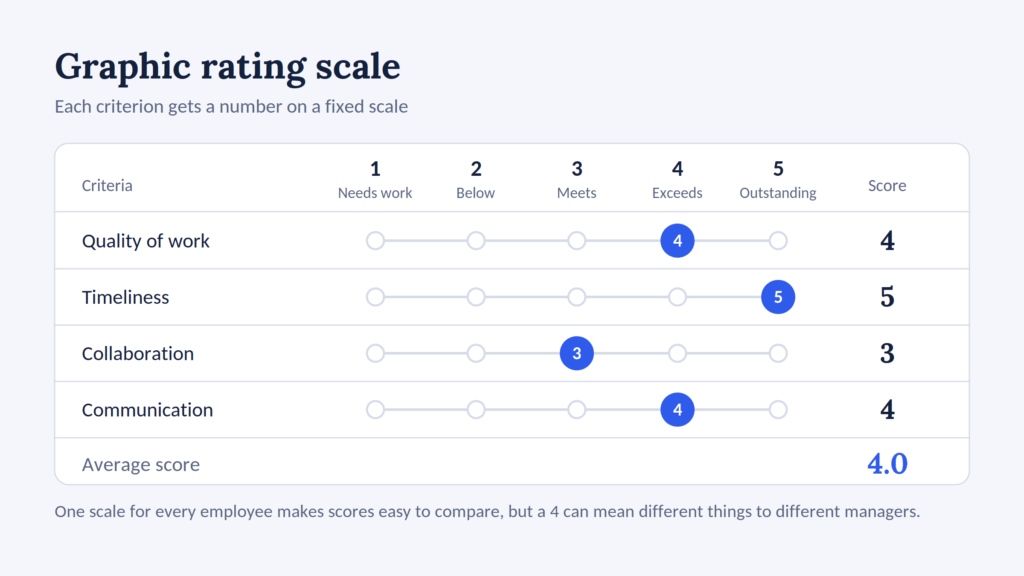
Using a set of predefined criteria, employees are assessed when using the rating scales approach. These requirements are typically role-specific and may include things like work product quality, timeliness, collaboration, and communication abilities. Every criterion is assigned a number, usually ranging from 1 to 5 or 1 to 10.
Benefits
- It is simple to comprehend and put into practice
- It gives a performance measurement that is quantitative
- It enables comparison amongst employees
Limitations
- Managers may interpret rating scales differently
- Scores often lack detailed context or explanation
- Can encourage overly generic evaluations
Also Read: 7 Modern Performance Appraisal Types that Create a Winning Culture
2. Checklist Method
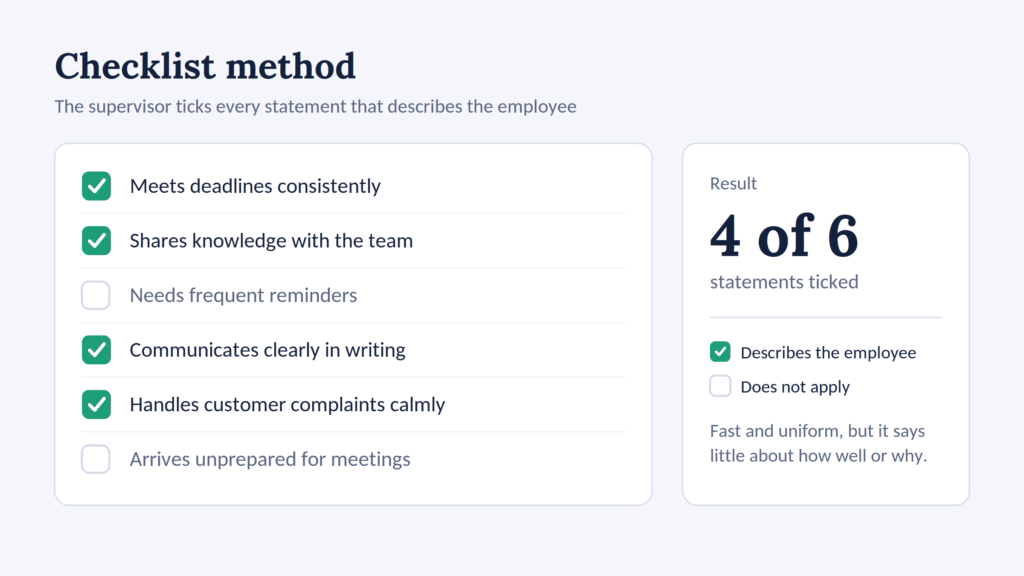
Supervisors apply this technique by using a checklist of assertions pertaining to several facets of the worker’s conduct and performance. They cross out the items that pertain to the worker undergoing assessment.
Benefits
- It is a straightforward and uniform method
- It limits the possibility of prejudice by making explicit claims
- It is also time-saving and effective for assessors
Limitations
- Does not capture performance quality in depth
- Oversimplifies complex employee contributions
- Limited developmental feedback for employees
3. Ranking Method
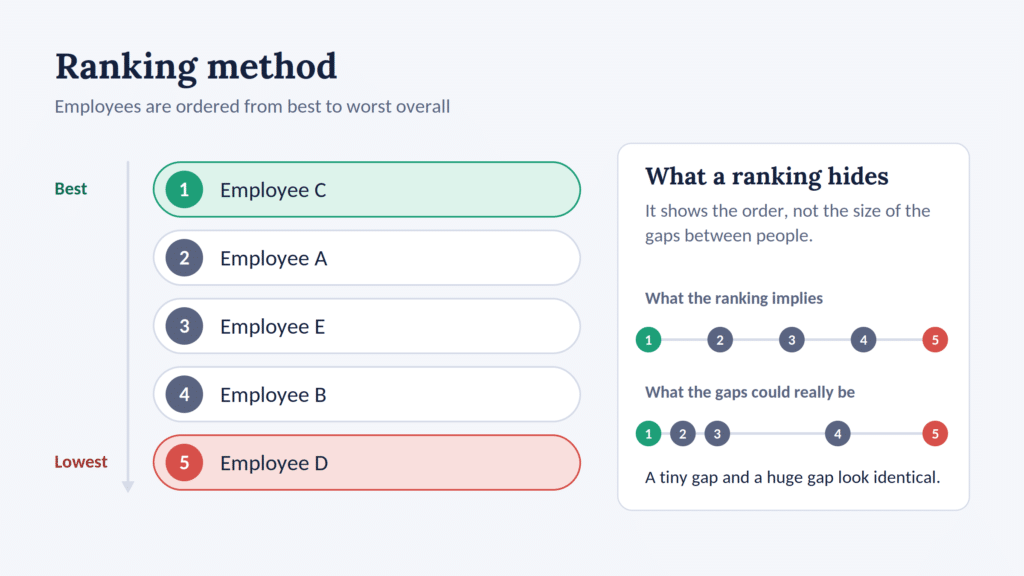
Using a ranking system, employees are ranked from best to worst according to their overall performance. Managers rank their staff members based on comparisons with one another.
Benefits
- It is a simple employee comparison.
- It draws attention to outstanding performers.
Limitations
- It may demotivate workers at lower levels, and they may need extra motivation
- It could lead to unhealthy worker competition
Also Read: Evolution Of Performance Management System
4. Paired Comparison Method
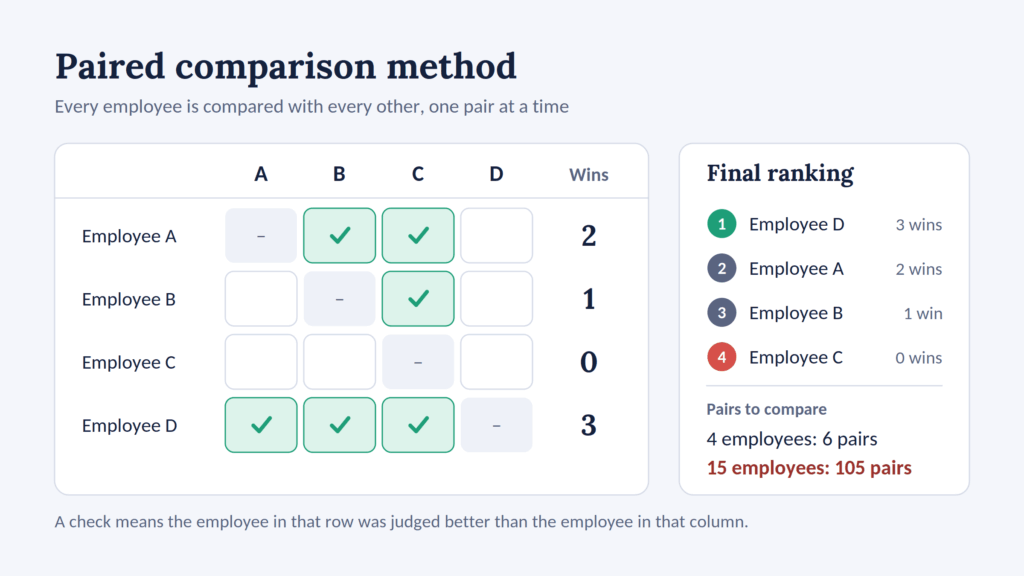
Managers must compare every employee with every other employee in pairs when using the paired comparison method. The higher-performing worker in each pair is determined, and a total ranking is created by counting the instances in which each worker is judged to be better than the others.
Benefits
- It lowers prejudice caused by ranking everyone at once
- It makes assessors choose between personnel in a particular way
Limitations
- Extremely time-consuming in larger teams
- Focuses more on comparison than development
- Can create unnecessary internal competition
5. Critical Incidents Method
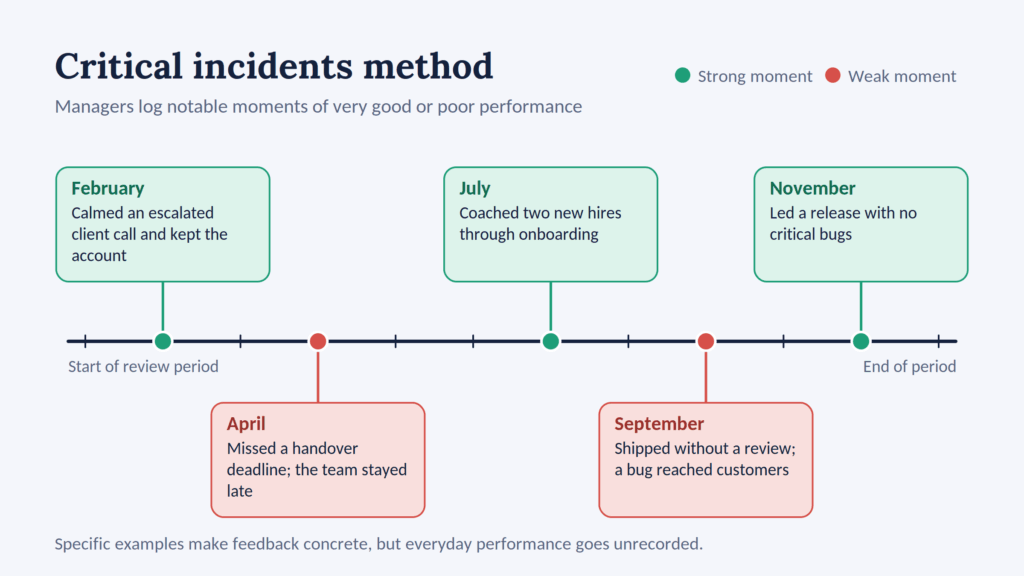
Unrecognized contributions account for 25% of employee exits. That’s why noteworthy actions representative of an employee’s work output should be recognized. In this method, managers record incidents of unusually good or poor performance throughout the review period.
Benefits
- It gives specific instances for criticism.
- It promotes ongoing performance tracking and documentation.
Limitations
- Requires consistent manager documentation throughout the year
- Managers may record only extreme positive or negative incidents
- Can overlook day-to-day performance consistency
6. Grading Method
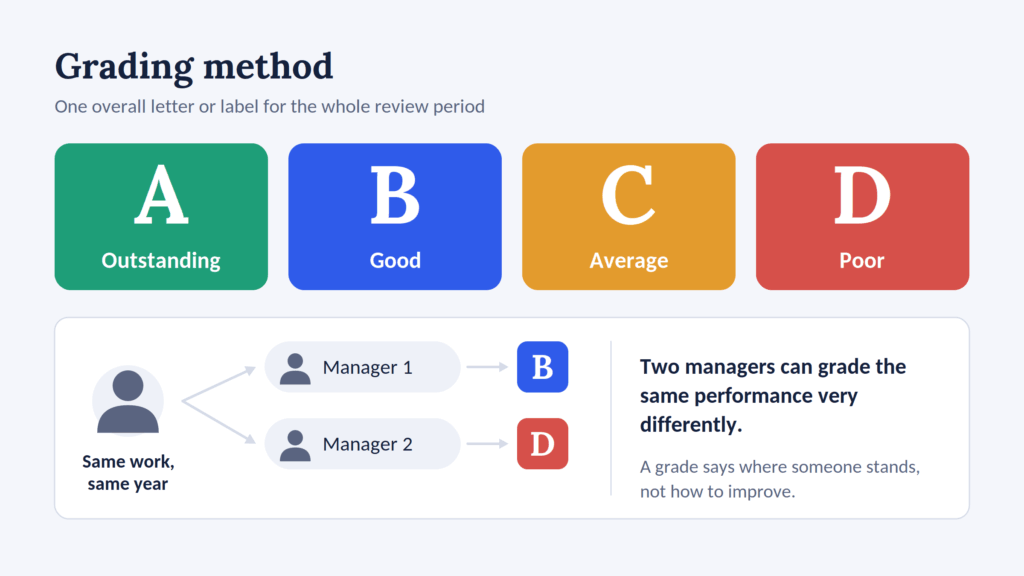
In the grading method, employees are assigned a letter or descriptor grade – typically A, B, C, D, or labels like “Outstanding,” “Good,” “Average,” and “Poor” – based on their overall performance.
How it works: Managers assess each employee holistically and assign a grade that reflects their general performance level. Some organizations use a fixed scale; others leave the criteria loosely defined.
Benefits
- Fast and easy to understand
- Works well when managers need a quick, high-level summary
- Familiar format (similar to academic grading)
Limitations
- Highly subjective – two managers may grade the same performance very differently
- Grades tell employees what they are, not how to improve
- No documentation of specific behaviors or incidents
Also Read: How HR Helps Performance Review Calibration and Standardization
Additional Traditional Performance Appraisal Methods
It’s critical to understand the various forms of assessment techniques in order to choose the best way for performance evaluation, goal alignment, staff development, and productivity gains.
1. Confidential Report
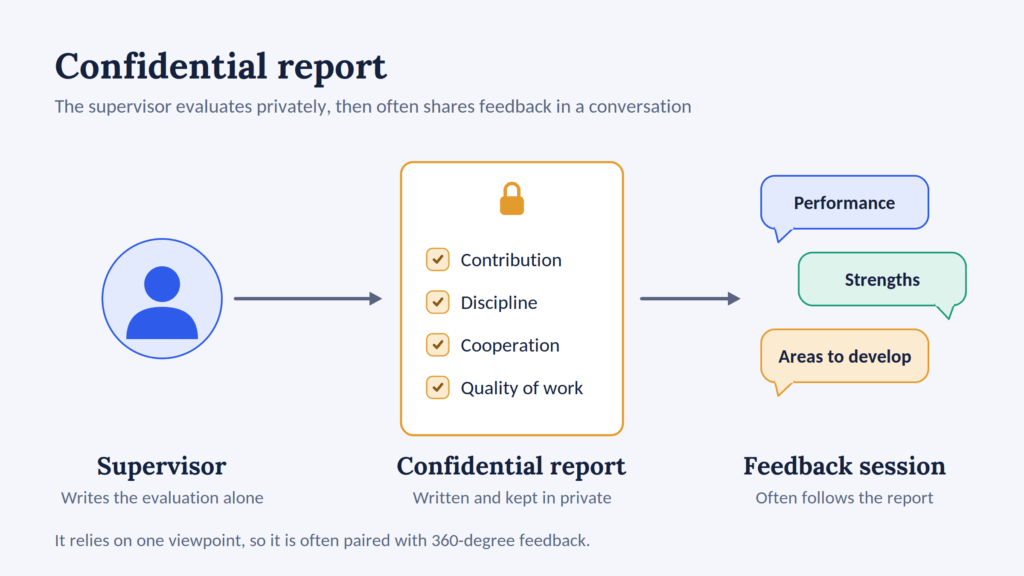
A Confidential Report is a conventional performance evaluation technique in which a supervisor evaluates an employee’s work in private. Typically, this report includes a variety of performance-related topics, including overall organizational contribution, discipline, cooperation, and quality of work.
Advantages
- Discretion: A more transparent and truthful appraisal process is promoted by confidentiality, which enables supervisors to offer frank criticism without worrying about bias or retaliation.
- Holistic View: Supervisors can provide a comprehensive picture of an employee’s performance by including particular accomplishments, obstacles faced, and growth shown over time, among other important contextual information.
- Simplicity: Because the report is confidential, it frequently includes a feedback session when managers and staff can have a detailed conversation about performance, strengths, and areas for development, which promotes mutual understanding and development.
Limitations
- Subjectivity: It depends only on the supervisor’s viewpoint, which can create subjective biases and ignore the contributions of colleagues and subordinates as well as other perspectives. This limitation is often addressed through 360-degree feedback to include multiple perspectives.
- Lack of Transparency: It can take a lot of time for supervisors to create comprehensive reports for every employee, particularly in larger teams or organizations. This can have an impact on how quickly feedback and developmental help are provided.
- Limited Input: Feedback may be less successful in promoting ongoing development and career advancement if it focuses more on past performance than on future development objectives and career aspirations.
2. Essay Appraisal
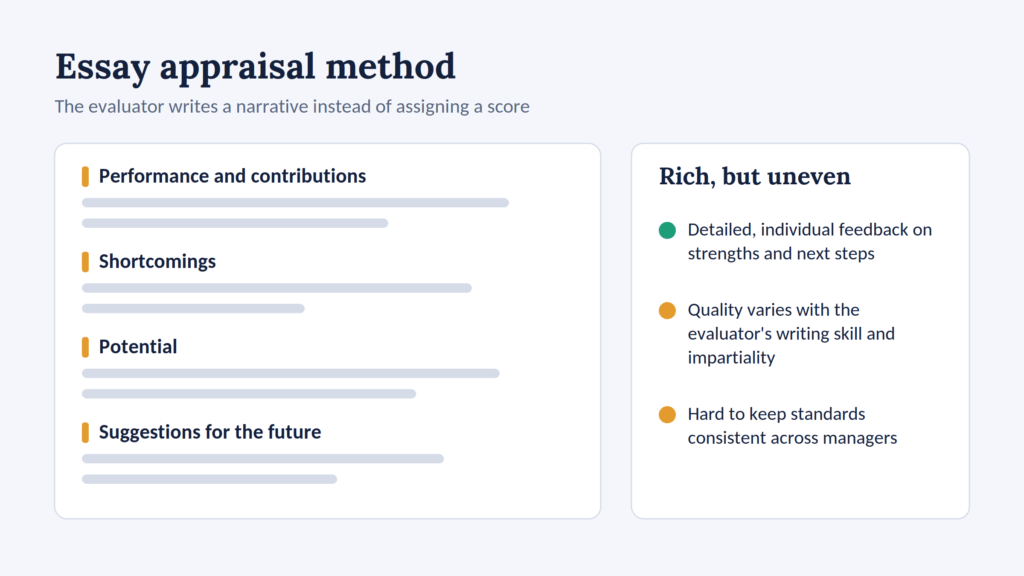
When using the essay appraisal approach, the assessor must provide a thorough account of the worker’s performance, potential, shortcomings, and overall contributions. Specific instances, broad observations, and suggestions for the future can all be included in this evaluation.
Advantages
- Detailed Feedback: It gives managers the ability to give detailed, narrative-based insights into a worker’s abilities, actions, and future contributions; this enables them to provide a more comprehensive understanding than just grading a worker’s skills.
- Individual Focus: Essay assessments can assist staff members in establishing SMART (specific, measurable, achievable, relevant, and time-bound) goals for their professional development by providing a detailed assessment of their strengths and areas for improved performance.
- Accountability: Workers are more likely to take initiative and take responsibility for their performance enhancements and growth goals when they receive individualized feedback, which encourages accountability.
Limitations
- Dependent on Evaluator Skill: The writing abilities, impartiality, and experience of the evaluators -which might differ greatly throughout managers and departments – have a significant impact on the caliber and equity of the comments.
- Difficulties with Consistency: It can be difficult to maintain uniform evaluation standards and criteria between assessors or appraisal periods, which could result in discrepancies in performance evaluations and feedback.
- Possibility of Misinterpretation: Because narrative feedback is subjective, staff members could misread the evaluator’s motives or conclusions, which could cause misunderstandings or arguments concerning performance goals and ratings.
Also Read: A Complete Guide to Improve the Performance Appraisal Process
3. Forced Distribution
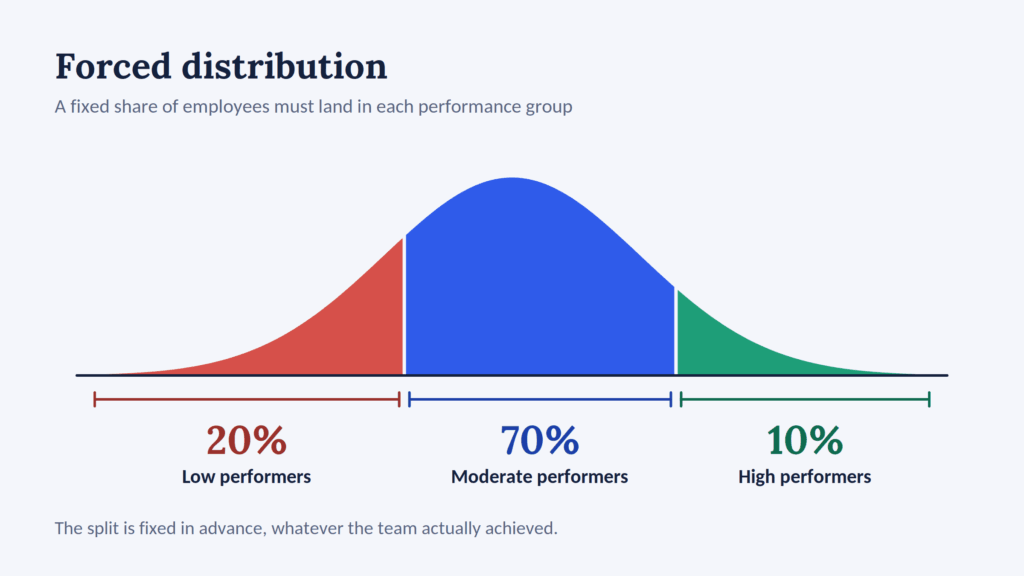
Workers are divided into performance categories (e.g., middle 70%, bottom 20%, top 10%), so that a specific proportion of them fall into each group.
These categories are used as high performers, moderate performers, and low performers, using the forced distribution method. This approach, which frequently resembles a bell curve, forces a specific percentage of personnel into each category.
Advantages
- Reduction of Central inclination: This reduces the inclination for managers to rate every employee as average and encourages a more realistic representation of individual contributions by forcing them to distinguish between employees’ performance levels.
- Aligns with Compensation Strategies: Promotes equitable and transparent reward distribution by objectively classifying workers into performance tiers that inform salary increases, bonuses, and other forms of compensation. This aligns with merit-based compensation schemes.
- Enhances Organizational Performance: Forced distribution promotes competitiveness, ongoing development, and overall organizational success by cultivating a meritocratic culture where excellent performance is acknowledged and rewarded.
Limitations
- Establishes a Competitive Environment: Competition can push certain workers to reach their full potential, but it can also lead to unhealthy rivalries, erode cooperation and teamwork within teams or departments, and negatively affect organizational cohesion.
- Possibility of Perceived Unfairness: When assigning employees to fixed percentages in large teams or organizations, it is possible to ignore individual contributions or outside variables that impact performance, which can leave workers feeling unsatisfied or unfairly treated.
- Negative Effect on Morale: Workers who are placed at lower performance levels may experience demotivation or disengagement, which can have an adverse effect on their commitment to the company over the long run, productivity, and morale.
These evaluation methods help organizations assess performance, guide professional development, and allocate rewards effectively.
However, they can also be subjective, time-consuming, and may not capture continuous performance trends accurately. Make sure you consider how these methods align with your organization’s culture and goals when implementing them.
4. Management by Objectives (MBO)
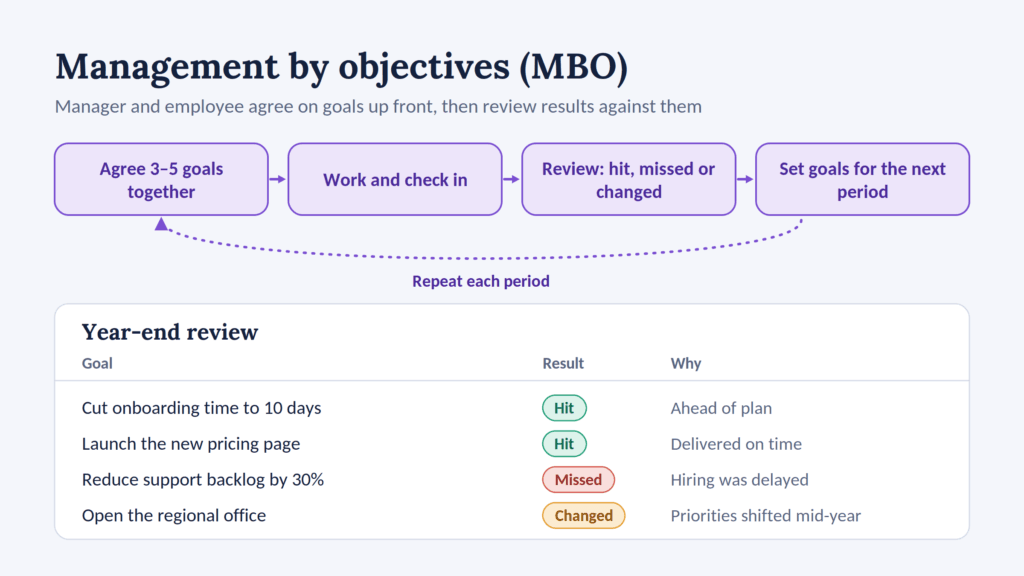
Management by Objectives is the answer to “what is MBO in performance appraisal.” It’s a goal-driven method, introduced by Peter Drucker in the 1950s, where a manager and employee jointly set specific, measurable objectives at the start of a review period, then evaluate performance against how many of those objectives were actually met.
How it works: The manager and employee agree on 3 to 5 concrete goals together, rather than the manager assigning them unilaterally. At the end of the period, the appraisal is a straightforward conversation about which goals were hit, missed, or changed, and why.
Advantages
- Clarity: Employees know exactly what they’re being measured against from day one, which removes a lot of the ambiguity that fuels disputes in other methods.
- Shared ownership: Because goals are set jointly, employees tend to feel more invested in hitting them than in methods where a manager grades them after the fact.
- Direct link to business outcomes: Individual goals can be tied straight to team or company targets, which makes it easier to show how one person’s work rolled up into a bigger result.
Limitations
- Weak on how, strong on what: MBO measures whether a goal was hit but says little about the behaviors, teamwork, or effort involved in getting there.
- Goal quality depends on the manager: Badly written or overly easy goals make the whole appraisal meaningless, and rewriting goals mid-year is common when circumstances change.
- Can undervalue collaborative work: Roles that are mostly about supporting others, like some operations or admin functions, don’t always translate cleanly into individual, measurable objectives.
Also Read: Performance Calibration Meetings: Everything You Need To Know
Pros and Cons of Traditional Performance Appraisal Methods
Here’s an honest summary of where traditional appraisals hold up – and where they don’t.
What they do well:
- Structure: They give managers a clear, repeatable process for evaluation
- Documentation: They create an official record that supports HR decisions
- Benchmarking: Quantitative methods (like rating scales) allow year-over-year comparison
- Goal alignment: When done well, appraisals connect individual effort to organizational direction
Where they fall short:
- Infrequency: Annual or semi-annual reviews mean most employees go months without structured feedback. One-third of employees wait more than three months to receive feedback from their managers.
- Recency bias: Managers naturally remember recent events more vividly, skewing assessments
- Subjectivity: Most traditional methods rely heavily on manager judgment, which varies widely
- Low engagement impact: When managers give weekly rather than annual feedback, employees are 5.2 times more likely to say they receive meaningful feedback and 3.2 times more likely to feel motivated to do outstanding work, according to Gallup.
- Cost: Traditional appraisal cycles are administratively heavy. Managers spend an average of 210 hours a year on performance management activities, a figure widely cited from Gartner/CEB research and reported by SHRM.
- Financial drag: A traditional annual review process can cost an organization with 10,000 employees somewhere between $2.4 million and $35 million in lost working hours a year, according to Gallup.
The core problem isn’t that these methods are wrong. It’s that a once-a-year process can’t keep pace with how work actually happens. Modern work is continuous, collaborative, and fast-moving. Static annual reviews struggle to capture that reality.
How to Choose the Right Performance Appraisal Method
| Method | Best team size | Best for | Bias risk |
|---|---|---|---|
| Graphic rating scale | Any size | Compensation decisions, benchmarking | Medium |
| Checklist | Any size | Fast, standardized reviews | Low |
| Ranking | Small teams | Identifying top performers quickly | High |
| Paired comparison | Small teams (under 15) | Reducing rating scale ambiguity | Medium |
| Critical incidents | Any size | Documenting specific behavior over time | Medium |
| Grading | Large organizations | Quick, high-level summaries | High |
| Essay appraisal | Any size, manager time permitting | Development planning, nuanced feedback | Medium |
| Forced distribution | Large organizations | Compensation tiering | High |
| Confidential report | Government, large enterprises | Sensitive, discretion-heavy evaluations | High |
| MBO | Any size | Goal-driven, individual contributor roles | Low to medium |
There’s no single method that works for every organization. Here’s a practical way to think about it:
Consider your team size. Paired comparison and ranking work in small teams. At scale, they become impractical and unfair. Rating scales and checklists are better for large organizations.
Think about what the appraisal output will be used for. Compensation decisions? Graphic rating scales and forced distribution give you a clear hierarchy. Development planning? Essay appraisals and critical incidents give you richer material to work with.
Match the method to your culture. Forced distribution and ranking in a collaborative, trust-based team can destroy morale fast. Essay methods work well where managers have the time, skill, and training to write meaningfully.
Plan for bias mitigation. Whatever method you choose, build in training for evaluators. The most common failure point in traditional appraisals isn’t the method itself – it’s inconsistent application.
Final Words
Effective employee performance evaluation has its foundation in the traditional methods of appraisal.
These techniques offer managers organized ways to evaluate performance, pinpoint areas in need of development, and make wise choices.
Having a thorough understanding of performance management guarantees a complete review process and assists managers in selecting the best strategy for their unique requirements.
Organizations today are increasingly moving beyond static annual reviews toward more continuous and insight-driven approaches to performance management. The goal is no longer just evaluation, but ongoing growth, alignment, and development.
Platforms like Engagedly help organizations connect performance reviews, feedback, recognition, and employee development into a more continuous experience that better reflects how modern teams work.
To move beyond traditional appraisals and build a more continuous, insight-driven performance system, you can request a demo and see how it works in practice.

Frequently Asked Questions
What is performance appraisal?
Performance appraisals help organizations:
– Measure performance against goals and expectations.
– Identify skill gaps and development opportunities.
– Support promotion and compensation decisions.
– Improve communication between managers and employees.
– Create documented performance records.
What are the traditional methods of performance appraisal?
Common traditional appraisal methods include:
– Graphic Rating Scale Method.
– Checklist Method.
– Ranking Method.
– Paired Comparison Method.
– Critical Incident Method.
– Grading Method.
– Essay Appraisal Method.
– Forced Distribution Method.
– Confidential Report Method.
What is the most commonly used traditional performance appraisal method?
Why organizations use it:
– Provides measurable performance scores.
– Allows comparison across employees.
– Easy to administer and analyze.
– Works well for large workforces.
– Supports compensation and promotion decisions.