Managing a team well is table stakes. Coaching is what makes a team actually grow, and it is the part most managers skip when the calendar fills up.
Quick answer. Managing is about directing work so the team hits its goals. Coaching is about developing people through questions, feedback, and support so they can solve problems on their own. Strong leaders use both, and manager coaching is simply the habit of bringing coaching skills into everyday management. Neither one replaces the other, and the right mix depends on the person, the task, and the situation.
This guide breaks down how coaching and managing differ, when to use each, and how to build manager coaching skills that fit into a normal work week.
What Is Manager Coaching?
Manager coaching is a way of leading in which a manager uses regular conversations, thoughtful questions, and honest feedback to help employees build skills and reach their own solutions. It focuses on growth and long-term performance rather than only on today’s task list. It works best alongside clear expectations and accountability, not instead of them.
That last point matters. Coaching does not mean going soft or giving up authority. It means choosing, on purpose, when to tell and when to ask.
What Is Managing?
Managing is the work of organizing people, tasks, and resources to get results. A manager sets goals, assigns work, gives direction, tracks progress, and reviews performance. Good managing gives people clarity, which is exactly what employees need when they are new, when a deadline is tight, or when the stakes are high.
The risk comes when managing is the only tool in the box. If every problem lands on the manager’s desk, the team stops thinking for itself and the manager becomes a bottleneck.
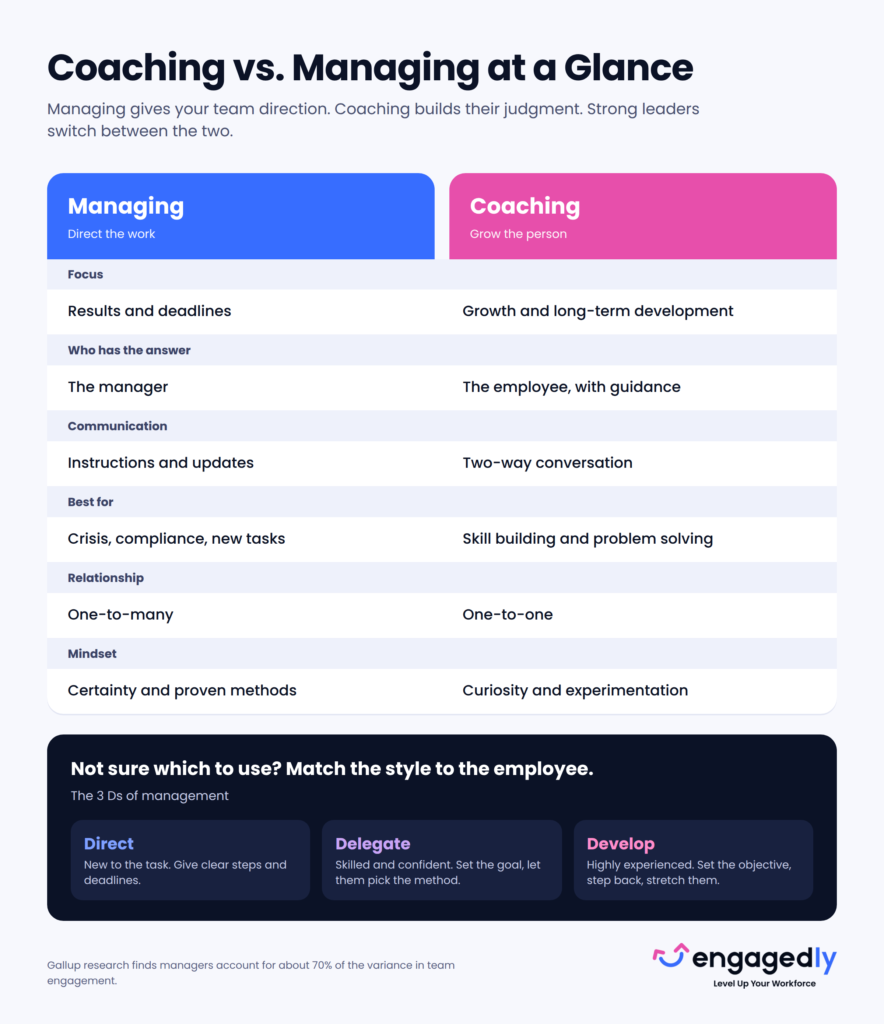
Coaching vs. Managing at a Glance
Managing
Coaching
Main focus
Results and deadlines
Growth and long-term development
Who has the answer
The manager
The employee, with guidance
Communication style
Instructions and updates
Two-way conversation
Best for
Crisis, compliance, new tasks
Skill building, career growth, problem solving
Relationship
One-to-many
One-to-one
Mindset
Certainty and proven methods
Curiosity and experimentation
Success measure
Output achieved
Capability built
6 Key Differences Between Coaching and Managing
Goal-oriented vs. growth-oriented
Managing is built around outcomes and deadlines. Coaching is built around the person. A coach starts by asking questions that help an employee set their own goals, such as “What would a great quarter look like for you?” That small shift makes people feel valued and gives them a stake in the result.
Authority vs. autonomy
Managers use their authority to steer the work. Coaches build trust and hand over more ownership. Managing says “here is what to do.” Coaching says “here is the goal, so how would you approach it?”
One-to-many vs. one-to-one
Managing often means briefing a whole team at once. Coaching happens person by person, because every employee has different strengths, gaps, and ambitions. Many organizations also add multi-rater feedback so employees get a fuller picture than one manager’s view.
Instructions vs. conversation
Managing tends to be one-way. A manager shares priorities and expectations and checks on progress. Coaching is a real conversation where the employee shares goals and obstacles and the manager listens, asks, and supports.
Crisis management vs. long-term goals
When something is on fire, clear instructions beat open-ended questions. A quick, directive style cuts confusion and speeds up action. Coaching pays off over a longer window, because it builds the skills and judgment that make the next crisis easier to handle.
Certainty vs. creativity
Managing leans on proven plans and repeatable methods. Coaching leaves room for new ideas, because employees are encouraged to test their own approaches to a problem.
You do not pick one side for good. A strong leader reads the situation and switches styles as needed. If that choice feels hard, the 3 Ds framework later in this article gives you a simple way to decide.
Why Manager Coaching Matters More in 2026
The case for coaching is stronger now than it was a few years ago, mostly because engagement is under pressure and managers are carrying a lot of it.
These are survey findings that show a strong relationship, not proof that coaching alone causes the gains. Still, the direction is consistent. Teams do better when managers talk with them, not just at them.
Benefits of Manager Coaching
Higher employee engagement
When employees feel heard and valued, they care more about the work. Regular coaching conversations build open communication and trust, which are the foundations of engagement.
Better productivity
Coached employees gain confidence and learn to solve problems without waiting for approval. That frees managers to focus on higher value work and speeds up how tasks get finished.
Faster personal and professional growth
Coaching gives people clear feedback and a path for skill building. Small, frequent conversations beat a once-a-year review for continuous improvement.
A stronger leadership pipeline
Managers who coach spot and grow future leaders. Employees practice decision making and ownership long before they hold a title.
Better retention
People tend to stay where they feel supported and see a future. Coaching signals that the company is investing in them, which helps job satisfaction and loyalty.
The 3 Ds of Management
When you are unsure whether to manage or coach, ask how much experience and confidence the employee has with this specific task. The 3 Ds framework turns that question into three clear modes.
Direct
Directing means giving clear instructions about the work, the expected result, the method, and the deadline. Put roles in writing and share templates or examples so nothing is left to guess. Directing fits best when the employee has limited experience with the task. Consider it when:
An employee is new to the company
They are handling a new client or customer
They have taken on a new role or responsibility
You need to roll out a new strategy or plan
Delegate
Delegation is a blend of managing and coaching. You define the result, and the employee chooses how to get there. Your job is to check progress and give feedback when it helps. Delegation works well when:
The employee is skilled and confident
They have a proven track record on similar work
They are managing a sensitive client relationship
Develop
Developing is full manager coaching. You set the objective and step back, without monitoring every move. When the work is done, recognize it, then find the next stretch challenge. Developing suits employees who are experienced and committed, especially when:
The team is highly skilled and competent
They have handled similar roles and clients before
They want to build new skills
The same person can sit in different modes for different tasks. A senior analyst might need Develop on forecasting and Direct on a brand new compliance process.
How to Run a Coaching Conversation
Most managers know they should coach but are not sure what to say. The GROW model, a widely used coaching framework, gives you four simple stages to follow.
Goal. Ask what the employee wants to achieve. For example, “What outcome would make this project a win for you?”
Reality. Explore where things stand today. For example, “What has happened so far, and what is getting in the way?”
Options. Let them brainstorm paths before you offer yours. For example, “What are three ways you could approach this?”
Will. Agree on next steps and a check-in date. For example, “What will you do this week, and how will I know it worked?”
Here is a quick illustration. Imagine a sales rep who keeps missing follow-up deadlines. A managing response is “Send every follow-up within 24 hours.” A coaching response is “What makes follow-ups slip for you?” The rep may say that notes are scattered across tools. Together you pick a fix, such as logging notes right after each call, and agree to review it in two weeks. Same problem, but now the rep owns the solution. This is a hypothetical example to show the difference in approach.
Tips for Managers to Improve Their Coaching Skills
Practice active listening
Give people room to talk, and avoid planning your reply while they speak. Repeat back what you heard to confirm you understood. If you are busy with your own inner monologue, you will miss the real issue.
Keep motivation and purpose in view
People commit when they see how their work connects to something bigger. Share real-time, specific feedback so employees know what to keep doing and what to adjust.
Build a growth mindset
Shift some of your attention from end results to the process behind them. Ask what is working, what is hard, and what they would try next. Encourage them to propose solutions before you step in.
Managers cannot coach well when they are stretched thin. Give them time, tools, and training for coaching conversations, and watch their workload so coaching does not become one more thing on an already full plate.
Common Manager Coaching Mistakes to Avoid
Giving the answer too quickly, which teaches people to wait for you
Coaching in a crisis, when the team needs clear direction first
Treating coaching as a yearly review item instead of an ongoing habit
Asking leading questions that only sound open
Skipping follow-up, so good ideas never turn into action
How to Tell If Manager Coaching Is Working
Pick a few signals before you start and compare them over a meaningful window, such as one or two quarters. Useful ones include engagement survey scores for your team, 1:1 completion rates, internal promotion rates, voluntary turnover, and how often employees bring solutions along with problems. Results will vary by team size, industry, and starting point, so treat your own baseline as the benchmark.
Coaching vs. Managing: Conclusion
Coaching and managing work best as a pair. Managing gives your team clarity, structure, and speed. Coaching gives them confidence, judgment, and a reason to grow with you. With engagement under pressure in 2026, the managers who learn to switch between the two will be the ones whose teams stay engaged and keep improving.
If you want to make coaching and performance management more structured and easier to scale across teams, you can request a demo to see how it works in practice.
FAQs
What is the difference between coaching and managing?
Managing focuses on organizing work and getting results through direction, deadlines, and oversight. Coaching focuses on developing the person through questions, feedback, and support so they can solve problems themselves. Managers need both, and the right choice depends on the employee’s experience and the situation.
What is manager coaching?
Manager coaching is when a manager uses regular conversations, open questions, and constructive feedback to help employees build skills and own their solutions. It sits alongside normal management duties like setting goals and tracking performance, and it works best when it happens often rather than once a year.
When should a manager coach instead of manage?
Coach when an employee has the basic skills and time to think, and when the goal is long-term growth, such as career development, building judgment, or improving an ongoing process. Manage and give direct instructions when someone is brand new to a task, when a deadline is close, or when there is a crisis or compliance risk.
What are the 3 Ds of management?
The 3 Ds are Direct, Delegate, and Develop. Direct means giving clear instructions to people who are new to a task. Delegate means setting the goal and letting experienced employees choose the method. Develop means setting the objective and stepping back with highly skilled employees while you look for new challenges for them.
What skills do managers need to be good coaches?
The core skills are active listening, asking open questions, giving specific and timely feedback, showing empathy, and following up on commitments. Patience helps too, since coaching asks you to let employees work out answers instead of handing them over.
How often should managers coach their employees?
There is no single rule that fits every team, but short, regular conversations usually work better than long, rare ones. Many managers use weekly or biweekly 1:1 meetings and add coaching questions to them. Adjust the pace to the employee’s experience, workload, and goals.
Can coaching improve employee engagement?
It often can. Gallup research links the manager relationship to team engagement, and its guidance recommends coaching as a core manager habit. Survey data shows a relationship rather than proof of cause, so pair coaching with clear expectations, recognition, and fair workloads.
Srikant Chellappa is the Co-Founder and CEO at Engagedly and is a passionate entrepreneur and people leader. He is an author, producer/director of 6 feature films, a music album with his band Manchester Underground, and is the host of The People Strategy Leaders Podcast.






 Innovative