











Constructive feedback on a performance review is feedback that names a specific, observable behavior, explains the impact it had, and gives the employee a clear next step. It sits between empty praise and harsh criticism, and its only job is to change behavior, not assign blame.
Constructive feedback is feedback that focuses on actions and outcomes rather than personality, gives the person a concrete path forward, and pairs recognition of strengths with room to grow. It differs from criticism because its purpose is development, not judgment, and it differs from vague praise because it always points to something the person can actually act on.
Most managers still blur this line. Global employee engagement fell to just 20 percent in 2025, its lowest point since 2020, according to Gallup’s State of the Global Workplace report, and feedback quality is one of the clearest levers organizations have to reverse that. Employees who say they got meaningful feedback in the past week are 80 percent more likely to be fully engaged at work, regardless of where they work from.
At its core, constructive feedback focuses on real behavior, provides actionable insight, andaligns individual contributions with organizational goals. Done well, it turns a performance review from a dreaded critique session into a development conversation that builds strength, trust, and accountability.
In this guide, you’ll learn what constructive feedback actually means, the frameworks managers use to deliver it, real examples you can adapt, and what’s changing about performance feedback in 2026.
What Constructive Feedback Really Is
Most managers confuse constructive feedback with criticism. But not all feedback is created equal.
Constructive feedback is:
- Specific and behavior-focused — Rather than vague judgments like “improve communication”, it highlights observable behaviors and the impact of those behaviors.
- Actionable — The employee should be able to see clear next steps and what success looks like.
- Future-oriented — It points toward growth, not punishment or blame.
- Balanced — It blends acknowledgment of strengths with targeted areas for improvement.
Constructive feedback differs from criticism because its intent is to develop, not to punish. Effective feedback focuses on actions and outcomes rather than personality traits.
For example, instead of saying “You’re disorganized”, a constructive feedback statement would be:
“On the Smith project, I noticed the final deliverables missed several sections of the scope. To help, let’s collaborate on a checklist that ensures all milestones are captured before submission.”
This approach makes it clear what behavior needs attention and how improvement happens.
Feedback Frameworks Managers Actually Use
You don’t need to reinvent your language every time you sit down for a review. These three models give you a repeatable structure, so feedback stays consistent no matter who’s delivering it.
The SBI model (Situation, Behavior, Impact)
SBI keeps feedback anchored to a specific moment instead of a general impression. You name the situation, describe the observed behavior, then explain its impact.
Example: “During yesterday’s client call, you interrupted the client twice while they were explaining their concern. That made it harder for them to feel heard, and it came up in their follow-up email.”
The AID model (Action, Impact, Desired behavior)
AID works well when you want to end the conversation pointed clearly at the future. You describe the action, its impact, then the behavior you want to see instead.
Example: “The report went out without the Q3 risk section (action), which meant leadership made a call without seeing the full picture (impact). Going forward, let’s build in a checklist step so every report includes it before it’s sent (desired behavior).”
The sandwich method, used carefully
The sandwich method opens with a genuine strength, delivers the constructive point, then closes with encouragement. It works, but only when the praise is specific. A vague compliment bookending real criticism reads as insincere and can undercut trust.
Example: “Your client relationships are genuinely strong, people trust you. On the reporting side, let’s tighten up how risks get flagged so nothing slips through. I know once we build that habit, your reports will match the quality of everything else you do.”
Pick one model and use it consistently across your team. The framework matters less than the consistency, since employees start to recognize the pattern and know what to expect from every conversation.
The Business Case: Stats
Constructive feedback is not a soft management preference, it is a measurable driver of engagement and retention.
Global employee engagement dropped to 20 percent in 2025, the lowest level Gallup has recorded since 2020, and the firm puts the cost of that disengagement at roughly $10 trillion in lost productivity worldwide.
Feedback is one of the few levers that moves the needle directly. Gallup found that employees who received meaningful feedback in the past week are 80 percent more likely to be fully engaged, a bigger lift than four extra “right amount of office days” combined. The same research found that only 16 percent of employees said their last conversation with their manager was extremely meaningful, and just 23 percent strongly agree they get the right amount of recognition for their work.
Employees are not resistant to hard feedback either. In Harvard Business Review’s coverage of Zenger Folkman’s research, 92 percent of employees said corrective feedback, delivered appropriately, effectively improves their performance, and people rated it as more useful to their growth than praise by roughly a three to one margin.
The gap isn’t whether employees want feedback. It’s whether managers are trained to deliver it well, consistently, and tied to something specific.
How to Give Constructive Feedback on Performance Reviews

Delivering constructive feedback on performance reviews requires structure, clarity, and consistency. When managers follow a thoughtful process, the conversation becomes less about pointing out flaws and more about unlocking performance. Here is a step by step approach you can use in performance reviews and in every ongoing feedback conversation.
1. Prepare With Data and Real Examples
Effective feedback starts long before the meeting. A manager who arrives with only vague impressions risks sounding subjective or unfair. Instead gather specific examples tied to goals, KPIs, project timelines, or customer outcomes. This approach anchors the conversation in facts rather than assumptions and helps employees understand precisely what happened and why it matters.
Use performance tracking tools, project documentation, customer feedback, and quantitative metrics to prepare. When feedback is backed by evidence it is easier for employees to accept and act on it. Preparation also signals that the manager is invested in the employee’s success.
2. Start With Strengths
Feedback is most impactful when it begins with recognition. Highlighting what the employee handled well builds trust and lowers defensiveness. Acknowledging strengths shows that the review is a balanced assessment rather than a list of problems.
Opening with strengths also gives managers an opportunity to connect good behaviors to business impact. For example, strong communication might have reduced project delays or improved client satisfaction. When employees understand how their strengths support organizational goals they become more confident and more open to hearing improvement areas.
3. Focus on Behavior and Outcomes
Constructive feedback loses its value when it becomes personal. Avoid language that labels or judges. Instead, speak only to observable behaviors and the outcomes those behaviors created. This keeps the conversation professional and objective.
For example, avoid statements like “You seem unmotivated.” A better approach is, “I have noticed that project updates are frequently delayed, which slows the team’s progress.” Let us explore what is getting in the way and how we can improve timeliness.” Focusing on actions lets employees understand what needs to change without feeling attacked.
4. Be Specific and Actionable
Vague feedback leaves employees confused and uncertain about what to do next. Make the path forward tangible by offering clear examples and practical steps. If a report lacked necessary detail, specify what information was missing and explain why it is important. If meetings run long, describe which moments caused the delays and how improved preparation could help.
For instance, you may say, “During weekly reports, include a short summary of key risks along with proposed mitigation steps. This helps the team anticipate potential challenges and respond proactively.”
5. Encourage Two Way Dialogue
Feedback should be a conversation, not a lecture. Invite the employee to share their perspective, ask questions, and discuss challenges. When employees feel heard, they are more likely to take ownership of their development. Dialogue also helps managers uncover root causes that may not be obvious, such as workload issues or process barriers.
Creating space for employee input strengthens psychological safety and builds trust across the team.
6. Set Clear Goals and Follow Up Regularly
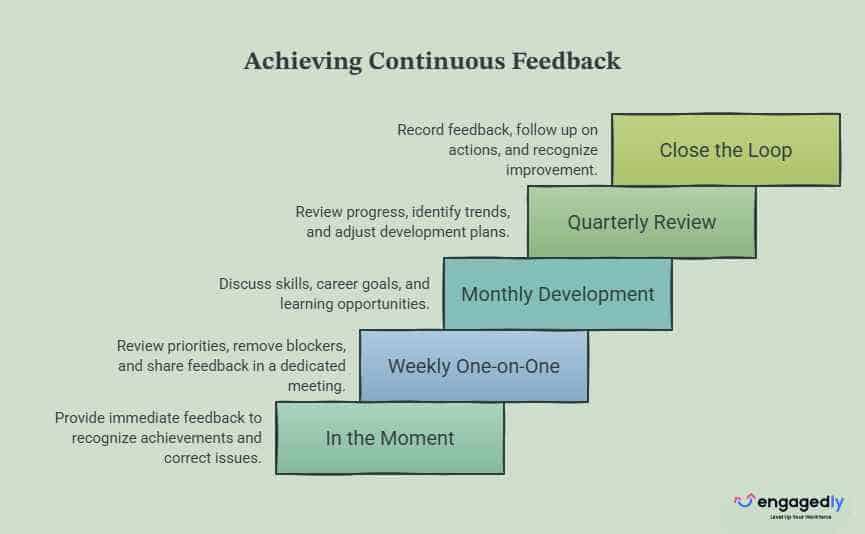
After discussing strengths and growth areas, define what improvement looks like. Use goals that are specific, measurable, achievable, relevant, and time-bound. Clarify what success looks like and decide how progress will be reviewed. Regular check-ins reinforce accountability and show the employee that development is a continuous priority, not a once-a-year expectation.
7. Maintain a Growth Mindset
Finally, approach every feedback conversation with the belief that skills can be developed. A growth-oriented mindset frames feedback as a tool for learning rather than a judgment of capability. When managers convey confidence in the employee’s ability to improve, the review becomes far more motivating.
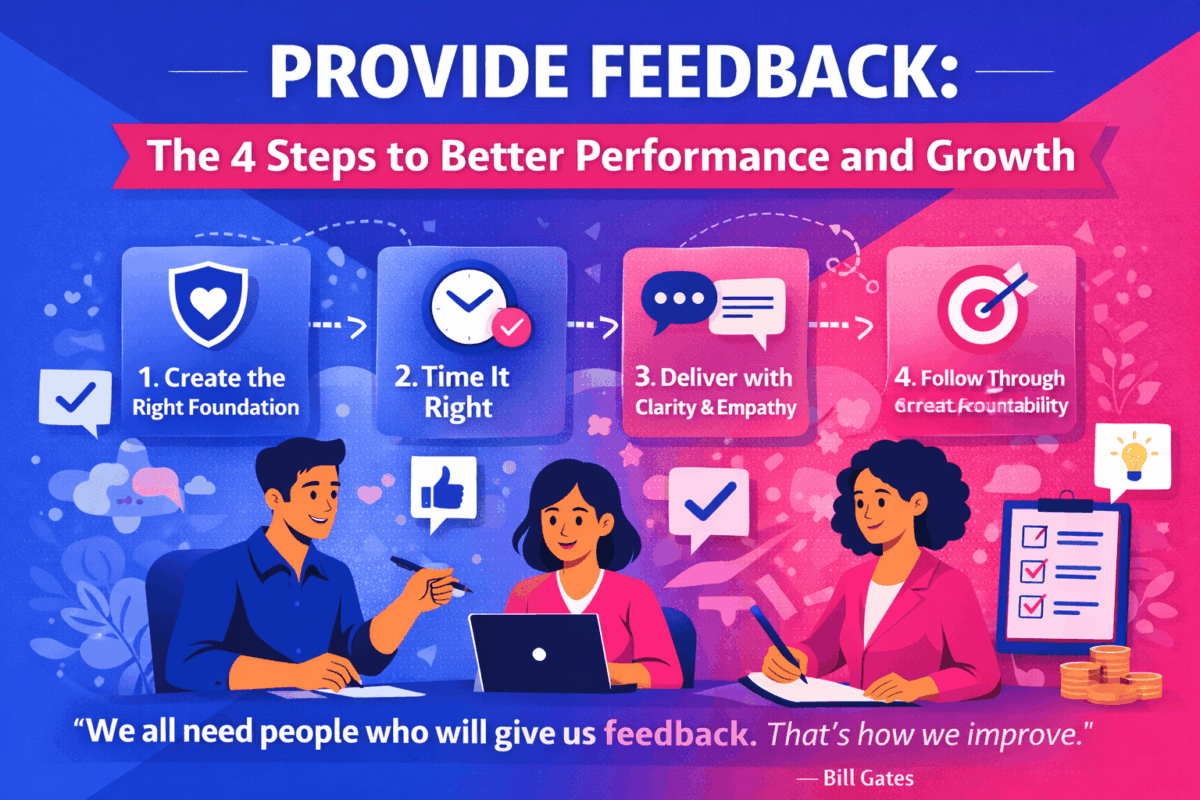
As Bill Gates said, “We all need people who will give us feedback. That is how we improve.” Constructive feedback delivered well is one of the most powerful drivers of performance and engagement.
What’s Changing About Feedback in 2026
Annual reviews are losing ground fast. Managers who receive weekly feedback themselves are more likely to give it to their own teams, and organizations are increasingly building lightweight, continuous check-ins instead of saving everything for one high-stakes conversation a year.
AI tools are also starting to change how feedback gets prepared and delivered, not by replacing the manager’s judgment, but by helping surface patterns across projects, flag one-sided or vague language before it reaches the employee, and turn scattered comments into a coherent, evidence-backed review. Used well, this frees managers to spend the actual conversation on coaching instead of drafting.
None of this changes what makes feedback land. It still needs to be specific, tied to real behavior, and followed up on. What’s changing is how much friction it takes to make that happen consistently across an entire organization, which is exactly the gap platforms with built-in 360 feedback and AI-assisted review tools are designed to close.
Constructive Feedback Examples
Constructive feedback becomes far more effective when it is tied to real behaviors and real outcomes. Managers often struggle because they know what feels “off” in performance but cannot articulate it in a clear and actionable way.
The examples below provide ready-to-use statements you can adapt for your performance reviews. Each pair includes one positive statement and one constructive version that shows exactly how to guide improvement without harming morale.
Communication Skills
Positive:
“You explained the client requirements clearly and confidently, which helped the team start the project with complete clarity. Your ability to simplify information is a big asset.”
Constructive:
“When presenting complex topics, try adding a short summary at the end with the top action items. This will help the group remember the essentials and reduce follow-up questions after the meeting.”
This approach reinforces communication strengths while directing the employee to create more structure in their messaging.
Teamwork and Collaboration
Positive:
“You collaborate well with cross-functional partners, and your willingness to jump in when others need help has strengthened team relationships.”
Constructive:
“In team discussions, try inviting quieter members to share their views. This will help the team surface more diverse ideas and show others that you value their input.”
This kind of feedback encourages collaboration not only through participation but also through facilitation.
Leadership and Initiative
Positive:
“You show initiative by taking ownership of difficult tasks and guiding your teammates during complex assignments. Your leadership has had a positive impact on team morale.”
Constructive:
“Continue building your leadership by delegating more of the mid-level tasks to your team. This will help them grow and will free you up to focus on the more strategic work we want you to lead.”
This highlights the difference between leading through effort and leading through empowerment.
Time Management
Positive:
“You meet deadlines consistently and your predictable work rhythm helps others plan their tasks with confidence.”
Constructive:
“Consider reserving focused time blocks for your highest priority work. This will reduce last-minute workload spikes and help you maintain steady progress throughout the week.”
Time management feedback works best when paired with practical strategies rather than generic advice.
Quality of Work
Positive:
“The deliverables you produced this quarter were thorough and well-structured. Your attention to detail helped avoid rework.”
Constructive:
“Before submitting final drafts, build in a short review step to catch small errors and formatting issues. This will help reduce revisions and showcase your best work the first time.”
Problem-Solving and Decision-Making
Positive: “You break down complex problems methodically, and your team relies on you to get to the root cause instead of just treating symptoms.”
Constructive: “When a decision needs to move fast, try setting yourself a time box before you finalize it. This will help you act on strong instincts you already have, instead of over-analyzing lower-stakes calls.”
Adaptability and Change Management
Positive: “You adjusted quickly when the project scope changed midway through the quarter, and your calm under pressure helped the rest of the team stay steady too.”
Constructive: “When priorities shift, try communicating the change to your stakeholders within the same day. This keeps everyone aligned and prevents rework caused by outdated assumptions.”
Do’s and Don’ts of Giving Constructive Feedback
Do use clear and specific language
Avoid vague or general statements. When you say something like “improve quality,” employees are left guessing what to change. Instead, describe the exact behavior and its impact. For example, “The weekly reports missed key risk updates, which slowed our decision-making. Let us include a brief risk summary moving forward.” Specificity builds clarity and reduces confusion.
Do provide timely feedback
The longer you wait, the less relevant the feedback feels. Employees often forget context and the value of the insight is lost. Research shows employees want more frequent guidance, not just once a year. Use regular check-ins to address issues early and keep development continuous.
Do follow up and support progress
Feedback without follow-up can feel like criticism rather than coaching. After sharing improvement areas, check in on progress, offer resources, and coach as needed. Consistency builds trust and reinforces accountability.
Do focus on actions and outcomes
People respond better when you focus on what they did, not who they are. Replace statements like “You are disorganized” with “The project files were submitted without the updated specs which created rework.” Action-based feedback keeps conversations objective and respectful.
Don’t rely on personality labels
Labels make employees defensive and shift attention away from the real issue. Keep conversations centered on behavior and results.
Don’t wait until the annual review
Performance reviews are not meant to surprise anyone. Delaying feedback limits improvement and increases frustration. Continuous feedback strengthens performance throughout the year.
Don’t give feedback without a clear next step
Employees should leave the conversation knowing exactly what to improve and how success will be measured. Lack of guidance leaves the feedback incomplete.
Conclusion
Constructive feedback on performance reviews works best when it is part of a continuous cycle rather than a once-a-year event. When feedback is thoughtful, specific, and tied to outcomes, it strengthens performance, builds clarity, and deepens engagement.
Research consistently shows that organizations that prioritize meaningful feedback significantly outperform those that do not. This is because employees understand what success looks like and how to achieve it, which turns performance conversations into opportunities for growth rather than moments of stress.
To build this kind of culture, embed regular check-ins, real examples, and actionable goals into every development discussion. Equip managers with tools that make feedback easier to give and easier for employees to act on. When insights from reviews translate into real behavior change, the entire talent ecosystem becomes stronger.
Platforms like Engagedly help managers deliver structured, multi-perspective feedback through its 360 Feedback and multi-rater module. The platform’s Agentic AI capabilities transform feedback from static comments into intelligent nudges and follow-up actions that drive continuous improvement. You can explore how this works here:https://engagedly.com/product/360-feedback-multi-rater/
When feedback becomes continuous and actionable, performance reviews evolve into a true growth engine for individuals and the organization.