Ethics in performance management is the practice of evaluating employees with fair, transparent, and consistent standards, so ratings, pay, and promotion decisions rest on documented evidence instead of personal opinion. It applies to managers, HR teams, and anyone who designs or uses review systems, including AI tools. Ethical practice reduces bias and builds trust, but it cannot remove subjectivity entirely, and it does not replace legal compliance, which varies by country and state.
Imagine an employee gives their all for an entire year, consistently exceeding expectations. Then comes review season, and they receive a lukewarm evaluation based on one recent mistake. Or worse – they’re rated lower than a colleague with similar performance, simply because their manager unconsciously favors people who remind them of themselves.
This isn’t just frustrating. It’s unethical. And it happens more often than you’d think.
In a Gallup survey of U.S. employees, only 22% strongly agreed that their performance review process is fair and transparent. That is a “strongly agree” measure, so it understates people who mildly agree, but the message is clear. Fewer than one in four employees fully trust the system that shapes their pay, promotions, and career path.
Here’s the reality: performance management isn’t just about tracking metrics and hitting goals. At its core, it’s about treating people fairly, transparently, and with respect. When ethics guide your performance management system, you don’t just create better reviews – you build trust, boost engagement, and retain your best talent.
Let’s explore why ethics in performance management matters more than ever, how bias sabotages even well-intentioned systems, and what you can do to build an evaluation process that’s genuinely fair.
Why Ethics in Performance Management Matters
Ethics in performance management matters because reviews decide pay, promotions, and who gets development opportunities. When people believe those decisions are fair, they act on feedback. When they don’t, they disengage or leave.
When your performance management system operates ethically, employees understand exactly how they’re being evaluated. There are no moving targets, no vague feedback, and no hidden agendas. Managers use clear, objective criteria instead of personal opinions or unconscious biases.
The impact? 77% of ethics and compliance professionals indicate their organizations now emphasize values rather than rules to motivate ethical behavior – a 27 percentage-point increase from 2016. This shift reflects a fundamental understanding: people perform better when they feel the system is fair.
The Business Case for Ethical Performance Management
Ethical performance management isn’t just the “right thing to do” – it’s a strategic imperative. Organizations with ethical performance systems see tangible benefits:
Higher Employee Engagement: When employees trust that performance reviews are fair, they’re more motivated to improve and contribute. 85% of employees report higher engagement levels through regular manager check-ins, especially when those conversations are transparent and development-focused.
Better Retention: Organizations emphasizing continuous feedback and development achieve 31% lower turnover rates versus traditional approaches. People stay where they feel valued and fairly treated.
Reduced Legal Risk: Biased performance reviews can lead to discrimination lawsuits, damage to your employer brand, and costly settlements. An ethical system protects both employees and the organization.
Improved Performance: When people trust the process, they’re more willing to receive feedback and act on it. Fair evaluations create a culture of continuous improvement rather than defensive posturing.
As Dave Ulrich, co-founder of The RBL Group, explains: “Good performance accountability is about having a positive conversation between manager and employee. A manager is a coach and communicator, not command and controller.”
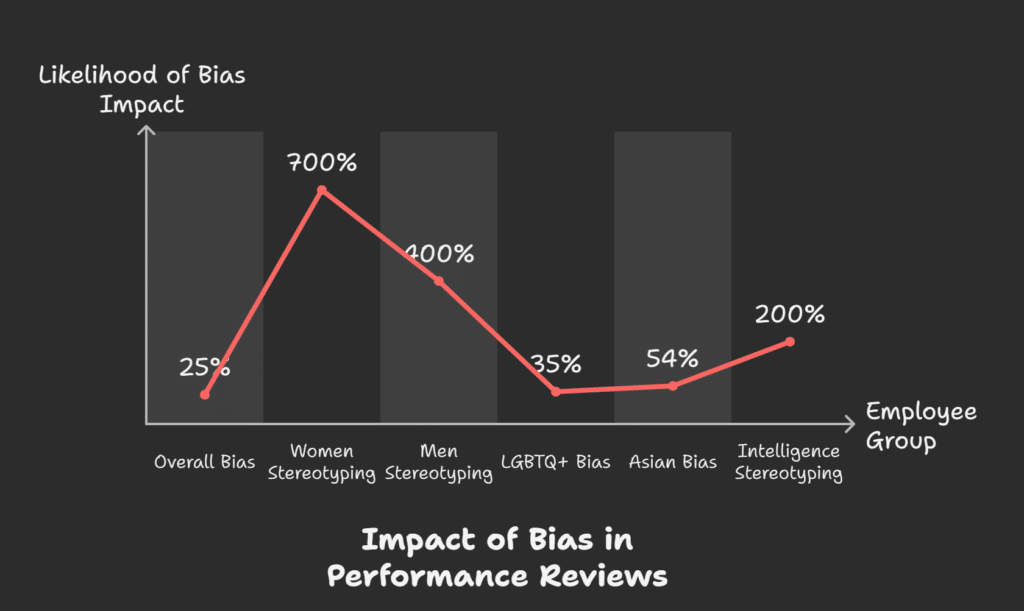
Women are 7 times more likely than men to internalize negative stereotypes like “emotional”, while men are 4 times more likely than people of other genders to be positively stereotyped as “likable”. These patterns don’t reflect actual performance – they reflect deeply ingrained social biases.
The impact extends across demographics: LGBTQ+ employees are 35% more likely to report that their supervisor’s personal biases negatively impacted their performance reviews, while for Asian employees, that number jumps to 54%.
Common Types of Performance Review Bias
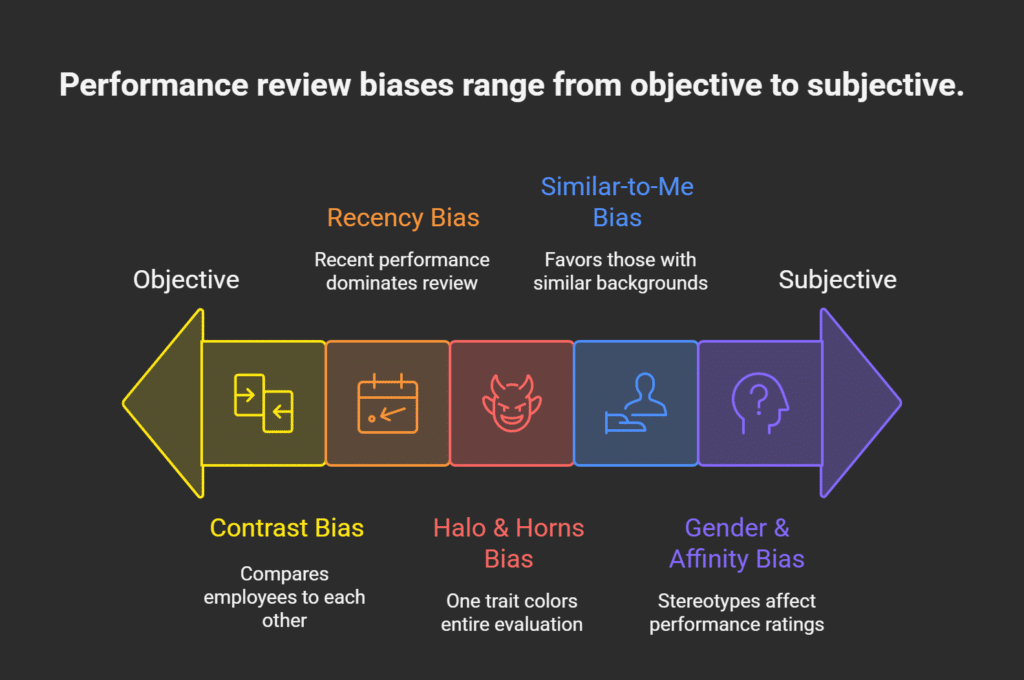
Understanding bias is the first step to eliminating it. Here are the most prevalent forms:
1. Recency Bias This is probably affecting your organization right now. Recency bias happens when the employee’s most recent performance level skews the opinion of the total work for the cycle being evaluated. An employee who performed brilliantly for 11 months but struggled in month 12 gets rated as if they struggled all year.
Example: Sarah led three successful product launches in Q1-Q3, but her Q4 project hit delays due to supply chain issues beyond her control. Her manager, focused on recent events, rates her as “needs improvement.”
2. Halo and Horns Bias Halo bias is the tendency to give overall favorable ratings due to strong performance in only one or two areas, while horns bias is the opposite – one weakness colors the entire evaluation.
Example: Marcus is always the first person in the office, creating a “halo” that makes his manager overlook his missed deadlines and incomplete projects.
3. Similar-to-Me Bias We naturally favor people who remind us of ourselves – same background, similar interests, familiar communication style. This unconscious preference can dramatically skew evaluations.
Example: A manager who attended a prestigious university consistently rates fellow alumni higher than equally qualified employees from other schools.
4. Contrast Bias This occurs when managers compare employees to each other rather than against established performance standards.
Example: An employee meets all their goals and performs well by objective measures, but their manager rates them lower because they’re not quite as exceptional as the team’s superstar performer.
5. Gender and Affinity Bias White and Asian people are 2 times more likely to be positively stereotyped as “intelligent” compared to Hispanic/Latino and Black people. These systemic biases infiltrate performance reviews unless actively countered.
Example: A female manager is described as “aggressive” for the same assertive communication style that would earn a male manager praise for being “decisive” and “strong.”
How AI Is Changing Ethics in Performance Management in 2026
AI can make reviews more consistent, but it can also repeat bias at scale. Any AI tool that touches ratings needs human oversight, transparency, and regular testing.
Even if you operate outside the EU, the direction is worth following. Here is a practical starting point for any team using AI in reviews.
Tell employees exactly what the tool does and does not influence
Keep a human accountable for every rating, and let managers override the tool
Test outputs by group (gender, age, ethnicity, role) at least once per review cycle
Check that the training data reflects your workforce, not just a vendor’s average customer
Keep records of how the tool was used so you can explain a rating if challenged
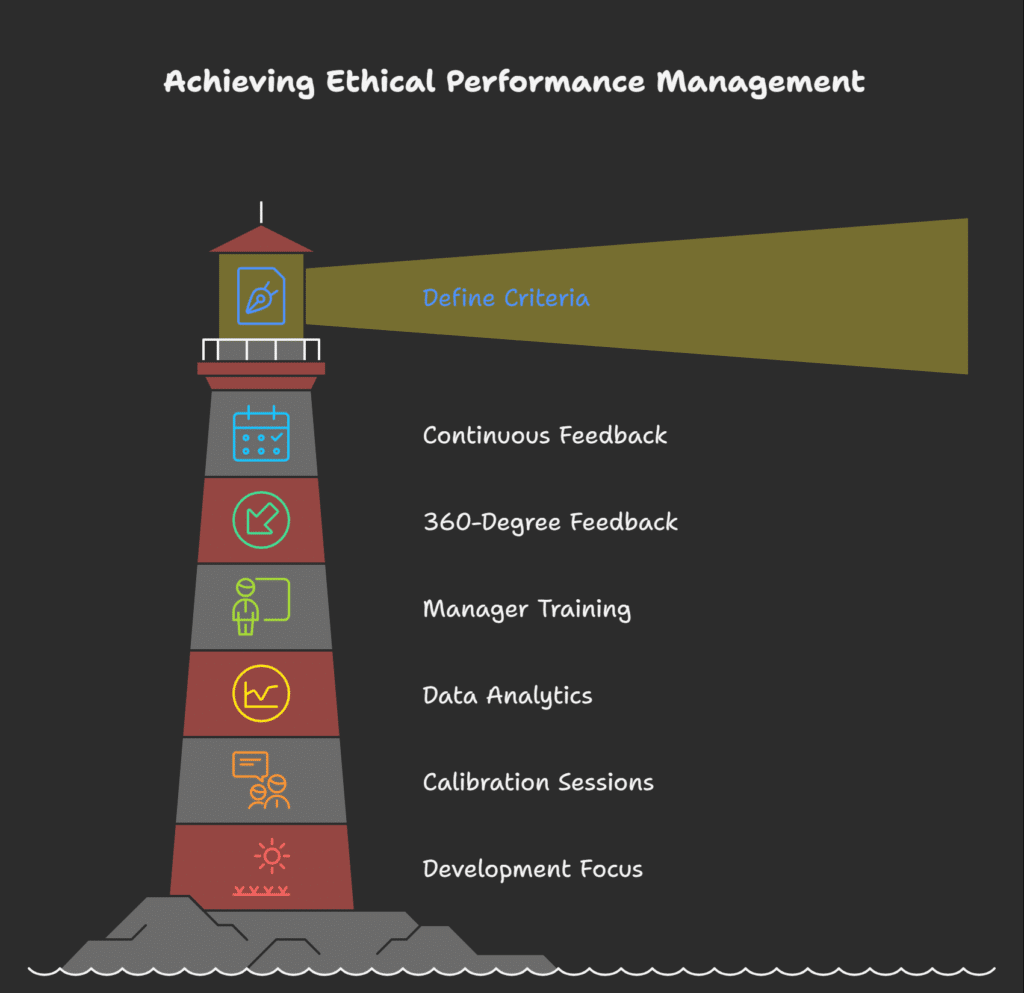
Building an Ethical Performance Management System
Creating an ethical performance management system isn’t about perfection – it’s about intentional design, ongoing vigilance, and commitment to fairness at every level.
1. Establish Clear, Objective Criteria
Vague evaluation standards invite bias. Instead, create specific, measurable criteria that leave little room for subjective interpretation.
What this looks like:
Define what “meets expectations” means for each role with concrete examples
Use competency frameworks that specify observable behaviors
Create rating scales with detailed descriptions for each level
Document examples of performance at different rating levels
Organizations that effectively build diverse teams at every level are 69% more likely than ineffective organizations to analyze performance ratings for bias against particular groups. The foundation? Clear standards that can be consistently applied.
2. Implement Continuous Feedback, Not Just Annual Reviews
Creates opportunities for course correction before small issues become big problems
Builds trust through regular, transparent communication
Provides more data points, making it harder for one biased opinion to dominate
Companies that shifted to more frequent performance check-ins (two or more times per year) were associated with lower concerns about supervisor bias and enhanced clarity regarding advancement opportunities.
Practical implementation:
Schedule quarterly formal reviews with monthly check-ins
Train managers to give specific, timely feedback rather than saving everything for review season
Create a feedback culture where employees also share upward feedback
3. Use 360-Degree Feedback to Counter Single-Point Bias
Over half of organizations still rely only on an employee’s manager to evaluate performance, creating an absence of alternative perspectives and a single “point of failure” when it comes to identifying and interrupting bias.
This crowdsourcing approach helps neutralize individual biases by bringing diverse viewpoints into the evaluation. When five people consistently observe someone’s strong project management skills, it’s harder for one biased manager to claim otherwise.
4. Train Managers on Bias Recognition and Mitigation
More than 90% of this year’s World’s Most Ethical Companies provide dedicated training for people managers, focused on their unique role in fostering a culture of integrity and psychological safety.
But here’s the critical point: anti-bias training alone is not enough. Research shows that required training alone can have mixed or even negative results. The key to improving the effects of training is to make it part of a wider program of change.
Effective training includes:
Interactive scenarios that help managers recognize their own biases
Practice sessions with peer feedback
Regular refreshers, not one-and-done workshops
Integration with accountability measures (like having managers’ reviews audited for bias)
Resources managers can reference during actual review writing
5. Leverage Data Analytics to Detect Bias Patterns
High-performing ethics and compliance programs are 2.1 times more likely to leverage data from a variety of sources to guide program focus and development.
Apply this same rigor to performance management:
What to analyze:
Rating distributions across demographic groups
Patterns in who gets promoted (and who doesn’t)
Differences in feedback language used for different groups
Correlation between ratings and subsequent outcomes
Manager-specific trends that might indicate bias
Example analysis: If your data shows that women consistently receive lower ratings than men in technical roles despite similar objective metrics (projects completed, code quality, etc.), you’ve identified a bias problem that needs addressing.
Technology can help, but treat it as a second pair of eyes, not the decision maker. AI tools can flag loaded language and unusual rating patterns, yet they inherit the biases in their training data. See the AI section above for how to test them..
Calibration meetings – where managers discuss their ratings before finalizing them – are one of the most effective bias-reduction tools.
How they work:
Managers present their planned ratings for their team members
Peers challenge evaluations that seem inconsistent with evidence
HR facilitates discussion to ensure consistency across teams
Managers must justify ratings with specific examples
Group consensus helps identify and correct outliers
This process creates accountability. A manager who realizes they’ll need to defend their ratings in front of peers is more likely to evaluate carefully and fairly.
7. Make Development the Focus, Not Just Evaluation
Ethical performance management shifts the conversation from “How do I judge you?” to “How do I help you grow?”
As Rob Burn, President of L & L Solutions, states: “Performance should be an expectation of employment and it is the leader’s job to create an environment where maximum performance is possible.”
This means:
Starting every review conversation with strengths, not weaknesses
Co-creating development plans rather than dictating them
Providing resources and support for growth
Celebrating progress, not just endpoints
Recognizing that people develop at different paces and through different paths
Ethical Dilemmas Managers Actually Face in Performance Reviews
Most ethical problems in reviews aren’t dramatic. They are small judgment calls that add up. These are the ones that come up most.
Favoritism. Rating a friendly, familiar employee higher than a quieter one with the same results.
Hidden ratings. Scoring “potential” or “flight risk” without telling the employee.
Monitoring creep. Using activity data such as login time or message counts as a stand-in for performance.
Pay pressure. Adjusting a rating to fit a raise budget instead of the evidence.
Silence. Skipping honest feedback because the conversation is uncomfortable.
A useful test is to ask whether you could explain the rating, and how you reached it, to the employee’s face. If not, the process needs work.
Red Flags: Signs Your Performance Management System Has Ethical Issues
Watch for these warning signs:
Lack of Trust: Gen Z employees report the lowest managerial trust levels, and E&C professionals report a 42-point disparity between executives and middle managers on ethical decision-making. If employees don’t trust the process, there’s likely a good reason.
Rating Compression: When every employee gets a rating of 3 out of 5 (or similar middling scores), managers might be avoiding difficult conversations or don’t have clear standards.
Demographic Patterns: If promotions consistently go to one demographic group while others remain stuck, your system has a bias problem.
Generic Feedback: When reviews are filled with vague platitudes like “needs to be more strategic” without specific examples, managers aren’t doing the work – or they’re avoiding honest assessment.
High Turnover After Reviews: If good employees regularly leave shortly after performance reviews, they’re likely getting feedback that feels unfair or demoralizing.
Lack of Documentation: If performance conversations happen verbally with no written record, there’s no accountability and no protection against bias or inconsistency.
The Path Forward: Creating a Culture of Ethical Performance Management
Ethics in performance management isn’t achieved through a single policy change or training session. It requires ongoing commitment, starting from the top.
Identify quick wins (like moving to quarterly rather than annual reviews)
Short-term (Next 90 days):
Implement bias training for all people managers
Create clear, documented evaluation criteria for each role
Set up data tracking to monitor rating patterns by demographic
Long-term (Next year):
Transition to continuous feedback culture with supporting technology
Establish regular calibration sessions
Build 360-degree feedback into your standard process
Create accountability measures that tie manager effectiveness to fair evaluation practices
Remember Howard Schultz’s wisdom: “I think the currency of leadership is transparency. You’ve got to be truthful.” This applies equally to performance management. When leaders commit to transparency and fairness, employees notice – and they respond with increased engagement, loyalty, and performance.
The Bottom Line
Ethics in performance management isn’t a “nice-to-have” – it’s a fundamental requirement for any organization that wants to attract, develop, and retain talented people.
When employees trust that they’ll be evaluated fairly, they take risks, voice ideas, and invest themselves fully in their work. When they suspect bias, they disengage, job-hunt, and do the minimum required.
The choice is yours. Will you perpetuate systems that allow bias to flourish under the guise of “subjectivity”? Or will you build a performance management process grounded in fairness, transparency, and genuine development?
As 77% of ethics professionals have learned, emphasizing values over rules is what motivates ethical behavior. The same principle applies to performance management: clear values, consistent application, and visible commitment to fairness will always outperform complex rules that people find ways around.
Start today. Your employees – and your organization’s future – depend on it. If you’re rethinking how to make performance management more fair, transparent, and continuous, it may be worth requesting a demo to see how modern systems support this shift.
FAQs
What does ethics in performance management mean?
Ethics in performance management refers to evaluating employees fairly, transparently, and without personal bias. An ethical system uses clear criteria, consistent standards, and documented evidence rather than subjective opinions. It ensures employees understand how decisions about ratings, pay, and promotions are made. When reviews are ethical, employees trust the process and are more open to feedback. This trust directly impacts engagement and retention.
How does bias affect employee performance reviews?
Bias distorts performance reviews by putting perception ahead of real contribution. Common forms include recency bias, halo and horns bias, and similar-to-me bias. These can cause strong performers to be undervalued and average performers to be overrated. In Gallup research, only 22% of employees strongly agreed their review process is fair and transparent, which shows how much trust is at stake. Over time, biased ratings lead to poor promotion decisions and higher turnover.
Why is ethical performance management important for retention and engagement?
Ethical performance management strengthens engagement because employees feel respected and fairly treated. When people trust their evaluations, they are more likely to act on feedback and invest in their development. Organizations with transparent feedback and continuous check-ins see significantly lower turnover rates. As leadership expert Dave Ulrich emphasizes, performance conversations should be coaching-oriented, not punitive.
What practices help reduce bias in performance evaluations?
Reducing bias takes deliberate system design and manager accountability. Start with clear, behavior-based criteria for each role, then replace annual-only reviews with regular check-ins. Add 360-degree feedback so no single opinion decides a rating, and hold calibration sessions where managers explain their scores with evidence. Finally, review rating data by group and by manager to spot patterns. None of these removes bias completely, but together they limit subjectivity and make decisions easier to defend.
How can organizations build a more ethical performance management system?
Organizations can build ethical performance systems by prioritizing transparency, development, and data-driven oversight. Start by defining objective standards for each role, training managers to recognize bias, and documenting feedback throughout the year. Use technology to track trends and flag inconsistencies. Thought leaders like Brené Brown note that unclear feedback is ultimately unkind. Ethical systems replace ambiguity with clarity and growth-focused dialogue.
Does employee clearance apply the same way to resignation and termination?
The clearance steps themselves, meaning asset return, knowledge transfer, and financial settlement, are largely identical either way. What differs is documentation and notice handling, since a termination can carry different notice or severance obligations than a voluntary resignation, depending on the employment contract and local law.
Is using AI in performance reviews ethical?
It can be, if a human stays accountable for every decision. AI is useful for flagging biased language or unusual rating patterns, but it can also repeat bias from its training data. Ethical use means telling employees what the tool does, letting managers override it, and testing its outputs across groups on a regular schedule. In the EU, AI used to evaluate performance is classed as high-risk, so extra obligations apply.
What is the difference between legal and ethical performance management?
Legal performance management means following the laws that apply to you, such as anti-discrimination and data protection rules, which vary by country and state. Ethical performance management goes further. A review can be legal and still feel unfair, for example if criteria were vague or a manager favored a friend. Treat the law as the minimum and fairness as the goal.
How often should performance reviews happen to stay fair?
There is no single right number, but more frequent check-ins tend to help. Gallup found that employees with quarterly progress checks were 2.1 times as likely to see the review process as fair and transparent. A common pattern is monthly one-on-ones, quarterly progress reviews, and one formal annual summary. Your ideal rhythm depends on team size, role type, and how quickly goals change.
What should an employee do if they think their review was biased?
Start by gathering specific examples, such as goals, results, and feedback received, and compare them against the written criteria. Then ask the manager to walk through how the rating was reached. If that doesn’t resolve it, raise it with HR or a skip-level leader and ask about the formal appeal or review process. Keep notes of each conversation. The exact route depends on your company policy and local employment law.
Srikant Chellappa is the Co-Founder and CEO at Engagedly and is a passionate entrepreneur and people leader. He is an author, producer/director of 6 feature films, a music album with his band Manchester Underground, and is the host of The People Strategy Leaders Podcast.

















 Performance