A manufacturing company can have hundreds of employees and still struggle to answer a simple question: who is ready to step into a critical role when someone leaves?
The answer may sit across spreadsheets, training records, manager notes, certification files, and the knowledge of supervisors who have worked on the plant floor for years. That becomes a problem when an experienced technician retires, a skilled operator moves into a supervisory role, or production needs someone with a specific certification at short notice.
Manufacturers cannot afford to treat talent management as a process that begins and ends with the annual performance review. They need a clearer view of the skills they already have, the skills they need to build, and the employees who could take on larger roles with the right development.
This is where talent management software for manufacturing can make a difference. The right platform can bring performance, learning, skills, succession planning, and career development together, giving HR and operations teams a better way to develop talent from within.
In this guide, we compare 10 talent management platforms manufacturing companies should consider in 2026.
What Is the Best Talent Management Software for Manufacturing?
There is no single best platform for every manufacturer.
Engagedly is a strong option for manufacturers that want performance, learning, skills, succession, and internal mobility without replacing their existing HRIS or payroll platform.
SAP SuccessFactors, Workday, and Oracle Fusion Cloud HCM are better suited to large global manufacturers that want enterprise-wide HCM and talent capabilities.
Cornerstone stands out when learning, certifications, skills, and workforce readiness are major priorities.
UKG and Dayforce are particularly relevant to manufacturers with large hourly and shift-based populations because talent processes can sit alongside workforce management, payroll, scheduling, and frontline employee workflows.
ClearCo and Paycor may be more practical for mid-sized organizations that want simpler hiring, onboarding, performance, and development processes.
The best choice depends on whether your biggest talent problem is skills, retention, frontline access, learning, succession, hiring, or enterprise workforce planning.
Best Manufacturing Talent Management Software: Quick Comparison
Platform
Best for
Manufacturing fit
Pricing
Engagedly
Performance, learning, skills, and mobility
Strong
From 2–8/user/month by suite
SAP SuccessFactors
Large SAP-based manufacturers
Strong
Custom
Workday
Enterprise talent, skills, and workforce analytics
Strong
Custom
Cornerstone
Skills, learning, certifications, and compliance
Strong
Custom
UKG Pro
Hourly and frontline manufacturing workforces
Strong
Custom
Dayforce
Pay, scheduling, talent, and development together
Strong
Custom
Oracle Fusion Cloud HCM
Large Oracle-based enterprises
Strong
Custom
Infor
Manufacturers already using the Infor ecosystem
Good
Custom
ClearCo
Hiring, onboarding, learning, and performance
Good
Custom
Paycor
Small and mid-sized manufacturers
Good
Published for smaller businesses; custom for larger organizations
Pricing and product packaging were checked in October 2026 and may change. Confirm final pricing and required modules with each vendor.
What Should Manufacturers Look for in Talent Management Software?
A manufacturing talent platform should reflect the realities of the workforce – not just HR processes designed for employees sitting at laptops.
Before selecting a platform, evaluate whether it can:
Track employee skills, competencies, qualifications, and development needs
Deliver training across plants, locations, and shifts
Support succession planning for operational as well as leadership roles
Connect performance reviews with employee development
Support internal mobility and career paths
Work for frontline and deskless employees
Manage onboarding and early employee development
Integrate with your existing HRIS, payroll, scheduling, or workforce systems
Provide visibility across plants, roles, and employee groups
Give managers practical tools without creating excessive administration
The weighting will vary by company.
A regulated manufacturer may care most about certifications and compliance training. A company facing a retirement wave may prioritize skills and succession. A high-turnover plant may need better recruiting and onboarding before it needs sophisticated talent analytics.
1. Engagedly
Best for: Manufacturers that want performance, skills, learning, and talent mobility alongside their existing HRIS.
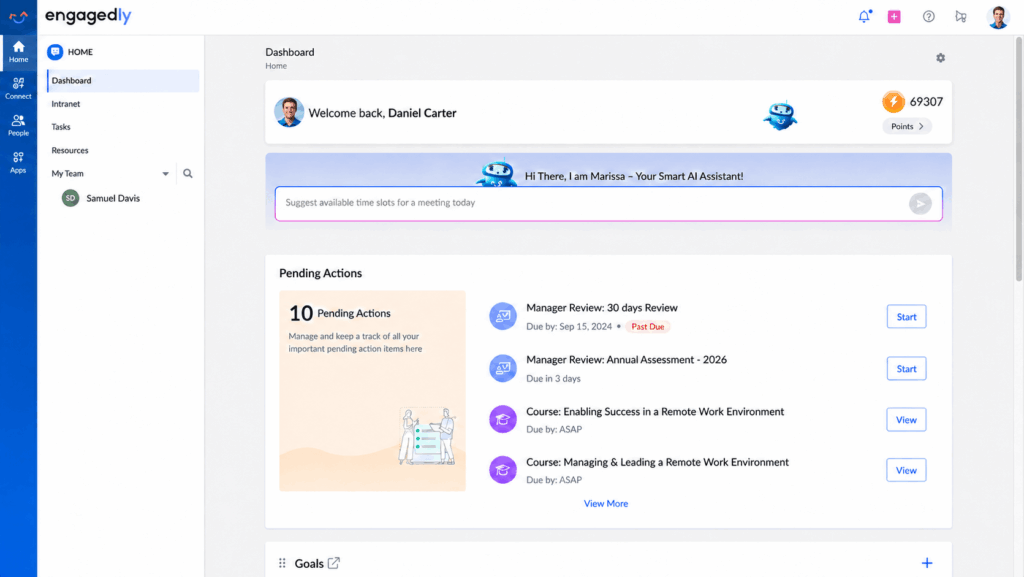
Engagedly is a talent management platform covering performance reviews, goals, feedback, competencies, skills, learning, employee listening, recognition, and talent mobility.
Rather than trying to become a payroll or core HR system, it focuses primarily on what happens after employee data enters the organization: performance, development, learning, skills, engagement, and career growth.
Why It Fits Manufacturing
Manufacturing organizations often need to manage employee development across very different populations.
A corporate analyst may have quarterly OKRs and formal career planning, while a plant supervisor may need skills visibility, training, feedback, and simple check-ins that fit around shift responsibilities.
Engagedly combines those processes in one platform and includes mobile access across its suites. Its current Performance Suite includes performance reviews, goals, feedback, meetings, competencies, and skills, while its separate Talent Mobility Suite covers career paths, skill-gap analysis, talent discovery, IDPs, and succession planning. Its Learning Suite adds LMS capabilities, certifications, compliance tracking, learning paths, and mobile learning.
Connects performance, skills, learning, and career development
Useful for manufacturers retaining an existing HRIS or payroll platform
Supports both formal performance processes and ongoing development
Modular structure allows companies to add capabilities gradually
Cons
Not a payroll or workforce-scheduling platform
Manufacturers looking for end-to-end recruiting through payroll may need other systems
Organizations primarily focused on large-scale enterprise workforce planning may prefer a broader HCM suite
Pricing
Engagedly currently lists its Performance Suite at 5–8 per user/month, Learning Suite at 3–5, and Talent Mobility Suite at $2, billed annually. Pricing varies by employee count and bundling, with a stated minimum of $7,500 per year.
Best for: Manufacturers wanting to strengthen employee performance, skills, learning, succession, and mobility without replacing their existing core HR stack.
2. SAP SuccessFactors
Best for: Large manufacturers already operating within the SAP ecosystem.
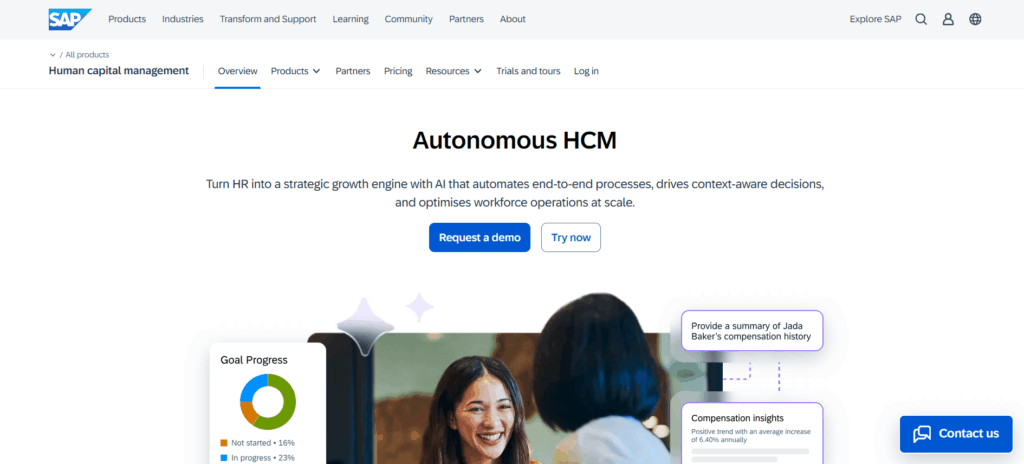
SAP SuccessFactors is a broad enterprise HCM suite covering recruiting, onboarding, performance, learning, compensation, career development, succession, and workforce-related HR processes.
For manufacturing organizations already using SAP across finance, operations, or enterprise systems, SuccessFactors can provide a more connected HR technology environment.
Why It Fits Manufacturing
Its strongest manufacturing use cases are skills, structured career development, succession, learning, and enterprise-scale talent planning.
SAP SuccessFactors Career and Talent Development supports role readiness, career paths, succession, mentoring, and an Opportunity Marketplace that connects employees with learning, internal jobs, assignments, and development opportunities.
Opportunity Marketplace is also available through the SuccessFactors mobile apps, making internal opportunities and career-development information more accessible beyond desktop users.
Strong skills, succession, and career-development capabilities
Natural fit for companies already standardized on SAP
Supports complex global organizations
Cons
Requires substantial configuration and governance
Can be more platform than a smaller manufacturer needs
Implementation and administration can require specialist expertise
Module combinations can make total cost difficult to compare
Pricing
SAP SuccessFactors uses enterprise pricing based on products, employee counts, contract structure, and implementation requirements. Organizations should price the specific talent modules they actually need rather than comparing the entire HCM suite.
Best for: Large and global manufacturers already invested in SAP that need sophisticated talent and succession capabilities.
3. Workday
Best for: Large manufacturing organizations that want talent, skills, workforce data, and analytics on one enterprise platform.
Workday combines core HCM with recruiting, talent management, learning, skills, performance, workforce planning, and analytics.
Its major advantage is the shared data foundation underneath those functions.
Why It Fits Manufacturing
A multi-site manufacturer may need to answer questions such as:
Which plants are likely to face critical skills shortages?
Where do we have employees with transferable skills?
Which roles have weak succession coverage?
Where are workforce costs and capability gaps growing simultaneously?
Workday’s talent platform brings recruiting, development, learning, and skills onto one connected foundation. Workday currently positions skills as embedded throughout its HCM environment rather than as a separate talent database.
That makes it relevant for manufacturers trying to connect workforce capabilities with broader workforce planning.
Strong connection between talent and workforce data
Suitable for complex multi-site organizations
Skills can support workforce planning and internal development
Cons
Designed primarily for larger enterprises
Implementation can be substantial
Smaller manufacturers may not use enough of the platform to justify the investment
Frontline experience should be tested against specific plant workflows
Pricing
Workday provides enterprise pricing based on organization size, products, and implementation scope.
Best for: Large manufacturing groups that want talent decisions connected with workforce planning and enterprise HR data.
4. Cornerstone
Best for: Manufacturers where skills, employee learning, certifications, and workforce readiness are the primary talent priorities.
Cornerstone has historically been known for learning, but its current platform covers a much broader talent-development environment including skills, performance, internal mobility, succession, recruiting, and workforce intelligence.
Its learning heritage remains particularly valuable for manufacturing.
Why It Fits Manufacturing
Manufacturers often have training requirements that are different from standard corporate learning.
Employees may need role-specific technical training, recurring certifications, safety courses, onboarding paths, equipment qualifications, and evidence that required training was completed.
Its manufacturing strength comes from the connection between talent processes and the systems frontline employees already use for work.
Why It Fits Manufacturing
Frontline adoption is one of the hardest problems in manufacturing HR technology.
A talent program is unlikely to succeed if employees need a separate desktop-only system they rarely use.
UKG’s manufacturing offering connects payroll, workforce management, scheduling, communication, hiring, and development across frontline and corporate populations. The company says it works with 6,000 manufacturing organizations globally.
UKG also offers a Talent Marketplace aimed at matching employees – including hourly and frontline workers – with skills and career opportunities.
Key Features
Recruiting and onboarding
High-volume frontline hiring
Performance and coaching
Learning
Talent Marketplace
Employee communication
Payroll
Time and attendance
Workforce scheduling
Workforce analytics
Pros
Strong alignment with hourly and frontline workforce processes
Payroll, scheduling, and talent can operate in the same ecosystem
Mobile employee workflows are relevant to shift-based populations
Manufacturing-specific workforce capabilities
Cons
A large platform if talent management is the only requirement
Talent functionality should be evaluated against specialist platforms if development is the main priority
Implementation scope increases when payroll and workforce management are included
Pricing is not publicly listed
Pricing
UKG provides custom pricing based on workforce size, products, implementation, and services.
Best for: Manufacturers where frontline access, scheduling, pay, hiring, and talent processes need to work together.
6. Dayforce
Best for: Manufacturers wanting workforce management, payroll, skills, and talent development in a connected platform.
It is particularly relevant where talent management cannot be separated from how hourly employees are scheduled, paid, and managed.
Why It Fits Manufacturing
Manufacturing organizations often have complex shift structures, pay rules, overtime, certifications, skills requirements, and workforce availability constraints.
Dayforce can bring many of those processes onto a common platform while adding development capabilities such as performance management, skills, succession, learning, and career development.
Its current talent platform supports performance, succession, learning, compensation, engagement, recruiting, onboarding, and Career Explorer.
Dayforce also increasingly emphasizes skills-based development, including skills profiles and AI-assisted matching between employees and development opportunities.
Key Features
Recruiting and onboarding
Performance management
Learning
Skills development
Succession planning
Career development
Compensation
Payroll
Workforce management
Scheduling
Pros
Talent data can sit alongside payroll and workforce data
Useful for organizations trying to reduce system fragmentation
Cons
Broad implementation scope
Manufacturers wanting only performance or learning may find it excessive
Configuration requires careful planning
Pricing is quote-based
Pricing
Dayforce provides custom pricing based on employee population, selected products, implementation, and services.
Best for: Mid-sized and large manufacturers looking for one environment spanning workforce operations and employee development.
7. Oracle Fusion Cloud HCM
Best for: Large manufacturers already using Oracle across their enterprise technology stack.
Oracle Fusion Cloud HCM covers recruiting, performance, learning, skills, career development, succession, workforce planning, compensation, and employee experience.
Like SAP and Workday, its strongest fit is the large enterprise rather than the individual plant.
Why It Fits Manufacturing
Oracle is particularly relevant to organizations that already use Oracle ERP, supply-chain, financial, or enterprise systems and want HR data within the same wider ecosystem.
Its talent capabilities increasingly focus on skills and internal mobility.
Oracle Opportunity Marketplace connects employees with internal jobs, gigs, learning opportunities, and development pathways.
Its 2026 updates include AI-powered career recommendations that compare employee skills with target roles, identify skill and certification gaps, and recommend actions to improve role readiness.
Key Features
Recruiting and onboarding
Performance management
Learning
Skills management
Career development
Opportunity Marketplace
Succession planning
Talent reviews
Compensation
Workforce analytics
Pros
Broad enterprise HCM functionality
Strong skills and career-development capabilities
Internal mobility supported through Opportunity Marketplace
Logical fit for existing Oracle enterprises
Cons
Designed for enterprise-scale organizations
Implementation and administration can be complex
May be excessive for mid-sized plants
Organizations should validate the experience for frontline users
Pricing
Oracle Fusion Cloud HCM uses enterprise pricing based on modules, employee numbers, and contractual requirements.
Best for: Large manufacturers already invested in Oracle that want enterprise HCM, skills, succession, and internal mobility.
8. Infor
Best for: Manufacturers already using Infor for ERP, workforce, or operational systems.
Infor stands out from many vendors on this list because manufacturing and distribution are already major parts of its broader software business.
Its people solutions include HR, talent, learning, workforce management, payroll, scheduling, and related capabilities.
Why It Fits Manufacturing
Infor Talent connects goals, performance, succession, learning, and workforce development.
Its learning platform also supports skills-focused content, employee development programs, and on-the-job validation, where employees can demonstrate capability after training.
That can be particularly relevant in environments where completing an online course is not enough to prove that someone can safely perform a task or operate equipment.
For organizations already using Infor elsewhere in the business, the potential advantage is a closer relationship between HR and the existing enterprise technology environment.
Key Features
Talent acquisition
Goals and performance
Learning and development
Skills-focused training
Succession planning
Career-development programs
Workforce management
Time and attendance
Scheduling
Workforce analytics
Pros
Strong manufacturing and industrial orientation
Learning can include on-the-job validation
Talent and workforce-management capabilities can coexist
Particularly relevant to existing Infor customers
Cons
Less compelling for companies with no existing Infor footprint
Companies should compare individual talent capabilities against specialist vendors
Large implementations still require significant planning
Pricing is quote-based
Pricing
Infor provides custom pricing based on products, users, implementation, and the wider Infor environment.
Best for: Manufacturers already using Infor that want talent management more closely connected with their existing enterprise systems.
9. ClearCo
Best for: Mid-sized manufacturers focused on hiring, onboarding, training, performance, and employee retention.
ClearCo is the new name for ClearCompany, which rebranded in March 2026 as its platform expanded beyond recruiting into a more unified talent-management offering.
The platform now brings together recruiting, onboarding, learning, performance management, engagement, compensation, people analytics, and related talent processes.
Why It Fits Manufacturing
ClearCo has a dedicated manufacturing offering centered on recruiting skilled workers, structured onboarding, required safety training, workforce readiness, certification visibility, employee development, and performance across plants and facilities.
This makes it particularly relevant for manufacturers where the biggest problems appear early in the employee lifecycle:
Hiring enough people.
Getting them production-ready.
Making sure required training is complete.
Supporting them after onboarding.
And identifying whether they are actually progressing.
Less focused on enterprise workforce planning than Workday or SAP
Skills and succession capabilities should be assessed against specialist platforms
May not replace payroll or workforce-management systems
Pricing is not publicly listed
Pricing
ClearCo uses custom pricing based on company size and selected platform capabilities.
Best for: Mid-sized manufacturers trying to connect hiring, onboarding, learning, performance, and retention without deploying a large enterprise HCM system.
10. Paycor
Best for: Small and mid-sized manufacturers wanting payroll, HR, hiring, and employee development from one provider.
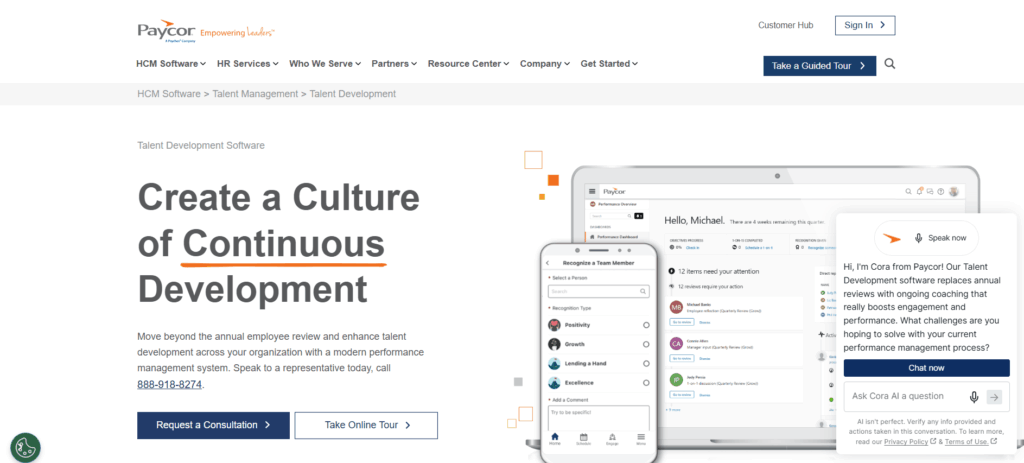
Paycor combines payroll and core HR with recruiting, onboarding, talent development, career management, learning, compensation, scheduling, time tracking, and employee surveys.
That breadth can appeal to manufacturers with smaller HR teams that do not want to manage many separate vendors.
Why It Fits Manufacturing
Paycor’s strength is practical consolidation.
A smaller manufacturer may not need the depth of Workday or SAP. It may need reliable payroll, onboarding, time tracking, recruiting, performance reviews, employee goals, coaching, and learning without employing a dedicated HR systems team.
Paycor Talent Development supports performance reviews, ongoing conversations, goals, OKRs, recognition, 9-box evaluation, and learning capabilities in its higher-level offering.
Key Features
Payroll
Recruiting
Onboarding
Time and scheduling
Performance reviews
Goals and OKRs
Career management
Learning management
Compensation
Pulse surveys
Pros
Broad HR and payroll coverage
Suitable for smaller HR teams
Supports hourly and frontline workforce processes
Public pricing available for smaller organizations
Reduces the number of separate vendors required
Cons
Talent capabilities are not as deep as specialist enterprise platforms
Global manufacturing organizations may require a more complex system
Advanced functionality may require additional products
Mid-market pricing requires consultation
Pricing
For organizations with fewer than 50 employees, Paycor currently publishes plans starting at $99 per month plus $5 per employee per month for Basic, with higher bundles adding HR and talent functionality. Paycor uses a different sales and pricing approach for larger organizations.
Best for: Small and mid-sized manufacturers wanting payroll and workforce administration alongside practical employee-development tools.
How to Choose Talent Management Software for Manufacturing
Choosing a manufacturing talent platform becomes much easier when you start with the workforce problem instead of the feature checklist.
If Critical Skills Are Leaving With Retiring Employees
Start with skills visibility.
You need to know:
Who has the skill today?
Who else is developing it?
Which roles depend on it?
Who could become the successor?
And what training or experience is required before that person is ready?
Platforms with strong skills, development, succession, and mobility capabilities should move higher on the shortlist.
Engagedly, SAP SuccessFactors, Workday, Cornerstone, Dayforce, and Oracle all approach this problem differently.
The important requirement is not simply a skills database.
It is the ability to turn a skills gap into an action.
If Frontline Turnover Is the Biggest Problem
Do not begin with succession planning.
Look at the first 90 days.
Where do candidates drop out?
How quickly do new hires complete onboarding?
Do they receive the right training?
Does anyone check in with them after week one?
Can supervisors see who is struggling?
Can employees access HR tools without sitting at a desktop?
For these situations, platforms with strong recruiting, onboarding, mobile, payroll, or frontline functionality – such as UKG, Dayforce, ClearCo, and Paycor – may deserve more attention.
If Compliance and Certifications Create the Biggest Risk
Prioritize learning and certification management.
You should be able to identify:
Who has completed required training
Which certifications are expiring
Which employees are qualified for specific roles
Where compliance gaps exist
Whether training actually resulted in job readiness
Cornerstone is particularly strong in this category, while SAP SuccessFactors, Dayforce, Infor, Engagedly, and other platforms also offer learning and skills functionality.
If Your Supervisors Are Being Promoted Without Development
This is not primarily a hiring problem.
It is a performance and development problem.
Look for:
Individual development plans
Manager check-ins
Feedback
Coaching
Mentoring
Learning pathways
Leadership competencies
Career progression
Promoting the best machine operator does not automatically create a capable supervisor.
The talent system should help manage that transition deliberately.
If Internal Mobility Barely Exists
Ask whether employees can see realistic paths from their current role to another role.
For example:
Operator → Senior Operator → Line Lead → Production Supervisor
The platform should ideally show the skills, competencies, training, or experience required at each step.
Without that visibility, an employee who wants to progress may assume the only way to move forward is to leave.
Talent marketplaces and career-pathing capabilities from platforms including SAP, Workday, Oracle, UKG, Engagedly, and others can help formalize these opportunities.
If You Already Have a Strong HRIS
Do not replace it simply because another talent platform has more features.
A manufacturer running a stable payroll, HRIS, and workforce-management environment may be better served by adding a specialist performance, learning, skills, or talent platform.
The key question is whether employee data can move cleanly between systems.
That is often more practical than a multi-year replacement of the entire HR technology stack.
Talent Management Software vs. HRIS: What’s the Difference?
The terms overlap, but they solve different problems.
HRIS / Core HCM
Talent Management
Employee records
Performance
Payroll
Goals
Benefits
Learning
Time and attendance
Skills
Employee documents
Career development
Compliance administration
Succession
Workforce transactions
Internal mobility
Some platforms do both.
UKG, Dayforce, Workday, SAP, Oracle, Infor, and Paycor combine core workforce or HCM functionality with talent tools.
Platforms such as Engagedly focus more heavily on the talent layer and typically work alongside existing HR systems.
Neither model is automatically better.
The right architecture depends on what systems you already have and what problem you are trying to solve.
Which Manufacturing Talent Management Platform Should You Choose?
Choose Engagedly if your main priorities are performance, skills, learning, development, succession, and mobility and you want those capabilities alongside your existing HRIS.
Choose SAP SuccessFactors if you are a large SAP-based manufacturer requiring enterprise talent, learning, skills, and succession.
Choose Workday if workforce data, skills, analytics, and enterprise talent planning need to operate on the same HCM foundation.
Choose Cornerstone if learning, certifications, skills, compliance, and workforce readiness are central to the problem.
Choose UKG if you manage a large frontline workforce and want talent processes connected with scheduling, communication, payroll, and workforce management.
Choose Dayforce if you want payroll, workforce management, performance, learning, skills, and succession within one platform.
Choose Oracle Fusion Cloud HCM if you are already part of the Oracle ecosystem and want enterprise talent and skills capabilities.
Choose Infor if your manufacturing environment already runs heavily on Infor systems.
Choose ClearCo if recruiting, onboarding, learning, performance, and early employee retention are the immediate priorities.
Choose Paycor if you are a smaller or mid-sized manufacturer that values simplicity and consolidation over enterprise-level talent complexity.
Final Thoughts
Manufacturing talent management is not simply about deciding who receives a high performance rating.
The bigger questions are operational.
Who can perform the work?
Who is qualified?
Where are the skill gaps?
Which employees could move into harder-to-fill positions?
Who is ready to become a supervisor?
Which roles have no viable successor?
And what knowledge will disappear when an experienced employee leaves?
The best talent management software for manufacturing helps make those answers visible and actionable.
For some organizations, that means deploying a comprehensive enterprise HCM suite.
For others, it means adding a focused talent platform alongside payroll and HRIS.
And for manufacturers struggling primarily with frontline hiring or onboarding, sophisticated succession planning may not even be the right place to start.
Before choosing a vendor, identify the two or three talent problems costing the business the most today.
Then ask each vendor to demonstrate those workflows using manufacturing scenarios rather than generic HR examples.
A particularly useful test is this:
Show us what happens from the moment an hourly employee joins the company until that employee becomes qualified, performs well, develops new skills, and becomes ready for the next role.
The gaps in that workflow will usually tell you more than a 100-feature comparison sheet.
Frequently Asked Questions About Talent Management Software for Manufacturing
What is manufacturing talent management software?
Manufacturing talent management software helps companies recruit, develop, evaluate, train, retain, and move employees across roles. Typical capabilities include performance management, learning, skills tracking, succession planning, career development, recruiting, onboarding, internal mobility, and workforce analytics.
What is the best talent management software for manufacturing?
The best platform depends on the manufacturer’s workforce and existing technology.
Engagedly is a strong option for performance, learning, skills, and talent mobility. Cornerstone is particularly relevant for learning and workforce readiness. UKG and Dayforce are well suited to large hourly workforces, while SAP SuccessFactors, Workday, and Oracle are designed for complex enterprise environments.
Why do manufacturers need talent management software?
Important capabilities can include:
Skills and competency management Learning and certifications Performance reviews Goals Career paths Succession planning Individual development plans Employee feedback Internal mobility Mobile access Recruiting and onboarding Workforce analytics The exact combination depends on the company’s most important workforce challenges.
Can talent management software track manufacturing skills and certifications?
Yes, many platforms can track skills, competencies, learning completions, and certifications.
However, the depth varies considerably.
Manufacturers should ask vendors whether the platform can track certification expiry dates, role-specific qualifications, skill proficiency, retraining requirements, and demonstrated on-the-job competency.
Can talent management software help with an aging manufacturing workforce?
Yes.
Skills inventories and succession planning can help identify roles where knowledge is concentrated in a small number of employees.
Career paths, learning, mentoring, and development plans can then help prepare successors before experienced employees retire.
Software does not transfer institutional knowledge automatically, but it can make the risk visible and provide a structured process for addressing it.
How can manufacturers improve internal mobility?
Start by defining realistic pathways between roles and identifying the skills required at each stage.
For example:
Machine Operator → Senior Operator → Line Lead → Production Supervisor
Employees should be able to understand what skills or experience they lack and what training or assignments could help them close the gap.
Talent marketplaces, career paths, skills profiles, learning, and development plans can make this process easier to manage at scale.
How should manufacturers manage talent for deskless employees?
Talent processes need to work around shifts and production responsibilities rather than assuming every employee has a laptop and corporate email.
Manufacturers should evaluate mobile access, authentication requirements, notifications, shared-device options, training delivery, manager workflows, and how much time an employee needs to complete common actions.
Test the employee experience on an actual phone during the vendor demonstration.
Is talent management software the same as workforce management software?
No.
Workforce management software typically focuses on scheduling, time and attendance, labor planning, absence management, and workforce coverage.
Talent management software focuses on recruiting, employee performance, learning, skills, development, succession, and career growth.
Platforms such as UKG and Dayforce offer both, while specialist talent platforms may integrate with a separate workforce-management system.
Should manufacturers buy one HCM suite or separate talent tools?
Both approaches can work.
A unified HCM suite reduces integration requirements and gives organizations a common employee-data foundation.
Specialist platforms may offer deeper functionality in areas such as learning, performance, skills, or mobility.
Manufacturers should compare the benefit of consolidation against the quality of the talent capabilities they actually need.
How much does manufacturing talent management software cost?
Pricing varies widely.
Some specialist platforms publish per-user or per-employee pricing, while most enterprise HCM vendors use custom contracts based on employee count, modules, countries, integrations, implementation, and support.
Manufacturers should compare total cost of ownership, not just subscription cost.
That includes implementation, integrations, administrator time, content libraries, professional services, and any separate mobile, learning, or analytics products required.
 Performance