Most organizations have a communication problem they don’t even know about. Ideas get shared, concerns get raised, and feedback gets passed up – but by the time it reaches senior leadership, the message has been polished, softened, or quietly dropped altogether.
Skip-level meetings exist to fix that.
This guide covers everything you need to know: what a skip-level meeting actually is, why it works, who should be in the room, what questions to ask, and how to run one without making your middle managers feel like they’re being audited.
What Is a Skip-Level Meeting?
A skip-level meeting is a structured, one-on-one conversation between a senior leader and an employee who does not directly report to them – intentionally bypassing the middle manager in between. In most organizations, this means a senior manager meets with someone who reports to one of their direct reports.
The “skip” refers to skipping a level of the organizational hierarchy. So if you’re a VP and you sit down with an individual contributor who reports to your manager, that’s a skip-level meeting.
These aren’t performance reviews. They aren’t disciplinary conversations. They are intentional check-ins designed to give leadership unfiltered insight into what’s actually happening on the ground – the day-to-day friction, the ideas that never get escalated, and the systemic issues that only become visible from the front lines.
Think of it this way: information naturally distorts as it moves up an organizational hierarchy. Middle managers, often with the best of intentions, filter, simplify, or re-contextualize employee feedback before it reaches the top. Skip-level meetings are a designed circuit breaker for that filtering effect.
Why Hold Skip-Level Meetings?
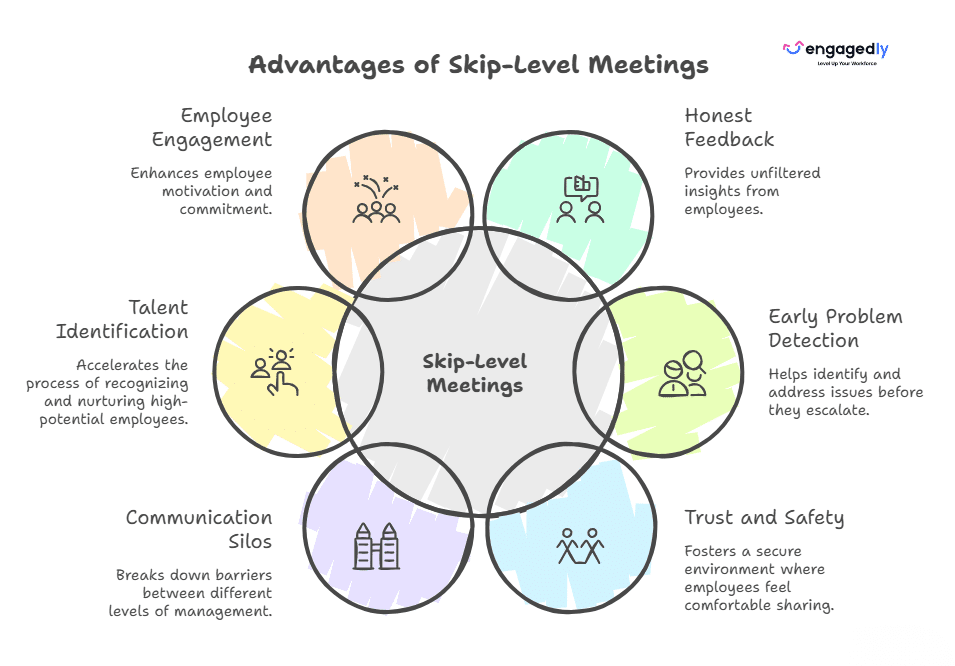
The data on workplace communication gaps is hard to ignore. According to Harvard Business Review, more than half of employees say they do not feel safe speaking up at work. That silence costs organizations real money – in missed innovation, unresolved bottlenecks, and unnecessary turnover. The biggest benefits of skip-level meetings include better communication, stronger trust, earlier problem detection, and more honest employee feedback.
Replacing an employee can cost up to 200% of their annual salary (Center for American Progress), and 68% of professionals have considered leaving their jobs because of a bad manager (Gallup). Skip-level meetings don’t solve all of that, but they are one of the most direct, low-cost ways to surface these problems before they spiral.
Here’s why organizations that take skip-levels seriously see real results.
1. You Get Brutally Honest Feedback
When employees talk to their direct manager, there’s an inherent filter. People self-censor to protect relationships, avoid awkward follow-up conversations, or simply because they assume their feedback won’t go anywhere.
Skip-level meetings remove some of that friction. Employees speaking directly with someone two levels above them – someone who isn’t their daily point of accountability – tend to be more candid. They surface broken processes, highlight unaddressed team friction, and share ideas that have been sitting in their head for months with no outlet.
That unfiltered signal is genuinely valuable. It’s the kind of insight you can’t get from a quarterly survey.
2. It Builds a Culture of Accountability
When senior leaders show up, listen carefully, and actually do something with what they hear, it sends a signal throughout the organization. Employees become more engaged. Managers know that their teams have an additional voice. And leadership stays honest about what’s working and what isn’t.
According to Gallup’s State of the Global Workplace report, engaged employees drive 18% higher productivity and 23% higher profitability compared to their disengaged counterparts – and disengaged workers show 37% higher absenteeism rates. Creating the conditions for honest dialogue – which skip-levels support – is a direct lever on engagement, and engagement drives performance.
3. It Breaks Down Communication Silos
Large organizations are structurally prone to silos. Departments stop talking to each other. Problems that span teams go unowned. And by the time a cross-functional issue surfaces at the leadership level, it’s already become a crisis.
Skip-level meetings pull those issues forward. When employees across different teams and functions share what they’re experiencing, patterns emerge that no single manager would have visibility into on their own.
4. It Strengthens Trust and Psychological Safety
Google’s Project Aristotle found that teams with high psychological safety have a 76% higher rate of innovation. Psychological safety – the belief that you can speak up without negative consequences – is foundational to high-performing teams. Skip-level meetings are one structural way to build it.
When employees see leadership acting on feedback, trust increases and communication becomes more honest over time.
5. It Helps You Spot Rising Talent Early
This one often goes unmentioned but it matters. Skip-level conversations give senior leaders direct exposure to how people think, communicate, and solve problems. Skip-level meetings offer senior leaders an opportunity to identify “rising stars” among their staff – people who may not yet be visible through normal reporting channels but who are clearly ready for more responsibility.
Who Should Attend a Skip-Level Meeting?
The Senior Leader (Skip-Level Manager)
This is the person initiating the meeting – typically a VP, Director, or C-level executive. Their role is to listen, ask thoughtful questions, and resist the urge to problem-solve on the spot. They are not there to evaluate, audit, or make promises.
The Employee
This is the individual contributor or lower-level team member who would not normally have direct access to this senior leader. Ideally, they’ve been given advance notice, understand the format, and know it isn’t a performance conversation.
Who Should NOT Be in the Room
The middle manager – the person being “skipped” – should not be present. Their presence immediately changes the dynamic and makes candid conversation nearly impossible.
This doesn’t mean keeping the manager in the dark. It means conducting the meeting without them so employees feel genuinely free to speak, and then sharing aggregated themes with the manager afterward.
Skip-Level Meeting Agenda Template
A skip-level meeting works best when it’s structured enough to stay productive but loose enough to feel like a real conversation. Aim for 30 to 45 minutes – long enough to go deep, short enough to respect everyone’s time.
Before the Meeting (1 to 2 Weeks Out)
Send a brief, clear message explaining the purpose of the meeting (not a performance review – just a listening session)
Share two or three sample questions so the employee can prepare
Inform the manager that skip-levels are happening and why, so there are no surprises
Refresh yourself on the employee’s role, current projects, and team context
During the Meeting (30 to 45 Minutes)
Opening (5 minutes)
Restate the purpose in plain language
Set expectations: this is informal, confidential at the individual level, and designed for honest conversation
Break the ice with a low-stakes opener
Core Discussion (20 to 25 minutes)
Ask 3 to 5 open, focused questions (see the section below)
Listen without interrupting or problem-solving
Take notes on themes, not just individual comments
Closing (5 to 10 minutes)
Ask if there’s anything important that hasn’t come up yet
Explain what happens next with the feedback
Thank the employee genuinely and specifically
After the Meeting
Compile key themes across all skip-level conversations (not individual attributions)
Share non-sensitive themes with the relevant manager
Communicate follow-up actions to employees so they know their input led somewhere
Track open items and revisit them in future meetings
20 Questions to Ask in a Skip-Level Meeting
The quality of your skip-level meeting depends almost entirely on the quality of your questions. Broad questions get surface-level answers. Specific, well-framed questions get real ones.
Here are 20 questions organized by theme.
Questions About Day-to-Day Work Experience
What’s taking up most of your time right now, and does that feel like the right use of it?
What’s getting in the way of doing your best work?
If you could remove one obstacle from your day tomorrow, what would it be?
What tools, resources, or information do you wish you had better access to?
Is there a process on your team that feels unnecessarily slow or broken?
Questions About Team Dynamics and Management
How supported do you feel in your current role?
When you have a concern or idea, do you feel comfortable raising it with your manager?
What does your manager do that makes your job easier?
Is there anything you wish your manager did differently?
How would you describe the overall energy and morale on your team right now?
Questions About Growth and Development
Do you feel like you’re growing in this role?
Are there skills you want to develop that you’re not currently getting a chance to practice?
Where do you see yourself in the next one to two years, and does your current path feel like it’s moving in that direction?
Is there a project or responsibility you’d like to take on that you haven’t had the chance to yet?
Questions About Culture and Leadership Direction
What do you think the organization does really well that we should protect?
What do you think leadership doesn’t fully understand about what it’s like to work here?
Is there something the company says it values that doesn’t feel reflected in day-to-day reality?
How would you describe our culture to a friend who was considering joining?
Questions That Surface Innovation
What’s an idea you have that hasn’t found a home yet?
If you were in my seat for a day, what’s the first thing you’d change?
How to Conduct a Skip-Level Meeting Successfully (7 Steps)
Running a skip-level meeting that actually builds trust and generates actionable insight isn’t about following a script. It’s about approaching each conversation with genuine curiosity and then doing something visible with what you learn.
Step 1: Define Your Purpose and Share It Early
Before you schedule anything, get clear on what you’re trying to accomplish. Are you trying to understand team morale? Surface operational bottlenecks? Build relationships across the organization? Your purpose shapes your questions.
Then share that purpose openly – with both the employee and their manager. Harvard Business Review notes that skip-level conversations work best when leaders frame the meeting as a way to “listen, learn, and gain context,” not as a performance evaluation or escalation path.
Ambiguity is the enemy of honest conversation. When people don’t know why they’re in the room, they default to safe, polished answers.
Step 2: Loop In the Manager First
One of the most common ways skip-level meetings go wrong is when the middle manager finds out after the fact. It immediately signals distrust and creates resentment – even when your intentions are completely good.
Before you schedule anything, let the manager know:
You’re holding skip-levels with their team as part of a broader practice
The goal is to learn, not to check up on them
You’ll share aggregated themes afterward so you can problem-solve together
Their relationship with their team is not being undermined
A simple message framing it as a collaborative process changes the entire dynamic.
Step 3: Create Psychological Safety from the First Minute
Launching skip-level meetings in a culture of fear or distrust can backfire spectacularly, eroding trust in middle managers. Before you start asking questions, employees need to genuinely believe that what they say won’t be used against them or their manager.
Say it out loud. Restate that this is a listening session, not an evaluation. Explain how you’ll use the feedback (shared as themes, not attributed quotes). And then prove it over time by actually handling feedback with discretion.
Step 4: Ask Focused, Open-Ended Questions
Avoid yes/no questions. Avoid broad, abstract questions like “How are things going?” that invite vague, positive-sounding non-answers.
The best skip-level questions are:
Specific enough to require a real answer
Open enough to allow unexpected responses
Non-threatening so employees don’t feel like they’re being tested
Use the 20 questions in the section above as your starting bank, and pick 3 to 5 that are most relevant to your current organizational context.
Step 5: Listen More Than You Talk
This sounds obvious but it’s the step leaders most consistently get wrong. The instinct to problem-solve, reassure, or defend a previous decision kicks in, and suddenly the employee is listening to you instead of the other way around.
Stay curious. When someone shares something surprising or uncomfortable, ask a follow-up question instead of responding with context or justification. The goal is to understand their experience, not to explain yours.
Step 6: Look for Patterns, Not Individual Complaints
A single employee raising a concern might reflect a personal situation. Five employees independently raising the same concern is a systemic signal – and that’s what you’re actually looking for.
Skip-level meetings reveal qualitative data, but not every comment requires action. The goal is to find repeated themes across multiple discussions, which often reveal systemic issues with process, communication, tools, or workload that may be invisible at higher levels.
Document your notes after each conversation and review them across sessions. The patterns will emerge.
Step 7: Follow Up and Actually Close the Loop
This is the step that determines whether skip-level meetings build trust or quietly destroy it.
If employees share honest, sometimes uncomfortable feedback and then hear nothing back, they learn a clear lesson: speaking up doesn’t matter. The next time you ask, they’ll give you the polished version. Building a culture of continuous, real-time feedback helps organizations avoid waiting for formal meetings before important concerns surface.
Leadership coaches often stress that “one-off conversations create awareness; consistent conversations create change.”
Follow-up looks like:
Sharing what themes you heard with relevant managers (without attributing individual comments)
Communicating to employees what you’re addressing now, what’s being reviewed, and what’s outside your ability to change
Revisiting key concerns in future rounds of skip-levels
Recognizing improvements that were directly driven by employee input
Transparency on the back end is what turns a single conversation into a feedback culture.
Common Mistakes to Avoid in Skip-Level Meetings
Even well-intentioned skip-level meetings can backfire if you make these common errors.
Making it feel like a surprise audit. Employees who receive a meeting invite from their boss’s boss with no context will assume the worst. Always communicate the purpose in advance.
Skipping the manager entirely. Not informing the middle manager that skip-levels are happening signals that you’re going around them. That breeds resentment and insecurity, both of which will poison the culture you’re trying to build.
Making promises you can’t keep. When an employee raises a concern and a senior leader responds with “I’ll get that fixed,” it sounds reassuring – but if nothing changes, it becomes a trust-destroying moment. Instead, acknowledge what you heard and explain your next step.
Treating it as a one-time event. One skip-level meeting is a nice gesture. A consistent quarterly or biannual cadence is a cultural practice. The value compounds over time.
Sharing individual comments with managers. The moment an employee hears that their specific comment was traced back to them, the psychological safety you built disappears. Share themes only, never attributed quotes.
Solving problems in the room. Skip-level meetings are for listening, not decision-making. Jumping straight to solutions often means you haven’t fully understood the problem, and it can inadvertently undermine the manager’s authority.
Asking questions that put employees on the spot. Questions like “What do you think of your manager?” asked without context can feel like a trap. Frame management-related questions carefully so employees feel free to answer honestly without fearing they’re getting someone in trouble.
Skip-Level Meeting vs 1-on-1 vs All-Hands: What’s the Difference?
These three meeting formats serve completely different purposes, and using one as a substitute for another creates problems.
Day-to-day coaching, task alignment, relationship building
Broad announcements, culture, company direction
Frequency
Quarterly or biannually
Weekly or biweekly
Monthly or quarterly
Format
One-on-one, conversational
One-on-one, task-oriented
Group presentation with Q and A
Direction of information
Bottom-up (employee to senior leader)
Two-way
Top-down, with limited upward flow
Replaces the others?
No
No
No
A skip-level meeting isn’t meant to mimic a performance review. Instead, it’s an opportunity for different people in an organization to familiarize themselves with each other and what they do, and maybe spark some new ideas along the way.
Each format has its place. The organizations that run all three well end up with communication that actually flows in every direction.
Conclusion
Skip-level meetings are one of the simplest leadership practices with the highest long-term upside. They create a direct line between leadership and employees, uncover issues before they become systemic problems, and build the kind of trust that surveys alone rarely achieve.
When done consistently and thoughtfully, a skip-level meeting becomes more than just a conversation. It becomes an operating mechanism for healthier communication, stronger engagement, better manager alignment, and smarter organizational decision-making.
The key is not just asking good questions. It’s creating an environment where employees genuinely believe their voice matters, and then proving it through visible follow-through. Organizations that listen well tend to adapt faster, retain better talent, and build cultures where people feel safe contributing ideas before problems escalate.
At its best, a skip-level meeting helps leadership see the organization as employees actually experience it, not just as dashboards and reporting structures describe it.
Skip-level meetings work best when feedback, growth conversations, goals, and employee development are connected instead of living in separate systems. Platforms like Engagedly help organizations create a more continuous feedback culture through performance management, employee engagement, talent analytics, and manager enablement tools. If you’re exploring ways to improve leadership visibility and employee communication, consider requesting a demo.
FAQs
What is a skip-level meeting?
A skip-level meeting is a conversation between a senior leader and an employee who does not report directly to them. The meeting intentionally “skips” one layer of management, allowing employees to share feedback, concerns, ideas, and experiences directly with higher-level leadership.
Skip-level meetings are commonly used to: Improve communication between leadership and employees Gather unfiltered feedback from frontline teams Identify organizational challenges early Strengthen trust across management levels Increase leadership visibility and accessibility Unlike performance reviews, skip-level meetings are designed to listen and learn rather than evaluate performance.
What is the purpose of a skip-level meeting?
The primary purpose of a skip-level meeting is to help senior leaders understand what employees are experiencing beyond management reporting channels.
Key goals include: Surfacing issues that may not reach leadership through normal channels Understanding employee sentiment and engagement Identifying process inefficiencies and communication gaps Gathering ideas for improvement and innovation Building stronger connections between employees and leadership Effective skip-level meetings provide leadership with valuable context that dashboards, reports, and surveys often miss.
Who should participate in a skip-level meeting?
A skip-level meeting typically involves:
A senior leader (director, VP, executive, or department head) An employee who reports to one of that leader’s direct reports The employee’s direct manager should not attend. Excluding the middle manager helps create a more open environment where employees can speak honestly about their experiences, challenges, and ideas.
How often should skip-level meetings be held?
Most organizations conduct skip-level meetings quarterly, biannually, or annually, depending on team size and business needs.
Common approaches include: Quarterly: Fast-growing organizations or teams undergoing significant change Twice per year: Most established organizations Annually: Large organizations with extensive employee feedback programs The ideal frequency balances leadership accessibility with the time required to act on feedback between meetings.
How long should a skip-level meeting last?
Most skip-level meetings last between 30 and 45 minutes.
Typical structure: 5 minutes for introductions and context 20–30 minutes for discussion and feedback 5–10 minutes for closing questions and next steps The goal is to create enough time for meaningful conversation without making the discussion feel formal or overwhelming.
What questions should leaders ask during a skip-level meeting?
The best skip-level questions focus on employee experience, team effectiveness, leadership communication, and growth opportunities.
Examples include: What’s helping you do your best work today? What’s making your job harder than it should be? What process would you improve if you could? Do you feel supported in your role? What should leadership understand better about your team’s work? What ideas do you have that haven’t been explored yet? Open-ended questions typically generate more valuable insights than questions that can be answered with a simple yes or no.
What should employees talk about in a skip-level meeting?
Employees should focus on sharing honest, constructive feedback and observations.
Appropriate topics include: Workplace challenges and blockers Process improvements Team collaboration issues Employee development opportunities Organizational communication gaps Suggestions for improving culture or productivity Skip-level meetings are most effective when employees share experiences and ideas rather than treating the discussion as a complaint session.
Are skip-level meetings confidential?
Skip-level meetings should provide a safe environment for honest discussion, but they are not usually completely confidential.
Best practice is for leaders to: Share themes rather than individual comments Avoid attributing feedback to specific employees Protect employee privacy whenever possible Communicate how information will be used before the conversation begins Employees should understand that the goal is organizational improvement, not personal investigation.
Srikant Chellappa is the Co-Founder and CEO at Engagedly and is a passionate entrepreneur and people leader. He is an author, producer/director of 6 feature films, a music album with his band Manchester Underground, and is the host of The People Strategy Leaders Podcast.
















 Performance

