Culture Amp competitors worth considering in 2026 include Engagedly, Leapsome, Lattice, 15Five, Qualtrics, Workleap (Officevibe), SAP SuccessFactors, Cornerstone OnDemand, CultureMonkey, and BambooHR – each built to combine performance management, engagement, and development in ways that go beyond a survey-only platform.
Culture Amp has been a pioneer in staff development and performance tracking since 2009. While the platform offers valuable features, organizations are exploring more Culture Amp competitors that better address their unique challenges in talent management and employee engagement.
This guide breaks down the main competitors of Culture Amp and the top talent management tools available in 2026, along with pricing pulled directly from each vendor’s own website, so you can find a solution that fits your budget and drives real engagement.
What should you look for in a Culture Amp alternative?
The right talent management tool should connect three things in one place: how people are performing, how engaged they feel, and how they’re growing. A platform that only surveys sentiment without acting on it isn’t solving the whole problem.
Performance assessment tools. Look for platforms that support continuous feedback and let you align individual goals with company objectives. Performance reviews should be flexible enough to run on your own cycle, not a rigid annual format.
Engagement measurement. The platform should support real pulse checks and full survey capability, not just a once-a-year form. This is what helps HR teams catch problems before they show up in attrition numbers.
Learning and development integration. A learning experience platform built into the same system means development plans and skill gaps are tied directly to performance data, not managed in a separate tool.
Integration depth. Your talent tool needs to connect cleanly with your existing HRIS, Slack or Teams, and other workflow tools, or adoption will suffer.
Ease of use and customization. Look for platforms that adapt to your organization’s structure, not the other way around – flexible reporting, configurable review templates, and survey customization matter more than a long feature list.
Top Competitors of Culture Amp
Finding the right solution for talent management requires an understanding of what each platform offers. Here is a detailed comparison of the top competitors of Culture Amp to help you make an informed decision.
1. Engagedly
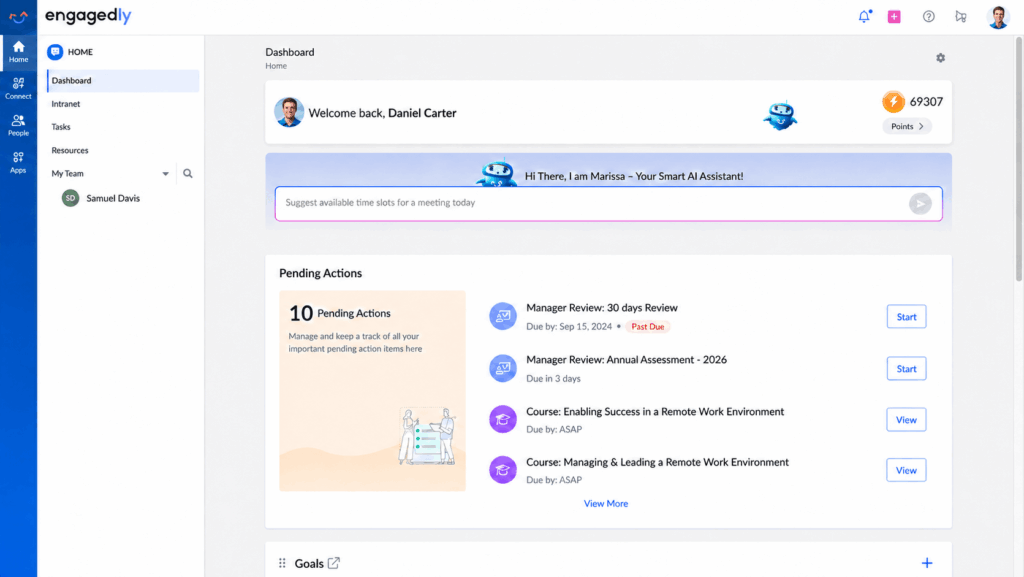
Engagedly is an AI talent management platform built to help organizations connect performance, engagement, learning, growth, and recognition in one unified experience. Powered by Marissa, its AI SuperAgent, Engagedly helps leaders turn people strategy into intelligent actions, reduce talent silos, and drive measurable business outcomes. Trusted by organizations worldwide, Engagedly supports stronger engagement, better retention, and the development of high performing teams.
Key features:
Customizable performance review cycles with 9-box calibration
Benefits: All-in-one suite that covers performance, engagement, learning, and talent mobility without needing separate vendors; highly customizable workflows; AI-driven insights through Marissa.
Cons: Smaller companies may not need every module in the full suite.
Pricing:
Manage Performance: $5-$8/user/month
Learn & Grow: $3-$5/user/month
Recognize & Reward: $2/user/month
Engage & Listen: $2/user/month
Talent Mobility: $2/user/month
Mentoring Suite (add-on): $8/user/month
Manage Compensation (add-on): $10/user/month
2. Leapsome
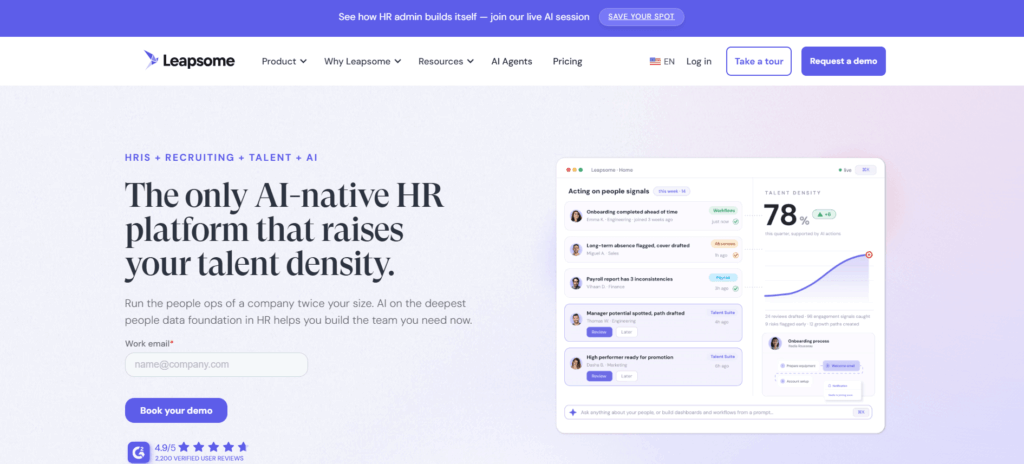
Leapsome is a people enablement platform connecting reviews, goals, surveys, learning, and compensation in one system.
Key features:
Adjustable review cycles with 360-degree feedback
Goal and OKR tracking
Engagement surveys with benchmarking
Learning paths tied to skills frameworks
Benefits: Available in 38 languages; ISO 27001-certified and GDPR-compliant; strong for globally distributed teams.
Cons: No public self-serve pricing; every module requires a sales conversation, which makes budgeting harder to plan upfront.
Prices:
Contact Leapsome for custom price options
3. Lattice
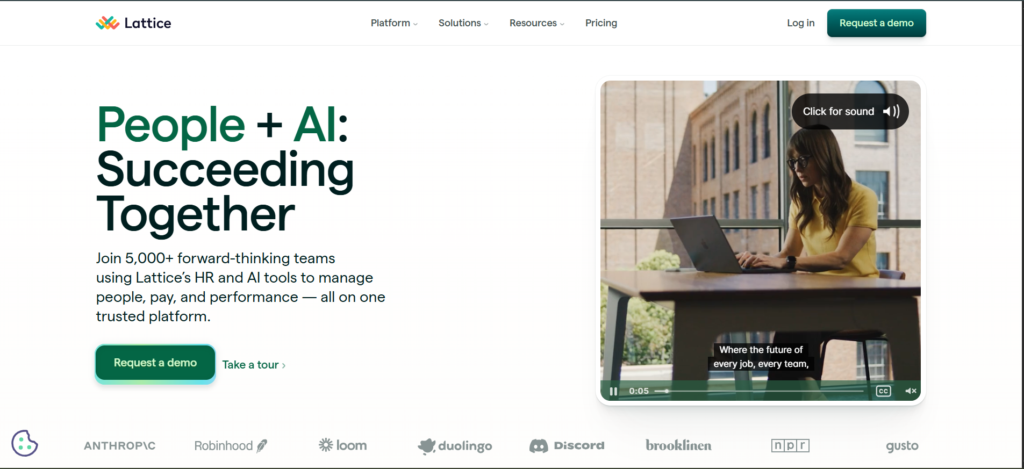
Lattice connects performance management to business outcomes through an integrated approach to reviews, goals, and engagement.
Key features:
Performance reviews, talent reviews, PIPs, and succession planning
Goals and OKRs tied to cascading business priorities
Engagement surveys with AI-powered trend analysis
An AI HR agent that answers questions and coaches managers in the flow of work
Benefits: Used by companies like Discord, Duolingo, and Robinhood; strong analytics layer included with every base product; dedicated human support on every contract.
Cons: Add-ons like Compensation and Grow stack on top of base pricing quickly; $4,000 minimum annual agreement applies even to small teams.
Pricing:
Foundations bundle (most popular): $13/seat/month
Performance: $10/seat/month
Goals & OKRs: $8/seat/month
Engagement: $4/seat/month
Compensation add-on: +$6/seat/month
Grow add-on: +$4/seat/month
Enterprise: custom pricing
Minimum annual agreement: $4,000
4. 15Five
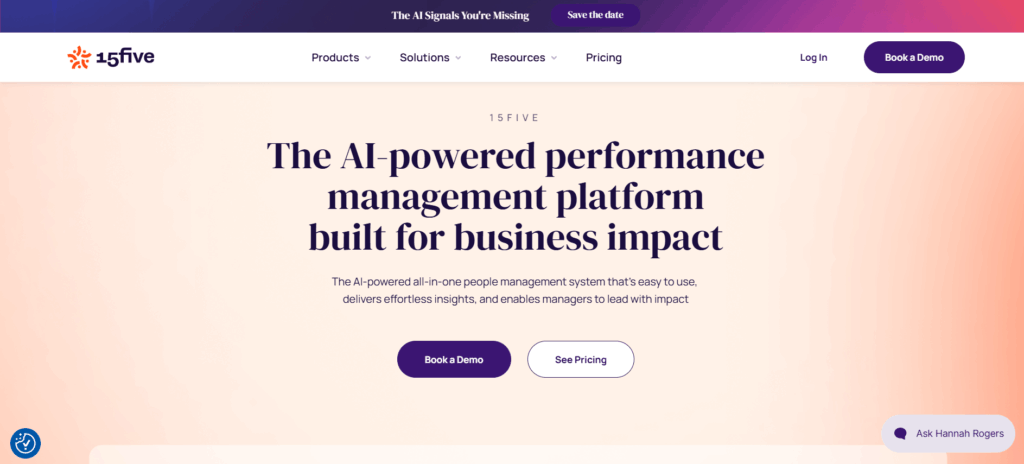
15Five turns engagement insights into action through continuous feedback and a strong focus on manager effectiveness.
Key features:
AI-assisted performance reviews and an AI thought partner (AMAYA)
Weekly check-ins, 1-on-1s, and OKR tracking
Engagement surveys with predictive impact scoring
Kona AI coaching add-on for managers
Benefits: Strong manager-effectiveness tools; transparent published pricing; over 3,000 customers and 250,000 employees served.
Cons: Add-ons for compensation and manager coaching can raise the total cost quickly for larger teams.
Pricing:
Engage: $4/user/month
Perform: $11/user/month
Total Platform: $16/user/month
Compensation add-on: $9-$11/user/month
Kona Coach add-on: $19/manager/month
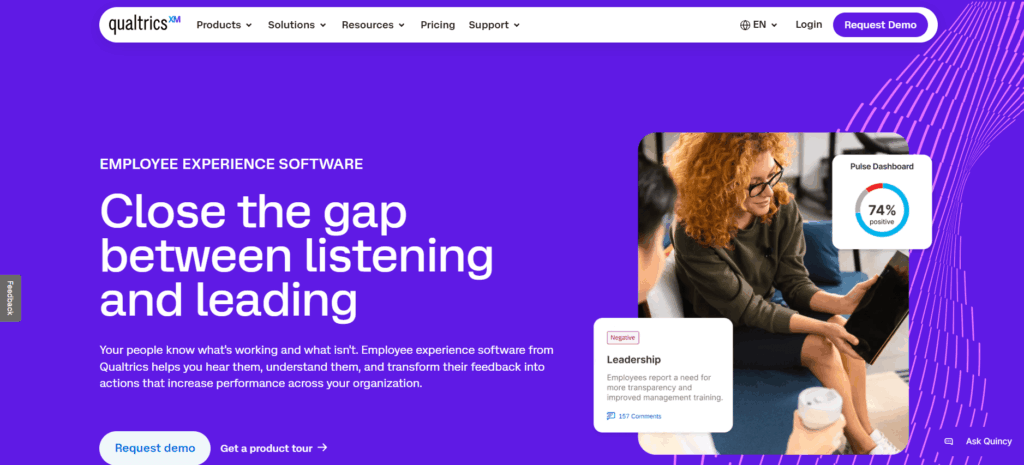
5. Qualtrics Employee Experience
Qualtrics offers enterprise-level employee experience management built on its broader XM survey platform.
Key features:
Advanced survey and listening capabilities across the employee lifecycle
360-degree feedback and predictive analytics
Deep integration with Qualtrics’ wider customer and product experience suites
Benefits: Robust analytical depth; used by a large share of Fortune 500 companies; strong data security credentials.
Cons: Complex implementation; pricing is entirely custom, which makes it harder to compare against self-serve platforms.
Prices:Custom prices based on organizational needs
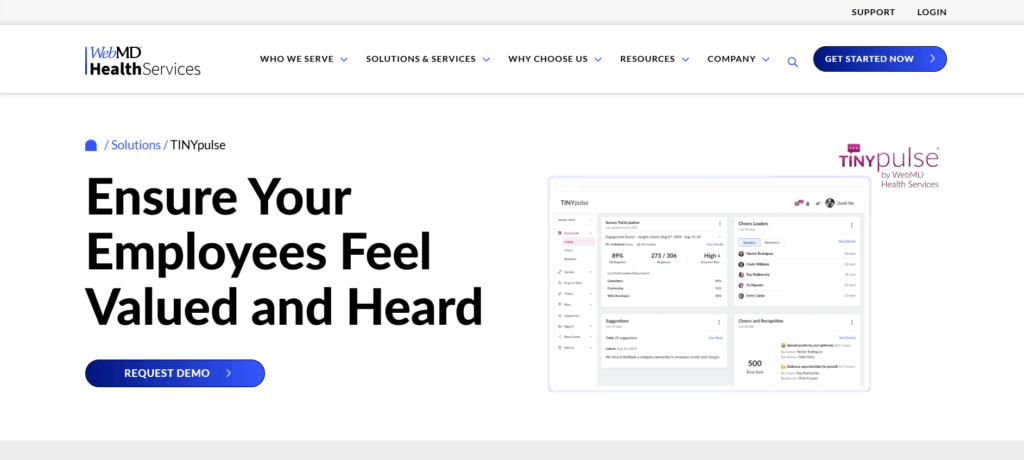
6. TINYpulse (Limeade Listening)
TINYpulse is a pulse-survey and peer recognition platform now operating under WebMD Health Services, following its earlier ownership by Limeade.
Key features:
Recurring pulse surveys and anonymous feedback channels
Cheers for Peers recognition tool
One-on-one meeting management
Benefits: Simple, focused feature set for teams that primarily want lightweight pulse surveys.
Cons: No self-serve pricing, customer, or security pages on the current site; everything routes through a WebMD sales conversation, and the brand has changed ownership multiple times since 2021.
Pricing: Custom Price.
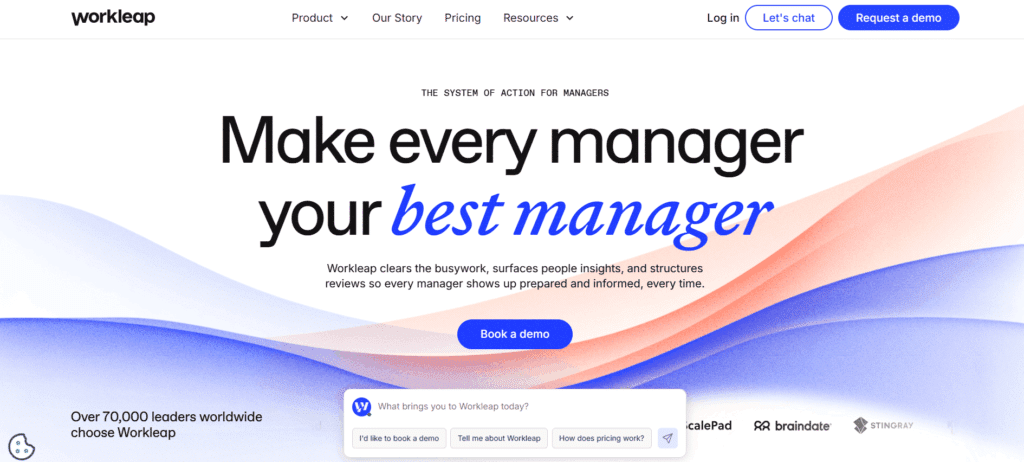
7. Workleap (Officevibe)
Officevibe is now part of the broader Workleap platform, which bundles engagement, performance reviews, and an AI HR agent into tiered plans.
Key features:
Team health and engagement reporting
360 performance reviews and goal setting
AI-generated summaries and an always-on HR assistant
Org chart and people directory
Benefits: Single platform covering engagement and performance rather than point tools; strong AI layer for HR admins.
Cons: Pricing is now a flat annual platform fee rather than transparent per-seat pricing, and every plan requires a sales conversation.
Pricing:
Standard: starting at $4,999/year
Pro: starting at $11,999/year
Enterprise (250+ employees): custom pricing
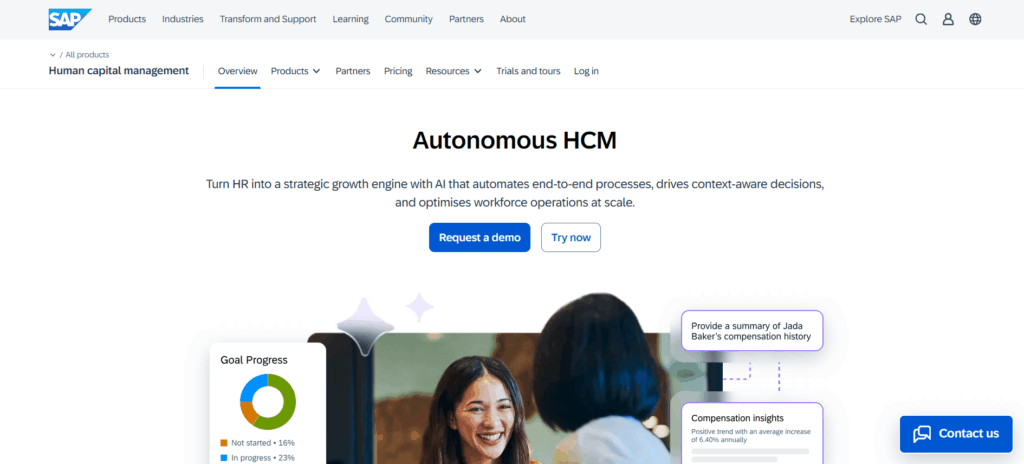
8. SAP SuccessFactors
SAP SuccessFactors offers enterprise-level talent management that integrates directly with existing SAP systems.
Key features:
Performance and goal management
Learning and development tools
Succession planning and compensation management
Workforce analytics
Benefits: Deep integration for companies already running SAP; comprehensive HR suite covering the full employee lifecycle.
Cons: Complex implementation and a steep learning curve; best suited to large enterprises with dedicated HRIS teams.
Pricing: Visit their platform page for pricing details.
9. Cornerstone OnDemand
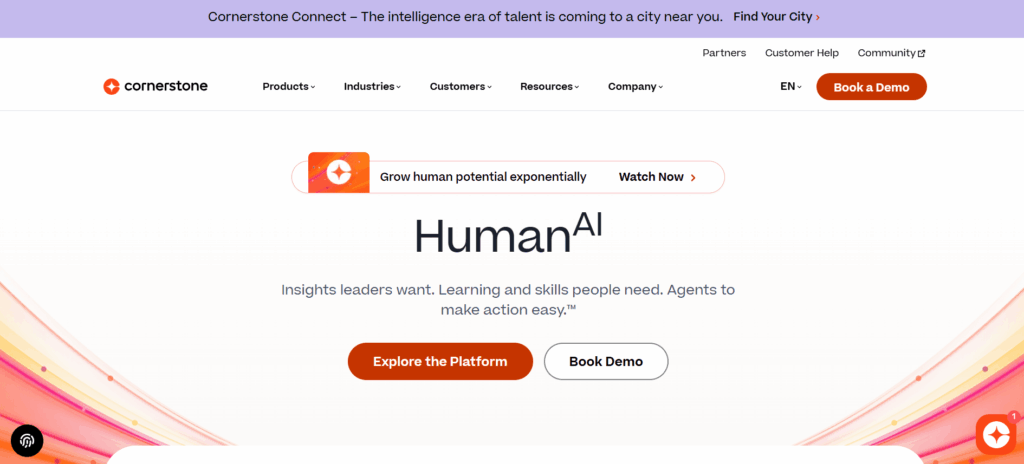
Cornerstone specializes in learning and talent development, pairing performance management with an extensive content library.
Key features:
Learning management system with a large content marketplace
Cons: Interface can feel overwhelming for smaller teams; implementation requires significant setup time.
Pricing: Cornerstone offers custom pricing only. Visit their platform page for pricing details.
10. CultureMonkey
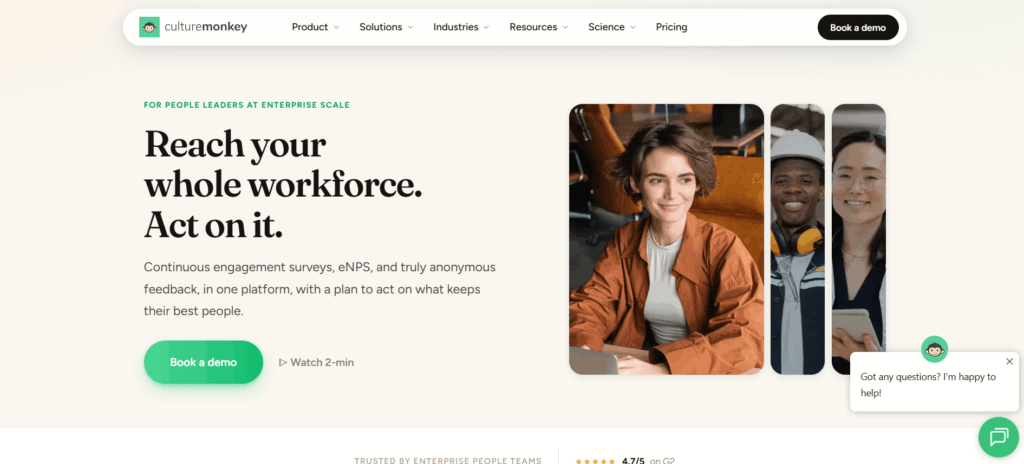
CultureMonkey focuses on lifecycle feedback and engagement, using AI-driven analysis to track culture over time.
Key features:
Multichannel feedback collection across 190+ countries
AI-powered engagement intelligence
Employee lifecycle surveys with anonymous feedback
Benefits: Strong multilingual support; positioned as enterprise-grade with GDPR and SOC 2 compliance.
Cons: No published rates; newer entrant in the space compared to established players.
Pricing: Custom pricing for enterprises.
11. BambooHR
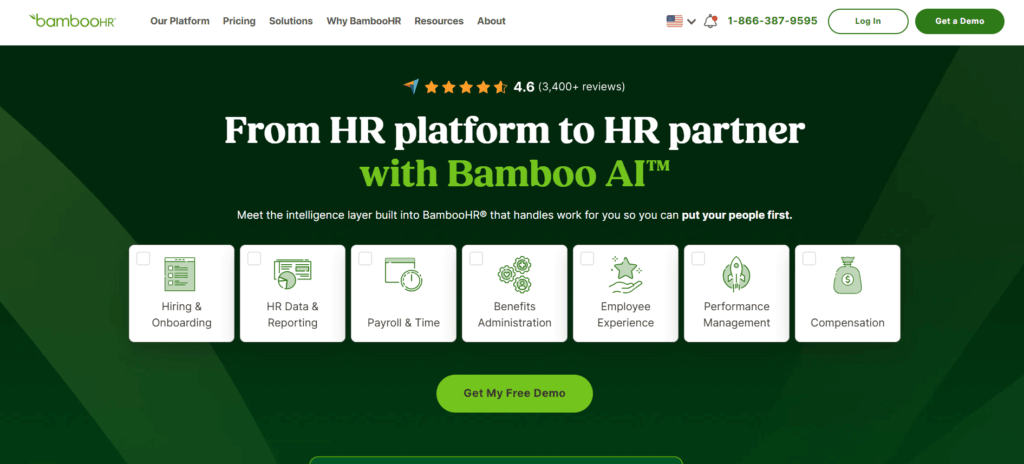
BambooHR offers HR and talent management built for small and mid-sized businesses, simplifying core HR processes alongside engagement features.
Key features:
Employee self-service portal and applicant tracking
Performance management tools
Onboarding automation and time-off tracking
Benefits: Easy to use for smaller HR teams; automatic volume discounts as headcount grows; flat-rate pricing available for very small companies.
Cons: Larger organizations may find feature depth limited compared to dedicated performance platforms; mobile app has room to improve.
Pricing:
Core: $10/employee/month
Pro: $17/employee/month
Elite: $25/employee/month
New trends shaping talent management tools in 2026
AI and automation. AI now powers skills-gap analysis, personalized learning recommendations, and predictive retention-risk flags, replacing manual pattern-spotting that used to take HR teams weeks.
Employee experience over annual events. Real-time feedback continues to replace the once-a-year review. Gallup’s data on engaged business units – 23% higher profitability, 18% higher productivity – keeps pushing organizations to make feedback a habit rather than an event.
Data-backed decisions. Predictive analytics are increasingly used to flag emerging leaders and future skills gaps before they become a hiring problem, with performance data tied directly to business outcomes to justify continued investment in talent tools.
Conclusion
Choosing the right talent management platform in 2026 comes down to one question: does it just measure engagement, or does it actually help you act on it? Culture Amp built its name on survey depth, but the competitors covered here show where the market has moved – toward connected systems that tie performance reviews, goals, learning, and recognition together in one place, instead of leaving HR teams to stitch feedback data into action manually.
Pricing models vary widely too. Some platforms, like Engagedly, 15Five, Lattice, and BambooHR, publish transparent per-seat rates so you can budget before ever talking to sales. Others, like Leapsome, Qualtrics, SAP SuccessFactors, Cornerstone, and CultureMonkey, keep pricing entirely custom, which can slow down evaluation for teams that want to compare costs upfront.
Whichever direction you’re leaning, it’s worth weighing modularity (can you start small and add on as you grow), integration depth with your existing HR stack, and how much of the platform is actually built to drive action rather than just collect it.
Ready to see how a connected performance, engagement, and learning platform compares to Culture Amp for your team? Request a demo with Engagedly and we’ll walk you through the modules that fit your organization’s goals.
Frequently Asked Questions (FAQs)
Why are companies searching for alternatives to Culture Amp?
Many organizations want a platform that combines continuous feedback, goal management, learning, and engagement in one system rather than a survey-only tool. Common drivers include deeper customization, better HRIS integration, and more actionable insights as annual reviews lose relevance.
What features should you prioritize when comparing Culture Amp competitors?
Prioritize continuous feedback and reviews, pulse and sentiment surveys, learning tools tied to skill growth, strong analytics, and seamless HRIS integrations. Ease of use and scalability matter just as much as the feature list itself.
How do all-in-one talent management platforms differ from survey-focused tools?
All-in-one platforms connect feedback to goals, performance reviews, learning, and recognition, so organizations can act on insights instead of just collecting data. Survey-only tools tell you something is wrong; integrated platforms help you fix it.
Is Engagedly a strong alternative for growing organizations?
Engagedly combines OKRs, continuous feedback, surveys, a learning experience platform, and recognition in one system, making it easier to align individual goals with business objectives. Its modular pricing lets growing teams start with what they need and add on as they scale.
How can switching talent management software improve employee engagement and performance?
Modern platforms replace infrequent reviews with continuous conversations, clearer goals, and personalized growth paths. When engagement data connects directly to action – coaching, learning, or recognition – organizations can respond faster to issues, which over time drives higher productivity and stronger retention.
Gabby Davis is the Lead Trainer for the US Division of the Customer Experience Team. She develops and implements processes and collaterals related to the client onboarding experience and guides clients across all tiers through the initial implementation of Engagedly as well as Mentoring Complete. She is passionate about delivering stellar client experiences and ensuring high adoption rates of the Engagedly product through engaging and impactful training and onboarding.















 Performance