











Mentoring and coaching in the workplace are two ways of helping employees grow with support from another person. Coaching targets a specific skill or performance goal over a short period, while mentoring supports broader career growth through a longer relationship. Organizations use both for onboarding, leadership development and retention. Neither guarantees results on its own, because outcomes depend on program design, good matching and manager support.
If you have ever wondered why some programs fill up with engaged pairs while others quietly fizzle out, this guide covers the differences, real examples, program types, a launch plan and how to measure what is working.
What is Coaching and Mentoring in the Workplace?
The CIPD describes workplace mentoring as a relationship where a more experienced colleague shares knowledge to support someone less experienced, and notes that mentoring tends to run longer than coaching. Coaching, by contrast, is usually tied to a defined goal and a shorter timeline.
What Is the Difference Between Coaching and Mentoring?
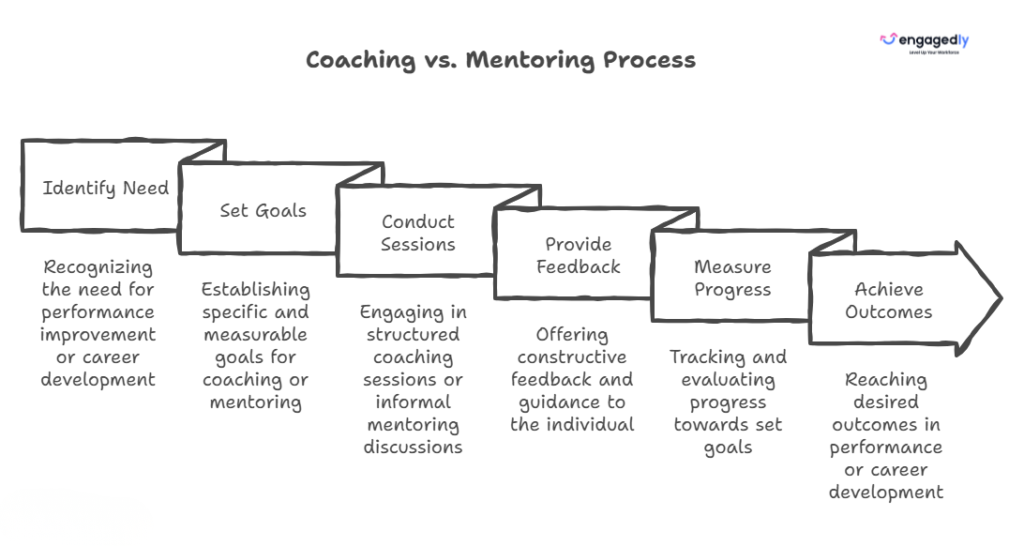
Employees often use coaching and mentoring interchangeably, but they solve different workplace challenges.
Coaching is usually performance-focused. It helps employees improve a specific skill, behavior, or outcome within a shorter period of time. Mentoring, on the other hand, focuses on broader career growth, confidence, and long-term professional development.
Both approaches are valuable, but organizations get the best results when they understand when to use each one.
| Aspect | Coaching | Mentoring |
|---|---|---|
| Primary Focus | Performance improvement | Career development |
| Duration | Short-term | Long-term |
| Structure | Goal-oriented and structured | Relationship-oriented |
| Driven By | Immediate business needs | Long-term employee growth |
| Common Topics | Productivity, leadership, communication | Career guidance, confidence, networking |
| Typical Relationship | Manager, coach, or external expert | Senior employee or experienced peer |
| Success Measure | Skill improvement and measurable outcomes | Growth, engagement, and career progression |
For example, a sales manager may coach an employee to improve negotiation skills over six weeks. A mentor may help that same employee prepare for future leadership opportunities over the next two years.
Organizations that combine both approaches often build stronger leadership pipelines, improve retention, and create a more supportive workplace culture.
Why Do Coaching and Mentoring Matter More in 2026?
Coaching and mentoring are no longer viewed as optional employee perks. In 2026, they are becoming core workforce development strategies, especially as organizations navigate hybrid work, AI adoption, leadership burnout, and frontline retention challenges.
Employees increasingly expect continuous learning and personalized career support from employers. At the same time, organizations are struggling to retain skilled talent and prepare future leaders fast enough.
Here is what the evidence says, along with its limits.
- Mentored employees at Sun Microsystems were promoted five times more often than employees outside the program, and mentee retention was 72% versus 49% for non-participants. This study was released in 2006 and covers one company, so treat it as a strong signal, not a guarantee.
- The same study found the program was least effective for the highest performers, which is a good reason to think about who you enroll first.
- In LinkedIn’s 2025 Workplace Learning Report, providing learning opportunities was the top retention strategy named by respondents.
- The 2025 ICF Global Coaching Study found that more than half of coaching clients are employer-sponsored, which shows coaching is moving from a perk to part of how companies develop people.
What Are the Benefits of Coaching and Mentoring?
Strong coaching and mentoring programs benefit both employees and organizations.
For employees, these programs create a safe environment to learn, ask questions, improve confidence, and develop new skills faster. For organizations, they improve retention, leadership readiness, collaboration, and performance.
Here are some of the biggest benefits of mentoring and coaching in the workplace:
Faster Employee Development
Employees learn faster when they receive personalized guidance instead of relying only on formal training programs. Coaching helps employees strengthen specific skills, while mentoring helps them navigate broader career challenges.
Better Employee Retention
Employees are more likely to stay with organizations that invest in their growth. Mentoring programs make employees feel supported, valued, and connected to the organization.
Stronger Leadership Pipeline
Coaching and mentoring help organizations prepare future managers and leaders internally instead of relying heavily on external hiring.
Improved Communication and Collaboration
Mentoring relationships often connect employees across departments, functions, or generations. This improves knowledge sharing and breaks down organizational silos.
Higher Employee Engagement
Employees who receive guidance and development opportunities are often more motivated and engaged in their work.
Faster Onboarding for New Employees
New hires become productive faster when they have access to experienced mentors who can help them understand company expectations, workflows, and workplace culture.
Also Read: Coaching vs. Managing: Definitions, Differences, and Tips for Managers
How Can Managers Coach Without Burning Out?
Managers are the day-to-day coaches in most companies, and many are stretched thin. LinkedIn’s Workplace Learning Report found that 50% of organizations say managers lack the support to facilitate career development, making it the biggest barrier reported.
If you want managers to coach well, give them these basics.
- Time set aside for development conversations, not just performance check-ins
- A simple framework for goal-setting and feedback
- Training on how to ask questions instead of giving answers
- A clear path to hand employees to a mentor when the topic is career direction rather than a skill

What Are Some Examples of Mentoring and Coaching in the Workplace?
Modern mentoring and coaching programs are becoming more structured, technology-driven, and outcome-focused. Companies are using mentoring not only for leadership development, but also for onboarding, DEI initiatives, frontline training, AI upskilling, and internal mobility.
Below are some real examples of how organizations are implementing coaching and mentoring programs in 2026.
Real Examples of Mentoring and Coaching in the Workplace
Microsoft Teams Mentoring Initiative (2024) Microsoft launched a global virtual mentoring program connecting 50,000+ employees across time zones, focusing on digital transformation skills and remote leadership development.
Salesforce Ohana Culture Coaching (2024) Salesforce expanded their mentoring program to include AI skills coaching, with senior developers mentoring junior staff on Salesforce AI integration, resulting in 40% faster project completion.
Google’s DEI Mentoring Network (2024) Google’s updated mentoring program focuses on underrepresented groups in tech, with specific tracks for women in leadership and LGBTQ+ career advancement.
Mastercard
Mastercard considered mentoring as a means to break down silos and help employees connect with co-workers across the business who have similar ambitions and interests. This leading global payments technology company leveraged its talent marketplace to generate mentor pairings based on capabilities and ambitions, instead of making matches based solely on seniority. Mastercard’s mentoring program has proven to be particularly beneficial for welcoming new talents into their organization.
Why it works – pairing by skills and ambitions instead of seniority widens who can find a mentor.
Schneider Electric
Surveys revealed that nearly 50% of exiting employees cited subpar growth opportunities as their primary reason for leaving the business. Therefore, Schneider Electric decided to take action and launch a talent marketplace to transform internal mobility and empower its employees to take charge of their professional development. Mentoring is a core component of internal mobility at Schneider Electric.
Why it works – tying mentoring to internal mobility gives employees a visible next step, which speaks directly to the growth complaints behind exits.
Novartis
With a headcount that surpasses 100,000, breaking down silos is a priority for Novartis. In the past, associates struggled to gain visibility into opportunities outside of their region and function. This led to the launch of a mentoring program with an emphasis on cross-functional and cross-country pairings. The company used its talent marketplace to generate mentee-mentor pairs based on relevant expertise.
Why it works – cross-functional and cross-country pairs give people visibility they cannot get inside their own team.
Cooley
Cooley is a global law firm with over 1,500 lawyers. The intricacies of their legal work demand that new attorneys be ready for action quickly. Their Cooley Academy Mentoring Program (CAMP) was designed to onboard new employees and get them ready to fasten connections with more experienced individuals. This provided them with a good support system that helped them become competent in their new roles faster.
McGraw-Hill
The education publication giant, based in New York City, has offices in 38 countries, which provides interesting opportunities for mentorships. The company undertook a comprehensive planning and strategy approach to its mentoring program development. A case study on the process shows that most employees are well-served by the program. 97% of participants said that they would recommend the program.
Across these examples, three patterns repeat. Matching is based on skills and goals, mentoring is connected to a business need such as onboarding or mobility, and the program is designed for a specific group instead of the whole company at once.
Also Read: 6 Guidelines to Developing A Professional Mentoring Program
What Are the Types of Coaching Programs in the Workplace?
Different coaching formats solve different organizational challenges. The best coaching programs are designed around employee needs, leadership maturity, and business goals.
Executive Coaching
Executive coaching focuses on senior leaders and managers. It helps improve leadership skills, strategic thinking, communication, and decision-making.
Peer Coaching
Peer coaching allows employees at similar levels to support each other through shared learning, accountability, and feedback.
Performance Coaching
Performance coaching helps employees improve specific skills, behaviors, or performance metrics tied to their role.
Group Coaching
Group coaching brings multiple employees together to learn from a coach and from each other. This format is often used for leadership development and cross-functional collaboration.
Career Coaching
Career coaching helps employees identify growth opportunities, prepare for promotions, and align their strengths with future career paths.
What Are the Types of Mentoring Programs in the Workplace?
Mentoring programs can take many forms depending on organizational goals, workforce size, and employee development needs. Some organizations focus on leadership development, while others use mentoring to improve onboarding, employee engagement, collaboration, or succession planning. Choosing the right format helps companies create stronger relationships and more meaningful employee development experiences.
Traditional Mentoring
Traditional mentoring is the most common mentoring model in the workplace. In this format, a senior or experienced employee mentors a less experienced employee over a longer period of time.
The mentor provides career guidance, shares workplace knowledge, and helps the mentee navigate professional challenges. These relationships often improve employee confidence, leadership readiness, and long-term career growth. Traditional mentoring is especially effective for onboarding new employees and preparing future leaders.
Reverse Mentoring
Reverse mentoring flips the traditional mentoring structure. Younger employees mentor senior leaders on topics like technology, digital communication, workplace trends, social media, or generational expectations.
This type of mentoring helps leadership teams stay connected with changing workforce dynamics and emerging technologies. It also creates a more inclusive culture where employees at different levels feel heard and valued. Many organizations now use reverse mentoring to strengthen diversity, inclusion, and digital transformation initiatives.
Group Mentoring
Group mentoring involves one mentor working with multiple mentees at the same time. This format encourages collaborative learning and allows employees to learn from both the mentor and each other.
Organizations often use group mentoring when scaling leadership development or onboarding programs across larger teams. It creates opportunities for broader discussions, peer support, and shared problem-solving. Group mentoring can also reduce the time commitment required from senior leaders while still supporting multiple employees.
Cross-Functional Mentoring
Cross-functional mentoring connects employees from different departments, teams, or business units. The goal is to improve collaboration, business understanding, and knowledge sharing across the organization.
For example, someone from operations may mentor an employee from marketing to help them better understand frontline challenges and workflows. This type of mentoring helps break down silos and encourages employees to think beyond their own roles. It also improves communication and alignment between teams.
Virtual Mentoring
Virtual mentoring programs use video calls, collaboration platforms, and digital mentoring tools to connect employees across locations and time zones. This format has become increasingly important in hybrid and remote work environments.
Virtual mentoring allows organizations to expand mentoring opportunities without geographical limitations. Employees can connect with mentors from different offices, regions, or even countries. Many companies now combine virtual mentoring with AI-powered matching platforms and progress tracking tools to improve participation and engagement.
How Is AI Changing Mentoring and Coaching?
AI is mostly changing the logistics. Matching tools suggest pairs based on skills and goals, scheduling gets easier, and some platforms summarize sessions or suggest discussion topics. The relationship itself still depends on trust between two people.
Before adopting an AI tool, ask a few practical questions.
- What data does it use to match people, and did employees consent to that?
- Can the vendor show evidence that its matching improves participation or outcomes?
- Who can see session notes or summaries?
Claims about matching accuracy vary a lot by vendor, so ask for results you can check.
How Can You Start a Coaching or Mentoring Program?
Successful coaching and mentoring programs need more than good intentions. Organizations need clear goals, structure, accountability, and ongoing support to ensure the program delivers measurable value.
The most effective programs are designed strategically rather than treated as informal HR initiatives. When employees understand the purpose of the program and receive consistent support, participation and outcomes improve significantly.
1. Define Clear Goals
Start by identifying what the program should achieve. Goals may include leadership development, onboarding support, employee retention, career growth, or skill development.
Clear objectives help organizations design the right mentoring structure and measure success more effectively. For example, a mentoring program designed for leadership development will look very different from one focused on onboarding new employees. Defining goals early also helps mentors and mentees stay aligned throughout the relationship.
2. Match Participants Thoughtfully
Strong mentor and coach relationships depend on compatibility, shared interests, communication styles, and development goals.
Instead of matching employees based only on seniority, organizations should consider career aspirations, strengths, learning preferences, and areas of expertise. Thoughtful matching improves trust, engagement, and long-term participation. Many companies now use AI-powered matching platforms to improve pairing accuracy and scalability.
3. Provide Structure and Guidelines
Set expectations around meeting frequency, confidentiality, communication, milestones, and progress tracking from the beginning.
Without structure, mentoring relationships often lose momentum over time. Organizations should provide clear guidelines, discussion frameworks, and suggested goals to help participants stay focused. Regular check-ins also help ensure both mentors and mentees remain engaged and supported throughout the program.
4. Use Technology to Support the Program
Many organizations now use mentoring platforms, learning systems, and AI-powered matching tools to manage participation and engagement at scale.
Technology helps simplify scheduling, communication, documentation, and progress tracking. It also makes mentoring more accessible for remote and distributed teams. Digital platforms can provide analytics on participation, meeting frequency, skill development, and employee feedback, helping organizations improve the program continuously.
5. Measure and Improve Continuously
Collect feedback regularly and track program outcomes to improve effectiveness over time.
Organizations should monitor metrics such as participation rates, employee satisfaction, retention, internal promotions, and skill development progress. Feedback from mentors and mentees can reveal what is working well and where adjustments are needed. Continuous improvement ensures the program stays aligned with employee needs and business goals as the organization evolves.
What Mistakes Make Mentoring Programs Fail?
Most programs do not fail because of bad intentions. They fail because of design gaps.
Success is measured only by sign-ups, not by outcomes.
Meetings are too rare or unfocused. A Wharton management professor quoted in the Sun Microsystems coverage said the meetings have to be meaningful, not arbitrary.
Pairs are matched only by seniority, so goals and styles clash.
Managers are not brought in, so mentoring feels like extra work.
How Can You Measure the Success of Coaching and Mentoring Programs?
Modern coaching and mentoring programs need to demonstrate measurable business impact, not just participation. In 2026, organizations are increasingly tying mentoring outcomes to retention, internal mobility, leadership development, employee engagement, and workforce readiness.
The most effective companies treat mentoring and coaching as strategic talent development initiatives supported by clear goals, ongoing feedback, and measurable outcomes. This is also why many organizations now use dedicated mentoring platforms like Mentoring Complete to improve matching, track participation, monitor progress, and scale mentoring programs across distributed teams.
Some of the most useful metrics include:
- Employee retention and turnover rates
- Internal promotion and mobility rates
- Leadership readiness and succession pipeline strength
- Employee engagement and satisfaction scores
- Participation and program completion rates
- Time-to-productivity for new hires
- Performance improvement and skill development progress
- Mentor and mentee feedback quality
- Cross-functional collaboration and knowledge-sharing outcomes
- Diversity, equity, and inclusion (DEI) development metrics
Beyond tracking participation, organizations should evaluate whether mentoring relationships are actually driving meaningful employee growth and business outcomes. Regular feedback surveys, milestone reviews, and mentoring analytics help HR leaders identify which programs are improving engagement, leadership development, and retention over time.
Conclusion
Mentoring and coaching are becoming essential components of modern workplace development strategies. As organizations face rapid change, skills gaps, hybrid work challenges, and rising employee expectations, structured guidance and continuous learning matter more than ever.
The most effective organizations are moving beyond occasional training sessions and building long-term coaching and mentoring cultures that support employees throughout their careers.
Whether the goal is leadership development, onboarding, retention, or performance improvement, coaching and mentoring programs help employees feel supported, connected, and prepared to grow.
To bring structure, visibility, and continuous development into your mentoring and coaching initiatives, organizations can request a demo to see how modern talent development platforms support mentoring, coaching, learning, feedback, and growth in one connected experience.
Frequently Asked Questions About Workplace Mentoring and Coaching
What is mentoring and coaching in the workplace?
Coaching usually focuses on helping employees improve a specific skill or achieve a short-term goal, while mentoring supports broader long-term professional development through guidance and shared experience. Together, they create a stronger learning culture and help employees grow more effectively within the organization.
What is the difference between mentoring and coaching?
Coaching is typically short-term and performance-oriented. It helps employees improve specific skills, behaviors, or work outcomes. Mentoring is more relationship-driven and focuses on long-term career development, leadership growth, and professional guidance.
Why are mentoring and coaching important in the workplace?
For organizations, these programs improve retention, employee engagement, leadership development, and collaboration. They also help companies build stronger internal talent pipelines and create a culture focused on continuous learning and growth.
What are the benefits of mentoring programs for employees?
Employees with mentors often adapt faster to workplace expectations and feel more connected to the organization. Mentoring can also help employees navigate career challenges, explore growth opportunities, and prepare for future roles.
What are the most common types of mentoring programs?
Common mentoring formats include:
Traditional mentoring
Reverse mentoring
Group mentoring
Cross-functional mentoring
Virtual mentoring