












What is an Individual Development Plan?
An individual development plan (IDP) is a written plan that an employee and their manager build together to set career goals, close skill gaps, and map out the learning and experience needed to reach them. Most IDPs cover 6 to 12 months and include goals, actions, support, deadlines, and check-ins. An IDP is a planning tool, not a promise of promotion and not a replacement for a performance review. It works best when both sides revisit it regularly.
It gives employees and managers a practical way to turn development into something measurable. Instead of vague career conversations, an IDP creates a clear plan with goals, timelines, learning activities, and progress checkpoints.
A strong individual development plan template usually includes:
- employee role and current responsibilities
- short-term and long-term career goals
- strengths and development areas
- learning activities and support needed
- timelines, milestones, and progress tracking
Individual Development Plan Template You Can Copy and Paste
This is a simple IDP template that works for most roles. Copy it into Word or Google Docs and fill it in during a one-on-one with your manager. Keep it to three development goals or fewer. A short plan gets finished. A long one gets forgotten.
| Section | What to write |
|---|---|
| Employee name and role | Your name, title, and team |
| Manager | Name of the person supporting your plan |
| Plan period | For example, January 2027 to December 2027 |
| Career aspiration | The role or type of work you want in 2 to 5 years |
| Current strengths | 2 to 3 strengths your manager and peers would agree on |
| Skill gaps | The skills standing between you and your aspiration |
| Development goal | Action | Support needed | How we will measure it | Due date | Status |
|---|---|---|---|---|---|
| Goal 1 | Course, project, mentor, or stretch assignment | Budget, time, access, sponsor | A specific metric or outcome | Date | Not started |
| Goal 2 | |||||
| Goal 3 |
| Check-in | Date | Progress | Changes to the plan |
|---|---|---|---|
| Quarter 1 | |||
| Quarter 2 | |||
| Quarter 3 | |||
| Quarter 4 |
Importance of Creating an Individual Development Plan
Engagement is under pressure, and development conversations are one of the few things managers can act on right away. Gallup’s research shows global employee engagement fell to 20% in 2025, and Gallup finds that declines in manager engagement account for most of the recent drop. That is a global figure, so US numbers will differ. Still, it points to a clear takeaway. A structured IDP gives managers a regular, specific reason to talk about growth, which is hard to do well without a plan.
Benefits of Creating an Individual Development Plan:
For Employees:
- Clarity of Job Goals and Standards: IDPs provide clear information on job expectations, helping employees understand their goals and how to achieve them.
- Enhanced Performance and Productivity: With a well-structured IDP, employees can focus on their development areas, leading to improved performance.
- Increased Engagement: A Gallup survey found that companies with engaged employees are 21% more profitable. Since IDPs keep employees aware of their goals and responsibilities, they tend to be more engaged and motivated at work.
- Comprehensive Assessment: IDPs offer an in-depth look at an employee’s strengths and areas for improvement, enabling targeted development.
- Autonomy and Planning: Employees can schedule and plan their development annually. Studies show that employees who have autonomy in their work are more than twice as likely to be highly engaged.
- Career Advancement: A well-structured IDP supports employees in charting a clear path for career progression and personal growth.
For Managers:
- Continuous Communication and Feedback: IDPs foster regular communication between managers and employees, creating a more productive, engaged, and motivated work environment.
- Succession Planning: By documenting employee progress, managers can better identify potential leaders for succession planning and stay prepared for unexpected changes such as turnover or skill gaps during expansion.
- Talent Retention: According to recent surveys, 86% of millennials would stay in their roles if given opportunities for career development. This highlights how effective IDPs can help retain top talent and strengthen organizational resilience.
Components of an Individual Development Plan
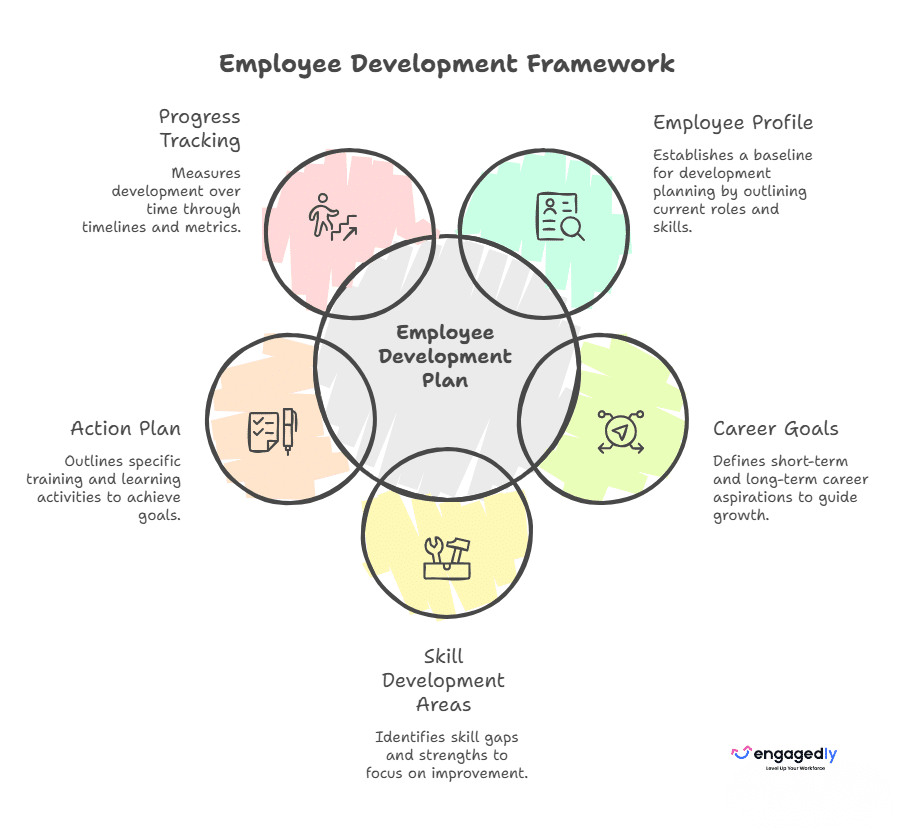
1. Employee Profile:
- Basic Information: This includes the employee’s name, position, department, and date of hire.
- Skills Inventory: A summary of the employee’s current skills, competencies, and qualifications.
- Performance Summary: A brief overview of the employee’s recent performance, including strengths and areas for improvement. Structured performance reviews make it easier to capture and reference this information consistently.
2. Career Goals:
- Short-Term Goals: Goals that the employee aims to achieve within the next 6-12 months. Using structured OKRs and goals helps align individual development with business priorities. These should be specific, measurable, attainable, relevant, and time-bound (SMART).
- Long-Term Goals: Goals focused on where the employee sees their career progressing over the next few years.
- Career Aspirations: An outline of the employee’s long-term vision for their career and potential roles they would like to pursue.
3. Skill Development Areas:
- Gap Analysis: Identification of skills or knowledge the employee needs to acquire or improve to achieve their career goals.
- Strengths and Weaknesses: A detailed look at what the employee excels at and where there is room for improvement.
- Developmental Needs: Specific skills, knowledge, or experiences the employee needs to enhance their current performance and future potential.
4. Action Plan:
- Development Activities: A list of training programs, workshops, certifications, courses, or job rotations that will help the employee develop the identified skills.
- Mentorship or Coaching: Opportunities for the employee to receive guidance from a mentor or coach who can assist with skill development and career progression.
- On-the-Job Learning: Specific projects, responsibilities, or assignments that allow the employee to gain practical experience and apply new skills in real-world scenarios.
Also read: Unlock Employee Development with Engagedly’s IDP
How to Create an Individual Development Plan in 6 Steps
Start with a short conversation, not a form. Here is a process most teams can finish in one or two meetings.
- Start with the career direction. Ask the employee where they want to be in 2 to 5 years. Write it in their words.
- Compare strengths and gaps. Use recent performance feedback, project results, and the skills needed for the target role. Structured performance reviews make this much easier to pull together.
- Pick no more than three goals. Choose the gaps that matter most for the role and the business. Link them to team goals through OKRs and goals where you can.
- Choose actions that mix learning styles. Combine a course or certification with a real project and a mentor or coach. Learning on the job usually sticks better than a course alone.
- Agree on support and deadlines. Write down the budget, time, and access the employee needs. Put a date next to every action.
- Schedule the check-ins before you sign. Book the quarterly reviews on the calendar now. The OPM federal IDP template also recommends quarterly check-ins during the year.
Individual Development Plan Goals Examples for 2026
Good IDP goals name a skill, an action, and a way to measure progress. Here are examples you can adapt.
- Use an AI writing or analysis tool for weekly reporting, and cut report prep time by a set amount by the end of Q2.
- Complete a people management course and run monthly one-on-ones with every direct report by the end of Q1.
- Shadow a senior colleague on three client negotiations, then lead one with feedback from a manager.
- Earn one role-relevant certification by September, with a study schedule agreed with your manager.
- Take ownership of a budget or forecast, and present it to leadership by year end.
- Mentor a new hire for 90 days to build coaching and communication skills.
7 Individual Development Plan Templates
These seven examples show how an IDP changes by role. Each one links a goal to a clear action, the support needed, and a way to measure progress. Copy the one that fits, then adjust it using the customization tips further down.
Individual Development Plan for Sales Manager
Sales Manager. Best for sales leaders who want to raise conversion through stronger communication and networking.
| Long-Term Goals | ||||
| Generate more revenue through an increased conversion rate. | ||||
| Short-Term Goals | ||||
| Improve communication, networking, and technical skills. | ||||
| Goal | Objective | Resources | Progress Tracking Metrics | Completion Date |
| Improve Communication skills | Work with senior sales representatives to learn effective communication practices. | Job shadowing and training program to learn communication skills. Provide resources to improve understanding of various terminologies. | Feedback from supervisor Number of leads converted | XYZ Date |
| Improve Networking Skills | Attend conferences and seminars to build a network. | The fee to attend conferences and other official gatherings, travel allowance, and time to attend the events. | Number of leads generated | XYZ Date |
| Improve Technical skills | Gain product knowledge for a better understanding. | Technical courses through a learning management system | Knowledge acquired | XYZ Date |
Individual Development Plan for Administrative Assistant
Administrative Assistant. Best for support roles focused on cutting costs and improving process efficiency.
| Long-Term Goals | ||||
| Reduce operational costs. | ||||
| Short-Term Goals | ||||
| Reduce supply costs. | ||||
| Goal | Objective | Resources | Progress Tracking Metrics | Completion Date |
| Reduce the purchase of supplies | Work with the department to identify unnecessary supplies. Monitor monthly purchases and consumption. Identify the need and place an order accordingly. | Department survey to assess the use of supplies. A course on inventory management. | Reduced purchase of supplies | XYZ Date |
Individual Development Plan for Training Manager
Training Manager. Best for L&D leaders closing organization-wide skill gaps.
| Long-Term Goals | ||||
| Reduce the organizational skill gap. | ||||
| Short-Term Goals | ||||
| Introduce necessary training programs and deliver quality training. | ||||
| Goal | Objective | Resources | Progress Tracking Metrics | Completion Date |
| Keeping the workforce updated with the latest industry trends, skills, and knowledge | Teach new skills to employees to improve their work speed and knowledge about the job role.
Conduct an off-site training program. | Travel costs and paid leaves to attend online training and certification courses.
Cost of inviting professors or industry experts to deliver lectures. | Conducting online or offline exams after course completion
Tracking performance before and after training sessions | XYZ Date |
| Improving the effectiveness of training sessions | Conduct “train the trainer” programs.
Take feedback on training delivery management. Survey employees to see if the training sessions are adding value to their job roles. | Preparing and circulating online and offline survey forms.
Analyzing the information received. | Employee engagement metrics: absenteeism rate, turnover, eNPS, and number of people enrolling in a training program. | XYZ Date |
Individual Development Plan for Leadership
Leadership. Best for technical leaders building soft skills and people leadership.
| Long-Term Goals | ||||
| Improve IT management. | ||||
| Short-Term Goals | ||||
| Improve soft skills, learn new technology, and acquire leadership skills. | ||||
| Goal | Objective | Resources | Progress Tracking Metrics | Completion Date |
| Improve soft skills | Have better communication with the team. | Soft skills training | Team member feedback | XYZ Date |
| Learn new technology or programming language | Learn new programming language to handle diverse teams and roles. | Courses and certification fees | Successful completion of courses | XYZ Date |
| Acquire leadership skills | Gain leadership skills by working on small-sized products. | Projects to lead
Support from senior developers and leaders | Feedback from the team | XYZ Date |
Individual Development Plan for Managers (Operations)
Managers (Operations). Best for managers aiming for a senior manager promotion.
| Long-Term Goals | ||||
| Get promoted to the position of senior manager. | ||||
| Short-Term Goals | ||||
| Improve soft skills, learn new technology, and acquire managerial skills. | ||||
| Goal | Objective | Resources | Progress Tracking Metrics | Completion Date |
| Improve communication skills | Have better communication with the team. | Soft skills training | Team member feedback | XYZ Date |
| Acquire managerial and technical skills | Work closely with line management.
Take certification courses. Renew all overdue certificates and licenses. Participate in the decision-making process. | Courses and certification fees | Successful completion of courses | XYZ Date |
Individual Development Plan for Junior Accountant (with a section for manager notes)
Junior Accountant. Best for early-career employees who need a simple plan with manager notes and cost estimates.
| Date | MM/DD/YYYY |
| Employee Name | XYZ |
| Designation | Junior Accountant |
| Goals | Fine-tuning existing skills for career advancement |
| Training and Development Needs | Accounting fundamental training programs
Tax consultation training On-the-job training for understanding financial transactions Online courses to strengthen concepts of investment planning |
| Estimated Costs | Estimated cost for each training program and online course |
| Completion Date | MM/DD/YYYY |
| Manager Notes | |
| Funds and resources for providing training are available in the organization.
Mr. ABC can introduce on-the-job training. | |
Individual Development Plan for Onboarding New Hires (in the form of a checklist)
Onboarding New Hires. Best for HR and managers who need a checklist for the first weeks.
| Employee Name | ||
| Designation | ||
| Department | ||
| Team Leader | ||
| Onboarding Checklist | Status | Priority level |
| Give an introductory lecture on the company’s vision, mission, achievements, and history. | ||
| Introduce yourself to the team members. | ||
| Give an office tour. | ||
| Provide employee handbooks. | ||
| Introduction to Office Practicalities | Status | Priority level |
| Assign a workstation. | ||
| Provide desktop credentials. | ||
| Generate employee IDs. | ||
| Inform employees about the company policy on leave, working hours, compensation, and benefits. | ||
| Training Needs | Status | Priority level |
| Introduce hires to the company’s training software. | ||
| Generate credentials for accessing training modules and literature. | ||
How to Customize an IDP Template
A strong individual development plan template should be flexible enough to match the employee’s role, goals, and growth stage.
Adjust by role
A sales employee may need goals tied to communication, pipeline growth, and negotiation. A technical employee may need goals tied to certifications, systems, or project ownership.
Adjust by career stage
New hires need onboarding and skill ramp-up. Mid-career employees need growth and mobility. Senior employees need leadership and succession planning.
Adjust by development goal
Not every IDP should focus on promotion. Some should focus on performance recovery, skill building, role expansion, or leadership readiness.
Adjust review cadence
Match the review cycle to the pace of the goal. Quarterly check-ins work for most annual plans, and monthly check-ins suit fast-moving goals like onboarding or a skills ramp-up. Whatever you choose, put the dates on the calendar when you sign the plan. Log every change in the check-in notes so the plan’s history is easy to see at review time.
Summing Up
IDP is a great tool to empower employees, improve engagement, and propel organizational performance. The systematic approach fosters a high-performance culture where employees understand their goals and expected performance and contribute to the organization’s success. If you’re looking to make development planning more structured and scalable, it’s worth requesting a demo to see how it can be implemented effectively.
Our platform facilitates extensive cooperation, offers seamless interfaces, and delivers a comprehensive picture of organizational goals and useful tools such as feedback, guidance, and visual graphs to track outcomes.
Frequently Asked Questions
What is an individual development plan template?
A typical individual development plan template includes:
Employee information and current role
Short-term and long-term career goals
Strengths and development areas
Learning and development activities
Timelines and milestones
Progress tracking and review notes
Using a structured template helps employees and managers turn career development into a measurable, actionable process.
What should an IDP template include?
Key components include:
Employee profile and current responsibilities
Career goals and aspirations
Strengths and areas for improvement
Skill gap analysis
Development activities and learning plans
Mentorship or coaching opportunities
Target completion dates
Progress metrics and review checkpoints
These elements help create accountability while ensuring development efforts remain aligned with business needs and employee growth goals.
What is the purpose of an individual development plan?
Benefits of an IDP include:
Clear career direction and development goals
Better alignment between employee aspirations and business needs
Increased employee engagement and motivation
Improved performance through targeted skill development
Stronger succession planning and talent readiness
More meaningful career conversations between employees and managers
An effective IDP transforms development from an occasional discussion into an ongoing growth strategy.
What is the best format for an individual development plan template?
Common formats include:
Excel or spreadsheets for tracking progress and milestones
Google Docs for collaboration and manager feedback
Microsoft Word for formal documentation
HR software platforms for ongoing development management
Learning and performance management systems for integrated tracking
Organizations often choose formats based on their development processes, reporting requirements, and collaboration needs.
How often should an IDP be reviewed?
Recommended review schedules include:
Monthly reviews for fast-paced development goals
Quarterly reviews for most career development plans
Mid-year progress discussions
Annual updates aligned with performance reviews
Additional check-ins when goals or responsibilities change
Regular reviews help employees stay accountable and allow managers to provide timely guidance and support.
Who should create an individual development plan?
The employee typically:
Identifies career aspirations
Assesses strengths and development needs
Takes ownership of learning activities
Tracks progress toward goals
The manager typically:
Provides feedback and coaching
Helps identify development opportunities
Aligns goals with business priorities
Removes obstacles and provides support
A collaborative approach ensures the plan supports both employee growth and organizational objectives.
What are the benefits of using an individual development plan template?
Key benefits include:
Clear development goals and expectations
Improved employee engagement
Better career planning and progression
More focused learning and development efforts
Stronger succession planning
Increased retention of high-potential employees
Easier progress tracking and performance discussions
Organizations that invest in development planning often see stronger employee commitment and long-term talent growth.
How is an individual development plan different from a performance improvement plan?
Individual Development Plan (IDP):
Supports career growth
Focuses on learning and development
Builds future capabilities
Applies to employees at all performance levels
Performance Improvement Plan (PIP):
Addresses performance concerns
Focuses on correcting specific issues
Includes short-term improvement expectations
Typically used when performance falls below expectations
While both involve goal setting, their objectives are fundamentally different.
Can an individual development plan support succession planning?
They help organizations:
Identify future leaders
Develop critical skills and competencies
Prepare employees for larger responsibilities
Build internal talent pipelines
Reduce leadership gaps
Improve workforce readiness
By linking development goals to future roles, organizations can create a stronger and more sustainable succession strategy.
How do managers make individual development plans more effective?
Best practices include:
Setting realistic and measurable goals
Providing regular coaching and feedback
Encouraging continuous learning
Connecting development goals to business objectives
Reviewing progress consistently
Offering stretch assignments and growth opportunities
Recognizing milestones and achievements
The most successful development plans are actively discussed, updated, and supported throughout the year.
