












Opportunities for improvement are the specific skills, habits, and behaviors an employee can strengthen to perform better, collaborate more effectively, and grow faster in their role. They are not the same as weaknesses. A strong performer can still have real opportunities for improvement, such as writing clearer emails, delegating more confidently, or adapting faster when priorities shift. The goal of identifying them is development, not criticism, and the most useful ones are specific enough that an employee knows exactly what to do differently next week.
Everyone has room to improve at work, even top performers.
Improvement opportunities are not just about fixing what is broken. They are the skills, habits, and behaviors employees can strengthen to work better, collaborate more effectively, and grow faster in their roles.
That could mean communicating more clearly, managing time better, becoming more proactive, or learning how to handle feedback more effectively.
The goal is not to point out flaws. It is to identify where growth can create better results for both the employee and the business.
When approached constructively, improvement opportunities help employees build stronger performance, managers give more useful feedback, and teams improve how they work together.
What Are Opportunities for Improvement?
Opportunities for improvement are specific areas where an employee can strengthen their skills, habits, or work style to perform more effectively.
These are not always weaknesses. In many cases, they are skills that are already functional but could be developed further to improve performance, collaboration, or long-term growth.
For example, an employee may communicate well in meetings but still need to improve written communication. Someone may consistently meet deadlines but still have opportunities to improve prioritization or delegation.
That is what makes improvement opportunities useful. They focus on progress, not just problems.
In the workplace, improvement opportunities often fall into a few common categories:
- communication and collaboration
- time management and organization
- adaptability and problem-solving
- leadership and accountability
- technical and role-specific skills
The most effective way to identify them is through self-assessment, manager feedback, peer input, and performance trends.
14 Opportunities for Improvement in the Workplace for Employees
1. Time management
The better that people can multitask, manage deadlines, and schedule their tasks, the more productive they’ll be. Good time management skills are a vital component of a good work ethic. So encourage your employees to improve their time management skills. The best way to do that is by encouraging employees to build to-do lists, install scheduling software, or develop daily tracking habits.
Promote daily time tracking in your organization. By tracking their time, everyone will better understand how to manage it. Also, remind your employees that good time management abilities will benefit them long-term. Proper time management will reduce workplace stress and make handling deadlines easier for them.
Also read: Productivity Tips For Managers And Employees In 2022
2. Teamwork
Effective teamwork produces better results than each team member’s contribution added up. You want your business to fully benefit from the synergistic effects of good team management. Encouraging employees to improve their teamwork skills is the best way to achieve organizational synergy. Additionally, investing in employee training and development programs can further enhance teamwork by fostering collaboration and shared knowledge
Ask your employees to prioritize their interpersonal skills and resolve differences. The better your employees communicate with one another, the better they’ll work as a team. Also, encourage your employees to learn more about their colleagues and fix any issues they have with one another.
It’s essential to motivate employees to abandon rivalries and other negative relationships with one another. These negative relationships impact workplace performance and decrease morale.
3. Interpersonal skills
Interpersonal skills, defined as interacting with customers or colleagues effectively, are invaluable to any organization. Ideally, you want your employees to speak effectively to colleagues and customers. Doing so permits them to provide the best customer service and perform the most productively.
You can encourage employees to improve their interpersonal skills by taking courses or practice tests on active listening and empathy. You could also help your employees identify specific interpersonal communication issues they have. For example, an employee may struggle to effectively speak with senior managers. You could provide them with specific advice on how to interact with their seniors.
4. Communication
Communication can be verbal, written, or non-verbal via body language. You want your employees to be adept in all three communication types. Holistic communication abilities are beneficial, so encourage your employees to improve every communication aspect.
Ask your employees which communication type they find most challenging. Then offer advice on how they can improve it. For example, you may have an employee who has excellent verbal communication skills but struggles to communicate in their emails properly.
You could provide them with a short course in email writing to improve their written communication skills. You could also agree to review and check their emails for a week before sending them. Every employee has their own communication issues, so approach each case individually.
Also read: 10 Ways To Improve Communication At Workplace
5. Writing
Depending on your industry, writing may or may not be a vital skill for your organization. In general, most organizations will have employees routinely create written material, including presentations, reports, proposals, or analyses. You want your employees to be as effective in writing any of these documents. The best way to encourage your employees to improve their writing abilities would be to provide them with a relevant style guide.
The style guide should contain detailed instructions on what vocabulary to use, what tone to speak in, and what length the document should be. By demystifying the writing process, you’ll help employees better understand how to write effectively. To further help employees, you could also ask a colleague or manager to review or proofread the content your employees produce regularly.

6. Accepting feedback
Being able to accept and effectively implement feedback is itself a skill–It’s also a rare and practical skill. Employees who incorporate feedback the fastest also improve the quickest and are generally the most productive.
Ask your employees to examine the feedback they’ve received and detect any patterns or repetitions. Using 360-degree feedback can give a more complete view of performance from multiple perspectives. Maybe an employee received the same complaint multiple times of their work not being delivered on time. Regular one-on-one meetings can help employees and managers discuss recurring feedback and create actionable plans for improvement.
Ask them why they repeatedly delivered work late and help them avoid this problem next time. Also, ask for your employee’s perspective about why they repeatedly delivered work late. Next, provide them with actionable advice for incorporating feedback more effectively. Ideally, your employees should develop an entire feedback loop where they receive feedback, incorporate it, and receive positive validation. Encouraging real-time feedback helps shorten this loop and drive faster improvement.
7. Organization
Well-organized employees do better work faster. Conversely, less-organized employees do worse work slower. Being well-organized also benefits employees via reduced stress and a better understanding of their workflow.
The best way to encourage employees to improve their organizational abilities is to inform them of the benefits of being more organized. Tell them that being organized will improve their work speed and likely lead to faster promotions.
Your employees should feel they have everything to gain from being more organized. Next, provide them with scheduling and management software and give them actionable advice, like teaching them how to build schedules. Also, diagnose the problems each employee has with organizing themselves and provide specific solutions.
8. Flexibility
Workplace flexibility is vital for a dynamic organization. Not every employee can always fully contribute to the organization. Employees sometimes fall sick and other times they might suddenly leave your organization. When these kinds of situations arise, your remaining workforce must step up and assume temporary responsibility.
Encouraging employees to do additional work isn’t easy, but should be done. Tell your employees that they will benefit from having diversified skill sets and incentivize them to learn new skills. Your ultimate goal should motivate your employees to create overlapping competencies instead of being intimidated by more work.
9. Problem-solving
Problem-solving refers to identifying and resolving workplace problems. These workplace problems could be related to customers, inter-department rivalries, or technical issues. In any case, your employees should be able to handle any issues they face. Encourage employees to improve their problem-solving abilities through active demonstration of successful problem-solving.
Your employees need to see and observe you or your managers effectively solve problems to learn. Also, encourage them to think creatively about problem-solving and develop dynamic solutions. You can also nurture your employees’ problem-solving abilities through short courses or exercises.
10. Leadership
Good leadership skills among your employees are an invaluable long-term investment. You want your employees to cultivate good leadership skills over time. Not every employee would make an excellent corporate leader, but nurturing and supporting their leadership abilities is important. Organizations benefit from every employee improving their leadership abilities and becoming more assertive.
You can encourage your employees to enhance their leadership abilities by providing them with team-building exercises. You could also promote leadership outside the office by encouraging employees to volunteer for non-profit organizations. Another great idea would be to give the employees leadership courses.
To further support employees in enhancing their leadership abilities, incorporating manager coaching can be an effective approach to help them grow into confident and capable leaders.
Also read: Leadership In Times Of Crisis:How To Lead Efficiently
11. Listening
Active listening is a crucial skill for any employee. Employees who listen to colleagues, customers, and managers better understand how to improve themselves. Active listeners are also less likely to be distracted by their phones or email. Overall, active listeners make better employees who work more productively.
You can encourage employees to become active listeners by removing distractions from their lives. You can also perform functional listening exercises with them to improve their skills. These exercises would usually involve asking them to repeat back information you’ve communicated to them. The more accurately they repeat what you’ve said to them, the better their active listening skills are.
12. Patience
In a dynamic and fast-paced modern work environment, developing adequate patience is best to reduce stress and remain calm. You want your employees to navigate through workplace challenges without stress or anxiety. Ideally, your employees should calmly and rationally approach solving problems upon encountering them.
The best way to encourage employees to improve their patience is to meditate and practice breathing exercises. They could also benefit from more work breaks or professional treatment if they suffer from high degrees of anxiety. Your goals should be to calm your employees down as much as possible and help them remain calm under stress.
13. Critical Thinking
Critical thinking skills help employees navigate a complex and dynamic work environment. Specifically, necessary thinking skills help employees figure out how to maximize business results. Ideally, you want all your employees to think critically and prioritize developing novel and practical solutions to their problems.
The best way to encourage critical thinking skills is by letting your employees know that they have the freedom to think. Your employees need to feel that their organization values them to provide helpful input. You could also provide your employees with courses on critical thinking to stimulate their interest in this skill.
14. Proactiveness
The more autonomous your employees are and the less direct supervision they require, the more effective they’ll be. You want management to spend the least time monitoring employees. Instead, you want employees to work proactively and solve problems before management even realizes those problems exist.
The best way to encourage proactiveness is by asking employees to think about improving the organization. Specifically, ask them to think about what would enhance their particular roles in the organization. Aligning these efforts with clear OKRs and goals ensures individual improvements contribute to business outcomes. By not micromanaging your employees and giving them the freedom to think, you’ll encourage them to develop proactive solutions to the problems they experience.
Also read: The Ultimate Guide To 30, 60, 90 day performance review and templates
3 Opportunities for Improvement Everyone Can Work On
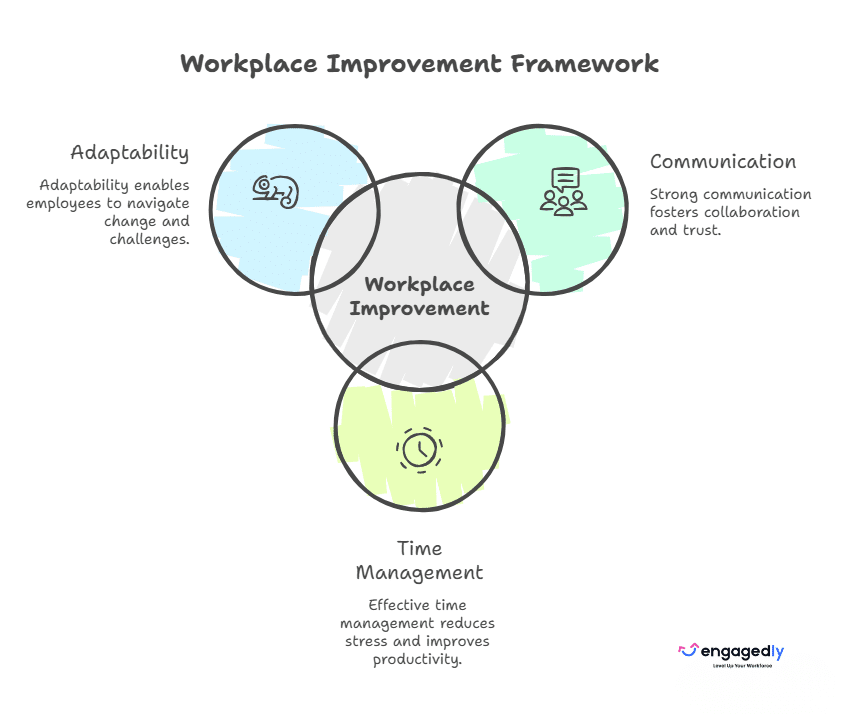
Some opportunities for improvement matter in almost every role, regardless of title, seniority, or function.
While certain development areas depend on the job, a few skills consistently shape how well employees perform day to day. These are the workplace fundamentals that affect communication, execution, and long-term growth across nearly every team.
If employees are not sure where to focus first, these three improvement opportunities are the most valuable place to start.
Communication
Communication is one of the most important improvement opportunities in any workplace because it affects nearly everything employees do.
Strong communication helps employees share ideas clearly, avoid misunderstandings, collaborate better, and keep work moving without unnecessary delays. It influences how well people contribute in meetings, how clearly they write emails, how effectively they ask questions, and how confidently they share updates.
Even high-performing employees often have opportunities to improve communication. Someone may speak clearly in meetings but struggle with written follow-ups. Another employee may communicate well with peers but need to improve how they present ideas to leadership.
Improving communication usually means being clearer, more concise, and more intentional about how information is shared.
For most employees, stronger communication leads to better alignment, fewer mistakes, and more trust across teams.
Time Management
Time management is one of the most practical opportunities for improvement because it directly affects productivity, consistency, and stress levels.
Employees who manage time well are more likely to meet deadlines, stay organized, and handle competing priorities without constant pressure. They tend to be more reliable, less reactive, and better equipped to maintain quality even when workloads increase.
Poor time management usually does not show up as laziness. It shows up as missed deadlines, rushed work, inconsistent follow-through, and constant task switching.
That is why improving time management often has less to do with working harder and more to do with planning better.
For most employees, this means learning how to prioritize tasks, manage workload realistically, reduce distractions, and focus on what matters most first.
Small improvements in time management often create immediate gains in performance and reduce avoidable stress across the workday.
Adaptability
Adaptability is one of the most valuable improvement opportunities in modern workplaces because change is constant.
Teams shift priorities. Processes evolve. New tools are introduced. Expectations change quickly. Employees who adapt well are better able to stay productive, solve problems faster, and maintain momentum when work becomes unpredictable.
Employees who struggle with adaptability often slow down when plans change. They may resist new processes, hesitate when priorities shift, or need more time than expected to adjust.
That makes adaptability one of the most important long-term development areas, especially in fast-moving environments.
Improving adaptability means becoming more comfortable with change, staying flexible when expectations shift, and responding to new situations with less friction.
Employees who build this skill tend to be more resilient, easier to work with, and better prepared for growth.
Opportunities for Improvement Examples (for Performance Reviews)
If you are writing your own self-assessment, frame each opportunity in first person and tie it to a concrete action, rather than describing it as a flaw. For example:
- Instead of “poor time management,” write “I plan to block focus time each morning to reduce last-minute rushing before deadlines.”
- Instead of “needs to communicate better,” write “I’m working on sending written project updates twice a week instead of only when asked.”
- Instead of “struggles with delegation,” write “I want to hand off one recurring task each month so I can focus on higher-priority work.”
These opportunities for improvement examples are useful in performance reviews because they are direct, actionable, and easy to apply.
- An opportunity for improvement is improving prioritization when multiple deadlines compete.
- There is room to strengthen communication clarity, especially in written updates.
- One development area is becoming more proactive in surfacing blockers early.
- An opportunity for improvement is applying feedback more consistently across projects.
- Improving cross-functional collaboration would help strengthen team efficiency.
- There is an opportunity to build more confidence in decision-making and ownership.
- One area for improvement is approaching conflict more directly and constructively.
- Improving adaptability would help maintain momentum during shifting priorities.
These examples work well because they focus on behaviors employees can improve, not personal shortcomings. That makes feedback easier to act on and more useful in long-term development conversations.
How to Frame Improvement Opportunities Constructively
Identifying improvement opportunities is only part of the process. How feedback is framed often determines whether employees act on it or disengage from it.
Employees respond better to feedback when it feels specific, fair, and useful. If feedback feels vague or overly critical, it is more likely to create defensiveness than improvement.
That is why improvement opportunities should always be framed constructively.
The most effective approach is simple. Focus on the behavior, explain the impact, and make the next step clear.
A practical way to do this is to structure feedback in three parts.
Start by describing what happened in clear, objective terms. Then explain why it matters by connecting the behavior to team outcomes, workflow, or performance. Finally, clarify what improvement looks like by giving the employee a practical next step they can apply moving forward.
Improvement Opportunities vs Areas of Weakness
Improvement opportunities and areas of weakness are related, but they are not the same thing.
Both point to performance gaps, but the way they are framed changes how employees interpret and respond to feedback.
Areas of weakness focus on what is lacking.
Improvement opportunities focus on what can be developed.
That distinction matters because employees are more likely to act on feedback when it feels constructive and growth-oriented rather than critical or limiting.
Calling something a weakness often feels personal. It can sound fixed, negative, or discouraging.
Calling it an improvement opportunity creates room for progress. It shifts the conversation from judgment to development.
For example, describing someone as having poor communication focuses on the flaw. Reframing it as an opportunity to communicate more clearly in written updates makes the feedback more specific and actionable. Similarly, calling someone disorganized can feel personal, while identifying an opportunity to improve prioritization and workflow planning gives them something concrete to work on.
Why Improvement Opportunities Matter at Work
Improvement opportunities matter because even small improvements in employee performance can create measurable gains across the business.
When employees improve how they communicate, prioritize, collaborate, and adapt, work becomes more efficient, teams become more reliable, and performance becomes easier to scale.
These are not minor changes. Over time, they shape how effectively a business operates.
Employees who consistently improve tend to make fewer mistakes, require less oversight, and contribute more confidently across teams. That leads to stronger execution, better collaboration, and less friction in day-to-day work.
The business impact is significant.
Recent workplace research reinforces this. Gallup found global employee engagement remains low, while manager engagement continues to decline despite managers having one of the biggest influences on team performance, productivity, and retention. At the same time, SHRM reports that burnout, heavier workloads, and widening skill gaps continue to put pressure on employee performance. Together, these trends make employee development a business priority, not just a management exercise.
That is why improvement opportunities matter.
They help employees perform better, managers coach more effectively, and teams operate with greater consistency.
At scale, continuous improvement is not just good for employee growth. It is essential for business performance.
In Summary
These 14 opportunities for improvement provide a strategic roadmap for enhancing employee performance and fostering a culture of continuous growth in the workplace.
By prioritizing skill development, creating a positive work environment, and embracing these identified areas, organizations pave the way for sustained success and employee satisfaction. If you’re looking to operationalize these improvements at scale, it’s worth requesting a demo to see how it all comes together.

Frequently Asked Questions (FAQs)
What are improvement opportunities at work?
Common improvement opportunities include:
Communication and collaboration
Time management and prioritization
Problem-solving and critical thinking
Adaptability and flexibility
Leadership and accountability
Technical and job-specific skills
Improvement opportunities focus on growth and development rather than criticism, making them a valuable tool for employee development and performance management.
What is the difference between a weakness and an improvement opportunity?
The key difference is perspective:
Weaknesses emphasize what is lacking.
Improvement opportunities emphasize future growth.
Weaknesses can feel negative or personal.
Improvement opportunities feel constructive and actionable.
Improvement opportunities encourage development rather than defensiveness.
For example, instead of saying an employee has poor communication skills, a manager might identify an opportunity to improve communication clarity in written updates.
What are the most common improvement opportunities for employees?
Common examples include:
Communication skills
Time management
Teamwork and collaboration
Adaptability and resilience
Problem-solving
Leadership skills
Organization and planning
Accepting and applying feedback
Critical thinking
Proactiveness and initiative
Developing these skills often leads to stronger performance, better teamwork, and greater career growth opportunities.
How do managers identify improvement opportunities?
Common sources include:
Performance reviews
One-on-one conversations
Goal and KPI results
Peer and customer feedback
Self-assessments
Daily observations and project outcomes
The most valuable improvement opportunities are usually based on recurring trends rather than isolated mistakes or one-time challenges.
How should improvement opportunities be written in performance reviews?
Effective performance review feedback should:
Focus on observable behaviors
Use specific examples
Explain the impact on performance or team outcomes
Include actionable next steps
Balance development areas with strengths
For example, instead of writing “Needs better communication,” a manager could write, “An opportunity for improvement is providing clearer project updates to stakeholders to reduce delays and improve alignment.”
Why are opportunities for improvement important in the workplace?
Benefits include:
Stronger employee performance
Better collaboration across teams
Increased productivity and efficiency
More effective feedback conversations
Higher employee engagement
Greater readiness for promotions and leadership roles
Organizations that encourage continuous improvement create a culture where employees are motivated to learn, adapt, and contribute at a higher level.
What are examples of improvement opportunities for performance reviews?
Examples include:
Improving prioritization when managing multiple deadlines
Communicating project updates more proactively
Applying feedback more consistently
Strengthening cross-functional collaboration
Developing stronger delegation skills
Increasing ownership of projects and outcomes
Improving adaptability during organizational change
Building confidence in decision-making
These examples are specific, actionable, and easier for employees to address than general criticism.
How can employees work on improvement opportunities?
Effective strategies include:
Seeking regular feedback from managers and peers
Setting measurable development goals
Taking training courses or certifications
Working with mentors or coaches
Applying new skills through stretch assignments
Tracking progress through regular check-ins
Small, consistent improvements often produce significant performance gains over time.
What are the top opportunities for improvement that benefit almost every employee?
The most valuable opportunities for improvement include:
Communication
Time management
Adaptability
Problem-solving
Collaboration
Accountability
These skills influence how employees work with others, manage responsibilities, and respond to changing business needs.
How do improvement opportunities support employee development?
They support employee development by:
Identifying skill gaps
Creating targeted learning goals
Encouraging self-awareness
Supporting career advancement
Improving performance over time
Helping managers provide better coaching
When improvement opportunities are discussed regularly and paired with development plans, they become a powerful tool for long-term employee growth and success.