A 360 feedback process is a performance development method that collects input about an employee from multiple people around them, typically their manager, peers, direct reports, and sometimes clients, along with a self-assessment from the employee. Unlike a standard review, where only a manager’s opinion counts, a 360 feedback process builds a fuller picture of how someone actually shows up at work. Done well, it becomes one of the most reliable tools an organization has for developing people. Done carelessly, it becomes a vague, anxiety-inducing exercise that nobody trusts.
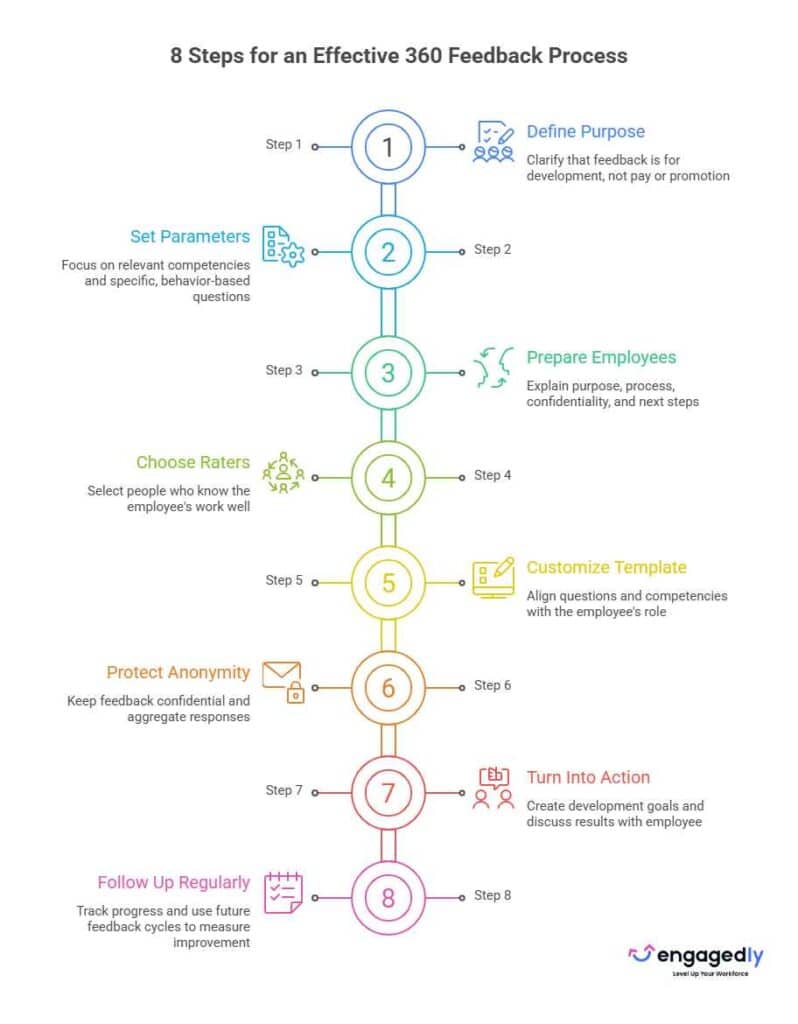
So what actually makes a 360 feedback process work? More than 74% of Fortune 500 companies now run some form of multi rater or 360 degree feedback program as part of their formal performance management, according to Dataintelo’s 2026 market report. Adoption isn’t the problem. Execution is. Below are the eight decisions that determine whether your program actually changes behavior or just generates a report nobody reads.
1. What Is The Purpose Of Your 360 Feedback Process, And What Do You Want From It?
The purpose of a 360 feedback process should be development, not evaluation. This is the single decision that shapes everything else you do, so answer it before you write a single survey question.
Most organizations run into trouble when they blur this line, using 360 data to influence pay or promotion decisions. That mixing of purposes is exactly why the industry has been shifting away from it. Best practice research consistently points the same direction.
Use 360 feedback to build self-awareness and drive skill development
Keep it separate from compensation, ratings, and promotion decisions
Get specific about what you want out of it, such as building a leadership pipeline, closing a skills gap, or supporting a new competency framework tied to changed expectations
Decide this before you invite a single participant, since the objective determines your rater groups, your questions, and how you report results back
One more shift worth naming here. Annual, one-and-done assessments are increasingly being replaced by shorter, more frequent cycles that let managers track development in near real time rather than waiting twelve months to find out if anything changed.
2. What Are The Parameters For Feedback?
Feedback parameters are the rules and structure you give raters before they write a single word, and without them, a 360 feedback process turns into a pile of vague, unusable comments.
Give everyone participating a short set of guidelines before the survey opens. Tell them what kind of language to use, what to avoid, and how to frame a criticism so it’s actionable instead of just blunt.
Keep the survey focused on 4 to 5 core competencies that are actually relevant to the role, such as communication, collaboration, and decision-making, rather than trying to measure everything at once
Write behavioral, specific questions instead of broad ones, so raters describe what someone did rather than offering a general impression
Use a 5-point scale rather than a longer one, since research on rating design has found that simpler unipolar scales tend to produce more reliable data than scales with too many gradations
Require at least one written example alongside every low or high rating, so the number has context behind it
3. Are Your Employees Primed For The Process?
Employees need to feel psychologically safe before a 360 feedback process will produce honest results. If people believe their answers can be traced back to them, or that the results will be used against someone, they soften what they say and the entire exercise loses its value.
Before you launch anything, walk employees through the objective of the program, what will happen with the results, what they personally stand to gain, and what the process looks like after feedback is collected. People invest in a process they understand. They disengage from one that feels like a surprise.
Explain the “why” before the “what,” since employees who understand the purpose participate more honestly
Tell raters explicitly that this is for development, not for compensation or promotion decisions, so co-workers aren’t tempted to either inflate or punish through their ratings
Set expectations for what support the person being reviewed will get afterward, such as a coaching conversation or a development plan, so the process doesn’t feel like it just ends at data collection
4. From Whom Do You Want To Collect Feedback?
Your rater group should include people who’ve worked closely enough with the employee to give specific, credible input, typically their manager, peers, and direct reports, and sometimes external clients or vendors.
Some organizations keep it simple and stick to peers. Others bring in managers as well. A smaller group also pulls in external stakeholders like clients. There’s no universally right answer here, but there is a practical range worth following.
Aim for 4 to 8 raters per person, drawn from different working relationships so you’re not just hearing one type of perspective repeated
Choose raters who’ve worked with the person for at least six months, so the feedback reflects an actual pattern of behavior rather than one recent incident
The more stakeholder groups you include, whether that’s clients, vendors, or cross-functional partners, the more important it becomes to keep every group aligned on what the process is for and how their input will be used
5. Custom Templates Or Generic Templates?
A generic 360 feedback template works fine for a small organization where most people do similar work. A custom template, built around specific job families or competency frameworks, is the better fit once you’re running the process across multiple departments or highly specialized roles.
Custom templates let you attach competencies to specific job titles, so an engineering lead and a sales manager aren’t being measured against the exact same rubric. Software like Engagedly’s 360 feedback module builds this in directly, letting you map competencies to roles rather than forcing everyone through the same generic form.
One newer development worth mentioning here. AI-assisted question generation is now common in leading platforms, tailoring survey questions in real time to a role, seniority level, or set of company values rather than pulling from a single static bank. It doesn’t replace thoughtful template design, but it does remove a lot of the manual setup work HR teams used to carry.
6. Is The Process Going To Be Anonymous?
Anonymity generally produces more honest, more accurate feedback, though it comes with a real tradeoff leaders should go in aware of.
Making a process anonymous tends to increase participation, since people are more willing to be candid when they’re not worried about the response being traced back to them. Research summarized in Wikipedia’s entry on 360 degree feedback notes that anonymous participation has been found to produce more accurate feedback, provided confidentiality among HR staff and managers is genuinely preserved. The tradeoff is that some anonymous comments will land as unfair or unclear, and without a name attached, there’s no easy way to ask for clarification.
Use a platform that aggregates responses and enforces a minimum number of respondents before results are shown, so no single comment can be traced back to one person
Communicate clearly, upfront, exactly how anonymity will be protected and who on the HR side will see raw versus aggregated data
Consider AI-based bias detection as a complement to anonymity, not a replacement for it. These tools flag rating patterns, like one group consistently scoring a certain demographic lower on a specific competency, that anonymity alone won’t surface
7. What Happens After The Feedback Cycle?
This is the point that actually determines whether your 360 feedback process succeeds or quietly fails. Feedback that gets collected and never discussed does more harm than good, it just makes employees suspicious of the next cycle.
Every piece of feedback you collect creates an obligation to act on it. Share results with the employee, walk through their strengths and gaps together, and turn that conversation into an actual plan.
Build development plans using the SMART framework, so goals are specific, measurable, achievable, relevant, and time-bound rather than vague intentions
Schedule a real follow-up conversation, not just an emailed report, so the employee has a chance to process the feedback with support in the room
If you’re running shorter, more frequent cycles, use each one to check progress on the last cycle’s goals, turning the process into a loop rather than a series of disconnected snapshots
If you’re using AI to summarize open-text comments, still have a human review the summary before it reaches the employee. Thematic synthesis is a genuine time-saver, but nuance and tone still need a person’s judgment
How AI Is Changing The 360 Feedback Process In 2026
AI hasn’t replaced any part of a 360 feedback process, it’s changed how the data gets analyzed and acted on. Platforms now commonly use natural language processing to summarize hundreds of open-ended comments into clear themes, which used to take a manager hours to do by hand.
The most useful applications right now fall into three areas.
Sentiment and theme detection across written comments, so patterns in feedback about communication or leadership style surface automatically instead of getting lost across dozens of individual responses
Bias flagging at the rater or rating level, surfacing outlier scores or skewed language before results reach a manager, so a pattern like one group rating a specific employee group lower on “leadership” gets caught and addressed rather than quietly shaping outcomes
Personalized development suggestions generated from feedback patterns, giving managers a starting point for a coaching conversation instead of a blank page
The market reflects how quickly this is being adopted. The global market for 360 degree feedback software is projected to grow from $1.35 billion in 2026 to $2.16 billion by 2031, according to Mordor Intelligence, with vendors that build in real-time personalization and bias detection commanding a clear pricing premium over those still running static survey workflows. None of this changes the fundamentals above. It just means the busywork of running a 360 feedback process is shrinking, which frees up more time for the conversations that actually move people forward.
Getting Started
A 360 feedback process works when the fundamentals above are in place before you send the first survey, purpose, structure, readiness, the right raters, the right template, a clear stance on anonymity, and a real plan for what happens afterward. Get those right and the process builds trust. Skip any of them and you end up with data nobody acts on.
If you want a platform that handles the template customization, the AI-assisted analysis, and the follow-up tracking in one place, take a look at Engagedly’s 360 feedback module or request a demo to see it in action.
Frequently Asked Questions
How often should you run a 360 feedback process?
Many organizations now run shorter cycles two or three times a year rather than a single annual assessment, since more frequent, lighter-touch feedback lets managers track progress in near real time instead of waiting a full year to find out if anything changed.
Is 360 degree feedback still relevant now that AI performance tools exist?
Yes. AI tools speed up analysis and surface patterns faster, but they don’t replace the core value of a 360 feedback process, which is hearing directly from the people who actually work alongside someone every day. AI is a layer on top of that, not a substitute for it.
How many raters should be included in a 360 feedback process?
Most organizations aim for 4 to 8 raters per person, pulled from different working relationships, such as a manager, several peers, and a few direct reports, so no single perspective dominates the results.
Should 360 feedback scores affect pay or promotion decisions?
Best practice says no. Mixing developmental feedback with compensation or promotion decisions tends to make raters less honest, since people soften criticism when they know it could hurt someone’s pay, and it tends to make the person receiving feedback defensive rather than open to it.
What’s the difference between a 360 feedback process and a standard performance review?
A standard performance review is typically a manager’s opinion of an employee. A 360 feedback process pulls in input from peers, direct reports, and sometimes clients, alongside the manager and a self-assessment, giving a much fuller picture of how someone actually operates day to day.
Jeevithan K is a Senior Solutions Consultant at Engagedly with extensive experience in HR technology, customer success, product implementation, onboarding, and training. He specializes in helping organizations adopt B2B SaaS and enterprise AI solutions effectively. His expertise also includes project management, account management, process improvement, and translating complex product capabilities into practical solutions that deliver meaningful value for customers.
















 Innovative