Artificial Intelligence (AI) is rapidly reshaping how organizations manage their people, bringing new efficiency and insight to every stage of the employee lifecycle. HR professionals across industries – from tech and finance to retail and manufacturing – are leveraging AI to attract, develop, and retain talent in smarter ways than ever before.
In fact, only about 39% of organizations currently use AI in their HR function, according to SHRM’s State of AI in HR 2026 report. But the intent is there: 87% of CHROs expect greater AI adoption within HR processes this year, and McKinsey research found 92% of companies plan to increase their AI investments over the next three years. This surge in adoption isn’t just about automating routine tasks; it’s about transforming the talent management paradigm.
AI tools can enhance candidate and employee experiences, reduce bias, improve decision-making with data, and even predict future workforce trends.
As we look at both current trends and the future outlook, here are 10 ways AI is revolutionizing talent management – spanning recruiting, onboarding, performance, learning and development, diversity and inclusion, workforce planning, employee engagement, and more.
1. Agentic AI moves from answering questions to running the workflow
Two years ago this section would have been about chatbots. Now it is about software that takes a task end to end and only comes back when something breaks.
The distinction is not marketing. A generative tool drafts a job description when you ask it to. An agent watches an open requisition, drafts the description, sources against a skills profile, books the screens, chases the no-shows, and escalates the cases that need a recruiter.
What agents are actually handling:
- Requisition intake and job description drafting
- Sourcing, plus re-engagement of past applicants who were close
- Interview scheduling and rescheduling across multiple calendars
- Post-interview summaries and scorecard drafts
- Onboarding orchestration across IT, payroll, and the hiring manager
Now the part the demos skip. Deloitte’s analysis of enterprise agentic adoption found only 11% of organisations had agentic systems running in production, and cites a Gartner forecast that more than 40% of agentic AI projects will be abandoned by 2027, largely because legacy systems were never designed for autonomous software to read and write against them.
If your HRIS only exposes data through a nightly batch export, agents will underperform regardless of how good the underlying model is. Integration quality is the constraint, not model quality. Ask any vendor pitching agents what happens when their agent needs to write back to your core HR system, and watch how specific the answer gets.
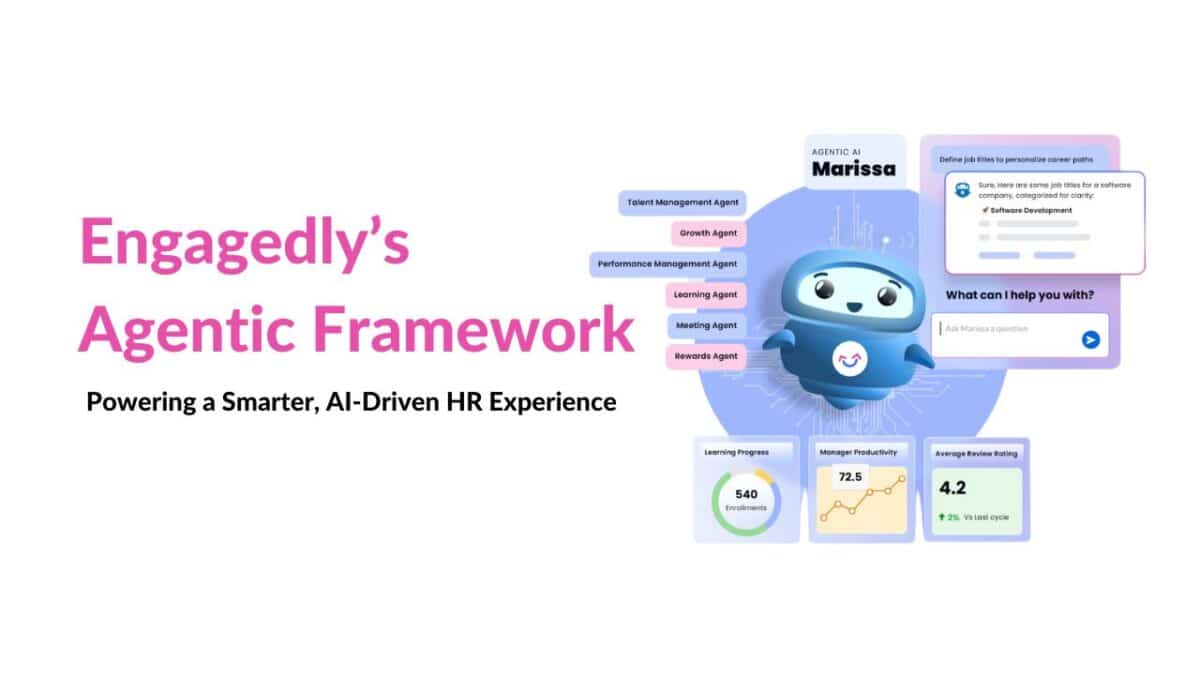
How Engagedly handles this: Marissa AI runs inside the same platform that holds your performance, learning, engagement and mobility data, so there is no batch-export gap between the agent and the record it needs to act on. It also works in the flow of work rather than as a separate tab people forget to open.
2. Screening moved from keyword filters to skills matching
Resume screening was the first AI use case in HR and it is still the most common. What changed is the matching logic underneath.
Keyword-based applicant tracking scored a candidate on whether their resume repeated the words in the job description. That rewarded people who were good at optimising resumes, which is not a job skill. Skills-based matching infers capability from experience descriptions, project history, assessment results, and internal skills data, then scores against a skills profile rather than a wordlist.
The efficiency claims usually quoted are 20% to 40% lower cost per hire and up to 50% faster time to hire. Be careful with the top of those ranges. Most trace back to vendor case studies with no control group and no follow-up on quality of hire.
The bias problem has not been solved by better matching. A University of Washington study presented at the 2024 AAAI/ACM Conference on AI, Ethics and Society tested three production large language models against 554 real resumes across more than three million resume-to-job comparisons.
The models favoured white-associated names 85% of the time, female-associated names 11% of the time, and never favoured Black male-associated names over white male-associated ones.
That study is from 2024 and the models have changed since. The finding has not been shown to reverse. In the EU, human review of these decisions has moved from best practice into law.
3. AI-assisted interviews now come with a transparency layer
Video interview analysis and game-based assessment are mature technology. What changed in 2026 is disclosure.
Emotion recognition in the workplace has been prohibited in the EU under Article 5 of the AI Act since February 2025. That covers inferring emotional state from facial expression or vocal tone during an interview with an EU candidate, regardless of where the employer sits. Several US states and New York City already require candidate notice and independent bias auditing for automated employment decision tools.
Gartner’s 2026 talent acquisition guidance is straightforward: clarify how you use AI in the hiring process, and where possible let candidates opt out of an AI interview. Public sentiment backs the caution. Pew Research found Americans oppose AI making final hiring decisions by 71% to 7%, and 70% opposed AI analysis of facial expressions. That survey is from 2023, so treat it as a floor rather than a current reading.
In practice:
- Disclose AI use inside the application flow, not buried in a privacy policy
- Offer a human-reviewed alternative path for candidates who ask
- Keep AI output advisory, with a named human making the call
- Log the decision well enough that you could reconstruct it a year later
Teams doing this well report it helps rather than hurts. Candidates tend to appreciate being told how they will be assessed, which makes the disclosure a courtesy that happens to also be compliance.
4. Recruiting assistants handle the follow-up nobody has time for
Candidate ghosting is mostly a capacity problem. A recruiter carrying 25 requisitions cannot answer 400 status queries a week. An assistant can.
Where they earn their keep:
- Application status updates without a recruiter touch
- Answering role, benefits, and process questions outside working hours
- Nudging candidates to finish assessments before they lapse
- Rescheduling when someone drops out of a slot
- Re-engaging strong runners-up when a similar role opens
High-volume frontline hiring is the clearest fit. Gartner identifies high-volume, low-complexity roles such as retail workers, customer service reps and drivers as the right place to go AI-first: the work is repetitive, the cost saving is large, and the existing service level in those funnels is already low.
For specialist and executive roles, the maths flips. A senior engineer who gets a bot instead of a human on first contact will assume the role is not serious.
For frontline teams: most of this only works if the workforce is actually reachable. Engagedly’s frontline enablement is a mobile-first platform for deskless and shift-based employees, covering communication, training, recognition and feedback. Customers using it report a 37% reduction in frontline turnover.
5. Onboarding gets personalised by role and skill gap
Onboarding used to be one checklist for everyone who joined that month. AI systems branch it.
The system already knows the role, the level, the location, and increasingly the skills profile from the hiring process. It uses that to sequence the first 30 days. Which compliance modules are mandatory. Which training this person can skip because they demonstrated it in assessment. Which stakeholders they should meet in week one. Which skill gap to start closing in week two.
The other half is the assistant answering “how do I set up direct deposit” at 11pm without anyone opening a ticket. Unglamorous, and it works.
The failure mode is predictable. Teams automate the paperwork, declare victory, and leave the human part untouched. A scheduled coffee with three teammates does more for 90-day retention than a perfectly personalised training path. Automate the admin so managers have time for the rest, not so they can skip it.
How Engagedly handles this: the Learning Experience Platform builds personalised learning paths from the new hire’s role and skill profile, tracks compliance training automatically, and uses gamification to lift completion rates. More on the wider approach at Learn and Develop.
6. Skills intelligence replaces the annual skills audit
This is the biggest structural change since 2024, and the next three items on this list depend on it.
Traditional skills management meant a spreadsheet built during an audit, accurate for about a quarter, then quietly wrong. Skills intelligence systems build the inventory continuously from work signals: project assignments, completed learning, certifications, performance data, internal applications, peer feedback.
Why it matters now. The World Economic Forum’s Future of Jobs Report 2025 puts 59% of the global workforce as needing reskilling or upskilling by 2030, and employers expect 39% of workers’ core skills to change over that period. You cannot plan against a gap you cannot see.
The uncomfortable finding comes from Fuel50’s Hidden Talent, Broken Systems research: 92% of HR leaders said they had sufficient visibility into workforce skills, while 74% said a lack of skills visibility was actively blocking business objectives. Both cannot be true. Most organisations have a skills taxonomy and think that counts as skills data.
Start with the roles where the gap costs you money, not with a company-wide taxonomy project. Taxonomy projects have a habit of taking eighteen months and producing a document.
How Engagedly handles this: Skill Gap Analysis maps the skills you have against the skills each role needs and keeps that inventory current from live work signals rather than an annual audit. It feeds directly into Talent Mobility and Growth, so the gap you find turns into a development plan instead of a slide.
7. Internal mobility becomes a hiring channel, not a perk
External hiring got slower and more expensive at the same moment skills data got usable. That combination is pushing internal mobility out of the L&D budget and into the sourcing strategy.
The case:
- LinkedIn’s Global Talent Trends found employees stay 41% longer at companies that regularly hire from within. The figure dates to the 2020 report and has been repeated in later LinkedIn research
- LinkedIn’s 2022 Workplace Learning Report put average tenure at companies that excel at internal mobility at 5.4 years, against 2.9 years at companies that struggle with it
- Fuel50’s State of Skills-Based Work 2026 found only 25% of organisations fill more than half their open roles internally
AI does the matching work that manager networks did badly. It surfaces the operations analyst whose SQL and stakeholder skills fit a finance role nobody thought to show her. It flags the one gap between an employee and the role they want, then suggests the stretch project that closes it.
The blocker is rarely technology. It is managers who hoard talent because losing a strong performer looks like a loss on their own scorecard. If internal moves are not counted as a manager success metric, the marketplace will sit there with beautiful matching and no movement.
How Engagedly handles this: Career Paths shows employees where they can go next and what closes the gap, Talent Discovery surfaces internal candidates managers would never have found, and IDPs turn the match into a plan with owners and dates. 46.6% of Engagedly clients rate the platform 4 or above for fostering career development.
8. Performance management runs on continuous signal instead of an annual form
The annual review survives at most companies. It has just stopped being where the information lives.
AI-supported performance systems pull from goal progress, peer feedback, project outcomes, and one-to-one notes, then summarise the pattern for the manager. Instead of a manager trying to remember January in November, the draft already exists and the manager edits it. That is a real time saving and a real accuracy gain, because recency bias is the single most reliable flaw in human review writing.
The bias case is genuine but often oversold. AI can strip demographic signals and flag gendered or vague language in written feedback. It can also encode whatever bias exists in the historical performance data it learned from. Bias reduction is an audit habit, not a feature you buy.
What actually improves review quality:
- Structured, frequent check-ins that leave a written record
- Multi-source feedback so one manager’s view does not dominate
- AI summarisation with the manager editing, never AI writing the final rating
- Calibration sessions where AI-flagged outliers get discussed by humans
How Engagedly handles this: the Performance Suite covers performance reviews with customisable cycles, 360 feedback, real-time feedback, OKRs and goals and one-to-one meetings, with 9-box calibration built in. 80.3% of clients rate it 4 or above for improving the quality and objectivity of evaluations.
9. Succession planning stops being a nine-box guess
Succession planning has traditionally run on the opinions of whoever was in the room. AI changes the input, not the decision.
The system profiles what has historically predicted success in senior roles at your company, then scans the workforce for people who fit that profile and were never on anyone’s list. That is the valuable part. Finding the invisible bench, not re-ranking the visible one.
It also lets HR model the scenario nobody enjoys discussing. If a regional VP resigns tomorrow, who is ready now, who is ready in twelve months with a specific development plan, and which roles have no successor at all.
Treat accuracy claims here with more scepticism than anywhere else on this list. Leadership success has a small sample size at most companies, and small samples produce confident-looking models that are mostly noise. Use it to widen the candidate pool. Do not use it to narrow one.
How Engagedly handles this: Succession Planning builds the bench from live skills and performance data rather than a spreadsheet reviewed once a year, and connects each successor to the development plan that gets them ready.
10. Retention analytics shifts from flight risk scores to intervention design
Predicting attrition was the flashy version, and it mostly disappointed. Flight risk scores turned out to be easy to generate and hard to act on. A manager told “this person is 78% likely to leave” and given nothing else does nothing useful with it.
The 2026 version focuses on drivers. The model identifies which factors are pushing risk in which segments: time since last promotion, pay compression against market, manager span of control, workload inferred from project data, engagement survey sentiment. Then it recommends an intervention that addresses that specific driver.
The privacy line matters more than it used to. Analysing internal communication sentiment sits right at the edge of what employees will tolerate and what regulators will permit. Pew found majorities of US adults opposed AI tracking workers’ movements, recording computer activity, and monitoring break frequency. Aggregate patterns are defensible. Monitoring individual messages is not, and in the EU it is close to prohibited territory.
How Engagedly handles this: Team Pulse and Employee Survey run continuous, aggregate sentiment analysis rather than individual message monitoring, and Rewards and Recognition gives managers something to act with once a driver shows up. 86% of administrators report a positive impact on time spent completing performance management tasks.
Conclusion
AI in talent management in 2026 is more uneven than the coverage suggests. Fewer than four in ten HR functions have implemented it at all, agentic AI is mostly still in pilot, and the regulatory deadline got pushed to December 2027, which bought time most teams will not use.
The organisations getting value are not the ones with the most AI. They are the ones with clean skills data, two or three well-chosen use cases, and a named human accountable for every decision the system touches.
Engagedly brings performance, learning, engagement, recognition, talent mobility and frontline enablement into one AI talent management platform powered by Marissa AI. Book a demo or take a self-guided tour.
Frequently Asked Questions (FAQs)
How is AI used in talent management?
AI is used across the entire talent management lifecycle to automate repetitive tasks, improve decision-making, and personalize employee experiences. Common applications include:
AI-powered candidate sourcing and resume screening
Recruitment chatbots and interview scheduling
Personalized onboarding and learning recommendations
Performance management and continuous feedback
Internal mobility and career pathing
Workforce planning and predictive analytics
Employee engagement and retention analysis
By reducing manual work and providing data-driven insights, AI enables HR teams to focus more on strategic people initiatives.
What are the benefits of AI in talent management?
AI helps organizations improve both HR efficiency and employee experience. Key benefits include:
Faster hiring and reduced recruitment costs
Better candidate matching
Personalized employee development
More objective performance evaluations
Improved employee engagement and retention
Smarter workforce planning
Data-driven HR decision-making
Increased productivity through automation
When implemented responsibly, AI allows HR professionals to make better decisions while delivering a more personalized employee experience.
Can AI improve employee retention?
Yes. AI helps improve employee retention by identifying patterns that may indicate disengagement or turnover risk before employees resign. It analyzes workforce data such as performance trends, career progression, learning activity, engagement survey results, and manager feedback to predict retention risks.
HR teams can then take proactive actions such as career development discussions, personalized learning opportunities, internal mobility, or recognition programs to improve retention.
Does AI replace HR professionals?
No. AI is designed to augment HR professionals rather than replace them. While AI automates administrative tasks like resume screening, scheduling, reporting, and data analysis, human judgment remains essential for leadership, coaching, conflict resolution, employee relations, hiring decisions, and organizational culture.
The future of HR combines AI-powered insights with human empathy, strategic thinking, and ethical decision-making.
What are the biggest challenges of using AI in HR?
Organizations adopting AI in HR should address several important challenges, including:
Protecting employee privacy and sensitive data
Preventing algorithmic bias in hiring and promotion decisions
Maintaining transparency in AI recommendations
Complying with employment and data protection regulations
Integrating AI with existing HR systems
Building employee trust through responsible AI governance
Successful AI adoption requires continuous monitoring, human oversight, and clear ethical guidelines.
What is the future of AI in talent management?
The future of AI in talent management is centered on predictive, personalized, and skills-based workforce management. Organizations are increasingly using AI to forecast hiring needs, identify future skill gaps, recommend personalized career paths, improve internal mobility, enhance leadership development, and support strategic workforce planning.
As AI technology continues to mature, it will become an essential tool for creating more agile, employee-centric, and data-driven HR functions while allowing HR leaders to focus on high-value strategic initiatives.
Author
Srikant Chellappa
CEO & Co-Founder of Engagedly
Srikant Chellappa is the Co-Founder and CEO at Engagedly and is a passionate entrepreneur and people leader. He is an author, producer/director of 6 feature films, a music album with his band Manchester Underground, and is the host of The People Strategy Leaders Podcast.
















 Performance