Performance management and talent development platforms are essential for organizations seeking to drive employee engagement, align goals, and foster continuous improvement. While Workday has established itself as a leading enterprise HR solution, many organizations today are exploring alternatives – whether due to implementation complexity, total cost of ownership, deployment speed, or the need for specialized features in performance management, engagement, and learning.
This comprehensive guide examines the top 10 Workday alternatives in 2026, highlighting platforms that help organizations streamline performance, boost engagement, and accelerate development while offering flexible implementations that fit diverse organizational needs.
Why Organizations Seek Alternatives to Workday
While Workday provides a comprehensive HR and financial management suite, several factors drive organizations to explore alternatives:
Cost Considerations: Workday typically requires significant upfront investment, which can be prohibitive for mid-market and smaller organizations scaling efficiently.
Implementation Complexity: The platform’s robust feature set comes with a steep learning curve and lengthy deployment timelines, often taking 6-12 months for full implementation.
Specialized Needs: Many alternatives offer deeper functionality in specific areas – continuous feedback, OKR management, employee engagement surveys, or integrated learning – that Workday treats as secondary modules.
Deployment Speed: Organizations need solutions that can be operationalized in weeks, not quarters, to address immediate performance management challenges.
User Experience: Emerging platforms prioritize intuitive interfaces and mobile-first design, reducing training overhead and improving adoption rates across organizations.
Top 10 Workday Alternatives You Should Consider in 2026
1. Engagedly
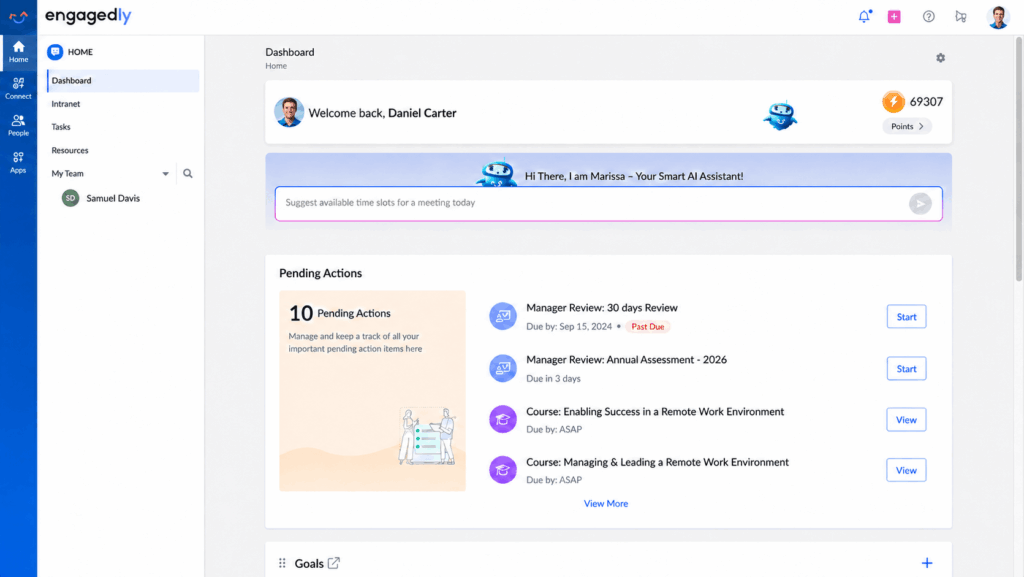
Engagedly is an AI talent management platform built to help organizations connect performance, engagement, learning, growth, and recognition in one unified experience. Powered by Marissa, its AI SuperAgent, Engagedly helps leaders turn people strategy into intelligent actions, reduce talent silos, and drive measurable business outcomes. Trusted by organizations worldwide, Engagedly supports stronger engagement, better retention, and the development of high performing teams.
AI-driven capabilities
Engagedly unifies performance reviews, OKRs and goals, 360 feedback and multi-rater assessments, employee engagement, and learning management into one agentic platform. With Marissa’s guidance, organizations get actionable insights and proactive recommendations that support continuous improvement.
Key features with Marissa AI
Performance reviews: AI-driven evaluations that keep ratings consistent, unbiased, and transparent.
Goals and alignment: Marissa auto-suggests goals, aligns them with strategic objectives, and tracks progress in real time.
Real-time feedback: Intelligent nudges that build a feedback-rich culture between managers and employees.
Learning management: AI-curated learning paths through the Learning Experience Platform, so upskilling does not require a separate tool.
360-degree feedback: AI-enhanced analytics that surface deeper insight from peer, manager, and report feedback.
Talent mobility: Skill gap analysis, IDPs, and career paths through the Growth Hub keep development tied to real opportunities.
Recognition: AI identifies top performers and suggests timely recognition, reinforcing a culture of appreciation.
User experience
Engagedly delivers a consistent experience across web and mobile, with AI-guided navigation. Marissa’s conversational interface lets leaders and employees interact naturally instead of digging through menus.
Unique strength
Engagedly is not just another HR system, it is an agentic AI-driven talent management platform. Mid-market organizations use it to automate tactical processes, surface predictive insights, and build a culture of engagement and high performance. For a side-by-side view of how it compares with the platform this list is built around, see Engagedly vs Leapsome.
Pricing
Modules range from $2 to $10 per user per month, billed annually, with a $7,500 per year minimum. Bundles and enterprise plans are available on request.
2. Lattice
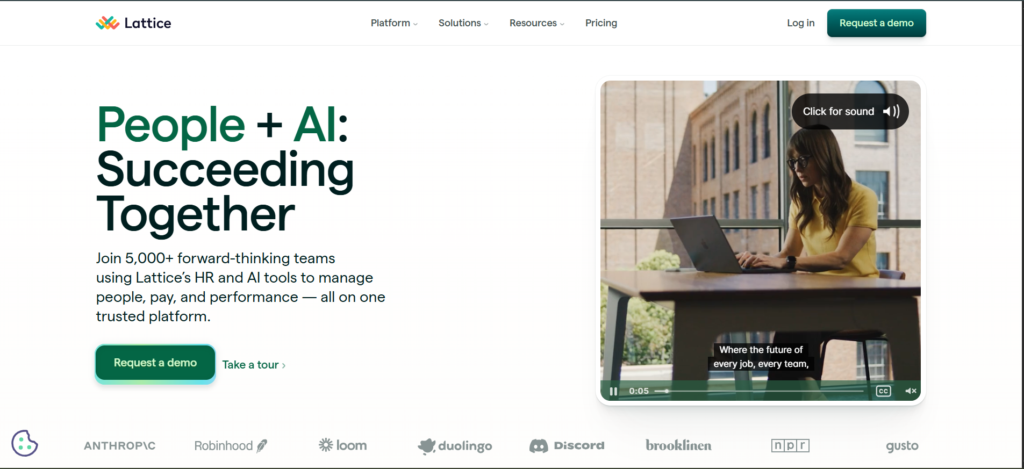
Lattice is a performance management and employee engagement platform built for mid-market companies prioritizing structured goal alignment and continuous development. The platform unifies performance reviews, OKR tracking, engagement surveys, and development planning in one system designed for HR-led programs.
Best For: Mid-market organizations (200-2,000 employees) that take performance management seriously and want deep customization without enterprise-grade complexity.
Key Capabilities: Structured performance reviews with customizable templates and multi-rater feedback, OKR cascading and goal alignment with progress dashboards, engagement surveys with benchmarked analytics, compensation planning tools, and career development frameworks. Lattice integrates with major HRIS platforms, reducing manual data entry and synchronization challenges.
Unique Strength: Lattice’s OKR architecture is among the deepest in the market. Organizations report review completion rates improve from 60% to 95% after implementing Lattice, largely due to integrated goal tracking that makes feedback contextual and performance conversations strategic.
Pricing: Lattice starts at $11/user/month for its core Talent Management module, with Engagement, Grow, and Compensation sold as add-ons at $4-6/user/month. Annual minimum commitment is $4,000. Full-featured deployments typically cost $18-25/user/month when all modules are bundled.
3. Leapsome
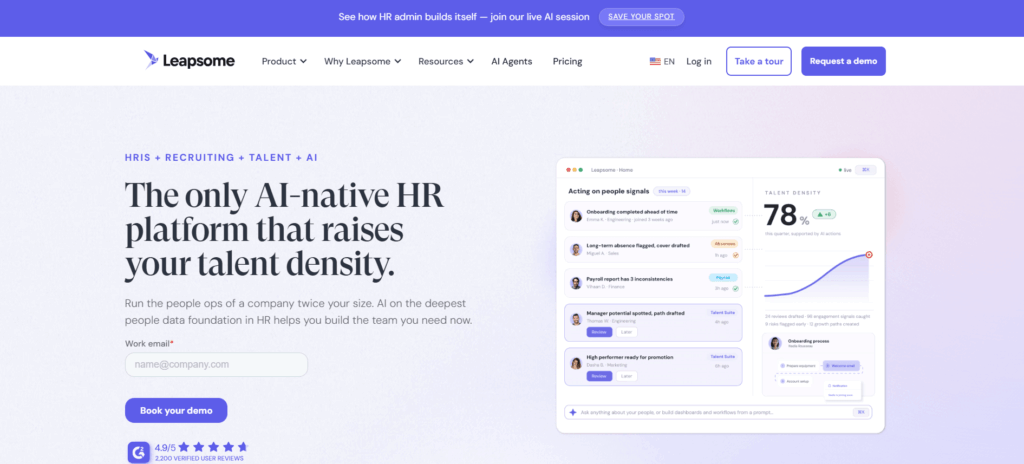
Leapsome is a people development platform that connects performance management, learning, feedback, and engagement into one cohesive experience. The platform is purpose-built for organizations seeking to align individual development with organizational performance.
Best For: Companies prioritizing skills development and learning alongside performance management, particularly those with distributed or international teams.
Key Capabilities: Customizable performance reviews with 360-degree feedback, goal setting with OKR support, integrated learning management system with AI-curated learning paths, engagement surveys with predictive analytics, and career development planning tied to skills mapping.
Unique Strength: Leapsome’s integration of learning and performance is distinctive. Organizations can attach specific development actions to performance gaps, creating a direct line from review insights to skill acquisition. Multilingual support serves globally distributed teams.
Pricing: Leapsome uses modular pricing starting at $3-8/user/month for individual modules. Full platform pricing requires a custom quote based on features, headcount, and contract length.
4. Culture Amp
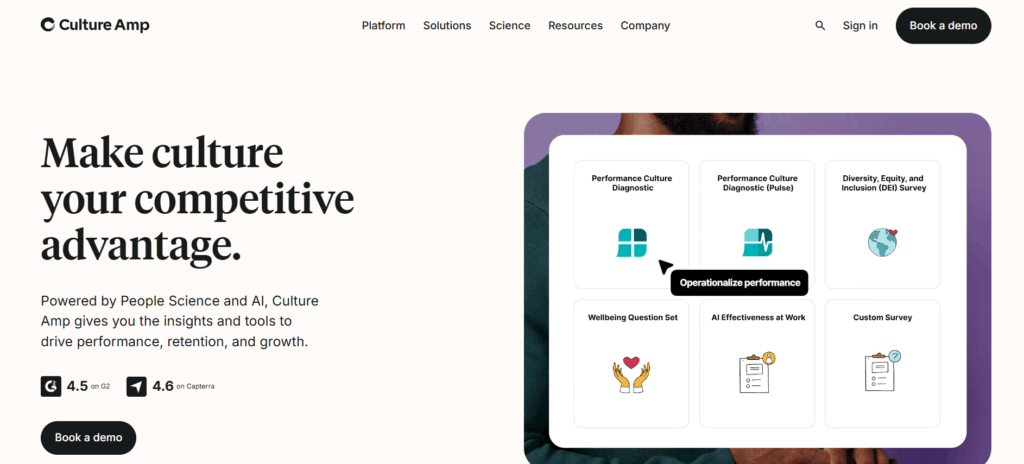
Culture Amp is an employee engagement and culture analytics platform that combines pulse surveys, feedback collection, and performance reviews with benchmarked insights. The platform focuses on transforming culture through data-driven decision making.
Best For: Organizations prioritizing employee experience and culture transformation, with strong emphasis on survey analytics and benchmarked comparisons.
Key Capabilities: Engagement and pulse surveys with sentiment analysis, performance reviews integrated with feedback, goal alignment tools, and culture benchmarking against industry peers. Advanced analytics surface hidden patterns in employee satisfaction, retention risk, and engagement drivers.
Unique Strength: Culture Amp’s benchmarking engine allows organizations to compare their scores against thousands of peer organizations, providing context for internal performance. AI-driven insights identify which actions will have the highest impact on retention and engagement.
Pricing: Culture Amp does not publish transparent pricing. Organizations typically work through a sales process.
5. 15Five
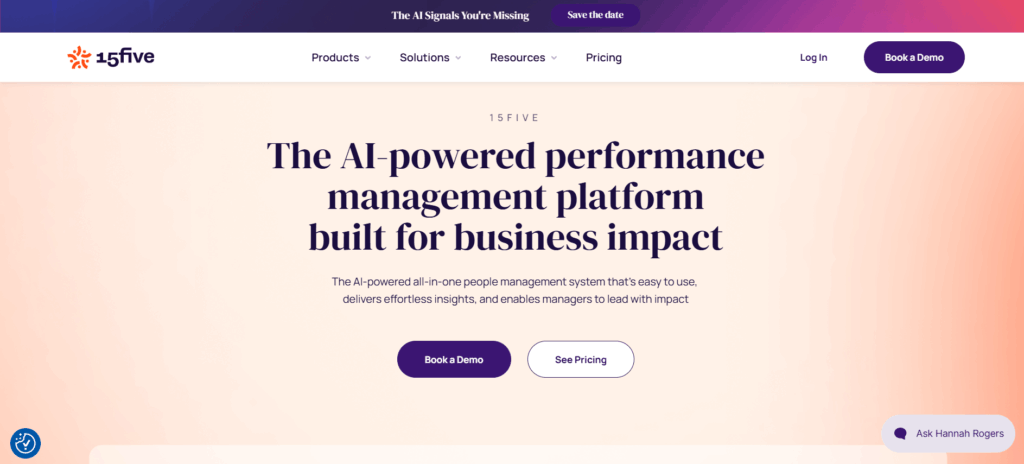
15Five is a performance management platform built around continuous feedback and manager coaching. The system is designed for organizations emphasizing weekly check-ins, ongoing development conversations, and real-time feedback over annual reviews.
Best For: Companies under 500 employees prioritizing manager coaching and weekly touchpoints, particularly tech-forward organizations.
Key Capabilities: Weekly check-in workflows with structured 1-on-1 agendas, continuous feedback and High Five recognition system, OKR and goal tracking, performance reviews with peer input, and engagement pulse surveys. The platform integrates with popular collaboration tools (Slack, Microsoft Teams).
Unique Strength: 15Five’s Work Context feature pulls signals from connected tools (Slack, Jira, GitHub) to create real-time performance context, eliminating the need for managers to remember what happened during the year.
Pricing: 15Five offers transparent tiered pricing starting at $4/user/month for basic feedback, with full Perform plans at approximately $10/user/month including check-ins, feedback, and reviews. Annual billing offers better rates.
6. PerformYard
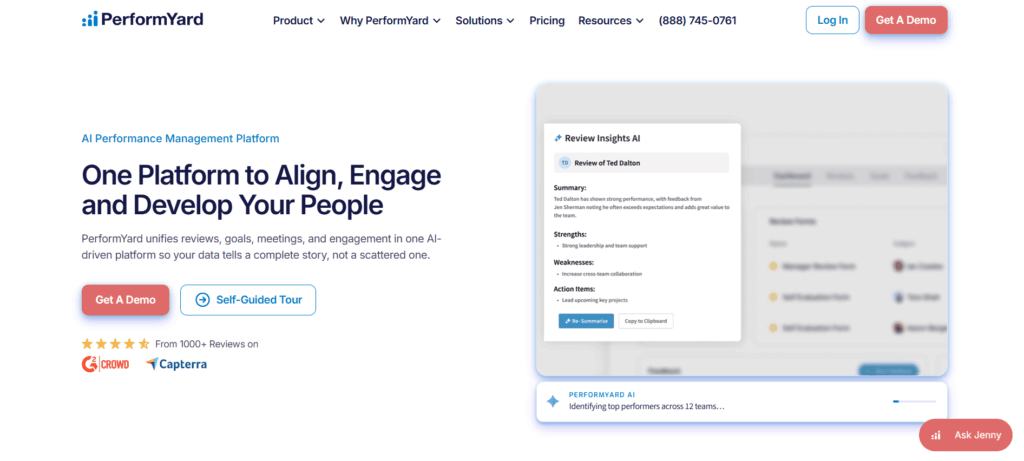
PerformYard is a focused performance management platform built for organizations that need best-in-class review customization without paying for features they won’t use. The platform excels at performance reviews and continuous feedback.
Best For: Mid-market organizations needing highly customizable review workflows and flexible feedback mechanisms without engagement or compensation modules.
Key Capabilities: Highly customizable performance review templates and workflows, continuous feedback and peer recognition, 360-degree feedback with comparative analytics, goal setting and tracking, and custom reporting.
Unique Strength: PerformYard’s customization-first approach is unmatched in the focused performance management space. Organizations can build review workflows that mirror their exact processes without compromise.
Pricing: PerformYard offers transparent pricing at $5-10/user/month depending on features selected, making it roughly half the cost of Lattice for organizations that only need performance management.
7. ClearCompany (ClearCo)
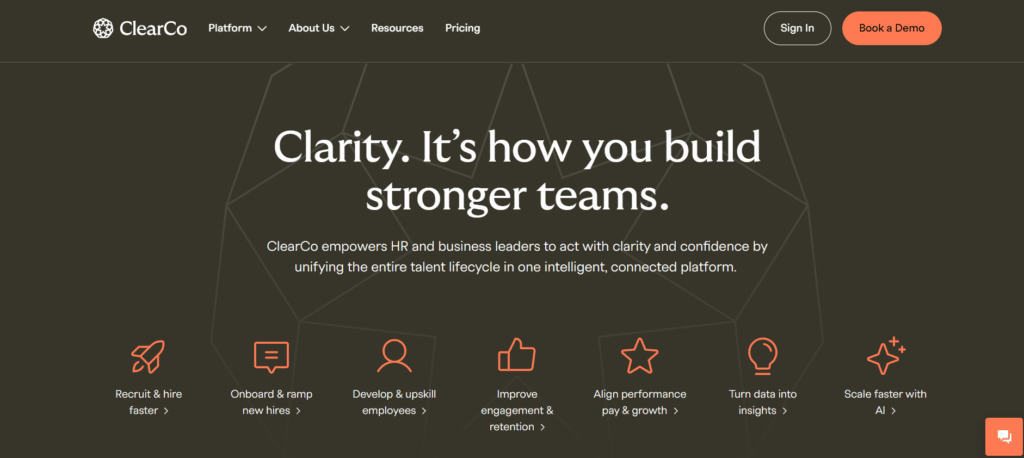
ClearCompany is an integrated talent management platform combining applicant tracking, onboarding, performance management, and employee engagement. The system is designed for mid-market organizations seeking end-to-end talent management in one place.
Best For: Mid-market organizations with dedicated talent acquisition and HR teams seeking to manage full talent lifecycle from recruiting through development.
Key Capabilities: Applicant tracking with job board integration, structured onboarding workflows with automated task management, performance reviews and goal tracking, employee engagement surveys, and workforce planning analytics.
Unique Strength: The tight integration between recruiting and performance management is rare. Organizations can track how hiring decisions correlate with later performance, creating a closed-loop talent system.
Pricing: ClearCompany uses custom pricing based on selected modules and headcount, typically ranging from $6-12/user/month. Request a quote for specific requirements.
8. BambooHR
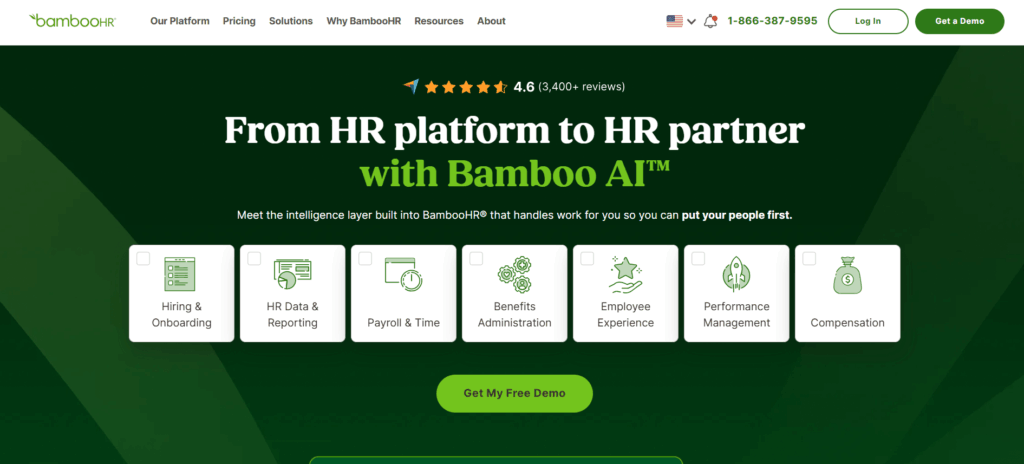
BambooHR is a foundational HRIS designed for small and mid-sized businesses that need core HR operations without enterprise complexity. The platform handles employee data, onboarding, time-off, and performance management in an interface built for quick adoption.
Best For: Small to mid-sized organizations (up to 500 employees) transitioning from spreadsheet-based HR management or requiring a lightweight HRIS with solid performance features.
Key Capabilities: Employee database with org charts, time-off tracking and workflows, applicant tracking with job board integration, performance reviews and goal tracking, onboarding checklists with e-signature, and basic reporting.
Unique Strength: BambooHR’s usability is industry-leading. The platform is built for adoption within days, not weeks. With a 92% ease-of-use rating across reviews, it minimizes training overhead.
Pricing: BambooHR offers transparent tiered pricing – Core starts at $10/user/month (basic HR), Pro at approximately $17/user/month (includes performance management), and Elite at $25/user/month (adds compensation tools). Performance management is bundled at Pro tier and above. All plans include a $250 minimum monthly fee.
9. Cornerstone OnDemand
Cornerstone OnDemand is an enterprise-grade talent experience platform built for large organizations requiring sophisticated learning management, succession planning, and talent analytics at scale.
Best For: Large enterprises (2,000+ employees) requiring integrated learning, performance, and talent mobility with global compliance capabilities.
Key Capabilities: Comprehensive learning management with content library, performance and succession planning tools, recruiting and onboarding solutions, talent analytics and workforce planning, and skills mapping. The platform supports complex multi-country deployments.
Unique Strength: Cornerstone’s breadth of enterprise features and integration with regulated industry requirements (financial services, life sciences, healthcare) make it the choice for large organizations with complex talent needs.
Pricing: Cornerstone OnDemand does not publish transparent pricing. Enterprise customers typically pay $18-25/user/month for core learning and performance modules, with implementation costs ranging $180,000-550,000 depending on deployment complexity and HRIS integration requirements.
10. Betterworks
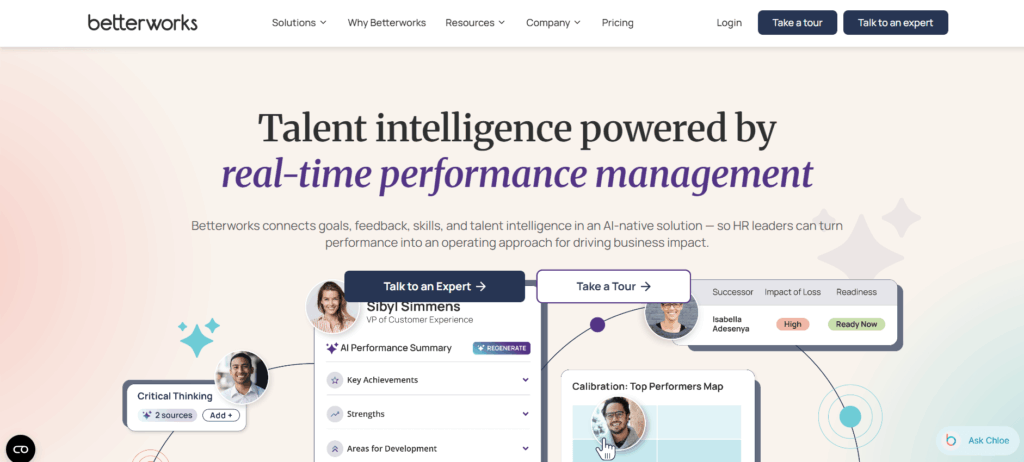
Betterworks is an enterprise performance management platform with deep emphasis on OKR alignment, continuous feedback, and performance calibration. The system is designed for organizations that have committed to OKR methodology as their primary planning framework.
Best For: Enterprise organizations (1,000+ employees) with mature performance management processes and strong emphasis on goal alignment and strategic execution.
Key Capabilities: Enterprise OKR cascading and alignment with real-time progress tracking, performance reviews with AI-powered calibration tools, continuous feedback and peer recognition, employee engagement surveys, and workforce analytics.
Unique Strength: Betterworks’ calibration module is among the most sophisticated in the market, helping HR leaders identify and eliminate rating bias at scale while ensuring fair performance evaluations.
Pricing: Betterworks pricing ranges from $8-15/user/month depending on deployment size and selected features, with enterprise pricing typically at the higher end. Implementation adds $20,000-50,000 in first-year costs.
Quick Comparison Table
Platform
Best For
Standout Feature
Starting Price
Engagedly
Unified AI-driven talent management
Marissa AI across all career planning workflows
$5/user/month (modules)
Lattice
Performance and OKR management
Deep OKR cascading with alignment tracking
$11/user/month
15Five
Continuous feedback with manager coaching
Work Context pulls signals from Slack/GitHub
$4/user/month
Leapsome
Performance connected to learning
Integrated LMS with AI-curated paths
Custom quote
Betterworks
Enterprise OKRs and talent intelligence
Real-time Talent Intelligence launched May 2026
$8-15/user/month
Reflective
Feedback in daily workflow
Now part of PeopleFluent, not standalone
Custom quote
Trakstar Perform
Compliance-driven reviews
Rebranded, now integrated into Mitratech suite
Custom quote
Culture Amp
Engagement-led performance
AI-generated survey action recommendations
$10-20+/user/month
Zoho People
Budget-friendly HR ecosystem
ZIA AI expanded for HR queries and reporting
$1-5/user/month
PerformYard
Fully customizable review workflows
Broad native HRIS integration list
$5-10/user/month
How to Choose a Workday Alternative
Assess Your Current Pain Points
Begin by identifying which specific Workday limitations drive your evaluation. Is it cost? Implementation timeline? Lack of engagement features? Specific capability gaps? Your pain point should drive your selection – a focused platform solving your exact problem often outperforms an all-in-one that compromises on depth.
Define Your Organization’s Maturity
Organizations new to formal performance management need simpler, more guided platforms (BambooHR, 15Five). Mature organizations with established processes benefit from customizable systems (PerformYard, Lattice) or advanced features (Betterworks, Engagedly).
Evaluate Total Cost of Ownership
Compare not just per-user pricing, but implementation costs, training overhead, and integration requirements. Many mid-market organizations find a focused platform ($5-10/user/month with faster implementation) delivers better ROI than enterprise systems requiring 6-month deployments and $200K+ implementation.
Prioritize Integration Capabilities
Your platform must connect with existing systems (payroll, HRIS, collaboration tools). Platforms with 100+ native integrations (BambooHR, Rippling) reduce custom development costs. If you’re in Workday ecosystem, ensure bi-directional data sync requirements are clear before committing.
Pilot Before Full Commitment
Test your top two choices with a pilot group before enterprise rollout. Real user feedback on adoption, data quality, and actual feature usage often surfaces issues that demos miss.
Key Trends Reshaping Performance Management in 2026
AI Becomes Baseline, Not Feature
Platforms now embed AI across workflows – from bias detection in calibration to predictive flight risk algorithms. Marissa AI in Engagedly represents this shift – AI doesn’t just report data, it guides decisions and surfaces patterns humans miss.
Continuous Feedback Replaces Annual Reviews
Forward-thinking organizations have eliminated formal annual reviews in favor of ongoing feedback loops. Platforms prioritizing weekly check-ins (15Five) and real-time feedback (Engagedly) align with this shift.
Skills and Internal Mobility Take Center Stage
Performance platforms increasingly connect skills to development paths and internal mobility opportunities. Leapsome’s learning integration and Engagedly’s talent analytics and mobility module reflect this evolution.
Engagement Becomes Predictive, Not Retrospective
Surveys that report feelings after the fact are giving way to real-time sentiment analysis and predictive models that identify disengagement before it leads to turnover.
Final Consideration
Workday remains a powerful solution for large enterprises requiring comprehensive HCM and financial management. However, for mid-market organizations (200-5,000 employees), specialized platforms often deliver superior results in performance management, engagement, and development.
Each alternative above excels in specific areas. Engagedly’s agentic AI transforms how organizations approach performance and development. Lattice delivers the deepest OKR architecture. 15Five prioritizes manager coaching. BambooHR emphasizes ease-of-use and quick adoption. By carefully evaluating your specific needs against each platform’s strengths, you’ll find the solution that accelerates your performance culture, improves retention, and drives measurable business outcomes.
Frequently Asked Questions
What is the main difference between Engagedly and Workday?
Workday is an enterprise HR and financial management system with broad capabilities across recruiting, HR, payroll, and finance. Engagedly is an AI-powered talent management platform focused specifically on performance, engagement, and development. Engagedly deploys in weeks with Marissa’s agentic guidance, while Workday typically requires 6-12 months and substantial implementation costs. For mid-market organizations not requiring global payroll and financial management, Engagedly delivers deeper performance capabilities at lower total cost of ownership.
Which Workday alternative is best for organizations under 300 employees?
For smaller organizations, BambooHR and PerformYard offer the best combination of ease-of-use, transparent pricing, and core performance features. If AI-driven intelligence and development are priorities, Engagedly’s modular pricing allows starting with specific modules (Performance or Learning) without enterprise-scale investment.
How do I ensure a smooth transition from Workday to an alternative?
Plan a 6-12 week transition with parallel operation – run both systems simultaneously while validating data accuracy in the new platform. Prioritize data migration of active employees and recent review cycles. Start with a pilot group to surface adoption challenges before enterprise rollout. Ensure leadership clearly communicates the new platform’s benefits to drive user adoption.
What’s the best Workday alternative for OKR-driven organizations?
Lattice and Betterworks both excel at OKR management. Lattice is best for mid-market organizations (smaller deployment, faster implementation, lower cost). Betterworks is best for enterprises with complex goal cascading and sophisticated calibration requirements. Engagedly’s OKRs and Goals module offers AI-powered progress insights that help organizations stay aligned with business strategy in real time.
How important is mobile accessibility in a performance platform?
Highly important. Managers need to give feedback, celebrate wins, and check progress from anywhere – not just from a desktop. All platforms above offer mobile apps, but quality varies. Engagedly and 15Five prioritize mobile-first design. BambooHR’s mobile app is exceptionally user-friendly. If your manager population is remote or field-based, mobile experience should be a primary evaluation criterion.
Ready to explore how Engagedly’s AI-powered platform transforms performance management for your organization? Request a personalized demo today to see Marissa in action.
Gabby Davis is the Lead Trainer for the US Division of the Customer Experience Team. She develops and implements processes and collaterals related to the client onboarding experience and guides clients across all tiers through the initial implementation of Engagedly as well as Mentoring Complete. She is passionate about delivering stellar client experiences and ensuring high adoption rates of the Engagedly product through engaging and impactful training and onboarding.














 Innovative