How to Increase Employee Engagement with Translation

Workers who view their job as more than just working for a paycheck often exhibit a high degree of commitment. These workers show dedication and passion for what they do, and this zeal translates to the kind of engagement they receive from their company. 

According to research from Harvard Business Review, more than 90% of business executives believe that employee engagement can improve the individual and collective performance of team members – which will contribute to the overall output of the company. Other benefits to companies from employee engagement include increased productivity, customer satisfaction, better professionalism, etc. 

If driving employee engagement in a multinational organization is the objective, translation is a great place to start. This article explains five ways to increase employee engagement through translation. 

1. Recruiting a local internal communications team

Recruit locally. For instance, for better interaction with the Japanese arm of your company, it makes sense to hire a Japanese speaker to help with internal communications. It will help with your content choice and development. It will also facilitate the dissemination of internal information and seamless interactions with international teams. 

Find one person in each market and communicate your objectives with them. It would increase employee engagement in countries where your company has a branch office.

2. Know the cultural differences in particular markets 

Communication styles differ based on the country and people. To prevent a disconnect between the office in the UK and offices in other parts of the world, you need to do your research and offer solutions to issues that arise.

Sometimes the teams in different countries can be worlds apart in behavior, which is obvious. Learn to understand the differences and let this guide you in communicating effectively with employees across the different branches in different markets.

Also Read: How Internal Communications can Align Your Employees with Organisational Goals?

3. Localize your content and target content with a global appeal

Localizing your content means you go back to the drawing board and plot new styles of content that are engaging and appropriate for staff in all the different markets globally. It can involve needing professional translation services to develop the content in their native language and change the context to suit different cultures. 

Many companies usually create a guide to localize the content according to plan. You may need a team from different markets to help in translating the content and making it suitable for the audience in their part of the world. You can also instruct your team to create content with worldwide appeal, reducing the work for the translators. Moreover, they can assist you in selecting content, determining which aspects need translation, and determining what type of content your staff would enjoy and spend time using.

4. You may get better results by segmenting the content form

Content can be engaging or boring, especially within a global organization. The goal of striking a balance can be pretty steep. You can try segmentation to see if you can target staff based on their location and post appropriate content for the specific target audience to check if you get more engagement. 

Factors that affect content engagement are the content’s role, the platforms or media you share it on, and the specific target market. Some brands produce a monthly newsletter and share it via email with each manager across the global offices. They share an abridged version via print for the staff working in the offices locally and overseas.

5. Use a mix of local and international content

When thinking of your office locally and internationally, include different kinds of content that would suit everyone. You can do this to help the team understand and connect with the staff worldwide and improve the global team’s synergy. Focus on getting the insights of the CEO, a local sales manager, and the entry-level staff. Be inclusive in your choice of content. Get contributions from all departments across different teams and the culture of your global team to spice up your newsletter. Spread it over the entire year to avoid overwhelming your team with information but also go for the right balance. 

You can also use games to increase employee engagement across the global team. Games such as a quiz, competitions, or other activities can help your team feel like a part of the whole. Choose games with global appeal that are appropriate.

Conclusion

Get the buy-in of your internal communications team on what everyone would like. Using translation services to communicate your plans and make your content accessible to all cultures is a sure way to get everyone from different countries and cultures to participate.


Do you want to know how Engagedly can help you increase employee engagement? Book a live demo with us.

Request A Demo


This article is written by Daisy Benson.

Daisy

Daisy is an industrial and organizational psychologist who researches to identify solutions to problems that improve the well-being and performance of organizations and their employees. Daisy is also a freelance writer and often writes articles for credible blogs.

Effective Employee Advocacy Strategy for Your Business

Employee advocacy, which encourages your employees to share the message about your business on social media, is a hard sell because not everybody wants to mix their professional lives with their personal ones. Forcing your employees to advocate for your business would cause them to sour on your company. But not enforcing them to join your employee advocacy program prevents your business from maximizing its online visibility.

The answer is somewhere in the middle—you want them to want to advocate your brand without making it feel like a chore for them. Below are the employee advocacy strategies you should consider.

Establish an Irresistible Company Culture

First, you must set up a list of attitudes and behavior that everybody in your organization must abide by. Having a transparent company culture that is aligned with your business objectives and brand gives your organization an identity that employees can identify with and latch on to.

At the same time, you can attract new hires who share the same ideals as your brand to a tee. This way, they will be more than happy to advocate for your business on their social media.

If you don’t have a company culture, you can start by profiling your current employees and building stronger relationships with them. Knowing their core values as human beings gives insights into the business you have. From here, consider how you reduce employee churn and build a community within your organization. By retaining as many employees as possible, you can quickly establish a culture that everybody will observe. 

One of the best ways to do this is by upskilling employees. Provide them with all the resources and information to succeed at their jobs. Get your high-performing employees and managers to take them under their wing so you can inherit their positions in the future.

Once you understand your employees better, you must connect them to a purpose that ties back to your company goals. Getting them aligned with your objectives allows them to give meaning to their work in your organization, reflecting back to them as people.

Having all these things together sets the tone for the employee advocacy strategy you plan to launch for your business.

Also read: 12 Ideas for Business Mentoring Activities

Set Goals and Boundaries for Your Employee Advocacy Strategy

Next, you must define what you wish to accomplish through your advocacy program. It’s all about consistency and alignment with your brand. You want to associate your program with what your brand is about, which points back to your company culture.

Ultimately, the program aims to generate new customers and attract like-minded people to work with your organization. This is achieved by getting employees to post social media updates that shed your company in a particular light.

Below are the posts your programs should encourage employees to share:

  • Latest project each employee is working on
  • Work culture
  • Images of company swag
  • Company news and blog posts 

Depending on your program’s current goals, you must encourage employees to share certain posts online to meet them. 

If you want to start a content writing business as part of your brand, get your employees to share your team’s latest blog posts. Then mention that they can apply for a writing job if they can write something similar. At the same time, there are things that your employees shouldn’t post about work. For instance, posting your company clients with whom you’ve signed NDAs is a big no-no.

While you want employees to be creative with how they advocate for your brand, you must also set some ground rules.

Monitor the Results of the Program

Once the program is up and running, you want to check its status and how employees are doing with it.

Seeing how they respond to the program is crucial—the lack of advocacy and the underwhelming results are indicators of a program that needs rethinking. This allows you to improve your program to get more employees to join or generate more sales.

Below are metrics that you must measure in your program:

  • Percentage of employees sharing your content – Depending on the platform you’ll use (which we’ll get into later), you want to make employee advocacy easier by creating different content types for them to choose from and share on social media. A higher share rate means they enjoy the content you’ve created for them to share. If not, you may have to provide better content in your program.
  • Activity – How often they work on your program indicates its quality. Fewer content shares and number of times logged in to your employer’s advocacy platform means that it’s not engaging enough for them to join and stay active. 
  • User engagement rate – Arguably more important than the number of shares the content has is how users received them. The more likes, shares, and comments it receives, the more you should create this typeF of content for your program moving forward.
  • Employee net promoter score – Integrate this metric into your program to help you assess whether the program (or even the organization as a whole) is doing a good job engaging its employees with its culture. 

From here, you should know better what factors to tweak in your program to get better results.

Also read: Employee Performance Management In Hybrid Era

Incentivize Employees Who Perform Well

You must reward employees who have been your best-performing advocates. The rewards prove that you value the people who champion your brand outside of the office. Also, they encourage other employees to do a much better job with the program, especially if you’re giving away rewards that could benefit them.

Below are ideas on how you should incentivize your program’s advocates:

  • Rewards that tie with the winning advocate’s hobbies, i.e., extended gym memberships to fitness buffs, a supply of food for pet owners, etc.
  • Vouchers or coupons from popular retailers and marketplaces.
  • A paid course or training program to help accelerate their career development and growth.
  • Give away products you’re selling for free.
  • Upgrades to tools they’re currently using, i.e., LinkedIn Premium, to help make building a much better professional network.

If you feel your program isn’t up to expectations, you may need to build a better community for your organization. Launching a team-building initiative like scavenger hunts is a great place to start. These may not cost a lot, but they go a long way to show employees that their hard work is acknowledged and appreciated.

Use an Employee Advocacy Strategy that Best Supports Your Objectives

Instead of using multiple sheets and documents to keep track of your employee advocacy, you need a tool to streamline the program. The platform combines all these tools in a single dashboard. It can also automatically collect data and monitor the activity of your employees so you can focus on the big picture.

Below is a shortlist of tools you should consider using to run your entire employee advocacy program:

  • Everyone Social – Make employee advocacy fun and easy by setting up content pieces for your employees to share with a click of a button or encouraging them to create their own.
  • Sociabble – Aside from employee advocacy, you can reach out to workers in their preferred online channels, boost your team’s lead generation efforts, and encourage prospective employees to apply.
  • PostBeyond – Launch and measure your employee advocacy program and social selling campaigns to build upon your campaigns and continuously reach out to your audience.
  • Smarp – Allow employees to receive personalized content suggestions about your brand to share across their social networks.

Conclusion

The key to an effective employee advocacy strategy is to encourage as many workers to participate in the program and help spread the message about your business, whether it’s recruiting new talent or generating leads and customers. Either way, the steps above should help you formulate a strategy that will achieve the objectives of your employee advocacy efforts.


Want to know how Engagedly can help with effective employee engagement? Fix a quick demo with our experts.

Request A Demo


About the Author:


Christopher Jan Benitez is a freelance writer for hire who specializes in the digital marketing field. His work has been published on SEO and affiliate marketing-specific niches like Monitor Backlinks, Niche Pursuits, Nichehacks, Web Hosting Secret Revealed, and others.

5 Ways To Use Technology To Improve Employee Experience

When it comes to primary goals, companies usually think of improving customer experience, making better products, and achieving revenue goals. But, they forget one of the essential things that fuel the entire program: employees. If your employees are not happy & satisfied, then your company will eventually get ruined.

We have read about the “Great Depression” and now we are experiencing “The Great Resignation” in the corporate world. According to Microsoft’s research report, around 52% of Gen Z and Millennials are likely to consider changing employers this year. And one reason behind that is they are facing poor employee experience at their current organizations. But, what exactly is employee experience?  

What Is Employee Experience?

In a nutshell, employee experience defines the entire journey of an employee from the moment they are on board till their last day at the office. It’s a summary of all the things that happened to them during their work period, which either makes them big critics or the most incredible supporters of the company.

Importance of Employee Experience Technology

The pandemic has forced organizations to work remotely and already accelerated the adoption of digital technology. Companies started using digital tools for managing tasks, projects, team meetings, communication, collaboration, and automation. 

With these tools, organizations maintain productivity and achieve revenue goals while working remotely. But, they are still facing the challenge of employee engagement and retaining their top talent. 

Remote working organizations are looking for ways to enhance the overall employee experience. It is an essential factor that drives the entire organization. If your employees are not satisfied, then employee engagement, retention, and everything else will shatter in a second. This will also impact customer experience . Because happy employees create happy customers. To prevent that from happening, you need to use technology wisely and provide a good employee experience to everyone working in your company. 

And that’s where employee experience technology comes into the picture. There are many ways you can improve employee experience with the help of digital tools. With proper tools, you can tailor customized experiences for your employees right from onboarding to leaving your organization. 

How to improve Employee Experience with Technology?

Here are some of the practical ways you can use technology to improve employee experience:

1. Invest in a powerful employee engagement platform

With work from home replacing the in-office culture, it has become important to maintain the same employee engagement rate for everyone. Though existing employees might not have a problem interacting with their colleagues, it might become challenging for newbies.

This is where platforms like Engagedly come into view. An all-in-one employee engagement platform that helps connect everyone in the organization with no barrier can be of great help while working remotely.

By investing in such tools, you are making it possible for all your employees to engage seamlessly with each other, further lessening the chances of miscommunication. Engagedly helps in streamlining internal communication and provides various other features like remote collaboration, employee recognition, survey tool, and gamification.

Also read: Guide to select the right Performance Review Software

2. Collect employee feedback and act on it

Whenever we order food delivery, we always give feedback on whether we like it. Likewise, it’s important to take feedback from employees regularly. This doesn’t mean that you should take only one feedback per year. No, as per surveys, organizations saw a 12% improvement in performing employees after taking weekly feedback and acting on it.

Besides, platforms like Engagedly enable you to conduct employee surveys and collect data on employee sentiments.

Apart from that, it’s also essential to take exit feedback from employees who are quitting the organization. Why? That’s because it would help the organization understand whether the employee had a good experience and further work on it.

3. Empower employees with the right team collaboration tools

When it comes to using digital tools for team collaboration, tons of apps are present in the market, which can overwhelm you. That’s why it is important to choose the right tools that will suit the requirements of your employees and the organization.

For example, for teams that need to converse in real-time and be in touch throughout office hours, tools like Slack can be of great help. Here, you can tag your colleagues regarding any doubts and communicate easily.

On the other hand, all-in-one work management tools like SmartTask not only offer task & project management capabilities but also team collaboration features like video conferencing and instant messaging in one app.

You can experiment with different digital tools by opting for their free trials to choose the right fit for your needs.

4. Automate repetitive tasks and streamline workflows

Every company uses different tools for various types of work. This demands employees to use multiple software tools which can be overwhelming. Also, tasks like entering client data into Google sheets or sending follow-up emails to prospects can be repetitive for employees. But, automation can help you in solving these problems within seconds.

Nowadays, tools like Zapier or Integromat can help you automate repetitive tasks and streamline workflows by connecting the tools you use. For example, you can automate follow-up sending processes or manual data entry activities.

Also read: 360 Degree Feedback: Best Practice Guidelines

5. Provide online learning opportunities

For recruiting Gen Z employees, you can’t charm them with a competitive salary only, as they also look for different things that will benefit their career. One of the best ways to improve your employees’ experience is by providing them with proper career growth opportunities. One way of doing this is by providing them access to courses from Coursera, Skillshare, and other high-end learning platforms.

You can provide them with free vouchers for the courses, conduct training sessions, arrange seminars, and other things that can surely help them in their career path. Gen Z employees look for jobs through which they can earn and upskill themselves at the same time. By helping them achieve that, you can increase the rate of employee retention. 

Final Words

For employee experience, most companies think that organizing an annual picnic or outing with the entire team and festival parties will do the trick. But that will not do the trick anymore. Employees are looking for companies with good work ethics and chances for growth. 

The pandemic has shown everyone that life matters the most, and everything else is secondary. Companies that understand this and value mental peace as well as help their employees grow are the ones that will have a high employee retention rate with good experience.


Author Bio

Shyamal Parikh

Shyamal Parikh is the Founder of SmartTask, an online work management/automation software that helps teams streamline their processes. May it be sales, hiring, customer success, or projects. He actively shares strategies and techniques that improve a team’s productivity. 


Do you want to know how Engagedly can help you realize your full business potential? Simply click the button below to book a demo with one of our specialists today. 

Book a DEMO


4 Competencies That You Must Include In A 360 Degree Feedback Form

To utilize 360 degree feedback effectively in an organization, it is important to design a handy feedback form for the entire process. To help you with the questionnaire, we have listed 4 most important 360 competencies that you must add to your 360 degree feedback form.

Continue reading “4 Competencies That You Must Include In A 360 Degree Feedback Form”

Constructive Feedback Examples To Help With Difficult Conversations

If you’re like most leaders, one of your biggest goals is to have difficult conversations with your team members that are critical to their success but such conversations often do not happen because of fear and awkwardness on both sides. 

If you dread these types of interactions because you’re afraid that you might offend the other person or that they might not respond well to what you have to say, then it will be hard to get them done and as a result, your team will suffer and you’ll feel even worse about the situation than before. 

Giving and receiving feedback can be challenging, even when the topic isn’t especially sensitive or serious. It might be intimidating to address your co-worker or employee on something they did that could be improved upon, but giving constructive feedback can help them grow as a person and make the work environment better in the long run. 

feedback

Constructive feedback isn’t always easy to give, especially when the recipient of that feedback doesn’t want to hear it, but that doesn’t mean it shouldn’t be given. Constructive feedback will help people in your life make positive changes and see the benefit of those changes long after you’ve left their lives. 

In this blog, we’re going to unpack 10 examples of constructive feedback you can give to help you have those difficult conversations in your workplace with ease.

1) Understanding What Has Happened

When someone asks you for feedback on a piece of work, it’s easy to fall into your role as an evaluator and simply list off everything you think is wrong with it. This is hardly constructive, though. It’s more useful to understand what has happened than it is to assign blame. If someone has provided a sub-par piece of work, focus on why they’ve done so before offering suggestions on how to improve. Understanding what went wrong allows you to evaluate exactly how they can move forward and produce better results next time around. Your critique will be much more valuable if you help them learn from their mistakes rather than simply criticizing them for making them in the first place. The emphasis should be on helping others learn from their actions rather than just being critical of them. Everyone makes mistakes—it’s part of being human—but by understanding what led to those mistakes, we can prevent ourselves from making similar ones in future situations.

2) Keeping The Focus On Future Behavior

One of the most important aspects of feedback is to keep your focus on future behavior, not past actions. Try putting yourself in their shoes – how might they interpret things if you said you always… or you never…? When giving constructive feedback, it is essential that you remain focused on helping them solve a problem rather than just being critical. This will help them learn and grow from the experience instead of taking it personally. If possible, try to provide at least one example where they have succeeded in behaving in a way that meets your expectations; hopefully providing something positive for them to latch onto as well! 

It’s easy to get caught up in criticizing someone’s mistakes, but that can make people defensive which will make it harder for them to hear what you are saying. Keep your language clear and simple. Make sure that when offering constructive feedback, you are clear about what specific behaviors need improvement. Using general statements like you need to improve… or I don’t like… doesn’t give anyone any direction as to what needs improvement/change and therefore, leaves little room for change. Using specific examples help others know exactly what you expect from them moving forward so they can work towards changing those behaviors over time.

3) Practicing Self-Awareness

Self-awareness is crucial for good management and it can also help you have successful tough conversations. Before delivering your feedback to an employee, take a moment to stop and think about how they will react to what you have to say. If your news isn’t positive, recognize that it’s possible that they won’t respond positively. However, if your intent is honest and delivered from a place of concern or interest, then even negative feedback can be taken in stride by an employee with self-awareness. 

One way to practice self-awareness is through mirroring techniques like active listening (which involves repeating back some of what another person says) and reflecting back on your understanding of their emotions during a conversation with them. This helps you build trust and rapport with others as well as gain insight into yourself. It also helps you have those difficult conversations when needed because it allows you to prepare emotionally before having a difficult conversation. In other words, practicing self-awareness makes difficult conversations easier because we are better able to understand ourselves as well as others on both emotional and logical levels. 

Practicing self-awareness does not mean reading your employees’ minds; rather, it means being aware of your own feelings so that you can more effectively read theirs without having to ask directly. This allows us to tailor our communication styles accordingly while still maintaining respect for boundaries between ourselves and others.

4) Modeling A Better Way

Constructive feedback can be a scary term. As an employee, it means that you’ve done something wrong and your boss is going to let you know about it. As a manager, providing feedback means you’re in a position of power and have to be careful that your criticism doesn’t come across as overly aggressive or even malicious. Fortunately, there are some ways to word criticisms so they hit on points people want to hear. 

Here are some constructive feedback examples to show how being clear about both positives and negatives can help anyone in any management position get their point across with tact:

  1. You really did a great job! I was especially impressed by [insert positive comment]. 
  2. I’m writing because I need to tell you about my concern/suggestion for improvement. 
  3. Your work is often quite good, but there’s one area where I think we need to improve. 
  4. I appreciate all your hard work over these past few months; however, I feel like we haven’t been making enough progress lately. 
  5. It seems like you’re struggling with [insert problem]. What’s going on? 
  6. [Name], here’s what I appreciate most: [insert positive comment]. 
  7. [Name], here’s what needs improvement: [insert negative comment]. 

5) Being Specific About What Needs To Change

Whenever you provide feedback, your most important job is to be specific about what’s going well and what isn’t. It’s okay to be a little blunter with constructive feedback than you are with praise—after all, it’s helpful for people to know where they can improve. Try starting conversations by stating what they’re doing well first and then moving on to pointing out areas of growth. Be sure to mention your desired outcome so that they know what kind of change you’d like them to make. 

For example, You always give your presentations so well; I think we can get even better results if we work on enhancing your eye contact. Let me know if you have any questions! Feedback examples 

And remember to stay positive and supportive throughout these difficult discussions. After all, nobody likes being told they’re not perfect. 

Give positive reinforcement while offering guidance on how they can become even better at their jobs! Make sure they understand why you feel that way. 

Avoid blanket statements such as You’re never prepared or You don’t do anything right. Instead, focus on specifics and be ready to back up your statements with examples from past projects or events. 

If possible, suggest one or two ways in which you think things could go better next time around (i.e., Next time let’s make sure we set aside enough time for adequate rehearsal.) 

When providing constructive criticism, try to keep an open mind and show empathy. It may seem easy to criticize someone else when they’ve made a mistake or fallen short of expectations, but putting yourself in their shoes can help remind you that mistakes happen — even when someone has done everything right.

6) Providing Additional Context

Rather than simply pointing out what was wrong, help your employee see why their actions are hurting you. Be specific. If necessary, provide additional context or examples that they can relate to. Without proper context and examples, employees may not be able to easily understand why a certain action is harmful. 

Here’s an example: Remember last month when we decided that it was best to send resumes to candidates who had applied within the past month? Sending your resume to candidates who haven’t even started looking for a job in over three months is decreasing our response rate drastically because there’s no need for them to apply again. I know you were just trying to help, but I think we should stick with our original plan.

7) Check-In On Progress Regularly

Even if you don’t see immediate results, check in with your team regularly. Offer to have lunch or coffee (or whatever) with them to see how they’re doing and if they need help. Find out what they think their biggest roadblocks are and help them overcome those obstacles—if possible. Even simply asking how someone’s work is going or what projects they’re working on shows that you care about them as a person and not just a resource. I know it can be hard to take time out of your day, but any time you can get by spending time with each other outside of meetings is valuable—and will give you some quality bonding moments outside of work.

Also read: 30 60 90 day reviews and templates

8) Praising Efforts and Actions, Not Just Outcomes

If you’re looking to provide feedback in a constructive way, it’s a good idea to get specific. Instead of saying, You never follow through on your commitments, try saying something like The goals we agreed upon at our last team meeting are still incomplete. I noticed that you haven’t submitted your weekly report or provided an update on our research tasks. Our deadline is coming up next week and we could really use your help to meet it. What can we do differently to ensure that these responsibilities are met? Asking questions rather than making accusations will lead to more effective feedback sessions where both parties walk away feeling valued and encouraged instead of defensive and angry. 

Also, remember to focus on what people did well (efforts) as opposed to just what they didn’t do (outcomes). Nobody likes being scolded for failing—instead, let them know how their actions made a difference and how they can continue doing great work. When giving feedback, be direct and honest with what you have observed. Do not hold back information or give excuses for someone else’s behavior; that is not helpful! It’s also important to remember that some people may have difficulty receiving feedback about their performance because they feel personally attacked when negative comments are made about their behavior. People who feel personally attacked will often shut down emotionally and stop listening completely.

9) Don’t Assume Anything; Ask Questions Instead

It can be tempting to assume you know why your boss is giving you constructive feedback, especially if your boss has given you similar advice in the past. Even if you do have a sense of what your boss wants, it never hurts to ask questions. Asking clarifying questions can help strengthen your understanding and provide an opportunity for your boss to elaborate on any points that aren’t clear. Plus, if your boss notices that you’re actively listening and asking smart questions, it will go a long way towards building a stronger relationship —and that alone can pay dividends down the road! 

One thing to keep in mind is that constructive feedback usually has two components: actionable suggestions, or what you did wrong, and bigger-picture thoughts about how to get better overall. The actionable suggestions are easy enough; however, larger developmental issues can take longer than just one conversation to discuss. In those cases, find time to check back later so there’s time dedicated to discussing both elements. When appropriate, schedule follow-up meetings throughout your performance review cycle so everyone stays accountable for their commitments along the way!

10) Keep Things Civil And Professional

If you’re looking to give someone feedback in a professional setting, make sure you don’t approach it from a confrontational perspective. Start by explaining what you appreciate about them (even if it’s just an aspect of their work), and then move into areas for improvement. Remember, these conversations are about helping your colleagues succeed. As always, keep things civil—no one likes being attacked at work or feeling like they’re being put on blast. Even if things start to get emotional, be sure to stay level-headed so as not to lose your cool. A poor delivery will almost always lead to a poor outcome. And finally, no matter how tough a conversation is, avoiding ending with something like this isn’t personal. This only confuses matters more. 

To end on a positive note: Always finish with something along the lines of thank you or I’m glad we had this talk. When done right, constructive criticism can help both parties grow professionally.


Do you want to know what is 360 Degree Feedback and how your HR department can get on board? Book a live demo with us.

Request A Demo

Creative Employee Motivation Ideas

Why does employee motivation matter so much to employers? and What do organisations tend to achieve by motivating their workforce?

Much research by industry experts have shown that the drive and passion that employees carry to their work are some of the most important factors of organisational success. There is no doubt that motivated employees are more engaged and productive, better at problem solving, and contribute more towards the achievement of company’s goals.

But what can organisations do to keep their workforce motivated and engaged at work?

In the current business environment where employees are exposed to innumerable problems pertaining to work and personal life, it is crucial to have motivational sessions for employees. As most organisations are now transitioning to hybrid work set up, it can become even more challenging to boost up their morale.

But certainly there are some ways in which employers can amp up their workforce’s motivation, and thereby achieve higher engagement levels.

This article will unpack some creative employee motivation ideas that employers can implement for their hybrid and remote workforce.

Employee Motivation Ideas

Here are some extraordinary and creative ideas to motivate your employees.

1. Stress-Relief Virtual Graffiti Wall

Art has an incredible effect on everyone. It allows people to explore their emotions and makes them feel relaxed. Use art as a motivator. Have a graffiti wall in your workplace or an online virtual wall that your employees can use to express themselves whenever they feel stressed. A workplace that brings out the artist in you! Now, that’s something truly motivating.

2. Spread The Joy

Laughter is the best medicine. Encourage your employees to be cheerful at work. Occasionally invite experts and conduct online or on-sight laughter therapy sessions for your hybrid team. Laughter therapy sessions are good stress-relievers and will help employees in reducing their stress.

You can even go a step ahead and invite employees’ families to join these sessions. Sharing such fun moments can be a great employee bonding.

Reward laughter and motivate your employees to spread the joy. This brings in a lot of positive energy into your work staff and keeps them motivated at work.

3. The Good News

Every employee craves recognition. Then why not give it to them? Praise employees every week for their accomplishments and contributions for the organisation. You can send an attractive, customised email or an online badge to employees, thanking them for their continuous efforts.

This keeps employees motivated at work because they know that there’s someone keeping track of their achievements and accomplishments. Shockingly, all employees don’t want money. What they do want however is some recognition and appreciation.

4. Surprise Awards

It’s just a usual Wednesday afternoon; everyone has a list of tasks to be completed by the week, all the employees are busily engaged in their work. The boss suddenly shows up and announces that he is happy with the recent accomplishments of one of the teams and gives the team a surprise award. Now, it isn’t a surprise just for the team which won the award, but also for the other teams too?

Also, the other teams no know that their accomplishments will be acknowledged by their boss, they will be motivated to work harder.

Also Read: Employee Recognition: The Art Of Gratitude

5. Keep Calm And Celebrate

Celebrating small accomplishments is vital in any organization. These celebrations can be as simple as clapping for the accomplishment of a team, sending out an email to the whole company to recognize efforts of the employees etc. Recognizing the efforts of your staff by taking them out for lunch or going for team outings on hitting the goals etc is also a good idea. This makes the employees feel valued and motivated.

Your responsibility as an employer is to retain your valuable work staff and make all your employees realize how important they are for your organizational growth. The above-mentioned ideas are just a few employee motivation ideas, you can always think of something new and more creative.

6. Create An Open And Inspiring Team Culture

Culture is the foundation of all organisational activities. By creating an open, friendly, caring, and inspiring work culture, you can motivate your employees to be their true selves in the workplace. Research has shown that employees are able to contribute more if they have a sense of belonging in the workplace.

A company’s culture filters down from top to bottom, and therefore, it is important for upper management to live by their words. Employees always look up to their leaders and follow their footsteps. So what message would you like to deliver to your employees? Be an inspiration to them and support them by creating a supportive and congenial work culture.

7. Transparent And Clear Communication

An organisation that has an open communication policy is more innovative and better at problem solving. Giving a platform to employees to communicate their ideas and issues is a great start to motivating them. Furthermore, you can also adopt a social performance management system that can help connect employees easily and also track their engagement levels.

Employee motivation is the key to achieving higher performance and output in an organisation. Only by keeping your employees focused and dedicated can you expect them to deliver quality results. The staff motivation ideas discussed in this article will surely help in enhancing the motivation of your workforce. Share your employee motivation ideas in the comments section.


Do you want to know how using Engagedly can help create a culture of employee engagement in your office? Request for a live demo and talk to our experts!

The Great Resignation: Causes, Effects, and Preventive HR Strategies 

In the aftermath of the unprecedented employment crisis caused by the COVID-19 epidemic, a new trend arose in the U.S. labor market in 2021, when millions of Americans quit their jobs willingly. In April 2021, four million people left their jobs, and in September 2021, 4.4 million employees resigned in a single month – an unbelievable record number! 

What were the driving factors for these departures? In this blog, we will have a look at various challenges employees face and the expectations they have that lead them to leave their jobs. 

We shall also share practical solutions that can be used to overcome an employee’s difficulties and how companies can introduce smart supportive initiatives and programs so that the employee retention rate is high.   

What exactly is The Great Resignation?

In 2020, a great deal of dread, anxiety, and doubt was produced by Covid-19 and as a result, businesses had closed, the economy had slowed, and many people worked from home.

In 2021, as we entered into a state of the “new normal” with employees starting to return to offices or embrace hybrid working environments, many employees started to leave their jobs on their terms. This movement, dubbed “The Great Resignation,” returned the power balance toward the employees’ side, who were seeking more than just an employment contract. Employees resigned in pursuit of better-compensated or more interesting and meaningful employment. 

Professor Anthony Klotz, from Texas A&M University, was the one to coin the term The Great Resignation when he observed the employment pattern caused by the COVID-19 epidemic.

During the lockdowns, healthcare, manufacturing, retail, public services, entertainment, media, the transport industry, and tourism were the most severely affected. 

What Caused The Great Resignation?

After Covid-19, employees started to consider their level of engagement with their jobs. And when they did so, they realized that some aspects of their jobs no longer suited them.

In 2021, one of the primary reasons employees left their jobs was because they were dissatisfied with the way they were treated during the pandemic. In addition, the lack of perks and the difficulty to maintain a work-life balance as a result of working remotely added to this dissatisfaction.

Other prevalent causes of The Great Resignation include:

  1. Growth prospects. Professionals are interested in learning new skills and advancing their careers. However, a lack of possibilities tends to be a prevalent resignation cause.
  2. Being underpaid. Employees are unable to accept the reality that their colleagues end up earning high-paying jobs elsewhere, forcing them to realize their worth in the market.
  3. Less challenging work. Skilled employees like to be challenged and involved in their job. However, many employees did not feel their job was challenging enough and hence, decided to leave their companies.
  4. Insufficient appreciation: Employees need appreciation for their efforts. When an employer disregards their successes, employees may seek alternatives where their contribution is valued.
  5. Corporate culture: Promoting open communication is essential for staff retention, as only then a company would come to know about the difficulties an employee is facing at the workplace.
Also Read: How To Retain Your Top Talent?

Key Statistical findings related to The Great Resignation

In September 2021, the latest Job Openings and Labor Turnover Survey recorded 4.4 million “quits” – the number of persons who left a job willingly, as opposed to via layoff, redundancy, or dismissal. 

According to the poll by Zety, the following are intriguing demographic breakdowns on job quitting:

Great Resignation

Which industry has been hit the hardest by The Great Resignation?

The huge exodus is occurring in all industries, but it is most prominent in service and retail positions.

Intriguingly, many reports concentrated on white-collar positions, while historically low-wage occupations have experienced large shifts.

In reality, more noteworthy resignations have occurred in the American retail sector than in any other area. 

During the pandemic, low-wage employees have been hit the hardest by management actions. Many were made to work for longer hours with fewer employees, in roles that necessitated interaction with the public and with little or no safety precautions implemented by the organization, and, at least in the United States, there was no assurance of paid sick leave – these factors led to the rapid burnout of employees.

What is the business impact of this on a company?

According to a study conducted by Bersin by Deloitte, the average cost of a new hire in the United States is $4,000. Taking into consideration missed production, and the time required to get a new employee up to speed on the job, the expenses might be much larger. 

Depending on the employee’s position and seniority, a Centre for American Progress analysis found that the cost may range between 20 and 213 percent of the employee’s pay. In the present environment, the departure of an employee results in greater workloads for the remaining employees, as they strive to absorb the departing employee’s duties.

Retention strategies to prevent The Great Resignation

We’ve pulled together tried and tested retention strategies to help keep your best employees engaged and motivated. 

These aren’t Engagedly’s ideas, they’re proven mechanisms for retaining top talent and need to be implemented with care and strategy.

Consider offering flexible work hours:

COVID-19 irrevocably altered the way we work and has shown that flexible work settings are here to stay.

A non-negotiable requirement for both present employees and potential hires is flexible timing scheduling that puts the needs of the employees first. This applies to both salaried employees and hourly workers. If you cannot provide your employees with adequate work schedule flexibility, they will seek it elsewhere.

Flex and hybrid work choices:

Although many employees prefer to be in the office, some of them work remotely. The reasons may vary from personal obligations to saving time. 

The previous two years have shown that remote (or hybrid) work is the future. According to a recent poll, 39% of employees would contemplate departing if employers were inflexible about remote roles. This proportion is 49 % among 18- to 34-year-old millennials

The shift towards technologically integrated virtual teams reduces the amount of time spent traveling each day, thereby increasing the overall corporate productivity.

The requirement has become so pressing because professionals who commute all day every week may have little spare time when they get home.

Developing career and growth opportunities:

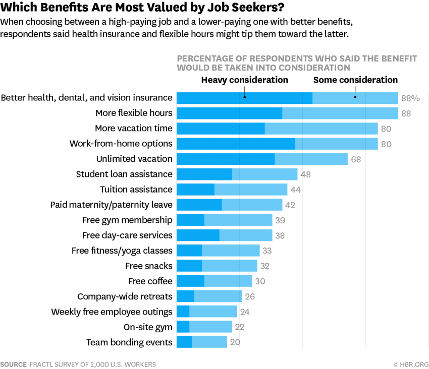
Benefits For Job Seekers

Millennials and Generation Z comprise the majority of the workforce in today’s market. HR leadership and team managers must understand what motivates these employees in a work setting to attract and retain them. 

These generations are keen to work for organizations that provide possibilities for professional growth. Hence, creating clear career pathways and mentoring programs should be a crucial component of your retention strategy. This not only helps your firm stay competitive with job seekers, but also makes it possible to create succession plans for aging leadership.

Also, ensure that you comprehend applicants’ professional objectives during their initial interviews, and maintain this discussion throughout employment. An awareness that employees’ career objectives are valued will improve engagement and demonstrate that they are supported in their development process. 

Managers should have frequent conversations with employees about their career objectives and search out opportunities that correspond with those objectives. This may include implementing cross-training programs to broaden the skill sets of employees or developing mentoring programs with an experienced leader.

The use of technology like the one offered by Engagedly helps to keep track of employees’ performance benchmarks; changes in preferences, and employee development.

Creative freedom matters:

Many individuals may feel dissatisfied with their work due to a lack of creativity in their work. Providing employees with the opportunity to be creative and build social relationships at work, or engage in passion projects inside the firm can result in happier, more devoted employees.

Reward commitment and Show Recognition:

To recruit the most qualified candidates, companies must provide competitive remuneration packages to employees who are committed. You must compensate employees enough so they do not have a second thought on salary when choosing to work for your organization. 

Since recognition can drive productivity, you can plan out a rewarding program

When there is an award to be won, employees strive hard to accomplish their allocated jobs in the best possible manner. It naturally drives the workforce to be more productive.

If businesses increase the number of employees, they acknowledge each week for their work, the following will occur:

  • 24% increase in quality of the job
  • 27% decrease in absenteeism
  • 10% decrease in attrition rate

Consider offering one-time incentives, in addition, to aid with student debt repayment and work-from-home opportunities. Take the time to demonstrate your gratitude to your employees with incentives, promotions, or simply an email.

Prioritize and implement mental health and employee help programs:

Countless people worked diligently during the epidemic and faced the difficulty of managing personal and professional obligations. As a result, the emphasis shifted to what companies are doing to make their employees feel valued and supported. 

HR departments must ensure that a communication strategy is in place to apprise employees of any accessible employee support programs and mental health programs. Not only is it vital to invest in these sorts of initiatives, but also to promote an open discussion on issues such as mental health and financial wellbeing. 

Consider providing instructional workshops to explore and answer questions about these resources. 

Also, consider imaginatively what employees may desire or need, going beyond ‘perks.’ For instance, offering employees access to their income before payday could significantly improve their quality of life. They may feel more valued and hence, may stick to your company.

Connect with intent:

Employees today want to feel like they’re contributing to something bigger than themselves, that they’re making a difference, and that their job matters. Hence, your organization’s mission should be clearly defined to the employees and initiatives should be explored to assist each employee to understand their unique purpose in the company.

In Start with Why, Simon Sinek describes a “golden circle” technique that might help you establish your mission. Ensure that each team or department understands how their efforts contribute to your organization’s overall performance when you evaluate organizational objectives. Reinforce to all employees that everyone’s work matter and is a significant contributor to the company’s growth. 

You may also choose to assist others who wish to define their particular mission. Employers need to understand the distinct set of skills, talents, and passions of their employees that can contribute to their own and the company’s success.

Clarify your expectations:

When managing uncertainty, the brain is often subjected to an invisible cognitive strain. You may compare it to a processor that must use more energy to do operations in the background. The cumulative effect of these additional mental demands results in unnecessary stress and strain.

When feasible, employers may alleviate this burden by providing employees with clearly defined goals. This is especially crucial for top performers and star achievers, who would often set very high expectations for themselves and are susceptible to burnout. 

Consider the well-being of your employees and their families:

Employers should ensure the physical, mental, and emotional well-being of their employees and their families to retain them. This may include health insurance; discounts on membership to a club, golf course, or fitness center where they feel relaxed and rejuvenated; mental health counseling and care services; maternity and paternity leaves, etc. Additionally, you may support parents of young children by offering child care support programs and Paid Time Off (PTO).

Review your organization’s policies:

The hiring and onboarding process may make or ruin a company. The implementation of all recruiting and onboarding rules and procedures is as essential as it is to review them.You must also foster an atmosphere in which the skilled and gifted employees feel at ease discussing workplace difficulties. Businesses must guarantee that they offer continuing training programs so that employees can acquire new skills while at work.

Also Read: 25 Unique Employee Benefit Ideas To Attract the Best Talent

Conclusion

There are several reasons why an employee may contemplate quitting his work. Although certain factors may be beyond your control, being proactive about the aspects you can influence might help you avoid losing your finest employees to The Great Resignation.

Employees’ perspectives can be understood by using a software that helps to learn what employees think about their work; job roles, and future in the company. This may be accomplished by using the Engagedly solution, which enables employees to provide feedback anonymously. Thus, employees will have no qualms about expressing their views and opinions on their management or the work environment. You may not be able to stop a specific employee from leaving his or her job, but you may avert the next loss.


If you’re looking to take a proactive approach to retaining and engaging your employees, book a live demo with us.

Request A Demo

Fun Gratitude Activities For Employees

You’re going to need great employees if you want to grow your business. Employers are often seen spending lot of money on hiring and training their employees. But all this can go waste if they do not appreciate their employees that often.

Continue reading “Fun Gratitude Activities For Employees”

Who All Should Give 360 Degree Feedback?

When it comes to choosing participants in a 360 degree feedback, you might want to enthusiastically ask everyone who even knows the employee in the slightest to participate. But hold on. Do you really need so many opinions?

Continue reading “Who All Should Give 360 Degree Feedback?”

Employee Recognition & Rewards In Hybrid Era

The COVID-19 crisis has changed how organisations operate. Most companies are now moving towards a hybrid setup and crafting strategies to manage their remote and hybrid teams.

In the last two years, employees’ morale and motivation have taken a major hit. Since the start of the crisis, employees have had to bear the brunt of the sudden transition to a remote setup that has impacted their productivity and engagement levels. Even now, when most organisations are adopting a hybrid setup, it is challenging for employees to maintain a higher level of motivation towards their work. The major impediments to employee morale are missing social cues and employee bonding.

Employees miss cheering on floors for each other, team outings and lunches, praising team members for their support and exemplary work, and most importantly, getting recognition for their contributions.

As organisations now prepare themselves to manage geographically dispersed teams, it is imperative for them to know how employee recognition and rewards work in this hybrid era.

This article will touch upon different aspects of employee recognition in a hybrid setup and provide some expert ways to keep your hybrid workforce motivated.

Continue reading “Employee Recognition & Rewards In Hybrid Era”

360 Degree Review: Enhancing Organization, Employees, and Culture

Organizations seek to develop high-performing employees who are productive, engaged, and committed to their job. While continual feedback is critical for developing these top performers, many companies find that continuous feedback is not effective at all times. One of the major reasons for the same being, not all employees work directly with their immediate managers daily. This is where 360-degree review scores over other forms of the feedback systems and, hence, has gained acceptance among many companies. 

Some companies remain skeptical of embracing the 360-degree review process. However, considering the pros and cons of 360-degree feedback, when done properly, the pros outweigh the cons, hands down.

This blog post offers insight into what is 360-degree feedback; the purpose of adopting a 360-degree feedback system, and how a 360-degree review can be helpful for an organization and its employees. Above all, its role in developing a work culture of an organization. 

360-degree review process: What is it?

The 360-degree feedback, also known as a 360-degree review process, is an employee assessment framework that enables the organization to better understand employee performance and perceptions from both internal and external stakeholders using a variety of anonymous and private appraisal tools.

It serves as a mirror, revealing to employees their skills and talents, and weaknesses. The 360-degree review system not only assists employees in developing self-awareness but also in determining the extent to which their perceived inadequacies influence various stakeholders.

Also Read: Everything You Need To Know About 360 Degree Feedback

Why implement a 360-degree review process?

The 360 degree performance reviewmechanism enables you to hear from all stakeholders. In contrast to conventional performance assessment, wherein managers (direct/indirect) make the final verdict on an employee’s performance, the 360-degree reviewmethod enables you to receive inputs from colleagues, customers, suppliers, and a variety of other stakeholders. These capabilities are commonly supported by the top performance review software for employee growth used by modern organizations.

This eliminates any prejudice a specific supervisor may have against an employee or vice versa. It focuses more on an employee’s performance and contribution to the team and to the business.

Does a 360-degree feedback help to change an employee’s outlook and performance?

Employees are the organization’s face and hence, their conduct and performance influence a company’s productivity and external stakeholders. The 360-degree review process can bring any form of mistakes or aberrations to notice and the concerned employee will have to work on it. Thus, the process enables personal development and aids in a company’s productivity.

Also Read: Know How To Implement 360 Degree Feedback in Your Startup

How will a 360-degree review add value to your organization?

According to Forbes, over 85% of Fortune 500 organizations employ 360-degree feedback as a foundational aspect of their entire leadership development process. Thus, a 360-degree review can influence employees and management.

Let’s begin a quick check-in on the positive impact of a 360-degree performance review on organizations.

360-degree review gives you a comprehensive picture

If you simply look at an employee from a particular viewpoint, you will miss out on important details. As a talent manager, the side you see may differ greatly from the one shown to others. However, using a 360-degree review, you can gather those additional viewpoints and use them to create a more complete picture of an employee’s performance.

With a more comprehensive overview in hand, you may approach your performance assessment from multiple angles.

Perhaps an individual may be a higher-level manager but has difficulty communicating with his superiors. Alternatively, maybe, an employee may get peers’ admiration but they may be hesitant to speak about his improvements, upfront. 

This is where a 360-degree performance review can help to gather information on various aspects of an employee’s engagement, performance, and behavior and communicate the same to the concerned person. Without 360-degree feedback, the employee may remain oblivious to these indispensable facts, from a variety of sources.

Establishes Communication Channels

Adopting the practice of a 360-degree performance review enables employees to provide feedback on one another’s work. This creates an atmosphere conducive to conversation and enables the resolution of issues. Effective communication increases a company’s likelihood of retaining the top employees.

Reinforces company values

Managers and higher management usually look for the best in every employee and encourage them to improve. You can share company values with all employees through a 360-degree review process and ask employees to get their performance aligned with the company values.  

To translate your values into practical measures, you can use 360-degree review software like Engagedly to help employees to understand where they are going wrong.

Engagedly’s 360-degree employee evaluation platform allows sharing of valuable feedback to employees. The best part is that the feedback is a one-to-one process. This confidentiality feature, coupled with constructive feedback, makes employees to retrospect and changes themselves to align with company values.

Agility

Agile refers to anything that is always evolving, adaptable, relevant, and updated, which is how your approach should be toward the performance assessments. 

360-degree feedback may assist you in achieving that agility by providing a more comprehensive image of your employee. A single-view performance assessment evaluates an employee from a single perspective (only from a manager’s perspective). 

When you invite many opinions on an employee, you get a more thorough and fast assessment, which enables you to perform an agile employee analysis and conclude better for a review process.

When you promote business values, openness, and the pursuit of a whole picture, you are fostering an atmosphere where transparency and a continuous performance assessment approach are supported by everybody.

These elements contribute to the growth and development of the business, as well as increased employee productivity.

How 360-degree review benefits employees?

The following are some of the most significant advantages of a 360-degree feedback system for employees:

All voices get heard and valued, and it promotes openness

They bring diverse views of all stakeholders to light, not only for an individual employee but for the whole business. This promotes openness and frequent communication amongst all stakeholders.

Corrective plan and employee improvements

This assessment approach enables employees to focus on their “weaknesses,” fix their “mistakes,” and ensure that their future actions do not negatively impact other stakeholders. This also promotes Kaizen – continual and systematic improvement

Kaizen is a technique of producing continuous improvement based on the notion that tiny, continual beneficial adjustments may yield substantial gains.

Customized training programs based on employees’ unique requirements

Training sessions may be planned and customized based on employee input. This increases employees’ motivation to attend more training. This step also enables organizations to save money by eliminating training sessions that do not offer value to employees and also by establishing a matrix-based work model

Matrix management is a style of management in which employees are accountable to multiple managers rather than a single supervisor. It does away with the one-boss, vertical structure that most businesses use and replaces it with a system in which employees report to several superiors across departments and projects.

Avoid discrimination and avoid communication gaps

360-degree feedback systems enable multifaced communication and help to identify and correct mismatch in plan execution. Junior-level employees may also offer areas for development for management-level employees. Communication gaps caused by hierarchy are reduced.

It helps avoid misunderstanding and cultivating a positive team spirit in order to progress on an individual level, which may result in team growth. Ego disputes and workplace turmoil may be avoided by taking everyone’s opinion into account.

Fosters self-improvement and teamwork

A 360-degree feedback system enables continuous improvement and growth, not just as a person, but also as a team. Because everyone taking part in the process has the chance to share their ideas, it increases responsibility and motivates participants to assist one another in improving and becoming better at their work.

Contribution of employees to all stakeholders

It gives an opportunity for evaluating and discussing how an employee contributes significantly to their stakeholders. This demonstrates to the organization and its employees how their contributions make a difference and why they should continue to do what they are doing.

The framework enables employees to enhance their performance while simultaneously maintaining their existing outstanding quality productivity.

Remuneration based on feedback

A 360-degree feedback system helps foster a healthy discussion about individual contribution and, subsequently, increasing remuneration. When an employee gets excellent responses from all stakeholders, statistical evidence of the individual’s contribution is provided, and pay may be determined appropriately.

Contributes to increased employee retention

A 360-degree feedback system instills in employees a sense of importance in the business, as all stakeholders recognize and value all contributions. It may serve as an effective means of recognizing employees, assisting them in identifying areas for development, and providing an opportunity for personal growth and exploration. Subsequently, employee retention increases and workforce productivity grows as a company grows.

Constructive criticism

Employees must recognize that not all feedback can be rosy and favorable, as a 360-degree review entails constructive feedback that’s in the employee’s best interest. Since 360-degree performance review entails reviews of all junior and senior employees; peers, and customers, employees have to get in the groove of handling negative criticism and learning from their errors. They can take the help of the in-charge managers and HR personnel for the same.  

Also read: 10 Benefits of 360 degree feedback

How 360-degree review helps to improve your work culture?

Satisfactory work culture is gradually becoming a must for employees in today’s working environment. Without a suitable workplace culture, a company will surely lose bright individuals. Diverse and robust workplace culture is critical for long-term corporate success.

Thus, how can your business establish and maintain a positive workplace culture while retaining its core workforce? The solution is to implement a robust 360-degree performance review system across your organization.

Implementing a 360-degree review system enhances your organization’s working culture. Continue reading to see how a 360-degree feedback system may help you enhance your workplace culture.


  1. Enhance employees’ self-awareness

A 360-degree feedback system assists employees in developing self-awareness and identifying their strengths and flaws. Employees may also get an insight into unknown talents and limitations via this approach. 

Increased employee self-awareness benefits both an employee and his company. This is because employees who can clearly perceive their own progress within the organization are more likely to work harder and remain loyal to their employer.


  1. Fostering a strong sense of trust between the employee and the organization

Organizations that employ a 360-degree feedback system foster an open work environment. This culture fosters employee collaboration in aspects such as task execution methods; interpersonal interactions with subordinates; peers and superiors, and so on.

It enables employees to feel secure and comfortable enough to express their ideas about their jobs and colleagues. Since the standard feedback procedure is the same for all employees, nobody worries about being suppressed for their thoughts, which fosters a strong sense of trust between the employee and the organization. Thus, an open work environment benefits not just employees, but also the organization.


  1. Helps to maintain a constant dialogue with employees.

A well-designed 360-degree feedback system contributes to the establishment of a culture of a continual dialogue between employees, colleagues, and supervisors. It lets all employees in your business to feel heard and their needs satisfied.

Collecting information on your employees in order to better understand and align them with your organization’s ethos and goals is one way to enhance your organization’s workplace culture.

When employees feel heard, they are more inclined to be happy with their workplace culture. 


  1. Eliminate bias and foster bonds of solidarity

One of the most serious risks to an organization’s working culture is prejudiced conduct against an employee by peers and superiors. Typically, traditional feedback procedures focused on collecting input from a single source. 

However, when your organization adopts a 360-degree performance review system, you may collect input from a variety of sources, including peers, subordinates, supervisors, direct reports, and sometimes even customers, relieving individual bias against employees. 

Employee satisfaction also rises when employees understand they will be evaluated fairly in a performance review system.

What is the easiest way to get started with 360-degree feedback?

Your first step should be to analyze and strengthen your current performance evaluation system. If you are still following the paper-based assessment process, consider shifting to a digital 360-degree review process.

Engagedly’s 360-degree performance review software is worth a try. It simplifies the 360-degree review process by allowing stakeholders at all levels of the organization to submit real-time feedback–including management, managers, fellow employees, and direct reports. It also allows to share a company’s mission, vision, values, and goals with the employees.

Engagedly’s 360-degree review platform may assist businesses in developing their managers in novel ways, as well as give a channel for employees to voice praise or worry about their frontline managers.

Also Read: How To Choose The Best 360 Feedback Software For Your Company?

Want to know how Engagedly can help you manage your hybrid employees better? Request us for a demo.

Request A Demo

15 Effective Ways: Keep Your Employees Happy Without A Pay Raise

‘How to keep employees happy is not just a question anymore. It has become a buzzword, especially in the post-pandemic era. The Great Resignation’ showed that employees are not always happy with only monetary benefits. They want more from their employers – more than just a pay raise.

There are several ways to make employees happy without having to raise their pay slab. One of the simplest ways would be to say “thank you” for their valuable contributions. Money is important, but it’s not the only answer to how to keep employees happy.

This article complies 15 best ways to keep employees happy without raising their paycheque. But before that let’s understand why the happiness of employees is so important for any company.

Why is employee happiness important?

The real strength of any company or business comes from its employees. When its employees are happy and satisfied, the company succeeds better in the long run. This is because such happy employees at work put more creative and productive efforts into accomplishing tasks and projects. 

Apart from that, happy and satisfied employees like to stick to the organization for a longer time, reducing the attrition rate and the subsequent loss from it.

Now that it is clear why employees’ happiness should be prioritized, it’s time to know how to keep employees happy.

Also read: 5 Employee Engagement Activities On A Budget!

How to Keep Employees Happy- 15 Effective Methods

1. Make work-life balance a priority

A healthy work-life balance is necessary for reducing stress and burnout risk. Such a balance also prevents employees from the dilemma of choosing between family and work. Nowadays, employees often choose workplaces that do not impact their personal life. For this reason, they are even ready to compromise on the pay scale.

Thus, providing a balanced work environment is one of the best ways to make employees happy without a pay raise.

2. Make work schedules flexible 

Flexibility at the workplace has become a new normal after the pandemic. People often look for employers who do not squeeze their employees to extract work. Instead, employers who prioritize employees’ comfort are far more popular than those with rigid work cultures. 

When employees choose their own work schedule, they perform better. Such employees feel relaxed and refreshed to complete assigned projects in better and quicker ways. Therefore, as an employer, you can ensure work flexibility to keep employees happy.

3. Let your employees participate in decision making

The norm until today was that leadership used to make decisions. By the time employees learn about them, the decisions are already taken and they can no longer take part. And this makes employees feel left out and ignored. Millennials today like to be a part of the decision-making process. Hence, any major decisions affecting the workforce should have employees’ input as well.

When evaluating how to create a healthy work atmosphere and retain employees, it is critical to listen to them and act on their feedback. If you are looking for ways how to keep employees happy, then make them feel valued by listening to them.

4. Focus on career mobility of employees

Employees should strive for career advancement and upward mobility. It gives individuals the emotional flexibility to take bigger chances, pitch new ideas, seek help and mentorship, improve their abilities, and grow in their careers.

Employees require clear guidance on how to pursue progress. It is the responsibility of employers to let them know that both career guidance and growth opportunities are available and accessible to them. Offering career advancement possibilities are one of the most effective methods to keep employees satisfied and engaged.

5. Ensure everyone works in a positive environment

Positive work environments are consistently cited as one of the most attractive attributes for employees. According to a Deloitte research, 94% of executive office bearers and 88% of the workforce believe that strong company culture is critical to a company’s success.

It is also critical to develop a whistleblowing mechanism for more openness and greater transparency. This mechanism guarantees that people have a safe route to raise any concerns, without fear of repercussions.

6. Reward employees for their hard work

It’s possible that managers don’t always realize that recognizing an employee’s hard work or accomplishments doesn’t require a huge, extravagant show of gratitude on their part. But no matter how big or small the recognition is, it plays a huge effect on how employees see their work getting appreciated. This, in turn, motivates them to continue the good work.

7. Offer Extensive Benefits – Lunch & Snacks

Snacks and lunches are a fantastic incentive, not just because they save employees time, but also prompt them to focus on their work while the company is taking care of their needs. 

Companies like Google are known for leveraging food benefits to get teams to collaborate more to get work done. This is one of the best ways to keep employees happy and you can adapt it right away.

Also read: The Cost of Employee Disengagement

8. Encourage employees to take breaks

Working hard is critical, but so is taking time to recuperate. Your staff will be happier and more productive if you encourage them to take sufficient breaks. It can be coffee runs, walks, lunch, or vacations.

Taking time off from work helps people to be more productive and focused when they return to work. Breaks have been shown to lower stress and improve performance.

9. Allow sabbaticals

Sabbaticals are risky and unconventional to keep employees happy. When employees are burdened with too much personal or family turmoil, they need a break. Forcing them to work proves to be negative, as they find it easier to switch jobs.

In such cases, “career breaks” allow employees to take time off from their jobs for a few months of break so that employees can fulfill all their liabilities. When they feel they have completed their family liabilities, they can return to their roles without the fear of being penalized.

10. Encourage innovation

Employees who believe they can advance in their careers are considerably more productive and creative. As a responsible employer, when you allow staff to focus on innovation, they feel valued. 

To foster their innovation, create a mechanism where people can pitch their fresh ideas. Once an idea has been accepted, put it into action as soon as possible. But do not forget to give credit to the person who came up with it. This will spread a positive message that you value their creativity.

11. Team building activities

Work isn’t all fun and games. That does not mean you can’t have some fun during work. 

Some managers may scoff at the idea of devoting time during the workday to something enjoyable. However, taking the time to get to know your staff outside of work can be beneficial. Furthermore, scheduling time at work to celebrate holidays or play games is an excellent strategy to increase employee happiness and counter burnout.

Ice-breaking games are excellent team-building activities, where your staff get to know others outside their professional workstations. When your staff understands each other better, their collaboration at work will be better and more fruitful.

12. Let employees pick their own project

Letting employees choose the specific work they do and what project they tackle is a growing trend in startups. The concept that employees should only work on one thing that they are passionate about is obsolete now. 

With the changing scenarios of work culture, maintaining product roadmaps that are driven by employees is far more innovative. This helps companies to maintain a higher success rate for project accomplishment. Even the employees feel they have a substantial say in what kind of work they want to do for the company.

13. Maintain transparency in the workplace

Workplace culture can have a huge impact on how employees perceive the company, but companies don’t always actively try to improve and develop a work culture that takes everyone along and paves the way for amicable collaborations.

Nothing is more crucial than being open and honest about expectations in the workplace. Transparency must begin on the first day of work itself. When a new employee joins, he/she should get every detail required for a smooth start.

Also read: 5 Creative Employee Motivation Ideas

14. Special focus on maternity/paternity packages

Everyone loves to spend the initial days with their babies when the family gets a new member. No matter how crucial the work may be, nothing seems more important than parenting the newborn. So it’s quite natural for employees to expect some time off from work when they are about to become parents. 

Maternity and paternity leave are not as expensive to provide as you would expect. Offering a hefty leave package can be a great gift to the employee who will be indebted to receive such empathy from his team members. 

15. Don’t lose focus on the purpose

Employees who have a feeling of purpose are naturally more productive. When creating a meaningful workplace, it is critical to find employees who share their vision and values.

A clear sense of purpose can improve the overall well-being and happiness of your team. When employees have a feeling of purpose at work, their engagement, dedication, and commitment to the company increase many-fold.

Conclusion

We hope you got the answer on how to keep employees happy. Employees’ happiness should be a priority for any employer. Since happy employees work harder and better, keeping them happy will ultimately benefit the company. 

It’s better not to assume that only money motivates employees. More than money, they look for values for themselves as well as in the work they do. So when an employer recognizes that, they give more than what is required for the development and success of the company.


Want to know how Engagedly can help you manage your hybrid employees better? Request us for a demo.

Request A Demo

4 Must Do’s When Eliciting Employee Feedback

Getting feedback from employees is probably the most common way for managers to know what their teams think of them and how to improve themselves. But getting all employees to give honest feedback isn’t an easy job. Here are 4 must do’s to elicit honest employee feedback.

Continue reading “4 Must Do’s When Eliciting Employee Feedback”

Understanding Employee Experience Vs. Employee Engagement

Employee experience is the totality of an employee’s perceptions and feelings about their work. It includes all their interactions with their employer, from the initial application process to the day they leave the company. On the other hand, employee engagement measures how connected employees feel about their work and their organization. Engaged employees are more productive and less likely to leave their jobs.

Why is employee experience necessary?

Employee experience is becoming increasingly important as companies compete for top talents. Today, employees are looking for meaningful work and a good fit with their values. They want employers who invest in their development and offer growth opportunities. Employee experience is one way to show employees you care about them and their well-being.

Difference between Employee Experience and Employee Engagement 

As we mentioned earlier, employee experience is the totality of an employee’s perceptions and feelings about their work, while employee engagement measures how connected employees feel to their work and organization. 

Employee experience is essential because it can influence employees’ engagement levels. Employee engagement is critical because it directly impacts productivity and turnover rates. 

Hence, if we talk about employee experience vs. employee engagement, improving employee experience can help you attract and retain top talent, which is essential for success in today’s competitive economy. Improving employee engagement induces loyalty and employee satisfaction among the employees, leading to a lower attrition rate. 

Employee Engagement Vs. Satisfaction

Employee Satisfaction implies employees’ level to which they are enjoying their work/job. They may or may not be engaged with their careers in this situation. Any employee leaving late after office hours and coming to the office before office hours without much-improved activity still signifies high employee satisfaction levels. 

On the other hand, Employee Engagement is related to motivating the employees to come to the office every day and helping the company succeed with their dedicated efforts. 

One of the core differences between employee engagements vs. employee satisfaction is that the engaged employee remains satisfied with their jobs, but satisfied employees are not necessarily engaged.

Also read: Benfits of employee career development program

How employee engagement relates to the employee experience:

Employee engagement and employee experience are related because engaged employees are more likely to have positive experiences at work. Conversely, employees who have negative experiences at work are less likely to be involved. 

Some ways to improve employee experience include creating a positive work environment, investing in employees through training and development opportunities, listening to employees, and responding to their feedback. These are also some of the best ways to increase employee engagement.

Employee engagement and employee experience are essential for companies because they directly impact productivity and turnover rates. Employee engagement measures how connected employees feel to their work, while employee experience measures how employees feel about their work. 

Improving employee engagement can lead to increased productivity and lower turnover rates, while improving employee experience can lead to higher levels of employee engagement.

How can you improve the employee experience?

There are many ways to improve employee experience, but some key steps include:

1. Development and training for skill enhancement

Invest in your employees by offering training and development opportunities. One of the top reasons people seek a new job is to learn new skills. Skilled employees can perform better and get high job satisfaction. A company that can follow a robust employee development plan for training and development facilities is likely to attract excellent employees.

2. Evolving as a positive work culture

Create a positive work environment that is supportive and encourages collaboration. Comfortable and productive spaces play a vital role in enhancing the employees’ experience. From temperature-regulated interiors to ergonomic furniture and well-positioned computer screens makes a considerable difference in the employee’s physical and emotional state. A disruption-free space allows your employees to perform best in their capacity.

3. Two-way communication

Listen to your employees and respond to their feedback. Employees who know that they are listened to by the companies and their immediate managers are more productive and engaged with their jobs and organization. 

A study revealed that 82% of the employees have great ideas based on their day-to-day experience for companies keen to improve. 

4. Employee Recognition 

Celebrate successes and recognize employees for their contributions. A frequent acknowledgment of ‘good jobs’ makes the employee feel more valued and further motivates them to do great work. It is a proven way of boosting your employees’ confidence and helping them be more productive in their teams. 

Organizations that do not acknowledge their employees often for their better performance are likely to lose the dedication and morale of their employees. 

5. Well-Defined Procedures and Policies

Implementing realistic policies and communicating them through formal channels is extremely important. Make sure your policies and procedures are clear and easy to follow. These procedures and policies provide a detailed roadway map to employees to execute their day-to-day operations efficiently. 

These policies include streamlining internal processes, guidance with decision making and adherence to the law and regulations. 

6. Monetary and non-monetary benefits for employees

Salary is the second most crucial factor responsible for retaining the top talents in the industry. Show employees you value them by offering competitive pay and benefits. For HRs, competitive pay refers to the offering a salary of 10% (more or less) than the average market pay rate. Competitive compensation is not just about money. It is inclusive of other bonuses and benefits that employees seek. 

7. Participation in Decision making

Allow employees to have a voice in decisions that affect them. It plays a pivotal role in building the employee’s trust, organizational development, productivity and innovation. The voice of employees in the decisions also boosts the self-confidence and job satisfaction among employees and makes them loyal to the organization. 

8. Focus on Employee Engagement

Stay up-to-date on the latest trends in employee engagement and incorporate them into your strategy. Employee satisfaction and employee engagement go hand in hand. If the employees are not happy with the given salary, they will be less motivated, and this will be visible in their performances 

Also read: Workplace Wellbeing Questionnaire: Best Practices

What is the Employee Experience Journey?

The employee experience journey is the process that employees go through when interacting with their employer. It includes all the steps from the initial application process to the day they leave the company. 

The employee experience journey aims to create a positive and memorable experience for employees that will encourage them to stay engaged and committed to their work. There are many ways to improve the employee experience journey. Still, some key steps include creating a positive work environment, investing in employees through training and development opportunities, listening to employees, and responding to their feedback. 

These are also some of the best ways to increase employee engagement. By improving the employee experience journey, you can create a more productive and engaged workforce.

How does employee experience makes a difference?

Employee experience is crucial for organizations with thoughtful and committed employees. However, retention is the primary aim of engagement spending.

A report by Workhuman and IBM suggests employees with a high score on employee experience get over three times the return on assets and twice the return on sales as those in the bottom quartile.

Employee experience may be detected and perceived in ways unrelated to traditional management. When management specifies employee roles, employees understand how to make a difference in safety. 

The Greatest Source of Engagement Is in Connections

Engaging is not a onetime event, a reward program, or a pleasant perk. While being engaged at work may feel fantastic, it isn’t a team-building exercise. It’s built daily through one’s job setting and interactions.

Managers are essential for employee engagement. Engagement comes first because it is critical to continual excellence. Even highly competent but unengaged employee may outperform their colleagues, yet they will never reach their full potential until they feel appreciated at work.

The manager accounts for 70% of the variance in employee engagement. Managers can provide the conversations, recognition, and feedback that drive employee engagement, resulting in a beautiful employee experience.

Conclusion

Employee experience and engagement are essential. The difficulty organizations face improving in each area, especially when considered against the backdrop of a worldwide pandemic and social and racial upheaval.

The financial bottom line will constantly improve when you get back to basics and put your people first. It’s up to leadership to demonstrate that engagement and experience are top objectives through words and actions.


Want to know how Engagedly can help you mange your remote employees better? Request us for a demo.

Request A Demo

10 Diversity Questions to Ask Employers During Your Interview

Modern companies understand the importance of diversity and inclusion. After all, we live in a globalized economy with a diverse international population. As such, it’s understandable that as a potential employee you’d be concerned with whether a company you apply for values diversity. You may be concerned with whether your particular demographic background is appropriately represented and fairly treated in the company. To help you understand how your company receives diversity, you can ask these 10 diversity questions.

Advantages of working in a diverse company

Diversity is a strength for modern corporations because diverse corporations enjoy highest advantage of the talent. As such, you need to make sure you work for a diverse company. 

1. Cultural diversity can improve productivity levels

Diversity improves productivity. Diversity allows groups of different people to use complementing skills to achieve a common goal. Even formal research proves the economic value of cultural diversity. This research found that cultural diversity across cities in the US positively correlates with productivity. The more multicultural an urban environment is, the more likely it is to be productive.  The reason cultural diversity is so effective in improving productivity is the diversity of skills and perspectives that a culturally diverse population brings. These diverse skills and perspectives work in a complementary fashion with one another to produce a positive overall result. 

2. Cultural diversity reflects positively on reputation

Cultural diversity not only improves a company internally, it also has a powerful effect on the company’s external reputation. In today’s diverse economy, potential employees are most likely to approach companies reputed for being the most accepting of diversity. When companies recruit employees from a diverse range of backgrounds, it proves to employees that the company values efficiency and diversity. This reputation results in skilled and talented potential employees being more likely to approach that company. The result is an overall increase in talent and productivity across the company. Therefore, cultural diversity has immense long-term benefits in terms of improved talent acquisition.

3. Cultural diversity encourages a wider range of skills

Cultural diversity results in a company possessing a greater range of skills across their entire staff. People from diverse backgrounds are likely to have a diverse range of skills and abilities. Therefore, when a company hires from a diverse population, they get a more diverse skill set overall. The benefit of having a diversified skill set means that companies will have improved talent across their entire company. Having a wider range of skills means that a company can complete more processes and is likely to solve more problems the company faces. Therefore, it is extremely beneficial for a company to prioritize obtaining diverse skill sets. 

4. Cultural diversity can increase profits

In the end, economic concerns primarily motivate businesses. Thankfully, cultural diversity is one of the best assets for increasing profits for most companies. Cultural diversity improves profits by increasing productivity and skill sets across the entire level of a company. For example, a 2013 survey by the Center for Talent Innovation reported that 48% of American companies with higher diversity at the senior management level achieved higher market growth than companies with lower cultural diversity at senior management. An example of the benefits of cultural diversity in American companies is if an American company does business with China. If the American company has employees, especially at higher management levels, who fluently speak Mandarin will find it easier to do business in China.

Also read: Remain Ahead of the Curve: Hire the Best Remote Talent in 2022

The 10 Diversity Questions You Should Ask 

Ask these 10 interview questions for diversity if you want to be certain the company you apply for recognizes the value of diversity. 

The Company Hierarchy

1-How diverse is the executive team?

Diversity matters the most at the highest levels. If a company has diversity at its senior management level, it’s an indicator that the rest of the company is also open to cultural diversity. Asking how diverse the executive team is one of the most important cultural diversity questions you can ask. So, ask this question during your interview and learn about whether the company’s higher management is committed to diversity. When looking at the executive team and note whether the executive team fully represents people like yourself. If the executive team is entirely homogeneous, ask your interviewer why that is. 

2-Is the leadership team committed to diversity?

Even if an organization’s executive team is technically diverse, that does not guarantee that the company itself is committed to diversity. You need to explicitly ask the company if their leadership fully believes that it’s important for their company to be culturally diverse. Ask the interviewer about their company’s support for diversity through their mentorship and sponsorship programs. The more a company supports diversity through their mentorship and sponsorship programs, the better that the company will support overall cultural diversity in their organization. If you find that the company does not support diversity through their mentorship and sponsorship programs, it’s evidence the company may not be fully committed to diversity. 

Management and Leadership 

3-What’s the makeup of the managerial team?

Naturally, you’ll work closely with your manager, so it’s important to make sure your manager is also fully committed to diversity and inclusion. You need to make sure that your manager understands the value of properly treating people of diverse backgrounds. Have a look at the company’s management team. Note how homogenous the management team is. Is it entirely made up of men? Women? People from the same university? The same race or ethnic group? Etc. The more diverse the management team is, the most likely that business is fully committed to cultural diversity. 

4-What does the promotion and evaluation process look like and who is in charge of these decisions?

You will not ask for promotions on your first day at the office, but you will probably want to improve your position long-term. For this reason, this is one of the most important interviews for diversity that you can ask. So, ask the company how they handle annual and bi-annual evaluation and promotions. You need to specifically ask the company how they make evaluation decisions. Does the company have a formal evaluation process? Or is the company dependent on individual opinions by managers? The best companies to work for will always have specific evaluation criteria for promotions.

Company Goals 

 5-How do you prioritize social events that all employees feel they can take part in?

Business social events are an important aspect of the entire experience of being an employee at a company. Yet, it can be difficult for all employees to be fully included in a business’ social event. You’ll want to make sure that your company understands that different people have different needs for social events and that they operate accordingly. For example, many employees with children cannot stay for late events, and may not be able to frequently attend events. Another concern would be whether social events include vegan food options for people who cannot eat meat. The more accepting is a company’s social events are of diverse needs, the more it indicates that a company is culturally diverse and progressive. 

6-What are your most important values?

This is an extremely important question since it reveals the entire nature of the business to you. By asking this cultural diversity question, you’ll not only obtain a better understanding of how much the company values diversity, but you’ll understand this company’s overall values. The answer you receive for this question will ultimately impact your overall perception of the company. The best companies to work for fully understand the importance of having the most progressive values. They also understand that they need to properly communicate that they value diversity to potential employees. Therefore, listen carefully to how the interviewer responds to this question. 

7-How do you foster an open, communicative environment for your employees?

No matter how diverse a company currently is, there will be areas that they should improve. The degree to which a company will recognize that fact and invest effort in improving their work environment says volumes about the company. Ideally, your employer should inform you about all the details of their company’s formal policies. You also want to make sure that the company explicitly states that it’s committed to progress and creating an openly communicating environment. The best companies will inform you they have a highly progressive culture, and they will cite specific progressive policies to prove that as well. 

8-How do you celebrate the diversity of ideas and people?

The celebration of diversity is an extremely important aspect of a good modern company’s corporate leadership. The celebration of diversity demonstrates the full commitment to diversity and inclusion that a company believes in. Ideally, your company will have specific events and policies in place to celebrate achievements from minority employees. This is also one of the most important diversity questions since it reveals just how much a company values its employees’ achievements and how much the company strives to celebrate those achievements.

Also read: How company culture shapes employee engagement?

Future Prospects 

9-Where do you think the company needs to improve the most? 

Some companies will outwardly accept and promote diversity, but they will actually lack it. This doesn’t mean the company doesn’t believe in diversity so much as it could mean they haven’t achieved it yet. So ask your interview about how the company feels about its diversity-related weaknesses and what they can do to improve those problems. This is an invaluable question because if a company cites diversity as a major area of improvement, it means they recognize the importance of diversity. 

10-What tangible goals does the organization have surrounding diversity, equity, and inclusion? Who makes sure these goals are met? 

It’s not enough to intend to improve diversity, a company needs to have plans and goals to achieve it. You need to ask your employer about what this company practically intends to achieve to improve diversity and equality in the company. The best companies should provide you with a small list of policies and goals they’ve developed to improve diversity. These goals should be specific and realistic to prove the company’s efforts are sincere.

In conclusion, diversity is one of the most important aspects of modern business life, given that diversity brings numerous practical benefits to organizations. As an employee, you want to join an organization that fully values diversity and the best way of achieving that would be to ask your employer these 10 diversity questions. 


Want to know how Engagedly can help you mange your remote employees better? Request us for a demo.

Request A Demo

5 Powerful CEO Engagement Activities That Are Impactful

Employee engagement initiatives are one of the primary objectives of a CEO. The employees are a significant asset to an organization, and an effective CEO engagement plan can continuously motivate them to give their best. 

As you move forward to the top rungs of the organizational ladder, your workload increases, and you have less time to connect with your employees. An effective CEO engagement plan is what you need to ensure employee engagement, making employees productive and more valuable to the company.

Leadership plays a critical role in employee engagement. One can’t run a business without them, as they keep the business wheels turning. CEOs who effectively engage with their employees and provide the right motivation and direction are more successful.

As a thought and people’s leader, you will always want your employees to feel proud to be a part of the organization. You will also want to ensure that your employees work in a happy and enjoyable environment. As a result, CEOs can undoubtedly do many things to help manage employees better and keep them feeling secure and connected.

Today, in this article, we will discuss the five powerful things CEOs can do to engage with their employees and appreciate their value in the company. 

How a CEO can engage with employees

Building employee engagement is the primary responsibility of a company CEO. To create a healthy relationship with their employees, CEOs need to engage more often, which will lead to increased employee engagement and efficiency.

Now the question arises of how the CEO can engage with his employees? Through an effective CEO engagement plan. Effective employee engagement increases employee retention and creates an emotional and psychological attachment between employees and companies.

So let’s look at a few steps a CEO can take to interact with his employees. 

  1. Allow employees to share their ideas. 
  2. Implement some of the shared ideas for the betterment of the company. 
  3. Share personal stories that connect with employees and help them better understand the company and the CEO.
Also read: 10 Reasons to use Goal Setting Software

The Effective Employee Engagement Initiatives

Leaders have a lot to do with an employee’s happiness at work–because when they feel good about themselves, they perform better. Building employee engagement is very important for the overall growth of an organization and requires a good CEO engagement plan.

Follow these employee engagement initiatives to create more genuine, productive, and longer-lasting connections with employees.

1. Build Trust

Building trust is one of the major components by which a CEO can set an instance for his workforce. When you set a good example, people are more likely to follow in your footsteps. Likewise, a poor example can lead people in the wrong direction. 

If you respect your people, they will feel more comfortable opening up to you, and you can point them in a better direction than they would have gone on their own. It’s all about how much trust you can gain from your people and be a source of good examples.

The best way to gain trust is to communicate with transparency and authenticity with your workforce. This is necessary for your business.

2. Invest in Small Acts of Kindness

The value of kindness is priceless in human relationships. Little gestures to the employees mean a lot, and these small acts significantly impact employee motivation and build an emotional connection with the organization.

The CEOs can send customized messages on special occasions, like employee birthdays and remarkable organizational achievements. Investing a little of time and money can help break down barriers between teams and make them feel  at ease where the CEO is a guide and leader to them. 

3. Create an “Advisory committee” Structure

Creating an advisory committee or council often helps to connect with the workforce. The group can comprise selective volunteers from specific departments, and they help the senior management set up long-term goals and important business planning.

Although the CEO takes major decisions regarding the company’s long-term planning and strategies, the advisory committee helps ensure the CEO gets all the help needed in deciding right. Thus, the employees feel more engaged and actively participate in building organizational strategies.

4. Use Social media to Interact more

Presence on social media is a fantastic way to connect with the employees and build a brand value for people. Most successful CEOs often follow this in connecting with the people and their employees. It allows you to stay up to date on your team’s life events and interact with them outside of the office.

Connecting employees through social media is an excellent tool for a good CEO engagement plan. Employee engagement through social media can be done in many ways which a CEO can leverage. Some of the ways include:

  1. Drop in comments, answer questions or reply. It is one of the best ways to engage with them, as it makes them feel heard. 
  2. Compliment employees on their achievements. It makes them feel proud and happy, boosting their productivity and further career development.

5. Recognize and Celebrate

Recognizing the achievers and celebrating their successes always encourages people to deliver better. To be a successful manager, you must first understand what recognition works best for your employees.

CEOs often take this employee engagement initiative to keep the employees motivated and recognized for their good work. Initiatives like ‘Employee of the Month,’ are always conducted to build a trusted and energized workforce. 

These initiatives often help build a strong, dedicated team and thus improve morale, increase motivation, and allow employees to get to know one another outside of the office. 

6. Allow Employees to Develop

Most managers don’t give their employees the room they need to perform to their best ability, but this is a mistake. Your employees always need support and mentorship. As a company CEO, you need to allow your employees to show off their skills and ability to do their assigned tasks. 

By giving employees the chance to prove themselves, you’ll help them work well with you in the future. To do this, you need to create an open and friendly environment, which will give your employees a chance to work in a way they’re most comfortable.

A comfortable environment enables the employees to work harder and bring out their best, building stronger teams, leading to more productivity and more overall success for everyone in the company.

7. Providing tools for success

It can be hard to explain to your employees why their daily routines are important to run the organization smoothly. You have to have a good grasp of the company’s workflow and how each department fits into the big picture. Training is the only way to ensure your employees are on the same page as you. 

Team members may feel unsure about their role and how to handle any critical situation, which will hamper productivity. A minor hiccup could become a much larger issue if the problem increases further. 

When you approach each employee individually and explain their duties, they will feel more confident in what they are doing and be more willing to take on new challenges without becoming overwhelmed.

8. Get to know your Employees

Spending time and building relationships can be what brings a team together. Learning about one another may seem like an old-school, outdated concept in today’s workplace dynamics. Still, a manager needs to consider taking the time out to know who employees are as people.

Making an effort to get to know your employees personally and treat them with respect will make them more satisfied and inspired to work. To connect employees on personal levels, feel like they are being recognized as a person rather than just a worker.

Also read: Qualties of a good manager: 10 Skills you need

Why is the CEO Engagement Plan important?

An effective CEO Engagement Plan has been proven to help business leaders connect more effectively with employees and improve their company’s results. It’s also good for employees, making them happier at the workplace.

Many factors determine how satisfied your employees are. Is your workplace environment a comfortable place? How well does the company’s management work with the employees? So many things can make or break employee engagement, but the best way to find out about it is to take feedback through 360-degree feedback directly from them. 

CEOs can learn a lot about the overall job satisfaction of all their employees in one go, ensuring they can make any changes to their work and prepare a specific employee engagement plan. The process and the plan to engage with employees make all the difference and help to create a positive work environment

How do Employee Engagement Initiatives Contribute to Organizational Development?

Employee engagement initiatives build a happy and engaged workplace. 

These environments are fun and creative and are filled with intelligent, enthusiastic employees who will go the extra mile to help their company succeed. As the employees are engaged, the office environment improves, and their actions become reliable, resulting in significantly fewer internal misunderstandings.

Employees who are engaged are more likely to help increase profit revenues year after year, and highly engaged employees are more likely to increase their productivity significantly—the advantages of engaged employees spread throughout the organization.

Engaged employees work with a sense of pride and motivation to provide a higher level of service to your customers. When your customers are satisfied, sales and profits rise, leading to constant business growth.

As a CEO of the organization, you will always want to have a dedicated and happy workforce, and when everyone is engaged, it’s much easier to lead your team to success.

How can Employee engagement be measured?

There are many ways to measure employee engagement. A survey can be conducted, and the survey helps gauge employee engagement and company culture through your employees’ eyes. 

Conducting periodic surveys helps the management and CEO understand how the employees are aligned and focused on company goals and how they are comfortable with the work environment.

Conclusion

Why is a proper CEO engagement plan important? Employee engagement initiatives motivate the workforce to be productive and dedicated to organizational goals. The goals and values represent the prime foundation of the organization. 

From the top management to the frontline workforce, every employee wants to be heard, valued, and trusted. Making your employees feel valued and essential creates higher levels of employee engagement.

Building employee engagement creates a positive atmosphere in the workplace and leads to higher productivity. Higher employee productivity yields superior customer satisfaction and builds a trusted and profitable organization.

Engaging employees at all levels will help to increase morale and lead to improved productivity. The best way to do this is by making them feel as though you value them. When you show them the value of their work, they will be more apt to make more effort to ensure that they’re doing a good job. By also engaging with them, you make sure that they can provide feedback on how they feel and how they are aligned with company goals. 

A good CEO engagement plan will help you make informed decisions to change any negative work environment. Holding regular meetings supported by continuous real-time feedback with employees is also a great way to keep your finger on the pulse of your employees, and this is the best way to find out if there are any issues or problems that you can help mitigate.

Frequently Asked Questions

What is a CEO engagement plan?

A CEO engagement plan is a structured approach that helps CEOs build meaningful relationships with employees through regular communication, recognition, feedback, and involvement in organizational initiatives. Its goal is to improve employee engagement, strengthen trust, and align employees with the company’s mission and business objectives.

Why is a CEO engagement plan important?

A CEO engagement plan is important because leadership directly influences employee motivation, trust, productivity, and retention. When CEOs actively engage with employees, they create a culture of transparency, improve communication, boost morale, and encourage stronger commitment to organizational goals.

How can a CEO improve employee engagement?

A CEO can improve employee engagement by communicating openly, recognizing employee achievements, encouraging idea sharing, providing growth opportunities, supporting continuous learning, gathering regular feedback, and maintaining visible leadership. Consistent interaction helps employees feel valued and connected to the organization’s vision.

What are the best CEO engagement initiatives?

Some of the most effective CEO engagement initiatives include:

Building trust through transparent communication
Recognizing employee achievements regularly
Creating employee advisory committees
Encouraging open feedback and idea sharing
Supporting employee development and career growth
Celebrating milestones and successes

Using internal communication and social platforms to stay connected
Conducting regular town halls and leadership meetings

How does CEO engagement affect employee retention?

Strong CEO engagement improves employee retention by increasing trust, job satisfaction, and emotional connection with the organization. Employees who feel recognized, heard, and supported by leadership are more likely to remain loyal and contribute to long term business success.

How can CEOs measure employee engagement?

CEOs can measure employee engagement using employee engagement surveys, pulse surveys, employee Net Promoter Score, 360 degree feedback, one on one meetings, retention rates, absenteeism, productivity metrics, and participation in company initiatives. Tracking these metrics regularly helps identify improvement opportunities.

How often should CEOs communicate with employees?

CEOs should communicate with employees consistently through monthly town halls, regular company updates, quarterly business reviews, leadership Q and A sessions, and ongoing digital communication. Frequent and transparent communication builds confidence, reduces uncertainty, and keeps employees aligned with business priorities.

Want to know how Engagedly can help you mange your remote employees better? Request us for a demo.

Request A Demo

Pros and Cons of 360 Degree Feedback In The Workplace

Reviewing an employee’s performance is an essential aspect of any successful performance management process. Without a question, a 360-degree review is an effective methodology to collect inputs from various stakeholders at different organizational levels and to steer employees’ performance in the right direction.

While the 360-degree review is a developmental tool rather than a rating mechanism, many companies combine it with other assessment techniques to enhance company-wide development.

However, what is a 360-review process and what type of challenges and advantages can they bring to your organization? Here’s a detailed look at everything you would like to know about the 360-degree review.

Understanding the 360-degree feedback mechanism

A 360-degree performance appraisal, sometimes referred to as a 360-degree review, multi-rater feedback, or 360-degree management review, happens when an employer analyzes an employee’s performance through different sources such as colleagues, customers, and managers, rather than just one-on-one input from a manager directly.

Once all inputs have been obtained from various sources, it is utilized to determine an employee’s strengths, shortcomings, and talents, and may be used to create a comprehensive performance assessment report. If the 360-degree performance assessment is well-designed, it may help to improve a team’s performance, employee awareness, and communication among employees. 

In this article, we will cover the pros and cons of 360 degree feedback tool as an employee development tool.

Also Read: 360 Degree Feedback: Best Practice Guidelines

360 degree feedback guide

Pros of the 360 Degree Feedback

The 360-degree assessments can be an exceptionally efficient performance management tool. 

1. Provides more precise, thorough, and extensive feedback.

In a typical evaluation, the employee receives input from a single source — their immediate supervisor. However, the 360-degree review focuses on the collection of inputs from various sources, providing employees with a far larger, more diversified, and, in many circumstances, more accurate variety of perspectives on their work.

This form of feedback is often better than the performance evaluation of a supervisor, who only observes how an employee performs in certain situations.

2. Fosters a favorable work atmosphere

A 360-degree review helps employees and teams to understand their strengths and limitations. Whenever a team is able to recognize all of their unique capabilities and challenges, they possess the required skills and understanding to make necessary changes for advancements.

When employees understand the responsibilities clearly, aligned with a company’s objectives, they may become more effective as individuals and as teammates, resulting in a more productive and happy work environment. Thus, a 360-degree review aids in the improvement of employees’ performance and fosters strong working relationships and a favorable work environment.

3. Scope for development

Another significant benefit of the 360-degree review is its effectiveness in identifying an employee’s growth needs.

The collective viewpoints offered by colleagues and managers may present fair facets and provide more clarity on the shortcomings of an employee. The company may then take the required steps to close the gaps by creating training programs that promote individual development and address the skill gaps.

For an instance, during a ‘360-degree review‘, an employee may receive reviews from his immediate team leader and multiple peers on his performance and time management skills. The employee may then collaborate with his manager to establish objectives. Post this, they can create an action plan to enhance his performance, according to the available working hours to enhance time management skills.

4. Helps to determine training needs

The 360-degree performance review helps to identify employees’ training gaps. To elaborate, the feedback enables management to get a holistic knowledge of employees’ skill competence and, accordingly, spot specific areas where training is needed.

5. Offers motivation and improves performance 

360-degree feedback has been shown to improve employee performance, and team communication and collaboration. 

When utilized properly, feedback may help to create trust, enhance communication, boost overall performance, and motivate teams to work together to accomplish common objectives. Additionally, it may assist employees in aligning their objectives with those of the business and providing a better picture of the abilities necessary for success.

6. Understand how others perceive you

Observing how people view you in the job may be a positive experience. The 360-degree review enables colleagues to anonymously share their feelings about their peers, which is not something that occurs often in a workplace.

If you can handle constructive feedback without being offended, you would like to know how others perceive you. To deal with criticism effectively, you need to cultivate a growth attitude and see it as a chance to bring in the required improvements.

7. Anonymous feedback

360 feedback is often anonymous and a reason for many employees to freely voice their opinion about other employees. Thus, this can be considered as one of the benefits of 360 feedback, since certain employees may feel more at ease providing feedback. This is particularly true for both positive and negative feedback.

If certain members of your team are afraid to offer negative feedback about a colleague, 360 feedback may provide a secure platform for them to bring their concerns to the attention of their manager.

8. Promotes transparency

Increased transparency, resulting from 360-degree feedback, may give rise to the development of trust among employees. 

An open and trustworthy environment may improve managerial decision-making skills; enhance employees’ performance and establish a firm knowledge foundation. Thus, 360-degree feedback can be used to develop a higher degree of trust among employees and create a transparent work environment, which may help to improve employees’ performance throughout the organization.

Also Read: 360 Degree Feedback:10 Questions To Consider

Cons of 360 Degree Feedback

While there are several benefits to adopting 360-degree feedback, there are also concerns related to it. The following are some drawbacks of using the 360-degree performance assessment evaluation approach.

1. Time-consuming process

A 360-degree performance assessment might take considerable time to conduct due to a large number of participants. 

Employees need time to respond prudently to the questions, and supervisors or Human Resources professionals need time to sort through the information and assess it. Often, the quality and quantity of feedback come at the expense of extra time. 

Evaluating the feedback and putting it into a single performance review document using specialized tools, such as that offered by ‘Engagedly 360-degree performance review,’ may speed up the process.

2. Ambiguous assessment

If there is a lack of trust among employees, they might refrain from expressing their true opinions. If the feedback is not candid, it is also likely to be erroneous, which is ineffective. 

A small team, on the best of terms, may be fearful of being overly critical, whereas a big team may lack the necessary familiarity to provide an informed judgment. 

Prevent this issue by establishing clear boundaries and communicating expectations transparently via 360-degree feedback.

3. May affect leadership

It is critical to communicate to managers what they learned from the 360-degree review and how they intend to handle the feedback. 

If participants believe that the 360-degree feedback process was a waste of time or a pointless exercise, no concrete progress or constructive change will occur; confidence in leadership will erode, and engagement will likely decline. 

Leadership may avoid this by implementing an action plan based on the feedback outcomes.

4. No way to monitor anonymous input

While anonymous feedback is beneficial in terms of encouraging employees to voice their ideas, it can occasionally be a double-edged knife. 

If a serious problem arises within a 360-degree feedback loop, you will be unable to identify the person who provided the negative or constructive input. This makes it more difficult for the management to properly address and resolve the disagreement.

5. Ineffective execution

Often, companies introduce and use the 360-degree assessment approach ineffectively. It is critical to approach the assessment process correctly, which includes appropriately and positively presenting the method and optimizing the relevance of the feedback. 

This is particularly critical when transitioning from one kind of performance feedback to the other and especially when the change may influence employees’ salaries or positions.

Also Read: 360 Degree Feedback: A Guide To Get It Right

How Does 360 Degree Review Software Help?

The 360-degree review process comes with its own set of advantages and disadvantages. If you’re unsure whether to deploy 360 feedback within your team, the solution is to use Engagedly’s 360-degree performance review software.

Engagedly streamlines the 360-degree review process by enabling stakeholders at all levels of the business — including management, managers, colleagues, and direct reports — to provide real-time input.

Additionally, Engagedly conforms to your organization’s performance management strategy, easing the review process regardless of whether you conduct evaluations annually, mid-year, quarterly, or regularly.


360 feedback

Frequently Asked Questions (FAQs)

What are the pros and cons of 360 degree feedback?

The main advantages of 360 degree feedback include comprehensive performance insights, improved self-awareness, better teamwork, targeted employee development, and stronger communication. Common disadvantages include time-consuming implementation, potential bias, anonymous feedback challenges, inconsistent ratings, and the need for careful planning to ensure effectiveness.

What is 360 degree feedback?

360 degree feedback is a performance evaluation method that gathers feedback from multiple sources, including managers, peers, direct reports, and sometimes customers. It provides employees with a well-rounded view of their strengths, areas for improvement, and workplace behaviors to support professional development.

What are the benefits of 360 degree feedback?

The key benefits of 360 degree feedback include:

Comprehensive performance evaluations
Increased self-awareness
Better collaboration and communication
Identification of skill gaps
Personalized development plans
Improved leadership development
Enhanced employee engagement
Stronger organizational transparency

When implemented effectively, it supports continuous learning and performance improvement.

What are the disadvantages of 360 degree feedback?

Common disadvantages of 360 degree feedback include:

Time-intensive review process
Potential bias or inaccurate feedback
Anonymous feedback misuse
Lack of constructive comments
Resistance from employees or managers
Difficulty interpreting conflicting feedback
Poor implementation leading to reduced trust

Proper training and communication help minimize these challenges.

Who should participate in a 360 degree feedback review?

A typical 360 degree feedback review includes input from:

The employee (self-assessment)
Direct manager
Peers and coworkers
Direct reports (for managers)
Cross-functional colleagues
Customers or clients (when applicable)

Collecting feedback from multiple perspectives provides a more balanced assessment.

Is 360 degree feedback used for performance evaluation or employee development?

360 degree feedback is primarily designed for employee development. It helps employees improve skills, behaviors, communication, and leadership capabilities. Some organizations also incorporate it into performance evaluations, but it is generally most effective when used as a developmental rather than compensation-focused tool.

How does 360 degree feedback improve employee performance?

360 degree feedback improves performance by increasing self-awareness, identifying strengths and development areas, encouraging continuous feedback, promoting accountability, and creating personalized learning plans. Employees can use the feedback to improve collaboration, communication, leadership, and overall job performance.

How often should organizations conduct 360 degree feedback?

Most organizations conduct 360 degree feedback once or twice a year. However, organizations focused on continuous performance management may use quarterly or ongoing feedback cycles to support employee growth and leadership development.

9 Expert Tips To Give Constructive Feedback To Your Peers

In a recent report by SHRM/Globoforce, 89% of HR leaders agree that giving feedback to peers is the key to employee success.

Constructive feedback has always been crucial for employee growth. It helps increase employee engagement, decreases turnover, and also helps in professional development. Constructive feedback is observation-based and aims to identify weaknesses in individuals, and find a solution. It helps in providing actionable suggestions and reinforces positive behavior. Considering the pandemic-stricken times, it has become more important now more than ever.

Sometimes, giving constructive peer feedback to colleagues is challenging because it tends to discourage them. But, it gives you an opportunity to contribute to regular performance reviews without involving salary appraisals or other negotiations. More importantly, peer feedback helps build a positive culture in your team as well as the whole organisation. Constructive peer feedback, when done right, has a plethora of benefits.

How To Give Constructive Feedback To Peers

Constructive feedback is the process of providing feedback to employees through direct comments, advice, or suggestions to help them mould their behavior, traits, and attitudes to achieve higher output or efficiency in work. It identifies the strengths, weaknesses, and other aspects that give faster results to employees.

The purpose of peer review is to identify the hidden problems or causes behind lower output, productivity, or performance of employees. It further strengthens the growth of employees by making them aware of their weak areas and highlighting their strengths. It serves the dual purpose of both personal and professional growth of employees.

9 Expert Tips To Giving Feedback To Peers

Using the below tips while giving feedback to peers will help in making a better impression on the employee and will further help them in understanding the improvement areas. Feel free to customise these tips as per your business requirements.

Giving peer feedback expert tips

1. Plan Well In Advance

It is important to be prepared in advance to give feedback to your colleagues. Feedback meeting with peers is a difficult conversation to have; why not prepare ahead for it?

Preparing in advance for the feedback meeting allows you to put across your point with ease and more confidence. This allows you to help your colleagues improve themselves and achieve the team goals. Always remember to keep the objective of the meeting clear.

Also Read: Planning To Set OKRs For Your Sales Team?

2. Focus On Specific Peer Feedback

There are many articles that talk about the importance of giving both negative and positive feedback together so that the employees aren’t demotivated. But when you are giving it to your peers, it is important to be specific about what exactly you want to convey. You don’t need to add positive performance aspects just for the sake of having them.

Being specific allows your peers to focus on the right thing and improve themselves.

3. Make It A Conversation 

One of the most common problems with giving feedback to peers is that peers aren’t encouraged to participate in it. Phrase your comments properly to encourage your colleagues to participate. For example, if you want to talk about their negative performance and suggest solutions, ask them how they are planning on improving their skills and how it contributes to organisational success.

Also Read: 5 Benefits of Continuous Feedback

4. Be Supportive

When you have chosen to give feedback to your peer, first put yourself in their shoes and understand where they need to improve themselves. Give them suggestions on how they can improve themselves. This helps them understand what you’re expecting of them and how they can meet those expectations. Make a proper action plan for your peers.

5. Summarise Peer Feedback

Summarise the main points discussed in the meeting and emphasise on the action plan that you have created for your colleague. This practice helps you avoid misunderstandings and be clear about what you discussed. In short, state your expectations, the results of their performance, the problems with their performance, the practices they should stick to and your solutions to help them improve.

6. Follow Up Is A Must 

This is optional when you are just a peer. But following up on feedback is a good practice. Feedback is purposeless unless it has an effect on the employee performance. So, follow up and see if they need your help; this makes your peers stay motivated and productive.

7. Be Empathetic

Being empathic in feedback conversations results in better outcomes. It is not easy to take criticism, and employees may get embarrassed or uncomfortable while having feedback discussions. It is therefore important to point out that the intent behind the feedback is good and directed towards improvements in the employee’s performance. Another point to keep in mind is to avoid using personal statements, as they can demoralize the employees and make them reluctant to accept the feedback.

8. Show Respect

Feedback is supposed to help employees understand their strengths and weaknesses. And in such conversations, it is imperative to have respect for each other to fulfill the purpose of the feedback. Being disrespectful during conversations can make employees defensive and even challenge the feedback, or sometimes disregard the whole conversation.

9. Leverage Feedback Tools

The right feedback tools assist in taking notes, recording meetings, and providing real-time feedback to employees. They make it easier to establish the process and have a clear peer feedback loop in the organization.

Tools such as Engagedly allow employees to initiate the feedback process from their end and ask their peers to provide them feedback on their performance. The feedback recorded during the process can be directly fed into the learning and development module to assist employees in improving their performance.

Also Read: 10 Best Employee Feedback Tools To Track Performance

Important: How you give feedback to your peers mainly depends on the nature of your relationship with them. For example, you cannot make an action plan for the CEO of your company and then follow-up on it; while you can do it easily for a colleague who’s on the same level as you. This is something you must absolutely keep in mind when giving feedback to peers.


Peer feedback loop tips


Wasting Time or Working? Making the Most of Team Meetings to Improve Efficiency

Team meetings are a way for leaders and their team members to connect and share relevant information, make decisions, and appoint directives that serve a greater purpose. 

Unfortunately, employees say that most meetings are a waste of time. They spend an average of 31 hours a month sitting in on unproductive calls. Without a highly engaged atmosphere, not only will you be unable to keep their interest, but you’ll be taking valuable time away for them to be in a workflow. 

It is estimated that ineffective team meetings waste more than $30 billion a year in the US, making this a crucial problem for business owners. You want to engage your people and enable them to execute the strategies you have for them without them feeling detached and dispassionate. 

Also read: 6 Proven Ways To Improve Team Engagement At Work!

Let’s explore ten ways to improve your team communication and productivity during call meetings. 

Eliminate unnecessary meetings and calls 

Before hosting a meeting, get clear about why it’s happening in the first place. Align with your goals and be sure that there’s a distinct purpose in gathering your team together with a direct call to action for them to follow. You don’t just want to fill up time with a call that could more productively be an email. 

Tina Hawk, SVP of Human Resources at GoodHire, suggests that too often team meetings are used to discuss the routine, while their main purpose should be making important decisions. Understand what you want the end result to be before going into it. Go over your employee roster to only include relevant team members in the meeting. If the call does not impact them, they don’t need to be on it. 

Also read: 3 Reasons Why Your Offboarding Strategy Is Critical For Employee Retention

Plan The Meeting

Clarity on the structure of the call will help you remain timely and efficient. Establish a clear agenda to share with employees ahead of time, enforce your protocol, and have a refined presentation to go over with a step-by-step plan for your expectations of meeting departmental goals

Don’t just wing it, and don’t assume you know enough to dive in without a blueprint. Establish a layout for meetings to help employees know what to expect and prepare well in advance for it. Formulate a time frame for meetings, schedule them amply in advance, and use your leadership skills to keep everything flowing interactively and with intent. 

Diminish lower priority work 

David Aylor, Founder & CEO of David Aylor, believes that without a system that helps to defer and delegate lower priority work, efficiency will suffer. There are countless tasks involved in achieving the bigger goal for a company. While each component is necessary to get where you want to be, not all tasks are as imperative as others. 

Team leaders should go over high-priority tasks to present to each department and how it fits in to result you want achieved for the long-term, understanding that employees wear many hats under the umbrella of their position, and focusing on what the key results are. 

Also read: What you need to know about OKRs

Assign meeting ownership

Staying on task is not always easy. Even though you have ownership of leading the way, involving your team always creates the impact. Assign roles that help keep the meeting flowing without delays and distractions. 

You might want to have someone take notes that can be transcribed to a software that simplifies employee communication through a discussion space, or someone to keep track of timing to support focus.

Promote No Meeting Days

Logan Mallory, VP of Motivosity, an employee engagement product, says, “Attending meetings can disrupt the employee efficiency, making it hard to get back in the flow.” Sometimes, team calls can feel redundant for employees, leading them to become a part of the day they dread. 

Let your team members follow their work groove without pulling them away from their day to discuss matters that could be put off for some time. Stepping away from meetings will help employees and you understand more about why they’re necessary, so convening for calls is more desired by your team. 

Communicate effectively 

If your employees feel they have a voice, they will be more inclined to participate in team calls. Establish open communications with your team members outside the meeting space to remain consistent with them. Find solutions through chatting apps to enforce workplace growth that improves collaboration. 

Choose a platform where employees can ask all their questions, align tasks, and manage their work. This collaborative effort to enhance the way everyone interacts will boost productivity and lessen time-wasting distractions. 

Also read: 10 Ways To Improve Communication At The Workplace

Give and receive feedback

Find out how employees feel about these meetings. Conduct formal surveys and listen to your team about how they’d rate the calls you’re having to see if they’re effective. It will help you target the type of meetings to be hosting. 

CEO of Quiet Light, Mark Daoust, states that the culture of ongoing employee feedback is the driving force towards employee development.” Initiate performance reviews and pay attention to where your employees’ strengths and weaknesses are, being willing to utilize your team calls to support improvement and development where it’s needed. 

Bring all the projects under one roof 

It’s a great business idea to streamline your channels of engagement to one system. Project management softwares allow you to gain access to everything your employees need all in one place, helping you plan, track data, and keep up with everyone’s task. 

Avoid overwhelm for your team by making it easier for them to obtain all the resources and management tools to work productively, also allowing you to oversee all of your business’s components. When you are leading team calls, you’ll know where to look for guidance. 

Measure everything

If you want a high-performing organization, you need to know the metrics for what works and what doesn’t. You must analyze company productivity, including sales and performance, paying attention to the scale that needs balancing. 

Ouriel Lemmel, CEO & Founder of WinIt, says, “An effective standard in place contributes to the achievement of goals. However, one can be only sure of progress if the process is measurable.” You cannot waste time trying to figure out where to put in efforts. Track your metrics t

Also read: Why companies should invest in People Analytics?

Follow up 

There’s no sense in having a call if you’re not going to follow up with how your employees take action after. Things come up, employees get sidetracked, and sometimes you need to step in to see how things are going. Whether it’s a follow-up email or a message sent on your communication channels, stay in touch. 

Your employee productivity will reflect in the way you engage with them and the culture you provide to always remain a leader who is in their circle. 

Also read: Virtual Onboarding: A New Reality

Don’t stop assessing your disciplines for things that could use more proficiency and be open to making necessary changes in the way you interact with your team, so there’s no time wasted. Stay up on business trends and be mindful of employee needs as they may adjust. Switching things up to make the most of team calls so everyone is contributing and growing collectively is a key factor to thrive. 


Do you want to know how Engagedly can help you with Real Time Performance Management? Book a live demo with us.

Request A Demo

A 7 Step Guide To A Successful 360 Degree Feedback Process

Roughly 60% of top development companies are using 360 degree feedback for both development and decision making for high-potential identification, confirmation of potential, and succession planning purposes – Bracken and Church(2013).

Multirater or 360 degree review process has become the most preferred feedback method for many organizations. It is a shift from the traditional feedback process, which is subjective and based only on the direct supervisor’s inputs. 

What is 360 degree feedback? 

360 degree review process is the method for collecting, quantifying and reporting observations about an individual from people that an individual has worked with, both internally and externally. This makes the feedback process more objective when compared to traditional feedback processes. People who take part in the feedback process include not only the manager but also peers, direct reports, consumers, and vendors. 

Also Read: Why Every Organization Should Practice Continuous Feedback?

If you have become a manager or joined as one recently, and planning to implement a 360 degree review process in your organization, here is a seven-step guide to implement it successfully.

Communicate The Process

If you are implementing multirater or 360 degree feedback for the first time in your organization, it is essential to communicate the process to all stakeholders. As it is relatively a new process, many people are still unaware of it. Communicate the purpose and also how the process will be conducted, and the results will be used so that everyone involved in the process has a clarity of it. Take time and communicate it to everyone over one-on-one meetings, group meetings, and emails. 

Also Read: Know How To Make Your Employee Feedback Work

Rater Selection

Rater selection is one of the most important processes of 360 degree feedback, as several people are part of it. Employees who are being reviewed should choose an adequate number of raters or feedback providers. When employees select a good number of reviewers, then there will be enough data for analysis. Review the list of raters whom your employees have selected, so that no unnecessary person is on the list.

It may take at least a week or two to finish with the rater selection process, but be patient and careful with this step.

Choose The 360 Feedback Software

As a manager, you should select a 360 feedback software that will help you set the questionnaire quickly for all your employees. It should be easy to use with little or no training so that less time is spent on understanding how it works.  If there is confusion in selecting the software, then demo versions should be used before selecting one. The software should be easily customizable as per organization needs, and also robust so that the data stays secure. Not only this, the 360 feedback software that you select should have an efficient customer support team to help you at any time with your issues.

Engagedly’s 360 feedback software tool is the perfect solution for you. It is not only easy to use and understand, but also can be customized as per your needs.

Also Read: 7 Essential Features Of A 360 Degree Feedback Tool

Questionnaire

Preparing the survey questionnaire for the 360 performance review process is one of the most important tasks. If you are unsure of what questions to set, you can take the help of HR experts or senior managers. Include questions such as:

  • What should this employee stop doing to get better at work?
  • Does this employee communicate well with colleagues?
  • What are the new things this employee should start doing to be better at work?
  • Does this employee show leadership qualities?
  • What are the things this employee is doing well and should continue doing?

Make it clear as well as concise, a long questionnaire will bore the readers, and a very short one won’t be effective. On the other hand, ambiguous questions will confuse the readers, and they will provide inaccurate ratings. Framing the correct set of questions plays a major role in deciding the effectiveness of the process.

Also Read: Workplace Competencies To Include In A 360 Degree Feedback Form 

Report

Once all the reviewers have submitted their reviews, it is time to generate a report for the employees who were reviewed in the 360 performance review process. It should be simple and self-understood. With the help of the report, the employees should be able to identify their strengths and weaknesses. It should be a guide for the employees, using which they can improve their productivity, and have an overall development. An apt report would be one that highlights the highest rated areas, lowest rated areas, blind spots, gaps, and ratings.

For managers, it becomes a stressful task to make such a report or to find a tool that incorporates all the points in a single report. Engagedly’s multirater or 360 degree feedback module incorporates all the points in a single report through well-defined graphs. Request for a demo with us.

Request A Demo

Action Plan

After the reviews have been completed and the report has been generated, create an action plan for your employees. The action plan should be based on improvement areas, blind spots, and skill gaps identified in the report. This will help the employees to improve their skills and develop themselves through training, internal or external workshops, conferences, coaching exercises, mentoring programs, etc. It should have specific goals and development plans outlined for your employees.

Continuous Evaluation

The 360 degree feedback process should be made a regular activity in your organization, preferably every quarter. If the process is conducted once a year or once in two years, then the effectiveness of the process plummets. Having a continuous evaluation helps in re-evaluating the employees from time to time and how they have improved from their previous 360 degree review process. Frequent feedback also helps the old and even the new employees to get used to the process.

Often, organizations start with the 360 degree review process but make no effective use of it. This 360 feedback guide will help you with it.


Planning to start a 360 Degree Feedback Process in your organization? Request us for a demo.

Request A Demo