Jeevithan K is a Senior Solutions Consultant at Engagedly with extensive experience in HR technology, customer success, product implementation, onboarding, and training. He specializes in helping organizations adopt B2B SaaS and enterprise AI solutions effectively. His expertise also includes project management, account management, process improvement, and translating complex product capabilities into practical solutions that deliver meaningful value for customers.
Team meetings are a way for leaders and their team members to connect and share relevant information, make decisions, and appoint directives that serve a greater purpose.
Unfortunately, employees say that most meetings are a waste of time. They spend an average of 31 hours a month sitting in on unproductive calls. Without a highly engaged atmosphere, not only will you be unable to keep their interest, but you’ll be taking valuable time away for them to be in a workflow.
It is estimated that ineffective team meetings waste more than $30 billion a year in the US, making this a crucial problem for business owners. You want to engage your people and enable them to execute the strategies you have for them without them feeling detached and dispassionate.
Let’s explore ten ways to improve your team communication and productivity during call meetings.
Eliminate unnecessary meetings and calls
Before hosting a meeting, get clear about why it’s happening in the first place. Align with your goals and be sure that there’s a distinct purpose in gathering your team together with a direct call to action for them to follow. You don’t just want to fill up time with a call that could more productively be an email.
Tina Hawk, SVP of Human Resources at GoodHire, suggests that too often team meetings are used to discuss the routine, while their main purpose should be making important decisions. Understand what you want the end result to be before going into it. Go over your employee roster to only include relevant team members in the meeting. If the call does not impact them, they don’t need to be on it.
Clarity on the structure of the call will help you remain timely and efficient. Establish a clear agenda to share with employees ahead of time, enforce your protocol, and have a refined presentation to go over with a step-by-step plan for your expectations of meeting departmental goals.
Don’t just wing it, and don’t assume you know enough to dive in without a blueprint. Establish a layout for meetings to help employees know what to expect and prepare well in advance for it. Formulate a time frame for meetings, schedule them amply in advance, and use your leadership skills to keep everything flowing interactively and with intent.
Diminish lower priority work
David Aylor, Founder & CEO of David Aylor, believes that without a system that helps to defer and delegate lower priority work, efficiency will suffer. There are countless tasks involved in achieving the bigger goal for a company. While each component is necessary to get where you want to be, not all tasks are as imperative as others.
Team leaders should go over high-priority tasks to present to each department and how it fits in to result you want achieved for the long-term, understanding that employees wear many hats under the umbrella of their position, and focusing on what the key results are.
Staying on task is not always easy. Even though you have ownership of leading the way, involving your team always creates the impact. Assign roles that help keep the meeting flowing without delays and distractions.
You might want to have someone take notes that can be transcribed to a software that simplifies employee communication through a discussion space, or someone to keep track of timing to support focus.
Promote No Meeting Days
Logan Mallory, VP of Motivosity, an employee engagement product, says, “Attending meetings can disrupt the employee efficiency, making it hard to get back in the flow.” Sometimes, team calls can feel redundant for employees, leading them to become a part of the day they dread.
Let your team members follow their work groove without pulling them away from their day to discuss matters that could be put off for some time. Stepping away from meetings will help employees and you understand more about why they’re necessary, so convening for calls is more desired by your team.
Communicate effectively
If your employees feel they have a voice, they will be more inclined to participate in team calls. Establish open communications with your team members outside the meeting space to remain consistent with them. Find solutions through chatting apps to enforce workplace growth that improves collaboration.
Choose a platform where employees can ask all their questions, align tasks, and manage their work. This collaborative effort to enhance the way everyone interacts will boost productivity and lessen time-wasting distractions.
Find out how employees feel about these meetings. Conduct formal surveys and listen to your team about how they’d rate the calls you’re having to see if they’re effective. It will help you target the type of meetings to be hosting.
CEO of Quiet Light, Mark Daoust, states that the culture of ongoing employee feedback is the driving force towards employee development.” Initiate performance reviews and pay attention to where your employees’ strengths and weaknesses are, being willing to utilize your team calls to support improvement and development where it’s needed.
Bring all the projects under one roof
It’s a great business idea to streamline your channels of engagement to one system. Project management softwares allow you to gain access to everything your employees need all in one place, helping you plan, track data, and keep up with everyone’s task.
Avoid overwhelm for your team by making it easier for them to obtain all the resources and management tools to work productively, also allowing you to oversee all of your business’s components. When you are leading team calls, you’ll know where to look for guidance.
Measure everything
If you want a high-performing organization, you need to know the metrics for what works and what doesn’t. You must analyze company productivity, including sales and performance, paying attention to the scale that needs balancing.
Ouriel Lemmel, CEO & Founder of WinIt, says, “An effective standard in place contributes to the achievement of goals. However, one can be only sure of progress if the process is measurable.” You cannot waste time trying to figure out where to put in efforts. Track your metrics t
There’s no sense in having a call if you’re not going to follow up with how your employees take action after. Things come up, employees get sidetracked, and sometimes you need to step in to see how things are going. Whether it’s a follow-up email or a message sent on your communication channels, stay in touch.
Your employee productivity will reflect in the way you engage with them and the culture you provide to always remain a leader who is in their circle.
Don’t stop assessing your disciplines for things that could use more proficiency and be open to making necessary changes in the way you interact with your team, so there’s no time wasted. Stay up on business trends and be mindful of employee needs as they may adjust. Switching things up to make the most of team calls so everyone is contributing and growing collectively is a key factor to thrive.
Do you want to know how Engagedly can help you with Real Time Performance Management? Book a live demo with us.
According to a recent study, 69% of employees would work harder if they felt their efforts were better appreciated.
Employee recognition and rewards in the workplace is one of the main drivers of employee engagement and retention in any company. Employees tend to stay motivated and more focused to reap the benefits of their hard work. Everyone likes being appreciated, especially when it is for their work. It increases the overall productivity of the employees and that of the organization.Continue reading “Tips for Employee Recognition and Rewards”
“When people are financially invested, they want a return. When people are emotionally invested, they want to contribute.” – Simon Sinek (Author, Start With Why).
In the era of digital transformation, changing technical landscape, and increasing competition, how do organizations keep their employees productive and aligned with organizational goals? The answer to the question lies in finding the organizational activities that contribute towards employee engagement. One of the ways that organizations use to understand the concerns and expectations of their workforce is through employee engagement surveys.
Introduction
Through the decades, HR managers have used employee engagement surveys as a core strategy to comprehend staff engagement levels, initiate behavior change, and drive higher output. Not only do the surveys help organizations to create an impact on human resource management, but they also provide employees with a medium to share their experiences and views on the practices being followed. Furthermore, with the data revolution and digitization, surveys have become more effective and process-oriented.
There has been a significant improvement in the engagement of US employees over the last decade, with an overall 36% of employees engaged in their work. (Gallup – Employee Engagement Report, 20211)
As the world is still reeling under the stress of the COVID-19 pandemic, various aspects of employee engagement and productivity have changed in the last two years. Some progressive and innovative organizations have been making sincere efforts to keep their dispersed employees engaged and committed to the organization. Engagement surveys come in handy in such scenarios. They help in gauging employee engagement on different parameters and offer insights for leaders to take action.
Before we dive deeper into the intricacies of employee engagement surveys, let’s take a closer look at what employee engagement means to the organization and how engagement surveys provide actionable insights to leaders.
Employee engagement talks about the level of dedication, enthusiasm, and zeal that employees exhibit toward their jobs. Engaged employees are a real asset to the organization as they help in achieving organizational goals through exemplary performance. That’s the reason the majority of Fortune 500 organizations put great emphasis on employee engagement initiatives. Research has shown that some of the activities that help elevate employee engagement are reward and recognition, learning and development, diversity and inclusion, ownership, and employee experience.
By creating a workforce of engaged employees, organizations can become highly competitive and transform themselves into market leaders. Higher engagement is also linked to increased productivity, reduced turnover, effective leadership, higher ROI, and overall happiness of the workforce. Therefore, by working towards the engagement of employees, organizations can reap multiple benefits and can create a workforce of dynamic employees that is performance-driven and result-oriented.
Measuring Employee Engagement
Employee engagement surveys are a strategic technique that helps in measuring the motivation, commitment, and purpose of employees towards their job responsibilities and, thereby, towards the organization. The survey reveals important information regarding employee perceptions towards the organization. Such insights help leaders and managers make a shift in the workplace to enhance the overall employee experience.
Carefully designed surveys can help organizations understand how their employees feel about work, leadership, any barriers to engagement and higher productivity, the causes of low employee morale, and much more. Responsiveness of the organization towards employee feedback can help drive major changes in the organization. It leads to lower absenteeism, higher retention, better customer centricity, customer acquisition, higher revenue generation, and a satisfied workforce.
An organization undertakes an employee engagement survey to understand what factors lead to an engaged workforce and the hindrances to the process. Companies that are heavily invested in their employees are able to retain their best performers and build a brand that attracts job seekers. Let us try to understand the importance of conducting surveys and employee engagement in an organization through some statistics.
The number of engaged employees is significantly lower when compared to the overall workforce. In the US, the number of disengaged employees is just 64%, and globally, the number is down to 80%. (Gallup2)
Companies with higher staff engagement enjoy better productivity and profitability. The estimated productivity increase is over 20% or more. (Gallup3)
91% of the 1000 surveyed employees said that burnout affects the quality of work as well as their personal relationships. (Deloitte4, burnout report)
Gender diversity has a direct relationship with employee engagement. Employees who work under a female manager are more engaged than those working under a male manager. (Gallup5, Analytics and Advice for Leaders)
Country and age have a significant impact on employee engagement. US employees in the age group of 30-39 are less engaged than those in the age groups of 40-49 and 50+. (Sloan Center On Aging & Work6)
Employee engagement has a positive impact on all areas of an organization. Highly engaged organizations realize a 41% reduction in absenteeism, a 10% increase in customer ratings, a 20% increase in sales, and substantially lower employee turnover. (Gallup7)
90% of leaders think that engagement strategy has a great impact on business success, but only 25% have a strategy in place. (Muse8)
In the post-pandemic world, 8 out of every 10 employees would prefer employers that offer economic well-being. These include retirement plans, health, disability, and life insurance, paid family medical leave, and emergency savings programs. All the benefits have a direct relationship to employee engagement in the workplace. (Prudential9)
Employee Engagement Survey Purpose
Recent shifts in the global economy have put organizations at the forefront of employee engagement. To remain competitive in the current capricious circumstances, organizations need a highly engaged and productive workforce that can bring in results. Because of this, employee engagement surveys have gained prominence due to their ease of delivery, quick response time, qualitative and quantitative data, and feedback analysis.
It has been found in multiple studies that employees that actively respond to employee engagement surveys are enthusiastic about their jobs and want to share the feedback for the betterment of the organization. On the contrary, employees that do not respond to surveys are not engaged in their jobs. While there are multiple reasons for employees to not fill out the engagement questionnaire, some of the most prominent ones can be:
Dissatisfaction with their current role and responsibilities.
Lack of trust in the process of engagement surveys, i.e., they believe that feedback doesn’t matter in the current business environment.
Distrust in the management of the organization.
Lack of communication and interpersonal skills.
Employees are afraid to give their honest opinion.
An employee engagement survey serves multiple purposes for the organization in the following ways:
Drives Behavioral Changes In Employees
Psychologists have found that asking questions can prompt people to change their behavior. It is based on the fact that questions help people reflect on themselves. It helps with staying committed to a cause and changing personal traits and characteristics for future goals.
Coined as a “question-behavior effect,” the phenomenon was first published in the Journal of Consumer Psychology10. It states that asking questions about the future behavior of a person can speed up their process of being ready to change.
The same concept is used in employee engagement surveys. Questions prompt employees to understand their current behavior and the changes required to achieve their goals. The crux of the survey lies in initiating the behavior change process among employees.
Interacting with employees and taking their feedback sends a signal that their opinions matter to the organization. Sending out regular surveys and acting on them makes the workforce more engaged and dedicated towards their work. Let us look at the importance of hearing from employees using the below statistics.
86% of surveyed employees felt that people in their organization were not heard fairly or equally.
63% of employees felt that their managers ignored their voices in some way, which had a devastating effect on their performance.
Over 74% of employees felt more effective at work when their concerns were heard by the management.
Engagement is directly related to being heard in the workplace. Around 92% of engaged employees felt they were heard by more than 30% of disengaged employees.
The above statistics highlight the importance of hearing out the employees and taking appropriate action on that. Through employee engagement surveys, organizations can break the shackles and prompt their employees to share realistic feedback.
Predictor Of Employee Behavior
Employee behavior is central to the success of an organization. Much of how employees behave in their day-to-day lives predicts the culture of the company and ultimately drives results. Predicting employee behavior can result in multiple benefits for human resource managers. It helps in understanding the level of commitment of employees towards the organization and how long they are willing to serve them.
It has been observed that asking people in employee engagement surveys how long they are willing to serve the organization is twice as accurate in forecasting future turnover as a predictive analysis. Additionally, surveys also help in predicting the number of upcoming resignations. It has been found that employees who do not respond to annual engagement surveys are highly likely to leave in the next six months.
Employee engagement is critical to the success of an organization. By undertaking various engagement initiatives, organizations can improve their overall performance and create a dynamic workforce. Much research has shown that engagement is an indicator of progress, and companies with higher engagement indices do well, even in unprecedented situations.
Employee Engagement Surveys are a great tool to measure engagement at various levels of the organization. Let us look at some of its benefits.
Industry Benchmarks
Engagement is the result of multiple activities that an organization undertakes. The product of these activities vary across countries and industries. Consequently, organizations that are expanding to different geographies need to understand what engages their employees the most.
Knowing where the organization falls on the engagement spectrum provides a bigger picture of the organization’s policies and practices. With the help of employee engagement surveys, upper management can compare the organization with the industry leaders and focus their efforts on improving engagement.
Frequent surveying provides a glimpse of changing trends in employee engagement and experience. Thus, HR managers can understand which strategies are helping out the organization and which obstacles need to be removed.
Preventing Revenue Loss And Catastrophic Mistakes
An estimate by Gallup states that the US companies lose between $450-$500 billion12 due to actively disengaged employees. This is on top of the revenue loss due to the pandemic and the shift in the external business environment.
The statistics clearly indicate the importance of adopting employee engagement initiatives at all levels of the organization. The higher the level of employee disengagement, the higher the chances of making costly and catastrophic mistakes. Therefore, to prevent losing out on revenue, it is critical to hear employee feedback and take appropriate action to boost employee engagement in both the short and long term.
Employee Mental Health And Overall Wellbeing
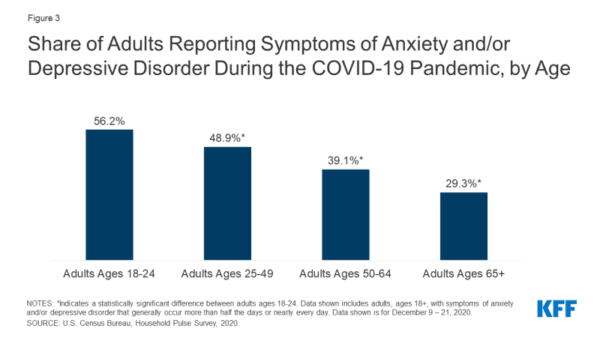
Depression and anxiety are the leading causes of loss of productivity and employee engagement. It has a tremendous impact on the world economy; the world stands out on losing over $1 trillion every year due to a loss of employee productivity. (World Health Organization13)
Another survey14 by SHRM found that of 1,099 surveyed employees, around 40% felt exhausted, burned out, and despondent due to the alteration in their lives caused by the pandemic.
There is no doubt that the pandemic has taken a toll on the mental health of employees. Aggravated by the long working hours and stress of family and child healthcare, things have gotten even worse. Employee wellbeing has become a priority for employers, and organizations globally are investing heavily to counter the effects of the pandemic on the mental health of their employees.
But, how do organizations identify that their employees are stressed and in need of support? Employee engagement surveys offer insightful data to understand the employee’s wellbeing and the peculiar areas that are a cause of concern for them. Furthermore, employers can also focus on the departments or business units with highly disengaged employees and focus on their improvement to prevent breakdown.
Employee Turnover Data Analysis
The information collected in engagement surveys can be used to analyze the employee turnover data. By comparing the responses of employees with the turnover data, HR managers can comprehend the areas of employee experience that need improvement in order to contain attrition.
The process involves comparing the responses of employees who left the organization within 3–6 months of conducting the engagement survey. It reveals how employees felt about the organization and their overall experience before leaving. Furthermore, the perceptions of such employees can then be compared with the ones who stayed to gauge the reasons for employee turnover. Managers can then intervene in the areas that need improvement and strategize a plan to increase engagement and enhance the overall experience.
Connecting Engagement Initiatives To Key Business Results
Leaders throughout the world believe engagement to be one of the five most important strategies in creating a revolutionary organization. But the biggest challenge they are trying to solve is tying employee engagement initiatives to key business results. Having an engagement survey is not enough if it cannot produce the desired results. Therefore, to get the most out of the surveys, human resource managers need to develop them in accordance with the key business indicators, such as customer centricity, overall stakeholder value, company reputation, and brand building.
Such an amalgamation of business outcomes with employee engagement surveys helps in strategizing the operations across different departments. Furthermore, it can bring important insights that help in charting out how organizations utilize their employees in unprecedented situations, such as the sudden change in the business environment, regulatory compliance, new competitors, and changing customer expectations.
Creating an employee engagement survey is a tedious task. It requires months of planning to address the areas that the survey should touch upon, and the involvement of employees from every level of the organization. To yield actionable results from surveys, HR managers should consider forming a cross-functional team of experts to look into different aspects of survey creation. The following points highlight the extensive process of creating employee engagement surveys.
Define The Purpose of the Survey
Employee engagement encompasses various factors, and working on all of them in one go is not possible. Though it can be tempting to include multiple focus areas in the survey, it might confuse the employees and digress from the current state of the company. Thereby a result, providing inaccurate results.
At the time of discerning, it is crucial to identify three or four high priority objectives, especially where engagement and productivity are lacking. For example, if customer acquisition and retention, employee turnover, and decreasing sales volume are the areas of concern, then the survey should only focus on these factors.
Involvement Of Leadership
For the survey to produce any results, the involvement of leadership is a must. The dynamics of leader-employee relationships are not one-directional, and that’s why involving leaders in employee engagement exercises can give direction and purpose to the process.
In the initial phase of survey planning, human resources managers must reach out to organizational leaders to get their input on the objectives of the survey. This also ensures they have a vested interest in taking action on the survey results.
Review Previous Surveys
While designing an employee engagement survey, HR managers can refer to the previous surveys to inculcate best practices and improvise on the ones that did not work well. It can offer meaningful insights, such as which survey designs were liked by employees, the response rate, accuracy of results, core focus areas covered, actions taken on the feedback, timeframe adopted for the whole process, and the overall engagement score. Such action points will help in designing the survey to bring in better results from employees.
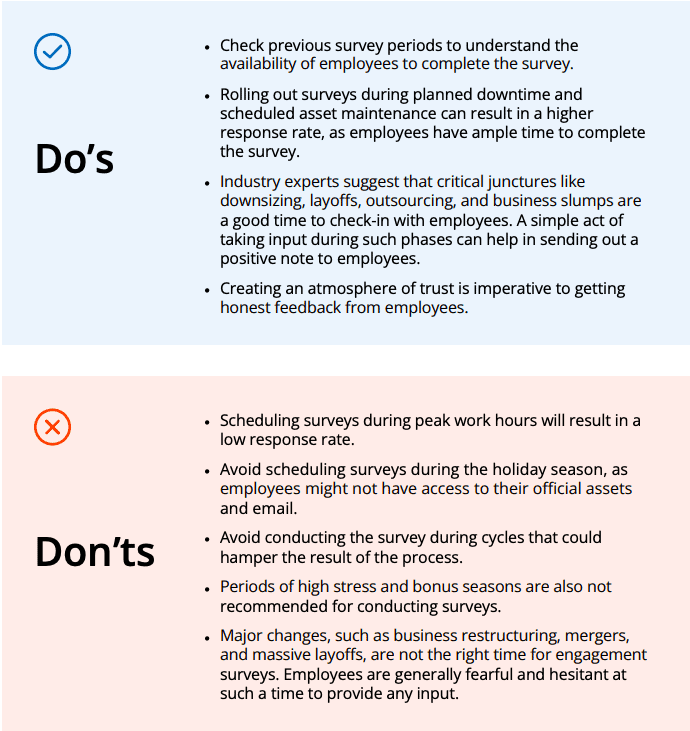
Consider The Timing Of Survey
The timing of the survey is of great importance in order to get a higher response rate and data accuracy. HR managers should consider the following do’s and don’ts when deciding on the timing of the survey.
Engagement Survey Frequency
The frequency of conducting a survey is of the utmost importance. Some organizations conduct surveys annually and then wait for a year to collect input from their employees. Much has already happened in the gap, and if their surveys are not accompanied by action, then it might result in disgruntled employees.
Therefore, human resource managers must conduct engagement surveys regularly in order to send a message that employees’ inputs are being valued.
Drafting Questions That Provide Actionable Results
Drafting good survey questions is time-consuming. It generally requires collaboration from multilevel, cross-functional teams to understand whether the surveys target the organization’s key objectives or not. The questionnaire must cover all the aspects that are relevant to the purpose of the engagement survey. The quality of questions has a statistically significant effect on the survey findings; hence, one must take the utmost interest and care while designing them.
The questions must be drafted in a manner that elicits an accurate response from the employees. Open-ended employee engagement questions must be included in the survey questionnaire. It helps employees voice their opinions and ideas. Furthermore, managers can analyze the collected responses and can dig into the areas that they would’ve never considered looking into.
Testing the questionnaire is also important to understand the relevance and accuracy of the collected data. Organizations use techniques such as focus groups, cognitive interviews, pretesting, and combinations of these to test the survey. Thereafter, the insights collected from testing are used to refine the questions.
Select The Best Employee Engagement Survey Template
An employee engagement survey template includes questions that measure the motivation and engagement of employees to perform their job duties. Additionally, the responses collected from the survey are useful in understanding the performance, competence, and satisfaction of employees.
A template comes in handy when conducting a survey, as it helps in gathering, organizing, and analyzing the data collected from employees. A good template should be customizable as per the needs of the organization and must highlight the areas that need improvement.
Designing Surveys to Inform Better Decisions & Drive Meaningful Outcomes
Survey design requires some art, but even more science. Some research estimates that employees are surveyed 1.5 times per year. Given this fact it’s important that we implement sound practices in the design of organization surveys that help inform key business decisions.
When it comes to survey design validity is essential, it determines what survey questions to use, and helps ensure that we are using questions that accurately measure the issues of importance. Validity ensures that we are measuring what we say we are measuring.
The Engagedly Team has spent time and effort constructing an engagement survey that is valid, supported by research, and reviewed by industry experts. Now our clients can confidently assess employee engagement within their organization in a few simple steps. This new product offering provides our clients with an easy-to-administer employee engagement survey built around evidence based practices. Additionally, we provide insights to better understand employee engagement within and across the company while highlighting key strengths and areas for opportunity as well.
Now more than ever we can all benefit from thinking more like a scientist by applying more rigor and critical thinking in the work that we do. At Engagedly that is our responsibility, to marry science and practice, wherever and whenever possible.
Once the engagement survey is created, it is time to get it rolling. There are a few things that managers need to consider before they decide to roll out the survey. Following the best practices for employee engagement surveys will help in getting accurate results. Some of the tactics to be followed are discussed below.
Communicate The Employee Engagement Survey Purpose
Effective participation in surveys happens only when employees are clear about the purpose of the survey. To encourage employees to participate in the survey, organizations need to clearly communicate the following to their employees:
What is the purpose of conducting the engagement survey?
What does the organization want to accomplish by taking feedback from employees?
What steps will the organization take upon completion of the survey and the anticipated results?
How will the survey help employees in their day-to-day activities?
The projected timeline of events starts with surveying and analyzing the results.
Emphasizing the importance of the survey to both employees and employers.
Maintain Employee Anonymity
It is important to keep the employee engagement survey anonymous. The reason behind this is that employees feel less anxious about the survey and are ready to provide open feedback without the fear of any retribution. Additionally, employee anonymity increases the likelihood of getting more responses.
By veiling the employee’s identity, surveys can prompt them to share their candid responses regarding the leadership styles, culture, interpersonal relations, support from managers, and other relevant areas that organizations want to mull over. Thus, it helps in gathering more responses with higher accuracy, leading to a better analysis of the data.
Commit To Taking Action
A sense of purpose is essential for an employee to work productively and contribute towards organizational growth. Without this, employers will lose their best talent to their competitors who value their employees more.
Taking action is the most crucial step in conducting a successful employee engagement survey. Employees value their employers more when they see their feedback is taken into consideration. Therefore, sharing key findings of the survey in a timely manner with the employees is important. By involving the workforce in survey findings, employers can make them feel valued and responsible for the solutions.
Please note that acting on survey findings also avoids “survey fatigue.”It refers to a lack of motivation to participate in assessments and can lead to fewer and (or) inaccurate responses. The fundamental reason behind survey fatigue, as found by McKinsey15 after reviewing 20 academic articles, is the perception that employers will not act on the results.
Often, employers do not tend to share the results or communicate with their employees after conducting the survey. This leads to an employee perception that employers do not value their responses.
On the contrary, sharing and acting on survey results leads to better response and participation from employees in future surveys. The below discussed best practices for employee engagement surveys will help in making surveys more effective and impactful.
Designing and conducting surveys takes a long time, and by not following the best practices, there is a good chance that it will not achieve its purpose. Asking questions that are ineffectively designed will lead to low response rates and inaccurate data. Thus, to avoid wasting time, effort, and money, it is pivotal to follow certain guidelines. The following points talk about employee engagement survey best practices that will help in designing and conducting surveys constructively.
Keep The Survey Short And Simple
Keeping the survey short and simple is an effective way to increase the response rate. The ideal number of questions to be kept in an engagement survey is around 75. And, it should not take more than 20 to 30 minutes for an employee to answer all the questions. Furthermore, try to avoid repetitive questions and confusing language. It may lead to vague responses if the employee is unable to understand the questions.
HR managers should also look into the previous surveys as well, to understand the optimal number of questions that got the highest response from employees.
Avoid Grouping Key Focus Areas
Grouping the key focus areas may confuse the employees and will result in uninterpretable responses. Avoid using double-barrelled questions regarding pay and benefits, growth and satisfaction, and learning and motivation. Even when the focus areas are closely related, grouping them will not be beneficial.
For example, an employee may find the pay satisfactory but not the benefits, or vice versa. In such a case, the surveyor will not be able to interpret the response, leaving no chance to create an improvement plan.
While building a questionnaire, managers should clearly segregate the categories and create questions around them. This will avoid any sort of confusion among respondents.
Involve Employees In Survey Design And Analysis
Before rolling out the survey to the whole organization, it is crucial to run it through a set of selected people to test its structure, consistency, and accuracy. It will help in redesigning unclear and ambiguous questions and will further refine the survey.
Involving heads of business units and departments in the design and analysis phases offers numerous benefits. They can highlight the areas that seem to be problematic and need to be addressed through surveys. Furthermore, they can help in laying down a strong foundation for examining the survey findings, leading to better analysis and actionable results.
Using Neutral Statements In Questions
The survey should have a mix of both positive and negative statements. Having plenty of positive statements such as “my manager understands my concerns” or “my team is quite responsive” will make the survey too rosy. Similarly, using too many negative statements will also subdue the intent of asking questions. Therefore, it is better to use neutral statements wherever possible, as they will elicit the best response from respondents.
Questions To Avoid
Management may want to include questions about age, gender, race, and other demographics to look into the trends or concerns of a group. For example, if women of color find the workplace to be responsible for their growth and development, or if employees in their 50s find the workplace more stressful. But such questions may raise one’s eyebrows, as employees might believe that management might use the data to target those specific groups. Thus, it is necessary to avoid or limit such questions in an engagement survey.
Another set of questions to limit is asking nice things about the management and focusing on the things that can be acted upon. Too many questions about management’s efficiency can put off the respondents. Instead, try to understand things from the employees’ perspective.
Question Behavior Rather Than Motive Or Thoughts
Questions about the thoughts, traits, and motives of an individual are disputable and will not provide any actionable data. The line of questioning should involve the observable behavior of the employee to understand their involvement and engagement. Thus, avoiding opinion-based questions in the survey will remove distortion from the results.
Another important aspect to work upon is removing personal bias from the survey. The questions should be drafted in a way that prevents any sort of bias from influencing the results. For example, asking questions about productivity and involvement of female employees can skew the purpose of the survey.
Include Some Verifiable Questions
Including questions with variable responses will help in establishing the validity of the survey. Such questions provide quantifiable data to understand if the responses collected are in line with reality. For example, a survey can include questions about the leadership of a particular department. The responses collected from the questions can be verified with objective measures like employee retention and overall departmental productivity. These measures will help in verifying the exactness of the collected data.
Another example could be asking questions about customer satisfaction from the client service department. The responses can be verified using metrics like call drops, frequency of calls from the same customer, and feedback submitted by the customer. The correlation of these metrics with the customer satisfaction index is a great measure to verify the survey responses.
What To Do With Employee Engagement Survey Results
The employee engagement survey forms the baseline for creating an action plan and implementing it across the organization. The real job starts after collecting the responses of employees in various key focus areas. Response data has to be thoroughly analyzed and subjected to various tests to check for validity and accuracy. To get the most out of the feedback results, management must follow the following steps to create a strategic action plan.
Share Employee Engagement Survey Results
There are multiple benefits to communicating employee engagement survey results. Firstly, it helps in building trust and shows employees that their responses are being taken into consideration. Secondly, it brings transparency to the system, which eliminates confusion, and thirdly, it creates a channel of communication between management and employees.
Sharing results with business heads helps them prepare to take action and hold discussions within the departments to find the root cause of the problems. Some issues will pertain to departments, and they can find the best solution by looking at the granular level of data.
The survey results usually provide insights about engagement, productivity, satisfaction, and other elements. Weaving them into a story will help employees understand the rationale behind the survey. Therefore, using a suitable medium like a presentation or an infographic, to highlight the results while narrating the importance of each focus area will be more effective.
Analyze & Identify Areas Of Concern
Analysis of survey results helps in finding the areas of concern and creating an action plan accordingly. Categorizing the results into different segments will help transform the data into actionable items. While some organizations rely on manual segmentation and analysis, some have transitioned to engagement platforms that come with tech-advanced algorithms to accurately analyze and interpret the data.
Such platforms help in providing a deeper understanding of every key focus area. For example, the survey results might show a positive organizational culture, but digging deeper into the data can reveal information about departments that are lacking support. Such an analysis is imperative for large-scale organizations with multiple business units and departments.
Facilitate Discussion Within Teams
Once the survey results are out, it is time to act on them and find solutions to the problems. By running post-survey meetings, organizations can ask people from different departments to brainstorm and come up with the right solutions. The purpose of these meetings is to involve people and give them an open channel to discuss issues and chart out an improvement plan.
Business heads or team leads must ensure that all employees participate in the process and establish a link between the survey results and employees’ perceptions. During the meetings, the problem statement must be clearly defined with the focus areas, and every employee must be given an opportunity to provide their thoughts on it. Through this process, employers can gather first-hand information directly from the employees who are facing trouble.
Make & Implement Decisions
The data gathered during engagement surveys and post-survey meetings helps in pinning down the problems. Leaders can utilize this information to create organizational-wide goals and cascade them to different business units.
Using Plan-Do-Check-Act cycle16 can help in streamlining the implementation process and providing observable changes and corrective actions to refine the processes. Introduced by Dr. W. Edwards Deming17 in the 1950s, PDCA is an iterative technique that helps improve business processes. It is used in designing and implementing decisions in the following manner:
Plan: It provides the framework for operations and is directly related to the goals and objectives of the survey findings.
Do: Also known as the action stage, the plan is set into motion and the insights are gathered for future evaluation. All the employees related to the focus areas to be worked upon are involved in this process. It may involve training, re-skilling, mentoring, coaching, and other significant activities required to improve staff engagement.
Check: Evaluating the action plan should be done in two steps. Once during the implementation process, as it helps in checking if the goals are correctly aligned, and twice at the end of the implementation to address the success and failure of the activities.
Act: At this stage, the reasons for the failure and success of the program are collected and used as feedback for running the next PDCA cycle.
Employee Engagement Survey Questions form the foundation of measuring engagement in multiple aspects. They should focus on solving organizational problems, get candid responses from employees, and intend to find the strengths and weaknesses of the organization.
Touching the core areas of engagement, such as satisfaction, leadership, culture, work environment, learning and development, organizational mission, and values, is imperative to have an overarching understanding of employee engagement. Let us look at some sample questions on different areas of engagement.
Sample Employee Engagement Survey Questions
Employee Work
I get a sense of accomplishment from my work.
I have access to all the tools and resources required to be productive at work.
The volume of work I have is manageable.
I feel my work is being valued.
Workplace Communication
My views and thoughts are taken into account while making decisions.
I can openly share my thoughts and experiences in my department.
I am well-informed about the organizational values and policies.
I feel the communication models used by the organization are effective and sufficient.
Organizational Culture & Strategy
I feel the organization is open to feedback and criticism.
The organization can adapt to the changing business needs.
The organization is equipped to meet the challenges.
New ideas and innovation form the core strength of any organization.
I feel that my job is secure.
Employee Manager
My manager encourages me to take action and initiative.
My manager provides honest feedback to me.
I need enough support from my manager to succeed in my role.
My manager is involved in my learning and development.
Leadership
I trust the leaders and their vision for the organization.
I see strong evidence of effective leadership in my business/unit head.
I see leaders committed to the organizational goals.
I am clear about the organizational mission and vision.
Learning & Development
I trust the process of learning and development being followed by the organization.
I have ample opportunities to grow and learn in my current job profile.
I get regular feedback from my manager.
The appraisal process is justified and helps me understand my quarterly and annual goals.
Employee Engagement
I am proud on the work that I do
I am immersed in my work
I find the work that I do provides me with purpose and meaning
Time flies when I’m working
I try my hardest to perform well on my job
I am fulfilled by the work that I do
Open Ended Employee Engagement Survey Questions
Open-ended questions provide deeper insights by encouraging employees to express their opinions and experiences. With the help of responses, it can become relatively easier to understand the cause of a problem. That’s why including such questions in engagement surveys is helpful. Check out the sample open-ended questions in the section below.
What improvements would you like to see in the organization?
Rate your overall experience on a scale of 1 to 10. Give reasons for the rating.
What changes would you like to see in the company’s policies?
What changes did you see in the organization since the last survey?
What strategies would you suggest the organization include for better work-life balance?
Final Thoughts
Much of the organization’s efforts in today’s world revolve around creating a dynamic, smart, adaptive, and engaged workforce. Organizations with a high engagement index are leading the way and utilizing various strategies for employee development.
Employee engagement surveys give employees a voice and assist employers in identifying areas for improvement. By considering employee feedback, organizations can dramatically improve their productivity and efficiency.
Over the last decade or two, the world is increasingly becoming a global village. Technological advancements have meant that businesses can now employ and work with remote workers around the globe. The new opportunity has brought people from different cultures to work together, creating a multicultural environment.
One of the tricky parts of this development is communication, especially when giving feedback. Feedback across cultures is a sensitive and challenging topic and will only get more popular because of the increasing popularity of multicultural workplaces. This article will discuss the various forms of feedback, why it is tricky, and how to improve your feedback.
As shown in this workplace engagement study, 65% of employees want more feedback, and 69% believe they would perform better at their workplace if recognized for their efforts. It isn’t surprising that employees want feedback as a source of motivation and growth. No one wants stagnancy. Organizations have also discovered the many advantages of giving regular feedback.
When it comes to giving feedback across cultures, there are more variables at play here, and this section will help us understand some of them.
Upbringing
Most of us can trace our first communicative interaction with early childhood. This period is where you learn how to communicate with your family. Part of what you would pick up is the subtle styles of communication, which are hand gestures, facial expressions, and other non-verbal forms of communication.
Humans believe their way of speaking, acting, and responding is how others will also behave. Sadly, this mindset is a bubble experience created by our lack of exposure to other cultures and their peculiar communication styles.
Although the internet has made it possible to search about the culture of people, reading it online and experiencing it are entirely two different things. Even if you casually know someone from a different culture, it’s likely a different ballgame when in an office setting.
These are two common reasons employee feedback may be tricky in a multicultural setting.
Feedback Styles
When you talk about feedback, we mean both positive and constructive feedback. Companies pay attention to how frequently they give positive feedback and how well they present constructive feedback.
We can say the same about a multicultural setting, where different cultures have various ways they express their positive and negative feedback.
And so, in this section, we will explore some of those feedback styles from different cultures.
To better understand the various feedback across cultures, we will use the hamburger analogy of feedback to explain the different styles.
Only Meat
We categorize the only meat approach as the direct method. The feedback is straightforward, blunt, and often comes out harsh. It is giving feedback with only the negatives and nothing positive.
Countries that practice these include Germany, the Netherlands, and South Africa, to name a few. In a system like this, no feedback is good feedback. It means you are doing the right things.
The meat and bun approach is also a direct method, although a little less blunt. It is a straightforward system that gives negative feedback before positive feedback, highlighting what you have done well.
This system emphasizes mistakes to improve performance but dwells very little on positive feedback. Some countries that practice this method are France, some German companies, Spain and Italy. Some Nordic countries also practice this approach.
Whole Hamburger
It has become a popular and widely used method. The approach suggests one starts with a positive comment about a project or behavior towards the project, followed by the meat, which is the negative comment. Finish the feedback process with another positive commentary.
The indirect system tries to dress up the constructive feedback. It seeks to point out mistakes and encourage the receiver of the feedback. It’s a common approach in the United States, Australia, Canada, and the UK.
Vegetarian
This method is gentle and indirect about its feedback. The approach uses metaphors, stories, and even parables to pass on negative feedback. Some places prefer to give positive feedback and remain silent on the negative.
Others provide negative feedback in private. In some cultures, how close you are to the person also influences how you pass on the negative feedback. Some countries where we see this feedback approach include Japan, Korea, India, and Vietnam.
In recent times, the expansion of multinationals has influenced some of these countries’ feedback culture, and hence we see hybrids of a sort in some of them today.
Upgraders and Downgraders
In the last section, we spoke on the various feedback forms and how direct or indirect they are. Upgraders and downgraders are words used in the direct and indirect approach to either emphasize or soften the effect of constructive feedback.
Upgraders
They are words like ‘absolutely’, ‘totally’, ‘strongly’, ‘fully’, and ‘completely’ are examples of upgraders. If we are to use them in a sentence, “This report is completely wrong,” or “This is totally unacceptable.” The goal of upgraders is to strengthen the feedback. Cultures that use the direct approach commonly use upgraders in their sentences.
Downgraders
Downgraders are words that soften the effect of feedback. It can come as a roundabout method and is often paired with the indirect form of feedback.
Words like ‘maybe’, ‘a little’, ‘a bit’, ‘kind of’, and ‘slightly’. Examples in a sentence include, ‘maybe you should think about it’. ‘We need to put in a little more effort’. ‘You are kind of there’. These words are deliberate understatements to soften the blow.
When properly utilized, upgraders and downgraders can become powerful tools when giving feedback across cultures.
How to Give and Receive Feedback Across Cultures
It’s one thing to know about different cultures and what words managers prefer to use when giving employees feedback. And another to implement the newfound knowledge. Here are some steps to take to improve your employee feedback across cultures.
Learn about the Culture
There is a rather popular case study used online to portray this point. It’s the story of a German executive named Jens who went to the Shanghai manufacturing plant of his company to improve performance. What ended up happening was performance dipped within the first six months, key management members resigned, and his feedback style that worked in Germany was failing here.
He later discovered that his direct approach to feedback demoralized his employees, and he quickly needed to change. With the help of a friend who was a local himself, he learned about the culture. He found out the direct approach wasn’t favorable in a country like China, where you needed to be more indirect with your constructive feedback and vocal about the positives.
The story is a real-life story that highlights the importance of observing and learning the cultural cues of a working environment. Jens learned it the hard way. Don’t be Jens.
Develop a Feedback System That Works for Both Parties
Still following Jens’ story, he had to adapt and develop a new feedback system that works with the Chinese. He didn’t want to be insincere with himself by adopting their method, so he had to build one.
He needed a style that represented his German roots but was softer – so the Chinese employees didn’t lose motivation. Jens successfully created a hybrid that worked in that environment.
There is a popular slogan for managers who enter a new cultural setting. “Go native.” The problem with this slogan is you either overdo it or underdo it, causing more problems. The best solution is finding a hybrid that can work in the environment.
This point sounds like an easy decision, but we humans have a history of complicating matters. Practice makes perfect, but feedback in the direct direction makes it worthwhile. Getting feedback from employees can help you keep improving your feedback system. Getting their opinion will also help give better constructive feedback to your employees.
Build Good Working Relationships with the People
In the workplace, you don’t have to be friends with everyone. If both parties can duly perform their duties, that’s good enough. But you see, there is an advantage to being understood by your employees and colleagues as this helps when giving out feedback.
Having a relationship can be as easy as being approachable, asking about other people’s days, giving your employees a chance to speak if they mess up, and complimenting them on their growth and positive performance. Doing all of this creates the atmosphere of someone who wants the best for them.
Your constructive feedback is also much more receptive if they know you want to help them improve. Action speaks louder than words, so show them.
In conclusion, giving and receiving feedback across cultures can be tricky but not impossible to learn. It’s a skill that will become increasingly useful as technology gets better and connects us.
Learn how Engagedly can simplify your employee feedback process by requesting a demo with us.
Deloitte research cites culture and engagement as the top challenges for 87 percent of organizations, particularly for measuring culture and engagement effectively. Measurement of both factors, culture, and engagement, is necessary as they yield major benefits. For developing a high-performance culture fueled by engaged employees, decouple the two – culture and engagement – and see each as an individual entity with its own set of contributions.
Companies with high-performing cultures are innovative and customer-focused and meet their strategic objectives under their values. In the same way, employees who are engaged are more productive and far less likely to leave the company. Both are important and closely related, but they differ in nature, and hence, measuring a company’s culture and employee engagement requires specific metrics. Unfortunately, companies often employ the same tool to measure both. For example, when employee surveys are conducted, there is no specific questionnaire for measuring the culture and understanding level of employee engagement. Your cultural change and employee engagement programs will fail if you aren’t clear on what you are measuring.
Can any one aspect –company culture or employee engagement – thrive by itself?
Although many managers believe that employee engagement surveys alone can boost productivity, it is not so. Improving the organization’s overall culture with a higher level of employee engagement is a far better way to boost business productivity and drive growth. To simply put, employee engagement is inextricably related to the strength of the company culture.
Understanding what is Employee Engagement
An employee’s engagement has to do with how employees feel about their workplace and work culture. The healthier a company’s culture is, the easier it becomes for the employees to grasp their roles and responsibilities. Engagement leads to happier, more motivated, and more committed employees.
Engaged employees are more likely to be:
Dedicated and motivated to exceed their company’s goals.
Positive and proactive about acquiring new skills and being creative in resolving problems.
Devoted to building their careers with an organization
Engaged employees add a multitude of benefits to an organization, which include increased productivity, stronger customer relationships, and decreased turnover, to name a few.
What do stats have to say about employee engagement and culture?
The number of disengaged employees actively seeking jobs is 73 percent, compared to 37 percent of engaged employees. The culture of an organization may influence the engagement of an employee.
The productivity of high-engaged employees is 21% more.
Interestingly, looking at certain stats, it is undeniable that employee engagement is closely related to a company’s high-performing and healthy culture.
Understanding what is company culture
Simply put, company culture refers to the employees’ norms, practices, and behaviour that influence how and why certain events or actions happen in an organization.
In what ways does a high-performance culture differ from a usual company culture?
A high-performance culture focuses on following effective and workable practices and norms to drive superior employee performance in an organization.
To elaborate, it’s a culture that allows a performance-driven organization to achieve superior financial and non-financial results, with values such as better service, high employee engagement; improved client satisfaction; increased productivity, and employee retention, over a long period.
Company culture and employee engagement:how are they unique?
To differentiate between the two, think of employee engagement as focusing on an employee (or ‘I’ factor) and culture as emphasizing the whole (‘or ‘we’ factor). Therefore, the employee engagement factor has to do with how employees feel about their employer and their workplace work.
An engagement survey can make a good predictor of employee retention, as it can measure loyalty and productivity. Managerial actions or other factors can severely affect employee engagement or even hurt it quickly.
Culture, on the other hand, focuses on intrinsic company values, which are often unquantifiable and difficult to assess. An organization’s culture is, essentially, ‘the way we do things.’ Changing culture takes time and effort because it’s often deeply ingrained. Hence, to influence a company’s culture, you must engage in a long-term reform program, or you must experience a significant external change, like an acquisition or merger.
Thus, employee engagement focuses on keeping employees motivated and happy while company culture lies deeply buried within an organization based on certain values, practices, norms, and a set of beliefs. To understand each of them better, it is necessary to understand how to measure your company culture and engagement.
Why is it necessary to measure engagement and culture?
Measuring culture and employee engagement is crucial since engaged employees are directly linked to employee retention, performance, and a company’s profitability. Importantly, the measurement of company culture and employee engagement helps to understand whether employees’ engagement and commitment align with a company’s expectations and strategic objectives or not.
Most organizations adopt certain metrics to measure company culture and employee engagement. To start with any form of quantifiable measurement, understand and know where the culture stands now and what steps you have taken to create a high-performing culture.
Unlike employee engagement, culture focuses on an organization’s core values and vision, and hence, any type of off-the-shelf survey will not be effective.
How company culture and engagement are assessed differently?
Culture and engagement are not only measured for different reasons, they must also be evaluated differently. For instance, you can find out how engaged your employees are based on the scores of your employee engagement survey. Using this data, you can then determine what improvements can be made. You can compare employees’ performance to that of previous years or similar organizations to get clarity on employee engagement and performance.
On the other hand, when it comes to culture, there is no right or wrong way to respond. Based on its goals and business objectives, an organization must identify what is ‘good’ and ‘bad’. Viewpoints on culture differ greatly from one organization to the next. For example, the culture of a bank will differ greatly from that of a start-up.
How does company culture shape employee engagement?
High-performance company culture is directly related to employee engagement, as the culture clearly defines healthy and supportive values and behaviors. In such a culture, employees know what’s expected of them and how their environment positively influences their performance. They feel connected, involved, and supported. Owing to all these factors which build up a conducive culture, they tend to be engaged. To enhance employee engagement, begin by strengthening your company culture, and here are several methods to do so:
1. Clearly define company culture
Culture forms the heart and soul of your organization, and thus, you need a strong culture to foster strong employee engagement. To get started, the leadership team should outline:
Company’s mission, vision, and values
Employee behavior expectations
Define culture and document it as a presentation or on your Intranet system, or in an employee handbook. Make your document widely available once it has been created and follow up on your defined culture. All hands meet or virtual gatherings can be held for the same.
2. Conduct Employee Surveys
Regularly assess your organization’s culture. By doing so, you’ll:
Learn what works in your company culture and how you can improve it.
Give employees a voice and you’ll discover new ideas you might not have thought of.
3. Work on employee feedback
When you decide to engage employees’ feedback, the payoff will be immense. The employees will sense that they are helping to shape the company culture, and their engagement will increase. Communicate the actions you plan to implement based on their feedback. Hold focus groups to discuss your action plan. Encourage employees to participate in brainstorming sessions to generate ideas.
Creating a strong culture for employee engagement has its own set of challenges – more like an ebb and flow, as it is not a one-time task. For long-term value, your culture needs to be nurtured regularly and for the same, measuring culture and employee engagement is crucial. In the process, you shall understand how satisfied and committed an employee is to her job.
By offering training regular sessions, managerial encouragement, and keeping an open mind about effective workplace practices, companies can meet the expectations of employees to create a high-performance culture.
In a nutshell, employee engagement is an ongoing process and is inextricably related to company culture. Over time, you need to focus on employee needs, and then use that information to create a strong company culture.
Feedback is a very essential aspect of every organization. Most organizations these days are designed in such a way that all these different departments are interconnected and contribute to accomplishing company goals and help increase organizational productivity.
Discrimination in the workplace isn’t always overt or obvious. Sometimes, people are discriminated against more subtly, like an unfair joke or comment about their appearance. This type of discrimination, known as a microaggression, often goes over people’s heads, but it really shouldn’t. Microaggressions harm the victim’s mental health and ruin their self-esteem. Microaggressions are usually unintentional, but they cause harm nonetheless. As a business owner or manager, it’s your job to teach your employees how to recognize and avoid committing microaggressions.
What is a microaggression?
Microaggressions are actions or behaviors in the workplace that unintentionally cause harm to members of marginalized communities. They’re called ‘microaggressions’ since their individual impacts are small. But, the cumulative effect of microaggressions is large and measurable as ‘microaggressions’. Since modern people spend most of their lifetimes at work, microaggressions impact their professional lives and mental health. In extreme cases, microaggressions even damage the victim’s physical health. Deep-rooted unconscious biases against marginalized communities cause microaggressions at work. Often, the people who commit microaggressions are not aware of the damage they’re causing. They have to be informed that they’re guilty of committing microaggressions and taught how to avoid them.
Unfortunately, workplace microaggressions are highly prevalent in American workplaces. We can assume the same is true for workplaces in most other countries. Many workplace studies and researches have concluded that microaggressions in the workplace are often routine and normalized to the point that victims don’t realize they’re being discriminated against.
For example, one studyfound that women suffer significantly more microaggressions in the workplace than men do. The six most prevalent microaggressions against women were often several magnitudes more likely to happen to women than men, especially women of minority ethnic and sexual identities. For example, 36% of women’s judgment was questioned in their area of expertise versus only 27% of men. 40% of black women report having their judgment question, and 37% of lesbians reported their judgments being questioned.
Another studyrevealed that 64% of women reported daily microaggressions as workplace reality. On average, women are forced to provide greater evidence to demonstrate competence than men. Women are also x2 likelier to be misidentified for someone in a more junior position than their male colleagues.
Damages caused by microaggressions
Suffering from daily workplace microaggressions causes numerous mental health issues for employees. Employees could suffer from any of the following conditions:
Microaggressions in the workplace can even impact employees after they’ve left their workplace. An individual might be less likely to apply to new jobs for fear of rejection or differential treatment because of their name or ethnicity. The result is decreased talent and declining employee productivity for companies.
Workplace engagement is likely to decline because of microaggressions. Employees that frequently suffer from microaggressions may become less willing to speak during meetings or actively participate in the company. They could also lose motivation and struggle to maintain their sense of purpose in your organization. For this reason, appropriately responding to microaggressions is vital for a company to maintain morale.
There are multiple microaggression types. The most common ones are :
Microassaults
Microinsults
Microinvalidations
Each microaggression type causes different damage to the victim. Some microaggression types can cause significantly greater damage than others to specific people.
Microassaults
Microassaults consist of intentional overt discrimination against a marginalized group. Common microassaults include putting-down someone, belittling them, or bullying them. A specific example of a microassault could be carving a racial epithet into a wall or posting historically offensive symbols and flags, like the American Confederate flag or Swastikas. Microassaults also include slurs against people because of their religion or sexuality. Microassaults actively cause damage to peoples’ self-esteem because of their overt nature. Micro assaults are easy to detect, but they’re often considered harmless jokes in a workplace.
A microinsult is when a marginalized community member receives a compliment that secretly insults their demographic group. The most common microinsult is to contrast the victim positively against a negative stereotype associated with their demographic. Microinsults are disguised as compliments, and they may be genuine from the person providing them. Yet, they are a microaggression because they reinforce the stereotypical image of the victim’s demographic. Microinsults imply that the victim’s demographic is a negative entity, with the victim’s positive attributes being an exception to the norm. An example of a microaggression is judging female business leaders as ‘harsh’ for speaking with authority. Another type of microinsult is when a professional is favored or discriminated against for choosing an occupation not traditionally associated with their demographic. For example, a female fighter pilot or a male nurse.
Microinvalidations
Microinvalidations are behaviors or words that invalidate the experiences and opinions of others because of their background. Most often, microinvalidations are expressed against members of historically disadvantaged groups. The target will typically be dismissed, discredited, and even be laughed at because of their divergent experiences and opinions. A specific example of a microinvalidation would be for an ethnic majority person to say ‘I don’t see color’ to a colleague from a minority ethnic background who’s complaining of workplace racism. This action is a microinvalidation because it denies that an ethnic minority may have different experiences from the ethnic majority. Microinvalidations are harmful since they delegitimize minority concerns.
Different forms of microaggression
Microaggressions occur in different forms:
Verbal
Verbal microaggressions involve comments or questions about minority members that hurt their self-respect or identity. An example of a verbal microaggression would be saying, “You’re so smart for a woman.”. This phrase is a clear microinsult.
Behavioral
Behavioral microaggression consists of non-verbal actions that imply certain people are inferior. An example of a behavioral microaggression would be a bartender serving a cis-person before serving a trans-person, despite waiting longer. This action is a microaggression because it involves treating the trans-person unfairly compared to the cis-person.
Environmental
Environmental microaggressions involve subtle discrimination against minorities. An example of an environmental microaggression is naming college campus buildings after members of the ethnic majority, despite no lack of relevant minority figures.
Microaggressions in the workplace are common. In any workplace, you’ll find people discriminated against for their race, gender, sexual orientation, age, and other demographies. For example, a 2018 Kansas State University studyfound that 73% of women in STEM fields were sexually objectified at least once.
Other common examples of microaggressions include:
Treating someone as an inferior citizen because of their background.
Offering backhanded compliments to people born outside the U.S. for their English language fluency.
Telling underweight people to eat more
Making assumptions about people because of their age or religion.
Refusing to use a trans-person’s preferred pronouns.
Underrepresenting people of different demographic backgrounds in the media.
Refusing to accept stereotypical or derogatory sports teams’ names as problematic.
Using insults that involve accusing an individual from one group of stereotypically acting like a different group’s member.
Assigning value to people based on their demographic origin.
How to combat workplace microaggressions?
Businesses need to prevent workplace microaggressions to maximize employee satisfaction and productivity. Refusing to prevent microaggressions in the workplace damages employee morale and mental health and harms organizational efficiency. Thankfully, there are several ways to combat workplace microaggressions actively.
Promote Actionable Awareness
Most microaggressions are not intentional. Instead, microaggressions result from either ignorance or subconscious biases. As such, organizations need to proactively raise awareness of microaggressions and inform employees of the microaggressions they commit. Your organization should actively provide employees with workplace instruction on what actions constitute workplace microaggression. They should also know why to avoid it.
It’s also important to consult employees who suffer from microaggressions about their experiences and empower them to bring attention to their problems. Educating employees about microaggressions is necessarily a communal effort that will involve your entire company to be effective.
Facilitate Respectful Dialogue
Microaggressions are an emotional matter that requires the sensitivity to resolve. When bringing up microaggressions with your employees, approach the subject respectfully. Remember, your job is only to facilitate conservation among your employees, not to teach how to think.
There are several ways of appropriately treating microaggressions. For example, don’t single out any demographic. Conversations about microaggressions should be broad and cover all. Encourage all demographics to discuss microaggressions, but don’t create an ‘us versus them dichotomy.
Also, don’t direct attention towards any specific individuals as that would cause workplace tensions. You want to generalize behavior and not avoid blaming any person or group.
It’s not enough to educate employees about microaggressions; you also have to penalize anyone that commits them. Ideally, you should have a safe and progressive workspace free of discrimination.
Failure to correct microaggressions is tacit acceptance of the bad behavior. Employees who frequently commit microaggressions need to know that their behavior is unacceptable. Consistency will ensure your organization has a safe and progressive work environment. You should follow this process every time:
Identify microaggression
Apply penalties
Evaluate results
Apply lessons and repeat
For example, if a male employee refers to a female manager as “bossy” for being assertive, HR should immediately explain why such language is inappropriate. HR must then examine the employee’s subsequent behavior with female managers and conclude whether his behavior has improved. If it hasn’t, you require to take additional action.
In conclusion, microaggressions are harmful to workplace productivity and employee mental health. Microaggressions consist of actions or words that often unintentionally cause harm to others. Repeated microaggressions damage workplace morale, so businesses should learn to prevent microaggressions by fostering a healthy and constructive work environment.
Learn how Engagedly can help you manage your employees better by requesting a demo from our experts.
Unconscious bias at work have become a major concern for modern workplaces. But, just what is an ‘unconscious bias’? And what does an unconscious bias mean? Quite simply, an unconscious bias is a bias that you don’t know that you have. Almost everyone likely has unconscious biases, but they cause a lot of problems in the workplace. The biggest problem with unconscious biases in the workplace is that they impact how people are treated by others.
What is unconscious bias at work?
The answer to the question, ‘what is unconscious bias?’ is that it is a set of non-conscious attitudes that a person feels about those around them. The sub-conscious attitudes aren’t necessarily coherent thoughts so much as biases that people don’t realize they have. As for how unconscious bias is formed: Most unconscious biases are deeply ingrained in people because of their social environments.
Unconscious biases affect how people think about and perceive others. Sometimes unconscious biases also affect how people emotionally feel about others or how they behave around them. For this reason, unconscious biases can cause harm in the workplace. There are many different types of unconscious biases–most relate to an individual’s own thoughts.
The most negative manifestations regarding unconscious biases are those that involve a negative emotion or stereotyping of other people. For example, an individual who has an unconscious bias against people of a different ethnic group will likely treat members of that ethnic group differently or worse in an office environment.
Unconscious biases around other people are the most dangerous, since they affect people’s behavior with others. For the rest of this article, we will mostly be referencing this form of unconscious bias since it is most relevant for modern workplaces.
Impact of unconscious bias at work
Unconscious bias harms a workplace by making it less comfortable for the people in it. Unconscious biases can directly lead to financial loss for a company and deteriorate employee experience.
Financial Loss
Unconscious biases threaten meritocracy in any firm. When there’s a high degree of unconscious bias among managers against members of certain groups, it leads to fewer people of that group applying to the company. This deduction in applicants leads directly to a loss of potential talent. There are also direct financial costs of unconscious bias.
It’s believed that US workplaces collectively lose $450 to $550 billion annually because of workplace bias, a majority of which is estimated to be unconscious bias. When employees face bias, they will tend to either leave the company or become dissatisfied. The result is a higher turnover rate and increased inefficiency. Companies can even face legal charges for demonstrating bias against employees.
Employee Experience
Unconscious bias can damage employee experience by inflicting micro-aggressions against the victim. Since unconscious biases are not deliberate, they get triggered outside of people’s control, which means unconscious biases can appear anywhere. For example, a manager would assume that an older employee does not have an interest in learning new technologies only because of their age. An older employee could feel personally attacked by such comments.
Another example could be a manager refusing to permit a younger employee to become a team leader, even if they’re the best qualified, because of a bias against younger people. These types of biases can cause a large degree of harm to employee morale over time. Some types of unconscious bias may even become systemic in an entire company or region. For example, 48% of African American women and 47% of Latin American women have reported being mistaken for administrative staff.
Employees who experience such biases actively are likely to have lower morale and higher dissatisfaction with the company. Employees with reduced morale will almost certainly contribute less to the company and have decreased productivity. One study that involved over 3,570 respondents of different racial backgrounds reported that those who experience unconscious biases were:
Now that we’ve answered the question, ‘what is unconscious bias?’, and ‘what does unconscious bias mean?’, we’ll cover how to prevent unconscious bias and combat it in your workplace.
Preventing or combating unconscious bias mostly involves teaching your workforce to recognize and eliminate their unconscious biases. Most people don’t realize they have unconscious biases, so they must be taught to do so.
Unconscious bias can’t be removed on an individual basis. Instead, it’s necessary to remove that throughout an organization. The following ways will help you successfully tackle unconscious bias at work.
1. Inform your managers and teams
The first step to removing unconscious bias from your workforce is to make them aware of it. After all, unconscious bias, by its nature, is not known to the people who possess it. Explain what stereotyping is to your employees and help them recognize their biases. By educating employees about unconscious biases, they’ll automatically recognize their own biases. Awareness training is the first step to combating biasness. The goal is awareness training is for your employees to understand and reflect that they may have demonstrated an unconscious bias in their past actions.
2. Help employees identify unconscious bias
Most of your employees will reflect immediately about whether they have any unconscious bias, but some may need a stronger push. The best way to convince all of your employees to start working on fixing their unconscious bias would be to set company-wide policy. Your employees need to know that your business is anti-biased and anti-discrimination. You can do this by inserting a diversity statement in your organization’s values. You should start using terms like ‘ diversity, equality, and inclusion’ to promote your workplace culture in favor of eliminating biases. By doing so, your employees will be motivated to work on fixing their unconscious biases.
3. Improved hiring process and career opportunities
Hiring and promotional activities are when unconscious bias is likely to be the most problematic. You need to have a company-wide policy of transparent hiring and promotion. Your employees need to feel that they’re judged only for the quality of the work they produce and not for their ethnicity, gender, age, sexual orientation, or other demographic qualities. When hiring new employees, make sure that only their qualifications are taken into account. When considering employee promotions, it’s vital to prove to your employees that only the best performing employees receive promotions.
You’ll know that your hiring and promotional policies are appropriate when no employees will feel left out for personal reasons. Your employees need to always feel that they’re valued for the work they produce, and not what the color of their skin is. Your inclusive workplace needs to actively demonstrate to employees that your firm’s total commitment is to diversity and inclusion.
4. Establish accountability at work
Unconscious bias accusations are most commonly directed towards managers and company leaders since unconscious bias is most dangerous when directed from these people. You need to ensure that your managers and business leaders are devoid of unconscious biases against employees. It’s also extremely important to ensure that when they do commit biased actions, your managers are held accountable for them.
Your employees will respect your company more for holding managers accountable. You should have an active company policy to ensure your managers are always accountable for their actions. Doing so will help systematically eliminate unconscious bias from your organization and prevent it from ever developing again.
5. Elevate to data driven approaches
One of the best ways to eliminate unconscious bias is to set objective standards and criteria for hiring and promotional activities. By reducing the amount of judgment that managers can leverage, you’ll automatically reduce the amount of unconscious bias they can demonstrate. You should start by developing an objective and clear criteria for recruitment. Your managers should have a clear set of requirements against which to judge potential candidates.
Some companies even use ‘blind evaluations’, in which a candidate’s demographic information, including gender, remains undisclosed during the evaluation process. It’s also possible to dispense with mostly human recruitment managers in favor of having performance management software judge whether potential applicants are suitable for a position.
You can also prevent unconscious biases from growing by encouraging your employees to increase communication among themselves. Building an open and expressive work environment makes it easier for employees to interact with one another and reduce the chances of developing biases. These conversations will also help employees improve work morale and develop better relationships with one another.
The more of your organization’s members participate in such activities, the better. By opening as inclusive a dialogue as possible, your employees will have the most opportunity to eliminate their biases. Another benefit of open dialogues is that they represent an excellent opportunity for employees to bring attention to the unconscious biases they’ve experienced.
7. Making meetings inclusive
Increasing inclusivity is generally one of the best ways to reduce unconscious biases. When every employee has the chance to speak in meetings, they’ll be able to value one another better by recognizing the importance of each other’s time. You can make meetings more inclusive by ensuring that all employees speak and that all of them speak equally. Equal interaction is one of the most effective ways to ensure that your employees feel inclusive in your organization. When every employee feels listened to, it’s evidence to them that they won’t suffer from unconscious biases or prejudices in your company.
8. Train managers and staff
Formal bias training is the most effective systematic way to reduce biases from your organization. Formal unconscious bias training includes all members of an organization. Bias training will help your employees to recognize what unconscious biases are, how to spot them, and recognize the different unconscious bias types.
This training will be invaluable for raising awareness of the importance of bias training, in addition to also providing employees a way to inform you of their concerns regarding any bias they’ve already faced in your organization. Bias training will also help teach those employees who are most guilty of unconscious biases how to remove their biases.
As such, bias training is an extremely effective way to prevent unconscious biases from your organization. It’s also the best systematic way since it would target all levels of your organization.
Ultimately, almost none of your efforts will prove worthwhile unless your company properly demonstrates their commitment to preventing bias until they empower complaints. Your employees need to see upper management take appropriate action against anyone in the organization’s unconscious bias to be convinced that your organization’s actions are genuine.
You need to empower your employees’ complaints and show them that proper action will always be taken against bias. One way that you can make it easier for employees to make complaints would be to permit them to make complaints anonymously. Employees will feel more empowered when they can make complaints anonymously and without fear of retribution.
In conclusion, unconscious biases are a threat to productivity in the modern workplace. An unconscious bias is a belief of attitude held by an individual that isn’t actively thought of. Unconscious biases are problematic because they impact how people treat others. At their worst, unconscious biases result in people treating others poorly and passing them over for employment and promotional opportunities they deserve. To ensure a good organizational workflow, it’s necessary to remove unconscious bias from your organization by implementing various steps, including bias training.
Learn how Engagedly can help you reduce bias in the performance management process and help you build a progressive workplace.
Diversity and inclusion have become the buzzwords in the current corporate world. Companies are welcoming individuals from different walks of life and are striving to create a culture where each individual feels a sense of belongingness. Diversity and inclusion are crucial not just from an ethical standpoint, but also as a facilitator for business growth and success.
Although the terms are used interchangeably, diversity and inclusion are two closely related but different concepts. Diversity without inclusivity can become futile, or worse, lead to organizational chaos. Also, inclusion without diversity cannot foster creativity and innovation. Hence, building diversity and inclusion in your workplace is quintessential for an organization.
Let us have a discussion on diversity vs. inclusion to understand their differences and how they contribute to organizational success.
What is diversity in the workplace?
Diversity refers to a wide spectrum of characteristics that shape an individual’s identity. These differences can be attributes like gender, ethnicity, sexual orientation, nationality, familiar background, education, age, etc.
Diversity in organizations refers to a unique mix of people from diverse groups that constitutes an organization. It is about the representation and overall makeup of the entity.
Diversity in the workplace can be segregated into four categories.
Internal diversity
This includes different factors that a person belongs to or inherits from birth. They cannot be changed or modified. Some of these factors include nationality, race, age, culture, gender, etc.
External diversity
External diversity refers to characteristics that an individual acquires externally and that become an integral part of their identity. These factors can be modified by a person.
Examples of external diversity factors include educational qualification, skill set, geographical location, citizenship, marital status, etc.
Organizational diversity
These differences are specific to the workplace as they occur within the organization. Factors for organizational diversity include department, seniority, managerial level, work location, job responsibilities, etc.
Every individual has a unique perspective and point of view. Numerous internal, external, and organizational diversity factors shape our worldview. World view diversity changes with time as different factors and experiences shape our outlook on the world. Factors of worldview diversity include political beliefs, ethics, opinions, etc.
What is inclusion at the workplace?
According to SHRM(Society of Human Resource Management)‘Inclusion’ refers to creating a fair and impartial work environment where each individual is allowed equal access to opportunities and resources to help them achieve their true potential and contribute to organizational success.
Hence, inclusion in the workplace helps create a sense of belongingness for individuals from diverse groups. It creates a unique culture where people feel that their presence, contribution, potential, ideas, and opinions are welcomed, heard, valued, and respected.
Inclusion is the glue that holds a diverse workforce together and boosts innovation, cooperation, engagement, and productivity.
What is the difference between diversity and inclusion?
Diversity vs Inclusion in the workplace is a highly debatable topic. As we discussed earlier, there is a close interconnection between the two. However, an organization needs to understand the differences between these concepts to create a positive work environment.
Diversity vs Inclusion in the workplace: The Difference
Diversity is the unique mix of people belonging to different groups having diverse attributes like race, social background, ethnicity, nationality, gender, etc. Inclusion is a set of policies, initiatives, and behaviour to create an organizational environment that provides these diverse individuals with a sense of belongingness.
The recruitment process in an entity ensures representation by welcoming people from different groups into an organization. Hence, diversity is primarily a Human resource function. It aims at eliminating any biases in the hiring process and creating a culture where people are chosen based solely on their skills and experiences. Having a heterogeneous population to choose from ensures that you recruit the best talent.
On the contrary, inclusion needs to be observed at all levels of management. It ensures that diversity works in an organization to foster creativity and productivity. It eliminates biases in organizational functioning. When people are represented at each managerial level and department, they feel safe and included.
Hence, for diversity to reap the desired benefits, it needs to be accompanied by inclusion.
How can you improve diversity and inclusion in workplaces?
Ensuring diversity and inclusion in the workplace is a crucial task that requires effective and consistent efforts. The human resource recruitment and administrative policies should be designed in a way so that every individual irrespective of who they are and what they do feels welcomed and included.
Hence, it is not enough to hire a diverse workforce. It is also essential that people feel represented at all levels. For example, a company could hire a certain percentage of a minority group as employees. However, if none of the members of the said group are included in leadership roles, the people may not feel adequately represented. Hence, inclusion needs to be followed at all levels in the organization.
Let us look at a few ways to improve diversity and inclusion in the workplace.
Recruitment from diverse groups
The whole discussion about diversity vs Inclusion begins with the recruitment process. Hiring individuals from different groups helps in incorporating diversity into the organization. Also, it provides you with a larger talent pool to choose from.
According to McKinsey, companies with a gender-diverse workforce are 21% more likely to achieve above-average profitability. The people from different walks of life bring a fresh perspective to the organization and encourage innovation.
Honour religious and cultural practices
The company policies should be formulated to honor different religious practices and cultures. Focus and give priority to holidays and celebrations. For example, observing women’s day or pride month in the office can make the employees feel a sense of belongingness.
Also, having floating holidays for minority group festivals helps accommodate the preferences of all groups. Boosting employee engagement in the workplacealso increases employee retention and morale.
Anti-discriminatory policies
Stop or prevent biases against individuals based on their gender, religion, sexual orientation, ethnicity, etc. As per an article in Harvard Business Review, 75% of people believed that a significant and real difference cannot be created with superficial policies and language.
Hence, there is a requirement for clearly stated anti-discriminatory policies. Also, the top leadership should formulate policies based on the specific needs of the entity and should commit to their proper execution.
An independent council maintaining diversity and inclusivity in the workplace can ensure that people feel safe and welcomed. The council should include members from different socio-economic, cultural, and religious backgrounds.
Also, there should be representatives from different genders, geographic locations, and sexual orientations. This will ensure that all voices and opinions are heard and respected. Also, personal biases against people from a particular group can be identified and eliminated.
Elimination of bias in the evaluation
The Human Resource team should strive to eliminate prejudices and partiality in evaluation and promotion. Sometimes, the professionals may suffer from subconscious biases that restrict them from conducting a fair recruitment, evaluation, and promotion.
A blind system of reviewing resumes can ensure that individuals are chosen based on their merits and not their age, sex, religion, or other such factors. Also, the job description for higher positions should be rewritten to make them more inclusive and gender-neutral.
To understand the challenges and opinions of your employees, you need to encourage one-on-one discussion with management. Encourage your workforce to speak freely and openly about their issues and concerns.
This will help instill trust amongst employees. Also, it can shed light on some of the existing biases in the organization.
Encourage diverse thinking
Having a diverse workforce can infuse the organization with a fresh perspective. People from different age groups, gender, and social-economic backgrounds have different viewpoints. Such diverse opinions and feedback can stimulate creativity and innovation.
The varied outlooks enable the organization to come up with culturally diverse solutions. An organization set up where individual opinions and ideas are encouraged and respected can help in fostering diverse thinking and also creates a sense of belongingness.
Diversity vs Inclusion
From the above discussion, we can conclude that both diversity and inclusion are interconnected in such a way that one is futile without the aid of the other.
Diversity and inclusion are the foundation for an ethical and successful business. When employees feel a sense of inclusion, they are more likely to take part in decision-making and assume responsibilities for the business’ success.
In the absence of sound inclusion policies, the diverse workforce may develop a sense of alienation, which can result in a lack of cooperation and a drop in overall performance.
A company with a diverse workforce without clear policies for inclusion is unable to safeguard the psychological safety of its employees.
The employees may feel unwelcome in the organization, which can lead to poor engagement and a decrease in employee retention. Also, if the organization does not have a diverse workforce, it can become stagnant with a limited perspective and a lack of ideas.
Learn how Engagedly can help you build a diverse and inclusive workforce by requesting a demo with us.
A company can look really terrific from outside, but only the employees working there can understand how their work-culture is and how it affects their performance at work as well as their career growth.
Employee engagement has different meanings for different people. Some might say it means motivated employees, whereas others may insist that it refers to happy or satisfied employees.
What ideally does employee engagement mean?
Employee engagement focuses on employees’ commitment towards their work, aligned with the objectives and values of the company. Specifically, engaged employees show an interest in their work not only because they are being paid. Rather, they care about the company’s growth, as their development is linked to the company’s development.
This article focuses on whyemployee engagement is important; how it can be achieved, and its benefits.
Relationship between working environment and employee engagement
Employee engagement can be visibly noticed in a positive working environment wherein employees can perform efficiently and with freedom. According to studies, investing in such an environment leads to more engaged employees, which boosts organizational performance and profitability. For the same, it is necessary to identify the employee engagement objectives that support an employee’s overall growth.
A look at the purpose of employee engagement activities
Employee engagement activities are aimed at creating a motivated and engaged workforce. This may be accomplished by putting in place an employee-centric environment and employee engagement initiatives that will help your team.
Factors that would help foster employee engagement
The key to achieving employee engagement is to implement strategies that address the below key engagement areas:
Aligning employees with the core values of the business
Techniques to encourage employees through employee engagement activities
Different techniques for getting employees involved in their day-to-day work are as follows:
A well-thought-out hiring approach
For a company to be successful, it must first recruit and retain motivated employees. Employee evaluation should not be solely on their skills, but personality and outlook should also be given consideration. In other words, employment monotony is not suitable for someone who needs variation in his job. This is where recruiting strategy comes into play, as it ensures that only those candidates whose experience and qualifications match the job description are hired.
Introduce employee-first workplace culture
In an employee-first workplace culture, employees feel their voice is heard and respected, and they feel comfortable sharing concerns. Thus, in an employee-first culture, every employee believes that he is free to be himself at work.
When you force people to mold their personalities to suit a rigidly defined company work model, you are restricting them from contributing their unique talents, perspectives, and new ideas to the table.
We all perform the best when we’re free to be ourselves, so don’t restrict your employees, or you’ll witness a slump in their motivation and engagement levels, along with a higher attrition rate.
This would result in unnecessary or extra expenditure due to constant hiring. Therefore, understand the importance of staff engagement and keep your best people on board, since it will be beneficial to your company.
Recognize your winners through performance culture
A performance-based culture refers to the best possible employee treatment at work so that the employee performs optimally, contributing to the company’s growth. Employees should never be promoted based on favoritism; rather, an empirical evaluation of job performance should take precedence.
Clearly outlining goals and objectives for employees is one important approach to achieve this. By making performance management as open and data-driven as possible, you can ensure that all employees take a lot of interest in their job and are accountable for meeting their targets.
The tie-up of OKRs and KPIs to data points instead of ambiguous criteria allows all employees to see who is doing well and why. This way, they will have a clear idea of the parameters of employee evaluation.
Involve Your Employees
If you understand whyemployee engagement is important, you would focus on providing opportunities to all employees. This way, they would feel like they’re a part of the team, and it would help them to take on more challenging work. Present the most pressing challenges in your organization and observe the steps taken to solve them. Consider involving your employees in planning ahead, assessing prospects, and improving company strategy.
Embrace Flexibility when it comes to working hours
Long hours in the workplace are no longer a sign of a dedicated, engaged worker. True involvement entails doing meaningful, intelligent work. An effective way to increase productivity is often to allow more freedom during the workweek. Which makes sense: 10 hours of 70 percent performance or eight hours of 100 percent performance?
Create a flexible work environment that promotes effective, focused work rather than useless busy work style. Flexible work hours, remote work, holiday entitlements, and sabbaticals are ways to provide flexibility to your employees.
Understand what flexibility means to your employees: it might vary from person to person.
Investment in regular training
Spend on your employees’ professional growth through training to create a team of empowered people who will enthusiastically put their newfound talents to the test.
Ensure that you have the right tools in place to make learning enjoyable and accessible. Consider deploying the latest training technologies to show your employees that you’re eager to invest in their ongoing learning and development.
Developing thorough training programs is important not just for keeping employees interested and involved in their jobs, but they also yield positive outcomes. According to a recent study, businesses that offer in-depth training programs earn a 24 percent higher profit margin and their per-employee income increases by 218 percent.
Although training and development programs require an initial investment, continuing to invest in an employee’s growth yields significant returns.
It is critical that you foster a working atmosphere in which employees feel free to share their views, strategies, and methods of working, without any fear of judgment or retaliation. It’s really bothersome to have an idea disregarded, without due evaluation or respect for its virtues. Hence, always encourage them to discuss their ideas and recommendations. These discussions will keep you informed about what’s going on at work. Thus, the importance of work engagement based on the values of open communication has a direct impact on productivity.
Constant feedback mechanism
In the Harvard Business Review, it was found that 57 percent of respondents preferred positive and productive feedback over praise and recognition (compared to 43 percent).
Put employee feedback on the top of your priority list. Think about how you can respond positively quickly to your employees’ ideas and views. Owing to this, employees’ feedback will not be restricted only to the appraisal period.
Encourage employees to express themselves when it comes to problem-solving. Create a secure environment where employees feel free to share feedback anonymously or non-anonymously. Use tools like pulse surveys and anonymous feedback platforms.
Appreciate personal achievements
Employees will be less engaged if they believe their employer does not recognize or appreciate their accomplishments.
This helps the team to consistently accomplish extraordinary feats and come up with brilliant ideas. Also, recognizing and celebrating employees’ accomplishments instill a collective sense of purpose in the team.
Competitive and timely payment process
Competitive salary and timely payment go a long way toward retaining the best employees and attracting potential talents.
Benefits of employee engagement
We have understood why employeeengagement is important and techniques to build strong employee engagement. Now, let us explore some of the benefits of employee engagement.
Boosts productivity
It goes without saying that engaged employees mean higher efficiency. The reason being, engaged employees like their job and find it meaningful. A motivated employee will work harder, quicker, and with more enthusiasm. Employees who are satisfied are more productive than those who are dissatisfied. Evidently, a Gallup survey found that workplaces with a high level of engagement had a 41% reduction in absenteeism. Hence, an engaged employee will be less absent from work, which is a significant boost to production.
Retention of top performers
According to a Gallup poll conducted in 2017, 51% of employees want to quit their present employment. Lack of acknowledgment, internal office problems, and a lack of pay raise are some of the causes.
Employees come to work with a set of expectations and aspirations. And if you don’t supply them, they’ll start hunting for better alternatives. Retaining your best employees ensures that the company maintains a positive culture, and it also saves money. A study indicates that replacing an employee costs 33% of their annual income, not to mention the difficulty and discomfort of having to train a new recruit.
As a result, engaging employees, who generally tend to be happy with their work, lower the cost of turnover while also increasing retention.
Employees who are enthusiastic about their job are often easy to deal with. However, it’s not because they’re happier or more upbeat but they showcase a high-engagement workplace culture.
Engaged employees, in theory, live your organization’s core values every day at the workplace and are acknowledged and appreciated for it. Celebrating your most enthusiastic and valued employees is one step toward fostering an engagement culture.
Improved employer loyalty
Employers are more likely to stick around if you focus on the values and importance of staff engagement. This results in a high rate of employee retention and a low cost of employee turnover.
Employees who show low levels of engagement and disinterest in their work are likely to hop over to another job as when an opportunity strikes. Even if your employees aren’t seeking a new job, it doesn’t imply they won’t take a better offer. Employees will stick around longer if they care about their employment and the organization they work for.
Profitability
Increasing employee engagement will result in increased income. The findings of Aon’s 2018 global engagement report are intriguing, which indicates that every 5 point increase in engagement translates to a 3% rise in earning. When employees are enthusiastic about their work, they are more likely to go the extra mile to get a job done.
Thus, if you retain employees, it would increase productivity and boost sales. Consequently, it makes complete sense that your profits will rise significantly too.
All-in-all, it is essential to reinvest time and money into increasing employee engagement, as the long-term economic benefits are well worth it.
Happy employees turn brand advocates
When employees feel satisfied with their work, they show interest and enthusiasm in their workplace. They also exhibit a high level of engagement, which can be evident in their increased contribution to work. They relate with their performance and the company they work for. This results in their overall happiness with the job, which can be the best factor for company culture, productivity, etc.
Essentially, highly engaged employees become your brand advocates. That is, employees turn into the most trusted voice of your company. They knowingly or unknowingly promote your company through word-of-mouth marketing and social media posts, with an emphasis on the company’s goodness.
Employee engagement is crucial for organizations globally. It helps in improving employee productivity and benefits the organization in the long run. In this post-pandemic era, where most of the employees are still working from home, employee engagement should be a core part of business strategy.
Learn how Engagedly can help you improve employee engagement by requesting us for a demo.
Many companies consider peer-reviews a critical element of the employee performance evaluation process. This is because employees work closely with each other and have a better understanding of their peers’ performance.
Furthermore, an employee peer review process acts as a mechanism of holding each other accountable, along with gaining useful feedback. We shall discuss peer-to-peer performance review in this article and its benefits of it.
What is an employee peer review process?
The term employee peer review refers to a process that involves colleagues assessing each other’s work capability and performance. During the peer performance evaluation, managers typically hand over a peer review form to all employees to anonymously fill out the information about their colleague’s performance. The anonymous nature of the processallows employeesto express theirhonest opinions aboutcolleagues.
Though manymethods exist for employee peer reviews, organizations may opt for a ‘peer-to-peer performance review model’ that integrates all approaches or may choose only those they deem relevant. The usual popular peer-to-peer performance review approaches are as follows:
Simple Review:
In this type of methodology, comments are sought from employees about their colleagues’ contributions and accomplishments. Usually, employees are approached either privately or with a group, and relevant information is gathered from those discussions or interviews.
As a general practice, feedback providers, peers, in this case, keep their identities anonymous. In some cases, however, an individual’s identity can be disclosed when the employee peer review is communicated directly to the employee being reviewed, but not to his supervisor.
Inspection:
This methodology is an elaborate and detailed version of a simple review. It demands both time and resources, wherein inspections happen in phases that all employees must complete. This practice is usually adopted when the purpose of the peer performance evaluation is to precisely determine the weaknesses or limitations of an employee being evaluated.
Team Reviews:
During this process, a panel or group makes an evaluation of each employee individually. The panel and employee often discuss the employee’s assessment together and reach a consensus.
How does an employee peer review process improve performance at the workplace?
Since the peer-to-peer performance review process serves as a reliable technique to fetch honest opinions about your colleague’s performance, the process can render a better understanding of an employee’s strengths and weaknesses. For instance, you may not be aware of your certain habits and behavior at the workplace – which may be good or bad, but any observation from a colleague will allow you to continue your positive behavior and improve on your negative ones.
Can the process be overwhelming for employees?
Employee peer-review process can turn out to be stressful for certain employees when it comes to offering colleagues’ feedback, as they may dwell on the colleague’s reactions after the review process. However, employees should try to give constructive frank inputs instead of mere criticism, keeping their personal feelings aside. Essentially,every employee has room for improvement, and through peer performance evaluation, you are helping your peersto assess and work on their areas of weakness.
An organization’s employee peer review process will be mainly dependent on an employees’ responsibilities. In the field ofsoftware development, many employees may be part of the peer-to-peer performance review process.This ensures that the software or application has gone through multiple reviews before its launch.
In thefield of copy-writing, editing, and publishing, a write-up is edited by SMEs and editors before being published. In such a case, a different peer review process will be required, focused on an individual’s performance and flawless completion of writing and editing work.
All in all, there is no fixed peer-review approach or one-size-fits-all peer review process for all employees. It is entirely up to top management and depends on the industry and the organization.
Role of employee peer review process in performance management assessment
Let us have a brief look at how different performance review processes occur and why an employee peer-review process is an inalienable part of the employee performance management process.
Supervisor/manager review:
In supervisor’s reviews, the final outcome is more important than the process itself. Hence, it is incomplete and has its own set of flaws.
Employee’s direct report:
Reviewing an employee based exclusively on direct reports, after having a conversation with an employee, may again be an incomplete assessment. The reason is that all information you’ll receive will be subjective, based on an employee’s assumptions.
Client’s feedback:
Relying solely on a client’s feedback gives you only an impression of how an employee works on their problem-solving skills.
Peer to peer performance review process:
Employee peer-review process will enable you to analyze an employee’s personality, correlated to his interactions with his peers.
This single reason makes employee peer review an indispensable part of the whole employee performance management process.
One of the key benefits of peer review programs is that they lighten the workload of managers andsupervisors. Furthermore, an employee peer-review process has multiple benefits that go far beyond easing managers’ workloads.
In-depth evaluation
A manager may be excellent at assessing his employees, but he is likely to overlook key performance insights during a manager’s feedback process, as he may already have a set of notions of an employee.
Employees behave differently in front of their supervisors than they do in front of their peers, even in the best of work environments. Consequently, managers cannot entirely rely on the information presented by the employee. The peer-to-peer performance review process allows employee assessments to be conducted in a more objective manner, allowing a deeper look into the employee’s strengths, weaknesses, and capabilities.
Holistic Employee Reviews
A performance reviewbased solely on the output and financial results of a company is meaningless. By identifying gaps in performance that may have gone unnoticed, peer reviews offer you the opportunity to address an employee’s shortcomings. Having constructive feedback will allow an employee to concentrate on the areas of improvement and ideally receive support to do so.
In addition to evaluating whether your business processes are still relevant and efficient, peer reviews help determine if it needs any adjustment. They can also point out changes that the organizational structure needs.
By comparing the peer review process to the company’s objectives, you get a deeper understanding of the relationship between the quality of the work and the results. Also, a look at performance data by role and/or team can reveal insights into performance gaps in a business.
Improves teamwork
The most successful way of motivating employees to enhance their performance is by building a strong team and cohesive team. Including the peer review process in your team-building exercises can maximize its benefits. If peers contribute to employee bonding through the employee peer review process, this can have a positive impact on employee performance.
One of the best ways to support collaboration and teamwork within an organization is through a peer-to-peer review process linked to performance appraisals, rewards, and recognition for employees.
How to conduct employee peer reviews effectively?
A sloppy review process wastes time, effort, money, energy, and resources. As a consequence, a peer review mechanism becomes inefficient. Hence, you must ensure that your employee peer review mechanism is reliable, practical, efficient, and comprehensive. Here’s how to go about doing it.
Choosing Peers thoughtfully
Select peers carefully for the employee peer review process so that they may provide an accurate picture of an employee’s strengths and weaknesses. These findings will help managers to build training and development programs, tailored specifically to the requirements of each employee.
Further, based on the peer review, a one-on-one meeting can be arranged with an employee to discussthefeedback. In this discussion, the managers can work with an employee to set realistic goals, aligned with the company’s objectives.
Peer appraisals may also aid managers in spotting hidden talent, such as the underappreciated heroes who consistently deliver excellent work while going unnoticed.
Identify and align core values
In an employee peer review process, you’d elicit feedback from employees regarding their teammates. But if you don’t know their colleagues’ core values, you won’t have specific answers to enhance their performance and capabilities. Thus, you’ll just be wasting your time and the peer review process will be ineffective.
As an example, think of an IT/softwarecompany where an employee’s work quality, smartness, and dynamism are highly prized. In such a case, the company’s core values should be based on the abovequalities. So, it makes sense to search for the same attributes in your company’s top performers through the peer-review process.
Don’t be afraid to use and experiment with new technologies
In order to gather feedback from employees about their peers, you don’t have to rely entirely on conventional approaches. Employees often use social media for work-related purposes these days. Your employee peer review system may also integrate the use of social media and other comparable technology resources.
Peer-to-peer performance review processes may be made more efficient by using intranet or software that streamlines the review process while still eliciting important information and ratings from employees.
Take a pro-employee stance
Employees in certain workplaces worry aboutthe mere mention of the term peer review. They may feel uncomfortable and become extra cautious of anything linked to a review’s conduct.
In certain cases, employees may see the task of evaluating or assessing a co-employee as an unnecessary element of their job. They may react in this manner assuming that it would affect their future or their relationship with their colleagues.
This is when a manager has to play a vital role inunderstanding what scares them about the peer review process; allay their concerns regarding the peer review processand convince them that it is for the betterment of the employees.
Outline expectations
Clearly communicate the objective for the peer performance evaluationprocess to your team. Make it clear to your team that the goal of peer evaluations is to assist each other to become the finest professional versions of themselves. Encourage your team to appreciate one another as well as to provide constructive critical analysis. Employees’ motivation and dedication to their profession improves when they can identify their strengths and weaknesses.
It’s fairly uncommon for peer evaluations to incorporate a Likert scale, which allows employees to rate the performance and achievements of their peers on a range from 1 to 7. Make sure you offer a place for employees to express their own views and opinions in addition to the numerical scales. Getting detailed written comments is much more valuable than giving just a number based on their level of agreement.
Focusing on all aspects of day-to-day work activities
You may wish to concentrate on one aspect of your employees’ job performance, but try to analyze everything they would accomplish while at work. Instead of focusing just on a single project, you may talk about their day-to-day activities as well. Getting a more in-depth look into how others see their work might be very beneficial to them.
Timely and regular praise
What happens after completion of an employee peer review? If you don’t know the answer, how can you expect to encourage desirable behavior in an employee? Thus, after completion of a peer-review process, it’s crucial to follow-up.
To do a peer review now and provide accolades a year from now is counterproductive. If you wait so long, you lose a lot of relevance. Employees will be more engaged in the process if they see that their contributions are promptly and often acknowledged after a peer review process.
Peer review must begin with the creation of a well-defined and detailed peer review system. The most essential thing is to set up an employee peer review process; put it into action and keep refining it with time. Engagedly‘s real time performance management software helps in implementing a scalable and efficient peer review process.
Frequently Asked Questions
What are peer reviews in the workplace?
Peer reviews are a performance evaluation method where employees provide structured feedback about the work, collaboration, and contributions of their colleagues. Unlike manager only evaluations, peer reviews offer insights from people who work closely together every day.
A well designed peer review process helps identify strengths, improvement areas, teamwork skills, communication effectiveness, and overall workplace behavior. When combined with manager feedback, peer reviews create a more balanced and accurate performance assessment.
Why are peer reviews important for employee performance?
Peer reviews improve performance by providing practical feedback from coworkers who regularly collaborate with the employee. This helps uncover strengths and development opportunities that managers may not always observe.
Benefits of peer reviews include: More comprehensive performance evaluations Greater accountability among team members Better collaboration and communication Faster identification of skill gaps Improved employee development and coaching Stronger workplace trust and transparency
Organizations that use peer reviews alongside manager evaluations often make better decisions about promotions, training, and performance improvement.
How do you conduct an effective peer review process?
An effective peer review process starts with clear objectives, standardized evaluation criteria, and anonymous feedback where appropriate. Employees should focus on observable behaviors, work quality, collaboration, and constructive suggestions instead of personal opinions.
Best practices include: Select reviewers who regularly work with the employee. Use consistent rating scales and written comments. Encourage honest and respectful feedback. Provide manager guidance and review moderation. Discuss results during one on one performance conversations. Follow up with development goals and coaching plans.
Regular peer reviews are more valuable than annual feedback because they support continuous improvement.
What should employees include in a peer review?
A high quality peer review should include balanced, specific, and actionable feedback. Employees should highlight strengths, recognize accomplishments, and suggest practical improvements supported by real workplace examples.
Effective peer review feedback typically covers: Communication and collaboration Quality and accuracy of work Reliability and accountability Problem solving and initiative Professional behavior Areas for growth and development
Constructive feedback is more valuable than general praise or criticism because it helps employees improve their performance.
What are the benefits of peer reviews for organizations?
Peer reviews help organizations build a culture of continuous feedback, accountability, and collaboration. They provide leadership with broader performance insights that improve talent management decisions. Key organizational benefits include:
More accurate performance evaluations Stronger teamwork and collaboration Increased employee engagement Better identification of future leaders Improved learning and development planning More objective promotion and succession decisions
When integrated into a continuous performance management strategy, peer reviews support long term employee growth and organizational success.
Request a demo with us to know how Engagedly can help you.
If your employees are unsatisfied in the workplace, then it doesn’t bode well for your business’s success. Luckily, there are lots of small things you can do to help your employees thrive and derive more satisfaction from their work.
What Is Employee Satisfaction?
Employee satisfaction is a measure of how happy employees are in their jobs and their work environment. It may be a simple concept, but there are lots of different elements that affect employee satisfaction.
From the type of work people do to the business culture, people’s relationship with their managers, and flexible working, there are many different things that decide whether people are happy in their work.
This is important for businesses because it affects employee performance and turnover rates. It’s costly to keep recruiting new workers and underperforming employees can hold a company back.
It’s in everyone’s best interests to create a great working environment, but how can you improve employee satisfaction?
10 Ways to Increase Employee Satisfaction in the Workplace
It’s in your power to change employee satisfaction levels. No, you probably can’t change the fundamentals of someone’s job, but there are a lot of other actions you can take to help them derive more joy from what they do.
1. Flexible Work Schedules
One of the biggest trade-offs with a job is receiving money for your time. It’s a fundamental part of most jobs, but that doesn’t mean there can’t be some flexibility.
People lead complicated lives that don’t necessarily fit a 9-5 schedule. For many businesses, it isn’t a problem to accommodate flexible work schedules.
The difficulty is, sometimes flexible work schedules create more problems than they solve. To make sure flexible work schedules are adding to employee satisfaction, they’ve got to be well implemented with intuitive employee scheduling software. Rotating shift schedules can give employees more control and responsibility for how they use their time, but only if they’re well organized.
If schedules are left to the last minute and communication is poor, then it’s going to be a source of frustration rather than employee satisfaction.
2. Don’t Micromanage
You have to give people space to get on with the job. Employees need some level of management, but they also need to know that managers trust them to get the job done.
You hire people because you believe they’re the right fit for the job, so allow them to get on with it. It’s impossible to do your best work with someone breathing down your neck, and likewise, managers have far too much going on to be checking every detail of their employee’s work.
Micromanagement is a common cause of low employee satisfaction because it gives the message that nothing the employee does is good enough.
Instead of micromanaging, place extra emphasis on your hiring process to make sure you get the right people in the first place. Then, empower people to make decisions while creating accountability.
If you communicate your expectations clearly, trust in your employees, and keep people accountable for their decisions and performance, then there isn’t a need for micromanagement.
3. Rewards and Incentives
Rewards and incentives are some of the best ways to motivate your employees and improve satisfaction. Everyone likes to feel appreciated, and there are lots of simple ways businesses can ensure this happens.
Of course, everybody likes receiving a bonus or a prize for their work, but it’s also about employers taking the time to show their gratitude. Employees get rewarded for their work through their income, but when they do exceptional work or go above and beyond, celebrate it.
As well as telling your employees they’re doing a great job, there are lots of other ways to reward your staff. You can create “employee of the month” awards, link bonuses to performance, reward “big wins” and much more.
This doesn’t have to be limited to performance either. You can reward loyalty, giving people perks for staying with your company long-term — a popular option for this is increasing PTO when people reach certain milestones.
If people don’t have the skills or knowledge they feel they need to do their job to the best of their abilities, then it’s going to affect employee satisfaction.
You hire people because you think they’re a good fit for the job, but you’ve still got to invest in giving them the tools they need to succeed. If you throw someone in on the first day without giving them the proper onboarding, then it’s natural they feel lost and out of place. A good onboarding process can ensure employees understand what’s expected of them, and can begin to adapt to their new team more quickly.
This investment shouldn’t stop once someone has adapted to the team. People have goals to continue to improve their skills and see progression in their careers. You can give them this by investing in regular training.
Not only does this give employees a sense of meaning, but it also results in more skilled workers – a win-win.
5. Prioritize Employee Health and Wellness
Many work environments aren’t naturally conducive to human health. People spend long hours looking at screens, lifting heavy objects, and doing other things we weren’t designed to do all day.
Employees need to take the initiative for their own health, but your business can easily make it easier by encouraging/subsidizing healthy habits. For example, you might introduce a free fruit bar, offer discounts on gym membership, or offer lunchtime yoga sessions.
Likewise, you can set a good precedent by encouraging regular breaks and encouraging people to make use of PTO. A healthy employee is more likely to be a happy employee, so this can have a positive impact on employee satisfaction.
6. Conduct a Job Satisfaction Survey
It’s hard to gauge employee satisfaction unless you take the time to find out. One way to assess if your policies are working is to conduct regular job satisfaction surveys.
Give people anonymity so they don’t feel restricted in what they can say, and encourage innovative ideas. The great thing about this is you don’t just get an idea of satisfaction level of your employees, but you also get insights that can improve your future policies.
If you want to learn about employee satisfaction, then the easiest way to do so is by getting information directly from your employees themselves.
As well as providing you with invaluable data, this also reinforces the idea that your employees have a voice and that you’re listening to it.
An employee satisfaction survey is an effective method to identify areas you’re successful in when it comes to employee happiness and job satisfaction and to understand what you need to improve. However, in order to get the best feedback from your employees, you need to ask the right questions.
It is important to include a mix of questions, such as:
Yes or no questions – these types are good for more broad and generic questions, in which you are looking for basic validation. For example:
Are you happy with your current role?
Do you enjoy being a member of your team?
Scaled questions – Otherwise known as a “Likert Scale Question”, these are best for asking employees to rate their level of satisfaction on a numeric basis, in order they evaluate their opinions and attitudes. For example:
Ask an employee if the strategic objectives of the organization are clear? The scale would run from 0 to 5, with 0 being “not clear” and 5 being “extremely clear”
Open-ended questions – these types of questions are used to collect any feedback or suggestions that could be too long. It enables employees to say what is on their minds and in their own words. For example:
Do you have any suggestions that would make your role more enjoyable?
8. Improve Communication
A lack of communication can be extremely frustrating for employees. Poor communication breeds uncertainty, and that’s not a recipe for employee satisfaction. Successful companies strive to keep their employees in the loop and give them the tools needed for transparent and effective communication.
Communication brings clarity, enabling employees to make better decisions and be confident they’re following best practices. When this communication breaks down, then people start pulling in different directions, and it’s not clear to employees what course of action they should be taking.
Clear communication, both top-to-bottom, and bottom-to-top, helps foster relationships and makes sure everyone is on the same page.
9. Frequent Feedback
Sometimes it’s hard to impartially judge your performance and spot areas of weakness. We rely on others to help us to improve our performance, and so we appreciate the feedback.
It’s easy to forget this when someone is doing a good job. You’re happy just to let them keep doing what they’re doing, but does the employee know this? Sometimes all it takes is to set up a quick meeting to say, “you’re doing a great job, keep it up!”
Employees have goals, and that’s a great thing for your company. It means associates can rise to become CEOs and make a real difference to a business.
However, if you’re not offering your employees a clear way to achieve these goals, then they’re going to look elsewhere. Too often, this means you lose your most talented employees to competitors who are willing to give them a chance of advancement.
If you take the time to help your employees plan their career path, invest in their success, and demonstrate that you promote from within, then this won’t be a problem. Employee satisfaction isn’t always down to what’s happening today, it’s also about the possibilities tomorrow offers.
11. Celebrate Milestones
Professional relationships might be different from personal ones, but at the end of the day, they’re still human. People still want to feel they’re a part of a team, and celebrate the big moments together.
Milestones are a great opportunity to bring people together and celebrate each other. That could be someone’s birthday or another year with the company.
Every workplace has its challenges, but milestones are a great time to bring people together. Recognize your employee’s contributions and bring a bit of joy to the group.
It’s hard to feel satisfied if you don’t feel appreciated and milestones are a great way to show appreciation for your staff.
There are actions you can take to improve employee satisfaction, and they don’t necessarily have to be big changes. Little things like taking the time to recognize your employees’ achievements, reward them for their hard work, and help their progression can make a tremendous difference.
Ultimately, it’s an investment in your business. Happy employees are more likely to thrive and stay with your business, helping to power it into the future.
With an action plan for improving employee satisfaction, it doesn’t take much to turn things around.
Want to know how Engagedly can help you improve workplace satisfaction? Request a demo today.
Saurabh Wani is a digital marketer at ZoomShift, an employee scheduling tool. He has worked as an HR Recruiter for over 2 years before moving to marketing. He loves traveling and can be seen binge-watching F.R.I.E.N.D.S when he is not working.
Employees spend a good part of their day in the workplace, making it a significant aspect of their lives. In the past, the workplace was a place to earn money to make a living and nothing more. In recent times, employee experience has become pivotal.
One of the primary reasons is that the labor market landscape is changing. Employees want more than decent pay at the workplace. They expect to see growth in their careers, learn more, and find meaning in what they do.
This article will define employee experience and look at why organizations should focus on them. We will also look at some of their benefits and tips to improve the employee experience.
What is Employee Experience?
Employee experience is how an employee perceives all that happens to them in an organization during their lifecycle. The lifecycle of an employee begins with their first interaction with the company to the day they exit the company. The life cycle comprises four primary spheres.
Recruitment
The first interaction with any company is at the recruitment stage. It is the stage where the candidate/future employee can have their first glimpse of an organization’s culture, work environment, and values. Therefore is an essential part of an employee experience.
Onboarding
The onboarding process is a vital part of the employees’ experience. Here, they undergo their induction into the organization. Different employers have their unique methods of carrying out this procedure, but the primary aim is to make sure the candidate, now turned employee, can settle down well into their new workplace.
Retention and Growth
The growth and retention part of the cycle is when the employee is already in the organization. It’s about the employer maintaining the employee satisfaction levels to stay as long as possible and assist their growth within the organization.
Exit
This stage is the last aspect of the employee cycle and the last point of interaction between the employer and employee.
At the exit interview, it’s important to note their feedback – especially the employees who were unhappy during their time in the company. Doing this will help to improve the employee experience of the organization.
The four stages will define the employee’s experience while working for an employer.
Components of Employee Experience
According to a 2017 studyby Jacob Morgan, there are three major components of an employee’s experience. These components are:
Technology at the Workplace
Technology is a part of most businesses today, with the internet providing a framework for the 21st-century workplace. Modern workplaces need to be equipped with the latest tech to improve productivity. Today, employees want features like a good user experience, up-to-date applications, and accessibility to the technology.
The Workplace Environment
The workplace environment deals with the office workplace arrangements, the design of the workplace, and infrastructure. How conducive the office is and the facilities will affect employee experience. We cannot limit the environment to only the physical workplace, as the pandemic has caused the rise of remote workers. This means employers are also in charge of maximizing the experience of remote workers.
Company Culture
Company culture tells of the business values, work-life balance, interactions among colleagues and managers. It is the most important of the three cores, as it dictates the working atmosphere of the organization.
It is necessary to focus on employee experience because it has become a key component for success in the current market. We will briefly look at three reasons to focus on employee experience.
A New Generation of Workers
As the era of baby boomers ends and the millennials form most of the labor force, the change in mindset is clear. Millennials don’t just want higher salaries, but want growth, progress, and meaning in their work. While the previous generations had few avenues to make money to survive, this generation has many options of earning money.
The invention of the internet has made it easy to make money through various means, like being a content creator, a freelancer, a freelance web developer, or starting an online business. Because of this, millennials need to know they are a part of the company. It isn’t just about earnings, but also about being fulfilled where they are working.
The best talents in the market today want to know what the companies can offer them. The move to an employee-centric market is a way for organizations to appeal to this new generation. Employee experience helps create an atmosphere of learning, improvement, and the well-being of employees. Factors they actively seek in employment.
Branding
Social media has become another pair of eyes looking at the activities of companies. A survey by Sprout Social revealed 78% of customers that had a positive experience on social media buy from them. This means the way the public perceives businesses matters.
A positive employee experience is a great way to show the public that your company is a great place to work, leading to more people patronizing you. Using social media to capture moments of a company culture that supports employee experience puts the company in the public’s good books and attracts talents.
Industry and Economic Volatility
Another reason you should concentrate on employee experience is in the end – these individuals are a company’s greatest asset. Focusing and investing in positive experiences will reinforce their stand for the company in times of uncertainty. Take, for example, the pandemic that occurred. If a company invested in their employees’ experience, it is easier to ask for their corporation. Taking a people-centric approach to achieve business goals sustains the company in the long run.
ROI Of Employee Experience
The ROI or returns on investments of employee experience are the benefits of investing in your employee. In this section, we discuss a few of them.
Increases Employee Engagement and Productivity
The same Gallup research also showed a 17% increase in employee productivity. Engaged employees are employees who feel like they are part of the organization. They invest their resources in achieving the organizational goals because they have the bigger picture of what it entails and therefore are productive.
A report by Gallup showed engaged employees (employees who have a positive experience working in the company.) show a 41% reduction in absenteeism and have 59% less employee turnover. The report supports the notion that employees with positive experiences prefer to stay in an organization and are unlikely to fake an illness to call in sick.
Attracts Talent
Attracting talents is becoming difficult because of steeper competition for them. Investing in the experience of employees is an attractive feature most candidates want. The average candidate wants to work in a company where their employees are valued.
Improves The Company’s Profits
A study by Willis Towers Watson revealed a company with a high EX (Employee experience) saw a 4% growth in revenue, 3% growth in gross profit margin in a year, and 4% increase in 3-years gross profit margin compared to companies that had low EX. In simple terms, a high correlation exists between employee experience and a company’s profit.
Another study by IBM Smarter Workforce Institute and the WorkHuman Analytics and Research Institute also came to the same conclusion. It found companies with high EX reports had almost three times the ROA (Return on assets) and twice the ROS (Return on sales) compared to companies with low EX.
Translate To Better Customer Service
Employee experience translating into customer experience isn’t a surprising one. Happy and fulfilled employees will work harder and be more productive, meaning customers will benefit from a positive employee experience.
A study review by IDU on their Market Analysis Perspective: Worldwide Employee Experience Management Strategies, 2021showed that 85% of those surveyed agreed that an improved employee experience translated to improved customer experience.
Reduces Stress and Burnouts
Stress and burnouts are two of the most common occurrences at the workplace. Companies can mitigate this by investing in the well-being of the employees, which is a part of a positive employee experience. A CareerBuilder survey showed that 33% of employees reported they had high-stress levels, and a staggering 61% reported they feel burnout from their job. High-stress levels and burnouts cause employees to make mistakes, become unproductive, and harm the bottom line.
Since we have explained employee experience, why we should focus on it, and the ROI on employee experience, let’s look at some tips on improving your employees’ experience in your organization. In this section, we highlight six ways to improve your employee experience.
Create a Memorable Job Application and Onboarding Process
It is said that first impressions count. As such, the company’s first contact with a prospective employee marks the beginning of their employee experience journey. You should optimize the job application process for candidate experience as most candidates want timely information on their application progress and prefer a shorter interview process.
Onboarding is a delicate stage in an employee circle. It can easily dictate how the employee will perceive the company for the next few months. Focusing on a detailed and wholesome onboarding will help the employee experience. You can assign a mentor to learn from and direct their questions.
Take Regular Surveys and Be Open to Employee Feedback
Improving employee experience can only be done if both parties are open to suggestions. Anonymous surveys allow employees to open up about issues in the workplace. Surveys should not be the only place where an employee can give feedback, but also a suggestion box or a similar idea that allows employees to walk and give feedback.
Listening to feedback is one of two steps leaders should take. The next and most crucial step is acting on the feedback or communicating why you may not act on it at a point. The aim is to show your employees you are listening to them.
Company culture consists of the values, norms, rules, and traditions enforced by management. The thing with culture is it can evolve for the better, and who better to see that it matures than the employees who experience it daily? Company culture can’t be stagnant and should change for the better. This will lead to an improved employee experience and overall synergy in the organization.
Create a Career and Development Plan for Them
Your employees want to know you care about them. A good way to show this is by developing a structured career plan. Let them know where they will be in the next 5-10 years with the company and help guide them. You can enroll them into the right training programs, workshops, or a mentor program to improve their performance.
Equip Them with the Right Technological Tools
In our technology-driven world, having the right tools improves workforce productivity. Equipping your employees with the market standard tools sends the message of supporting them to do their best. It empowers them and the company to compete in the market or industry.
Team-Building Activities
It may sound a bit cliche to say, but it works. Organizing activities that help employees unwind and blow off some steam outside work is good for the company. Organizing game nights, panics, or dinners with employees of other departments can help break the ice between workers and improve the harmony of workers.
A study by Achievers showed 36% of employees felt a powerful reason to switch jobs was a lack of recognition. Appreciating those who deserve it by giving them credit allows the company to score some points on the employees. It can make for a pleasant experience to get recognized in front of others.
Employees prefer to be given credit on the spot as the buzz and filling of excitement dies off with time. Creating a recognition program that works will go a long way in improving your employee experience.
In conclusion, building and improving employee experience will require the full support of the management. It is not uncommon for management to look at it as a waste of investment. But it has many merits and proven research to show it is a worthwhile investment to make for a company.
Learn how Engagedly can improve employee experience by requesting a demo with us!
Self-feedback is a highly beneficial tool in the workplace. It is a form of personal feedback that managers and employees can provide to themselves. Managers can evaluate themselves and use employee feedback to create a well-rounded work environment.
The self-assessment motive suggests that people seek out tasks that lead to feedback, even if the feedback is negative.
There are several types of feedback, each having its purpose and benefits. Providing feedback during the quarter encourages accountability and ensures that employees stay on the right track.
Summative goal setting is beneficial because it usually provides a metric or grade and encourages improvement. Abstract and measurable feedback are both important aspects of a well-rounded workplace.
Self-feedback can improve office dynamics and communication between managers and their employees. It can lead to increased productivity and more effective goal-setting. Self-evaluation is a driver in realistic goals—we cannot set attainable goals without first addressing our strong points and areas we need to work on.
Feedback can be a useful benchmark to keep track of performance improvement. Even if there are no metrics to prove it, an increase in positive feedback or expressed improvement can help track employee growth.
It also encourages employees to be honest with themselves about their strengths and their weaknesses through employee feedback. You know yourself best. It is sometimes difficult to obtain an accurate read on your performance with external feedback alone.
Others may sometimes provide feedback that is inaccurate or too lenient. We cannot depend on the feedback of others alone.
Self-feedback can also increase self-awareness and encourage team-building. It is a beneficial trait as it improves communication and leadership skills. A healthy communicative environment correlates with higher sales and customer retention.
Employees’ self-review may suggest that they are a part of a department that hinders their productivity. Managers can use this employee feedback to find a solution and, in turn, increase productivity and employee satisfaction.
Understanding Self-Feedback
The self-assessment motive suggests that people want to find an accurate view of themselves. They seek tasks that result in feedback. This motive is especially relevant for adjustable traits. It does not matter if the feedback is negative or positive—people still naturally seek it.
Feedback is information about how a product or person performs, often used as a basis for improvement. There are several types of feedback that you can give verbally or in metrics.
You telling your employee that you are noticing an improvement in their teamwork is an example of verbal feedback. Compiling a report of their sales numbers from the previous years is also feedback. Sometimes, it can be in the form of asynchronous comments and suggestions.
Effective leaders provide several types of feedback for employees and themselves throughout the quarter. Formative feedback is ongoing and measures performance during the quarter. Summative feedback is provided after the fact and usually has metrics attached to it.
How It Can Help in the Workplace
Self-feedback can result in an overall more productive and positive work environment. When managers conduct self-feedback, it ensures that they are working to be effective leaders.
They can also evaluate employees’ self-feedback to determine what changes they can make to improve productivity and employee satisfaction.
It encourages accountability and can help all participants improve their self-awareness. The best leaders are self-aware and can evaluate themselves as well as they can their subordinates.
It can lead to professional development for both the individual and the company.
Evaluating yourself is an important and relatively simple task. To perform a strong self-evaluation, you should first determine how you will use this feedback. Are you turning this report in for performance reviews? Are you trying to set personal goals to be a better leader?
Then, write out your accomplishments, strengths, and weaknesses. It is helpful if you have analytics to back this up. For example, if you accomplished a certain amount of sales or received positive feedback from your employees, it is helpful to record those notes for your self-feedback.
It is important to be honest with yourself during self-evaluation—you cannot set realistic goals if you are not aware of your strengths and weaknesses. You should also determine the strengths and weaknesses of your employees.
You should then set measurable, realistic goals. Attainable goals are goals that are within reach. You should always challenge yourself, but unrealistic goals can discourage you and hinder your productivity.
You should also be asking yourself if what you are currently doing is productive toward accomplishing your goals or if you need to make changes. Realistic goals are important for productivity.
To set a realistic goal, design them to be specific, measurable, attainable, relevant, and time-based. Don’t forget to align your feedback with your team’s goals.
Example of Self-Feedback
An example of effective self-feedback could be, “Last year, I scheduled three check-ins with all of my employees. These meetings resulted in an 8% increase in sales.”
Benefits of Self-Feedback
Self-feedback is a useful tool in the workplace for employees and superiors alike.
1. Helps Improve the Goal-Setting Process
Self-feedback solidifies goal-setting plans along with feedback from others. Evaluating yourself helps you set realistic goals and forces you to ask yourself if your current course of action is truly productive in reaching your goals.
It Encourages You to Reflect With Honesty and Leads to Self-Improvement. Being honest with yourself about your weaknesses makes it easier for you to frame them as opportunities to improve.
The Practice of Self-Feedback Can Enhance Self-Awareness. Self-awareness is the ability to understand your behavior and how it may impact others. Self-aware managers are proven to make better employers and leaders.
They are more likely to communicate effectively and make sound decisions.
Self-feedback increases self-awareness by forcing you to evaluate your strengths, weaknesses, and overall performance.
According to a study conducted by Harvard Business Review, there are two types of self-awareness: internal self-awareness and external self-awareness.
Internal self-awareness is how accurately we can view ourselves—it is how we comprehend our values, behaviors, strengths, weaknesses, and how we affect others. External self-awareness involves understanding how others view us.
Employee feedback helps managers ensure that each individual feels that they are working in a safe and productive environment.
The best leaders and employees are self-aware—self-aware individuals are often strong communicators. An increase in positive communication between managers and employees leads to a healthier work environment and, in turn, improved employee performance.
A reliable team leads to customer retention and satisfaction.
3. Helps Managers Keep Track of Their Accomplishments.
Formative self-feedback is useful for tracking your progress throughout the quarter, whether it is abstract like an attitude improvement or concrete, like an increase in retention or sales.
An example of formative self-feedback is: “I feel like I am improving my communication skills by setting up weekly one-on-one meetings with my employees.”
Summative self-feedback is a great tool to use as a summary of accomplishments and places for improvement. It often includes metrics like the number of sales, percentage increases, turnover rates, retention rates, and more.
An example of summative self-feedback is: “This year, I helped increase customer retention by 23%.”
Employee Feedback and Its Importance
When employees conduct self-feedback, it allows them to provide honest insights to managers about their team dynamic. Team-building is important and is impossible without the tools to do so.
Employee feedback is a crucial aspect of building a strong team. It also encourages employee accountability.
Finding out how employees view themselves as part of the team can help managers evaluate the team as a whole.
However, self-feedback from employees alone is not nearly as productive as when combined with constructive employer feedback.
The theory of self-assessment motive is especially relevant with employees trying to climb the ranks in their organization. They seek out approval from their fellow employees and higher-ups.
How Managers Can Use This Feedback
Using employee feedback can assist managers with filling in information gaps in their organization. It allows them to use their employee’s insight to determine several workplace elements, including assigning tasks and determining realistic timelines.
For example, if an employee’s feedback suggests that they do not feel comfortable or productive in their team, a manager can use this information to place the employee in a team that they will be able to perform best in.
The process of receiving and dissecting employee feedback can improve the communication skills of both employees and managers.
Whether it is for performance evaluations or a casual check-in, employee feedback is a crucial tool for managers to use to build a strong team.
Self-feedback is a useful tool for managers to ensure accountability and productivity. The combination of self-feedback and employee feedback is the recipe for success in a workplace. Self-feedback can also enhance self-awareness.
When managers and employees evaluate how their actions affect others, they are more mindful of their actions and the results that they have.
Check out this article from Forbes to learn more about formative feedback and communicating with purpose.
Effectively communicating feedback, both good and bad, is a crucial leadership skill to have.
FAQs About Self Feedback
What is self feedback?
Self feedback is the process of evaluating your own performance, behavior, strengths, weaknesses, and progress. In the workplace, employees and managers can use self feedback to improve self awareness, set realistic goals, track accomplishments, and identify areas for development.
Why is self feedback important in the workplace?
Self feedback is important because it encourages employees and managers to reflect honestly on their performance. It can improve self awareness, accountability, communication, goal setting, productivity, and professional development.
What are the benefits of self feedback?
The main benefits of self feedback include improved goal setting, greater self awareness, better team building, improved communication, stronger accountability, and better tracking of accomplishments. Self feedback can also help employees identify strengths and weaknesses and turn areas for improvement into development opportunities.
How do you give yourself effective self feedback?
To give yourself effective self feedback, first determine the purpose of the evaluation. Then review your accomplishments, strengths, weaknesses, and measurable results. Be honest about areas that need improvement, identify what is helping or preventing you from reaching your goals, and establish specific, measurable, attainable, relevant, and time based goals.
What should you include in a self feedback assessment?
A self feedback assessment should include your accomplishments, strengths, weaknesses, measurable results, areas for improvement, progress toward goals, and specific actions for future development. Supporting statements with relevant performance data can make the assessment more useful.
What is an example of self feedback?
An example of self feedback is: “Last year, I scheduled three check ins with all of my employees. These meetings resulted in an 8% increase in sales.” This example connects an action with a measurable result.
Providing constructive feedback to your employees is an essential aspect of performance management. After all, if you don’t tell your employees what they’re doing wrong, how will they know what to improve? At the same time, you also have to make sure that your feedback is constructive. If your feedback isn’t constructive, it could demotivate employees and make them feel unappreciated, so it’s important to provide appropriate feedback. Don’t sweat it if you’re not sure how to do this; follow our in-depth guide on employee constructive feedback.
What is constructive feedback?
In simple terms, constructive feedback is when you identify an employee’s specific weaknesses and provide them with practical solutions to address those weaknesses. Constructive feedback is given to assist employees and correct their problems, not punish or lecture them. Constructive feedback is a supportive communication tool.
The opposite of constructive feedback is destructive feedback. Destructive feedback is when you insult and ridicule an employee for their shortcomings without providing any information they could use to improve themselves. Destructive feedback is never done with good intentions; it only causes harm to employees and results in deteriorating workplace relationships.
Constructive feedback, when done correctly, will improve workplace relationships and help employees address their problems. Destructive feedback only causes further problems, so you want to make sure you only provide constructive feedback to your employees to maximize productivity.
Benefits of constructive feedback
Providing constructive feedback will not only avoid all the problems caused by destructive feedback, but there are also numerous individual and organizational-level benefits of constructive feedback.
Improves morale
Giving constructive feedback to employees lets them know they’ve made progress, even if their current performance isn’t perfect. Just knowing that the company they work for recognizes their improvements, no matter how small, boosts employee morale.
Improved morale is decisive for consolidating company loyalty and encouraging increasing productivity. This is easier to achieve with the best employee feedback softwares that enable continuous recognition. People work better when they feel they’re being taken care of, and constructive feedback helps engagement.
Some studies indicate that companies that routinely provide constructive feedback have a 14.9% lower employee turnover rate than companies that don’t, which saves a lot of time and energy.
Improved learning
No matter what level your employees are at, there will always be new things to learn and areas to improve. Ideally, you want to facilitate and encourage as much learning as possible. Providing constructive feedback is one of the best ways to achieve this. The more detailed information you can provide to your employees, the better they can improve their work.
Entry-level candidates, especially, benefit from constructive feedback provided by experienced managers. Entry-level candidates are also least likely to understand their overall work performance or recognize how to improve themselves due to their lack of experience.
One survey revealed that 40% of workers are actively disengaged from their company when they’re not provided with any feedback from their employees. Disengaged employees have decreased productivity and higher turnover rates, so giving good constructive feedback has long-term productivity benefits for your company.
Providing constructive feedback helps create a positive and productive work culture where employees don’t feel alienated. By giving constructive feedback, your employees are encouraged to work better. When even a single employee decides to work better, it strongly affects their colleagues.
Suppose everyone in a company is focused on improving their productivity. In that case, it creates a positive work environment where employees share mutual respect and concern. Employees also find it easier to collaborate more effectively and develop better comradery.
The improvements in your company’s work culture directly impact your company’s productivity and profitability. When your employees work better and uplift one another, they produce better results for them and you.
Clarifies expectations
One of the worst things for employees is unclear about expectations. Your employees should know precisely what’s expected of them and how they should complete their jobs. The lack of clarity contributes to workplace anxiety, miscommunication, and productivity loss.
By providing constructive feedback, your employees will clearly understand how they need to do their work. When provided with this sense of direction, people can automatically adjust their performance accordingly.
Improves leadership
Managers who provide the best constructive feedback will be perceived as vastly better leaders than those who don’t. A manager willing to provide constructive feedback helps them improve their performance. Through good employee constructive feedback, employees also experience a greater sense of community and belonging in your company, boosting their willingness to invest effort.
Now that we’ve covered why you need to give the best constructive feedback, we’ll explain how to do it.
Establish trust
You need to establish an open and trusting relationship with your employees so that they respect your opinions. Your employees need to feel that you intend to help them, not hurt them. When your employees share this level of trust with you, they will be more willing to listen to your feedback and regard it as valuable.
Balance positive and negative feedback
It’s crucial to balance your positive and negative feedback to balance your advice. When your direction is balanced, your employees feel that your feedback is genuine.
When your feedback balances between positive and negative aspects, your employees learn what their problems are and how to correct them and receive encouragement.
To have a balance, you need to provide as much positive encouragement as you do critical information. You want to paint a realistic picture of your employee’s performance, one that simultaneously recognizes their achievements but also highlights their problems.
Observe, don’t interpret
The best constructive feedback is objective and quantifiable. So use as much statistical data as possible instead of relying on qualitative judgments. Also, let your employees offer their explanations and personal opinions on their performance. Doing so will allow your employees to feel a part of the process. You’ll also obtain a better understanding of their perspectives, which will make it easier, in turn, for you to give feedback.
Focusing on specific information is the most effective way to provide good feedback. Try to zoom in on as many particular issues as possible so that your employees have a concrete understanding of what they need to do.
Focusing on specific problems allows your employees to understand better what they need to do. If you provide your employees with vague or generalized information, they might become confused or misunderstand what you’re communicating.
For instance, you might want to inform an employee that their presentation skills are weak. The most effective way to do this would be to tell them of specific problems with their presentation skills, such as constant stammering, foul body language, too fast, etc.
Don’t make it personal
The best constructive feedback focuses on an employee’s actions, not their character. You need to direct your criticism to your employee’s activities and how they can improve them. Don’t make personal attacks like telling an employee that they’re lazy. Instead, inform them that they have declining productivity and you’d like to help them fix that problem.
Be timely and regular with your feedback
The best constructive feedback is provided on a timely and regular basis. Providing regular feedback helps your employees understand their performance in a given time. Predictably timed feedback session periods also make giving feedback a more systematic process, so create a regular schedule.
How not to give feedback
Alongside knowing what to do, you would also benefit from knowing what not to do.
Don’t deliver reactionary feedback, plan what you want to say
Plan employee feedback sessions carefully. Note down all the feedback you want to provide an employee before conducting their feedback meeting. Also, don’t randomly throw in information and complaints during a feedback session that you hadn’t planned to share before.
One of the worst things for an employee during a feedback session is to be bombarded with a barrage of vague complaints. Random vague complaints are not conducive to productivity because they’ll always perceive them as hostile.
Don’t talk too much, make it a conversation
Feedback sessions aren’t monologues. Don’t make the mistake of just throwing large amounts of information at your employees. Employee feedback sessions should be two-way. You need to give your employees enough opportunity to speak to you. Doing so will help management simultaneously develop a more accurate understanding of their employees’ perspectives.
Don’t make it about you, make it about their goals
One of the biggest mistakes that most managers make during a feedback session is to phrase the session around company profits and how the employees need to do more for the company. Unless they own stock in the company they work for, the odds are the average employee doesn’t care what happens to the company unless it affects them.
So focus your feedback on how your employee can improve their job and do better. People like knowing how they can improve for themselves instead of how it will help management secure a bigger bonus. Employees react better when they feel your feedback is oriented around helping them perform better.
In conclusion, providing constructive feedback to your employees is vital if you want their performance to improve. The importance of constructive criticism derives from the fact that it’s unlikely your employees will know how to improve productivity without it, but you have to provide criticism carefully. If you provide destructive criticism, your employees will take it as a personal attack, and they’ll end up leaving your company. The best way to provide constructive feedback is to balance positive and negative aspects of performance, provide objective feedback, and give employees the chance to speak back.
Engagedly can make the feedback sharing process easy for you, want to know how? Request us for a quick demo!
We all dream of working in a rewarding job, fulfilling and a successful career choice, but sadly, more often than not, work becomes synonymous with stress.
As HR managers, business owners and CEOs, you all probably already know how vital employee happiness is for an organisation’s success. Anxious employees — restless, stressed, and unmotivated — are unhappy employees and, as a result, often begin to perform poorly, have little resilience, and the workplace starts to ooze toxicity.
According to statistics, if an employee is happy, they’re willing to stay in their jobs 4x longer and commit 2x as much to them. They’re also 12% more productive.
The quicker businesses realise this, the more prepared they will be to help employees deal with the everyday and unexpected pressures of work and the more enjoyable and productive the workplace is.
In this article, we’ll explore employee anxiety and its effect on workplace culture and productivity. We’ll also look into how HR managers or business owners can proactively reduce stress at work and foster a positive environment.
What is anxiety?
Anxiety, in general, means to be in a state of nervousness about something when the outcome is uncertain.
But what is workplace anxiety?
Workplace anxiety involves feelings of stress, nervousness, uneasiness, and tension concerning activities within a workplace. These could range from job performance, interactions with co-workers, or even public speaking.
The difficulty with fostering workplace happiness and reducing anxiety is that the causes and symptoms vary from person to person. It’s not a constant emotion, so it may occur all the time or be sporadic, making it difficult to notice and diagnose.
It’s common knowledge these days that a happy workplace leads to higher employee satisfaction and productivity. On the flip side, both the physical and emotional consequences often have adverse side effects on their overall health and well-being both personally and professionally.
It’s why HR managers need to try and address it in its infancy. You want to provide clear avenues for your employees to relieve their anxiety positively.
Signs of workplace anxiety
The first step is to notice the signs.
A tell-tale indication that an employee is suffering from workplace anxiety is their hesitancy to work or be present in the workplace. They want nothing to do with the environment — including the work itself and the people within the business.
Physical signs:
Headaches
Low energy
Inexplicable fatigue
Upset stomach
Insomnia
Rapid heartbeat
Nausea
Muscle aches
Emotional signs:
Irritability
Mood swings and anger
Frustration and agitation
Aversion to social gatherings
Inability to concentrate
Forgetfulness
Failure to meet deadlines or taking too long to do things
Depression
Low self-esteem
Workplace anxiety is common – around 40% of people report feeling stressed during a workday.
One of the main things you can do to acknowledge the problem is understanding what’s happening and what’s really behind it. Considering many factors that cause workplace anxiety, this part can be challenging. But while it’s not a walk in the park, you should acknowledge it anyway.
Difficult working conditions – They’ve got too much on their plate. These may be unmanageable workload, unrealistic deadlines, or feeling confronted with vague job instructions.
Job uncertainty – They’re less productive and worry about making ends meet because they don’t know if they’re in a financially stable position. To avoid this, tell them how long you’re planning to keep them under your employment or present them with all their options.
Underpayment – Not providing enough compensation for your employees will make them question their value to the workplace. If you’re not willing to shoulder their essentials for living the life they know they deserve, they’ll look for employment that can make this happen for them.
Lack of trust and transparency – You don’t let your employees handle work you deem is important. This crushes their spirit — causing them to feel disheartened or apathetic towards work.
Define the current culture and the ideal culture you want
Before you can create a culture where employee happiness is championed, you sometimes have to recognise the environment as it currently is. This is especially true if you’re like most and haven’t previously sat down and actively decided what culture you want to cultivate.
Company culture will develop with or without active effort on your part. Still, if you aren’t at the helm of ship steering it, it could quickly become toxic and unproductive.
As a company owner or HR manager, your views on company culture may very well differ from the average employee. Why not try having constructive conversations with your employees from various departments to determine the workplace culture as they see it.
Another good idea may be to run employee satisfaction surveys to measure your employee’s happiness and ask for their feedback.
If there are negative aspects to your current culture, make sure to acknowledge them. Accepting the weaknesses is one of the most powerful things you can do. It allows you to move quickly to eliminate them.
Tips for designing effective employee satisfaction surveys:
Use open-ended questions – They can help employees share more information than close-ended questions. They allow a respondent to explain points and be thorough.
Communicate the importance of the surveys – Explain what the surveys are about, what you want them to accomplish, and why you’re using them. Also, tell employees how grateful you’ll be if they choose to participate in them.
Show their effectiveness – Present the survey results to everyone in the workplace and take actionable steps immediately. It shows employees that the surveys are taken seriously, encouraging participants to participate the next time around.
Normalise – Conduct these surveys regularly and make employees feel normal about participating in them.
Once you’ve defined your current culture, leap into what you think is the ideal positive workplace culture. Is it one where there are substantial communication channels between employees and higher management? Is it a culture where you promote interaction outside of work hours? What that ideation is, it’s up to you. The important thing is, you communicate this to everyone in the workplace.
Increase employee engagement
The key to a successful and anxiety-free workplace is employee engagement, with everyday stress being inevitable, finding ways to engage employees will help foster loyalty and commitment to their work.
It shouldn’t be surprising that you should consider the changing needs of employees. Their needs change throughout their tenure, and you should account for this. The success of an engagement activity does not always hinge on the amount of money you are willing to spend on it. Success hinges on regular and consistent actions.
Tips to increase employee engagement:
Recognise good work – Inform employees every time they’ve done a great job to let them know they’re not taken for granted. And as necessary, offer them rewards and promote them to well-deserved ranks.
Prioritise open communication – Regularly provide feedback about their work and tell them they’re free to voice their concerns.
Give importance to their wellness – Promote their physical and mental well-being. You can provide employees gym and fitness centre memberships, free healthy meals, or opportunities to talk to therapists.
Allow time to recharge – Encourage them to establish a work/life balance. Give them paid time off, schedule team bonding activities, and plan corporate retreats.
Workplace culture is not just about changing the behaviour of your workforce; it is about creating mechanisms and structures within the workplace to facilitate positive behaviour.
Create a hybrid or flexible workplace environment – Employees work better and faster when placed in pleasant environments. This leads to increased productivity because they can work more freely and comfortably.
Take advantage of automation tools – Project management apps, time trackers, and note-taking programs are some excellent examples. They streamline an employee’s workflow, reduce unnecessary work and result in them spending more time on the essential and fulfilling tasks.
Improve communication channels – Assess how you communicate with everyone in your team and determine where to improve. Some of the actions you can take are to avoid micromanaging and cut down the time during meetings.
Set an incentive program – If assignments come with significant bonuses, employees may view them as more valuable. As a result, they’ll prioritise these tasks and strengthen their commitment to them.
Pressure and stress aren’t always negative things. As long as it’s placed in healthy amounts, pressure can help employees. The tactics of automation tools, flexible work environments or feedback surveys aren’t about eradicating stress and anxiety from the workplace. Instead, it’s about facilitating the right kind of pressure you want to put on your employees.
Stress and pressures in the workplace should align with the tasks they can bear. If you subject them to pressure they find unbearable, it’ll lead to workplace anxiety, decreased productivity.
Final Thoughts
Your employees are vital to the workplace. They’re the ones who keep the work going.
That’s why it’s crucial that you don’t set them aside. If employees feel that you have their backs, you can count on them to make sure they have your back, too.
Want to know how Engagedly can help you foster a positive work environment? Request a demo today.
Kayleigh Berry is an SEO marketer at Paperform. Her strong history in Psychology, Entrepreneurship, and Creativity, combined with her 100 miles per hour personality, keeps her up to date with all the latest trends in the new and changing digital marketing industry. Outside of work, you’ll find Kayleigh surfing or training her Australian Shepherd.
Healthcare is one of the largest and fastest-growing industries in the world. With the ongoing global pandemic, the demand for healthcare services has increased now more than ever. To ensure that the healthcare professionals work with the same level of consistency as before and their performance is not affected, they need to be evaluated from time to time. Although there are multiple tools for performance management in healthcare, 360 degree feedback proves to be one of the most effective.
360 degree feedback is a modern feedback process in which every stakeholder with whom the healthcare professional has worked shares feedback. These stakeholders involve managers, subordinates, nurses, hospital aides, and patients. Since the feedback is from multiple sources, it provides a comprehensive view of actions and behaviors and a deeper insight into performance. Read on to know its importance in healthcare.
Examining Overall Skills Through 360 Degree Feedback
Employees who work in the healthcare industry or are in hospital management are usually assessed by the number of patients they treat successfully. Often, it ignores important interpersonal skills that are required to be successful. These skills may include empathy, teamwork, communication, attentiveness, etc.
Having a 360 degree feedback process for your healthcare professionals tends to solve this issue. Peers, patients, supervisors, and subordinates assess different aspects of a healthcare professional’s performance. It is based on their experiences and observations while working with them. They provide valuable insights about the employee that help them to make changes to the way they work. It helps them understand not only their clinical skills but also their interpersonal skills.
360 degree feedback is a great tool when it comes to identifying one’s strengths, weaknesses, gaps, and potential blindspots. With the help of it, healthcare professionals learn how to reinforce their strengths and work on their areas of weaknesses.
In the absence of 360 degree feedback, healthcare professionals are not aware of their potential blindspots and gaps. As a result, their actions might end up having a negative impact on their coworkers or patients unknowingly. When healthcare professionals are aware of their weaknesses and blindspots, they work more efficiently to deliver effective patient care.
Higher Patient Satisfaction
The main aim of the employees of any healthcare organization is that their patients are satisfied with the level of care they receive. 360 degree feedback in healthcare serves as an effective tool to measure the patient satisfaction index. In a traditional approach, healthcare professionals are assessed using a top-down approach by their managers and leaders. But in 360 degree feedback, everyone, including the patients, evaluates the healthcare professionals. So it is more valued and accepted by doctors, nurses, and other hospital aides alike. They are more open to receiving feedback from their patients. As patients themselves are part of the process, it helps in improving productivity and increasing the patient satisfaction index.
360 degree feedback talks about the importance of talent management in healthcare. It helps doctors, physicians, nurses, and other hospital executives identify training and development opportunities for themselves. This allows them to sharpen their clinical or professional skills while honing their interpersonal skills. It ensures that they are more skillful and professional at work, which, as a result, improves patient satisfaction and safety.
FAQs About 360 Degree Feedback in Healthcare
What is 360 degree feedback in healthcare?
360 degree feedback in healthcare is a feedback process in which a healthcare professional receives input from multiple people they work with, such as managers, peers, subordinates, nurses, hospital aides, and patients. It provides a broader view of a healthcare professional’s performance, skills, and workplace behaviors.
Why is 360 degree feedback important in healthcare?
360 degree feedback is important in healthcare because it evaluates more than clinical or technical performance. It can provide insights into communication, empathy, teamwork, attentiveness, and other interpersonal skills that influence how healthcare professionals work with colleagues and patients.
How does 360 degree feedback improve healthcare performance?
360 degree feedback helps healthcare professionals identify strengths, weaknesses, performance gaps, and potential blind spots. These insights can help professionals understand how their behavior affects coworkers and patients and identify areas where they can improve their performance.
Who provides 360 degree feedback in healthcare?
Healthcare 360 degree feedback can come from multiple stakeholders who interact with the healthcare professional. Depending on the role and organization, these may include managers, supervisors, peers, nurses, subordinates, hospital aides, and patients.
How does 360 degree feedback improve patient care?
360 degree feedback can improve patient care by helping healthcare professionals identify weaknesses and blind spots that may affect their interactions with patients or coworkers. Awareness of these areas can help professionals improve how they work and deliver care.
How does 360 degree feedback improve patient satisfaction?
360 degree feedback can contribute to patient satisfaction by allowing patients to provide feedback about their experiences with healthcare professionals. Including patient perspectives gives healthcare professionals additional insight into how patients perceive the care and interactions they receive.
What skills can 360 degree feedback assess in healthcare?
360 degree feedback can provide insights into both professional and interpersonal skills. These can include communication, empathy, teamwork, attentiveness, clinical or professional capabilities, and other workplace behaviors observed by different stakeholders.
Do you want to know how Engagedly can help you with 360 Degree Feedback? Then request for a live demo.
Employee engagement leads to a great customer experience and gives superior business results. Every employer knows that. Despite that, many organizations neglect employee engagement activities because they prioritize on numbers and how to improve, increase their company profit and what helps or benefits the company.
But in today’s day and age, how far will that get your organization? The Great Resignation has come by for a reason. One of the biggest reason being, a demand for more value attached for all the efforts that all employees are putting in. That’s why many companies today are ready to offer valuable, tangible perks in return for an efficient workforce.
Therefore, as an employer, keeping your employees engaged is the biggest challenge you can face today. Here are 6 creative employee engagement ideas that you can use to increase engagement among your employees.
1. Encourage Knowledge Sharing
Create an open sharing space, where the members of all the teams in your organization can share knowledge, new ideas, and information about their projects. In the virtual world today, people cannot connect and gather information on the go, like they used to in the pre-pandemic days. So try to jazz up the events. To make this fun, you can change the theme every month and ask them to share ideas according to the theme.
Create an employee-focused magazine with news, featured opportunities, stories and other fun columns. To make it more engaging, feature the employee of the month on the magazine cover. Who doesn’t enjoy being featured on the cover of a magazine as the Employee of theMonth? You can choose to make it either an online issue or a printed edition.
3. Reward Employees
Rewards are a great propeller of engagement. Create a charged up environment by offering tons of exciting benefits and offers, where your employees feel motivated to engage. While some rewards can be tangible such as tickets for a trip or lunch and dinner coupons; or it could be something intangible such as extra time-off for a job well done.
4. Have Themed Office Days
When your workforce is predominantly remote, every time they visit the office, they visit with a sense of excitement and eagerness. Coming to office is not a regular affair anymore, but special. So plan to make them as significant as the employees expect them to be. Having themed office days can bring a lot of fun and increase employee loyalty. When employees actively take part in fun activities, it inspires them to give their best to the company.
5. Focus On What Your Employees Do Best
During the pre-pandemic days, we could get a quick chat in real time. It took little time for the boss to turn to us and say, “Hey, do you think you can do this?” That informal tete a tete used to make sure we get the work we enjoy. That has gone missing now that we are working from home. The biggest mistake a manager can make is assigning tasks that don’t match their employees’ skills. Employees want to be given the opportunity to shine, which means they have to have the ability to do what they do best, as often as possible. Talk to your employees and find out which task they are comfortable with and assign their work accordingly.
6. Provide Mentoring and Coaching
More and more employees are realizing that work-life balance is essential today. More importantly, using that time to either spend with close ones or to upskill oneself. This is where mentors come into the picture. Mentors guide mentees in work and ways of life. It will do your employees a world of good if you can provide mentoring and coaching facilities for your employees.
A study by American Society for Training and Development says that over 71% of Fortune 500 companies (paywall) have formal mentorship programs set in their workplaces. While that sounds rather promising, only 37% of these workers claim to have a mentor according to an Olivet Nazarene University survey
Have a good and easy mentoring process in place for your employees. And make sure it’s effective enough for all employees. Run a survey to get their opinions. Your employees will gain a lot out of this process and will know that their company cares for them. This will lead to a great boost in engagement levels.
Bonus Tip:Experiment on Employee Engagement
Small things can make a difference sometimes. Try something unusual to engage your employees. For example, ask your employees to come on video with their funniest attire on. If you come up with better ideas, experiment with them. Even if you slip up from time to time, your staff will appreciate the fact that you’re putting in the effort to get to know them on a more personal level.
We don’t think we need to reiterate how important employee engagement activities are in today’s world. It drives an organization forward. Though some of these activities might take some time and effort, your employees will definitely appreciate them!
Have other fun employee engagement ideas up your sleeve? Share them with us!
Do you want to know how Engagedly can help you with Employee Engagement?
Employee engagement is not just when employees are doing their job, but when they are more than happy, and enjoy a level of satisfaction and commitment to do it. They go an extra mile to get the job done. But with most of our workspaces confined to our homes, employee engagement has been a constant issue for most organizations. It can be quite common for employees to lose interest in their work and be disengaged while working from home for such a long time.
Although many organizations are calling their employees back to office or following the hybrid model of work, we aren’t exactly sure whether we will return to ‘normal’ way of work anytime soon. One more big question which remains unanswered is whether employees would be happy to work from the office permanently.
Employee engagement has become one of the top priorities for human resources and the leadership of the organization. Here are seven common employee engagement ideas for your team.
Emphasize On Work-Life Balance
One important thing that the pandemic taught us is focusing on ourselves, and making us the priority.
As employers, it is important to emphasize on the work-life balance of your employees. Educate your employees on why it is important and how it will help them boost their productivity. Employees should know when to switch-off from work and take a break. Whether you are working at a single stretch or in sporadic bursts throughout the day, knowing the correct time to take a break is essential. Doing so will help you avoid burnout and stress.
WHO reports that increased screen time (for all ages) is one common side effect of the pandemic, as most of our lifestyle became sedentary. As a result, cases of neck pain, obesity, irregular sleep patterns, headache and eye problems have increased over the past two years.
Build Your Wellness Program
“Clients do not come first. Employees come first. If you take care of your employees, they will take care of the clients.”–Sir Richard Branson, Owner Virgin Group.
Along with emphasizing on the work-life balance of your employees, it is important that wellness initiatives are in place. With continuous work from home, more and more people not only suffered from physical illnesses as mentioned above, but also suffered from many mental illnesses too. Isolation, depression, anxiety, insomnia have increased considerably over the past two years(Source: WHO).
It is crucial that organizations and leaders understand and empathize with their employees. Here are some simple steps which you can take to ensure that your employees are doing good, both physically and mentally.
For mental health:
Virtual yoga and meditation classes
Train your employees so they can identify mental health issues
Work-life balance along with wellness programs will not only help your employees to maintain their physical and mental health, but will also help them improve their overall productivity. When they see that the organization cares for them, they feel valued and important. It will improve employee engagement and retention.
Connect With Your Employees Frequently
It goes without saying that connecting with your employees is the most effective and simplest way to improve employee engagement. The disconnect and the sense of isolation can be reduced among your employees by communicating with them frequently. Let them know that they are not alone and the organization and the leadership is always there to help them out with their issues. As a manager, block and schedule discussions with your employees well in advance. Try to keep the conversations as informal as possible so that your employees can take their minds off from work and connect.
“At Engagedly, managers and skip-level managers connect with their employees to know how they are doing and if they can help improve anything. Every month, we also have focus group discussions with our founders. It is a platform for the leadership team to brainstorm directly with the employees, and to informally explore solutions to work problems. Not only is it a great opportunity to informally connect with the leadership, but also with colleagues from other teams.”
Foster a culture of continuous learning in the organization. Encourage your employees to reskill and upskill themselves. It will not only help your employees to learn new skills, but will also help you to create an agile workforce which is much better adapted to change. Additionally, employee engagement increases and attrition decreases. Some common ways to upskill and reskill your employees are:
Job Rotation and Shadowing: They are budget friendly and easily approachable upskilling and reskilling processes. It gives employees the flexibility to role changes in the organization.
Mentoring: Mentoring is a great way for new employees to connect with more experienced employees of the organization or vice versa. It helps employees to learn new skills, and grow personally and professionally.
Who doesn’t like gifts? Everyone does! Tangible rewards and care packages are a great way to show your employees that you value and care for them.
Thanksgiving is just around the corner, and the time couldn’t be better for your employees to receive a gift from the company. Although all reward options or gifts might not be budget-friendly, a little investment on your employees won’t hurt. If you are not sure what to gift your employees, here are some suggestions for you:
Gift your employees company swag items such as mugs, t-shirts, notepads and pens
Self-care packages
A set of scented candles
Box of chocolates and coffee
Retreat packages
Sponsor dining or lunch for the family
Motivational books
A month’s subscription to OTT platforms
Performance Management Software
With a diverse workforce spread globally, it is essential to invest in a performance management software (PMS) to manage your employees. Most PMS available in the market not only helps in tracking employee performance but also supports an array of other features. Goal-setting, employee feedback, check-ins, rewards and recognition, gamification, LMS, peer feedback, praise, social feed, etc. are part of most PMS. They not only help employees and peers stay connected with each other but also improves employee engagement and experience.
The last two years have not been easy for anyone. It has been tough and your employees have managed to sail through it successfully. They deserve a break! Plan and schedule for a company wide shutdown or break. Until and unless it is urgent your employees shouldn’t be required to attend any calls, meetings (internal or external), emails, or zoom calls related to work. This will give a fresh start to all your employees and help them perform better. Your employees will think with a fresh mind, be more innovative and engaged at work.
Want to know how Engagedly can help you improve employee engagement? Request us for a quick demo!