BARS can be considered to be a robust tool intended to improve performance evaluation. It can be achieved by combining qualitative and quantitative measures. BARS, compared to conventional rating scales, uses instances of behaviors reflecting different performance levels.
In this way, it helps to make evaluations more meaningful and objective. It is feasible to narrow the gap between real-world performance and abstract evaluation criteria using this process. It likewise provides a clear and fair appraisal procedure.
At present, BARS is used extensively across different industries. It helps to ensure precision and consistency while minimizing biases in performance reviews. You might be a manager who wants to enhance team productivity.
Otherwise, you can be an HR expert who is looking for effective evaluation tools. In either case, comprehending BARS will transform the manner in which you measure employee performance. This article will emphasize some essential information regarding BARS.
What is BARS?
The behaviorally anchored rating scale is a performance evaluation tool aimed at measuring behaviors that contribute to job performance. While BARS combines a qualitative and a quantitative analysis approach to employee evaluations, it differs from general rating scales as it incorporates critical incidents and predefined behaviors into the resulting numerical rating.
BARS was created in the 1960s, and the primary reason for its creation was the subjectiveness of the traditional approach to performance reviews.
This system is unique by aligning each rating point with observable and measurable job behaviors. For instance, rather than giving a random score for teamwork, a BARS system may describe specific behaviors such as effectively addressing complex challenges with the help of members in the team’ for higher ratings.
First of all, BARS can be called a preferred option because it is specific and directly connected with organizational goals; Secondly, when compared to other, more traditional approaches, BARS has a number of potential benefits including, but not limited to, collaboration opportunities with more effective target groups. This makes it a favored method for forward-thinking companies such as Engagedly.
Key Components of BARS
The Behaviorally Anchored Rating Scale (BARS) consists of several important elements that further augment its effectiveness as a performance appraisal tool.
1. Anchored Behaviors
Anchored behaviors are defined as the specific actions related to various levels of job performance of an employee. The behaviors are chosen meticulously to conform to the demands of the position. They likewise offer a solid benchmark against which to measure adherence.
For instance, the anchored behaviors of a sales representative may vary. It can range from sales performance levels greater than expected to struggle with customer relationships.
2. Rating Scale
Another important element is the rating scale, which uses both numeric and behavioral data. Also, unlike most scales in which numbers might lack context, each point of BARS is related to a particular behavior. It also makes this process much easier and quicker because no ambiguity appears in interpretations since all rules are clearly designed with the same approach.
3. Critical Incidents
Critical incidents form the foundation of the scale. The following is a set of paradigms of behaviors or acts, which either contribute to or hinder success in the role. The data is collected by the HR teams for these incidents through discussions, interviews, or observation making the anchors realistic and relevant.
4. Collaboration in Development
Finally, the collaborative nature of BARS development is a standout feature. The process involves input from HR professionals and managers, in addition to employees.
It will help to foster inclusivity and accuracy. Such coordination guarantees that the scale aligns with the goals and objectives of the organization. This can be done without overstepping the trust that employees hold in the company’s management.
Together, BARS is a strong tool, resulting in objective and fair performance reviews.
How BARS Work: The Process Explained
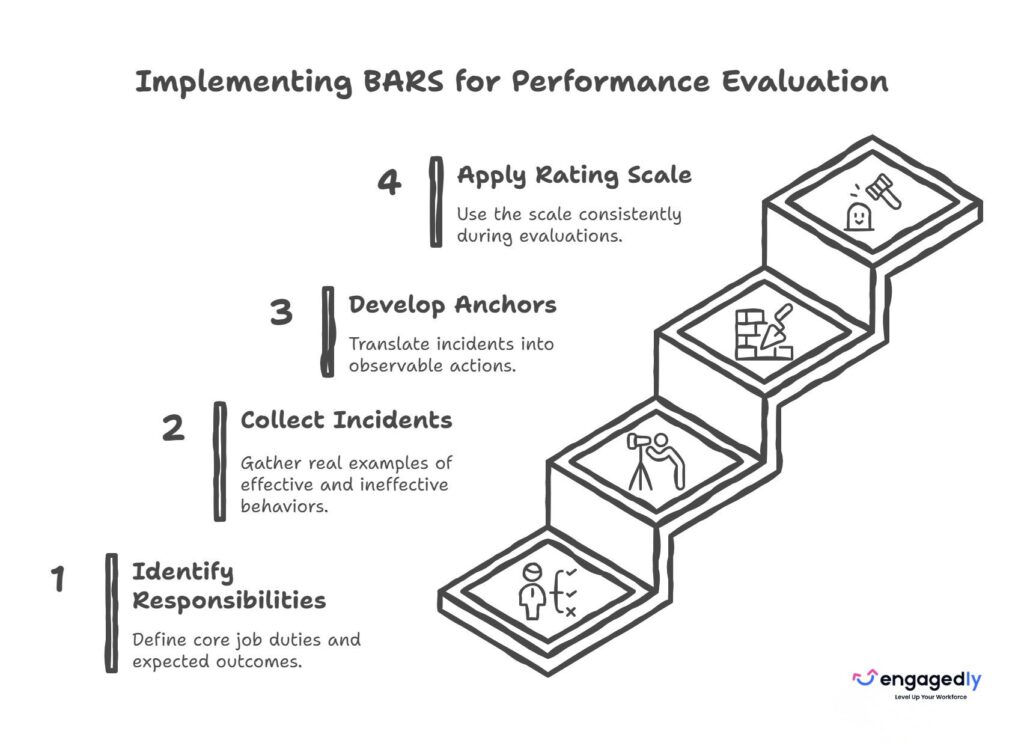
1. Identify Key Responsibilities
The Behaviorally Anchored Rating Scale (BARS) is a method that is very systematic and is always relevant to the process. It starts with defining the key responsibilities of the position under review.
This is about identifying what success means in a specific position, for instance, achieving sales targets, maintaining quality standards, or excelling in customer service.
2. Collect Critical Incidents
The next step that follows involves a collection of critical incidents which are examples of effective and ineffective behaviors of how each of the responsibilities is performed. Such occurrences are derived from interviews with employees, supervisors, and others who are involved.
For example, being critical in a project environment could include good handling of assignments and distribution of work in a short span of time or miscommunicating the changes in a project plan.
3. Develop Behavioral Dimensions
After such occurrences are established, Human Resource departments together with managers in the organization design the behavioral anchors for the rating scale.
These anchors define observable behaviors related to various levels of performance ranging from high to low. The anchors are then integrated into a numerical rated scaleto create more order for evaluations.
4. Create the Rating Scale
The scale is utilized during implementation for evaluating employee performance while considering the behavioral anchors. This makes sure that they are consistent and based on objective criteria.
Employees receive responses to their ratings depending on their score with recommendations for improvement.
By following this structured process, BARS assists in obtaining reasonable, transparent, and development-oriented performance appraisals.
Step-by-Step Guide to Build a BARS for Your Organization
Step 1: Job Analysis & Identify Key Responsibilities Begin with a clear job description and talk with subject-matter experts (managers, top performers, sometimes clients or internal stakeholders) to understand day-to-day responsibilities, critical tasks, expected outcomes. Document all major responsibilities and deliverables.
Step 2: Collect Critical Incidents (Positive & Negative) Use the Critical Incident Technique (CIT) — interview employees, supervisors, even customers/clients if relevant — and ask for real examples of effective and ineffective performance. For each “incident,” capture: what happened, the context, what was done (behaviors), and its impact (outcome).
Step 3: Translate Incidents into Observable Behaviors From the collected incidents, extract concrete, observable behavior statements (“Answered customer calls within first 2 rings and greeted politely,” “Missed deadlines twice in a month without prior communication,” etc.). Avoid vague traits such as “good attitude.”
Step 4: Group Behaviors into Performance Dimensions Cluster related behaviors under performance dimensions — e.g. “Customer Service,” “Teamwork,” “Quality of Work,” “Initiative,” etc. Make sure each dimension reflects a broad area of job performance but remains manageable (ideally not more than 6–8 dimensions per role).
Step 5: Anchor Behaviors to Rating Scale Levels Choose a rating scale (commonly 1–5 or 1–7). For each dimension and for each level, write a behavioral anchor: what performance at “1 (Poor)”, “3 (Meets expectations)”, “5 (Outstanding)” looks like. If needed, also define “2” and “4” for incremental gradations.
Step 6: Review, Refine and Validate Circulate the draft BARS among different stakeholders (managers, some employees, HR). Get feedback on clarity, relevance, fairness. Revise anchors for clarity, avoid overlap between levels, ensure language is neutral, inclusive, and observable.
Step 7: Rater Training & Calibration Session Before first use, conduct a calibration session: get all assessors together (managers, HR), walk through sample behaviors, discuss and align understanding of each anchor. Use example incidents (from real or hypothetical cases) and ask each rater to rate — then compare, discuss differences, and align.
Step 8: Pilot Test & Rollout Run a pilot with a small group (one department or team), collect feedback, observe challenges (e.g., ambiguous anchors, difficulty recalling incidents, inconsistent ratings). Adjust based on pilot findings, then roll out across organization.
Step 9: Feedback & Documentation After each review cycle, collect feedback from managers and employees about clarity, fairness, usefulness. Document suggested improvements.
Step 10: Periodic Review & Update At least annually (or when job responsibilities change), revisit your BARS: update critical incidents, anchor statements, or dimensions. Ensure the scale remains relevant to evolving job roles and organizational goals.
Following these steps will help ensure that your BARS is not just a theoretical tool, but a practical, context-sensitive, lived performance-management system.
Real-World Examples: Sample BARS Scales for Typical Roles
Example 1: Customer-Facing Customer Support / Service Role
Dimension / Rating
1 (Poor)
3 (Meets Expectations)
5 (Outstanding)
Customer Communication & Courtesy
Uses abrupt or unprofessional tone; often misses customer queues
Answers calls within 2 rings, greets politely, resolves common queries
Example 3: Team Lead / Manager (People + Task Management)
Dimension / Rating
1 (Poor)
3 (Meets Expectations)
5 (Outstanding)
Team Planning & Delegation
Misses deadlines or misallocates tasks causing delays
Plans sprints, delegates tasks evenly, delivers on time
Optimises workload, foresees bottlenecks, reallocates proactively, ensures team growth and balance
Mentorship & Coaching
No one-on-one feedback, rarely guides juniors
Conducts periodic feedback sessions, helps with issues when asked
Regular coaching, identifies development opportunities, helps team grow, builds internal talent pipeline
Stakeholder Communication & Reporting
Reports are often delayed or inaccurate
Shares accurate updates on time; escalates important issues
Proactively communicates risks and mitigation plans, influences stakeholders, ensures transparency
Advantages of Using BARS
1. Enhanced Objectivity
About performance evaluation, the BARS has numerous advantages that make it a preferred tool for performance assessment. One of its most significant advantages is its objectivity in the determination of evaluation indicators. BARS eliminates bias and guarantees uniformity in rating by linking them directly to behavior.
2. Consistency Across Evaluators
Management provides clarity within the organizationregarding performance expectations. Every rating is linked to clear behavior, and the employees grasp what it takes to achieve high ratings. This encourages employees to get closer to the organization’s goals by being able to clearly see them.
The process of producing BARS also occurs with a focus on cross-employee cooperation which helps to build trust. Engaging employees in defining critical incidents and anchors ensures the system is viewed fairly and relevant to the employees.
Moreover, BARS supports legal defensibility, as it relies on job-specific, evidence-based criteria, reducing the risk of disputes. All these benefits of acting in cooperation make BARS a quite credible and efficient tool for performance management.
Limitations and Challenges of BARS
Although there are many strengths associated with BARS, there are also some limitations and challenges associated with this scale.
1. Time-Intensive Development
One of the main issues is the time and resources required for the development and execution of the system. It is a considerable amount of work and cooperation simply to come up with a detailed and sound behaviorally anchored rating scale which involves identifying critical incidents, establishing behavioral anchors, and calibrating the scale.
2. Rigidity of the System
Unlike previous models that provide some room to make adjustments, there is a definite set procedure that cannot be altered in the current system.
BARS’s use of pre-defined behaviors makes the assessment of certain roles static and inaccurate in places where jobs are in constant evolution. This may be disadvantageous in dynamic industries where responsibilities evolve rapidly.
3. Stakeholder vulnerability & risk of Misinterpretation
The process of selecting critical incidents and anchors can also introduce subjectivity. However, because this initial development of the scale is done objectively, the results may contain biases of those involved in creating the scale.
4. Creativity or innovation
BARS may fail to support the occasions when employees are expected to provide innovative work or come up with some inspiring ideas, as the technique does not contemplate intangible productivity.
Finally, the process of training managers for the use of BARS may be an issue because people need to know the system and agree with its main principles.
It is therefore important to address these challenges to realize the full potential of behaviorally anchored rating scales in performance management.
Ensuring Validity, Reliability & Fairness
Why this matters: A BARS’s strength lies in clarity and objectivity — but poor design or inconsistent use can erode both. To maximize BARS’s effectiveness, treat it as a measurement instrument, not just as a checklist.
Key practices:
Use Subject-Matter Experts (SMEs): Involve multiple SMEs (managers, top performers, experienced staff) when writing anchors — to ensure content validity (that anchors reflect real behaviours relevant to job success).
Pilot-test before full rollout: Test with a small group, compare ratings between different raters for same employees, examine consistency.
Rater training and calibration: Conduct regular calibration sessions when ratings are done — walk through sample incidents, align understanding across raters. Helps reduce “leniency bias,” “halo effect,” and inconsistency.
Review inter-rater reliability (IRR): Periodically compute reliability statistics (e.g. % agreement, correlation) to detect divergence among raters — and retrain or revise anchors if reliability is low.
Ensure fairness and inclusion: Review behavioural anchors with an eye on diversity and inclusivity — avoid wording or behaviours that disadvantage certain cultural or communication styles. Also ensure behaviors are observable and objective rather than subjective impressions.
Document everything: Maintain documentation of BARS design, anchor decisions, calibration meeting minutes, and periodic reviews — for transparency and legal defensibility. Many organizations find BARS easier to defend legally because evaluations are evidence-based.
When BARS Makes Sense — And When It Doesn’t: Comparing with Other Appraisal Methods
Method
When It Works Best
When It Falls Short / BARS Is Better
Complementing BARS
Traditional Numeric Rating (Likert Scale)
Quick, simple reviews; when many roles are similar or outcomes are easily measurable
Often too vague or subjective; hard to compare across raters
When you want to standardize ratings across teams, departments, geographies
When defensibility (legal/HR audits) is important
When BARS may not be ideal:
Highly creative roles — where innovation, originality, creativity, and intangible contributions matter (e.g. R&D, design)
Very small organizations with limited HR bandwidth (because BARS demands resources)
Roles with fluid responsibilities or frequently shifting tasks — unless you’re ready to update anchors often
Common Pitfalls & How to Avoid Them
Common Mistakes Organizations Make with BARS — and How to Avoid Them
Too many performance dimensions — If you try to measure everything, the BARS becomes cumbersome. Aim for 5–8 dimensions per role. More dimensions cause complexity, reduce reliability.
Vague or generic anchors — Phrases like “good attitude,” “positive behaviour” or “hard worker” are subjective and open to interpretation. Always anchor to observable, specific behaviours.
Skipping rater training / calibration — Without calibration, different managers will interpret anchors differently, undermining consistency.
Failing to update the scale — As jobs evolve, old anchors become irrelevant. If not updated, BARS becomes stale or misleading.
Overemphasis on rare “critical incidents” only — If you anchor mostly on rare events, you may miss everyday performance. Balance anchors to cover routine behaviour as well as exceptional performance.
Ignoring contextual / environmental factors — Behavior doesn’t happen in a vacuum. If anchors don’t account for context (team size, resources, constraints), ratings may penalize employees unfairly.
Trying to use one BARS for too many different roles — Each role is unique; don’t try to force one BARS across dissimilar jobs.
Poor stakeholder buy-in — If employees or managers don’t trust or understand the scale, BARS becomes a compliance exercise rather than a meaningful developmental tool.
Tips for Effective Implementation of BARS
1. Engage Stakeholders
Applying the tool– Behaviorally Anchored Rating Scale (BARS) needs to be planned and executed properly. One of the following tips is to ensure collaboration during development. Involving employees, managers, and HR professionals in determining the critical incidents and defining anchors makes the system more relevant and acceptable.
2. Provide Training
Providing comprehensive training to managers is also pivotal, especially in relation to giving them broad knowledge. Managers need to know how to work with the scale, and how to offer constructive feedback in accordance with the scale results. Sometimes it is useful to give clear guidelines and examples that will be helpful for avoiding such gaps.
3. Monitor and Update
A major factor to consider that is frequently overlooked is periodic review and update. Since the job requirements keep changing, the critical incidents and anchors in the BARS should be reviewed as needed. Regular feedback from the employees and managers can also help refine the system.
Finally, other tools used in performance management, like the goals-setting tools or learning management tools, can be improved through integration with BARS. If organizations implement these tips, it would be easier for them to reap the benefits that are inherent in BARS and ensure its successful implementation.
Best Practices for Maintaining BARS Over Time
Set a regular review cadence: Revisit BARS annually (or whenever role responsibilities change significantly). During review, collect input from managers and employees about which behaviors are still relevant.
Record and analyze performance data: Keep historical BARS data. Use it to see if certain anchors never get used (e.g. no one ever rated “1” or “5”), which may indicate anchors are unrealistic or poorly defined.
Calibrate and re-train raters periodically: Especially if new managers join, or after major organisational changes. Calibration helps maintain consistency.
Integrate feedback loops: After each performance cycle, solicit feedback — were the anchors clear? Were there missed behaviors? Use surveys or focus-groups.
Align BARS with company strategy and values: As organizational goals shift, update behavioural dimensions to reflect new priorities (e.g. collaboration in hybrid teams, remote-work communication, innovation, adaptability).
Communicate changes clearly: If you revise BARS, share updated scales with all stakeholders; explain why changes are made; ensure buy-in before next appraisal cycle.
Future of BARS in Performance Appraisal
The future of the Behaviorally Anchored Rating Scale (BARS) is promising, in the context of the current pursuit of fair and useful methods of performance evaluation by organizations.
BARS is likely to become better organized and more user-friendly with the overall enhancements in HR technology. For example, by using AI tools, certain processes like identification of critical incidents and generation of behavioral anchors can be developed with less time.
The focus on employee experience is also beneficial for BARS. Since BARS target behaviors instead of results, it forms a part with the trend of employee growth and engagement. The kind of feedback it offers makes it suitable for use in talent management in today’s organizations.
In addition, as the organizational work environment becomes more diverse and companies embrace hybrid and remote work models, BARS allows behavior assessment specific to virtual environments, such as online collaboration or remote communication.
In the long term, BARS can be easily integrated with analytics platforms which can provide analysis of performance trends and find out ways to improve organizational results. Therefore, by adapting to changing workplace dynamics, BARS is equipped to go on being a keystone in the framework of performance management.
BARS in the Modern Workplace: Remote Work, Hybrid Teams & Tech Integration
Rethink behavioural anchors for remote / hybrid work: Some behaviours become more relevant — timely asynchronous communication, responsiveness in chat/email, proactive updates, documentation, remote collaboration, virtual meeting etiquette, self-management, initiative in absence of supervision.
Capture new dimensions: In remote settings, you might add dimensions like “Remote Collaboration & Communication,” “Documentation & Transparency,” “Self-Management & Autonomy,” “Response Time / Availability,” “Knowledge Sharing.”
Use technology & analytics tools: Modern HR platforms, performance-management software, or HR analytics tools can help you:
Store and standardize BARS templates across teams;
Collect incident data (via forms, event logs, project trackers);
Track performance trends over time;
Automatically flag potential fairness or bias issues;
Provide dashboards to managers and employees for continuous feedback.
Combine BARS with continuous feedback practices: Instead of relying only on annual reviews, embed BARS-based feedback in regular check-ins, 1:1s or quarterly reviews. This keeps behaviour-performance alignment in real-time.
Leverage BARS for remote onboarding and training: For new hires working remotely, BARS provides clarity about expected behaviours and performance standards — helps them understand what success looks like.
By combining objectivity and actionable feedback, BARS supports the continuous development of an organization. While companies such as Engagedly seek to redefine HR technology by developing new approaches in various fields, adopting methods like BARS remains a useful tool and a foundation for effective performance management.
FAQs
What is the behaviorally anchored rating scale?
The behaviorally anchored rating scale is a scale that measures the performance of new staff or trainees in accordance with certain stipulated behavior patterns. These patterns are used to determine the rating of an individual employee.
How do you use the scale of the BARS?
The BARS method involves a scoring scale that runs from a low of 1 to a high of 5. This scale is also useful in self-assessing and appraising the performance of employees where the actual behavioral exhibit is tied to each of the scale points.
What makes BARS unique in relation to all the other performance appraisal techniques?
BARS is a performance appraisal technique that measures performance based on measurable behaviors pertinent to the job. They deviate from the traditional methods by using descriptive behavioral anchors tied to a numerical scale, which lessens objectivity.
How is BARS developed?
BARS is generated with the use of critical incidents, the formulation of behavioral referents for each level of performance, and the establishment of a rating scale. Contributions from employee and manager respondents, as well as HR practitioners, help maintain its relevance and accuracy.
Which industries can be associated with the usage of BARS?
BARS is implemented in such sectors as healthcare, education, hospitality, and corporate among others since performance can be measured from definite behaviors.
Gabby Davis
Gabby Davis is the Lead Trainer for the US Division of the Customer Experience Team. She develops and implements processes and collaterals related to the client onboarding experience and guides clients across all tiers through the initial implementation of Engagedly as well as Mentoring Complete. She is passionate about delivering stellar client experiences and ensuring high adoption rates of the Engagedly product through engaging and impactful training and onboarding.