



How Performance Management Has Changed In 2024?

The year 2020 has been a roller-coaster ride for all due to the COVID19 pandemic. While we are almost in the fourth month of the year 2024, we are still unsure how the rest of the year will turn out to be. Remote working or hybrid working has become the new norm and is still likely to continue for sometime. This new era of working has allowed employees to work flexibly, increase their productivity, put in extra effort, and work from anywhere while managing their personal lives. But it has also resulted in an increase in the number of employees reporting burnout, stress, and anxiety. As the way we work has changed, performance management also needs a more comprehensive approach. Here are some trends that are already shaping up and are here to stay.

Performance Management Goes Virtual For All

When everyone shifted to working from home or remote working, it became difficult for organizations to manage their employee’s performance. So most companies shifted to cloud-based applications or tools from the traditional approach. In our recent survey to understand the impact of COVID on Performance Management and Employee Development, we found that performance management has gone virtual and more progressive. Here are some of the results from the survey:

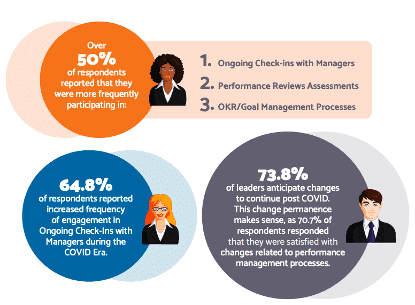
  • Over 50 % of organization leaders reported that their employees were more frequently participating in check-ins, performance review assessments, and OKRs and Goal Management
  • 64.8% of respondents reported increased frequency of engagement in ongoing check-ins with managers in the COVID Era
  • 73.8% of respondents said that these changes would continue even post COVID, and 70% of them were satisfied with these changes

We also found that organizations are now focussing more on continuous performance management than a yearly or half-yearly review of performance.

Download The Whitepaper

People Development Becomes Feedback Focussed

In the survey mentioned above, we also found that people’s development has become on-the-job and based on real-time feedback. More and more organizations are focusing on sharing immediate or real-time feedback with their employees. When feedback is shared only during reviews or appraisals, it loses importance, and often employees fail to connect the dots. On the other hand, regular feedback helps employees know what they are doing right and what to improve on. It helps them reinforce the practices that will help the organization grow. It boosts their morale; motivation and satisfaction level. We can say that regular and continuous feedback has become an important part of performance management for the virtual workforce.

Also Read: A 7-Step Guide To A Successful 360-Degree Feedback Process

The Need for Skill Development and Mentoring

Skill Development and Mentoring are a big part of employee performance management in the virtual working environment. It is the right time for employees to upskill and cross-skill themselves. Frequent check-ins and feedback help managers understand their employees better. As a result, managers can identify their training and development needs easily. Give your employees access to online training academies such as Coursera, Udemy, edX, etc.

This is also the right time to start a mentoring program for your employees. Having a mentor in these uncertain times will be helpful for your employees. A mentor will help in the personal and professional development of your employee. Invest in mentoring software such as Mentoring Complete uses its proprietary algorithm and a 3-step matching process to find the correct mentor-mentee match.

When an employee sees that the organization cares for their growth and development, they feel empowered, confident, and committed to their work. It results in a decrease in employee turnover and an increase in retention.

Enhanced Streamlining of Goals and Alignment

Goal Setting and Alignment have always been a crucial component of performance management. It helps employees stay focused, engaged, and stay motivated at all times. Traditionally companies planned their goals for the entire year or half-yearly. However the current volatile nature of business has forced organizations to set short-term goals. More and more organizations have started using the OKR methodology to set their SMART goals. 

Successful organizations such as Google, Amazon, Disney, LinkedIn, etc., use OKRs or Objectives and Key Results to set their goals. OKRs consist of two components – Objectives: a clearly defined goal to be achieved, and Key Results: measurable steps to achieve the objectives. Each objective should have 3-5 key results. OKRs help employees to set and align individual goals to the organization’s goals. Additionally, OKRs help everyone identify measures of success, prioritize tasks, and set stretchable goals. They can be easily updated or discontinued as per changing business needs.

Also Read: OKR Goal Setting For Successful Businesses

Focus on Wellbeing And Employee Experience

As per recent research in Harvard Business Review, employers who invested in the well-being of their employees saw three times the return on their money spent.

Employee well-being and experience are the essence of performance management for remote employees in 2024. It is a year when companies cannot focus on providing the best customer experience alone! They also need to focus on providing the best employee experience. Failing to do so will impact employee engagement and productivity. But with employees working remotely, it often becomes difficult. Here are some ways that will make it easy:

  • Use tools like Engagedly and engage in regular two-way communication and feedback. It will help you keep a pulse on employee’s engagement levels
  • Offer or conduct virtual yoga or gym sessions through Zoom or Google Hangouts
  • Give them access to online doctor consultation platforms
  • Reward and recognize them to keep them motivated
  • Have ‘Virtual watercooler’ sessions

This helps in creating a better experience for your employees. They are fit, satisfied, and happy at their jobs. Not only this, but it also helps in improving employee retention and employee engagement. Needless to say, it also results in innovation.


Are you planning to invest in a performance management software? Then request for a live demo.

Request A Demo

7 Common Goal Setting Mistakes Managers Should Avoid

With many organizations still functioning remotely, it is crucial for employees to have clear and well-defined goals to keep them on track and focused. Having clear goals helps them improve their productivity, enhance their decision-making skills, and keep them motivated and engaged.

It is almost the end of the first quarter of 2021, and it is time to set goals for your second quarter. So it is necessary to set them right, and avoid the mistakes made previously. Here are seven common goal setting mistakes to avoid when setting goals for yourself and the team.

Failing to Set SMART Goals

We understand setting SMART goals might sound a little bit cliche, but you simply can’t ignore it. George T Doran introduced SMART goals in 1981, and it has been used by organizations worldwide since then. When employees don’t set SMART goals, they lack direction and fail to understand their goals clearly. SMART goals have five main key focus areas:

– Specific: Goals should have a specific purpose. It becomes easier for employees to understand. If goals aren’t specific, they will fail sooner or later

– Measurable: Goals must be measurable so that employees can track the progress of their goals. It will help them track achievements and define success

– Achievable: Goals cannot be too easy, nor can they be too difficult. Easy goals will not challenge the employee, whereas a difficult one will demotivate them

– Relevant: Goals should be relevant and linked to the overall organization and department goals

– Time-Bound: There needs to be a specific time within which the goal needs to be completed. When goals are time-bound, it drives performance, and employees stay motivated and engaged

Also Read: 5 Reasons Why You Need A Performance Management Software

Excluding The Employees

As per recent research by Gallup, only about half of employees understand their job expectations.

Often managers commit the mistake of excluding the employees from the goal setting process. This results in employees lacking a clear understanding and expectation of their goals. Instead, it should be a collaborative effort between the manager and the employees. Employees, when they are part of their goal setting process, they feel more accountable for it. Additionally, the employees don’t feel the goals as forcefully imposed, which results in job satisfaction and increased productivity.

Non-Aligned Goals

According to a report by McKinsey&Company, 91 % of businesses noticed an improvement in profits when organization goals and key strategies were linked to team performance goals.

Non-aligned goals lack directions. Furthermore, employees fail to understand how they contribute to the bigger picture. For employee goals to be effective, they should be aligned with the team, department, and organizational goals. Employees who understand what role they play in an organizations’ success tend to be more productive and are more engaged at work. When they know how they contribute to the overall picture, they are more focused and motivated, which results in success for the organization.

Goals Are Not Flexible

It is often possible that the objective of a goal itself changes even after an employee starts working towards it. In this case, it is wise to update the goals as per their needs. Static goals often affect the motivation and productivity of the employees. Most organizations commit the mistake of not revisiting their goals or updating them until it is time for employee performance reviews. Having flexible goals makes them relevant and important for the employee and the organization.

Also Read: How To Conduct An Effective 360 Degree Feedback?

Fail To Track Progress

As mentioned above, organizations often fail to revisit the goals until performance reviews. It results in employees failing to understand what they are doing right and need to keep on doing, and what they are doing wrong and need to stop.

When goals are tracked, it helps identify problems as well as their progress. As a manager, help employees identify key milestones and set up a timeline to achieve the same. Review the progress of the goals from time to time and share feedback with your employees. This will help them to stay focused and aligned with the organizational goals.

Ignoring The Small Wins

“People work for money but go the extra mile for recognition, praise and rewards.” — Dale Carnegie, Leadership Training Guru, and Author.

Setting clear and well-defined goals is crucial, but it is also necessary to take out time to recognize and reward your employees. When you recognize or reward your employees on small wins, they are motivated to achieve further. But failing to do so often makes employees feel undervalued and unimportant, and they get derailed from their goals. A lack of appreciation decreases their morale and motivation to work. It reduces the engagement and productivity of the employees. On the other hand, even a small announcement on the company website or social media or paying bonuses is enough to make them feel appreciated.

Additionally, it helps in creating a culture of appreciation throughout the organization.

Also Read: 5 Benefits Of Investing In Employee Recognition Software

Not Using A Goal Setting Software

We all know COVID-19 has changed the way we all work today. Organizations globally have ditched the traditional goal setting process and have invested in a goal setting software. If your organization has not invested in one yet, it is the right time to do so. Goal setting software helps the creation and managing of goals easier for everyone in the organization. In addition to that, it also improves the visibility of the goals and helps to track them easily.


Do you want to know how Engagedly can help you with setting effective goals? Then request for a live demo.

Request A Demo

Performance Management: Post COVID Changes To Get Used To

The secret of change is to focus all of your energy not on fighting the old, but on building the new. – Socrates

Remote work is not the only aspect of change in the past year. COVID-19 has made sure that everything that was once normal is not so anymore. So we at Engagedly sought to understand these changes (esp. with performance management), how they are impacting us today and whether these changes are permanent. 

We surveyed to understand the situation better and bring to you information that will help you improve employee engagement and learning. 

In the previous edition, People Development Goes Virtual and More Feedback Focused, we discussed how the pandemic has impacted learning and development, and feedback. In this edition, we will discuss the comprehensive overview

The Performance Management Survey: 

We asked leaders from 5 key industries to report the degree of change for different performance management processes. They were to report whether or not each of the performance management processes was occurring more or less frequently during COVID-19. 

They responded on a five-point scale (1= significantly less frequent and 5 = significantly more frequent).

What did we find?

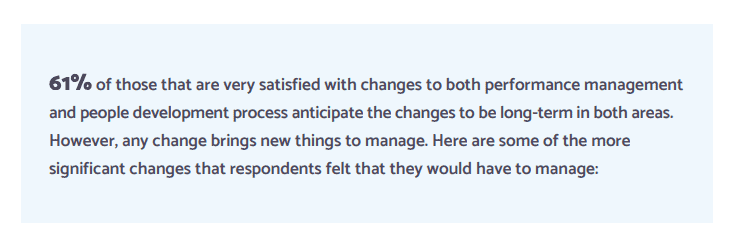
Overall, 20% of respondents were very satisfied with the changes they experienced related to performance management and people development processes. These are the leaders that reported being very satisfied (5, on a 1-5 point likert scale measuring satisfaction) with the changes to performance management and people processes that they experienced due to COVID-19. 

Taking a deeper look into those who were very satisfied with the changes provides some additional insights to guide future initiatives. 

Also read: Performance Management Gone Virtual and More Progressive

When asked, “What specific process change(s) to people development had the biggest impact on your satisfaction?” There were a few key themes that surfaced: 

  • Improved training technologies/processes 
  • More frequent and accessible trainings for employees 
  • Breadth of training offered 

When asked, “What specific process change(s) to performance had the biggest impact on your satisfaction?” Here were a few key themes that surfaced: 

  • Incentivizing/recognizing employees for good/improved performance and adherence to new policies 
  • Checking in more frequently with employees about performance and asking them how they were doing personally as well (well-being) 
  • Optimization of systems and technology 
  • Transitioning back to the in-person work environment and work schedules Investments in technologies 
  • Supporting the more flexible work environment and coordinating the work of the team(s) 
Also read: Know How to Make Employee Feedback Work

We are still amidst the fog of COVID and its remote work environment when it comes to most of the workplaces in the US. It still remains to be seen if these changes are widespread permanence or if they will be more industry-specific. While we do anticipate that there will be some retrenchment to the old way of managing Performance and Learning & Development but it seems quite likely that we will not go back to pre-February 2020 days

When looking at the data and insights we can always learn a lot from those that are doing well, or have had a favorable experience. Though our natural tendency is to fix the broken parts, sometimes a fix is as easy as replicating or copying where things are working well. These lessons can come easily from both internal and external sources. All we need to do is be mindful of this fact, and stay curious.

Want to view the detailed report? Click here.


Want to know how Engagedly can help you with implementing continuous feedback? Then request for a live demo

Request A Demo

People Development Goes Virtual and More Feedback Focused

2020 has taught us many things. But most importantly, it has made us realise the power of technological advancement and digitization. In our previous edition, we brought to you details on how Performance Management has Gone Virtual and More Progressive. In this edition, we will discuss people development and employee feedback in the post pandemic era. 

While technology and digitization has allowed us to continue working through the pandemic period, what about learning and reskilling? Your employees require learning and development too, especially in today’s day and age. So with the transition to remote work and organizations’ inability to conduct in-person training, we anticipated an increase in virtual and technology-driven learning and development

We decided to conduct a survey to understand the situation better and bring to you information that will help you enhance employee engagement and learning. 

To assess the extent of the changes COVID has brought upon us, we reached out to leaders and HR heads. They were asked to report the degree of change for different people development processes by reporting whether or not each of the development related processes was occurring more or less frequently during COVID. They responded on a five point scale (1= significantly less frequent and 5 = significantly more frequent)

We focused the questions on the following people development processes: 

  • Online Training from External Content Providers 
  • Online Training from Internal Content Providers 
  • Live Online Training from Internal Teams 
  • Live Online Training from External Content Providers 
  • Ongoing Feedback 
  • Developmental Assessment(s) (i.e. 360, Personality, etc.) 

Guess what we found?

The changes in people development was more pronounced than the changes in Performance Management Processes. Over 50% responses indicate that they took part in all 5 of the people development processes that were assessed in more frequency. Moreso, Online Training from Internal Content Providers, reported the largest change with 69.1% of leaders reporting that this was occurring more frequently now. 

This was followed by Live Online Training from Internal Teams, Online Training from External Content Providers, Ongoing Feedback, Live Online Training from External Content Providers, and Developmental Assessment(s) (i.e. 360, Personality, etc.), respectively. This explains the recent uptick in employee development training vendors growth across the entire spectrum. We then took to assess if the leaders are satisfied with these changes and expect these changes to continue.

Here is what we found: 

Answer to Research Paper survey

Key takeaways for you:

As learning and development technologies and approaches have evolved to take on more virtual and real time feedback (on the job development), COVID has acted as an accelerant to these changes as anticipated. While organizations are actively embracing learning technologies and more progressive approaches to development like Real Time Feedback and Coaching, it remains to be seen if this is here to stay. Given the level of satisfaction with remote work changes, the future work environment may embrace a hybrid model (remote and in office), so we anticipate many of these shifts will be permanent.

Want to view the detailed report? Click here.


Do you want to know how Engagedly can help you with Performance Management? We have live demo for you.

Request A Demo

Performance Management Software : Here’s Why You Need It

Measuring employee performance is one of the crucial objectives for every organization. Globally, organizations have started ditching the traditional way of managing performance and are adopting the modern approach. They have moved away from traditional paper-based reviews to using performance management software.

Performance management software is known to increase employee engagement, boost motivation, and facilitate two-way communication. Not only this, it helps in better management of employees and land also increases the efficiency and accuracy of employee performance reviews.

If your organization still haven’t invested in a performance management software, read on to know why you should.

Feedback Module

Feedback is critical to driving employee engagement and retention. For feedback to be useful, it needs to be frequent and on the spot. Performance management software makes sharing and receiving feedback a lot easier for both the employees and managers. It allows for consistent and ongoing sharing of feedback on a real-time basis. Instead of waiting for the performance reviews, managers get to share feedback with their employees instantly. It gives employees the flexibility to ask for feedback whenever required. Timely feedback helps good employees become better and the ones not up to the mark to improve. Ken Blanchard (American Author) rightly says ‘feedback is the breakfast of champions.’

A performance management software not only facilitates two-way communication but also improves collaboration. It in turn improves employee engagement and retention.

Rewards, Recognition And Gamification

Like feedback, employees feel the constant need for recognition of their work. Receiving timely recognition boosts employee’s confidence, and they get validation for their work. Celebrating the wins of your employees keeps them motivated and engaged. Most of the performance management software that is available in the market have a built-in employee recognition and rewards module. They allow you to recognize and reward your employees instantly for their work.

For example, using tools like Engagedly, you can publicly praise or award points to your employees.

Also Read: Recognition At Work : The Virtual Edition

Goals And OKRs

Goal management is an important process for all organizations. It helps employees to stay focused on a common goal. Moreover, it helps in measuring the overall progress. A performance management software enables employees and the organization to set clear, SMART, and dynamic goals for themselves. In addition to this, it allows individuals to cascade their goals and also align them with the organization’s goals. It helps everyone to work towards a common goal.

Multirater Feedback

Employees not only love receiving feedback from their managers, but they love it from their peers too. 360 degree feedback is increasingly becoming popular among organizations and is a common module of most performance management software. In this process, employees receive feedback from multiple audiences, which includes managers, peers, subordinates, vendors, and customers. Employees get an overall and balanced perspective of their performance. Moreover, it bridges the gap between what an employee perceives and what others think about the employee. It also allows employees to share feedback about their managers anonymously without the fear of getting subjugated.

We can definitely say that 360 degree feedback not only helps in the self-awareness of the employees but also promotes an open culture in the organization.

Also Read: How To Conduct An Effective 360 Degree Feedback?

Improved Transparency & Reduced Bias

Performance management software offers a great deal of visibility to everyone in the organization. Every stakeholder has a clear view of the progress of goals, feedback, and ongoing projects. Moreover, as it logs in data consistently, it reduces the chance of any biases or favoritism towards an employee. It leads to creating a sense of trust and open culture in the organization.

Analytics and Insights

Performance management software provides detailed insights about an employee’s performance in the form of detailed graphs and charts. It helps employees to make decisions about their skills and developmental needs. Additionally, it helps managers and organizations to make compensation and promotion-related decisions during annual or half-yearly reviews. Not only this, but it also saves employer’s time during reviews as all the information is already there in the performance management software.


Do you want to know how Engagedly can help you with Performance Management? We have live demo for you.

Request A Demo

Performance Management Gone Virtual and More Progressive

2020 has been a year of complex experiences, revelations and learnings. As a result, we have understood that the way the world works can change drastically without warning. Most working people today are facing uncertainties coupled with family needs and probable financial tensity, presenting unprecedented challenges. Our functions and ways of life need to change in tandem. 

A recent research by SHRM shows that ‘work-related concerns have left more than 40 percent of employees feeling burned out.’ In fact, many organizations have even taken the decision to skip performance reviews this year. 

Keeping a tab on these ongoing transitions, we sought to understand how the recent shift in the way we work has affected performance management and people development processes. We curiously asked ourselves the question, “What has changed in performance management and people development during the COVID era?” To have a closer look at the changes and how it affects us, we conducted surveys on performance management and people development processes. 

Want to know what we found? We will get there in a moment. But before that, allow us to give you some details about the survey.

Which industries did we cover? 

The survey covered about 20 different industries. However, our results clustered into 5 key industries: 

  • Construction
  • Manufacturing
  • Healthcare
  • Financial
  • Telecommunications

These 5 key industries accounted for 50% of responses to the survey. (View survey)

What was the survey about?  

As we have mentioned before in this article, we wanted to gauge how the pandemic has affected performance management. So we asked the leaders to report the degree of change for different performance management processes by reporting whether or not each of the performance management processes was occurring more or less frequently during COVID-19. They responded on a five point scale (1= significantly less frequent and 5 = significantly more frequent).

We focused the questions on these key areas performance management processes:

  • Pay for Performance Incentives
  • Usage of Performance Ratings
  • Focus on OKR/Goal Management Processes
  • Frequency of Reviews/Assessments
  • Ongoing Check-Ins with Managers/Others

Wait! The survey does not end there. We wanted to be slightly more thorough. So after they reported on the degree of change they experienced during COVID, we asked the leaders two additional questions.

  1. Do you anticipate the changes to continue post COVID? (Yes or No)
  2. How satisfied they were about the changes to the performance management processes due to COVID? (1 = Very Dissatisfied and 5 = Very Satisfied).

Here is what we found! 

Performance Management and Talent development

So now that we have a better understanding about the changes in performance management and their impact, we come to the next important step.

Read: Performance Management and Employee Development in the Covid Era

Key takeaways for you:

  1. Performance Management process changes from once-a-year reviews to a continuous approach has been an ongoing shift. But it is clear that the impact of COVID to a virtual workforce has been an accelerant in that shift. 
  2. Organizations are moving to a more continuous check-in based approach and also towards a Goal/OKR oriented approach to managing performance.
  3. Moreover, what we learnt from this survey is that these changes were welcomed by the leaders by and large. 

Then the key question becomes, do these changes stick or is this only a temporal effect?

  • It seems (at least from the current responses) that these changes may be permanent in the post COVID workplace. Permanence may be driven due to the fact that these shifts to a more progressive approach were well received and hence, there will be little reason to go back to the ‘Old Way’ of doing things.

Among the other questions, we pondered regarding use of ratings in performance reviews and changes in pay-for-performance models. It appears there was some shift in doing more Ratings-based Reviews and increased Pay for Performance, but the data did not suggest that it was significant enough to make a claim that that shift was more than temporary, possibly due to cost containment efforts. We will need to run another study in a few months to test our hypothesis. So keep a look out for the follow ups on this piece!

Want to view the detailed report? Click here.


Do you want to know how Engagedly can help you with Performance Management? We have live demo for you.

Request A Demo

Top 7 Performance Appraisal Mistakes Managers Make

Performance Appraisal is one of the most important process in an organization, especially for the employees. But often, employees feel unsatisfied and harbour a bitter feeling towards the managers and the organization once the process is over. It happens because of some of the common mistakes which the managers make in conducting the process.

Here are some tips to help you measure your employee’s performance better.

Halo Effect

When a real time performance management software is not in place to conduct continuous performance evaluations, managers tend to have a clouded judgement because of recency bias. They tend to forget past work and achievements of employees and conduct the performance appraisal based on just their recent work.

A manager should do their background work on knowing about the tasks and achievements of the employee, or have a real time performance management system in place to keep a track of it.

Also Read: Don’t Let Recency Bias Affect Your Performance Discussions

Make It Regular

Often managers commit the mistake of holding their reviews and feedback until it’s time for annual performance appraisal. They fail to realize what impact an instant and continuous feedback process can have on their employees. As a result, the employees are not sure when they are working in the wrong direction or right.

The managers believe that performance appraisal is the right time to provide feedback to their employees. But as performance appraisals happen half-yearly or annually in most companies, it becomes too late to receive feedback for some work which was done at the beginning of the year. Using a real time performance management software would solve the problem easily. Their progress can be easily tracked and reviewed, and it will not be a surprise for them at the time of appraisal.

Absence Of An Action Plan

Often managers and employees leave out one key component from the performance appraisal… discussion about future plans. A manager’s job involves not only assessing the employee at present but also guiding them in achieving personal and career goals of the future. This helps in an easy career transition of an employee. They can easily switch roles, and also change projects as per their plans.

Also Read: Understanding Employee Wellbeing In 2021

Not Recognizing Achievements

In a recent survey conducted by Bureau of Labor Statistics, they found that 25% of employees leave organization due to lack of recognition.

If your organization is not practicing a continuous feedback approach to recognize your employees, then performance appraisals are just the perfect time to do so. Instead of focusing too much on negatives and criticisms, appreciate your employees for their accomplishments and strengths. This type of constructive feedback will not only improve their productivity at work, but will also improve their engagement.

Using Engagedly’s Real Time Performance Management Software you can publicly praise your employees and also award points for accomplishments. The praises and rewards will be visible to everyone in the organization.

Delaying The Process

Many organizations tend to postpone or altogether cancel the performance appraisal process. They are not the only yardstick to measure employee performance, but employee promotions and salaries surely depend on it. To delay or postpone them creates a bad impression of the manager or the organization on the employees. Employees might feel that they are not given enough importance, and all the organization cares about is work. If managers are not getting an ample amount of time to conduct a yearly performance review, they can opt for continuous feedback or quarterly reviews.

Failing To Set SMART Goals

As a manager, performance appraisal is the correct time to set SMART goals for your employees based on past goals and objectives. Give them an outline of what is expected from them in the next performance cycle. The acronym SMART stands for:

  • Specific–Goals should not be vague, or else they are bound to fail soon
  • Measurable–An ideal goal should be measurable so that the progress and completion can be tracked. Measurable goals help us define its success
  • Achievable–Any goal should be achievable; they shouldn’t be too difficult or easy
  • Relevant–Goals should be relevant
  • Timely–Goals should specify the time during which it is to be completed

An ideal example of a SMART goal for an IT project would be to complete 60% UI/UX (Specific, Measurable, and Achievable) designing of the website in two months (Relevant and Timely). The goal should not be rigid and should be flexible to changes.

Also Read: Here’s How To Set Effective Goals For Your Employees

No Follow Up

A perfect performance appraisal, SMART goals, timely rewards, and recognition; all of these would be of no use if there is no follow up from your end. Check with your employees from time to time if the project is on track and development plans are met and milestones achieved. If there is no proper follow-up, employees often fall through the gap and lose their motivation, which ultimately affects productivity.

Implement real time performance management software at your organization to conduct your performance appraisal with ease. It will not only help you to track your employee’s progress and goals easily, but also provide continuous feedback to them, which will keep them engaged and motivated at their work.


Want to know how Engagedly can help you manage your employee’s performance better? Then request for a live demo.

Request A Demo

5 Reasons Why You Need A Performance Management Software

COVID-19 has completely changed the way organizations work today. With most of the workforce still working from home and processes gone virtual, it is crucial to have an effective performance management process in place. While paper-based or traditional performance management processes would have been feasible if the workplace was not remote or organizations were small. But considering the current scenario, organizations need to invest in performance management software to manage their employees.

In this article, we will highlight how having performance management software can benefit your organization in this era of remote working. Here are the reasons.

Effective Goal Setting And Management

A recent study by Gallup indicates that about 50% of employees do not know what is expected of them at their workplace.

Performance Management Software or PMS allows organizations to set well-defined goals for their employees. It helps employees to align their individual SMART goals to the company’s vision, mission, and goals. They offer better visibility of goals and help everyone understand how their efforts contribute to the higher-level goals. Moreover, it allows managers to track and measure progress and provide feedback on goals whenever required. It not only makes the process of goal setting simpler but also makes it easy to track and manage them.

Also Read: What To Look For In A Goal Setting Software

Real-Time Feedback

Feedback, whether positive or critical, is crucial for employee development. Additionally, it is also responsible for driving employee engagement and retention. But feedback can only have an impact when it is on time. Having performance management software helps feedback to be instant and real time. Managers can share their feedback whenever they want, irrespective of different time-zones and geographies. It helps in facilitating two-way communication between the employees and their managers, improves collaboration, and thus helps in building a strong team.

Multirater Assessment

Multirater assessment or 360 degree feedback is one of the most popular modules in Performance Management Software. In this process, employees receive anonymous feedback from people with whom they have a working relationship. These participants include peers, direct reports, managers, customers, and even vendors. Employees receive a comprehensive perspective of their performance and behavior. It helps them bridge the perception gap that exists between self-evaluation and what others think about them. Moreover, it helps them understand their potential blind spots and gaps. Since feedback is from multiple sources, it is less affected by bias and is more acceptable to everyone.

Also Read: The Importance Of  360 Degree Feedback For Healthcare

Celebrating Small Wins

Most performance management software has an in-built employee recognition and rewards module. It helps managers and leaders to celebrate the small wins of their employees. It is human nature to love appreciation and praise for their hard work. So when employees receive appreciation or rewards, they feel motivated and engaged. It increases job satisfaction and happiness at work.

Engagedly’s Real Time Performance Management Software comes with a public praise option, where employees can praise each other.Managers and other leaders also have the option to award points for the accomplishments of their employees.

Analytics

Performance Management Software collects data over time and provides a detailed analysis of employee’s performance. With the help of detailed charts and graphs, managers get a clear idea about the performance trends of the employees. It not only helps employees to assess their own performance but also acts as a guide when deciding on skills and developmental needs. Moreover, the analytics report of the performance management software makes the quarterly, half-yearly, or yearly review process more productive and saves time.

Also Read: 5 Simple Ways To Build A High Performance Team

Are you looking out for a performance management software for your organization? Then request a live demo.

Request A Demo

Here’s How To Set Effective Goals For Your Employees

In 2020, when everyone is working remotely, the importance of setting effective goals cannot be undermined. Having clear and well-defined goals help employees to be engaged and stay focused at work. It motivates them, helps prioritize work, and enhances decision-making skills.

If you are setting or planning goals for yourself, then it might seem quite easy to manage. But as a manager, if you are setting goals for your team, then it is not an easy task to make them effective.

Here are some tips by which you can set effective goals for your employees.

Set SMART Goals

The concept of SMART goals was first introduced by George T. Doran in 1981 and has been in use ever since. SMART goals help employees understand their goals better, which improves their chances of success. It focuses on five key areas:

– Specific: Goals should be clear and specific. It becomes easier for employees to understand what is to be achieved. If goals aren’t specific, they will fail sooner or later

– Measurable: Goals must be measurable so that employees can track the progress of their goals easily. It will help them track achievements and define success

– Achievable: Goals cannot be too easy, nor can they be too difficult. Easy goals will not challenge the employee, whereas a difficult one will demotivate them

– Relevant: Goals should be relevant and linked to the overall organization and department goals

– Time-Bound: Goals need to be carried out within a specific time period. When goals are time-bound it drives performance, and employees stay motivated and engaged

Also Read: Why Healthcare Administrators Should Set SMART Goals

Include Your Employees

As per recent research by Gallup, only about half of employees understand their job expectations.

The goal setting process should be a collaborative effort between a manager and an employee. Encourage employees to identify their own job-related short-term and long-term goals. Once the employees have identified their goals, managers should guide them to align it with the business objectives. When employees set their own goals, they feel more accountable for the results. In addition to this, the goals do not feel imposed, and they tend to be more productive and engaged at work.

Also Read: The Essential Guide To Employee Productivity In A Hybrid Setup

Align The Goals

According to a report by McKinsey&Company, 91 % of businesses noticed an improvement in profits when organization goals and key strategies were linked to team performance goals.

For employee goals to be effective, they should be aligned with the team, department, and organizational goals. Employees who understand what role they play in an organizations’ success tend to be more productive and are more engaged at work. When they know how they contribute to the overall picture, they are more focused and motivated, which results in success for the organization.

Make Them Adaptive

Goals should be flexible so that they can be updated with the changing priorities of the organization. Most organizations commit the mistake of not revisiting their goals or updating them until it is the time for employee performance reviews. Having flexible goals makes them relevant and important for the employee and the organization.

Also Read: Employee Engagement Software To Help Enhance Productivity

Track The Progress

Once the goals have been set, the next step is to create a plan to track and monitor the progress of the goals. When goals are tracked, it helps identify problems as well as the progress of the goals. As a manager, help employees identify key milestones and set up a timeline to achieve the same. Review the progress of the goals from time to time and share feedback with your employees. This will help them to stay focused and aligned with the organizational goals.

Reward The Achievers

“People work for money but go the extra mile for recognition, praise and rewards.” — Dale Carnegie, Leadership Training Guru, and Author.

When employees receive recognition and rewards for their work or completed goals, it shows that their work is being valued and appreciated. Rewards and recognition can be in the form of certificates, simple acknowledgments, bonuses, or even announcing it over the organization’s social media. It reflects organization values and helps in building a culture of appreciation throughout the organization. It also works as an encouragement for others to work hard.

Also Read: Employee Rewards & Recognition During COVID-19

Use A Goal Setting Software

We all know COVID-19 has changed the way we all work today. Many organizations globally have ditched the traditional goal setting process and have invested in a goal setting software to set and manage the goals of their employees. If your organization has not invested in one yet, it is the right time to do so. Goal setting software helps to create and manage goals easily for everyone in the organization. In addition to that, it also improves the visibility of the goals and helps to track them easily.https://engagedly.com/request-demo/


schedule demo with okr expert

Guide to Setting Employee Goals Through Engagedly

2020 has forced the world into utilizing its virtual platforms, for the reasons we are all aware of. So in this era, having useful tools in place that will help enhance the virtual working experience, is a must-have. Choosing Engagedly is just the beginning to creating a positive work environment and increasing workplace productivity. Employee goals are one of the most significant driving factors for employee productivity. You cannot achieve something without clearly defining what to do and without keeping track of your progress from time to time.

Also read: High Performing Teams In Healthcare

Engagedly’s Goals feature helps you do the same without any hassle or confusion.

Get started with Engagedly’s goal setting feature with these five simple steps!

Step 1: Create a goal

While setting employee goals are never easy, creating them on Engagedly is. All you need to do is go to ‘My Goals’ from Engagedly’s goals module and click on ‘+New Goal’. Goals differ from person to person and from one department to the other. Write your goal and add notes about it. After creating a goal, you can also change its ownership if needed in future. Click here for further details.

Step 2: Pick the type for Check-in

The best part about setting employee goals through Engagedly is, depending on the type of goal, you can select the type of check-in that you want to do for your goal. Quantity check-in allows you to add whole numbers as your goals and check-in to them. Percentage check-in allows you to add key-results to it and check-in to your goals percentage-wise.

Step 3: Add Key results

Key results are generally used if you want to break down a broader goal into smaller, understandable and measurable units. You can only add key results to a goal if you select percentage check-in.

For example:

Achieve $100 in sales can be broken down using the following key results.

 KR 1: Get $20 from existing customers.

 KR 2: Get $80 from new customers.

Also read: Why Do You Need A Performance Appraisal Software?

Step 4: Select and add contributors

While there are projects that you might be handling on your own, there will also be projects where you need to collaborate with other stakeholders. Once you create a goal, just click on ‘Add contributors’ and add the names of the users that you want to add as contributors. Now, you and your contributors can collectively work towards meeting the goal that you have created.

Step 5: Align them with organization’s goals

Now that you have successfully created a goal for yourself and/or with contributors, you can start working on accomplishing it. But Engagedly also gives you a chance to see how your goals can contribute to organizational success. You can align your goals to the company/department goals.

Once the goal is created, click ‘align’ and select the company goal or department goal that you want to align with. With this step, you are all set. Yes, it’s as easy as that.


Do you want to know how Engagedly can help you with Employee Goal Setting? Then request for a live demo.

Request A Demo

6 Reasons To Invest In A Performance Appraisal Software

“Talent is one of the last frontiers for differentiation. Any company can have a patent or produce a product. The difference is the quality of that product comes with the value of the talent you have.”–Elaine Orler, President and Founder of the Talent Function Group . Continue reading “6 Reasons To Invest In A Performance Appraisal Software”

Why Do You Need A Performance Appraisal Software?

That time is long gone when you could’ve asked this question! Today’s corporate world, 80% of which is functioning virtually, has long since embraced performance appraisal software and have understood the significance of having one in place. In fact, since the pandemic hit, you’ll know that there’s a steady change taking place with respect to employee performance management and employee engagement. The performance review process is, not so quietly, being replaced by employee performance appraisal software.

This is not a death knell for the performance review process as such. But it signals that nobody has patience for the old ways of carrying out a performance review process anymore. To be honest, the process has long been due for a change.

When did it all begin?

The concept of the performance management began the in early 1900’s. Several sources have mentioned several different names so it is hard to pinpoint who exactly came up with the idea. But one thing all the sources agreed upon was the fact that performance management seems to have come into being sometimes during the early 1900’s. But it wasn’t until the 1950’s that the concept of performance management really picked up. Employers began to understand that in order for employees to perform well or to be motivated to perform well, they needed encouragement and motivation.

Since then, performance review cycled through many different iterations, including Jack Welch’s rank and yank system at General Electric and Google’s prolific use of goals and objectives to motivate employees.

Also read: Why do you need a Real Time Performance Management Software

In present times however, there are a lot of conflicting ideas about what constitutes performance management. Many companies which were once pioneers in the performance review process, such as General Electric, Enron, IBM, Motorola etc have either done away with the processes that brought them recognition or have themselves dissolved. The current trend is of course to get the review process off papers and take it online. In the past few years, so many software applications have appeared on the market. Is it any better than the traditional performance process? Definitely!

Here are three ways in which employee performance appraisal software can improve the performance review process and drive employee engagement:

Ease of Use

The problem with traditional performance reviews is that so many of them heavily rely on paper. It becomes a cumbersome task to take all of that paper and consolidate it into a review. With software on the other hand, all you need to do is input your review, most performance review software applications will even collate all your performance reviews into one handy document.

Realtime and Continuous Feedback

Performance review applications make it easier for employees and managers to give continuous feedback. Feedback works best when it is given and received at regular intervals and is real-time.

Continuous feedback isn’t something that is just reserved for a certain breed of employees. Constructive feedback is for everyone. It can help struggling employees improve, it can help good employees become better and it might even help struggling employees figure out they are suited for different job roles.

Also read: 6 Reasons To Invest In A Performance Appraisal Software

Options for further Add-Ons

Most employee performance appraisal software applications come with a whole host of features that help aid the performance review process. Engagedly for instance, also has the OKR module which allows you to add and monitor goals and objectives for employees, 360 multirater feedback module, a continuous feedback model, all of which can be utilized during the performance review so that managers have a broad and comprehensive overview of how their employees are doing. Additionally, these features also make tracking an employee’s performance a lot easier.


Engagedly is offering a suite of products part of its Remote Work Toolkit free to any organisation, until Sept 30th, 2020. 

The Coronavirus has affected the way we work today and for months to come. Unprecedented events require unprecedented measures. We at Engagedly believe it is our responsibility as socially conscious corporate citizens to help equip organisations with additional tools and resources during this time of crisis.


Do you want to know how Engagedly can help you with seamless Performance Evaluation? Then request for a live demo.

Request A Demo

Club Reviews with Social Recognition to Enhance Engagement

Yes, it’s quite an effective way to enhance employee engagement. Since our inception, humans of Engagedly have been very vocal about recognition being an important part of the workplace.

Want to engage employees? Reward and recognize them.

Want to motivate employees to work better? Recognize them.

The right kind of recognition can work like magic. That’s why, we have a feature in the Engagedly app that deals solely with recognition. It’s called ‘Praise’ and it helps peers and managers recognize employees publicly, with everyone else in the organization. In an article by Software Advice, they mention

Companies are getting extremely tired of boring, unproductive performance reviews. A platform like Engagedly can make them great again,” said Brian Westfall of Software Advice, a company that researches and hosts reviews of human resources software. “The ability to praise others in real-time not only engages and rewards employees for participating, but it also provides valuable, up-to-date information for managers to do a more ongoing, comprehensive performance appraisal.

Also read: Know What Features To Look For In A 360 Feedback Software

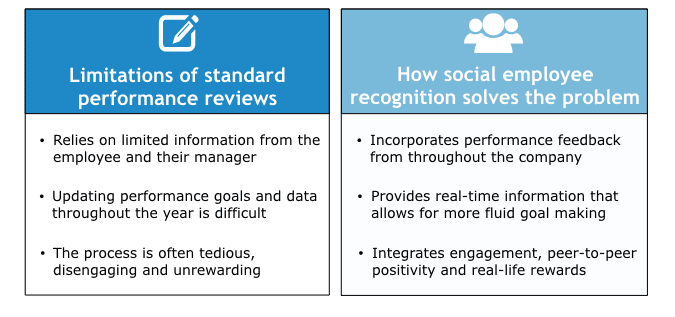
While we have talked about employee engagement and performance reviews on various occasions, this article brings up a slightly different angle – social recognition to go along with performance reviews. Social recognition is uniquely positioned in that, while it is more informal and prompt than annual reviews, it’s also more comprehensive than 360 degree feedback.

Annual performance reviews often suffer from certain setbacks. When you only rely upon a manager’s memory, the review becomes a one-sided, one-dimensional affair. And this is not something you can blame a manager for. For reviews to work a 100%, all managers would be required to possess phenomenal memories, which is a really improbable qualification.

Image of comparison between Performance Reviews and Social Employee Recognition

Picture Credit: Software Advice

Early adopters of social employee recognition software report “measurable impacts on employee engagement, as well as correlations with improved business performance,” according to Gartner’s Predicts 2016 for HCM Applications.

If it’s not already in place, social recognition can be a great addition to your organization. There are 3 things you need to keep in mind though, when you are implementing it:

Reduce the hierarchy

Flatter structures are more suitable for such a process as we are recommending to you. According to Gartner’s research, social recognition thrives in companies where “command-and-control hierarchies give way to more network-style organizations.” Break down the walls between upper and lower levels of the company and implement channels to promote company-wide discussion and interaction.

Customize your rewards system

If you plan on handing out generic kudos like “Great job”, you will not be utilizing the R&R module efficiently. This kind of recognition needs no effort, and managers aren’t going to have useful feedback to learn from either. Institute rules that only reward meaningful recognition, and consider consolidating all of your rewards programs into one.

Consider it as an augmentation

If you are thinking social recognition can be a stand alone facility for your organization, that can’t be so. That and continuous peer-to-peer praise can save your performance review process, but you still need a solid performance management system bedrock to build on. If you don’t have one, or find your current system lacking, check out our performance review software page as well as our rewards and recognition section for better understanding and clarity.

Also read: Now More Than Ever: The Need For Staff Appreciation


Engagedly is offering a suite of products part of its Remote Work Toolkit free to any organisation, until Sept 30th, 2020. 

The Coronavirus has affected the way we work today and for months to come. Unprecedented events require unprecedented measures. We at Engagedly believe it is our responsibility as socially conscious corporate citizens to help equip organisations with additional tools and resources during this time of crisis.


Do you want to know how Engagedly can help you with seamless Performance Evaluation? Then request for a live demo.

Request A Demo

Performance Evaluation Software For The Healthcare Sector

Let’s face it! Employee performance evaluation is one of the most important aspects in any working sector. From the time of on-boarding, employees work intending to score positively in the upcoming reviews, while the managers keep tracking and sharing feedback for the same reason. We are saying this as a norm because many organizations have discarded their traditional paper-based performance reviews and annual reviews for a digital solution – employee performance review software.

Through a performance review software, you can keep track of the performances of your healthcare professionals more accurately. You can clearly communicate your performance expectations with them and stay connected with everyone.

Also read: OKR Examples For Your Finance Team To Balance Growth, Cost And Efficiency

There are many performance review software available online for you to choose from. Depending on your organization’s requirement, select a software that best suits you. But before that, don’t forget to go through this list of must-haves for a performance review software:

Easy to Use

Though we mention this point in almost every article of ours, we stand by this maxim in this article too. Given today’s healthcare scenario, your healthcare professionals have little time to explore and learn how to use a software. The performance review process should be easy to understand and implement in an organization.

Through a systematic approach, your healthcare organization can manage medical activities effectively and promote improvement in your service quality. Today most performance review software out there have multiple fascinating features, but they can be very confusing. A software should follow a process to execute a specific action. A performance review software should have a concrete procedure to carry out performance evaluation, without affecting other activities in the organization. A simple user interface and a clear procedure is a must-have!

Also Read: 10 Best Tools For Setting And Tracking Goals

Customizable Templates for Reviews

While many software offer sample review templates for different departments, they are not usually customizable. Performance review templates make the performance evaluation process more organized and help you follow a specific standard for evaluating each team. A customizable review template allows you to change the contents of the review template based on changing work practices and industry trends. Makes it a necessary feature for the healthcare industry.

Continuous Performance Evaluation

To be effective and yield results for your business, performance management must be a year-round process with no end.

– Teala Wilson, CHRL from HRPA, talent management consultant at Saba Software

The days of onetime annual performance reviews are long gone. It is important to continue it at regular intervals throughout the year, especially now that the healthcare professionals need to be more engaged and motivated than ever. Choose a performance review software that supports performance evaluation anytime throughout the year. This helps you keep track of employee performance efficiently and perceive their personal development.

Ability to Self-Evaluate

While everyone else around you gets a chance to evaluate you, it’s necessary for you to get the chance to evaluate your own performance as well. It’s very important to assess yourself accurately. Self-evaluation gives you a chance to improve yourself and contribute to organizational productivity. You cannot do it without having a proper system to measure your performance. A performance review software must allow you to assess yourself accurately by allowing you to create your individual goals, check-in frequently and use these as reference to measure your own performance.

Aligning Goals and Objectives

When evaluating the performance of a healthcare professional, you need all the details of their performance over a particular period of time to maintain an accurate review. Not many software gives this option but associating individual/organizational goals and objectives with their performance review can help improve the quality of the review. So pick a performance review software that allows you to associate employee goals and their progress with the review for reference.

Also read: Virtual Onboarding: A New Reality

Predetermined Competencies

When you evaluate the performance of a healthcare professional, it is important to list out the necessary performance review competencies beforehand.

Example:

Competency: Analytical Thinking in Healthcare

Representative Behaviors:

  • Approaches a healthcare case by defining its core issue; determine its significance; collect data; use tools to disclose meaningful patterns in the data; make inferences about the meaning of the data; then use logic and intuition to arrive at conclusions or decisions
  • Approaches a complex case by breaking it down into its component parts and considers each part in detail
  • Carefully weighs the priority of things to be done

In some software, there are competencies that are already listed for you to choose from and some software allow you to create performance review competencies yourself. Having an option to choose/ create competencies gives you an opportunity to add more to a performance review.

We would love to know your thoughts on this matter. Feel free to drop in your comments below!


Engagedly is offering a suite of products part of its Remote Work Toolkit free to any organisation, until Sept 30th, 2020. 

The Coronavirus has affected the way we work today and for months to come. Unprecedented events require unprecedented measures. We at Engagedly believe it is our responsibility as socially conscious corporate citizens to help equip organisations with additional tools and resources during this time of crisis.


Do you want to know how Engagedly can help you with seamless Performance Evaluation? Then request for a live demo.

Request A Demo

Employee Performance Management During COVID-19

Employee Performance Management is crucial for all organizations, as it is one of the key drivers for organizational success. But many organizations often confuse or mix it with an annual performance review or a performance appraisal. Moreover, they use it as a means to remove low performing employees from the organization. Before we delve into the main topic, we need to understand: ‘What is employee performance management?‘ and ‘Why is it important?‘. Continue reading “Employee Performance Management During COVID-19”

Was Your Performance Management Strategy A Failure?

Many organizations had big plans for 2020’s performance management. It all looked so amazing on the paper and you expected it to work like magic. But just like all the other killer plans this year, the performance management strategy you designed for your organization didn’t work.

Continue reading “Was Your Performance Management Strategy A Failure?”

What Is Social Performance Management?

While you’re still struggling with choosing the frequency of your performance reviews, there’s a new employee performance management system on the block that is working wonders for many organizations: Social performance management.

Performance management fails in a few organizations for various reasons like having an outdated system, no frequent feedback etc. Most companies are increasing looking at new ways of measuring an employee’s performance. One of those ways is social performance management.

Continue reading “What Is Social Performance Management?”

5 Best Practices For Effective One On One Meetings

The remote working season has made some major changes to our style of working. Employees are required to have numerous meetings with different people from their teams as well as from different teams. There are too many virtual one on one meetings happening at almost every organization.

Continue reading “5 Best Practices For Effective One On One Meetings”

Can Performance Reviews Drive Employee Productivity?

Isn’t this a million dollar question? Well, for managers who understand how to use performance reviews not just to review their current performance but also to come up with strategies and plans to bring the best out of them, the answer is always yes.

Continue reading “Can Performance Reviews Drive Employee Productivity?”

These Features Can Make A Big Difference In A Goal Setting Software

Do you have a goal setting software in place, in your organization? There are certain important features that all goal setting softwares should have. If you wish to know what to look for in a goal setting software, have a look at this article. But beside the features already listed in there, there are a few more, that can really create an enhanced experience when it comes to setting goals effectively.

Here are some of the features that make a lot of difference in the field of goal setting.

Ability to view team goals

Most problems have a solution when you look at them from a bird’s eye view. The ability to view team goals allows managers to view all the goals of their direct reports in one go, instead of painstaking going through an excel sheet or calling their direct reports one by one to know which goals they are pursuing. That gives you the advantage of being able to see all the goals panned out on one screen and which team member is handling which goal.

Also read: The Significance Of Having an HRM Software In Your Organization

Ability to create goals

It’s always easy for us to start and pursue a goal, when the steps are made easy. The whole journey need not be difficult. A goal setting system is only useful when it is used regularly by employees. Few of the things that can drive goal creation are an easy to use interface, notifications to check-in easily, and a system that alerts HR and managers to users who do not have active goals.

Different modes of Quantifying

Quantity are measured in different forms by different people. So, a goal setting software should have the ability to handle both quantity and percentage check-ins. This is because it gives users flexibility when they are creating goals for themselves or others. Not all goals are dependent on quantity. In fact, some of them cannot be measured in terms of quantity. For goals like this, the percentage check-in acts as a suitable alternative and does not make it difficult when setting up a goal.

Now that we’ve told you how the above features can make a difference to your goal-setting process, make it easier for your employees to set, track and achieve their goals and yours.

Also read: 10 Best Employee Tools To Track Performance

If you are looking to get a Goal setting software for your organization, request for a free demo with us. 


Engagedly is offering a suite of products part of its Remote Work Toolkit free to any organisation, until Sept 30th, 2020. 

The Coronavirus has affected the way we work today and for months to come. Unprecedented events require unprecedented measures. We at Engagedly believe it is our responsibility as socially conscious corporate citizens to help equip organisations with additional tools and resources during this time of crisis.


Get in touch with us to know more about the free remote working tool-kit.