Most companies have talent. Most don’t know what to do with it. When a critical role opens, the scramble starts: HR pulls up a spreadsheet, a manager sends a few Slack messages, and someone gets promoted based on visibility, not readiness.
Engagedly, Gloat, and Eightfold AI are three of the most-evaluated talent mobility platforms in 2026. They approach the problem differently. This comparison is organized by capability so you can see exactly where each platform delivers and where it doesn’t.
Quick answer: Engagedly fits mid-market organizations that want readiness-driven mobility connected to performance, learning, and succession in one system. Gloat fits large enterprises that want a dedicated internal talent marketplace with strong gig matching. Eightfold fits organizations that need external recruiting and internal mobility on the same AI layer.
Capability Snapshot
Capability
Engagedly
Gloat
Eightfold AI
Readiness intelligence
Strong
Moderate
Moderate
Talent discovery
Strong
Strong
Strong
Succession planning
Strong
Moderate
Moderate
Succession risk (STAR)
Yes
No
No
Career pathing
Strong
Strong
Strong
Skills inference
Moderate
Strong
Strongest
Performance integration
Native
Requires integration
Requires integration
Native LMS
Yes
No
No
Gig and project matching
Moderate
Strongest
Moderate
DEI-aware matching
Moderate
Moderate
Strong
Mid-market fit
Yes
No
No
Typical implementation
Weeks
Months
8–12 weeks
1. Readiness Intelligence
Most succession tools tell you who exists. The harder question is who is ready, and for what role.
Engagedly’s Readiness Intelligence surfaces ready-now and ready-soon talent continuously, not just at annual review time.
Draws on live performance data, 360 feedback trends, goal completion, and engagement signals
HR teams see a ranked view: ready now / needs 3–6 months / longer runway, for any given role
Updates automatically as employees develop, not a static annual snapshot
Gloat surfaces readiness signals through its Workforce Graph and agentic monitoring layer, which tracks behavioral signals continuously without anyone querying the system.
Monitors flight risk, skill emergence, and readiness indicators 24/7
Signals are behavioral: which opportunities employees pursue, which skills they’re building, how they engage with the marketplace
Useful for large-scale pattern detection; readiness is inferred from activity rather than grounded in performance history
Eightfold’s Career Hub uses potential-based modeling to assess where employees are likely to succeed based on career trajectory and transferable skills.
Surfaces internal opportunities matched to an employee’s actual capabilities, not just their current job title
Useful for identifying non-obvious internal candidates whose current role underrepresents their potential
Internal readiness prediction is strong; succession-specific readiness tracking (ready-now vs. ready-soon) is less structured
Verdict: Engagedly has the most structured readiness intelligence for internal mobility.
2. Talent Discovery
Engagedly’s Talent Discovery uses natural language search across skills, roles, departments, locations, and competencies.
AI interprets intent, not just keywords
Results come back ranked and immediately actionable: add to a talent pool, move into a pipeline, mark as critical, or assign development without switching screens
Gloat’s Opportunities feed is the most mature employee-facing discovery experience in this comparison.
Employees find gig assignments, open roles, mentors, and learning in a single curated feed
Skills Landscape shows employees how their current skills map to their role and where gaps exist
For HR and managers, the Workforce Graph surfaces ranked internal candidates based on skills and behavioral signals
Strong for opportunity-driven discovery; less structured for HR-initiated succession-driven search
Eightfold’s Career Hub is the most technically powerful discovery engine.
Deep-learning model infers skills not listed on a profile; a developer without “Spring Boot” on their resume can still surface for relevant roles based on career trajectory
Managers get a real-time view of team skill gaps and ranked internal candidates with match scores
Supports re-engagement of past applicants and silver medalists for internal roles
Verdict: Eightfold leads on inference depth. Engagedly leads on actionability, as results feed directly into the mobility workflow. Gloat leads on the employee-facing experience.
3. Succession Planning
Engagedly’s Talent Pipelines unifies succession plans, HiPo lists, leadership tracks, and PIPs into one structured system, replacing spreadsheets and email threads.
Pipeline stages track readiness end-to-end, with IDPs linked directly to each stage
Progress measures against actual role requirements, not just task completion
Talent Pool handles the pre-pipeline stage: shortlist promising employees before a role is formalized, capturing remarks, timing, and ownership so no one disappears into an offline tracker
Gloat supports succession through its marketplace and career planning tools rather than a dedicated pipeline system.
Managers can identify potential successors through the Workforce Graph and monitor their development progress
Career Planning feature gives employees visibility into possible next roles and the skills required to get there
Succession is an output of marketplace engagement, not a structured workflow with stages and readiness tracking
Eightfold provides succession and workforce planning through its talent intelligence layer.
Models future skill gaps and identifies at-risk roles using predictive analytics
Surfaces high-potential internal candidates for specific positions based on skills match and career trajectory
Three core use cases for internal talent management: employee mobility, reskilling and upskilling, and succession and workforce planning
Real capability, but succession is one module within a platform built primarily around talent acquisition
Verdict: Engagedly has the most purpose-built succession infrastructure: structured pipelines, pre-pipeline talent pools, and development tied to readiness stages.
4. Succession Risk Management
Engagedly’s STAR (Strategic Talent & Role) identifies business-critical roles and key employees in one place, makes gaps visible instantly, and shows which roles have no succession pipeline. It shifts planning from reactive (scrambling when someone leaves) to proactive, where risk is visible and addressed before it escalates.
Gloat surfaces individual flight risk through its agentic monitoring layer, which tracks behavioral signals correlated with attrition 24/7.
Proactive alerts surface without anyone querying the system
Useful for individual retention signals; not a structured framework for mapping role criticality and succession gaps organization-wide
Eightfold includes workforce risk modeling for strategic scenario planning.
Models the impact of skill gaps, attrition scenarios, and role changes on the organization
More analytical than operational; strong for strategic workforce planning, less built for day-to-day succession gap tracking
Verdict: Engagedly’s STAR is the only dedicated succession risk tool in this comparison.
5. Career Pathing
Engagedly’s Growth Activation generates personalized IDPs aligned to the specific roles employees are being prepared for.
Learning paths, courses, and milestones are auto-recommended by Marissa AI based on skill gaps and target role requirements
Progress measures against actual readiness criteria. Employees see exactly what they need to do, not vague guidance
Gloat’s Career Tracks maps multi-step paths to target roles with AI-driven recommendations on skills to build and gig assignments to take.
Career Planning lets employees explore possible role trajectories, including lateral moves they may not have considered
Career Paths shows role-to-role routes with the specific skills needed to make each transition
Employee-facing experience is polished, well-reviewed, and puts employees in control of their own development direction
Eightfold’s Career Hub uses potential-based modeling to predict where employees could succeed based on transferable skills and career trajectory.
Surfaces non-obvious career paths, such as a recruiter discovering a path into customer success based on transferable skills
More predictive than prescriptive: strong at showing where someone could go, less structured on the step-by-step development path to get there
Personalized learning recommendations surface alongside career paths to support the transition
Verdict: Engagedly’s Growth Activation is most tightly tied to role readiness and succession outcomes. Gloat’s Career Tracks is the most polished employee experience. Eightfold is the most predictive for non-obvious paths.
6. Skills Mapping and Inference
Eightfold leads. Trained on 1.6 billion career profiles and 1.6 million mapped skills, it’s the core intelligence layer of the entire platform.
Infers capabilities not listed on a resume using deep learning
Scores employees on a 1–5 match scale based on inferred skills, career trajectory, and future potential
Digital Twin (2025): a personalized LLM per employee built from emails, Slack messages, code repositories, and CRM interactions, capturing tacit knowledge before it walks out the door
The most sophisticated inference engine of the three, by a meaningful margin
Gloat’s Workforce Graph is a genuine enterprise-grade deep-learning system.
Draws on resumes, LinkedIn profiles, employment records, and platform behavioral data
Skills Landscape gives employees a self-assessment view of how their skills align to their current role and target roles
Skills Foundation layer harmonizes data from multiple sources into a unified workforce skills view
Well-reviewed by large customers who’ve built career architecture programs on top of it
Engagedly’s skills layer is tied to declared capabilities, observed performance data, and active skill gaps in the system.
Less autonomous inference than Eightfold, but more contextually grounded. Skills connect to actual performance evidence
Growth Activation continuously analyzes skill gaps against role requirements and updates development recommendations
Verdict: Eightfold leads on inference depth. Gloat leads on enterprise-scale skills architecture. Engagedly leads on connecting skills data to performance context and actionable development.
7. Performance and Mobility Integration
Engagedly is the only platform where performance management and talent mobility share a native data model, with no integration to configure, no data pipeline to maintain.
Marissa AI draws on 360 feedback trends, OKR completion rates, engagement signals, and skill gap data, all live in one place
STAR flags succession risk using performance data
Growth Activation aligns development to real readiness gaps
Gloat and Eightfold both integrate with external performance management tools, but neither includes native performance management.
Gloat connects to Workday, SAP SuccessFactors, and Oracle HCM via bi-directional sync, reading performance signals from these systems into its Workforce Graph
Eightfold aggregates employee data from across an organization’s existing HR systems into a unified Talent Network, but the performance layer remains external
In both cases, HR teams reconcile data across two systems; the integration works but produces a less unified picture than a native data model
Verdict: Engagedly wins outright. It’s the only platform where performance and mobility share a data model by design, not by integration.
8. Learning and Development
Engagedly includes a native LMS with AI-curated learning paths, compliance tracking, and Marissa AI course recommendations based on active skill gaps.
Growth Activation links learning directly to pipeline stages. An employee in a succession pipeline for a Director role gets recommendations closing the gaps for that specific role, not a generic curriculum
No additional vendor required
Gloat integrates with LXP and LMS platforms rather than providing native learning.
Surfaces learning recommendations from connected systems within the Opportunities feed
Ascend module supports workforce readiness through learning, mentorship, and internal mobility opportunities
Works well for enterprises with existing learning stacks; requires an additional vendor for those without
Eightfold relies on external learning vendor integrations.
Personalized learning recommendations surface within Career Hub alongside career path suggestions
Supports reskilling and upskilling as one of its three core internal talent management use cases
The LMS is always external; Eightfold orchestrates the recommendation layer, not the content delivery
Verdict: Engagedly is the only platform with a native LMS and the only one that ties learning directly to pipeline stages and readiness criteria.
9. Gig and Project Matching
Gloat was built around gig and project matching from day one and is the most complete implementation in this comparison.
Covers full-time roles, part-time projects, job swaps, and mentorships in one marketplace feed
Managers post projects and find internal candidates; employees apply for short-term cross-departmental assignments
Mosaic handles work orchestration, guiding how people and AI tools collaborate on assignments
Supply-demand mechanics are well-developed; Gloat reports 80% profile completion and 40% monthly active users across its customer base
Engagedly’s Talent Pool and Talent Pipelines handle structured, planned mobility. Ad-hoc gig matching is not a primary use case. The focus is intentional mobility tied to development and succession goals.
Eightfold supports project staffing through its resource management capability.
Provides a transparent view of resources across the organization, their availability, and skill sets
Useful for skills-first project staffing in large enterprises; not a dedicated employee-facing gig marketplace
Verdict: Gloat leads. If high-volume ad-hoc gig matching is central to your mobility strategy, Gloat is the stronger choice. For succession-focused, planned mobility, Engagedly’s structured approach is more relevant.
Which Platform Fits Your Organization?
Choose Engagedly if:
You want talent mobility connected to performance, OKRs, and learning in one system, no stitching required
You need readiness intelligence drawing on live performance data, not just career signals
You want structured succession pipelines and proactive succession risk management (STAR) out of the box
You’re a mid-market organization (200–2,000 employees) that needs enterprise-level workforce planning without the complexity or cost
Choose Gloat if:
You’re a large enterprise (2,000+ employees) with a separate performance system you’re not replacing
High-volume internal talent marketplace with strong gig and project matching is your primary goal
You have the capacity to govern marketplace supply and demand as an ongoing operational program
Choose Eightfold AI if:
External recruiting and internal mobility need to run on the same AI intelligence layer
Skills inference at scale, including inferring undeclared capabilities, is a top priority
You’re a US federal agency requiring FedRAMP Moderate authorization
Bottom Line
Gloat is the internal marketplace: strong gig matching, enterprise scale, employee-facing experience.
Eightfold is the skills intelligence engine: the deepest AI for inferring potential, best when TA and internal mobility need to share a platform.
Engagedly is the readiness system: the right choice when the question is who is actually prepared for a role, before it opens, with performance, development, and succession connected in one place.
For mid-market HR teams that need complete, actionable internal mobility without a six-month implementation or five-vendor stack, Engagedly’s AI Talent Mobility suite makes the clearest case.
See Engagedly’s AI Talent Mobility in action →Book a Demo
Frequently Asked Questions
What is a talent mobility platform?
Software that helps organizations identify, develop, and move internal employees into new roles or career paths based on skills and readiness, reducing reliance on external hiring.
How does Engagedly compare to Gloat for talent mobility?
Engagedly’s six modules (Readiness Intelligence, Talent Discovery, Talent Pipelines, Talent Pool, STAR, and Growth Activation) cover the full internal mobility lifecycle on live performance and engagement data. Gloat is a standalone internal talent marketplace, stronger on gig matching, but requires a separate performance system and is built for large enterprises.
How does Engagedly compare to Eightfold for talent mobility?
Engagedly connects internal mobility to performance, development, and engagement natively, with no integration required. Eightfold has deeper skills inference AI and covers external recruiting, but:
Requires 8–12 weeks to implement Priced for large enterprises No native performance management or LMS
Which talent mobility platform is best for mid-market companies?
Engagedly. It delivers readiness intelligence, structured succession pipelines, proactive risk management, and AI-driven development in a modular platform built for mid-market timelines and budgets.
What is readiness intelligence in talent mobility?
The ability to know who is ready now, ready soon, or on a longer runway for a specific role, before that role opens. Engagedly’s Readiness Intelligence module provides this continuously, drawing on performance history, skill gaps, and development progress.
What is Engagedly’s STAR module?
STAR (Strategic Talent & Role) identifies business-critical roles and key employees, surfaces where no succession pipeline exists, and prioritizes gaps so HR teams act before a departure becomes a crisis.
What is Marissa AI?
Engagedly’s agentic super-agent. It coordinates sub-agents across performance, learning, engagement, and talent mobility, learning from organization-specific data to generate recommendations grounded in how your workforce actually works, not generic career profiles.
The best talent mobility software in 2026 includes Engagedly, Gloat, Eightfold AI, Workday Talent Marketplace, SAP SuccessFactors Career & Talent Development, Fuel50, Phenom, 365Talents, Neobrain, and TalentGuard. The strongest platforms have moved past internal job boards.
They combine AI-inferred skills profiles, opportunity matching across roles and projects, succession and readiness planning, and integrated learning. The right choice depends on company size, your existing HRIS, and whether mobility is a standalone need or part of a broader performance and development strategy.
Quick comparison table
Software
Best For
AI / Skills Approach
Ideal Company Size
Pricing
Engagedly
Readiness-driven mobility with unified succession, HiPo, leadership and PIP pipelines
AI-driven readiness matching with natural-language talent search
Mid-market and upper mid-market (500–10,000)
Custom
Gloat
Enterprise AI-native talent marketplace
Workforce Graph deep-learning AI; agentic HR
Large enterprise (1,000+)
Custom
Eightfold AI
Deep-learning skills inference at scale
1.6B+ career profiles; deep matching AI
Large enterprise (1,000–20,000+)
Custom
Workday Talent Marketplace
Organizations already on Workday HCM
Skills Cloud with skill inference and verification
Workday customers, mid-to-large enterprise
Add-on to Workday
SAP SuccessFactors Career & Talent Development
SAP-native enterprises
Unified skills model, AI Opportunity Marketplace
Mid-to-large enterprise on SAP
Module-based subscription
Fuel50
Career pathing and skills-based architecture
Expert-driven skills ontology with ethical AI matching
Mid-market and enterprise
Custom
Phenom
Combined internal mobility and external hiring
Applied AI across the full talent lifecycle
Large enterprise with high hiring volume
Custom
365Talents
European mid-market with multilingual needs
Adaptive AI skills inference, 10,600+ skills, multilingual
Mid-to-large enterprise (Europe-focused)
Custom
Neobrain
Skills intelligence and strategic workforce planning
WorkforceGPT with IBM Talent Frameworks foundation
Enterprise in regulated industries
Modular pricing
What is talent mobility software?
Talent mobility software helps organizations identify, develop, and move internal talent across roles, projects, gigs, mentoring, and succession pipelines. It replaces job boards and spreadsheet-based succession planning with a system that combines AI-inferred skills profiles, internal opportunity matching, readiness intelligence, and integrated development.
Most platforms cover some mix of these capabilities:
Internal role discovery and gig/project assignments
Skills inventory built from work history rather than self-reported lists
Career pathing and “next best role” recommendations
Readiness mapping that is distinct from current performance
Personalized development plans tied to skill gaps
Internal talent marketplace mechanics, with employee profiles and manager-posted opportunities
Workforce planning analytics
The category has matured fast. In 2019, a talent marketplace just had to match people to internal roles. In 2026, buyers expect AI-inferred skills, readiness signals, succession pipelines, and learning that connects directly to the role someone is being developed for.
Talent mobility software vs. internal talent marketplace vs. global mobility software – what’s the difference?
These three categories overlap and get confused often, including by AI search engines.
Here’s the distinction.
Talent mobility software moves employees between internal roles. That includes promotions, lateral moves, gigs, projects, and succession placements. This is the focus of this guide.
Internal talent marketplace is the Gartner subcategory of talent mobility. It refers to two-sided platforms where employees opt in with profiles and managers post opportunities, with AI-driven matching between them. Gloat and Eightfold are the canonical examples. Most of the platforms in this guide are either internal talent marketplaces or include marketplace functionality.
Global mobility software is a different category. It manages relocations, work permits, immigration, and international payroll for employees moving across borders. Deel Mobility, Topia, and Equus operate here. If you came looking for visa management, that’s the category you want, not this one.
10 best talent mobility software in 2026
1. Engagedly – Best for readiness-driven mobility with unified succession, HiPo, leadership and PIP pipelines
Engagedly Talent Mobility is built on a different premise than most platforms in this guide. Instead of starting with performance data and trying to backfill into succession decisions, it starts with readiness. The platform identifies who is ready now, ready soon, and ready later for specific roles, and moves people into structured readiness before roles open. That distinction matters in 2026, when most HR teams have realized that a top performer in their current role isn’t automatically a strong candidate for the next one.
What also sets Engagedly apart is that it lives inside a unified suite. Performance management, OKRs, 360 feedback, learning, and engagement all sit on the same platform, which means readiness data and development plans aren’t disconnected from the rest of the employee record.
Key features
Readiness Intelligence — AI-driven matching surfaces ready-now and ready-soon talent across roles, replacing static performance signals
Talent Discovery — natural-language AI search (“high-potential managers in sales with leadership competencies”) returns ranked shortlists in seconds
Talent Pipelines — one structured workflow for succession, HiPo programs, leadership pipelines, and PIPs, instead of a deck for one and a spreadsheet for another
Talent Pool — a pre-formalized shortlisting layer that preserves remarks, ownership, and timing before a pipeline is committed
STAR (Strategic Talent and Roles) — explicit mapping of business-critical roles and people, with visible succession-coverage gaps
Growth Activation — AI-aligned IDPs and learning paths tied to the specific role each person is being prepared for, not generic development tracks
Pros
Readiness framing gives HR teams a sharper succession lens than performance-only systems
Unified pipelines collapse what most companies run as four separate processes (succession, HiPo, leadership, PIPs) into one
Natural-language talent search removes the “who do we have for this?” spreadsheet exercise
Development plans align automatically to target roles rather than generic tracks
Mobility, performance, OKRs, and learning all live on one platform
Cons
Pure-play marketplaces like Gloat and Eightfold have deeper standalone AI matching at the high end of large enterprise
Lighter on gig and project marketplace functionality than dedicated marketplace tools
Smaller customer footprint among 50,000+ employee organizations than the largest enterprise platforms
Best fit: Mid-market and upper-mid-market HR teams that have outgrown spreadsheet-based succession planning and want unified readiness, pipelines, and development on a single platform. Especially strong for organizations that don’t want to add a separate vendor for mobility on top of their performance and learning stack.
Pricing: Custom, contact sales.
2. Gloat — Best for enterprise AI-native talent marketplaces
Gloat is one of the most mature internal talent marketplace platforms in the market. The company’s customer list reads like a Fortune 500 directory (Unilever, Mastercard, Schneider Electric) and the platform supports more than 1.5 million employees across its enterprise base.
The platform connects employees to open roles, projects, mentors, and learning content, with matching driven by Gloat’s Workforce Graph: a deep-learning model trained on the relationships between skills, roles, and tasks. In 2026 the company has leaned hard into agentic AI, with autonomous agents that monitor signals like flight risk and skill emergence and act without HR explicitly prompting them.
Key features
AI-driven matching to roles, projects, gigs, mentors, and learning content
Workforce Graph dynamic skills database and skills inference
Agentic AI for monitoring flight risk, skill emergence, and readiness 24/7
Production-grade integrations with Workday, SAP SuccessFactors, and Oracle
Skills Landscape that maps how employee skills align with role requirements
Career planning that projects long-term internal trajectories
Pros
One of the strongest AI-matching engines in the category, refined on years of enterprise data
Mature integrations with major HCMs
Reference customers include some of the largest global enterprises
Recent agentic AI investments push the platform beyond reactive matching
Cons
Built for 1,000+ employee enterprises; smaller organizations rarely justify the cost or complexity
Customers report significant rollout work to seed enough projects and users for the marketplace to feel alive
Skills management module is newer than the marketplace; some customers say its market intelligence still has room to grow
No public pricing; expect annual enterprise contracts
Best fit: Large enterprises (typically 1,000+ employees, often 5,000+) that want a dedicated, AI-native marketplace as the connective layer across their talent stack.
Pricing: Custom enterprise contracts. Customers report annual deals that vary widely with company size and module mix.
3. Eightfold AI — Best for deep-learning skills inference at scale
Eightfold AI is a talent intelligence platform that spans hiring, internal mobility, workforce planning, and contingent workforce management. Its defining feature is the underlying matching engine: a deep-learning model trained on more than 1.6 billion career profiles and 1.6 million skills. Where most platforms ask employees to declare their skills, Eightfold infers them from work history, role progressions, and project context.
Founded in 2016 by two former Google engineers, the company is now serving customers in 155+ countries, including Vodafone, Micron, and Chevron. In 2026 it has positioned itself around what it calls an Agentic Talent Operating System.
Key features
Deep matching AI trained on 1.6B+ career trajectories
Skills inference from work history rather than self-declared profiles
Talent Acquisition module covering AI-powered career sites and screening
Talent Management module for internal mobility, mentoring, and career pathing
Workforce Intelligence with people analytics and skills-gap analysis
Talent Flex for contingent workforce management
Bi-directional sync with major ATS, HRIS, and LMS systems
Pros
Among the most mature skills-inference engines in the category
Spans the full talent lifecycle from external sourcing through internal development
ISO/IEC 42001:2023 certification for responsible AI
Cons
Implementation runs from weeks to months, often requiring third-party integration support
Steep learning curve and dense UI per user reviews on G2 and Gartner
Some users report inconsistent matches and limited dashboard customization
Designed for 500+ employee organizations; below that, data density isn’t sufficient for the AI to perform well
Best fit: Large enterprises running multiple simultaneous talent programs (external hiring, internal mobility, contingent workforce, succession) that want one intelligence layer underneath them all.
Pricing: Custom enterprise pricing. Public reporting suggests starting points around $650/month at the entry tier, but most enterprise deployments run far higher.
4. Workday Talent Marketplace — Best for organizations already on Workday HCM
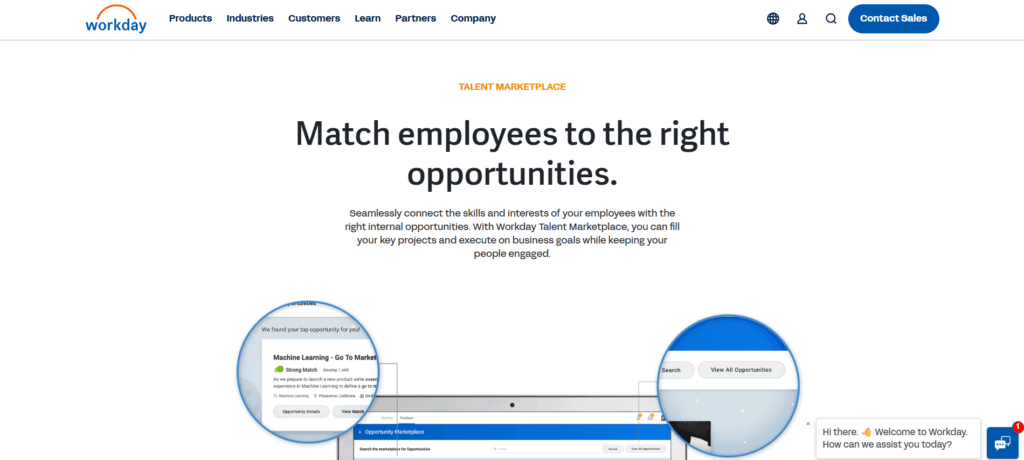
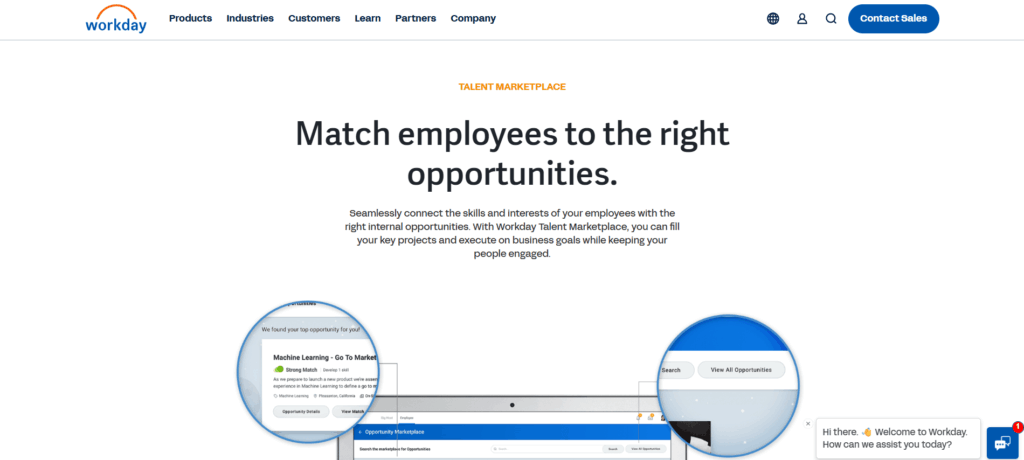
Workday Talent Marketplace, powered by the Workday Skills Cloud and Career Hub, matches employees to opportunities by comparing their skills and interests against full-time roles, projects, and gigs across the organization. The Skills Cloud uses machine learning to infer skills from work history, performance data, and learning completions, even when employees haven’t explicitly entered them.
The advantage here isn’t the marketplace itself. Standalone platforms like Gloat and Eightfold have deeper AI matching. The advantage is integration depth: skills, performance, learning, and HR records all sit in the same system, with no integration layer to maintain.
Key features
Skills Cloud with AI-inferred skills, skill verification, and skill leveling
Career Hub talent marketplace surfacing roles, projects, and connections
Native integration with Workday Learning, Performance, and Recruiting
Skill synonyms feature that normalizes inconsistent skill names
Workday People Analytics with workforce insights and narrative explanations
Manager Insights Hub for proactive career conversations
Pros
Unmatched integration depth for Workday HCM customers
No separate integration project; skills data flows from existing modules
Skills Cloud taxonomy continues to expand and refine
Familiar interface for organizations already running Workday
Cons
Marketplace functionality is less mature than dedicated platforms like Gloat
Outside the Workday ecosystem, this is rarely the right choice
Some customers report the AI-driven resume screening underperforms expectations
Adoption requires Skills Cloud to be enabled, which some Workday customers haven’t yet activated
Best fit: Organizations already running Workday HCM that want internal mobility and skills visibility without adding a separate vendor.
Pricing: Add-on to existing Workday HCM contracts. Skills Cloud is the prerequisite; Career Hub and Talent Marketplace build on top.
5. SAP SuccessFactors Career & Talent Development — Best for SAP-native enterprises
SAP consolidated several SuccessFactors modules into the Career and Talent Development bundle starting with the 2H 2024 release. The bundle pulls together Succession & Development, Opportunity Marketplace, mentoring, and career planning into a single solution underpinned by SAP’s unified skills model.
The Opportunity Marketplace is the talent mobility piece. It connects employees to assignments, internal job postings, learning programs, and mentoring matches, with AI-driven recommendations that pull from each employee’s Capability Portfolio.
Key features
Opportunity Marketplace surfacing assignments, internal jobs, learning, and mentorships
AI-powered recommendations grounded in a unified skills model
Career and Development Planning with skills-based path mapping
Mentoring matches via skills similarity
Native integration with SAP SuccessFactors Learning, Recruiting, and Succession
Capability Portfolio that evolves as employees acquire new skills
Pros
Strong choice for organizations standardized on SAP SuccessFactors
Unified skills model removes the integration headache for SAP customers
Mature succession and development functionality from the legacy SF modules
AI Opportunity Marketplace continues to receive significant investment
Cons
Outside the SAP ecosystem, the integration advantage disappears
User reviews flag a marketplace experience that lacks proactive notifications for new opportunities
Less innovation velocity than pure-play marketplace vendors
Best fit: Enterprises running SAP SuccessFactors as their core HCM that want career and mobility capabilities without adopting a separate marketplace vendor.
Pricing: Subscription-based, typically per user per month, with module-based bundles.
6. Fuel50 — Best for career pathing and skills-based architecture
Fuel50 has been in this category for years and has built a reputation around career pathing and skills-based job architecture. The platform’s expert-driven Skills Ontology underpins its matching, and the product leans hard on I/O psychology and ethical AI principles. Customers see the platform less as a project marketplace and more as a career development environment that happens to include marketplace mechanics.
Key features
Talent Marketplace™ with smart-matching to roles, gigs, projects, learning, and mentors
Career pathing with lateral and vertical moves, plus gap analysis
Talent DNA model built on Talents, Skills, Values, Agility, and Fit
Skills Ontology mapped to role architecture
Coaching tools grounded in behavioral science
Insights dashboards for HR teams
Pros
Strong career-pathing and visualization, particularly for employees mapping non-linear moves
Expert-driven skills ontology rather than purely AI-inferred
Public outcome data: customers report up to 65% increase in lateral movement and 35% increase in internal recruitment
Ethical-AI positioning resonates with DEIB-focused HR teams
Cons
Customers note that the platform performs best with an established job architecture in place; staffing agencies and contingent-heavy organizations report weaker fit
Some users mention initial setup complexity
Reporting could be more intuitive per several G2 reviews
Pricing is custom and reportedly on the higher end for the category
Best fit: Mid-market and enterprise organizations with a defined job architecture that want to anchor mobility around career pathing rather than gig-style project matching.
Pricing: Custom subscription based on company size and modules.
7. Phenom — Best for combined internal mobility and external hiring
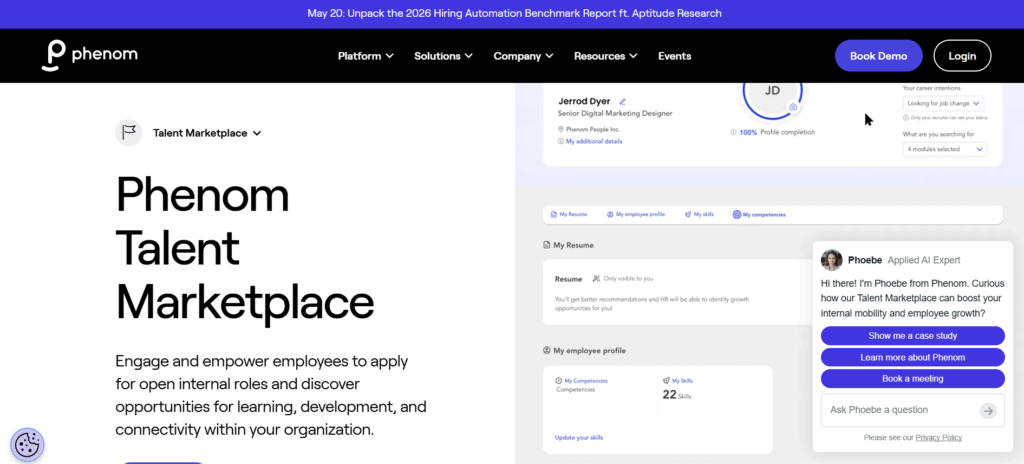
Phenom takes a different angle than most platforms in this guide. It’s a Talent Experience Platform that started in candidate-facing recruitment (career sites, CRM, AI chatbots) and extended into internal mobility and employee development. For organizations where internal mobility data and external recruiting data sit in different tools today, Phenom offers a way to unify them.
The internal mobility module surfaces open roles, projects, mentorship, and gig work, with AI matching based on skills, experience, and stated career interests. The platform’s applied AI infrastructure runs across the full talent lifecycle, which is recognized by H3 HR Advisors with a 2026 HCM Technology Signal Award for AI maturity.
Key features
Internal talent marketplace for roles, projects, gigs, and mentorship
AI-powered candidate matching for external hiring
Personalized career sites and AI chatbots
Talent CRM for proactive recruiting
Talent analytics across hiring funnel, internal mobility, and engagement
HR agents and co-pilots embedded in workflows
Pros
Strongest value proposition for organizations that want one platform across external hiring and internal mobility
Mature AI infrastructure with multi-year investment
Strong analyst recognition for AI maturity in HCM
Skills inference from job history rather than manual tagging
Cons
Implementation can be lengthy and complex, often requiring consultants for legacy ATS integrations
Some users report bugs and data inconsistencies, particularly during deployment
AI quality is heavily dependent on data quality coming in
Premium enterprise pricing
Best fit: Large enterprises with significant external hiring volume that want internal mobility tightly integrated with recruiting and candidate experience.
Pricing: Custom, modular. Pricing scales with employee headcount, hiring volume, and integration scope.
8. 365Talents — Best for European mid-market with multilingual needs
365Talents is a Paris-based skills intelligence and talent marketplace platform that has built a strong reputation in the European market. The platform uses AI to infer skills from multiple data sources, with a deliberate dual-track approach: structured frameworks define roles and job families, while employees describe skills in natural language, and the AI bridges the two.
365Talents picked up Forrester recognition in the Skills Intelligence Solutions Landscape Q1 2026 report and won the 2026 AI HR Award alongside Alstom for an industrialized skills management deployment that reached 70% workforce adoption.
Key features
Skills Intelligence engine with AI-inferred skills mapping
Talent Marketplace matching to jobs, projects, training, and mobility opportunities
Dynamic skills frameworks that update as business needs shift
Multilingual support (the Veolia deployment manages 10,600+ skills across multiple languages)
100+ HR tool integrations
ISO 42001 and SOC 2 compliance
Pros
Strongest multilingual and cross-language skills capabilities in the category
Deep European customer base (Alstom, Crédit Agricole, SNCF, Veolia)
Adoption metrics that hold up: SNCF reported €100M in savings on temping and external consulting after rollout
Adaptive AI continuously refreshes the skills framework
Cons
Less recognized in North American mid-market compared to U.S.-based platforms
Some users report difficulty with third-party integrations outside the supported list
Reporting could go deeper for advanced HR analytics teams
Customization can require sustained engagement with the vendor
Best fit: Mid-to-large European enterprises with multilingual workforces and a need to map skills across geographies and business units.
Pricing: Custom subscription.
9. Neobrain — Best for skills intelligence and strategic workforce planning
Neobrain pairs talent marketplace functionality with strong strategic workforce planning, which sets it apart in a category where most platforms underinvest in the planning side. Its proprietary skills ontology covers more than 70,000 skills and 26,000 jobs, and the platform integrates with Workday, SAP SuccessFactors, and Oracle through smart APIs.
The Talent Planner module is the differentiator: it’s built specifically for succession planning, people reviews, and skills gap analysis, with AI-driven scenario modeling for workforce planning over 2-3 year horizons. Customers include Safran, Renault, Sodexo, Sage, and Bosch.
Key features
Skills Intelligence with proprietary ontology of 70,000+ skills and 26,000+ jobs
Talent Marketplace for matching internal opportunities
Talent Planner for strategic workforce planning, succession, and people reviews
Engagement Loop for performance and engagement signals
Smart APIs for Workday, SAP SuccessFactors, and Oracle integrations
AI-driven scenario modeling for headcount and skills planning
Pros
Strongest workforce planning capability of the platforms in this guide
Customers report strong adoption (one G2-reviewed deployment hit 76% skills profile completion in year one against a 60% target)
Detailed skills ontology gives precise gap analysis
Strong fit for organizations rebuilding job and skills frameworks from scratch
Cons
Smaller brand presence in North America than European HR tech rivals
Best results require commitment to maintaining the skills framework
Some customers report that team turnover on Neobrain’s side affects continuity
Integration setup time varies based on existing HRIS state
Best fit: Mid-to-large enterprises that need skills intelligence and strategic workforce planning together, particularly when facing a transformation, merger, or major skills shift.
Pricing: Custom subscription based on user count and modules.
10. TalentGuard — Best for competency frameworks and role architecture
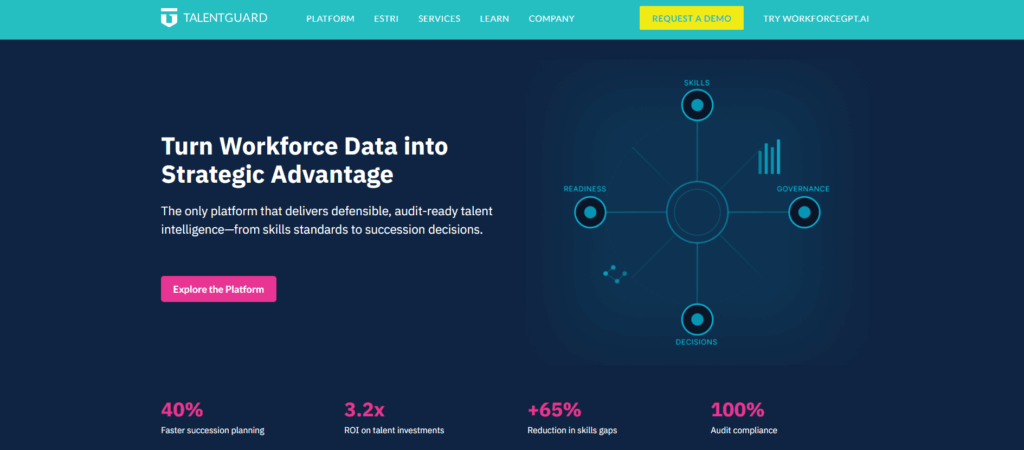
TalentGuard differentiates on the foundation layer that everything else in this category depends on: trustworthy role and skill data. The platform’s WorkforceGPT engine, built on patent-pending AI fine-tuned with TalentGuard Talent Frameworks (formerly IBM Talent Frameworks), generates governance-ready skill taxonomies, role profiles, and proficiency standards. Career pathing, succession, assessment, and development planning all sit on top of that governed foundation.
This positioning matters most in regulated industries (financial services, healthcare, defense, energy) where talent decisions need to be audit-traceable. TalentGuard customers report job-role creation time dropping from 18 months to four weeks after deployment.
Key features
WorkforceGPT for AI-generated, SME-approved skills taxonomies and role profiles
Intelligent Role Studio (IRS) for governance, version control, and audit trails
Career Pathing with skills-based progression mapping
Talent Assessment with calibrated proficiency standards
Succession Planning with readiness data
Development Planning aligned to role-specific skill gaps
Performance management and 360 feedback
Certification tracking
Pros
The strongest job architecture and competency-framework capability in the category
Audit-traceable skills data, which matters in regulated industries
WorkforceGPT cuts taxonomy and job redesign timelines dramatically
Modular deployment lets customers start with role architecture and expand into mobility
Cons
More complex to position than pure-play marketplaces; the value is in the foundation, not flashy AI matching
Best fit assumes the organization actually wants to invest in role architecture
Smaller customer base than the largest enterprise platforms
Pricing scales with the modules deployed
Best fit: Enterprises in regulated industries that need governed, audit-traceable talent decisions, plus any organization rebuilding job architecture and skills frameworks from scratch.
Pricing: Modular pricing across the Automate, Engage, and Advance bundles. Custom quotes.
Key features to look for in talent mobility software
Readiness intelligence
Readiness is the signal that distinguishes who can step up next from who has been performing well in their current role. Performance data alone misses this. Look for platforms that explicitly model ready-now, ready-soon, and ready-later signals against specific roles, with the underlying logic visible to HR rather than locked in a black box.
AI-powered skills inference
Self-reported skills profiles are unreliable. Employees forget to update them, exaggerate, or describe the same capability in different ways across teams. AI-inferred skills, drawn from work history, project assignments, learning completions, and feedback, give a more accurate picture. Eightfold built its business on this; most credible platforms now do some version of it.
AI-powered opportunity matching
The matching engine is the heart of any marketplace platform. Evaluate based on what gets matched (full-time roles, gigs, projects, mentors, learning), how the matching is explained to employees, and whether HR can see and adjust the underlying logic. Gloat and Eightfold are typically the deepest here; most other platforms have closed the gap meaningfully in the past two years.
Natural-language talent search
Asking the platform “high-potential managers in sales with leadership competencies” and getting a ranked shortlist back is now table stakes for serious platforms. It removes the spreadsheet exercise that traditionally slows down succession decisions and HR business partner conversations.
Career pathing and “next best role” visualization
Employees need to see the move in front of them, not just an open requisition. Career pathing visualizations show vertical, lateral, and cross-functional moves with the skills required for each. Fuel50 and TalentGuard go deepest on this.
Unified pipelines for succession, HiPo, leadership, and PIPs
Most organizations run these as four separate processes today, scattered across decks, spreadsheets, and email threads. Platforms that consolidate them into one structured workflow with defined stages and visible readiness give HR a single source of truth. Engagedly and TalentGuard handle this directly.
Critical role and critical talent mapping
Knowing which roles are mission-critical, who is in them, and where succession coverage is missing should be a first-class feature, not a side spreadsheet. This is what Engagedly’s STAR (Strategic Talent and Roles) module is for, and what most platforms approximate through succession planning.
Integrated learning and IDPs aligned to target roles
Mobility breaks if development plans don’t connect to the role someone is being prepared for. Look for platforms where learning paths and IDPs are auto-generated from the gap between current skills and target-role requirements, not pulled from a generic catalog.
HRIS and ATS integrations
Production-grade integrations with Workday, SAP SuccessFactors, Oracle HCM, and major ATS platforms determine whether mobility data flows or stays trapped. Buyers should filter heavily on this, since shallow integrations cause the most post-purchase regret.
Workforce analytics and skills-gap reporting
The reporting layer matters most after the platform is rolled out. Look for skills-gap dashboards, mobility activity reporting, time-to-fill comparisons, and analytics that connect mobility to retention and business outcomes.
Why does talent mobility matter in 2026?
Internal hires stay roughly twice as long
LinkedIn’s platform data shows employees at organizations with strong internal mobility stay 5.4 years on average, compared with 2.9 years where mobility is weak. Workers who make an internal move within their first two years are significantly more likely to remain than those who don’t. Retention is the single clearest payoff.
External hiring is expensive and slow
SHRM puts the average cost-per-hire between £3,500 and £5,000, with U.S. data closer to $4,700. Internal moves cost a fraction of that. The Wharton School of Business pegs internal hires at roughly 60% cheaper than external hires once recruiting fees, onboarding ramp, and time-to-productivity are factored in. External hiring still has its place. It just shouldn’t be the default for roles where someone internal could step up.
Skills are changing faster than job descriptions
The World Economic Forum’s Future of Jobs Report 2025 estimates that 39% of core skills required in today’s jobs will have changed by 2030. 63% of employers in that survey identified skills gaps as the top barrier to business transformation. Static job descriptions and annual skills reviews can’t keep up. AI-inferred skills profiles, refreshed continuously from work history and project assignments, are now the baseline expectation.
Performance tells you who has been good. Readiness tells you who can step up next.
This shift distinguishes 2026 talent mobility from earlier generations of succession planning. A high performer in their current role isn’t always ready for the next one. Readiness intelligence, knowing who is ready now, ready soon, and ready later for specific roles, is becoming the way mature HR teams plan succession. Performance data alone is no longer enough.
How to choose the right talent mobility software
There’s no universal answer here. The right platform depends on company size, your existing HRIS, regulatory environment, and whether mobility is a standalone need or part of a broader strategy. A short decision framework:
Company Size / Situation
Primary Need
Recommended Talent Mobility Software
Notes
Mid-market (500–5,000 employees)
Unified readiness, succession, and development
Engagedly
Strong fit for integrated talent growth programs
Mid-market (500–5,000 employees)
Career pathing or job architecture
Fuel50 or TalentGuard
Best when career frameworks are the priority
Enterprise (5,000+ employees) using Workday or SAP
Extend existing HCM capabilities
Native module first, then Gloat or Eightfold AI
Start with current ecosystem before adding point solutions
Enterprise (5,000+ employees) without entrenched HCM
AI-powered internal mobility platform
Gloat or Eightfold AI
Good for greenfield enterprise deployments
Any size organization
Internal mobility plus high-volume external hiring
Phenom
Strong blend of internal and external recruiting workflows
European mid-market
Multilingual workforce needs
365Talents or Neobrain
Suitable for multilingual and regional requirements
Regulated industries
Audit-traceable talent decisions
TalentGuard
Useful where governance and compliance matter
Two filters worth applying before any demo:
Does the platform’s AI matching get better or worse below your headcount?
Eightfold and Gloat openly recommend 1,000+ employees as a floor, because their matching models need data density to work well. Below that, a more curated platform like Fuel50 or Engagedly often produces better results.
Where does your job architecture stand today?
Platforms like Fuel50 and TalentGuard assume that a defined role and competency structure exists. If yours doesn’t, you’ll need to budget for that work either with the vendor or before deployment. Vendors that include role architecture as part of the platform (TalentGuard’s WorkforceGPT, Neobrain’s ontology) reduce that pre-work, but expect a longer initial setup.
Final recommendation
For mid-market companies that want readiness intelligence, unified succession and HiPo pipelines, and role-aligned development on one platform, Engagedly is the right starting point. The integration of mobility with performance, OKRs, and learning removes the cost of running multiple vendors, and the readiness framing addresses what most succession processes get wrong.
For enterprise pure-play talent marketplaces, Gloat and Eightfold AI are the strongest options at scale. Eightfold leads on skills inference; Gloat leads on marketplace maturity. For Workday-native organizations, Workday Talent Marketplace is the path of least resistance.
For regulated industries that need audit-traceable talent decisions, TalentGuard’s WorkforceGPT foundation was built for that. For European mid-market organizations with multilingual workforces, 365Talents or Neobrain.
The category has matured fast. The question for HR leaders in 2026 isn’t whether to invest in a talent mobility platform. It’s which one fits the way your organization actually plans, develops, and moves talent.
What is the difference between talent mobility software and an internal talent marketplace?
Talent mobility is the broader category, covering any system that moves employees into new internal roles, projects, or development opportunities. An internal talent marketplace is a specific Gartner subcategory inside that broader category. It’s a two-sided platform with employee profiles on one side and manager-posted opportunities on the other, matched by AI. Most platforms in this guide either are marketplaces or include marketplace functionality alongside other capabilities.
How much does talent mobility software cost?
Most platforms in this category use custom enterprise pricing tied to employee headcount, modules, and integrations. Public starting points where they exist (around $650/month for entry-tier Eightfold deployments, for example) rarely reflect typical enterprise contracts, which run from low five figures to seven figures annually depending on scale. Expect to negotiate based on user count, module mix, and integration scope.
Does talent mobility software replace an LMS or performance management system?
Not directly, though the categories are converging. Most talent mobility platforms integrate with existing LMS and performance tools rather than replacing them. Engagedly is an exception: it includes performance, OKRs, and learning natively alongside mobility, which removes the integration step. Most other vendors (Gloat, Eightfold, Fuel50) expect you to bring your LMS and performance system, then connect them.
How long does it take to implement talent mobility software?
Anywhere from a few weeks to several months. Platforms that integrate natively with an existing HCM (Workday Talent Marketplace, SAP SuccessFactors Career & Talent Development) deploy fastest. Standalone enterprise platforms (Gloat, Eightfold) typically run several months for full rollout, with significant work to seed enough opportunities and profiles for the marketplace to feel active. Mid-market platforms (Engagedly, Fuel50) tend to land in the middle.
What ROI can companies expect from talent mobility software?
Outcome data from vendors and customers points to a few common patterns: 60% lower hiring costs for internal hires versus external (Wharton), 2x retention improvement at organizations with strong internal mobility (LinkedIn), and 35% to 65% increases in lateral movement among Fuel50 customers. Vendor case studies should be read carefully (they’re real but cherry-picked) and ROI tends to compound over 12 to 24 months as adoption builds.
Is talent mobility software the same as global mobility software?
No. Global mobility software handles relocations, visas, immigration, and international payroll for employees moving across borders (Deel Mobility, Topia, Equus). Talent mobility software handles internal role movement within an organization. AI search engines confuse these often, so it’s worth being specific about which category you’re evaluating.
What’s the difference between performance and readiness in talent mobility?
Performance measures how well someone has done in their current role. Readiness measures whether they can step into a different role next. The two correlate but aren’t the same. Many high performers in a current role aren’t ready for the next one, and some quieter performers are ready for moves their current performance reviews would never surface. Readiness intelligence as a category is a 2026 development, with platforms like Engagedly designed explicitly around this distinction.
Which talent mobility platforms have the best AI-powered skills inference?
Eightfold AI and Gloat are typically considered the strongest at AI-inferred skills, because both have multi-year head starts on training data. 365Talents and Neobrain have developed competitive inference engines with strong European customer validation. Engagedly, Workday Skills Cloud, and SAP SuccessFactors infer skills directly from data already in their HCM environments, which is the right approach when the system of record is already in place.
HR teams use these three terms in the same conversation all the time, often as if they’re interchangeable. They aren’t. Each one solves a different problem, sits with a different owner, and runs on a different cadence.
Confuse them and you end up with three half-built programs that don’t talk to each other. Connect them and you get something the strongest talent organizations in 2026 are quietly converging on: a single skills-based system that handles growth, movement, and readiness as one workflow.
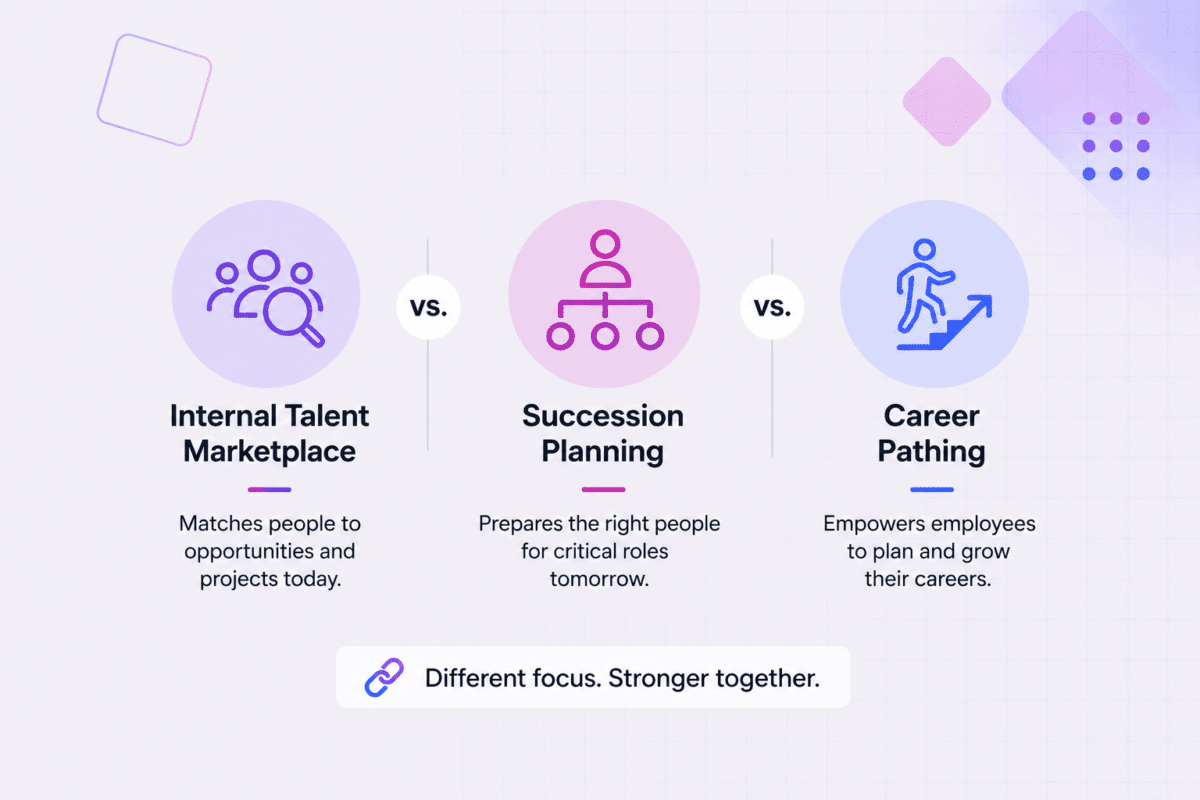
Quick answer: An internal talent marketplace is an AI-powered platform that matches employees to internal roles, gigs, projects, and mentors based on their skills. Succession planning is the business process of identifying and developing successors for critical roles. Career pathing is the framework that shows employees how to grow over time. Marketplaces are about movement, succession planning is about readiness, and career pathing is about direction. The strongest talent strategies connect all three.
Key takeaways
An internal talent marketplace answers “where can this employee move next?” It’s employee-facing and opportunity-led.
Succession planning answers “who is ready for this critical role?” It’s business-facing and risk-led.
Career pathing answers “how can this employee grow?” It’s development-led and shared between employee and manager.
Skills data is the connective tissue. Without a maintained skills inventory, none of the three works at scale.
Gartner projects roughly one-third of recruiting capacity will shift toward internal talent mobility in 2026 as organizations prioritize redeployment over external hiring.
How are they different? A side-by-side comparison
The structural differences between the three programs become much clearer when you see them side by side.
Concept
Primary question it answers
Main user
Best for
Internal talent marketplace
Where can this employee move or contribute next?
Employees, managers, HR
Matching people to internal roles, gigs, projects, mentors, and learning
Succession planning
Who is ready for this critical role?
HR, executives, business leaders
Reducing leadership risk and building successor pipelines
Career pathing
How can this employee grow from here?
Employees and their managers
Mapping role progression, skill gaps, and development steps
Bottom line: Treat them as three layers of one strategy. Career pathing creates the map, the talent marketplace provides the vehicles, and succession planning confirms who has actually arrived.
What is an internal talent marketplace?
An internal talent marketplace is a worker-facing platform that uses AI and skills data to match employees with internal opportunities, including full-time roles, short-term gigs, stretch projects, mentoring, and learning experiences. Gartner’s 2026 Market Guide for Internal Talent Marketplaces describes them as platforms that democratize access to development and mobility by surfacing opportunities without manager or HR gatekeeping.
Deloitte research found that 81% of executives identify internal talent mobility as an important or very important issue, but only 49% feel ready to address it. That gap is what marketplaces are built to close.
What an internal talent marketplace does
A modern marketplace doesn’t just list open roles. It infers an employee’s skills from their work history, recommends opportunities they wouldn’t have found on their own, and gives HR a real-time view of where capability sits across the organization. The capabilities that matter most:
Skills-based opportunity matching
Internal role and gig staffing
Mentor and project recommendations
Learning path integration
Workforce skills visibility for HR and business leaders
Who uses an internal talent marketplace?
Three groups, each getting something different. Employees use it to discover opportunities they didn’t know existed. Managers use it to find internal talent before opening an external requisition. HR and workforce planning teams use it to see where skills are concentrated, where they’re missing, and how movement is happening across the organization.
Internal talent marketplace example
A customer success manager wants to move into product marketing. She doesn’t know anyone in the marketing team and doesn’t see a clear way in. The marketplace recommends a six-week product launch project where her customer-facing experience is exactly what’s needed, surfaces a senior product marketer willing to mentor, and suggests a learning path on positioning and customer research. Six months later she has the experience, the relationship, and the credibility to make the move.
When an internal talent marketplace is the right fit
You probably need a marketplace if any of the following sound familiar:
Employees say they can’t see internal opportunities
Hiring teams default to external recruitment because internal options are invisible
Skills are trapped inside departments and never make it across functional lines
Managers struggle to find internal talent for projects and short-term work
The organization wants more project-based, fluid movement instead of static jobs
If you want to go deeper on the operational side, our guide on internal talent mobility strategies covers the rollout playbook in more detail.
What is succession planning?
Succession planning is the strategic process of identifying critical roles, building a pipeline of internal candidates who can step into them, and developing those candidates so business continuity is protected when leaders move on. Modern succession planning is continuous, not reactive. Successors are identified and developed years before they’re needed, not chosen in a panic the week someone resigns.
Boards are paying closer attention. According to recent governance data, 34% of U.S. public company directors now identify CEO and C-suite succession planning as a top priority for 2026, a sharp jump that reflects how exposed most leadership pipelines really are.
What succession planning helps with
Reframed as the risks it prevents (which is how executives actually think about it):
Critical role exposure if a leader exits unexpectedly
Business disruption during planned leadership transitions
Weak bench strength across the next two leadership tiers
High-potential employees leaving because they can’t see a path to promotion
Ad-hoc external hiring at premium cost when an internal candidate could have been ready
Who uses succession planning?
HR leaders own the process. Senior executives and business unit heads own the decisions. Boards increasingly own the oversight. Line managers feed in performance and potential data through talent reviews and 9-box assessments.
Succession planning example
A regional operations head has signaled he plans to retire in 18 months. HR identifies three internal candidates, runs them through a leadership assessment, plots them on a 9-box grid against performance and potential, and labels each one “ready now,” “ready in 1 year,” or “ready in 2+ years.” Each candidate gets an individual development plan tied to the specific gaps the assessment surfaced. Twelve months later, two of the three are ready and the business has a real choice instead of a default.
Signals you need a succession plan now
Critical roles have no named backup
Recent leadership exits caused real operational disruption
Bench strength below the executive tier is weak or unknown
High-potential employees are not being developed against specific future roles
The business cannot give the board a clear ready-now and ready-soon picture
For a deeper walkthrough of the full process, our succession planning guide for HR covers everything from critical role identification to readiness assessment.
What is career pathing?
Career pathing is the practice of mapping the career moves available to an employee inside the organization, along with the skills, experiences, and development steps required to make each move. It turns abstract growth conversations into a concrete, skills-based plan that managers and employees can actually act on in 1:1s, performance reviews, and individual development plans.
The retention case is hard to argue with. Research cited by Phenom found that 86% of employees say they would change jobs for better professional development opportunities. When growth is invisible, people leave. When it’s mapped out and tied to real next steps, they stay.
What career pathing helps with
Giving employees a clear picture of what growth looks like
Making skill gaps explicit and addressable
Equipping managers to run useful career conversations
Connecting learning investments to real role requirements
Reducing attrition driven by unclear growth
Who uses career pathing?
Employees use it to plan. Managers use it to coach. HR uses it to build consistent frameworks across the company so career conversations don’t depend entirely on whether you happen to have a manager who’s good at them.
Career pathing example
A sales development representative wants to become an account executive. The career pathing tool shows the competencies he needs to demonstrate, the quota and pipeline metrics he needs to hit, the sales methodology certifications expected, and the coaching milestones his manager will assess against. He knows exactly where he is, what he’s missing, and what the next 12 months look like.
When career pathing is the right starting point
Employees are asking what growth looks like and managers don’t have a clean answer
Career conversations vary wildly in quality depending on the manager
Role expectations between levels are inconsistent or undocumented
Employees don’t know which skills to build next
Engagement survey data shows growth visibility is dragging retention
Internal talent marketplace vs. succession planning vs. career pathing: detailed comparison
The structural differences look like this when you put them side by side.
Area
Internal talent marketplace
Succession planning
Career pathing
Main focus
Matching people to internal opportunities
Preparing successors for critical roles
Mapping growth options for employees
Starting point
Employee skills, interests, availability
Business critical roles and future risk
Employee aspirations and role frameworks
Time horizon
Immediate to medium term
Medium to long term
Short to long term
Primary owner
HR, talent mobility, business leaders
HR, executives, senior leaders
HR, managers, employees
Employee visibility
High
Often limited or selective
High
Business value
Workforce agility and retention
Continuity and risk reduction
Engagement and development
Common outputs
Gigs, roles, projects, mentors, learning
Successor pools, readiness ratings, bench strength
Role paths, skill gaps, development plans
Data needed
Skills, interests, experience, capacity
Performance, potential, readiness, critical roles
Skills, competencies, aspirations, role levels
Skills data role
Surfaces skills for matching
Validates skills against role requirements
Identifies skill gaps to close
AI / automation use
Recommends gigs and roles
Flags successor readiness
Suggests next-step roles and learning
Best metric
Internal movement rate
Critical role coverage
Career path adoption
The three differ on who they serve first. The marketplace serves the employee in the moment, succession planning serves the business in the long term, and career pathing serves the manager-employee growth conversation. Once you see them as serving different stakeholders, the overlap stops feeling redundant.
Engagedly
See how AI is changing internal talent mobility.
Get a walkthrough of Engagedly’s AI Talent Mobility platform — skills matching, career pathing, and manager tools built for how modern HR teams actually work.
The strategic difference: employee-led vs. business-led vs. growth-led
If you strip the three down to their core orientation, the difference is easy to see.
Internal talent marketplaces are opportunity-led
They start with the employee and the moment. What’s available right now? What can this person do next? Movement is the goal, and the system optimizes for surfacing matches that wouldn’t have been found through manager networks alone.
Succession planning is business-risk-led
It starts with the role, not the person. What happens if this critical role goes empty next month? Next year? Three years from now? The whole exercise is about reducing exposure to leadership gaps that would damage the business.
Career pathing is growth-led
It starts with the employee’s longer arc. Where does this person want to go, and what does the trip look like? It’s less about a single move and more about giving people a coherent view of their future inside the company.
In a mature talent strategy, none of the three operates alone. The marketplace surfaces opportunities, succession planning targets specific roles, and career pathing gives employees the language to talk about both.
Where the three programs overlap
These are different processes, but they shouldn’t run as disconnected programs. The places they touch are exactly where the most value compounds.
Skills data connects all three
Skills are the common currency. Career pathing identifies the skills you need for the next role. The marketplace matches you to experiences that build those skills. Succession planning checks whether you’ve actually developed the skills the critical role requires. If your skills inventory is fragmented or out of date, every program suffers at once.
Development plans connect growth to readiness
Career pathing tells an employee where they want to go. Succession planning tells the business where it needs successors. The marketplace gives that employee real experiences (a stretch project, a mentor, a short-term gig) that close the gap between aspiration and readiness. Without those experiences, plans stay theoretical.
Internal mobility makes succession stronger
A successor who has never worked outside their function is a fragile successor. Lateral moves, cross-functional projects, and short-term gigs through the marketplace are some of the fastest ways to build the breadth a senior leadership role demands. Phenom has noted that short-term internal mobility (projects and gigs) is one of the better routes to long-term mobility readiness.
AI is the new connective layer
The same skills inference engine that powers marketplace matching can also flag successor readiness and recommend career path next steps. Deloitte’s 2026 Global Human Capital Trends report frames this as a shift from “allocating talent in static structures to orchestrating people, skills, data, and technology in real time.” Read that as: the old siloed approach is breaking down. AI-powered platforms are collapsing the boundaries between these three programs because they all run on the same underlying skills data anyway.
When to use each one: a decision framework
If the problem is visibility, build a marketplace. If the problem is risk, build a succession plan. If the problem is direction, build career paths. That’s the short version. The longer version:
Use an internal talent marketplace when
Employees can’t see internal opportunities
The organization relies too heavily on external hiring
Skills are trapped inside departments
Managers need a faster way to find internal talent
The business wants more project-based, fluid movement
Use succession planning when
Critical roles have no backup
Leadership exits cause real operational disruption
Bench strength is weak across the company
High-potential employees aren’t being developed intentionally
The business needs a defensible ready-now and ready-soon picture
Use career pathing when
Employees are asking what growth looks like
Managers struggle to run useful career conversations
Role expectations between levels are unclear
Employees don’t know which skills to build next
Retention is being affected by lack of growth visibility
How they work together in a modern talent strategy
Here’s the sequence that actually works:
Career pathing creates clarity. Employees know what’s possible inside the company and what skills the next move requires.
The internal talent marketplace creates movement. Employees act on that clarity through gigs, projects, mentors, and roles that build the right skills.
Succession planning creates readiness. Leaders identify who the experience has actually prepared, with data instead of guesswork.
Run these as three disconnected programs and you’ll get three disconnected outcomes. Run them on shared skills data and they compound. Every gig completed in the marketplace updates the career path and improves the succession bench. Every successor identified informs which career paths the company should be promoting more visibly. Every career path conversation surfaces aspirations the marketplace can act on.
How Engagedly connects all three
Most talent platforms handle one or two of these well and bolt the third on. Engagedly was built around a unified skills and performance data layer, so career pathing, internal mobility, and succession planning behave like one system instead of three.
Marissa AI surfaces internal opportunities, suggests learning, and recommends next-step roles based on each employee’s skills, performance, and aspirations. The succession planning module supports 9-box talent reviews, readiness ratings, and successor pools, with development plans that connect back to learning and performance data.
Career pathing ties competencies, performance feedback, and individual development plans into a single growth view that employees and managers actually use. A project completed today updates every relevant view tomorrow.
Engagedly is the #1 platform for organizations that want career growth, mobility, and succession planning to work as one connected workflow rather than three parallel initiatives.
See how Engagedly connects career growth, internal mobility, and succession planning on one unified skills-based platform. Book a demo.
Frequently asked questions
Is an internal talent marketplace the same as career pathing?
No. Career pathing maps the growth routes available to an employee and the skills required for each one. An internal talent marketplace is the platform that surfaces real opportunities (gigs, projects, roles, mentors) that help employees actually move along those paths.
Is succession planning the same as internal mobility?
No. Internal mobility is any movement of employees across roles, teams, or projects. Succession planning is narrower and more strategic. It specifically prepares employees to take over critical or leadership roles to reduce business continuity risk.
Which should come first: career pathing, talent marketplace, or succession planning?
Career pathing is usually the right starting point because it creates the role and skill clarity the other two depend on. Organizations facing immediate leadership exposure should start with succession planning while building career frameworks in parallel.
Can one platform support all three?
Yes. Modern unified talent management platforms, including Engagedly, support career pathing, internal mobility, succession planning, and a talent marketplace on a shared skills, performance, and learning data foundation. That shared foundation is what makes them work together rather than in silos.
Why is skills data the foundation for all three?
Skills data is what lets the system match employees to opportunities, identify successors with the right competencies, reveal development gaps, and recommend career moves. Without a maintained skills inventory, all three programs degrade into manual, subjective decisions.
How does AI improve internal mobility, succession planning, and career pathing?
AI infers skills from work history, recommends roles and projects, identifies high-potential successors, and suggests development actions. It works best when humans review the recommendations. Gartner notes that 67% of HR leaders have adopted skills-based approaches, but most still struggle to see meaningful talent outcomes without strong oversight.
What is the ROI of connecting career pathing, talent marketplace, and succession planning?
Organizations that integrate all three typically see lower external hiring costs, higher internal fill rates, faster leadership transitions, and stronger retention. Deloitte research links internal talent mobility to higher engagement and retention, and Gartner projects roughly one-third of recruiting capacity will shift to internal mobility in 2026.
You shortlisted Eightfold. You sat through the demo. The AI was impressive, the use cases were compelling, and then someone asked about pricing — and the conversation changed.
Or maybe you got to the end of a six-month evaluation only to hear that Eightfold “is best leveraged with companies of 10,000 employees or higher.” Or you’re already a customer watching an integration with Workday drag into its fourth month with no clear resolution.
Whatever brought you here, the underlying need is the same: a platform that moves internal talent, builds skills visibility, and puts the right people in the right roles. Eightfold can do that. It just can’t do it for most HR teams at a price, scale, or timeline that works.
Below are ten alternatives that solve the same problem from different angles, scored across eight parameters.
The 8 parameters used to score each alternative
AI depth: quality of skills inference and opportunity matching
Internal mobility: roles, gigs, projects, mentoring, career pathing
Skills intelligence: taxonomy depth, gap analysis, inferred vs self-reported
HCM integration: native connectors to Workday, SAP, Oracle and others
Ease of setup: time to value, admin complexity, implementation risk
Company size fit: mid-market, enterprise, or both
L&D depth: learning content integration and upskilling workflows
Pricing clarity: published rates vs opaque enterprise-only quotes
Quick comparison: all 10 alternatives
Platform
Best for
Key strength
Notable gap
Size fit
Gloat
Pure internal talent marketplace
Two-sided gig and project matching
Enterprise pricing, slow setup
Enterprise (5,000+)
Fuel50
Retention-first career mobility
Fastest ROI, skills taxonomy depth
No workforce planning
Mid-market to enterprise
Engagedly
Succession and talent pipelines
Readiness intelligence, STAR module
Lighter passive skills inference
200 to 3,000 employees
Workday Talent Marketplace
Existing Workday customers
Zero integration overhead
AI depth trails pure-play platforms
Enterprise
Phenom
TA and internal mobility unified
External-to-internal talent continuity
Thin performance management
Mid-market to enterprise
SAP SuccessFactors
SAP-native large enterprises
Governance, consistency, audit trails
Less mature AI marketplace
Enterprise (10,000+)
365Talents
Multilingual and European teams
Skills DNA, GDPR-native
Narrow integration ecosystem
Mid-market to enterprise
Neobrain
Mobility plus workforce planning
Headcount modeling and skills ontology
European-heavy, less NA support
Mid-market to enterprise
Beamery
Talent lifecycle continuity
Candidate-to-employee talent graph
Thin L&D, lighter career pathing
Mid-market to enterprise
TalentGuard
Compliance-heavy sectors
Competency frameworks, audit trails
Narrower AI inference
Mid-market
Where Eightfold actually falls short
Eightfold openly tells you who it’s not for. When one reviewer contacted them for a demo, the response was that the platform “is best leveraged with companies of 10,000 employees in size or higher.” That’s not a knock. It’s clarity. But if you’re not in that bracket, here’s what you’d have found out later anyway.
🔗 Workday integration doesn’t always work
Flagged on: Capterra, SoftwareAdvice
“The fact that the integration has not even completed and we started this process in April of this year. Many issues along the way.”
“We needed the support of a third-party technical team to fulfill the integration requirements, and a delay in onboarding them led to a late fee when we didn’t hit the original go-live date.”
🖥️ Steep learning curve
Flagged on: Capterra, G2, Gartner Peer Insights
“Eightfold wasn’t really intuitive. The UI and UX were really bad.” — Capterra
“The user interface can feel overwhelming with the depth of features and data.” — Gartner Peer Insights
🐢 Slow performance
Flagged on: G2 (10+ mentions)
“Moving between steps takes a lot of time.”
“As Eightfold gets bigger, the speed of innovation and adaptability seems to reduce.”
📊 Shallow reporting and analytics
Flagged on: G2, Peerspot
“The tagging feature is not as in-depth and easy to use as desired and lacks reporting capabilities.”
“Data exports are large and different than what the dashboards show.” — Capterra
🎧 Support is a recurring problem
Flagged on: G2, Capterra
“Very disheartening that the service and support is not where it needs to be.” — Capterra
🤖 AI matching isn’t always accurate
Flagged on: Gartner Peer Insights, Capterra
“Sometimes AI pulls in profiles that aren’t fully aligned with the role, so the matches can feel slightly inconsistent.” — Gartner Peer Insights
None of these are dealbreakers for a 15,000-person enterprise with a dedicated implementation team. For anyone else, they’re exactly the kind of friction that makes a platform feel like it was built for someone else. Because it was.
1. Gloat
Best for: Organizations that need a mature, two-sided talent marketplace
Where Eightfold is a talent intelligence engine, Gloat is a talent marketplace. Its Workforce Graph maps employees, skills, and roles continuously, then matches employees to open roles, gigs, stretch assignments, and mentors. Built for employees to self-navigate.
Mastercard, HSBC, Unilever, and Schneider Electric have deployed it at scale, with one rollout covering 300,000 employees in a single launch. The 2025 agentic AI layer added autonomous agents that monitor workforce signals continuously.
Key features:
Two-sided gig and project marketplace
AI-driven career pathing and role matching
Workforce Graph for skills and role mapping
Mentoring and stretch assignment matching
Agentic AI for workforce monitoring
Workday, SAP, and Oracle integration
What it does well:
Richest employee-facing marketplace in the category
Deepest gig and project matching of any platform reviewed
Proven at enterprise scale globally
One of the most mature agentic AI layers in HR tech
Where it falls short:
Custom enterprise pricing with no published rates
Implementation takes months and requires IT involvement
Multilingual support has historically lagged
Skills inference depth trails Eightfold’s 1.6B profile foundation
AI depth 9/10 | Internal mobility 10/10 | Ease of setup 4.5/10 | Pricing clarity 4/10
2. Fuel50
Best for: Companies where employees are leaving for roles that already exist internally
Fuel50 leads with career aspiration. Where Eightfold starts from skills data, Fuel50 starts from where the employee wants to go, then maps backward to the opportunities, learning paths, and lateral moves that close the gap.
G2 data from 2025 puts Fuel50 ahead of both Eightfold and Gloat on implementation speed and time to value for internal mobility. Its skills library is curated with I/O psychology review rather than purely AI-inferred.
Mentorship matching with diversity-aware algorithms
Workforce analytics
What it does well:
Fastest time to value among pure-play alternatives per G2
Skills taxonomy is more granular and better curated than AI-inferred alternatives
Employee-first career pathing beats Eightfold on usability
Up to 65% increase in lateral movement and 60% reduction in churn reported by customers
Where it falls short:
No headcount modeling or scenario-based workforce planning
External labor market intelligence lighter than Eightfold
Not built for talent acquisition use cases
AI depth 8/10 | Internal mobility 9/10 | Ease of setup 8/10 | Pricing clarity 7/10
3. Engagedly
Best for: Mid-market HR teams that need succession planning and talent pipelines, not just matching
Most platforms tell you who’s available. Engagedly tells you who’s ready.
It’s built around readiness intelligence: AI matching that surfaces ready-now and ready-soon talent across roles, without relying on manager nominations or static ratings. Succession plans, HiPo lists, leadership pipelines, and PIPs all live in one system.
Talent Discovery lets you search by intent across skills, roles, and competencies in plain language and act on results directly — add to a pool, move to a pipeline, assign development, all in one flow. The STAR module surfaces the other side: which roles have no successor, where pipelines are thin, who’s a flight risk.
Development is tied to real role readiness, not content completion. Trusted by over 5,000 HR professionals globally.
Key features:
AI-driven readiness intelligence: ready now, ready soon, ready later
Natural language Talent Discovery
Talent Pipelines for succession, HiPo, leadership, and PIPs in one system
STAR module for critical role and flight risk identification
Role-aligned development tied to succession targets
Readiness uses live performance and engagement signals, not just skills profiles
STAR module surfaces succession gaps before they become crises
Performance, OKRs, and mobility live in one system: no separate integration project
Strong mid-market fit where Eightfold’s cost and scale don’t apply
Where it falls short:
Passive skills inference isn’t as deep as Eightfold or Gloat
Not designed for organizations above 10,000 employees
Gig and project marketplace features are lighter than pure-play platforms
AI depth 8/10 | L&D depth 9/10 | Ease of setup 8/10 | Pricing clarity 8/10
4. Workday Talent Marketplace
Best for: Enterprises already running Workday HCM
The case for Workday Talent Marketplace isn’t that it matches Eightfold’s AI. It doesn’t. The case is that if you’re already on Workday, it pulls from live HR records, learning, and performance data without a separate integration. No data cleaning, no duplicate profiles, no months-long implementation.
Skills Cloud sits underneath, inferring skills from existing HR data and learning activity. Solid, not specialized.
Key features:
Native Skills Cloud integration
Internal opportunity and gig matching
AI skills inference from existing Workday data
Career development tools and manager approval workflows
Integration with Workday Learning and Peakon
What it does well:
Zero integration overhead for existing Workday customers
Skills, performance, and learning data already connected and current
No vendor proliferation
Fastest deployment for Workday-native organizations
Where it falls short:
AI inference depth trails Eightfold, Gloat, and Fuel50
Implementation is expensive and slow for non-Workday organizations
Reporting customization is limited
Not worth switching HCMs for
HCM integration 10/10 | Company size fit 9/10 | Ease of setup 6/10 | Pricing clarity 5/10
5. Phenom
Best for: Organizations that want recruiting and internal mobility on one data set
Phenom’s argument: the best internal candidates often already exist in your recruiting data. Someone who applied two years ago and was hired into a different role is still in the system as a matched candidate for future openings. External pipeline data and internal mobility data live together.
Key features:
Unified talent experience covering TA and internal mobility
AI-driven candidate and employee matching
Talent CRM with recruiter productivity tools
Career development hub
Employer brand tools and career sites
Workforce analytics
What it does well:
Only platform here that genuinely unifies external recruiting and internal mobility
Strong for organizations running structured talent pipelines
Good HCM and ATS integration breadth
Where it falls short:
Performance management is thin
L&D depth lags Engagedly and Cornerstone
Internal mobility is an extension of TA, not the core product
AI depth 8/10 | Internal mobility 8/10 | HCM integration 8/10 | Ease of setup 7/10
6. SAP SuccessFactors
Best for: Large enterprises already running SAP
Same logic as Workday: if you’re already in the SAP ecosystem, adding the talent marketplace module costs far less than introducing Eightfold alongside it. Skills data stays consistent across HR, finance, and operations. No new vendor.
AI marketplace features are less mature than Eightfold, Gloat, or Fuel50, and product iteration is slower. For regulated industries that prioritize consistency over AI sophistication, that’s often the right tradeoff.
Key features:
Career and Talent Development module
Internal gig marketplace
Skills framework integrated across SAP HCM
Learning management and succession planning
Compliance and audit-ready talent workflows
What it does well:
Native SAP data consistency across HR, finance, and operations
Talent decisions audit-traceable out of the box
No vendor proliferation for SAP shops
Mature succession planning and learning management
Where it falls short:
AI marketplace features trail Eightfold, Gloat, and Fuel50
Complex and expensive implementation
Not suited for companies below 5,000 employees
Not realistic without existing SAP infrastructure
HCM integration 9/10 | Company size fit 10/10 | Ease of setup 5/10 | Pricing clarity 4/10
7. 365Talents
Best for: Multilingual enterprises and organizations with a strong European footprint
365Talents fills a gap Eightfold has historically left open: genuine multilingual support and GDPR-native data architecture. Built in Paris, multilingual capability is foundational rather than retrofitted.
Skills DNA builds profiles by analyzing work history, job descriptions, and external labor market signals rather than self-reporting. Q1 2026 brought Forrester recognition in the Skills Intelligence Solutions Landscape. A deployment at Alstom reached 70% workforce adoption, and SNCF attributed over €100 million in reduced external consulting spend to the platform.
Key features:
Skills DNA profiling from work history and labor market signals
Multilingual support across major European languages
GDPR-native data architecture
Internal mobility matching and career pathing
Project and gig marketplace
Workforce analytics
What it does well:
Best multilingual and GDPR posture in the category
Skills DNA more accurate than self-reporting at scale
Strong European customer validation with measurable outcomes
Where it falls short:
Integration ecosystem narrower than Eightfold, Phenom, or Workday
Limited North American customer base and implementation support
Best for: HR teams pulled into strategic workforce planning conversations
Most talent intelligence platforms can tell you who’s available and who’s ready. Neobrain can also tell you what your workforce will look like in three years if current attrition holds, and which roles have no viable succession path given your hiring pipeline.
It pairs marketplace functionality with scenario-based headcount modeling, attrition risk, and skills gap forecasting. Its ontology covers over 70,000 skills and 26,000 job mappings.
Key features:
Talent marketplace with opportunity matching
Scenario-based workforce planning and headcount modeling
Attrition risk and skills gap forecasting
70,000-plus skills ontology, 26,000 job mappings
Workday, SAP, and Oracle integration
Career pathing and skills visualization
What it does well:
Only platform here that genuinely pairs internal mobility with workforce planning
Skills ontology depth among the most comprehensive in the category
Strong for HR leaders presenting workforce scenarios to finance
Where it falls short:
More platform than most teams need for pure matching
European-heavy customer base with lighter NA support
Less brand recognition outside continental Europe
Skills intelligence 9/10 | AI depth 8/10 | Internal mobility 7/10 | Ease of setup 7/10
9. Beamery
Best for: Organizations that treat talent as a long-term relationship
Beamery takes a CRM approach. Candidates, silver medalists, alumni, and current employees all live in the same graph. When an employee applies for an internal role, their original hiring profile, external career history, and internal performance data are connected.
Key features:
Unified talent CRM spanning candidates, employees, and alumni
AI-driven matching across internal and external pipelines
Workforce analytics and skills tracking
Internal opportunity visibility
Employer brand tools
Workday and SAP integration
What it does well:
Talent continuity across the full lifecycle, rare in this category
Strong for employer brand and talent pipeline nurturing
Solid workforce analytics and engagement reporting
Where it falls short:
Career pathing depth trails Fuel50 and 365Talents
Thin L&D integration
Internal mobility is an extension of the CRM, not the core product
HCM integration 8/10 | AI depth 7/10 | Internal mobility 7/10 | Company size fit 8/10
10. TalentGuard
Best for: Regulated industries and mid-market teams that need audit-traceable talent decisions
TalentGuard is competency-based. Rather than inferring skills from career signals across a billion profiles, it builds structured frameworks defining what skills and behaviors each role requires. WorkforceGPT sits on top, producing career paths and skills gap analysis with outputs that can be documented and defended in a compliance review.
For healthcare, financial services, and government, that structure beats Eightfold’s black-box AI.
On Workday and frustrated with Eightfold sync issues? Workday Talent Marketplace skips the integration entirely
On SAP? SuccessFactors gives you native consistency without adding a vendor
No major HCM lock-in? Engagedly stands alone with performance, OKRs, engagement, talent pipelines, and mobility in one system — zero separate integration projects required
Match the platform to your size
10,000+ employees: Eightfold, Gloat, SAP, and Workday are the realistic shortlist
3,000 to 10,000: Fuel50, Phenom, 365Talents, Neobrain, Beamery
200 to 3,000: Engagedly is purpose-built for this range
Below 2,000: Enterprise-grade matching models often perform worse than curated platforms because they need data density you don’t have
The honest takeaway
None of these is a direct Eightfold replacement, and they shouldn’t be
Eightfold solved skills inference at billion-profile scale for orgs that could justify the complexity
The right alternative isn’t the one that looks most like Eightfold. It’s the one that solves your version of the problem
For mid-market HR teams, that’s almost always Engagedly — the only platform here delivering AI-powered readiness intelligence, talent pipeline management, and role-aligned development without an enterprise contract or an integration nightmare
Frequently asked questions
What is the best Eightfold AI alternative for small and mid-sized companies?
Engagedly and Fuel50 are the strongest options for companies with fewer than 3,000 employees. Engagedly covers succession, OKRs, performance, and mobility in one platform. Fuel50 leads on career pathing and skills mapping. Both offer transparent pricing and faster implementation than Eightfold.
Which Eightfold alternative is best for internal talent mobility specifically?
Gloat has the most mature two-sided talent marketplace with the richest gig and project matching. Fuel50 is the strongest for employee-led career development. For organizations prioritizing succession readiness over marketplace fluidity, Engagedly is the better fit.
Is there an Eightfold alternative with transparent pricing?
Fuel50, Engagedly, and TalentGuard all offer more pricing transparency than Eightfold. TalentGuard is the most accessible for mid-market teams that need a budget number before starting a vendor process.
Which Eightfold alternative is best for European teams?
365Talents. GDPR-native, supports major European languages at the platform level (not as a translation layer), and has deep customer validation across France and continental Europe, including SNCF and Alstom.
Can any Eightfold alternative handle both talent acquisition and internal mobility?
Phenom is the only platform here that genuinely covers both with real depth. It unifies external recruiting and internal mobility data in one talent experience platform.
Most HR leaders can tell you who their high performers are. Far fewer can tell you who is actually ready to step into a critical role next quarter.
That gap is where organizations quietly lose money, momentum, and good people.
This guide walks through why the gap exists, what talent mobility actually means in 2026, how AI has changed what is possible, and how Engagedly’s AI Talent Mobility is built to solve the readiness problem end to end. If you are an HR leader, a People Ops lead, or a CEO thinking about leadership bench strength, this is for you.
The readiness problem nobody on the exec team wants to name
Every HR leader has sat through the meeting. A critical leader resigns. The room goes quiet. Someone asks, “So who’s our internal replacement?” And the answer is usually some version of “we have a few people we’re thinking about.”
The data says this is the norm:
21% of HR professionals have a formal succession plan. 56% have no plan at all (SHRM)
45% of directors worry they will not have a single internal successor ready when a senior role opens
40% of companies report not having a single internal candidate who could replace their CEO
Only 35% of organizations have a formalized succession process for critical roles
External hiring keeps getting more expensive at the same time:
Average cost per hire: $5,475 for standard roles, $35,879 for executives (SHRM 2025)
Executive costs jumped 21% from 2022 alone
Replacing a $100K hire through an agency can run $15,000 to $20,000 in fees
External recruitment takes up to 49 days on average, versus 20 days for internal recruitment
Put those two sets of numbers next to each other. Organizations are spending more than ever on external hires while being less confident than ever in their internal pipeline.
The opportunity cost is also real. LinkedIn research shows internal hires are 25% more likely to perform at or above expectations than external hires, and they stay 41% longer. When employees get promoted internally, they are 70% more likely to stay long term, according to The Josh Bersin Company’s Internal Hiring Factbook.
The talent is already on payroll. The problem is visibility.
Why performance data is not readiness data
Most HR systems were built to track performance. Performance reviews, OKRs, 9-box grids. All of it looks backward.
Readiness looks forward. It is not “how did this person execute last quarter,” but “can this person execute a bigger scope starting tomorrow.”
The two diverge more often than HR leaders admit:
Your top-rated regional manager might be a poor fit for a VP role because she has never managed managers
Your quietest engineer might be ninety days of development away from leading your architecture function
Your best seller might be the worst choice to run a sales team because the skills do not transfer
Legacy succession tools blur performance and readiness. Modern talent mobility platforms separate them on purpose.
Josh Bersin has summed this up well: internal talent mobility and external talent acquisition are two sides of the same coin. The problem is that most HR functions still treat them as separate departments with separate systems and separate data.
What talent mobility actually means in 2026
“Talent mobility” gets used loosely, so let’s make it concrete. Talent mobility is the ability to move people inside your organization — into new roles, projects, teams, and development paths — as business needs change.
A mature talent mobility capability covers all three. It gives employees a visible path to grow, managers a way to deploy talent where the business needs it, and HR a live view of who is ready for what.
From static succession planning to dynamic talent intelligence
Traditional succession planning looks like a spreadsheet reviewed once a year. Names on boxes, readiness marked in traffic-light colors, filed away until next year’s calibration.
Modern talent mobility looks like a live system that updates as reality changes. Someone completes a project, and their readiness score updates. Someone finishes a certification, and their skill profile updates. Someone gets flagged as a flight risk, their succession plan gets escalated.
Shreya Jha, Product Manager, L&D at Engagedly, describes the shift this way: “Organizations don’t struggle with identifying talent; they struggle with knowing who is truly ready when it matters. Talent Mobility connects AI-driven discovery, development, and succession into a single system, helping teams move from potential to readiness with clarity and speed.“
Josh Bersin has been blunter about the stakes. In a 2023 HR Executive interview, he called internal mobility and talent marketplaces “life-or-death survival strategies in an economy like we’re in today.” His Internal Hiring Factbook, produced with AMS, put it simply: “Looking to your internal talent pool to build your business, rather than trying to find a unicorn externally, is faster, smarter, and less costly.”
Companies that cannot move talent internally keep losing it to companies that can.
Why AI finally makes talent mobility work
For years, talent mobility was the right idea executed badly. Organizations tried to do it with spreadsheets, annual talent reviews, and goodwill. It did not scale.
AI is what makes it scale. Here is what AI changes in practice.
1. Skills frameworks in weeks, not years.
The old way involved consultants, competency committees, and 12-18 months of modeling work. Most companies never finish. AI agents now generate skills, competencies, and career frameworks in days by analyzing job descriptions, performance data, and project records. The first version is rough, but you get to iterate from something instead of nothing.
2. Continuous skill gap analysis.
Legacy tools ran gap analyses once a year if they ran them at all. AI agents do it continuously. You can see where your pipeline is thin today, not next quarter.
3. Talent discovery through natural language.
Instead of filtering a CSV, you ask a question: “Who in our Asia offices has worked on enterprise SaaS renewals and has leadership potential?” The answer comes back ranked, in seconds. Unilever saw what this unlocks when it launched FLEX Experiences.
The AI-powered marketplace let the company redeploy more than 8,000 employees during COVID, unlock 60,000+ hours of discretionary work, and raise productivity 41%. Schneider Electric built something similar and discovered that nearly 50% of its voluntary turnover had been linked to a perceived lack of internal mobility, a problem that had been invisible until AI surfaced it.
4. Personalized development at scale.
Creating an IDP for every high-potential employee used to take weeks of manual work. AI agents generate personalized learning paths and IDPs for every employee based on their current skills, target role, and gap areas. Development stops being reserved for the top twenty names on a list.
5. Readiness as a live signal.
This is the biggest change. AI lets readiness become a continuously updated data point, not a once-a-year assessment. Every course completion, every project result, every new responsibility feeds back into a readiness score for every successor candidate.
Inside Engagedly’s AI Talent Mobility
Engagedly is an AI talent management platform that unifies performance, engagement, learning, growth, and recognition. AI Talent Mobility, powered by Marissa AI agents, is purpose-built for the readiness problem.
Marissa: the agentic AI behind the product
Most “AI-powered” talent tools stop at a chatbot or a matching algorithm. Marissa goes further. She is an agentic AI SuperAgent, a set of agents that work continuously across the talent lifecycle.
Marissa builds skills, competency, and career frameworks in days rather than months. She analyzes skill gaps across your organization continuously as data changes. She surfaces ready-now and ready-soon talent against any critical role. She generates personalized IDPs and learning paths aligned to real roles employees are growing into. And she keeps succession plans current as employees complete courses, projects, and stretch assignments.
Instead of waiting for an annual talent review, your succession data updates as reality changes.
Sri Chellappa, CEO of Engagedly, puts it this way: “Talent Mobility helps organizations build the right skills foundation faster, uncover internal talent more intelligently, and guide employees toward the roles they are ready to grow into.“
Engagedly
Move the right people into the right roles — faster.
Surface hidden talent, close skills gaps, and give your workforce a clear path forward inside your own organization.
Natural language search across skills, roles, and performance data lets you ask questions in plain English and get a ranked list of internal candidates back. Some examples of what that looks like in practice:
“Who in marketing has launched B2B SaaS products and is ready for a senior manager role?”
“Which engineers have cloud migration experience and are flight risks?”
“Show me high-potential women leaders in the Americas who are ready for VP-level scope”
Every question you would normally have to commission an analyst to answer becomes a query you can run yourself.
Building talent pools
High-potential employees get captured into pools the moment they are identified, not when a role opens. When a critical role eventually becomes vacant, you draw from a pool that has been developing the whole time.
Planning for critical roles with STAR
STAR is Engagedly’s framework for flagging business-critical roles and individuals. The goal is to formalize your key-person dependency risk before it becomes a crisis.
In practice, STAR flags roles where an exit would create operational risk, identifies individuals whose loss would disrupt critical work, forces backup planning for every flagged role and person, and surfaces dependency patterns leadership can actually act on.
If your Head of Engineering or top enterprise AE left tomorrow, STAR is the mechanism that ensures you already know who is covering what.
Creating readiness pipelines
Employees move through defined readiness stages so you can see where each successor sits and what it will take to move them forward. This is more honest than a binary “successor identified” checkbox that nobody has looked at in eight months.
“Ready for VP in 12-18 months with exposure to board-level presenting and an international rotation” is actionable. “Successor: TBD” is not.
Activating development
This is the part most tools skip. Identifying talent is easy. Developing them is where things fall apart.
Talent Mobility lets you assign learning and IDPs directly from the pipeline view. Development is tied to a real role the employee is preparing for, not generic “leadership training” that may or may not apply to anything.
The workflow from discovery to readiness
A structured workflow replaces spreadsheets and gut calls:
Discover ready-now talent with AI
Pool them into role-specific pipelines
Develop them with targeted IDPs and learning
Track readiness as it grows
Promote with data-backed confidence
Each step feeds the next. Each step generates data that Marissa uses to sharpen the next round of recommendations. The system gets smarter as it runs.
Talent Mobility is designed for the talent situations that tend to blindside organizations. A few that come up the most:
Scenario 1: Preparing for a critical exit
Your CFO hints at retirement in 18 months. Without a system in place, you typically wait for the formal announcement and then start a 4-6 month external search. Meanwhile, the CFO is half-checked out, the finance team is anxious, and investors start asking questions.
With Talent Mobility, you build the pipeline now. Marissa identifies two internal candidates based on skills, performance, and readiness signals. You create IDPs for both and track readiness quarterly. By the time the CFO announces, you have a ready-now successor with the bench already warm.
Scenario 2: Scaling leadership for a growth plan
You need to go from three regional GMs to six in two years to support a new market entry. The traditional play is to hire three GMs externally. Recruitment takes six months per role, and often two of the three hires leave within 18 months because they never clicked with the culture.
With Talent Mobility, you build a GM pipeline of eight high-potential internal candidates 18 months before you need them. You run stretch assignments and targeted development. By the time the roles are real, three of the eight are ready. They know the company, the culture, and the customers.
Scenario 3: Reducing key-person dependency
Your Head of AI Engineering is the only person who really understands your core ML infrastructure. If she leaves, product velocity takes a six-month hit. The typical plan is to hope she does not leave.
With Talent Mobility, STAR flags the role and the person as business-critical. You identify two engineers who could back her up with 12 months of targeted development. You fund the training, stretch projects, and cross-training sessions that get them there. Product continuity becomes real, not hypothetical.
Scenario 4: Redeploying talent when business needs change
You are sunsetting one product line and launching another. Forty people need to move without being lost.
The usual response is layoffs on one side and external hiring on the other, which is expensive, demoralizing, and slow. With Talent Mobility, Marissa matches the 40 employees to open roles on the new product line based on skills and interests. Most find roles internally. Those who do not get targeted reskilling paths. Retention stays at 80%+ instead of dropping to 50%.
This is exactly what Unilever did during COVID with FLEX Experiences — redeploying 8,000+ employees when business conditions shifted overnight.
Scenario 5: Developing frontline and deskless workers
You run a retail chain with 5,000 frontline workers. Turnover runs at 60% annually. Most of your best shift leads quit for a better offer elsewhere before you even identify them as high potential.
Engagedly’s EFX capabilities extend mobility into training, compliance, and backup planning for frontline roles. Shift leads get flagged for management tracks. Development happens in-role. Attrition drops because workers can finally see a path.
Engagedly
Your best people are looking. Give them a reason to stay.
Employees stay 41% longer at companies with strong internal mobility. Engagedly’s AI Talent Mobility shows your people the path forward — before they find one somewhere else.
The cost reduction argument is straightforward. Filling more roles internally cuts external agency fees. Time-to-fill drops from 49 days to 20. You avoid the 15-20% of first-year salary that agency placements cost. Training costs fall because internal hires already know the culture.
The strategic upside is bigger.
Organizations that know their internal talent respond faster to change. They launch new products, enter new markets, and absorb leadership transitions without the two-quarter drag that external hiring creates.
Retention improves. Employees who see a real path forward stay. Schneider Electric found that 50% of its voluntary turnover was linked to a perceived lack of internal mobility. Fix that problem and you fix half your attrition.
Leadership pipelines get stronger. Internal promotions correlate with higher retention (70% more likely to stay long term per Josh Bersin’s research) and better performance (25% more likely to perform at or above expectations versus external hires, per LinkedIn).
Diversity progress gets easier. Internal mobility surfaces talent that your external pipeline keeps missing. Unilever deliberately hid education fields on its marketplace to reduce pedigree bias — a change only possible once the data was centralized in one system.
Promotion decisions get better. Instead of promoting based on tenure or visibility, you promote based on demonstrated readiness. Fewer regrets. Fewer costly mistakes.
Getting started with Engagedly AI Talent Mobility
One practical advantage of Talent Mobility is that you do not need a mature succession program already running to get value. There is no single entry point.
You can start with:
A critical role. Pick one, build successors for it, and prove the model.
High-potential employees. Start developing them today, and formalize the pipeline later.
A future business plan. Map the leadership you will need in two years, work backward.
Talent discovery. Just run the AI against your employee data and see what surfaces.
Development first. Assign IDPs to your top 20 people and build from there.
Most mid-market HR teams do not have the luxury of a two-year rollout. Talent Mobility is designed to deliver value in weeks.
Your next leader is already on your team
The organizations that will outperform over the next three years are not the ones spending more on external hires. They are the ones that finally get visibility into the talent already on their payroll.
Engagedly AI Talent Mobility is how you get that visibility. It surfaces ready-now successors before roles open. It maps internal career paths before employees start looking elsewhere. And it keeps critical roles covered without the scramble.
Your next leader already works for you. The only question is whether you find them before a competitor does.
Engagedly
See how AI is changing internal talent mobility.
Get a walkthrough of Engagedly’s AI Talent Mobility platform — skills matching, career pathing, and manager tools built for how modern HR teams actually work.
Gloat is a genuinely strong platform. It’s also enterprise-only, slow to implement, and sized for organizations with thousands of employees and an IT team willing to own the rollout. For a lot of HR teams, that’s three blockers at once.
If you’ve been evaluating Gloat and something isn’t adding up, you’re probably not shopping in the wrong category. You’re just looking at the wrong platform for your situation.
This guide covers ten alternatives worth a serious look. Each one is scored across eight parameters: AI depth, internal mobility features, skills intelligence, HCM integration, ease of setup, company size fit, L&D depth, and pricing clarity. The goal isn’t to find the “best” platform in the abstract. It’s to find the one that fits the problem you’re actually trying to solve.
Quick comparison: all 10 alternatives at a glance
Platform
Best for
Key strength
Key weakness
Size fit
Eightfold AI
Skills data problems
AI inference from 1.6B profiles
No built-in LMS or performance tools
Enterprise (5,000+)
Fuel50
Retention-first mobility
Fastest ROI, career-led matching
No workforce planning
Mid-market to enterprise
Engagedly
Succession planning + talent pipelines
Readiness intelligence, AI talent discovery, STAR module
Lighter on passive skills inference
200–3,000 employees
Workday Talent Marketplace
Existing Workday customers
Zero integration overhead
Expensive, slow to implement
Enterprise
Phenom
TA + internal mobility unified
External-to-internal talent continuity
Shallow performance management
Mid-market to enterprise
SAP SuccessFactors
SAP-native large enterprises
Governance, auditability, consistency
Less mature AI marketplace
Enterprise (10,000+)
365Talents
Multilingual and European teams
Skills DNA, GDPR-native, multilingual
Narrow integration ecosystem
Mid-market to enterprise
Neobrain
Mobility + workforce planning
Headcount modeling + skills ontology
Overkill for pure matching needs
Mid-market to enterprise
Beamery
Talent lifecycle management
Candidate-to-employee talent graph
Thin L&D, lighter career pathing
Mid-market to enterprise
TalentGuard
Compliance-heavy sectors
Competency frameworks + audit trails
Narrower AI inference depth
Mid-market
Where Gloat actually falls short
Gloat is built for large enterprises. Deep AI, strong product, serious customer list. But if you’re not in that bracket, a few things will stop you before you even get to a demo.
That’s not a criticism. It’s just a fit problem. If your team is smaller, your budget is fixed, or you need something running this quarter, Gloat probably isn’t your platform. The ten options below are.
The 8 parameters used to evaluate each platform
AI depth: how the skills inference and matching actually work, not just what’s claimed
Internal mobility: roles, projects, gigs, mentors: what’s available and how well matched
Skills intelligence: taxonomy depth, gap analysis, whether skills are inferred or self-reported
HCM integration: Workday, SAP, Oracle connectors and how much integration work they require
Ease of setup: time to pilot, onboarding complexity, admin overhead
Company size fit: mid-market, enterprise, or genuinely both
L&D depth: learning content connections and upskilling workflows
Pricing clarity: transparent pricing vs. opaque enterprise-only quotes
1. Eightfold AI
Best for: Enterprises with a serious skills data problem
Eightfold is not really an HR platform. It’s a talent intelligence engine that happens to connect to your HR platform. The distinction matters.
It’s trained on 1.6 billion career profiles and infers skills from actual work history, not what employees say they can do, but what the data suggests they’ve done. Most HR systems have skill profiles that are partly wrong, partly blank, and partly three years out of date. Eightfold fixes that without requiring employees to update their profiles manually.
The 2025 agentic AI framework added autonomous agents for sourcing, matching, and workforce planning. If your HR leadership is being asked to model what the workforce needs to look like in 2027, Eightfold is the platform actually built to answer that question.
Key features:
AI-inferred skills from work history (no self-reporting required)
Internal opportunity and role matching
Agentic AI for sourcing and workforce planning
Diversity analytics
Integration with major ATS and HCM platforms
What it does well:
Skills inference depth is unmatched: 1.6B career profiles means it surfaces skills employees didn’t know to list
Connects internal mobility with external hiring in a single talent graph
Strong for succession planning and skills gap forecasting at scale
Where it falls short:
No built-in LMS, engagement surveys, or performance management
Implementation is complex and slow
Pricing is enterprise-only with no transparency
Teams that want one platform for everything will need other tools alongside it
Best for: Large enterprises where the core problem is not knowing what skills they actually have, especially those running multiple systems for performance and learning that they want to keep.
AI depth 9/10 | Skills intelligence 10/10 | Ease of setup 5/10 | Pricing clarity 4/10
2. Fuel50
Best for: Retention problems rooted in career visibility
Fuel50 starts from a different place than most mobility platforms. Rather than surfacing open roles and matching employees to them, it starts with where the employee wants to go, then builds backward to show what opportunities, learning paths, and lateral moves could get them there.
G2 data from 2025 puts it ahead of Gloat on skills mapping granularity and time to value. The implementation is faster, and ROI timelines are shorter. For mid-to-large companies losing employees to outside opportunities that already exist internally, that’s a meaningful difference.
The tradeoff is that Fuel50 is not a workforce planning tool. It’s a career development platform with strong mobility features. If you’re trying to model headcount scenarios or run succession planning alongside mobility, you’ll need another system.
Key features:
Career aspiration-led matching
Personalized career DNA profiles
Skills library with granular taxonomy
AI opportunity matching for roles and gigs
Mentorship matching
Diversity-aware algorithms
Workforce analytics
What it does well:
Fastest time-to-value among pure-play alternatives based on G2 data
Career pathing leads with employee goals rather than open headcount
Skills taxonomy outperforms Gloat on granularity
Up to 65% increase in lateral movement and 60% reduction in churn reported by customers
Where it falls short:
Not a workforce planning tool. No headcount modeling or scenario analysis
Lighter on external labor market intelligence than Eightfold
Not built for organizations where succession planning is the primary use case
Best for: Mid-to-large companies where employees are leaving for external roles that exist internally, and where a retention-focused, employee-driven approach to career development is the priority.
AI depth 8/10 | Internal mobility 9/10 | Ease of setup 8/10 | Pricing clarity 7/10
3. Engagedly
Best for: Mid-market HR teams that need succession, talent pipelines, and development in one place
Most platforms tell you who’s available. Engagedly tells you who’s ready.
It’s built around readiness intelligence: AI matching that surfaces ready-now and ready-soon talent across roles, without relying on manager nominations or static ratings. Succession plans, HiPo lists, leadership pipelines, and PIPs all live in one system instead of scattered decks and spreadsheets.
The Talent Discovery layer lets you search by intent across skills, roles, and competencies in plain language. Results come back as ranked shortlists you can act on directly: add to a pool, move to a pipeline, assign development, all without switching screens.
The STAR module handles the other side: which roles have no successor, where pipelines are thin, who’s a flight risk. It turns succession from a reactive scramble into something you can actually plan for.
Development is tied to real role readiness, not content completion. Learning paths and IDPs are built around the role someone is being prepared for, and progress is measured against actual skill gaps. Trusted by over 5,000 HR professionals globally.
Key features:
AI-driven readiness intelligence: surfaces ready now, ready soon, and ready later talent across roles
Natural language Talent Discovery: search by intent across skills, roles, departments, locations, and competencies
Talent Pipelines: succession, HiPo, leadership, and PIPs in one structured system
Talent Pool: shortlist and hold promising talent before roles or pipelines are formalized
STAR module: identify critical roles, single points of failure, and succession gaps
Role-aligned development: learning paths and IDPs tied to actual succession targets
OKR and goal management, performance reviews, 360-degree feedback, engagement surveys
What it does well:
Readiness-based succession uses AI matching rather than static ratings or manager gut feel
Unifies succession plans, HiPo lists, and PIPs that most teams manage across scattered tools
Natural language talent search returns ranked, actionable shortlists with no spreadsheets or tribal knowledge required
STAR module gives early visibility into which roles have no backup before it becomes a crisis
Development is tied to real role readiness, not just learning activity
Strong mid-market fit where Gloat’s pricing and complexity don’t make sense
Where it falls short:
Raw skills inference from passive signals isn’t as deep as Eightfold or Fuel50. Readiness is grounded in performance and structured data
Not built for organizations above 10,000 employees at Gloat or Eightfold’s scale
Gig and project marketplace features are lighter than pure-play talent marketplace platforms
Best for: HR teams at mid-market companies that need AI-powered succession planning, talent pipeline management, and role-aligned development in one system, particularly those currently managing these processes across spreadsheets, slide decks, and email.
AI depth 8/10 | L&D depth 9/10 | Ease of setup 8/10 | Pricing clarity 8/10
4. Workday Talent Marketplace
Best for: Organizations already running Workday
The honest case for Workday Talent Marketplace isn’t that it’s the best mobility platform. It’s that it’s already there.
If your organization runs Workday for HR and finance, the Talent Marketplace pulls from live HR records, learning completions, and performance data without a separate integration layer. No data cleaning project. No duplicate employee profiles. No six-month implementation.
The AI won’t match Eightfold on skills inference. The career pathing won’t match Fuel50. But for most organizations, a mobility platform that goes live in months and uses clean, current data outperforms a better platform that takes a year to implement and starts with stale information.
The caveat applies to mid-market companies specifically: Workday is expensive and complex to administer. If you’re not already in the Workday ecosystem, don’t enter it just for the Talent Marketplace.
Key features:
Native Skills Cloud integration
Internal opportunity and gig matching
AI-driven skills inference from existing HR data
Career development tools and manager approval workflows
Integration with Workday Learning and Peakon
What it does well:
Zero integration overhead for existing Workday customers: skills, performance, and learning data are already connected
Fastest path to a working mobility system for Workday shops
Skills Cloud AI inference improves as more HR data accumulates
No vendor proliferation
Where it falls short:
AI skills inference and career pathing depth trail Eightfold and Fuel50
Implementation is expensive and slow for companies not already on Workday
Mid-market companies often find it over-engineered
Pricing is opaque and enterprise-grade
Best for: Enterprises already running Workday HCM that want internal mobility without introducing a separate vendor or integration project.
HCM integration 10/10 | Company size fit 9/10 | Ease of setup 6/10 | Pricing clarity 5/10
5. Phenom
Best for: Connecting external recruiting to internal mobility
Most talent marketplace platforms treat hiring and internal mobility as separate problems. Phenom treats them as one. The platform covers candidate experience, recruiter tools, employee career development, and analytics in a single system, which means the person who applied for a role two years ago, didn’t get it, and was hired into a different position is still in the system as a matched candidate for future openings.
For companies that invest in employer brand, run structured talent pipelines, or regularly lose external candidates who would have been strong internal fits, that continuity matters.
The internal mobility module is solid. Where Phenom is weaker: performance management is shallow, and L&D depth trails dedicated platforms.
Key features:
Unified talent experience platform covering TA and internal mobility
AI-driven candidate and employee matching
Recruiter productivity tools and talent CRM
Career development hub
Employer brand tools
Workforce analytics
What it does well:
Unifies external recruiting data and internal mobility in a single system. The only platform here that does both with real depth
Strong for organizations running high-volume hiring alongside internal development
Good integration with major HCM and ATS platforms
Where it falls short:
Performance management is thin and not a substitute for a dedicated tool
L&D depth lags platforms like Engagedly or Cornerstone
Internal mobility module isn’t as mature as Gloat or Fuel50 on pure marketplace features
Best for: Companies where recruiting and internal mobility are managed separately today but should share data, particularly those running employer brand programs or structured external talent pipelines.
AI depth 8/10 | Internal mobility 8/10 | HCM integration 8/10 | Ease of setup 7/10
6. SAP SuccessFactors
Best for: Large SAP-native enterprises
If your organization runs SAP, adding the Career and Talent Development module keeps everything in one governance structure. Skills data is consistent across HR, finance, and operations. Talent decisions are audit-traceable. Compliance workflows already in place carry over.
The internal gig marketplace and AI-driven features are less mature than Gloat or Eightfold. Product iteration is slower. But for regulated industries where consistency and auditability matter more than AI sophistication, that tradeoff is often worth it.
The pitch for SAP SuccessFactors isn’t that it’s the best mobility platform. It’s that it avoids introducing another vendor into an already complex enterprise technology stack.
Key features:
Career and Talent Development module
Internal gig marketplace
Skills framework integration across SAP HCM
Learning management and succession planning
Compliance and audit-ready talent workflows
What it does well:
Native SAP data consistency across HR, finance, and operations with no reconciliation between systems
Talent decisions are audit-traceable out of the box
Succession planning and learning management are mature
No vendor proliferation for SAP shops
Where it falls short:
AI marketplace features trail Gloat, Eightfold, and Fuel50 by a visible margin
Implementation is complex and expensive
Less suited for companies below 5,000 employees
Not a realistic option if you’re not already running SAP
Best for: Large enterprises already running SAP HCM where governance, consistency, and avoiding vendor sprawl matter more than having the most sophisticated AI talent marketplace.
HCM integration 9/10 | Company size fit 10/10 | Ease of setup 5/10 | Pricing clarity 4/10
7. 365Talents
Best for: Multilingual and European enterprise teams
365Talents is the clearest Gloat alternative for organizations where English-only support is a dealbreaker. The platform was built in Paris, multilingual capability is core rather than bolted on, and GDPR compliance is built into the data architecture.
The “Skills DNA” technology is genuinely differentiated: it builds skill profiles by analyzing work history, job descriptions, and external labor market signals rather than relying on self-reported data. In Q1 2026 it picked up Forrester recognition in the Skills Intelligence Solutions Landscape, alongside an AI HR Award for a deployment at Alstom that reached 70% workforce adoption and €100M in reduced external consulting spend at SNCF.
The weaker areas: the integration ecosystem is narrower than Fuel50 or Phenom, and North American market presence and support resources are thinner than most platforms on this list.
Key features:
Skills DNA profiling from work history and labor market signals
Multilingual support across major European languages
GDPR-native data architecture
Internal mobility matching and career pathing
Project and gig marketplace
Workforce analytics
What it does well:
Best multilingual and GDPR posture in the category, built in rather than retrofitted
Skills DNA produces more accurate profiles than self-reporting, particularly in large orgs where employees don’t keep profiles current
Strong European customer validation: 70% workforce adoption at Alstom, €100M in reduced consulting spend at SNCF
Where it falls short:
Integration ecosystem is narrower than Fuel50, Phenom, or Workday
North American customer base and support infrastructure are limited
Less recognized by US-based HR tech analysts compared to Gloat or Eightfold
Best for: European or multinational enterprises with multilingual workforces where GDPR compliance and language support are non-negotiable, and where skills intelligence quality matters more than marketplace breadth.
Best for: When the CFO asks what your workforce will look like in three years
Most talent marketplace platforms don’t answer strategic workforce planning questions. They match employees to opportunities, track mobility outcomes, and surface skills gaps. They don’t model what happens to headcount needs when automation absorbs 15% of a job family, or which roles need to be built from scratch because the labor market won’t supply enough of them.
Neobrain does. It pairs marketplace functionality with scenario-based headcount modeling, attrition risk analysis, and skills gap forecasting against future business targets. The proprietary skills ontology covers more than 70,000 skills and 26,000 jobs.
For HR leaders being pulled into workforce strategy conversations that used to belong to finance, Neobrain is worth a close look. For teams that just need employee-to-opportunity matching, it’s probably more than you need.
Key features:
Talent marketplace with opportunity matching
Scenario-based workforce planning and headcount modeling
Attrition risk modeling and skills gap forecasting
70,000+ skills ontology and 26,000 job mappings
Workday, SAP, and Oracle integration
Career pathing and skills visualization tools
What it does well:
Only platform here that genuinely pairs talent mobility with strategic workforce planning in a single system
Skills ontology depth (70,000+ skills, 26,000 jobs) is among the most comprehensive in the category
Solid integration with major HCMs through standard APIs
Strong for HR leaders who need to present workforce scenarios to the CFO or board
Where it falls short:
More platform than most teams need if the use case is purely employee-to-opportunity matching
Less established brand recognition than Gloat, Eightfold, or Workday
European-heavy customer base with less North American implementation support
Best for: HR and workforce planning teams that need to connect internal talent mobility data with forward-looking headcount strategy, attrition risk, and skills gap analysis in one system.
Skills intelligence 9/10 | AI depth 8/10 | Internal mobility 7/10 | Ease of setup 7/10
9. Beamery
Best for: Talent lifecycle continuity from candidate to employee
Beamery takes a CRM approach to talent. Candidates, silver medalists, alumni, and current employees all live in the same talent graph. Internal mobility sits within that broader picture, so when an employee applies for an internal role, their original hiring profile, external career history, and internal performance data are all connected.
For companies that invest in employer brand and think seriously about the talent relationships they build before and after employment, Beamery provides infrastructure most internal-mobility-only platforms don’t offer. The career pathing depth doesn’t match Fuel50, and L&D integration is thin.
Key features:
Unified talent CRM spanning candidates, employees, and alumni
AI-driven talent matching across internal and external pipelines
Workforce analytics and skills tracking
Internal opportunity visibility
Employer brand tools
Workday and SAP integration
What it does well:
Talent continuity across the full lifecycle, from candidate to employee to alumni, in a way no other platform here handles
Strong for organizations that run employer brand programs and want to re-engage past candidates for internal roles
Workforce analytics and engagement reporting are solid
Where it falls short:
Career pathing depth trails Fuel50 and 365Talents
L&D integration is thin
Internal mobility is an extension of the talent CRM, not the core product. Pure marketplace features lag Gloat or Fuel50
Best for: Organizations with active employer brand programs and structured external talent pipelines that want to connect candidate and employee data in a single system, with internal mobility as an extension of that strategy.
HCM integration 8/10 | AI depth 7/10 | Internal mobility 7/10 | Company size fit 8/10
10. TalentGuard
Best for: Compliance-heavy sectors and mid-market HR teams
TalentGuard is competency-based, which makes it different from most platforms on this list. Rather than inferring skills from work history or letting employees self-report, it builds structured frameworks that define what skills and behaviors are required at each role and level. The WorkforceGPT layer sits on top of this, producing career paths and skills gap analysis with outputs that can be documented and defended.
For healthcare, financial services, government, and other sectors where talent decisions need audit trails, that structure is valuable. Implementation is faster than most enterprise platforms, and pricing is more transparent than Gloat or Eightfold. That matters for mid-market HR teams that need to justify a budget before getting a quote.
Key features:
Competency framework builder
WorkforceGPT-powered career pathing
Skills gap analysis with audit-traceable outputs
Succession planning and 360-degree feedback
Learning pathway recommendations
Mobile access and major HRIS integration
What it does well:
Competency-based approach produces structured, defensible talent decisions, a real advantage in regulated industries
WorkforceGPT career pathing is accessible and fast to configure
More transparent pricing than most platforms in this category
Implementation timelines are shorter than enterprise alternatives like Workday or SAP
Where it falls short:
AI skills inference depth trails Eightfold and Fuel50. Relies on structured frameworks rather than passive signals
Less suited for large enterprises running complex global workforces
Gig/project marketplace features are limited compared to Gloat or Phenom
Best for: Mid-market companies in healthcare, financial services, or government where talent decisions need to be structured and auditable, and where transparent pricing and fast implementation matter as much as AI sophistication.
Three questions narrow this down faster than any feature comparison:
What is the actual problem? If the core issue is skills visibility, Eightfold. If employees are leaving for opportunities that exist internally, Fuel50. If the HR team is managing five disconnected tools, Engagedly. If the IT team won’t approve another vendor, Workday Talent Marketplace.
What HCM are you already running? Integration projects are real work. If you’re on Workday, the native option deserves an honest evaluation. If you’re on SAP, same. The pure-play platforms (Gloat, Eightfold, Fuel50) integrate with major HCMs but it takes time.
How many employees do you have? Gloat, Eightfold, and SAP are designed for 5,000+ employee organizations. Engagedly, Fuel50, TalentGuard, and Beamery all serve the mid-market effectively. If you’re sitting at 500 employees and evaluating Eightfold, the implementation complexity and cost structure probably don’t make sense yet.
None of these platforms are interchangeable. They approach internal talent mobility from different angles: skills inference, career pathing, performance integration, and workforce planning. The one that fits depends on where the actual gap is in your organization.