










A performance management system is a mix of process and software that helps employers set goals, hold regular check-ins, collect feedback, run reviews, and plan development in one connected workflow. It is built for HR leaders, managers, and employees at US organizations of any size. It does not replace manager judgment, and no system guarantees better performance on its own. Results depend on how consistently managers use it.
If you’ve ever sat through a performance review, you know most people dread them. Managers put them off. Employees brace for them. HR chases everyone to finish the forms.
But that reaction says more about how the review is run than about performance management itself. When the system behind it works, the results are hard to argue with. Companies that focus on people’s performance are 4.2x more likely to beat their competition, with 30% higher revenue growth.
The catch? Almost nobody has built that system. Only 2% of Fortune 500 CHROs say theirs inspires employees to improve (Gallup). The rest have a process that makes paperwork, not progress.
The difference isn’t philosophy. It’s design.
This guide walks you through that design: what a performance management system includes, how the cycle works, how to keep it fair, where AI actually helps, how to choose a platform, and how to tell if it’s working.
Key takeaways
- A performance management system is more than the annual review. It covers goal setting, check-ins, feedback, formal reviews, calibration, recognition, and development, all running on the same data.
- Frequency beats format. Employees who get weekly feedback are 48% engaged. Those who get it annually are 5% engaged.
- Fairness is a workflow, not a policy. Calibration sessions, behavior-based rubrics, and outcome audits do more for trust than any rewrite of your review form.
- Managers are the make-or-break variable. They drive 70% of the variance in team engagement. If your system is hard for them to use, nothing else matters.
- AI helps with drafting and pattern-spotting, not deciding. Keep the judgment human and keep an audit trail.
What is a performance management system?
A performance management system is how you set expectations, track progress, give feedback, review results, and grow your people. It combines a process, a set of conversations, and software that ties it all together.
It’s not the annual review. The annual review is one event inside it.
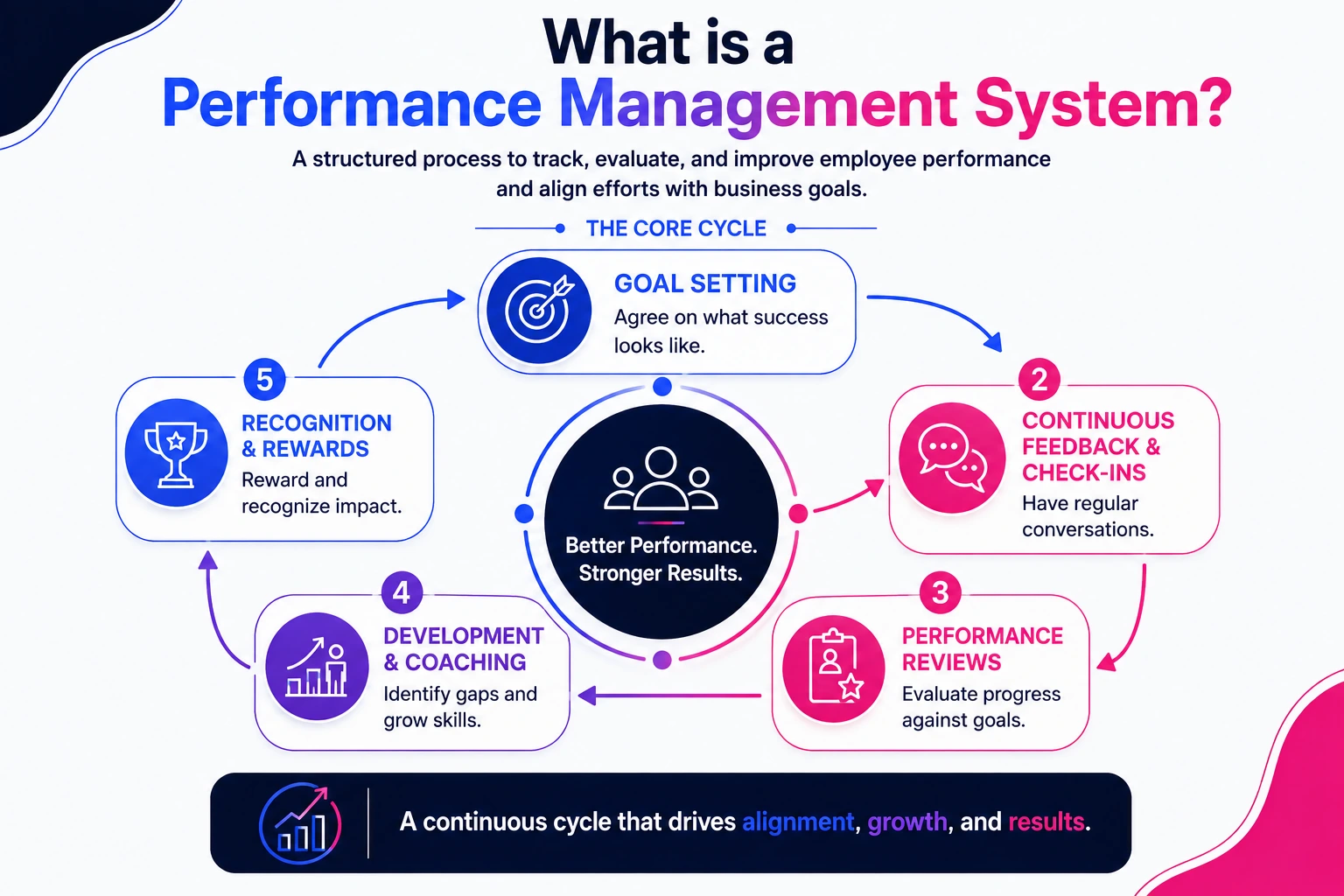
Two parts have to work together:
- The method. How you set goals. How often you talk. What “good” actually means at your company.
- The technology. Where all of that lives, so it builds up over time instead of disappearing.
The system runs on collaboration. You and your team set expectations together, agree on how success gets measured, trade feedback all year, and review the results at the end.
Performance management covers a lot of ground: progress reviews, real-time feedback, one-on-ones, coaching, recognition, rewards, and goal setting.
The system is what makes those things happen everywhere, every time. Without it, they only happen when a manager is naturally good at them.
What a performance management system does
| Function | What that looks like day to day |
|---|---|
| Sets clear expectations | Everyone sees what they’re responsible for and how it connects to company goals |
| Creates a feedback rhythm | Check-ins happen on a schedule, not by accident |
| Captures evidence | Wins and misses get logged as they happen, not remembered in December |
| Standardizes reviews | Same rubric, same scale, same calibration across every team |
| Connects to real outcomes | Ratings shape pay, promotion, and development, and people can see how |
| Reveals patterns | Company-wide data shows where problems are forming |
That last one is the difference between a process and a system. A process gives you a form. A system gives you insight.
Also read: Why your organization needs an employee performance management system
Benefits of a performance management system
Employers use a performance management system to make expectations clear, catch problems early, and keep reviews consistent across teams. The benefits show up in a few places.
- Clearer expectations. Every employee can see what they own and how it connects to company goals.
- Fewer review-day surprises. Check-ins and logged feedback mean nothing important waits until December.
- More consistent decisions. One rubric and one calibration process make pay and promotion calls easier to explain.
- A documentation trail. Notes, goals, and review history are stored in one place, which helps if a decision is ever questioned.
- Better development planning. Review results can point directly to skills gaps and learning actions.
- Company-wide visibility. Leaders can see rating patterns, flight risks, and manager differences instead of guessing.
These benefits depend on adoption. A system managers avoid will not deliver any of them.
Performance management vs. performance appraisal
People use these two terms as if they mean the same thing. They don’t, and the mix-up causes real problems.
| Performance appraisal | Performance management | |
|---|---|---|
| Looks | Backward, at one moment | Forward, all year |
| How often | Once or twice a year | Ongoing, with formal checkpoints |
| Purpose | Judge and rate | Develop and improve |
| Who owns it | HR runs it | Managers own it, HR supports |
| Input from | The boss | Self, peers, manager, direct reports |
| What you get | A rating and a form | Better work and clearer growth paths |
| How it feels | A verdict | Coaching |
Anna Tavis, who teaches Human Capital Management at NYU, puts it well: “Getting feedback once a year is totally not serving a purpose. It comes as a verdict, a judgment, whereas the intention here is to be course-correcting, to have coaching throughout the year.” (Knowledge at Wharton)
Appraisal is one piece of performance management. It’s not a replacement for it.
Free template: Appraisal Performance Review Template — a ready-made structure for writing reviews that are specific and useful, without spending a weekend on them.
Related: Traditional appraisal methods · Modern appraisal methods · How performance management evolved
Why performance management matters?
What a broken performance management system costs you
Ask a Fortune 500 CHRO whether their performance management system inspires people to improve, and 2% will say yes (Gallup, 2024). Two percent. These are the executives who own the thing.
Go one level down and it doesn’t get better. 61% of managers and 72% of workers can’t say they trust the process they’re in (Deloitte, 2025).
Ask why, and you land on a fairly uncomfortable admission: 75% of companies say they can’t accurately measure the value an individual creates (Deloitte, 2025).
Sit with that for a second. Companies are deciding raises, promotions, and layoffs using data they’ve openly told researchers isn’t reliable. No wonder only 29% of HR leaders think their process helps anyone do better work (Gartner, 2023), and 60% say it doesn’t work the way they want (Mercer, 2025).
The bill comes due in two places. People who aren’t performing well deliver 25% less value, and they’re 14% more likely to leave (Gartner, 2023). You lose the output, then you lose the person, then you pay to replace them.
What an effective system is worth
Here’s the good news, and the reason this page is 5,000 words long instead of a shrug.
Every one of those problems is fixable, and companies that fix them don’t get a modest bump. They separate from the field.
| What happens when it works | Source |
|---|---|
| 4.2x more likely to outperform peers, with 30% higher revenue growth | McKinsey, 2024 |
| 23% higher profits, 18% higher productivity, 51% less turnover | Gallup, 2026 |
| Quarterly progress checks: 90% more likely to be engaged | Gallup, 2024 |
| Daily instead of annual feedback: 3.6x more motivated | Gallup |
| Useful feedback: 5x as likely to be engaged, 48% less likely to job hunt | Gallup/Workhuman, 2024 |
| Nearly half of companies expect a 10%+ productivity jump from fixing this | WTW, 2025 |
The 3 changes that make a system work
Most research tells you what works. This one tells you what happens when you stop halfway.
McKinsey tested three specific moves:
- Link goals to business priorities. Individual targets ladder up to what the company is actually chasing this year.
- Train managers to coach. Not to fill forms. To hold a conversation that changes what someone does next quarter.
- Pay for performance. Ratings connect to compensation, so the rating means something.
Companies that did all three: 84% said their system worked (McKinsey). Companies that picked one and called it a transformation got very little.
That’s the trap most rollouts fall into. New software, same untrained managers, same disconnected comp cycle. The three moves aren’t a menu. They’re a set.
How feedback frequency affects engagement
If you remember nothing else from this section, remember this ladder. Gallup tracked employee engagement against a single variable: how often people hear from their manager.
| How often you give feedback | % of your people who are engaged |
|---|---|
| Weekly or more | 48% |
| A few times a month | 38% |
| A few times a year | 23% |
| Once a year or less | 5% |
Source: Gallup/Workhuman, 2024
Look at the top and bottom rows. Weekly feedback produces roughly ten times the engagement of annual feedback.
Not ten percent better. Ten times.
There is no software feature, no rating scale redesign, and no consultant engagement that beats simply talking to your people more often. Everything else in this guide is built to make that habit easier to keep.
The 4 Cs framework: Clarity, Cadence, Candor, Consequence
Before you look at software, it helps to have a way of thinking about what you’re building. Almost every failure we see traces back to one of four things being missing.
We call them the 4 Cs: Clarity, Cadence, Candor, and Consequence.
Clarity
People know what they’re responsible for and how it connects to the bigger picture.
This is the foundation, and it’s where most companies are weakest. Only 47% of employees strongly agree they know what’s expected of them at work, down from 61% in 2015 (Gallup).
Clarity pays off fast. Workers who feel aligned with leadership goals are 78% more motivated than those who don’t (PwC, 2025).
You have Clarity if: every person can name their top three priorities and point to the company goal each one supports.
Cadence
Conversations happen on a rhythm, not when someone remembers.
Right now, 56% of employees review their goals with their manager once a year or less (Gallup). A goal you look at once a year isn’t a goal. It’s a wish with a deadline.
You have Cadence if: check-ins happen monthly at minimum, and nobody is surprised at review time.
Candor
Feedback is specific, honest, and delivered in a way people can actually use.
This is the hardest one, because it depends on manager skill rather than process design. Only 20% of companies say their managers are good at coaching and feedback (WTW, 2025).
You have Candor if: employees can tell you one specific thing they’re working on because of feedback they got this quarter.
Consequence
Performance connects to something real: pay, promotion, growth, or opportunity.
Gartner found that when employees believe pay is tied to performance, they’re up to 17% more productive (Gartner, 2026). Note the word believe. The link has to be visible, not just real.
You have Consequence if: an employee can explain how their rating affected their pay, their next project, or their development plan.
Missing one C weakens the other three. Clarity without Cadence means goals drift. Candor without Consequence means feedback feels pointless. Consequence without Clarity is just arbitrary.
The 4 stages of the performance management cycle
There are four stages in the cycle. Each feeds the next.
1. Plan. You and your team set SMART goals or OKRs and connect them to company objectives. This is the Clarity stage, and it’s the one most companies rush.
2. Monitor. Progress gets tracked through check-ins, one-on-ones, and feedback in the moment. This is Cadence.
3. Review. The formal evaluation happens. Usually a self-review first, then the manager’s, often with peer and 360-degree feedback added in. Candor lives here, along with most of the bias risk.
4. Reward and develop. Results connect to recognition, pay, promotion, and growth plans. This is Consequence, and it’s the stage most often skipped.
Then it starts again, with what you learned feeding the next round of goals.
Related: SMART goals examples · Cascading goals · What are employee check-ins? · Review examples and phrases · Guide to performance bonuses
The 8 components of a performance management system
A good platform pulls all eight of these together. Here’s what each one does and what to look for.
1. Goal setting and alignment
Clear, challenging goals beat vague ones, and both beat having none.
Don’t stop at the individual level. Team goals need to connect to company goals. That’s the difference between 500 people working hard and 500 people working hard in the same direction.
Set them together, too. A shared conversation gives both sides a real read on what’s possible.
Look for: OKR and SMART goal support, cascading views, cross-team linking, and progress tracking. Engagedly’s OKRs and Goals lets you cascade from company level down to the individual, so every goal has a visible parent.
If goal-setting is new to you, start with our goal-setting templates.
Also read: Setting employee goals in Engagedly · Why goal setting matters · Employee goal examples
2. Regular check-ins and one-on-ones
It’s tempting to run your one-on-one as a project checklist. Face-to-face time is better spent on blockers, patterns, and growth.
Follow up on what your team is working on. It keeps momentum going and lets you fix small problems before they become review-day surprises.
But frequency alone isn’t enough. Gallup asked nearly 15,000 employees about their last conversation with their manager. Only 16% called it extremely meaningful (Gallup, 2026).
Look for: structured 1-on-1 agendas, shared talking points, action item tracking, and conversation history you can scroll back through. Engagedly’s Check-Ins and 1-on-1s keep the thread going between meetings.
New hires need the tightest cadence of all. Two templates for those first checkpoints:
Free templates: 30-Day Employee Performance Review Template for the first onboarding check, and the 90-Day Employee Performance Review Template for the point where you can see real signal.
Also read: Coaching vs. managing · Coaching skills for managers
3. Performance reviews and 360-degree feedback
The biggest change in reviews over the last decade is who gets to weigh in.
360-degree feedback brings in peers, direct reports, and cross-functional partners. It catches blind spots one rater always misses.
Upward feedback, where employees rate managers, feels awkward at first and stays useful forever. Yet McKinsey found only two in five companies use both upward and downward review (McKinsey).
Look for: flexible review cycles, self/peer/manager/upward flows, competency libraries, and reviewer reminders. Engagedly’s Performance Reviews can be configured per team, so engineering and sales don’t share one generic template.
Free template: Annual Performance Review Template — built to cover what was achieved and what comes next, so the yearly review isn’t purely a look backward.
Also read: Review examples for managers · 30-60-90 day review templates · Who should give 360 feedback · 360 feedback best practices
4. Recognition and rewards
Recognizing good work matters as much as flagging poor work. It’s also the piece most often skipped.
Only 23% of employees say they get the right amount of recognition. The ones who do are four times more likely to be engaged (Gallup/Workhuman).
It’s the cheapest lever in this whole guide. Praise costs nothing and compounds.
Look for: peer-to-peer recognition, values-linked praise, public visibility, and recognition analytics. Engagedly’s Rewards and Gamification makes peer recognition ongoing instead of a quarterly shout-out.
Want a deeper playbook? Download The Ultimate Reward and Recognition Playbook.
Also read: Best recognition software · What happens without recognition
5. Continuous feedback and coaching
A review doesn’t end at “good work” or “needs improvement.” The value is in the specifics: what to change, and how.
Adam Grant of Wharton frames it neatly: “It’s surprisingly easy to hear a hard truth when it comes from someone who believes in your potential and cares about your success.” (CNBC)
There’s a limit, though. Jim Harter, Gallup’s Chief Scientist for Workplace, warns: “Constant criticism makes it nearly impossible for a manager and employee to build a trusting relationship.” (Gallup)
A few things that make hard conversations land better:
- Treat it as a shared problem. You’re solving something together, not delivering a verdict.
- Say it early. Waiting for the formal review leaves people blindsided by something you noticed in March.
- Ask before you conclude. Underperformance often has a cause worth knowing: workload, unclear scope, something outside work.
- Balance it. Only praise and feedback stops meaning anything. Only criticism and your team stays on edge.
Look for: real-time feedback capture, feedback requests, and feedback tied to goals and competencies. Engagedly’s Real-Time Feedback lets anyone request or give feedback without waiting for a cycle.
Also read: The SBI feedback model · Why feedback matters · Constructive feedback in reviews · Delivering negative reviews
6. Learning and development
This is where performance data earns its keep. A rating that doesn’t lead to an action is just admin work.
It’s also the fastest-fading part of the employee experience. Only 31% of employees say someone at work encourages their development (Gallup, 2025). And 59% of CHROs now name development as a top struggle, up 16 points in a single year (Gallup, 2026).
Look for: skill frameworks, gap analysis, course assignment, and a direct link from review results to learning. Engagedly’s LXP, Growth Hub, Skill Gap Analysis, and Career Paths turn review outcomes into next steps.
Also read: Best employee development software · ROI of development programs · Workplace competencies guide
7. Performance analytics and reporting
Company-wide data answers questions no single review can. Where is performance strongest? Which managers grow people, and which burn them out? Are ratings fair across groups?
Only 6% of organizations say they’re doing this well (Deloitte, 2025).
Look for: rating distribution reports, equity analysis by group, engagement correlation, and flight-risk flags. Engagedly’s Talent Analytics and CXO Insights surface these patterns.
Not sure which numbers to watch first? Start here.
Free whitepaper: 10 Critical HR Metrics High-Performance Cultures Should Track — your guide to building a data-driven culture where HR drives business results instead of just reporting on them.
8. Succession planning and internal mobility
A good system gives you a live map of skill across the company. That map is what makes succession planning and internal moves possible.
Look for: 9-box talent review, successor tracking, readiness scoring, and internal opportunity matching. Engagedly’s Succession Planning and Talent Mobility build on data you’re already collecting.
Also read: The 9-box talent review · Best succession planning software · AI-powered talent mobility guide
Types of performance management systems
Organizational vs. individual performance management systems
Most guides group these systems into two levels. An organizational system tracks company-wide results, such as revenue targets and department KPIs. An individual system tracks each person’s goals, feedback, and growth. A healthy setup connects the two, so one person’s goals visibly support the company’s priorities.
The methods below, such as OKRs, 360-degree feedback, and BARS, are ways of running the individual side.
Different methods answer different questions. Most mature companies run two or three together.
| Method | What it measures | Best for | Watch out for |
|---|---|---|---|
| MBO / OKRs | Progress against agreed objectives | Outcome-driven roles, cross-team alignment | People setting easy goals to look good |
| 360-degree feedback | Behavior and impact across relationships | Leadership growth, matrixed teams | Becomes a popularity contest if tied to pay |
| Rating scales | Traits and skills on a fixed scale | Large, standardized workforces | Everyone lands in the middle |
| BARS | Behavior against defined examples | Roles where how matters as much as what | Expensive to build for every role |
| Forced ranking | You against your peers | Mostly abandoned | Kills collaboration; legally risky |
| 9-box grid | Performance and potential | Succession planning | “Potential” is the most bias-prone call in HR |
| Continuous check-ins | Progress and growth over time | Fast-moving and hybrid teams | Needs real manager skill |
| Project-based | Delivery against scope | Agile teams, contractors | Misses growth and teamwork |
Thinking of changing your scale? You’re in good company. 45% of organizations use a five-point scale, and 54% have already changed theirs or are considering it (WTW, 2025).
Related: Choosing a rating scale · System examples · What makes a good system
Annual reviews vs. continuous performance management
Formal performance management goes back to the World Wars, when militaries needed to understand what each person could do. By mid-century, businesses were using appraisals to grade workers and hand out rewards. The 1960s brought a shift toward development.
Then, for roughly fifty years, not much changed. The technology improved. The model, evaluate once a year and rate, did not.
Peter Cappelli of Wharton calls the current shift “a fundamental change in the way to manage your employees and the relationship with them.” (Knowledge at Wharton)
Writing in HBR, Cappelli and Tavis noted that “hated by bosses and subordinates alike, traditional performance appraisals have been abandoned by more than a third of U.S. companies” (HBR, 2016).
Patty McCord, who built Netflix’s talent function, is blunter: “If the purpose is to give feedback, then the annual performance review is a pretty terrible system. It’s backward looking. It’s not in the moment. It’s usually not actionable.” (IESE Insight)
Annual vs. continuous: a side-by-side comparison
| Annual | Continuous | |
|---|---|---|
| How often you talk | Once or twice | Weekly to monthly, plus formal checkpoints |
| Feedback delay | Up to 12 months | Days |
| Goal changes | Once a year | Whenever priorities shift |
| Manager effort | One painful spike | Spread out and lighter |
| Recency bias | High | Low |
| Surprises at review time | Common | Rare by design |
| Engagement | 5% engaged | 48% engaged |
Engagement data: Gallup/Workhuman, 2024
What continuous performance management does not mean
It doesn’t mean scrapping the formal review. Most companies that tried a pure “no ratings” model brought structure back, because pay, promotion, and legal defensibility all need a documented decision.
The version that works: talk continuously, decide periodically. The formal review gets easier because the conversations already happened.
Google, Microsoft, Netflix, Adobe, and Uber all made this move. Five things show up in every one of those redesigns:
- More frequent, lower-stakes conversations
- Development talks separated from pay decisions
- Simpler rating scales
- More money spent on manager training than on software
- Calibration as a scheduled, formal step
Read more: 8 companies that redefined performance management · How Purdys Chocolatier rebuilt theirs · Continuous performance management software · The problem with annual reviews · Rethinking your practices
How to reduce bias and keep performance reviews fair
A system that’s consistent but unfair is worse than no system. It makes bias look official.
And the bias is real. Research from Harvard Kennedy School found managers rated people of color lower than white employees, with the steepest penalty for Black employees in the US. Attempts to correct for it didn’t help. Women of color still ended up with the lowest final ratings (HKS, 2025).
HBR research found something subtler. Even when men and women perform identically, managers soften feedback for women — and in softening it, remove the useful information (HBR, 2023).
A language study of 248 reviews put numbers on it. 58.9% of reviews for men contained criticism. For women, it was 87.9%. Criticism of someone’s personality showed up in 2 of 83 critical reviews for men, and 71 of 94 for women (Fortune).
7 ways to reduce bias in performance reviews
1. Run calibration sessions. Get managers from different teams in a room to compare ratings against one standard before anything is final. This is the single highest-impact fix, and it solves rating inflation too. → Calibration meetings explained · HR’s role in calibration
2. Train for specific biases. Not “bias awareness” in general. Name them: recency bias, halo and horn effect, similarity bias, leniency bias. → Biases to avoid · Recency bias · Leniency bias · The halo effect · Rater bias
3. Write rubrics around behavior. Swap “Exceeds expectations” for a described behavior and an example. Vague scales are where bias hides.
4. Capture evidence all year. Recency bias is really a memory problem. If wins get logged as they happen, the review draws on twelve months instead of six weeks.
5. Get more than one opinion. Peer and upward feedback dilutes any single rater’s blind spot.
6. Audit your outcomes. Look at ratings, promotions, and pay by gender, race, and tenure. If a pattern shows up, find the cause instead of adjusting the number. Engagedly’s CXO Insights reports this at the org level.
7. Show your work. Publish the criteria, the timeline, and how to appeal. People judge fairness by the process as much as the outcome.
That last point is backed by McKinsey: perceived fairness, not rating accuracy, is what decides whether people trust the system (McKinsey).
Also read: Ethics in performance management
AI in performance management
AI moved from pilot to production faster here than almost anywhere else in HR. It also moved faster than most companies’ rules for using it.
| Finding | Source |
|---|---|
| 37% of organizations use AI somewhere in performance management | WTW, 2025 |
| Top uses: goal setting (44%), development plans (40%), reviews (37%), coaching (35%) | WTW, 2025 |
| 43% of organizations use AI in HR tasks, up from 26% in 2024 | SHRM, 2025 |
| Managers save about four hours across the review process using AI | Gartner, 2026 |
| 90% of HR leaders say AI changed what a “high performer” looks like | Betterworks, 2026 |
| But only 42% include AI expectations in goal setting today | Betterworks, 2026 |
| Executives are 6x more likely than employees to think reviews have kept up with AI | Betterworks, 2026 |
That’s the story of 2026 in three rows. Almost everyone agrees AI changed what good work means. Very few have changed how they measure it. And leaders think the gap is smaller than it is.
What AI is genuinely good at:
- Drafting. Turning a year of logged feedback into a review draft you edit. That’s where the four saved hours come from.
- Catching biased language. Flagging personality comments, gendered words, and empty praise before submission.
- Fixing recency bias. Surfacing the win from month three that everyone forgot.
- Checking goal quality. Flagging goals that can’t be measured the moment they’re written.
- Spotting patterns. Rating spread, engagement links, flight risk.
What it shouldn’t do:
- Decide ratings. Advisory only. That’s both an ethics call and a fast-moving compliance one.
- Replace the conversation. A polished AI review from a manager who hasn’t spoken to you in six months is worse, not better.
- Run without a trail. If a model shaped a rating, you need to show how.
Marissa AI is built for exactly this split. It drafts, flags bias, and checks goal quality. The decision stays with you.
Also read: AI in performance management · AI in performance reviews · AI and talent management · 10 ways AI will reshape talent strategy in 2026
Performance management for deskless, hybrid, and dynamic teams
One template doesn’t fit everyone. Three groups break most systems.
Deskless and field workers
Think manufacturing, healthcare, hospitality, retail, and logistics. These people work away from a desk and often can’t get to internal systems easily.
They’re the majority of the global workforce and get the minority of design attention. If your system assumes a laptop and a calendar invite, it doesn’t serve them.
What to change: mobile-first access, shorter and more frequent touchpoints, shift-aware scheduling, and goals based on what you can observe. Engagedly’s mobile app exists for this gap.
Also read: Performance management in manufacturing
Hybrid and distributed teams
Remote work removed the casual information managers used to rely on. Proximity bias fills the gap: the people you see get rated higher.
What to change: written goals and documented progress, output measures instead of presence, deliberate calibration to catch proximity effects, and async feedback.
Free whitepaper: Choosing the Right Performance Management Software for Remote Workplaces — what to look for when your team is spread across locations and time zones.
Dynamic teams
Teams have shifted from traditional to agile to dynamic: cross-functional, always changing, often with no assigned leader, and disbanding when the project ends.
| Traditional | Agile | Dynamic | |
|---|---|---|---|
| Leadership | Assigned line manager | Assigned scrum master | Self-managing |
| Workflow | Predictable | Shifts frequently | Changes constantly |
| Membership | Same job title | Formal sprints | Cross-functional, in flux |
| Lifespan | Ongoing | Ongoing | Ends with the project |
Team model framework adapted from SAP’s performance management research
What to change: capture feedback at project milestones instead of year-end, gather input from whoever they actually worked with, and evaluate on skills rather than role.
Also read: 5 traits of a high-performance team · Talent management strategies
How to choose a performance management system
Most buying processes over-weight feature lists and under-weight adoption. A system nobody uses scores 100% on the RFP and 0% on results.
| # | What to check | The question to ask | Why it matters |
|---|---|---|---|
| 1 | Manager usability | Can a busy manager finish a check-in in under five minutes on a phone? | Managers drive 70% of the variance in team engagement (Gallup). If the tool fights them, nothing else matters |
| 2 | Flexibility | Can cycles, scales, and competencies differ by team? | One template for sales and engineering fits neither |
| 3 | Integrations | Does it sync with your HRIS, payroll, SSO, Slack, and LMS? | Data in a silo can’t inform pay or promotion |
| 4 | One connected flow | Do check-ins feed the formal review automatically? | If they’re separate, you’ve bought two tools |
| 5 | Calibration | Can you run calibration inside the tool? | Fairness is a workflow, not a policy doc |
| 6 | Equity reporting | Can you see ratings broken out by group? | You can’t fix bias you can’t see |
| 7 | AI governance | Is AI advisory? Is there an audit trail? Can you turn it off? | Regulation is moving fast |
| 8 | Development links | Do review results create learning actions? | Otherwise ratings go nowhere |
| 9 | Mobile access | Does it work for people without a desk? | See above |
| 10 | Onboarding support | What do the first 90 days look like? | Adoption is won or lost here |
6 questions to ask a performance management vendor
- Show me the manager’s weekly experience, not the admin console.
- What happens to a check-in note six months later, at review time?
- How do you handle a mid-cycle manager change?
- Walk me through calibration for 400 people across 12 teams.
- Show me a rating report split by gender and tenure.
- What percentage of your customers’ managers complete check-ins monthly?
That last one is the best question on the list. Ask for the number, not the story.
Also read: Best performance management systems · Choosing review software · Top review software · Compare talent management software · Pricing
How to implement a performance management system
The most common mistake is buying software before deciding what performance means at your company. Here’s a sequence that avoids it.
Weeks 1–4: Define. Agree on the philosophy. Set your rating scale and what each level means. Pick your cadence. Decide the pay link and say it out loud. Name the two or three metrics that will prove it worked.
Weeks 5–8: Build. Create competency frameworks by job family, not one global list. Configure templates and workflows. Connect your HRIS, SSO, and payroll. Write the communication plan.
Weeks 9–12: Pilot. Run with two teams, one enthusiastic and one skeptical. Train managers on the conversation, not just the software. Fix friction weekly.
Weeks 13–20: Roll out. Go business unit by business unit. Publish the criteria to everyone. Hold manager office hours during the first cycle. Run your first calibration with HR facilitating.
Ongoing: Improve. Audit rating spread and equity after every cycle. Ask employees whether it felt fair, not whether they liked it. Review goal quality, not just completion. Refresh competencies yearly.
Also read: Adoption barriers and fixes · How to transform performance management
How to measure if your performance management system is working
Completion rate isn’t success. It’s hygiene. These are the numbers that show real change.
| Metric | What it tells you | Where you want it |
|---|---|---|
| % who know what’s expected of them | Clarity | Above the 49% benchmark and climbing |
| % who call the process fair | Trust | Above the 22% benchmark |
| Check-ins per manager | Cadence | Monthly minimum, weekly ideal |
| Feedback volume per person | Candor | Rising, from multiple sources |
| Ratings by demographic group | Equity | No meaningful gap between groups |
| Ratings by manager | Calibration quality | Converging after calibration |
| Goal quality vs. completion | Whether goals mean anything | High completion and real stretch |
| Regretted attrition of top performers | The bottom line | Falling |
| Internal promotion rate | Consequence | Rising |
| Manager coaching scores | Your capability gap | Above the 20% benchmark |
Also read: Building a KPI system for reviews
6 reasons performance management systems fail
Six patterns explain most failures.
1. It’s built for HR, not managers. If a review takes three hours and a training video, managers will rush it at the last minute.
2. Goals get set once and forgotten. With 56% of employees reviewing goals annually or less, the planning stage produces a document, not a direction.
3. Managers can’t coach. Only 20% of companies say theirs can. Software doesn’t fix a skill gap. It exposes one.
4. Ratings lead nowhere. If people can’t trace the line from rating to pay, promotion, or growth, the whole thing reads as theater.
5. Fairness is assumed, not built. No calibration, no rubrics, no audit. The results show it.
6. The purpose is contradictory. Trying to coach someone and decide their raise in the same meeting doesn’t work. Separate the conversations.
Also read: 6 reasons systems fail · When your strategy fails · The PIP paradox · PIP alternatives
Getting started with Engagedly
Everything you need to manage performance, all in one place.
The standalone annual review is done, and the data explaining why isn’t subtle. Weekly feedback produces about ten times the engagement of annual feedback. Quarterly check-ins nearly double it. Companies that combine goal alignment, manager coaching, and real rewards report an 84% success rate.
None of that requires a new philosophy. It requires Clarity, Cadence, Candor, and Consequence, plus a system where the conversation you had in March still exists in November.
The companies getting this right don’t have the fanciest forms. They’re the ones where a manager can have a five-minute conversation on a Tuesday and have it count.
If your setup today is spreadsheets, forms, and calendar reminders that only meet once a year, that’s the gap worth closing.
Request a demo to see goals, check-ins, 360 feedback, reviews, calibration, and development working together. Or compare Engagedly against your current stack first.