Top 10 AI Talent Management Platforms for HR Leaders in 2026

For years, this industry has promised “AI-powered” everything. From where I sit, much of that was surface-level at best, more about presentation than real impact.

2026 feels different.

We’re finally seeing platforms where AI is doing meaningful work inside organizations. Not just assisting, but actively contributing, whether that’s drafting performance summaries, identifying early signs of disengagement, or connecting employees to opportunities based on skills they haven’t formally listed. That’s the shift we’ve been working toward at Engagedly.

At the same time, this progress has made the landscape more crowded and, frankly, more confusing. There are dozens of vendors making similar claims. On the surface, many platforms look comparable across performance management, learning, engagement, goal-setting, and skills intelligence.

Which means choosing the right one still takes real evaluation.

We’ve spent significant time analyzing this space, not just based on features, but on how these platforms perform in real-world conditions.

1. Engagedly

Engagedly Best AI Performance Management Software

Best for: Mid-market organizations that want performance, learning, engagement, and skills intelligence in one platform

Website: engagedly.com

Engagedly is the only platform on this list where AI runs through every module, not just one or two. At the center of it is Marissa AI, an agentic AI system (not a chatbot) that coordinates specialized agents across goals, feedback, learning, recognition, and career pathing. You ask Marissa a question in plain English, and it routes the request to the right agent behind the scenes. No menu-hunting.

What makes this different from competitors bolting ChatGPT onto their UI: Marissa actually learns from your organization’s data. Specifically, it can:

  • Recommend goals based on what has worked before in your company
  • Identify high performers and flag engagement drops with specific follow-up actions
  • Generate personalized learning paths tied to individual skill gaps
  • Write review summaries and coach managers on delivering better feedback

The platform itself covers a lot of ground:

  • Performance reviews: 360-degree, multi-rater, with AI-written summaries
  • OKRs with predictive tracking and cascading goal alignment
  • LMS with compliance automation and AI-curated learning paths
  • Employee engagement surveys with real-time sentiment analysis
  • Skill intelligence layer for internal mobility and career pathing
  • Gamification across all modules (sounds gimmicky until you see adoption rates climb)

For mid-market companies that don’t want to stitch together five different tools, Engagedly does it all under one roof, as seen across top AI talent management software for HR leaders. The Marissa AI framework is genuinely ahead of where most competitors are with their AI offerings.

Pricing: Custom quote, typically mid-market range

G2 rating: 4.4/5

2. Lattice

Lattice AI

Best for: Mid-market teams that prioritize clean performance management and people analytics

Website: lattice.com

Lattice built its reputation on making performance reviews less painful, and it still does that well. The platform handles continuous feedback, structured review cycles, goal tracking, OKRs, and engagement surveys in a single interface that actually looks good.

Their AI features focus on writing assistance:

  • Helping managers draft better review comments
  • Summarizing feedback themes across teams
  • Surfacing coaching nudges at the right time

It works, though it’s narrower than what you’d get from Engagedly or Cornerstone. The L&D capabilities are limited. If learning management is a priority, you’ll need a separate tool or an integration.

Where Lattice shines is the people analytics layer:

  • Compensation benchmarking against market data
  • Headcount planning and org modeling
  • Attrition risk modeling with predictive signals

For HR leaders who report to the CFO as much as the CEO, that data layer matters.

Pricing: From $11/user/month

G2 rating: 4.7/5

3. Eightfold AI

Eightfold AI

Best for: Enterprises building a skills-first workforce strategy

Website: eightfold.ai

Eightfold is less “HR platform” and more “talent intelligence engine.” It sits on top of 1.6 billion career profiles and uses deep-learning models to map skills, predict career trajectories, and match people to roles. The talent marketplace for internal mobility is where it really earns its keep.

The company launched an agentic AI framework in 2025, with autonomous agents handling:

  • Candidate screening and talent rediscovery
  • Workforce forecasting and pipeline planning
  • Skills gap analysis across departments

This is enterprise-grade stuff. It integrates with your ATS and HCM, but it doesn’t replace them. You won’t find a built-in LMS or engagement survey tool here.

If your problem is “we don’t know what skills we have and we can’t plan for what we’ll need,” Eightfold is the answer. If your problem is “our performance reviews are a mess,” look elsewhere.

Pricing: Enterprise pricing, typically $50K+/year

G2 rating: 4.2/5

4. Cornerstone OnDemand

Cornerstone OnDemand

Best for: Large organizations where learning and development is the top priority

Website: cornerstoneondemand.com

Cornerstone has been in the LMS game longer than most competitors have existed. Their content library is massive, compliance tracking is battle-tested, and the AI-powered content curation actually saves time. Instead of dumping a full catalog on employees, it surfaces relevant courses based on role, skill gaps, and career trajectory.

The skills ontology is where Cornerstone has been investing most aggressively. It can:

  • Map capabilities across the entire workforce
  • Infer skills from job history and learning activity
  • Connect skill profiles to career paths and succession plans

Performance management and goal-setting modules exist and work fine, though they feel more utilitarian than what you’d get from Lattice or Engagedly.

Fair warning: the platform is complex. Implementation takes time, and a 200-person company will find it overkill. But for organizations with 5,000+ employees where structured learning programs are a business requirement, it’s hard to find a better LMS foundation.

Pricing: Custom enterprise pricing

G2 rating: 4.1/5

5. Workday HCM

Workday AI

Best for: Large enterprises that need HR and finance on the same cloud platform

Website: workday.com

Workday is the 800-pound gorilla of HCM. If your organization already runs payroll, benefits, and financial planning on Workday, adding their talent management modules is the path of least resistance. Skills Cloud (their AI skills intelligence layer) infers skills across the workforce and connects them to learning, performance, and succession planning.

The AI capabilities are solid but not flashy. Here’s what you get:

  • Workday Peakon Employee Voice (acquired) for continuous listening with text analytics
  • Skills Cloud for AI-driven skill inference across the workforce
  • HiredScore (acquired) for AI-powered candidate screening
  • Built-in performance management, learning, and goal-setting modules

The downside is cost and complexity. Workday implementations are long, expensive, and require dedicated admin resources. Mid-market companies with 500 employees will find this is more platform than they need.

Pricing: Typically $100+/user/year, enterprise contracts

G2 rating: 4.0/5

6. Leapsome

Leapsome

Best for: Scaling companies (200-2,000 employees) that want structured talent processes without bureaucracy

Website: leapsome.com

Leapsome has the highest G2 rating on this list (4.8), and it’s earned. The platform connects performance reviews, goals, engagement surveys, feedback, and learning paths in a way that feels lightweight but complete. The UI is clean, onboarding is fast, and the AI features (review writing, feedback structuring, trend analysis) work without getting in the way.

The competency framework is useful for companies building career ladders for the first time. Engagement surveys include AI-powered action recommendations, which saves HR teams from staring at dashboard data and wondering what to do next.

Leapsome doesn’t have the depth of Engagedly’s agentic AI or Cornerstone’s LMS library. But for companies in the 200-2,000 employee range that want something up and running in weeks rather than months, it’s one of the best options.

Pricing: From $8/user/month

G2 rating: 4.8/5

7. Beamery

Beamery

Best for: Enterprises focused on talent acquisition and pipeline management through the full talent lifecycle

Website: beamery.com

Beamery is a Talent CRM with an AI intelligence layer on top. It helps enterprise recruiting teams build candidate pipelines, automate outreach, and match people to roles based on skills and potential. The TalentOS platform connects sourcing, engagement, and internal mobility.

This is not a performance management or engagement platform. If you need review cycles, OKRs, or employee surveys, Beamery won’t help. What it does well is the pre-hire and early-lifecycle piece: building talent communities, nurturing passive candidates, and using AI to predict which internal employees are a fit for open roles.

Companies that already have a strong HRIS/HCM and need a dedicated talent acquisition intelligence layer will get the most value here.

Pricing: Custom enterprise pricing

G2 rating: 4.1/5

8. Phenom

Phenom

Best for: Enterprises that want a unified talent experience for candidates, employees, recruiters, and managers

Website: phenom.com

Phenom calls itself a “talent experience” platform, and the framing is accurate. It builds separate but connected experiences for four audiences:

  • Candidates get personalized career sites and chatbot interactions
  • Employees get career pathing and internal mobility tools
  • Recruiters get AI-powered sourcing and CRM features
  • Managers get workforce intelligence dashboards

The AI layer ties it together. Career pathing recommendations are based on skills data, internal job matching surfaces opportunities employees wouldn’t otherwise find, and recruiter workflows are heavily automated.

Performance management is not Phenom’s strength. The platform is strongest at the acquisition-to-onboarding part of the lifecycle, with internal mobility as a natural extension. Companies that want one vendor for recruiting and talent development (but not deep performance or learning management) should look here.

Pricing: Custom enterprise pricing

G2 rating: 4.3/5

9. UKG Pro

UKG Pro

Best for: Mid-to-large organizations that want a comprehensive HCM suite with workforce planning baked in

Website: ukg.com

UKG Pro is a full HCM platform covering:

  • Payroll and benefits administration
  • Recruiting and onboarding
  • Performance management with continuous feedback
  • Learning module for compliance and development tracks
  • Strategic workforce planning with budget modeling and skill gap forecasting

The employee experience features are surprisingly strong for an HCM platform. Group messaging, community spaces, and announcement tools create something that feels more like an internal social network than a traditional HRIS.

UKG Pro’s weakness is that it tries to do everything, which means some modules (particularly talent mobility and skills intelligence) don’t go as deep as specialist platforms like Eightfold or Engagedly. But if you want payroll, benefits, and talent management from a single vendor with good support, it’s a safe bet.

Pricing: Custom quote

G2 rating: 4.2/5

10. Korn Ferry Talent Suite

Korn Ferry Talent Suite

Best for: Organizations focused on leadership development, succession planning, and organizational design

Website: kornferry.com

Korn Ferry comes from the consulting world, and it shows. Their Talent Suite is built around:

  • AI-driven success profiling that defines what “great” looks like for each role
  • Talent assessments that evaluate candidates and employees against those profiles
  • Succession risk identification and leadership pipeline development
  • Architect tool for job profiling and org design
  • Assess tool for research-backed talent evaluation

These tools are widely used by Fortune 500 companies. If your C-suite cares about leadership bench strength and you need data to back up succession decisions, Korn Ferry has the credibility.

The platform is less suited for day-to-day performance management, employee engagement, or learning management. Think of it as a strategic talent advisory platform rather than an operational HR tool. Many organizations use Korn Ferry alongside an Engagedly or Workday for the operational side.

Pricing: Custom enterprise pricing

G2 rating: 4.1/5

How to choose the right platform

There’s no single “best” platform here. It depends on what’s actually broken in your organization.

  • Scattered tools, want one unified platform: Engagedly makes the strongest case for mid-market companies. Marissa AI works across all modules, so your data isn’t siloed by function.
  • Skills intelligence and workforce planning: Eightfold AI goes deepest here, but you’ll need other tools for performance and engagement.
  • L&D is the strategic priority: Cornerstone has the most mature LMS with AI-powered content curation.
  • Scaling company, need fast deployment: Leapsome or Lattice. Leapsome edges ahead on learning; Lattice wins on analytics and compensation.
  • Want talent management bundled with payroll and benefits: Workday for HR + Finance integration, UKG Pro for broader employee experience.
  • Gap is in talent acquisition and pipelining: Beamery for CRM-style pipeline management, Phenom for unified talent experience.
  • CEO asking about succession risk and leadership bench: Korn Ferry, ideally used alongside an operational platform like Engagedly or Workday.

Final thoughts

Two years ago, when people said “AI-powered” in talent management, what they often meant was a thin layer of automation dressed up as intelligence. A recommendation engine that pushed the same few courses to everyone. That was the reality across much of the market.

That’s not the bar anymore.

What we’re seeing now, and what we’ve been building toward at Engagedly, is a shift from AI as a feature to AI as infrastructure. It’s not about adding a chatbot or sprinkling automation into workflows. It’s about rethinking how talent systems operate at their core.

With Marissa AI, we took an agentic approach. Instead of a single monolithic system trying to do everything, you have specialized AI agents handling performance, learning, engagement, and development. They work together through a unified interface, continuously learning from the real signals inside your organization, not generic datasets. That distinction matters. It’s the difference between something that looks intelligent and something that actually adapts.

But I’ll be candid about one thing.

No matter how compelling a platform looks in a demo, that’s not where decisions should be made. Demos are controlled environments. They’re designed to impress. Real organizations are not.

If you’re evaluating any platform, including ours, run a proper pilot. Give it 90 days. Put it in the hands of managers and employees who will use it in the middle of real work, not in a guided walkthrough. See how it performs during an imperfect review cycle. Watch how it responds when engagement drops in a team that’s already stretched thin.

Because ultimately, the best platform isn’t the one with the most features or the most polished demo.

It’s the one your people actually choose to use on a Tuesday morning, without a reminder.

Skills Decay in the AI Era: The Hidden Talent Crisis Nobody’s Measuring

Here’s something that should keep every HR leader up at night: while we’re all frantically discussing whether AI will replace jobs, we’re completely missing the more immediate threat—the rapid decay of skills we already have.

Think about it. Your marketing team learned SEO best practices two years ago. Your developers mastered Python frameworks six months back. Your customer service reps became experts in your legacy systems last quarter. But in the AI era, how much of that expertise is still relevant?

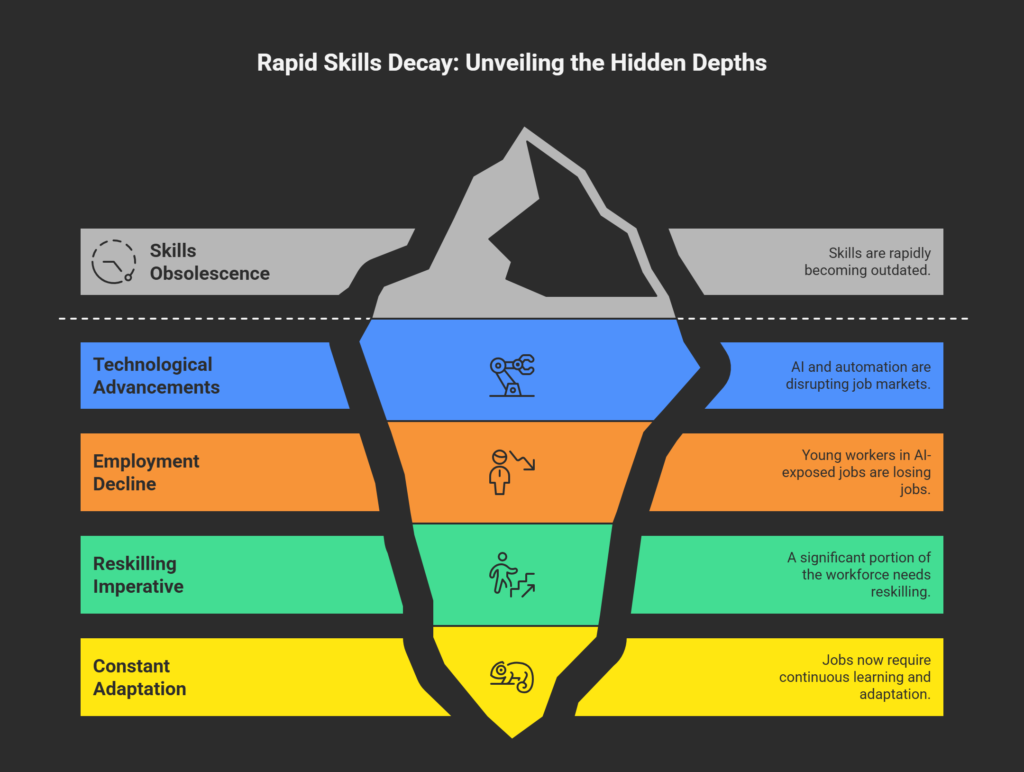
The answer is uncomfortable: skill sets for jobs have changed by around 25% since 2015, and by 2028, employers estimate that 44% of workers’ skills will be disrupted. We’re not just facing an AI skills crisis—we’re watching organizational knowledge evaporate in real-time, and most companies aren’t even measuring it.

The Silent Erosion Nobody’s Tracking

Let’s talk about what’s actually happening on the ground. Young workers aged 22-25 in AI-exposed jobs such as software developers, accountants, and customer service agents have experienced a 13% decline in employment since ChatGPT’s release in November 2022. That’s not a projection—it’s happening right now.

But here’s the twist: it’s not that these workers lack skills. It’s that their skills became obsolete faster than anyone anticipated. As Stanford economist Erik Brynjolfsson puts it: “This is the fastest, broadest change that I’ve seen,” second only to the shift to remote work during the pandemic.

The ai skills crisis isn’t just about learning new AI tools. It’s about the shelf life of every skill your workforce possesses, shrinking from years to months. Consider this reality check: 39% of key job skills in the U.S. are expected to change by 2030, and 59% of workers will require upskilling or reskilling by 2030.

That’s more than half your workforce needing fundamental retraining in just five years.

The Measurement Gap: What We’re Not Seeing

Here’s where most organizations are flying blind. We track performance metrics, engagement scores, and productivity numbers. But how many companies actually measure skills decay? How many HR leaders can answer these questions:

  • Which employee skills are becoming obsolete this quarter?
  • How quickly are technical competencies losing relevance?
  • What’s the half-life of our training investments?
  • Which roles are most vulnerable to skills erosion?

The brutal truth? Most can’t. We’re investing millions in learning and development without knowing if last year’s training is still valuable. It’s like buying insurance without knowing what risks you’re covering.

39% of respondents express apprehension regarding the adequacy of training provided by their employers in emerging digital and technology skills. Your employees know something’s wrong—they can feel their skills slipping. The question is: are you listening?

The Real Cost of Invisible Obsolescence

Let’s get practical about what skills decay actually costs your organization. It’s not just about employees feeling unprepared (though that’s certainly part of it). The financial implications are staggering.

67% of digital transformations are delayed due to skill shortages, with 87% of North American IT leaders reporting delays due to insufficient IT skills. These aren’t minor hiccups—we’re talking about delays of 5-10 months or more on critical initiatives.

Now multiply that across your organization. Every delayed project. Every initiative that can’t launch because your team lacks current skills. Every competitive advantage you’re missing is because your workforce knowledge is outdated. See how Engagedly brings AI into core people operations to simplify workflows, support data-informed decisions, and optimize talent management.

Bill Gates frames the broader challenge well: “It is true that some workers will need support and retraining as we make this transition into an AI-powered workplace. That’s a role for governments and businesses, and they’ll need to manage it well so that workers aren’t left behind”.

But here’s the uncomfortable question: how do you retrain workers when you don’t even know which skills are decaying?

The Speed Problem: AI’s Exponential Impact

Traditional skills obsolescence followed a predictable pattern. You learned something, it remained relevant for 5-10 years, then gradually became outdated. You had time to adapt.

AI has shattered that timeline.

Historically, only 6% of the workforce needed reskilling. By 2024, that number rose to 35% of the workforce—or over 1 billion workers across the globe. That’s not a gradual shift. That’s an explosion.

Consider what this means for someone in your organization right now. A mid-level manager who learned data analysis in 2022 is already using outdated methods. A customer service representative who mastered your systems last year is competing with AI that never sleeps, never takes breaks, and improves daily.

The velocity of change is unprecedented. As one industry analyst noted in discussing manufacturing digital transformation, 74% of companies report an acute shortage of skilled workers, and 94% expect to hire or repurpose workers through increased adoption of smart manufacturing technology.

The Generation Divide: Different Speeds of Decay

Here’s an insight that might surprise you: skills aren’t decaying at the same rate for everyone. Age creates dramatically different experiences of the ai skills crisis.

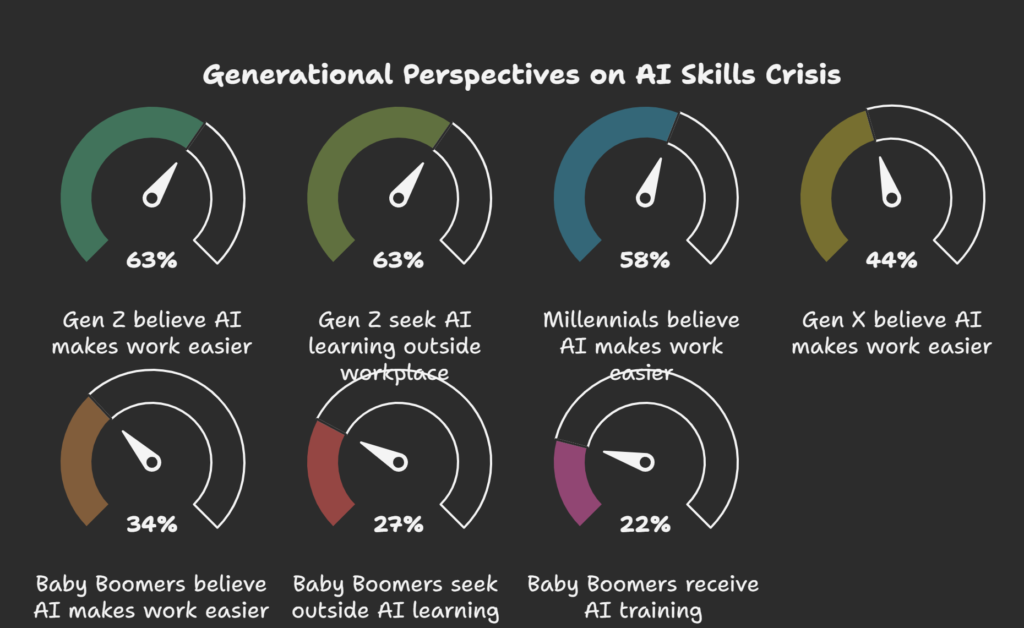
Only 34% of Baby Boomers believe AI can make their work easier, compared to 63% of Gen Z, 58% of Millennials, and 44% of Gen X. But this isn’t just about adoption attitudes—it’s about how quickly different generations can retool.

The data gets more specific: Gen Z workers are twice as likely (63%) to seek AI learning opportunities outside the workplace compared to Baby Boomers (27%). Younger workers instinctively understand that their skills have expiration dates. They’re already adapting.

Meanwhile, older employees generally have navigated the workplace for a longer period of time and are more likely to have picked up communication and other soft skills that are harder to teach and that employers may be reluctant to replace with AI.

The takeaway? Your organization is experiencing skills decay at multiple speeds simultaneously. One-size-fits-all training won’t cut it.

What Actually Gets Replaced (And What Doesn’t)

Let’s be specific about what the ai skills crisis is attacking. Not all skills decay equally, and understanding the pattern is crucial for your L&D strategy.

Eight of the top ten most requested skills in U.S. job postings are durable human skills, with communication, leadership, metacognition, critical thinking, collaboration, and character skills each appearing in approximately 15 million U.S. job postings annually.

Notice what’s not on that list? Routine technical tasks. Data entry. Basic analysis. These are precisely the skills AI is absorbing fastest.

As James Manyika, senior vice president at Google, observes: “There will be jobs lost, but also gained, and changed. The number of jobs gained and changed is going to be a much larger number, so if you ask me if I worry about a jobless future, I actually don’t”.

The critical insight here: 66% of all tasks in 2030 will still require human skills or a human-technology combination. But here’s the catch—those human skills need to be paired with AI literacy. Neither alone is sufficient.

The Training Paradox: Why Current Approaches Fail

Now we hit the real problem. Most organizations have responded to the ai skills crisis with more training. Sounds logical, right? Except it’s not working.

While 75% of companies are adopting AI, only 35% of talent have received AI training in the last year. That’s a catastrophic gap between adoption and preparation.

But it gets worse. Even when training exists, it’s often ineffective. Respondents on a 2024 Skillsoft survey said that the learning format in existing talent development programs is sometimes not effective, or they struggle to find time or leadership support for completing these programs.

Here’s why traditional training approaches fail in the AI era:

1. They’re too slow. By the time you design, approve, and roll out training for a new tool, that tool has evolved or been replaced.

2. They’re too generic. AI affects different roles in completely different ways. Marketing’s AI needs look nothing like engineering’s.

3. They’re not continuous. A one-week course on ChatGPT in January doesn’t prepare you for the AI landscape in June.

4. They ignore measurement. Without tracking skills decay, how do you know if your training is even addressing the right gaps?

Marc Benioff, CEO of Salesforce, gets to the heart of it: “Artificial intelligence and generative AI may be the most important technology of any lifetime”. Yet we’re treating AI literacy like any other corporate training module. Discover how Engagedly’s AI-powered platform streamlines HR processes, elevates performance outcomes, and enhances every stage of the employee lifecycle.

The Hidden Casualties: Entry-Level Talent

While we’re focused on reskilling existing employees, there’s another group being devastated by skills decay: people trying to enter the workforce.

Labor research firm Revelio Labs has found that postings for entry-level jobs have declined by about 35% since January 2023. Think about what that means. The traditional path—get educated, land an entry-level role, learn on the job—is collapsing.

Why? Because AI is absorbing precisely the tasks that entry-level employees used to perform. The routine work that helped people learn organizational systems and build experience is disappearing.

40% of white-collar job seekers in 2024 failed to secure interviews while high-paying positions exceeding $96,000 hit decade-low hiring levels. The ladder itself is losing its bottom rungs.

For organizations, this creates a secondary skills crisis: How do you build your talent pipeline when the traditional entry points no longer exist? How do junior employees develop expertise when the learning-by-doing tasks are automated?

Real Solutions: Measuring What Matters

Enough diagnosis. Let’s talk about what actually works in addressing the ai skills crisis. And it starts with measurement.

Create a Skills Half-Life Dashboard

Stop thinking about skills as permanent assets. Start tracking them like inventory with expiration dates. For each critical role in your organization:

  • Identify the five most important technical skills
  • Assign each skill a relevance timeline (6 months, 1 year, 2 years)
  • Track when the skill was last updated or refreshed
  • Monitor industry changes that might accelerate decay

This isn’t about creating bureaucracy. It’s about visibility. You can’t manage what you can’t see.

Implement Continuous Micro-Learning

Forget annual training programs. Six in 10 workers will require training before 2027, and that training needs to be continuous, bite-sized, and immediately applicable.

Think: 10-minute weekly skill updates instead of 3-day quarterly workshops. Real-time learning is integrated into the workflow instead of separate training sessions. On-demand resources when employees hit a knowledge gap, not scheduled courses, they may or may not need.

Build AI Literacy Across Generations

Remember that generational divide? Address it head-on. Create different learning pathways for different groups:

  • Gen Z/Millennials: Fast-paced, self-directed, tool-focused training
  • Gen X: Structured integration of AI into existing expertise
  • Boomers: Emphasis on augmentation, not replacement, with hands-on support

One format doesn’t fit all. Only 22% of Baby Boomers receive AI training, and generic approaches won’t change that.

Redefine Job Roles Around Durable Skills

Here’s a counterintuitive approach: instead of constantly retraining people for tasks that will change again, restructure roles around skills that endure.

Analytical thinking, curiosity, and lifelong learning are among the top 10 skills on the rise for future jobs. These don’t decay. Build jobs that emphasize these capabilities, with AI handling the tasks that do become obsolete.

The Partnership Model: Humans + AI

Let’s be clear about something: the goal isn’t to out-compete AI. It’s to work alongside it effectively. As Silvio Savarese, chief scientist at Salesforce AI Research, explains: “AI is placing tools of unprecedented power, flexibility, and even personalization into everyone’s hands, requiring little more than natural language to operate. They’ll assist us in many parts of our lives, taking on the role of superpowered collaborators”.

The most successful organizations aren’t trying to make their employees AI-proof. They’re making them AI-fluent. There’s a massive difference.

AI-proof thinking says: “Learn skills AI can’t do.” AI-fluent thinking says: “Learn to leverage AI for exponentially better outcomes.”

Consider customer service. AI can handle routine inquiries, yes. But a human customer service representative who knows how to use AI effectively—when to intervene, how to personalize responses, which situations require human judgment—is far more valuable than either AI or human alone.

Building Your Skills Resilience Framework

The ai skills crisis isn’t a problem you solve once. It’s a new operational reality that requires systematic approaches. Here’s a framework that actually works:

Quarter 1: Audit and Baseline

  • Map critical skills across your organization
  • Identify high-risk decay areas (typically technical roles in fast-changing fields)
  • Survey employees about their own perception of skills relevance through 360-degree feedback
  • Establish baseline metrics

Quarter 2: Implement Early Warning Systems

  • Set up skills monitoring (industry changes, tool updates, competitive analysis)
  • Create feedback loops where employees report skills gaps in real-time
  • Establish partnerships with learning providers for rapid response training
  • Begin pilot programs in the highest-risk areas

Quarter 3: Scale Responsive Learning

  • Roll out continuous micro-learning programs
  • Integrate AI tools into daily workflows with embedded training
  • Create peer learning networks where employees teach each other emerging skills
  • Measure time-to-proficiency on new tools and capabilities

Quarter 4: Evolve and Optimize

  • Review what worked and what didn’t
  • Update skills relevance timelines based on actual decay rates
  • Refine training approaches for different employee segments
  • Plan next year’s skills development roadmap

This isn’t a one-time initiative. It’s a permanent organizational capability.

The Bottom Line: Act Now or Fall Behind

Here’s the uncomfortable truth: your competitors are facing the same ai skills crisis you are. The question is who responds faster and more effectively.

75% of surveyed workers were using AI in the workplace in 2024, with nearly half (46%) beginning within the last six months. AI adoption is happening whether you’re ready or not. The skills your workforce needs are changing whether you’re tracking it or not.

The organizations that will thrive aren’t those with the most AI tools. They’re the ones who successfully navigate the human side of this transition—who can measure skills decay, respond rapidly to gaps, and keep their workforce relevant in real-time.

As one McKinsey partner observed: “Our research says that 50% of the activities that we pay people to do can be automated by adapting currently demonstrated technologies. We think it’ll take decades, but it will happen. So there is a role for business leaders to try to understand how to redeploy talent. It’s important to think about mass redeployment instead of mass unemployment”.

Mass redeployment. That’s your mission. Not mass unemployment, not mass panic, not mass resistance. Mass redeployment of human talent toward the work that matters most.

But it starts with seeing the problem clearly. Skills decay is real. It’s measurable. And it’s accelerating. The question isn’t whether you’ll address it. The question is whether you’ll address it before it’s too late.

If you’re serious about staying ahead of skills decay and turning workforce signals into action, it might be worth requesting a demo to see how leading teams are operationalizing this shift. Your move.

FAQs

What is the AI skills crisis and why does it matter now?

The AI skills crisis is the rapid decline in relevance of existing workforce skills due to accelerated AI adoption. Unlike traditional skills obsolescence, AI-driven change is shrinking skill lifespans from years to months. Studies show nearly half of all workers will need reskilling by 2030, while organizations rarely measure which skills are decaying. This gap leads to delayed projects, stalled digital transformation, and lost competitiveness.

How does skills decay impact business performance and productivity?

Skills decay directly affects productivity, project timelines, and innovation capacity. When employee capabilities lag behind technology, organizations face delayed digital initiatives, increased rework, and reliance on external hiring. Research shows most digital transformation delays are caused by skill shortages rather than technology failures. Invisible obsolescence also wastes L&D budgets when training targets outdated competencies. Measuring skill relevance and time-to-proficiency helps leaders connect workforce readiness to business outcomes.

Why traditional training programs fail in the AI era?

Traditional training fails because it is slow, generic, and disconnected from real-time skill needs. AI tools evolve faster than annual or quarterly training cycles can keep up, making static courses obsolete quickly. Many programs also lack personalization by role or skill level and fail to track whether training actually closes gaps. Without continuous measurement of skills decay, organizations cannot prioritize what to retrain.

How can organizations measure and manage skills decay effectively?

Organizations can manage skills decay by treating skills as time-bound assets rather than permanent capabilities. Practical steps include:
• Creating a skills inventory by role
• Assigning relevance timelines or “half-lives” to critical skills
• Tracking when skills were last refreshed
• Monitoring industry and technology changes

Dashboards and CXO-level insights that link skills data to performance and project outcomes provide early warnings.

What is the best long-term strategy to future-proof the workforce against AI?

The most effective strategy is building AI fluency combined with durable human skills. Instead of trying to make roles AI-proof, leading organizations redesign jobs around critical thinking, collaboration, and judgment while using AI to augment routine tasks. Companies like Salesforce emphasize human–AI collaboration rather than replacement. Continuous microlearning, role-based AI training, and skills-based talent management create long-term resilience.

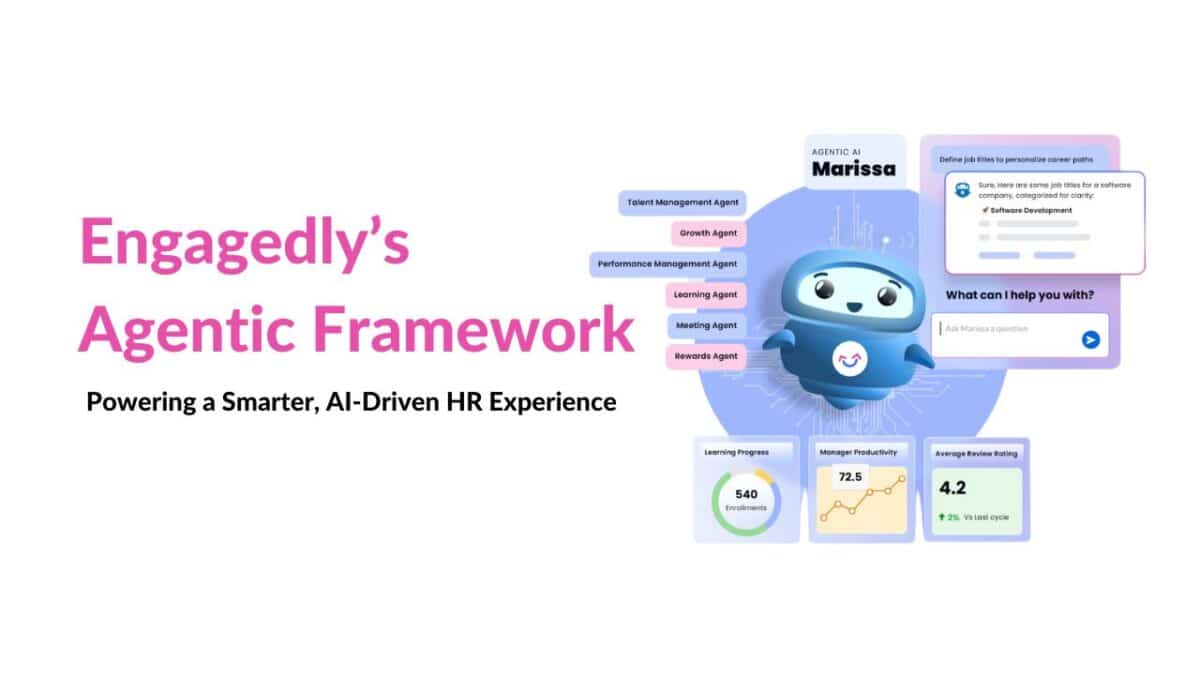
Engagedly’s Agentic Framework: Powering a Smarter, AI-Driven HR Experience

Employees today don’t want to dig through menus or wait for answers—they expect quick, personalized support from their tools. Engagedly’s new Agentic Framework is designed to meet this need by infusing intelligent AI “agents” throughout the platform.

This framework is the engine behind Engagedly’s smart features (like the Marissa™ AI assistant) and is transforming how employees and HR teams interact with the system. In this blog, we’ll break down what the Agentic Framework is, how it works, and why it makes user interactions smarter, faster, and more personalized.

What is the Agentic Framework?

At its core, Engagedly’s Agentic Framework is a network of AI-driven agents working together to assist users across different HR functions. Instead of a single monolithic AI, Engagedly uses multiple specialized agents (for goals, learning, performance, etc.) coordinated by a “Super Agent”. The Super Agent acts as the face of the AI – think of it as Engagedly’s virtual assistant (Marissa AI) that the user interacts with directly. 

When you ask Engagedly’s assistant a question or give it a task, that Super Agent doesn’t do everything itself – it delegates the request behind the scenes to the right expert agent in the framework, then brings the answer back to you.

This design allows each agent to be an expert in its domain (for example, one agent knows all about the Goals module, another specializes in Learning, and so on) while the Super Agent orchestrates the conversation. The result is an AI assistant that can help with career planning, goal setting, learning, performance reviews, HR questions, and more – all through one chat interface, powered by a team of cooperating agents. 

Engagedly’s Agentic Framework is what makes this possible, enabling the system to handle a wide variety of queries autonomously and intelligently​.

Now, let’s dive into the key components of this framework and how they work together to answer your questions.

Marissa Super Agent and User Interaction

The Super Agent is the primary point of contact for the user. In Engagedly’s case, this is the role of Marissa AI, the AI-powered HR assistant. From the user’s perspective, Marissa is who they chat with – whether it’s through a chat window or voice interface. 

You might ask, for example, “Hey, what’s the status of my current goals?” or “Enroll John Doe in the Leadership 101 course.” 

The Super Agent receives these queries in natural language. Its job is to understand the request (using natural language processing) and then figure out which behind-the-scenes agent should handle it. Think of the Super Agent as a smart receptionist: it greets you, listens to what you need, and then routes you to the right specialist internally.

Importantly, the Super Agent stays with the conversation from start to finish. It might ask follow-up questions if something is unclear, and once the specialized agent returns with an answer or result, the Super Agent presents that answer back to you in an easy-to-understand way. 

This means you, as the user, always interact with one friendly AI persona, unaware of the complex teamwork happening in the background. The experience is seamless – you ask Marissa AI anything related to Engagedly’s HR suite, and it responds with the information or action, no matter which module or data source it had to tap into. 

This greatly simplifies user interaction: you don’t need to know which part of the software to navigate to; the Super Agent takes your request and does the heavy lifting by delegating it internally. Discover how Engagedly’s AI powered platform streamlines HR processes, elevates performance outcomes, and enhances every stage of the employee lifecycle.

Engagedly’s Fleet of Specialized Agents

Now, who are these specialized agents we’ve been talking about? Engagedly’s platform covers a broad range of HR functions – and for each major area, there is an AI agent ready to help. Here are the key agents in Engagedly’s Agentic Framework and how they relate to core Engagedly modules:

1. Talent Management Agent: 

This agent focuses on high-level talent management insights and actions. It assists admins in building and maintaining a complete talent framework—including job titles, skills, competencies, and career paths. By keeping these foundational elements up to date, the agent enables effective workforce planning and supports employee growth and career progression across the organization.

In the future, this agent will be able to support strategic queries from HR leaders—such as, “Identify top performers who are ready for leadership roles,” or “Do we have any skill gaps in our engineering department?” These capabilities will help organizations make more informed, data-driven talent decisions.

2. Learning Agent: 

Aligned with Engagedly’s Learning Experience Platform, this agent is the expert on employee learning and development. Users can interact with it to find courses, get recommendations, or manage their learning activities. 

For example, an employee could ask, “Find me a course on project management,” or “What compliance trainings do I still need to complete?” In the current phase, the agent focuses on individual user needs. In future phases, it will evolve to handle team- and organization-level queries—such as identifying pending trainings for a team or surfacing skill development opportunities across departments.

The Learning Agent would use Engagedly’s learning module data to answer. It can help enroll users in courses, suggest learning paths, or fetch progress reports. Essentially, it makes the vast learning resources easier to navigate by simply asking the assistant.

3. Goals Agent: 

This agent corresponds to Engagedly’s OKRs & Goals module. It helps users discover the goals they need to work on and suggests new goals aligned with their organization, department, or business unit—leveraging Engagedly’s built-in “Goals Suggest” tool. Instead of navigating through the interface, users can simply ask questions like, “What goals should I prioritize this quarter?” or “Show me my active goals.”

In future iterations, the agent may also assist in creating and updating goals conversationally—making goal management more intuitive and aligned across the organization.

4. Employee Growth Agent: 

Centered around Growth & Development, this agent helps with career planning and personal development – an area Engagedly supports through its Growth Hub (Individual Development Plans, competencies, and mentorship). 

An employee could ask, “What skills should I develop to advance to a Senior Engineer?” or “Show me my growth plan for this year.” 

The Employee Growth Agent would access information like the employee’s development plan, available growth resources (Engagedly’s Resources library), and even role competencies. It might suggest learning activities, mentoring opportunities, or track progress on an Individual Development Plan

In short, this agent is like a career coach embedded in the platform, guiding employees on growth opportunities and tracking their progress.

5. Review Assistant Agent: 

This agent is all about performance reviews and feedback cycles, tying into Engagedly’s Performance Review module (which includes 360 feedback, continuous feedback, etc.). It can help managers and employees during the review process. 

For example, a manager could say, “Summarize Jane’s performance feedback for this quarter,” and the Review Assistant could compile key points from various feedback and analytics. It might also help write review comments or give tips, using AI to draft evaluations based on data (always with human oversight). 

Another use: an employee can ask, “What feedback have I received from my peers?” and it can pull that from the 360-feedback module. By leveraging AI, this agent can even help eliminate bias by focusing on objective data. It essentially acts as a smart assistant during reviews, making the process less laborious and more insightful.

6. HR Assistant Agent: 

This is an evolution of the traditional HR helpdesk bot – and in fact, Engagedly’s Marissa AI began in this role. The HR Assistant Agent can answer common HR questions and assist with HR-related tasks. 

Think of things like “How many vacation days do I have left?”, “What is the process to refer a candidate?”, or “Add a new employee record for our new hire.” 

This agent draws on company HR policy documents (for answering policy questions) and on Engagedly’s core HRIS-like functions or integrations (for employee data management). It can execute actions such as creating or updating user profiles (for example, adding a new employee would use a tool corresponding to User Create in the system, updating user info would use User Update, etc.). 

In general, the HR Assistant is there to handle day-to-day HR inquiries and tasks in a conversational way, freeing up HR teams from repetitive questions and giving employees quick answers.

Each of these agents is specialized, but thanks to the Agentic Framework, they don’t operate in isolation. They are all accessible through the single interface of Marissa AI (the Super Agent). The Agent Classifier and Orchestrator make sure your query finds the right one. From an end-user’s perspective, it feels like talking to one AI that knows everything about the HR platform. 

Internally, it’s a whole team of AIs each handling their specialty. This design not only makes the AI’s responses more accurate (since each agent is focused on a specific area of expertise), but it also means Engagedly will develop and improve each agent separately without affecting others. New agents will be added as new features roll out, and existing ones will be fine-tuned with more knowledge of their domain over time.

Benefits of Engagedly’s Agentic Framework

Why go through all this complexity? Because the payoff is enormous for the user experience and HR outcomes. Here are some key benefits that Engagedly’s Agentic Framework brings to the table:

1. Smarter Answers and Actions: 

The multi-agent approach means each query is handled by a domain expert. This leads to more accurate and insightful answers. The AI isn’t just parroting generic info – it’s pulling from real, up-to-date data in the Engagedly system (your goals, your company’s feedback records, learning catalog, etc.) via the appropriate tools. 

It also understands context better by using AI (LLMs) at multiple decision points. The result is an assistant that can answer complex questions (“What training should I take to improve in my current role based on my performance reviews?”) with intelligent, data-driven responses rather than one-size-fits-all advice.

2. Faster Problem Solving: 

From an end-user standpoint, getting things done in Engagedly becomes much faster. Instead of manually navigating through different modules (Goals, Learning, Feedback, etc.) and figuring out where to find information, a user can simply ask the AI and get an answer or have an action performed. 

The Agentic Framework handles the multi-step process in seconds – what might take an employee 15 minutes clicking around the platform, the AI can do in a fraction of that time. This speed is especially valuable for managers or HR folks who need quick insights across systems. 

For example, preparing for a one-on-one meeting might involve checking an employee’s goals, recent feedback, and training status – the AI can fetch all that in one consolidated response when asked. In short, the framework boosts efficiency and saves time for everyone.

3. Personalized and Context-Aware Interaction: 

Because of the Agent Memory and the context it provides, conversations with Engagedly’s AI feel much more personalized. The assistant can remember that you asked about a specific project or person earlier and use that context in follow-up answers. It can also tailor its responses based on who is asking – an employee vs. a manager might get answers scoped to their team or permissions. 

These agents are designed to simplify the user experience by offering quick, relevant responses based on existing system data. While they don’t learn from past interactions today, future enhancements may explore deeper personalization. For now, the focus is on delivering consistent, accurate support that helps users get things done faster and with less friction.

For HR departments, this means employees are more likely to actually use the tools available to them, because interacting with the system is as easy as having a conversation with a knowledgeable colleague.

4. Holistic HR Support in One Place:

Because the Agentic Framework spans across all the major functions of the Engagedly platform, it essentially provides a one-stop-shop for HR support. Whether an employee needs help with a personal HR query or a manager needs a strategic insight, they go to the same assistant. This unified approach drives higher adoption of the system’s features. 

It also ensures consistency in answers (the AI will give the same guidance to everyone based on the single source of truth data in the platform). The framework breaks down silos between different HR functions – performance, learning, engagement, etc. – by enabling cross-talk between agents when needed. 

For example, a query about improving performance might involve both the Goals Agent and Learning Agent (goals data + learning recommendations). The orchestrator can facilitate such multi-agent collaboration to deliver a holistic answer. The end result is that organizations can manage talent development, performance improvement, and employee engagement in a more integrated way. See how Engagedly brings AI into core people operations to simplify workflows, support data informed decisions, and optimize talent management.

Experience the Power of Engagedly’s Agentic AI

Engagedly’s Agentic Framework represents a significant leap forward in HR technology. By orchestrating a “team of AI agents” behind a friendly interface, Engagedly is able to provide users with an assistant that is knowledgeable in every facet of talent management.

Managers get to make data-informed decisions faster, employees get timely answers and guidance for their growth, and HR teams can focus on strategic work while routine queries are handled intelligently by the AI. It’s a smarter, faster, and more personalized way to engage with your HR software.

The best part? You don’t have to wait for the future – this is happening now. Engagedly is rolling out these AI capabilities (with Marissa AI at the helm) to help organizations elevate their performance and development processes. If you’re excited about the possibilities of AI in talent management, now is the time to experience Engagedly’s Agentic Framework in action.

Ready to transform your HR experience with intelligent agents? Reach out to Engagedly for a demo or consultation. See firsthand how Marissa AI and the Agentic Framework can empower your workforce and drive better engagement and performance. Don’t miss the opportunity to bring a cutting-edge AI co-pilot to your HR team – get in touch with Engagedly and let these smart agents start working for you!

Frequently Asked Questions (FAQs)

What is an Agentic Framework in HR software?

An Agentic Framework is a multi-agent AI architecture where specialized AI agents collaborate under a central “super agent” to complete tasks and answer queries. Instead of relying on a single chatbot, this framework uses domain-specific agents for goals, learning, performance, and HR operations.

In practice, users interact with one assistant interface, while the system delegates requests to the appropriate expert agent behind the scenes. This structure improves accuracy, context awareness, and automation across talent management workflows, making HR platforms more intelligent and responsive.

How does a multi-agent AI system improve the employee experience?

A multi-agent AI system enhances employee experience by delivering faster, personalized, and context-aware support across HR functions. Instead of navigating multiple modules, employees can simply ask questions in natural language.

The system can:

  • Retrieve goal progress and feedback summaries
  • Recommend learning paths based on skill gaps
  • Answer HR policy or leave balance queries
  • Support career development planning

By reducing friction and manual searching, AI-driven HR platforms improve usability, boost adoption, and increase engagement with talent management tools.

How can AI agents support performance management and goal tracking?

AI agents support performance management by aggregating data from goals, feedback, and reviews to provide actionable insights. For example, a manager can request a performance summary, identify strengths and development areas, or align team OKRs without manually compiling reports.

Goal-focused agents can also suggest priorities, surface alignment gaps, and provide progress updates instantly. This reduces administrative effort while enabling data-informed decisions. When AI integrates learning and performance data, it creates a continuous feedback loop that supports measurable employee growth.

What makes agent-based HR automation different from traditional HR chatbots?

Traditional HR chatbots typically answer FAQs using predefined scripts or static knowledge bases. Agent-based HR automation goes further by executing tasks, accessing live system data, and collaborating across modules.

Instead of just answering “How many leave days do I have?”, an agent-based system can update records, enroll users in training, summarize review data, and generate recommendations. This shift from reactive support to intelligent task orchestration increases efficiency, reduces manual workload, and enhances strategic HR operations.

Is AI-powered talent management software worth investing in?

AI-powered talent management software is valuable for organizations seeking efficiency, scalability, and data-driven decision-making. By embedding intelligent agents across learning, performance, and workforce planning, companies can automate routine tasks while improving strategic visibility.

Benefits include:

  • Faster access to insights
  • Reduced HR administrative burden
  • Personalized career development support
  • Improved alignment between goals and performance

For growing organizations, AI-enabled HR platforms provide a competitive advantage by integrating automation with employee engagement and development initiatives.

10 Ways AI is Transforming Talent Management

Artificial Intelligence (AI) is rapidly reshaping how organizations manage their people, bringing new efficiency and insight to every stage of the employee lifecycle. HR professionals across industries – from tech and finance to retail and manufacturing – are leveraging AI to attract, develop, and retain talent in smarter ways than ever before. 

In fact, about 45% of organizations currently use AI in HR functions, and a staggering 92% of companies plan to increase AI investments in HR over the next three years. This surge in adoption isn’t just about automating routine tasks; it’s about transforming the talent management paradigm. 

AI tools can enhance candidate and employee experiences, reduce bias, improve decision-making with data, and even predict future workforce trends. 

As we look at both current trends and the future outlook, here are 21 ways AI is revolutionizing talent management – spanning recruiting, onboarding, performance, learning and development, diversity and inclusion, workforce planning, employee engagement, and more.

1. Intelligent Candidate Sourcing and Outreach

AI is dramatically improving how organizations source talent. Advanced algorithms can scan millions of online profiles, resumes, and social media data to identify promising passive candidates who match a role’s requirements, moving beyond traditional generative AI systems.

Instead of waiting for applicants, recruiters can proactively target talent using AI-driven recommendations. For example, talent intelligence platforms use machine learning to find candidates with the right skills and even predict cultural fit by analyzing online footprints. The result is a wider, more qualified talent pool at the top of the funnel. 

Companies are seeing tangible benefits: 44% of organizations now use AI for recruitment, and AI-driven tools have been shown to cut recruitment costs by up to 30% while reducing time-to-hire by 50%. In practice, this means roles are getting filled faster with better-matched candidates, giving organizations across industries a competitive edge in the war for talent. Discover how Engagedly’s AI powered platform streamlines HR processes, elevates performance outcomes, and enhances every stage of the employee lifecycle.

2. Automated Resume Screening and Shortlisting

One of the earliest and most widespread uses of AI in talent acquisition is automating resume screening. AI-powered Applicant Tracking Systems (ATS) can automatically filter and rank incoming resumes based on predefined criteria – such as skills, experience, and keywords – far faster than any human. 

This dramatically speeds up the initial selection: 75% of recruiters say AI tools help screen resumes faster, and organizations report that AI filtering can weed out about 40% of job applications before a human ever reviews them. By eliminating obvious mismatches, recruiters can focus their time on the most promising candidates. 

Moreover, modern AI screening tools are getting smarter at evaluating soft skills and potential by analyzing writing style or even video introductions. The current trend is moving beyond simple keyword matching to more nuanced “fit” scoring. For HR teams drowning in applications, these AI screeners have become invaluable for handling volume without sacrificing quality. 

Looking ahead, as algorithms improve, we can expect even more accurate shortlists and perhaps AI systems that provide a rationale for why each candidate is a good match – enhancing transparency in the hiring process.

3. AI-Augmented Interviews and Assessments

AI is transforming how organizations assess candidates through interviews and testing. A prominent example is the rise of AI-powered video interviews: candidates record responses to preset questions on camera, and AI algorithms evaluate their answers (both words and, in some cases, facial expressions or tone) to gauge traits like communication skills, empathy, and problem-solving. 

Companies have started to trust these tools at scale. About 58% of companies now use AI for video interview analysis, harnessing AI to increase hiring accuracy by identifying subtle cues and patterns humans might miss. The impact can be remarkable – Unilever, for instance, reinvented its early-career hiring by having applicants play neuroscience-based games and complete video interviews, which were then analyzed by AI. 

This approach allowed Unilever to filter out 80% of candidates automatically and focus on the top 20%. The results? A 90% reduction in time-to-hire, £1 million in annual savings, and a 16% increase in diversity of hires

Across industries, AI-driven assessments (including game-based assessments and online tests scored by AI) are making hiring more data-driven. These tools can predict job performance with greater objectivity, and as they evolve, we expect interviews to increasingly become a human-AI collaboration – AI offering data insights while human managers make the final judgment calls.

4. Chatbots for Candidate Engagement and Recruiting

Recruiting doesn’t stop at sourcing and screening – maintaining communication with candidates is crucial. Here, AI chatbots have emerged as game-changers in talent acquisition. 

AI HR assistants and recruiting chatbots can handle routine inquiries, provide application status updates, and even schedule interviews, all through natural conversational interfaces available 24/7. This always-on engagement significantly enhances the candidate experience. 

Applicants get instant answers (for example, details about company culture or benefits) without waiting for a recruiter’s email. These chatbots can also nudge candidates to complete forms or assessments, keeping the pipeline flowing. The majority of candidates are on board with this technology: 

62% of job seekers are comfortable interacting with AI in the hiring process, and in one study 73% of candidates couldn’t even tell they were interacting with a bot rather than a human. 

Real-world use spans many industries – from high-volume retail hiring where bots pre-screen and schedule store associate interviews, to tech companies where chatbots help woo hard-to-get software engineers by answering technical role questions. 

By handling thousands of candidate conversations simultaneously, AI chatbots ensure no applicant falls through the cracks, and recruiters can focus on building relationships with the most interested and qualified talent. 

It’s a trend that’s only growing: by some predictions, 75% of job seekers may prefer AI-driven interactions for the initial stages by 2025, due to the faster feedback 

5. Streamlined Onboarding with Virtual Assistants

Once a candidate becomes a new hire, AI continues to add value in the onboarding process. Joining a new company typically involves heaps of paperwork, training modules, and FAQs. AI-powered onboarding systems and virtual HR assistants are making this transition smoother and more personalized. 

For example, many organizations now deploy chatbots or digital assistants that guide new employees through orientation step-by-step – setting up IT accounts, explaining benefits enrollment, and introducing company policies in an interactive manner. 

These assistants are available around the clock for questions like “How do I set up direct deposit?” or “Where do I find the org chart?”, providing instant answers that would otherwise tie up HR staff. It’s no surprise that 92% of HR departments now direct new employees to chatbots or other AI tools for information during onboarding

The benefits are twofold: new hires feel supported (no question is too small to ask the bot), and HR teams are freed from answering repetitive queries. AI can also tailor the onboarding journey based on role or experience level – for instance, suggesting specific training modules if the system knows a hire lacks certain skills. As a result, employees reach productivity faster and with less first-week frustration. 

The future of onboarding is likely to see more personalized “learning paths” for each new hire crafted by AI and predictive check-ins (e.g., the system might flag if a remote new hire hasn’t engaged with certain materials and alert HR to intervene). Overall, AI makes onboarding more engaging and efficient, ensuring new talent feels welcomed and equipped from day one.

6. Personalized Learning and Development Programs

Learning and development (L&D) is another core aspect of talent management being revolutionized by AI. Traditional one-size-fits-all training is giving way to AI-driven personalized learning. Modern Learning Management Systems (LMS) leverage AI to recommend courses, articles, or stretch assignments tailored to an individual’s role, skill gaps, and career goals. 

For example, if an employee in marketing wants to develop data analytics skills, an AI-enabled platform might suggest specific data science courses, relevant webinars, or even connect them with a data mentor internally. This personalization keeps employees more engaged in L&D because the content is relevant and pitched at the right level. 

The impact on engagement and retention is significant – organizations using AI in training report a 72% increase in employee engagement with learning content and improved knowledge retention by 60%. AI doesn’t just push content; it also adapts in real-time. Think of an AI tutor that notices where a learner struggles in an online module and then provides additional practice or simplifies the explanation accordingly. 

Industries like finance and healthcare are using these adaptive learning systems to keep their workforce’s skills up-to-date in fast-moving fields. Moreover, AI can analyze skill inventories across the company to identify talent gaps and then prompt targeted development programs to fill them. 

As we approach the future, experts predict the majority of corporate training programs will be AI-driven by 2025, meaning most employees will have a “personal learning assistant” guiding their ongoing development. For HR, this results in a more skilled workforce and better ROI on L&D spend, as training is efficient and impactful. See how Engagedly brings AI into core people operations to simplify workflows, support data informed decisions, and optimize talent management.

7. AI-Driven Career Pathing and Internal Mobility

In the past, mapping out career paths or finding internal candidates for new roles was often an informal or manual process. AI is changing that by enabling intelligent internal mobility. Companies are deploying AI platforms (sometimes called talent marketplaces) that analyze employees’ skills, experiences, and interests and then match them with internal job openings, stretch assignments, or mentorship opportunities. 

This means instead of an employee having to network or rely on chance, they can receive proactive recommendations: “Your profile matches this new project team” or “There’s a marketing analyst opening that fits your skills growth.” 

Such AI-driven career pathing not only helps employees grow within the company but also significantly boosts retention – when people see a future for themselves at the organization, they’re more likely to stay. 

Data backs this up: personalized, AI-guided career development plans have been shown to increase retention by up to 20%, and AI-powered internal mobility tools can reduce employee attrition by 35% by ensuring talent finds new challenges internally instead of leaving for external opportunities. 

A real-world example is IBM, which uses an AI career assistant to recommend next roles to employees and even suggest what training they’d need for those roles, effectively charting out career moves. Other companies partner with platforms like Gloat or Eightfold.ai to power internal job marketplaces. 

In all industries – whether a bank encouraging tellers to pursue HQ roles, or a tech firm helping engineers move into product management – AI is making career progression more transparent and data-driven. This transforms talent management by breaking down silos and unlocking the full potential of the workforce already on board.

8. Continuous Performance Management and Feedback

AI is reinventing performance management from the old annual review model to a more continuous, data-rich process. Today’s performance management systems increasingly incorporate AI to monitor objectives, gather feedback, and even coach employees in real time. 

For instance, AI can analyze an employee’s work output (sales figures, project deliverables, customer feedback scores, etc.) and compare it against goals or peer benchmarks to provide instant insights. 

Managers might get alerts like, “This salesperson is 10% below target this quarter; here are suggested actions,” or an employee might receive automated nudges: “You’ve completed 3 of 5 training goals for this year, keep going!” These systems can also digest feedback from multiple sources – peer reviews, client comments, etc. – and summarize patterns for managers. 

Importantly, AI helps remove bias: it can be programmed to ignore irrelevant demographic data and focus purely on performance metrics, and it can flag language in feedback that might indicate bias.

Research shows AI can reduce bias in performance evaluations by about 25%, supporting a fairer review process. Adoption is growing fast: 58% of organizations now use AI for performance management, and 65% of HR professionals believe it makes the process more efficient and objective. 

Some companies have even introduced AI “coaches” – for example, an app that listens (with consent) to sales calls and then gives the employee tips on how to improve communication or product knowledge. While managers and HR still play a critical role in mentoring and decision-making, AI provides a powerful assist by crunching the data continuously in the background. 

The future likely holds performance dashboards that can predict an employee’s trajectory, identify who might be promotion-ready, and suggest personalized development plans to maximize everyone’s potential.

9. Data-Driven Succession Planning and Leadership Development

Succession planning – identifying and grooming future leaders – has traditionally been a mix of gut feeling and manual tracking of high performers. AI is elevating this to a more scientific approach. By analyzing a wide range of data (performance history, personality assessments, 360-degree feedback, career progression, etc.), AI can help predict which employees have high leadership potential and what gaps they need to fill to assume larger roles. 

For example, an AI system might learn that successful leaders in a company often have a mix of cross-functional experience and certain behavioral competencies; it can then scan the workforce to flag individuals who fit that success profile but maybe haven’t been noticed. 

In practice, this has proven effective – AI-based evaluations have been able to predict leadership potential with up to 80% accuracy according to some HR analytics studies. This kind of insight allows HR to be proactive: instead of scrambling when a senior person leaves, companies have a data-backed bench of successors and targeted development plans for them long beforehand. 

A case in point: PepsiCo used an AI-driven talent analytics tool to identify future leaders earlier in their careers and then created tailored training programs for them, resulting in a stronger leadership pipeline. AI can also simulate scenarios – e.g. “If X VP left tomorrow, who are the best internal candidates ready now, and who could be ready in a year with some mentoring?” – providing actionable succession roadmaps. 

As organizations become more data-rich, expect AI to play an even bigger role in leadership development, perhaps even using predictive analytics to suggest not just who could lead, but what style of leadership might be effective given trends in the company or industry. This ensures continuity and that the next generation of leaders is prepared in alignment with the company’s future needs.

10. Predictive Retention and Turnover Analytics

Employee turnover is costly and disruptive – and AI is now giving HR an upper hand in predicting and preventing it. Predictive analytics for retention involves AI algorithms analyzing factors that correlate with employees leaving, such as tenure in role, promotion wait times, pay relative to market, engagement survey scores, manager quality, and even sentiments expressed in internal communication (where appropriate and privacy-compliant). 

By crunching these disparate data points, AI can generate “flight risk” scores for employees and identify those who might be likely to resign in the near future. Armed with this knowledge, HR and managers can intervene with retention strategies (career discussions, adjustments in role or salary, etc.) before it’s too late. 

The accuracy of these models is impressive – in some cases, they can anticipate employee turnover with nearly 87% accuracy. One famous example is IBM: using its Watson AI, IBM claims it can predict which employees are likely to leave with 95% accuracy, a program that reportedly helped save the company around $300 million in retention costs by enabling timely interventions. 

This kind of AI-driven insight is applicable across industries: a hospital might use it to retain nurses by identifying early signs of burnout; a software firm might catch engineers who feel stuck in their roles. The future of retention analytics might integrate even more data (perhaps analyzing external job market trends or social media indicators of job search activity) to give a holistic view of retention risk. 

For HR professionals, these predictive tools transform retention from a reactive task to a proactive strategy, allowing them to focus efforts on key individuals or teams and address issues (like workload, lack of advancement, or compensation) that the AI has flagged as drivers of attrition. In short, AI is helping companies keep their talent by seeing the warning signs well in advance.

Conclusion

AI is no longer a futuristic concept in HR—it’s a present-day game changer. From recruitment and onboarding to performance management and retention, AI is driving a fundamental shift in how organizations attract, engage, and grow their people. It’s enabling HR teams to move beyond manual, one-size-fits-all processes and toward smarter, data-driven, and deeply personalized talent strategies.

The numbers speak for themselves: faster hiring, lower costs, improved engagement, and better retention outcomes. But beyond the metrics, AI empowers HR to focus more on the “human” in human resources—spending less time on administrative work and more time on building culture, supporting people, and driving business impact.

As AI continues to evolve, the companies that invest in these technologies today will be the ones shaping the future of work tomorrow. Talent management is being redefined—and with AI, HR leaders are better equipped than ever to lead that transformation.

Frequently Asked Questions (FAQs)

How is artificial intelligence transforming talent management?

Artificial intelligence is transforming talent management by automating repetitive HR tasks and enabling data-driven decisions across recruiting, onboarding, performance, and retention.

AI tools can:

  • Source and screen candidates faster
  • Personalize learning and development programs
  • Analyze performance data objectively
  • Predict employee turnover risks

Instead of relying solely on manual processes, HR teams use machine learning and predictive analytics to gain real-time insights. This shift improves hiring quality, reduces bias, enhances employee engagement, and allows HR professionals to focus more on strategic workforce planning and culture building.

How does AI improve recruitment and hiring processes?

AI improves recruitment by accelerating sourcing, screening, and candidate engagement. Intelligent algorithms can scan large talent pools, match skills to job requirements, and rank applicants based on fit. Automated resume screening reduces manual workload, while AI-powered chatbots answer candidate queries and schedule interviews instantly.

Video interview analysis and skill-based assessments further enhance hiring accuracy by identifying communication patterns and competencies. The result is shorter time-to-hire, lower recruitment costs, and improved candidate experience—especially in high-volume or competitive hiring environments.

Can AI reduce bias in hiring and performance evaluations?

Yes, AI can help reduce bias when properly designed and monitored. By focusing on objective data—skills, experience, performance metrics—AI systems minimize the influence of unconscious human bias in decision-making.

In hiring, structured algorithms can standardize candidate screening criteria. In performance management, AI can flag biased language in reviews and highlight inconsistencies in ratings. However, ethical AI governance is critical. Organizations must regularly audit algorithms, ensure diverse training data, and maintain human oversight to avoid reinforcing systemic biases.

How does AI support employee retention and workforce planning?

AI supports retention through predictive analytics that identify employees at risk of leaving. By analyzing engagement scores, career progression, compensation trends, and performance data, AI models generate insights that help HR intervene early.

For workforce planning, AI forecasts skill gaps, succession needs, and leadership readiness. This enables proactive talent development and internal mobility strategies. Instead of reacting to turnover or capability shortages, organizations can build data-backed retention and succession plans aligned with long-term business goals.

Is investing in AI-powered HR technology worth it for growing organizations?

Investing in AI-powered HR technology is often worthwhile for organizations seeking scalability and efficiency. AI reduces administrative workload, enhances talent acquisition accuracy, improves learning personalization, and strengthens performance analytics.

For growing companies, these tools provide:

  • Faster hiring cycles
  • Smarter internal mobility decisions
  • Data-informed leadership development
  • Better retention forecasting

While implementation requires thoughtful change management and ethical oversight, AI-driven HR systems create measurable ROI by aligning people strategy with business outcomes and future workforce demands.