












A performance rating scale is a structured system – usually 3 to 5 levels – that organizations use to score how an employee’s work compares to defined expectations. It turns manager opinions into consistent, comparable data that HR can use for promotions, raises, and development planning.
Picking the wrong one is one of the most overlooked mistakes in HR, and it’s rarely a small one. A 2026 benchmark of 250+ organizations found that 92.4% of companies still use a rating scale in some form, so getting this one decision right affects almost every performance conversation your managers have this year. This guide breaks down every major type of scale, shows real rubric wording, and gives you a framework to pick the one that fits your team.
Choosing the wrong performance rating scale is one of the most overlooked mistakes in HR. It leads to biased reviews, frustrated managers, and employees who have no real idea where they stand. This guide breaks down every major type of performance rating scale, shows real rubric examples, and gives you a clear framework to pick the one that actually fits your team.
What Is a Performance Rating Scale?
A performance rating scale is a structured framework that organizations use to evaluate how well employees perform against defined expectations. It standardizes the review process by giving managers a consistent set of criteria, levels, or descriptions to assess competencies, goal achievement, and overall job performance.
Think of it as the measurement tool behind every performance review. Without it, feedback becomes a collection of personal opinions rather than structured, comparable data. A well-designed scale transforms subjective impressions into objective, actionable insight that HR teams use to guide promotions, raises, coaching, and workforce planning.
Why Your Choice of Rating Scale Actually Matters
Most organizations pick a rating scale because it came bundled with their HR software. That is a mistake.
The scale you choose directly shapes the quality of data you collect. A scale with too few options flattens real performance differences. One that is too complex overwhelms managers and leads to inconsistent ratings across departments.
The numbers back this up. In a 2026 benchmark from Talent Strategy Group covering 250+ organizations, the five-point scale still dominates at 56.9% adoption, followed by four-point scales at 20%, three-point scales at 16.2%, and scales with six or more points at just 6.9%. That same research found 63.6% of organizations now give managers an expected performance distribution to follow, and among those, 34.1% enforce a strict forced distribution while 65.9% use a guided distribution that leaves room for manager judgment.
The stakes are real on the employee side too. Gallup’s research found only 29% of employees strongly agree their performance reviews are fair, only 26% strongly agree they’re accurate, and just 14% say their review actually inspires them to improve. A rating scale that clusters everyone in the middle or swings too lenient is a direct contributor to those numbers.
Here is what poor scale design costs you in practice:
- Centrality bias — managers default to the middle rating for everyone, making it impossible to identify top or low performers
- Leniency bias — positive-leaning scales push ratings toward the top, inflating scores across the board
- Recency bias — vague scales make it easier for managers to rate based on the last few weeks rather than the full review period
- Low spread — when all employees cluster around the same score, you lose the data needed for meaningful calibration
Common Types of Performance Rating Scales
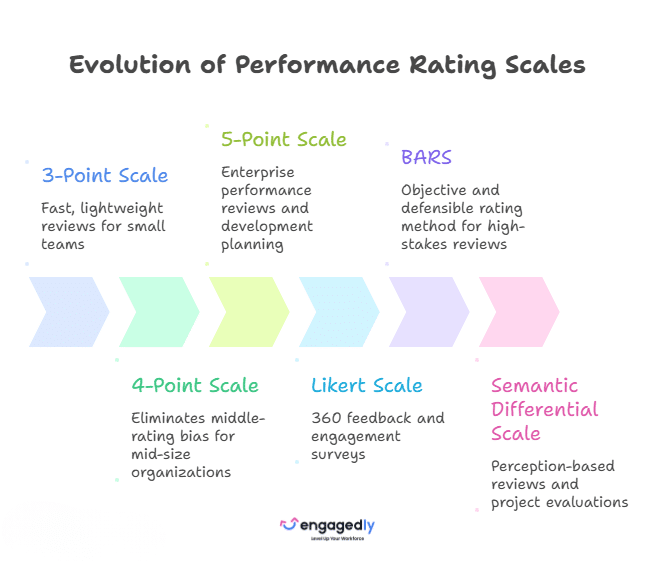
There is no single best scale. Each has trade-offs depending on your organization size, role complexity, and review goals. Here are the most widely used options.
3-Point Rating Scale
The 3-point scale is the simplest format and works well for fast-moving companies that want low-friction reviews. It typically uses three labels to describe performance levels. A standard version looks like this:
- Does Not Meet Expectations
- Meets Expectations
- Exceeds Expectations
Additionally, the 3-point scale reduces manager confusion and speeds up the review process. The trade-off is low spread. With only three options, it is hard to distinguish between an employee who barely meets expectations and one who consistently hits targets. For that reason, many companies move away from it as their teams grow and performance data needs to support more nuanced compensation decisions.
Best for: Small teams, early-stage companies, or supplementary ratings on simple, binary competencies.
4-Point Rating Scale
More organizations now use the 4-point scale to address the centrality bias problem that plagues 3-point and 5-point scales. By eliminating a neutral middle option, it forces managers to make a clearer judgment call.
A typical 4-point scale looks like this:
- Needs Development — performance consistently falls below role expectations
- Occasionally Meets Expectations — performance is inconsistent; some expectations are met but not reliably
- Consistently Meets Expectations — performance reliably meets role expectations across the review period
- Exceeds Expectations — performance regularly goes beyond what the role requires
Because there is no middle score to retreat to, managers engage more honestly with where each employee actually stands. Research from CEB (now Gartner) found that removing the middle option from rating scales produced more accurate performance differentiation and stronger employee calibration outcomes.
Best for: Organizations dealing with centrality bias, mid-size teams, and reviews where compensation is tied to rating outcomes.
5-Point Rating Scale
The 5-point scale is the most commonly used format in performance management globally. It offers enough spread to capture real nuance while remaining simple enough for managers to use consistently. The UC Berkeley model is one well-known institutional example:
- Exceptional — rare; reserved for outstanding contributors who set the standard
- Exceeds Expectations — regularly performs above role requirements
- Meets Expectations — solid, reliable performance across the review period
- Needs Improvement — performance gaps are present and must be addressed
- Unsatisfactory — performance is significantly below expectations; formal action may be required
The 5-point scale’s strength is its spread. It is detailed enough for complex roles but flexible enough to work across departments. The risk is centrality bias — managers often default to the middle rating (Meets Expectations) for nearly everyone, which compresses data and makes it hard to distinguish strong performers from average ones.
Best for: Larger organizations, roles with multiple competency dimensions, and reviews where development planning is a key output.
Likert Scale
The Likert scale measures agreement or sentiment rather than performance levels directly. It is most useful for evaluating soft skills, cultural alignment, or self-assessments. A standard 5-point Likert scale uses the following options:
- Strongly Disagree
- Disagree
- Neutral
- Agree
- Strongly Agree
Likert scales work especially well for 360-degree feedback. For example, a peer reviewer might be asked, “This employee communicates expectations clearly to the team,” with the Likert options above as their response choices. The scale is symmetrical, balanced, and easy to interpret.
A 6-point or 7-point Likert removes the neutral option, similar to the logic behind a 4-point performance scale, pushing respondents toward a defined position.
Best for: 360-degree reviews, engagement surveys, self-assessment tools, and behavioral feedback.
Behaviorally Anchored Rating Scale (BARS)
BARS is the most sophisticated and objective performance rating format available. Each rating level uses specific, observable behavioral examples instead of abstract descriptors like ‘meets expectations. This significantly reduces the subjectivity that plagues most rating scales.
A BARS scale for a “Customer Communication” competency in a sales role might look like this:
- 5 — Outstanding — proactively follows up with all customers within 24 hours, tailors communication style to each client, and resolves complaints without escalation in 95%+ of cases
- 4 — Above Average — follows up with most customers within 48 hours and handles the majority of complaints independently
- 3 — Satisfactory — communicates with customers when prompted; occasionally misses follow-up windows
- 2 — Below Average — inconsistent follow-through; requires manager reminders to complete basic customer communications
- 1 — Unsatisfactory — regularly fails to respond to customers; complaints frequently escalate
However, BARS takes the most upfront investment to build because each scale must be custom-designed for each role and competency. But the output is far more defensible, fair, and useful than generic scales. It also reduces the legal risk associated with contested performance reviews.
Best for: Roles where specific behaviors can be defined, high-stakes performance reviews, compliance-driven industries, and organizations committed to reducing rating bias.
Semantic Differential Scale
The semantic differential scale presents two opposite descriptors at either end of a spectrum, with several unlabeled points in between. Respondents indicate their position along that spectrum.
For example: “How effective was this project outcome?”
Total Failure — 1 — 2 — 3 — 4 — 5 — 6 — 7 — Complete Success
This format is intuitive and gives respondents expressive freedom. It works well when measuring perceptions, attitudes, or outcomes that exist on a continuum rather than fitting neatly into defined categories. For standard performance reviews, it is less common but useful for project-based evaluations or post-review reflections.
Best for: Project outcome reviews, perception-based assessments, and qualitative feedback tools.
Real-World Examples of Each Scale (With Rubric Wording)
The section above explains how each scale works. This section shows the exact rubric wording you’d actually put in a review form. Understanding the structure of each rating scale is one thing. Seeing how they work in real review situations makes the differences much clearer.
3-Point Scale Example
Competency: Time Management
- Does Not Meet Expectations — regularly misses deadlines; requires manager intervention to prioritize tasks
- Meets Expectations — completes most tasks on time; occasionally needs deadline reminders
- Exceeds Expectations — consistently delivers ahead of schedule; proactively flags potential delays before they occur
4-Point Scale Example
Competency: Problem Solving
- Needs Development — struggles to identify solutions independently; escalates most problems to management
- Occasionally Meets Expectations — solves routine problems but needs guidance with complex or novel situations
- Consistently Meets Expectations — independently resolves most issues within their scope; applies sound judgment
- Exceeds Expectations — identifies root causes before they become problems; proposes process improvements that benefit the wider team
5-Point Scale Example
Competency: Collaboration
- Exceptional — actively builds cross-functional relationships; recognized by peers as a catalyst for team performance
- Exceeds Expectations — consistently supports teammates; often goes beyond role boundaries to contribute to team goals
- Meets Expectations — works cooperatively within the team; fulfills collaborative responsibilities reliably
- Needs Improvement — occasionally creates friction within the team; requires coaching on collaborative behaviors
- Unsatisfactory — consistently disruptive to team dynamics; collaborative failures are recurring and impacting team output
Likert Scale Example
360-Degree Feedback Statement: “This employee actively listens during team discussions and incorporates feedback into their work.”
- Strongly Disagree
- Disagree
- Neutral
- Agree
- Strongly Agree
BARS Example
See the Customer Communication example in the BARS section above. The same structure applies across any competency where teams can define behaviors precisely.
UC Berkeley and Harvard Models
Two university-developed scales are worth knowing because many enterprises adapt them directly.
UC Berkeley 5-Level Scale (for overall performance):
- Exceptional
- Exceeds Expectations
- Meets Expectations
- Needs Improvement
- Unsatisfactory
Harvard’s Multi-Scale System covers four dimensions:
Overall performance uses a 5-point scale:
- Leading
- Strong
- Solid
- Building
- Not Meeting Expectations
Goal achievement uses a 3-point scale:
- Goal was met
- Goal was partially met
- Goal was not completed
Competency assessment uses a 4-point scale:
- Advanced
- Proficient
- Developing
- Does not demonstrate knowledge
Direct report effectiveness uses a 3-point scale:
- Highly Effective
- Effective
- Requires Improvement
What makes the Harvard model useful is that it uses different scales for different measurement types rather than forcing everything into one format. That is worth considering when you design your own system.
Performance Rating Scales Compared at a Glance
| Scale Type | Points | Best For | Key Risk | Bias Risk |
|---|---|---|---|---|
| 3-Point | 3 | Simple, fast reviews | Low spread; limited nuance | Leniency bias |
| 4-Point | 4 | Eliminating average scores | No neutral option (which is intentional) | Lower centrality bias |
| 5-Point | 5 | Broad competency reviews | Managers cluster at middle | Centrality bias |
| Likert | 5–7 | Soft skills, 360 feedback | Not ideal as a standalone review tool | Acquiescence bias |
| BARS | 4–7 | Behavioral, role-specific reviews | High setup cost | Lowest bias overall |
| Semantic Differential | 5–7 | Perception and outcome reviews | Too abstract for competency scoring | Halo effect |
How to Choose the Right Performance Rating Scale for Your Organization
There is no universal answer here, but there is a clear process. Work through these four steps and the right scale will become obvious.
Step 1 – Define What You’re Measuring
Performance reviews typically measure three types of things:
- Outputs and goals — did the employee meet their OKRs or KPIs? A 3-point or goal-specific scale works well here.
- Competencies and behaviors — does the employee demonstrate the skills the role requires? A BARS or 4-point descriptive scale is strongest here.
- Overall performance — a summary judgment of the employee’s contribution. A 5-point scale gives the most flexibility for this type of holistic rating.
If you are measuring all three, consider using a multi-scale system like Harvard’s model rather than forcing every dimension into one format.
Step 2 – Decide How Much Nuance You Need
Ask your HR team one question: when managers review employees, how important is it to clearly distinguish between your top 20% and your middle 60%? If that distinction matters for compensation or succession planning, you need at least a 4-point scale. If you’re a small team doing development-focused reviews, a 3-point scale is fast and effective.
Step 3 – Consider Your Managers’ Calibration Tendencies
Look at your last round of review data. If ratings cluster in the middle, you have a centrality bias problem. A 4-point scale or forced distribution approach addresses this directly. If ratings skew high across the board, you have a leniency bias problem. Clearer behavioral anchors, like those in BARS, tend to correct this.
Step 4 – Test for Transparency and Fairness
Before rolling out any scale company-wide, test it:
- Share the scale with a sample of employees and ask if they understand how each level is defined
- Ask two managers to independently rate the same employee using the scale and compare results
- Check whether the scale creates meaningful differences across your workforce or compresses everyone into two or three buckets
If the scale fails any of those three tests, revise it before launch. A scale that employees do not trust, or that managers apply inconsistently, produces data that is worse than no data at all.
Common Mistakes to Avoid When Using Rating Scales
Even well-designed scales fail when they’re implemented poorly. Here are the most common problems organizations run into.
Using a numeric-only scale without descriptors. Asking managers to rate leadership on a 1–10 scale with no further guidance is a recipe for inconsistency. A score of 7 from one manager might mean the same thing as a 5 from another. Always pair numeric scores with descriptive language.
Hiding the scale from employees. One of the most damaging things a company can do is claim they have abandoned performance ratings while continuing to use them internally for compensation decisions. Employees eventually find out, and the result is a credibility loss that takes years to recover from. Transparency is not optional.
Not training managers on the scale before using it. Rating scales require calibration. Without training, you get 50 managers with 50 different interpretations of what “meets expectations” means. Calibration sessions where managers discuss their ratings before finalizing them significantly improve consistency. Many organizations now run formal calibration meetings across departments to reduce rating inconsistencies and improve fairness across teams.
Selecting a scale based on what your software supports rather than what your team needs. Many HR platforms offer a default 5-point scale with generic labels. That default is a starting point, not a recommendation. Customize it or find a platform that lets you define your own rubric wording.
Treating all competencies the same. For example, a technical skill like “writes clean code” can be assessed with a fairly objective scale. A soft skill like “demonstrates leadership” is harder to pin down without behavioral anchors. Using the same scale format for both often means one of them is measured poorly. Use BARS for behaviorally complex competencies and simpler scales for quantifiable outputs.
How AI Is Changing Performance Rating Scales in 2026
AI hasn’t replaced the rating scale itself, but it’s starting to change how ratings get applied. Most organizations are still cautious here. The same 2026 Talent Strategy Group benchmark found that 69.2% of organizations do not use AI in the reviewing process at all, and 88.7% don’t use it to assist compensation decisions. AI adoption is even lower upstream, with 48.3% reporting no AI use in goal setting and 49.3% reporting none in feedback and coaching.
Where AI is showing up is mostly in the background of the rating process rather than the rating itself:
- Draft-assist for written justifications. Managers use AI to turn bullet-point notes into full narrative comments that match the tone of the rating given.
- Bias flagging. Some platforms scan draft reviews for language patterns linked to leniency or centrality bias before a rating is finalized.
- Calibration support. AI tools surface rating distribution patterns across teams so HR can spot a manager who rates everyone a 4 out of 5 before calibration meetings happen.
The scale itself, whether it’s 3-point, 4-point, or BARS, still needs a human to define what each level means for a given role. What’s changing is the amount of manual work required to apply that scale consistently across a large team.
Build a More Effective Performance Review Process
Performance rating scales shape how organizations evaluate performance, identify growth opportunities, and make critical talent decisions. But the scale itself is only one part of an effective performance management strategy.
Modern organizations are moving beyond static annual reviews toward more continuous systems that combine structured evaluations with real-time feedback, goal tracking, development planning, and workforce analytics. The goal is not just to rate employees more accurately, but to create clearer alignment, better coaching conversations, and stronger employee growth over time.
Platforms like Engagedly help HR teams connect performance reviews, OKRs, 360 feedback, continuous feedback, employee development, and talent analytics into one integrated experience. This allows organizations to build more transparent, data-driven, and scalable performance management programs without adding unnecessary complexity.
If you’re evaluating ways to modernize your performance review process, improve rating consistency, and support employee development more effectively, request a demo to explore how Engagedly can help.
Frequently Asked Questions
What is a performance rating scale?
Organizations use rating scales to:
Standardize performance reviews across teams
Reduce subjectivity and manager bias
Track employee progress over time
Support promotion, compensation, and development decisions
Generate consistent performance data for workforce planning
A well-designed rating scale helps employees understand what good performance looks like and how they can improve.
What are the most common types of performance rating scales?
3-point scale – Simple categories such as Does Not Meet, Meets, and Exceeds Expectations
4-point scale – Removes the neutral middle option to reduce centrality bias
5-point scale – The most common format for performance reviews
Likert scale – Measures agreement or perception, often used in 360-degree feedback
Behaviorally Anchored Rating Scale (BARS) – Uses specific behavioral examples for each rating level
Semantic differential scale – Measures performance or outcomes along a spectrum between opposite descriptors
Each scale serves different purposes depending on organizational goals and review complexity.
Which performance rating scale is best for employee performance reviews?
Generally:
5-point scales provide the best balance of simplicity and differentiation
4-point scales help reduce centrality bias by eliminating the middle option
BARS scales provide the highest level of objectivity and consistency
3-point scales work well for small organizations or simple evaluations
Organizations evaluating promotions, compensation, and succession planning often benefit from 4-point, 5-point, or BARS-based systems.
What is a 5-point performance rating scale?
A common example is:
Unsatisfactory
Needs Improvement
Meets Expectations
Exceeds Expectations
Exceptional
Benefits of a 5-point scale include:
Clear performance differentiation
Easy manager adoption
Strong support for development discussions
Useful performance data for calibration and compensation decisions
This remains the most commonly used rating scale in performance management.
What is a Behaviorally Anchored Rating Scale (BARS)?
For example, instead of rating communication as “Excellent,” BARS defines exactly what excellent communication looks like in practice.
Benefits of BARS include:
Reduced rating bias
Greater consistency across managers
Clearer employee expectations
More defensible performance evaluations
Better coaching and development conversations
Because it requires custom behavioral definitions, BARS typically takes more time to implement than traditional scales.
What is centrality bias in performance reviews?
Common causes include:
Avoiding difficult conversations
Lack of confidence in rating decisions
Poorly defined performance criteria
Inadequate manager training
Organizations often reduce centrality bias by:
Using 4-point rating scales
Providing behavioral rating examples
Running manager calibration sessions
Training managers on evaluation standards
How can organizations reduce bias in performance ratings?
Best practices include:
Using clearly defined rating criteria
Implementing behavior-based scales such as BARS
Conducting calibration meetings across departments
Incorporating 360-degree feedback
Training managers to recognize common rating biases
Reviewing ratings for consistency before finalization
The more objective the evaluation process, the more reliable the performance data becomes.
Should performance ratings be tied to compensation decisions?
Compensation decisions often include:
Performance review outcomes
Goal achievement
Market pay benchmarks
Internal equity considerations
Critical skills and business impact
Using multiple data points helps organizations make fairer and more transparent pay decisions.
Can different departments use different rating scales?
For example:
A company-wide 5-point scale for overall performance
BARS scales for competency assessments
Goal completion scales for OKRs
Likert scales for 360-degree feedback
Using multiple scales allows organizations to measure different aspects of performance more accurately.
How often should employee performance ratings be conducted?
Annually
Semiannually
Quarterly
However, modern performance management increasingly combines formal reviews with:
Continuous feedback
Monthly check-ins
Goal progress conversations
Development-focused coaching sessions
Regular feedback improves performance more effectively than relying solely on annual reviews.
What should employees do if they disagree with a performance rating?
Recommended steps include:
Reviewing the rating criteria
Asking for specific examples supporting the rating
Sharing relevant accomplishments or context
Discussing development opportunities
Creating a plan for future improvement
A transparent review process should allow employees to understand how ratings were determined and what actions can improve future outcomes.