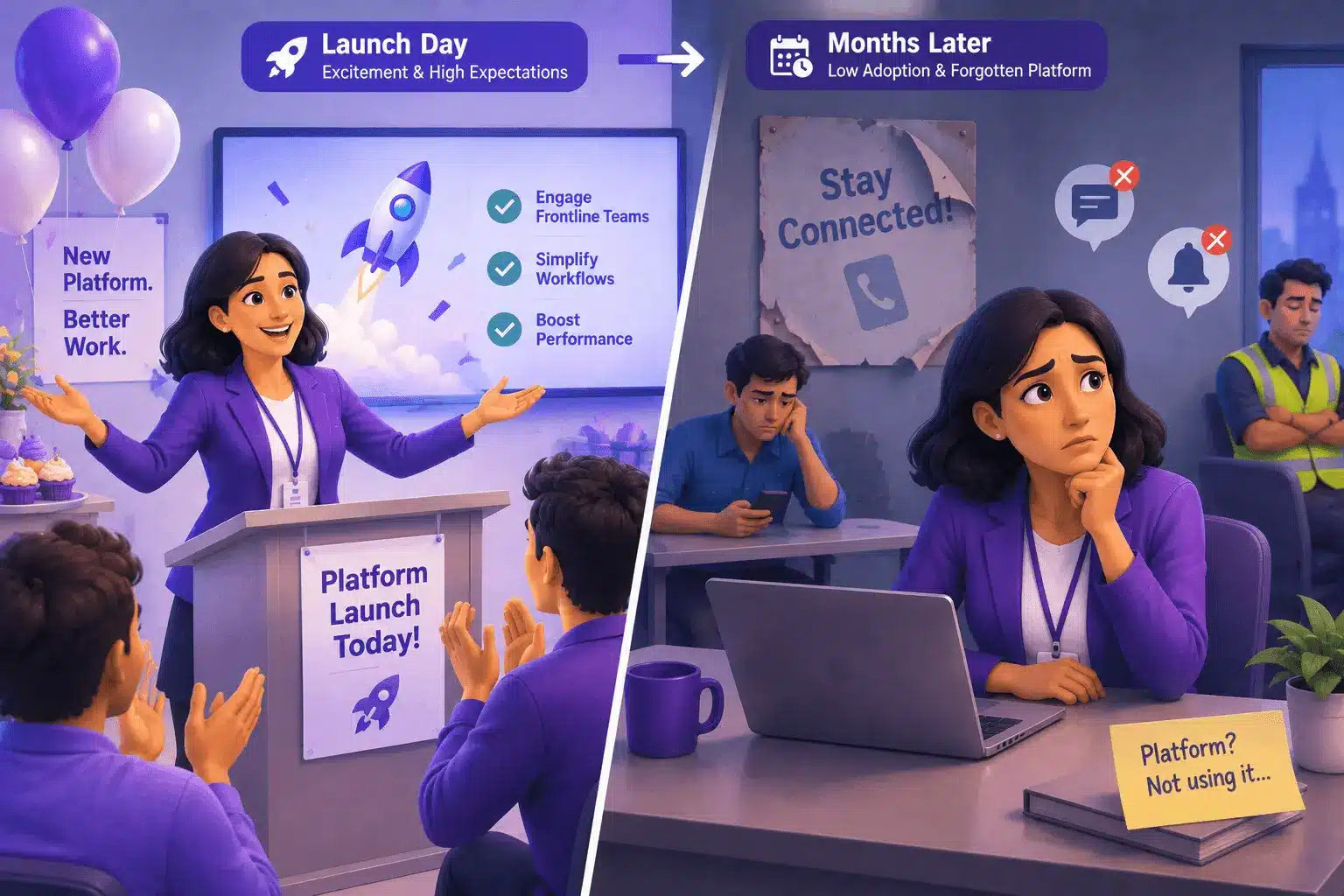
Buying software is the easy part of fixing a broken process. The hard part shows up twelve weeks later, when the platform is live, the training is done, and almost no one is using it. Nowhere is that gap more expensive than in performance management, where adoption isn’t a vanity metric; it’s the difference between a process that shapes promotions, pay, and development and one that quietly becomes a spreadsheet nobody trusts.
When a rollout fails, the instinct is to blame the tool and start a new vendor search. But low adoption is rarely a software problem. It’s a design problem: the process asks managers for time and skill they were never given, and stops mattering to employees the moment nothing happens after the review.
Here is the number that explains why. Gallup asked CHROs at Fortune 500 companies whether their performance management system inspires employees to improve. Two percent said yes. Not 2% of employees, who might be expected to grumble. Two percent of the people who bought the thing.
When the buyers do not believe in it, nobody below them has a reason to.
Deloitte’s 2025 Global Human Capital Trends survey found 61% of managers and 72% of workers could not say they trust their organization’s performance management process. You cannot train your way past that. You cannot configure your way past it either.
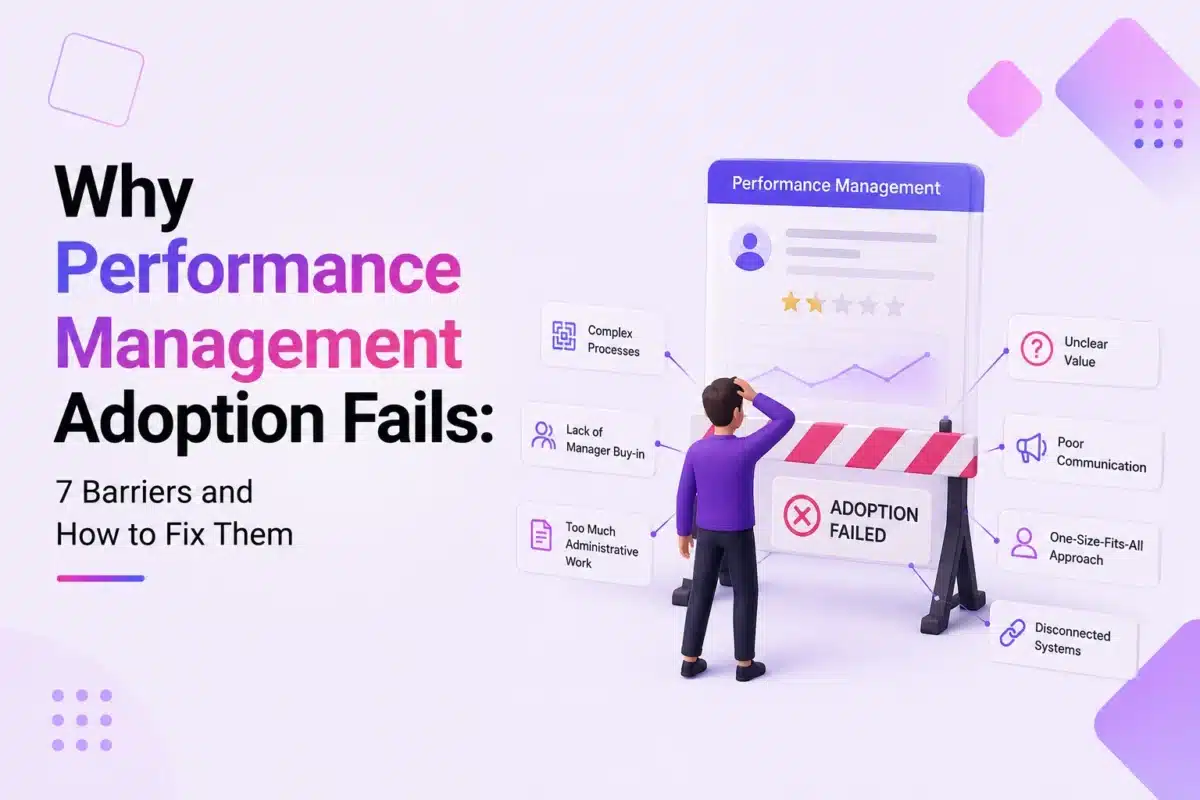
Below, we look at the seven barriers that stall performance management adoption — and offer an actionable fix for each one, none of which is a software feature.
So what actually goes wrong?
Ask people who have run these implementations and the same five answers come back:
Managers do not participate
The process never becomes an ongoing conversation
Goals drift out of alignment with real work
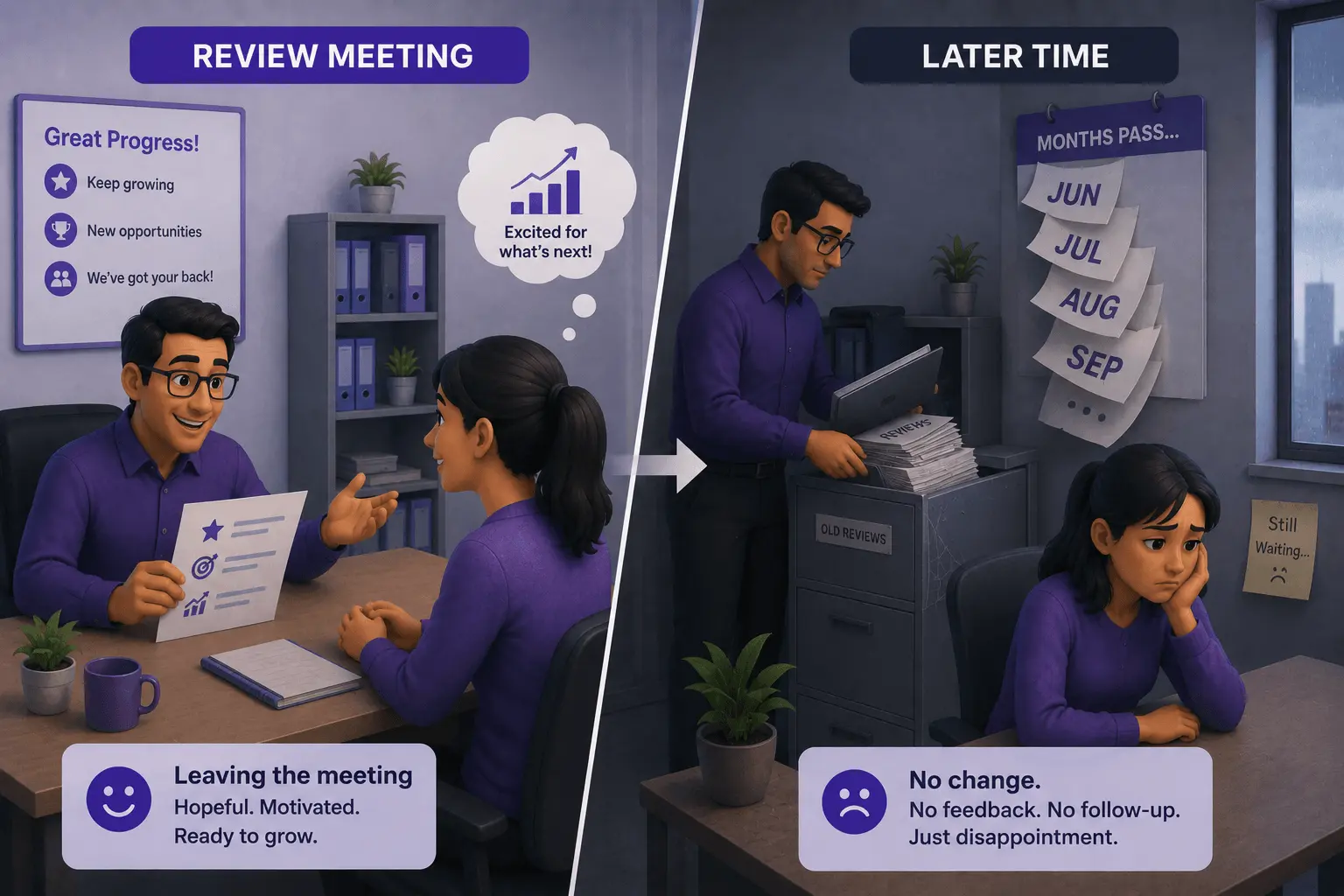
Nothing happens after the review closes
Change management stops at the launch email
Start by working out which ones you have.
✨ Key Takeaways
Measuring completion instead of quality hides the real problem — 96% completion with eleven-word comments is compliance, not adoption, and it’s what triggers a needless second RFP.
Low adoption is a design problem, not a software problem — the platform usually works fine; the process around it asks managers for time and skill they were never given.
Manager participation is the single biggest failure point, and it’s arithmetic: rollouts add a recurring obligation without retiring anything, and forms built by committee take 40 minutes per report.
Continuous performance management only works if the conversation is continuous — most companies just run the annual review four times a year with a login screen.
Adoption dies in cycle three, not at launch. That’s the first cycle where employees have evidence that their honest input went nowhere, so the fixes that matter happen before go-live and right after cycle one.
First, find your barrier
Low adoption looks identical from the dashboard no matter what is causing it. The symptom pattern is what tells them apart. Find the row that matches what you are seeing.
What you are seeing
Most likely barrier
Managers complete late, after multiple reminders, every cycle
1. No time was made
Check-ins are completed but comments are short and generic
2. Capability gap
Activity spikes in the review window and flatlines between cycles
3. Still an event, not a rhythm
Goals in the system do not match what the team is actually working on
4. Goal alignment broke
Cycle one was fine, cycle three collapsed
5. No post-review process
Adoption is high in one function and near zero in another
6. Change management gap
Completion is above 90% but engagement scores are flat
7. You are measuring the wrong thing
Most organizations have two or three of these at once. Fixing the wrong one produces no movement, which is usually what leads to a premature conclusion that the platform failed and a second RFP nobody needed.
What low adoption is quietly costing you
Skip this if you already have budget. It exists for the conversation where someone asks why this is worth another quarter of effort.
Global employee engagement fell to 20% in 2025, the second consecutive annual decline Gallup has recorded and the lowest since 2020. That costs the world economy roughly $10 trillion in lost productivity, about 9% of global GDP.
The part that matters for your rollout is where the decline came from. Manager engagement dropped from 27% to 22% in a single year, and the gap between managers and individual contributors has closed from 11 points in 2022 to 3 points now. Managers are barely more engaged than the people they manage, and your entire performance process runs through them.
Then there is what employees say about reviews themselves, all Gallup, all percentage who strongly agree:
Statement
% who strongly agree
My performance review inspires me to improve
14%
My performance review is accurate
26%
My performance review is fair
29%
I know what is expected of me at work
47%
Against that, employees who get weekly rather than annual feedback are 5.2 times more likely to say the feedback is meaningful and 3.2 times more likely to say they are motivated to do outstanding work. The annual model produces the table. Frequency produces the multipliers. Your platform is only the delivery mechanism.
Retention is where this reaches the finance team. Only 31% of employees strongly agree someone at work encourages their development, and development conversations are exactly what a performance process is supposed to force into the calendar. Gartner also reports that organizations with better-than-average healthy change adoption see roughly double the year-over-year revenue growth rate.
None of which is theoretical. Rudolph and Sletten, a California construction firm, was running reviews on paper: fill in the form, scan it, email it. Completion sat at 33%. After moving to Engagedly, it hit 100%, and their talent management lead, Shareen, made a point of saying people picked it up without formal training. The full case study has the detail.
Going from a third to everyone is not a software story. It is a friction story.
Before the list: adoption doesn’t die at launch — it dies in cycle three
Watch enough rollouts and they all fail on the same schedule.
Cycle one looks great. Novelty does the work, executives are watching, and the reminder emails are still new enough that people actually open them. Cycle two holds, though you’re chasing a little harder now. Then cycle three arrives, the numbers fall off a cliff, and by then the launch is nine months in the rearview — so nobody thinks to trace the drop back to a decision made before go-live.
Here’s what actually happened. Cycle three is the first time employees have evidence. They wrote something honest back in cycle one. They watched to see what it would change. Nothing changed. So this time they either skip it or type the shortest thing that clears the field validation — and who could blame them.
Two things follow from this:
Your cycle one completion rate is almost meaningless. Don’t celebrate it, and definitely don’t report it upward as a win.
The interventions that matter happen before launch or right after cycle one — not nine months later when the dashboard finally looks bad enough to panic about.
Which brings us to the seven barriers themselves.
Barrier 1: Managers were never given the time
This is the biggest one, and the least glamorous. Manager participation is the single most common failure point in performance management rollouts, and the most common cause is arithmetic.
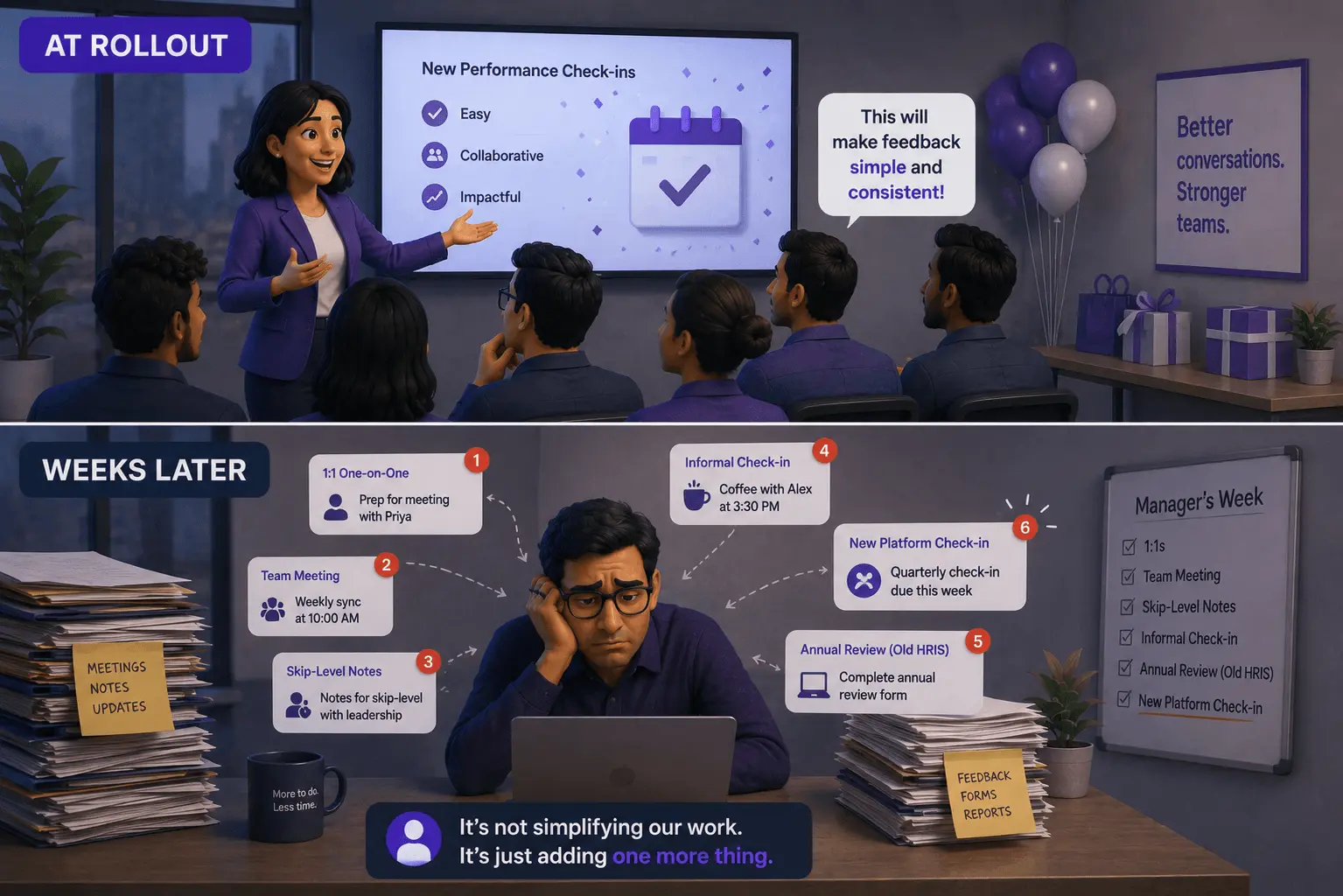
Most rollouts add work. Almost none of them remove any. The manager still has their one-to-ones. They still have the team meeting, the skip-level notes, the informal check-in over coffee, the annual review form in the old HRIS that IT has not switched off yet. Now they also have quarterly check-ins in a new platform. From where they sit, this is the sixth thing, not the replacement for the first five.
Laszlo Bock, who built Google’s people operations function, put the failure mode plainly in Work Rules!: performance management systems have become “substitutes for the vital act of actually managing people.”
That is what a sixth obligation does. It converts managing into administering.
Gartner surveyed 2,947 employees and managers in late 2025 and found 47% of managers say more is expected of them than a year ago. Two thirds said their primary responsibility is managing their people, ahead of driving progress on organizational goals. They are not resisting your platform out of principle. They are triaging.
The form itself compounds it. Somebody in the configuration workshop suggested adding a competency section. Somebody else wanted a self-assessment. Legal wanted a documented development plan. Nobody said no to anything, because saying no in a configuration workshop feels unhelpful. The result is a check-in that takes 40 minutes per report. For a manager with twelve reports, that is a full working day, four times a year.
Long forms also push managers toward vague answers, because vagueness is fast. The Gallup numbers on accuracy and fairness, 26% and 29%, are partly downstream of forms designed by committee.
The fix
Both problems are arithmetic, so both fixes are subtraction, and both belong before launch.
Subtract before you add. List every existing performance ritual by name and give each one a verdict.
Existing ritual
Verdict
What managers hear at launch
Annual review form in the old HRIS
Retired
“The mid-year form is dead. This replaces it.”
Q1 goals doc in Sheets
Retired
“Goals live in one place now.”
Weekly one-to-one
Kept, with a standing performance item added
“Same meeting, one extra question.”
Skip-level notes
Absorbed into the check-in record
“Stop keeping a parallel doc.”
Quarterly team retro
Kept, unchanged, for a stated reason
“This is a team ritual, not a performance one.”
If you cannot name one thing the new system kills, managers will read it as an additional obligation, and they will be right.
Then time the form yourself. Fill it in as a manager would, for a real direct report, with the clock running:
More than ten minutes per person and you cut fields until it is under ten
Ask of every field: what decision does this input change? If the answer is nothing, delete it
Complexity can come back in year two, once the habit exists
Deloitte found just 6% of organizations say they are doing well at using performance data in a way that also builds worker trust. Most performance data gets collected and never used, which managers work out faster than HR expects.
In Engagedly, performance review and check-in templates are built per cycle rather than fixed, so cutting a form to three questions is a configuration decision, not a support ticket. Most teams struggling here have never revisited the template they approved during the buying process.
Altisource is the counterexample. They moved to quarterly reviews with a company-wide OKR program, and their organizational development team credited the platform’s simplicity for how fast people picked it up. They reached 90% engagement and 80% goal success. Details in the Altisource case study.
Time is only half the problem, though. Give a manager a ten-minute form and an empty afternoon and you still have to answer what goes in the box.
Barrier 2: Managers have the tool but not the skill
That is the second half of the manager participation problem, and the one most often misdiagnosed as a technology issue.
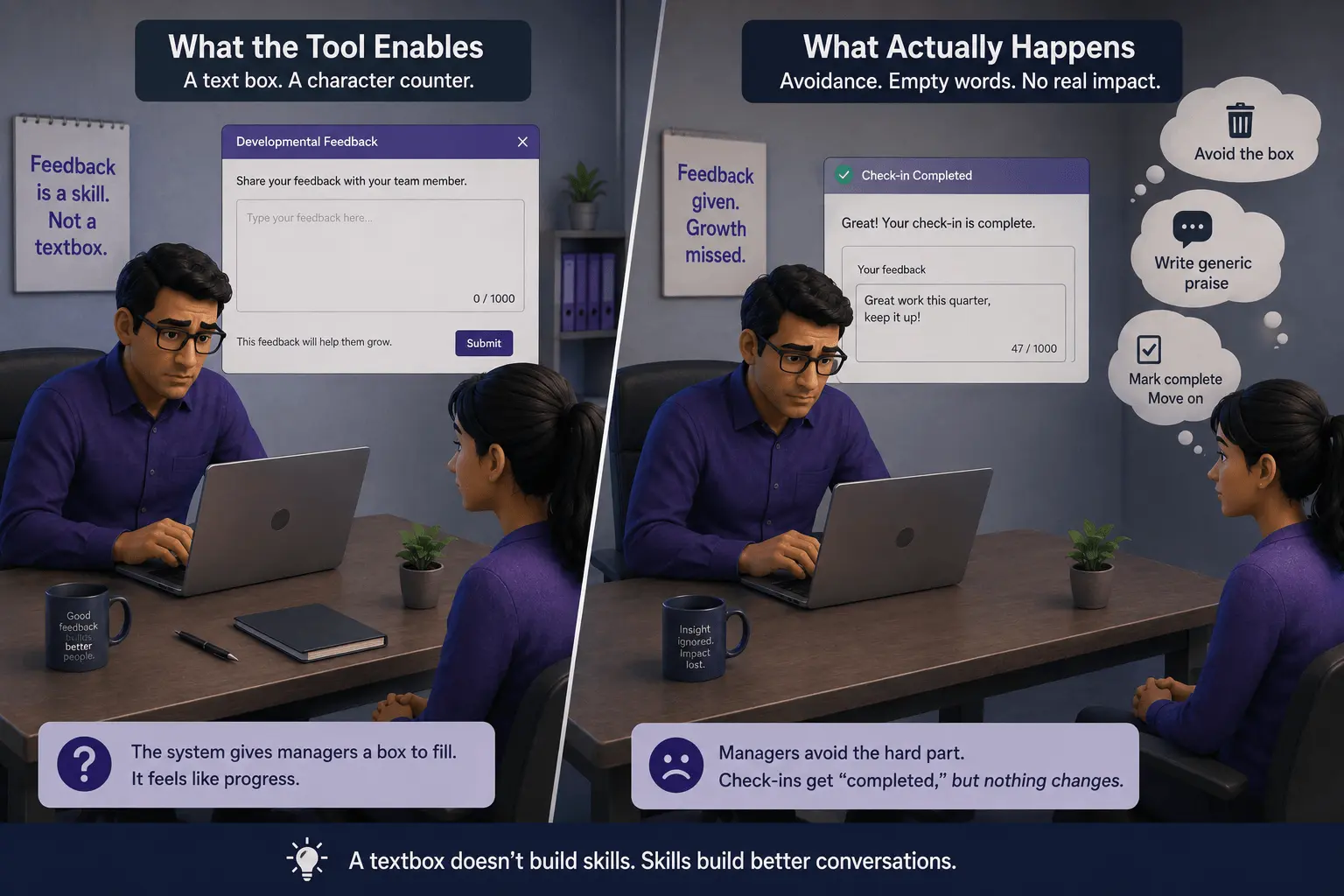
A manager who has never been taught to give developmental feedback does not become good at it because you gave them a text box with a character counter. They become good at avoiding the text box. Or they write “great work this quarter, keep it up,” which is technically a completed check-in and functionally nothing.
Douglas Stone and Sheila Heen, the Harvard Negotiation Project authors of Thanks for the Feedback, cite survey data showing 63% of executives name the same obstacle: their managers “lack the courage and ability to have difficult feedback discussions.”
Courage and ability. Neither one ships with the software.
Deloitte found that only about 26% of organizations say their managers are very or extremely effective at enabling the performance of their teams, and that managers spend roughly 13% of their time developing people. Gartner has had leader and manager development as the number one HR priority for three years running, and in its July 2024 survey 74% of HR leaders said their managers are not equipped to lead change.
So the sequence most companies run, which is buy platform, then train on platform, then hope coaching improves, has the dependency backwards. Coaching capability is the input. The platform is where the coaching gets recorded.
Worth being honest about what this costs. Coaching capability takes months and a budget line, and it competes with every other L&D priority. Plenty of HR teams know this and buy the platform first anyway, because a platform is a visible deliverable and manager capability is not. It still produces the 28% completion rate.
The fix
Separate the two training tracks completely. Collapsing them into one enablement session is why so many rollouts end up with a trained manager population that still writes eleven-word comments.
Platform training
Coaching training
Teaches
Where the buttons are
How to give developmental feedback
Format
Recorded video, self-serve
Practice with real feedback, cohort-based
Length
20 minutes, once
Recurring, months
Starts
At go-live
Before go-live
Owner
HR ops or the vendor
L&D
Success looks like
Managers can complete a check-in
Comment quality holds steady across cycles
It also helps to put the prompt inside the tool rather than in a deck a manager read once. Value-linked recognition works this way: instead of an open text box, the manager picks the behavior they saw and says why. Engagedly pairs recognition and badges with check-ins for this reason, and it is the closest thing to on-the-job coaching practice most managers get.
HIMSS did something adjacent to this. They replaced mid-year and year-end reviews with frequent check-ins and tied recognition badges to company values, so managers had a concrete behavior to reinforce rather than an empty field to fill. Employee participation rose 35%, and 91% of employees received recognition tied to values. The HIMSS case study covers how they sequenced it.
Barriers 1 and 2 are about whether the conversation happens at all. The next two are about its shape.
Barrier 3: The review stayed an event instead of becoming a rhythm
Almost every company that buys a continuous performance management platform ends up running a slightly faster annual review on it.
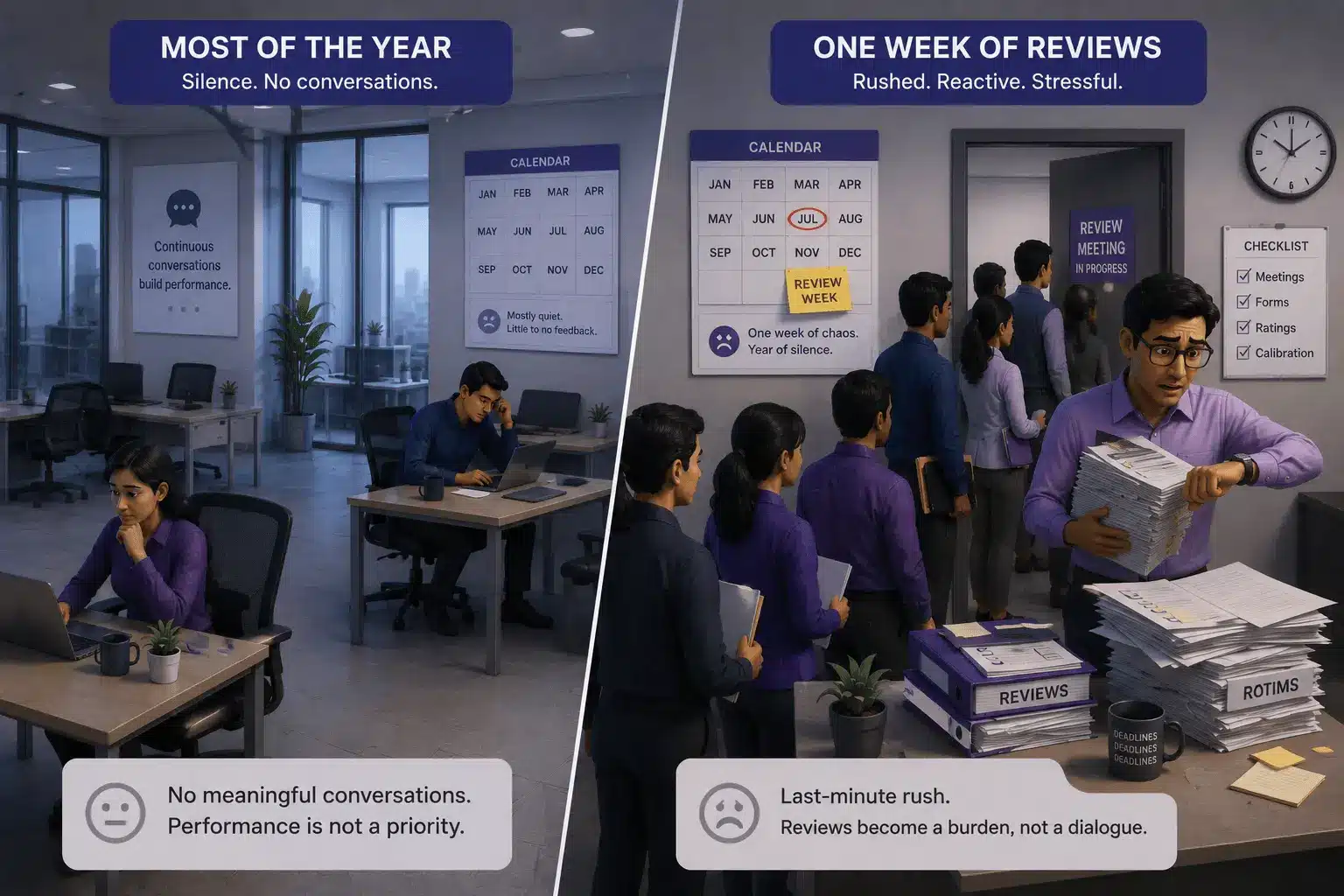
The mechanics look like this: the window opens, reminders go out, everyone completes their form in the last four days, the window closes, and nothing happens for eleven weeks. Usage data shows a sawtooth. Spike, flat, spike, flat.
The difference between that and an actual rhythm is not the software. It is where each thing happens.
Event, run four times a year
Actual rhythm
Where feedback happens
Inside the check-in form
Continuously, form captures a summary
When managers think about it
The four days before the deadline
Weekly, in existing one-to-ones
What the check-in contains
News
Confirmation of things already discussed
What drives completion
Reminder emails
The conversation already happened
Usage pattern
Sawtooth
Steady with mild cycle peaks
That is not continuous performance management. That is the annual review, run four times, with a login screen. The benefit was never in the frequency of the form. It was in the frequency of the conversation.
Marcus Buckingham, who redesigned Deloitte’s own performance management system, has made this his central argument: “The antidote to dynamic change is frequency.”
The quality of any single conversation matters far less than how often it happens, and most organizations have optimized the opposite variable. Gallup found 74% of employees get a review once a year or less, and 57% discuss their goals with their manager annually or less. Set against the 5.2x and 3.2x multipliers from weekly feedback, that gap is enormous.
The fix
This one is uncomfortable because it is not primarily a configuration change. Decouple the conversation from the window:
Make lightweight feedback available and expected between cycles, not just inside them
Put a standing performance item into existing one-to-ones rather than creating a new meeting
Stop treating the formal check-in as the place where things get said for the first time
If a manager’s quarterly check-in contains news, the rhythm is broken.
A useful diagnostic is the ratio of between-cycle activity to in-window activity. If more than 80% of your feedback volume lands inside the check-in window, you have an event, not a rhythm, no matter what the platform is capable of.
The platform’s job is to lower the cost of a small interaction. Real-time feedback, praise, and feedback requests in Engagedly all work outside a cycle, and the nudges keep them from being forgotten between quarters. Worth auditing whether those are switched on, because plenty of implementations configure the review cycle carefully and leave the between-cycle features dormant.
Frequency is only half of that shape, though. A conversation that happens weekly and is about nothing still fails.
Barrier 4: Goals are set once and never touched again
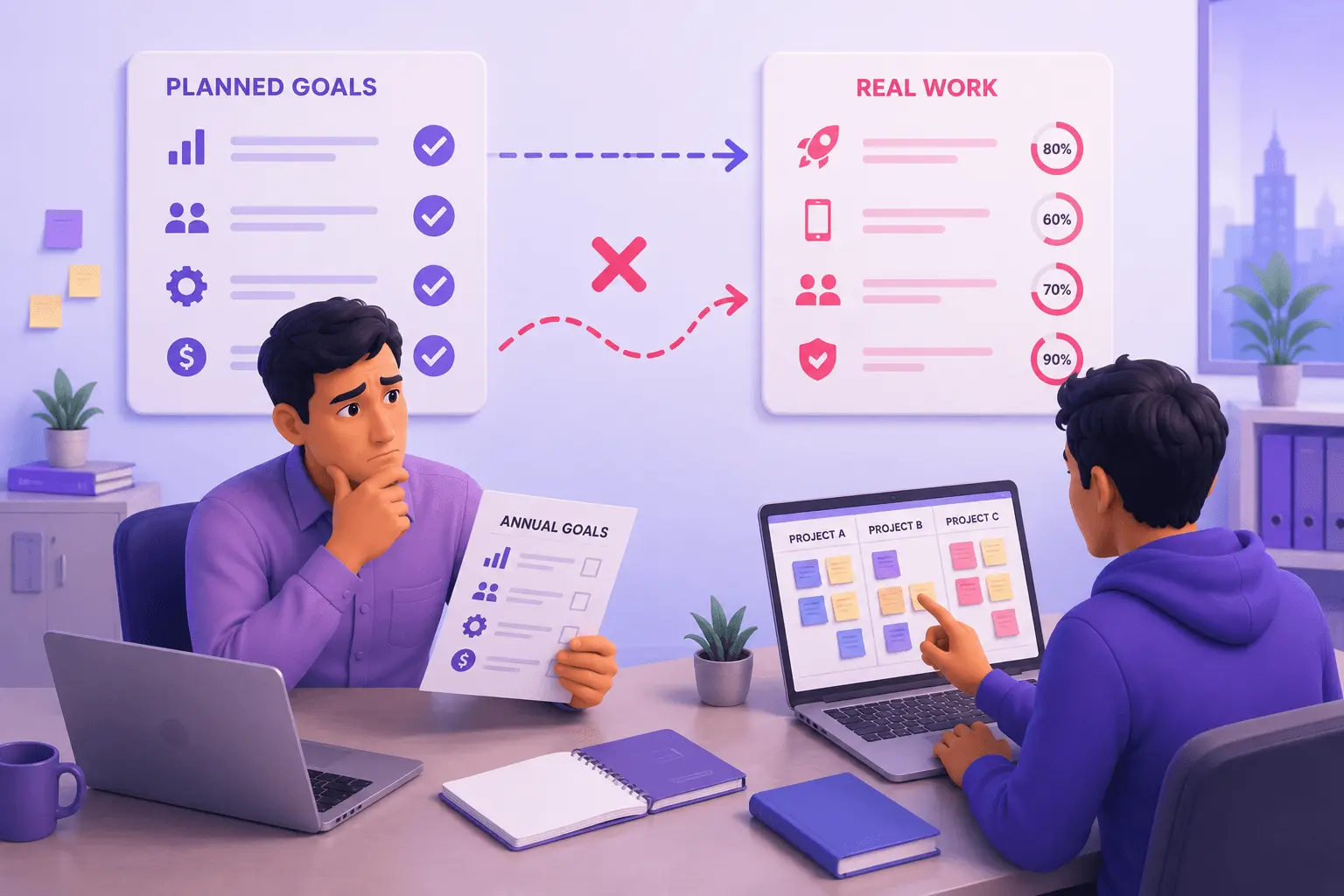
Goal alignment is where adoption quietly stops making sense to the people using it.
The pattern is familiar enough to put on a calendar:
When
What happens to the goals
What it does to adoption
January
Written in a rush, cascaded from something the employee never saw
Low ownership from day one
March
Team priorities shift, goals do not
Goals start describing the wrong work
June
Objectives in the system match nothing anyone is doing
Employee opens the platform, closes it
September
Manager stops maintaining the goals module
Check-ins lose their anchor
December
Goals reconstructed retroactively to match what happened
The record is fiction, and everyone knows it
Once that sets in, every check-in becomes an abstract conversation. There is nothing concrete to talk about, so the comments get vague, which is Barrier 2 showing up as a symptom of Barrier 4.
John Doerr, who brought OKRs from Intel to Google and wrote Measure What Matters, compresses the whole problem into four words: “Ideas are easy. Execution is everything.”
A goal written in January and abandoned by March is an idea. The execution is the maintenance nobody scheduled.
Fewer than half of employees (47%) strongly agree they know what is expected of them at work. The more useful Gallup finding is what fixes it: employees actively involved in setting their own goals are twice as likely to have clear expectations. Cascading goals downward produces alignment on paper. Involving people in writing them produces alignment they can act on.
The fix
Three things worth doing:
Make goal review an explicit agenda item in every check-in, so drift gets caught quarterly instead of annually
Give managers permission to retire a goal mid-cycle rather than carrying dead objectives to year end for the sake of the record
Make the parent objective visible on the employee’s goal, so the connection between their work and the company’s direction does not depend on remembering a slide from an all-hands
Cascading OKRs and goals make the third point easier, because the parent objective travels with the goal instead of living in a separate deck. If your goals sit in Engagedly but the check-in happens somewhere else, that link is the first thing to reconnect.
Zone approached this from the culture side rather than the process side. They put real-time feedback and OKRs in place and made managers accountable for team growth as part of the role rather than as a quarterly obligation. Engagement moved above 90%.
Fix the frequency and the substance and you have a conversation worth having. What happens next is where most organizations stop.
Barrier 5: Nothing happens after the review closes
This is the barrier that produces the cycle three collapse described earlier, and it is the one HR teams plan for least.
Enormous effort goes into the cycle itself: comms, configuration, calibration sessions, chasing. Then the window closes and the process ends. There is no defined sequence for what comes next, so:
Development plans get written and never revisited
Calibration outcomes never reach the people they describe
Themes that came up in forty check-ins go into a deck that goes into a folder
Ask an employee why they stopped responding to feedback requests, and you will rarely hear “the interface was confusing.” You will hear that they wrote something honest in March and nothing happened.
Wharton’s Peter Cappelli and NYU’s Anna Tavis summarized the shift in their Harvard Business Review piece on performance management: “The focus is shifting from accountability to learning.”
Accountability ends when the form is submitted. Learning does not.
Gallup’s finding that only 14% of employees strongly agree their review inspires them to improve is the aggregate version of this. People are not saying the review was unpleasant. They are saying it did not do anything.
The fix
Design the post-review process with the same care you gave the review itself. A workable minimum, all inside 30 days of the cycle closing:
Action
Owner
Deadline
Visible to
Documented next step tied to something specific in the review
Manager
14 days after close
Employee, in the platform
Every development action given an owner and a date
Manager
14 days after close
Employee and HRBP
Calibration outcomes communicated to the people they describe
HRBP
21 days after close
Employee
Organization-level themes published with specifics
HR
30 days after close
Everyone
That last row is the one that gets skipped, and it is the one that matters most. Publishing that two goals were reprioritized at leadership level, or that a process was killed because it came up in eleven separate check-ins, does more for the next cycle than any reminder campaign.
“We heard you” is not a loop closure. It is an acknowledgement of receipt, and people can tell the difference.
Two things make this survivable at scale. Development actions need to live where the next check-in happens, not in a document nobody opens, which is what individual development plans and career paths are for. And surfacing organization-level themes needs sentiment analysis on survey data, because reading forty check-ins by hand is how follow-up quietly gets dropped in cycle two. Engagedly covers both. The harder part is still committing publicly to act on what comes out.
Nuspire ran engagement surveys, acted on the results with new engagement and recognition programs, and saw engagement climb 15% over three years. The survey was not the intervention. What they did with it was.
The first five barriers are all things the process does or fails to do. The last two are things HR does around it, starting with how the whole thing was introduced.
Barrier 6: Change management stopped at the launch email
Most rollout communications explain what the platform does. Very few explain why a manager should care, in terms that the manager recognizes.
“Drive alignment and visibility across the organization” is a sentence written for the person who signed the contract. The manager reading it has fourteen direct reports, two open roles, and a quarter to close.
John Kotter, whose Leading Change remains the standard text on why transformations fail, named this as error four of eight: “Undercommunicating the Vision by a Factor of Ten.”
Kotter’s estimate was that most organizations communicate a change at a tenth of the volume required. Performance management rollouts usually manage one launch email and three webinars.
Gartner is blunt about the cost of skipping this. Only 32% of mid to senior business leaders said the last change they led achieved healthy change adoption, meaning employees acted on it, acted on time, and did so without the change wrecking their performance and wellbeing. A separate April 2025 survey of more than 2,850 employees found 79% report low trust in change. Gartner’s Kayla Velnoskey describes today’s change as “ungovernable” because it is continuous, stacked, and driven by things outside the company.
Low trust matters more than most rollout plans account for. Gartner found the inspirational approach to change leadership only works when change trust is already high. When it is low, inspiration predicts healthy adoption in roughly a quarter of cases. Your launch video is landing in a room that has been burned before.
The fix
Two practical consequences.
Build the case per audience instead of per company. Same rollout, three different arguments:
Audience
Lead with
Do not lead with
Managers
The comp conversation that goes badly because nothing was documented, and the year reconstructed from memory every December
Alignment, visibility, org-wide transparency
Employees
Clarity on what is expected, which fewer than half currently have
Process compliance or completion deadlines
Executives
The retention and revenue numbers above
The feature list
Then make leadership behavior visible, because it is the highest-bandwidth channel you have. If the CEO has not completed their own check-in, every manager knows within about a week, and what they hear is that this process is for people below a certain level. Have leadership complete check-ins in the first week of the window and say so out loud. Gartner’s guidance points the same way: amplify change influencers embedded inside the process rather than relying on top-down instruction.
One more thing. If an executive finds the process too heavy to finish, resist the urge to grant an exception. They have just surfaced a design flaw on your behalf. Fix the form.
Two things make this easier to manage. Since trust in change is usually low before you start, measure that baseline with a short employee survey rather than assuming your comms are landing. And completion reporting needs to be sliceable by management level, because if you cannot see whether adoption thins out above director, you are relying on rumor for the strongest signal in your rollout.
Get the change management right and adoption starts moving. Which creates the last problem, because now you have to decide what “moving” means.
Barrier 7: HR is measuring completion instead of quality
Completion rate is a wonderful metric. It is easy to pull, it goes up when you send reminders, and it tells you almost nothing about whether performance management is working.
A company can hit 96% completion with an average check-in comment length of eleven words. That is not adoption. That is compliance with a good dashboard.
W. Edwards Deming listed performance appraisal among the seven deadly diseases of management in Out of the Crisis, and his verdict on rating systems applies just as well to the metrics built around them: “The effect is exactly the opposite of what the words promise.”
Deming’s argument was that measuring individuals inside a system tells you about the system. Measuring completion tells you about your reminder cadence, not your managers.
The trap is that completion is what gets reported upward, so it becomes what HR optimizes. Reminders go out, completion climbs, the board deck looks healthy, and manager behavior is exactly where it was in January.
It also sets up a bad second year. When leadership sees 96% completion and flat engagement scores, the conclusion they usually reach is that the platform did not work, and the RFP starts again. The platform worked fine. The thing being measured was never the thing that mattered.
The fix
Track a few quality signals alongside completion:
Signal
What it tells you
Healthy direction
Median comment length
Whether managers are writing or clearing a field
Rising, then stable
% of check-ins referencing a live goal
Whether goals are still aligned to real work
Above 70%
Between-cycle feedback as % of total
Whether it is a rhythm or an event
Above 20%
% of employees who can state their top priority
Your local version of Gallup’s 47%
Above 60%
Time from cycle close to visible action
Whether the post-review process exists
Under 30 days
Completion by management level
Whether leadership is modeling it
Flat across levels
Then put the quality metrics at the top of the slide and completion underneath. Whatever sits at the top is what the organization optimizes for.
Most come straight out of platform analytics. The priority-clarity one needs a short pulse survey alongside, which is a two-question exercise, not a project. Engagedly reports across check-ins, goals, feedback, and surveys in one place, which matters mainly because it puts a quality number and a completion number on the same slide instead of three exports the night before the review.
Emids, a healthcare IT provider, moved off an evaluation process that had stopped working and automated the full cycle with documentation. Engagement rose 16%. The Emids case study covers the mechanics.
Most organizations have several of these at once, so the practical question is sequence.
If adoption is already low: a 90-day recovery sequence
If you are mid-rollout and the numbers are not where you want them, the order matters more than the individual actions.
Find out what is actually happening. Talk to ten managers, five with high adoption and five with none. Do not survey them. Sit with them and watch them complete a check-in. You will learn more in an hour than from a quarter of dashboard analysis.
Cut. Make the form shorter, retire whatever nobody uses, and say out loud what the new process replaced.
Fix the goals, because everything else depends on them. If the objectives in the system do not describe current work, no amount of process design will make the check-in feel worth doing.
Close one loop visibly, with names, dates, and changes people can verify. A single real loop closure does more for the next cycle’s participation than a communication campaign will.
Fix the measurement last. Once you are looking at quality rather than completion, you can go back and add the things you cut, assuming you still want them.
Most adoption problems are design problems that surfaced ninety days late.
How Engagedly closes the adoption gap
Every fix in this guide comes down to the same four design principles: keep check-ins short enough that managers actually finish them, let feedback flow between cycles instead of only inside them, keep goals current enough to be worth discussing, and report on quality instead of completion.
Engagedly is built around those four, which is why teams don’t just launch on it; they keep using it. Rudolph and Sletten went from 33% completion on paper to 100%, and adopted it without any formal training. Altisource hit 90% engagement and 80% goal success. HIMSS lifted participation 35% after swapping annual reviews for frequent check-ins tied to company values.
You already know which of the seven barriers are showing up in your own dashboard. Book a demo and we’ll walk through exactly how Engagedly fixes the ones that are costing you adoption, using your rollout, not a generic tour.
FAQs
Why do managers not use performance management software?
Usually time and capability rather than resistance. Most rollouts add a recurring commitment without removing anything, and the check-in form is often long enough to consume a full day per cycle for a manager with a large team. Underneath that, many managers have never been trained to give developmental feedback, so they avoid the parts of the tool that require it.
How do we make performance management an ongoing conversation instead of an event?
Decouple the conversation from the review window. Put a standing performance item into existing one-to-ones, make lightweight feedback available between cycles, and check whether more than 80% of your feedback volume lands inside the formal window. If it does, you are running an annual review four times a year.
What should happen after a performance review closes?
Within 30 days, every employee should have a documented next step tied to something in the review, every development action should have an owner and a date, and HR should publish what changed at the organizational level with specifics. Cycles that end without visible consequence are the main cause of participation collapse by the third cycle.
How do we keep goals aligned through the year?
Review goals in every check-in rather than annually, let managers retire objectives mid-cycle instead of carrying dead ones to year end, and make the parent objective visible on each employee’s goal. Gallup finds employees involved in setting their own goals are twice as likely to have clear expectations.
What is a realistic manager adoption rate?
Completion above 90% is achievable in most organizations within two cycles, but on its own it means very little. A better target is 90% completion with median comment length holding steady and more than 70% of check-ins referencing a live goal.
Jeevithan K is a Senior Solutions Consultant at Engagedly with extensive experience in HR technology, customer success, product implementation, onboarding, and training. He specializes in helping organizations adopt B2B SaaS and enterprise AI solutions effectively. His expertise also includes project management, account management, process improvement, and translating complex product capabilities into practical solutions that deliver meaningful value for customers.
















 Innovative