



8 Points To Ensure An Effective 360 Feedback Process In 2026

A 360 feedback process is a performance development method that collects input about an employee from multiple people around them, typically their manager, peers, direct reports, and sometimes clients, along with a self-assessment from the employee. Unlike a standard review, where only a manager’s opinion counts, a 360 feedback process builds a fuller picture of how someone actually shows up at work. Done well, it becomes one of the most reliable tools an organization has for developing people. Done carelessly, it becomes a vague, anxiety-inducing exercise that nobody trusts.

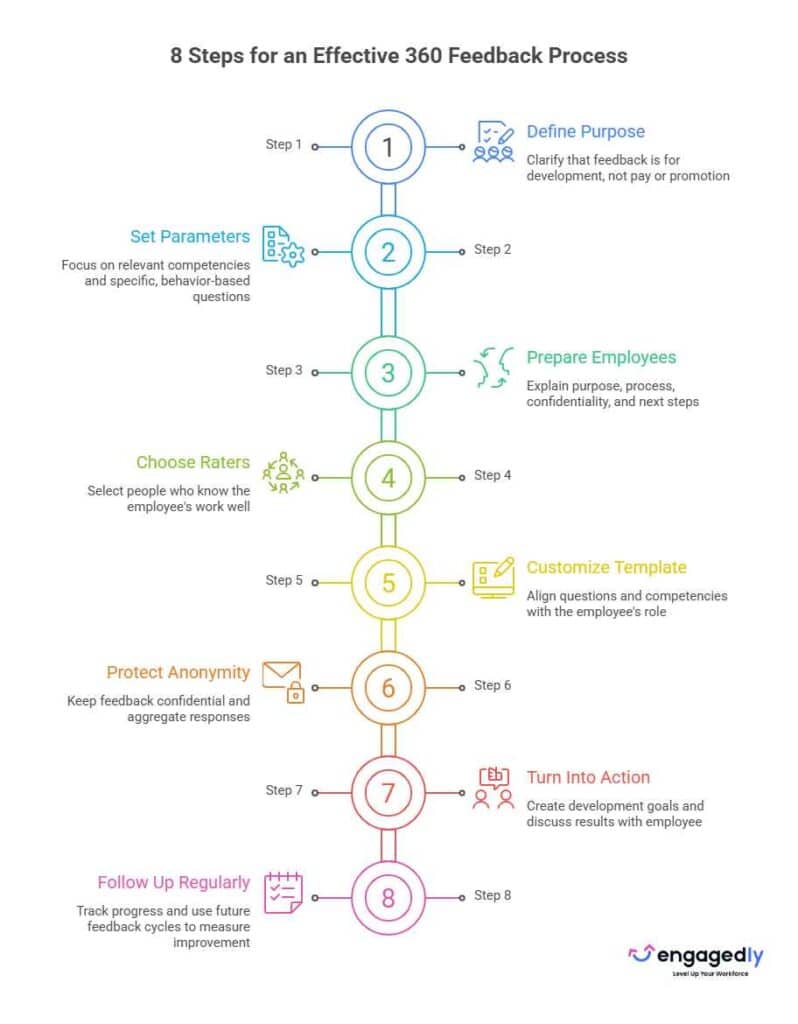
So what actually makes a 360 feedback process work? More than 74% of Fortune 500 companies now run some form of multi rater or 360 degree feedback program as part of their formal performance management, according to Dataintelo’s 2026 market report. Adoption isn’t the problem. Execution is. Below are the eight decisions that determine whether your program actually changes behavior or just generates a report nobody reads.
8 Steps for an Effective 360 Feedback Process

1. What Is The Purpose Of Your 360 Feedback Process, And What Do You Want From It?

The purpose of a 360 feedback process should be development, not evaluation. This is the single decision that shapes everything else you do, so answer it before you write a single survey question.

Most organizations run into trouble when they blur this line, using 360 data to influence pay or promotion decisions. That mixing of purposes is exactly why the industry has been shifting away from it. Best practice research consistently points the same direction.

  • Use 360 feedback to build self-awareness and drive skill development
  • Keep it separate from compensation, ratings, and promotion decisions
  • Get specific about what you want out of it, such as building a leadership pipeline, closing a skills gap, or supporting a new competency framework tied to changed expectations
  • Decide this before you invite a single participant, since the objective determines your rater groups, your questions, and how you report results back

One more shift worth naming here. Annual, one-and-done assessments are increasingly being replaced by shorter, more frequent cycles that let managers track development in near real time rather than waiting twelve months to find out if anything changed.

2. What Are The Parameters For Feedback?

Feedback parameters are the rules and structure you give raters before they write a single word, and without them, a 360 feedback process turns into a pile of vague, unusable comments.

Give everyone participating a short set of guidelines before the survey opens. Tell them what kind of language to use, what to avoid, and how to frame a criticism so it’s actionable instead of just blunt.

  • Keep the survey focused on 4 to 5 core competencies that are actually relevant to the role, such as communication, collaboration, and decision-making, rather than trying to measure everything at once
  • Write behavioral, specific questions instead of broad ones, so raters describe what someone did rather than offering a general impression
  • Use a 5-point scale rather than a longer one, since research on rating design has found that simpler unipolar scales tend to produce more reliable data than scales with too many gradations
  • Require at least one written example alongside every low or high rating, so the number has context behind it

3. Are Your Employees Primed For The Process?

Employees need to feel psychologically safe before a 360 feedback process will produce honest results. If people believe their answers can be traced back to them, or that the results will be used against someone, they soften what they say and the entire exercise loses its value.

Before you launch anything, walk employees through the objective of the program, what will happen with the results, what they personally stand to gain, and what the process looks like after feedback is collected. People invest in a process they understand. They disengage from one that feels like a surprise.

  • Explain the “why” before the “what,” since employees who understand the purpose participate more honestly
  • Tell raters explicitly that this is for development, not for compensation or promotion decisions, so co-workers aren’t tempted to either inflate or punish through their ratings
  • Set expectations for what support the person being reviewed will get afterward, such as a coaching conversation or a development plan, so the process doesn’t feel like it just ends at data collection

4. From Whom Do You Want To Collect Feedback?

Your rater group should include people who’ve worked closely enough with the employee to give specific, credible input, typically their manager, peers, and direct reports, and sometimes external clients or vendors.

Some organizations keep it simple and stick to peers. Others bring in managers as well. A smaller group also pulls in external stakeholders like clients. There’s no universally right answer here, but there is a practical range worth following.

  • Aim for 4 to 8 raters per person, drawn from different working relationships so you’re not just hearing one type of perspective repeated
  • Choose raters who’ve worked with the person for at least six months, so the feedback reflects an actual pattern of behavior rather than one recent incident
  • The more stakeholder groups you include, whether that’s clients, vendors, or cross-functional partners, the more important it becomes to keep every group aligned on what the process is for and how their input will be used

5. Custom Templates Or Generic Templates?

A generic 360 feedback template works fine for a small organization where most people do similar work. A custom template, built around specific job families or competency frameworks, is the better fit once you’re running the process across multiple departments or highly specialized roles.

Custom templates let you attach competencies to specific job titles, so an engineering lead and a sales manager aren’t being measured against the exact same rubric. Software like Engagedly’s 360 feedback module builds this in directly, letting you map competencies to roles rather than forcing everyone through the same generic form.

One newer development worth mentioning here. AI-assisted question generation is now common in leading platforms, tailoring survey questions in real time to a role, seniority level, or set of company values rather than pulling from a single static bank. It doesn’t replace thoughtful template design, but it does remove a lot of the manual setup work HR teams used to carry.

6. Is The Process Going To Be Anonymous?

Anonymity generally produces more honest, more accurate feedback, though it comes with a real tradeoff leaders should go in aware of.

Making a process anonymous tends to increase participation, since people are more willing to be candid when they’re not worried about the response being traced back to them. Research summarized in Wikipedia’s entry on 360 degree feedback notes that anonymous participation has been found to produce more accurate feedback, provided confidentiality among HR staff and managers is genuinely preserved. The tradeoff is that some anonymous comments will land as unfair or unclear, and without a name attached, there’s no easy way to ask for clarification.

  • Use a platform that aggregates responses and enforces a minimum number of respondents before results are shown, so no single comment can be traced back to one person
  • Communicate clearly, upfront, exactly how anonymity will be protected and who on the HR side will see raw versus aggregated data
  • Consider AI-based bias detection as a complement to anonymity, not a replacement for it. These tools flag rating patterns, like one group consistently scoring a certain demographic lower on a specific competency, that anonymity alone won’t surface

7. What Happens After The Feedback Cycle?

This is the point that actually determines whether your 360 feedback process succeeds or quietly fails. Feedback that gets collected and never discussed does more harm than good, it just makes employees suspicious of the next cycle.

Every piece of feedback you collect creates an obligation to act on it. Share results with the employee, walk through their strengths and gaps together, and turn that conversation into an actual plan.

  • Build development plans using the SMART framework, so goals are specific, measurable, achievable, relevant, and time-bound rather than vague intentions
  • Schedule a real follow-up conversation, not just an emailed report, so the employee has a chance to process the feedback with support in the room
  • If you’re running shorter, more frequent cycles, use each one to check progress on the last cycle’s goals, turning the process into a loop rather than a series of disconnected snapshots
  • If you’re using AI to summarize open-text comments, still have a human review the summary before it reaches the employee. Thematic synthesis is a genuine time-saver, but nuance and tone still need a person’s judgment

How AI Is Changing The 360 Feedback Process In 2026

AI hasn’t replaced any part of a 360 feedback process, it’s changed how the data gets analyzed and acted on. Platforms now commonly use natural language processing to summarize hundreds of open-ended comments into clear themes, which used to take a manager hours to do by hand.

The most useful applications right now fall into three areas.

  • Sentiment and theme detection across written comments, so patterns in feedback about communication or leadership style surface automatically instead of getting lost across dozens of individual responses
  • Bias flagging at the rater or rating level, surfacing outlier scores or skewed language before results reach a manager, so a pattern like one group rating a specific employee group lower on “leadership” gets caught and addressed rather than quietly shaping outcomes
  • Personalized development suggestions generated from feedback patterns, giving managers a starting point for a coaching conversation instead of a blank page

The market reflects how quickly this is being adopted. The global market for 360 degree feedback software is projected to grow from $1.35 billion in 2026 to $2.16 billion by 2031, according to Mordor Intelligence, with vendors that build in real-time personalization and bias detection commanding a clear pricing premium over those still running static survey workflows. None of this changes the fundamentals above. It just means the busywork of running a 360 feedback process is shrinking, which frees up more time for the conversations that actually move people forward.

Getting Started

A 360 feedback process works when the fundamentals above are in place before you send the first survey, purpose, structure, readiness, the right raters, the right template, a clear stance on anonymity, and a real plan for what happens afterward. Get those right and the process builds trust. Skip any of them and you end up with data nobody acts on.

If you want a platform that handles the template customization, the AI-assisted analysis, and the follow-up tracking in one place, take a look at Engagedly’s 360 feedback module or request a demo to see it in action.
Frequently Asked Questions

How often should you run a 360 feedback process?

Many organizations now run shorter cycles two or three times a year rather than a single annual assessment, since more frequent, lighter-touch feedback lets managers track progress in near real time instead of waiting a full year to find out if anything changed.

Is 360 degree feedback still relevant now that AI performance tools exist?

Yes. AI tools speed up analysis and surface patterns faster, but they don’t replace the core value of a 360 feedback process, which is hearing directly from the people who actually work alongside someone every day. AI is a layer on top of that, not a substitute for it.

How many raters should be included in a 360 feedback process?

Most organizations aim for 4 to 8 raters per person, pulled from different working relationships, such as a manager, several peers, and a few direct reports, so no single perspective dominates the results.

Should 360 feedback scores affect pay or promotion decisions?

Best practice says no. Mixing developmental feedback with compensation or promotion decisions tends to make raters less honest, since people soften criticism when they know it could hurt someone’s pay, and it tends to make the person receiving feedback defensive rather than open to it.

What’s the difference between a 360 feedback process and a standard performance review?

A standard performance review is typically a manager’s opinion of an employee. A 360 feedback process pulls in input from peers, direct reports, and sometimes clients, alongside the manager and a self-assessment, giving a much fuller picture of how someone actually operates day to day.

Everything You Need To Know About 360 Degree Feedback

360 degree feedback is a performance evaluation method where an employee receives input from everyone around them, not just their manager. That means peers, direct reports, cross functional partners, and sometimes clients or vendors all weigh in. The goal is simple. One person’s view of your work is never the full picture, so 360 feedback fills in the blind spots that a single manager review always misses.

When companies first roll this out, plenty of employees are skeptical. Some think it’s just extra paperwork. Others assume it will turn into a popularity contest instead of an honest evaluation. That skepticism is fair if the program is built badly. But when it’s done right, 360 feedback is one of the most reliable ways to figure out how someone actually performs day to day, not just how they look on paper.

Here’s everything you need to know about 360 degree feedback in 2026, including what changed with AI, what the latest data says, and how to actually make the process work.

What Is 360 Degree Feedback?

360 degree feedback is feedback an employee receives about their performance from multiple sources at once. Instead of relying only on a manager’s opinion, the process pulls in perspectives from peers, direct reports, cross functional collaborators, and sometimes external stakeholders like vendors or customers.

Traditional performance reviews put the entire evaluation in one person’s hands, the manager. That setup is convenient, but it’s also narrow. Managers see a fraction of what an employee actually does day to day. As people move up the ladder, they typically get less direct feedback too, since fewer people feel comfortable being candid with someone senior. 360 feedback closes that gap by giving both managers and the people around an employee a structured way to share what they see.

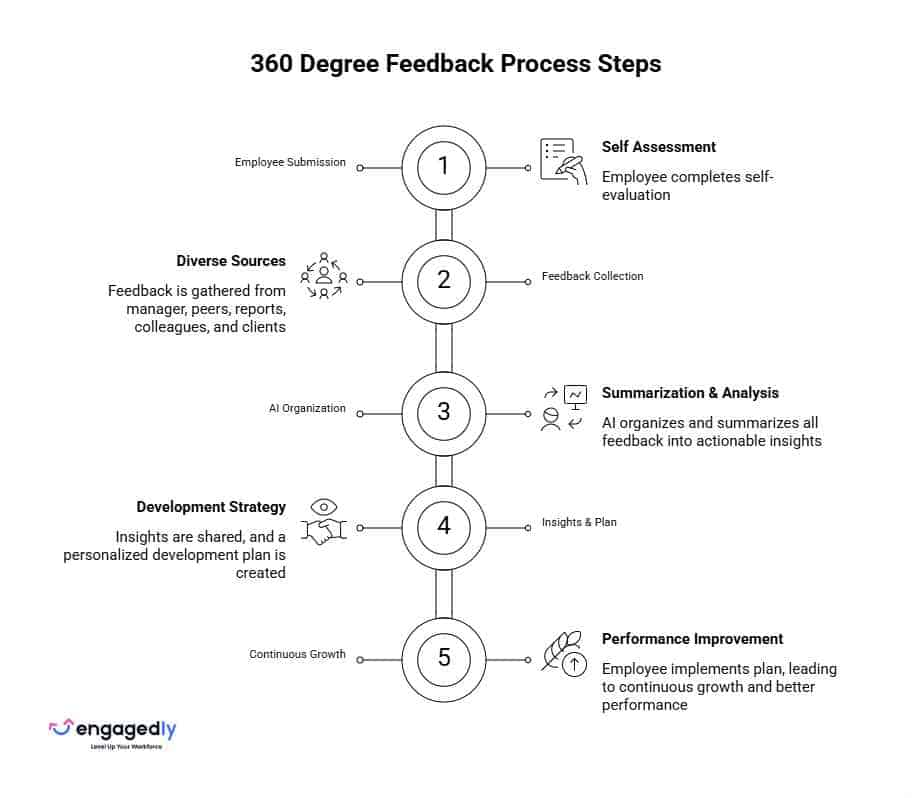
How a 360 Degree Feedback Process Works

Why 360 Degree Feedback Still Matters

The short answer is that managers alone don’t have enough visibility to fairly judge performance, and the data backs this up.

A widely cited Software Advice study surveyed around 300 US based employees and found some revealing patterns.

Key findings from that survey:

  • 37 percent of employees say they have one on one meetings with their manager once a month or less
  • 31 percent find those one on ones minimally or not at all productive
  • 19 percent are minimally or not at all confident their manager has enough information to fairly assess their performance
  • Half of employees say coworkers, not managers, have the best insight into their day to day performance

As Brian Westfall, senior market researcher for Software Advice, put it, a manager’s perspective is inherently limited because it’s a single point of view. Combining multiple perspectives creates a more accurate picture of how someone is actually doing, which gives both managers and employees more confidence in the result.

Demand reflects that too. The global market for 360 degree feedback software was valued at roughly 1.44 billion dollars in 2025 and is projected to reach 1.63 billion dollars in 2026, growing at a 13.2 percent compound annual rate. Organizations aren’t cutting back on multi rater feedback, they’re investing more in it.

360 Feedback Meets AI in 2026

AI hasn’t replaced 360 feedback, it’s changed how the feedback gets collected, summarized, and acted on. The biggest shift is the move away from a once a year event toward a continuous loop that managers and employees can actually keep up with.

A few real changes worth knowing about:

  • AI can now synthesize peer, customer, and manager feedback into a rolling digest surfaced weekly or monthly instead of waiting for a formal cycle, which leads to faster coaching interventions and clearer development actions
  • Review drafting assisted by AI can cut the time managers spend writing summaries by 30 to 60 percent, while improving consistency in language across teams
  • AI tools are increasingly used to flag uneven rating patterns across raters, which helps HR catch bias before it skews someone’s final review, a trend Robert Half highlights as a top HR priority for 2026

There’s a catch worth mentioning. AI should aggregate and summarize feedback, not generate it. If raters start leaning on AI to write their comments for them, the feedback loses the specificity that makes 360 reviews useful in the first place. The best 2026 implementations treat AI as an assistant that organizes human input, not a replacement for the human input itself.

A good 360 degree feedback process still needs these core elements to work, AI or no AI.

  • Reviewer anonymity
  • Customized feedback templates
  • Customizable feedback cycles
  • A clear connection between feedback and actual development plans, not just a report that sits unread

Engagedly’s Multirater or 360 Degree Feedback module covers all of the above and gives HR administrators full control over the cycle, so once it’s set up, the process runs without constant manual oversight.

Benefits Of 360 Feedback

Feedback from multiple sources. A single reviewer brings a single set of biases. Pulling in feedback from managers, peers, and direct reports doesn’t eliminate bias entirely, but it spreads it out so no single skewed opinion dominates the final picture.

A realistic view of how you’re perceived. Most people carry an idealized version of themselves in their head. Multi rater feedback shows the gap between that self image and how colleagues actually experience working with you, and that gap is often where the real growth opportunity sits.

Clearer development priorities. 360 feedback tends to surface specific patterns, not vague impressions, which makes it easier to identify what someone should actually work on next.

Measurable behavior change. This isn’t just theory. Research from Atwater and colleagues found that 50 percent of leaders demonstrably improved their behavior after receiving multi rater feedback.

Challenges In 360 Degree Feedback

Accuracy isn’t guaranteed. Feedback can be shaped by incomplete information, personal bias, or a rater simply not understanding an employee’s full scope of responsibilities.

No built in guardrails on content. Without clear parameters, some employees end up flooded with negative feedback while others get vague, unhelpful comments that don’t point to any real action.

Anonymity isn’t always protected. Some organizations strip anonymity in the name of transparency, but this usually backfires. Without anonymity, people tend to write what they think the recipient wants to hear instead of what’s actually true.

AI generated or low effort feedback. This is a newer problem in 2026. When raters use AI tools to quickly draft their comments, feedback can end up generic and detached from specific behavior, which defeats the purpose of collecting it from multiple people in the first place.

The Right Time For 360 Degree Feedback

There’s no universal schedule that works for every organization. Some run it annually, some monthly, some twice a year. What matters more than frequency is setting a clear timeline in advance for designing the survey, distributing it, and analyzing results.

Standard performance reviews can work fine on an annual or semiannual cadence since they’re tied to specific goals and outcomes. 360 feedback is different because its value comes from ongoing development, not a single checkpoint. If the goal is genuinely helping employees grow, running it twice a year tends to strike the right balance between frequency and survey fatigue.

Implementing 360 Feedback Software

Start with a clear process. The most common mistake organizations make is running a 360 program because it’s trendy, not because they have a specific goal in mind. Before launching one, get clear on what you actually want to learn from it.

Protect confidentiality. Don’t undercut your own program by removing anonymity. People need to feel safe being honest, or the entire exercise becomes a formality.

Set clear feedback parameters. Without ground rules, feedback quickly turns vague or unhelpful. Give raters guidance on tone, specificity, and what to avoid before the cycle starts.

Decide your sources carefully. Some organizations stick to peer feedback. Others bring in managers, direct reports, and even external clients or vendors. The more sources involved, the more important it is to keep everyone aligned on the process and expectations.

Choosing The Right 360 Feedback Software For Your Company

Simplicity. Any tool you roll out for the first time should be intuitive enough that employees don’t need formal training to use it. Test a free trial with a small group before committing.

Customization. You can go with an off the shelf tool used broadly across industries, or one flexible enough to adapt as your organization’s needs shift. Given how quickly workplace needs change, flexibility tends to age better.

Security. 360 feedback data is sensitive by nature, since it includes candid input from managers, peers, and direct reports. Ask vendors directly how your data is protected and where it’s stored. Data protection requirements vary by country, so make sure the platform complies with the regulations that apply to your organization.

AI capabilities, used responsibly. By 2026, this has become a real differentiator. Look for platforms that use AI to summarize feedback, catch rating bias, and surface trends, without letting AI generate the actual comments on a rater’s behalf.

Support and guidance. No matter how intuitive a tool is, good vendors walk your team through the full setup and ongoing use. Strong documentation and responsive support make a measurable difference in adoption.

360 Degree Feedback Best Practice Guidelines

Evaluate how the work gets done, not just the outcome. Outcomes don’t always reflect the effort or approach behind them. Identify the specific skills and behaviors you want employees to demonstrate, and assess against those directly.

Make criticism constructive. This is where reviews go wrong most often. Set ground rules in advance for what counts as fair, useful criticism.

Example of good criticism:

  • John isn’t very punctual, but he consistently completes all his assigned tasks on time

Example of bad criticism:

  • John is never on time and spends most of his day doing nothing

The first example gives John something to actually work with. The second offers nothing but a negative impression.

Review consistently, not just once a year. If feedback only shows up occasionally, employees start assuming everything is fine between cycles. When a full review finally happens and surfaces real issues, it feels like an ambush, and that damages trust rather than building it.

End on a supportive note. Even when a review surfaces real problems, managers need to pair that feedback with a concrete plan forward. The goal of any review is to motivate improvement, not leave someone demoralized.

Don’t exempt leadership from the process. Managers, directors, and even the CEO benefit from 360 feedback just as much as anyone else. Leaders who never get honest feedback have no reliable way to know if their own approach is actually working.

Final Thoughts

360 degree feedback isn’t a trend that’s fading, it’s becoming more central to how organizations evaluate and develop people. The core idea hasn’t changed since the concept first caught on. One perspective is never enough to fairly judge someone’s performance. What has changed is the tooling around it, with AI now helping summarize feedback faster, catch bias across raters, and turn scattered comments into a continuous coaching loop instead of a once a year event.

None of that works without the fundamentals though. Anonymity, clear feedback guidelines, consistent cycles, and a real plan for acting on what comes in. Get those right, and 360 feedback becomes one of the most reliable tools you have for building a culture where people actually grow instead of just getting judged.

If you’re ready to bring structured, unbiased, multi rater feedback into your organization, Engagedly’s 360 Degree Feedback module handles the entire cycle for you, from anonymity and custom templates to AI powered insights that turn feedback into real development plans.

Request a demo to see how it fits into your performance process.

Frequently Asked Questions

What is 360 degree feedback in simple terms?

It’s a way of evaluating an employee’s performance using input from multiple people around them, including managers, peers, and direct reports, instead of relying on just one manager’s opinion.

How often should 360 feedback be conducted?

Twice a year tends to work well for most organizations, since it’s frequent enough to support ongoing development without overwhelming employees or raters with survey fatigue.

Is 360 degree feedback still relevant in 2026?

Yes. Market data shows continued growth in adoption, and current research shows employees still don’t trust that managers alone have enough visibility to fairly assess their performance.

Can AI replace 360 degree feedback?

No. AI can help summarize and organize feedback and catch bias patterns across raters, but the actual input still needs to come from real people who work directly with the employee being reviewed.

What’s the biggest risk with 360 feedback programs?

Losing anonymity. Once raters feel their comments can be traced back to them, honesty tends to disappear, and the whole program loses its value.

Do’s and Don’ts of Giving 360 Feedback!

The struggle with 360-degree feedback does not always deal with the act of giving feedback in itself. Rather, it might deal with trying not to be burnt out while attempting to give good, actionable feedback to a number of people.

Continue reading “Do’s and Don’ts of Giving 360 Feedback!”

Ask These Questions Before Implementing A 360 Feedback Software

What makes a 360 feedback program effective? Is there are step by step manual or guide out there that can ensure a 360 feedback program’s success?

Continue reading “Ask These Questions Before Implementing A 360 Feedback Software”

How To Choose The Best 360 Feedback Software For Your Company

More than 85% of all the Fortune 500 companies use the 360 degree feedback process as a cornerstone of their overall leadership development process – Forbes.

360 degree feedback is an essential tool for any organization. A feedback culture where employees enthusiastically participate by receiving and giving feedback to their managers, colleagues and their direct reports drives employee engagement and helps the organization stay productive.

Continue reading “How To Choose The Best 360 Feedback Software For Your Company”