

Setting goals is easy. Keeping those goals visible, measurable, and connected to business priorities is where organizations often struggle.
A manager may set quarterly targets in a spreadsheet. Employees might document individual objectives somewhere else. Progress updates happen in meetings, performance reviews live in another system, and by the end of the quarter, nobody has a reliable view of what is actually on track.
That is the problem goal-setting software is designed to solve.
Modern employee goal-setting software helps organizations create goals, cascade company priorities across teams, track progress, manage OKRs, and bring goals into regular manager-employee conversations.
Some platforms focus almost entirely on OKRs. Others connect goals with performance reviews, feedback, learning, projects, or broader strategy execution.
So, which solution is right for your organization?
What Is the Best Goal-Setting Software in 2026?
The best goal-setting software in 2026 includes Engagedly, Betterworks, Lattice, 15Five, Leapsome, Profit.co, Weekdone, ClickUp, Asana, and WorkBoard.
The right choice depends on what you want to accomplish.
| Goal-Setting Software | Best For | Pricing |
|---|---|---|
| Engagedly | Goals connected with performance and talent management | $5–$8/user/month* |
| Betterworks | Continuous performance and goal alignment | From $8/user/month |
| Lattice | HR-led goals, OKRs, and performance | Goals & OKRs from $8/seat/month |
| 15Five | Manager effectiveness and employee performance | Perform from $11/user/month |
| Leapsome | Flexible goals, OKRs, and people enablement | Custom pricing |
| Profit.co | Enterprise OKRs and strategy execution | Custom pricing |
| Weekdone | Dedicated OKR management for SMBs | Free for up to 3 users; paid plans available |
| ClickUp | Connecting goals directly with tasks and projects | Paid plans from $7/user/month |
| Asana | Cross-functional goal and project management | Advanced from $24.99/user/month |
| WorkBoard | Enterprise strategy execution and OKRs | Custom pricing |
*Pricing changes frequently. Check each vendor’s current pricing before purchasing.
1. Engagedly
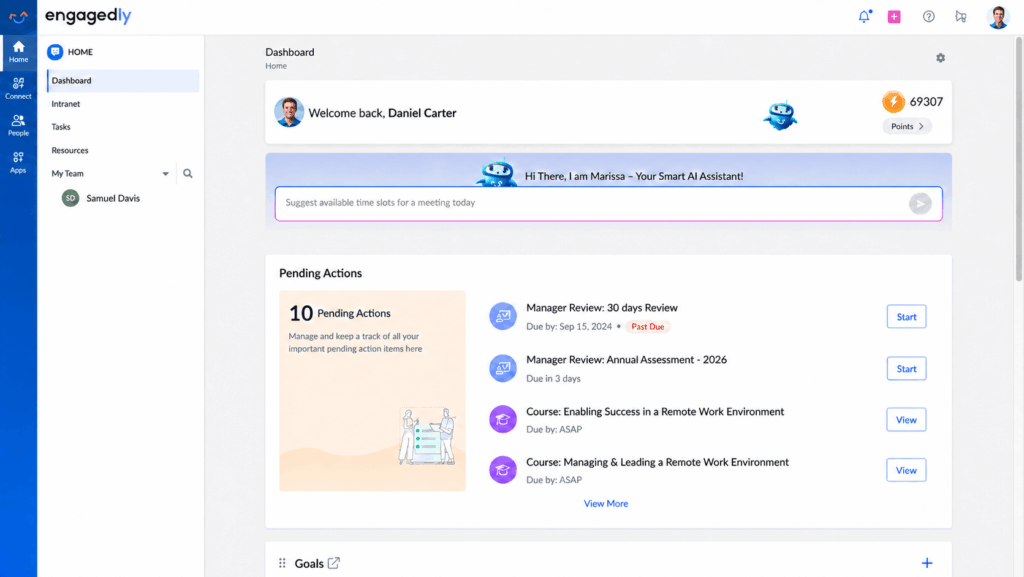
Best for: Mid-sized organizations that want employee goals and OKRs connected directly with performance management, feedback, development, and talent processes.
Engagedly is an AI-powered talent management platform that combines goal setting and OKRs with performance reviews, 360-degree feedback, 1:1 meetings, skills, learning, recognition, and talent development.
Rather than treating goals as a separate quarterly exercise, organizations can use Engagedly to connect goals with ongoing performance conversations.
Company-level goals can be cascaded to business units, teams, and individual employees. Teams can define measurable key results, assign contributors, manage goal priorities and weightages, and monitor progress through reports and dashboards.
Goals can also be pulled into meetings, feedback conversations, and performance reviews, helping managers evaluate employees with more context around the outcomes they were expected to deliver. Engagedly also provides AI-powered goal suggestions through Marissa AI.
Key Features
- Company, department, team, and individual goals
- OKRs and measurable key results
- Cascading and contributing goals
- Goal weightages and priorities
- AI-powered goal suggestions
- Goal dashboards and reporting
- Goal discussions during 1:1 meetings
- Real-time feedback connected to goals
- Goal integration with performance reviews
- Mobile access and integrations
Pricing
Engagedly’s Performance Suite is currently listed at $5–$8 per user per month, billed annually, with a minimum annual pricing threshold of $7,500. Goals and OKRs are included within the Performance Suite.
Where Engagedly Stands Out
Engagedly is particularly useful when organizations do not want goal management to operate in isolation. Goals can feed into reviews, feedback, development, learning, and broader talent decisions.
For organizations that only want a lightweight standalone goal tracker, however, the broader platform may offer more functionality than they require.
Best fit: HR teams looking to connect employee goals with continuous performance management and development.
2. Betterworks
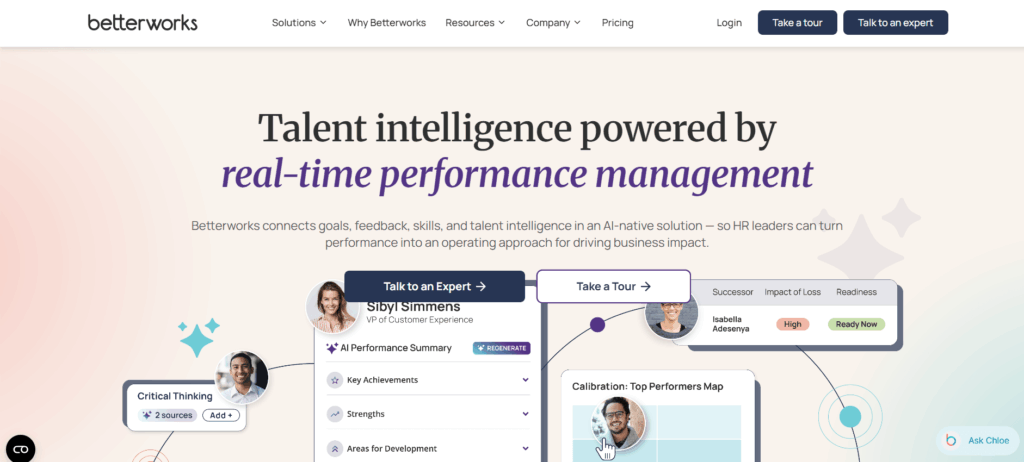
Best for: Organizations that want goals to form the foundation of continuous performance management.
Betterworks combines goals and OKRs with feedback, conversations, 1:1 meetings, performance management, and AI assistance.
One of its strengths is keeping goals active throughout the performance cycle rather than revisiting them only during quarterly or annual reviews.
Organizations can cascade company priorities into team and individual goals, monitor progress in real time, and bring goal achievement into performance conversations. Betterworks also uses AI to recommend goals based on strategy and employee roles.
Key Features
- Company, team, and individual goals
- Goals and OKRs
- Cascading goal alignment
- Real-time progress tracking
- Goal reminders
- AI-assisted goal creation
- Feedback and conversations
- 1:1 meetings
- Performance review integration
Pricing
Betterworks currently lists its Performance plan at $8 per user per month, including Goals & OKRs, performance management, feedback, conversations, 1:1 meetings, and AI assistance.
Where Betterworks Stands Out
Betterworks is strongest for companies that want goals to provide measurable evidence for employee performance conversations.
Best fit: Mid-market and enterprise organizations adopting continuous performance management.
3. Lattice
Best for: HR teams that want structured goals and OKRs within a broader people management platform.
Lattice combines goal management with performance reviews, feedback, 1:1s, employee engagement, analytics, and talent-management capabilities.
Its Goals & OKRs product supports cascading goals, progress updates, reminders, configurable goal processes, and integrations such as Jira and Salesforce.
That makes it particularly useful for organizations that want employees to understand how individual priorities contribute to broader company objectives.
Key Features
- Cascading goals
- OKRs
- Progress updates
- Goal reminders
- Configurable workflows
- 1:1 meetings
- Employee feedback
- Performance management
- Jira and Salesforce integrations
Pricing
Lattice currently lists Goals & OKRs at $8 per seat per month. Its broader Foundations package, which combines several people-management capabilities, starts at $13 per seat per month. Lattice also lists a $4,000 minimum annual agreement.
Where Lattice Stands Out
Lattice offers a good balance between dedicated goal management and broader HR performance workflows.
Best fit: HR teams looking for configurable OKRs within an established performance-management platform.
4. 15Five
Best for: Organizations that want goals connected to manager effectiveness, weekly check-ins, and employee performance.
15Five allows organizations to create company, department, team, individual, and self-development objectives using the OKR framework.
Employees and managers can track progress over time while bringing goals into weekly check-ins and performance conversations. Its Jira and Salesforce integrations can also automatically update certain key results based on work completed elsewhere.
Key Features
- Company and employee OKRs
- Individual development objectives
- Weighted OKRs
- Weekly check-ins
- 1:1 meetings
- Performance reviews
- 360-degree feedback
- Career development tools
- Jira and Salesforce integrations
Pricing
15Five’s Perform plan costs $11 per user per month when billed annually and includes OKRs & Goals along with performance reviews, 360 feedback, career planning, check-ins, and other performance features.
Where 15Five Stands Out
The platform is particularly strong when organizations want managers to discuss goals frequently instead of treating them as static records.
Best fit: Organizations prioritizing manager effectiveness and continuous employee conversations.
5. Leapsome
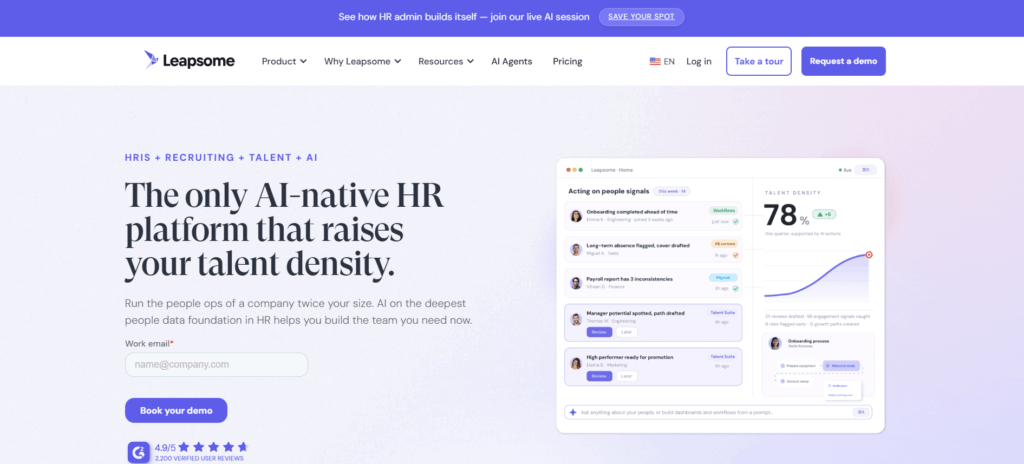
Best for: Organizations that want flexible goal frameworks alongside reviews, competencies, feedback, and development.
Leapsome supports company, team, individual, performance, and development goals.
Organizations can use traditional goals or structured OKRs, establish automated goal cycles, assign owners and contributors, and visualize alignment using interactive goal trees.
Its AI capabilities can also suggest OKRs and initiatives, while dashboards provide visibility into completion rates, outdated goals, team progress, and adoption.
Key Features
- SMART goals and OKRs
- Company, team, and individual goals
- Automated goal cycles
- AI-assisted goal creation
- Goal trees
- Goal analytics
- Progress dashboards
- Feedback and comments
- Jira integration
- Performance-review integration
Pricing
Leapsome uses custom pricing based on employee count, modules, and contract length. A 14-day free trial is currently available.
Where Leapsome Stands Out
Leapsome provides considerable flexibility for businesses that use different goal-setting approaches across departments.
Best fit: Growing and global organizations looking for flexible people enablement and goal management.
6. Profit.co

Best for: Organizations that want OKRs to support broader strategy execution.
Profit.co goes beyond basic goal tracking by connecting OKRs with strategy management, KPIs, projects, employee performance, and other execution workflows.
Organizations can create OKRs at different levels, cascade them across teams, assign priorities, track progress, use more than 300 built-in KPI options, and create dashboards for executives and managers.
Its strategy-focused approach makes it particularly relevant for organizations that want to connect corporate objectives with execution across multiple functions.
Key Features
- Company, team, and individual OKRs
- Cascading goals
- 300+ KPI options
- Custom priority weights
- Real-time dashboards
- OKR templates
- Automated notifications
- Strategy roadmaps
- Task and portfolio management
- AI-assisted strategy capabilities
Pricing
Profit.co currently uses custom pricing based on selected modules and user count and offers a 30-day trial.
Where Profit.co Stands Out
Its strongest differentiator is the ability to combine OKRs with broader strategy-execution frameworks.
Best fit: Enterprises and strategy teams that need more than employee-level goal tracking.
7. Weekdone

Best for: Small and mid-sized organizations looking for a focused OKR platform.
Weekdone specializes in OKRs, weekly planning, check-ins, and strategy alignment.
Organizations can create annual goals and quarterly OKRs, connect team objectives with company priorities, and visualize relationships through an OKR hierarchy.
Weekly check-ins help teams keep goals active throughout the quarter rather than setting objectives and forgetting about them.
Key Features
- Annual and quarterly OKRs
- Company, department, team, and individual goals
- OKR hierarchy
- Weekly check-ins
- KPI tracking
- Dashboards and reports
- Feedback and recognition
- Jira and Asana integrations
- Slack and Microsoft Teams integrations
- OKR coaching and training
Pricing
Weekdone is free for up to three users and provides a 14-day free trial for teams with four or more users. Paid pricing varies by team size.
Where Weekdone Stands Out
Its combination of software and OKR coaching can help organizations that are implementing OKRs for the first time.
Best fit: SMBs that want a dedicated OKR tool rather than a full talent-management suite.
8. ClickUp
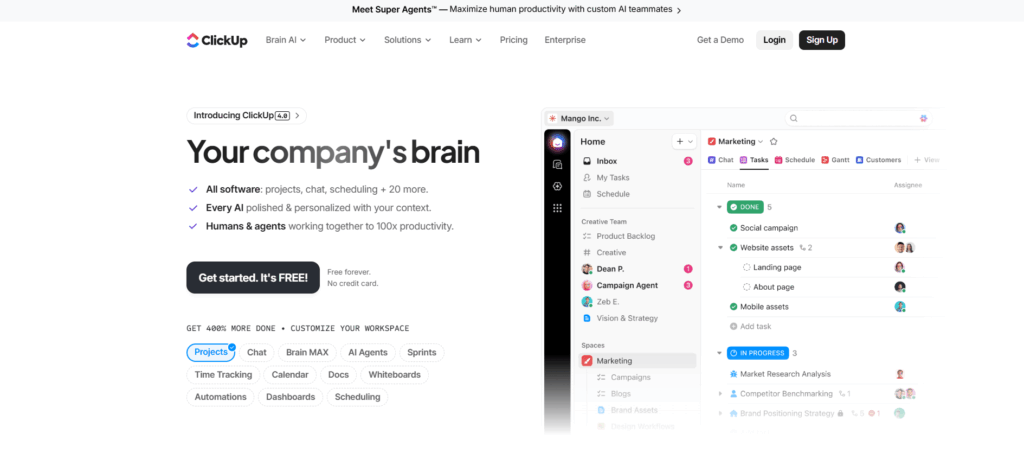
Best for: Teams that want goal tracking tightly connected to projects and day-to-day tasks.
ClickUp approaches goal management from a work-management perspective rather than an HR perspective.
Teams can create high-level goals and break them into measurable targets based on numbers, currency, true/false outcomes, or task completion.
Goals can then be linked directly to work inside ClickUp, allowing progress to update as associated tasks are completed. Teams can also organize goals into folders for OKRs, sprints, quarterly targets, or employee scorecards.
Key Features
- Goals and measurable targets
- OKR tracking
- Numerical and monetary targets
- Task-based goal progress
- Automatic progress tracking
- Goal folders
- Dashboards
- Permissions and sharing
- Project and sprint management
Pricing
ClickUp offers a Free Forever plan with limited Goals usage. Its Unlimited plan starts at $7 per user per month when billed annually and includes Goals and Portfolio Management.
Where ClickUp Stands Out
ClickUp is especially useful when goals need to connect directly to projects, tasks, and operational work.
It is less HR-focused than platforms such as Engagedly, Betterworks, or Lattice.
Best fit: Product, marketing, operations, and project teams already managing work in ClickUp.
9. Asana
Best for: Cross-functional organizations that want strategic goals connected with project execution.
Asana Goals helps companies connect company-level objectives with the projects and work responsible for delivering them.
Leaders can monitor progress across portfolios while employees can understand how individual projects contribute to broader priorities.
This makes Asana particularly useful when the main goal-management challenge is connecting strategy with everyday work rather than running an HR performance-management program.
Key Features
- Company goals
- Team goals
- Goal progress tracking
- Project-to-goal connections
- Portfolios
- Status updates
- Dashboards
- Workload management
- Project and task management
Pricing
Goals are included with Asana’s Advanced plan, currently priced at $24.99 per user per month when billed annually.
Where Asana Stands Out
Its biggest advantage is the connection between strategic objectives and project execution.
Best fit: Organizations already using Asana for cross-functional project management.
10. WorkBoard
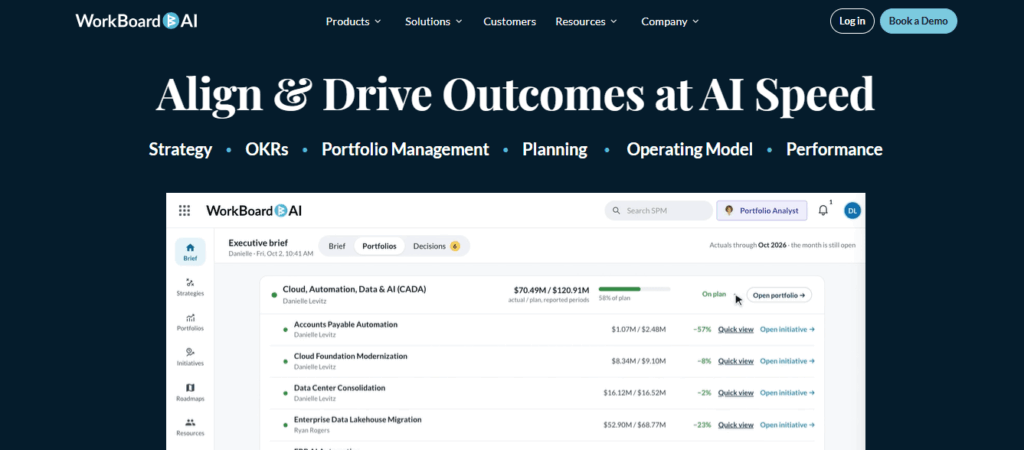
Best for: Large enterprises that need OKRs as part of an organization-wide strategy-execution system.
WorkBoardAI focuses heavily on strategy, business outcomes, OKRs, portfolio management, planning, operating cadence, and performance.
Companies can connect strategic priorities with objectives and key results across teams while giving executives visibility into execution, dependencies, risks, and progress.
Its current platform also uses AI agents to assist with OKR creation, identify alignment issues, generate scorecards, support business reviews, and help managers prepare for conversations.
Key Features
- Enterprise OKRs
- Strategy-to-goal alignment
- AI-assisted OKR creation
- Goal progress monitoring
- Strategic portfolio management
- Scorecards
- Business-review workflows
- Strategy dashboards
- Performance and coaching capabilities
Pricing
WorkBoard does not publicly list standard pricing and generally uses custom enterprise pricing.
Where WorkBoard Stands Out
WorkBoard is considerably more strategy-focused than a typical employee goal tracker.
Best fit: Large enterprises that need executive strategy, OKRs, portfolios, and execution management within one environment.
What Is Goal-Setting Software?
Goal-setting software is a digital platform that helps organizations create, assign, align, track, and measure employee, team, and organizational goals.
Instead of managing objectives through spreadsheets, documents, or disconnected systems, goal-management software creates a central place where employees and managers can see:
- What needs to be achieved
- Who owns each goal
- How progress is measured
- How individual goals connect with company priorities
- Whether goals are on track or at risk
- What progress has been made over a specific period
Many modern platforms also support OKRs, SMART goals, KPIs, cascading goals, check-ins, dashboards, feedback, and performance-review integration.
Goal-Setting Software vs. OKR Software: What’s the Difference?
Goal-setting software is a broader category.
It can support individual employee goals, team targets, development goals, SMART goals, performance objectives, KPIs, or company priorities.
OKR software, meanwhile, is specifically designed around the Objectives and Key Results framework.
An objective defines what you want to achieve, while key results define how success will be measured.
For example:
Objective: Improve customer retention.
Key Results:
- Increase renewal rate from 85% to 90%.
- Reduce customer churn from 8% to 5%.
- Improve customer satisfaction score from 4.1 to 4.5.
Many platforms in this list support both traditional goals and OKRs, so organizations do not necessarily need separate systems.
What Features Should You Look for in Goal-Setting Software?
The most important features depend on how your organization manages goals, but several capabilities are particularly valuable.
Goal Alignment and Cascading
Employees should be able to understand how their work contributes to team, department, and company priorities.
Look for tools that allow goals to be connected or cascaded across organizational levels.
Flexible Goal Frameworks
Not every organization uses the same methodology.
The platform should ideally support frameworks such as SMART goals, OKRs, KPIs, individual development goals, or custom goal structures.
Measurable Progress Tracking
Managers need more than a list of objectives.
Good goal-tracking software should allow teams to define measurable targets, update progress, and quickly identify goals that are on track, behind schedule, or at risk.
Check-Ins and Reminders
Goals should remain part of regular conversations.
Automated reminders and recurring check-ins can prevent goals from disappearing after they are created.
Dashboards and Reporting
Managers and HR leaders should be able to see progress at individual, team, department, and organizational levels without manually compiling spreadsheets.
Performance Management Integration
For employee performance goals, connecting goals with feedback, 1:1s, and performance reviews creates more context for evaluations.
Integrations
Look for integrations with the tools employees already use, such as Jira, Salesforce, Slack, Microsoft Teams, HRIS platforms, and project-management systems.
AI Assistance
AI is increasingly being used to suggest measurable goals, improve OKR wording, summarize progress, flag risks, and reduce the administrative work involved in goal management.
How to Choose the Best Goal-Setting Software
Start with the problem you are trying to solve.
If your primary goal is employee performance and development, platforms such as Engagedly, Betterworks, Lattice, 15Five, or Leapsome are likely to be more relevant.
If your priority is dedicated OKR management, Weekdone or Profit.co may be stronger options.
Organizations focused on project execution may prefer ClickUp or Asana because goals connect directly with tasks and projects.
Large enterprises trying to connect strategy, OKRs, portfolios, and executive execution may find WorkBoard more suitable.
The best platform is therefore not necessarily the one with the longest feature list. It is the one that fits how your organization actually sets goals, discusses progress, evaluates performance, and adjusts priorities.
Final Thoughts
The best goal-setting software should do more than provide employees with a place to enter objectives.
It should help people understand what matters, how their work contributes to company priorities, how progress will be measured, and when priorities need to change.
For organizations primarily focused on project execution, tools such as ClickUp and Asana make it easier to connect goals with everyday work.
For companies implementing dedicated OKR programs, Weekdone, Profit.co, and WorkBoard provide stronger strategy and OKR-focused capabilities.
And for organizations that want employee goals connected with performance reviews, feedback, 1:1s, development, and broader talent management, platforms such as Engagedly, Betterworks, Lattice, 15Five, and Leapsome provide a more integrated approach.
Engagedly is particularly suited to organizations that want goals to remain connected to the complete employee performance cycle—from setting expectations and tracking progress to providing feedback, evaluating results, and supporting development.
Want to see how Engagedly can help connect employee goals with performance and development? [Request a demo].
Frequently Asked Questions About Goal-Setting Software
What is the best goal-setting software for employees?
What is the best software for tracking employee goals?
What is OKR software?
Can goal-setting software improve employee performance?
What is the difference between goal-setting software and performance management software?
Performance management software typically covers a broader set of processes, including performance reviews, 360-degree feedback, competencies, 1:1 meetings, development planning, and sometimes compensation.
Platforms such as Engagedly, Betterworks, Lattice, 15Five, and Leapsome combine both capabilities.