



Best 20 Employee Feedback Software for Employee Engagement in 2026

If you’ve sent out an annual engagement survey and received results three months later that nobody acted on, you already know what the wrong feedback tool looks like. The right one gets you usable information fast enough to do something with it.

This list covers 20 tools that HR and people teams are actually using in 2026.

1. Engagedly

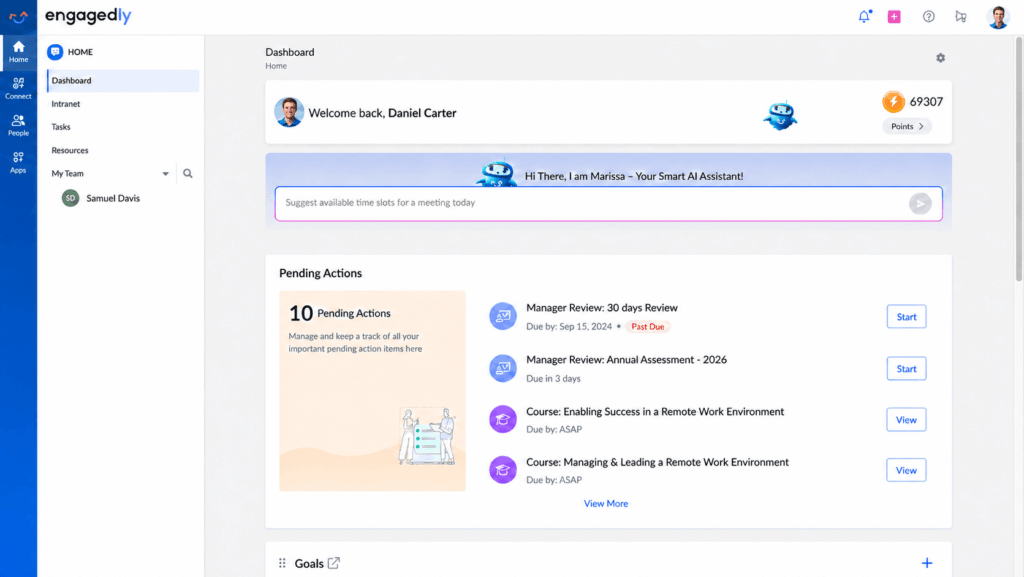
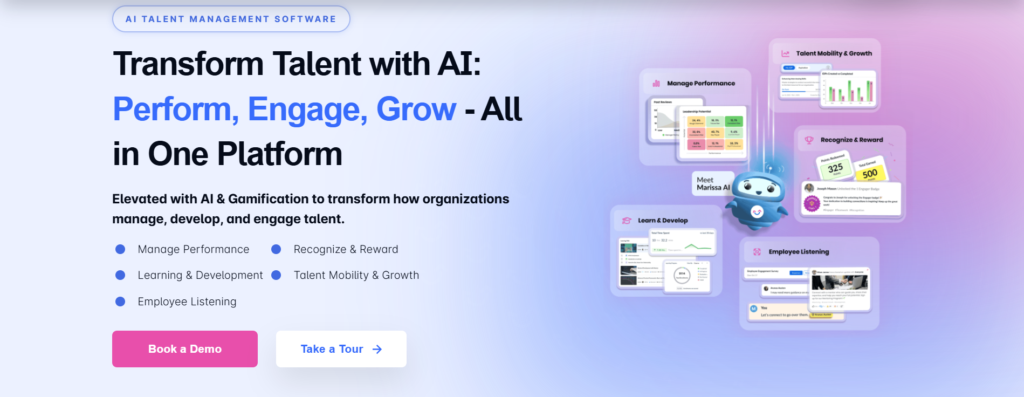
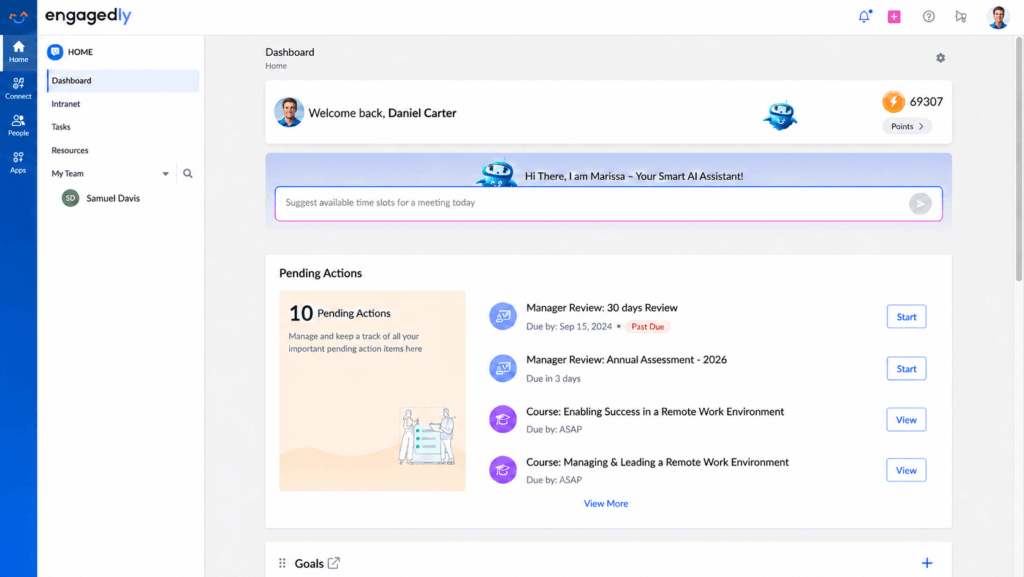
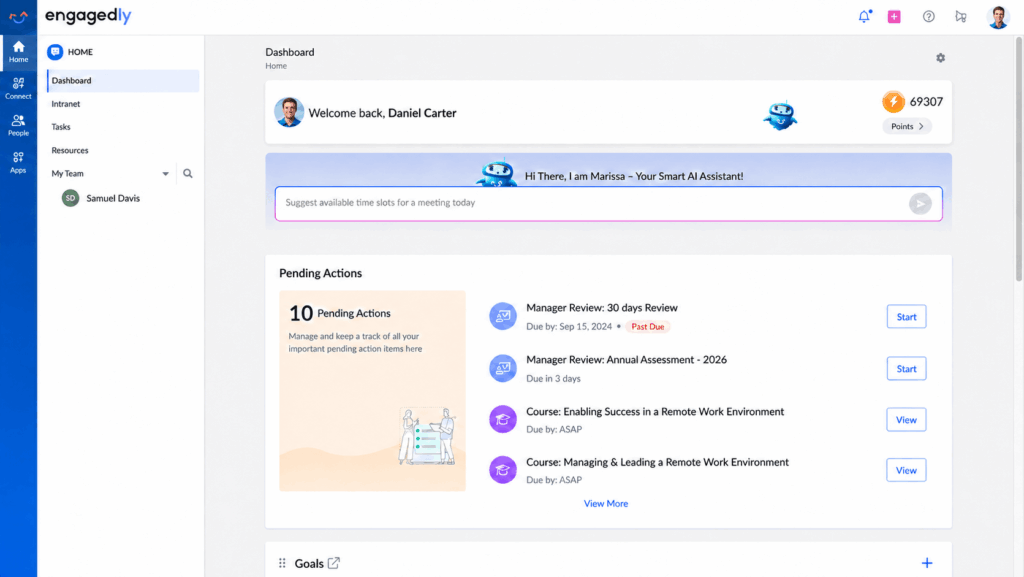
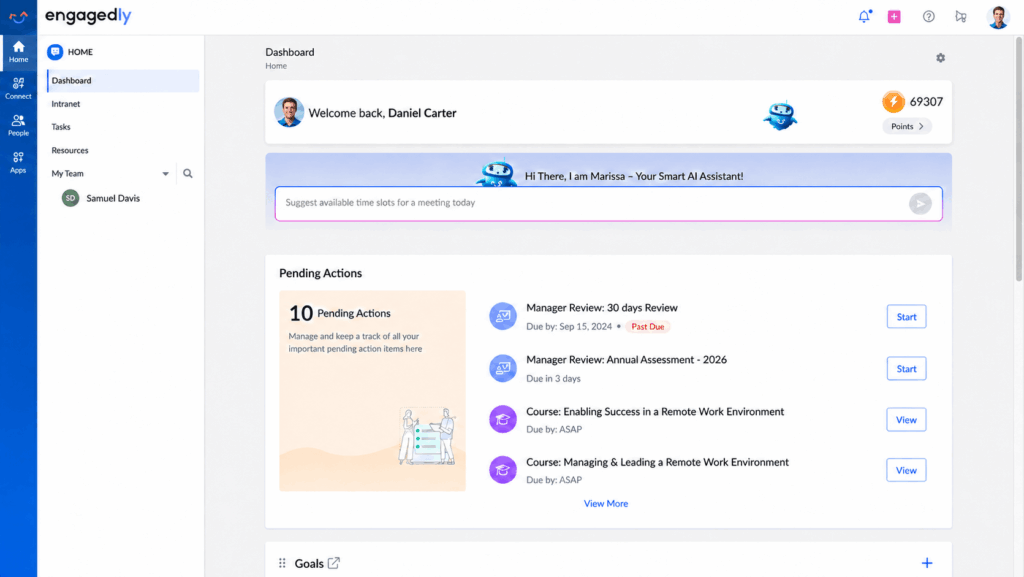
Engagedly is built around one premise: feedback, performance, and development should live in the same platform. The feedback side includes 360-degree reviews, continuous check-ins, pulse surveys, and real-time recognition. Marissa AI surfaces patterns across feedback data so managers aren’t doing manual analysis after every review cycle.

It’s designed for mid-size to enterprise companies that want more than a standalone survey tool. HR teams use it to connect what employees say with what actually happens next, whether that’s a development plan, a goal update, or a coaching conversation. The real-time feedback module makes it possible to give and receive feedback outside of formal review windows, which changes how teams actually use the tool day to day.

Pros:

  • 360 feedback, pulse surveys, OKR tracking, and LMS are all in one platform
  • Marissa AI flags patterns and potential issues without requiring managers to dig through data manually
  • Review cycles are configurable for both structured annual reviews and ongoing check-ins
  • Integrates with Workday, BambooHR, ADP, and most major HRIS tools — see the full integrations list
  • Works on mobile, which matters for frontline and deskless workforces

Cons:

  • Implementation takes real time, especially for companies setting up custom workflows from scratch
  • The range of features can feel like too much if you only need one piece of it
  • Pricing is custom, so you have to go through a sales conversation before knowing costs

Request a demo of Engagedly

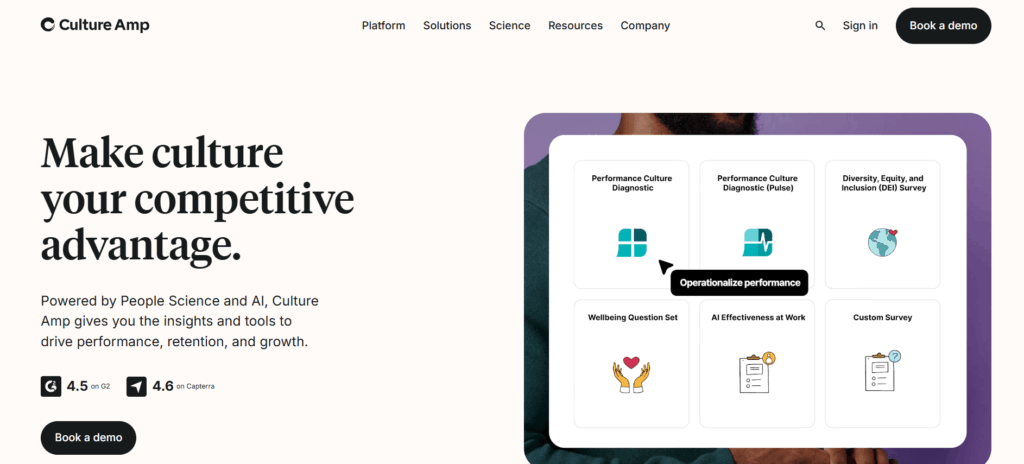
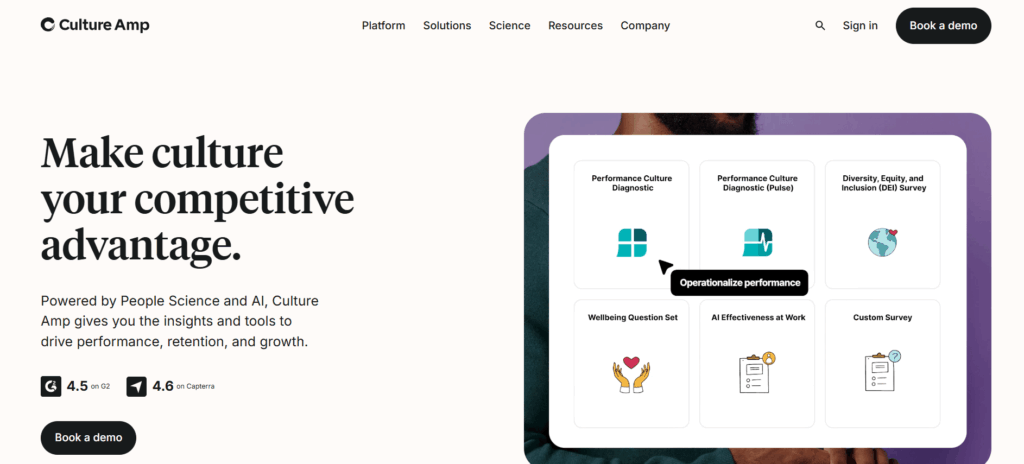
2. Culture Amp

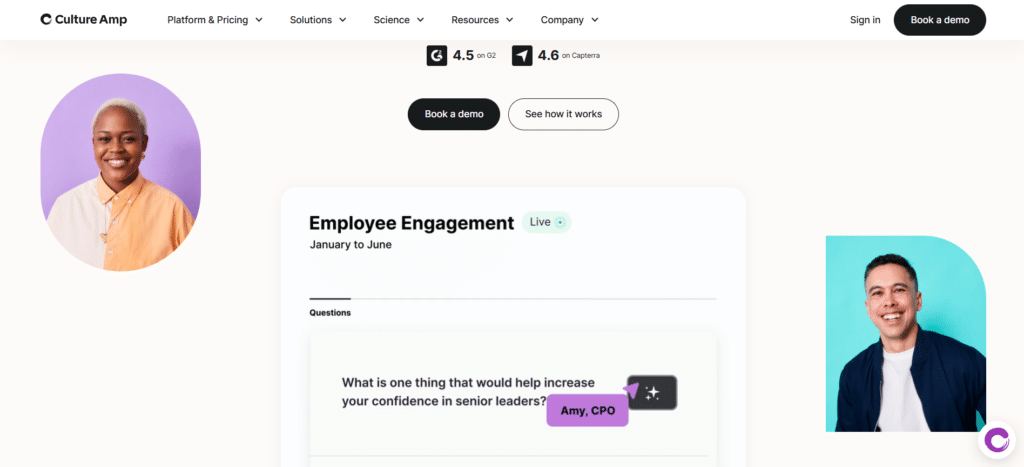
Culture Amp has benchmarking data that most newer tools simply don’t have. It covers engagement surveys, DEI measurement, onboarding and exit surveys, and manager effectiveness reviews. The analytics are detailed, and the platform surfaces suggested actions after surveys close rather than leaving HR teams to figure out next steps on their own.

It’s heavily used in tech and professional services companies with 200 to 5,000 employees. If you’re evaluating both, it’s worth reading a direct Engagedly vs Culture Amp comparison to understand where each platform draws its boundaries.

Pros:

  • Science-backed survey design with a large benchmark dataset for industry comparison
  • DEI measurement tools built into the core product, not an add-on
  • Manager reports are readable without HR translating the results
  • Integrates with Slack, Workday, BambooHR, and others

Cons:

  • Performance management and feedback don’t live in the same place
  • The action-planning tools are lighter than the survey side
  • Pricing is higher than comparable tools for smaller teams

3. Lattice

Lattice started as a performance management tool and layered engagement features on afterward. That origin shows. The performance side is strong: goal tracking, structured reviews, manager one-on-ones. The engagement side covers pulse surveys and some analytics, but it’s not as deep as tools built specifically for employee listening programs.

If your priority is keeping performance and engagement in a single platform and you can accept some trade-offs on the listening side, Lattice is a reasonable call. If you’re running a side-by-side evaluation, there’s a detailed Engagedly vs Lattice breakdown that covers the key differences.

Pros:

  • Clean interface with solid adoption rates among employees and managers
  • Strong OKR and goal-setting features
  • AI-assisted review summaries reduce the time managers spend writing
  • Good integration with Slack and Microsoft Teams

Cons:

  • Engagement and survey features lag behind dedicated tools
  • Costs climb when you add multiple modules
  • Analytics customization is more limited than some customers expect

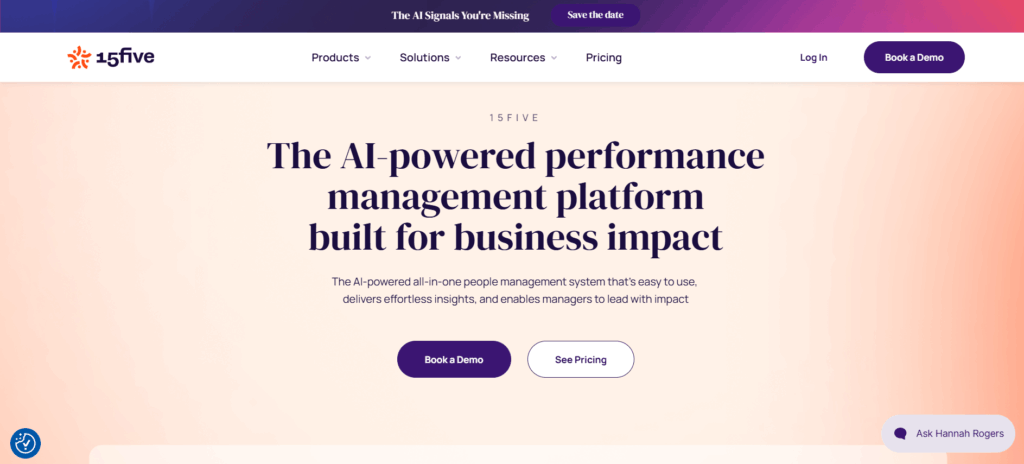
4. 15Five

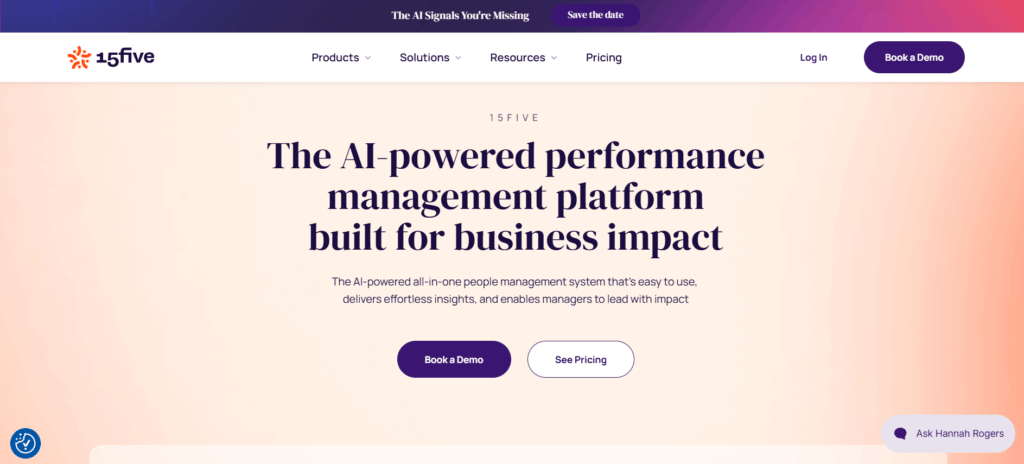
15Five is built around the weekly check-in: a short form employees fill out covering what they’re working on, how they’re doing, and what’s blocking them. Done well, this creates a continuous signal without the overhead of running formal surveys. It also includes OKRs, performance reviews, and manager coaching tools.

Companies that put manager effectiveness at the center of their people strategy tend to get the most out of it. A head-to-head Engagedly vs 15Five comparison is worth reviewing if you’re deciding between them.

Pros:

  • Weekly check-in format is low effort for employees but produces consistent data over time
  • Manager coaching tools include conversation guides and 1-on-1 frameworks
  • HR Outcomes Dashboard connects engagement data to metrics like retention and performance
  • Good customer support and onboarding

Cons:

  • The weekly check-in model doesn’t fit every company culture
  • 360 feedback features are less configurable than enterprise-focused platforms
  • The interface has dated in some areas compared to newer tools

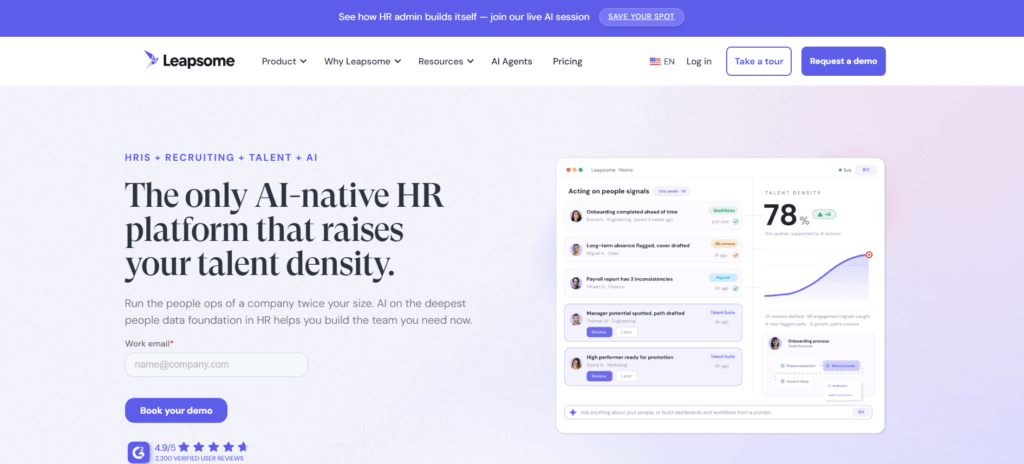
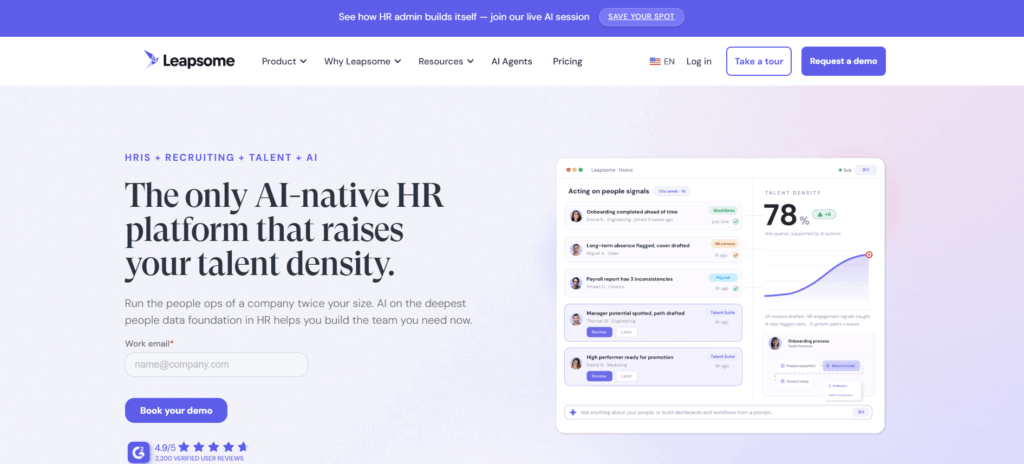
5. Leapsome

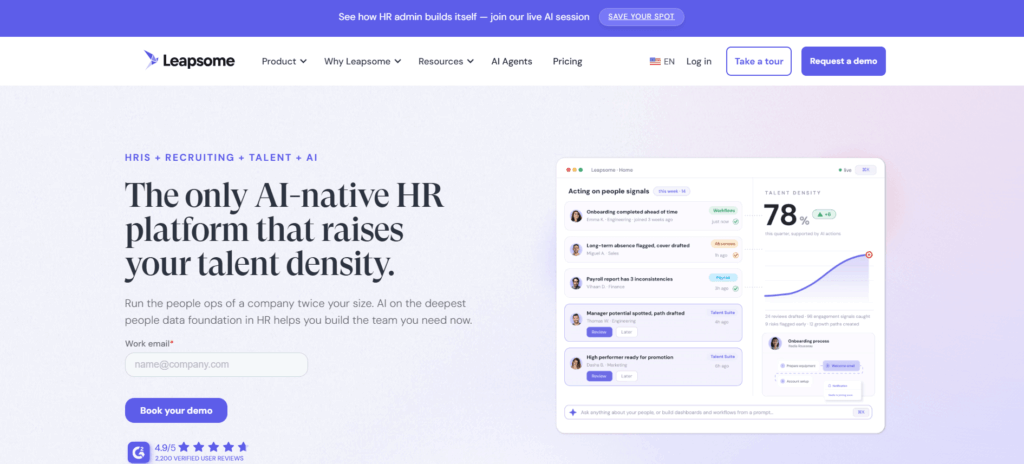
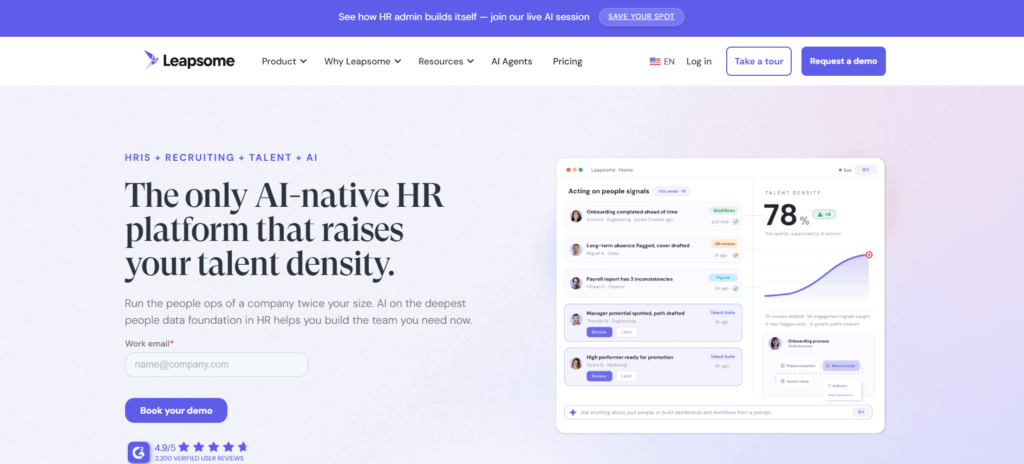
Leapsome ties engagement surveys, performance reviews, learning, and compensation together in one platform. The feedback tools are solid on their own, but what distinguishes Leapsome is the connection between feedback and development. An employee gets feedback, that feedback informs a development goal, and that goal links to a learning module. It’s a tighter loop than most platforms offer.

Understanding how 360 feedback actually benefits employees and organizations is useful context before evaluating any platform in this category.

Pros:

  • Feedback and development are genuinely integrated, not just displayed on the same dashboard
  • AI analysis of open-ended responses saves time during review cycles
  • Interface adoption is high, which matters more than most buyers account for
  • Strong GDPR compliance features for European organizations

Cons:

  • Implementation requires more investment upfront than lighter tools
  • Rolling out features incrementally is harder because of how tightly the modules connect
  • Pricing is custom and skews toward the enterprise end

6. Qualtrics XM

Qualtrics is the tool for companies that want survey methodology rigor at scale. It’s used more often for formal employee experience research than for continuous listening programs. The analytics are powerful, but the platform is built for people who know what they’re doing. HR teams without a dedicated analyst on staff often find it more complex than they need.

It’s a fit for large enterprises running structured EX research programs alongside other engagement tools. If you’re considering it, it’s worth looking at a breakdown of Qualtrics competitors before committing to a demo process that can take months.

Pros:

  • Sophisticated survey methodology and statistical analysis that few tools can match
  • Highly flexible for custom research programs and complex study designs
  • Scales to very large employee populations
  • Strong text analytics for open-ended responses

Cons:

  • Steep learning curve for teams without research or analytics experience
  • Expensive, with pricing that reflects its enterprise positioning
  • Setup often requires professional services support

7. Microsoft Viva Glint

Glint was acquired by LinkedIn and later folded into Microsoft’s Viva suite. For companies already on Microsoft 365, Glint is now embedded in that stack. It handles pulse surveys, engagement programs, and team-level reporting through the Teams interface.

The integration benefit is real. Outside the Microsoft ecosystem, the case for Glint gets harder to make. Companies evaluating this tool should also understand what continuous feedback actually looks like in practice before deciding whether a Teams-embedded survey tool covers what they need.

Pros:

  • Deep integration with Microsoft Teams and the rest of the M365 environment
  • Solid engagement survey templates and benchmarking data
  • Familiar interface for employees already spending their day in Microsoft tools
  • Included in some Microsoft 365 enterprise licensing

Cons:

  • Much less useful for organizations not running on M365
  • 360 feedback and performance management features are thin compared to dedicated platforms
  • Some features from the original Glint product have been slow to reach the Viva version

8. Workday Peakon Employee Voice

Peakon was acquired by Workday and now sits inside the Workday HCM suite. The product specializes in continuous listening: short automated surveys running on a rolling schedule rather than big annual campaigns. The real-time benchmarking data is one of its more useful features.

For companies already on Workday, adding Peakon is straightforward. For everyone else, the value proposition is harder to justify. Understanding how to interpret employee engagement survey results is something any team running continuous listening programs will need to sort out, regardless of which tool they pick.

Pros:

  • Real-time benchmark comparisons against industry and company-size peers
  • Automated survey cadence reduces the administrative work of running ongoing programs
  • Predictive analytics for identifying employees at higher risk of leaving
  • Tight integration with Workday HCM

Cons:

  • Pricing and implementation complexity are sized for large enterprises
  • Customization is more limited than standalone engagement platforms
  • Less useful as a standalone tool outside the Workday stack

9. Officevibe

Officevibe, now part of the Workleap suite, has had some rebranding over the past few years, but the core product remains the same: short weekly pulse surveys, anonymous feedback channels, and manager-facing reports. It’s one of the easier tools to get running, which is why it shows up in a lot of growing companies that want results without a long setup process.

Running effective employee surveys comes down to more than just tool selection. Survey design and cadence matter as much as the platform.

Pros:

  • Can be live within days, not months
  • Anonymous feedback tends to produce more honest responses than identified surveys
  • Manager reports are readable without HR having to translate the numbers
  • Good integration with Slack and Teams

Cons:

  • Survey customization is more limited than enterprise platforms
  • Analytics don’t go as deep for organizations with complex reporting needs
  • Not the right tool for companies that also want performance management features

10. CultureMonkey

CultureMonkey tracks engagement across the full employee lifecycle. It covers onboarding surveys, mid-tenure pulse checks, and exit interviews in a single workflow. The AI sentiment analysis is useful for companies that collect a lot of open-ended responses and don’t have the bandwidth to read every comment individually.

If you’re building out a lifecycle listening program, it’s worth understanding employee sentiment analysis as a discipline, not just a feature toggle.

Pros:

  • Lifecycle coverage from day one through exit in one platform
  • AI sentiment tagging makes open-ended responses more manageable at scale
  • Multi-language support for globally distributed teams
  • Anonymity controls are configurable to fit different cultural contexts

Cons:

  • Performance management features are limited compared to platforms like Engagedly or Lattice
  • Less brand recognition in the US market, which can complicate internal procurement conversations
  • The reporting interface has a learning curve for new users

11. Achievers

Achievers combines employee recognition with a listening module called Voice of Employee. The connection between recognition activity and engagement data is useful in practice. When you can see that teams with higher recognition rates also show stronger survey results, it gives HR a concrete way to demonstrate the return on recognition programs.

The impact of employee recognition on engagement is well-documented, and Achievers is one of the few platforms that puts both datasets in the same view.

Pros:

  • Recognition and survey data in the same platform enables cross-analysis that separate tools don’t support
  • Over 100 customizable survey templates
  • Real-time dashboards with filtering by team, location, and tenure
  • Integrates with Slack, Teams, Workday, and others

Cons:

  • Primarily a recognition tool, so the feedback side has more limited features
  • Not a substitute for a full performance management platform
  • Enterprise-level customization is limited compared to dedicated engagement tools

12. ThriveSparrow

ThriveSparrow is a newer platform that’s moved quickly to cover 360 feedback, pulse surveys, engagement tools, and OKR tracking. The interface is cleaner than many tools in this category, and the action plan suggestions generated after surveys are genuinely useful rather than generic. For the price, it covers substantial ground.

Pros:

  • Affordable compared to enterprise alternatives, often significantly so
  • 360 feedback, pulse surveys, and OKRs in a single platform
  • Fast to set up with a smooth onboarding process
  • AI-generated action plan suggestions tied to survey results

Cons:

  • Smaller company with less proven scale at large enterprise deployments
  • Integration library is not as deep as established competitors
  • Some features are still being developed

13. Quantum Workplace

Quantum Workplace has been running engagement surveys for over 15 years, which means its benchmarking data has depth that newer tools can’t replicate quickly. It covers engagement surveys, pulse checks, recognition, and performance reviews.

Understanding 10 employee engagement metrics your HR team should be tracking gives useful context for evaluating any platform’s reporting capabilities.

Pros:

  • Extensive benchmark database built over years of survey data across thousands of companies
  • Covers engagement, recognition, and performance reviews in one product
  • Clear action-planning workflow after surveys close
  • Manager coaching tools included

Cons:

  • The interface looks older compared to more modern competitors
  • Pricing is mid to high, harder to justify for smaller teams
  • Implementation can take longer than buyers expect upfront

14. Eletive

Eletive is a Scandinavian platform that makes an interesting bet: feedback tools should give individual employees visibility into their own engagement data, not just give HR and leadership a dashboard to review. The pulse surveys, analytics, and benchmarking are all present, but the employee-facing design is what makes it distinct.

If your goal is building a genuine employee engagement framework rather than a reporting layer for HR, Eletive’s approach is worth understanding.

Pros:

  • Employees can see their own engagement data, which changes how they interact with the product
  • High survey completion rates reported by customers
  • Industry and role-level benchmarking
  • Anonymity and psychological safety features are well-designed

Cons:

  • Performance management features are limited
  • Less established in the US market than European competitors
  • Integration options are narrower than what larger platforms offer

15. TINYpulse

TINYpulse has been around since 2012 and was one of the original pulse survey tools. The format is simple: one question per week, anonymous responses, manager visibility into trends over time. It’s not the most sophisticated product on this list. That’s also the point. Companies that have tried and abandoned more complex platforms sometimes come back to something this lightweight because the simpler tool actually gets used.

If you’re trying to understand what pulse survey questions actually move the needle, that’s the harder problem to solve regardless of which tool you run them in.

Pros:

  • Simple enough that employees complete it and managers actually read the results
  • Anonymous format drives more honest responses than identified surveys
  • Quick to roll out with minimal training requirements
  • Affordable for small and mid-sized teams

Cons:

  • Analytics are shallow compared to modern engagement platforms
  • No built-in 360 feedback or performance management capabilities
  • AI feature development has been slower than competitors

16. Motivosity

Motivosity organizes its product into four modules: Connect, Recognize, Lead, and Listen. The Listen module covers eNPS, pulse surveys, and 360 feedback. The recognition side is arguably where Motivosity is stronger, but having recognition and engagement data in the same analytics view has real value for understanding what’s actually driving employee sentiment.

For teams that want to go deeper on recognition before layering in feedback tools, the guide to building an employee recognition program covers what that looks like in practice.

Pros:

  • Recognition and engagement data in the same analytics view
  • eNPS tracking is easy to run and straightforward to report on
  • Affordable for small to mid-sized teams
  • Manager effectiveness scores built into the reporting

Cons:

  • Feedback and survey features are less mature than dedicated engagement tools
  • Not well-suited for complex 360 feedback programs or enterprise performance cycles
  • UI can feel cluttered when running multiple modules at the same time

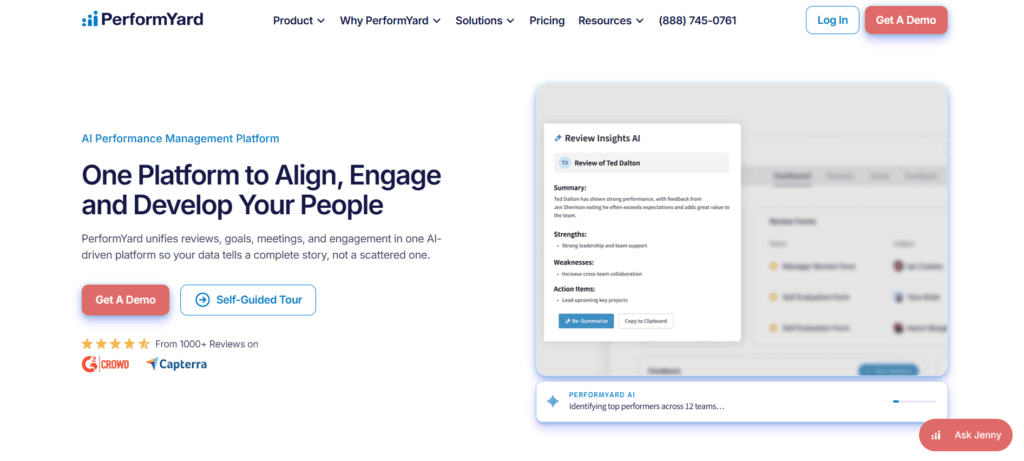
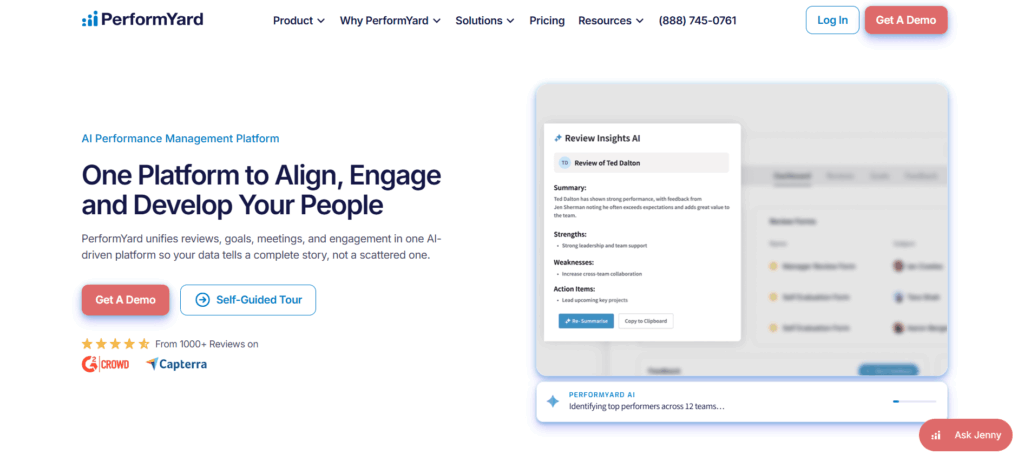
17. PerformYard

PerformYard focuses on structured performance reviews rather than continuous listening. HR teams use it to configure and run review cycles, collect multi-rater feedback, and maintain documented performance records. It’s an operational tool. Companies that need clean performance documentation and a configurable review process without a lot of extra features tend to find it a good fit.

Before locking in any performance review tool, it’s worth reviewing the most common reasons performance management systems fail to make sure you’re solving the right problem.

Pros:

  • Highly configurable review cycles and rating formats
  • Straightforward interface that’s easy for employees to navigate
  • Strong track record and ratings among small and mid-sized businesses
  • Dedicated customer support

Cons:

  • Pulse survey capabilities are limited compared to tools built for ongoing engagement
  • No AI-powered analysis
  • Less useful for companies that want feedback and development to connect between formal review cycles

18. Zonka Feedback

Zonka Feedback comes from the survey market rather than HR tech. It’s good at employee satisfaction surveys, eNPS tracking, and structured feedback at specific moments in the employee journey. The setup is fast and doesn’t require HR tech expertise to get running.

It works better as a supplemental tool than a primary engagement platform. If you’re running job satisfaction surveys alongside a broader engagement program, Zonka can handle that layer without requiring you to migrate your entire feedback stack.

Pros:

  • Fast setup without requiring technical HR knowledge
  • Strong eNPS tracking with trend visualization over time
  • Multi-channel distribution including email, SMS, and kiosk formats
  • Good value for the price

Cons:

  • Not designed to replace a full performance or engagement platform
  • HRIS integration options are more limited than dedicated HR tools
  • Analytics don’t scale well for organizations with complex segmentation needs

19. SurveySparrow

SurveySparrow uses a conversational survey format that works more like a chat interface than a traditional form. It covers employee surveys, 360 feedback, and engagement programs, and it also handles customer feedback, which is useful if a single tool needs to serve multiple teams in the organization.

For teams running peer review programs alongside engagement surveys, the guide to employee peer reviews and dos and don’ts of giving 360 feedback are worth reading before the platform decision.

Pros:

  • Conversational format produces higher completion rates for most survey types
  • Handles both employee and customer feedback in one platform
  • Solid 360 feedback module
  • Automated workflows for follow-up actions after surveys close

Cons:

  • The dual positioning as HR and CX tool means it’s not a specialist in either area
  • Advanced analytics require higher pricing tiers
  • Not suited for companies that need performance management alongside surveys

20. Sogolytics

Sogolytics is an enterprise survey platform with a strong analytics layer. It handles engagement surveys, pulse checks, and eNPS, with reporting that segments data by department, location, tenure, and other variables. The platform is more technical than most on this list, which is a plus for companies with dedicated HR analytics resources.

Teams that run data-heavy feedback programs often also want to understand how HR data can improve organizational decision-making more broadly. That context shapes how you evaluate any analytics-heavy tool.

Pros:

  • Strong segmentation and cross-tab reporting that goes deeper than many competitors
  • Automated pulse survey cadence with customizable frequency settings
  • Good anonymity controls and data security certifications
  • Competitive pricing for the analytics depth available

Cons:

  • Interface is less polished than newer competitors
  • Setup and configuration require more technical effort than lighter tools
  • Customer support quality has been inconsistent based on user reviews

How to pick the right tool

The worst outcome is buying software your managers ignore. Before finalizing anything, run a pilot with 20 to 30 employees and see whether people complete the surveys and whether managers actually read the results.

If you want performance management, learning, and feedback in one place, Engagedly, Lattice, and Leapsome are the strongest options. If your priority is engagement survey depth and analytics, Culture Amp and Qualtrics go further there. If budget is the binding constraint and you need something running quickly, ThriveSparrow, Officevibe, and Motivosity are worth a closer look.

Understanding the impact of employee engagement on productivity is ultimately what should drive the tool decision, not feature checklists. The right platform is the one your people actually use.

Most tools in this list offer a free trial or demo. Use it. The platform that looks best in a slideshow isn’t always the one people will log into on a Tuesday.

See how Engagedly handles this end to end.

Best 20 OKR Software for 2026: Tested and Compared

The OKR software market has gotten crowded fast. The global OKR software market grew from $1.36 billion in 2024 to roughly $1.6 billion in 2025, and the number of platforms claiming to solve goal-setting has grown with it. That creates a real problem: most comparison lists are written by people who have never actually logged into these tools.

This list is different. Our team spent time inside each platform, creating real objectives, setting key results, running check-ins, and testing the reporting. No demos, no vendor briefings. We came in as regular users.

We kept the list to 20. Engagedly ranks first because it is the most complete option for companies that want OKR tracking and performance management in a single platform. But the right tool depends on your size, your team’s technical comfort, and what you already have in place.

As of 2025, nearly half of Fortune 500 companies use OKRs, and 70% of the largest corporations embed them as part of broader strategy rollouts (OKR Mentors, 2025). 83% of companies working with OKRs say they have benefited from the framework (OKR Impact Report / Haufe Talent), and the global OKR software market is projected to reach $1.6 billion in 2025 at a 15.9% CAGR (The Business Research Company).

Quick Comparison: 20 Best OKR Software Tools for 2026

#ToolBest ForPricing (from)Free TrialRating
1EngagedlyOKRs + full performance managementRequest quoteYes★★★★★
2TabilityMetrics-driven, fast-growth teams$6/user/mo14 days★★★★☆
3MooncampMid-market, visual OKR modeling€6/user/mo14 days★★★★☆
4TeamflectMicrosoft 365 organizationsFree <10 users; $7+Free plan★★★★☆
5WeekdoneExecution-focused teams$10/user/moYes★★★☆☆
6PerdooStrategy-heavy organizations€8/user/moYes★★★★☆
7Profit.coGovernance-heavy enterprisesQuote-based30 days★★★☆☆
8PeopleGoalCustom HR workflows$4/user/mo7 days★★★★☆
9Oboard.ioVisual, design-forward teams$6/user/mo30 days★★★★☆
10BusinessmapStrategy-to-execution, Agile teams€10/user/mo14 days★★★★☆
11CascadeEnterprise strategy mappingQuote-based14 days★★☆☆☆
12SynergitaHR-led teams (OKRs + reviews)Free / paid on request7 days★★★☆☆
13SugarOKRLightweight goal trackingFree / paid on requestYes★★★☆☆
14SimpleOKRSmall teams on a budget$49.99/mo flat7 days★★★☆☆
15RangeRemote-first, async-heavy teamsFree <12 users; $8+Yes★★★☆☆
16PrimalogikPerformance-driven + 360 feedback$4/user/mo30 days★★★☆☆
17Allo.ioCreative and product teams$8.99/user/mo14 days★★★☆☆
18FutureworksStructured planning, mid-size orgsFree <5; €13+Free tier★★★☆☆
19BOJA OKRBootstrapped, budget-zero teamsFree foreverN/A★★★★☆
20Effy AISmall teams, AI-assisted reviewsFree <5 usersYes★★★☆☆

The 20 Best OKR Software Tools for 2026

1. Engagedly ★★★★★

Best for: Companies that want OKR tracking inside a full performance management platform, not bolted onto one.

Pricing: Request a quote

Most OKR tools stop at goal-setting. Engagedly does not. It connects OKRs to the rest of how work gets evaluated: 1-on-1s, check-ins, continuous feedback, 360 reviews, and learning paths all sit in the same platform. That matters because the most common reason OKRs fail is not bad software; it is that goals get set quarterly and then forgotten. Engagedly’s performance management cycle keeps OKRs visible throughout the year rather than making them a once-per-quarter exercise.

Marissa, Engagedly’s AI assistant, can help draft objectives and key results, surface employees who might be falling behind on goals, and suggest learning content that matches a team member’s development areas. It reduces the administrative overhead that kills OKR adoption in most organizations.

For HR teams specifically, the platform handles everything from goal setting for employees to performance appraisals in one workflow rather than requiring people to jump between three different tools. If you are running OKRs and still doing performance reviews in a separate system, you are creating unnecessary friction for managers.

Pros

  • OKRs, continuous feedback, and performance reviews in one platform
  • AI-assisted goal creation with Marissa reduces setup time
  • Strong 1-on-1 and check-in tooling keeps goals visible between cycles
  • Flexible enough for quarterly OKRs and annual reviews simultaneously
  • Learning module connects development goals and OKRs directly

Cons

  • Pricing requires a demo conversation, which adds friction at the evaluation stage
  • More setup than standalone OKR tools; suits larger teams better than very small ones
  • Feature depth can feel like too much for a team that just wants basic goal tracking

2. Tability ★★★★☆

Best for: Fast-growing teams that want clean OKR tracking without a heavy performance management layer.

Pricing: From $6/user/month | Free trial: 14 days, credit card required

Tability has one of the better UIs in this category. Onboarding is fast, the weekly check-in prompts actually work as habit-forming mechanisms, and the progress visualizations are clear enough that anyone can understand where things stand without a walkthrough.

Where it gets complicated is navigation. Once you get past the core OKR view, the sidebar, sub-sidebar, and filtering options pile up quickly. For a new user, it takes longer than it should to find what you need. There is a learning curve that the clean interface initially disguises.

Pros

  • Fast setup; can create first OKR in minutes
  • Real-time progress tracking with automatic update prompts
  • Strong visual design makes goal status easy to read at a glance
  • Good integrations with Slack, Notion, and Jira

Cons

  • Navigation becomes cluttered once you move beyond core OKR views
  • No built-in performance review tools; OKRs only
  • 14-day trial requires a credit card, which adds friction

3. Mooncamp ★★★★☆

Best for: Mid-market and enterprise teams that want a visual strategy map alongside OKR tracking.

Pricing: From €6/user/month | Free trial: 14 days, no credit card required

The strategy map is the standout feature here. It shows how every OKR across your organization connects without the chart becoming a tangled mess. For leadership teams trying to see whether all the moving parts actually point in the same direction, this view is genuinely useful.

The first-login experience is less impressive. The dashboard arrives pre-filled with sample data, and there is no clear indication of what to do next. It reads as cluttered before you have even set your first objective.

Pros

  • Visual strategy map makes org-wide alignment easy to understand
  • Clean interface once past the initial dashboard
  • Good for mid-market teams that outgrow simple OKR tools
  • Integrates with Slack, MS Teams, and common productivity tools

Cons

  • First-login dashboard is cluttered and disorienting
  • Pre-filled sample data creates confusion during setup
  • Performance review features are limited compared to full-suite platforms

4. Teamflect ★★★★☆

Best for: Organizations already committed to Microsoft 365 who do not want to leave Teams for goal tracking.

Pricing: Free for up to 10 users, then $7/user/month | Free trial: Full-featured free plan for small teams

No other tool in this category matches Teamflect’s Microsoft integration. OKRs, feedback, performance reviews, and recognition all live inside Microsoft Teams. If your organization runs on the Microsoft stack, this removes the adoption problem that kills most OKR rollouts: people do not need to open another app to update their goals.

The progress update interface is the weak point. It feels cramped, and setting quarterly OKR cycles requires manual date entry rather than selecting a predefined cadence.

Pros

  • Unmatched Microsoft Teams integration; OKRs work inside Teams natively
  • Status filters (on-track, at-risk, behind) give managers a fast snapshot
  • Free plan for up to 10 users is genuinely usable, not crippled
  • 360 feedback and recognition built in alongside OKRs

Cons

  • Requires Microsoft 365; not useful without it
  • Progress update UI feels cluttered
  • Cycle setup requires manual date entry rather than a preset selector

5. Weekdone ★★★☆☆

Best for: Teams that want weekly progress cadence built into their OKR system rather than quarterly check-ins.

Pricing: Free for up to 3 users, $10/user/month for teams | Free trial: Yes

Weekdone is built around weekly reporting rather than quarterly OKR cycles, which suits teams that need more frequent accountability. The statistics view shows logins, update frequency, and which OKRs are going stale, giving managers something to act on rather than just a list of goals.

The navigation gets messy once you are past the initial setup. At $10/user/month, it is also on the pricier side for what you get.

Pros

  • Weekly check-in system creates regular goal-review habits
  • Engagement statistics show which team members are actively updating
  • Simple enough to deploy without a long implementation process

Cons

  • Navigation becomes cluttered at scale
  • $10/user/month is expensive relative to comparable tools
  • No meaningful performance review or feedback functionality

6. Perdoo ★★★★☆

Best for: Strategy-focused organizations that want OKRs and KPIs visible in the same system.

Pricing: Free up to 5 users, then €8/user/month | Free trial: Yes

Perdoo has a “Give Kudos” feature that works exactly like reacting to a Slack message: when someone updates an OKR, colleagues can acknowledge it. Small detail, but it reduces the sense that OKR updates go into a void.

The KPI integration is double-edged. It is useful for organizations that want both frameworks visible, but the dashboard sometimes surfaces KPI reports more prominently than OKR updates, which can pull attention in the wrong direction.

Pros

  • Strategy map gives a clean view of objective hierarchy across the org
  • OKRs and KPIs in one system, useful for operations-heavy teams
  • Kudos feature adds a lightweight social layer that improves update frequency
  • Free for up to 5 users

Cons

  • KPIs can visually dominate the dashboard over OKRs
  • Performance review tools are limited compared to dedicated HR platforms
  • Interface can feel busy for smaller teams

7. Profit.co ★★★☆☆

Best for: Governance-heavy enterprises that want weighted OKR scoring and HR features under one subscription.

Pricing: Quote-based | Free trial: 30 days

Weighted OKR progress is the most interesting feature here. Rather than treating all key results as equal contributors to an objective, you can assign weights that reflect actual priority. It is a nuance that matters in larger organizations where some KRs genuinely count more than others.

The dashboard takes over 20 seconds to load after signup. Some navigation labels (OKRs Program Status, Cockpit) are not self-explanatory, and several areas open to empty screens with no clear next step.

Pros

  • Weighted key results enable more accurate OKR scoring
  • Built-in performance reviews and 360 feedback
  • Strategy roadmap, surveys, and meetings available as toggleable modules

Cons

  • Slow load times that noticeably affect usability
  • Navigation labels are confusing; some pages open empty
  • Requires a demo call to get pricing

8. PeopleGoal ★★★★☆

Best for: HR and People teams that want to build custom workflows around OKRs rather than use a fixed product structure.

Pricing: From $4/user/month with a $199/month minimum | Free trial: 7 days

The App Store is what sets PeopleGoal apart from anything else in this list. You can add plug-and-play modules for onboarding, recognition, pulse surveys, and more without writing code. It turns the platform from an OKR tool into a configurable HR system where OKRs are one component of a broader structure.

That flexibility comes with a cost: the learning curve is real. The minimum charge of $199/month also means it is not viable for very small teams even at $4/user/month.

Pros

  • App Store makes it the most configurable platform on this list
  • Combines OKRs, feedback, engagement, and onboarding in one system
  • 360 feedback cycles with multi-source input
  • Lower per-user cost than most enterprise alternatives

Cons

  • Steep initial learning curve; which apps to install is not obvious
  • $199/month minimum charge makes it uneconomical for small teams
  • Setup requires more time investment than simpler OKR tools

9. Oboard.io ★★★★☆

Best for: Design-oriented teams that want a visually clean OKR setup with good collaboration tools.

Pricing: From $6/user/month | Free trial: Yes (verify exact trial length at signup)

Creating an OKR in Oboard is fast and the comments section inside each objective works well for teams that want to celebrate milestones or add context without switching to Slack.

The overall layout has too much visual information competing for attention at once. The “Create Objective” button is easy to miss on first login. The trial period advertised on the homepage (30 days) did not match what appeared during signup (14 days), which is a small but trust-eroding inconsistency.

Pros

  • Fast objective creation with good in-app collaboration tools
  • Clean visual dashboard once past the initial clutter
  • Real-time progress tracking with team visibility

Cons

  • First-login layout is visually overwhelming
  • Create Objective button is not prominent enough
  • Trial period advertised inconsistently across signup and homepage

10. Businessmap ★★★★☆

Best for: Agile and Lean teams that need OKRs connected directly to execution workflows and portfolio management.

Pricing: From €10/user/month (minimum ~15 users) | Free trial: 14 days, no credit card required

Businessmap (formerly Kanbanize) ties goals to day-to-day work items in Kanban boards. Each objective can link to initiatives and tasks that move within actual workflows, so you can see whether work is actually happening against a key result rather than just reading a self-reported progress bar.

The interface shows its age, and the depth of configuration available creates a learning curve for teams coming from simpler tools. A demo with their team is worth booking before committing.

Pros

  • Connects OKRs to actual work items in Kanban workflows
  • Widget library gives instant access to performance and initiative tracking
  • Strong integrations including GitHub, MS Teams, and Power BI
  • Good for portfolio-level strategy visibility

Cons

  • Dated interface compared to newer tools in this category
  • Steep learning curve for workflow and board configuration
  • Minimum 15-user threshold makes it expensive for smaller teams

11. Cascade ★★☆☆☆

Best for: Enterprise strategy teams that need a structured framework for multi-level goal alignment across large organizations.

Pricing: Quote-based | Free trial: 14 days, no credit card required

Cascade has excellent onboarding. The initial questions guide you through goal setup before you even enter the dashboard. The problem is what happens after. Once inside, the volume of features and the lack of clear next steps makes the initial momentum stall.

It is powerful for enterprise strategy teams. For companies under a few hundred employees, it is probably too much platform.

Pros

  • Best onboarding experience of any tool tested
  • Deep strategy mapping that breaks high-level goals into measurable OKRs
  • Integrations with Salesforce, Asana, and SAP

Cons

  • Too complex for teams under 100-200 people
  • Pricing unavailable without a sales conversation
  • Post-onboarding navigation is disorienting without guidance

12. Synergita ★★★☆☆

Best for: HR-led teams that want OKRs alongside employee development and feedback tools at a low entry cost.

Pricing: Free forever (limited); paid plans on request | Free trial: 7 days

Creating an objective in Synergita takes about two minutes from signup. The interface is about as friction-free as OKR creation gets. The free-forever plan is limited to one company objective, which is enough to evaluate but not enough to run real OKRs.

Progress tracking is where Synergita loses ground. We could set objectives and close them, but updating progress within an objective was not intuitive. The navigation structure separating company, team, and individual objectives adds complexity that does not serve smaller organizations.

Pros

  • Very fast objective creation; low initial friction
  • OKRs and performance management integrated
  • Free plan available for evaluation

Cons

  • Progress update workflow is not intuitive and took time to locate
  • Company/team/individual navigation is confusing for smaller teams
  • Free plan limited to a single company objective

13. SugarOKR ★★★☆☆

Best for: Teams that want fast, no-overhead OKR tracking and are not yet ready for a full performance management platform.

Pricing: Free plan available; paid plan pricing on request | Free trial: Yes

The progress bar slider with color-coded status labels (On Track, Behind, At Risk, Back Burner) is the best implementation of quick progress updates across this entire list. It is visual, intuitive, and takes about ten seconds to update a key result status.

Beyond that basic interaction, the platform is thin. Check-in notes and more detailed progress commentary are not straightforward, and the free plan restricts features that other tools include by default.

Pros

  • Best progress update interface tested; color-coded slider is fast to use
  • Status labels are clearer than the numeric scores used by other tools
  • Quick to deploy with minimal setup

Cons

  • Check-in notes and progress commentary not easily accessible
  • Free plan restricts features that similar tools include at no cost
  • Limited reporting and no built-in feedback or review tools

4. SimpleOKR ★★★☆☆

Best for: Small leadership teams that want unlimited users at a predictable flat monthly cost.

Pricing: $49.99/month flat, unlimited users | Free trial: 7 days

The flat $49.99/month for unlimited users is genuinely useful for small organizations that are tired of per-user pricing math. At that price point, a ten-person team pays about $5/user/month, which is competitive.

The product is mid-transition: there is an old version and a new version accessible simultaneously, which creates confusion. Reporting is essentially absent. OKRs created during the trial cannot be edited post-subscription, which is a strange constraint.

Pros

  • Flat $49.99/month makes budgeting simple for growing teams
  • Unlimited users without per-seat pricing
  • Fast to set up; minimal configuration required

Cons

  • No reporting functionality
  • Old and new UI versions coexist, which is disorienting
  • OKRs from the trial period cannot be edited after subscribing

15. Range ★★★☆☆

Best for: Remote and async-heavy teams that want check-ins, mood sharing, and meeting agendas alongside OKR tracking.

Pricing: Free for 12 users (max 3 goals); paid plans from $8/user/month | Free trial: Yes

Range is quick. Switching between goals, check-ins, and meeting agendas is seamless. It is one of the better tools for remote teams that want something beyond basic goal tracking.

The OKR-specific functionality is where Range falls short. There is no dedicated Key Results section; “sub-goals” serve a similar function but the distinction is unclear. Progress visualization against expected milestones is also missing, which makes longer-term OKR tracking feel loose.

Pros

  • Fast, responsive UI with easy switching between goals and daily check-ins
  • Async-first design with mood sharing and blocker prompts built in
  • Strong integrations: Slack, MS Teams, Google Calendar, Zoom
  • Free for up to 12 users

Cons

  • No dedicated Key Results section; sub-goals are a workaround
  • No progress forecast or milestone visualization for long-term OKRs
  • Free plan limits goals to three, which restricts real use

16. Primalogik ★★★☆☆

Best for: Performance-driven organizations that want 360 feedback and surveys alongside goal tracking.

Pricing: $4-8/user/month; OKR features in the performance tier | Free trial: 30 days, no credit card needed

The survey feature is genuinely different from anything else in this list. You can create a custom survey, upload a list of respondents, and send targeted questions with meaningful flexibility. Most OKR tools treat engagement surveys as an afterthought; Primalogik treats it as a core feature.

The trial period surfaces every feature at once, which overwhelms users who came for something relatively simple. The OKR module is also only available on the performance plan, which adds cost.

Pros

  • Strong 360 feedback tool with multi-source input
  • Custom survey builder is the most capable in this category
  • 30-day free trial with no credit card required

Cons

  • Trial shows too many features at once; disorienting for new users
  • OKR module locked behind higher-tier plan
  • Not ideal for teams that want a focused OKR-first experience

17. Allo.io ★★★☆☆

Best for: Creative and product teams that want visually engaging OKR dashboards connected to their project workflows.

Pricing: $8.99/user/month base; OKR add-on at $1.99/month extra | Free trial: 14 days, no credit card required

The interface is clean and updating key results is fast. Seeing both overall objective progress and individual key result status in one view without navigating elsewhere is a design decision that saves time during weekly check-ins.

OKRs are not included in the free plan and require an add-on. The default login also shows a large number of sample OKRs that are visually indistinguishable from your own goals, with no obvious way to remove them.

Pros

  • Clean visual design; one of the better-looking tools on this list
  • Fast key result updates with clear individual and aggregate progress views
  • Connects OKRs to projects and files for workflow integration

Cons

  • OKR features not included in base plan; require a paid add-on
  • Sample OKRs clutter the dashboard and cannot be easily hidden
  • Pricing adds up quickly relative to OKR-native tools

18. Futureworks ★★★☆☆

Best for: Mid-size organizations that want OKRs embedded into a structured meeting and planning cadence.

Pricing: Free for 1-5 users; paid plans from €13/user/month | Free trial: Free tier available without a credit card

The Strategy Map connects vision, goals, and OKRs in one view, and the built-in Meeting Mode runs check-ins with structured agendas so OKR reviews become a routine rather than a manual effort. It is designed around the honest observation that you will not remember to look at your OKRs unless something prompts you to.

Several of the most interesting features (AI Coach, Connectors) are still marked “coming soon.” At €13/user/month for paid plans, that gap between what is promised and what is available matters.

Pros

  • Strategy Map gives simple top-down alignment view
  • Meeting Mode embeds OKR check-ins into regular team meetings
  • Free plan for up to 5 users without requiring a credit card

Cons

  • AI features and integrations still listed as coming soon
  • €13/user/month is high for a platform where key features are not yet live
  • Fewer integrations than competitors at the same price point

19. BOJA OKR ★★★★☆

Best for: Early-stage teams and bootstrapped organizations that need functional OKR tracking at zero cost.

Pricing: Free forever | Free trial: No trial needed; sign up and start

Free tools in this category are usually either stripped down to the point of uselessness or abandoned by their developers. BOJA is neither. The alignment and performance reporting is detailed, exportable, and more capable than some tools charging $6/user/month. The editable demo workspace means you are not staring at an empty screen on day one.

The design is the honest downside. The platform looks like something built five years ago and not updated since, which makes it feel less reliable than it actually is.

Pros

  • Completely free with no usage limits or paywalled features
  • Detailed alignment and performance reports that rival paid tools
  • Custom report builder for progress, check-ins, owners, and status
  • Editable demo workspace removes the blank-slate problem

Cons

  • Visual design is dated and may undermine first impressions
  • No mobile app
  • No integrations with Slack, MS Teams, or common HR tools

20. Effy AI ★★★☆☆

Best for: Small teams (under 20 people) that want AI-assisted performance reviews and basic OKR tracking without HR complexity.

Pricing: Free for up to 5 users; paid plans scale for larger teams | Free trial: Yes

The AI-generated review templates are genuinely helpful for teams that dread the blank page during review cycles. Onboarding a small team takes minutes, and the structured employee review form with clear rating scales reduces the time it takes to write a useful performance assessment.

The OKR dashboard is basic. For a team that needs OKRs as a reporting mechanism for performance reviews, that is fine. For a team that wants OKR tracking as the primary use case, there is not enough here.

Pros

  • AI-generated performance review templates reduce review-writing time significantly
  • Simple to onboard; small teams are up and running in under 30 minutes
  • 360 feedback with peer, manager, and direct-report input
  • Free for up to 5 users

Cons

  • OKR functionality is limited; not suited as a primary OKR tool
  • Limited integrations beyond Slack
  • No 1-on-1 meeting, threading or advanced OKR analytics

How to Choose the Right OKR Software

Most teams buy OKR software based on a demo or a features comparison table, then discover six months later that adoption is low and OKRs are being updated just before quarterly reviews to avoid embarrassment. The software was not the problem. The question going in was wrong.

Before evaluating platforms, answer these four questions for your organization:

1. What is currently breaking?

If goals go stale between cycles, you need a tool with strong check-in prompts and update notifications. If team members do not know how their work connects to company objectives, you need visualization tools. If performance reviews feel disconnected from goals, you need a platform like Engagedly that handles both. The right tool depends on the specific failure you are solving, not on which features look good in a comparison table.

2. How do your managers actually behave?

An OKR tool only works if managers use it. Teams where every OKR has a defined owner achieve 26% stronger results on average, and organizations that launch OKRs in under a week report up to 50% higher completion rates (OKRs Tool, 2025). If your managers will not adopt a new system without it living inside a tool they already use, that should drive your decision.

3. What happens to OKRs between cycles?

65% of teams admit their OKRs are not directly linked to company goals (OKRs Tool, 2025). That disconnect usually grows in the space between objective-setting and the next 1-on-1 meeting or performance review. If your process for connecting goals to ongoing employee feedback is undefined, buying a standalone OKR tool will not fix it.

4. Are you tracking OKRs or running them?

There is a real difference. Tracking means logging progress and generating reports. Running OKRs means using them to make decisions, reprioritize initiatives, and have productive conversations in continuous performance management routines. Most tools are built for tracking. Fewer are built to make OKRs the actual operating system of a team.

Final Thought

72% of employees working with team OKRs have a better understanding of company vision compared to about 50% without OKRs (Haufe Talent). That gap does not come from the software. It comes from managers who use OKRs as a communication tool rather than a compliance exercise.

If you are evaluating Engagedly and want to understand how it handles the performance management layer that most OKR tools ignore, schedule a demo here.

21 SMART Communication Goals Examples and Tips to Transform Your Workplace

“Just communicate better” is the kind of directive that sounds reasonable in a leadership meeting but accomplishes nothing in practice. Without specific targets and ways to measure progress, communication initiatives drift. They eat up budget and people’s time while producing results no one can actually point to.

The fix is straightforward: SMART communication goals. Specific, measurable, achievable, relevant, time-bound. Organizations that build their communication strategy around structured goals tend to see real differences. A Towers Watson Change and Communication ROI study found that companies with highly effective communication are 3.5 times more likely to outperform their industry peers. And a McKinsey Global Institute report estimated that improved communication and collaboration could raise knowledge worker productivity by 20 to 25 percent.

This guide walks through 21 SMART communication goals you can adapt to your organization, along with practical tips for making them stick.

Why Communication Goals Need Structure

Most organizations know communication matters. Fewer treat it as something worth measuring. The gap between “we should communicate better” and “here’s how we’ll know if we did” is where most efforts quietly die.

The Numbers Behind Good Communication

The research on this is pretty consistent across sources:

That last Gallup stat is worth sitting with. Only about one in five employees worldwide feels genuinely engaged at work. Communication won’t fix everything, but it’s one of the few levers that can be pulled quickly and cheaply relative to the size of its impact on employee engagement.

Why Vague Goals Don’t Work

When a goal reads “improve internal communications,” nobody knows what success looks like. Teams can’t prioritize, resources get spread thin, and six months later someone asks “did that work?” and nobody has an answer.

SMART goals cut through this by defining:

  • What you’re doing (Specific)
  • How you’ll know it worked (Measurable)
  • Whether it’s realistic given your constraints (Achievable)
  • Why it matters to the business (Relevant)
  • When you need to hit the target (Time-bound)

This isn’t revolutionary thinking. It’s discipline. And it maps directly to how goal setting drives performance across every other function in an organization.

Understanding the SMART Framework for Communication

Here’s how each component works when applied specifically to communication:

Specific: Rather than “improve internal comms,” you’d say something like “launch a bi-weekly newsletter reaching all 500 employees with company updates and team recognition.” Answer these: What channel? Who’s the audience? What behavior or outcome are you targeting?

Measurable: Pick metrics you can actually track. Open rates, survey participation percentages, meeting attendance, response times, employee satisfaction scores. If you can’t put a number on it, rethink the goal.

Achievable: Stretch targets are fine. Impossible ones aren’t. Look at your current baseline, your team’s capacity, and your tech stack before committing to a number. A 10-point jump in engagement scores might be realistic; a 40-point jump probably isn’t.

Relevant: Every communication goal should tie back to something the business cares about. Employee retention, change management, customer satisfaction, building a high-performance culture. If you can’t explain why a communication initiative matters to the bottom line, reconsider it.

Time-bound: Deadlines create urgency. “By end of Q2” is better than “eventually.” Include milestones along the way so you can course-correct early.

Core Communication Skills Worth Targeting

Before picking goals, it helps to know which communication skills actually move the needle. Your SMART goals should map to one or more of these:

  • Active listening: fully concentrating, understanding, and responding thoughtfully
  • Verbal communication: clarity in meetings, presentations, and conversations
  • Non-verbal cues: body language and tone that support (or undermine) the message
  • Written communication: emails, reports, and documentation that don’t require three follow-up questions
  • Visual communication: slides, graphics, and multimedia that make complex information accessible

These aren’t abstract skills. They’re the specific things that determine whether a manager’s one-on-one meetings are productive or just calendar filler, and whether a town hall generates alignment or eye rolls.

21 SMART Communication Goals Examples

These are organized by function. Adapt the specifics (percentages, timelines, team sizes) to your own context.

Internal Communication Goals

1. Build a Structured Onboarding Communication Plan

Create and roll out a 30-day onboarding communication plan that covers company culture, values, and role expectations for every new hire. Measure through a new hire satisfaction survey targeting at least 85% positive ratings on communication clarity by end of Q2.

This directly affects early retention. A disorganized first month is one of the top reasons new hires leave within 90 days. Good onboarding communication is one of the fastest ways to reduce turnover.

2. Increase Employee Survey Participation

Push quarterly employee engagement survey participation from 62% to 80% by running three reminder campaigns, shortening the survey, and giving employees dedicated time during work hours to complete it. Target: next quarter.

Low survey participation often reflects a trust problem. If people don’t believe their input changes anything, they stop giving it. So this goal should be paired with visible action on previous survey results.

3. Launch an Internal Newsletter

Build and distribute a monthly internal newsletter reaching 95% of employees within three months. Track open rates (target: 70%), click-through rates (target: 25%), and quarterly reader feedback with 80% rating the content as useful.

4. Improve Feedback Responsiveness

Respond to at least 80% of employee suggestions submitted through feedback channels within two weeks of receipt. Set up a tracking system by month-end and report progress to leadership monthly.

People stop giving feedback when it disappears into a void. This goal forces accountability on the receiving end.

5. Drive Collaboration Platform Adoption

Hit 90% active user adoption of a new collaboration platform across all departments within the first quarter after launch. Define “active” as logging in and engaging at least three times per week.

Tool adoption fails more often from poor communication about why the tool exists than from the tool itself.

6. Reduce Support Tickets Through Self-Service Content

Produce 15 video tutorials covering the most common support ticket categories, reducing ticket volume in those categories by 30% over six months. Review ticket data monthly and update content based on user feedback.

7. Improve Town Hall Satisfaction

Raise quarterly town hall meeting satisfaction scores from 70% to 85% by adding interactive Q&A sessions, cutting presentation time by 20%, and publishing follow-up action items within one week. Measure through post-event surveys.

Most town halls fail because they’re one-directional. Nobody needs another hour of slides they could have read in an email. The interactive element is what makes the live format worth people’s time.

8. Establish a Peer-to-Peer Recognition Program

Launch a recognition program targeting at least 100 peer-submitted recognition messages monthly within three months. Feature highlights in weekly communications and track participation by department.

Recognition is one of the most underused engagement tools available to any manager. It costs almost nothing but consistently shows up in employee satisfaction data as something people want more of.

9. Cut Email Response Times

Reduce average internal email response time from 48 hours to 24 hours. Roll out email protocols and a training session by month-end. Track response times using communication analytics.

10. Create a Cross-Functional Communication Committee

Form a cross-functional communication committee with representatives from at least 80% of departments by Q2. Meet bi-weekly to surface communication gaps and implement at least three improvements per quarter.

Silos are a communication problem before they’re a structural one. Collaboration breakdowns usually start with teams that simply don’t talk to each other.

Leadership and Management Communication Goals

11. Train Managers in Communication Skills

Run monthly 90-minute communication training sessions for all managers with at least 85% attendance. Cover active listening, feedback delivery, and difficult conversations. Measure impact through 360-degree feedback showing a 15% improvement in communication ratings within six months.

Given that Gallup’s 2025 data shows 70% of team engagement depends on the manager, this might be the single highest-ROI communication goal on this list. Manager communication skills are worth investing in heavily.

12. Ensure Consistent One-on-One Meetings

Get 100% of managers conducting bi-weekly one-on-ones with every direct report, achieving a 95% completion rate within two months. Verify through calendar audits and employee confirmation.

This one sounds basic, and it is. But “basic” and “easy” are different things. Consistent one-on-ones are one of the highest-impact communication habits a manager can build.

13. Increase Leadership Transparency

Publish monthly leadership updates covering company performance, strategic priorities, and employee concerns. Target 75% readership across all employees with 70% rating the content as “valuable” or “very valuable.”

Transparency isn’t just a buzzword. The Gallagher Employee Communications Report 2025 found that poor communication from managers and leaders remains a top barrier to organizational success, with 1 in 3 respondents listing leadership communication coaching as a top priority.

Crisis and Change Communication Goals

14. Build a Crisis Communication Protocol

Develop and test a crisis communication plan with response time targets: initial acknowledgment within 30 minutes, detailed update within 2 hours, full resolution communication within 24 hours. Run quarterly drills and aim for 95% protocol adherence.

If you don’t have a plan before the crisis, you’re making it up under maximum stress. Leadership in crisis is largely about having rehearsed the communication playbook when things are calm.

15. Communicate Through a Major System Migration

During a 12-week system migration, deliver weekly update communications maintaining 80% open rates. Hold bi-weekly Q&A sessions with 70% of affected employees attending at least one session.

Change fails most often when people feel blindsided. Weekly updates are the minimum for any transition that changes how people do their daily work.

Customer-Facing Communication Goals

16. Speed Up Customer Response Times

Cut average response time to customer inquiries from 4 hours to 2 hours across all channels. Train the team on new response protocols within three weeks and maintain performance for three consecutive months.

17. Reduce Customer Follow-Up Questions

Decrease customer follow-up questions by 25% over four months by creating standardized response templates, running communication training, and auditing 100% of outgoing customer communications for clarity.

If customers consistently need to ask follow-up questions, the first response isn’t doing its job.

DEI Communication Goals

18. Run a DEI Awareness Campaign

Execute a six-month DEI awareness campaign with monthly themed communications reaching 90% of employees. Target at least four campaign touchpoints per employee and 65% participation in at least one DEI event or training.

Operational Communication Goals

19. Reduce Meeting Overload

Cut total meeting hours by 20% over the next quarter. Implement “no meeting Fridays,” require agendas for all meetings, and convert 30% of recurring meetings to async updates through collaboration tools.

This is increasingly urgent. The average knowledge worker spends a staggering share of their week in meetings that could have been emails. Freeing up that time has immediate, measurable productivity effects.

20. Shift Communication to Async Channels

Move 40% of real-time communication to asynchronous channels (recorded videos, project management tools, shared documents) within six months. Track through platform analytics and employee satisfaction surveys.

This matters more now than it did even two years ago. With hybrid and distributed teams everywhere, async communication is the only way to include people across time zones without burning everyone out.

21. Establish an AI-Assisted Internal Knowledge Base

By Q3, build an internal knowledge base powered by AI search that covers the top 50 employee questions across HR, IT, and operations. Target a 40% reduction in repetitive questions sent to support teams and a 4-out-of-5 helpfulness rating from employees who use it.

AI-powered knowledge bases went from experimental to practical over the past two years. The goal isn’t to replace human communication but to stop wasting people’s time answering the same onboarding or IT questions for the tenth time. The role of AI in HR is growing quickly, and internal communication is one of the areas where it pays off fastest.

How to Implement and Track These Goals

Setting goals is the easy part. Making them work requires a system.

Step 1: Audit Your Current Communication

Before you set targets, understand your starting point. Survey employees about communication effectiveness. Pull existing metrics: email engagement, meeting attendance, survey response rates. Identify where the biggest gaps are. Benchmark against industry data where possible.

Step 2: Prioritize by Impact and Feasibility

You can’t do everything at once. Pick three to five goals that address your biggest pain points and have the highest business impact. Look for quick wins that build momentum and credibility for larger initiatives.

Step 3: Assign Owners

Every goal needs someone responsible for driving it forward, tracking metrics, reporting progress, and making adjustments. Without clear accountability, goals become shared responsibilities, which usually means nobody’s responsibility.

Step 4: Set Up Tracking Before You Launch

Decide how you’ll measure each goal before you start executing. Build dashboards, set up analytics, determine reporting cadence, define what “success” actually looks like. An embarrassing number of organizations launch communication initiatives without any measurement infrastructure in place.

Step 5: Review and Adjust Regularly

Schedule monthly or quarterly check-ins to review progress, identify blockers, adjust tactics, and share what’s working. Communication strategy isn’t static. What worked in Q1 may need rethinking by Q3. A good performance management cycle includes regular review cadences, and your communication goals should follow the same rhythm.

Step 6: Share Progress Openly

When you hit milestones, tell people. Share progress broadly, credit the teams doing the work, and use wins as proof that structured communication goals produce results. This creates a flywheel: success builds buy-in, which makes the next initiative easier to launch.

Mistakes That Derail Communication Goals

A few recurring patterns to watch for:

Goals that nobody can explain. If someone on the team can’t clearly articulate what the goal means and what success looks like, the goal needs rewriting. Use the SMART framework as a gut check.

Unrealistic targets without resources. A 50% improvement sounds great on a slide deck, but if you’re asking a two-person team to deliver it without additional budget or tools, you’re setting them up to fail. Base targets on your current performance plus a realistic stretch, usually 15-30%.

No measurement plan. If you can’t track it, you can’t prove it worked. Build measurement into your plan from day one. If something feels hard to measure, use proxy metrics, samples, or regular pulse surveys.

Goals disconnected from business strategy. Communication goals that don’t connect to something leadership cares about will get deprioritized when budgets tighten. Every goal should have a clear line to a business outcome.

Setting and forgetting. A goal written in January and ignored until December isn’t a goal. It’s a wish. Make goal progress a standing agenda item in manager meetings.

Tools That Support Communication Goals

You don’t necessarily need new tools to improve communication, but the right technology makes tracking and execution much easier:

  • Employee engagement platforms for surveys, feedback, and recognition programs
  • Collaboration tools like Slack or Microsoft Teams for real-time and async communication
  • Email and newsletter platforms with built-in analytics
  • Video tools for async updates and tutorials
  • Goal management software that connects communication targets to broader performance frameworks
  • AI-powered knowledge management systems for reducing repetitive questions and making information findable

Getting Started

Here’s what I’d actually do: pick three goals from this list that match your biggest communication gaps. Rewrite them with your own numbers and deadlines. Assign someone to own each one. Set up a way to track progress. Start.

Gallup’s latest data puts global employee engagement at 21%. That’s a lot of people going through the motions. Communication won’t single-handedly fix that, but organizations that treat it as a measurable discipline rather than something that just sort of happens tend to hold onto better people and get more from their teams.

Most companies aren’t doing this at all, which means the bar is low and the upside is real.

Frequently Asked Questions

What exactly is a SMART communication goal?

It’s a communication objective that’s specific, measurable, achievable, relevant, and time-bound. Instead of “communicate better,” you’d write something like “achieve 80% employee participation in monthly town halls within Q2.” The framework forces clarity on what you’re doing, why it matters, and how you’ll know if it worked.

How many goals should a team take on at once?

Three to five. Focus on the goals that address your biggest communication problems and support your strategic priorities. You can always add more once the first batch is working.

Do SMART communication goals work for remote and hybrid teams?

They become even more important. When informal communication happens less naturally (no hallway conversations, no accidental coffee chats), you need more intentional structures. Goals around async communication, virtual meeting quality, and collaboration platform adoption are especially relevant for distributed teams.

How do you measure “good communication”?

Multiple indicators: engagement metrics (open rates, participation), feedback scores (surveys, satisfaction ratings), behavioral outcomes (fewer follow-up questions, faster decisions), and business results (productivity, employee retention). The right metrics depend on your specific goals.

What tools help track communication goals?

Communication analytics platforms, survey tools, email software with engagement tracking, collaboration platform analytics, and goal management systems. Some organizations get by with spreadsheets. The tool matters less than the habit of actually tracking.

What if we miss our targets?

Missing a target tells you something. Was the goal unrealistic? Did resources fall short? Did priorities shift mid-quarter? Use the data to adjust your approach, revise the target if needed, and apply what you learned to the next cycle. The performance management process should include room for iteration, and communication goals are no different.

20 Best Employee Engagement Software for 2026

Employee engagement software is no longer a “nice to have.” With only about 32% of employees feeling truly engaged at work, and disengagement linked to higher turnover and lower productivity, organizations are investing in tools that help cultivate connection, feedback, recognition, and performance alignment.

The global employee engagement software market is rapidly growing, projected to reach tens of billions by 2030, driven by AI-powered analytics, mobile-first solutions, sentiment insights, and real-time feedback capabilities.

In this blog, we’ll break down the best employee engagement software, provide detailed comparisons, and explain how to choose the right solution for your organization.

Why Investing in Employee Engagement Software Matters

Before we dive into platforms, let’s briefly cover why employee engagement matters now more than ever.

Employee engagement isn’t just surveys and dashboards. It’s about creating meaningful experiences that keep people motivated, connected, and invested in their work. Companies that excel in engagement see improved productivity, higher retention, and stronger business outcomes.

Some key market trends shaping engagement software are:
• The rise of AI-driven sentiment analysis and predictive engagement engines.
• Increased focus on continuous feedback, recognition, and leadership enablement.
• Growth of mobile and remote-first engagement capabilities.
• Expanded analytics that connect engagement to business results.

Yet many platforms in the market fragment these capabilities, forcing HR teams to juggle multiple tools. This is where a holistic platform like Engagedly shines.

What to Look for in the Best Employee Engagement Software

Surveys and Pulse Checks

Look for platforms that support more than just annual engagement surveys. The best employee engagement software should offer pulse surveys, lifecycle surveys, eNPS, onboarding feedback, exit surveys, and anonymous feedback options. These tools help HR teams capture employee sentiment continuously and spot issues before they become larger retention or culture problems.

Recognition and Rewards

Recognition is one of the strongest drivers of employee engagement, morale, and retention. Look for software that supports peer recognition, manager shoutouts, milestone celebrations, value-based rewards, and public appreciation. The best tools make recognition easy, visible, and tied to company culture rather than treating it as a one-time program.

Performance Integration

Engagement should not live in a silo. Strong platforms connect engagement with performance reviews, goal tracking, 1:1s, continuous feedback, manager coaching, and development planning. This helps organizations turn employee sentiment into meaningful action and ensures engagement contributes to long-term performance and growth.

Analytics and Reporting

The best employee engagement software should do more than collect responses. It should help leaders identify trends, benchmark engagement, uncover turnover risks, and understand what actions improve outcomes. Look for dashboards that connect engagement insights with performance, retention, and productivity metrics.

Ease of Use and Adoption

Even the most feature-rich platform will fail if employees and managers do not use it consistently. Look for intuitive interfaces, mobile accessibility, simple workflows, and tools that fit naturally into how employees already work. High adoption is what turns software into actual business impact.

Integration Capabilities

Employee engagement tools should work well with your existing HR tech stack. Prioritize platforms that integrate with HRIS systems, communication tools like Slack and Microsoft Teams, and performance management systems. Strong integrations reduce manual work and create a more connected employee experience.

Scalability and Flexibility

The right platform should grow with your organization. Whether you are scaling from 200 employees to 2,000 or managing a global workforce, your software should support segmentation, localization, advanced permissions, and flexible workflows without requiring a complete system change later.

Top 20 Employee Engagement Software Platforms

Here are the leading platforms HR leaders should consider:

  1. Engagedly
  2. Lattice
  3. Leapsome
  4. Betterworks
  5. Culture Amp
  6. 15Five
  7. Reflektive
  8. Trakstar
  9. Zoho People
  10. BambooHR
  11. Workvivo
  12. Microsoft Viva Glint
  13. Workday Peakon Employee Voice
  14. Qualtrics EmployeeXM
  15. Perceptyx
  16. Quantum Workplace
  17. Officevibe by Workleap
  18. Achievers
  19. Bonusly
  20. Reward Gateway

We’ve evaluated these platforms based on engagement features, performance integration, analytics, ease of use, scalability, recognition capabilities, and overall value for different company sizes.

1. Engagedly

Engagedly is an AI-powered talent management platform built to support every stage of workforce development. It helps organizations tackle common challenges with intelligent precision, using Marissa, its AI SuperAgent.

With Engagedly, mid-market organizations can address issues such as inconsistent performance evaluations, goal misalignment, low engagement, and scattered learning programs, turning them into opportunities for meaningful growth.

AI-Driven Capabilities

Engagedly brings performance management, employee engagement, and learning management together in one unified platform. With guidance from Marissa, organizations receive actionable insights and proactive recommendations that strengthen performance and nurture a culture of constant improvement.

Key Features with Marissa AI

Performance Reviews: AI-supported evaluations create consistency and transparency, improving fairness, satisfaction, and employee retention.

Goal Setting and Alignment: Marissa suggests relevant goals, connects them to organizational priorities, and tracks progress in real time.

Employee Engagement: AI-based sentiment analysis and recommendations help leaders understand morale and take steps to reduce turnover.

Continuous Feedback: Smart nudges encourage ongoing communication between managers and employees, supporting real development.

Learning Management: AI-personalized learning paths make upskilling efficient and engaging without the need for separate tools.

360 Degree Feedback: AI-enhanced analytics provide a deeper, more balanced view of employee performance.

OKRs (Objectives and Key Results): Automated tracking and predictive insights help teams stay aligned and achieve their goals.

Employee Recognition: AI identifies high performers and prompts timely recognition, creating a culture of motivation and appreciation.

User Experience:

Engagedly offers a smooth and intuitive experience across both web and mobile. Marissa’s conversational interface lets users interact naturally, making it easy for leaders and employees to accomplish tasks through simple, strategic dialogue.

Unique Value Proposition:

Engagedly is more than an HR system. It is an agentic AI-driven talent management platform designed to help mid-market organizations:

  • Automate routine tasks so leaders can spend more time on strategy.
  • Access predictive insights that highlight workforce challenges before they escalate.
  • Build a culture centered on engagement, growth, and high performance.

For organizations seeking scalable and intelligent talent transformation, Engagedly with Marissa is not just a solution. It is a competitive advantage.

2. Lattice

Lattice is a performance and engagement platform that emphasizes continuous feedback, employee development, and people analytics. It helps organizations improve engagement by aligning performance, goals, and feedback systems.

Key Features:

Engagement Surveys: Tools to measure sentiment and identify culture improvement areas.
Performance Reviews: Structured review cycles for consistent evaluations.
Goals and OKRs: Frameworks for alignment and progress tracking.
Feedback: Continuous feedback tools to encourage meaningful conversations.

User Experience:
Lattice is known for its simple, elegant UI and strong analytics capabilities. Users appreciate its ease of adoption and smooth experience across core engagement and performance functions.

USP:
Lattice stands out for its powerful people analytics, helping organizations connect engagement data with performance and productivity trends.

3. Leapsome

Leapsome is a people enablement platform that blends performance management, learning, and employee engagement tools. It enables organizations to run surveys, gather feedback, align goals, and support employee development through structured workflows.

Key Features:

Engagement Surveys: Customizable surveys and analytics for measuring engagement and collecting insights.
Performance Reviews: Comprehensive performance evaluation and development tools.
OKRs and Goals: Tools to set, track, and align objectives across teams.
Learning and Development: Personalized learning paths and skill development modules.

User Experience:
Leapsome offers a modern interface that is easy to use and accessible for teams of all sizes. Its intuitive design helps employees participate consistently in feedback, reviews, and learning cycles.

USP:
Leapsome stands out for combining engagement, learning, and performance management in one platform, making it a strong choice for organizations focused on holistic people development.

4. Betterworks

Betterworks is a performance management platform that emphasizes goal alignment and achievement. It provides tools for setting and tracking goals, conducting performance reviews, and facilitating continuous performance management.

Key Features:

Goal Setting and Tracking: Tools to set, monitor, and achieve individual and organizational goals.
Performance Reviews: Comprehensive performance evaluation tools.
Feedback: Continuous feedback mechanisms to support employee development.
Continuous Performance Management: Tools to ensure ongoing performance tracking and improvement.

User Experience:
Betterworks features a clean and user-friendly interface that integrates seamlessly with other tools. Its design focuses on ease of use, ensuring a smooth user experience.

USP:
Betterworks stands out for its emphasis on goal alignment and achievement, helping organizations ensure that their employees’ goals are aligned with overall business objectives.

5. Culture Amp

Culture Amp is an employee engagement and culture analytics platform built to help organizations measure engagement and develop action plans to improve the employee experience.

Key Features:

Engagement Surveys: Research-backed surveys with advanced analytics.
Performance Reviews: Tools for structured performance evaluations.
Action Planning: Guided tools to implement and measure improvement initiatives.
Feedback: Continuous feedback options to strengthen development.

User Experience:
Culture Amp offers a data-rich but easy-to-navigate interface designed for HR teams and leaders. Its dashboards simplify complex engagement data into actionable insights.

USP:
Culture Amp is especially strong in culture analytics and benchmarking, making it a top choice for organizations focused on deep engagement insights and DEI initiatives.

6. 15Five

15Five is a performance and engagement platform that focuses on continuous conversations, employee well-being, and development. It supports regular check-ins, surveys, and performance tracking.

Key Features:

Engagement Surveys: Tools to measure sentiment and identify improvement opportunities.
Performance Reviews: Structured reviews with development-focused workflows.
OKRs: Goal setting and alignment tools.
Check-Ins: Weekly check-ins for ongoing engagement and feedback.

User Experience:
15Five is known for its friendly, lightweight interface that encourages consistent employee participation. Its focus on simplicity helps drive adoption across teams.

USP:
15Five stands out for its Best-Self Review approach and well-being focus, helping organizations build healthier, high-performing cultures.

7. Reflektive

Reflektive is a performance and feedback platform designed to support real-time communication, recognition, and continuous performance improvement.

Key Features:

Feedback: Real-time feedback to encourage ongoing development.
Performance Reviews: Structured review workflows.
Goal Management: Tools to set, align, and track goals.
Check-Ins: Regular check-in tools to support managers and teams.

User Experience:
Reflektive offers a streamlined, modern interface that integrates well with workplace tools. Its real-time feedback design makes it easy for employees to stay engaged.

USP:
Reflektive stands out with its strong focus on real-time feedback, making it ideal for teams that prioritize continuous communication over traditional review cycles.

8. Trakstar

Trakstar is a performance management platform that helps organizations streamline performance reviews, goal setting, and employee engagement tracking with powerful analytics.

Key Features:

Performance Reviews: Tools for consistent, structured evaluations.
Goal Setting: Features for aligning individual and organizational goals.
Feedback: Continuous feedback options for development.
Engagement Tracking: Surveys and analytics to monitor engagement levels.

User Experience:
Trakstar provides an easy-to-navigate interface and clear reporting dashboards. Its simplicity makes it a strong choice for teams that want a straightforward platform.

USP:
Trakstar’s advanced reporting and analytics help organizations gain deep insights into performance and engagement trends.

9. Zoho People

Zoho People is an all-in-one HR management platform that includes performance and engagement tools alongside core HR functions.

Key Features:

Performance Reviews: Structured tools for evaluating employee performance.
Goal Tracking: Tools for setting and tracking organizational and individual goals.
Feedback: Continuous feedback mechanisms.
HR Management: Leave tracking, attendance, employee database and more.

User Experience:
Zoho People offers a simple, efficient interface, especially beneficial for companies already using the Zoho ecosystem. It ensures easy navigation and smooth workflows.

USP:
Zoho People stands out for its versatility as a full HR suite with built-in engagement and performance capabilities.

10. BambooHR

BambooHR is an HR platform built for small and mid-sized businesses, offering HR management along with engagement and performance features.

Key Features:

Performance Reviews: Tools for conducting structured evaluations.
Feedback: Tools for continuous feedback and insights.
Goals: Features for creating and tracking goals.
Employee Data Management: Tools for managing employee records and HR processes.

User Experience:
BambooHR is known for its clean, intuitive, and approachable interface. Its user-friendly design makes it easy for teams to adopt and navigate.

USP:
BambooHR’s strength lies in its all-in-one HR management approach, making it ideal for SMBs wanting a single platform for HR and engagement needs.

11. Workvivo

Workvivo takes a social intranet approach to employee engagement, combining internal communications with culture-building tools. The platform feels less like traditional HR software and more like a familiar social feed, making it easy for distributed teams to stay connected.

Key Features:

Social Employee Experience: News feeds, employee stories, and social interactions that build community across locations.

Internal Communications: Company updates, leadership messages, and team announcements in one central hub.

Recognition: Peer recognition and celebrations visible across the organization.

Pulse Surveys: Quick engagement checks and sentiment tracking.

User Experience:

Workvivo’s strength is its consumer-grade design. Employees scroll through updates the same way they would on social media, which drives higher participation than traditional engagement tools. The mobile experience is particularly strong, making it accessible for frontline and remote workers.

USP:

Workvivo excels at creating connection in distributed workforces. If your challenge is building culture across offices, time zones, or remote teams, the social feed approach helps employees feel part of something bigger than their immediate team.

12. Microsoft Viva Glint

Microsoft Viva Glint provides enterprise survey program management with built-in analytics, designed for organizations already invested in the Microsoft 365 ecosystem. The platform handles organization-wide engagement measurement with AI-powered insights and manager action plans.

Key Features:

Enterprise Surveys: Annual, pulse, lifecycle, and custom survey programs with research-backed templates.

AI-Powered Analytics: Automated insights that surface trends, risk areas, and opportunities.

Manager Dashboards: Team-level insights with recommended actions tailored to each manager’s results.

Action Planning: Guided tools to help leaders translate survey data into specific initiatives.

User Experience:

Viva Glint integrates directly into Microsoft Teams, Outlook, and other 365 tools employees already use. This reduces friction and improves response rates. The survey experience itself is clean and mobile-friendly, though the analytics interface has more depth than some other platforms.

USP:

For organizations running on Microsoft 365, Viva Glint offers the smoothest integration path. Survey invitations arrive in Teams, results sync with manager workflows, and the platform benefits from Microsoft’s ongoing AI investments. According to Forrester research, integrated engagement tools see 23% higher adoption than standalone platforms.

13. Workday Peakon Employee Voice

Workday Peakon Employee Voice specializes in continuous listening rather than annual surveys. The platform sends frequent, short pulses to capture real-time sentiment and uses AI to analyze open-text responses for themes and trends.

Key Features:

Continuous Listening: Regular pulse surveys that track engagement trends over time instead of point-in-time snapshots.

Text Analytics: AI scans open-ended comments to identify patterns like manager quality, workload concerns, or growth opportunities.

Benchmarking: Compare your engagement scores against similar organizations and industries.

Manager Actions: Specific recommendations for managers based on their team’s feedback patterns.

User Experience:

Peakon keeps surveys short (usually under two minutes), which drives response rates above 80% in many organizations. The manager experience focuses on making insights accessible to leaders who aren’t data analysts, with clear visualizations and suggested next steps.

USP:

Peakon’s always-on listening model catches engagement dips as they happen, not months later. A sales team struggling with quota changes shows up in weekly sentiment data, giving leadership time to address concerns before they escalate into turnover.

14. Qualtrics EmployeeXM

Qualtrics EmployeeXM brings enterprise-grade experience analytics to employee engagement. The platform handles complex survey design, multi-channel feedback collection, and deep statistical analysis across employee segments.

Key Features:

Advanced Survey Design: Sophisticated survey logic, branching, and question libraries built on research.

Experience Analytics: Connect engagement data with HRIS, performance, and business metrics for holistic analysis.

Journey Mapping: Track employee experience across onboarding, development, promotion cycles, and exit.

Predictive Insights: Statistical models that identify which factors drive engagement in your specific organization.

User Experience:

Qualtrics offers powerful capabilities but comes with a learning curve. The platform suits organizations with dedicated analytics teams or HR professionals comfortable with data. Mobile surveys work well, though building complex programs takes expertise.

USP:

Qualtrics excels at sophisticated employee experience programs. If you need to understand how engagement varies across 15 office locations, 10 business units, and 5 tenure bands, then model which factors matter most, Qualtrics has the analytical depth. Organizations using Qualtrics report 31% improvement in identifying engagement drivers compared to simpler survey tools, according to their customer research.

15. Perceptyx

Perceptyx positions itself as an enterprise listening platform that turns feedback into action. Beyond survey tools, the platform includes AI-powered insights, action planning agents, and manager guidance to close the loop between listening and doing.

Key Features:

Multi-Method Listening: Surveys, pulse checks, lifecycle touchpoints, and passive feedback channels.

AI Insights: Automated analysis that identifies engagement risks and opportunities without manual data crunching.

Action Planning Agents: Guided workflows that help managers and HR teams respond to specific feedback themes.

Retention Analytics: Connect engagement data to turnover patterns and predict attrition risk.

User Experience:

Perceptyx builds its interface around action rather than just reporting. Managers see clear priorities based on their team’s feedback, with specific suggestions on what to do next. The mobile experience works well for survey participation.

USP:

Perceptyx focuses on closing the survey-action gap. Many engagement platforms tell you scores dropped or identify problems. Perceptyx goes further by guiding managers through responses: schedule 1:1s with these team members, address this specific concern in your next team meeting, recognize progress on this initiative.

16. Quantum Workplace

Quantum Workplace combines engagement surveys with action planning and retention analytics in a comprehensive suite. The platform emphasizes doing something with engagement data, not just collecting it.

Key Features:

Engagement Surveys: Annual, pulse, and lifecycle surveys with benchmarking data.

Action Planning: Structured frameworks to translate survey results into team and organizational initiatives.

Performance Tools: Goal setting, 1:1s, and feedback workflows that connect to engagement data.

Retention Analytics: Track engagement’s connection to turnover and identify flight risk indicators.

User Experience:

Quantum Workplace aims for practical usability rather than flashy features. HR teams and managers find the interface straightforward, with clear paths from survey results to action plans. The mobile app handles surveys and recognition smoothly.

USP:

Quantum Workplace works well for mid-market organizations that want engagement capabilities without enterprise complexity. The platform gives you enough analytical depth to understand trends while keeping the manager experience simple. Companies using Quantum Workplace report 18% higher manager participation in action planning compared to survey-only tools.

17. Officevibe (Workleap)

Officevibe from Workleap focuses on pulse surveys, manager 1:1 habits, and lightweight recognition. The platform helps managers build consistent engagement rhythms without overwhelming them with features.

Key Features:

Pulse Surveys: Quick weekly or biweekly pulses that track team sentiment over time.

Anonymous Feedback: Safe channels for employees to surface concerns without attribution.

Good Vibes: Simple peer-to-peer recognition that keeps appreciation visible.

1:1 Templates: Structured agendas and talking points to improve manager check-ins.

User Experience:

Officevibe keeps things deliberately simple. Managers get a weekly summary of their team’s pulse results and can respond through structured 1:1 tools. The interface avoids overwhelming users with data, focusing on a few key metrics and clear next steps.

USP:

Officevibe shines for teams that want to start building engagement habits quickly. You can roll it out in days rather than months, and managers who’ve never run pulse surveys before find it approachable. The platform works especially well for smaller teams or companies new to structured engagement programs.

18. Achievers

Achievers runs recognition and rewards programs at enterprise scale. The platform treats recognition as the primary engagement lever, making appreciation frequent, visible, and tied to company values.

Key Features:

Recognition Programs: Peer-to-peer and manager recognition tied to core values and behaviors.

Rewards Marketplace: Points-based system with thousands of reward options including gift cards, merchandise, and experiences.

Engagement Surveys: Pulse surveys and feedback tools to measure recognition’s impact.

Analytics: Track recognition frequency, value alignment, and correlation with engagement scores.

User Experience:

Achievers makes recognition easy and visible. Employees can recognize peers in seconds, and recognition shows up in company feeds where others can see and celebrate. The rewards catalog offers enough variety that most employees find something meaningful. Users consistently describe the interface as intuitive.

USP:

Research from SHRM shows that organizations with strong recognition programs see 31% lower voluntary turnover. Achievers builds recognition into daily workflows rather than treating it as an annual bonus event. If lack of appreciation drives disengagement in your organization, Achievers addresses that specific gap.

19. Bonusly

Bonusly specializes in fast, social peer-to-peer recognition with small rewards. The platform integrates deeply with Slack and Microsoft Teams, making recognition part of where teams already work.

Key Features:

Peer Recognition: Give recognition and small point bonuses directly in Slack or Teams channels.

Social Feed: Public recognition visible to the whole organization, building culture through appreciation.

Rewards Catalog: Cash out points for gift cards, donations, or custom company rewards.

Analytics: Track recognition patterns, participation rates, and connection to engagement.

User Experience:

Bonusly feels native to Slack and Teams rather than a separate tool to remember. You can recognize a colleague without leaving your conversation thread, which drives frequent use. The mobile app works well for teams not on desktop all day.

USP:

Bonusly reduces friction in recognition to nearly zero. Instead of logging into an HR platform, employees type a quick slash command in Slack. This ease drives 2-3x more recognition frequency compared to traditional programs, according to Bonusly’s internal data. For teams that live in Slack or Teams, it’s the most natural recognition experience available.

20. Reward Gateway

Reward Gateway takes an all-in-one approach, combining recognition, rewards, communications, and surveys in a single employee hub. The platform includes discount programs and benefits access alongside engagement tools.

Key Features:

Recognition and Rewards: Social recognition tied to points and reward redemption.

Employee Discounts: Access to thousands of retail, travel, and service discounts as part of total rewards.

Communications Hub: Company news, updates, and announcements in one central location.

Engagement Surveys: Pulse and annual surveys to measure sentiment alongside recognition data.

User Experience:

Reward Gateway aims to be the one place employees go for everything engagement-related. The interface balances multiple functions without feeling cluttered. Mobile access is strong, particularly for the discounts feature which employees use regularly.

USP:

Reward Gateway combines transactional benefits (discounts, perks) with emotional engagement (recognition, communication). This dual approach gives employees reasons to visit the platform frequently, which increases engagement tool adoption. Reviews consistently mention ease of use and the breadth of discount offerings.

How to Choose the Right Engagement Software for Your Organization

Choosing the best platform isn’t just about features. Here’s a practical decision framework:

1. Define your priority outcomes

Are you focused on recognition, culture measurement, performance alignment, or well-being? Different tools excel in different areas.

2. Evaluate ease of adoption

A complex tool with rich features may fail if employees don’t use it. Look for intuitive design and mobile access.

3. Look for data-driven insights

Platforms with strong analytics and predictive capabilities future-proof your HR practice.

4. Check integration needs

Ensure the tool integrates with your HRIS, collaboration tools, and performance systems.

5. Budget wisely

Feature sets and pricing scale vary widely — pick one that aligns with both needs and ROI potential.

How to Choose the Right Software for Your Team Size

Small Businesses

Small teams should prioritize ease of use, affordability, and fast rollout. Tools like Officevibe, Bonusly, and BambooHR work well for smaller organizations that need lightweight engagement without enterprise complexity.

Mid-Market Teams

Mid-sized companies usually need stronger reporting, manager workflows, and better integrations. Platforms like Engagedly, Lattice, 15Five, and Leapsome are often the best fit here.

Enterprise Organizations

Enterprise teams need scalability, segmentation, security, and deeper analytics. Platforms like Culture Amp, Qualtrics, Viva Glint, and Workday Peakon are better suited for large organizations with complex reporting needs.

Final Thoughts

Employee engagement software is no longer optional — it’s core to organizational success. With the market expanding rapidly and expectations shifting toward real-time insights, AI-assistance, and integrated workflows, selecting the right platform is crucial.

Engagedly stands out as a leading choice for comprehensive engagement, performance, learning, and AI-driven insights in one place, making it a standout solution.

Whether you’re a growing startup or a large enterprise looking to strengthen culture, improve retention, and tie engagement to performance outcomes, this list will help you find the right fit.

FAQs About Employee Engagement Software

1. What is employee engagement software?

Employee engagement software helps organizations measure, improve, and manage how connected, motivated, and satisfied employees feel at work. These platforms typically include surveys, recognition tools, feedback systems, performance tracking, and analytics.

2. What are the benefits of employee engagement software?

Employee engagement software helps improve retention, employee satisfaction, productivity, recognition, communication, and manager effectiveness. It also gives HR leaders real-time insights into workforce sentiment and engagement trends.

3. How do I choose the best employee engagement software?

The best platform depends on your company size, goals, and priorities. Look for software with strong survey tools, recognition features, analytics, performance integrations, ease of use, and scalability.

4. What is the best employee engagement software for mid-sized companies?

For mid-sized companies, platforms like Engagedly, Lattice, Leapsome, and 15Five are often strong choices because they combine engagement, performance, and manager workflows without enterprise complexity.

5. Can employee engagement software improve retention?

Yes. Employee engagement software helps organizations identify disengagement early, improve manager effectiveness, strengthen recognition, and address employee concerns before they lead to turnover.

6. Is employee engagement software only for large enterprises?

No. Many employee engagement platforms are built for companies of all sizes. Small businesses often use lightweight tools like Officevibe or Bonusly, while mid-market and enterprise companies may need more robust platforms like Engagedly or Culture Amp.

50 Proven Employee Engagement Survey Questions (2026 Edition)

Most employee engagement surveys fail before anyone clicks submit.

Not because of low response rates or bad timing — but because they ask the wrong questions. Companies spend weeks crafting 60-question surveys that produce mountains of data and zero useful direction. Employees fill them out, nothing changes, and next year’s participation drops another few points.

The problem isn’t surveys. It’s that most organizations treat them like checkbox exercises instead of diagnostic tools. Good employee engagement survey questions don’t just measure satisfaction — they uncover the specific friction points killing productivity and pushing people toward the exit.

Gallup’s 2025 State of the Global Workplace report found that only 23% of employees globally are engaged at work. Companies with highly engaged workforces see 23% higher profitability and 81% lower absenteeism. That gap is worth millions. The right survey questions help you close it.

What Makes an Engagement Survey Question Worth Asking

Useful survey questions share three characteristics: they’re specific enough to identify the problem, actionable enough to drive a solution, and honest enough that people will actually answer truthfully.

“Are you satisfied with your job?” tells you almost nothing. Half your workforce might say yes while actively interviewing elsewhere. “Do you see a clear path for career growth here?” tells you something you can fix.

Dr. William Kahn, who first defined psychological engagement at Boston University, found that it has three core dimensions: meaningfulness (does this work matter?), safety (can I be myself here?), and availability (do I have what I need to succeed?). Your questions should probe all three.

Survey length matters too. Research from Qualtrics shows completion rates drop sharply past 15 minutes. A tight 25–35 question survey beats an 80-question marathon every time.

The 50 Questions (Organized by Category)

Category 1: Overall Engagement (5 Questions)

These are your headline numbers — the ones worth tracking every quarter.

1. On a scale of 0–10, how likely are you to recommend this company as a great place to work?

This is your eNPS — employee Net Promoter Score. Promoters (9–10) are engaged. Passives (7–8) are on the fence. Detractors (0–6) are your flight risks. Companies with an eNPS above 30 tend to have healthy retention. Below 0 means something is broken. See how engagement connects to productivity for broader context on why this number matters.

2. I would recommend this company’s products or services to friends and family.

When employees are proud of what they’re selling, engagement follows. When they’re indifferent or embarrassed, you have a values misalignment problem.

3. I feel genuinely excited to come to work most days.

“Excited” is a higher bar than “satisfied.” Low scores here often precede quiet quitting.

4. If I were offered a similar role at another company today, I would stay here.

This is your retention temperature check — more honest than most direct questions about leaving.

5. I feel a strong sense of connection to this company’s mission.

Disconnection from purpose predicts disengagement before any other signal. This is the early warning question.

Category 2: Purpose and Meaning (5 Questions)

BetterUp research found employees who find meaning in their work are 69% less likely to quit. But meaning doesn’t happen automatically — people need to see the connection between daily tasks and larger outcomes.

6. I understand how my work contributes to the company’s goals.

Low scores mean your internal communication is failing. People are executing without knowing why.

7. The work I do makes good use of my skills and abilities.

When talented people feel underutilized, they get bored and leave. High performers who score low here are your biggest flight risk. Check out the Engagedly piece on individual development plans for how to address this structurally.

8. I have opportunities to learn and grow at this company.

LinkedIn’s 2025 Workplace Learning Report found 94% of employees would stay longer if their employer invested in their development. This question separates lip service from reality.

9. My role challenges me in a way that keeps me engaged.

There’s a difference between being busy and being challenged. This surfaces the distinction.

10. The work I do aligns with my personal values.

Values misalignment is one of the most common reasons people leave without ever saying so.

Category 3: Manager Effectiveness (8 Questions)

Your direct manager determines your day-to-day experience more than any other single factor. Gallup data shows managers account for 70% of variance in team engagement scores. These questions diagnose that relationship.

11. My manager cares about me as a person, not just an employee.

This gets at whether people feel seen or used. Low scores point to transactional management that breeds disengagement over time.

12. I receive meaningful feedback that helps me improve.

Annual reviews don’t count as meaningful feedback. This tells you if managers are coaching regularly or just filling out forms once a year. See the Engagedly post on continuous feedback benefits for what “meaningful” actually looks like in practice.

13. My manager helps me understand what good performance looks like.

Vague expectations are a top driver of disengagement. Employees need to know the target before they can hit it.

14. My manager removes obstacles that get in the way of my work.

Management is about enabling work, not just assigning it. When managers create bureaucracy instead of clearing it, productivity tanks. Related: what are employee check-ins and how managers can use them to unblock their teams.

15. I trust my manager to make fair and consistent decisions.

Trust is non-negotiable. Low scores here are five-alarm fires — they point to either incompetent or inconsistent leadership, both of which require immediate attention.

16. My manager supports my career development, not just my current role.

A manager who only cares about your current output is one of the fastest routes to turnover. See also: professional development goals for managers.

17. My manager acknowledges and recognizes contributions from the team.

Recognition that goes through a manager hits differently than company-wide shoutouts. This surfaces whether it’s actually happening at the team level.

18. I feel comfortable discussing concerns with my manager.

Psychological safety with your direct manager is a prerequisite for everything else. If people can’t raise problems up, you won’t hear about them until they resign.

Category 4: Psychological Safety and Inclusion (6 Questions)

Amy Edmondson’s research at Harvard Business School demonstrates that psychological safety is the single biggest predictor of team learning and innovation. Teams that score low here are either dominated by loud voices or managed defensively — either way, good ideas go unheard.

19. I feel comfortable expressing opinions that differ from my team’s.

Low scores mean your culture is selecting for conformity over honesty.

20. People from all backgrounds have equal opportunities to succeed here.

This is your inclusion reality check. Look at responses segmented by demographic — big gaps signal systemic problems, not individual ones. The Engagedly post on DEI statistics is worth reading alongside this data.

21. When mistakes happen, we focus on learning rather than assigning blame.

Fear-based cultures hide problems until they become crises. Low scores mean issues are festering in silence.

22. I can speak up about problems without worrying about how it will affect me.

A more direct version of the safety question — some people who answer 19 positively will answer this one differently.

23. I feel like I belong on this team.

Belonging is distinct from inclusion. You can include someone formally while they still feel like an outsider.

24. My unique perspective is valued here.

This question matters most for employees who don’t fit the cultural default — it surfaces invisible exclusion that aggregate data misses.

Category 5: Workload and Wellbeing (6 Questions)

Gallup’s 2024 Employee Wellbeing Report found that 66% of employees experience significant stress at work. Burnout is engagement poison — and it usually builds slowly, invisibly, until someone quits or breaks down.

25. I have the resources and support I need to do my job well.

Engaged employees want to do great work. When they lack tools, budget, or headcount, frustration builds fast.

26. My workload is manageable and sustainable over the long term.

This is different from asking about stress. People will tolerate heavy loads for short periods; unsustainability is the real problem.

27. I can disconnect from work without worrying about falling behind.

Blurred boundaries between work and rest are still endemic, especially for remote and hybrid workers. Low scores here predict burnout before any other indicator.

28. My physical and mental health is supported by this company’s culture.

The shift since 2020 toward explicit wellbeing questions is warranted — employees now expect organizations to take this seriously.

29. I feel energized (not just busy) by the work I do most weeks.

Busyness is not engagement. This distinguishes productive challenge from exhausting overload.

30. I have enough time to do my work at a quality I’m proud of.

Quality of output is a dignity issue for most professionals. Chronic understaffing that forces rushed, mediocre work is demoralizing.

Category 6: Recognition and Growth (6 Questions)

Gallup data from 2025 shows employees who receive regular recognition are significantly more likely to be engaged, produce higher-quality work, and stay with their employer. Recognition isn’t just a nicety — it’s structural.

31. I receive recognition when I do good work.

People need to know their contributions matter. This surfaces whether that’s actually happening or just assumed.

32. Recognition at this company is timely and specific, not generic.

“Great job” is not recognition. This question probes whether your recognition culture has any real content to it.

33. I see a clear path for career advancement at this company.

Career stagnation is one of the fastest engagement killers. When people can’t visualize their next move, they start looking externally. See the post on individual development plan templates for how to build those pathways.

34. There are people at this company I can learn from.

Mentorship and peer learning are development. This reveals whether your talent development is systematic or accidental. Related: coaching and mentoring in the workplace.

35. This company invests in my professional development in ways that matter to me.

The key phrase is “that matter to me.” Generic training budgets that nobody uses score low on this even when the investment looks large on paper.

36. I feel supported when I take on new challenges or stretch assignments.

Risk-taking and growth require a safety net. If people feel abandoned when they stretch, they’ll stop stretching.

Category 7: Culture and Values (5 Questions)

37. Leadership’s actions match the company’s stated values.

This is your hypocrisy detector. Every company has a values statement. This question measures whether leaders actually live it — and employees know the difference. See how organizational values impact business strategy.

38. I trust senior leadership to make good decisions for the company’s future.

Strategic confidence matters. When employees doubt leadership’s competence or direction, engagement becomes impossible — they’re just waiting to see what happens rather than investing in success.

39. We collaborate effectively across teams and departments.

Silos destroy productivity and engagement. This identifies where collaboration breaks down structurally. Engagedly’s piece on common team collaboration issues maps out what typically goes wrong.

40. The company communicates important decisions and changes clearly and promptly.

Communication failures compound during organizational change. This surfaces whether information is actually reaching people — or getting stuck somewhere in the middle.

41. I feel proud to tell people where I work.

External pride correlates strongly with internal engagement. If people are embarrassed or indifferent about their employer when talking to friends, that tells you something surveys rarely ask directly.

Category 8: Remote and Hybrid Work (5 Questions)

These questions matter more in 2026 than they did five years ago. Hybrid work is now the default for knowledge workers — and it creates distinct engagement challenges that generic questions don’t surface.

42. I have the equipment and technology I need to work effectively from home.

Basic infrastructure matters. Poor home office setups create daily friction and quietly signal that remote employees are an afterthought.

43. I feel connected to my team despite working remotely or in a hybrid arrangement.

Isolation is engagement kryptonite. Different teams score very differently here — some managers actively build remote culture, others let it atrophy. See remote working tools you need for the practical side.

44. Communication from leadership is clear and frequent enough for distributed teams.

Remote work amplifies communication gaps. Without hallway conversations, intentional communication becomes critical — and most companies aren’t doing enough of it.

45. My contributions are visible and recognized, even when I’m not in the office.

“Out of sight, out of mind” remains real. Remote and hybrid workers worry about being overlooked for promotion and recognition — this question surfaces those fears before they become departure decisions.

46. I have enough opportunities for meaningful in-person connection with my team.

Pure remote can erode belonging over time even when people say they prefer it. This question probes whether the human connection is actually there, not just whether the video calls are happening.

Category 9: AI, Technology, and the Future of Work (4 Questions)

These questions are new to most survey programs in 2026. AI’s presence in the daily work experience is no longer hypothetical — employees have opinions about it, anxieties about it, and expectations around it that most surveys haven’t caught up to.

47. I feel confident about my role in the company given the changes happening with AI and automation.

Anxiety about job security due to AI is real and broadly underreported in traditional engagement surveys. Getting ahead of this builds trust.

48. The tools and technology available to me help me do better work, not just more work.

Technology investments can create productivity pressure without improving quality of experience. This surfaces the difference.

49. This company is transparent about how AI tools are being used in ways that affect my work.

Employees want to know when and how AI is being deployed in their workflow. Opacity here breeds distrust.

50. I feel prepared to adapt to how my role may evolve over the next few years.

This question measures future-readiness and confidence — a new dimension of engagement that matters more as the pace of change accelerates.

What NOT to Ask

Bad questions waste time and erode trust. A few patterns to avoid:

Double-barreled questions. “My manager provides clear direction and recognizes my contributions” asks two different things. Split it.

Questions you’re not prepared to act on. If you’re not ready to address compensation, don’t ask about it. Every question sets an expectation — unmet expectations destroy survey credibility faster than not surveying at all.

Leading questions. “Don’t you agree our benefits package is competitive?” isn’t a question.

Overly broad questions. “How do you feel about the company?” could mean anything. Specificity drives actionability.

How to Read What You’re Hearing

Numbers without context are just noise.

High overall scores, low manager-specific scores. You have a people problem, not a systems problem. Some managers are failing their teams. Look at department-level data.

Low growth scores, high manager scores. Career paths are unclear or blocked, but people like their immediate boss. Fixable with better career frameworks and internal mobility programs. The Engagedly post on performance management tools for engagement covers some practical approaches.

High scores from new employees, declining scores with tenure. The honeymoon effect. People join excited and lose momentum. This signals broken promises or unmet expectations from the hiring and onboarding process.

Scores dropping across all categories simultaneously. This is organizational — a leadership change, a restructuring, layoffs, or strategic uncertainty. Broad declines need company-wide responses, not team-level fixes.

Demographic gaps on inclusion questions. If women or underrepresented groups score significantly lower on belonging or advancement, you have structural equity problems. Training alone won’t fix it.

For a deeper dive on turning survey data into decisions, see how to interpret your employee engagement survey results.

Pulse Surveys vs. Annual Surveys

You need both. They serve different purposes.

Annual surveys (25–40 questions) provide comprehensive benchmarks across every dimension of engagement. Run these once a year to track long-term trends and compare against previous cycles.

Pulse surveys (5–10 questions) give you real-time feedback on specific situations — after a reorg, a leadership transition, a policy change, or a major product launch. Run these quarterly or after major events. See top pulse survey questions you should ask for what to include.

The mistake most companies make is running the same 40 questions four times a year and calling it a pulse program. Pick a few key indicators — eNPS, workload, manager effectiveness — and rotate in timely questions about what’s actually happening in your organization right now.

The Survey Structure That Works

Here’s a proven 30-question structure that takes under 12 minutes:

SectionQuestions
Overall engagement3–4
Manager effectiveness5–6
Growth and development4–5
Culture and values4–5
Wellbeing and workload3–4
Remote/hybrid (if applicable)3
AI and future readiness2–3
Open-ended (3 questions minimum)What’s working well / What should we improve / What one thing would improve your experience

Lead with your eNPS question. Get the most important data point before people drop off. Group related questions together so people can think coherently instead of context-switching between topics.

On anonymity: be explicit about it in your survey intro and make sure the threshold for group reporting (typically 5+ respondents) is communicated clearly. People don’t answer honestly if they think they can be identified. Harvard Business Review research consistently shows anonymous surveys produce more reliable data on culture and psychological safety than attributed ones.

What to Do With Your Results

Data without action is worse than no data. It tells employees their feedback doesn’t matter — which makes the next survey even harder.

Share results within two weeks. Don’t wait. Transparency builds trust, and people already know things aren’t perfect. Hiding bad news just confirms leadership isn’t being honest.

Pick three priorities, not fifteen. Focus on areas with the lowest scores that affect the most people. Quick, visible wins on real problems build momentum for the harder work.

Create plans with owners and deadlines. “We’re going to improve communication” is not a plan. “VPs will publish a monthly strategic update starting April 1” is a plan.

Close the feedback loop publicly. Report back quarterly on what you’ve changed based on survey responses. “We heard you on career path clarity — here’s what we built.” This is the single most important thing you can do to maintain survey participation over time.

Don’t wait a full year to resurvey problem areas. If manager effectiveness scores tanked, send a targeted pulse three months after implementing management training. Show you’re serious.

The companies that do this well don’t treat surveys as annual events — they build listening into the operating rhythm of the organization through regular pulses, manager 1-on-1s, stay interviews, and employee check-in cultures. The 50 questions above are a starting point. What you do with the answers is where the actual work begins.

Want to track engagement alongside performance data in a single platform? Explore Engagedly’s engagement and performance management tools to see how leading HR teams are connecting listening to action.

Top 20 360 Degree Feedback Software Platforms for 2026

Choosing the right 360-degree feedback software has become harder, not easier, as the market has grown. There are now dozens of platforms, each claiming to be the most flexible, the most insightful, the most employee-friendly. The problem is that most of them look similar on a demo call.

Traditional performance reviews rely on a single manager’s perspective. That creates obvious blind spots: a manager only sees what happens in their direct line of sight. 360 degree feedback collects structured input from peers, direct reports, managers, and sometimes external stakeholders, giving employees a more complete picture of how their behavior actually lands with others.

But not every 360 tool delivers on that promise. Some are clunky survey builders with a “360” label slapped on. Others are genuinely powerful, tying feedback results to development plans, coaching conversations, and career growth.

This guide covers 20 platforms based on feature depth, real user experience, and how well each one connects feedback to actual behavior change. Whether you are running 360s for the first time or replacing a tool that stopped working, there is something on this list for your situation.

What Is 360 Degree Feedback Software?

360 degree feedback software collects performance input from multiple reviewers around an employee: their manager, peers, direct reports, and sometimes customers or external partners. The goal is a fuller picture of how someone’s work and behavior affect others.

Unlike top-down reviews, 360 feedback surfaces patterns a single manager would not catch. According to the Center for Creative Leadership, participants in 360 feedback programs improve their performance by an average of 10% when the feedback connects to real coaching and development planning. Without that follow-through, the improvement drops sharply.

Why 360 Degree Feedback Matters

Organizations run 360 feedback for a few specific reasons.

Leadership development. High-potential employees and managers need multi-perspective feedback to understand their impact. A manager who thinks they communicate clearly may be surprised to learn their team finds them hard to read. That gap does not surface in a manager-only review.

Blind spot identification. Peer feedback catches things managers miss: communication habits, collaboration tendencies, how someone responds under pressure. These behavioral patterns shape team dynamics far more than most people realize.

Culture building. Regular multi-rater feedback normalizes giving and receiving constructive input. It strengthens trust over time, but only if people believe the process is safe and the feedback will actually be used.

Succession planning. Talent management teams use 360 data to assess leadership readiness and identify who is prepared for larger roles. A well-run 360 program gives far better succession data than manager ratings alone.

A 2024 report from Gartner found that organizations using 360 feedback as part of development programs see 23% higher engagement scores and 18% lower turnover among high performers compared to companies using manager-only reviews. (Gartner, 2024)

What to Look for in 360 Degree Feedback Software

Anonymity controls. Respondents need to feel safe being honest. The best 360-degree feedback softwares offer strong anonymity and data protection features. Look for platforms that protect anonymity, enforce minimum response thresholds, and prevent managers from identifying who said what.

Flexible question design. Your 360 surveys should reflect your actual competencies and values. Customizable question libraries matter more than large pre-built banks you cannot modify.

Multi-language support. Global teams need localized surveys. A feedback process that does not account for cultural context often produces data you cannot trust.

Reporting clarity. The best platforms turn raw ratings into visual reports that highlight strengths, development areas, and competency gaps. A spreadsheet of average scores is not a report.

Development planning integration. 360 feedback without follow-through creates cynicism. Look for platforms that connect feedback results to individual development plans, coaching conversations, and learning resources.

User experience. If the survey takes 40 minutes to complete, people will not finish it. Mobile-friendly, focused survey design directly affects completion rates.

Analytics and benchmarking. HR teams need to track trends across departments and leadership levels. Comparative analytics help you see where the organization has developed over time.

TL;DR: Top 20 360 Degree Feedback Software at a Glance

PlatformCore Positioning
EngagedlyEnd-to-end 360 feedback within a full performance, learning, and talent management platform
LeapsomeModern 360 cycles combined with development plans, OKRs, reviews, and learning
Lattice360 feedback connected to performance management, career development, and continuous feedback
Culture AmpResearch-backed 360 feedback linked with engagement insights, coaching, and people analytics
15FiveManager coaching-centric 360 feedback integrated with weekly check-ins and Best-Self Reviews
PerformYardHighly configurable 360 review workflows with strong reporting controls
SpidergapDedicated standalone 360 feedback platform focused on leadership development and clear reporting
PrimalogikSimple, fast-to-launch 360 feedback with clean reports for growing teams
Trakstar PerformConfigurable 360 feedback within broader performance and goal management
BetterworksGoal-driven 360 feedback connected to OKRs, check-ins, and continuous performance conversations
Qualtrics EmployeeXMEnterprise-grade 360 feedback with advanced analytics and global scalability
KekaSMB and mid-market HR platform with mobile-friendly 360 feedback inside performance management
HiBob (Bob)Employee-friendly HR platform with integrated 360 feedback and development planning
BambooHRLightweight 360 feedback embedded inside a core HR and performance system
WorkleapFast, flexible 360 feedback cycles for frequent, lightweight feedback
Cornerstone OnDemandCompetency-driven 360 feedback at enterprise scale within a full talent suite
Sage HRSimple, anonymous 360 feedback for small to mid-sized organizations
TalentGuardCompetency-based 360 feedback tied to skills benchmarking and career pathing
SurveyMonkeyDIY 360 feedback surveys with customizable templates and basic analytics
JotformLow-cost, form-based 360 feedback workflows for startups and small teams

1. Engagedly

Best for End-to-End 360 Feedback Within a Complete Talent Management Suite

Engagedly offers 360 degree feedback as part of a broader talent management platform that includes performance reviews, goal setting, learning and development, and employee engagement. The 360 module connects directly to performance cycles and development planning rather than sitting as a separate module.

HR teams can build custom competency frameworks, design multi-rater surveys, and set anonymity thresholds. The platform generates visual feedback reports that break down ratings by competency, rater group, and behavioral indicators.

Feedback results flow into individual development plans, so employees can build learning paths directly from their 360 insights. Managers get coaching prompts and conversation guides rather than just a data report. The multi-rater feedback product page covers the full feature set.

Pros:

  • 360 feedback is natively embedded in a full talent suite, not bolted on
  • Feedback flows directly into development plans and continuous feedback loops
  • Competency frameworks are fully customizable
  • Marissa AI provides coaching prompts and development recommendations
  • Strong analytics for HR teams tracking trends across departments

Cons:

  • Modular pricing with a $7,500 annual minimum may be out of reach for very small teams
  • New users face a learning curve given the platform’s breadth
  • Not a standalone 360 tool; best suited for organizations that want an integrated system

Who it is for: Mid-market and enterprise organizations that want 360 feedback connected to broader talent strategy, not just a survey workflow.

Pricing: Modular pricing starting at $2 to $8 per user per month, billed annually. Minimum annual commitment of $7,500. Pricing varies based on employee count and the modules selected.

2. Leapsome

Leapsome combines 360 feedback with performance reviews, goal tracking, and learning management. It is designed for companies that want people-focused feedback processes rather than bureaucratic review cycles.

The 360 module supports custom competency frameworks, multiple review cycles per year, and both rating scales and open-ended questions. Responses are anonymized automatically, and the platform provides comparative analytics across rater groups.

Development planning tools let employees build action plans directly from their 360 results, with suggested learning resources attached.

Pros:

  • Intuitive interface with high employee adoption rates
  • Development plans connect directly to feedback results
  • Supports multiple feedback cycles per year without added complexity
  • Strong learning and goals integration

Cons:

  • Custom pricing makes it hard to evaluate cost without a sales conversation
  • Reporting customization is more limited than some enterprise alternatives
  • Smaller HR teams may find the feature set more than they need

Who it is for: Fast-growing tech companies and mid-market teams that want an integrated approach to feedback and development.

Pricing: Custom pricing. Contact Leapsome for a quote.

3. Lattice

Lattice offers 360 feedback alongside performance reviews, goal setting, 1:1 meetings, and engagement surveys. The platform is built for organizations that want continuous feedback rather than annual review cycles.

HR teams can customize question sets, set minimum response requirements for anonymity, and schedule recurring 360 cycles. The reports are visual and relatively easy to interpret without extensive HR analytics training.

Lattice connects 360 feedback to career development frameworks, helping employees understand how their feedback maps to growth opportunities.

Pros:

  • Clean, user-friendly interface that improves completion rates
  • Strong connection between 360 results and career development pathways
  • Modular pricing lets organizations start lean and expand
  • Good manager 1:1 and check-in tooling alongside 360

Cons:

  • Performance features and engagement features are separate modules with separate costs
  • Reporting depth is moderate; advanced HR analytics teams may want more
  • Some users report that 360 customization options are narrower than competitors

Who it is for: Mid-market companies, especially in tech and professional services, that want a continuous feedback culture.

Pricing: Starts at $11 per user per month for core talent and performance features. Engagement, Grow, and Compensation modules add $4 to $6 per user per month.

4. Culture Amp

Culture Amp combines employee engagement surveys with performance management and 360 feedback. The platform is built on behavioral science and uses benchmarking data from thousands of organizations to contextualize results.

The 360 tool uses validated competency models and question banks. The platform analyzes feedback patterns and surfaces coaching recommendations based on the data. Because Culture Amp also manages engagement surveys, HR teams can see how 360 feedback correlates with team sentiment and turnover risk.

Pros:

  • Research-backed question design with validated competency models
  • Engagement and 360 data sit on the same platform, enabling cross-analysis
  • Strong people analytics and benchmarking against industry data
  • Coaching recommendations built into the feedback workflow

Cons:

  • Full platform capabilities require purchasing multiple modules
  • Better suited for people analytics-mature teams; less plug-and-play for smaller HR functions
  • Custom enterprise pricing requires a sales process

Who it is for: People analytics teams and organizations that want science-driven feedback processes tied to engagement data.

Pricing: Bundled pricing across Engage, Perform, and Develop modules, tailored by organization size. Contact Culture Amp for a quote.

5. 15Five

15Five focuses on continuous performance management and manager effectiveness. Its 360 feedback tool, called Best-Self Review, is designed to support coaching conversations rather than just produce data.

The platform collects input from multiple sources and generates reports structured for manager coaching sessions, including conversation guides and follow-up templates. It integrates with 15Five’s weekly check-ins and goal tracking, so managers can monitor progress on development areas between formal reviews.

Pros:

  • Coaching-first design makes feedback results easier to act on
  • Tight integration with weekly check-ins creates an ongoing development rhythm
  • Good for organizations prioritizing manager development
  • Clean user experience with high adoption

Cons:

  • Not ideal for organizations that want heavyweight HR analytics
  • 360 features are strongest within the context of 15Five’s broader workflow; standalone 360 use is limited
  • AI and manager training features are priced as add-ons

Who it is for: Organizations that prioritize manager development and want 360 feedback tied to ongoing coaching cadences.

Pricing: Starts at $4 per user per month for engagement tools and $11 per user per month for performance management. Full platform access is $16 per user per month, billed annually.

6. PerformYard

PerformYard is a performance management platform with strong 360 feedback capabilities. It gives HR teams control over exactly how their review processes work, including weighted scoring, conditional questions, and specific rater categories.

The platform supports multiple 360 cycles per year and provides detailed analytics on completion rates and response patterns. Reporting is flexible, allowing different views for employees, managers, and HR leaders.

Pros:

  • High configurability for organizations with specific review process requirements
  • Supports weighted scoring and conditional logic in 360 surveys
  • Multiple user-facing report views for different audiences
  • Strong customer support and onboarding included

Cons:

  • The flexibility requires more setup time than simpler tools
  • Interface is functional but less modern-feeling than some competitors
  • Better suited for structured review processes; lighter-touch feedback workflows are not the strength

Who it is for: Mid-market companies that need a configurable 360 tool without enterprise-level complexity or cost.

Pricing: $5 to $10 per person per month, billed annually. Add-ons for AI, engagement, meetings, and surveys run $1 to $4 per person per month.

7. Spidergap

Spidergap is a standalone 360 feedback platform. It does one thing and focuses on doing it well, rather than trying to be a full performance management suite.

The platform offers pre-built competency models, custom question builders, and automated reminder emails. The reports use spider charts that show ratings across competencies and highlight gaps between self-ratings and how others rate the same person. If you are running a focused leadership development program and do not need the surrounding HR infrastructure, Spidergap is worth a serious look.

Pros:

  • Simple, focused design makes setup fast and intuitive
  • Spider chart reports are easy for participants to read and interpret
  • Automated reminders improve completion rates without manual follow-up
  • Free trial available before committing

Cons:

  • No performance reviews, goals, or broader HR features; purely 360
  • Per-recipient pricing can become expensive at larger scale
  • Limited analytics depth for teams that want cross-cohort trend analysis

Who it is for: Organizations that want a dedicated 360 tool, particularly for leadership development programs, without needing a full platform.

Pricing: Starts at $1,099 annually for 10 feedback recipients. Pro and Enterprise plans add SSO, volume discounts, and dedicated support. Free trial available.

8. Primalogik

Primalogik is a performance management and 360 feedback platform designed for small to mid-sized companies. The focus is ease of use and quick implementation.

HR teams can choose from pre-built templates or create custom surveys. Anonymity is handled automatically, and reminder emails are built into the process. The reports are straightforward, with clear visualizations and development suggestions.

Pros:

  • Fast to set up; most teams are running their first 360 within hours
  • Clean, readable reports that do not require HR analytics training to interpret
  • Good pricing value for small and mid-sized teams
  • All plans include onboarding support

Cons:

  • Reporting depth and customization are more limited at scale
  • Not built for enterprise complexity or global deployments
  • Feature set is narrower than full talent management platforms

Who it is for: Growing companies that need a practical 360 tool without a steep learning curve or long implementation timeline.

Pricing: Feedback tools start at $3 to $6 per user per month. Full performance management starts at $4 to $8 per user per month. Annual discounts available.

9. Trakstar Perform (Mitratech)

Trakstar Perform is a performance management platform that includes 360 feedback, goal tracking, and review cycles. It gives HR teams control over how talent processes are structured without requiring enterprise-level IT resources.

The 360 tool supports custom competency models, weighted ratings, and open-ended feedback. HR teams can control data visibility to protect anonymity and psychological safety. The analytics dashboard shows completion trends, rating distributions, and development priorities across the organization.

Pros:

  • Configurable workflows without needing developer resources
  • Strong anonymity controls with granular visibility settings
  • Detailed analytics dashboard for HR reporting
  • Unlimited storage and built-in reporting across all plans

Cons:

  • Pricing is quote-based, which makes early-stage budget planning harder
  • User interface is functional but dated compared to newer platforms
  • Implementation timeline can stretch for complex configurations

Who it is for: Mid-market and enterprise teams that want a configurable performance and feedback system with solid compliance controls.

Pricing: Custom pricing based on organizational needs. Contact Trakstar for a quote.

10. Betterworks

Betterworks is an OKR and performance management platform that includes 360 feedback as part of a continuous performance approach. It is built for goal-driven cultures where feedback and outcomes need to connect clearly.

The platform connects 360 feedback with goal progress and ongoing check-ins. Employees get multi-perspective input on both what they are achieving and how they are working with others. Analytics show how feedback themes correlate with goal attainment and team performance.

Pros:

  • OKR and feedback data sit on the same platform, enabling stronger outcome correlation
  • Check-in and continuous feedback tools create context around 360 results
  • Designed for scale; works well for organizations with 500 or more employees
  • Dedicated support included in plans

Cons:

  • Minimum size requirement (approximately 500 employees) excludes smaller teams
  • Pricing is enterprise-grade and requires a sales process
  • Feature depth requires organizational readiness; underutilized by teams without a feedback culture

Who it is for: Organizations using OKRs that want 360-degree feedback tied to business outcomes and continuous performance conversations.

Pricing: Custom, enterprise-grade pricing. Contact Betterworks for a quote.

11. Qualtrics Employee Experience

Qualtrics offers 360 feedback as part of its employee experience platform alongside engagement surveys, pulse checks, and lifecycle feedback. It is designed for large enterprises with complex, multi-geography feedback needs.

The platform provides deep analytics including sentiment analysis, heat maps, and predictive insights. Multi-language survey support and the ability to manage thousands of participants make it a viable option for global organizations. Reporting is highly customizable, allowing HR teams to slice data by department, region, role, and demographic factors.

Pros:

  • Best-in-class analytics depth for large, complex organizations
  • Handles multi-language, multi-country deployments with relative ease
  • Integration with Qualtrics’ broader experience management ecosystem
  • Predictive insights and sentiment analysis built into reporting

Cons:

  • Cost is significant; not appropriate for SMBs or mid-market teams with limited budgets
  • Complexity requires dedicated admin resources and ongoing platform management
  • Overkill for organizations that do not need enterprise-grade analytics

Who it is for: Large enterprises that need advanced analytics, global scalability, and deep integration with broader HR and experience data.

Pricing: Usage-based, custom pricing across AI-powered Experience Management suites. Contact Qualtrics for a quote.

12. Keka HR

Keka is an HR and performance management platform popular across Asia Pacific. It includes 360 feedback, performance reviews, goal tracking, and employee engagement tools in one system.

The 360 module is mobile-friendly, supports custom competencies and anonymity controls, and sends automated reminders. Reports are visual and readable. Keka integrates 360 feedback with development planning and succession management at a price point accessible to growing teams.

Pros:

  • Affordable pricing designed for SMBs in emerging markets, particularly India and Southeast Asia
  • Mobile-first design works well for frontline and distributed teams
  • Strong core HR integration (payroll, leave, attendance) alongside 360
  • Good localization for Indian compliance and HR practices

Cons:

  • Limited market presence and support outside Asia Pacific
  • Analytics depth is lower than enterprise-grade platforms
  • Less suitable for globally distributed organizations outside the region

Who it is for: SMBs and mid-market companies, especially in India, Southeast Asia, and the Middle East, that want an affordable integrated HR and 360 feedback solution.

Pricing: Starts at approximately 99 INR per employee per month. Plans scale from core HR and payroll to advanced automation and performance management.

13. HiBob (Bob)

HiBob, commonly called Bob, is an HR platform built for mid-market companies that want a modern employee-friendly system. It includes performance management, engagement, and 360 feedback in a single interface.

Bob’s 360 tool integrates with its performance cycles and development plans. The platform supports custom question sets, anonymity thresholds, and visual feedback reports. The employee-facing experience is clean and designed to encourage participation rather than create resistance.

Pros:

  • Strong employee experience design drives higher participation rates
  • 360 integrates natively with Bob’s HRIS, performance cycles, and development planning
  • Good for companies that want HR and feedback in one place
  • Regular product updates and active development roadmap

Cons:

  • Pricing is custom and tends toward mid-market and above
  • 360 functionality is solid but not as deep as dedicated 360 platforms
  • Implementation complexity scales with organization size

Who it is for: Mid-market companies looking for an all-in-one HR platform with solid 360 capabilities and modern UX.

Pricing: Custom pricing tailored to organization size and needs. Contact HiBob for a quote.

14. BambooHR

BambooHR is a popular HR platform for small to mid-sized businesses. Its performance management module includes 360 feedback, performance reviews, and goal tracking.

HR teams can create custom surveys, set reviewer groups, and track completion progress. Reports are straightforward and focus on actionable insights rather than complex analytics. For companies already using BambooHR for core HR, adding 360 feedback requires no additional integration work.

Pros:

  • Very easy to use; minimal training required for HR admins or employees
  • Native integration with BambooHR’s core HRIS eliminates duplicate data entry
  • Good option for organizations that want basic 360 without complexity
  • Responsive customer support

Cons:

  • 360 feature set is basic compared to dedicated platforms
  • Limited competency framework customization
  • Analytics are narrow; not suited for teams that want trend analysis across cohorts

Who it is for: Small to mid-sized businesses that want functional 360 capabilities within their existing HR system without a separate tool.

Pricing: Starts at $10 per employee per month. Plans include Core, Pro, and Elite tiers with optional add-ons for payroll, benefits, and time tracking.

15. Workleap

Workleap (formerly Officevibe) offers continuous performance management, 360 feedback, and employee engagement tools. It is built for teams that want frequent, lightweight feedback processes rather than heavy annual cycles.

HR teams can launch 360 reviews in minutes using templates or custom questions. The feedback reports focus on development priorities without overwhelming users with data. The platform emphasizes speed from setup to results.

Pros:

  • Fast to launch; most 360 cycles are up and running within a day
  • Designed for frequent, lightweight feedback, not just annual reviews
  • Good engagement survey integration alongside 360
  • Competitive pricing with no setup fees

Cons:

  • Lighter feature set than full talent management platforms
  • Reporting depth is limited for complex analytics needs
  • Development planning tools are less mature than competitors like Leapsome or Engagedly

Who it is for: Fast-moving teams and startups that want agile feedback processes without long implementation timelines.

Pricing: Starts at $5 per user per month for Officevibe, Performance, or Compensation. Combined engagement and performance packages at $8 per user per month. No setup fees.

16. Cornerstone OnDemand

Cornerstone is a comprehensive talent management suite including 360 feedback, learning, performance, and succession planning. It is designed for large, complex organizations with formal talent infrastructure.

The 360 tool ties directly to Cornerstone’s competency frameworks. HR teams can run multi-level assessments tied to role-specific competencies and leadership models. Global deployments are supported with multi-language capabilities and localized workflows.

Pros:

  • Deep integration with competency frameworks and succession planning data
  • Handles large-scale global deployments with localization support
  • Tight integration with learning management for post-feedback development
  • Well-established platform with a long track record in enterprise HR

Cons:

  • Significant implementation cost and timeline
  • Pricing is enterprise-level; not accessible for smaller organizations
  • Platform complexity requires dedicated HR and IT resources to administer

Who it is for: Large enterprises with formal competency models, structured talent processes, and the internal resources to administer a complex platform.

Pricing: Custom enterprise pricing. Contact Cornerstone for a quote.

17. Sage HR

Sage HR is an HR platform built for small to mid-sized businesses. It includes performance reviews, 360 feedback, and employee management tools in a straightforward package.

The 360 module prioritizes anonymity and simplicity. Setup is fast, the interface is clean, and HR teams without dedicated people analytics resources can run a full 360 cycle without heavy training.

Pros:

  • Fast setup with minimal training required
  • Strong anonymity controls give respondents confidence to be honest
  • Affordable pricing with a 30-day free trial available
  • Clean, accessible interface for non-technical HR teams

Cons:

  • Limited analytics and reporting depth
  • Not suited for complex or global organizations
  • Feature set is narrow compared to integrated talent management platforms

Who it is for: Small to mid-sized companies that want affordable, simple 360 feedback without a steep learning curve.

Pricing: Customizable pricing based on modules and employee count. Free 30-day trial available.

18. TalentGuard

TalentGuard focuses on competency management, career pathing, and performance assessments. Its 360 feedback tool ties directly to competency models rather than functioning as a general survey tool.

The 360 module assesses employees against predefined competencies and benchmarks individual performance against role expectations. Development planning tools help employees close competency gaps through targeted learning and on-the-job experiences.

Pros:

  • Competency-based design makes 360 results directly actionable for career development
  • Strong skills benchmarking data for role-specific performance assessment
  • Development planning tools connect feedback to structured learning paths
  • Good fit for organizations with mature competency frameworks

Cons:

  • Less useful for organizations that do not have defined competency models in place
  • Pricing is quote-based with limited transparency
  • Narrower market presence and fewer integrations than larger platforms

Who it is for: Organizations with established competency frameworks that want 360 feedback tied to skills benchmarking and career pathing.

Pricing: Custom pricing. Request a demo for a tailored quote.

19. SurveyMonkey

SurveyMonkey is a general survey platform that many organizations adapt for 360 feedback. It offers templates, question libraries, and basic reporting at a price point accessible to small teams.

HR teams can build custom 360 surveys, distribute them via email, and collect responses anonymously. The platform provides basic analytics and exportable reports. It is not purpose-built for 360 feedback, which means it lacks anonymity controls, development planning integration, and competency-based reporting.

Pros:

  • Low cost and widely familiar to employees, which reduces friction
  • Highly flexible; can be adapted for almost any survey use case
  • Fast to set up for organizations with simple 360 needs
  • No long-term contracts required

Cons:

  • Not purpose-built for HR or 360 feedback; missing anonymity thresholds, competency frameworks, and development planning
  • Reporting is basic and requires manual work to interpret
  • No connection to performance review cycles or talent management

Who it is for: Small companies or teams running occasional 360 reviews without dedicated HR software or budget for a purpose-built tool.

Pricing: Team Advantage starts at $25 per user per month; Team Premier at $75 per user per month. Enterprise pricing available on request.

20. Jotform

Jotform is a form builder that can be adapted for 360 feedback. It is not purpose-built for HR, but it is affordable and customizable enough for organizations testing the 360 process before committing to dedicated software.

HR teams can create feedback forms with rating scales, open-ended questions, and conditional logic. Responses can be collected anonymously, and basic reporting is included.

Pros:

  • Very low cost; free tier available for small teams
  • Highly flexible form design with conditional logic support
  • Good starting point for organizations experimenting with 360 feedback
  • HIPAA-compliant plans available for healthcare organizations

Cons:

  • Not built for HR; lacks competency frameworks, anonymity thresholds, and development planning entirely
  • No continuous feedback or performance management integration
  • Scales poorly for larger organizations or ongoing 360 programs

Who it is for: Startups and small teams experimenting with 360 feedback on a tight budget before investing in a dedicated platform.

Pricing: Free Starter plan available. Paid plans: Bronze at $34/month, Silver at $39/month, Gold at $99/month. Custom Enterprise pricing available.

How to Choose the Right 360 Degree Feedback Software

Decide if you want standalone or integrated.

If you already have a performance management system, check whether it includes 360 capabilities. Standalone tools like Spidergap work for dedicated leadership development programs. Integrated platforms like Engagedly or Lattice make sense if you want 360 feedback connected to broader talent processes, development plans, and goal tracking.

Consider your feedback frequency.

Annual 360 reviews have different requirements than quarterly or project-based cycles. Platforms like Workleap and 15Five are built for more frequent, lightweight feedback. If you plan to run one annual leadership 360, a simpler tool may serve you fine.

Evaluate anonymity and psychological safety.

If respondents do not feel safe being honest, the data is worthless. Look for platforms with strong anonymity controls, minimum response thresholds, and clear policies about who sees what. This matters more than almost any other feature.

Run a real pilot before committing.

Put your actual employees and managers through a demo survey. If the survey interface is clunky or the reports are confusing, adoption will suffer regardless of how good the feature list looks.

Think about what happens after the feedback is collected.

According to Zenger Folkman research, leaders who receive 360 feedback and then work on one or two specific development areas improve their effectiveness ratings by 20% over 12 to 18 months. Without structured follow-up, that improvement drops below 5%. The best 360 tools connect feedback to coaching conversations, development planning, and learning resources. Platforms that stop at data collection rarely produce behavior change.

Common Mistakes When Implementing 360 Feedback

Skipping communication.

Employees need to understand why you are running 360 feedback, how the data will be used, and what protections are in place. Without clear messaging, people assume the worst and give safe, inflated ratings.

Using 360 feedback for evaluation.

Tying 360 feedback to compensation or promotion decisions kills honesty immediately. Use 360 for development, not evaluation. Most experts agree on this; the research backs it up.

Overloading surveys.

A 60-question survey with dense competency language will get abandoned halfway through. Keep surveys focused, clear, and under 20 minutes. Quality of responses drops sharply past that point.

Ignoring cultural context.

What feels like constructive feedback in one culture can feel harsh or disrespectful in another. Global deployments need localized approaches, not just translated surveys.

Failing to follow up.

Collecting feedback and doing nothing with it is worse than not running the process at all. It breeds cynicism and makes future participation rates drop. Every 360 participant needs support turning their feedback into a concrete development plan.

Frequently Asked Questions

What is the difference between 360 feedback and performance reviews?

Performance reviews are manager-led evaluations focused on job performance and goal achievement. 360 feedback collects input from multiple sources to give employees a broader view of their strengths and development areas. Many organizations use both, with 360 feedback informing development conversations rather than formal evaluations.

How often should we run 360 feedback?

Most organizations run 360 feedback once or twice per year. Annual cycles work for leadership development programs. More frequent reviews, quarterly or project-based, make sense for fast-moving teams targeting specific behaviors.

How many reviewers should participate in a 360?

Five to ten reviewers is the standard range. Fewer than five makes anonymity difficult to protect. More than ten creates survey fatigue. The goal is diverse perspectives without overwhelming participants.

Should 360 feedback be anonymous?

Yes, for most rater groups. Anonymity encourages honest feedback. Most platforms show aggregated results by rater group but not individual responses. Self-assessments and manager ratings are typically not anonymized.

Can we use 360 feedback for performance evaluation?

Technically yes, but most practitioners recommend against it. Once 360 feedback affects compensation or promotion, respondents inflate ratings or avoid being direct. Keep 360 focused on development for reliable data.

7 Performance Appraisal Methods Worth Using in 2026 (and How to Pick)

Performance appraisal has changed a lot in the last few years, and not just in the ways you’d expect.

The annual review isn’t dead, exactly. But it’s increasingly irrelevant on its own. Gallup’s 2025 State of the Global Workplace report found that global employee engagement dropped to 21% in 2024, the sharpest decline since the pandemic. The cost? An estimated $438 billion in lost productivity worldwide. Much of that decline traces back to manager disengagement, which fell from 30% to 27% in the same period.

That’s the backdrop against which performance appraisal methods need to be evaluated. Not as theoretical frameworks, but as practical tools that either help or don’t.

Here are seven methods that organizations are using right now, what the research actually says about each, and where they fall short.

1. 360-degree feedback

This one collects input from multiple directions: managers, peers, direct reports, sometimes even customers. The employee also does a self-assessment.

The research is mixed but leans positive when the process is well-designed:

  • A meta-analysis of 26 multi-rater feedback programs (Smither et al., 2005) found sustained performance improvements over time.
  • Atwater et al. (2000) reported that roughly half of supervisors improved after receiving candid multi-source feedback.
  • A five-year longitudinal study found that while scores didn’t budge from year one to year two, they rose consistently from the second year through the fourth.

But there’s a flip side. A meta-analysis by Kluger and DeNisi (1996) covering 3,000+ studies found that in about one-third of cases, feedback actually made performance worse, especially when poorly delivered.

What makes the difference:

  • Anonymity and trust baked into the process from day one
  • Trained raters who understand what constructive feedback looks like
  • Follow-up coaching rather than just handing someone a report
  • A platform that structures the workflow, so feedback doesn’t get lost in spreadsheets. Engagedly’s multi-rater feedback module, for example, automates rater selection, anonymizes responses, and ties results to development plans in one place.

Without those elements, 360-degree feedback can backfire. The design matters more than the decision to adopt it.

Related reading: Benefits of 360-degree feedback | What is rater bias and how does it affect performance reviews? | Performance management biases to avoid

2. Management by Objectives (MBO) and OKRs

Peter Drucker introduced MBO back in the 1950s with a simple premise: set clear, measurable goals that both manager and employee agree on, then evaluate against those. OKRs (Objectives and Key Results) build on the same idea but push for more ambitious targets and transparent alignment across the organization.

This approach works because it gives people clarity. Quantum Workplace’s 2024 Workplace Trends Report found that employees are 3.2 times more likely to be engaged when their performance goals align with organizational goals. That’s a meaningful multiplier.

The problems tend to show up in execution, not in the framework. Common pitfalls:

  • Objectives that aren’t specific enough to be actionable
  • Teams drowning in fifteen OKRs instead of focusing on three
  • Reducing performance to numbers while ignoring the behaviors and collaboration behind those numbers
  • Goal-setting that happens once a quarter and then gathers dust

What works in practice:

  • Start with 3 to 5 company-level OKRs, cascade to teams, then individuals
  • Use goal-tracking tools that make alignment visible across the org. Engagedly does this well because goals cascade visually and update in real time, so misalignment surfaces early.
  • Pair every goal review with a developmental conversation. If you’re just scorekeeping, you’re missing the point.

Related reading: 7 reasons why goal setting is important | SMART goals examples for work | The ultimate guide to setting business OKRs

3. Behaviorally Anchored Rating Scales (BARS)

BARS replaces vague rating descriptors with specific behavioral examples at each point on a scale. Instead of rating someone “good” or “excellent” with no definition, each score is tied to an observable behavior.

For a customer service role, a “5” might mean “resolves the customer’s issue within two hours and follows up proactively the next day.” A “3” might mean “responds within four hours but escalates to a supervisor.” No ambiguity about what each score means.

Why this matters:

  • Consistency between raters goes up. When two managers can look at the same employee and arrive at wildly different scores, the system is measuring the manager, not the employee. BARS fixes that.
  • Performance conversations get more productive because both sides can point to specific behaviors rather than arguing over impressions.
  • Training becomes more targeted: if someone scores a “3” on follow-up, the development plan writes itself.

The trade-offs are real, though:

  • Building the scales takes significant upfront effort, deep role analysis, behavioral definitions at each level, and periodic updates as the role changes.
  • Doesn’t scale easily if you have hundreds of distinct roles.
  • Can feel rigid if anchors aren’t reviewed regularly.

A tech startup I came across implemented BARS for its customer success team. They built behavioral benchmarks around response time, empathy, and follow-up quality. The result was fewer complaints, better training conversations, and performance discussions that actually went somewhere because both sides could point to specific behaviors rather than arguing about subjective impressions.

Related reading: Behaviourally anchored rating scale: a complete guide | How to choose the right performance rating scale | How to eliminate halo effect in performance reviews

4. Assessment center method

Employees are placed in simulated scenarios: role-plays, group exercises, case studies, in-basket exercises. Trained assessors watch and rate them across multiple competencies.

This method excels at one thing most appraisal methods struggle with: predicting future performance. While most methods look backward, assessment centers evaluate how someone handles novel situations, works under pressure, and makes judgment calls when there’s no clear answer.

What assessment centers are good for:

  • Identifying leadership potential and soft skills that don’t show up in KPIs
  • Succession planning, especially for senior roles
  • Building customized development plans based on observed behavior, not self-reported strengths

The costs to consider:

  • You need trained assessors, ideally calibrated against each other
  • Dedicated time and physical or virtual space
  • Simulated environments are, by definition, artificial. Some people perform differently when they know they’re being watched.

Large multinationals often run two-day centers for high-potential talent, combining group exercises with psychometric simulations. For mid-sized organizations, a lighter version (half-day, fewer competencies) can still give useful signal for leadership pipeline decisions.

Related reading: 9-box talent review | Workplace competencies: a complete guide | Effective talent management strategies

5. Psychological appraisals

This method uses trained psychologists to assess employees through interviews, personality tests, simulations, and self-assessments. The focus isn’t on output or deliverables. It’s on cognitive traits, emotional makeup, motivational patterns, and leadership potential.

Daniel Goleman’s work on emotional intelligence supports the logic. Self-awareness, empathy, self-regulation: harder to measure through standard metrics, but they tend to predict long-term leadership effectiveness better than task-level output.

Where it fits:

  • Succession planning for senior leadership roles
  • Executive coaching and high-potential development
  • Identifying hidden strengths like resilience or adaptability that standard reviews miss

Where it gets tricky:

  • Expensive and time-intensive; requires qualified professionals
  • Privacy concerns are real, especially around personality trait assessments
  • If employees don’t understand how results will be used, trust erodes fast

The most practical approach is to fold psychological appraisal insights into a broader talent development workflow, connecting them to individual development plans and ongoing coaching conversations rather than treating them as standalone evaluations.

Related reading: Individual development plan templates and examples | Professional development goals for managers | Coaching vs. managing: tips for managers

6. Human resource (cost) accounting method

This one treats human capital the way finance treats physical assets: compare the costs invested in an employee (salary, benefits, training, onboarding, potential replacement costs) against the value they generate (revenue contribution, output, institutional knowledge).

Why it appeals to leadership:

  • Makes the business case for people investments in terms finance teams understand
  • Helps justify spending on development programs with hard ROI data
  • A mid-sized firm ran this kind of analysis and found their leadership development program delivered a 3x return over five years through lower turnover, more internal promotions, and higher productivity

The challenges:

  • Quantifying intangible contributions is genuinely hard. How do you put a dollar value on someone’s mentoring instincts or their ability to keep a team calm during a crisis?
  • You can proxy these through retention rates and engagement scores, but precision is limited
  • Not widely adopted as a standalone method due to standardization issues

This approach isn’t common as a standalone appraisal system, but its principles are showing up more in workforce analytics. Platforms like Engagedly that tie performance data to engagement metrics and retention trends make this kind of analysis more accessible than it used to be.

Related reading: 10 critical HR metrics high-performance cultures should track | The ultimate guide to developing a KPI system for performance reviews

7. Continuous feedback and pulse surveys

This is the method that’s gained the most momentum in 2025 and 2026. Instead of waiting for an annual review, organizations use platforms to deliver real-time feedback, regular check-ins, and short pulse surveys to track engagement and performance sentiment on an ongoing basis.

The context: Gallup’s 2025 report attributes much of the global engagement decline to manager disengagement. About 70% of team engagement variability traces back to the manager. When managers aren’t checking in regularly, teams drift.

AI is accelerating this trend. An October 2024 Gartner survey of nearly 3,500 employees found that 87% believe algorithms could give fairer feedback than their managers. A separate June 2024 Gartner survey of 3,300+ employees found that 57% believe humans are more biased than AI in compensation decisions. That says less about AI’s capabilities and more about how employees feel about manager-led feedback right now.

What continuous feedback looks like when it works:

  • Regular check-ins (weekly or biweekly) with a structured but lightweight format
  • Pulse surveys that run quarterly and actually lead to visible changes
  • AI-assisted analytics that flag attrition risk, spot performance trends, and surface development needs early. Engagedly’s Marissa AI does this by analyzing feedback patterns and recommending actions, so managers spend less time interpreting data and more time having useful conversations.
  • A closed feedback loop: collect, act, communicate what changed, repeat

What kills it:

  • Feedback fatigue from surveys that go out constantly but change nothing
  • Managers treating check-ins as status updates instead of developmental conversations
  • No structured follow-up turning feedback into action

Related reading: Continuous feedback benefits | What are employee check-ins? | 5 tips for effective weekly check-ins | Use of artificial intelligence in performance reviews

Why this matters right now

Several things have converged to make the choice of appraisal method more consequential than it used to be:

  • Remote and hybrid are the default. You can’t rely on hallway observations when half your team works elsewhere. Structured feedback is no longer optional. Here’s what performance management looks like for distributed teams.
  • Engagement is at a low point. 21% globally, 31% in the U.S., a decade-low per Gallup’s early 2025 data. Appraisal methods disconnected from development and career growth will make this worse.
  • Employees expect data-backed feedback. The 87% Gartner stat isn’t going away. Organizations still running purely subjective annual reviews risk being seen as behind by both current employees and prospective hires.
  • The cost of disengagement keeps climbing. Gallup estimates highly engaged teams see up to 43% lower turnover in low-turnover environments. Replacing disengaged employees in specialized roles is expensive by any measure.

How to actually implement these methods

  • Start with one or two, not seven. Most organizations do best combining a developmental method (360-degree feedback) with an ongoing one (continuous feedback or pulse surveys). Trying to run all seven simultaneously just creates noise.
  • Train your managers first. Gallup’s 2025 data shows that when managers receive both role-specific training and ongoing support, their well-being jumps from 28% to 50%. That’s a 32-point swing. Managers who are well-supported build teams that are well-supported.
  • Use technology to reduce friction. The goal isn’t to automate judgment but to free up time for the conversations that matter. Engagedly brings feedback collection, goal tracking, reviews, and analytics into a single workflow, which means managers spend less time switching between tools and more time actually managing.
  • Calibrate across raters. If you’re using BARS or assessment centers, run calibration sessions so assessors are aligned. Without this, more raters just means more noise.
  • Connect appraisal to development, explicitly. Feedback that doesn’t become a development plan, a coaching conversation, or a career path discussion is feedback that went nowhere. Here’s how IDPs work in practice.
  • Measure whether it’s working. Track engagement, retention, performance improvement trends, and manager satisfaction with the process. If the numbers aren’t moving, the method needs adjustment.

So what do you actually do with all this?

If you take one thing from this post, let it be this: no single method covers everything. OKRs give you alignment. 360-degree feedback builds self-awareness. BARS creates consistency. Continuous feedback keeps the conversation alive between formal reviews. The organizations getting actual results are the ones treating appraisal as a system, not a calendar event.

Pick two methods. Pilot them with a team. Measure what changes. Adjust. That’s it. The worst thing you can do is keep running the same annual review process while engagement numbers keep dropping.

For more on how performance management has changed and where it’s going next: The evolution of performance management systems | The 4 stages of a performance management cycle

Common questions

How many of these methods should we use?

It depends on your size, resources, and culture. A practical starting point is 360-degree feedback for development, OKRs for strategic alignment, and continuous feedback for day-to-day engagement. You can add others as your organization matures.

Are modern methods more expensive than traditional annual reviews?

Some are, particularly assessment centers and psychological appraisals. But technology has brought down the cost of continuous feedback, pulse surveys, and goal tracking significantly. And the ROI often shows up through better retention and higher performance, both of which have measurable financial impact.

Can small companies use these methods?

Yes. Continuous feedback and OKRs work well even in small teams. BARS and assessment centers require more resources, but you can adapt the underlying principles to smaller scale. A 10-person startup can still define behavioral expectations per role without running a formal assessment center.

How do you reduce bias in 360-degree feedback?

Anonymity is the baseline. Beyond that: train your raters on what constructive feedback looks like, run calibration sessions, and pair qualitative feedback with structured development plans so it leads to action, not just ratings.

How often should pulse surveys run?

Quarterly is the most common cadence. Monthly works for fast-moving teams, but only if you act on the results. The frequency of collection matters less than the speed of follow-up. See this guide on effective employee surveys.

Organizational Citizenship Behavior: Key Benefits and How to Cultivate It

Organizational Citizenship Behavior refers to the voluntary actions taken by employees at their workplace. These behaviors can contribute to a productive and positive environment. OCB incorporates actions like showing initiative and assisting coworkers. It will likewise nurture a harmonious ambiance. 

While OCB is exhibited by the employees, it will enhance job gratification and foster teamwork. On top of this, it will enhance the overall efficiency of the organization. Businesses will benefit from high morale and minimized turnover. 

It is imperative to use thoughtful strategies while cultivating OCB. These can be recognizing contributions and developing a supportive culture. Fostering OCB will help businesses establish a resilient and thriving workforce. Here, we have articulated the main advantages of OCB and some other essential information. 

Why Organizational Citizenship Behavior Matters More Than Ever in 2025

In 2025, OCB, voluntary actions that go beyond job requirements, has become an organizational superpower. Meta-analyses show that OCB directly improves operational efficiency, customer satisfaction, and unit-level performance across industries. For instance, altruism and civic virtue were linked to increased restaurant profits, reduced food waste, and elevated service quality (Wikipedia).
In high-tech environments, OCB directed toward the organization (OCBO) significantly enhanced job performance, especially among employees with strong human capital (ResearchGate). With rising expectations around employee engagement, adaptability, and performance, fostering OCB is more critical than ever.

OCB – A Brief Introduction

Organizational citizenship behavior represents a set of actions. These are voluntarily taken by employees. These are intended to enhance the workplace. These are not task-specific behaviors. On the other hand, these are self-initiated behaviors to improve organizational outcomes. For instance, an employee working late to ensure his or her colleague meets deadlines is a live example of OCB.

The term was invented by Dennis Organ in the 80s and has since been used as a foundation for workplace relations. According to the Academy of Management Review report, organizations with higher levels of OCB outperform their rivals. It is in terms of employee turnover rate and customer satisfaction.

Key Benefits of Organizational Citizenship Behavior

OCB provides several advantages that supplement organizational performance. Encouraging employees to perform some activities besides their call of duty results in a better corporate working environment. Some of the main advantages of OCB are explained in detail as follows.

1. Enhanced Employee Collaboration

Cooperation is always important in any successful workplace. Some employees are known to demonstrate OCB. They will always perform tasks for other peers/colleagues willingly.

Moreover, they will solve problems on the team level. The performance of these activities creates good relationships between individuals within organizational structures. It will likewise establish trust among team members. 

For instance, an employee may help a colleague with work-related issues even if the two of them have no working relationship. It minimizes conflict so there can be good teamwork and guarantees that tasks are accomplished on time.

2. Increased Productivity

A study found that organizations that implement OCB are beneficiaries of increased productivity. A survey was conducted by ScienceDirect in 2020. It depicted that organizational citizenship behavior’s knowledge can enhance organizational productivity by up to 20%.

Employees contribute positively to process improvements in critical situations. It helps to retain standard set performance in organizations. It also encourages other people to adopt the same actions. Consequently, it can lead to improved performance levels.

3. Improved Job Satisfaction

While performing OCB, employees undertake the action to develop feelings of accomplishment. In other words, supporting the organization creates intrinsic motivation in the organization. This enhances job performance. It likewise plays a major role in increasing employee morale. This becomes even more effective when supported by real-time feedback that reinforces behaviors instantly.

Firms like Engagedly use tools that track and reward such behaviors. Thus, it ensures that companies inform the employees regarding how much they appreciate their level of motivation. Engaged employees will usually not look for other organizations to work for. This implies low turnover rates and associated costs.

4. Better Organizational Climate

OCB’s impact addresses an organization’s climate that focuses on the organization’s work environment and culture. A company is composed of employees who voluntarily display positive behaviors. It will foster positive working conditions and creativity, in addition to flexibility. 

This favorable climate also attracts top talent. This is because prospective employees seek collaborative organizational environments.

5. Customer Satisfaction

The advantages of organizational citizenship behavior include more than internal operations. Caring about their work and customers allows employees to produce exceptional customer service.  

For instance, an employee interacting with customers performs more than the expectations. Therefore, he will create a positive customer experience

Consequently, the advantages of organizational citizenship behavior are multiple. This is especially true when it comes to internal organization functioning and external visibility. In other words, identifying these behaviors will help an organizational culture to be created consistently. It will drive success for sure.

Kinds of Organizational Citizenship Behavior

Engaging and molding the workforce is essential for organizational development. Consequently, companies must understand the various types of OCB. Dennis Organ, who first introduced the concept, identified five main types of OCB. Each of the types plays a special role in an organization’s success.

1. Altruism

Altruism is the action of providing services to other people without expecting a return. Altruistic employees include those who help other employees with tasks. It likewise comprises those who provide suggestions in tricky areas or circumstances. 

For instance, an organizational team member can have considerable years of experience. He might help a fresher to undergo the organizational formalities. He is an example of altruism. 

All these actions will improve relations. However, these can likewise tackle challenges interfering with business operations.

2. Conscientiousness

Conscientiousness represents an employee’s commitment to meet organizational expectations. Such employees show organization, obedience, accountability, and a proactive attitude toward their roles. 

For example, an employee might always be precise with deadlines. He might likewise maintain records or point out waste. He might also identify inefficiencies and exhibit conscientiousness. His commitment results in motivating other people around them. It will lead to an overall increase in team productivity.

3. Sportsmanship

Being a good sportsman is maintaining a positive attitude, even in challenging circumstances. Sportsmanlike employees do not whine and tend to concentrate on the solutions.

For instance, an employee who will continue to have a positive attitude after a project failure will encourage the rest of the team members. This behavior reduces negativity in the workplace and encourages people to become more productive in today’s ever-evolving world.

4. Courtesy

Courtesy of politeness concerns proactive efforts to prevent conflicts and promote harmony. Professional and courteous staff will communicate updates to their peers, give suggestions, and respect others’ time and work as valuable.

For instance, notifying a team member about a scheduling date change in advance is considered a courtesy. Such behaviors add up to make the workplace environment cleaner, respectful, and more professional.

5. Civic Virtue

Civic virtue refers to active participation in management and the benefit of the organization. Civic virtue employees stay informed of the company’s policies, attend optional meetings, and provide their support to organizational causes. 

For example, voluntarily joining a cross-functional task force indicates civic virtue. Such behavior shows a high level of identification with organizational goals and a desire to possess them.

When such types of organizational citizenship behavior are recognized and supported, leaders can cultivate a work environment that thrives on collaboration, respect, and shared purpose.

All of them play a significant part in improving the dynamics of the workplace environment and the organization’s constant progress toward prosperity.

Citizenship Behaviors: What They Are and Why They Matter in Modern Workplaces

Citizenship behaviors—often referred to as citizenship behaviors at work—are the voluntary, extra-role actions employees perform that improve team dynamics and organizational functioning. These behaviors are not written in job descriptions, yet they significantly impact organizational success, productivity, and collaboration.

Citizenship behaviors include actions such as helping a colleague with deadlines, sharing knowledge proactively, keeping the workplace organized, and supporting organizational initiatives without being asked. Research shows that strong citizenship behaviors lead to higher team cohesion, better morale, and improved organizational performance.

Citizenship behaviors are closely connected to Organizational Citizenship Behavior (OCB), as they represent the practical, day-to-day actions that bring OCB principles to life. While OCB provides the framework, citizenship behaviors demonstrate how employees actually practice those behaviors at work.

Key Characteristics of Citizenship Behaviors

  • Voluntary and discretionary—not tied to formal job duties
  • Focused on team or organizational benefit
  • Enhance productivity and morale
  • Contribute to psychological safety
  • Strengthen workplace culture

Examples of Citizenship Behaviors

  • Offering help to overwhelmed coworkers
  • Welcoming and supporting new team members
  • Volunteering for cross-functional committees
  • Keeping communication channels positive and respectful
  • Sharing constructive feedback to improve team processes
  • Proactively participating in organizational initiatives

Why Citizenship Behaviors Matter Today

As workplaces evolve, organizations rely more heavily on teamwork, autonomy, and cross-functional collaboration. Citizenship behaviors help fill gaps, reduce friction, and create a high-trust environment where employees can perform at their best.

Companies with high levels of citizenship behaviors consistently report:

  • Lower turnover
  • Higher employee engagement
  • Improved customer outcomes
  • Stronger organizational culture
  • Greater adaptability during change
  • Better overall performance metrics

Encouraging citizenship behaviors can transform a workplace from compliance-driven to contribution-focused, making employees feel valued, supported, and aligned with organizational goals.

Best Practices to Cultivate Organizational Citizenship Behavior

Implementation of organizational citizenship behavior in an organization, therefore, needs planning and subsequent efforts to be made. Leaders need to implement strategies that drive employees’ behaviors in voluntary actions without making them feel they are being forced.

Here are some best practices to foster OCB effectively:

1. Recognize and Reward Contributions

Recognition is one of the most powerful ways of motivating OCB. Those individuals who sense their additional input is appreciated will likely go on to be beneficial personnel. Many organizations also integrate this into structured performance reviews to ensure consistency.

Engagedly’s performance management system empowers managers with the tools required to monitor, recognize, appreciate, and reward this behavior in real time. A token of appreciation in public, a performance bonus, or even a simple ‘thank you’ note is beneficial.

2. Offering Development Opportunities

An increase in OCB can also be attributed to employees seeing opportunities for growth and development. When companies provide training and skill-building workshops, employees feel capable of handling responsibilities themselves.

Engagedly’s talent development solutions ensure that employee goals are aligned with the organizational goals for productivity and positive employee contribution.

3. Encourage Open Communication

Organizational citizenship behavior needs a transparent communication culture to thrive in an organization. It has been noted that employees make an extra effort when they are included in decision-making processes.

These involve daily/weekly feedback, group discussion forums, and approaches to leadership channels to help establish this culture.

Thus, technology-driven solutions such as engaged engagement ensure that teams can easily communicate with each other.

4. Cultivate a Culture Of Collaboration

Teamwork is the core of OCB. Imposing values and positive behavior through structured activities such as brainstorming, team-building, and collaborative work fosters team culture within the organization. When staff feel a bond with other employees, they will not hesitate to help or collaborate voluntarily.

5. Align Goals and Values

When personal values match organizational values, employees will be willing to demonstrate OCB naturally. The leaders should also ensure that they encourage the common goals during onboarding sessions, meetings, and events. Highlighting outcomes through OKRs and goals creates stronger alignment and accountability.

6. Provide Necessary Resources

Subordinates cannot contribute beyond their roles if they do not have the tools to do their initial job properly. Leaders should attempt to provide employees with timely access to create a supportive environment where employees can focus on additional contributions.

When the above best practices are adopted, the culture that supports OCB will be developed and promoted, hence empowering the workforce and the organization as a whole.

Challenges of Organizational Citizenship Behavior

If an organization’s citizenship behavior has various advantages, it also possesses some challenges. Recognizing these challenges helps to consider shortcomings and avoid possible failures in the sustainable development of fostering OCB.

1. Risk of Burnout

Employees who practice OCB consistently may face burnout because of the extra responsibilities they take. Managers must manage workload distribution so that employees do not overwork themselves.

2. Potential for Exploitation

If the employees are not rewarded or appreciated for the additional work that they do in equal proportion, then the workers may feel neglected. Such behaviors are not encouraged, but platforms like Engagedly can be used to track and reward employees for their appropriate behaviors.

3. Resistance to Change

There will always be some employees who might ignore OCB because of varying attitudes and ethical issues. This can be avoided through the application of targeted strategies like team-building exercises and management training.

Final Thoughts

Organizational citizenship behavior is not just an idea but a revolutionary strategy for improving workplace relations and effectiveness. By understanding its various types, benefits, and the associated challenges, organizations can unlock their full potential.

Business management tools, such as Engagedly, provide detailed structures for encouraging OCB, thus guaranteeing an organization’s success and collaborative work environment. If you’re looking to build a culture where behaviors like these are consistently recognized and reinforced, you can request a demo to see how it works in practice.

FAQs

What are the five aspects of OCB?

OCB consists of five categories: altruism, courtesy, conscientiousness, civic virtue, and sportsmanship. They either directly contribute to organizational benefits or to the well-being of the individuals within the organization.

What is the usefulness of Organizational Citizenship Behavior?

OCB can lead to increased job performance and interest in the workplace, which can impact how an employee handles a task. When they are more open and positive, they are able to look at a problem from different angles. They can also draw on teamwork to get more information.

What are the variables driving OCB?

OCB includes the following components: organizational compliance, loyalty, and participation. The factors that influence OCB job satisfaction, leadership, and organizational climate.

What is an example of OCB? 

Examples of OCB are assisting colleagues, voluntarily taking on extra tasks, being polite, demonstrating ideas, coming up with creative solutions, and supporting the organization and its policies. 

How to

solve organizational challenges?

  • Organize team-building activities. 
  • Describe and promote organizational goals. 
  • Acclaim organizational achievements. 
  • Develop a decision-making process. 
  • Appreciate innovative ideas suggested by employees.


Best Pulse Survey Softwares in 2026: Top 10 Tools Compared

Your last annual engagement survey probably took three months to run and another month to present back to leadership. By then, the people who gave you the worst scores had either mentally checked out or handed in their notice.

That’s not a process problem. It’s a timing problem.

Gallup’s 2025 State of the Global Workplace report put a number on it: only 21% of employees globally are engaged at work, the lowest figure since the COVID-19 pandemic, and the productivity loss from that disengagement runs to $438 billion a year. Most organizations already suspect something is wrong. They just find out too late to do anything about it.

Pulse survey software fixes the timing. Short, frequent check-ins (usually 2 to 5 questions, sent weekly or monthly) give HR teams and managers a read on how people are feeling while there’s still time to act on it. The best platforms don’t just collect responses.

They connect survey data to performance, flag trends before they become problems, and give managers something concrete to do when a team’s scores drop.

There are dozens of tools in this space, and they vary widely in depth, analytics quality, and how well they fit into your existing HR stack. This guide covers the ten best options available in 2026, ranked by feature depth, real user feedback, and fit across different organization types, so you can find the right one without running a six-month evaluation process.

What Is Pulse Survey Software?

Pulse surveys are short, frequent questionnaires (typically 2 to 10 questions) sent to employees on a recurring cadence, whether weekly, bi-weekly, or monthly. Unlike a sprawling annual engagement survey, a pulse survey is designed to take under five minutes and deliver insights fast.

Pulse survey software automates this process. It handles scheduling, anonymization, response collection, and data visualization. HR teams spend less time managing logistics and more time responding to what employees are actually saying.

The best platforms go further. They connect survey data to performance management, goals, and manager workflows, turning a feedback loop into a feedback system.

Why It Matters More Than Ever

Gallup’s Chief Scientist for Workplace Management, Jim Harter, has tied the current engagement decline directly to “broken performance management practices” and a gap in ongoing feedback between managers and employees. The fix isn’t more perks. It’s better listening, more often.

Research backs this up: teams that receive regular feedback show 14.9% lower turnover than those that don’t. Organizations using continuous listening practices are significantly more likely to catch disengagement signals before they become resignation letters.

Pulse surveys are the infrastructure for that kind of listening. They’re also what gives managers the data they need to have better 1-on-1 conversations with their teams before problems compound.

Features of Pulse Survey Software

Before you start comparing platforms, it’s worth knowing what separates a good pulse survey tool from a great one.

Customizable question libraries. Pre-built, validated question sets save time and improve data quality. The best tools let you customize cadence, question type (Likert scales, eNPS, open-ended), and topics without starting from scratch each time.

Anonymity controls. Employees share more when they trust the process. Strong anonymity settings, with clear thresholds for when data is visible, drive higher response rates and more honest feedback.

Real-time dashboards. The whole point of a pulse survey is speed. Dashboards that update in real time, segmented by team, role, location, or tenure, mean HR teams can spot issues within days, not quarters.

Action planning tools. Data without action is just data. The best platforms include manager nudges, follow-up templates, and accountability tracking that turn survey scores into concrete next steps.

Benchmarking. How does your engagement score compare to industry peers? External benchmarks add context that internal data alone can’t provide.

Integration with your HR stack. A pulse tool that doesn’t talk to your HRIS, Slack, or Microsoft Teams creates friction. Good integrations drive higher adoption and cut manual work.

Sentiment analysis and AI. More advanced platforms apply natural language processing to open-ended responses, surfacing themes and trends that would take hours to spot manually.

Lifecycle and event-triggered surveys. The best systems go beyond regular cadence. They automatically send onboarding, anniversary, or exit surveys at key moments in the employee journey.

Top 10 Pulse Survey Software for 2026

Here’s our ranked list of the best platforms available right now, based on feature depth, real user reviews, and fit across different organization types.

1. Engagedly: Best All-in-One Platform for Mid-Market Teams

Most pulse survey tools make you choose: either you get solid engagement listening, or you get solid performance management. Engagedly doesn’t force that tradeoff.

It’s one of the few platforms that connects pulse surveys, eNPS tracking, 360-degree feedback, OKRs, real-time recognition, and learning, all in a single unified system. For HR teams tired of stitching together three separate tools just to get a complete picture of their workforce, that integration is a genuine differentiator.

The pulse survey module sits at the core of Engagedly’s engagement suite. You can run recurring pulse checks on your own cadence, build surveys from customizable templates, and distribute them automatically to specific teams or departments. Responses feed into real-time dashboards that segment data by team, department, role, or tenure. Managers see what’s relevant to them, and HR gets the organization-wide view.

What separates Engagedly from point solutions is what happens after the survey closes. Pulse data connects directly to performance reviews, 1-on-1 agendas, check-ins, and OKR tracking. A manager who sees a dip in their team’s sentiment score can immediately pull up that week’s check-in notes, review feedback trends, and log an action item, without leaving the platform. That closed-loop workflow is genuinely harder to replicate when your engagement tool and performance tool are separate products.

Engagedly also bakes recognition into the listening cycle. The “Good Vibes” peer recognition feature lets employees celebrate each other’s contributions publicly, which research consistently shows reinforces the feeling that feedback actually matters. Gamification elements, from badges and leaderboards to reward points, drive participation without making surveys feel like a chore.

The AI assistant layer, Marissa AI, adds another dimension. It analyzes open-text survey responses to surface themes and sentiment trends, saving HR teams hours of manual reading. For mid-market organizations without a dedicated people analytics team, that kind of automated insight is a real operational advantage.

Pros:

  • Fully integrated: pulse surveys connect natively to performance reviews, OKRs, 360 feedback, and recognition in one system
  • Customizable templates and automated distribution to specific teams or departments
  • Marissa AI surfaces sentiment themes and engagement trends from open-text responses
  • Strong value relative to comparable all-in-one platforms
  • Built-in gamification and peer recognition drive higher participation rates

Cons:

  • The breadth of the platform means more to configure upfront compared to lightweight point solutions
  • Organizations that only need pulse surveys may find the feature set broader than their immediate needs

Advanced Features: eNPS tracking, pulse surveys, Marissa AI sentiment analysis, 360-degree feedback, OKR and goal management, peer recognition (Good Vibes), gamification, lifecycle surveys, real-time dashboards, learning integration

What Real Users Say: Customers consistently highlight how much easier it is to connect engagement data to actual performance conversations. The most common feedback centers on how Engagedly eliminates the need to context-switch between multiple HR tools. Survey results, check-in notes, and goal updates all live in the same place. Some users note the initial configuration takes time, particularly for organizations setting up complex review cycles alongside surveys.

Best For: Mid-market organizations that want pulse surveys integrated with performance management, 360 feedback, and OKR tracking, without running separate tools for each. Particularly strong for HR teams who want AI-assisted analysis of open-text responses without needing a dedicated people analytics team.

Pricing: Engagedly’s Engage and Listen suite is priced at $2 per user per month (billed annually), with a minimum annual commitment of $7,500. Pricing may vary based on employee count and bundled modules.

2. Culture Amp: Best for Mid-Market and Enterprise Continuous Listening

Culture Amp has built its reputation on doing engagement science properly. Their question sets are developed by organizational psychologists, their benchmarking library spans thousands of companies across industries, and their action-planning framework gives managers clear nudges on what to do after survey results land.

For HR teams that want credible data and a clear path from insight to action, Culture Amp is one of the strongest options in the market.

Pros:

  • Research-backed question sets developed with people scientists
  • Manager nudges and action-planning built directly into the workflow
  • One of the largest benchmarking libraries in the industry
  • Predictive attrition modeling and DEI analytics for advanced programs

Cons:

  • Premium pricing puts it out of reach for smaller organizations (typical contracts start around $4,500/year and scale significantly from there)
  • Configuration can require dedicated training to get right
  • Implementation and premium support are often quoted separately, adding 10-20% to total contract value

Advanced Features: Predictive attrition modeling, DEI analytics, people science consulting support

What Real Users Say: Admins consistently praise the depth of insights. The most common critique is that initial setup has a learning curve, especially for teams without a dedicated people analytics function.

Best For: Mid-market and enterprise HR teams running continuous listening programs who want research-grade data and manager accountability baked in.

Pricing: Included in the Engage plan through custom, quote-based pricing. Features include engagement and pulse surveys, AI-powered comment summaries, benchmarks, dashboards, and action planning tools.

3. Qualtrics EmployeeXM: Best for Large Enterprises Needing Complex Survey Logic

Qualtrics is the enterprise analytics powerhouse of the survey world. Its survey logic capabilities are genuinely unmatched. You can build branching paths, trigger automated distributions, apply text AI to open-ended responses, and segment data in ways most other tools can’t touch.

The catch: you need the internal capacity to run it. Qualtrics isn’t a tool you stand up in an afternoon.

Pros:

  • Enterprise-grade analytics with text AI and sentiment analysis
  • Highly flexible survey logic and automated distribution
  • Global scalability with strong compliance and data security
  • Best-in-class for complex, multi-country listening programs

Cons:

  • High cost and significant admin overhead
  • Overkill for organizations under a few hundred employees
  • Requires investment in training and dedicated admin resources to realize full value

Advanced Features: Driver analysis, predictive engagement models, real-time dashboards

What Real Users Say: Reviewers consistently call it the most capable platform they’ve used, and the most complex to operate. It rewards investment in training and admin resources.

Best For: Large enterprises with a dedicated people analytics team and complex listening program requirements.

Pricing: Custom, usage-based pricing within its Experience Management suites. Pricing is quote-based, includes AI capabilities for unlimited users, and is tailored to planned interactions and program scale.

4. Glint (Microsoft Viva): Best for Enterprises on the Microsoft Stack

Since Microsoft acquired Glint and folded it into Viva, it’s become the natural choice for organizations already deep in the Microsoft ecosystem. Manager dashboards are a particular strength: Glint surfaces engagement trends directly to people managers and builds follow-up workflows into the tools they already use.

Pros:

  • Manager-focused dashboards with clear, actionable visibility
  • Fast pulse cadence with built-in follow-up workflows
  • Native integration with Microsoft 365 and Teams. Employees don’t need to log into another app

Cons:

  • Less granular customization than some rivals at the same price point
  • Enterprise pricing model with limited flexibility for mid-market teams
  • Dependent on Microsoft’s product roadmap and integration decisions

Advanced Features: AI-powered sentiment analysis, manager follow-up workflows, industry benchmarking

What Real Users Say: Managers love the visibility it gives them. HR admins sometimes want more customization control than the platform allows.

Best For: Enterprise organizations already running on Microsoft 365 and Viva who want engagement baked into the tools employees use every day.

Pricing: Starts at $2.00 per user per month (annual commitment). Higher-tier plans add workplace analytics, brief team pulse surveys, and advanced insights for managers and leaders.

5. Workday Peakon Employee Voice: Best for Workday-Centric Organizations

If your organization runs on Workday HCM, Peakon is the most natural extension. Its continuous short-survey cadence keeps a constant pulse on employee sentiment, and its machine-learning algorithms surface the drivers of engagement that are most likely to move the needle at your specific organization.

Anonymity controls are particularly strong, which tends to improve response rates.

Pros:

  • Continuous short-survey model with high completion rates
  • Machine-learned engagement drivers that adapt to your specific organization
  • Tight, native integration with Workday HCM
  • Strong anonymity controls

Cons:

  • The value proposition is strongest inside the Workday ecosystem. It is less compelling as a standalone tool
  • Reporting can feel rigid compared to dedicated analytics platforms
  • Organizations outside Workday won’t get the same integration benefits

Advanced Features: Machine-learned engagement drivers, lifecycle insights, trend forecasting

What Real Users Say: Works exceptionally well when embedded in Workday. Teams outside the Workday ecosystem find the integration benefits less relevant.

Best For: Workday customers who want native, continuous employee listening without adding another vendor to their HR tech stack.

Pricing: Custom, quote-based pricing tailored to company size and needs, including engagement and pulse surveys, AI-powered comment summaries, benchmarks, dashboards, and action planning tools.

6. 15Five: Best for SMBs and Mid-Market Teams Tying Engagement to Performance

15Five occupies an interesting niche: it combines weekly manager check-ins with pulse surveys and OKR tracking, creating a feedback loop that connects how employees feel to what they’re working on. Manager adoption is consistently high. The platform fits into a manager’s weekly workflow, not alongside it.

Pros:

  • Combines weekly check-ins and pulse surveys in one workflow
  • Manager adoption is among the highest in this category
  • Clear linkage between pulse data, OKRs, and performance conversations
  • Transparent, accessible pricing

Cons:

  • Analytics are lighter than enterprise-tier tools
  • Some features are gated behind higher pricing tiers
  • Less powerful for organizations with complex org structures or calibration needs

Advanced Features: Pulse dashboards, Best-Self Review, check-in analytics, AI coaching tools

What Real Users Say: Very high adoption across the board. Users at larger organizations sometimes find the analytics don’t go deep enough for enterprise-level people analytics needs.

Best For: SMBs and mid-market companies that want engagement tied directly to performance management and weekly manager rhythms.

Pricing: Offered through the Engage plan at $4 per user per month (billed annually). Includes employee engagement surveys, targeted assessments, action planning, heat maps, data breakdowns, and benchmarking tools.

7. Lattice: Best for High-Growth Companies Linking Engagement and Performance

Lattice has positioned itself as an all-in-one talent management platform, and engagement surveys are a core part of that story. Its UI is one of the cleanest in the category, which drives adoption, and the combination of 1:1 tools, OKR tracking, and pulse surveys gives managers a complete picture of each employee.

Pros:

  • Clean, intuitive UI that drives strong user adoption
  • Good integration of 1:1s, OKRs, and pulse data in one view
  • Strong onboarding support and customer success
  • Mature integration ecosystem across HRIS and communication tools

Cons:

  • Engagement analytics aren’t quite at the depth of top enterprise tools
  • Pricing climbs as you add modules, so model costs carefully
  • Less suited for frontline or deskless workforces

Advanced Features: Engagement dashboards, career frameworks, goal analytics, compensation management

What Real Users Say: Widely praised for ease of use. Some users raise concerns about cost as they add modules over time.

Best For: High-growth companies that want a unified platform for engagement, performance, and career development without running three separate tools.

Pricing: Available as an Engagement add-on for $4 per seat per month. Includes pulse surveys, automated onboarding and exit surveys, eNPS, AI-driven insights, theme analysis, recommended actions, and export tools.

8. Officevibe (Workleap): Best for Small to Mid-Market Teams Wanting Simple, Fast Pulses

Officevibe strips the complexity out of pulse surveys and focuses on doing one thing really well: getting employees to respond honestly and giving managers something clear to act on. Setup is fast, response rates are high, and the manager coaching prompts help people leaders who are new to acting on engagement data.

Pros:

  • Fast setup and consistently high response rates
  • Manager nudges with recognition built in
  • Very low friction for employees completing surveys
  • Competitive pricing with a low per-user entry point

Cons:

  • Limited advanced analytics for HR teams that want to dig deeper
  • Not ideal for organizations with complex hierarchies or large-scale segmentation needs
  • Teams that grow quickly may outgrow its analytics capabilities

Advanced Features: Turnover signals, manager insights, peer recognition cards

What Real Users Say: Consistently praised for simplicity and manager experience. Teams that scale beyond mid-market sometimes find they’ve outgrown its analytics.

Best For: Small to mid-market teams that want high response rates, fast insights, and manager accountability without a complex setup.

Pricing: $5 per user per month (10-user minimum, billed monthly or yearly). Includes automated pulse and custom surveys, AI reporting, engagement metrics, eNPS, and feedback tools.

9. Leapsome: Best for European Mid-Market and Global SMBs

Leapsome has built a modular platform that connects engagement surveys to learning, OKRs, and 360 feedback, all in one system. For organizations tired of tool sprawl, this integration is a genuine differentiator. It’s especially popular in Europe, where GDPR compliance and strong data privacy controls matter.

Pros:

  • Modular platform that connects engagement, learning, and performance
  • Good customization options for teams with specific needs
  • Strong value for the feature set relative to price
  • GDPR-compliant with strong data privacy controls

Cons:

  • Some admins find the UX more complex than competitors
  • Benchmarking database is smaller than market leaders like Culture Amp
  • Module-by-module pricing can add up depending on what you need

Advanced Features: Engagement and learning integrations, 360-degree feedback, OKR tracking

What Real Users Say: Strong value perception. A few UX rough edges noted by power users, but the breadth of the platform is widely appreciated.

Best For: European mid-market organizations and global SMBs that want engagement connected to learning and performance in one platform, without tool sprawl.

Pricing: Modular, quote-based pricing. Organizations can select the Surveys module individually or bundle it with other modules, with multi-module and volume discounts available.

10. Quantum Workplace: Best for Mid-Market Organizations Wanting Research-Backed Surveys

Quantum Workplace has been in the engagement space longer than most, and its research-backed benchmarks reflect that history. The action planning tools are solid, and its lifecycle survey capabilities make it a good fit for organizations that want to listen at key moments across the employee journey, not just on a weekly cadence.

Pros:

  • Research-driven benchmarking library with deep historical data
  • Solid action planning and reporting workflows
  • Trusted, established vendor with a strong track record
  • Good lifecycle survey capabilities for onboarding and exit listening

Cons:

  • UI feels dated compared to newer platforms
  • Fewer integrations than the newest generation of tools
  • $15,000 annual minimum makes it less accessible for smaller teams

Advanced Features: Benchmarking library, lifecycle surveys, action planning

What Real Users Say: Respected for benchmark quality and vendor reliability. Some users find the interface less modern than competitors.

Best For: Mid-market organizations that prioritize benchmarking, research credibility, and lifecycle listening over a polished UI or deep integrations.

Pricing: Included in the Engagement plan with custom, quote-based pricing. Contracts start at a $15,000 annual minimum, with costs based on employee count and multi-product or volume discounts.

Which Pulse Survey Software Is Best for You?

There’s no universal right answer. The best fit depends on your team size, how mature your HR function is, what else is in your tech stack, and, critically, what you plan to actually do with the data.

Here’s a practical breakdown by scenario:

You want pulse surveys fully integrated with performance management, OKRs, and recognition in one platform. Engagedly is built for exactly this. Rather than running a standalone engagement tool alongside your performance system, Engagedly connects them natively. A manager can see a dip in pulse scores, pull up their team’s 1-on-1 notes and OKR progress, and take action, all in the same platform. At $2 per user per month with a $7,500 annual minimum, it’s also among the most accessible all-in-one options in this tier.

You want pulse surveys tied directly to manager check-ins and weekly workflows. 15Five has the highest manager adoption in this category. Its combination of weekly check-ins, pulse data, and OKR tracking creates a rhythm most managers actually stick with. If getting managers to engage consistently with the data is your biggest challenge, 15Five addresses it better than most.

You’re small to mid-market and want simplicity with high response rates. Officevibe (Workleap) is the strong choice. Fast setup, consistently high response rates, and manager nudges that don’t require HR to chase down follow-ups. Just know that if you grow quickly, you may outgrow its analytics.

You’re a high-growth company linking engagement and performance in one platform. Lattice is a natural fit here. Clean UI, strong onboarding support, and good integration between 1:1 conversations, goals, and pulse data. Model out the pricing carefully as you add modules.

You’re on the Workday platform. Peakon is the obvious first call. The native integration removes most of the technical friction, keeps employee data in one system, and the machine-learned engagement drivers are a genuine advantage for large organizations.

You’re embedded in the Microsoft ecosystem. Glint (Microsoft Viva) is the natural fit. Manager visibility directly inside Teams is a significant adoption advantage. Employees don’t need to log into another app.

You’re a mid-market or enterprise organization that needs research-grade benchmarks and deep engagement science. Culture Amp is worth the investment. The quality of their validated question sets, benchmarking library, and predictive attrition modeling is genuinely differentiated. Budget for admin training to get the most out of configuration.

You’re a global organization , especially with significant European operations: Leapsome’s GDPR compliance, modular design, and combination of engagement with learning make it compelling if tool sprawl is already a pain point.

You’re a large enterprise that needs custom survey logic, lifecycle triggers, and statistical depth. Qualtrics is the most analytically capable option on this list. But go in knowing it rewards investment in admin resources. It’s not a tool you stand up in an afternoon.

You want research-backed benchmarking but aren’t in an enterprise budget tier. Quantum Workplace has one of the strongest benchmarking libraries in the mid-market segment and a solid track record.

Final Thoughts

The data is clear: employee engagement is declining, and annual surveys are no longer sufficient to monitor it. Pulse survey software gives HR teams and people managers the real-time visibility they need to catch disengagement early and respond while it still matters.

But the software itself isn’t the answer. The organizations that see the most impact from pulse surveys are the ones that close the loop. They share results, acknowledge what they heard, and make visible changes based on what employees said. The tool enables the listening. The culture makes it count.

If you’re evaluating platforms, start with your goals. Do you need deep analytics or fast setup? Do you want engagement standalone or connected to performance? Are you Workday-heavy or Microsoft-first? The answers narrow your list quickly.

Engagedly offers an integrated approach that connects pulse surveys directly to performance management, 360 feedback, and goal-setting, so the data you collect doesn’t sit in a dashboard collecting dust. Ready to see how it fits your organization? Get started with a free demo.

Frequently Asked Questions

What is pulse survey software? Pulse survey software automates the delivery, collection, and analysis of short, frequent employee surveys. These surveys typically run weekly to quarterly and give HR teams a real-time view of employee sentiment, engagement, and wellbeing, faster than traditional annual surveys allow.

How often should you run pulse surveys? It depends on your organization’s culture and goals. Weekly surveys work for teams that want granular, always-on data, but they risk survey fatigue if employees don’t see changes based on their responses. Monthly or bi-weekly cadences tend to balance frequency and fatigue effectively for most organizations. The key rule: only survey as often as you can act on the results.

What’s the difference between pulse surveys and annual engagement surveys? Annual surveys go deep. They’re comprehensive, statistically robust, and excellent for year-over-year benchmarking. Pulse surveys go fast: they’re short, frequent, and designed for near-real-time feedback. Most mature engagement programs use both: annual surveys for strategic benchmarking, and pulse surveys to monitor organizational health between cycles.

What questions should a pulse survey include? Strong pulse surveys typically cover four to six engagement drivers: clarity of role, sense of belonging, manager relationship quality, workload, recognition, and growth opportunities. Single-question eNPS (“How likely are you to recommend this organization as a place to work?”) is also a useful pulse metric. The best platforms provide validated question sets rather than requiring you to design questions from scratch.

How do you improve pulse survey response rates? Response rates rise when employees trust that their feedback leads to visible action. Being transparent about results, sharing what you heard, acting on it, and keeping surveys short are the three biggest levers. Anonymity also matters. Response rates are consistently higher on platforms where employees trust the anonymization process.

Is pulse survey software worth the cost? Given that disengaged employees cost the global economy $438 billion annually in lost productivity, the more useful question is: what’s the cost of not knowing how your employees feel? Even basic pulse tools, used consistently and acted upon, generate measurable improvements in retention and engagement scores.

What integrations should I look for? At minimum, your pulse tool should integrate with your HRIS (Workday, BambooHR, ADP, etc.) and communication tools (Slack, Microsoft Teams). Single sign-on (SSO) reduces friction for employees. More advanced integrations with performance management tools and goal platforms allow you to connect sentiment data to business outcomes.

10 Free Goal Setting Templates to Empower Your Workforce

Goal setting is easier when employees and managers have a clear structure to follow. Without one, goals often become vague, hard to track, or disconnected from business priorities.

A good goal-setting template helps employees define what they want to achieve, how success will be measured, when progress will be reviewed, and what support they need from their manager. It turns goal setting from a one-time task into a practical performance habit.

Research by Dr. Gail Matthews at Dominican University found that people who write down their goals achieve significantly more than those who do not. The study also found that people who shared progress updates performed even better.

In this guide, you’ll find 10 free employee goal-setting templates for SMART goals, OKRs, annual planning, quarterly reviews, team goals, 1:1 conversations, and performance development.

Smart goals example

The Importance of Goal-Setting for Employee Performance

Goal-setting templates help employees turn broad expectations into clear, trackable actions. Instead of vague priorities, employees know what they are responsible for, how progress will be measured, and when goals will be reviewed.

Key Benefits of Goal Setting

Goal-setting templates improve performance because they make work easier to prioritize, measure, and manage.

1. Improved Focus and Productivity

A study shows that employees who have goals are 14.2 times more likely to stay inspired. They help you move forward in the right direction. This becomes even more effective when teams use a standardized employee goal setting template to define and track objectives.

When you prioritize tasks and are clear about what you have to do, you put all your energy into something that matters to you. Clear targets help you manage your time in meaningful progress rather than just time-wasting.

2. Clear Expectations and Accountability

When you define your goals clearly and definitely, you avoid the chance of misunderstanding or guesswork. When employees focus on established goals, they understand their targets and the next steps upon task completion. This enhances accountability and fosters confidence in their roles.

3. Better Collaboration and Alignment

When employees complete their tasks, fulfilling the objectives, they promote collaboration across the team. It becomes easier to manage work and move together towards shared goals.

Top 10 Free Goal-Setting Templates

Here, we are discussing 10 highly effective employee goal-setting templates for different performance, productivity, and planning needs:

1. SMART Goals Template

This structured template follows the SMART framework. That means: Specific, Measurable, Achievable, Relevant, and Time-bound. It helps users create actionable steps for their desired goals.

CriteriaDescriptionExample
SpecificDefine your goal clearly with precise details on what you want to achieve.“Increase website traffic by improving SEO content strategy.”
MeasurableIdentify measurable indicators to track progress and success.“Achieve a 20% increase in website traffic within 3 months.”
AchievableEnsure the goal is realistic and attainable within your resources and constraints.“Assign a dedicated team member to update 10 blog posts monthly.”
RelevantAlign the goal with broader business objectives or team priorities.“Enhancing SEO supports the goal of improving lead generation.”
Time-boundSet a deadline to create urgency and track progress effectively.“Achieve the 20% traffic increase by the end of Q2.”

Features:

  • Prompts to define clear objectives and timelines.
  • A breakdown to measure progress and determine feasibility.
  • Sections to align goals with personal or professional priorities.

This SMART employee goal-setting template is perfect for creating structured objectives that employees can track and measure easily.

2. OKR (Objectives and Key Results) Template

The OKR method aligns larger objectives with measurable outcomes. It breaks large objectives into actionable tasks. Big tech companies like Google favor this system the most.

ObjectiveKey Result 1Key Result 2Key Result 3Progress Tracking
[State your Objective clearly][Quantifiable Key Result with a specific metric][Quantifiable Key Result with a specific metric][Quantifiable Key Result with a specific metric][Progress % or Traffic Light System]

Example OKR for Marketing Team

ObjectiveKey Result 1Key Result 2Key Result 3Progress Tracking
Increase website traffic through improved content strategyPublish 15 SEO-optimized blog posts in Q2Achieve 20% growth in organic website traffic by end of Q2Secure 10 backlinks from reputable industry sites🟡 50% Complete

Features:

  • Section for defining objectives, for example: “Increase team productivity.”
  • Space to list 3-5 key results for each objective with measurable metrics.
  • Quarterly or annual tracking for progress reviews.

Tips for Writing Effective OKRs

Objectives should be clear, inspiring, and aligned with your business goals.
Key Results must be measurable, specific, and outcome-focused.
✅ Use a progress tracking system like percentages (0-100%), traffic lights (🟢, 🟡, 🔴), or milestones.

3. Kanban Board Template

 Kanban Board Template

This template has built-in visual designs. It divides tasks into different stages based on their completion, such as “To Do,” “In Progress,” and “Completed.” This makes it excellent for monitoring the workflow in each phase. It also ensures that a record of all the work is kept so that no action goes unnoticed.

Features:

  • Drag-and-drop columns for easy task movement.
  • Customizable labels and priority tags.
  • Simple tracking for individual or team goals.

4. Daily Planner Template

The daily planner template emphasizes day-to-day goals, helping users manage time effectively. It is most suitable for small, actionable tasks.

Features:

  • Sections for different priorities. Like primary tasks, secondary tasks, and deadlines.
  • Hourly scheduling blocks to plan your day efficiently.
  • Reflection or gratitude prompts to keep motivation high.

5. Habit Tracker Template

This is a simple yet powerful tool. It monitors progress. It helps users create new habits and break old ones.

Workspace Habit Tracker Template

DateStart on TimeClear InboxPrioritize TasksTake BreaksOrganized DeskEnd on TimeNotes/Reflection
DD/MM/YYYY✅ / ❌✅ / ❌✅ / ❌✅ / ❌✅ / ❌✅ / ❌[Add thoughts, progress, or challenges]

Example Workspace Habit Tracker

DateStart on TimeClear InboxPrioritize TasksTake BreaksOrganized DeskEnd on TimeNotes/Reflection
01/03/2025Missed breaks; felt less productive by evening.
02/03/2025Inbox overload — need better email management.
03/03/2025Cluttered desk affected focus; decluttering tomorrow.

Tips for Using a Workspace Habit Tracker

✅ Identify key habits that improve your productivity.
✅ Use visual cues like colors or icons (✅ = Achieved, ❌ = Missed) to spot patterns.
✅ Reflect regularly to adjust your strategy for improved workflow and focus.

Features:

  • Monthly or weekly grids with checkboxes for each day.
  • Visual progress tracking, for example, color coding for completed habits.
  • Space for reflections or notes on challenges faced.

6. Quarterly Goal Template

This template breaks down annual goals into manageable 90-day increments, helping to promote sustained focus over a shorter period.

Download the Quarterly Goal Template (Make a Copy)

Features:

  • Sections for outlining goals, strategies, and metrics for each quarter.
  • Milestone tracking for continuous progress updates.
  • Reflection prompts to review successes and areas for improvement.

7. Financial Goal Tracker

This template focuses on managing finances effectively. It is most suitable for saving, investing, or paying off debt.

Features:

  • Sections to outline goals like savings, income, and expenses.
  • Charts or graphs to visualize financial progress.
  • Monthly and yearly trackers for budgeting.

8. Vision Board Template

This creative and inspiring template helps users visualize their goals through images, quotes, and affirmations.

Features:

  • Drag-and-drop functionality for adding pictures and text.
  • Categorized sections, such as career, health, and relationships.
  • Focus on long-term aspirations and dreams.

9. Mind Map Template

Mind maps organize complex ideas into simpler forms. It breaks down large goals into smaller and actionable tasks.

Features:

  • Central space for the main goal.
  • Branches for sub-goals and supporting tasks.
  • Visual format for brainstorming and prioritizing.

10. Balanced Life Goal Template

This holistic template helps users set goals in different areas of life, like career, relationships, health, and personal growth.

Features:

  • Separate sections for each life category.
  • Prompts for setting short-term and long-term goals.
  • Encourages focus on overall well-being.

Understanding their features and uses can help you select the best goal-setting template to align with your objectives and achieve success efficiently. To get the most from any employee goal-setting template, organizations must provide guidance, training, and routine feedback loops.

How to Implement These Templates Effectively

Only having great templates does not mean you have achieved your goals. It is just half the battle. Implementation is the key to determining how you get the desired result. Here are some steps to maximize these templates’ effectiveness:

Training & Introduction: Organize training sessions, as they make companies 17% more productive. These sessions familiarize employees with the templates and their benefits and provide examples of how the templates can be used to achieve individual and team goals.

Customization: Adapt templates to fit specific team or individual needs. For example, a marketing team might prioritize KPI templates, while a development team may focus on project management templates.

Integration with Tools: Sync templates with digital tools like Trello, Asana, or Google Sheets for seamless collaboration. Digital integration makes it easier to update and share goals.

Regular Reviews: Schedule regular check-ins to review progress and adjust goals when needed. Routine feedback ensures that employees stay on track and maintain accountability.

Feedback & Improvement: Encourage employees to share feedback on the templates. This helps refine this feedback over time. A collaborative approach by employees ensures the templates are relevant and effective.

Criteria for a Good Goal-Setting Template

A good employee goal-setting template is not just a checklist. It is designed to facilitate meaningful planning and monitoring. You need to select the right template that integrates goal setting into their daily routines.

Key Features of an Effective Template:

  • Ease of Use: A good goal-setting template must be simple and easy to use. It should be designed so that employees can use it without any special training. A complicated and detailed template can discourage employees from adopting it.
  • Clarity: A good template should clearly outline the goal-setting process, including timelines, metrics, and actionable steps. This clarity helps employees make their goals actionable and achievable.
  • Customization: A rigid template is likely to be more achievable only if it fits a certain role, project, or department. Every team or even individual needs its template according to its needs.
  • Tracking and Progress: The template should be able to track regular updates and progress. Templates help monitor progress and identify areas for improvement. Visual tools like progress bars or color coding enhance usability.
  • Alignment: A good goal-setting template should align individual employee goals with organizational objectives. This alignment guarantees that all the employee’s input directly impacts the organization’s achievement.

With all these beneficial features, a goal-setting template becomes a valuable tool for employees and managers. This helps them more likely to accomplish their tasks with a well-designed template. This also leads to better outcomes for both individuals and teams.

Conclusion

Setting goals does not have to be complicated. The 10 free templates shared here are practical, easy to use, and designed to fit various needs, from personal development to team collaboration and performance reviews. With employee goal-setting templates like SMART goals and OKRs, teams can focus on what truly matters, track their progress, and stay motivated.

Remember, successful goal setting is more than just filling out a template. It is about creating a workplace culture where goals drive growth, collaboration, and innovation. Take the time to introduce these templates properly, adapt them to fit your team’s needs, and make them a part of everyday work routines.

If you are ready to take your goal-setting efforts to the next level, consider using a platform like Engagedly. It is designed to simplify performance management and enhance employee engagement. With features for goal setting, feedback, and more, Engagedly can help you build a high-performing team. Choosing the right employee goal-setting template ensures consistency, accountability, and long-term performance alignment.

Book a demo with the team today and see how it can transform your workplace!

FAQs

What is a goal-setting template?

A goal-setting template is a structured document that helps employees define goals, success metrics, timelines, action steps, and progress updates. It gives employees and managers a clear format for planning and tracking performance goals.

What should be included in an employee goal-setting template?

An employee goal-setting template should include the goal, success metric, timeline, key actions, owner, progress status, and manager support needed. For development goals, it should also include learning activities and skill-building actions.

What is the best goal-setting template for employees?

The best goal-setting template depends on the purpose. SMART goal templates work well for individual goals, OKR templates work well for team alignment, and quarterly goal templates work well for short-term performance planning.

How do SMART goals improve employee performance?

SMART goals improve employee performance by making expectations clear, measurable, and time-bound. Employees know what success looks like, how progress will be tracked, and what actions they need to take.

What is the difference between a SMART goal template and an OKR template?

A SMART goal template helps employees define one clear and measurable goal. An OKR template connects a broader objective with multiple measurable key results, making it better for team or company-level alignment.

How often should employee goals be reviewed?

Employee goals should be reviewed at least quarterly. For fast-moving teams, monthly check-ins or 1:1 goal reviews are more effective because they allow managers and employees to adjust priorities before performance issues grow.

Can goal-setting templates be used during performance reviews?

Yes. Goal-setting templates are useful during performance reviews because they create a written record of expectations, progress, achievements, and next steps. They also make review conversations more specific and action-oriented.

How do managers make goal-setting templates more effective?

Managers can make goal-setting templates more effective by keeping goals specific, reviewing progress regularly, giving timely feedback, and connecting goals to employee development. The template should guide the conversation, not replace it.

Constructive Feedback on Performance Review: Strategies, Examples, and Best Practices

Constructive feedback on performance review is not just a managerial formality. It is one of the most impactful drivers of employee engagement, performance improvement, and long-term retention. Yet, many organizations treat performance reviews as annual checkboxes instead of growth opportunities.

According to Gallup research, employees who receive meaningful feedback in the past week are 80% more likely to be fully engaged at work — and engagement correlates with stronger business outcomes across productivity, profitability, and retention.

At its core, constructive feedback focuses on real behavior, provides actionable insight, and aligns individual contributions with organizational goals. Done well, it turns a performance review from a dreaded critique session into a development conversation that builds strength, trust, and accountability.

In this guide, we’ll explore what constructive feedback really means, why it works, how to deliver it effectively, and concrete examples to use in your performance reviews. You’ll walk away with a clear feedback framework that you can implement right away.

What Constructive Feedback Really Is

Most managers confuse constructive feedback with criticism. But not all feedback is created equal.

Constructive feedback is:

  • Specific and behavior-focused — Rather than vague judgments like “improve communication”, it highlights observable behaviors and the impact of those behaviors.
  • Actionable — The employee should be able to see clear next steps and what success looks like.
  • Future-oriented — It points toward growth, not punishment or blame.
  • Balanced — It blends acknowledgment of strengths with targeted areas for improvement.

Constructive feedback differs from criticism because its intent is to develop, not to punish. Effective feedback focuses on actions and outcomes rather than personality traits.

For example, instead of saying “You’re disorganized”, a constructive feedback statement would be:
“On the Smith project, I noticed the final deliverables missed several sections of the scope. To help, let’s collaborate on a checklist that ensures all milestones are captured before submission.”

This approach makes it clear what behavior needs attention and how improvement happens.

The Business Case: Stats

Constructive feedback is not just a management preference. It is a measurable driver of engagement, performance, and organizational growth. Research consistently shows that employees who receive meaningful and regular feedback perform better and feel more committed to their work.

Gallup found that employees who receive meaningful weekly feedback are 80 percent more likely to be fully engaged compared to those who receive feedback less frequently. Engagement matters because it connects directly to business outcomes.

Highly engaged teams experience higher productivity and profitability, stronger customer loyalty, lower turnover, and fewer safety incidents. These results show that constructive feedback is not a soft skill but a core performance enabler.

Despite this impact, many organizations struggle to get feedback right. Only about 26 percent of employees say that the feedback they receive actually helps them improve their performance. This highlights a major gap between intention and execution.

At the same time, 92 percent of employees believe that well-delivered constructive criticism improves their performance, which means employees are not resisting feedback. They are asking for better, clearer, and more actionable guidance.

Positive reinforcement plays a role as well. 63% of employees report that they do not receive enough praise or acknowledgment for their work. Without a balance of recognition and constructive direction, performance conversations can feel one-sided and discouraging.

The evidence is clear. Employees want more feedback, delivered more often, and in a way that genuinely supports improvement. Organizations that excel at constructive feedback create a workforce that is more engaged, more productive, and more likely to stay.

How to Give Constructive Feedback on Performance Reviews

Delivering constructive feedback on performance reviews requires structure, clarity, and consistency. When managers follow a thoughtful process, the conversation becomes less about pointing out flaws and more about unlocking performance. Here is a step by step approach you can use in performance reviews and in every ongoing feedback conversation.

1. Prepare With Data and Real Examples

Effective feedback starts long before the meeting. A manager who arrives with only vague impressions risks sounding subjective or unfair. Instead gather specific examples tied to goals, KPIs, project timelines, or customer outcomes. This approach anchors the conversation in facts rather than assumptions and helps employees understand precisely what happened and why it matters.

Use performance tracking tools, project documentation, customer feedback, and quantitative metrics to prepare. When feedback is backed by evidence it is easier for employees to accept and act on it. Preparation also signals that the manager is invested in the employee’s success.

2. Start With Strengths

Feedback is most impactful when it begins with recognition. Highlighting what the employee handled well builds trust and lowers defensiveness. Acknowledging strengths shows that the review is a balanced assessment rather than a list of problems.

Opening with strengths also gives managers an opportunity to connect good behaviors to business impact. For example, strong communication might have reduced project delays or improved client satisfaction. When employees understand how their strengths support organizational goals they become more confident and more open to hearing improvement areas.

3. Focus on Behavior and Outcomes

Constructive feedback loses its value when it becomes personal. Avoid language that labels or judges. Instead, speak only to observable behaviors and the outcomes those behaviors created. This keeps the conversation professional and objective.

For example, avoid statements like “You seem unmotivated.” A better approach is, “I have noticed that project updates are frequently delaye,d which slows the team’s progress. Let us explore what is getting in the way and how we can improve timeliness.” Focusing on actions lets employees understand what needs to change without feeling attacked.

4. Be Specific and Actionable

Vague feedback leaves employees confused and uncertain about what to do next. Make the path forward tangible by offering clear examples and practical steps. If a report lacked necessary detail, specify what information was missing and explain why it is important. If meetings run long, describe which moments caused the delays and how improved preparation could help.

For instance, you may say, “During weekly report,s include a short summary of key risks along with proposed mitigation steps. This helps the team anticipate potential challenges and respond proactively.”

5. Encourage Two Way Dialogue

Feedback should be a conversation, not a lecture. Invite the employee to share their perspective, ask questions, and discuss challenges. When employees feel heard, they are more likely to take ownership of their development. Dialogue also helps managers uncover root causes that may not be obvious, such as workload issues or process barriers.

Creating space for employee input strengthens psychological safety and builds trust across the team.

6. Set Clear Goals and Follow Up Regularly

After discussing strengths and growth areas, define what improvement looks like. Use goals that are specific, measurable, achievable, relevant, and time-bound. Clarify what success looks like and decide how progress will be reviewed. Regular check-ins reinforce accountability and show the employee that development is a continuous priority, not a once-a-year expectation.

7. Maintain a Growth Mindset

Finally, approach every feedback conversation with the belief that skills can be developed. A growth-oriented mindset frames feedback as a tool for learning rather than a judgment of capability. When managers convey confidence in the employee’s ability to improve, the review becomes far more motivating.

As Bill Gates said, “We all need people who will give us feedback. That is how we improve.” Constructive feedback delivered well is one of the most powerful drivers of performance and engagement.

Constructive Feedback Examples

Constructive feedback becomes far more effective when it is tied to real behaviors and real outcomes. Managers often struggle because they know what feels “off” in performance but cannot articulate it in a clear and actionable way.

The examples below provide ready-to-use statements you can adapt for your performance reviews. Each pair includes one positive statement and one constructive version that shows exactly how to guide improvement without harming morale.

Communication Skills

Positive:
“You explained the client requirements clearly and confidently, which helped the team start the project with complete clarity. Your ability to simplify information is a big asset.”

Constructive:
“When presenting complex topics, try adding a short summary at the end with the top action items. This will help the group remember the essentials and reduce follow-up questions after the meeting.”

This approach reinforces communication strengths while directing the employee to create more structure in their messaging.

Teamwork and Collaboration

Positive:
“You collaborate well with cross-functional partners, and your willingness to jump in when others need help has strengthened team relationships.”

Constructive:
“In team discussions, try inviting quieter members to share their views. This will help the team surface more diverse ideas and show others that you value their input.”

This kind of feedback encourages collaboration not only through participation but also through facilitation.

Leadership and Initiative

Positive:
“You show initiative by taking ownership of difficult tasks and guiding your teammates during complex assignments. Your leadership has had a positive impact on team morale.”

Constructive:
“Continue building your leadership by delegating more of the mid-level tasks to your team. This will help them grow and will free you up to focus on the more strategic work we want you to lead.”
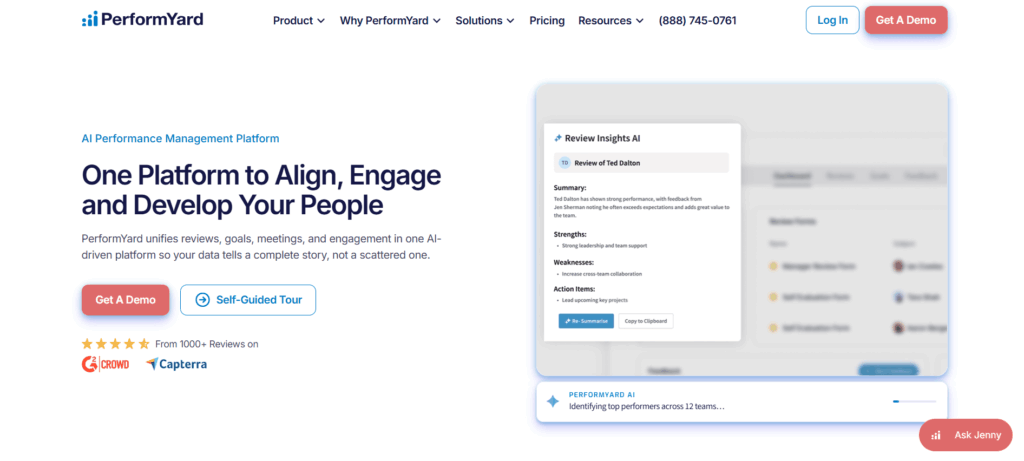
This highlights the difference between leading through effort and leading through empowerment.

Time Management

Positive:
“You meet deadlines consistently and your predictable work rhythm helps others plan their tasks with confidence.”

Constructive:
“Consider reserving focused time blocks for your highest priority work. This will reduce last-minute workload spikes and help you maintain steady progress throughout the week.”

Time management feedback works best when paired with practical strategies rather than generic advice.

Quality of Work

Positive:
“The deliverables you produced this quarter were thorough and well-structured. Your attention to detail helped avoid rework.”

Constructive:
“Before submitting final drafts, build in a short review step to catch small errors and formatting issues. This will help reduce revisions and showcase your best work the first time.”

Do’s and Don’ts of Giving Constructive Feedback

Do use clear and specific language

Avoid vague or general statements. When you say something like “improve quality,” employees are left guessing what to change. Instead, describe the exact behavior and its impact. For example, “The weekly reports missed key risk updates, which slowed our decision-making. Let us include a brief risk summary moving forward.” Specificity builds clarity and reduces confusion.

Do provide timely feedback

The longer you wait, the less relevant the feedback feels. Employees often forget context and the value of the insight is lost. Research shows employees want more frequent guidance, not just once a year. Use regular check-ins to address issues early and keep development continuous.

Do follow up and support progress

Feedback without follow-up can feel like criticism rather than coaching. After sharing improvement areas, check in on progress, offer resources, and coach as needed. Consistency builds trust and reinforces accountability.

Do focus on actions and outcomes

People respond better when you focus on what they did, not who they are. Replace statements like “You are disorganized” with “The project files were submitted without the updated specs which created rework.” Action-based feedback keeps conversations objective and respectful.

Don’t rely on personality labels

Labels make employees defensive and shift attention away from the real issue. Keep conversations centered on behavior and results.

Don’t wait until the annual review

Performance reviews are not meant to surprise anyone. Delaying feedback limits improvement and increases frustration. Continuous feedback strengthens performance throughout the year.

Don’t give feedback without a clear next step

Employees should leave the conversation knowing exactly what to improve and how success will be measured. Lack of guidance leaves the feedback incomplete.

Conclusion

Constructive feedback on performance reviews works best when it is part of a continuous cycle rather than a once-a-year event. When feedback is thoughtful, specific, and tied to outcomes, it strengthens performance, builds clarity, and deepens engagement.

Research consistently shows that organizations that prioritize meaningful feedback significantly outperform those that do not. This is because employees understand what success looks like and how to achieve it, which turns performance conversations into opportunities for growth rather than moments of stress.

To build this kind of culture, embed regular check-ins, real examples, and actionable goals into every development discussion. Equip managers with tools that make feedback easier to give and easier for employees to act on. When insights from reviews translate into real behavior change, the entire talent ecosystem becomes stronger.

Platforms like Engagedly help managers deliver structured, multi-perspective feedback through its 360 Feedback and multi-rater module. The platform’s Agentic AI capabilities transform feedback from static comments into intelligent nudges and follow-up actions that drive continuous improvement. You can explore how this works here:https://engagedly.com/product/360-feedback-multi-rater/

When feedback becomes continuous and actionable, performance reviews evolve into a true growth engine for individuals and the organization.

FAQ Section

What is constructive feedback on a performance review?
Constructive feedback is clear, specific, and focused on improvement. Instead of vague judgments, it highlights what an employee can do differently, why it matters, and how to move forward. It aims to support growth and strengthen future performance rather than criticize past actions.

How often should feedback be given?
Feedback should not be limited to annual reviews. Research shows that meaningful conversations held weekly or bi weekly lead to far better engagement and performance outcomes. Regular check ins help employees course correct quickly and feel more supported in their roles.

What is the difference between positive and constructive feedback?
Positive feedback reinforces strengths and recognizes successful behaviors. Constructive feedback focuses on improvement with clear next steps. Both are essential because employees need to know what to keep doing well and what to adjust for better results.

Can feedback improve performance and engagement?
Absolutely. Employees who receive consistent, meaningful feedback show significantly higher engagement, productivity, and overall performance. When feedback is ongoing and actionable, it becomes one of the strongest drivers of individual and organizational success.

Engagement Surveys: The Actionable Guide to Reducing Turnover

Employee turnover dropped by 31% in organizations with high employee engagement. That single statistic should make every HR leader sit up and pay attention.

Yet despite the clear connection between engagement and retention, only 23% of employees globally report feeling engaged at work. The gap between knowing engagement matters and actually improving it is costing companies billions in turnover costs.

Here’s the reality: replacing an employee costs 1.5 to 2 times their annual salary. For a company with 100 employees earning an average of $60,000, just 10% annual turnover translates to $900,000 in replacement costs. Every. Single. Year.

Engagement surveys aren’t just another HR checkbox. They’re your early warning system for turnover, your roadmap for retention, and your direct line to understanding what actually keeps employees from walking out the door.

This guide will show you exactly how to use engagement surveys to reduce turnover in your organization, with specific tactics you can implement starting today.

Why Engagement Surveys Are Your Best Defense Against Turnover

Think of engagement surveys as your organization’s health monitoring system. Just as regular medical checkups catch problems before they become emergencies, engagement surveys identify retention risks months before employees submit their resignation. This insight depends heavily on asking the right employee engagement survey questions.

The data backs this up. When employees answer “Do you intend to remain in your job for the next year?” there’s typically a 15 to 30 point difference in scores between those who ultimately leave and those who stay. That gap gives you a critical window to intervene.

Doug Conant, former CEO of Campbell’s Soup, put it perfectly: “To win in the marketplace you must first win in the workplace.” You can’t win in the workplace if your best talent keeps leaving.

Consider the actual costs of disengagement. Organizations with actively disengaged employees experience 43% higher turnover compared to highly engaged teams. Globally, disengagement drains $8.9 trillion from the economy annually. That’s nearly a tenth of worldwide GDP.

But here’s what makes engagement surveys powerful: they don’t just measure problems. They pinpoint exactly where to focus your retention efforts.

The Engagement-Turnover Connection You Need to Understand

Not all engaged employees are created equal, and understanding the spectrum makes all the difference in your retention strategy.

Highly Engaged Employees represent only 22% of the workforce, according to recent data. These are your retention success stories. They score 8-10 on engagement surveys, are 22% more likely to say they won’t job hunt, and demonstrate consistent participation in company initiatives. They’re not just satisfied; they’re emotionally invested in your organization’s success.

Moderately Engaged Employees make up the largest group at 46%. This is your vulnerable middle. These employees could tip either toward full engagement or toward the exit door depending on their next few experiences. They meet expectations but lack full emotional investment. A bad manager, a missed promotion, or poor work-life balance could push them into active job searching.

Disengaged Employees account for 32% of workers. This group is already halfway out the door. In fact, 69% of disengaged employees would leave for just a 5% pay increase. One disengaged employee costs an organization $2,246 per year in lost productivity alone, not counting the replacement costs when they eventually leave.

The key insight? Your engagement surveys help you identify which group each employee falls into before it’s too late to act.

The Questions That Actually Predict Turnover

Most engagement surveys fail because they ask generic questions that don’t directly connect to retention. If you want to reduce turnover, you need questions that reveal flight risks.

Start with the direct intention questions. These are your most powerful predictors:

“Do you see yourself working at this company in two years?” A score at or below 50% strongly indicates turnover risk. Research shows this question has the clearest correlation with actual departure rates.

“How likely are you to recommend this company as a great place to work?” This Net Promoter Score style question benchmarks between 54-60% typically. Anything above 65% indicates strong retention potential, while below 50% signals danger.

But intention alone doesn’t tell you why employees might leave. That’s where diagnostic questions come in:

“Do you feel valued for your contributions?” Nearly one-third of employees report feeling undervalued. This single factor now outranks even compensation as an engagement driver. When 63% of employees cite lack of career advancement as a reason for leaving, questions about growth become critical.

Ask: “Do you have clear opportunities for career advancement?” and “Does your manager actively support your professional development?” Only 1 in 4 employees feels confident in their career trajectory. That’s a massive retention gap you can address.

Work-life balance questions reveal another common turnover trigger. “Can you maintain a healthy work-life balance in your current role?” should be non-negotiable in your survey. Burnout is a turnover accelerator, and employees who can’t disconnect from work are already scanning job boards.

Recognition matters more than most leaders realize. 37% of employees say meaningful recognition from managers is the most important factor in their engagement. Ask: “Do you receive meaningful recognition for your work?” Gender gaps exist here too, with only 50% of women reporting meaningful recognition compared to 57% of men.

The manager relationship is crucial. Gallup research shows that 70% of team engagement variance is attributable to the manager. Include: “Does your immediate supervisor create an environment of trust and openness?” and “Is your supervisor a good leader?”

Here’s a pro tip: always include open-ended questions like “What would make you more likely to stay with this organization long-term?” The unfiltered responses often reveal retention issues your closed-ended questions miss entirely.

How to Analyze Survey Results for Turnover Risk

Collecting survey data is only half the battle. The real value comes from knowing how to read the warning signs.

Compare stayers versus leavers.

Six to 12 months after your engagement survey, compare responses from employees who left with those who stayed. This retrospective analysis reveals which survey answers actually predicted turnover. Often, you’ll discover that questions you thought were critical had no correlation with departures, while others you overlooked were flashing red warning lights.

Segment your data strategically.

Don’t just look at company-wide averages. They hide crucial details. Segment by:

  • Department (is your sales team hemorrhaging talent while engineering is stable?)
  • Manager (is one supervisor driving all your turnover?)
  • Tenure (are you losing people in their first year or after five years?)
  • Demographics (are women leaving at higher rates than men?)

A company might have an overall engagement score of 65%, which seems decent. But when you segment, you discover that your under-35 managers have engagement scores of 40%, explaining your leadership pipeline problem.

Identify score patterns, not just averages.

Look for dramatic differences in specific questions across groups. A 20-point gap in “I feel valued” scores between departments tells you exactly where to focus retention efforts.

Track trends over time.

Single survey snapshots have limited value. Quarterly pulse surveys or annual comprehensive surveys tracked year-over-year reveal whether your retention initiatives are working. If “intent to stay” scores dropped from 70% to 55% over six months, you have a retention crisis brewing regardless of what your turnover numbers currently show.

Pay attention to voluntary versus involuntary turnover.

Engagement surveys predict voluntary turnover, when employees choose to leave. Separate this from involuntary turnover (terminations, layoffs) in your analysis. The drivers are completely different.

Use statistical analysis for larger organizations.

If you have enough data, run correlation analysis between engagement scores and actual turnover. This scientifically validates which factors matter most in your specific organization. What drives retention at a tech startup might differ from what matters at a healthcare organization.

Five Immediate Actions to Reduce Turnover Based on Survey Results

You’ve run your engagement survey. You’ve analyzed the results. Now what? Here are five high-impact actions that directly reduce turnover.

Action 1: Address Manager-Specific Issues Within 30 Days

When survey data reveals that one manager’s team has significantly lower engagement scores, you have roughly 90 days before turnover accelerates. Manager engagement fell from 30% to 27% in 2024, with female managers experiencing a seven-point drop. If managers are disengaged, their teams follow.

Create an immediate improvement plan. This isn’t punitive; it’s supportive intervention. Provide coaching on the specific issues revealed (typically around communication, recognition, or development). Consider reassigning high-risk employees if the manager can’t quickly improve. As Christian Gomez from ADP notes, newly promoted managers are particularly vulnerable and require targeted support in their first year.

Action 2: Implement Recognition Programs Within 60 Days

If survey results show employees don’t feel valued, recognition programs deliver quick wins. Organizations implementing employee recognition programs experience 31% lower voluntary turnover. That’s immediate ROI.

The key is meaningful recognition, not generic “employee of the month” plaques. Research shows employees who receive recognition are 45% less likely to leave within two years. Create systems where managers can provide specific, timely recognition for actual contributions. Make it visible to peers and leadership.

Action 3: Create Clear Career Paths Within 90 Days

When 63% of employees cite lack of career advancement as a reason for leaving, career development isn’t optional. Here’s the brutal truth: 94% of employees report they would stay longer if their company invested in career development.

For high-performing employees showing retention risk in your survey, create individualized development plans immediately. These should include:

  • Specific skills they’ll develop in the next 6-12 months
  • Timeline for advancement opportunities
  • Mentorship or stretch project assignments
  • Regular check-ins on progress

For broader impact, map out visible career ladders in your organization. Employees need to see where they can go, not just where they are.

Action 4: Fix Work-Life Balance Issues Immediately

If survey responses reveal work-life balance problems, this demands urgent action. Burned-out employees don’t stick around. They find employers who respect their time.

Analyze workload distribution. Are certain teams or individuals consistently overwhelmed? Redistribute work, hire additional support, or eliminate low-value tasks. Consider flexibility options: remote work, flexible hours, or compressed work weeks. The Conference Board found workplace flexibility ranks as the second most important retention factor after competitive salary.

Action 5: Close the Feedback Loop Within Two Weeks

Here’s where most organizations fail with engagement surveys: they collect feedback and then… silence. Employees who took time to share honest input hear nothing back. Trust evaporates. Future survey participation drops.

Share results transparently within two weeks of survey completion. Explain what you learned, acknowledge problems honestly, and commit to specific actions with timelines. Then follow through. As one expert noted, “You have to earn the right to solicit input by showing employees it’s valued.”

Three months later, communicate progress on commitments. Nothing builds trust faster than demonstrating that employee feedback drives real change.

Building a Survey Strategy That Prevents Turnover

One-off surveys won’t reduce turnover. You need a systematic approach that catches problems before they become resignations.

Annual Comprehensive Surveys: Conduct thorough engagement surveys once per year covering all aspects of employee experience. These establish baselines and track year-over-year trends. Best practice timing is mid-year or after annual reviews, avoiding busy seasons.

Quarterly Pulse Surveys: Between comprehensive surveys, run short 5-10 question pulse surveys quarterly. These track whether your retention initiatives are working. Pulse surveys should focus on a few key metrics: intent to stay, feeling valued, manager effectiveness.

Onboarding Check-Ins: Survey new employees at 30, 60, and 90 days. First-year turnover is expensive and often preventable. These early surveys catch cultural fit issues, training gaps, or manager problems while there’s still time to intervene.

High-Risk Group Surveys: When you identify departments or demographics with concerning engagement scores, conduct targeted follow-up surveys. Dig deeper into their specific challenges with additional questions and focus groups.

Exit Survey Connection: Link exit survey responses to your engagement survey data. Employees who left should have shown warning signs in their last engagement survey. If they didn’t, you’re asking the wrong questions.

Kevin Kruse, leadership expert, describes it well: “Employee engagement is the emotional commitment the employee has to the organization and its goals.” You can’t build that emotional commitment without consistently listening and acting.

Real-World Example: How One Company Cut Turnover by 40%

A mid-sized healthcare company faced 28% annual turnover in their nursing staff, costing them approximately $4.2 million annually. Their engagement survey revealed three critical insights:

First, nurses felt undervalued despite working demanding shifts. Recognition scores averaged just 42%.

Second, career advancement opportunities were unclear. Only 31% of nurses saw a path forward in the organization.

Third, work-life balance scores were critically low at 38%, driven by unpredictable scheduling and mandatory overtime.

Here’s what they did:

They implemented peer-to-peer recognition programs where nurses could acknowledge each other’s contributions. Recognition mentions were shared in weekly team meetings. Within three months, recognition scores jumped to 68%.

They created a visible career ladder with four nursing advancement levels, each with defined requirements and salary increases. They launched a mentorship program pairing experienced nurses with those seeking advancement. Career path clarity scores rose from 31% to 59% within six months.

They revamped scheduling to give nurses more control, implemented a no-mandatory-overtime policy except emergencies, and hired additional float nurses to reduce burnout. Work-life balance scores improved to 61%.

The result? Turnover dropped from 28% to 17% within 18 months, saving the organization $2.3 million annually. Their engagement survey scores became the roadmap for these specific interventions.

Common Mistakes That Undermine Survey Effectiveness

Even well-intentioned engagement survey programs fail when organizations make these critical errors:

Mistake 1: Survey Fatigue Through Over-Surveying Running monthly surveys exhausts employees. They stop providing thoughtful feedback. Limit yourself to one comprehensive annual survey plus quarterly pulse surveys. Quality matters more than frequency.

Mistake 2: Asking Questions You Can’t or Won’t Act On Don’t ask about compensation if you have zero budget for raises. Don’t inquire about remote work if you’re committed to office-only. Every question raises expectations. Ask only what you’re prepared to address.

Mistake 3: Ignoring Anonymity Concerns If employees don’t trust that surveys are truly anonymous, they won’t be honest. Small team surveys where responses can be easily identified kill candor. For teams under 10 people, use focus groups instead or aggregate data at higher organizational levels.

Mistake 4: Failing to Benchmark Your 65% engagement score means nothing without context. Are you better or worse than industry peers? Better than last year? Without benchmarks, you’re flying blind.

Mistake 5: Analysis Paralysis Some organizations spend months analyzing survey data while retention problems worsen. Pick your top three issues and act quickly. Perfection is the enemy of progress.

As Simon Sinek wisely said: “When people are emotionally invested, they want to contribute.” Your engagement survey is how you discover what prevents that emotional investment.

Making Engagement Surveys Part of Your Retention Strategy

Engagement surveys reduce turnover when they’re treated as strategic business tools, not HR paperwork. The organizations seeing 31% lower turnover from high engagement don’t just measure engagement; they act on it relentlessly.

Start with your next survey cycle. Focus your questions on the factors that actually predict turnover: intent to stay, feeling valued, career growth, work-life balance, and manager effectiveness. Analyze results for high-risk segments. Take immediate action on the top three issues. Close the feedback loop transparently.

Your employees are telling you exactly what will make them stay or drive them to leave. The question is whether you’re listening and whether you’re willing to act on what you hear.

Remember Jack Welch’s insight: “No company, small or large, can win over the long run without energized employees who believe in the mission and understand how to achieve it.”

Engagement surveys give you the data. Reducing turnover requires you to use it.

Ready to transform your approach to employee engagement? Engagedly’s platform helps organizations measure, analyze, and improve engagement systematically. Because retention starts with listening.

Provide Feedback: The 4 Steps to Better Performance and Growth

Every company struggles with the same invisible problem: people are working hard, but they’re not sure if they’re working in the right direction.

Managers assume employees know how they’re doing. Employees assume silence means either approval or trouble. And in that gap, motivation quietly drops.

Here’s the reality.
80% of employees who receive meaningful feedback in a given week are fully engaged at work. Yet only 23% say they actually receive that kind of feedback.

That gap costs organizations in lost productivity, stalled growth, and talented people who leave because they feel unseen.

As Bill Gates put it, “We all need people who will give us feedback. That’s how we improve.” Most companies agree with this in theory. In practice, feedback gets delayed, watered down, or saved for performance reviews, where it feels more like judgment than guidance.

Feedback isn’t failing because it doesn’t work. It’s failing because of how it’s delivered.

This guide breaks feedback down into four practical steps that work in real teams. No jargon. No complicated models. Just clear, actionable ways to turn feedback into a driver of performance, trust, and growth.

Why Most Feedback Fails

Most organizations still rely on a broken feedback model. Managers wait for performance reviews, collect months of observations, deliver everything at once, and hope people improve. That works about as well as watering a plant once a year.

Because feedback is delayed, it loses relevance. By the time reviews happen, employees barely remember the situations being discussed. Instead of guidance for what to do next, feedback feels like a judgment of the past.

The impact is real. Employees who receive daily feedback are 3.6 times more likely to feel motivated to do outstanding work than those who receive annual feedback. That gap alone explains why so many feedback systems underperform.

There’s also a psychological cost. Research shows social evaluation triggers the same neural pathways as physical pain. When feedback is rare and high stakes, people become defensive instead of receptive.

Clarity makes things worse. Vague comments like “communicate better” give no direction. Without specific examples and next steps, feedback becomes noise. Nearly half of employees fail to act on feedback simply because they don’t know what to do with it.

The disconnect is striking. Only one in five employees receives weekly feedback, even though many managers believe they give it often.

Feedback isn’t the problem. The way we deliver it is.

Step 1: Create the Right Foundation

Effective feedback doesn’t start with the feedback itself. It starts with building an environment where feedback becomes normal, expected, and valued.

Ed Batista, executive coach and Harvard Business Review contributor, nails this concept: “Make feedback normal. Not a performance review.”

When feedback only happens during formal evaluations, it carries enormous weight and triggers defensive reactions. When it’s woven into daily interactions, it becomes just another tool for getting better at what we do.

Start by establishing psychological safety. This fancy term simply means people feel safe speaking up, asking questions, and admitting mistakes without fear of punishment or embarrassment. Without this foundation, feedback will always feel threatening, regardless of how you deliver it.

How do you build this?

Model vulnerability as a leader. Share your own mistakes and what you learned from them. When someone admits an error, thank them for their transparency rather than punishing them. Separate problem-solving from blame-assigning.

Set expectations early and clearly. During onboarding or when starting a new project, have explicit conversations about how feedback will work in your team. Explain that feedback flows in all directions, that it’s frequent rather than rare, and that its purpose is growth rather than judgment.
Use the conversation approach Ken Blanchard advocates. His famous quote, “Feedback is the breakfast of champions,” captures the idea that feedback should nourish performance the way breakfast fuels your body. It’s not a special occasion meal but a regular necessity.

Regular check-ins matter more than you might think. 72% of employees believe one-on-one time with their direct manager is the most critical point in their onboarding journey. These regular touchpoints normalize feedback conversations and prevent the buildup of issues that explode during annual reviews.

Ask for feedback yourself. Nothing signals that feedback is safe like actively requesting it from your team. Try this in your next meeting: “What’s one thing I could do differently to better support this project?”
When leaders actively seek input, it demonstrates that feedback isn’t about hierarchy but about collective improvement.

Track feedback frequency as a team metric. If you’re serious about creating a feedback culture, measure it. Are managers having weekly conversations with their reports? Are team members giving each other peer feedback? What gets measured gets managed.

The goal is simple: by the time you need to provide difficult feedback, it should feel like a natural extension of ongoing conversations rather than an uncomfortable exception.

Step 2: Time It Right

Here’s a truth that will save you countless feedback failures: when you provide feedback matters almost as much as how you say.

One-third of employees wait more than three months to receive feedback from their managers. By the time that feedback arrives, the moment has passed. The project is done. The behavior has become ingrained. The opportunity for real-time course correction is gone.

Elon Musk’s approach to feedback emphasizes continuous loops: “I think it’s very important to have a feedback loop, where you’re constantly thinking about what you’ve done and how you could be doing it better.” This isn’t about constant criticism but about making reflection and adjustment part of your regular rhythm.
The research backs this up. Effective feedback has an expiration date. People remember recent experiences far better than distant ones, so feedback delivered immediately after an action is exponentially more valuable than feedback delivered weeks later.
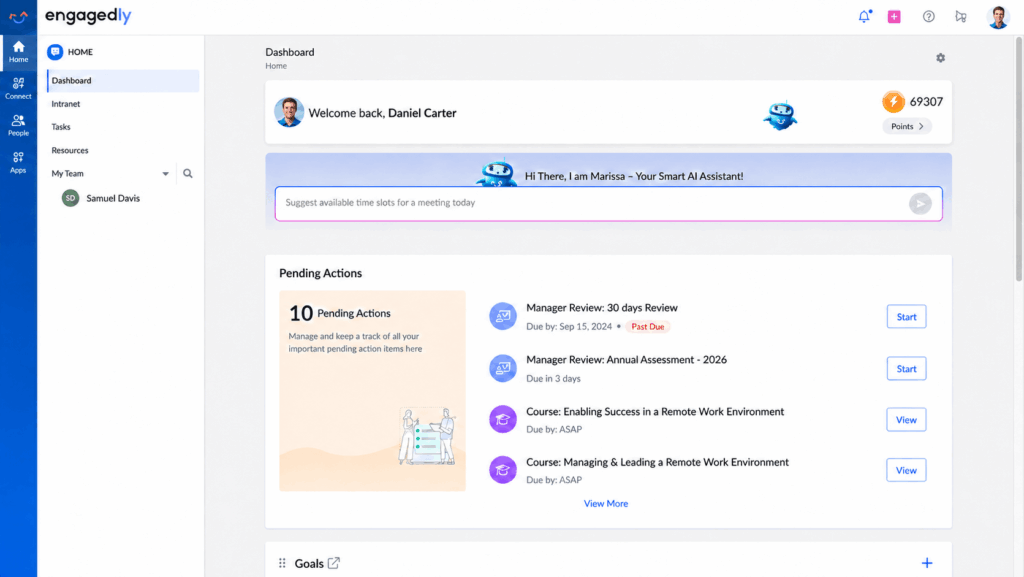
Best-in-class managers deliver feedback within 24-48 hours of an event. See someone handle a client situation brilliantly? Tell them that afternoon. Notice a team member struggling with time management on a project? Address it during your next scheduled one-on-one rather than waiting for quarterly reviews.

But timing isn’t just about speed. It’s also about context. Don’t ambush people with feedback when they’re stressed, rushing to a deadline, or dealing with personal difficulties. Even well-intentioned feedback lands poorly when someone’s bandwidth is maxed out.

For constructive feedback, schedule a specific time. “Do you have 15 minutes tomorrow to discuss the presentation?” gives people time to prepare mentally and prevents the anxiety of unexpected critical conversations.

For positive feedback, deliver it immediately and, when appropriate, publicly. 69% of employees say if they felt appreciated, they would work harder. Recognition has maximum impact when it’s timely and visible to others.

Here’s a practical framework: provide feedback for most jobs a few times per week. Not every single day, which would be overwhelming, but frequently enough that it becomes routine. For significant wins or concerning patterns, don’t wait for the next scheduled conversation.

Consider the momentum factor too. Feedback delivered when a project is still ongoing allows for real adjustments. Feedback delivered after everything is complete becomes historical analysis rather than practical guidance.

63% of Gen Z employees prefer timely feedback that’s constructive and consistent throughout the year. Younger workers, especially, have grown up with instant feedback loops in gaming, social media, and education. They expect and thrive on rapid, regular input.

The timing principle is straightforward: feedback should arrive when it’s most useful, which is almost always sooner than you think.

Step 3: Deliver with Clarity and Empathy

Now we get to the moment itself: how you actually provide feedback in a way that lands effectively.

Start with the mindset that Dave Ulrich, renowned HR thought leader, describes: “Good performance accountability is about having a positive conversation between manager and employee. A manager is a coach and communicator, not a command and controller.”

Your role isn’t to judge or command. It’s to help someone become better at their work. This shift in perspective changes everything about how you show up in feedback conversations.

Lead with observation, not judgment. Instead of “You’re not detail-oriented enough,” try “I noticed the client report had three calculation errors that we had to correct before sending.” The first attack character. The second states facts that can be discussed.

Be specific with examples. Vague feedback like “Great presentation!” feels nice but teaches nothing. “The way you anticipated the client’s budget concerns by including three pricing tiers really demonstrated strategic thinking”, tells someone exactly what worked and why.

Research from Teresa Amabile and Steven Kramer shows that a sense of progress is the most powerful workplace motivator, even stronger than recognition or pay. Your feedback should help people see their progress clearly by highlighting specific improvements or areas for growth.

Use the SBI model: Situation, Behavior, Impact. This simple framework keeps feedback grounded in reality.

Situation: “In yesterday’s team meeting…” Behavior: “…when you interrupted Sarah three times while she was explaining the technical approach…” Impact: “…it shut down the conversation and we didn’t hear her full recommendation.”

This approach focuses on specific behaviors people can change rather than personality traits they can’t.

Balance positive and constructive feedback. High-performing teams share nearly six times more positive feedback than average teams, while low-performing teams share nearly twice as much negative feedback as average teams. Recognition isn’t fluffy feel-good stuff. It’s a strategic driver of performance.

Doc Rivers, legendary NBA coach, captures an important truth: “Average players want to be left alone. Good players want to be coached. Great players want to be told the truth.”

Your best people can handle direct feedback. What they can’t handle is vagueness or sugarcoating that prevents them from improving.

Deliver feedback privately for constructive criticism, publicly for recognition. Basic principle, but violated constantly. Never embarrass someone by criticizing them in front of peers. Always amplify wins where others can see them.

Ask questions and listen. Feedback shouldn’t be a monologue. “What’s your perspective on how the project went?” opens dialogue. People often recognize their own areas for improvement when given space to reflect.

Focus on the future, not just the past. Instead of dwelling on what went wrong, shift to “Here’s what I suggest trying next time” or “What would you do differently if you faced this situation again?”

Be clear about what needs to change. If something is critical, say so directly. “This pattern needs to change” is clearer and kinder than hoping someone reads between the lines.

Peter Drucker, management guru, reminds us: “The leader of the past knew how to tell. The leader of the future will know how to ask.” Great feedback conversations involve asking as much as telling.

End every feedback conversation with clear next steps.

What will the person do differently?

What support do they need?

When will you check in again?

Without this clarity, even great feedback fizzles into nothing.

Step 4: Follow Through and Create Accountability

This is where feedback usually breaks down. Someone hears it, agrees with it, and then nothing changes because there’s no follow-through.

Fast feedback drives engagement. In fact, 84% of employees who receive it say they’re engaged. But one conversation isn’t enough. Feedback only works when it’s reinforced with clear actions and accountability.

Start by turning feedback into specific commitments. “Communicate better” is vague. “Send a status update every Friday by 3 PM” leaves no room for confusion.

Lock in follow-ups. A simple “Let’s review this in two weeks during our one-on-one” signals that the feedback matters and won’t be forgotten. It also prevents the cycle of repeating the same feedback months later.

When improvement happens, make it visible. Publicly acknowledging progress in meetings or updates reinforces the behavior and shows that acting on feedback leads to recognition.

Support matters as much as direction. If time management is the issue, share tools or training. If communication needs work, recommend a book or a strong peer to learn from. Feedback without support feels like criticism.

Keep a record of what was discussed and agreed upon. Not to build a case against someone, but to track progress and avoid ambiguity. Clear documentation keeps feedback fair and focused.

Adapt to the individual. Some people want frequent check-ins, others prefer weekly or milestone-based feedback. Ask what works for them and adjust.

Open up feedback beyond managers. Many employees value input from peers and customers but rarely get it. Structured peer feedback fills that gap and creates a fuller picture.

Finally, treat feedback as a loop, not a one-time event. Feedback leads to action. Action leads to results. Results shape the next conversation. That cycle, repeated consistently, is what drives real improvement.

Common Mistakes That Undermine Feedback

Even with the best intentions, certain patterns sabotage feedback effectiveness. Avoid these common traps.

Common MistakeWhy It Undermines FeedbackWhat to Do Instead
The sandwich approachFeels manipulative. People wait for the “but” and discount the praise as fake.Be direct and genuine. Say what’s working and what’s not without wrapping one inside the other.
Focusing on personality, not behaviorAttacks identity and triggers defensiveness instead of change.Point to observable actions and outcomes that can be improved.
Giving feedback only when something’s wrongTrains people to associate feedback with criticism.Balance corrective feedback with recognition and reinforcement.
Overloading people with too much feedbackNo one can act on twenty issues at once. It leads to inaction.Focus on two or three high-impact areas at a time.
Not checking for understandingYour message may be misunderstood or partially absorbed.Ask what they’re taking away from the conversation.
Avoiding difficult conversationsSilence signals disinterest and pushes people to disengage or leave.Address issues early, clearly, and with empathy.
Comparing people to othersCreates resentment and damages trust and motivation.Focus on individual growth and progress, not peer comparisons.
Neglecting positive feedbackPeople feel unappreciated and disengage over time.Make recognition a regular part of feedback conversations.

The Real Impact of Better Feedback

When organizations get feedback right, the results show up everywhere.

Start with engagement and retention.
Only 22% of employees who don’t receive feedback stay engaged. Meanwhile, 58% either disengage or begin looking for a new job. Feedback isn’t a nice-to-have. It’s often the deciding factor between staying and leaving.

Then look at business outcomes.
Organizations that provide consistent feedback report 21% higher profitability than those that don’t. This isn’t about morale alone. Feedback directly influences performance, decision-making, and results.

Recognition plays a big role here.
69% of employees say they would work harder if they felt appreciated. Feedback is one of the most powerful and immediate ways to create that sense of appreciation and it shows up in effort and output.

But there’s a gap.
Only about one in three employees believes the feedback they receive is actually helpful. The problem isn’t feedback itself. It’s how it’s delivered. Most managers were never taught how to give feedback that’s clear, timely, and actionable.

Now consider the multiplier effect.
Companies that make feedback a regular habit see 39% higher effectiveness in attracting talent and 44% better retention. When employees talk about growth, coaching, and real conversations, recruiting gets easier and people stay longer.

Finally, culture changes.
When feedback becomes normal instead of stressful, when it flows both ways, and when it focuses on growth rather than judgment, trust increases. People take smarter risks, collaborate more openly, and innovate faster because they know feedback is there to help, not punish.

Make Feedback Your Competitive Advantage

The companies winning on talent aren’t paying more.

They’re helping people grow faster through better feedback.

Start now.
Hold regular one-on-ones.
Give specific positive feedback today.
Ask for feedback yourself.
Have the conversation you’ve been avoiding.

Feedback isn’t an event. It’s daily fuel for performance.

Your employees want it. Many are craving it.
The question isn’t whether to give feedback. It’s whether you’ll do it well.

That’s how average teams become great ones.

1:1 Meeting Format: 5 Essential Rules for Managers and Employees

One truth that might sting: only 15% of employees who work for a manager who does not meet with them regularly are engaged. That’s it. One in seven.

Now flip that statistic. When managers hold regular one-on-one meetings, employee engagement nearly triples. We’re talking about the difference between a disengaged team that’s counting the hours and an energized workforce that drives real business results.

If you’ve been treating your 1:1s as optional calendar events or status update sessions, you’re leaving serious performance on the table. This isn’t about adding another meeting to your schedule. It’s about mastering the single most powerful management tool at your disposal.

What Makes the 1 on 1 Format Different From Every Other Meeting

Before we get into the rules that separate exceptional 1:1s from the forgettable ones, let’s clear up a common misconception. Your one-on-one meetings shouldn’t look or feel like team meetings with fewer people.

Think about your typical team meeting. The agenda focuses on projects, deadlines, and deliverables. Everyone’s there to report progress and align on next steps. The manager usually drives the conversation. Sound familiar?

Now consider what a proper 1-on-1 format should be: a dedicated space for your employee to discuss what matters to them. Their challenges. Their growth. Their concerns. Their wins. This meeting belongs to them, not you.

Kim Scott, author of Radical Candor and Radical Respect, calls 1:1 meetings “the most important thing you do as a manager”. She’s not exaggerating. These conversations build the trust and psychological safety that make everything else in your management toolkit actually work.

The research backs this up in dramatic fashion. When done well, regular one-on-one meetings deliver results that seem almost too good to be true:

  • 432% increase in the odds that an employee has a strong sense of leadership
  • Boost engagement by 300% and increase team productivity by 18%
  • Regular 1:1 meetings boost employee retention and lower voluntary exits by almost 33%
  • Engagement improved by 57% when team leaders checked in with team members frequently

That last one came from research by The Marcus Buckingham Company across thousands of employees. These aren’t marginal improvements. They’re game-changing numbers.

Rule #1: Never Cancel (And Pick a Real Cadence)

Let’s start with the hardest rule to follow and the easiest one to break: consistency.

When you cancel a 1:1 meeting, you’re not just rescheduling 30 minutes. You’re sending a clear message about priorities. And your employee hears it loud and clear: other things matter more than our relationship.

The sweet spot of 1:1 meeting frequency is to meet every week or two for 30 to 60 minutes. That recommendation comes from Google re: Work and numerous management experts who’ve studied what actually works.

But here’s what matters more than the exact frequency: you need to pick a cadence and stick to it religiously.

Weekly works best for:

  • New team members in their first 90 days
  • Employees navigating challenging projects or transitions
  • High performers you’re actively developing for bigger roles
  • Remote workers who lack casual face time

Bi-weekly makes sense for:

  • Experienced team members who operate independently
  • Managers with larger teams (more than five direct reports)
  • Situations where you already have frequent informal touchpoints

Monthly should be the exception, not the standard. Too much happens in four weeks. Problems compound. Frustrations build. Opportunities get missed.

Whatever frequency you choose, treat these meetings as sacred. They’re not optional when things get busy. They’re even more critical when things get busy.

If you absolutely must reschedule (emergencies happen), do it proactively. Don’t wait until the last minute. Don’t let them find out when you skip the meeting. Propose a new time immediately.

Rule #2: Structure Around the 10/10/10 Framework

Here’s where most managers go wrong: they wing it. They show up with vague intentions and hope a productive conversation just happens.

It doesn’t.

You need structure, but the right kind of structure. Not a rigid agenda that kills spontaneity, but a framework that ensures you cover what matters.

A good one is: ten minutes for them, ten minutes for you, ten minutes to talk about the future. This comes from Manager Tools, and it’s been battle-tested across thousands of organizations.

First 10 Minutes: Their Agenda

This is sacred time. Your employee leads. You listen.

They might want to discuss:

  • A challenge they’re wrestling with
  • Feedback they need on an approach
  • A team dynamic that’s bothering them
  • Something personal that’s affecting their work
  • An idea they’ve been thinking about

Your job here is not to solve, fix, or immediately respond. Your job is to understand. Ask clarifying questions. Take notes. Show genuine curiosity about what they’re experiencing.

Powerful opening questions that work:

  • “What’s been on your mind this week?”
  • “What’s the most important thing we should talk about today?”
  • “Where are you stuck right now?”
  • “What would make this week a win for you?”

Notice what these questions don’t do. They don’t ask for a status report. They don’t drill into project updates. They open space for what really matters to your employee.

Second 10 Minutes: Your Agenda

Now it’s your turn. But stay strategic about what you bring to this time.

This is when you:

  • Share feedback on recent work (both positive and constructive)
  • Provide context about company changes or team direction
  • Remove blockers you’ve noticed
  • Offer guidance on skills they’re developing
  • Communicate important information they need

What this time is NOT for: status updates on projects. You should already know project status through other channels. Using 1:1 time for status updates is like using a Ferrari to deliver mail. Sure, it works, but you’re completely missing the point.

Final 10 Minutes: The Future Focus

This is the piece most managers skip, and it’s where the magic happens.

Spend this time on:

  • Career development: Where do they want to be in a year? Three years? What skills are they building toward that vision?
  • Goal progress: How are they tracking against their current objectives? What support do they need?
  • Long-term team dynamics: How can the team work better together? What’s improving? What’s not?

You won’t necessarily have deep career conversations every single week. That’s fine. Some weeks you’ll end the meeting early because the long-term picture hasn’t changed much. But having this time scheduled forces both of you to think bigger than the immediate urgency.

Rule #3: Make It Genuinely Two-Way

Here’s an uncomfortable truth: if you’re talking for 20 of the 30 minutes, you’re doing it wrong.

Employees who got little to no one-on-one time with their manager were more likely to be disengaged. Those who get twice the number of one on ones with their manager relative to their peers are 67% less likely to be disengaged.

But it’s not just about having the meeting. It’s about how you show up in it.

Active Listening Looks Like This:

Put away your laptop. Seriously. Close it. If you need to take notes, use a notebook or tell them you’re taking notes on your device and ask if that’s okay.

Make actual eye contact. Not the kind where you’re glancing at your screen every few seconds. Real, engaged eye contact that communicates, “You have my full attention.”

Ask follow-up questions. When they share something important, dig deeper:

  • “Tell me more about that.”
  • “How did that make you feel?”
  • “What would success look like to you?”
  • “What support would help most right now?”

Pause before responding. After they finish speaking, take a breath. Count to three. This does two things: it gives them space to add more, and it ensures you’re responding thoughtfully rather than reactively.

The Feedback Exchange

One-on-ones are where feedback should flow freely in both directions. Not just the annual review sanitized version. Real, timely, actionable feedback.

When giving feedback:

  • Be specific about what you observed
  • Connect it to impact (on them, the team, or the work)
  • Focus on behavior, not personality
  • Offer it close to the event (within days, not weeks)

When receiving feedback:

  • Don’t get defensive (harder than it sounds, I know)
  • Ask clarifying questions to really understand
  • Thank them for the courage it took to share
  • Follow up on what you heard in the next meeting

Research from LifeLabs Learning found that when managers actively seek feedback in 1:1s, autonomy boosts engagement. Employees who feel heard are employees who stay engaged.

Rule #4: Document Everything (But Keep It Simple)

If your one-on-one conversations disappear into the ether the moment you both leave the room, you’re losing about 70% of their value.

You need a record. Not for surveillance. Not for CYA. For continuity.

The Shared Running Document

A shared document (e.g. a Google Doc) that both parties have access to, and that contains both notes from previous 1:1s and a running agenda for the next one, is the gold standard.

Here’s what goes in it:

Before each meeting:

  • Agenda items from both of you (anyone can add items anytime)
  • Topics carried over from the last meeting
  • Questions or concerns that came up since you last talked

During the meeting:

  • Key discussion points
  • Decisions made
  • Action items with owners
  • Important context or insights

After the meeting:

  • Follow-up on previous action items
  • Progress on ongoing goals
  • Patterns you’re noticing over time

This documentation serves a critical purpose: it allows you to track patterns. When your employee mentions feeling overwhelmed three meetings in a row, that’s data. When they keep returning to the same career goal, that’s a signal you need to help them make progress.

The format matters less than the consistency. Google Docs, Notion, your performance management software, whatever. Just pick something both of you can access easily and will actually use.

What to Track Beyond Meetings

Smart managers supplement their 1:1 notes with:

  • Small wins are worth celebrating
  • Skills the employee is developing
  • Feedback from others about this person
  • Ideas they’ve shared that deserve follow-up
  • Personal details (they’re training for a marathon, their kid just started college, they’re learning Spanish)

That last category might seem trivial, but it’s not. Remembering that someone’s kid just graduated from college and asking about it shows you see them as a whole person, not just a productivity unit.

Rule #5: Focus on Growth, Not Just Performance

Here’s what separates good managers from great ones: great managers see 1:1 meetings as development conversations, not just check-ins.

Your employees aren’t just looking for a paycheck. Millennials are highly collaborative and want instant feedback. They want to meet, learn, and grow. This applies across all demographics, honestly, but it’s especially true for workers who have choices about where to work.

The CAMPS Framework for Development

LifeLabs Learning developed a framework that’s worth adopting. CAMPS stands for five fundamental needs that drive engagement:

Certainty: People want to feel secure and know what to expect

  • Regular, consistent 1:1s build this automatically
  • Take notes and follow up (shows you’re reliable)
  • Align on goals and priorities clearly

Autonomy: Employees need freedom in how they approach their work

  • Ask for their input on solutions, don’t just prescribe
  • Let them choose their approach when possible
  • Provide context, not just orders

Meaning: Connect their work to something bigger

  • Discuss how their role contributes to the team and company mission
  • Help them see the impact of what they’re building
  • Share customer feedback and business results

Progress: Recognition that they’re moving forward

  • Start meetings by acknowledging recent wins
  • Track development goals and celebrate growth
  • Point out improvements you’re noticing

Social Inclusion: The need for connection and belonging

  • Make time for genuine personal conversation
  • Help them build relationships across the organization
  • Check in on team dynamics

You don’t need to formally assess all five areas at every meeting. But having this framework in mind helps you ensure you’re addressing the full picture of what keeps your employees engaged and growing.

Career Conversations That Actually Help

Most career development discussions are too vague to be useful. “I want to grow” doesn’t give you much to work with.

Get specific:

  • “What does the next logical step in your career look like?”
  • “What skills do you want to develop this year?”
  • “Who in the organization has a role you’d eventually like to have?”
  • “What type of work energizes you? What drains you?”
  • “What would you want to be working on a year from now?”

Then, and this is the critical part, help them build a real development plan. Not a wish list. An actual plan with:

  • Specific skills to develop
  • Projects or stretch assignments that build those skills
  • Resources (training, mentors, books, courses)
  • Timeline for progress checkpoints
  • Your commitment to support them

Ritualize feedback, including skills-based feedback. Help create individual development plans (IDPs) and check in at each 1-1 to extract lessons and plan the next steps.

The ROI of Getting This Right

Let’s bring this back to business impact, because that’s what ultimately matters.

A 1% increase in the number of hours a CEO spent with his or her own people correlated to an increase in productivity of 2.12%. That finding comes from research published in the O.C. Tanner Global Culture Report.

Think about that. Every hour you invest in one-on-one meetings returns more than double in productivity gains. But only if you’re doing them right.

Getting them wrong has costs too:

  • 23% of employees look for a new job every single day, with most citing their manager as the reason
  • 75% of employees considered their direct boss to be “the worst part of their job” according to Hogan Assessments
  • 65% of respondents indicated they’d take a new boss over a pay raise

That last statistic should wake up every manager reading this. Your employees would literally trade money for a better relationship with you.

Making It Work With Engagedly

The principles we’ve covered are universal, but the right tools make them dramatically easier to implement consistently.

Engagedly’s performance management platform is purpose-built to support exactly this kind of continuous, development-focused management approach. When you integrate your 1:1 meeting practice with Engagedly, you get:

Structured flexibility: Pre-built templates for the 10/10/10 format (or customize your own) that keep conversations focused while allowing natural flow

Seamless documentation: Shared notes that connect directly to goals, feedback, and development plans, so nothing gets lost and patterns emerge automatically

Goal visibility: Real-time progress on OKRs and individual goals built right into your meeting interface, so development conversations are grounded in actual data

Feedback integration: Continuous feedback from peers, customers, and stakeholders surfaces in 1:1s, giving you a complete picture of how someone’s performing and growing

Action tracking: Automatic reminders and follow-ups on commitments made during meetings, so good intentions actually turn into progress

Analytics: Insights into 1:1 frequency, quality, and impact across your organization, helping leadership build a consistent coaching culture

The platform doesn’t replace the human element of effective one-on-ones. It amplifies it. You still need to show up present, curious, and committed to your employee’s growth. Engagedly just makes sure you have the structure, data, and tools to do that consistently and effectively.

Your Next Steps

Reading about effective 1:1s is different from actually running them. Here’s how to put this into practice:

This week:

  • Block recurring 1:1 time with each direct report
  • Set up a shared documentation system
  • Send each person a message explaining the format and asking what they want to discuss

In your next meeting:

  • Start with “What’s the most important thing we should talk about today?”
  • Try the 10/10/10 structure
  • Ask for feedback on how the format worked

Over the next month:

  • Never cancel. Seriously.
  • Track patterns in what people bring up
  • Start identifying one development goal per person to support actively

Within a quarter:

  • You should see more honest conversations
  • Employees should feel more heard and supported
  • Problems should surface earlier (which is good)
  • Your team’s engagement scores should start moving

The 1 on 1 format isn’t rocket science. But like most powerful management tools, it’s simple in concept and requires discipline in execution.

Your employees are either getting this vital support from you, or they’re looking for it somewhere else. Usually at another company.

Which outcome are you creating?

What’s a SMART Target? The Key to Driving Performance and Employee Engagement

If you have spent any time in a workplace, you have probably heard the term “SMART targets.” But most people use it without fully applying it.

A SMART target is a structured way to set goals so they are clear, measurable, and actionable.

A SMART target is a structured way to define goals so they are clear, trackable, and achievable.

Instead of setting vague goals like “improve performance” or “increase sales,” a SMART target answers five key questions:

  • What exactly needs to improve?
  • How will success be measured?
  • Is this realistically achievable?
  • Does it align with business priorities?
  • By when should it be completed?

This is what SMART stands for:

  • Specific – clearly defines the goal
  • Measurable – includes a metric to track progress
  • Achievable – realistic based on current capabilities
  • Relevant – aligned with broader objectives
  • Time-bound – tied to a clear deadline

In simple terms, a SMART target turns intention into execution.

Example:

Instead of:
Increase customer satisfaction

Write:
Increase customer satisfaction score from 70 to 80 within 6 months by improving response time and support quality

That level of clarity is what makes SMART targets effective.

Why Should You Care About SMART Targets?

Most goals fail for one reason: they are unclear.

When goals are vague:

  • Teams interpret them differently
  • Progress cannot be measured
  • Accountability disappears

SMART targets solve this by turning intent into execution.

They:

  • Create clarity across teams
  • Make progress visible
  • Improve accountability
  • Increase employee engagement

When people know exactly what is expected, performance improves. This becomes even more effective when applied to internal communication through well-defined SMART communication goals examples.

Now lets break down SMART in greater detail, shall we?

SMART Target Formula

S is for Specific

Have you ever played darts blindfolded? No fun, right? Indeed, this is how vague goals are experienced — you know there’s a target, but have no clue how to hit it.

For example – instead of saying “I want to increase the customer satisfaction” a more concrete SMART target would be: “I want to improve our Customer Satisfaction score by 10% in six months”. Now we’re talking! You can see it, target it and hit it!

M is for Measurable

Success is something we all dream of having, but when do you ever know that you have actually succeeded? Here is where “measurable” comes in. Taking a measured approach to your goals gives them validity.

A measurable goal is like a thermometer which helps you determine exactly how hot (or cold) your progress has been…Instead of saying something like, “I want to grow our social media” say “We aim to grow our followers by 5K on Instagram during the Q1” In other words, you can now measure and track your target!

A is for Achievable

Okay, dream big. But not too big. We are not all astronauts for a reason. Setting impossibly high goals is self-defeating. When it comes to achieving our goals SMART targets will help you to reach for the stars but also keep your feet on earth. Those 5 thousand new followers might just be is feasible with your current growth hacks but more than a million overnight? Not so much.

R is for Relevant

Alright, real talk: if your targets don’t map back to your overall goals then what are you doing? As an illustration – consider you are the executive of a fitness company and let’s say that developing your coding skills is on one of your main goals. Um, okay? Not helpful.

Relevance is key. Optimize the and make sure your targets are in line with general business goals For example, if you want to increase sales in your business, the appropriate targets will be incorporate lead generation strategies and efficient sales funnels.

T is for Time-Bound

We have all had that project which never seems to come to an end (hello endless home renovations). SMART targets need deadlines. Goal without a deadline is like, “I want to double revenue” without determining the time by which you should achieve it is like committing to a road trip without knowing where to go. You basically wander in circles and go nowhere.

Example of a good time-bound target: — “I am going to increase revenue by 20% during the next year” That way, you have a little clock that ticks down. It creates an urgency which might accelerate you to put efforts in a prioritized way.

Why Do SMART Targets Drive Employee Engagement?

Check this out: employees who have clear goals are more engaged. Seems obvious, right? However, most companies throw their employees out into the water with very vague instructions and expectations. Setting your team up with SMART targets provides that roadmap, which increases motivation. Employees want to see success and better yet, they want the formula for it.

It forces accountability with SMART targets. It is a way of saying, “Here’s the blueprint. We’re all in this together. Now let’s crush it.” And when your team starts checking those targets off the list? Dang, the morale boost is real!

Case Study: Google’s OKRs (Objective and Key Results)

Now, let’s take a peek into the world of Google. We all know the behemoth it is today, but part of its success comes from the use of OKRs—Objectives and Key Results. Google’s version of SMART goals, really. Each team sets OKRs every quarter. The magic? They’re aggressive but achievable, and they tie into the company’s overall strategy, keeping every team aligned on their contribution to the bigger picture.

An example OKR might be: “Objective: Launch a new feature to increase user engagement. Key Result: Achieve a 10% rise in time spent on the platform by users within six months.” Every Google employee knows what they’re working towards and can track their contribution. It’s a great way to keep everyone motivated and engaged, and that’s part of why Google remains one of the most innovative companies in the world.

How Can You Implement SMART Targets in Your Business?

The good thing about SMART targets is that they are flexible. This is not just something that tech giants like Google or Facebook use in their boardrooms, they can work just as efficient for your local bakery — and even yourself for personal career growth. Whether you’re team managing a team 1,000 or improving your own productivity, the principle remains rock-solid.

Here is your cheat sheet to get started:

  • Step 1: Define Your Specific Goal –If your goal is vague you go nowhere. Maybe you want to expand your client base by 20%, or release a new offering in Q3. It needs to be clearly stated and should have no room for confusion. If you cannot explain it in a sentence, it is not specific.
  • Step 2: Make It Measurable –Figure out how to track success. Are you looking to cut customer churn by X amount, grow revenue by Y percent or hit a new number on social media? Set a specific metric that goes along with your goal to know when you achieved it, or how far off it is.
  • Step 3: Check if it’s Achievable – Ambition is excellent but don’t cheat on yourself. Oh, you need to get out of those boundaries; however never set that far… sloppy! It’s about balance.
  • Step 4: Ensure its Relevant –Does this goal even matter in the grand scheme of things? If you’re in retail for example, you likely don’t care about your twitter followers as much as foot traffic. Ensure your objectives are in line with broader business and marketing goals.
  • Step 5: Put a Time Frame on It –Goals without a deadline just keep drifting into the future. Whether it’s in the next month or quarter, define your timeframe and stick to it. This creates accountability and a sense of urgency.

Common Mistakes to Avoid When Setting SMART Targets

We have all set goals that look amazing on paper but fell apart in real life. Writing without a complete ideology is like trying to bake a cake without knowing all the ingredients first — it falls flat rather quickly. Avoid these classic pitfalls as you set SMART targets

  1. Being too vague: If you say, that you want to “get more customers” what does thateven mean? Five more? Five hundred? The more specific you are, the easier it is to measure and manage goals.
  2. Ignoring the measurable part: Quantity counts. The goal of “Improving customer satisfaction” is a good one to have, but how can you tell if it works? Make it concrete with metrics like “increase our Net Promoter Score by 10 points”.
  3. Going too big: While aim high, of course — goals like “double our revenue in six months” aren’t even realistic when you haven’t seen consistent growth over a 12 month period. Cut it into small portions that are achievable.
  4. Lack of relevance: Don’t waste time pursuing targets that don’t matter. Otherwise you are wasting time and energy for nothing more than a shiny object.
  5. No deadline: Remember, a goal without deadline is simply wishful thinking. Whether its one month or one year, set a realistic timeframe make the goal concrete.

Conclusion

If you’ve read this far, here’s the real question: what’s the value of a SMART target if it’s not used effectively? SMART targets aren’t just corporate jargon; they are practical tools designed to maximize department performance, boost team engagement, and help achieve ambitious goals. However, like any tool, their success depends on how well they are applied. So, next time you set goals—whether at work or in your personal life—give the SMART framework a try. You might find it adds clarity and direction to your efforts.

FAQs

What is the purpose of SMART targets?

SMART targets are essential for determination of transparent and actionable objectives, which can be easily achievable and tracked. Mostly, it is applicable in either professional or personal contexts to succeed. 

How SMART Targets improvises employee engagement?

With determined specific and clear goals, employees get to know the respective job roles and expected outcomes. It enhances morale and motivation for high engagement. 

Give an example of SMART Target in any business?

The great example you can think of is ‘increase the customer experience by 15% within next 6 months by improvising customer service response time and quality of the products.’ 

Is it beneficial for small businesses to use SMART targets?

SMART targets are very versatile and it can be used for any kind of businesses regardless of small local business or a Fortune 500 company. 

The Top 10 Cornerstone OnDemand Alternatives You Need to Know in 2025

Performance management platforms have become indispensable for organizations striving to enhance productivity, engagement, and overall workforce development. These platforms support critical processes such as goal alignment, continuous feedback, employee engagement, and learning management. One of the most recognized solutions in this space is Cornerstone OnDemand, known for its robust talent management and learning functionalities.

However, not every organization finds Cornerstone the perfect fit. Some businesses look for more agile, cost-effective, or user-friendly alternatives that better align with their unique needs. Factors such as pricing, integration flexibility, scalability, and modern user experience often drive the search for alternatives.

In this article, we’ll explore the top 10 alternatives to Cornerstone OnDemand in 2025, analyzing their features, usability, and unique selling points to help you make an informed decision.

1. Engagedly

Engagedly is an AI-powered talent management platform built to support every aspect of workforce development, helping organizations tackle long-standing challenges with intelligence and precision. At the core is Marissa, our AI SuperAgent, which enables mid-market organizations to address issues like inconsistent performance reviews, goal misalignment, disengaged employees, and scattered learning programs—turning obstacles into opportunities for growth.

AI-Driven Capabilities

Engagedly combines performance management, employee engagement, and learning management into one unified, agentic platform. Guided by Marissa, organizations receive proactive insights and tailored recommendations that drive performance and nurture a culture of continuous improvement.

Key Features with Marissa AI

  • Performance Reviews: AI-powered evaluations ensure fairness, consistency, and transparency, improving both employee satisfaction and retention.
  • Goal Setting & Alignment: Marissa suggests relevant goals, aligns them with company priorities, and tracks progress in real time.
  • Employee Engagement: Intelligent sentiment analysis highlights engagement gaps and provides actionable steps to boost morale and reduce turnover.
  • Continuous Feedback: Smart nudges encourage regular feedback exchanges, strengthening communication and supporting growth.
  • Learning Management: Personalized, AI-curated learning paths simplify upskilling without the need for separate systems.
  • 360-Degree Feedback: Enhanced analytics give deeper visibility into peer, manager, and team feedback for holistic development.
  • OKRs (Objectives & Key Results): Automated monitoring and predictive insights keep teams aligned with organizational goals.
  • Employee Recognition: Marissa identifies standout performers and suggests timely recognition, helping foster motivation and appreciation.

User Experience

Engagedly provides a seamless experience across web and mobile, with an intuitive design and AI-assisted navigation. Marissa’s conversational interface allows leaders and employees to interact naturally—removing the complexity of menus and replacing them with meaningful, strategic conversations.

Unique Value Proposition

Engagedly is more than an HR platform—it’s an Agentic AI-driven talent management system. By combining Marissa’s intelligence with powerful performance and engagement tools, mid-market organizations can:

  • Automate routine processes so leaders can focus on strategy.
  • Leverage predictive insights to solve workforce challenges proactively.
  • Build a culture centered on engagement, development, and high performance.

For organizations seeking scalable workforce transformation, Engagedly with Marissa isn’t just an upgrade—it’s a competitive advantage.on.

2. Lattice

Lattice

Lattice is a performance management and employee engagement platform that emphasizes continuous employee development.

Key Features:

  • Performance Reviews for structured evaluations.
  • OKRs for goal-setting and alignment.
  • Employee Engagement Surveys to measure satisfaction.
  • Feedback tools for continuous communication.

User Experience:

Lattice has an intuitive design backed by robust analytics, making it easy to implement across teams.

USP:

Its focus on employee development and continuous feedback makes Lattice an ideal fit for organizations prioritizing growth-oriented cultures.

3. Leapsome

Leapsome integrates performance management with learning, providing a holistic approach to employee growth.

Key Features:

  • Performance Reviews and customizable review workflows.
  • Goal Setting and tracking across teams.
  • Feedback and recognition features.
  • Integrated Learning Management System for training.

User Experience:

Its customizable workflows and smooth interface make it easy to adopt.

USP:

The seamless integration of performance management and learning sets Leapsome apart as a comprehensive growth-focused platform.

4. Culture Amp

Culture Amp is widely known for its data-driven engagement and performance insights.

Key Features:

  • Employee Engagement Surveys.
  • Performance Reviews and goal setting.
  • Feedback loops to encourage ongoing development.

User Experience:

Actionable insights are presented in a user-friendly design, helping HR teams make data-informed decisions.

USP:

Culture Amp’s strength lies in its analytics-driven approach to company culture and engagement, giving organizations a unique lens into workforce well-being.

5. 15Five

15Five is built on the philosophy of continuous performance improvement and employee well-being.

Key Features:

  • Weekly check-ins and performance reviews.
  • Goal-setting and alignment tools.
  • Engagement surveys and recognition features.
  • Manager coaching insights for leadership support.

User Experience:

Known for its simple and lightweight interface, it encourages high adoption across teams.

USP:

15Five excels in ongoing feedback and check-ins, making it perfect for organizations focused on nurturing employee-manager relationships.

6. PerformYard

PerformYard offers flexible performance management that adapts to organizational needs.

Key Features:

  • Performance Reviews and appraisal cycles.
  • Goal and OKR tracking.
  • Real-time feedback and recognition.
  • Customizable workflows for HR teams.

User Experience:

The platform is designed to be configurable, allowing companies to create processes tailored to their culture.

USP:

PerformYard’s flexibility and customization make it appealing to organizations that want control over how they manage performance.

7. BambooHR

BambooHR

BambooHR is an all-in-one HR software that also integrates performance management.

Key Features:

  • Performance Reviews and feedback.
  • Goal-tracking capabilities.
  • Employee data management, leave tracking, and payroll (in some regions).

User Experience:

BambooHR’s clean, easy-to-use design is popular among small and mid-sized companies.

USP:

Its all-in-one HR + performance management offering provides a simple, unified solution for organizations looking for efficiency.

8. Workday

Workday is a leading enterprise-level HR and performance management platform.

Key Features:

  • Talent and performance management.
  • Comprehensive analytics and reporting.
  • Learning and workforce planning.

User Experience:

Workday offers powerful features but may come with a steeper learning curve compared to mid-market tools.

USP:

Its enterprise-grade analytics and scalability make Workday a fit for large, global organizations.

9. ClearCompany

ClearCompany provides a broad talent management suite with strong performance management capabilities.

Key Features:

  • Performance Reviews and feedback.
  • Goal alignment tools.
  • Applicant tracking and onboarding.

User Experience:

Its integration of performance and talent acquisition provides a smooth end-to-end HR experience.

USP:

ClearCompany stands out by linking talent acquisition and performance management, creating a unified workforce strategy.

10. Reflektive

Reflektive emphasizes real-time feedback and continuous improvement.

Key Features:

  • Real-time feedback and recognition.
  • Goal setting and tracking.
  • Structured performance reviews and check-ins.

User Experience:

A modern, intuitive platform designed for engagement and adoption.

USP:

Reflektive is ideal for organizations that want to embed feedback and recognition into daily workflows.

Conclusion

While Cornerstone OnDemand is a powerful and established platform, it may not be the best fit for every organization. Businesses today are seeking alternatives that are more flexible, intuitive, and aligned with modern workforce needs.

From agile, engagement-driven platforms like Engagedly and Lattice, to data-driven insights from Culture Amp, or enterprise-scale solutions like Workday, there’s no shortage of strong alternatives.

By evaluating these platforms based on features, user experience, and unique strengths, you can select a performance management solution that not only replaces Cornerstone OnDemand but also helps your organization thrive in 2025 and beyond.

FAQs

What should I look for when choosing a performance management platform in 2026?

Start by evaluating how well the platform supports goal alignment, continuous feedback, and employee development in one system. Look for:

• AI-driven insights for smarter performance reviews
• Built-in OKRs and real-time progress tracking
• Engagement surveys and sentiment analysis
• LMS integration for upskilling
• Strong analytics and reporting

Also assess scalability, ease of integration with your HRIS, and user experience. Mid-market organizations often prioritize flexibility and intuitive design, while enterprises may focus on advanced workforce analytics and global compliance.

How do AI-powered talent management platforms improve performance reviews?

AI-powered platforms use data analysis and automation to improve fairness, consistency, and efficiency in performance evaluations.

For example, solutions like Engagedly leverage AI assistants to:

• Suggest aligned goals based on company priorities
• Detect feedback bias patterns
• Provide predictive insights on engagement or attrition risk
• Automate reminders for continuous feedback

This reduces administrative burden while improving transparency and employee trust. AI also enables real-time nudges and analytics, helping managers make data-informed decisions instead of relying solely on subjective input.

Which alternative is best for mid-sized companies replacing Cornerstone?

Mid-sized companies typically prioritize usability, affordability, and faster implementation. Platforms like Lattice, Leapsome, and Engagedly offer strong performance reviews, OKRs, and engagement features without enterprise-level complexity.

These tools often provide customizable workflows, modern UX, and scalable pricing. If your organization needs AI-powered automation plus integrated learning, Engagedly may be a strong fit. If your priority is continuous development and feedback culture, Lattice or Leapsome could be better aligned.

How does employee engagement software differ from traditional performance management systems?

Traditional systems focus mainly on annual reviews and goal tracking, while modern employee engagement platforms go further by measuring sentiment, feedback frequency, and workplace culture.

Tools like Culture Amp and 15Five emphasize:

• Pulse surveys and engagement analytics
• Manager coaching insights
• Continuous check-ins
• Recognition programs

By combining engagement data with performance metrics, organizations gain deeper visibility into productivity drivers and retention risks.

Is it better to choose an all-in-one HR suite or a specialized performance tool?

It depends on your organizational complexity and integration needs. All-in-one platforms like Workday and BambooHR centralize HR, payroll, workforce planning, and performance management in a single ecosystem.

Specialized performance tools, however, often deliver deeper functionality in reviews, OKRs, and continuous feedback with a more intuitive experience.

If you require enterprise-scale reporting and global workforce management, an all-in-one suite may be ideal. If agility, employee experience, and rapid adoption are top priorities, a focused performance management solution could provide better ROI.

The Top 10 ClearCompany Alternatives You Need to Know in 2025

Performance management and talent management platforms have become essential for organizations aiming to boost employee productivity, engagement, and alignment with company goals. ClearCompany is one of the recognized players in this space, offering tools for applicant tracking, onboarding, performance management, and employee engagement.

However, organizations might seek ClearCompany alternatives for several reasons. Some may require more advanced performance analytics, stronger learning and development features, better scalability, or tighter integrations with existing HR systems. Others might look for platforms with more user-friendly designs or cost-effective pricing options.

This article provides an overview of the top 10 ClearCompany alternatives in 2025, evaluating them based on features, usability, and unique selling points (USPs).

Criteria for Evaluation

Features
Key functionalities such as performance reviews, goal setting, engagement tools, feedback, onboarding, and learning management.

User Experience
Ease of use, intuitive design, accessibility, customization options, and available customer support.

Unique Selling Points (USPs)
What differentiates each platform is whether it offers advanced analytics, continuous feedback, strong integrations, or holistic employee development.

Top 10 ClearCompany Alternatives in 2025

Here are 10 excellent alternatives to ClearCompany worth considering:

  1. Engagedly
  2. Lattice
  3. Betterworks
  4. Culture Amp
  5. Reflektive
  6. Leapsome
  7. 7Geese
  8. Trakstar
  9. Zoho People
  10. BambooHR

1. Engagedly

Engagedly is an AI-powered talent management platform designed to address every facet of workforce development, empowering organizations to solve persistent challenges with intelligent precision. Powered by Marissa, our AI SuperAgent, Engagedly helps mid-market organizations overcome hurdles like inconsistent performance evaluations, goal misalignment, low engagement, and fragmented learning experiences—transforming these challenges into opportunities for growth.

AI-Driven Capabilities

Engagedly unifies performance management, employee engagement, and learning management into a single, agentic platform. With Marissa’s intelligent guidance, organizations gain actionable insights and proactive recommendations that optimize performance and foster a culture of continuous improvement.

Key Features with Marissa AI

  • Performance Reviews: AI-driven evaluations ensure consistent, unbiased, and transparent reviews, helping mid-market organizations improve satisfaction and retention.
  • Goal Setting & Alignment: Marissa auto-suggests goals, aligns them with strategic objectives, and tracks progress in real time.
  • Employee Engagement: AI-powered sentiment analysis and recommendations help leaders boost morale and reduce turnover by addressing engagement gaps.
  • Continuous Feedback: Intelligent nudges foster a feedback-rich environment, empowering managers and employees to communicate effectively and grow together.
  • Learning Management: Personalized learning paths, curated by AI, make upskilling efficient and engaging without the need for separate platforms.
  • 360-Degree Feedback: AI-enhanced analytics provide deeper insights into peer, manager, and report feedback for holistic performance development.
  • OKRs (Objectives and Key Results): Automated tracking and predictive analytics keep teams aligned and on track to meet organizational goals.
  • Employee Recognition: AI identifies top performers and suggests timely recognition opportunities, fostering motivation and a culture of appreciation.

User Experience

Engagedly delivers a seamless experience across web and mobile with an intuitive design and AI-guided navigation. Marissa’s conversational interface allows leaders and employees to interact naturally—no complex menus, just strategic conversations that turn intent into intelligent actions.

Unique Value Proposition

Engagedly isn’t just another HR system—it’s an Agentic AI-driven talent management powerhouse. By combining Marissa’s intelligence with robust tools, mid-market organizations can:

  • Automate tactical processes so leaders can focus on strategy.
  • Gain predictive insights to proactively address workforce challenges.
  • Build a culture of engagement, growth, and high performance.

For organizations seeking scalable talent transformation, Engagedly with Marissa is not just an upgrade—it’s a competitive advantage.

2. Lattice

Lattice is a performance management and employee engagement solution that emphasizes continuous feedback and growth. It helps companies align goals, conduct reviews, and improve employee engagement.

Key Features:

  • Structured performance reviews
  • Goal management and OKRs
  • Employee engagement surveys
  • Continuous feedback and one-on-one tools

User Experience:
Known for its clean design and robust analytics, Lattice is intuitive and widely adopted across industries.

USP:
Lattice’s strength lies in its employee development focus—organizations that prioritize feedback and engagement find it highly effective.

3. Betterworks

Betterworks is a goal alignment and continuous performance management platform built to help organizations drive results through OKRs and real-time feedback.

Key Features:

  • OKR tracking and goal alignment
  • Continuous performance reviews
  • Real-time feedback and recognition
  • Integration with workplace apps

User Experience:
Betterworks has a straightforward interface with seamless integrations into popular productivity tools.

USP:
It is particularly strong in goal alignment, ensuring employees are working toward company-wide objectives.

4. Culture Amp

Culture Amp blends employee engagement, performance management, and analytics, helping organizations improve both culture and results.

Key Features:

  • Engagement and pulse surveys
  • Performance reviews and feedback
  • Goal setting and tracking
  • People analytics for insights

User Experience:
Culture Amp is valued for its data-driven design, offering actionable insights based on employee sentiment.

USP:
Its core strength lies in culture transformation, helping organizations improve engagement through analytics.

5. Reflektive

Reflektive is a performance management tool designed for real-time feedback and agile performance tracking.

Key Features:

  • Performance reviews
  • Goal setting and OKRs
  • Continuous check-ins and feedback
  • Analytics dashboards

User Experience:
Reflektive offers a modern interface designed for continuous improvement.

USP:
Its real-time feedback and continuous tracking make it ideal for organizations seeking an agile performance culture.

6. Leapsome

Leapsome integrates performance management with learning, helping companies foster employee growth alongside feedback and reviews.

Key Features:

User Experience:
Leapsome offers high flexibility, with customizable workflows for different organizational needs.

USP:
Its integration of performance management and learning makes it stand out as a holistic growth platform.

7. 7Geese

7Geese is an OKR-driven performance management solution focused on aligning goals and feedback.

Key Features:

  • OKR setting and alignment
  • Continuous feedback
  • Performance reviews
  • Employee recognition tools

User Experience:
Its clean design and goal-first structure make it easy for organizations to manage performance.

USP:
7Geese’s deep focus on OKRs makes it ideal for organizations prioritizing goal achievement.

8. Trakstar

Trakstar provides HR and performance management solutions that combine employee engagement, performance reviews, and analytics.

Key Features:

  • Structured performance reviews
  • Goal setting and feedback
  • Engagement surveys
  • Detailed analytics

User Experience:
A straightforward, easy-to-use platform with emphasis on analytics and reporting.

USP:
Trakstar’s robust reporting and analytics make it valuable for data-driven organizations.

9. Zoho People

Zoho People is a full HR management suite with integrated performance management tools.

Key Features:

  • Performance reviews
  • Goal and KPI tracking
  • HR administration features (leave, attendance, etc.)
  • Feedback tools

User Experience:
Part of the Zoho ecosystem, it integrates seamlessly with other Zoho applications.

USP:
Zoho People’s all-in-one HR + performance approach makes it ideal for organizations wanting a unified HR stack.

10. BambooHR

BambooHR is a widely used HR management platform with performance management as part of its suite.

Key Features:

  • Employee performance reviews
  • Goal tracking and feedback
  • Employee database management
  • HR functions like payroll and leave management

User Experience:
BambooHR is designed for simplicity, making HR and performance management approachable for SMBs.

USP:
Its ease of use and all-in-one HR features make it attractive for small to mid-sized businesses.

Conclusion

While ClearCompany is a strong player in the performance and talent management market, organizations in 2025 have a wide variety of alternatives to choose from. From platforms like Engagedly, which integrates performance, engagement, and learning into one powerful solution, to specialized options like 7Geese (OKR-driven) or Culture Amp (data-driven engagement), each tool offers unique strengths.

By carefully evaluating features, usability, and unique selling points, companies can select the solution that aligns best with their needs—driving not only better employee performance but also long-term organizational success.

FAQs

What are the best alternatives to ClearCompany for performance management?

The best alternatives are platforms that combine performance reviews, goal alignment, and employee engagement in a scalable system. Popular options include Engagedly, Lattice, Culture Amp, and BambooHR.

When comparing vendors, evaluate:

• Review workflows and 360-degree feedback capabilities
• OKR or KPI tracking features
• Engagement surveys and analytics dashboards
• Integration with ATS, payroll, and HRIS systems

How do I choose the right talent management platform for my company?

Start by identifying your top priorities: performance reviews, goal alignment, learning management, or engagement analytics.

For example:
• Companies focused on OKRs may prefer goal-driven tools like Betterworks.
• Organizations emphasizing culture and sentiment analysis often consider Culture Amp.
• Mid-market firms seeking AI-driven automation may evaluate Engagedly.

Also assess scalability, user adoption rates, reporting depth, and total cost of ownership.

What features should modern performance management software include in 2026?

Modern performance management software should combine continuous feedback, structured reviews, and real-time goal tracking in one unified system.

Key features include:

• Customizable performance review cycles
• OKRs and goal alignment dashboards
• Engagement and pulse surveys
• 360-degree feedback
• Learning management integration
• Advanced people analytics

AI-powered insights and predictive analytics are increasingly important for reducing bias and improving retention metrics.

Is it better to use an all-in-one HR system or a specialized performance tool?

All-in-one HR systems centralize payroll, attendance, onboarding, and performance management in a single platform, making them efficient for small to mid-sized businesses. Tools like Zoho People and BambooHR are examples of this approach.

Specialized platforms, however, often provide deeper performance analytics, advanced OKR tracking, and stronger engagement capabilities. Organizations prioritizing strategic talent development may benefit more from a dedicated performance management solution.

How does AI improve employee performance and engagement tracking?

AI improves performance management by analyzing patterns in feedback, goals, and engagement data to provide actionable insights.

For example, AI-driven platforms like Engagedly can:

• Detect inconsistencies or bias in reviews
• Suggest aligned goals based on company objectives
• Identify engagement gaps through sentiment analysis
• Predict potential attrition risks

This shifts performance management from reactive annual reviews to proactive, data-driven workforce optimization.

The Top 10 Leapsome Alternatives You Need to Know in 2025

Performance management and employee engagement platforms have become essential tools for modern organizations. These solutions enable businesses to streamline performance reviews, align goals, collect continuous feedback, and strengthen employee engagement—all of which directly impact productivity and organizational growth.

Leapsome is one of the better-known platforms in this space, recognized for combining performance management with learning and engagement tools. However, many companies find themselves looking for alternatives to Leapsome. Whether due to pricing, specific feature needs, integration preferences, or scalability, the search for the right fit is critical.

This blog explores the 10 best Leapsome alternatives in 2025, with detailed insights into their features, user experience, and unique selling points.

Why Companies Might Seek Alternatives to Leapsome

While Leapsome offers a comprehensive suite of tools, it may not be the perfect match for every organization. Companies often look for alternatives due to:

  • Scalability: Some businesses outgrow Leapsome or require more advanced customization.
  • Pricing: Organizations may want a more cost-effective solution without compromising features.
  • Integration: Companies might prefer platforms that better integrate with their existing HR or productivity stack.
  • Specialized Needs: Some firms require advanced analytics, learning management, or recognition tools that go beyond Leapsome’s offering.

Criteria for Evaluation

When reviewing alternatives, we’ll consider:

  • Features: Performance reviews, goal setting, continuous feedback, employee engagement, analytics, integrations.
  • User Experience: Interface design, ease of use, accessibility, support.
  • Unique Selling Points (USPs): Distinct advantages, innovative features, and market positioning.

Top 10 Leapsome Alternatives in 2025

Here are ten excellent alternatives to Leapsome:

  1. Engagedly
  2. Lattice
  3. Betterworks
  4. Culture Amp
  5. Reflektive
  6. 15Five
  7. 7Geese
  8. Trakstar
  9. Zoho People
  10. BambooHR

1. Engagedly

Engagedly is an AI-powered talent management platform designed to address every facet of workforce development, empowering organizations to solve persistent challenges with intelligent precision. Powered by Marissa, our AI SuperAgent, Engagedly helps mid-market organizations overcome hurdles like inconsistent performance evaluations, goal misalignment, low engagement, and fragmented learning experiences—transforming these challenges into opportunities for growth.

AI-Driven Capabilities

Engagedly unifies performance management, employee engagement, and learning management into a single, agentic platform. With Marissa’s intelligent guidance, organizations gain actionable insights and proactive recommendations that optimize performance and foster a culture of continuous improvement.

Key Features with Marissa AI

  • Performance Reviews: AI-driven evaluations ensure consistent, unbiased, and transparent reviews, helping mid-market organizations improve satisfaction and retention.
  • Goal Setting & Alignment: Marissa auto-suggests goals, aligns them with strategic objectives, and tracks progress in real time.
  • Employee Engagement: AI-powered sentiment analysis and recommendations help leaders boost morale and reduce turnover by addressing engagement gaps.
  • Continuous Feedback: Intelligent nudges foster a feedback-rich environment, empowering managers and employees to communicate effectively and grow together.
  • Learning Management: Personalized learning paths, curated by AI, make upskilling efficient and engaging without the need for separate platforms.
  • 360-Degree Feedback: AI-enhanced analytics provide deeper insights into peer, manager, and report feedback for holistic performance development.
  • OKRs (Objectives and Key Results): Automated tracking and predictive analytics keep teams aligned and on track to meet organizational goals.
  • Employee Recognition: AI identifies top performers and suggests timely recognition opportunities, fostering motivation and a culture of appreciation.

User Experience

Engagedly delivers a seamless experience across web and mobile with an intuitive design and AI-guided navigation. Marissa’s conversational interface allows leaders and employees to interact naturally—no complex menus, just strategic conversations that turn intent into intelligent actions.

Unique Value Proposition

Engagedly isn’t just another HR system—it’s an Agentic AI-driven talent management powerhouse. By combining Marissa’s intelligence with robust tools, mid-market organizations can:

  • Automate tactical processes so leaders can focus on strategy.
  • Gain predictive insights to proactively address workforce challenges.
  • Build a culture of engagement, growth, and high performance.

For organizations seeking scalable talent transformation, Engagedly with Marissa is not just an upgrade—it’s a competitive advantage.

2. Lattice

Lattice is a performance management and employee engagement platform that focuses on continuous feedback and employee development. It helps organizations drive better performance through goal setting, performance reviews, and engagement surveys.

Key Features:

  • Performance Reviews: Structured performance evaluations to assess and develop employee performance.
  • OKRs: Tools for setting and tracking objectives and key results.
  • Feedback: Continuous feedback options to facilitate regular communication between employees and managers.
  • Employee Engagement Surveys: Tools to measure and improve employee engagement and satisfaction.

User Experience:
Lattice is known for its intuitive interface and robust analytics, making it easy for users to navigate and gain insights. The platform’s design focuses on simplicity and effectiveness, ensuring a positive user experience.

USP:
Lattice’s strong focus on employee development and continuous feedback sets it apart, making it an excellent choice for organizations that prioritize ongoing employee growth and improvement.

3. Betterworks

Betterworks is a performance management platform that emphasizes goal alignment and achievement. It provides tools for setting and tracking goals, conducting performance reviews, and facilitating continuous performance management.

Key Features:

  • Goal Setting and Tracking: Tools to set, monitor, and achieve individual and organizational goals.
  • Performance Reviews: Comprehensive performance evaluation tools.
  • Feedback: Continuous feedback mechanisms to support employee development.
  • Continuous Performance Management: Tools to ensure ongoing performance tracking and improvement.

User Experience:
Betterworks features a clean and user-friendly interface that integrates seamlessly with other tools. Its design focuses on ease of use, ensuring a smooth user experience.

USP:
Betterworks stands out for its emphasis on goal alignment and achievement, helping organizations ensure that their employees’ goals are aligned with overall business objectives.

4. Culture Amp

Culture Amp is an employee engagement and performance management platform that provides data-driven insights to improve company culture. It offers tools for engagement surveys, performance reviews, goal setting, and feedback.

Key Features:

  • Employee Engagement Surveys: Tools to measure and enhance employee engagement.
  • Performance Reviews: Comprehensive tools for conducting performance evaluations.
  • Goal Setting: Facilitates setting and tracking individual and team goals.
  • Feedback: Continuous feedback mechanisms to support employee development.

User Experience:
Culture Amp features a user-friendly design that provides actionable insights, making it easy for users to navigate and make informed decisions.

USP:
Culture Amp’s data-driven insights for improving company culture make it a valuable tool for organizations looking to enhance employee engagement and performance through actionable data.

5. Reflektive

Reflektive is a performance management platform that focuses on real-time feedback and goal management. It provides tools for performance reviews, goal setting, feedback, and check-ins to drive continuous improvement.

Key Features:

  • Performance Reviews: Structured tools for conducting regular performance evaluations.
  • Goal Management: Tools for setting and tracking individual and team goals.
  • Feedback: Real-time feedback mechanisms to facilitate regular communication and development.
  • Check-Ins: Regular check-ins to monitor progress and address any issues promptly.

User Experience:
Reflektive features a modern and intuitive interface that ensures ease of use. The platform’s design focuses on simplicity and effectiveness, providing a positive user experience.

USP:
Reflektive’s real-time feedback and goal management capabilities set it apart, making it a valuable tool for organizations that prioritize continuous improvement and timely feedback.

6. 15Five

15Five is a widely recognized performance management platform that emphasizes continuous employee feedback and development. It provides tools for performance reviews, OKRs, engagement surveys, and weekly check-ins.

Key Features:

  • Performance Reviews: Structured performance evaluations to support employee growth.
  • OKRs: Tools for aligning and tracking objectives and key results.
  • Feedback: Regular feedback options to strengthen communication between employees and managers.
  • Engagement Surveys: Features to measure and enhance employee engagement and satisfaction.

User Experience:
15Five offers a user-friendly design with a focus on simplicity and adoption. Its interface makes it easy for employees and managers to engage with the tool regularly.

USP:
15Five’s focus on employee well-being and its signature “Best-Self Review” approach make it unique, helping organizations build a culture of feedback and personal growth.

7. 7Geese

7Geese is a performance management platform centered around OKR-driven performance tracking. It enables organizations to align employee efforts with business objectives while providing tools for feedback and recognition.

Key Features:

  • OKRs: Tools for setting, tracking, and achieving organizational and individual objectives.
  • Performance Reviews: Comprehensive evaluation processes to support employee development.
  • Feedback: Continuous feedback mechanisms to foster regular communication.
  • Recognition: Features that support peer-to-peer recognition and employee motivation.

User Experience:
7Geese features a simple and goal-focused interface, making it easy for employees and managers to align around key priorities.

USP:
7Geese’s strong emphasis on OKR alignment makes it an excellent choice for organizations that prioritize goal-driven performance management.

8. Trakstar

Trakstar-Employee-Performance-Software

Trakstar is a performance management solution that provides structured performance reviews, goal tracking, and analytics. It helps organizations enhance productivity through continuous feedback and engagement.

Key Features:

  • Performance Reviews: Tools to conduct consistent and transparent evaluations.
  • Goal Setting: Features to align individual and organizational goals.
  • Feedback: Continuous feedback to improve communication and employee development.
  • Employee Engagement: Tools to measure and improve engagement levels.

User Experience:
Trakstar offers a straightforward and easy-to-navigate platform. Its reporting and analytics features provide managers with deep insights into performance trends.

USP:
Trakstar stands out for its powerful reporting and analytics, giving organizations data-driven insights to improve performance management.

9. Zoho People

Zoho People is an all-in-one HR platform that includes performance management features alongside core HR functions, making it a flexible choice for organizations already using the Zoho ecosystem.

Key Features:

  • Performance Reviews: Structured tools for evaluating employee performance.
  • Goal Setting: Tools for setting and tracking individual and team goals.
  • Feedback: Continuous feedback mechanisms to support ongoing development.
  • HR Management: Features like employee data management, leave tracking, and more.

User Experience:
Zoho People offers a seamless experience, especially for businesses already integrated with other Zoho products. Its interface is simple, and the platform is designed for efficiency.

USP:
Zoho People’s versatility as both a full HR management suite and a performance management platform makes it ideal for organizations seeking a unified solution.

10. BambooHR


BambooHR is an HR management solution that includes performance management features designed for small to mid-sized businesses. It combines employee data management with tools for performance tracking and feedback.

Key Features:

  • Performance Reviews: Tools to conduct structured performance evaluations.
  • Feedback: Continuous feedback mechanisms to support employee growth.
  • Goal Setting: Features for setting, tracking, and achieving goals.
  • Employee Data Management: Comprehensive tools for managing employee records and HR processes.

User Experience:
BambooHR is known for its clean and intuitive design. Its simplicity makes it especially appealing to SMBs that want an easy-to-use platform without overwhelming complexity.

USP:
BambooHR’s strength lies in its all-in-one HR approach, making it valuable for companies looking for both HR management and performance features in a single platform.

Final Thoughts

Choosing the right alternative to Leapsome in 2025 comes down to clarity around your organization’s priorities. While Leapsome offers a strong mix of performance management, learning, and engagement tools, not every platform fits every growth stage, budget, or technology ecosystem.

If your focus is AI-driven automation and predictive workforce insights, solutions like Engagedly may offer a strategic advantage. If continuous feedback and development culture are top priorities, platforms such as Lattice or 15Five could be strong contenders. For organizations prioritizing engagement analytics and culture transformation, Culture Amp stands out.

The key is to evaluate scalability, integration flexibility, analytics depth, and user experience—not just feature lists. The right performance and engagement platform should not only replace your current system but also strengthen goal alignment, elevate employee development, and support long-term organizational growth.

FAQs

What are the best alternatives to Leapsome for performance management?

The best alternatives to Leapsome are platforms that combine performance reviews, goal alignment, feedback, and engagement in a scalable system. Popular options include Engagedly, Lattice, Culture Amp, and 15Five.

When evaluating alternatives, consider goal-setting flexibility, analytics depth, learning integration, and user experience. The right choice depends on whether your priority is AI-driven insights, culture analytics, or continuous manager-employee feedback.

Why do companies look for alternatives to Leapsome?

Companies look for alternatives to Leapsome when they need greater scalability, more advanced analytics, tighter integrations, or a different pricing structure. Some organizations want stronger AI capabilities, while others prioritize employee recognition, OKRs, or deeper engagement insights. As teams grow, customization and reporting requirements often increase, prompting a search for more flexible platforms. Evaluating alternatives ensures the tool continues to support evolving performance and engagement needs.

Which Leapsome alternative is best for mid-sized organizations?

Mid-sized organizations often benefit from platforms that balance advanced features with ease of use. Tools like Engagedly and Lattice are strong fits because they offer performance reviews, OKRs, engagement surveys, and continuous feedback without enterprise-level complexity.

AI-driven platforms are especially valuable for mid-market teams that want predictive insights and automation without managing multiple systems.

How do Leapsome alternatives differ in goal setting and OKRs?

Leapsome alternatives vary widely in how they handle goal management and OKRs. Platforms like Betterworks and 7Geese are strongly OKR-focused, making them ideal for goal-driven cultures.

Other tools emphasize broader performance conversations, combining goals with feedback, engagement, and development. The best choice depends on whether your organization prioritizes strict OKR execution or holistic performance growth.

Is it better to choose an all-in-one HR platform or a specialized performance tool?

The decision depends on your organization’s size and complexity. All-in-one platforms like Zoho People and BambooHR simplify HR operations by combining performance management with core HR features.

Specialized tools, however, often deliver deeper insights into feedback, engagement, and goal alignment. Organizations focused on performance excellence and development may see higher ROI from dedicated performance management solutions.

The Top 10 Workday Alternatives You Need to Know in 2025

Performance management and HR platforms are crucial for organizations that want to drive productivity, align goals, and build a culture of continuous improvement. Workday has long been a recognized name in this space, offering robust human capital management (HCM) and financial management solutions. However, many organizations today are looking for alternatives — whether due to cost, complexity, scalability concerns, or the need for more specialized performance management features.

This article explores the top 10 Workday alternatives in 2025, highlighting platforms that help organizations improve performance, engagement, and development while offering flexible solutions that better fit their unique needs.

Why Companies Might Seek Alternatives to Workday

While Workday provides a comprehensive suite of HCM and financial tools, it may not be the perfect fit for every organization. Some common reasons companies consider Workday alternatives include:

  • Cost: Workday is often expensive, which may not be practical for small to mid-sized organizations.
  • Complexity: The platform is robust but can be overwhelming, with a steep learning curve.
  • Scalability Needs: Some businesses need lightweight, agile platforms that can be deployed faster.
  • Specialized Features: Many alternatives offer deeper functionality in areas like continuous feedback, OKRs, or employee engagement that Workday may not emphasize.
  • Integration: Companies may prefer solutions that integrate more easily with their existing HR, payroll, or collaboration tools.

This guide reviews the top Workday alternatives with a focus on their features, user experience, and unique selling points (USPs) to help you identify the right platform for your organization.

Top 10 Excellent Alternatives to Workday You Should Consider

Here are 10 excellent alternatives to Workday in 2025:

  1. Engagedly
  2. Lattice
  3. Leapsome
  4. Culture Amp
  5. 15Five
  6. PerformYard
  7. ClearCompany
  8. BambooHR
  9. Cornerstone OnDemand
  10. Betterworks

1. Engagedly

Engagedly is an AI-powered talent management platform built to support every aspect of workforce development, helping organizations turn recurring challenges into growth opportunities. At the heart of Engagedly is Marissa, our AI SuperAgent, which empowers mid-sized companies to tackle issues like uneven performance evaluations, unclear goals, low engagement, and disconnected learning programs with precision and intelligence.

AI-Powered Capabilities

Engagedly brings performance management, employee engagement, and learning into one unified, AI-driven platform. With Marissa’s smart guidance, leaders gain proactive insights and actionable recommendations that strengthen performance and nurture a culture of continuous improvement.

Key Features with Marissa AI

  • Performance Reviews: AI-enhanced evaluations that ensure fairness, consistency, and transparency, helping improve employee trust and retention.
  • Goal Setting & Alignment: Automatically suggested goals linked to business strategy, with real-time progress tracking.
  • Employee Engagement: Sentiment analysis and AI-driven recommendations to address morale and minimize turnover.
  • Continuous Feedback: Smart nudges that encourage frequent, constructive feedback between managers and employees.
  • Learning Management: AI-curated learning paths tailored to each employee, making upskilling efficient and engaging.
  • 360-Degree Feedback: AI-powered analytics that deliver deeper insights from peer, manager, and direct report feedback.
  • OKRs (Objectives and Key Results): Predictive tracking and progress monitoring to keep teams aligned with company objectives.
  • Employee Recognition: AI identifies top performers and suggests timely recognition moments to boost motivation and reinforce positive culture.

User Experience

Engagedly offers a smooth, intuitive experience across web and mobile. With Marissa’s conversational interface, users can interact naturally—turning intentions into intelligent, guided actions without navigating complicated menus.

Unique Value Proposition

Engagedly goes beyond being another HR platform—it’s an AI-powered, agentic solution for talent transformation. By combining robust functionality with Marissa’s intelligence, organizations can:

  • Automate routine tasks so leaders can focus on strategy.
  • Gain predictive insights to resolve challenges before they escalate.
  • Build a culture centered on engagement, learning, and high performance.

For organizations looking to scale and modernize workforce development, Engagedly with Marissa delivers not just an improvement—but a sustainable competitive edge.

2. Lattice

Lattice is a performance management and employee engagement platform focused on continuous growth and development. It helps organizations set clear objectives, collect feedback, and build a transparent culture of accountability.

Key Features:

  • Structured performance reviews
  • OKR and goal management
  • Continuous feedback channels
  • Engagement surveys and analytics

User Experience:

With an intuitive design and modern interface, Lattice is easy to navigate. Its real-time dashboards provide actionable insights for both HR teams and leaders.

USP:

Lattice’s emphasis on employee growth through ongoing feedback and engagement surveys makes it a strong choice for companies prioritizing development and retention.

3. Leapsome

Leapsome is an all-in-one performance management and learning platform that unifies reviews, OKRs, and employee development into one seamless experience.

Key Features:

  • Customizable performance reviews
  • Goal setting and OKR tracking
  • Continuous feedback and peer recognition
  • Integrated learning management system

User Experience:

Leapsome’s workflows are highly customizable, making it adaptable for businesses of different sizes and industries.

USP:

Its integration of learning with performance management sets Leapsome apart, creating a holistic solution for organizations focused on skill-building alongside evaluation.

4. Culture Amp

Culture Amp is best known for its employee engagement and culture analytics. It combines surveys, feedback, and performance reviews with actionable insights to help organizations improve workplace culture.

Key Features:

  • Engagement and pulse surveys
  • Performance reviews and feedback
  • Goal alignment tools
  • Data-driven culture analytics

User Experience:

Culture Amp delivers clean dashboards with benchmarked data, making it easy to compare results across industries.

USP:

Its deep focus on engagement analytics and culture transformation makes it ideal for organizations prioritizing employee experience.

5. 15Five

15Five is a performance management platform designed around continuous improvement and employee check-ins.

Key Features:

  • Weekly check-ins and 1:1 meeting tools
  • OKRs and goal tracking
  • Performance reviews
  • Engagement surveys

User Experience:

15Five’s straightforward design makes it easy to roll out and adopt quickly across teams.

USP:

Its weekly check-in structure makes it ideal for companies that want regular touchpoints without overwhelming complexity.

6. PerformYard

PerformYard is a performance management tool built for flexibility and customization, making it a good fit for companies with unique review processes.

Key Features:

  • Customizable performance reviews
  • Goal management
  • Continuous feedback
  • 360-degree feedback

User Experience:

PerformYard is designed for HR teams that need adaptability without compromising ease of use.

USP:

Its customization-first approach is the key differentiator, allowing organizations to tailor the platform to their specific processes.

7. ClearCompany

ClearCompany is a talent management platform offering solutions for recruiting, onboarding, performance management, and engagement.

Key Features:

  • Performance reviews and goal alignment
  • Recruiting and applicant tracking system (ATS)
  • Employee engagement surveys
  • Workforce planning tools

User Experience:

ClearCompany offers a unified experience across recruiting and performance, which appeals to organizations that want an end-to-end HR solution.

USP:

Its integration of talent acquisition with performance management makes it unique among HR platforms.

8. BambooHR

BambooHR

BambooHR is an all-in-one HR platform designed for small and mid-sized businesses.

Key Features:

  • HRIS with employee data management
  • Performance reviews and goal tracking
  • Time-off tracking
  • Applicant tracking

User Experience:

BambooHR is known for its simplicity and ease of setup, making it a great choice for companies without large HR teams.

USP:

Its all-in-one HR suite with people-focused design makes it especially valuable for smaller organizations.

9. Cornerstone OnDemand

Cornerstone OnDemand is an enterprise-grade platform specializing in learning and talent management.

Key Features:

  • Performance and succession planning
  • Comprehensive learning management
  • Recruiting and onboarding
  • Analytics and workforce planning

User Experience:

While robust, Cornerstone is more complex and suited to large enterprises with advanced needs.

USP:

Its enterprise-scale learning and succession planning tools make it a leader for large organizations investing heavily in workforce development.

10. Betterworks

Betterworks

Betterworks emphasizes goal alignment and continuous performance management.

Key Features:

  • OKR and goal setting
  • Performance evaluations
  • Continuous feedback tools
  • Analytics and dashboards

User Experience:

The platform integrates seamlessly with collaboration tools, ensuring smooth workflows.

USP:

Betterworks’ laser focus on goal alignment makes it a strong contender for organizations driven by strategic objectives.

Conclusion

Workday is a powerful solution, but it’s not always the best fit for every business. Organizations seeking alternatives may prioritize cost-effectiveness, ease of use, or specialized features like continuous feedback, OKR alignment, or employee engagement analytics.

From Engagedly’s comprehensive all-in-one approach to Lattice’s feedback focus, Leapsome’s integration of learning, and ClearCompany’s end-to-end talent management, each of these alternatives offers unique strengths.

By carefully evaluating these platforms against your organization’s needs, you can select a solution that not only manages performance but also enhances engagement, fosters growth, and drives long-term success.

FAQs

What are the best alternatives to Workday for performance management?

The best alternatives to Workday are platforms that offer strong performance management and engagement features without the cost or complexity of a full HCM suite. Popular options include Engagedly, Lattice, Leapsome, and 15Five. These tools focus on continuous feedback, goal alignment, and employee development, making them ideal for organizations that want agile performance management rather than enterprise-heavy infrastructure.

Why do companies look for alternatives to Workday?

Companies seek alternatives to Workday due to high costs, complex implementation, and a steep learning curve. While Workday excels as an enterprise HCM and financial platform, many organizations—especially mid-sized businesses—need faster deployment, simpler user experiences, and deeper focus on performance, engagement, or OKRs. Alternatives often provide more flexibility, easier integrations, and better adoption across teams.

Which Workday alternative is best for mid-sized organizations?

Mid-sized organizations typically benefit from platforms that balance powerful features with ease of use. Solutions like Engagedly and Lattice are strong fits because they offer performance reviews, continuous feedback, engagement analytics, and OKRs without enterprise-level complexity. AI-powered insights and automation also help lean HR teams scale effectively.

How do Workday alternatives compare in goal setting and OKRs?

Workday alternatives vary in how deeply they support goal management. Platforms like Betterworks and Leapsome emphasize OKRs and strategic alignment, making them ideal for goal-driven cultures. Others combine goals with feedback, learning, and engagement to support holistic performance growth. Choosing the right tool depends on whether your organization prioritizes strict OKR execution or continuous development.

Is it better to replace Workday with a specialized performance management tool?

Replacing Workday with a specialized performance management tool can be beneficial if your primary need is improving feedback, engagement, and goal alignment rather than managing full HR and finance operations. Specialized platforms are typically easier to adopt, faster to implement, and more focused on employee experience. However, large enterprises with complex payroll and compliance needs may still require Workday alongside a lighter performance tool.

The Top 10 ADP Workforce Now Alternatives You Need to Know in 2025

1. Engagedly

Engagedly is an AI-powered talent management solution built to cover every aspect of workforce growth. With the support of Marissa, our AI SuperAgent, the platform helps mid-sized organizations tackle common challenges such as inconsistent reviews, misaligned goals, low engagement, and scattered learning experiences—turning these obstacles into opportunities for development.

AI-Powered Talent Transformation

Engagedly brings performance management, employee engagement, and learning into one connected platform. Guided by Marissa’s intelligence, organizations receive actionable insights and proactive suggestions that boost productivity while creating a culture of continuous growth.

Key Features with Marissa AI

  • Performance Reviews: AI-led assessments deliver fair, consistent, and transparent evaluations, improving employee trust, retention, and satisfaction.
  • Goal Setting & Alignment: Marissa recommends goals, aligns them with company strategy, and monitors progress in real time.
  • Employee Engagement: AI sentiment analysis uncovers morale issues and offers data-driven ways to strengthen engagement and reduce attrition.
  • Continuous Feedback: Smart nudges encourage regular feedback loops, helping managers and employees build stronger communication and growth habits.
  • Learning Management: AI-personalized learning paths streamline upskilling and development—no need for separate tools.
  • 360-Degree Feedback: Enhanced analytics deliver deeper, well-rounded insights from peers, managers, and direct reports.
  • OKRs (Objectives & Key Results): Automated tracking and predictive insights keep teams aligned with organizational objectives.
  • Employee Recognition: AI identifies high performers and recommends timely recognition, reinforcing motivation and appreciation.

User Experience

Engagedly provides a clean, intuitive experience across desktop and mobile. With Marissa’s conversational interface, users interact naturally—transforming what used to be complex menus into straightforward, strategic conversations that drive intelligent action.

What Makes Engagedly Different

Engagedly is more than a standard HR platform—it’s an Agentic AI-powered talent engine. With Marissa at its core, organizations can:

  • Automate routine tasks, freeing leaders to focus on strategy.
  • Access predictive insights to solve issues before they become problems.
  • Build a culture of recognition, growth, and sustained high performance.

For mid-sized businesses looking to elevate their talent strategy, Engagedly with Marissa offers more than an upgrade—it delivers a true competitive edge.

2. Lattice

Lattice is a performance management and employee engagement platform centered on continuous feedback and employee growth. It enables organizations to set goals, conduct structured performance reviews, and measure engagement.

Key Features:

  • Performance Reviews for structured evaluations.
  • OKRs and goal-tracking tools.
  • Continuous feedback and 1:1 tools.
  • Engagement surveys for employee satisfaction.

User Experience:
Lattice’s interface is intuitive, analytics are strong, and adoption is high due to its simple design.

USP:
A strong focus on employee development and continuous improvement, making it ideal for growth-oriented companies.

3. Leapsome

Leapsome combines performance management with learning and development, offering a holistic platform for employee growth.

Key Features:

  • Customizable performance review processes.
  • Goal setting and OKR alignment.
  • Continuous feedback channels.
  • Built-in learning management tools.

User Experience:
Leapsome’s workflows are highly customizable, and its clean design ensures easy navigation.

USP:
The integration of performance management and learning gives organizations a two-in-one solution.

4. PerformYard

PerformYard focuses on flexible performance management tailored to each company’s unique processes.

Key Features:

  • Customizable performance review cycles.
  • Goal tracking and alignment tools.
  • 360-degree feedback options.
  • Reporting and analytics dashboards.

User Experience:
Known for its adaptability, PerformYard provides flexibility without overwhelming users.

USP:
Ideal for organizations wanting customized workflows that fit their exact performance management strategy.

5. 15Five

15Five is a well-recognized performance management platform emphasizing weekly check-ins and ongoing feedback.

Key Features:

  • Weekly pulse check-ins for managers and employees.
  • OKRs and goal-setting tools.
  • Engagement surveys and peer recognition.
  • Performance review functionality.

User Experience:
The platform is designed to encourage frequent manager-employee touchpoints through a clean, user-friendly interface.

USP:
Its check-in model fosters ongoing conversations and accountability.

6. Culture Amp

Culture Amp combines engagement surveys with performance management tools, offering data-driven insights to improve culture.

Key Features:

  • Engagement surveys with benchmarks.
  • Performance review tools.
  • Goal setting and tracking.
  • Continuous feedback.

User Experience:
Provides actionable insights through an easy-to-use interface.

USP:
Known for culture-focused analytics, it helps organizations improve engagement and inclusivity.

7. Workday

Workday is an enterprise-grade HR and finance platform with comprehensive performance and workforce management tools.

Key Features:

  • Goal setting and career development planning.
  • Performance evaluations.
  • Learning and talent management.
  • Workforce analytics.

User Experience:
Workday is robust and feature-rich but comes with a steeper learning curve, making it more suited to large enterprises.

USP:
Its end-to-end HR and finance integration sets it apart for enterprise-scale businesses.

8. BambooHR

BambooHR is an all-in-one HR solution with lightweight performance management capabilities.

Key Features:

  • Performance reviews and self-assessments.
  • Feedback and goal tracking.
  • Employee data management.
  • Time-off and leave tracking.

User Experience:
BambooHR is known for its ease of use and clean design, making it popular with SMBs.

USP:
Its all-in-one HR approach appeals to smaller organizations needing both HR and performance tools.

9. Cornerstone OnDemand

Cornerstone OnDemand is a comprehensive talent management suite focused on learning and development alongside performance.

Key Features:

  • Learning management and training.
  • Performance review tools.
  • Succession planning.
  • Skills development.

User Experience:
Feature-rich and scalable, though better suited to larger companies.

USP:
Its strength lies in deep learning and development tools paired with performance management.

10. ClearCompany

ClearCompany is a talent management system with a strong emphasis on recruiting and performance alignment.

Key Features:

  • Applicant tracking and onboarding.
  • Performance review tools.
  • Goal alignment and feedback.
  • Engagement surveys.

User Experience:
A straightforward interface with strong recruiting-performance integration.

USP:
Unique for its recruitment + performance management blend, making it useful for growing companies.

Conclusion

While ADP Workforce Now is a strong HR platform, organizations in 2025 have no shortage of alternatives offering specialized tools, better integrations, or more intuitive user experiences.

  • Platforms like Engagedly, Lattice, and Leapsome stand out for employee-centric growth and continuous improvement.
  • PerformYard and 15Five excel at flexible, feedback-driven models.
  • Workday, BambooHR, and Cornerstone OnDemand deliver scalability and comprehensive HR functionality.
  • Culture Amp and ClearCompany focus on engagement, analytics, and alignment.

By carefully evaluating features, user experience, and unique value propositions, businesses can identify the ADP Workforce Now alternative that aligns best with their goals—and build a motivated, high-performing workforce.

FAQs

What should companies look for in a modern workforce management platform?

A modern workforce management platform should combine performance management, goal tracking, engagement surveys, and learning tools in one unified system.

Look for:

  • AI-powered insights for predictive analytics
  • 360-degree feedback and continuous feedback loops
  • OKR alignment and real-time progress tracking
  • Integration with payroll and HRIS systems
  • Clear analytics dashboards

How do AI-driven talent management platforms improve performance reviews?

AI-driven talent management systems use automation and data analysis to make evaluations more consistent, unbiased, and actionable.

For example, platforms like Engagedly use AI agents to recommend goals, flag engagement risks, and standardize review feedback. This reduces manual work and improves fairness.

Benefits include:

  • Real-time performance insights
  • Predictive attrition signals
  • Automated feedback nudges
  • Personalized development plans

These features help HR leaders shift from reactive reviews to proactive talent development.

Which performance management tools are best for mid-sized businesses?

Mid-sized businesses typically need flexibility, scalability, and strong adoption rates without enterprise-level complexity.

Options like Lattice and 15Five emphasize continuous feedback and goal tracking, while BambooHR appeals to SMBs needing all-in-one HR functionality.

The best choice depends on:

  • Whether you prioritize engagement analytics
  • If AI automation is important
  • The need for built-in learning management
  • Budget and integration requirements

What is the difference between performance management and talent management software?

Performance management software focuses on evaluations, goal tracking, and feedback cycles.

Talent management platforms go broader by including:

  • Learning management and upskilling
  • Succession planning
  • Employee engagement analytics
  • Workforce planning

For example, Cornerstone OnDemand emphasizes learning and development, while Workday offers end-to-end HR and finance integration for enterprise-scale operations.

Understanding this distinction helps decision-makers choose between a focused solution or a comprehensive workforce ecosystem.

Are there better alternatives to ADP Workforce Now for engagement and culture building?

Yes, several platforms specialize in engagement and culture analytics rather than core HR administration.

For example, Culture Amp is known for benchmarked engagement surveys and culture insights, while ClearCompany connects recruiting with performance alignment.

Organizations seeking stronger employee experience outcomes should evaluate:

  • Sentiment analysis capabilities
  • Recognition systems
  • Continuous feedback tools
  • Actionable engagement dashboards

The Top 10 SAP SuccessFactors Alternatives You Need to Know in 2025

Performance management and employee experience platforms are essential for driving workforce productivity and organizational success. Among the top platforms, SAP SuccessFactors is a widely recognized Human Capital Management (HCM) suite. It offers a broad range of HR functionalities—from performance and goals to learning and workforce analytics.

However, SuccessFactors isn’t always the perfect fit for every business. Companies may find it too complex, costly, or lacking in flexibility for their unique needs. As organizations look for more tailored, scalable, and AI-driven solutions, several strong competitors have emerged.

This article explores the 10 best alternatives to SAP SuccessFactors in 2025, with a closer look at their features, user experience, and unique selling points. If you’re looking for a modern, agile talent management solution, these platforms are worth considering.

Why Companies Might Look for Alternatives to SAP SuccessFactors

While SAP SuccessFactors provides a comprehensive suite for human capital management, organizations may seek alternatives for several reasons:

  • Complexity: The breadth of features can make the platform difficult to configure and manage, especially for mid-sized businesses.
  • Cost: Licensing and implementation costs may exceed the budgets of growing companies.
  • Integration Challenges: Some businesses require smoother integrations with modern collaboration or productivity tools.
  • User Experience: Employees and managers often prefer more intuitive, streamlined platforms with mobile-first experiences.
  • Innovation: Companies may want AI-powered insights, real-time analytics, or modern engagement tools that go beyond traditional HR systems.

The good news is there are many strong competitors offering powerful yet flexible solutions for performance management, engagement, and learning.

Criteria for Evaluation

When assessing SAP SuccessFactors alternatives, we’ll focus on the following:

Features

  • Performance reviews and evaluations
  • Goal setting and tracking (including OKRs)
  • Continuous feedback
  • Engagement and recognition
  • Learning management and development tools
  • Reporting and analytics
  • Integration with other systems

User Experience

  • Intuitive design and navigation
  • Mobile and web accessibility
  • Customization flexibility
  • Customer support and training availability

Unique Selling Points (USPs)

  • Innovative or AI-driven functionalities
  • Reputation and credibility
  • Customer reviews and adoption
  • Differentiators in performance management and employee engagement

Top 10 Excellent Alternatives to SAP SuccessFactors in 2025

Here are 10 excellent alternatives to SAP SuccessFactors to consider before selecting your next performance management platform:

  1. Engagedly
  2. Lattice
  3. Leapsome
  4. Culture Amp
  5. 15Five
  6. PerformYard
  7. BambooHR
  8. Workday
  9. ClearCompany
  10. Cornerstone OnDemand

1. Engagedly

Engagedly is an intelligent, AI-driven talent management solution built to strengthen every aspect of workforce development. With the support of Marissa, our AI SuperAgent, the platform enables organizations to tackle persistent challenges—such as inconsistent evaluations, goal misalignment, disengagement, and fragmented learning—by turning them into opportunities for growth and performance.

AI-Powered Capabilities

Engagedly brings performance management, employee engagement, and learning into one unified system. Guided by Marissa, organizations gain actionable insights, proactive recommendations, and intelligent nudges that drive continuous improvement and sustained success.

Key Features with Marissa AI

  • Performance Reviews: AI-powered reviews deliver consistent, unbiased, and transparent assessments, boosting employee satisfaction and retention.
  • Goal Setting & Alignment: Marissa recommends goals, aligns them with organizational strategy, and tracks progress in real time.
  • Employee Engagement: Advanced sentiment analysis identifies engagement gaps and provides actionable recommendations to enhance morale and reduce turnover.
  • Continuous Feedback: Smart prompts encourage ongoing communication, helping managers and employees build a culture of constructive feedback.
  • Learning Management: Personalized, AI-curated learning paths make upskilling seamless and engaging without relying on multiple platforms.
  • 360-Degree Feedback: Intelligent analytics provide deeper insights from peers, managers, and reports for holistic performance growth.
  • OKRs (Objectives & Key Results): Automated tracking and predictive analytics ensure teams stay aligned with organizational priorities.
  • Employee Recognition: AI pinpoints top performers and suggests timely recognition, driving motivation and appreciation.

User Experience

Engagedly offers a seamless experience across desktop and mobile, with an intuitive design guided by AI. Marissa’s conversational interface makes interaction effortless—leaders and employees can engage naturally, focusing on actions and strategy instead of navigating complex menus.

What Makes Engagedly Different

Engagedly is more than just an HR platform—it’s an AI-powered talent accelerator. By combining robust tools with Marissa’s intelligence, organizations can:

  • Automate routine processes so leaders can concentrate on strategy.
  • Leverage predictive insights to address workforce challenges before they escalate.
  • Build a culture centered on engagement, growth, and high performance.

For organizations looking to scale talent transformation, Engagedly with Marissa offers not just improvement—it delivers a strategic advantage.tage for organizations looking to build a culture of continuous performance and engagement.

2. Lattice

Lattice is a performance management and employee engagement platform that focuses on continuous feedback and employee development. It helps organizations drive better performance through goal setting, performance reviews, and engagement surveys.

Key Features:

  • Performance Reviews: Structured performance evaluations to assess and develop employee performance.
  • OKRs: Tools for setting and tracking objectives and key results.
  • Feedback: Continuous feedback options to facilitate regular communication between employees and managers.
  • Employee Engagement Surveys: Tools to measure and improve employee engagement and satisfaction.

User Experience:
Lattice is known for its intuitive interface and robust analytics, making it easy for users to navigate and gain insights. The platform’s design focuses on simplicity and effectiveness, ensuring a positive user experience.

USP:
Lattice’s strong focus on employee development and continuous feedback sets it apart, making it an excellent choice for organizations that prioritize ongoing employee growth and improvement.

3. Leapsome

Leapsome is an all-in-one performance management and learning platform designed to help organizations foster employee development and organizational growth. It integrates performance reviews, OKRs, continuous feedback, and learning into a unified solution.

Key Features:

  • Performance Reviews: Customizable review processes tailored to organizational needs.
  • Goal Setting: Tools for creating, tracking, and achieving goals at all levels.
  • Feedback: Continuous feedback mechanisms to support employee growth.
  • Learning Management: Integrated learning modules for employee upskilling.

User Experience:
Leapsome provides a user-friendly interface with customizable workflows, making it easy for organizations to adapt the platform to their requirements.

USP:
Leapsome’s integration of performance management with learning management sets it apart, making it ideal for companies seeking a holistic approach to employee development.

4. Culture Amp

Culture Amp is a people and culture platform that helps organizations improve employee engagement, performance, and overall workplace culture. It provides data-driven insights to drive meaningful organizational change.

Key Features:

  • Employee Engagement Surveys: Comprehensive tools to measure engagement and sentiment.
  • Performance Reviews: Structured review processes for fair and transparent evaluations.
  • Goal Setting: Tools to align individual and organizational objectives.
  • Feedback: Continuous and constructive feedback features.

User Experience:
Culture Amp offers intuitive dashboards and data visualization that empower HR leaders and managers to act on insights effectively.

USP:
Culture Amp’s strength lies in its culture-first, analytics-driven approach, helping organizations enhance employee engagement and performance through actionable data.

5. 15Five

15Five is a performance management platform that emphasizes continuous communication between employees and managers. It is known for its simplicity and effectiveness in driving engagement and productivity.

Key Features:

  • Performance Reviews: Tools for structured and consistent evaluations.
  • OKRs: Goal-setting features to align company objectives with employee efforts.
  • Feedback: Lightweight check-ins and continuous feedback.
  • Engagement Surveys: Employee surveys to monitor satisfaction and culture.

User Experience:
15Five offers a clean, simple design that employees can adopt easily. Its check-in system ensures that managers stay connected with their teams on a regular basis.

USP:
15Five’s focus on weekly check-ins and lightweight feedback loops makes it stand out as a practical solution for organizations that want real-time communication and transparency.

6. PerformYard

PerformYard is a flexible performance management platform designed to adapt to the needs of different organizations. It supports structured reviews as well as continuous feedback and goal tracking.

Key Features:

  • Performance Reviews: Configurable reviews for different roles and levels.
  • Goal Management: Goal-setting and tracking tools.
  • Feedback: Continuous and 360-degree feedback support.
  • Check-Ins: Tools for regular manager-employee conversations.

User Experience:
PerformYard offers a straightforward design with customizable workflows, making it adaptable for businesses with varying needs.

USP:
PerformYard’s flexibility and configurability are its biggest strengths, giving organizations the freedom to design performance management processes that match their culture.

7. BambooHR

BambooHR

BambooHR is a widely used HR software suite for small and mid-sized businesses. Along with HR data management, it includes performance management features that improve employee growth and organizational efficiency.

Key Features:

  • Performance Reviews: Tools for structured evaluations and development plans.
  • Goal Setting: Features to set and track goals.
  • Feedback: Continuous feedback channels for employees and managers.
  • HR Management: Core HR features such as time-off tracking, data management, and onboarding.

User Experience:
BambooHR is recognized for its clean and intuitive design that simplifies HR and performance management for growing companies.

USP:
BambooHR’s unique strength lies in being an all-in-one HR suite with performance management built-in, reducing the need for multiple platforms.

8. Workday

Workday is an enterprise-grade Human Capital Management (HCM) solution offering robust HR, payroll, and performance management capabilities. It is designed for large organizations with complex needs.

Key Features:

  • Performance Management: Structured review cycles and development tools.
  • Goal Tracking: Tools for aligning individual goals with organizational strategy.
  • Learning: Integrated learning management system.
  • HR & Payroll: Comprehensive HR and payroll functionality.

User Experience:
Workday offers powerful features with extensive reporting and analytics, though it comes with a steeper learning curve compared to lightweight solutions.

USP:
Workday’s end-to-end enterprise suite makes it ideal for large organizations needing integrated HR, payroll, and performance management in one platform.

9. ClearCompany

ClearCompany is a talent management platform that unifies recruiting, onboarding, and performance management. It focuses on aligning employee performance with organizational goals.

Key Features:

  • Performance Reviews: Structured and transparent evaluation processes.
  • Goal Setting: Tools to track alignment between employee goals and company strategy.
  • Feedback: Continuous feedback and communication tools.
  • Talent Management: Recruitment and onboarding features built in.

User Experience:
ClearCompany delivers a seamless, integrated experience across talent acquisition and performance management, making it easy to manage the full employee lifecycle.

USP:
ClearCompany’s integration of recruiting with performance management sets it apart, ensuring alignment from hiring through employee development.

10. Cornerstone OnDemand

Cornerstone OnDemand is a global leader in learning and talent management. It is best suited for large enterprises seeking scalable solutions for workforce development.

Key Features:

  • Performance Reviews: Structured evaluations with customizable workflows.
  • Learning Management: Robust LMS for employee training and compliance.
  • Succession Planning: Tools for developing leadership pipelines.
  • Analytics: Advanced workforce reporting and insights.

User Experience:
Cornerstone OnDemand offers enterprise-level capabilities with a comprehensive feature set, though its complexity may require dedicated admin resources.

USP:
Cornerstone OnDemand’s strength in learning and succession planning makes it a top choice for organizations prioritizing long

Conclusion

SAP SuccessFactors remains a powerful HCM platform, but it isn’t the right fit for every organization. Whether due to cost, complexity, or the need for more modern features, many businesses are turning to alternatives.

From AI-powered platforms like Engagedly to enterprise-grade systems like Workday and Cornerstone, each option offers unique strengths. The key is to align the platform’s capabilities with your organization’s size, culture, and strategic goals.

By carefully evaluating features, user experience, and differentiation, you can identify the best SAP SuccessFactors alternative to drive performance, engagement, and growth in 2025 and beyond.

FAQs

What are the best alternatives to SAP SuccessFactors in 2026?

The best alternatives to SAP SuccessFactors are platforms that deliver strong performance management, engagement, and learning features without the complexity of a traditional enterprise HCM. Leading options include Engagedly, Lattice, Leapsome, and Culture Amp. These tools focus on continuous feedback, OKRs, engagement analytics, and modern user experience, making them well-suited for growing and mid-sized organizations.

Why do companies replace SAP SuccessFactors with other platforms?

Companies often replace SAP SuccessFactors due to high costs, complex configuration, and slower adaptability to modern workforce needs. While it offers broad HCM functionality, many organizations want faster deployment, better integrations with collaboration tools, and more intuitive interfaces. Others seek advanced AI-driven insights, real-time engagement analytics, or simplified performance management. Alternatives typically provide more flexibility and better adoption among managers and employees.

Which SAP SuccessFactors alternative is best for mid-sized businesses?

Mid-sized businesses typically benefit from platforms that balance advanced functionality with ease of use. Tools like Engagedly and 15Five offer performance reviews, continuous feedback, engagement insights, and OKRs without the overhead of enterprise systems. AI-powered platforms are especially valuable for lean HR teams that want automation, predictive insights, and faster decision-making.

How do SAP SuccessFactors alternatives compare in learning and development?

Learning capabilities vary significantly across SAP SuccessFactors alternatives. Platforms such as Leapsome and Cornerstone OnDemand integrate learning directly with performance management. Others emphasize development through feedback, coaching, and goal alignment rather than formal LMS features. Organizations focused on continuous upskilling should evaluate how closely learning recommendations connect to performance data.

Is it better to choose a specialized performance tool over a full HCM suite?

Choosing a specialized performance management tool is often better if your primary goal is improving feedback, engagement, and goal alignment rather than managing payroll and core HR. Specialized platforms are typically easier to implement, faster to adopt, and more employee-friendly. However, large enterprises with complex compliance and payroll needs may still prefer full HCM suites like Workday. Many organizations successfully pair a lightweight performance tool with an existing HRIS.