



5 Ways You Can Use AI in Sales

Progressive sales teams around the world are harnessing the power of AI today. Statistics reveal that the use of AI sales tools increased to above 25% in 2021. Artificial intelligence in sales not only helps in growing business revenue but also enables sales reps to work more efficiently. They can streamline their most dreaded sales tasks besides fostering stronger relationships with the audience. 

However, this does not mean that AI will replace humans in sales. Instead, they will only save your team’s valuable time so they can focus on the most important thing i.e., selling. 

In today’s post, we will discuss the importance of AI sales management and the different ways in which you can leverage it. 

The Need for AI in Sales

Sales is one of the most significant functions of any business. Your company’s sales team plays a pivotal role in finding prospects and then converting them into happy and paying customers. 

Sales AI tools can simplify and optimize the sales process. These tools leverage trainable algorithms to process large datasets and predict user behavior, make accurate recommendations, and enhance decision-making. 

Here are some of the sales functions that AI can assist with:

  • Identifying buyer needs: AI in sales can equip sales reps to closely track buyer journeys and understand their requirements. 
  • Customer segmentation and personalization: AI can analyze customer data to segment customers based on their demographics, behavior, preferences, and other factors. This can help sales teams to personalize their communication and offers to better meet the needs of individual customers.
  • Sales process optimization: Sales AI tools can analyze sales processes to identify inefficiencies and recommend process improvements. This can help sales teams to streamline their workflows, reduce costs, and improve overall performance.
  • Collecting information from multiple platforms: In today’s time, sales outreach programs are expanded across several channels. With AI tools, the sales team can track all prospects’ information from a single dashboard and enhance productivity in their routine tasks. 

The way the sales process is conducted has drastically changed over the years. Consequently, AI has become an indispensable tool for sales teams to accelerate their business growth. 

Also Read: Engagedly + Meta Workplace: Elevate Rewards and Recognition to New Heights

Benefits of AI Sales Tool

Benefits of AI in Sales

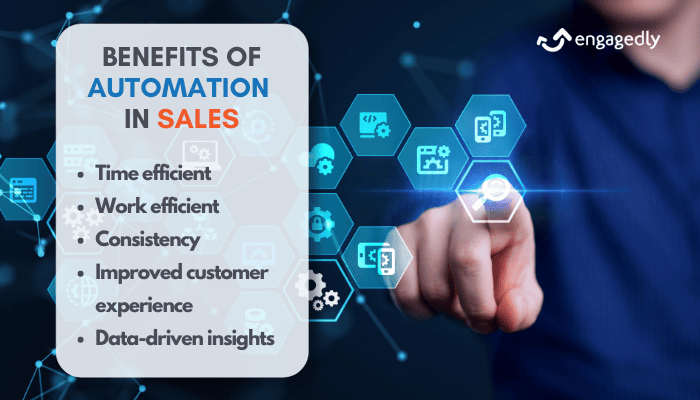
Automation in sales has become increasingly important due to the following reasons:

  • Time-saving: Automation helps sales professionals to save a significant amount of time by automating repetitive and time-consuming tasks. With automation, they can focus on more important tasks like customer interactions, building relationships, and closing deals.
  • Increased efficiency: Automation reduces the chances of errors in sales processes and ensures that tasks are completed on time. It also allows sales teams to manage and prioritize their workloads more effectively, leading to increased efficiency.
  • Consistency: Automation ensures that sales processes are standardized, which ensures consistency in communication, marketing campaigns, and customer experiences. This consistency builds trust with customers and helps in creating a positive brand image.
  • Improved customer experience: Automation enables sales teams to provide personalized experiences to customers. This leads to increased customer satisfaction, loyalty, and repeat business.
  • Data-driven insights: Automation provides data and insights on sales processes, customer behavior, and marketing campaigns. This information helps sales teams to make informed decisions and improve their sales strategies over time.

5 Ways Your Team Can Use AI in Sales

Artificial intelligence in sales can be used in many different ways to transform your sales processes and boost your revenue engine. Here, we will look at the five most notable applications of AI in sales. 

Lead Scoring and Prioritization 

It is seen that human salespeople approach the process of lead scoring in an unscientific way. Often, their decision-making is based on half-finished data and gut instinct. Consequently, most of their time is spent chasing poorly qualified leads. 

Ai can drastically change this situation by bringing a level of logic and standardization to the process. 

AI algorithms can compile all information about a client, including their history, social media postings, and interactions with the sales team. Based on this information, these algorithms can rank the leads in the pipeline according to their chances of closing successfully. 

In other words, they can help to identify patterns and determine which leads are most likely to convert, thus promoting logical decision-making. 

Sales Prediction and Forecasting

Sales forecasting is the process of anticipating sales revenue that a business may generate over a specific period. Accurate sales forecasts prepare a business for any unforeseen emergencies and maintain resilience. 

Using AI is an incredible way to supercharge your sales forecasting capabilities. With AI, sales managers can identify the current trends and understand their path to meeting sales goals each quarter. They can prioritize prospects that have a greater tendency to convert with sales forecasting. 

Sales teams no longer need to rely on their instinct to arrive at a number. Instead, they can leverage AI-powered sales forecasting tools for the following:

  • Determine which deals to prioritize on
  • Identify new leads that demonstrate a high probability of converting
  • Pinpoint new opportunities that might increase the sales revenue

Finally, predictive forecasting can also create value for sales teams internally. For instance, sales managers can use the same data analysis to forecast their team’s performance in advance. This way, they can take proactive steps to enhance their sales attribution based on factual figures. 

Also Read: Engagedly Launches AI Everywhere with Marissa™ your Enablement Coach

Sales Automation and Sales Productivity

This is one of the best examples of AI in sales that can streamline your sales processes and automate workflows

AI tools can boost your sales team’s productivity in several ways. These tools augment the work and eliminate the drudgery that distracts the team members from focusing on higher-value tasks. 

There are plenty of areas of the sales department where having an AI-powered tool can speed things up. For instance, there are predictive dialers that allow sales representatives to make outbound calls at scale. Similarly, there are AI tools that automate post-call reporting that liberates reps from manually typing everything after a sales call. 

Apart from these, many more sales processes can be automated with AI, allowing your sales team to focus on actual selling. 

Predict Cross-sells and Up-sells

As discussed above, AI is quite effective in identifying qualified leads. Now similarly, AI tools can also predict cross-selling and up-selling opportunities that a sales rep is most likely to be successful with for every individual customer. 

Thanks to machine learning, these tools can analyze data from past interactions with a prospect and the previous sale history of each customer to predict the products/services that will appeal the most to every lead. 

This boosts sales by eradicating the guesswork that the sales team has to do for cross-selling and up-selling. Additionally, it ensures that your sales team does not annoy the leads by recommending products they have no interest in. 

Both cross-sells and up-sells are great strategies to boost overall sales. Statistics reveal that there is an approximately 70% chance of selling to an existing customer as compared to a 20% chance of finding a new prospect. And with AI, companies can make the most of this opportunity and enhance their bottom line. 

Improve Customer Service with Chatbots

Often, leads want to talk to a human representative before making the final sales decision. Other times, they just want to feel like they are talking to a human sales rep. And this is where an AI-powered chatbot comes in handy. 

AI chatbots are a brilliant substitute that offers round-the-clock customer service assistance. They are trained and integrated call center software to address basic questions about a company’s products/services, make accurate recommendations, and even make up-sells and cross-sells.

This boosts the sales team’s productivity as it reduces their load of answering basic customer queries. Additionally, an instant response to the prospects makes them more inclined to make the final purchase. 

Also Read: Hello from Marissa™ AI – Your AI Enablement Coach

3 Popular AI Sales Tools

Now let’s take a look at the three most popular AI sales tools along with their most noteworthy features. This will help you select the best tool for your team. 

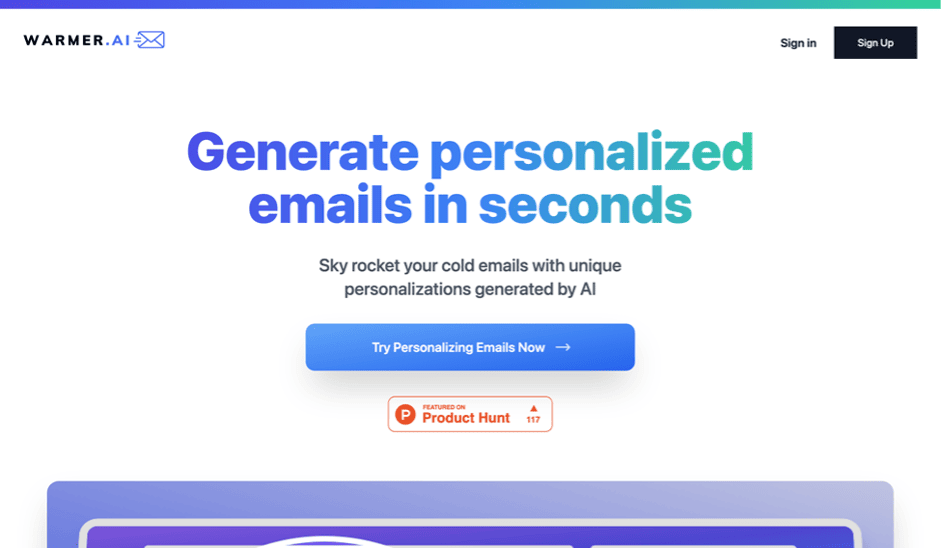
Warmer.ai

Warmer.ai-AI Sales toolImage: Source


Cold outreach is a crucial aspect of every business’s sales process. However, discovering the right information about every prospect and creating a strong introductory email is often a challenge for sales teams. 

Warmer.ai is an excellent AI tool that enables sales teams to personalize emails using accurate data about the prospect. This includes details such as their job title, interests, awards, etc. 

Thus, sales teams can improve the email response rate while saving valuable time for other core activities. 

Clari

Clari-AI Sales toolImage: Source


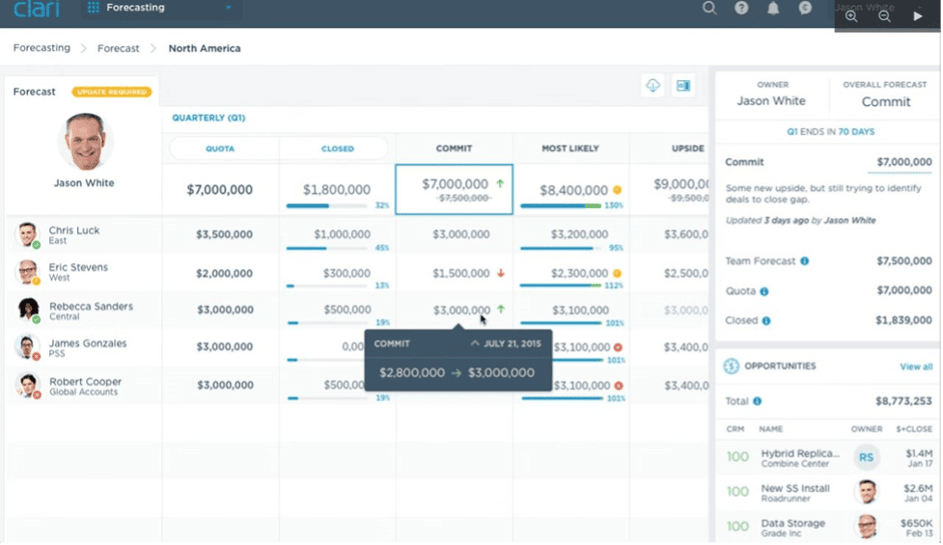
Clari is among the best sales enablement platforms for modern sales teams. The tool allows sales representatives to convert more leads by arming them with data-driven insights and the best sales content.

The AI sales tool leverages actual deal data to automatically generate forecasts for every rep, region, channel, and product/service line. It also offers enhanced visibility into the sales team’s performance, prospect engagement, and deal status. 

Drift

Drift-AI Sales tool Image: Source


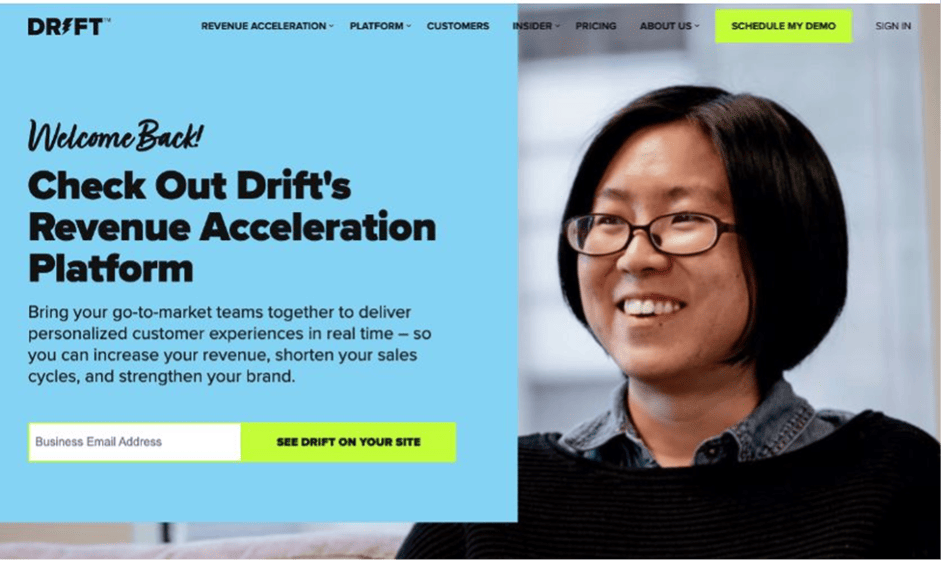
Drift is an AI-powered platform that enables small and medium-sized enterprises to speed up their sales cycle. The platform works to engage the visitors from the word go, instead of making them fill out long forms. 

The sales assistant works in tandem with chatbots to address customer queries and even schedule demo sessions with the sales team. Thus, it automates lead capturing without increasing the company’s headcount. 

Also Read: How AI is Enabling Cloud-based SaaS Applications for Remote Work

Future of AI in Sales

To conclude, AI in sales has massive potential. That said, there is no one way of using this technology in your sales processes. It is good to begin evaluating the aspects of your sales process that you wish to simplify and streamline. This will also help you choose the right AI sales tool for your team. 


Frequently Asked Questions

Q1. What is an AI sales tool?

Ans. An AI sales tool is an advanced software solution empowered by artificial intelligence that optimizes sales processes by leveraging data-driven insights, automating tasks, and enhancing customer interactions to boost sales performance and revenue generation.

Q2. What are the benefits of using an AI sales tool?

Ans. Using an AI sales tool offers numerous benefits, including improved sales efficiency, enhanced lead generation and qualification, personalized customer experiences, predictive analytics for accurate forecasting, streamlined sales processes, increased productivity, and better decision-making based on data-driven insights.


Author: Charu

Charu-blogger

Charu is an outreach specialist with over 4 years of experience in digital marketing. Her expertise lies in developing and executing outreach campaigns that drive engagement and build brand awareness. When she’s not brainstorming outreach ideas, you can find Charu exploring the outdoors or practicing yoga.


Subscribe To The Engagedly Newsletter 


Engagedly + Meta Workplace: Elevate Rewards and Recognition to New Heights

Unlocking the Potential of a Culture of Appreciation and Motivation

We cannot underestimate the power of recognizing and rewarding employees, when it comes to boosting employee morale and driving organizational success. When employees feel valued, appreciated, and proud of their contributions, their engagement soars, and their performance reaches unprecedented levels.

In today’s fiercely competitive talent landscape, retaining top-notch employees is no easy feat, which is why a well-crafted Rewards and Recognition program holds tremendous value.

Enter Engagedly and Meta Workplace, two powerful platforms poised to revolutionize your organization’s approach to rewards and recognition. By combining these forces, you have the opportunity to foster a culture of appreciation, motivation, and collaboration. It will inspire your workforce, elevate retention rates, and propel your organization towards unprecedented achievements.

Streamlined Efficiency for Unparalleled Results

Streamlined rewardsThe seamless integration of Engagedly with Meta Workplace empowers organizations to streamline their Rewards and Recognition program. Say goodbye to the time-consuming and error-prone process of manually tallying rewards points. With the automated calculation and assignment of points for hashtags used to praise or appreciate team members, managing rewards becomes effortless. HR professionals and team leaders can now sit back and witness their employees basking in the well-deserved recognition they crave.

Streamlined rewards and recognition

Also Read: Task Management: The Not-so-Secret Weapon to Maintain Efficiency Without Burnout

Effortless Setup and Real-Time Feedback

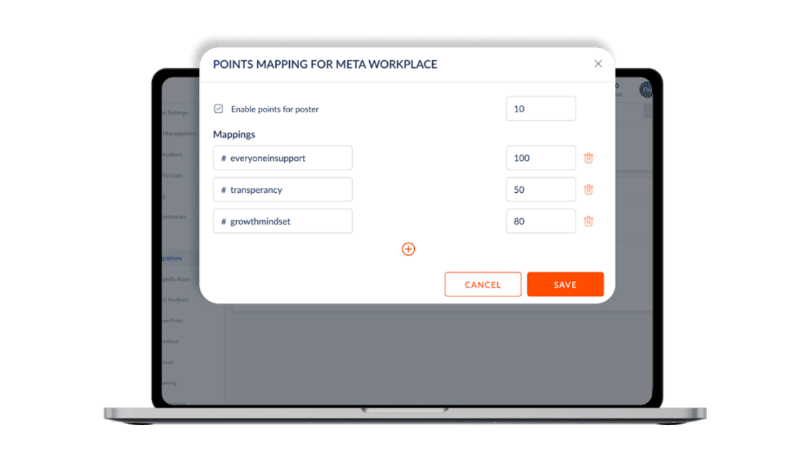
Getting started is a breeze as HR admins and leaders establish a simple point value mapping system for praising team

Customization for real impact

members using specific hashtags. This setup allows for easy and automatic allocation of points within Engagedly. It reduces confusion and saving precious time when it comes to calculating and populating leaderboards. As points are instantly reflected in Engagedly, employees gain immediate visibility into their standing and are motivated to enhance their performance or maintain their top position. This transparency fuels their potential, unlocking their untapped capacity for greatness. HR admins and leaders can focus on fostering a supportive culture and provide ever

yone a clear understanding of how their contributions make a difference, further boosting morale.

Customization for Impactful Alignment

The integration of Engagedly and Meta Workplace offers the power of customization. It enables organizations to assign varying point of values to each hashtag used for praising and appreciating employees. By tailoring point values to align with company values and priorities, organizations can reinforce their core beliefs and promote them effectively. Just imagine the impact this level of personalization can have on employee motivation and retention rates! HR admins and leaders gain enhanced control over the direction of their Rewards and Recognition program, ensuring it resonates deeply with their workforce.

Also Read: Top 10 Performance Management Software In 2023

Fostering a Culture of Continuous Appreciation and Celebration

Engagedly and MetaTransform your workplace into a hub of positivity and success with the dynamic synergy of Engagedly + Meta Workplace. Nurture a culture where appreciation and motivation thrive in every aspect of your organization. Witness your team flourish, buoyed by the collective esteem and pride that comes from being valued and recognized. Rest easy knowing that streamlined recognition processes guarantee that every accomplishment is duly acknowledged and rewarded. Empower your team to embrace greatness through a culture of continuous cheer and appreciation!

Also Read: Employee Recognition & Rewards In Hybrid Era

Unlock the Potential, Empower Success

Cheer and Success - Engagedly

With the Engagedly + Meta Workplace integration, your organization can harness the power of employee motivation, build a culture of genuine appreciation, and propel performance to unparalleled heights. Say goodbye to lackluster recognition programs and embrace a streamlined, efficient, and effective approach that will keep your top performers engaged and hungry for more.

Embrace the future of Rewards and Recognition and position your organization as a true leader in talent management. Elevate your workforce, retain your finest talent, and outshine the competition. Engagedly + Meta Workplace is the winning formula for unleashing the full potential of your organization.


Subscribe To The Engagedly Newsletter 

Unleash Success: Achieve Goals with Goals 2.0

Wondering what’s Goals 2.0? Allow us to explain. 

Success in the hectic world of business isn’t accidental. It is the outcome of thorough preparation, wise decision-making, and effective execution. Goal setting, a fundamental practise that helps organizations move towards their desired outcomes, is at the heart of this process. Businesses pave the way for growth and success by establishing clear objectives and coordinating efforts to achieve them.

Here’s an interesting fact: According to a Harvard Business research, people who establish precise goals are ten times more likely to achieve than those who do not. Yet goal setting benefits more than just people; it also benefits organisations. According to American Management Association data, firms that successfully develop and communicate goals have a 21% gain in profitability.

These startling numbers highlight the critical role that goal setting plays in generating organizational performance. Setting goals goes beyond wishful thinking and turns desires into practical actions. Goals provide purpose, engage teams, and promote an accountability culture by offering a path for development.

In this post, we will look at the importance of goal setting and how it may alter organizations. We’ll look at how adopting a complete goal management platform, such as Goals 2.0, may transform the way organizations define, manage, track, and achieve their goals. Prepare to discover the secrets to unlocking your organization’s full potential and going on a road to unprecedented success.

Crush Your Business Goals with Enhanced Transparency, Collaboration, and Alignment

Setting, managing, tracking, and achieving goals are essential aspects of any organization. However, it can be a significant challenge to ensure everyone is aligned and working towards common objectives, especially in large organizations with numerous teams. That’s where Goals 2.0 comes into play – the most comprehensive goal management platform designed to transform the way organizations operate and propel them to higher levels of success.

Draft Goals for Better Alignment

Draft goals

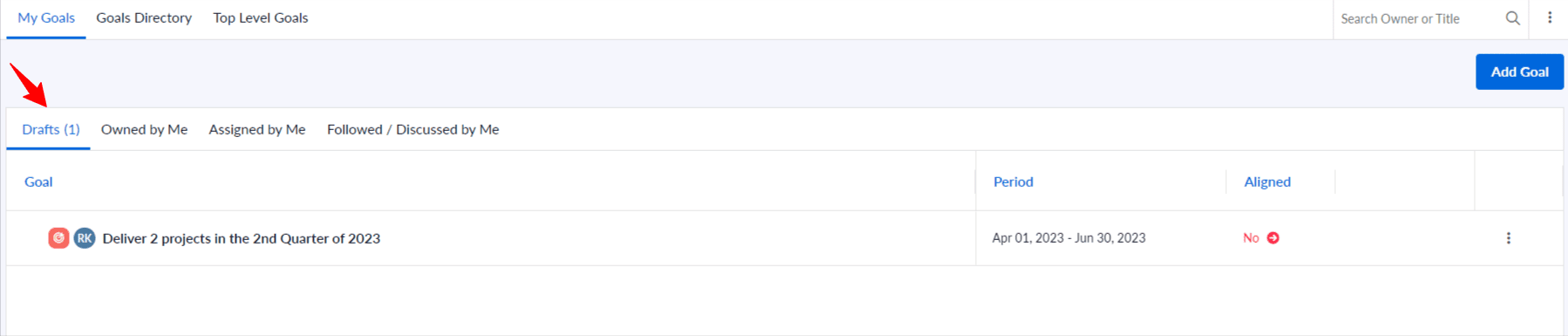
Aligning everyone in your organization with common goals is no small feat, particularly when different teams have contrasting viewpoints. With Goals 2.0, you gain access to an amazing feature that allows you to create multiple drafts and share them with stakeholders to ensure proper alignment before publishing the goals. This streamlined approach to goal management and alignment has never been easier.

Extended Collaboration

Engagedly Goals 2.0-Extended Collaboration

Previously, collaboration among teams was a complex and time-consuming process. Goals 2.0 changes that by making collaboration a breeze. Goal-setters can invite team members, managers, and other stakeholders to comment, review, suggest, and provide feedback on the goals – both before and after they are published. Simply tag the necessary stakeholders using “@” and witness how cross-functional teams react to each other’s goals quickly and decisively. Furthermore, juggling and altering goals becomes a cakewalk with Goals 2.0.

Goal Setting Module

Less Effort, More Effect

Seamless and essential integrations with platforms like Salesforce, JIRA, and Google Sheets make life easier for your employees. No more duplicating reports or data – simply update the progress on the respective platform dashboards, and all the data gets synced flawlessly in Goals 2.0. This integration eliminates errors and ensures progress information remains intact without any mismatches. Managers and decision-makers gain instant insights from different platforms, enabling them to measure progress and success effortlessly on a unified dashboard.

Milestones for Delightful Goal Achievement

Welcome to the world of (S)milestones, where even big and complex goals become delightfully easy to achieve. By splitting Key Result Areas (KRAs) into milestones, your tasks become well-defined, bringing unprecedented clarity to your journey toward accomplishing your goals. With Goals 2.0, you can assign or change owners for milestones and key results, fostering a happy environment where goals are consistently reached with ease.

Aligned and Contributing Goals

Aligned Goal Hierarchy view

In Goals 2.0, you can set both aligned goals and contributing goals. Aligned goals are those that align with the overall organizational objective but do not contribute to any other goals. They run parallel to the overall goals set. Aligned goals do not automatically become contributing goals; they must be marked separately. Contributing goals, on the other hand, are those that directly contribute to another goal or a set of goals established by the organization. These goals play a vital role in achieving the overall organizational objective and driving organizational success.

A Helping Hand

With Goals 2.0, no one in your organization will feel helpless. The Support for Collaboration feature allows individuals to seek assistance or guidance in the process of achieving their goals. Whenever someone gets stuck, all they need to do is tag the person they need help from – there’s no need for any other channel of collaboration. Watch your organization work together like a well-oiled machine.

Goalistic Picture

Engagedly Goals 2.0-Goalistic pictureBeyond individual and team goals, understanding your organization’s goals is crucial for everyone. Goals 2.0 provides a bird’s-eye view of the broader organizational goals, business units, departments, team members, and individual goals – all at a glance. The Milestone Propagation feature in Goals 2.0 gives you a holistic picture, adding more sense and purpose to your efforts. Imagine the wonders this comprehensive view can do for everyone’s performance.
A Walk in the Park

With Goals 2.0, you can save time and effort by importing and cloning goals. If you have goals maintained in Excel sheets, you can effortlessly import them into Goals 2.0 and continue from there. No need to recreate them from scratch. For recurring goals or those with minimal changes, you can clone previous goals, make the necessary edits, and publish them. It’s as simple as that.

All at a Glance

Visual graphs represent your goal targets and actual progress, allowing you to quickly assess where you stand in accomplishing your goals. Gain insights into your expected and current progress, empowering you to reorient your approach if necessary and ensure timely goal attainment.

Feedback to Drive Results

Engagedly Goals 2.0-FeedbackPromptly responding to goal progression makes a significant difference to individuals, teams, and the entire organization. Goals 2.0 includes a feedback feature that enables you to share instant feedback on your team’s progress or completion of goals. This feedback-driven approach helps your organization perform better in achieving its goals.
But Wait, there’s more …

Goals 2.0 offers an array of additional features, including setting independent and cascading goals, visually aligned and contributing goals, creating multiple goals together, organizing via tags and in-depth filters, and recognizing and praising achievements.

Engagedly’s Goals 2.0 is an intelligent, intuitive, and insightful goal management platform that enhances transparency, collaboration, and communication within organizations. With better alignment and the power of Goals 2.0, organizations can achieve unprecedented success.

So, say goodbye to goal management headaches and unlock the true potential of your organization with Goals 2.0.

Goal settings and OKRs

MS Teams Integration with Engagedly

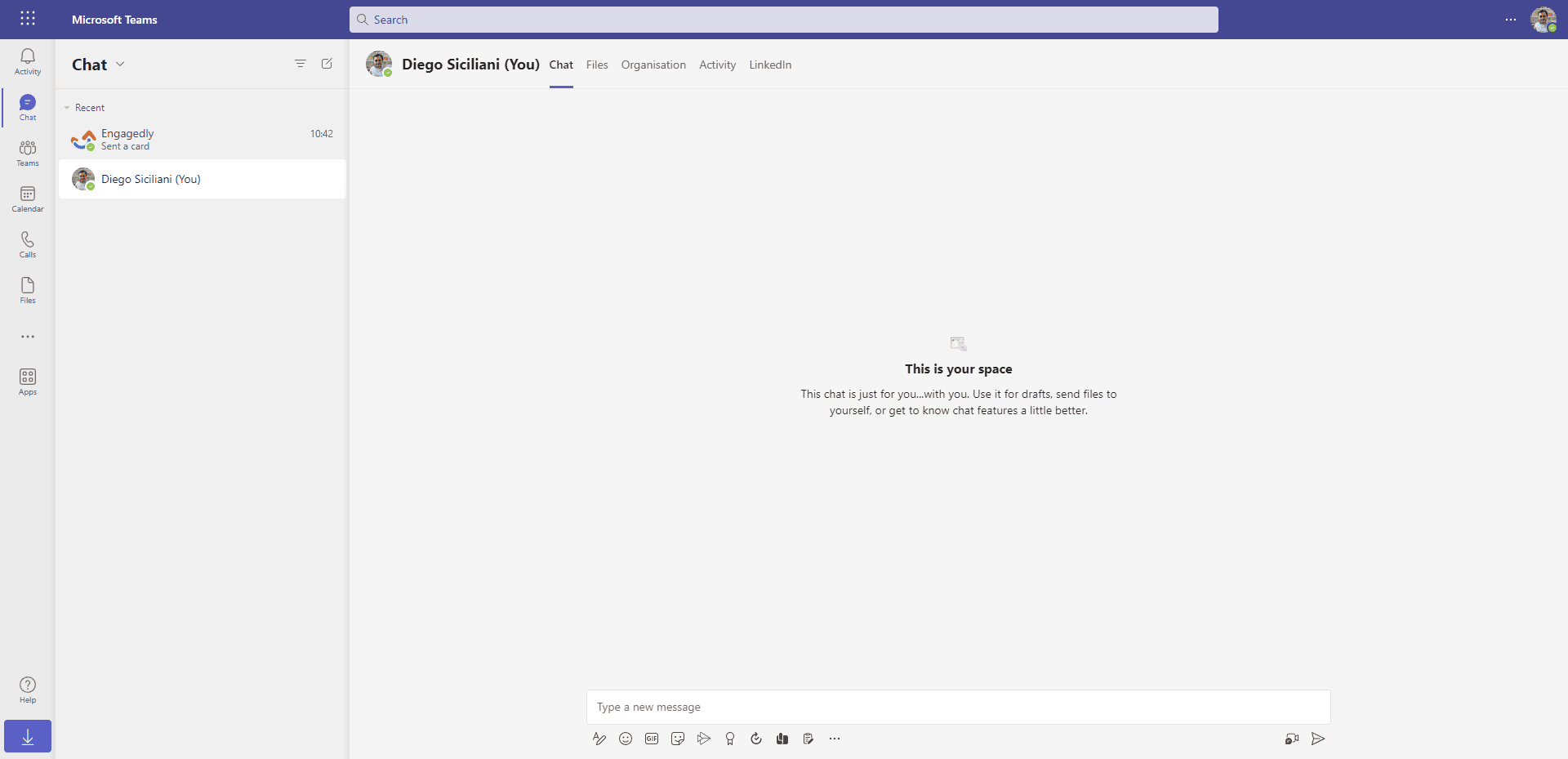
Engagedly Integration with MS Teams: How and Why Will It Help Drive Performance?

Efficient app integration. That’s the goal we are striving for. Are you tired of juggling a million apps and losing productivity? Well, fear not, because MS Teams integration with Engagedly is here to save the day!

By seamlessly integrating with MS Teams, Engagedly eliminates the headache of constantly switching between apps and lets you focus on the important stuff. Plus, your team members will feel more connected to the workplace as they easily access our modules within MS Teams.

Not only will this boost efficiency and engagement among team members, but integrating with Engagedly’s suite of features will take your performance to the next level with zero additional effort.

MS Teams integration with Engagedly

So why not give it a try? Say goodbye to app overload and hello to a smoother, more productive workflow with Engagedly and MS Teams!


How Do App Overload and App Switching Ruin Productivity?

App overload and app switching can really put a damper on your productivity! Here are ten ways they can ruin your day:


  • You waste time switching between apps instead of getting work done.

  • Too many apps can be overwhelming and make it hard to focus.

  • You might forget to check an app and miss important messages or updates.

  • Having too many apps can slow down your computer or device.

  • It’s easy to get distracted by notifications from multiple apps.

  • You might have trouble remembering which app you used for a specific task or project.

  • Using too many apps can lead to information overload and confusion.

  • Switching between apps can interrupt your train of thought and make it hard to get back on track.

  • You might accidentally close an app or lose progress when switching between them.

  • App overload can lead to burnout and stress, making it even harder to be productive.


Sounds like a nightmare! That’s why it’s important to find tools like Engagedly that can integrate with other apps and streamline your workflow.


Engagedly and MS Teams Integration: Definite Perks and Benefits

Feedback at Lightning Speed: Quick and Easy Wins!

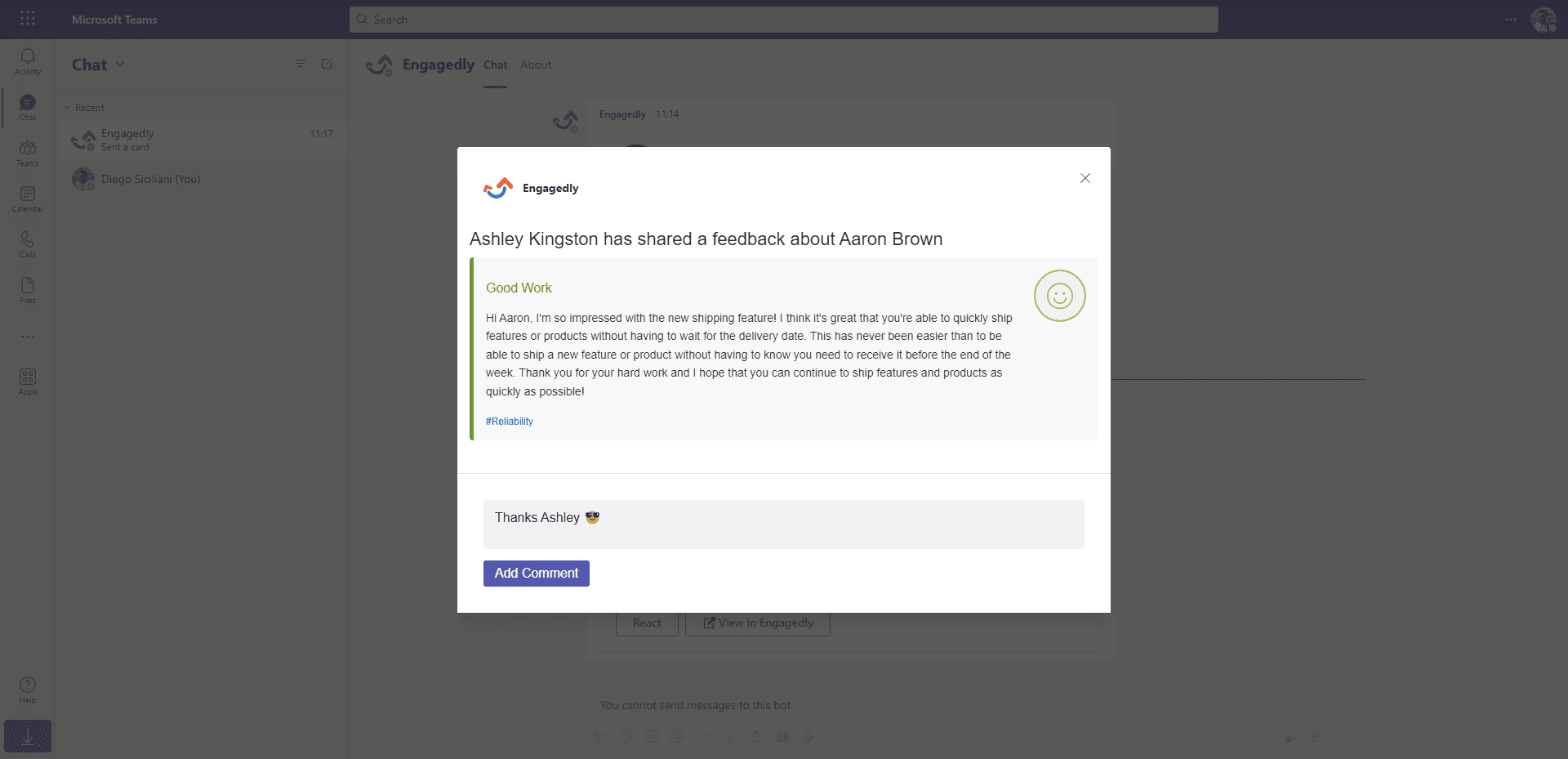
Clunky, slow feedback processes leave your employees feeling disconnected and disengaged. Well, fear not, because MS Teams is here to shake things up!

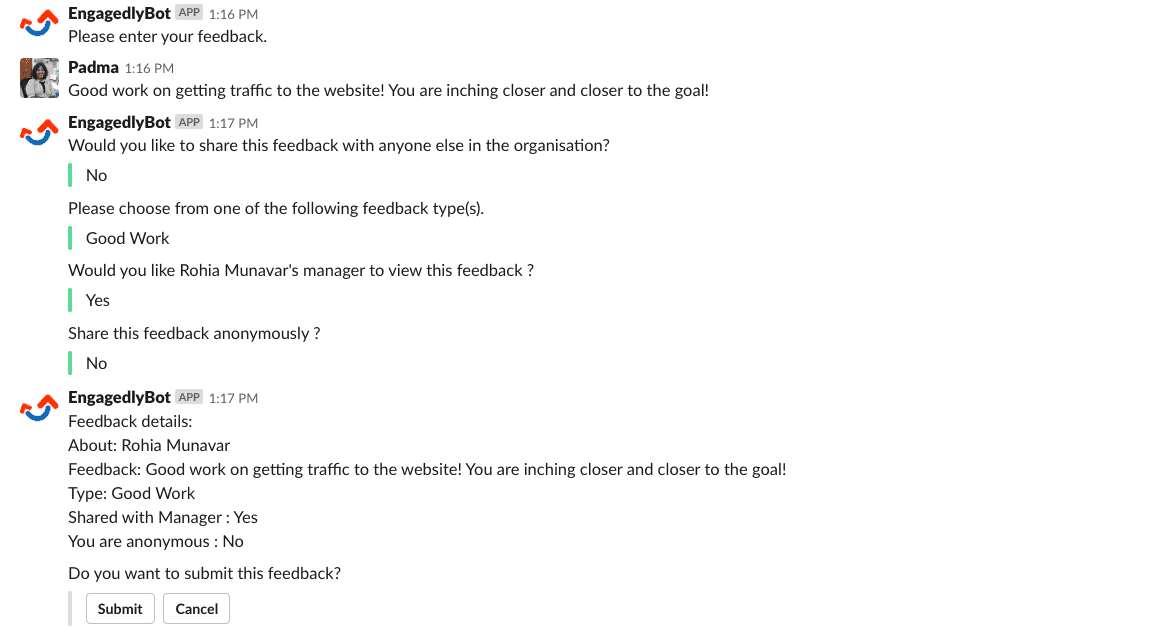
With MS Teams, managers can easily share comments and critiques, allowing the whole team to be part of a more engaging feedback process. Plus, the quick and convenient feedback process means that team members can instantly share their requests, comments, or views – all without leaving MS Teams.

Feedback with MS Teams

Let your employees transform how they request and receive feedback with MS Teams and watch your team become more connected and engaged than ever before!

Get Your Praise on: The Solution You Need!

Praise with MS Teams

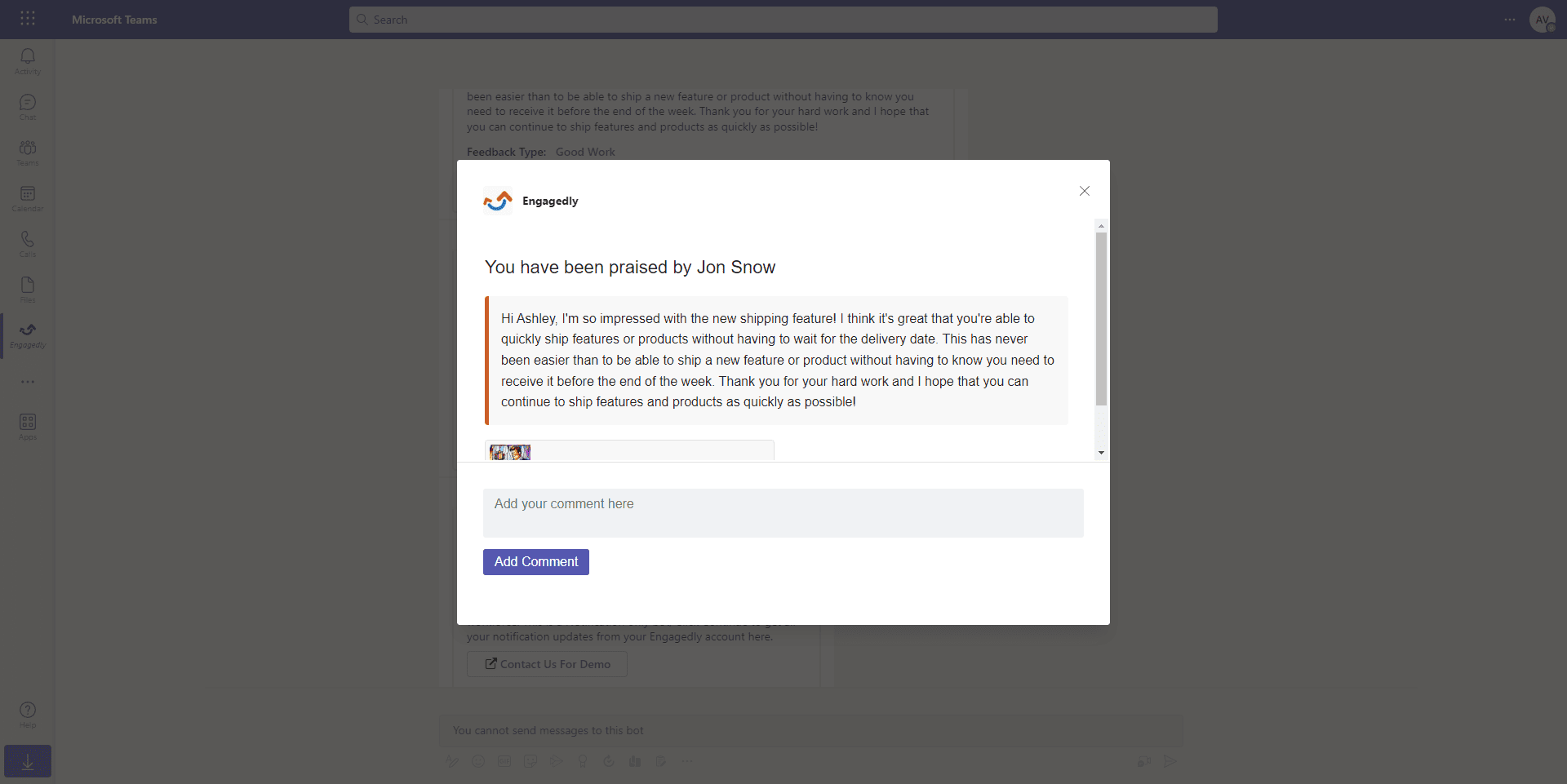
Say goodbye to app switching and hello to a culture of appreciation! With Engagedly, praising your employees has never been easier – no more procrastination, no more hassle.

Effortlessly give kudos, spark conversations within the group, and build a culture of recognition that fosters success. Plus, with the ability to give praise on the go, you can recognize your team members anytime, anywhere. 

So why not turn recognition into action and start building a healthier work culture? Get ready to see the benefits of a praiseworthy solution with Engagedly.

Boost Your Team Spirit!

Who says socializing has to be limited to after-work drinks? With Engagedly’s integration with MS Teams, your team can stay connected and informed like never before!

From brainstorming ideas together to quickly responding to messages, this integration helps employees feel more in tune with their coworkers, so they always feel “in the know”. Plus, it provides an avenue for faster feedback and communication, which can motivate team members through meaningful conversations.

All of this adds up to a work environment that’s conducive to growth and engagement beyond compare. So, redefine socializing and take your team’s collaboration to the next level with Engagedly and MS Teams. Get ready to boost your team spirit and see the benefits of seamless communication and collaboration!

Game on for Productivity: Score Big with Engagedly!

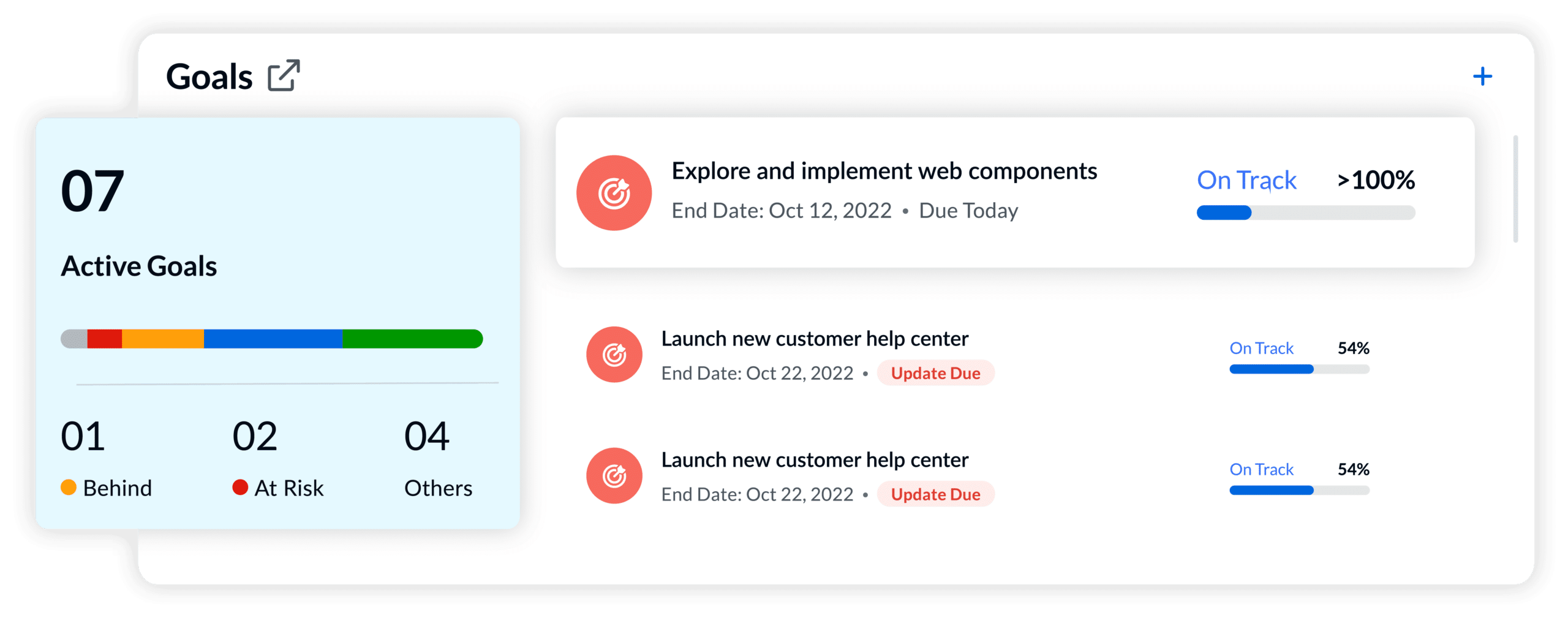
Looking to take your goal-focused organization to the next level? Look no further than Engagedly! Our improved goal management system makes it easier than ever to track, manage, discuss, and update goals.

As a manager, you’ll be able to power up productivity and open up conversations, all while staying on top of the latest updates related to your team’s goals. With Engagedly, you can bring big results with minimal effort and keep your team on track toward success. So why not give it a try and see how easy goal management can be?


In conclusion

Ready to build high-performance teams for the future of work? Engagedly’s integration with MS Teams makes it a breeze! With the ability to directly interact and take action from MS Teams, your employees can seamlessly manage key Engagedly modules and boost productivity. So, get ready to take your team to the next level with Engagedly and MS Teams!


CSR Initiative: Engagedly Inc. Collaborates With Drishtee Foundation To Empower 100 Women

Corporate Social Responsibility (CSR) has evolved from a mere buzzword to a business essential. Its significance lies in the fact that companies that overlook it stand a higher risk of lagging behind their competitors.

Consumers today are more conscious of the impact businesses have on society and the environment, and prefer those that acknowledge their responsibilities towards society.

In a recent survey, 86% of consumers believe that companies should take a stand on social issues, and over 60% choose to endorse brands that share their values.

This blog entry emphasizes the importance of CSR partnerships, particularly the collaboration between Engagedly Software and Drishtee Foundation.

Swavlamban: A Corporate Social Responsibility (CSR) Initiative

CSR Initiatives Engagedly

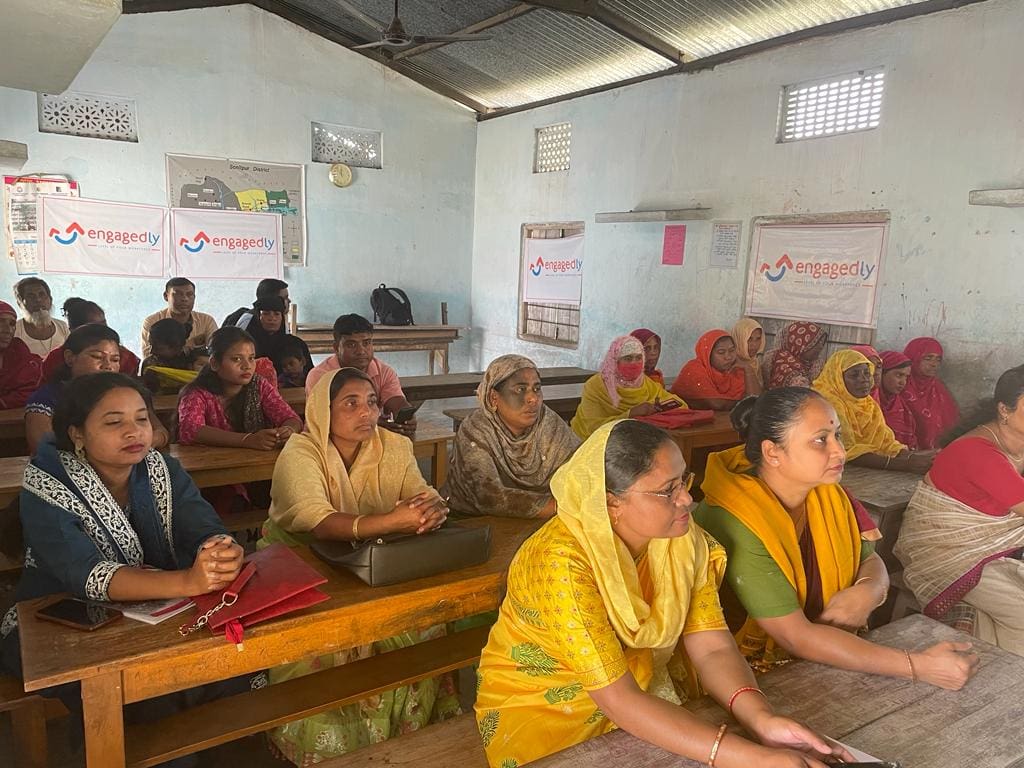
Engagedly Software and Drishtee Foundation collaborated in empowering 100 women through poultry farming training and resources highlights how companies can take concrete steps towards discharge of their social responsibilities.

The program caters to all aspects of poultry farming, from understanding animal breeds, health management and nutrition to marketing. This initiative promotes self-reliance and self-sufficiency, therefore creating a cycle of empowerment and economic growth.

Why conduct Corporate Social Responsibility (CSR) Initiatives:

Bring about positive changes:

CSR Engagedly


More forward-thinking companies are embracing CSR not purely for a public relations requirement, but as a tool for effecting genuine positive change in the world, forming stronger relationships with employees and customers alike. Large corporations particularly, with their significant influence over society and the environment, have a responsibility to contribute to worthy initiatives making a positive impact.

For example: Microsoft’s AI for Accessibility program, which funds and provides resources to develop AI technologies that can improve the lives of people with disabilities, serves as an excellent example of CSR in action. It promotes positive change in society, establishing Microsoft as a reputable social-impact focused brand.

Attract exceptional talents:

Corporate Social Responsibility (CSR) plays a pivotal role in attracting and retaining exceptional talent.

A Deloitte survey reveals that for 70% of millennials, a company’s environmental and social commitments influence their work decisions. As the largest demographic segment in today’s workforce, millennial preferences and values hold great sway over the evolving business landscape.

Companies that disregard CSR are at risk of losing top-notch talent to their competitors, whereas those prioritizing these initiatives reap the rewards of dedicated employees, stronger engagement, and a vibrant workplace culture.

Also Read: Ways To Attracting and Retaining The Right Talent

Further empower the society:

Swavlamban - A CSR initiative of Engagedly

The alliance between the Drishtee Foundation and Engagedly Software perfectly exemplifies how businesses can fulfil their social responsibilities while positively impacting both society and the corporate world. By empowering women in rural areas through education and training, these organizations foster a cycle of self-reliance and economic progress. Such initiatives not only help companies forge solid relationships with both customers and employees but also garner attention from the brightest talent in the industry.

Mahatma Gandhi astutely observed, “The difference between what we do and what we are capable of doing would suffice to solve most of the world’s problems.

When organizations take proactive steps in CSR, they bridge this gap, contributing significantly to global development.

Inspire others:

Being thought leaders in their respective fields, forward-thinking businesses must recognize the importance of meaningful CSR initiatives. By developing strategic partnerships and coupling them with actionable measures for positive change, they inspire others within the industry to follow suit. In doing so, an atmosphere in which businesses prioritize social responsibility over profit-driven objectives will gradually emerge–benefiting all stakeholders involved.

Also Read: 6 Reasons in Favor of Fostering a People-Centric Workplace

Conclusion:

In essence, embracing CSR is not only a necessary step for businesses to attract top talent but also an opportunity for them to drive positive change by aligning with global societal needs. As companies grow more invested in addressing various challenges facing our world today, they have the potential to make significant strides towards creating a more sustainable future for all.


Frequently Asked Questions

Q1. What is Corporate Social Responsibility (CSR)?

Ans. Corporate Social Responsibility (CSR) refers to a company’s voluntary actions to improve society beyond its legal obligations. It includes sustainable business practices, philanthropic giving, ethical labor practices, environmental stewardship, and community development. Engaging in CSR can enhance a company’s reputation and contribute to the overall betterment of society.

While CSR is a voluntary practice, it is becoming increasingly important for companies to prioritize their social and environmental responsibilities, given the growing expectations of stakeholders and the impact of business activities on the planet and society.

Q2. Why conduct Corporate Social Responsibility (CSR) initiatives?

Ans. Companies conduct Corporate Social Responsibility (CSR) initiatives because they recognize their responsibility to contribute to the well-being of society and the environment beyond their legal obligations. Engaging in CSR can enhance a company’s reputation, attract and retain employees, build customer loyalty, and contribute to the overall betterment of society. Additionally, as stakeholders increasingly expect companies to prioritize social and environmental responsibilities, investing in CSR initiatives can help businesses stay competitive and adapt to changing market expectations.


7 Examples of People Operations OKRs/ HR OKRs

Human resources, also known as people operations, plays a vital role in every organization’s success. This dynamic department encompasses a wide array of functions, ranging from formulating and implementing effective workplace policies and procedures to fostering a strong company culture. Additionally, they handle essential tasks such as performance management, compensation and benefits management, compliance, and training. By aligning with People Operations OKRs (Objectives and Key Results), this strategic team ensures the organization stays on track, driving growth and achieving its goals with efficiency and effectiveness.

Continue reading “7 Examples of People Operations OKRs/ HR OKRs”

Engagedly’s Brand New Indigo Design System

New launch alert! Engagedly’s Indigo design system allows you to personalize your homepage to your heart’s content! This means you can easily find the stuff that piques your interest, while the website can showcase its awesome services and products to you in a way that’s just right. And the best part? You can make it look and feel just the way you want it to! So what are you waiting for? Engage with Engagedly and customize your homepage today!

Engagedly's Indigo Design System

Out with the Old; in with the New!

Engagedly’s latest design system, Indigo, offers a customizable and fluid approach with enhanced personalization options. The design features a cleaner and more thought-out layout, tailored to meet users’ specific needs and preferences. The system includes flyouts and quick links for immediate action, enabling users to access necessary information effortlessly. Indigo acknowledges the importance of information density and provides users with greater personalization, flexibility, and control.

The design system offers features like “My Circle” and “Celebrations,” providing an interactive and engaging experience for users. Essentially, it represents a compelling, clear, and functional purpose that answers the question, “Why am I here?” By offering a more personalized experience, users feel a stronger connection to the platform, resulting in increased engagement and satisfaction.

Engagedly’s Indigo design system provides a user-friendly experience that is easy to navigate and tailored to users’ needs. With its enhanced personalization options, interactive features, and functional layout, it offers a compelling representation of the platform’s purpose.

What’s New About Engagedly’s Indigo Design System? 

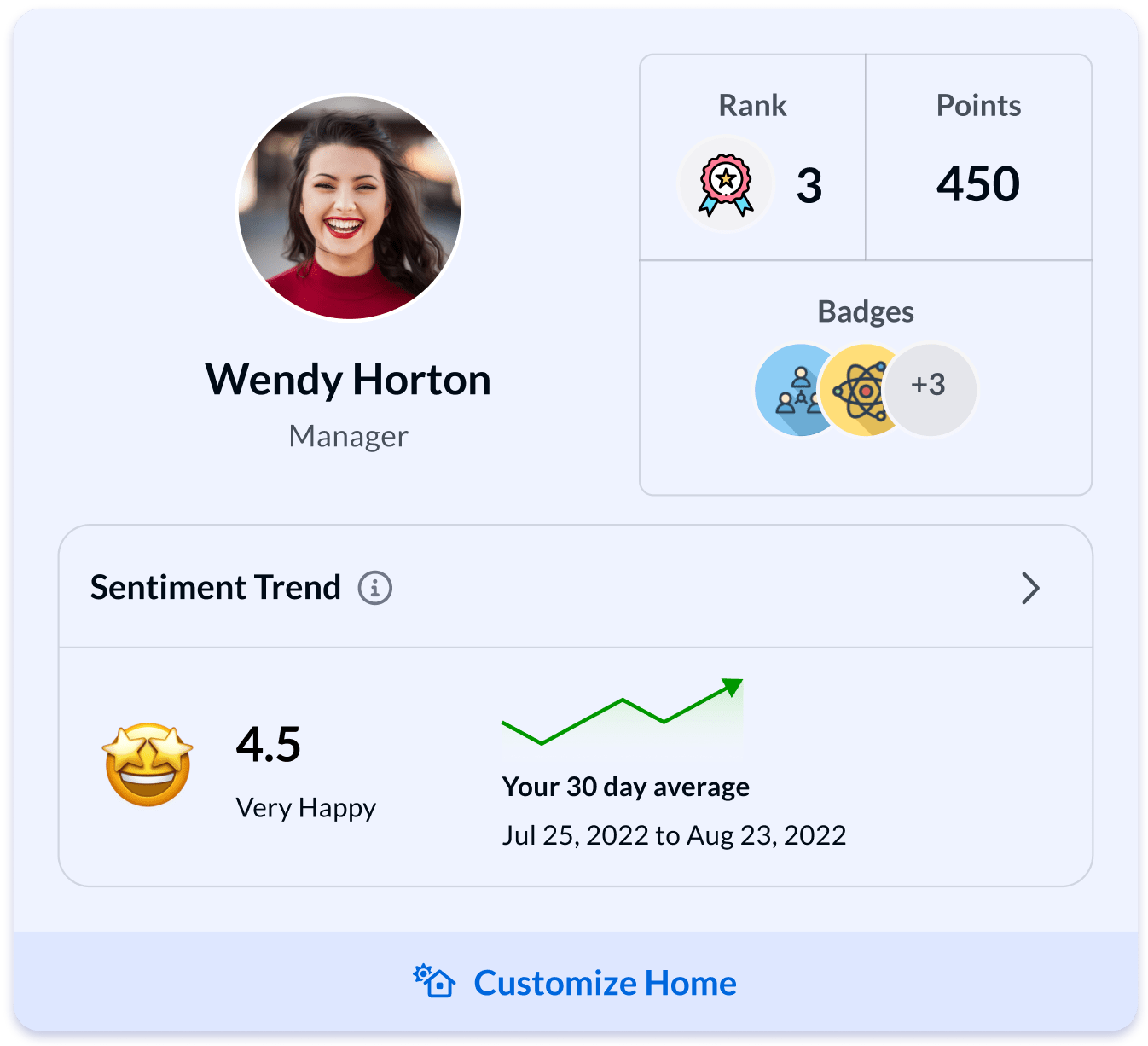
Profile Card

Profile Card in Engagedly's Indigo Design System

  • The Indigo design system adds personalization and gamification to the page, driving engagement.
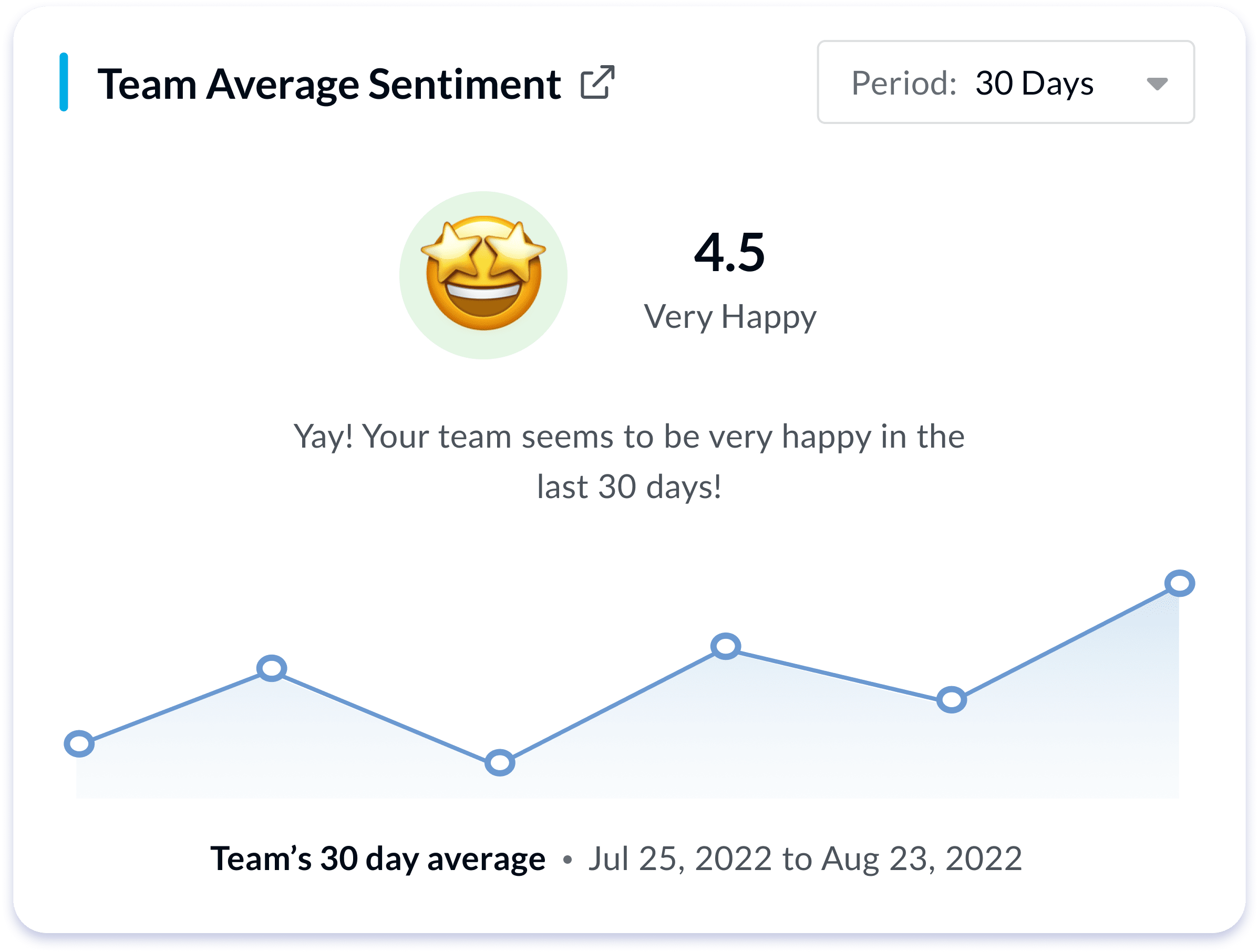
  • It includes a feature that displays Ranks, Points, and Sentiment Trends in one place.
  • This information helps users understand their progress and incentivizes them to earn points and improve their rank.
  • By providing a clear understanding of their progress, users are motivated to engage more with the platform.
  • The gamification element adds an element of fun and competition to the user experience, further increasing engagement.
  • Overall, the personalized and gamified approach of the Indigo design system enhances user engagement and satisfaction.

Fluidity in Navigation

Engagedly’s Indigo design system is like a genie that grants your wishes. It offers a fluid approach that lets you take the reins and customize your homepage to your heart’s desire. With the ability to manage sections and set information hierarchy, you can navigate with ease and get stuff done lightning fast. It’s the ultimate productivity wingman!

Flyout Screens

Flyout screens in Engagedly's indisgo design system

Engagedly’s Indigo design system is like a superhero who swoops in to save the day! It gives users access to all the relevant information across the platform and lets them take action with just one click, all without leaving the homepage. This superpower makes the experience more interactive and keeps users engaged and excited to explore more. Who needs an app when you’ve got Indigo?

Two-Column Approach in Engagedly’s Indigo Design System

Engagedly’s Indigo design system is like a master storyteller who weaves all the important information from different modules into one cohesive tale. With a clear visual hierarchy, each section gets its time to shine and capture your attention. It’s like a well-crafted symphony for your eyes!

My Team

Engagedly Homepage Features

Welcome to the “My Team” page, where all the details about your team’s performance are just a click away! Here, you’ll find all the critical performance indicators from Learning, Goals, Feedback, and Team Pulse, giving you a comprehensive view of your team’s growth. You can see how close your team is to achieve their goals, get a quick vibe check with the sentiment score, and catch up on recent feedback. Plus, you can take action on your team members’ performance cycle and assess their skills. Let’s get growing!

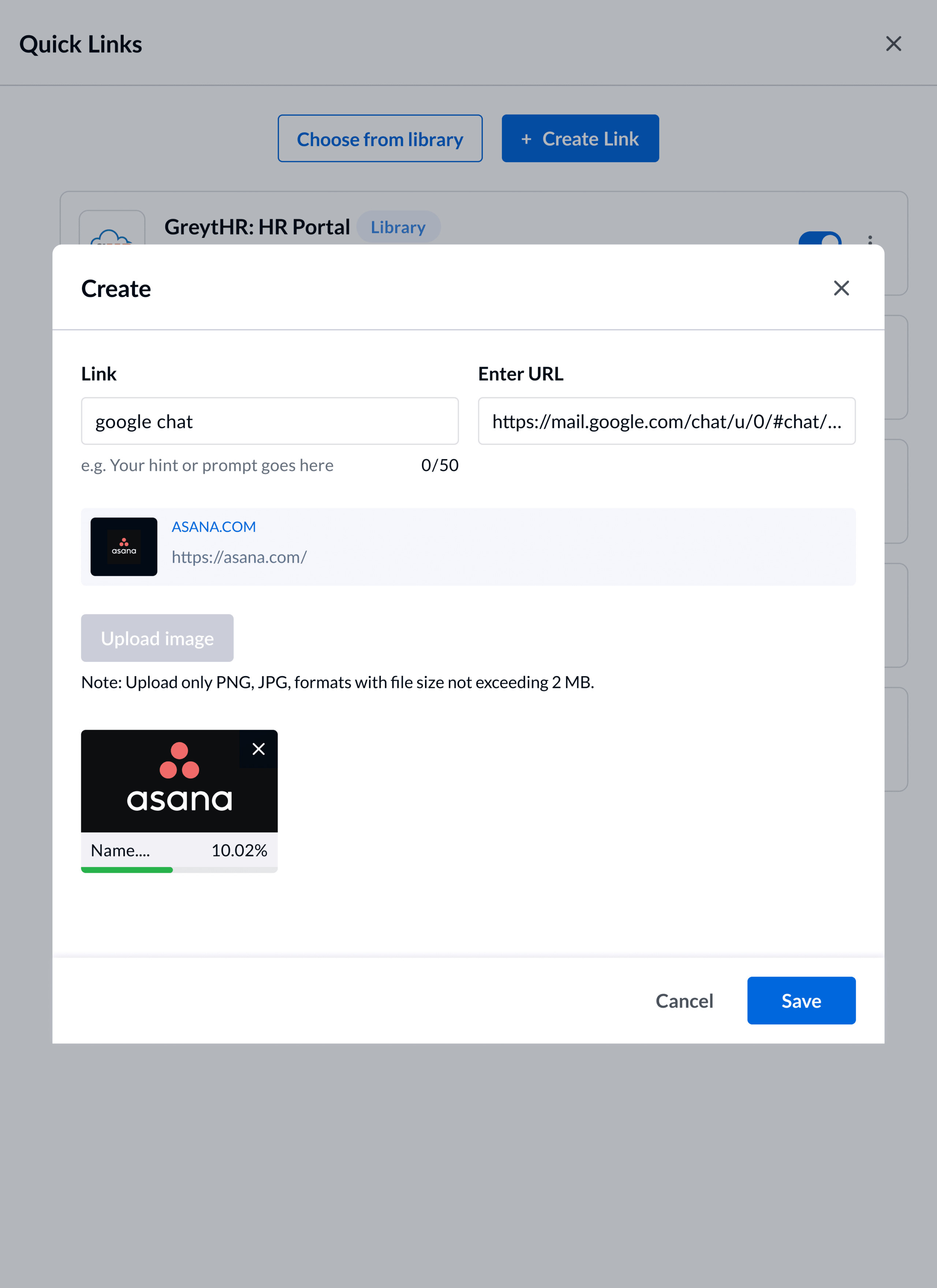
Quick Links

Engagedly homepage features

Admins can create a list of awesome links and add them to the library for everyone to access. Plus, they can pin the most important ones to everyone’s homepage for super easy access. No more wasting time searching for key information – it’s all right there at your fingertips!

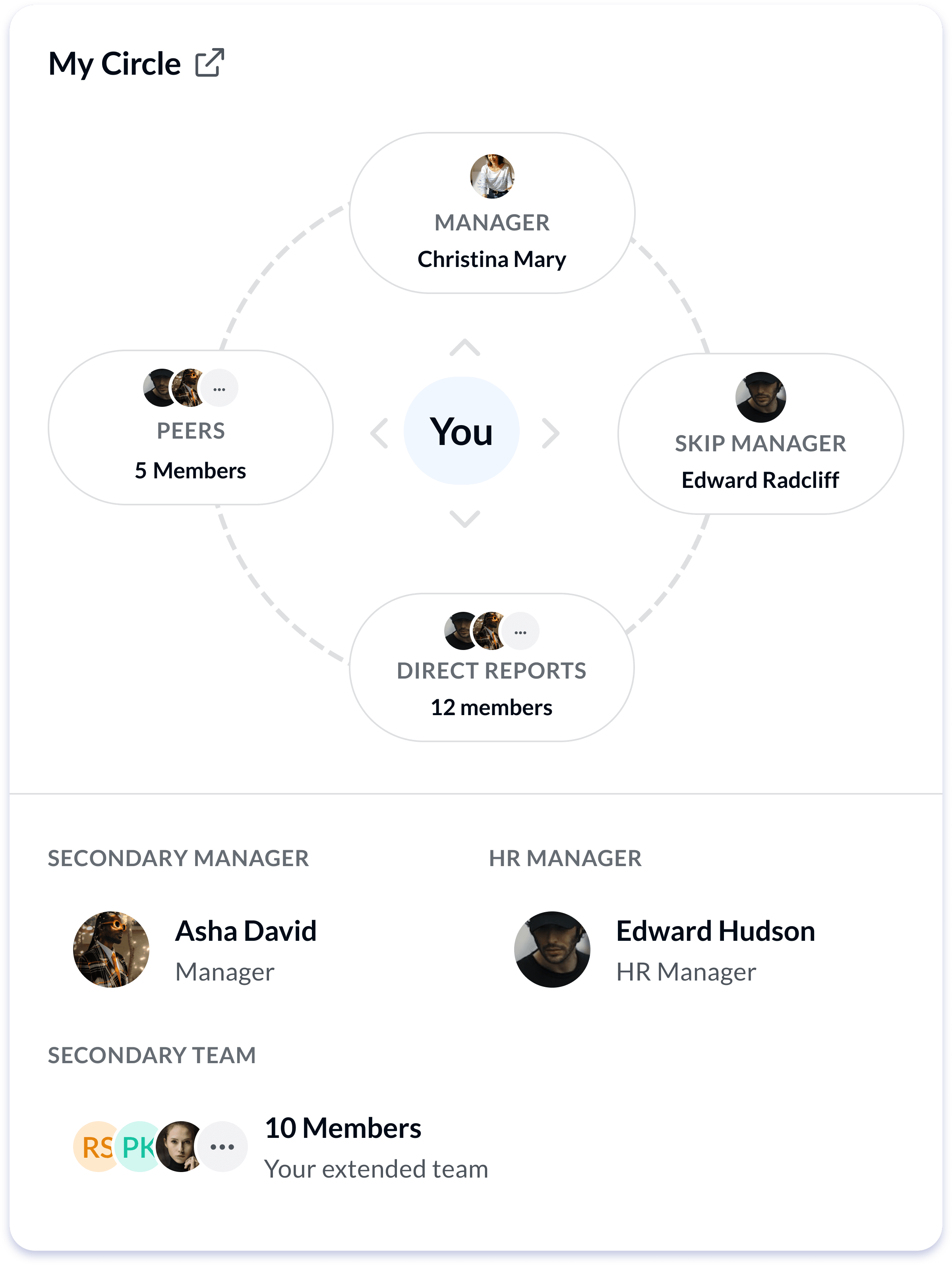
My Circle

Engagedly homepage features

This cool feature right here gives you a quick peek at your reporting structure, so you can understand your role in the organization with ease. No more confusion – just clarity!

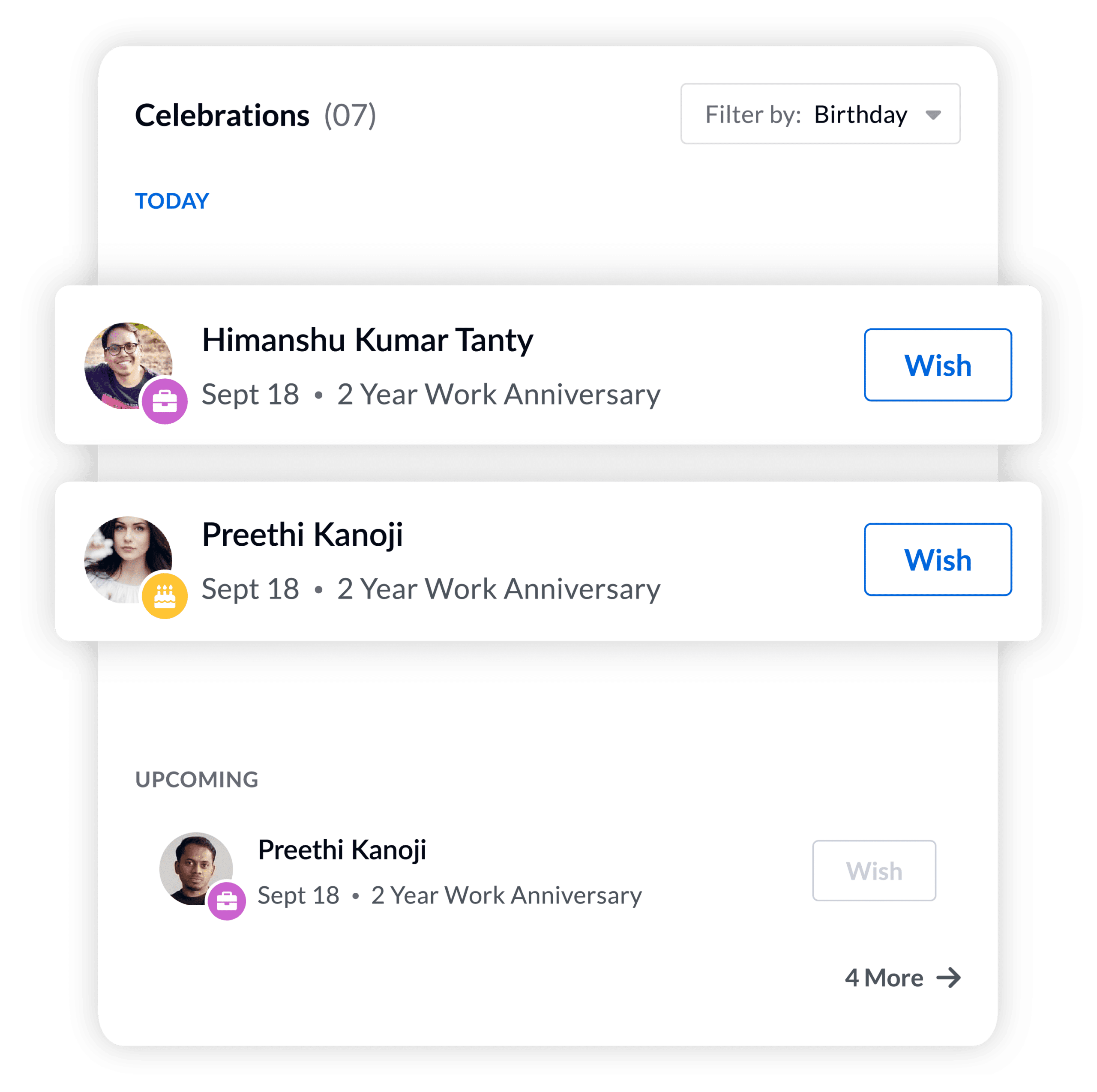
Celebrations

Engagedly homepage features

This latest feature displays upcoming birthdays and work anniversaries on your home page. With this nifty tool, you can plan and organize celebrations with ease, making your colleagues feel extra special and valued. Let’s spread some cheer!

Parting Note

We’ve completely transformed the user experience with streamlined layouts and personalized screens. Now it’s super easy for you to find exactly what you need without any frustration. Our unique features are even more intuitive than before, making your journey through the platform adaptive and effortless. Let’s get started!


6 Reasons in Favor of Fostering a People-Centric Workplace

Wondering what does people-centric workplace mean?

Everyone yearns for a place they can call “home,” and for many employees, the workplace is just an extension of their actual residence. In there, they get to meet, work with, and create bonds with different individuals who eventually become a big part of their lives even outside the scope of their work. But for many businesses, employees are merely resources to achieve an end. Such organizations prioritize the needs of customers at the expense of employee satisfaction. 

A very defective business approach!

We simply can’t neglect the fact that employees are the thin line between an organization and their clientele, and having a team of highly motivated employees increases the efficiency of your workforce. 

Hence, the saying “happy employees lead to happy customers.

Adopting a human-centric culture allows you to empathize with your employees, treat them with respect, and prioritize their needs. Above all, you enhance the relationship with and within your employees and ultimately gain their loyalty. 

The benefits of adopting a human-centered approach are vast, so in this article, you’ll gain deeper insights about the importance of a human-centric workplace. 

How to humanize your workplace

How To Humanize workforce

The concept of a human-centric approach is built on empathy, creativity, and business needs, but in between these three elements lies the 360 feedback software, a product of technological advancement and a sophisticated HR software that allows you to keep track of

  1. Employee progress 
  2. Employee performance metrics and 
  3. Learning simultaneously.

While the concept of human-centric work culture isn’t a new phenomenon, let’s catch a glimpse of what the three elements stand for. 

  • Empathy: is that which showcases the amount of care we have for the people who will be using the workplace environment. It is the ability to fit yourself in the position of your employees while identifying their needs to create better working conditions. 
  • Creativity: We can’t stop being creative since our world is constantly changing and new problems keep arising, so it’s left to us to become intentionally innovative in solving problems such as inferiority complex and lack of connection at work.
  • Business needs: If perfection is our goal, then we must be willing to extend a supportive hand to our employees especially when it comes to enabling collaboration and communication. Setting up a work environment that boosts employee efficiency starts with including them in the design process. 

Benefits of Fostering a human-centric workplace

Committed and motivated individuals

Committed and motivated individualsA human-centric organization treats the employee experience as primary, and that increases the efficiency of the workforce. In fact, Gartner’s research shows that employees in human-centric organizations are 3.8 times more productive than when these practices aren’t implemented. 

  • When employees are fed with the impression that an organization prioritizes its profit margins over their well-being, they lose the zeal and focus to perform their tasks efficiently. 
  • It results in a decrease in overall productivity and affects the revenue generated. 

Keep in mind that employees are the driving force of any organization and must be treated with care. When you cater to the needs of your employees, then it’s just natural that they go the extra mile to impress you. 

Pro tips: 

  • Focus on employee wellness and embrace the hybrid work model 
  • Keep tab on employee progress through OKR meetings
  • Recognize accomplishments and introduce employee benefits packages  

Also read: Harnessing the Power of Employee Advocacy for Maximum Impact

Positive and effective communications 

Positive and effective communications

The role of a manager transcends the scope of work, and the quality of your leadership isn’t just measured by your ability to assign tasks and coordinate your employees but also by how well you can motivate and support them to become better at what they do. 

No matter the type and size of the business, the manager’s top concern should be the welfare of the employees. Provided you are a retail manager and your employees work in shifts, then managing your employees effectively and improving communication with them, as well as creating flexible schedules can be done by using retail scheduling software.

This will enable you to develop a productive and encouraging work atmosphere, since employees have a life outside the scope of work, which directly impacts their productivity at the workplace.

Employees have a life outside the scope of work, which directly impacts their productivity at the workplace. 

  • A human-centric work culture allows employees to share their woes, aspirations, and ideas with their superiors without fear of criticism.
  • While leaders showcase a level of emotional intelligence and servant leadership practices, employees develop a sense of belonging and are constantly inspired to display high levels of effectiveness when discharging their duties. 
  • This promotes an atmosphere of positivity and enhances the flow of communication at all levels of the organization. 

Pro tips: 

  • Create room for constant exchange of feedback and value employee inputs
  • Schedule occasional one-on-ones and skip level meetings

Also read: How to Improve Internal Communication in the Workplace

Highly satisfied customers 

Customer loyalty isn’t built in a day, and it takes a great deal of effort to stay at the top of customers’ minds. 

When you have a team of highly motivated people, employees become more passionate about their work and practice more effective communication modus operandi to meet the needs of your clientele.

The assurance that the organization prioritizes their needs serves as a driving force that increases their efficiency in the workplace. When customers become used to your services and eventually derive the satisfaction they yearn for, what you get is customer loyalty. 

Pro tips:

  • Satisfy the needs of your employees by recognizing and rewarding their efforts and see how they move your business to greater heights. 
  • Show appreciation to employees who are putting in their best.

Increased revenues and organizational growth

Increase in revenue

Employee satisfaction and customer loyalty are important factors that determine the growth of any organization. While the latter is dependent on the former, organizations must strike a balance between the two to reach their full potential.

  • Having an all-inclusive work model where employees and their superiors alike are constantly updated on the company’s progress can ameliorate the engagement and productivity of your workforce. 
  • If you take care of your employee engagement, you can double the business efficiency, which all leads to lasting impact on your customers’ satisfaction. 
  • Organizations can then leverage this as a means to generate more income and step up the growth of their businesses.

Pro tips:

  • Focus on your workforce first and what you get is customer satisfaction, organizational growth and higher profits. 
  • Create learning and development opportunities 

Also read: How to Set and Reach Department Goals?

Increase employee retention rates

Organizations are constantly striving to retain talented employees, but only a few firms understand how profitable a human-centric workplace can be in enhancing the employee work experience.  

Just as organizations will make extra efforts to keep talented employees in their workforce, employees give preferences to organizations that prioritize their well-being and psychological safety. Everyone wants to feel at home at their workplaces and be treated with respect

  • When employees experience setbacks in their workplaces or personal lives, they expect a certain level of empathy from coworkers and superiors in the organization. 
  • Human centric businesses prioritize employee wellness over profit margins, and decisions are made to satisfy the needs of employees. 
  • The long term effect of this is increased employee retention rates and a surge in overall business productivity. 

Pro tip:

  • Streamline company strategies and operations to enhance employee experience. 

Attract talent pools

Attract talent pool


A human-centered work culture does more for you than just retaining employees; it can also be an effective tool in attracting today’s best talents.

Job seekers can be particularly inquisitive when looking for job placement, and many will go to great lengths to conduct background checks on the position and work ethics of the organization they are vying for. 

They want to know 

  • What is achievable within the organization, 
  • How employees are treated, 
  • How conducive the working atmosphere is, 
  • The relationships that exist between coworkers and superiors, 
  • The employee benefits package, and what have you. 

All of these and more are what a human-centric workplace promises for employees. With these, you won’t have to expend much effort to hunt down talented candidates, as they will naturally come to you in myriad ways. 

Pro tip:

  • Create a good first impression in the hearts of potential employees by adopting a human centric work approach. 

Set your course for greatness 

Employees are hardwired to seek out comfortability in their workplace; they want to be reassured that their career path is laced with elements that drive efficiency and not regression. 

Organizations, on the other hand, strive to beat the fierce competition in the business world by way of innovation and ingenuity while relying on the efficiency of their workforce. 

To that effect, the human-centric work model should be an integral part of every business looking to up its game in the global market, as it balances the interests of employees and organizations alike.

While the benefits it brings are unquantifiable, it is the key to unlocking the full potential of an organization.  


Frequently Asked Questions

Q1. What is a people-centric workplace?

Ans. A people-centric workplace is an organization that prioritizes the needs, well-being, and satisfaction of its employees above all else. In a people-centric workplace, the focus is on creating an environment where employees feel valued, respected, and supported, and where their contributions are recognized and rewarded.

This type of workplace culture values open communication, collaboration, and teamwork, and places a strong emphasis on creating a positive and inclusive work environment where everyone feels empowered to do their best work.

Q2. What is an example of people-centric workplace?

Ans. One example of a people-centric organization is Patagonia, an outdoor clothing and gear company. Patagonia has a reputation for being a socially and environmentally responsible company, but it also prioritizes its employees’ well-being and satisfaction.

For example, Patagonia offers its employees generous benefits, including paid parental leave, onsite child care, and an employee health care plan that covers alternative and holistic treatments. The company also encourages its employees to pursue their passions outside of work, with initiatives like its Environmental Internship Program and its Environmental Grants Program, which provide funding and support for employee-led environmental projects.

Patagonia’s commitment to its employees goes beyond just benefits and perks, however. The company is also known for its flat organizational structure and open communication policies, which encourage collaboration and teamwork across departments. And perhaps most importantly, Patagonia’s leadership prioritizes transparency and ethical decision-making, which helps to build trust and a sense of shared purpose among its employees.

Overall, Patagonia is a great example of a people-centric organization that values its employees as much as its customers and the environment.


Author: Rilwan Kazeem

Rilwan Kazeem


Rilwan Kazeem is a freelance content writer, and an enthusiastic one at that. He has been in the writing world for three years. Being an explorer and reader, he engages his readers with in-depth and thought-provoking blogs and articles. 


Mentoring Complete Integration with Engagedly

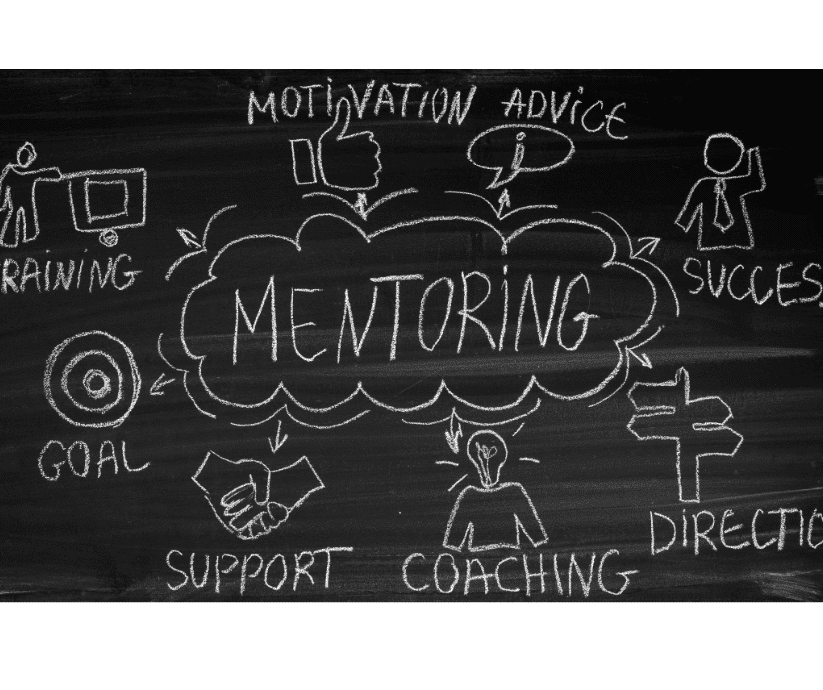
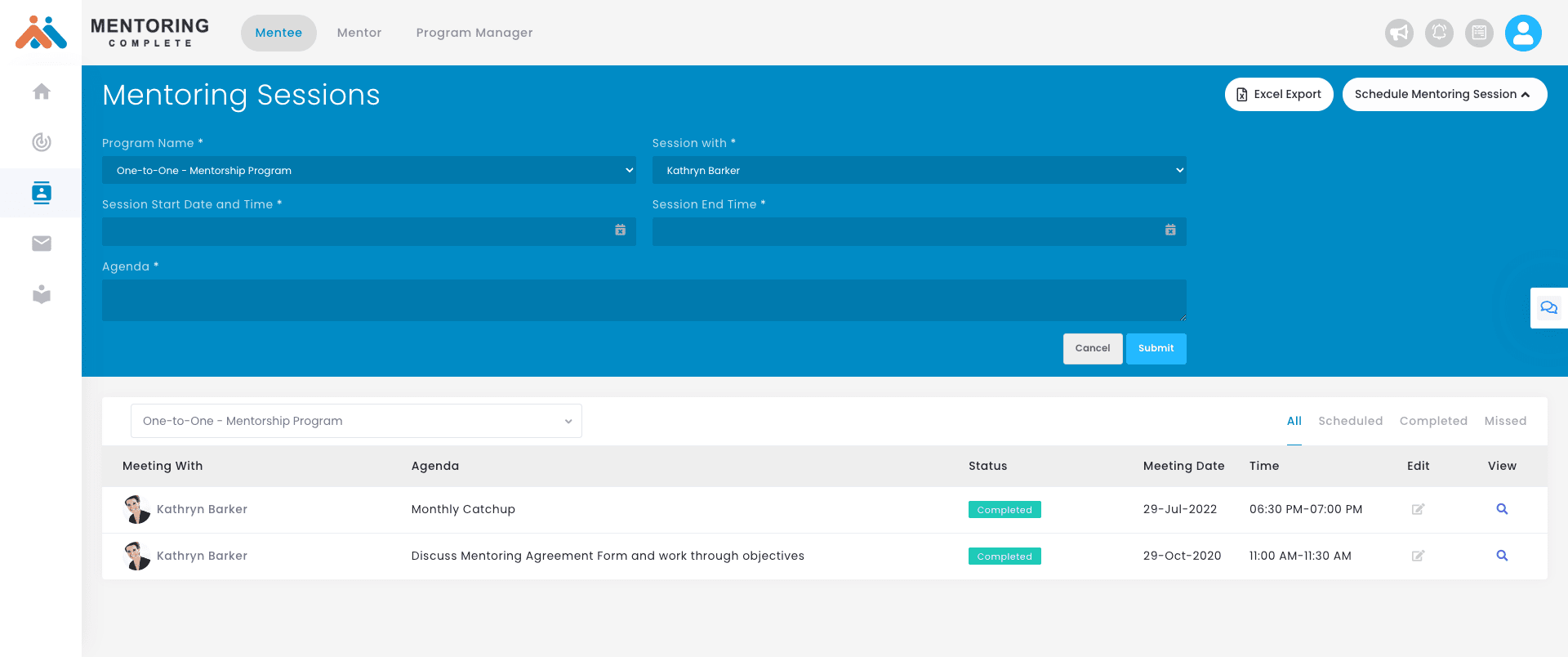
How can companies grow their teams and align them with business objectives? How can companies combine new-age technology with proven growth methods? This problem requires a team effort, and for a collective effort, we give you a collective solution: Mentoring Complete Integration with Engagedly. Measure employee development, and upgrade your people strategy needs by introducing mentoring programs for your employees. It’ll create a knowledge-sharing space where employees can guide other employees to empower them and grow.

Mentoring

What makes an organization worth working at? How does an organization develop a place to nurture a talented group of people? Employee happiness, mental well-being, growth opportunities, delightful work culture, exciting challenges, and e-learning collectively make an organization worth exploring. And once this is done, an organization becomes a well-rounded place to nurture a talented group of people and achieve a delicate balance.

Many people believe that higher compensation leads to happiness at work. However, studies have shown that 36% of employees would give up $5000 yearly to be happy at work! But what will make them happy, if not higher compensation? 

Learning and development are vital in enhancing employee engagement. It leads to a happier workplace when organizations help employees stay aligned with the growing technological advancements so they can grow with the organization.

Need a better solution?

Two significant components of a positive, high-performing workplace culture include boosting your people strategy and leveraging the existing talent within your organization. Engagedly is a people strategy platform, and in Mentoring Complete, a mentoring platform, you will have the tools you need to handle many challenges while overcoming the roadblocks.

When employees feel heard and like their ideas bring value to the conversation, this can bring a transformative impact to your organization. According to a study, 68% of employees & 91% of C-suite executives agree that technology has helped them progress.  

Every organization should look to technology to provide their employees with growth opportunities. Engagedly and Mentoring Complete are the perfect combination of tools to enhance productivity, performance, and potential.

Introducing Mentoring Complete 

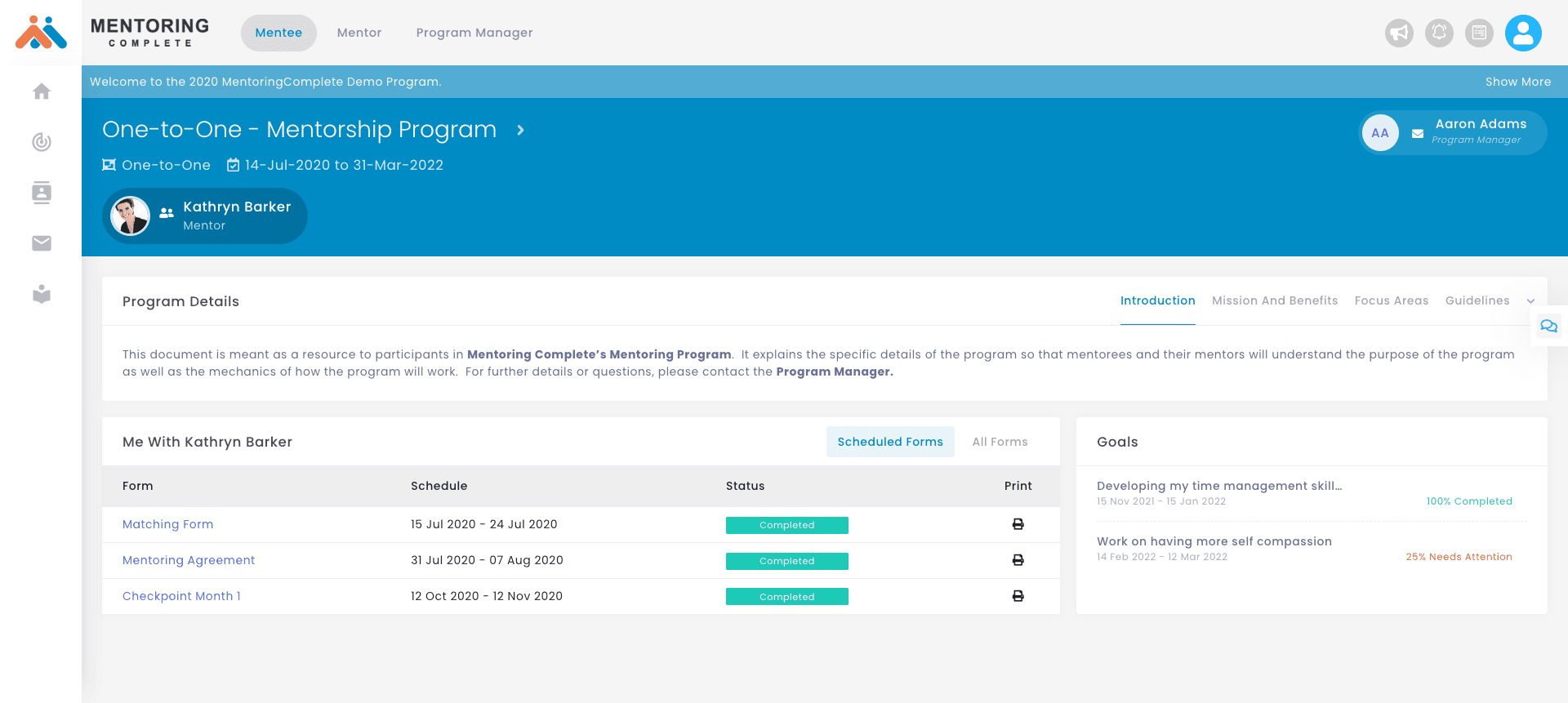
Mentoring Complete is a platform that offers employee development by allowing them to choose a mentor for their professional and personal growth. Organizations can run multiple mentoring programs based on organizational goals and witness productive outcomes. This platform is designed by experts with almost three decades of the mentoring experience.


With Mentoring Complete, you can see your workplace in a new light. Employee productivity will reach new heights, and they’ll be far more creative than before in a mentoring program. That will eventually lead the organization to new outcomes.

Do you know that 88% of employees believe a distinct work culture is essential for a business to succeed? 

And how will you get there? 

It isn’t just about giving salary hikes that compensate for a positive work environment; it’s more about how far you can go to be there for your employees. Again, how can you achieve that? 

89% of business owners acknowledge mentoring as a significant factor in their success. It creates value for employees by speaking up about their perspectives, getting involved in significant business decisions, and adhering to company values. 

What can mentoring programs do for your organization?

Nearly three-quarters of workers consider quitting, and almost nine in ten new hires would readily leave within the first month of joining! But why such severe numbers? A positive or healthy work environment is the key to retaining talent. If we talk about the new joiners, they’ll need time to align with the company culture. But what about the experienced employees? What is impacting their engagement percentage?

Building a positive workplace culture is not a one-step process; it requires time, patience, and unity from employees and management. When new employees are hired, creating an environment where they can learn and act freely is essential. But often, they get stuck because of hierarchies or a chain of command, resulting in being less expressive towards their managers or even other team members. 

For experienced individuals, work could get highly monotonous, which leads them toward loss of interest. Their involvement slowly decreases, and their learning stops, forcing them to look for other opportunities to help them grow. 

Mentoring experiences have proven to be one of the important ways to retain talent. With people from within the organization as their mentors, they can translate their mindset about work, something challenging for them, or even something they want to achieve in their careers. It’s an expressive tool! 

What has Engagedly been offering you?

Being a part of an exceptional people strategy platform Engagedly already, you’re making your efforts count: 

Developing Your Employees 

  • Courses/Certifications
  • Customizable course module
  • Assigning new courses 
  • Learning-based ranking system 

Simplifying Engagement

  • A platform on which they can share ideas
  • Share praises to boost motivation
  • Recognize their achievements & give rewards
  • Helping their network with other team members

Monitoring Employee Growth

  • Monitor their growth
  • Deeper insights on performance 

Aligning Employee Goals with Organizational Goals

  • Create independent goals 
  • Insights on the progress of goals
  • Pin-point on focus areas

Creating a Feedback Mechanism

  • Transparency between management and subordinates
  • Build and share feedback forms
  • Create individual/team surveys 
  • Keep a tab on review cycles

With the growth modules, you’re all set to change your organization positively. However, more is still needed as part of your toolbox. With advanced trends, people are still exploring ways to walk around their daily tasks, handle their work calls and get through economic downturns without impacting their growth. This aspect is changing employees’ perspectives and motivating them to approach new skill sets relevant to the need of the hour. Organizations like yours must be equipped with stead-fast approaches to help employees transition smoothly from such complexities. 

Therefore, we’re bringing something new, positive, transformative, and collective to complete your employee management and development journey. 

Engagedly + Mentoring Complete

Employee development is an essential part of every organizational goal. But it often needs a more suitable medium to get fulfilled. 

How about we give you a complete solution to those challenges without much hassle?

Engagedly is a people strategy product that can help leverage talent to achieve business goals. It aims to bring out the best performance of your people and generate strategic outcomes for your organization. Mentoring Complete caters to building mentoring programs within the organization so that you, as an employer, can leverage the experience and expertise present within your workforce, create a knowledge-sharing environment, and motivate employees to achieve their highest potential. 

Since Mentoring Complete and Engagedly have individual benefits, collaboratively, these can be even more beneficial for your organization. They can set your employees on a journey to help build a solid foundation to face unprecedented challenges and turn them into opportunities.

Engagedly + Mentoring Complete powers a step-by-step approach to help an organization achieve its goals. One identifies the obstacles from an organizational perspective and sets employees toward an excelling path. The other taps into the psychological mindset of employees and transforms their perspectives. Let’s dive deeper into it:

Performance Execution

This solution by Engagedly amplifies the understanding of building a better organizational structure in terms of setting up a review portal for employees. It is wholly templatized so that you can build it for your desired roles. Furthermore, it has customizable and flexible workflows to enable your performance management strategy, OKR, goal alignment, and 9-box distribution to identify potential employees, leading to a more competent and efficient approach to organizational development. 

Mentoring Complete focuses on employee comfort when handling feedback/reviews from management. With a mentor, they’ll be more confident in suggesting their point of view in various projects and business decisions whenever required. Mentoring relationships help employees adhere to their routines to stay productive and equally creative. As an employer, you can organize workplace mentoring programs to curb the communication gap between employees and management. 

Drive Employee Engagement

Better employee engagement in an organization delivers productive results. This product by Engagedly unlocks productive approaches that counter challenges on the way to an organization’s success. Let’s look at some of its offerings: 

  • Upskilling Opportunities
  • Feedback/Communication Platform
  • Gamification Module
  • Create Surveys 
  • Social Platform
  • Employee Recognition Medium

Mentoring Complete is a personal development tool that assigns people a mentor who guides them throughout their mentoring journey. They suggest changes in routine, direct them toward a plan of action, and give them enough resources to build their learning path to gain knowledge and transform their career. Mentoring Complete enhances organizational transparency so employees can talk to their managers about their roadblocks and seek productive outcomes. 

With all of these practices, employees become more engaged in the organization. You can run and align mentoring programs with your organizational goals, explore “Attracting and Retaining Talent” for more details. 

Employee Enablement

Employee enablement is a strategy for motivating employees to deliver high-quality results. With Employee Enablement by Engagedly, your organization can bring effective change, leading to holistic success. 

It helps transform employees’ perspectives with Feedback Solutions (Real-Time Feedback and 360/multi-rater Feedback), Online Learning Portal (LMS), and Gamification methods. Putting these into practice, you can enable your employees to amplify their career prospects and produce better outcomes for themselves.

Feedback mechanisms promote transparency between the management and subordinates, improving employee performance and helping an organization grow. On the other hand, learning software, such as LMS and Gamification methods, works collaboratively to help employees develop their skills.

Mentoring Complete caters to a holistic employee development journey; it creates a space where mentees/employees can express their concerns to mentors, learn ways to recover from them, and push themselves toward personal growth. Feedback is often viewed as unfavorable; it happens when there’s no healthy mechanism set.

Mentors can guide mentees/employees with ways to utilize feedback positively from their managers. It generates a peaceful environment at work and enhances the productivity of employees. With Mentoring Complete, you can build goal-oriented mentoring programs and capture the smallest to most severe obstructions on your way to growth.

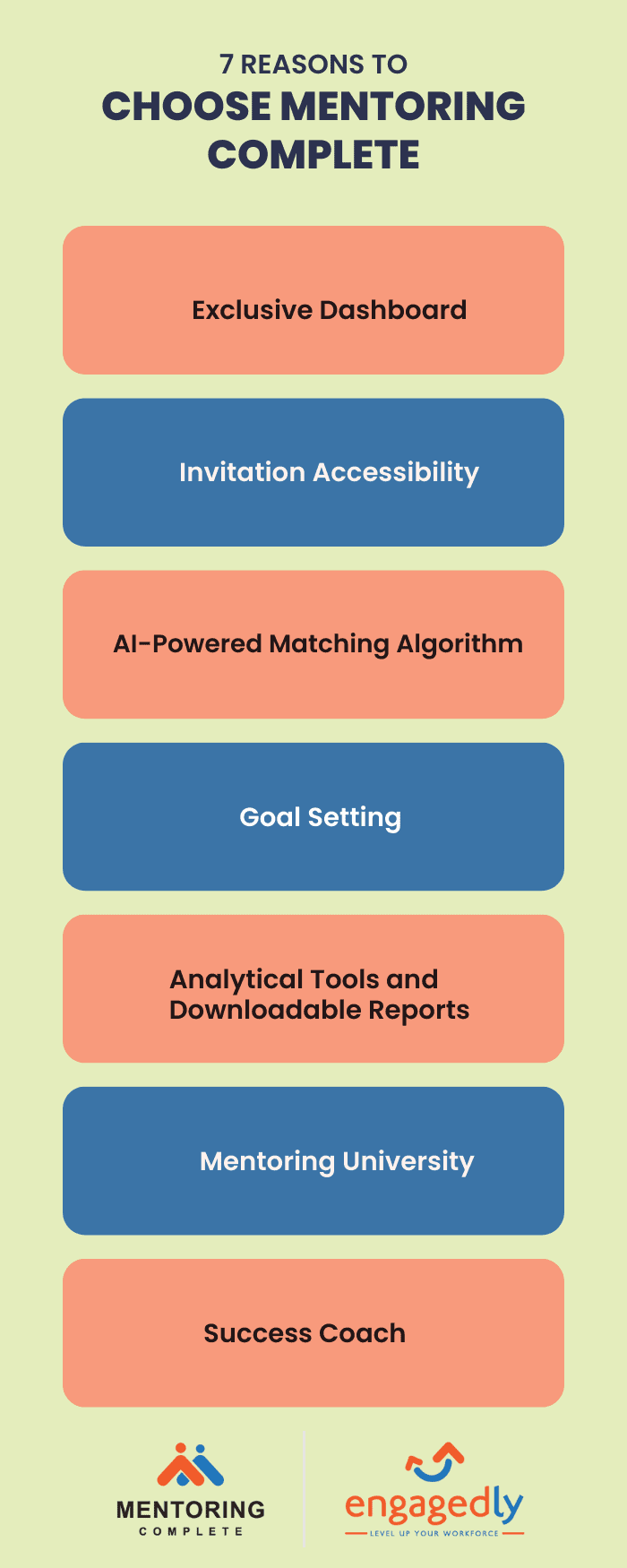
Why choose Mentoring Complete?


We’re here to help you experience quality products and services so that you can always be proud of your decision to opt for our product. We believe in a simplistic yet technology-driven lifestyle when managing your employees. You can invest your time building mentoring programs that align well with your organizational goals rather than learning about the software. Below are a few of our offerings that you will experience within the product:

Exclusive Dashboard

The Mentoring Complete platform is feature-rich to manage mentoring relationships of your employees smoothly. It doesn’t matter what program you’re running; its inclusiveness makes sure that you’re not spending much of your time while navigating throughout. 

Invitation Accessibility

The platform offers organizers ease of use functionalities, including Program Invitations. They can use this function to invite people within their organization to the platform as mentors or mentees, up to their comfort. This tool allows them a free hand over how expansive they want; they can send emails individually or use the public invite option. 

AI-Powered Matching Algorithm

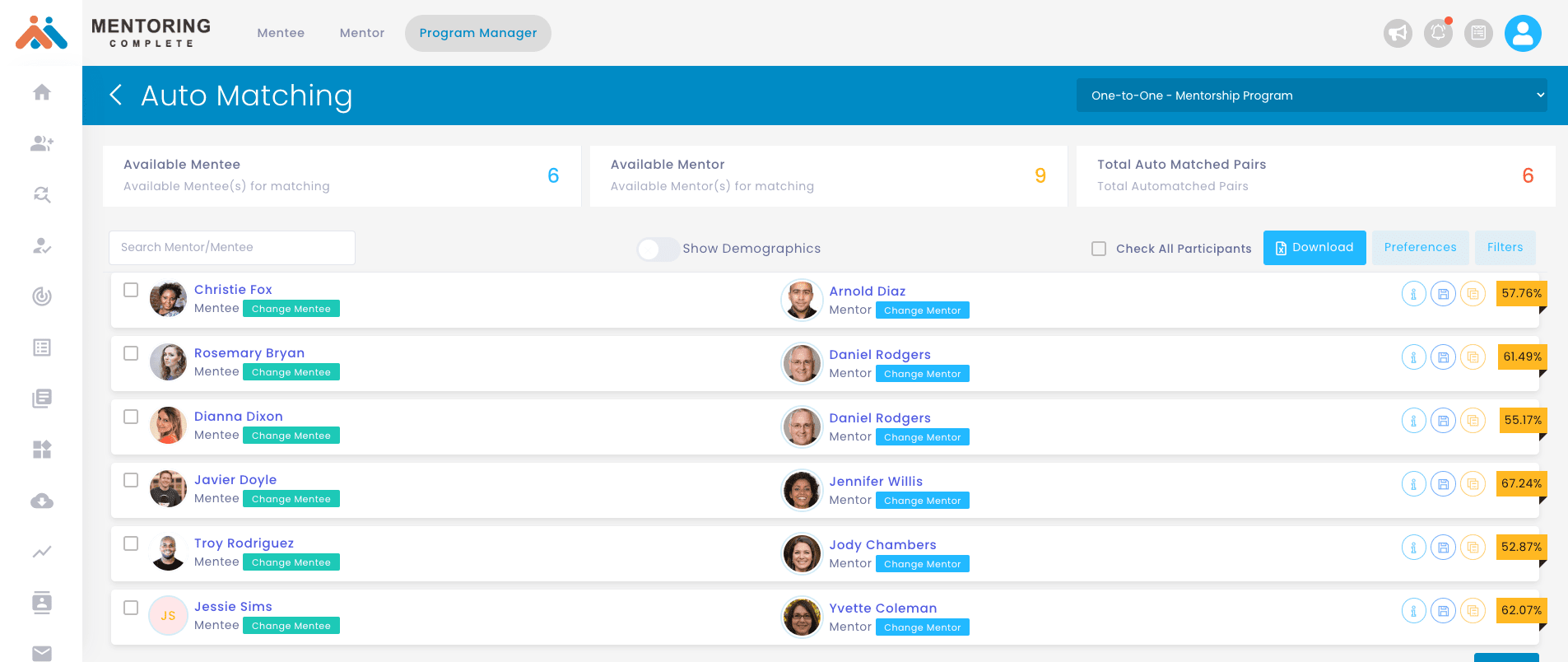
The matching of mentors and mentees is powered by our AI-powered Precision Matching tool. Once the employees/members are registered in the platform, the matching process starts. This tool matches two individuals’ percentages based on two roles, i.e., a mentor and a mentee. The precision Matching tool has an accuracy of making more than 90% successful matches. 

Goal Settings

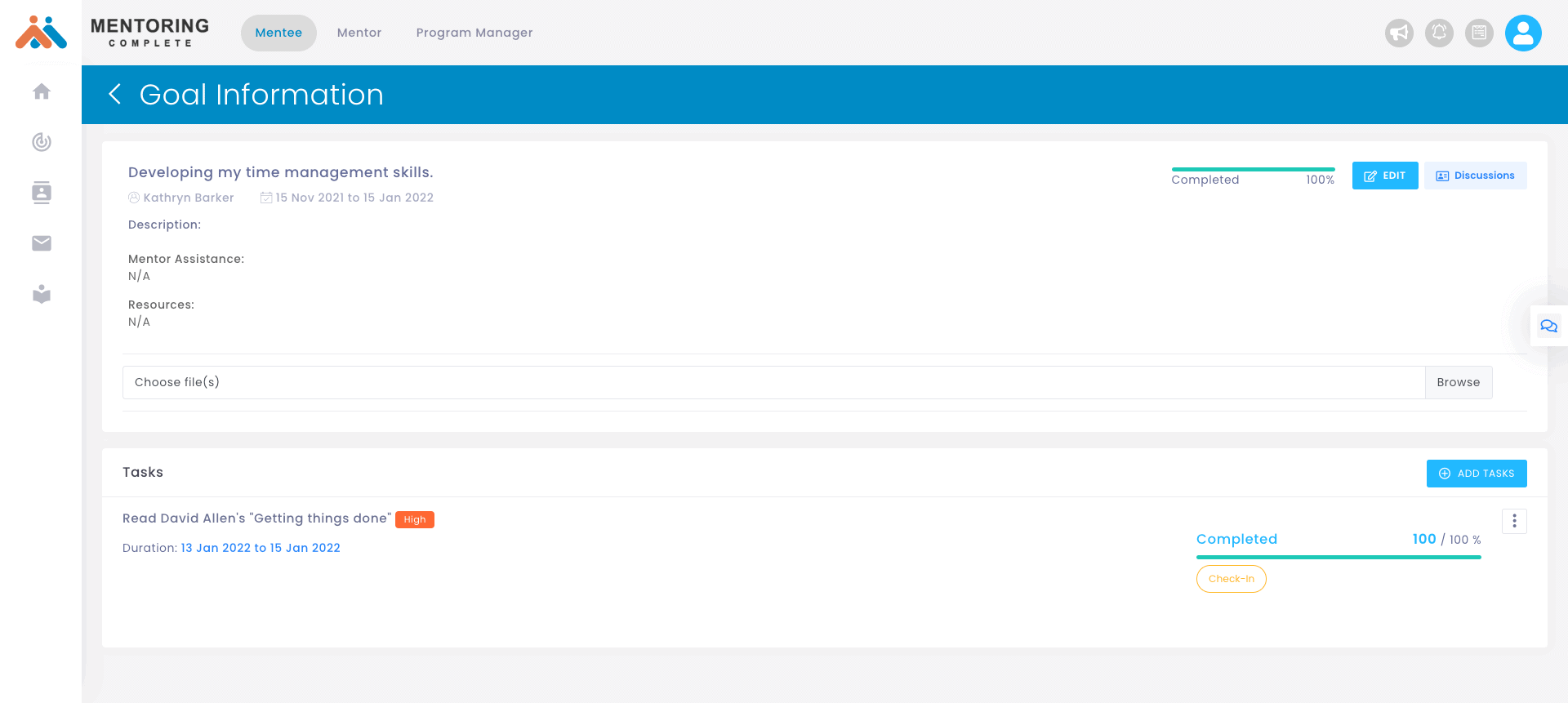
This setting fabricates a motive for a mentoring relationship. Only mentees will have access to configure and set their goals or what they expect from this mentoring relationship. Once they lock in their goals, mentors and program managers can overlook them. Goal setting aims to provide mentors a direction to evaluate the following steps, questions, relevant resources, and more so that the relationships can become transformational for mentees.  

Analytical Tools & Downloadable Reports

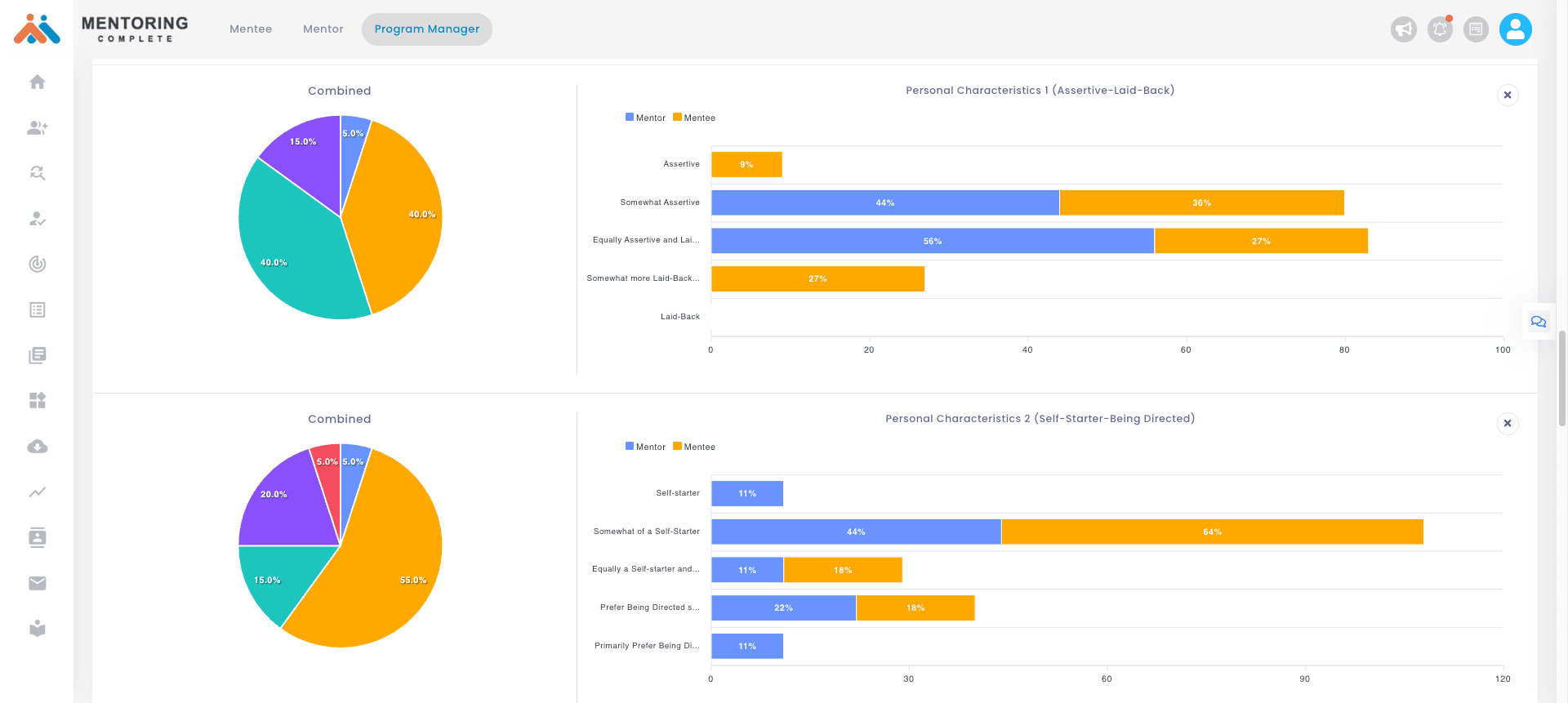
The Mentoring Complete platform is built to help organizations succeed, especially on the most critical front, employees. Program Managers/Program Organizers will have admin access to the platform to navigate any mentoring relationship and interfere if there’s any lag. They can view the relationship’s analytics on the platform, download the reports, and configure their next steps accordingly. 

Mentoring University 

Learning is one thing that never stops. Therefore, with the Mentoring Complete platform, you will be eligible to help each organization member explore different mentoring courses. Mentoring University includes courses/certifications for Mentees, Mentors, and Program Managers/Organizers, so everyone can stay engaged and learn. 

Success Coach

To make your experience smoother, we will assign a Success Coach to help you navigate through the software and explain all the features so that your experience stays fluid. Your success coach will understand your organizational goals and suggest mentoring programs that align well with those. 

Even if you are a first-timer to mentoring software, we have compiled a list of mentoring programs that can fit your organizational needs. And if these fit somewhere within your goals, then your success coach will help set up.

Mentoring Programs that you can run: 

  • Mentoring Programs for Workplace
    • Leadership Mentoring
    • Career Mentoring
    • Diversity Mentoring
    • Reverse Mentoring
    • Group Mentoring
    • Flash Mentoring
  • Mentoring Programs for Academia 
    • Student Mentoring
    • Alumni Mentoring
  • Mentoring Program for Professional Associations
    • Career Mentoring
  • Mentoring Program for Non-Profit Orgs

Engagedly + Mentoring Complete will give rise to the sustained growth of your organization. From technological relevance to the psychological growth of an employee, these can bring positive change within the organization. It’s time to take employee development up a notch!

Significant outcomes are usually achieved with collaborative efforts. Therefore we bring you Engagedly + Mentoring Complete, gain collective benefits, and accomplish your organizational goals without hassle. Talk to our experts, resolve all your doubts, and opt for a free trial now! Pay only when you feel confident!


Hello from Marissa™ AI – Your AI Enablement Coach

Who Is Marissa™ AI?

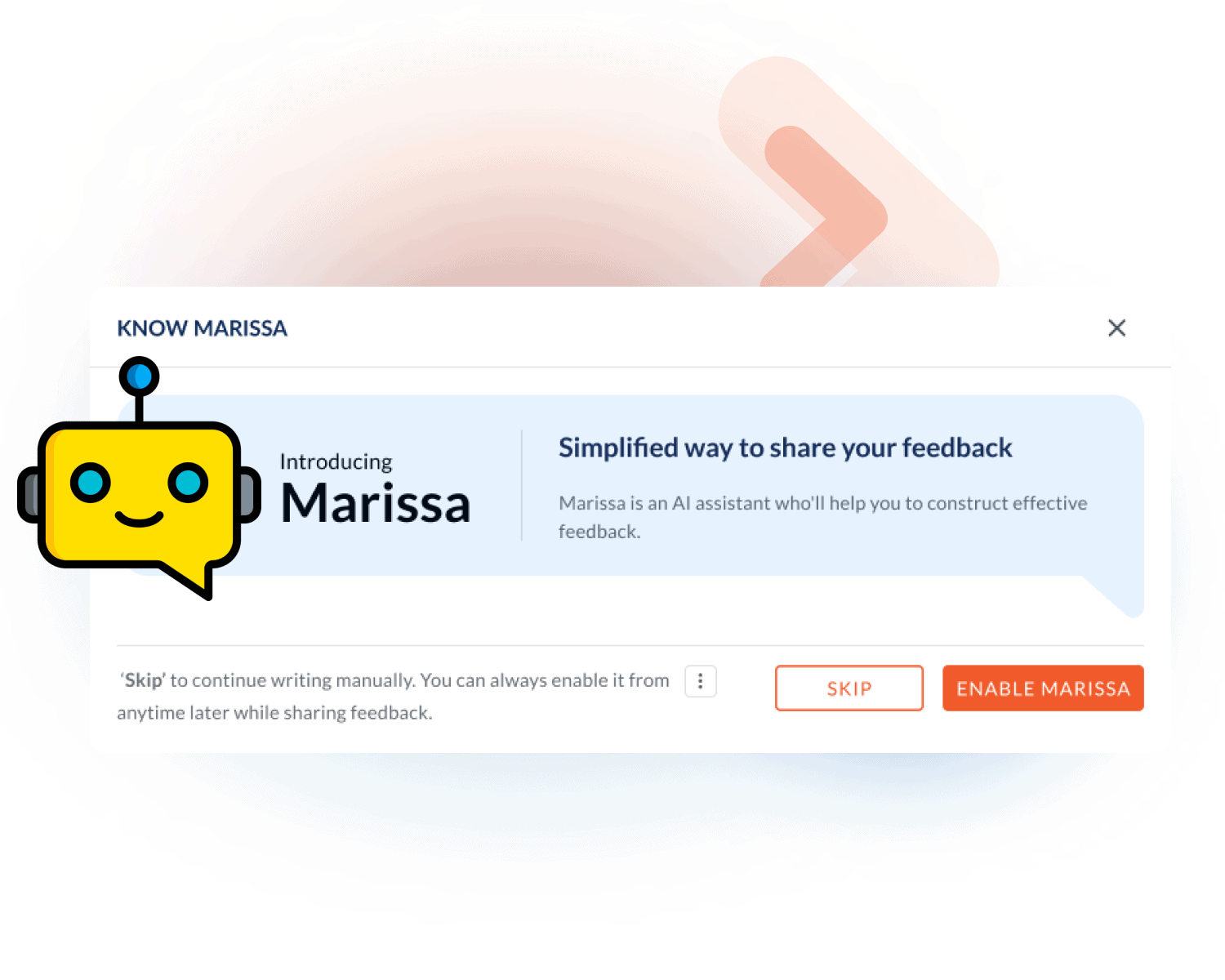
Marissa™ AI is the AI enablement coach and a game-changing tech that’s transforming the world of talent management.

Marissa™ AI is a new approach that uses contextual AI to create a highly engaged and high-performing organization. It’s designed to help employees, managers, and HR leaders build a better workplace where everyone can grow and excel in their roles.

Marissa AI

With Marissa™ AI, your AI enablement coach, employees have the tools they need to succeed. They can get personalized coaching, feedback, and career advice tailored to their strengths and skills. This helps them stay motivated and engaged, which leads to better performance and job satisfaction.

At the same time, Marissa™ AI empowers managers and HR leaders with the data they need to make informed decisions about talent development. 

They can track employee progress, identify areas for improvement, and create targeted training programs that help everyone reach their full potential.

Overall, Marissa™ AI is revolutionizing talent management by making it more personalized, data-driven, and effective. It’s a powerful tool for anyone who wants to build a better workplace, improve performance, and unlock the full potential of their team. So why not give it a try and see how it can help you and your organization thrive?

Also Read: Benefits of Talent Management Software for Your Business

Marissa™ AI – Your Feedback Ally

Giving constructive feedback can be quite challenging, but don’t worry, Marissa™ AI is here to help. 

Constructive feedback is vital to personal and professional growth, and it’s essential to have a strategic approach when giving it.

Feedback

Feedback can often be misinterpreted, causing defensiveness or resentment. That’s why Marissa™ AI is your ultimate feedback ally! With this AI enablement coach, Marissa™ AI, you can give impactful feedback that’s contextually relevant and will help your team unlock its full potential.

Also Read: Everything You Need to Know about 360-Degree Feedback

Marissa™ AI makes giving feedback a breeze. You can trust her to guide you through the process of providing feedback that is actionable and helps your team members grow. With Marissa™ AI, you can approach feedback with confidence and ease, knowing that you’re giving the proper feedback in the right way.

So, if you’re struggling to give constructive feedback or want to improve your feedback-giving skills, turn to Marissa™ AI. She’s the perfect tool to help you give feedback that inspires growth and success in your team.

How Is Marissa™ AI a Game Changer?

Objectivity and Precision

Are you tired of giving feedback that leaves your employees feeling fearful or defensive? Look no further than Marissa™ AI..your very own AI enablement coach!

With Marissa™ AI, managers and leaders can give feedback that builds trust and fosters positive workplace interactions. 

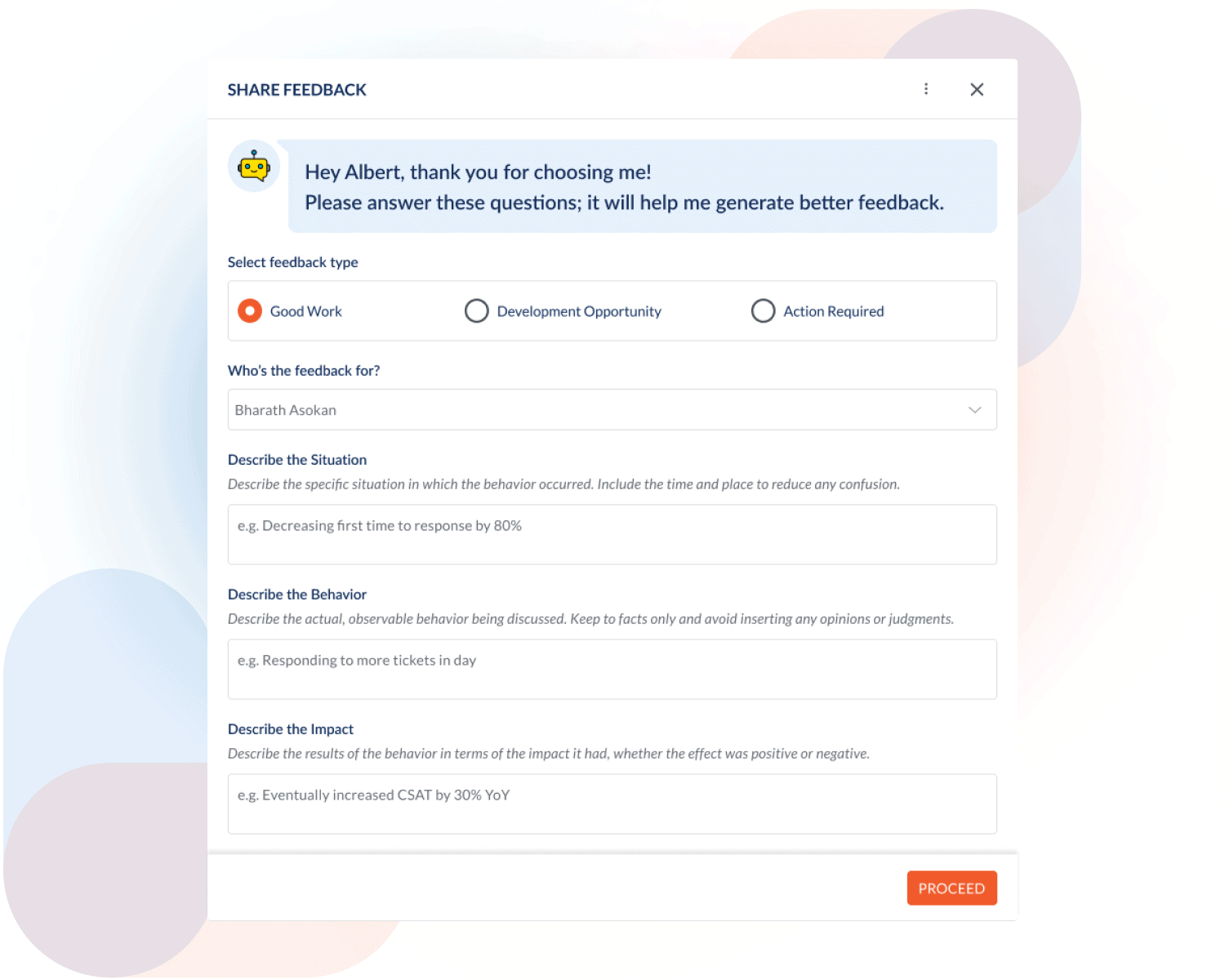
How does it work? Marissa™ AI utilizes the SBI (Situation, Behavior, Impact) framework to ensure that feedback is accurate, objective, and unbiased. By focusing on the specific situation, behavior, and impact of an employee’s actions, Marissa™ AI helps to create a clear and constructive feedback experience. This allows managers and employees to realign their expectations and work toward desired results.

Situation-Behavior-Impact Framework

By fostering communication and trust between managers and employees, Marissa™ AI can help to improve workplace culture and productivity. So why not give it a try and see the positive impact it can have on your team?

Contextual and Constructive Feedback

Marissa™ AI takes into account the context of each situation and analyzes the employee’s behavior and its impact. This helps the tool to identify specific areas that need improvement and provide tailored feedback that is both relevant and actionable.

One of the biggest advantages of Marissa™ AI is that it allows managers and leaders to give feedback without jeopardizing candor. This means that they can provide honest and constructive feedback that is focused on improving performance, without worrying about how it might be received.

With Marissa™ AI, managers can create momentum for their team members, helping them to grow and develop in their roles. By providing feedback that is relevant and actionable, Marissa™ AI helps to ensure that everyone is working towards the same goals and making progress together.

Overall, Marissa™ AI is an invaluable tool for managers and leaders who want to provide effective feedback that helps their team members grow and succeed.

Real-Time Feedback

Have you ever needed help with giving feedback to your team members? Maybe you’re not sure how to phrase it, or you’re worried about coming across as biased. Well, fear no more! With Marissa™ AI, managers and leaders can generate impactful feedback in just a few minutes.

This is a game-changer when it comes to providing real-time feedback to your team.

Real-time feedback

Instead of worrying about how to communicate your message effectively, all you have to do is input some prompts based on the Situation-Behavior-Impact (SBI) framework, and Marissa™ AI will do the rest. You’ll get accurate, contextual feedback that can help address performance issues before they become bigger problems.

Gone are the days when you had to struggle with communication barriers or potential prejudices. With Marissa™ AI, you can provide feedback that is both helpful and objective. So why not give it a try? Your team will thank you for it!

Employee Growth & Development

We all know that feedback is crucial for improving our performance and achieving our goals, right? But sometimes, getting feedback can be uncomfortable or ineffective. That’s where Marissa™ AI comes in.

With Marissa™ AI, employees receive feedback that is tailored to their specific strengths and weaknesses. This feedback is based on critical events and actions, so it’s relevant and actionable. By providing practical insights, Marissa™ AI gives employees clear direction on how to improve their skills and take steps toward their goals.

attaining goals

The best part? Marissa™ AI‘s feedback is precise and personalized, so employees feel empowered and motivated to make positive changes. And as we all know, a positive change can lead to real growth and development.

Overall, Marissa™ AI is a valuable tool for any employee who wants to progress in their career. It provides insightful feedback that helps them build skills, set goals, and achieve success. 

Also Read: The Value of Employee Development in the Modern Workplace

Trusting and Positive Work Environment

Have you ever felt like communication in your workplace could be better? Your team could collaborate more effectively, but you’re unsure how to make it happen. Well, that’s where Marissa™ AI comes in!

Marissa™ AI is all about building stronger relationships between managers and employees. We believe that trust, communication, and growth are key to creating a productive and positive work environment. By providing valuable feedback and insights on progress, managers become trusted partners in their employees’ journey toward success. This means that instead of feeling defensive or blaming others when problems arise, teams can tackle challenges with openness and constructive dialogue.

The result? More effective collaboration, greater productivity, and a shared sense of purpose. With Marissa™ AI, your organization can unleash the power of trust and communication to drive meaningful progress and success.

How Does Marissa™ AI Work?

How Marissa AI Works

Parting Note

With Marissa™ AI, you can say hello to a powerful tool that helps you unlock your team’s full potential!

Marissa™ AI makes providing constructive feedback a breeze. We generate personalized feedback for each team member that speaks directly to their strengths and areas for improvement. This means you can nurture and inspire your team members to reach new heights of success, without feeling overwhelmed or unsure of how to help them.

Our tool is your trusted feedback ally in building highly engaged, high-performance teams. With Marissa™ AI, you’ll be able to provide feedback that your team members can use to improve and grow, rather than feeling demotivated or discouraged.

So, why not give Marissa™ AI a try and see the difference it can make for your team? We’re confident that you’ll love the results!


Get In Touch With Us


Go from Me to We with Team Pulse!

Are you a manager or leader looking to bring out the best in your team? Do you need help engaging and retaining your employees in remote or hybrid work modes? It’s true leaders and managers have a lot on their plate when it comes to driving performance and engaging their employees at the same time. But here’s the thing – managers can’t just sit back and oversee their team’s tasks. They need to actively engage with their employees and build strong relationships. And that’s where listening tools like Engagedly’s Team Pulse come in handy.

Team Pulse is a fantastic tool that helps managers get real-time feedback from their team on a recurring basis. This means that managers can identify bottlenecks and issues that might be hindering productivity and take action to resolve them promptly.

Team Pulse

Now, you might be wondering, do managers really need to have frequent meetings with their team to deliver results? The short answer is no. While meetings are important, they can be time-consuming and inconsistent. Listening tools like Team Pulse can help managers stay in touch with their team’s needs and identify areas for improvement without having to schedule endless meetings.

Overall, listening tools like Engagedly’s Team Pulse are a game-changer for organizations. By giving managers the ability to understand their team’s needs and take the right initiatives promptly, these tools can help boost employee engagement and drive better results. 

Also Read: Best Employee Engagement Strategies for a Better Workplace

Why Go with Team Pulse?

  • Pulse on Your People

Are you tired of constantly putting out fires in your team? Team Pulse is here to save the day!

With Team Pulse, you can stay on top of all the bottlenecks, demotivating elements, positive feedback, and critical issues that your team faces. No more guessing or hoping for the best. You’ll have your finger on the pulse of your team’s needs and ideas on a continual basis.


Team Pulse Questionnaire

But wait, there’s more! Team Pulse doesn’t just keep you informed, it also empowers you to take prompt and necessary action before it’s too late. That’s right, no more procrastinating or dragging your feet. With well-informed decisions and prudent actions, you’ll be able to tackle any challenge that comes your way.

So, say goodbye to firefighting and hello to a more proactive and efficient management style. Try Team Pulse today and see the difference it can make for you and your team!

  • Going the Right Way

Have you ever wondered what your team really thinks about your organization’s culture? Are you racking your brains to discover what changes you can make to improve retention rates? With Team Pulse, you can perform smart pulse checks at regular intervals and get valuable insights from different demographics. And let’s be real, who doesn’t love a good demographic breakdown? 

Plus, Team Pulse gives you a razor-sharp view of your work culture, so you can make informed decisions on where to focus your efforts. Ask your employees anything you need to know in a pulse survey! 

But wait, there’s more! Team Pulse also helps with change management, so you can reduce attrition rates and keep your employees happy. It’s like having a secret weapon in your HR toolkit.

Also Read: Positive Work culture: What It Is and How to Build It

  • Works Like a Charm

Think of Team Pulse as your organization’s personal clockwork. With a few simple clicks from your admin, you’ll be on your way to launching weekly pulses that will help you better understand your team’s thoughts and feelings. All you need to do is submit your responses before the submission date.

But wait, there’s more! Your managers can get in on the action too by reviewing the questions provided by the admin and adding their own, specific to their team’s needs. This means you’ll get to know exactly how your teammates are feeling about their work, which will help you all grow and succeed together.

And don’t worry, managers will be reviewing your responses and starting conversations with you and your team if necessary. 

  • Freedom to Remain Anonymous

Team Pulse is not just your average feedback platform. It’s a place where you can provide transparent feedback or even stay incognito and give anonymous feedback. That’s right, no more worrying about your boss breathing down your neck. 

With Team Pulse, you can finally let your true thoughts and feelings out without any consequences. Don’t like the way your manager handles your team meetings? Well, now’s your chance to say it without anyone knowing who you are!

And if you’re the boss, you can use Team Pulse to get direct feedback from your employees without involving their managers. That way, you can get an accurate picture of what’s really going on in the trenches and make informed decisions to improve your organization.

So, whether you’re an employee or a boss, Team Pulse is the perfect place to provide feedback in a safe, honest, and anonymous way. 

  • Enhanced Employee-Manager Rapport

With Team Pulse, managers can reach out to their employees frequently, not to be nosy, but to understand their issues and seek their views. Say goodbye to the days of feeling like you’re shouting into the void because your opinions matter and your managers want to hear them.

Plus, with real-time feedback, managers can take quick action to solve problems and prevent them from happening again. 

Manager review on Team Pulse

And employees, get ready to feel seen and heard. Team Pulse is the most convenient way to connect with your team and build trust with your managers. No more awkward water-cooler conversations or passive-aggressive emails. Just honest, open communication leading to a happier, more productive workplace.

  • Transparency Like Never Before

Team Pulse is all about creating an environment where employees can speak their minds without fear of judgment. You can collaborate with your coworkers and managers, share your ideas, and work together to achieve your goals. 

Managers also benefit from Team Pulse’s transparent culture. They get a clear view of what their team wants and needs, which makes it easier to spot problems and come up with solutions. No more guessing games or assuming what your employees are thinking. With Team Pulse, everything is out in the open.

Why Now?

Currently, we have tools to Enable Development, Execute Performance and Engage Employees. However, the missing piece of the puzzle is a set of Listening & Measurement tools that will help the organizations to identify the challenges faced and take the right initiatives.

Team Pulse is a listening tool for managers to get real-time feedback from their team that’ll help them identify bottlenecks and take them to closure. Technically, it is a recurring set of questions sent out to employees on a set frequency.

Engagedly’s Team Pulse enables your organization to listen to employees throughout their lifecycle. It consistently gives you invaluable insights straight from your people, which would help you act on time and take appropriate decisions that would accelerate the growth of your organization. It works in three steps- Listen, Analyze, and Take Action!  

Team Pulse Features

How Team Pulse works

Engagedly’s Team Pulse is flexible in its approach to problem-solving and can adapt to organizational needs. Listed here are the features:

  • Admins add questions for the organization: Question library/Create questions

  • Pinning questions

  • Managers are allowed to add questions for their respective teams

  • Collecting anonymous responses

  • Adding questions from E10 in Team Pulse

  • Awarding points

  • Viewing resource center – (View Goals)

  • Viewing response history

  • Manager reviews

  • Commenting on responses/Adding people to conversations

  • Leaderboard and Nudge

  • Viewing, comparing, and downloading reports

Final Thoughts on Team Pulse

According to research done by Microsoft, ‘when managers help teams prioritize, nurture their culture, and support work/life balance, employees feel more connected and are more positive about their work.’

Achieving this depends on the frequency and quality of the team’s interactions, for which meetings are no longer the best way for managers. There are much more effective ways, including having fewer meetings altogether.

With Team Pulse, you can listen to your employees throughout their entire lifecycle, from onboarding to offboarding, and everything in between. 

Team Pulse provides you with valuable insights straight from the source – your people! You’ll have access to information that will help you make informed decisions and take action in a timely manner.

Real-time employee engagement

Say goodbye to the days of being in the dark about what your employees want and need. With Team Pulse, you’ll be able to accelerate the growth of your organization by responding to employee feedback and making the necessary changes.

So why wait? Start using Engagedly’s Team Pulse today and show your employees that you’re listening! Let’s get Pulsing!


AMP It Up with Engagedly

Aren’t you tired of juggling hundreds of apps to track employee communication and drive employee feedback? Log in to one app to share feedback and praise on a job well done; log in to another to set your goals and track them; and then yet another to communicate with the entire organization. Well, those days are done. Gear up to AMP up with Engagedly.

We have the genie in a bottle that’ll pack all those tedious and tiresome actions in just one place- your Email. 

By integrating its modules with AMP‘s unique characteristics, Engagedly simplifies your work. Now, complete numerous tasks on Gmail or MS Outlook, such as taking action, participating in conversations, fostering interactions, and boosting involvement. Along with saving you time and effort, it greatly lowers app overload.

How does it do what it does?

Previously, you had to log in to one portal to share feedback, another to post surveys, and maybe another for internal communications. Fret no more. Now, with AMP emails, you can interact dynamically with content directly in the email message. Talk about easy breezy interaction with no app overload! 

Also Read: The Ultimate Guide to 360-Degree Feedback in the Workplace

The modern app functionality is now accessible via email. Thanks to AMP for Emails, senders can now integrate AMP components and create rich, engaging emails. This dynamic email format offers a subset of components for usage in email messages.

How good is it?

  • The fun and engaging way to encourage engaging conversations

  • Promotes interactions and increases participation or completion by 2x

  • Picture of convenience with no app overload

  • Friction and procrastination take a nosedive

  • Fosters two-way communication

  • Interact and take actions directly from the mail

  • Major time-saver

  • No more context switching

Looking for more AMP advantages? Here you go!

Feedback faster than Flash!

Faster feedback from email with AMP and Engagedly

Enjoy the power of interactive emails in your Google or Microsoft Workspace with Engagedly. You may answer, nudge, and leave a comment directly from the inbox thanks to AMP’s cutting-edge technology. Responding to requests for feedback is quick and done while on the go when you AMP up with Engagedly!

Simplicity leads to productivity!

Track goals from email with AMP and Engagedly

Track your goals, engage in target-oriented conversations, and update your progress… all in one place. That’s right, inside your Gmail or Outlook inbox. Save time to dig deeper into your goals and achieve them with ease. It really is super convenient to goal it away on G Suite email. 

Also Read: 7 Reasons Why Goal Setting Is Important

Super quick pat on the back!

Do you need to compliment someone, thank them for a compliment, or wish to like or comment on a compliment? Do all that and everything all at once, in one place! 

Praise your coworker from email with AMP and Engagedly

Has your team or a colleague given you the report well in advance? Praise them directly from your Gmail or Outlook.

Social on the go!

Interact with your colleagues, keep track of important announcements, write a post, leave a comment, and share views with up-vote/down-vote acknowledgment – without breaking your rhythm of work. How? Because it’s all done on G Suite email or Outlook. In a nutshell, it redefines convenience. All thanks to Engagedly’s Social platform!

No more skipping surveys!

Short and quick surveys with AMP and Engagedly

Another cumbersome survey to take? So much work to do and on top of that a survey to complete? Turn that frown upside down. AMP makes sure that you never miss out on surveys as it brings them right into your Google or Outlook workspace. 

You can now respond to surveys, weekly team pulse, and engagement surveys… right from your Google or Outlook Workspace. It also accelerates your survey response rate with Engagedly’s interactive surveys. When it comes to surveys it’s time to say, “Yes, we can!” 

In a nutshell

Staying ahead of the curve and the pack. Engagedly’s exclusive integration with AMP is all about making your work life easier and more fun. AMP up with Engagedly and be ready to combat app overload which is a major hurdle to efficiency.

The average organization has over 250 apps with less than 50% showing any meaningful engagement. Additionally, switching between apps frequently causes friction and encourages procrastination. The ability to communicate inside users’ preferred apps holds the key to the answer.

Be on top of everything without breaking a sweat! Convenience, efficiency, and productivity, all at once!


5 Signs of Imposter Syndrome at Work and How to Deal with It

Imposter syndrome at work

Imposter syndrome is an internal experience when an individual denies believing they are competent as others consider them to be. They also worry about being tagged as incompetent or incapable of meeting workplace expectations.   

You aren’t alone in experiencing this syndrome when sometimes it becomes hard to cope. It’s also challenging to confess these feelings to others. Managers intend to support their team, but identifying and addressing the syndrome may not be easy.  

Imposter syndrome is not what only new hires experience, rather, all people experience it. Research shows that 62% of workers experience imposter syndrome, and 42% of employees are experiencing both the syndrome with burnout worldwide. 

In this regard, career trends specialist at Glassdoor, Jill Cotton, added that the workplace needs to ensure a smooth path to success. So, help an individual overcome problems of imposter syndrome.  

Behavioral pattern of imposter syndrome

  • Perfectionism – We strive like a perfectionist to get things right so that we get exposed. 
  • Procrastination – We want everything to be in fine line and not expose our failures. 
  • Blaming others – We blame others in case of any mistake, as our mistakes can be devastating. 
  • Being a workaholic – We overcommit to avoid others pointing out that we aren’t good enough.  
  • Avoidance or apathy – We lower the goals realizing our inefficiency. Later if we don’t do well, we can blame it on our initiative.

Also Read: Unique Ways to Support Wellness in the Workplace

Imposter syndrome during the pandemic

The 2020 pandemic caused a rise in imposter syndrome. Self-doubt became a byproduct when employees started to work in isolation. Due to this, 33% of professionals reported how the pandemic, along with problems like imposter syndrome, impacted their professional confidence.   

The symptoms intensified with fewer chances to connect and celebrate success with coworkers. 

Signs of Imposter Syndrome

The head of Early Career Insights, Laura Mills, told Workest that employees with signs of imposter syndrome face difficulty accepting praise or compliments. They can even abstain from asking for help as, to them, it is a sign of failure.  

Signs of imposter syndrome

Giving others credit for your success

You don’t realize success or accomplishments. You give accolades for other reasons except for the one you are to be praised for. These are types of imposter syndrome. People with a healthy knowledge of self-esteem can take credit for any hard-earned achievements. They will praise others but have problems accepting it themselves. No matter how privileged you feel, accept credit when it’s due at the workplace.   

Taking up unnecessary pressure on yourself

Do you over-prep for every meeting and stay back to work even after your co-workers have left? Perhaps you are constantly comparing yourself and cannot handle the constant anxiety saying that you are yet to give your best. If this sounds similar, these are obvious signs of imposter syndrome and try to come out of it. People with the syndrome have a tendency to overcompensate with fear to avoid being ‘found out’. However, with success, the fear also worsens, resulting in an escalating cycle leading to an unbearable situation overall. Constant fear leads to procrastination.   

Doing too much self-sabotaging 

You receive an ambiguous email from your boss and get trapped in a spiral of anxiety. The email is enough to convince yourself that you may get fired. You keep on thinking that whatever you bring to the table to your boss might devalue you and hamper your future promotions. 

You are already preoccupied with a story to make you unnecessarily anxious. Even when things aren’t falling into place with personal relationships or office colleagues and friends, deep down, you start believing that you don’t deserve to be happy. And that you have to take risks and will get hurt eventually.   

Struggling with burnout 

You may be struggling with burn out for years, leading to imposter syndrome problems. Burnout is a condition that is caused due to persistent occupational stress, and you may struggle to cope with it. Three characteristics to understand it is:

  • Exhaustion or fatigue 
  • Lower work effectiveness
  • Feeling increased pressure and negativity from the job and being mentally distanced from the job 

This shows how imposter syndrome gives rise to burnout situations. If you only overthink and never feel proud of your accomplishments, it can eventually lead to feeling low and getting a negative perspective on your occupation. Once this happens, you will stop caring about your professional performance in the workplace.   

Also Read: Employee Burnout: What You Need to Know About It

Not working for your needs 

The situation can come up in different ways. An individual may be reluctant to negotiate for salary when hired. That reluctance to negotiate for salary again comes from the feeling that you are a fraud and getting the job is enough for you, no matter the pay scale. 

It impacts self-care and doesn’t even take benefits like vacations or others. But you work hard throughout the day without leaving any stone unturned at your workplace. 

These are some of the signs of imposter syndrome at work that both managers and employees can experience. If you recognize any of these signs with behavioral changes, try to acknowledge them. Whichever signs you relate with, it is important to find what drives you to those behaviors and the associated causes. 

How to get rid of imposter syndrome? 

Before holding on to negative self-talk when suffering from imposter syndrome, try the following to get rid of it. 

Go by facts and not feelings 

Imposter syndrome aggravates your feeling that your performance isn’t up to the mark. These are often based on fear and are not real. Try to combat imposter syndrome with facts, and don’t let your negative feelings win. That way, you can take actionable steps for what you cannot control. 

You cannot stop your brain from creating stories, but you can try to center your thoughts around facts. When feeling trapped in an imposter syndrome, go by facts rather than feelings.   

Look for Guidance 

Look for guidance from a mentor who can help improve your soft and hard skills. This way, when you feel that you aren’t good at any task, you can get back confidence with the belief that you are trying your best. The mentor should be someone from your field with practical experience to support you. Moreover, if you trust the person, you can better share imposter syndrome as an employee and how you feel.

Learn from your teammates

A common instinct is to compare yourself with your teammate and think each member can outdo you. While comparing becomes a habit, try to reframe your perspective. 

Next time you feel like comparing yourself with teammates, take a step back and try to learn from what you think are their superior qualities. You will have teammates who excel in various fields, and there’s a lot to learn from each, including yourself. That won’t make you less worthy. Instead, it’s an excellent opportunity to help others grow in a team. Recognize others’ good work and use it as a tool to improve yourself to deliver better in the future. 

Also Read: Six Benefits of Collaboration in the Workplace

How can managers prevent imposter syndrome?

If you are a team manager, your priority should be to support each and reduce signs of imposter syndrome at work. A few ways can be:


  • Provide opportunities for connection 


Every team member should have ample chances to connect with each other. Mentor any new member of the team and help them mingle better. Similarly, all the members should be aware of any available resources. 


  • Clarify ways for communication 


Without a clear sense of communication norms, it can be intimidating how to approach other team members. It can simplify the initial hurdle of communicating. Make sure to use the correct tool and person to contact when having doubts. 


  • Keep a frequent check


Have a check-in during a meeting where team members can feel free to express how they are doing.  Have a check-in during a meeting where team members can feel free to express how they are doing. Regular one-on-one meetings are also an effective way for managers to create a safe space for employees to discuss their concerns and build trust.

If managers are transparent about sharing thoughts, it encourages team members to do the same. So, when someone is putting a lot of pressure to give their best, managers can help them with positive feedback. 


  • Get into the habit of sharing frequent feedback 


More often, imposter syndrome isn’t based on a real situation. Situations leading to imposter syndrome can improve with comforting and frequent feedback from team members and managers. Once you have a sense that you are doing it right, it can work with confidence. A little feedback now and then, can boost your confidence and help grow the basis of working hard. 

It is how managers can help team members conquer the syndrome with confidence and proper guidance. Managers should support the growth interests of team members, giving them the adequate confidence boost they require.  

Also Read: The Ultimate Guide to 360-Degree Feedback in the Workplace

In conclusion: Can imposter syndrome affect your work?

If imposter syndrome seems to hold you back at work, try to identify the psychological discomfort behind the role. It is a temporary state of being in a person who is always thinking about whether they can give their best performance. If you are aware of workplace microaggressions, you must know how they can lead to imposter syndrome. So, challenge the lies beneath imposter syndrome and prevent it from aggravating. This syndrome can affect any area of activity, if you don’t let your negative feelings go. If you are building a healthier feedback culture and want managers to support employee confidence more consistently, this is a good time to request a demo and explore how Engagedly helps reinforce that at scale.


Frequently Asked Questions

What are the common signs of imposter syndrome at work?

Common signs of imposter syndrome include doubting your abilities despite strong performance, attributing success to luck, avoiding recognition, overworking to prove yourself, fearing failure, procrastinating because of perfectionism, and struggling to accept positive feedback. Recognizing these signs early can help employees and managers address self doubt before it affects performance and well being.

How can you overcome signs of imposter syndrome?

You can overcome signs of imposter syndrome by focusing on evidence instead of assumptions, acknowledging your achievements, seeking guidance from mentors, asking for constructive feedback, learning from colleagues instead of comparing yourself with them, and setting realistic expectations. Regular feedback and professional development also help build long term confidence.

How can managers help employees deal with imposter syndrome?

Managers can reduce imposter syndrome by creating a psychologically safe workplace where employees feel comfortable asking questions and sharing concerns. Regular one on one meetings, continuous feedback, recognition, mentoring, clear communication, and growth opportunities help employees build confidence and reduce unnecessary self doubt.

Can imposter syndrome affect employee performance?

Yes. Imposter syndrome can reduce employee confidence, increase stress, contribute to burnout, and lead to procrastination or overworking. Over time, it may affect productivity, decision making, collaboration, and career growth. Early support from managers and a strong feedback culture can minimize these effects.

Is imposter syndrome common among experienced professionals?

Yes. Imposter syndrome affects professionals at every career stage, including senior leaders, managers, and high performers. Promotions, new responsibilities, career transitions, or major workplace changes can trigger feelings of self doubt regardless of experience or past achievements.

What causes imposter syndrome in the workplace?

Imposter syndrome can develop because of perfectionism, unrealistic expectations, fear of failure, lack of recognition, workplace comparison, major career changes, limited feedback, or high pressure work environments. Remote work and reduced social interaction can also contribute to these feelings.

Why Engagedly is The Perfect Tool for People and Strategy Alignment

Every company’s success is dependent on its employees. However, not all organizations have a well-coordinated people strategy to support, connect, and interact with their workforce. Research by Gartner shows that a lack of people-centric policies, especially in post-pandemic virtual or remote workplaces, affected employee performance and well-being.

Organizations will only achieve their strategic goals if they prioritize their people. And this is where a people strategy alignment comes into the picture.

A people strategy entails more than just filling immediate hiring needs or implementing an onboarding program. It governs the entire employee-employer relationship. And it is up to HR leaders to develop an influential people strategy to attract and retain talented employees in today’s workplace.

What is a People Strategy?

A people strategy is a company’s overall plan for attracting, engaging, training, and retaining employees. It establishes the strategy for a company’s relationship with its workforce at all stages of the employee lifecycle, from recruitment to offboarding.

Also Read: How To Facilitate People Strategy Sessions in 2023?

Leaders should collaborate with the rest of the C-suite, line managers, and finance to develop a people strategy. This collaboration serves two purposes: For starters, it keeps everyone on the same page. Second, it ensures that the people strategy achieves the organization’s overall business objectives.

As these groups come together, it’s critical to clarify what you want to achieve with a people strategy and keep these goals in the forefront of everyone’s minds to ensure everyone stays focused on them. According to Boston Consulting Group research, an influential people strategy should allow a company to:

  • Develop talent management
  • Improve leadership
  • Create a healthy organizational culture
  • Promote diversity, equity, and inclusion

What is the Importance of People and Strategy Alignment?

1. Increased decision-making speed

Indecision can stifle productivity, lead to missed deadlines, and have a domino effect throughout an organization. Organizational goals and alignment clarify who has decision-making authority over each work activity. Aligned organizations make better decisions and take less time to execute. Employees can also focus on doing their jobs rather than determining who needs to be consulted when making decisions.

2. Increased employee engagement

Most employees want to enjoy their jobs, believe their work matters, and know they are making a difference. An aligned organization communicates an employee’s work to the organization’s overall strategy. Employees are more satisfied and effective when they understand how their work relates to company strategy.

3. More resources are not necessary

An aligned organization clearly distinguishes between activities that promote growth and those that serve as a support function. It ensures that the company focuses its limited resources on the appropriate actions to promote growth, and align functional and business priorities. This enables businesses to do more with less, resulting in cost savings while increasing performance.

4. Enhanced self-government

Employees develop a clear vision of their work, priorities, and, most importantly, decisions as a natural result of a well-aligned organization. Because there is less ambiguity surrounding their responsibilities, employees have the confidence to make decisions independently rather than waiting to be told what to do or asking permission.

5. Reduce customer confusion 

Customers and external stakeholders expect assurance and deliverables to be met consistently. An aligned organization develops mechanisms to ensure that processes within the organization exactly deliver what the customer expects. This way, the organization can consistently ensure customer satisfaction.

How to Attain Strategic Alignment?

  • Ensure that all leaders are on the same page

The executive team is responsible for outlining clear and compelling options for where to play and what actions to take. When done correctly, a successful strategic plan positions a company to outperform the sum of its parts.

Before you can expect your teams to consistently execute the strategy across the company, your leadership team must all agree that the strategy is clear, credible, and implementable.

Invest the time and effort necessary to align your leaders on your vision, mission, values, target market, unique value proposition, success metrics, and strategic priorities.

Also Read: How Inclusive Leadership Boosts Employee Engagement And Performance
  • Involve Next-level Leadership Actively

Next-level leaders (one level below the executive team) must buy into and commit to the strategic direction to achieve accurate strategic alignment. They must be actively involved in the strategy design process to accomplish this.

After you’ve got the executive team on the same page in step #1, we recommend getting honest and direct feedback from next-level leaders on what needs to be clarified, added, changed, or deleted for the strategy to be clear, credible, and implementable enough to move forward in unison. Then, have an open discussion with next-level leaders about the changes you did and did not include in your strategic plan and the reasoning behind your decisions.

  • Demonstrate how line managers and individual contributors contribute to the success

Line managers and employees will be far more invested in the strategic plan for success if they have a clear view of their role. Every employee contributes, from the cafeteria worker who understands that a nutritious and appealing meal sends employees back to work well-fed to the accountant who understands that accurate and timely reporting expedites decision-making.

Ascertain that everyone understands the overall strategy, and then assist them in defining their specific goals, roles, success metrics, and unique contribution.

  • Maintain the Plan in the Foreground

Your strategy communication should be clear, consistent, and ongoing. Every meeting should cover strategic links, progress, issues, and how to solve emerging problems before they become too big to handle.

The plan and progress should be communicated to all employees via emails, one-on-one meetings, company newsletters, social media, or any other means available to you. Be innovative while remaining transparent.

How Engagedly Helps to Achieve People and Strategy Alignment?

Creating a solid strategy is something that every organization strives for. A highly effective strategy assists organizations in establishing a competitive position, increasing market share, and thriving in a harsh business environment. Or they become obsolete and die slowly. However, here we will tell you why the Engagedly learning feature is the right tool to execute that strategy and bring the strategic processes to life.

people strategy alignment

1. Improve the onboarding process for new employees

The process of including new employees in an organization is known as onboarding. It’s critical to understand the distinction between onboarding and orientation. Orientation is a one-day event that usually kicks off the onboarding process. However, onboarding can last for months or even years after an employee is hired.

When hiring new employees, many businesses need to pay more attention to the importance of onboarding. 22% of businesses don’t have a formal onboarding program yet, and 49% have a partially successful process. What does lousy onboarding look like? New employees are less productive, stressed, disconnected, and more likely to seek alternative employment.

Companies spend a lot of money on employee turnover because of poor onboarding procedures. Onboarding increases employee engagement. The process benefits both new and returning employees, and company leaders.

The first days of a new job leave an indelible impression on an employee and lay the groundwork for their overall engagement with the organization. Engagedly tools such as LMS, goal-setting module, 30-60-90 reviews, file drive feature, and social sharing platform can assist you in providing your employees with the tools, knowledge, and roadmap they require from day one.

2. Maintain regular check-ins and project reviews

A check-in meeting allows managers to receive updates on current projects and challenges, reinforce team goals, and identify potential engagement issues as they arise. In other words, a check-in allows you to take the temperature of your team.

They are more akin to one-on-one discussions between managers and employees about their work, goals, well-being, and development plans. They will assist you in better understanding what your employees are working on and how you can help them. Employees are 3.5 times more likely to contribute to their full potential when they feel like they belong at work, which regular check-ins facilitate.

Also Read: Tips To Create A Culture Of Frequent Employee Check-ins

Employee engagement is becoming increasingly important for employees, as they feel isolated and unsupported due to remote work. According to Harvard Business School, 40% of those polled felt physically and emotionally isolated from their workplace.

engagedly tool

Engagedly is a tool that provides tools for teams working on projects across departments and regions to conduct regular check-ins and project reviews. You can ensure progress and accountability across your organization with our ongoing check-ins, 360 assessments, OKR, and goal-setting software.

Conclusion

A people culture solidifies an organization’s foundation as a people-focused enterprise. Employees’ needs should be heard, acknowledged, and addressed. Great people managers are the critical missing link in developing a great organizational culture. Encourage good people management by including it in key performance indicators for managers. 

Talent Management Software

Frequently Asked Questions

Q1. What is the relationship between HR and business strategy?

  • Employees in the organization reflect all elements that contribute to the actualization of the Business strategy, such as skill, attitude, competencies, reward, recognition, satisfaction due to effective promotion policy, desired behaviors to keep customers satisfied, performance, required passion, team spirit, and so on. This translates into business numbers like productivity, growth, and profits.

Q2. How do you get ready for a strategic planning session?

  • Several factors can impact how you prepare for a strategic planning session. What type of preparations are required heavily depends on where the group is in the strategic planning process. For example, if a company’s management team is starting, it may indicate that building clarity and alignment around the planning approach is critical.

Q3. Why is strategy formulation more difficult than strategy implementation?

  • Strategy implementation is transforming a previously developed strategy into a set of concrete actions. Strategy implementation is more complex than strategy formulation because it necessitates significant work and coordination. Implementation necessitates resources, time, and effort to ensure the plan is carried out effectively. 

Gender Equality Challenges in Leadership and How to Overcome Them

Gender Equality at work

Did your Director just thrust his hand toward your face while you were speaking in a board meeting? Was this just to get the POV of your male colleague? We have all been there. The humiliation. The sheer unprofessionalism of that one solitary gesture. Yes, you guessed it right. Today, in this blog, we are going to dive head-on to unravel the five major gender equality challenges women leaders face in today’s global economy. We shall also try to find tips and tricks to combat these challenges and triumph!

The prejudice and discrimination, silent and sinister, have created gigantic hurdles for female leaders everywhere. In an idyllic statement, Sheryl Sandberg, COO, Facebook, professed that “In future there will be no female leaders. There will just be leaders.” But how far are we from that idealistic world? Why is that Utopia, where there are no gender equality challenges, still a distant dream?

Why is there such a blatant gap in employment in the workforce between men and women?

World Population Prospects 2022, the official report from the UN, stated that there are going to be 8 billion people on this planet. And it turned out to be true. Think about it. 8 billion people. But according to the Global Gender Gap Report 2022 published by the World Economic Forum, only 36.9% of women were hired into leadership roles in 2022, a mere 3% increase from 33.3% in 2016. 

Why to this day do such rampant gender equality challenges abound?

The global women leaders summit organized by GIWPS and The Rockefeller Foundation on June 20-23, 2022 addressed the urgent need for action to advance gender equity. One of the signatories, Nicola Sturgeon , the First Minister of Scotland, announced that “Women leaders are a catalyst for change.” But this begs the question that why is the percentage of these catalysts so low in the global workforce? 

A report published in 2021 highlighted that the industries with the lowest share of female representation in the overall makeup of the industry were Technology, Agriculture, Energy, Supply Chain and Transportation, Manufacturing, and Infrastructure. 

Why is it that when it comes to hiring women in leadership roles, organizations take a one-step-ahead-and-two-steps-back approach?

 Let’s dive right into the heart of these problems and work our way through the tips to combat the challenges.

Five major gender equality challenges in leadership

The Vicious Loop of Bias-Prejudice-Discrimination

The biggest hurdles many female leaders face are bias, gender stereotypes, and preconceived attitudes about female capabilities. It can also be the manifestation of a socially conditioned brain thinking, “Oh! She’s just a woman. Women can’t lead.”

Prejudice against female employees is fatal in management and leadership spheres. It makes it onerous a task for female leaders to become women who climb to executive levels.

In today’s society, outright bias and discrimination are unethical and disapproved of. Many female leaders daily fight the subconscious judgment prevalent at their workplace. Therefore, they are often less likely to be promoted.

Gender equality challenges at the workplace

How to fight this loop?

Many businesses spend time considering how to bring in a more diverse workforce without having a clear strategy. Culture and organizational paradigms play a role in this. 

More than just laws and hiring procedures, creating an inclusive workplace matters. Everyone should feel respected, heard, and be able to make a difference while advancing their careers.

The single most effective action a company can take to encourage more women leaders is to foster a culture of “Conscious Inclusion” by increasing people’s motivation, awareness, and ability for decision-making. Lead, consider, and take action with the awareness of involving everyone. Business leaders need to walk the talk and lead by example.

Also Read: Building Diversity and Inclusion at Your Workplace!

Glaring Pay Disparity

Women in executive jobs still make between 8% and 25% less than male executives in the same positions, despite the gender pay gap of the 1990s decreasing. In most firms, there are fewer female leaders than male leaders. Even in the C-suite, women are frequently paid less than men.

Even if equal compensation for women executives should be a goal, that alone is not the answer to this problem. We have Chidi King, Director of the Equality Department of the International Trade Union Confederation (ITUC), stating a fact that women are still getting paid 23% less than men in the same jobs.

Companies must check the availability of promotions. Women are frequently found in lower-paid leadership roles. Because they have less chances to achieve “high-paying” C-suite positions, these female leaders are compensated less. 

Pay disparity in gender

How to bridge the gap?

Samir Modi, Managing Director of Modicare Enterprises, has shared an interesting two cents on this. 

He says, “Women bosses exude positivity and can handle immense responsibilities with great finesse. They also bring in natural leadership attributes such as empathy and display higher emotional quotient, which are absolutely necessary in navigating through the complex business environments that we operate in.” He also goes on to expound that one must practice equality at home to achieve it at the workplace.

The only way to master this hurdle is to make a stand. 

  • Leaders must create a safe work environment where any employee who has put in the effort, doesn’t shy away from reaping the rewards. 
  • People leaders and managers must be trained and groomed to be approachable so that no one hesitates to talk to their immediate supervisors. 
  • Business leaders have a love for data. Leaders should inculcate the culture of data-oriented analysis and discussions throughout the org.

Also Read: What Is Pay Transparency? Pros and Cons

The Arduous Chain of Expectations, Rising Stress Levels, and Burnout

One of the key insights that we have unearthed from Deloitte’s Women at Work 2022 report is that almost half of the women polled report feeling burned out, and 53% report that their stress levels are higher now than they were a year ago. This has, thus, become a major player in the gender equality challenges that we perceive worldwide.

Only 43% of people feel comfortable discussing mental health issues at work. The “always on” culture is still prevalent. Just over one-third of women evaluate their ability to switch off from work as bad or very poor. 42% of that group are concerned that their professional advancement will be hampered if they are not always available.

The question that pops into our mind is a resounding ‘Why?’.

Also Read: How to Foster a Positive Work Environment and Reduce Anxiety!

Why is it that women leaders and workforce are not able to adapt to and adopt this ‘hustle culture’ with aplomb? 

There are multilinear narratives to answer that. The major factors are:

  • There are frequently less demands placed on female leaders than on their male colleagues. Even in senior management roles, women are more likely to report feeling compelled to:

-Balance being liked and respected

-Overcome assumptions

-Deal with gender-related expectations

  • These lead to a constant condition of walking on a tightrope, especially for women leaders.
  • Furthermore, global research continues to show that women often have lesser career advancement opportunities and are less likely to be assigned “authoritative” roles. 

Even brilliant women leaders, thus, feel the need to constantly prove their mettle to survive in the corporate jungle. 

  • While the hybrid method of working offers advantages, such as the ability for many to keep the flexibility that remote working can provide, it also raises the possibility of exclusion for those who are not physically there. Nearly 60% of women who work in hybrid contexts believe they have been left out of significant meetings, and nearly half claim they do not have enough exposure to leaders, a crucial factor in career advancement and sponsorship. 

burnout at workplace

How to break this chain?

The major mantra to combat this chain is ‘Building a positive and nurturing workplace.’ 

  • Companies must set the bar high enough and control unfair demands if they are sincere about supporting a culture that empowers female workers. 
  • Women must be given appropriate tasks and well-deserved promotions to prove their leadership ability. 
  • The best way to promote career advancement for women is to ensure equal access to promotions and new leadership positions. 
  • Mentorship programs and development strategies will be a huge boost to their careers and network.

The Oppression of Sexual Harassment and Microaggressions

Yes, even after the mega-publicized and still ongoing #metoo movement, there still exists gender-based harassment at every nook and cranny of today’s global economy. 

Women who hold leadership positions are sometimes thought to be less deserving than their male counterparts. This may result in decreased collaboration and unprofessional behavior from people toward female leaders. One explanation for this is that women in positions of authority are more likely to encounter a range of unfavorable situations, such as sexual harassment, discrimination, microaggressions, unconscious bias, etc.

According to the Women in the Workplace 2022 report by LeanIn.Org and McKinsey & Company, 55% of women in senior leadership positions have experienced sexual harassment at work. 

As women leaders advance toward higher positions in management and leadership, they face the most traumatic hurdle of the gender barriers in the workplace, which is sexual harassment. This demon is like the mythical monster Hydra, with many ugly heads, like:

  • Sexual animosity
  • Undesirable body language or gestures
  • Derogatory statements or innuendos
  • Lewd and salacious intent and attempts

The Deloitte report divulges that the majority of women (59%) have experienced harassment (such as unwanted physical advances or repeated disparaging comments) and/or microaggressions (such as being interrupted or talked over, being patronized, and so on) over the past year at work, an increase over the 52% who reported experiencing harassment and/or microaggressions in 2021.

To deal with the harassment, many women are compelled to leave their professions, switch careers, or cut back on their work hours. Such behaviors could compel individuals to pass up important opportunities and further impede their job growth. 

How to battle this?

Business leaders worldwide need to, rather, should be forced to implement anti-harassment training for each and every vertical of their companies. But, people have a tendency to be deaf as a post to the message conveyed in training and workshops. So, conducting sessions won’t do. Leaders need to set an example. 

  • A zero-tolerance policy needs to be prioritized and set.
  • Lenient work culture and attitude toward harassment encourages such lewd advances more. Transgressors should be dealt with utmost severity and punishment.
  • Ignoring the victim’s complaint leads to a betrayal of trust and further shatters the victim’s morale. This should never happen. Every organization must have an anti harassment committee which needs to hear both parties and pass on fair judgment.

The Uphill Climb Toward Becoming a C-Suite Leader

One of the greatest gender equality challenges that our women leaders face these days is making their way to the sacred C-suite. More and more women are bagging the roles of managers and supervisors, but walking in the hallowed walls of C-suite in the corporate world is still a distant dream for many female leaders today.”, says Aishwarya Khan Bhaduri, the Marketing Manager at Engagedly. 

The glaring factors we stumbled upon, while doing a root cause analysis, are: the significant lack of mentorship and preconceived notions. 

Anyone who has held a position in a huge organization is aware of the value of sponsors and mentors in advancing one’s career. Men still outperform women when it comes to creating a strong professional network, though. In certain circumstances, women are over-mentored and under-sponsored. 

According to Dr. Konrad, an Ivey Academy professor , research reveals that people are much less inclined to recognize women’s expertise than they do men’s. 

Decision-makers at the highest levels in the largest, most-powerful business organizations continue to be men,” Dr. Konrad says. “Men prefer to be led by other men, and show a clear anti-female bias in their ratings of leadership effectiveness.”

female business leaders

How to scale up?

  • Leaders should drive toward helping promising female leaders break the proverbial glass ceiling and rise to the executive ranks. 
  • Every vertical in an organization should have advocates, mentors, and sponsors for guidance.
  • Women in the C-suite must not be reluctant to participate in discussions about modifying current procedures and structures in order to foster a more inclusive environment.
  • Each and every leader today should imbibe the mantra of ‘be the change to make the change’ and throw away all preconceived notions of gender bias that have been mentally conditioned since times immemorial.
  • A big no-no to the culture of patronizing the ‘little woman’. Gender equality will then be a predominant truth and not a challenge.
  • Women leaders need to empower themselves and remember that their worst adversary is equivocation. They need to know what they want and take the bull by its horns.
Also Read: Five Inspiring Examples of Coaching and Mentoring at the Workplace!

Final Thoughts

General Motors Chair and CEO Mary Barra shared her encouragement for women in the workplace by pleading with all women employees to “Find your voice. Have a point of view.” “Too often”, she said, “women are discouraged from speaking up, which can close the door to future opportunities.” 

Many businesses are ignorant of the gender equality challenges that women encounter at work. The only effective approach to learn is to evaluate the culture of your company, then figure out how to improve the culture and provide female leaders with the resources they need. 

Leena Nair, CEO, Chanel, equivocates that “to create a balance we need to change the men, the women and the culture.” Before joining Chanel, she was the Chief HR Officer at Unilever where she in her own words, “…feel especially honored in steering Unilever to a more balanced future. 

As a woman who has experienced being in the minority, I have empathy for anyone who feels marginalized. I take it personally.”


Employee Engagement


Frequently Asked Questions

Q1. What are the top five challenges faced by female team members?

Ans. Female team members face quite a few challenges at the workplace. A few them would be:

  • Gender discrimination and prejudice
  • Lack of acknowledgment for hard work
  • Opinions and ideas not being valued
  • Sexual harassment and other types of microaggressions
  • Anxiety

Q2. How does gender inequality affect leadership?

Ans. Women are seriously underrepresented in leadership. Authoritative roles in decision-making and management are, often, not assigned to women leaders.

Q3. What is the best solution for gender inequality?

Ans. Here are the top five solutions to battle gender equality challenges at the workplace:

  • Always assess employees based on skills and data
  • Eradicate the pay gap
  • Emphasize on having a work-life balance
  • Serious punishment for harassment cases
  • Proper mentoring programs

Open Offices or Closed Offices? – Why Good Office Design Is Important

Office designs speak volumes about the type of organization you are trying to position yourself as. And it is no surprise that office designs tend to play a huge role in retaining current employees and welcoming future employees.

And not just that, the right kind of office space helps increase employee engagement, improves employee productivity, and promotes a healthy work culture.

Continue reading “Open Offices or Closed Offices? – Why Good Office Design Is Important”

5 Tips for Leading Multigenerational Teams to Success

People want different things — it’s no secret. Depending on their social and economic status, education level, or unique preference, every person has their own set of priorities. And it is these priorities that determine what they want out of a job.

But while we, as a society, may be aware that people need and want different things, the truth is that modern management strategies still haven’t figured out that there’s one considerable obstacle to leading a team to success: age.

Because 19% of the modern workforce is actively disengaged (Gallup’s technical term for being miserable at work), it’s easy to conclude that great leaders need to find new ways to bring workers together. And that’s not just for the sake of organizational success but also to achieve higher job satisfaction levels, which, in turn, drive company-wide results.

So, if you’re a small business owner or manager looking to do what’s best for their multigenerational team, here are the best strategies that will allow your team to thrive.

Understand What Drives Workplace Satisfaction for Your Team

As you work towards developing your leadership style that will encourage success, you have to find out one thing: what is it that makes your employees happy?

By taking the time to understand your team and analyzing employees’ feedback to identify any discrepancies in terms of priorities, you can adjust your leadership style, set team goals, and even encourage your workforce to discover new meaning in their day-to-day tasks to make everyone happier and more productive.

Obviously, the best way to understand your multigenerational team is to conduct a survey and ask about their top priorities at work. However, if you don’t have the time or resources to do that, you can still find plenty of resources on what people want to get from their jobs.

Also Read: 15 Effective Ways: Keep Your Employees Happy Without A Pay Raise

In July 2019, SurveyMonkey and CNBC conducted an online survey asking people what made them happy at the office. The results revealed that most workers’ job satisfaction was boosted by finding meaning in their work. But it’s worth knowing that monetary compensation, autonomy, development opportunities, and recognition also played significant roles in helping people feel satisfied with their work.

multigenerational workforce

Source: cnbc.com

And a recent article from Flamingo collected data from multiple resources, identifying the five most desired employee benefits. According to the company’s research, these include health insurance, PTO, retirement plans, flexible work, and wellness programs, and the guide gives plenty of great advice on how to provide these benefits and what to expect in return.

Define Communication Preferences and Expectations

One of the greatest difficulties for multigenerational teams is that every age group has specific preferences regarding the proper way to communicate at work. 

And, sure, it may not seem that significant whether you assign tasks via email, face-to-face, chats, or Slack. However, research shows that defining communication guidelines (and stating why they need to be followed) might be one of the most impactful things you can change to lead your team to success.

According to a survey conducted in 2017, individuals over the age of 55 have a strong preference for voice communication. Conversely, younger employees (aged 18-44) favor digital communication methods like text and email. 

multigenerational team

Source: statista.com

So, an older employee may find it oddly strange (or even disrespectful) that their manager prefers to send them an email regarding a relevant matter than a call. Yet, data shows that over 20% of people still think it’s inappropriate to call someone without texting them first.
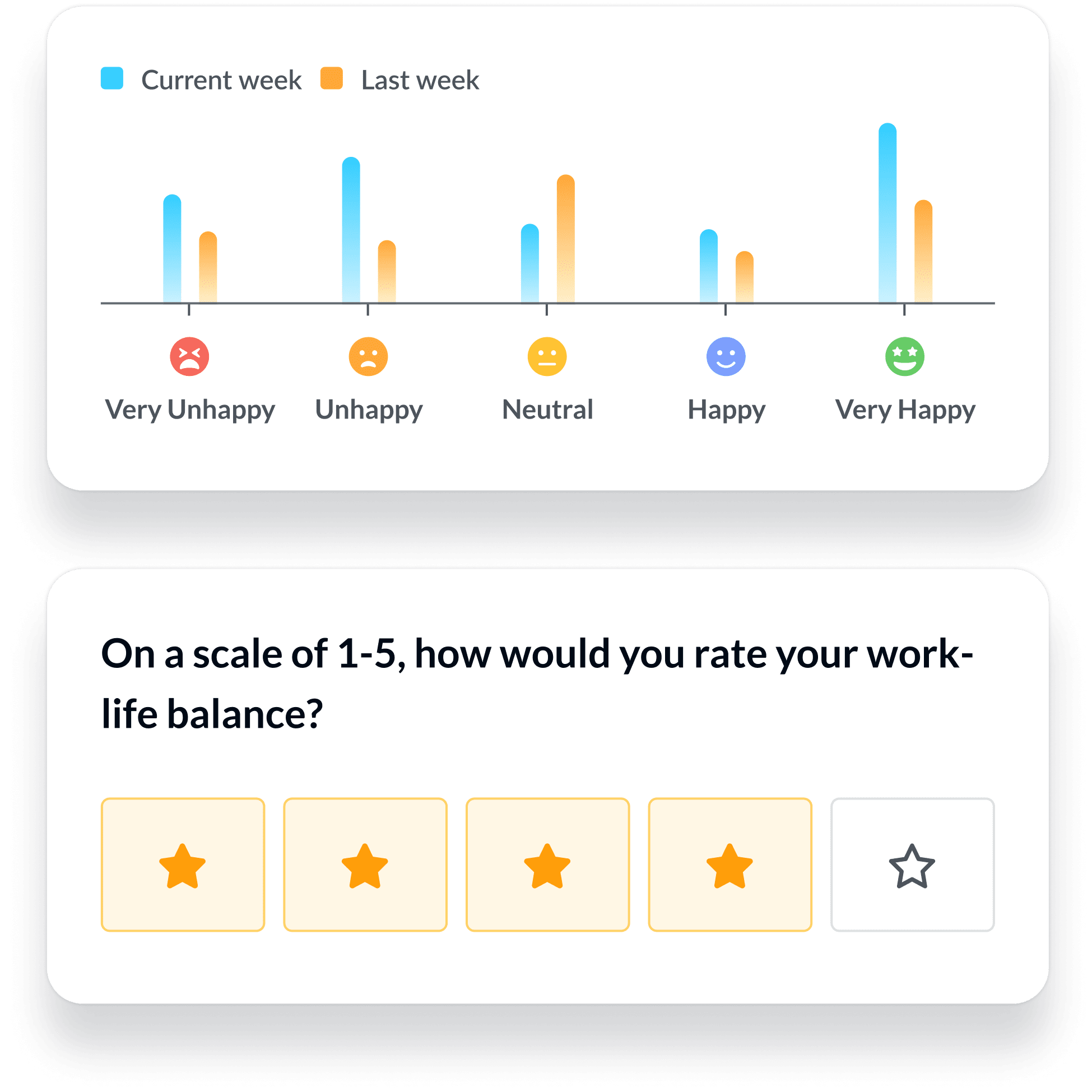
The good news is, leading a multigenerational team does not have to mean communication struggles. In fact, the solution can be as simple as doing a couple of easy things.

First, ensure that your employees know what to expect from you regarding team communication. If you insist on managing projects through online tools so that all information is easily accessed by those working remotely, just say so. Your employees will understand.

Also Read: Why Does Workplace Communication Matter?

Secondly, find out people’s unique preferences. If you need to communicate with someone one-on-one, ask them how they prefer to do it. Then, be prepared to meet them halfway. 

Yes, older employees can change their way of thinking and accept modern, informal, or faster communication methods they’re not entirely comfortable with. But, if you can do them the courtesy of having important conversations face-to-face, you’ll show that you’re a leader who cares about them and nurtures intimacy and trust, both of which are crucial for a team striving for success.

Identify Strengths and Encourage Stimulating Work

A recent survey from Gallup revealed that as many as 58% of job seekers think that the way to achieve job satisfaction is to be allowed to do what they do best. 

So, as a leader of a multigenerational team, you need to understand that one of the most impactful things you can do to drive success is to identify your employee’s strengths and encourage them to do work they find stimulating. 

The fact that your employees belong to different generations gives you the advantage of having multiple points of view on the same topics. Plus, working with a diverse group of people could also allow you the flexibility to find out what your workers love to do. You can offer them the opportunity to spend at least a portion of their workday on tasks that feel meaningful (or downright exciting).
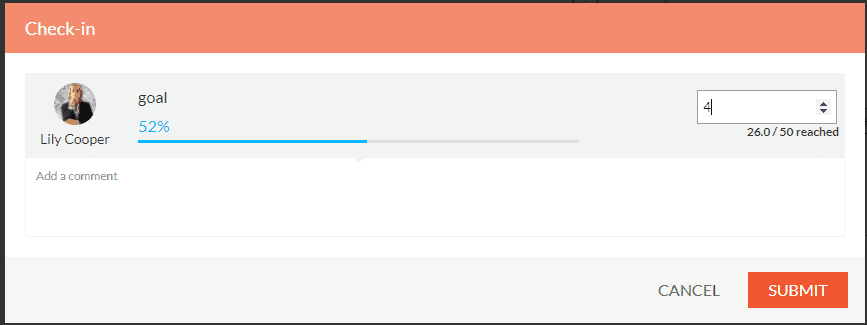
For instance, if you check out a business like Eachnight, you’ll see how well multi-generational (and multi-disciplinary) teams can work together to solve consumer pain points. 

Because it targets people of all ages, Eachnight understands that producing valuable content requires different approaches. And, thanks to the fact that its team includes a large number of people — from well-established and experienced surgeons to health and wellness coaches to young content creators — the brand is capable of creating unique resources.
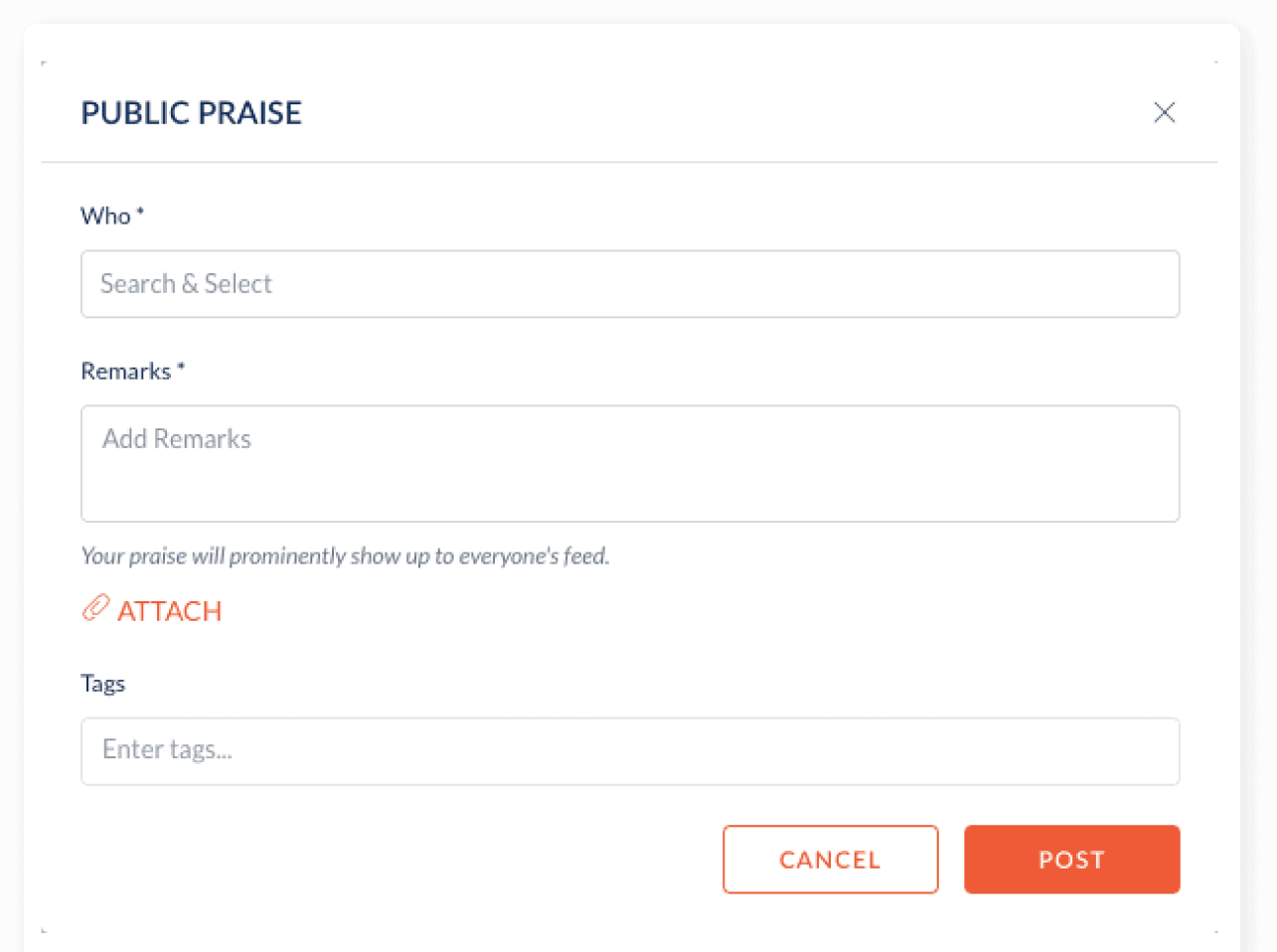
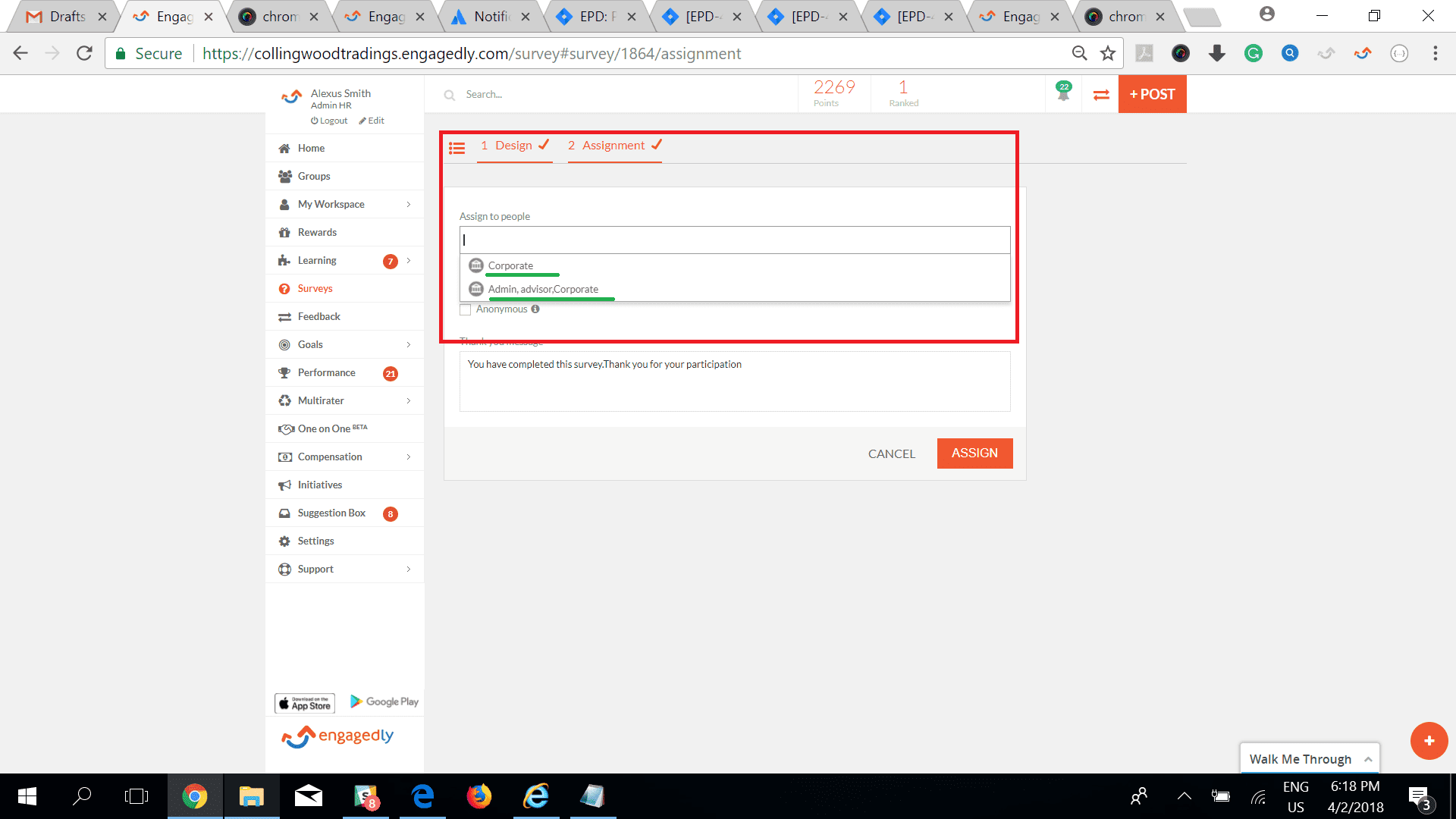
For example, the mattress quiz shown below is a piece of interactive content that none of the company’s competitors offer. And the way Eachnight acquired it is by simply allowing employees to do what they do best and what they find exciting.

Create Opportunities for Bonding and Collaboration

If the above example teaches us anything, it’s that success must be preceded by collaboration. So, if your goal is to successfully lead your multigenerational team, it might not be a bad idea to set aside a generous amount of time for team building.

Now, you can choose a host of team-building activities, depending on whether you want to help people bond, encourage creative thinking, or nurture their problem-solving skills. But the one thing you should remember is that, in general, people form stronger bonds when they have the opportunity to interact face-to-face

With this in mind, it might not be a bad idea to insist on your entire team coming together at least once a year.

Yes, getting everyone in the same room might sound like it’s outside your budget. But there are always ways to work around financial constraints. So, if you’re thinking about organizing a team retreat to encourage employees to build closer relationships, make sure you do your best to plan something fun, and rest assured that the results will more than justify the cost.

Don’t Neglect Your Own Growth as a Leader

Finally, as you explore ways to help your multigenerational team to do better, don’t forget that your role as a leader is just as important as your employees’ role in achieving success.

With this in mind, you must work on your leadership skills as diligently as you work towards helping your employees achieve the desired results. 

Also Read: 6 Leadership Challenges In The Workplace & Ways To Overcome Them

Explore resources that will open your eyes to new leadership techniques. Be prepared to gather and accept employee feedback (yes, even if it’s negative). And learn to acknowledge your mistakes and commit yourself to always trying to do better.

Is perfect leadership a destination you will ever reach? Most likely not. But rest assured that if your team sees how hard you are working on improving yourself, they will be just as inspired to invest in their own professional growth. Moreover, they’ll be more ready to widen their horizons, learn new skills, and collaborate with peers whose points of view they may not entirely understand (yet).

In Closing

There you have it, some of the best tips for leading multigenerational teams to success.

As you can see, the best way to bring people together, regardless of age, doesn’t necessarily depend on technical tools or strategies. Instead, the most impactful thing you can do is practice open and honest communication and encourage everyone to keep an open mind. 

As a leader of a multigenerational team, don’t be afraid to do things differently and disregard age-ist stereotypes. Work with your team to build strong relationships, encourage lifelong learning in your organization, and accept that our differences aren’t an obstacle but an opportunity to come together and do something great.


multigenerational team


Frequently Asked Questions

Q1. What is a multigenerational workplace?

Ans. A multigenerational workplace includes employees from different generations such as baby boomers generation, Generation X, the millennial generational, and Generation Z.

Q2. What are some of the challenges in a multigenerational workplace?

Ans. Some of the challenges include:

  1. Communication issues
  2. Negative stereotypes
  3. Varying employee expectation

Q3. What are the significant benefits of a multigenerational workplace?

Ans. The benefits of a multigenerational workforce are:

  1. Learning/mentoring opportunities
  2. Knowledge transfer
  3. Problem-solving abilities
  4. Different perspectives
  5. Unique relationships

This article is written by Natasha Lane.

Natasha Lane

Natasha is a lady of a keyboard and one hell of a geek. She has been working for, and collaborating with, individual clients and companies of all sizes for more than a decade. Natasha specializes in writing about design, branding, digital marketing, and business growth. She is also addicted to art in all its forms and grilled tofu.

5 Performance Management Mistakes That You Should Never Make

Performance reviews play an important role in an employee’s work life. They decide if an employee had worked well enough to get a promotion, a raise, etc. Most people are conscientious about how they handle performance reviews. After all, nobody wants to be the bad guy, even if an employee’s performance isn’t up to par.

An effective performance management system helps identify employees’ issues and find solutions for the same. This will improve their quality of work and in turn, increase productivity.

Continue reading “5 Performance Management Mistakes That You Should Never Make”

Quiet Quitting: Everything You Need to Know

Quiet quitting has become a social media sensation in recent days, especially among Gen Z and millennials. It might sound like someone is silently putting in their resignations, but the reality is different altogether. In fact, quiet quitting is a trend wherein the employees of a workplace stick to a bare minimum. It is a rebellion against the ‘hustle culture’ where employers ask employees to go above and beyond to get work done.

The COVID-19 pandemic affected everyone’s lives in more than one way. It caused people to reconsider their chosen career paths. According to the U.S. Bureau of Labor Statistics, 71.6 million people quit their jobs during the Great Resignation, which went on from April 2021 to April 2022, for a monthly average of 3.98 million. This also paved the way for another phenomenon called “Quiet Quitting.”

Let’s explore all you need to know about this new phenomenon happening at work, but first, let’s answer what quiet quitting is.

What is quiet quitting?

Quiet quitting doesn’t mean employees leaving their jobs. They limit their tasks to only what is strictly required to match their job description. For some, quiet quitting is a form of rebellion against the hustle culture. 

When employees choose to quit, they just want to do the bare minimum instead of working for extended hours or taking up any additional work. Their main concern is to get the job done. Therefore, they are setting boundaries for their professional work and focusing more on their work-life balance. 

These employees are still performing their jobs, but they are not adhering to the ‘work is life’ culture in order to lead their careers and stand out to their employers. They stick to their job description, and when they get home, they put work aside and concentrate on non-work obligations and activities.

Quiet quitting, on the other hand, could indicate that a person is dissatisfied with their job or is suffering from burnout. Quiet quitting is a strategy for an employee to deal with burnout and relieve stress. It could also indicate that they are ready to move jobs or are already seeking one.

Burnout at work and quiet quitting

Who are the employees quietly quitting?

According to Deloitte’s 2022 Global Gen Z and Millennial Survey, Boomers and Gen-X approach work very differently from other generations. While older workers like the “up and grind” mindset, current generations are more focused on a healthy and balanced lifestyle.

According to a survey conducted by ResumeBuilder.com, 25% of employees across all ages stated they perform the bare minimum at work, but this figure rises to 30% among millennials. In comparison, just 8% of workers aged 54 and up reported decreasing productivity. While millennial employees are more inclined to be quiet quitters, unhappiness in other generations is evidently widespread.

What’s the reason behind quiet quitting?

The biggest reason for quiet quitting these days is burnout.  According to a Microsoft survey of 30,000 workers, 54% of Gen Z employees don’t hesitate to quit their jobs. This is mainly because they want to get into jobs they prefer suitable for themselves.

The World Economic Forum rates youth disillusionment one among the many immediate dangers in its 2021 Global Risks report. According to the findings, mental health has deteriorated since the onset of the pandemic, leaving 80% of the youth workforce vulnerable to despair, anxiety, and disillusionment. 

All of these factors are a big reason for quiet quitting. We have listed here a few other factors responsible for quiet quitting to gain popularity among working professionals.

Promotes mental wellness

Several studies have found a correlation between work-life balance and mental health. This movement seeks to restore balance where work has infiltrated your personal time. It can also assist you in distancing your self-worth from your work. When all you have is work, it’s difficult not to derive a sense of worth from it.

Protects against burnout

Burnout was recognized by the World Health Organization in 2019 as an occupational syndrome. The characteristics can be emotions of depletion, tiredness, cynicism, mental alienation from work, and poor performance. Overwork causes burnout, which can have long-term physical, emotional, and mental health consequences. Overwork and a lack of self-care can lead to burnout, which can be harmful to both the individual and the business.

Many people who suffer from burnout wind up taking time off work or working at less than full capacity. Quiet quitting can improve the balance of work and personal life, potentially preventing burnout before it occurs.

Improves workplace relationships

When employees are content, their productivity rises. This can even help if you’re preoccupied or don’t want to be present. Furthermore, when people are joyful, they are less tense and find it easier to establish friends at work.

Another effect of the quiet quitting trend is that simply completing your job eliminates the bad impact of continuously feeling in competition with colleagues.

Experts say that rather than being concerned about lost productivity, employers can take advantage of the silent quitting trend. They can encourage employee well-being and provide a conducive workplace.

Also read: Building a positive workplace culture!

Signs of quiet quitting at work

Quiet quitting signs might vary based on the employee’s reasons for wishing to take a break from work. If an employee is actually dissatisfied, the indicators may be far more visible than if they simply seek a better work-life balance.

As an employer or a team leader, it is important to know why employees are quitting. Then only you can find a solution. But how are you going to know that? Here are some quiet quitting examples by which you can understand the phenomenon better.

  • Skipping work-related meetings
  • Late arrivals and early departure
  • Low productivity
  • Low participation in team activities
  • Lack of enthusiasm for work

Impact of this quiet quitting trend on businesses

According to the Gallup State of the Global Workplace study, employees who are alienated at work cost the world economy $7.8 trillion in lost output.

With fears of an approaching economic slump circulating, employers are concerned about productivity levels. For instance, non-farm worker productivity in the United States declined by 2.5 percent in the second quarter of this year compared to the same period last year. According to the Bureau of Labor Statistics, this is the steepest yearly reduction since 1948.

Companies such as Google are indicating that layoffs are inevitable in reaction to decreased productivity. These layoffs are costly for both employees and companies, with the cost of laying off one person equal to 200% of the employee’s income.

Impact of this quiet quitting trend on employees

Slacking off at work can produce tension among coworkers because some are left to compensate for others. This, in turn, fosters a toxic working culture, which may compound employee unhappiness.

While the Great Recession resulted in more jobs relative to experienced workers, an impending recession has shifted the calculus in favor of employers.

According to a new poll conducted by consultancy firm PwC, half of the respondents in the United States planned to reduce their staff, including companies such as Apple, Peloton, and Walmart. According to a July research by a job-search service, 60 percent of job searchers feel a greater need to find work now before economic conditions worsen.

This suggests that employers have an advantage over employees. Quiet quitters or those accomplishing the bare minimum may be the first to depart in this scenario. Quiet quitting can jeopardize their future possibilities as well. Furthermore, underperforming employees may build a terrible reputation that will accompany them for the rest of their lives, especially when HR services are being outsourced and digitalized.

What can businesses do to counter the impact of quiet quitting?

Organizations must ensure that employees don’t suffer from burnout. Employees should be allowed to set realistic boundaries. For example, most employees feel guilty about taking yearly vacations as they feel it might impact their careers.

To combat the bare minimum norms, employers must urge employees to take care of their health. Furthermore, they should encourage breaks. If a company wishes to have a great working culture, it must respect the emotions of employees.

Favorable work culture will most likely result in increased production and productivity. Only then companies can finally solve the true issue with ‘quiet quitting.’ No one wants to feel like they’re getting a bad deal at work. If you want the best deal for your company, allow employees to have open discussions about what they feel and how they like to see things at the workplace.

Promote open dialogue

Employees must feel safe approaching their bosses with any problems or challenges they may be having. Managers should also make a point of checking in with their personnel rather than waiting on them. Employees who can approach their superiors openly are considerably more likely to discuss topics that are important to them, which affects their job engagement.

Encourage a good work-life balance

Maintaining a healthy work-life balance is critical to keeping your workers interested and satisfied at work. Assure that your workforce has the ability to take a vacation, sick leaves, or personal day offs as needed. If possible, avoid scheduling too many meetings on late evenings or weekends.

Make sure your staff feels appreciated

Employee rewards and recognitionEmployees who feel respected, valued, and appreciated at work are more likely to be happy, committed, and interested in their roles. To keep staff engaged, make sure they receive both positive and constructive feedback. It is also an excellent idea to take the time to recognize your employees’ efforts. Do this in the best way possible for them, whether publicly or privately.

Also read: How to make your employee recognition programs work!

Try not to overwork your employees

Employees that are overworked are more likely to be burnt out, stressed out, and unhappy at work. You should avoid scheduling too many overtime hours or placing employees under too much pressure to reach unrealistic targets. Overworking your employees will just add to your stress and obligation.

Create opportunities for career growth

If a person feels trapped in a dead-end job, they are more likely to be unhappy and disengaged at work. Create possibilities for people to grow and rise within the firm to avoid this. Offer courses and training programs to employees for upskilling themselves and learn interesting new things.

Take feedback from your team

Your employees are the most reliable source of information about what it’s like to work for your company. As a result, you must pay attention to what your staff says and consider their recommendations. This will show them that you respect their opinion. This will also allow you to take the required actions to create a better work culture. When the work environment is conducive and employee-friendly, output and efficiency from employees will also be the highest.

Invest in an employee engagement tool

Employee engagement tools are another creative way to enhance engagement in the workplace. They can help you boost employee engagement with technology by integrating all of your engagement initiatives together on a single user-friendly platform. 

Also read: Employee experience vs. employee engagement

Companies can use such employee engagement tools to keep their staff and employees meaningfully connected and extract better outputs. Here is how an employee engagement tool can help your company:

  • It improves overall employee engagement.
  • It improves the employee retention rate.
  • It gives employees an excellent channel to convey their concerns and opinions.
  • It enhances employee productivity and makes way for creativity and innovation.
  • It encourages a higher attendance rate. 
  • It helps to create a conducive and happy work environment.
  • It keeps track of employee performance and gives feedback when needed.
  • It helps in the timely distribution of rewards and recognition.
  • It improves team coordination and enhances team output.

The bottom line

Quiet quitting may be a temporary trend that is viral on social media, but it originates from real-world issues that employees encounter on a daily basis. That is why it is important to pay close attention to why this trend started in the first place. 

All stakeholders should consider a human resource specialist approach to redesigning the work culture. This can be accomplished by acknowledging the existence of an issue and committing to resolving it rather than abandoning it entirely.


5 Must-Have Features to Look For in an OKR Software Tool

The key result has to be measurable. But in the end, you can look, and without any arguments: Did I do that or did I not do it? Yes? No? Simple. No judgments in it. 

Andy Grove

When it comes to setting goals and being successful, the one organization that comes to our mind is Google. Google’s OKRs are legendary and a lot of the company’s success can be attributed to their OKRs.

As a result, it’s no secret that everyone wants to emulate Google’s goal setting method and perhaps their meteoric success as well.

OKRs stand for ‘Objectives And Key Results’. OKRs are a popular approach for goal-setting which allows employees to execute individual as well as company objectives.

Objectives are something that you want to achieve, and key results are a measurable way to keep track of how close you are to achieve your goals.

OKR software helps employees with task management and to track the progress of their goal easily. But with too many options available in the market, it becomes a difficult job for an organization to select one.

Goal settings and OKRs

OKR Software Features To Look For

The section below highlights the best OKR software features to look for before you invest in a tool.

OKR software features1. Easy And Simple to Use By Everyone

“Simplicity is the ultimate sophistication.” — Leonardo da Vinci.

The OKR software should be user-friendly and easy to use. Users should be able to understand how the software works with little or no training. The user interface should be clean and not cluttered with useless information. The simpler the software, the easier it would be for everyone to use. Understanding and managing the software should not be a new project in and of itself for all employees. Additionally, it should support easy integration with other tools or processes. The adoption rate of software depends on its user-friendliness and simplicity of use.

Also Read: Why OKRs Are Crucial When Onboarding New Employees

2. Flexible and Customizable

OKR software should be flexible and support easy customization. OKRs/Goals check-ins can be in the form of a percentage, quantity, or milestone. The software should give users the flexibility to check in on their goals as per their needs. Flexible and customizable software will be useful for the organization in the long run.

3. Allows Comment

OKRs have a shelf-life and are generally set every quarter. The ability to comment on OKRs allows managers and employees to discuss it regularly. OKR platform with comment functionality promotes two-way communication and helps in setting a culture of regular feedback and a healthy work culture.

Also Read: Have You Set Effective OKRs For Your Customer Success Team?

4. Cascade and Align

OKR software should possess the basic functionality to align and cascade OKRs and goals. OKRs and goals are often shared responsibility. Cascading goals will allow the sharing of goals from one level of the organization to the next. For example, a manager can cascade his goals down to his direct reports.

Goal alignment, on the other hand, helps everyone visualize the bigger picture. It allows individuals to engage in goal alignment and goal management. For example, if one of the organization’s main goals is to break into an as-yet untapped market, the ability to align goals shows an employee how exactly they are contributing to this specific goal.

5. Dashboards and Insights

OKR software tools should present actionable dashboards and insights. It should be easy to understand and analyze so that it is actionable. Moreover, it should highlight the number of goals, the percentage of completion, goal alignment, and their status. It will help employees know whether any goal will be a bottleneck and needs attention. Moreover, an OKR software with an actionable dashboard and insights will help employees stay aligned and focussed.

Performance Reviews

6 Tips That Self-Motivated Leaders Follow

A team always looks up to its leaders, especially, self-motivated leaders. Businesses always look out for mantras to motivate managers and leaders. Self-motivation in leadership team is the primary essence of a successful brand. Great leaders are surprisingly approachable, open, and always motivated. Read more to find few tricks or tips that self-motivated leaders follow.

1. Setting Goals

Even before learning how to motivate managers and leaders, any good organization first focuses on setting goals. Self-motivated leaders, with their organized minds, set goals for themselves which they want to achieve. Setting non-achievable goals do not mean that they cannot be achieved. Leaders always strive to reach their goals and do not get discouraged or let negative thoughts stop them. When you can set gigantic goals for yourself, you imbibe the capability to achieve them.

Set goals and set up a plan to achieve those goals!

Also Read: Leadership traits that drive high engagement!

2. Being Open to Change

Motivation in leadership can only stem from the inherent flexibility to adapt to change. With the changing dynamics of work culture and the current global scenario, rigidity means being obsolete. Being open to change is a refreshingly cool trait to have. This shows how flexible you are and how well you can handle yourself in case of any uncertainty.

Great leaders believe that values change with time, so they constantly and consistently adapt to and adopt change.

3. Learning from People Around Them

Modesty and being respectful to people around them is another quality that makes self-motivated leaders successful. Great leaders believe that no one is superior or inferior to anyone. Everyone has their challenges to face and their ways of overcoming those obstacles. They learn from everyone around them. Leaders are observant and good at conversations. They try to be unbiased and imbibe the good things from people they interact with. That’s how they grow!

Also Read: How Important Is Feedback In Today’s World?

4. Reflecting on Their Progress

In the journey of being successful leaders, it is important to know where we are going wrong and how we can improve. Successful leaders reflect on their progress toward their goals frequently and work hard to improve themselves.

Self-motivated leaders stay motivated because of their constant laser-sharp focus on their goals. They strive to achieve the impossible, always. This is how they leave a mark on their team and the world! Teams get motivated seeing the zeal in their leaders.

5. Balancing Emotions

We are all human beings and not automatons, ergo we have feelings and emotions. Sometimes our emotions can be so strong that they can either make us extremely happy or extremely sad. Feelings have the ability to make us successful or a failure. Motivation in leadership comes from channeling the feelings in a positive and productive way. Successful leaders do not dwell on negativity. They try to perceive failure as a learning to improve the next time and not as a failure per se. They carefully balance their emotions to make the best possible decisions.

Also Read: The Different Kinds Of Awkward Situations At The Workplace

6. Being the Best Version of Themselves

Leaders try to focus and improve themselves by trying to be the best version of themselves. When teams sense this passion to improve and prove, they reciprocate the same traits. When such self-motivated leaders try to achieve goals, overcome any challenges, streamline processes, bring in innovative initiatives, their team follows them with enthusiasm and excitement.

Conclusion

Self motivated leaders inspire others through consistent actions rather than authority alone. They set meaningful goals, embrace change, learn from those around them, reflect on their progress, manage emotions effectively, and continuously work to become better versions of themselves. These habits create resilient leaders who build trust, encourage innovation, and motivate teams to achieve shared goals. Organizations that develop self motivated leaders are better equipped to improve employee engagement, strengthen collaboration, and achieve sustainable business success.

Frequently Asked Questions

What are self motivated leaders?

Self motivated leaders are individuals who consistently drive themselves to achieve goals without relying on external rewards or constant supervision. They take initiative, remain focused during challenges, embrace continuous learning, and inspire others through their actions and commitment.

Why are self motivated leaders important in the workplace?

Self motivated leaders create a positive work environment by leading through example. They improve team morale, encourage accountability, adapt to change, and motivate employees to perform at their best. Their leadership also supports innovation, collaboration, and long term business growth.

What are the key qualities of self motivated leaders?

Successful self motivated leaders typically demonstrate:

Clear goal setting
Positive attitude
Adaptability
Emotional intelligence
Accountability
Continuous learning
Resilience
Strong communication
Self discipline
Growth mindset

These qualities help them lead teams effectively and overcome workplace challenges.

How can leaders become more self motivated?

Leaders can strengthen self motivation by setting meaningful goals, tracking progress regularly, seeking continuous learning opportunities, embracing feedback, maintaining a positive mindset, and celebrating small achievements. Building healthy routines and reflecting on successes and failures also helps sustain motivation over time.

How do self motivated leaders inspire their teams?

Self motivated leaders inspire employees by demonstrating commitment, maintaining a positive attitude, recognizing achievements, encouraging open communication, and supporting professional growth. Their enthusiasm and consistency encourage team members to stay engaged, confident, and focused on achieving shared objectives.

Can self motivation be developed or is it a natural trait?

Self motivation can be developed through consistent habits and intentional practice. While some individuals may naturally feel more driven, anyone can build self motivation by setting clear goals, improving self discipline, developing resilience, and maintaining a growth mindset. Leadership development programs and coaching can further strengthen these skills.