Find tons of enriching performance management resources in this blog category. It is a real-time people strategy platform that helps all aspects of business insights!
A performance management system is one of the most important aspects of an organization. HR managers are usually the ones who carry out the performance management process in an organization.
Most organizations already have a performance management system, but if you are planning to implement a performance management system in your organization or to improve the existing one, here’s a list of common reasons for the failure of the performance management system that you might need to avoid.
If any organization wants to stay competitive, it needs to boost its work efficiency. Besides completing tasks faster, efficient workplaces will likewise enhance employee gratification. It will also improve overall productivity. Companies must adopt techniques that can enhance workflow and minimize bottlenecks.
They also need to foster a positive ambiance in this fast-paced business world. Every step from leveraging technology to effective time management will create a more productive workplace. You might be a large corporation or a small startup. In any case, it is essential to implement the appropriate strategies.
This article discusses the top 10 proven strategies that allow employees to achieve maximum work efficiency. It also helps them to maintain their level of input.
1. Streamline Goals with Objective Alignment
One of the important steps in increasing efficiency is the alignment of personal and corporate goals. OKRs and goals help teams concentrate on priorities.. They also help to manage critical tasks and set measurable objectives at all levels of an organization.
Contributions made by employees will help organizations achieve further goals and objectives in most cases. Motivation and a sense of accountability will be boosted in these situations. It is feasible for a business to change. Moreover, it should be necessary to revise them regularly so that they remain pertinent.
Goal management tools are available on platforms like Engagedly. It helps to track and achieve targets in a less complicated process. This also guarantees that employees concentrate on definite aims. It restricts the time spent on non-essential activities.
Feedback is key to enhancing work efficiency. Organizations having a robust feedback culture enable employees to revise their performance. They can likewise refine their strengths and address challenges where necessary.
A 360-degree feedback system is useful. This is because it gathers feedback from managers concerning a particular employee. It also gathers feedback from team leaders and other members.
A study conducted by Gallup revealed that some employees worked under the feedback increment system. They were 21% more productive than employees who did not work under the system.
These tools help organizations resolve issues early and foster growth. It likewise helps them to maintain cultural goals. Regular feedback also helps in spotting the gaps that need addressing. It is also applicable for gaps that acknowledge achievements and foster trust. It is a prerequisite for higher work efficiency.
3. Leverage Performance Management Software
Reducing manual input is vital to reducing errors. It is likewise essential to adopt automated systems for managing performance. These tools track feedback through performance statistics. This is because performance is measured in real-time, offering data-driven insights. It helps leaders make informed decisions.
Performance management systems make it a standard practice to annually review employees through structured performance reviews. It likewise aids in monitoring their goals and progress in a project. Thus, it helps to actively search for competent employees.
For example, Engagedly provides automatic systems designed to manage performance. It also helps simplify performance reviews and encourage frequent check-ins. If outdated manual processes are removed, teams will stay focused on organizational goals.
Automation of performance tracking facilitates transparency. It does this by helping employees understand how they can contribute to the whole organization.
4. Encourage Smart Time Management
Improved time management can favorably influence work efficiency. It is helpful when employees are encouraged to attend the most vital and urgent assignments. It will help to foster productivity and ensure punctuality.
Using tools such as time trackers ensures that employees use their time effectively. Moreover, it will ensure that productivity lagging gaps are addressed properly. This proactive action will reduce the chances of burnout. It will likewise enhance the output quality. Good time management eliminates situations of procrastination. It also forms an organized working schedule. Here, employees’ concentration will be directed towards vital content and assured results.
5. Invest in Learning and Development
A competent and proficient workforce is an essential element for every organization. Firms should implement a culture of continuous learning and reskilling. It will help the staff to stay current with industry trends and technology evolution.
Firms investing in learning and development strategies have reported positive results. For instance, a Forbes report mentions that a company with better-trained employees experiences a 24 percent higher profit margin.
Programs such as Engagedly’s LMS encourage customized training programs. It helps to upskill workers and improves retention. It also aids in encouraging the growth culture within the organization. Centralized systems like a growth hub help track this development. Increasing the frequency of workshops and e-learning courses can help make the teams more agile. The development of employees also improves engagement and job satisfaction. Thus, it helps to make a more engaged workforce capable of solving problems more effectively.
6. Promote Employee Engagement
Naturally, engaged employees are more productive and competent. Organizations that reward their employees encourage them to work together. Moreover, they also encourage them to stay in the organization to increase work efficiency.
Introducing tools for employee recognition and rewards can help gauge satisfaction and address gaps. According to a Gallup study, organizations mastering employee engagement experience 21% higher profitability. Recognizing individual and team efforts stimulates motivation and devotion. It likewise aids in organizational commitment. It will result in enhanced work efficiencyand morale. Managing employee engagementenables innovation and low turnover rates. It likewise promotes obsession among the employees. These are all beneficial for the firm.
7. Optimize Collaboration with the Right Tools
Communication tools are particularly essential when working remotely or under a hybrid system. This is because they help eliminate manual work. Tools such as Slack and MS Teams enhance proper communication. They also help to get rid of cross-communication and enhance bright and clear visions of the projects.
Project management systems simplify complex tasks. They will do this by providing specific roles and time frames. This will be set for every member of the team or department. The use of collaborative systems increases teamwork by allowing employees to exchange ideas. They can also verify work status and solve problems together.
When processes are reviewed and improved in organizations, redundant tasks are eliminated. In this way, it will enhance overall work efficiency. Improved communication tools allow members of different teams to work cohesively. They will do so in the same direction towards the set. Thus, it will improve workplace culture, productivity, as well as discipline.
8. Automate Repetitive Processes
Repetitive activities waste energy and time. This will affect productivity in the long run. Such processes can be delegated to automated machines. In this way, employees can spend their time doing something strategic.
Automation tools like CRM systems and email automation platforms save time while ensuring accuracy and consistency. Performing functions like data entry and submitting reports can be automated. This, in turn, helps businesses grow.
Automated solutions for performance management also cut down on manual work. It will help employees to concentrate on the work that really matters. Achieving accuracy and high productivity requires little effort and smart play.
Leveraging Engagedly’s automated solutions for performance management and feedback further reduces manual effort. It will also empower teams to focus on high-impact projects. By automating routine tasks, organizations can achieve consistency and eliminate errors. They can likewise maximize productivity with minimal manual intervention.
9. Cultivate a Positive Work Environment
A healthy work environmenthas a close relationship with work efficiency. Letting people share or express themselves will help to set up a healthy environment. It can also minimize work stress and provide importance to employee well-being.
This is because flexible working hours and hybrid work can create a positive atmosphere for employees. Companies can also schedule various sessions. These can be team-building activities and recognition programs.
In particular, when employees are appreciated, they will produce more effectively. Therefore, it will increase work efficiency. This enhances the level of trust and cooperation in organizations. Hence, it will be feasible to establish an efficient workforce satisfying the organization’s goals and objectives.
10. Monitor and Measure Productivity Metrics
Organizations that regularly track productivity metrics can identify areas for improvement. Analyzing data on the working patterns of the employees and the completion of tasks enables leaders to formulate the best strategies.
Using advanced analytics tools will help organizations monitor other parameters. These can be the percentage rates and time required for the completion of a certain task. Engagedly’s analytics tools help leaders make informed decisions using CXO-level insights about individual and group performance.
Continuous measurement ensures that the team is kept in check. It will likewise depict early areas of improvement for enhancing organizational goals. Regular monitoring of performance metrics will help to manage performance consistently. It will enhance organizational strategies and achieve correspondence with business goals.
Final Thoughts
The basic idea of increasing work efficiency requires a combination of goal alignment, the technological approach to work, and the recognition and creation of a pleasant work environment. The use of tools such as those provided by Engagedly can help make performance management a much easier proposition for organizations to encourage growth and boost employee engagement.
With data-driven insights, constant feedback and optimization of business processes enable companies to become permanently efficient while keeping the motivation of their employees aligned with long-term goals. If you’re looking to build a more structured and scalable system to improve workplace efficiency, you can request a demo to see how it works in practice.
FAQs
What does work efficiency mean?
Work efficiency is the ability to complete tasks with less wasted time, effort, and resources while maintaining quality results.
Work efficiency is the art of maximizing output while minimizing unnecessary input. In a professional setting, true efficiency is never just about speed—it is about consistency, quality, and shifting focus toward high-impact work. Sustainable work efficiency relies on clear priorities, streamlined workflows, effective time management, and equipping employees with the right automation tools to avoid chronic burnout.
How do companies increase workplace efficiency?
Organizations improve work efficiency by aligning goals, reducing bottlenecks, using better tools, and creating clear performance systems. To systematically increase operational velocity, companies must move away from micromanagement and focus on architectural improvements:
Strategic Alignment: Connecting daily individual tasks directly to high-level corporate objectives. Continuous Feedback: Deploying real-time coaching to identify and resolve workflow bottlenecks early. Process Automation: Stripping out repetitive administrative tasks through modern digital software. Workload Balancing: Utilizing people analytics to ensure tasks are distributed equitably across teams.
How does goal alignment improve efficiency?
Goal alignment improves productivity by helping employees focus on priorities that directly support team and business outcomes.
Goal alignment explicitly connects an individual employee’s daily labor to broader organizational triumphs. When a workforce is universally aligned – often through structured frameworks like Objectives and Key Results (OKRs) – it drives efficiency by clarifying exact operational priorities, eliminating time wasted on non-essential tasks, sharpening personal accountability, and ensuring every department pulls in the exact same strategic direction.
What software improves work efficiency?
Efficiency at work improves with tools for performance tracking, collaboration, time management, automation, and analytics.
Modern enterprise technology acts as a central nervous system for productivity by cutting out manual friction and expanding operational transparency:
Performance Management Software: Centralizes goal tracking, OKRs, and continuous evaluation cycles. Asynchronous Collaboration Tools: Platforms like Slack or Microsoft Teams that reduce lengthy, unnecessary meetings. Workforce Analytics Dashboards: Provide real-time data on project timelines, bottleneck detection, and resource allocation. Workflow Automation Engine: Software that handles automated report generation, data entry, and routine employee notifications.
Does employee engagement improve efficiency?
Employee engagement and learning improve work efficiency by increasing motivation, skills, accountability, and the ability to solve problems faster.
Yes, there is a direct mathematical link between employee engagement, continuous learning, and bottom-line efficiency. Highly engaged employees naturally bring significantly more discretionary effort to their roles, take personal ownership of project outcomes, and solve problems faster. Furthermore, robust upskilling and development programs directly minimize execution errors, building an agile, skilled workforce capable of delivering peak results with minimal oversight.
Performance management tools are software platforms and structured systems that help HR leaders and managers set goals, track employee progress, deliver continuous feedback, and make data-driven talent decisions – all in real time, rather than waiting for an annual review cycle to catch up. The best ones don’t just measure performance. They actively improve it.
According to Gartner’s 2026 HR Trends report, only 47% of CHROs say their culture currently drives employee performance. That means more than half of HR leaders are operating without the cultural foundation that makes performance management work. Tools alone won’t fix that – but the right tools, used intentionally, are where meaningful change begins.
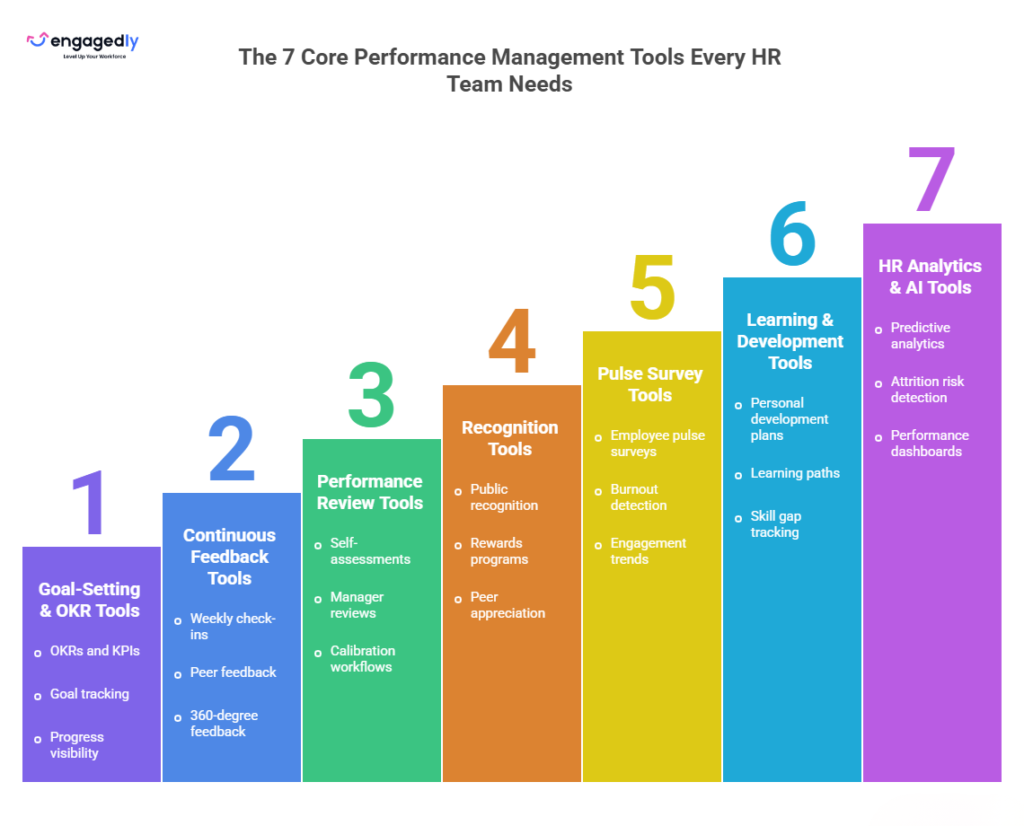
This guide breaks down the seven performance management tools every HR leader should have in their stack, the techniques that make them effective, and how AI is changing what’s possible.
What Are Performance Management Tools?
Performance management tools are real-time software platforms and structured HR systems used by managers and HR leaders to track employee productivity, align individual goals to organizational objectives, enable continuous feedback, and generate actionable insights for talent development.
They range from simple goal-tracking dashboards to AI-powered coaching platforms. What they share is a common purpose: creating a continuous, structured loop between employee effort, manager input, and organizational outcomes.
A modern performance management system typically includes:
Goal-setting frameworks such as OKRs (Objectives and Key Results) and KPIs
Why Performance Management Tools Matter More Than Ever
The urgency around performance management tools has grown sharply. Here is what the current data tells us about why:
The trust gap is real. According to Deloitte‘s 2025 Global Human Capital Trends report, 61% of managers and 72% of workers admit they do not trust their organization’s performance management process. That is a staggering vote of no-confidence in the systems most companies are still using.
Disengagement is expensive. Gallup’s 2025 State of the Global Workplace report found that global employee engagement dropped to just 21% – the second-lowest point in a decade. The cost? An estimated $8.9 trillion in lost productivity annually worldwide.
Managers are not equipped.Gartner research from October 2025 found that 64% of CHROs believe their leaders and managers do not have the mindset to lead change effectively. Without the right tools to support them, that gap widens every quarter.
The financial case is clear. McKinsey research shows that companies that focus on their people’s performance are 4.2 times more likely to outperform their peers, realizing an average of 30% higher revenue growth and experiencing attrition five percentage points lower.
As Tony Guadagni, Director, Research in the Gartner HR practice, put it at the Gartner HR Symposium in October 2025: “The future of performance management processes is automation, but the future of managing performance can’t be.” That tension – between what tools can automate and what humans must lead – is exactly why choosing and using the right tools thoughtfully has never been more important.
The 7 Core Performance Management Tools
1. Goal-Setting and OKR Tools
Goal-setting tools are the foundation. Before you can track or improve performance, employees need to know what good performance actually looks like in their role – and how their work connects to something bigger.
The OKR (Objectives and Key Results) framework has become the dominant methodology for high-growth organizations. It works because it separates the “what” (the objective) from the “how you’ll know you got there” (the key results). When goals are visible, specific, and tied to team and company-level objectives, employees have a clear reason to care about their work beyond showing up.
What the data tells us matters here: employees set their own goals in just over 50% of companies, while managers set them in about 40%. That 50% is the better number to aim for. Employees who have a voice in setting their goals are far more invested in hitting them.
What to look for in a goal-setting tool:
OKR and KPI support
Visibility at team, department, and company levels
Progress tracking with check-in prompts
Easy alignment between individual and organizational goals
Integration with your HRIS and communication tools
Real-world example: A mid-sized SaaS company using cascading OKRs found that goal completion rates rose to 92% by year four of consistent use – a 27% increase from early adoption.
2. Continuous Feedback Tools
The annual feedback conversation has one major flaw: it is almost always too late to change anything. By the time December comes around, the project that went sideways in March is ancient history. Continuous feedback tools fix this by making feedback a regular, low-friction part of how work actually happens.
These tools support manager-to-employee feedback, peer-to-peer feedback, and 360-degree feedback from multiple reviewers. They create a documented record of real-time input, which makes formal reviews more accurate, more fair, and less anxiety-inducing for everyone involved.
The engagement connection is direct. Research shows that 80% of employees who say they have received meaningful feedback in the past week are fully engaged. Weekly feedback doesn’t have to be a 30-minute sit-down. It can be a structured comment in a platform, a quick check-in prompt, or a recognition moment that gets acknowledged publicly.
One nuance worth noting: more feedback is not always better. In organizations with 250 or more employees, satisfaction scores peak when 20 to 40 people provide qualitative feedback. When feedback volume exceeds 200 contributors, employee satisfaction actually drops by 12% (PerformYard, 2025 State of Performance Management Report). The goal is meaningful, calibrated feedback – not noise.
What to look for in a feedback tool:
Real-time, request-based, and scheduled feedback options
360-degree and peer-to-peer capabilities
Feedback templates and prompts to reduce friction
Documentation that carries into formal review cycles
Privacy settings and anonymization for sensitive input
3. Performance Appraisal and Review Tools
Performance appraisals get a bad reputation – usually because they are done poorly. Run well, a structured performance review is one of the best conversations a manager and employee can have: a chance to reflect honestly, calibrate expectations, and set direction.
Modern performance appraisal tools replace static paper forms with dynamic, configurable review cycles. They support self-assessments, manager reviews, multi-rater input, and calibration sessions where HR can compare ratings across teams to catch bias and inconsistency.
The mechanics matter a lot here. Research from PerformYard’s 2025 State of Performance Management Report found that review forms with too few questions (five or fewer) have the lowest completion rates, suggesting employees disengage when reviews feel superficial. The sweet spot is 10 to 15 questions – focused enough to be completed without fatigue, substantial enough to generate useful data.
What to look for in an appraisal tool:
Configurable review forms and cycles
Self-assessment, manager, and multi-rater support
Calibration and rating normalization features
Completion tracking with automated escalation
Historical review data for trend analysis
4. Employee Recognition and Appreciation Tools
Recognition is chronically underused in most organizations. Managers tend to notice and remember what goes wrong. The steady, reliable performance that keeps a team running – the project managed smoothly, the client handled graciously, the extra hour nobody asked for – often goes unacknowledged.
This is a mistake with real consequences. Companies that foster a strong culture of continuous feedback and recognition experience 14.9% lower turnover rates than those with no feedback culture.
Employee recognition tools create a structured, visible channel for appreciation. Social recognition features let peers and managers call out good work publicly, which amplifies the impact beyond the individual. When someone sees a colleague get recognized for a specific behavior, they understand what the organization values – and that shapes how everyone works.
What to look for in a recognition tool:
Social, public recognition capabilities
Values-based recognition tagging
Peer-to-peer and manager-to-employee acknowledgment
Integration with rewards and incentive programs
Reporting on recognition patterns across teams
5. Pulse Survey and Employee Engagement Tools
Pulse surveys are short, frequent check-ins – usually five to ten questions – designed to track how employees are feeling about their work, their manager, and the organization on an ongoing basis. They are different from an annual engagement survey, which gives you one snapshot per year. A pulse survey gives you a trend line.
That trend line is where the real value is. A sudden dip in a team’s engagement score can surface problems – burnout, unclear direction, friction with a manager – weeks before they become resignation letters. When HR has that data in real time, they can act before the situation becomes irreversible.
What to look for in a pulse survey tool:
Short, configurable survey formats
Anonymous response options to encourage honesty
Trend reporting across time periods and teams
Alerts for significant engagement drops
Integration with broader performance data
6. Learning and Development Tools (Personal Development Plans)
Performance and learning are not separate functions – they are two parts of the same loop. When a manager identifies a gap in an employee’s performance, the next question should be: what does this person need to develop? Without a learning infrastructure, performance conversations end at the diagnosis and never reach the remedy.
Personal Development Plans (PDPs) give employees a structured roadmap: here are your growth areas, here are the resources and milestones, here is how we will track progress. The PDP process creates accountability on both sides – the employee commits to growth, and the manager commits to supporting it.
What to look for in an L&D or PDP tool:
Goal-linked learning paths
Skill gap analysis tied to performance data
Self-directed and manager-assigned learning options
Progress tracking with milestone check-ins
Integration with external learning content providers
7. HR Analytics and People Intelligence Tools
All the tools above generate data. HR analytics platforms turn that data into decisions. They surface patterns that are invisible in any single review or survey – which teams are at risk of attrition, which managers consistently develop high performers, where goal-setting clarity is low, and which roles carry the most burnout risk.
In 2026, the best analytics tools don’t just report what happened. They predict what is likely to happen next. Predictive talent insights powered by AI can identify potential burnout and disengagement before managers notice the behavioral signals, giving HR the lead time to intervene.
According to Deloitte’s 2025 Global Human Capital Trends report, only about one-third of executives believe their performance management approach enables timely, high-quality talent decisions. Analytics tools are how organizations close that gap.
What to look for in an HR analytics tool:
Real-time dashboards with drill-down by team, department, and role
Predictive models for attrition and engagement risk
Goal completion and performance trend reports
Integration with HRIS, payroll, and communication platforms
Data export options for leadership reporting
Performance Management Techniques That Actually Work
Tools matter, but they are only as effective as the techniques used to implement them. The most sophisticated platform in the world will not save a performance culture where managers skip check-ins, feedback is withheld until reviews, and goals are set once and forgotten.
Here are the five core techniques that make performance management tools deliver real results.
Plan
The planning stage is where everything either starts right or goes sideways. This is the moment when managers and employees sit together – in person or virtually – to agree on what success looks like for the quarter or year ahead.
Goals set in this phase should be SMART: Specific, Measurable, Achievable, Relevant, and Time-bound. They should also be collaborative. When employees participate in setting their own goals, ownership increases, and so do completion rates. Bring in OKR tools here to build visibility and alignment across teams.
Monitor
Setting goals is not enough. Regular monitoring means checking in on progress frequently enough to catch obstacles before they derail outcomes. For most teams, this means a structured weekly or bi-weekly check-in supported by a tool that logs what was discussed and what actions were agreed upon.
Forty-one percent of organizations now prioritize weekly or bi-weekly check-ins instead of annual reviews (ThriveSparrow, 2025). The shift is happening because organizations are seeing the results: faster course-correction, stronger manager-employee relationships, and more accurate data going into formal review cycles.
Rate
Formal performance ratings still serve a purpose when they are applied fairly and consistently. The goal is not to rank people against each other but to give employees clear, calibrated feedback on where they stand and what it would take to move forward.
The most effective rating systems combine quantitative scores with qualitative context. A number without an explanation tells an employee very little. A calibrated rating paired with specific examples and development guidance is genuinely useful.
Reward
Recognition and reward should follow documented performance. When employees see a clear, consistent connection between good work and meaningful acknowledgment – whether that is public recognition, a bonus, a promotion, or a development opportunity – trust in the system builds.
Effective managers know that rewards do not have to be large to be impactful. A specific, timely public acknowledgment often matters more than a vague annual bonus.
Coach and Mentor
The idea that poor performers simply need to be managed out is outdated. Most underperformance is a symptom of unclear expectations, insufficient development, or misaligned role fit – all of which coaching can address.
In 2026, AI-powered coaching tools are making it more practical for managers to provide targeted, personalized guidance at scale. Platforms like BetterUp and Engagedly incorporate coaching frameworks directly into performance workflows, so development conversations are embedded in day-to-day work rather than saved for a formal review.
How AI Is Reshaping Performance Management Tools
Artificial intelligence is not a future feature of performance management tools. In 2026, it is already embedded in the most effective platforms – and it is changing what HR leaders can realistically do with the data they collect.
Here is where AI is making the most meaningful difference:
Predictive performance insights. AI algorithms can now analyze patterns across goals, check-ins, feedback, engagement scores, and even collaboration tool activity to identify employees who are at risk of burnout or disengagement weeks before it becomes visible to their manager. This gives HR the lead time to intervene.
Bias reduction in reviews. AI-assisted writing tools help managers produce feedback that is specific, evidence-based, and free from the language patterns associated with demographic bias. This is particularly important in organizations scaling across geographies and cultures.
Automated administrative tasks. Completion tracking, reminder escalation, goal progress nudges, and survey distribution are all areas where AI can eliminate the manual overhead that makes performance management feel like a chore for HR teams.
AI coaching and career recommendations. Tools are now recommending specific learning resources, stretch assignments, and development actions based on individual performance profiles – moving coaching from a manager-dependent luxury to a data-driven standard.
As Gartner’s Tony Guadagni noted in October 2025: “Despite managers already experimenting with the use of AI in performance management, a majority of them report that they haven’t formally received any training about how to appropriately use AI in performance management.” The takeaway for HR leaders: deploying AI tools without training managers on how to use them responsibly is a wasted investment. The tool is only as good as the human using it.
How to Choose the Right Performance Management Tool for Your Organization
Not every organization needs the same stack. A 50-person startup and a 10,000-person enterprise have fundamentally different needs – different levels of review complexity, different HR bandwidth, different integration requirements.
Here is a practical framework for evaluating your options:
Start with where your current process breaks down. Is the problem that goals aren’t set clearly? That feedback never happens between reviews? That your HR team spends more time chasing completions than analyzing data? Identify the biggest gap first, and select a tool that directly addresses it.
Prioritize integration over features. A performance management tool that does not talk to your HRIS, payroll system, or communication platform will create more work, not less. Always ask: does this integrate with what we already use?
Consider your manager capability gap. If your managers are not confident giving feedback or having development conversations, choose a platform that guides them through it – with templates, prompts, and coaching frameworks built in. A powerful analytics suite is useless if the upstream data quality is poor because managers are not engaging with the tool.
Think about adoption, not just functionality. The best tool is the one your people will actually use. Mobile access, intuitive design, and a short learning curve matter as much as the feature list. Evaluate this honestly during demos.
Plan for growth. Choose a tool that can scale with your organization’s headcount, complexity, and evolving needs. Switching platforms is expensive in both time and trust.
Conclusion
Performance management tools have evolved far beyond annual reviews and static rating systems. In 2026, they are the operational backbone of how organizations align goals, develop talent, retain high performers, and adapt to constant change.
AI is accelerating what is possible, but the human side of performance management still matters most. Technology can surface insights, automate workflows, and identify patterns. Managers still need to coach, recognize, guide, and build trust.
For HR leaders, the real question is no longer whether to modernize performance management. It is whether your current systems are helping employees perform at their best or quietly holding them back.
If your organization is reevaluating its performance management strategy, it may be worth exploring how modern platforms like Engagedly bring together AI-powered insights, continuous feedback, goal alignment, and employee development in a single experience. You can request a demo to explore how it fits your organization’s needs.
Frequently Asked Questions
What are performance management tools?
Performance management tools are software platforms and structured systems that help organizations set goals, track employee performance, provide feedback, conduct reviews, and support employee development. They create a continuous process for improving performance rather than relying solely on annual evaluations.
Most performance management tools include: Goal-setting and OKR tracking Continuous feedback systems Performance review workflows Employee recognition features Engagement surveys Learning and development planning Analytics and reporting dashboards
Why are performance management tools important?
Performance management tools help organizations align employee efforts with business objectives while improving accountability, engagement, and development. They provide managers with the visibility and structure needed to support employee success.
Key benefits include: Clearer goal alignment More frequent and actionable feedback Better employee engagement Improved performance visibility Stronger talent development More informed workforce decisions
What are the four stages of performance management?
The four stages of performance management are planning, monitoring, reviewing, and rewarding. Together, they create a continuous cycle that helps employees improve performance and achieve business goals.
The four stages include: Planning: Setting goals, expectations, and success measures Monitoring: Tracking progress through regular check-ins and feedback Reviewing: Evaluating performance against agreed objectives Rewarding: Recognizing achievements and supporting development Organizations that consistently follow all four stages typically achieve stronger performance outcomes.
What are the five elements of performance management?
Effective performance management relies on five core elements that work together to drive employee growth and organizational success.
The five elements are: Setting clear and measurable goals Monitoring progress regularly Developing employee skills and capabilities Providing timely and constructive feedback Evaluating performance fairly and consistently Removing any one of these elements can weaken the overall performance management process.
What is the difference between performance management tools and HR management software?
Performance management tools focus on employee performance, development, and feedback, while HR management software primarily handles administrative HR functions.
Performance management tools typically support: Goal tracking Performance reviews Feedback and coaching Employee recognition Talent development HR management software typically supports: Payroll processing Benefits administration Employee records Compliance management Time and attendance tracking Many modern HR platforms combine both capabilities into a single system.
Performance reviews often evoke mixed feelings—ranging from anxiety to awkwardness—but they don’t have to. When structured thoughtfully, these conversations can transform into powerful opportunities for employee growth, accountability, and open communication.
A well-crafted performance review summary should go beyond simply checking boxes; it should serve as a guide for improvement, motivation, and stronger alignment between managers and their teams.
If you’re looking for actionable ways to make your performance reviews more impactful, you’ve come to the right place. In this article, we’ll explore seven performance review summary examples that not only promote accountability but also inspire employees to unlock their potential. We’ll go beyond theory, providing real-world scenarios where these examples can be applied to drive measurable results.
Providing constructive criticism and fostering accountability are essential components of effective performance reviews. As organizational psychologist Philip E. Tetlock notes, “Accountability binds people to collectivities by specifying who must answer to whom, for what, and under what ground rules.” This underscores the importance of clear expectations and ownership in the feedback process.
Below are detailed examples designed to inspire effective and growth-oriented performance reviews.
Example 1: Recognizing Leadership Excellence
A team manager who has demonstrated outstanding leadership in driving team performance.
Sample Summary:
Strengths: “You’ve consistently motivated your team, resulting in exceeding quarterly targets by 15%. Your ability to provide clear direction and inspire team members has improved morale and collaboration across the board.”
Opportunities: “To further enhance your leadership, consider delegating more responsibilities to senior team members. This will foster their growth and free up your time for strategic planning.”
Analysis:
Why it works: The summary acknowledges concrete achievements, which reinforces confidence. Highlighting delegation not only promotes accountability but also encourages the manager to mentor their team more effectively.
Actionable tip: Tie feedback to measurable outcomes (e.g., tracking the number of delegated tasks).
Example 2: Boosting Customer Service Skills
A frontline customer service agent who performs well but has areas to improve.
Sample Summary:
Strengths: “Your ability to empathize with customers has earned you an impressive average satisfaction score of 4.8/5. Your calm demeanor under pressure consistently reassures customers.”
Opportunities: “To further elevate your service quality, focus on reducing average response times. Leverage quick-reference tools and canned responses for common inquiries to enhance efficiency.”
Analysis:
Why it works: The summary emphasizes strengths while providing a clear, actionable path to improvement. This motivates the employee by showing how small adjustments can make a big impact.
Actionable tip: Encourage setting measurable goals, such as reducing response time by 10%.
Example 3: Addressing Underperformance with Empathy
An employee struggling to meet performance expectations in a sales role.
Sample Summary:
Strengths: “Your efforts to build meaningful connections with clients showcase your strong interpersonal skills.”
Opportunities: “To meet targets, consider creating a structured outreach plan that includes daily goals and follow-ups.”
Support: “We’ll provide mentorship sessions to guide you in optimizing your sales techniques and time management.”
Analysis:
Why it works: By addressing underperformance empathetically, the summary reduces defensiveness and maintains a supportive tone. Offering concrete support builds trust and accountability.
Actionable tip: Schedule follow-ups to track progress and adjust the plan as needed.
Example 4: Acknowledging Team Collaboration
An employee who thrives in collaborative projects but could take on more leadership roles.
Sample Summary:
Strengths: “Your ability to bridge gaps between teams has been instrumental in ensuring smooth project execution. Your collaborative approach fosters unity and drives efficiency.”
Opportunities: “Consider stepping into a leadership role for upcoming cross-functional initiatives. This will allow you to expand your influence and showcase your leadership potential.”
Analysis:
Why it works: The summary highlights a valuable skill while nudging the employee toward greater responsibility, aligning their growth with organizational needs.
Actionable tip: Assign the employee a leadership role in a smaller project as a trial.
Example 5: Encouraging Innovation in Problem-Solving
An employee known for creative approaches to challenges in technical roles.
Sample Summary:
Strengths: “Your innovative solutions have reduced workflow inefficiencies by 25% and saved the team over 20 hours weekly. Your ability to think outside the box is a key asset.”
Opportunities: “Documenting your processes can help replicate your successes across teams and contribute to broader organizational efficiency.”
Analysis:
Why it works: Acknowledging specific contributions motivates the employee, while encouraging documentation promotes knowledge-sharing and scalability.
Actionable tip: Set a timeline for creating process documentation and consider pairing them with another team member to streamline the effort.
Example 6: Developing Technical Expertise
A mid-level software engineer excelling in core responsibilities but needing upskilling for future roles.
Sample Summary:
Strengths: “Your expertise in backend development has ensured high-quality, timely project deliveries. You consistently deliver reliable, scalable code.”
Opportunities: “To prepare for future leadership roles, consider gaining certifications in DevOps practices. A learning experience platform (LXP) can support continuous upskilling aligned with career growth. This will enable you to contribute across the development lifecycle.”
Analysis:
Why it works: By tying upskilling opportunities to career progression, the summary frames growth as a positive challenge rather than a critique.
Actionable tip: Suggest specific courses or certifications and discuss how these align with the employee’s career aspirations.
Example 7: Strengthening Communication Skills
A technical expert who excels individually but needs better stakeholder communication.
Sample Summary:
Strengths: “Your in-depth product knowledge and meticulous analysis have significantly improved the accuracy of our project forecasts.”
Opportunities: “Enhancing your communication with non-technical stakeholders will ensure your insights drive actionable outcomes. Consider enrolling in a business communication workshop.”
Analysis:
Why it works: The feedback pinpoints a critical skill gap while suggesting actionable steps for improvement, showing that the organization values their contributions and wants to see them succeed.
Actionable tip: Pair them with a mentor who excels in stakeholder communication for peer learning.
What Are the Most Effective Performance Review Approaches?
The Balanced Scorecard Approach: Seeing the Whole Picture
The Balanced Scorecard provides a 360-degree view of employee performance by evaluating multiple dimensions rather than focusing narrowly on one or two criteria. These dimensions include:
Financial Performance: Contribution to the company’s financial success.
Customer Relations: Impact on customer satisfaction and loyalty.
Internal Process Efficiency: Ability to streamline workflows and minimize bottlenecks.
Learning and Growth: Openness to learning and career development.
This method offers a holistic perspective, moving beyond simple metrics like sales figures.
Case Study: Mars, Incorporated
Mars, a global leader in confectionery, pet care, and food products, adopted the Balanced Scorecard to align its operations with strategic goals across its diverse business units. The company evaluated performance through:
Financial Performance: Assessing profitability and cost management across divisions to ensure each contributes to the company’s overall financial health.
Customer Relations: Tailoring products and promotions to meet diverse market demands, thereby enhancing customer satisfaction and loyalty.
Internal Process Efficiency: Streamlining supply chains and production processes to reduce waste and improve operational efficiency.
Learning and Growth: Fostering a culture of innovation through employee development programs, encouraging continuous improvement and adaptability.
Results
Strategic Alignment: Employees better understood and contributed to company goals.
Improved Decision-Making: A holistic view enabled decisions balancing short-term and long-term goals.
Increased Accountability: Regular monitoring fostered responsibility and commitment.
Mars’s successful implementation shows how private companies can use the Balanced Scorecard to drive holistic performance and align daily operations with strategic objectives.
The 360-Degree Feedback Mechanism: A Mirror for Blind Spots
Traditional performance reviews often focus on a single perspective—typically from a supervisor—which can leave employees in the dark about critical aspects of their performance. This limited view overlooks blind spots, undervalues contributions, and fails to offer a complete understanding of their impact.
Employees don’t know how their peers, subordinates, or other collaborators perceive them, leading to missed opportunities for growth, unaddressed weaknesses, and overlooked strengths.
360-Degree Feedback changes the game by gathering insights from multiple sources:
Supervisors provide overarching feedback on alignment with organizational goals.
Peers highlight teamwork, collaboration, and day-to-day interactions.
Subordinates offer insights into leadership effectiveness and support.
Self-assessment encourages employees to reflect on their own performance.
This approach solves key challenges by:
Uncovering blind spots: Employees become aware of areas for improvement that might otherwise remain hidden.
Highlighting unrecognized strengths: Unique skills or contributions can come to light when viewed from different perspectives.
Promoting accountability: A broader review fosters a culture of ownership and personal growth.
Improving collaboration: Honest feedback from colleagues strengthens trust and team dynamics.
With 360-degree feedback, employees no longer feel like they’re working in a vacuum. Instead, they gain the clarity needed to align their efforts, improve their performance, and grow within the organization. This mechanism provides a complete mirror of their work, ensuring no critical detail is left unnoticed.
The SMART Goal Evaluation: Turning Dreams into Action Plans
Setting goals without a clear plan is like owning a treadmill and using it to hang clothes—you might have good intentions, but they won’t lead to meaningful outcomes.
Vague objectives like “Do better in sales” or “Increase productivity” sounds ambitious but lack direction, making them more dreams than action plans.
Without clarity, employees struggle to stay focused, measure progress, or achieve meaningful results. Vague goals create confusion and leave both employees and managers frustrated.
Enter SMART Goals—a method that transforms aspirations into actionable and measurable objectives.
SMART stands for:
Specific: Clearly define what needs to be achieved.
Measurable: Establish criteria to track progress.
Achievable: Ensure the goal is realistic within the given constraints.
Relevant: Align the goal with broader organizational or personal priorities.
Time-bound: Set a deadline to create urgency.
Aligning these with structured OKRs and goals ensures performance is tied to business impact.
Examples:
Vague goal: “Increase sales.”
SMART goal: “By focusing on retail sector clients, increase quarterly sales by 15%.”
Why it works: Both employees and managers understand the specific target, the focus area (retail clients), and the timeframe (one quarter).
Vague goal: “Become a morning person.”
SMART goal: “Wake up at 6:30 a.m. on weekdays and jog for 20 minutes.”
Why it works: The goal is actionable, measurable, and time-bound, making it easier to achieve.
Why SMART Goals Work:
Clarity: Employees know exactly what’s expected of them, reducing confusion.
Accountability: Progress can be tracked, ensuring ownership of outcomes.
Focus: Aligns efforts with organizational or personal priorities.
Motivation: Breaking down large aspirations into smaller, attainable milestones makes progress tangible.
The Continuous Feedback Loop: No Surprises, Just Growth
Annual performance appraisals can feel like blindside moments—your manager brings up a mistake from 10 months ago, something you’ve long forgotten. By then, it’s too late to address or improve. The solution? Continuous feedback, a system that replaces outdated annual reviews with ongoing, real-time guidance. Think of it as a GPS that recalibrates whenever you veer off course.
Employees lack timely feedback to correct mistakes or capitalize on achievements, leaving them unmotivated and misaligned with expectations.
Regular Check-Ins: Frequent, informal conversations to discuss progress, challenges, and opportunities.
Real-Time Feedback: Immediate recognition of achievements or constructive criticism after key moments.
Actionable Development: Clear, actionable suggestions to improve performance and develop skills on an ongoing basis.
Why Continuous Feedback Works:
Timely Recognition: Acknowledging successes promptly boosts morale and motivation.
Proactive Corrections: Employees can address issues in real-time rather than waiting for a yearly review.
Clear Direction: Regular feedback ensures employees stay aligned with goals, reducing misunderstandings and frustration.
Example Comparison:
Traditional Annual Review:
“Your sales numbers were low last February. Let’s not let that happen again.”
Outcome: Too late to fix the problem or understand its root cause.
Continuous Feedback:
February: “Sales numbers dipped this week; let’s adjust your approach to focus on higher-value clients. Here’s some training material to help.”
Outcome: Immediate course correction, improved results, and skill development.
Case Study: Continuous Feedback Loop at Cargill
Cargill is a privately held American company, dealing with food production and agriculture all around the world. Managing such a widespread organization necessitated a Continuous Feedback system that was agile and could respond to real-time needs within a large-scale organization.
Implementation of Continuous Feedback:
Cargill has switched to a continuous feedback system realizing the weaknesses of traditional annual reviews. The elements of this approach included:
Regular Check-Ins: Instead of long, formal meetings scheduled once or twice a year, managers frequently stopped by to chat briefly about what their employees were doing, the difficulties they were facing, and how they could help.
Real-Time Feedback: Prompt feedback was received after important assignments or projects so that reinforcement and course correction could happen in a timely manner.
Employee Development Plans: Continuous conversations allowed the establishment and modification of personalized development plans that can strike a balance between individual goals as well as company needs.
Conclusion
Performance reviews, when done right, can inspire growth, accountability, and stronger teams. By using impactful performance review summary examples, organizations can transform feedback sessions into opportunities for meaningful progress. Remember, reviews are not just about evaluation—they’re a step toward unlocking potential and driving excellence. If you’re looking to make performance reviews more consistent and impactful, it’s worth requesting a demo to see how the right system can support your process.
FAQs
What should a performance review summary include?
A performance review summary is a concise evaluation of an employee’s strengths, progress, and improvement areas with clear next steps. A performance review summary is a short, structured recap of an employee’s performance during a review period.
It typically includes: key strengths and accomplishments areas for improvement measurable outcomes or examples next steps for growth and accountability
Unlike generic review comments, a strong summary gives context and direction. For example, instead of saying “good leadership skills,” a manager might note that the employee exceeded quarterly targets by 15% while improving team morale. That makes the feedback clearer, more credible, and easier to act on. The best summaries help employees understand both what they did well and what they should focus on next.
How do managers write better review summaries?
Write a strong performance review summary by combining specific achievements, constructive feedback, measurable outcomes, and actionable improvement steps.
A strong performance review summary should be specific, balanced, and tied to real work outcomes.
A practical structure is: start with key strengths and accomplishments mention evidence or measurable impact identify one or two improvement areas end with actionable next steps or support
For example, instead of saying “needs better communication,” a manager could say the employee’s technical insights are valuable but should be shared more clearly with non-technical stakeholders. That makes the feedback easier to understand and apply. Strong summaries avoid vague language and help employees connect performance feedback to future growth, accountability, and career development.
What belongs in a manager review summary?
Managers should include strengths, measurable results, development areas, and clear goals in every performance review summary. Managers should include the details that make feedback useful, fair, and easy to act on.
The most important elements are: strengths and core contributions measurable outcomes, such as targets met or efficiencies gained skill gaps or improvement opportunities development goals and follow-up actions
For example, a review summary for a customer service employee might mention a 4.8/5 satisfaction score, then recommend reducing response times using quick-reference tools. This approach keeps the review balanced and practical. A summary should not stop at praise or criticism alone. It should connect performance to improvement so employees leave the review with clarity, not confusion.
How do review summaries support accountability?
A performance review summary improves accountability by clarifying expectations, documenting results, and defining specific actions for improvement. A performance review summary improves accountability when it clearly shows what the employee owns, what outcomes were achieved, and what must happen next.
It strengthens accountability by: connecting feedback to specific responsibilities documenting progress against goals identifying gaps without vague language setting clear expectations for future performance
For example, if an employee is underperforming in sales, a helpful summary might recommend a structured outreach plan with daily goals and follow-ups, plus mentoring support. That creates ownership and a path forward. When employees know exactly what is expected and how progress will be measured, they are more likely to take responsibility for improvement.
Why are generic review comments ineffective?
A useful performance review summary gives specific context, measurable examples, and development guidance instead of vague praise or criticism. A performance review summary is more useful than a generic review comment because it provides clarity, evidence, and direction.
The difference is simple: generic comments: broad and forgettable strong summaries: explain what happened and why it matters useful summaries: include next steps, not just observations
For example, “great job” does not tell an employee what to repeat, while “your innovative process changes reduced inefficiencies by 25%” reinforces a valuable behavior. Likewise, “needs improvement” is weak unless it explains where and how. Specific summaries make feedback more credible, help employees grow faster, and improve the overall value of the review process.
A 30-60-90 day performance review is a set of three structured check-ins that a manager holds with a new hire at the end of their first 30, 60, and 90 days. It covers onboarding, role clarity, goal progress, and support needs, and it gives both sides a documented view of how the start is going. It works best as a coaching tool rather than a pass or fail test, and it does not replace everyday feedback or the annual review.
New hires form opinions quickly, and most companies do not onboard well. That is why these three conversations matter. Here is the short version.
Day 30 focuses on onboarding quality, role clarity, tools, and team support.
Day 60 focuses on goal progress, collaboration, and learning needs.
Day 90 focuses on readiness, engagement, and longer-term development.
Below you will find the 2026 changes worth adopting, questions for each review, a filled-in example, a plan for off-track hires, and a free template.
What Has Changed for 30-60-90 Day Reviews in 2026?
The biggest change is that these reviews are no longer three isolated meetings. Strong teams now treat them as checkpoints inside a steady flow of feedback, with the manager clearly in charge of the experience.
Managers carry the onboarding experience
Gallup research on US employees found that when managers take an active role in onboarding, employees are 3.4 times as likely to say their onboarding was exceptional. That is a strong argument for putting the reviews on the manager’s calendar rather than leaving them to HR.
Feedback happens between the reviews
The three formal reviews work best when weekly one-on-ones feed them. If a 60 day review contains a surprise, the weekly conversations were not doing their job.
AI helps with preparation, not judgment
Managers can use AI tools to summarize one-on-one notes, draft questions, or turn feedback into a clear write-up. The rating and the message itself should stay with a person who knows the employee. Always check that AI-generated notes match what was actually said.
Reviews cover hybrid and remote realities
Time zones, meeting access, and tool comfort now belong in the conversation. See the remote section below.
What are 30-60-90 Day Reviews?
30-60-90 day reviews are an employee engagement and development strategy opted by various organizations for newly inducted employees. The process involves checking in with employees frequently and developing a standard practice to conduct reviews during the first 30, 60, and 90 days of an employee’s tenure in the organization.
During the reviews, managers can share their feedback with the employees and reflect upon their performance during the review period, using performance review examples to provide structured assessments. This helps in laying down a path for performance tracking and aligning employee goals with organizational objectives. Moreover, it also gives new hires an opportunity to discuss their career objectives and ambitions with their managers. Hence, these strategic reviews help in the learning and development initiatives of employees and carve out a career path based on their skill sets and organizational requirements.
30-60-90 day reviews help in laying out a standard procedure for employees to measure their performance against the set benchmark. This helps leaders and managers recognize the best talent and reward them for their excellence. It also leads to the development of action plans for employees with low performance and engagement. Moreover, during the annual appraisal process, managers can refer to the documented reviews and measure improvements and employee performance against the goals set up during the review period.
The added advantage of conducting 30-60-90 reviews is the measurement of the engagement level of the newly hired employees in the organization. Employee engagement is one of the most important aspects of retaining and nurturing talent. Through an effective and strategic review process, organizations can create an action plan for increasing employee engagement and productivity. Furthermore, it aids in reducing the turnover of the newly recruited employees.
What Do the Latest Statistics Reveal About 30-60-90 Day Reviews?
The numbers point to a gap between how much onboarding and feedback matter and how well most organizations deliver them. These are Gallup survey findings based on what employees say they experienced. They show why early, regular conversations are worth the effort, but they do not prove that a 30-60-90 review alone causes better results.
Onboarding statistics
Only 12% of employees strongly agree that their organization does a great job of onboarding, according to Gallup. In other words, most new hires start without an experience they would call great, which leaves plenty of room for a structured review process to make a difference.
The manager’s role stands out in the data. When managers take an active part in onboarding, employees are 3.4 times as likely to say their onboarding process was exceptional. That is one of the strongest arguments for having the manager, not only HR, run the 30, 60, and 90 day conversations.
Onboarding quality also shapes how ready people feel. Employees who strongly agree their onboarding was exceptional are nearly twice as likely to feel fully prepared to excel in their new role, according to a Gallup Panel study of US employees. They are also 2.3 times as likely to say their job is as good as or better than they expected.
Feedback and engagement statistics
Feedback frequency matters as much as the review itself. In seven Gallup studies covering 44,025 responses, about seven in 10 employees were highly engaged when they strongly agreed they had received meaningful feedback in the past week. That held regardless of team size, which is a useful reminder that a busy manager can still get this right with short, regular conversations.
The gap between annual and frequent feedback is wide. Gallup found that employees are 3.6 times more likely to strongly agree they are motivated to do outstanding work when their manager gives feedback daily rather than annually. For a new hire, waiting for an annual review to hear how they are doing means going a very long time without a clear signal.
What these numbers mean for your review plan
Taken together, the data supports three practical choices.
Have the manager lead each review, since manager involvement is linked to a better onboarding experience.
Hold weekly one-on-ones between the three formal reviews, so nothing in the 30, 60, or 90 day conversation comes as a surprise.
Keep each conversation specific and short enough to repeat, rather than saving everything for one long meeting.
Let us look at why the first 90 days deserve this attention.
Why Are 30-60-90 Day Reviews Important?
The pandemic has caused a massive shift from traditional work setups to working from home or hybrid work environments. Most new employees are being onboarded virtually, and they miss the opportunity to physically interact with the team and human resource managers.
In such a scenario, it is increasingly difficult to understand the problems and concerns of the new hires. Therefore, to overcome this barrier, it is imperative to have a review mechanism that provides a platform for employees to have a discussion with managers.
Having a structured 30-60-90 day review process helps in checking in on employees at a fixed interval and giving them feedback on their performance. Let us discuss why it is important for organizations to have a review process in place.
Opportunity to Identify Gaps in the Onboarding Process
Employee onboarding is the first impression of an employer towards its employees. A report by Glassdoor states that strong onboarding practices can increase employee retention by 82% and productivity by over 70%. Therefore, it is important to support new employees in the initial 90 days of their employment.
Organizations with better onboarding practices utilize tools and technology to equip employees to succeed in their new positions. Furthermore, emphasizing assimilation and fostering employee socialization can boost employee confidence in the organization.
Employers can identify gaps in their onboarding process by having an employee review at the end of the first 30 days of employment. It is an opportunity to understand why the employee felt disengaged and left out during the onboarding process. Additionally, managers can also initiate a formal mentoring program to help employees acquire the skills required for task accomplishment.
Moreover, it helps employees build connections with other employees in different departments. Conducting reviews also helps in understanding the mental health of employees and creating measures for overall employee well-being.
Once the gaps in the process are identified, organizations can initiate corrective actions to improve the overall employee experience. For example, employee engagement and social connection can be improved by physically or virtually introducing employees to different team members and starting a buddy system for new hires. Formal mentoring and coaching sessions can be conducted for employee development and skill enhancement.
A Benchmark for Measuring Employee Performance
In addition to having a great onboarding experience, it is important to set up a benchmark for measuring the performance of new employees. As per a research, the productivity of employees in the first 90 days of employment increases as they adapt to the company culture and understand the various aspects of performance. In order to gauge and measure employee performance, managers must initiate 30-60-90 day reviews.
Managers can set SMART (Specific, Measurable, Achievable, Relevant, Time-bound) goals for employees and measure performance based on goal achievement. Aligning these with structured OKRs and goals ensures clarity and alignment across teams. By having various checkpoints, it becomes easier to align employees towards organizational goals and provide them with guidance for improving their performance.
In addition, employees are also aware of the performance standards they are expected to achieve in order to create a strong foundation in the organization. Having a realistic timeframe helps with the smooth transition of new employees into the organization.
Building a Foundation for Employer-Employee Relationships
Conducting reviews goes a long way toward establishing a strong foundation for the employer-employee relationship. That’s why employee bonding and relationship building are rated as one of the most important aspects of engagement, productivity, and retention.
Social connectivity is quintessential for employee engagement and development, especially for new employees. Therefore, human resource managers should collaborate with leaders to develop a well-defined review plan that supports social connectivity over multiple platforms.
Fostering connections and relationships are equally important for employees working from home and from the office. Therefore, leveraging virtual tools to conduct reviews can help resolve the challenges of geographically dispersed employees.
Understanding Employee Wellbeing & Mental Health
Employee well-being and mental health have gained prominence with the adoption of a hybrid work culture. The lack of human connectivity and social connections is a predominant factor in debilitating mental health. Mental health issues become a pressing issue when employees start feeling distant and neglected by their employers.
Even for new employees, addressing personal challenges they encounter at the workplace or because of the business modus operandi is critically important.
Conducting reviews at frequent intervals can help managers keep track of employee well-being and mental health. Furthermore, fostering a supportive culture and encouraging employees to share their problems during reviews can help in identifying any underlying concerns.
While conducting reviews, managers can assure employees that their mental health is of prime importance to organizations. Such activities help in assuring employees that they are being cared for.
What Are the Benefits of 30-60-90 Day Reviews?
A report11 by Gallup on “How Millennials want to work and live”, highlights that 44% of employees feel more engaged when their managers hold regular review meetings with them. In contrast, only 20% of employees who do not meet their managers frequently are engaged.
The above statistics highlight the importance of conducting frequent reviews for employee engagement. By prudently implementing a 30-60-90 day review plan, organizations can transform their employees into a dynamic and self-driven workforce.
The benefits of conducting reviews extend to all the stakeholders involved in the organization. Let us understand how the application of 30-60-90 day reviews benefits both employees and employers.
Benefits For Employees
Employees can take advantage of the 30-60-90 day reviews and leverage the knowledge grasped during the process to improvise on their performance. Check out the list of benefits for employees below.
1. Personal and Professional Development
Conducting reviews in the initial phase of an employee’s journey goes a long way in their personal and professional development. During reviews, managers can highlight the strong and weak areas of employees and suggest a learning path for them to enhance their skills and productivity. In addition, employees can also discuss plans for their career progression with the managers. It helps them in envisioning their future roles in the organization.
The reviews are of great help in identifying personal development gaps that could lead to low performance by an employee. An extensive 30-60-90 day review plan also suggests interpersonal areas of an employee to improve upon.
2. Asking for Support
Every organization tries to foster a supportive environment for its employees. But not everyone can achieve it because of the challenges put forward by culture, hierarchy, and personal inhibitions of employees. One of the ways to achieve higher organizational efficiency is to have a respectable and supportive culture that allows employees to reach out for help.
Employee reviews give an opportunity to new employees to ask for support from their managers. Based on the discussion, managers can initiate mentoring and coaching sessions, 1:1s with employees, and other activities deemed necessary for employee support.
3. Boosts Employee Morale and Motivation
A self-driven and motivated workforce is the strongest asset of an organization. Finding suitable and dynamic employees requires hard work from the human resources department. But developing them into a performance-driven and committed workforce is far more challenging.
Employees are skeptical about the organization during their first 90 days of employment. In this phase, they are unsure about the culture and business environment, and require more than just formal training to assimilate into the organization.
Conducting planned and strategic reviews helps in boosting employee confidence and motivation. Frequent check-ins and 1:1s organized by managers make employees feel supported and cared for, which ultimately sets them in the right direction.
Benefits For Employers
Employee reviews directly impact the performance of employees and, thereby, the organization’s output. A well-structured and strategically laid-out review plan can benefit the organization in the following ways:
1. Reducing Employee Turnover
As per the statistics12, over one-third of all new hires leave within the first six months of their tenure. This is irrespective of the job role and position being offered by the organization.
The great resignation has further added to the woes of human resource managers. They are now battling with the problems of finding new talent and ensuring they stay committed for a long period of time. To contain the premature exit of employees, it is crucial for organizations to consider strategic ways to convert them into long-term employees.
Using 30-60-90 day reviews helps in understanding the challenges faced by employees and finding strategic solutions to them. Managers can pick up early warning signs during the review process and can take preemptive action to contain attrition. It may include training and incentive programs for employees. A well thought out 30-60-90 day review process can reduce employee turnover at all levels of the organization.
2. Increasing Employee Engagement
Employee engagement is one of the most important traits of a performance-driven organization. Engaged employees are likely to stay for a longer period in the organization and are more oriented towards business goals. Employee engagement is an organizational strategy that helps in achieving higher levels of performance, better retention, and better quality of work.
One of the benefits of conducting 30-60-90 reviews is that it increases employee engagement. Frequent reviews help employees understand their performance gaps and provide them with learning opportunities. Continuous real-time feedback further strengthens this process by enabling immediate course correction. Furthermore, managers can better assess the skills of new hires and align them to the respective projects where they can best utilize their skill sets.
3. Metrics for Performance Measurement
Employee reviews are a great way to assess the performance of new hires. Every employee has a unique set of skills and competencies, and utilizing them effectively is the key to increasing organizational efficiency. By measuring performance at regular intervals, managers can ascertain that employees are on the right track. It also helps in comprehending any challenges that are undermining the performance of employees.
Reports and data created at the time of conducting 30-60-90 day reviews help in recognizing the efforts of employees. Additionally, it is also used to identify low performing employees and help them improve. Leveraging talent analytics and mobility insights helps turn this data into actionable decisions.
4. Reward and Recognition
SurveyMonkey conducted a survey13 with over 1,500 employed Americans to find out how recognition at their organization helps them. Following were the key highlights of the survey:
Around 82% of the employees felt that recognition is linked to happiness in the workplace.
Over 32% of surveyed employees felt that recognition improves the way their colleagues interact with them.
Public recognition, according to 68% of employees, increases their chances of getting a raise or promotion.
These above statistics highlight how important recognition is for employees. A reward and recognition platform supports employees in achieving their highest potential and thereby increasing organizational efficiency.
30-60-90 day reviews are a great way to identify potential employees and reward them suitably for their efforts. Effective utilization of such a review mechanism can help in building a skilled, performance-driven, and happy workforce that is ready to go the extra mile to achieve organizational goals.
5. Identify Training Needs
Learning capabilities and aptitude are different for every employee. Even after going through the initial level of training and induction, there might be scenarios where an employee needs more support.
To handle such challenges, it is important to organize reviews where employees can share their concerns regarding performance. Therefore, managers should create an open channel of communication during reviews that helps employees clearly state any obstacles in their learning process.
Performance metrics, such as quality of work, customer centricity, and productivity level collected during 30-60-90 day reviews help in identifying employees with training needs. Managers can create a training plan to improve the performance of such employees.
If multiple employees are struggling in the same learning areas, then it can be because of the wrong practices and systems being followed for the onboarding process. Such issues can be handled by identifying the loopholes in the system and initiating corrective actions.
6. Employee Development
The entire process of the performance management system revolves around employee development. Such development plans have to be built in collaboration with employees. It ensures that their skills, competencies, and expectations are taken into consideration while planning the activities.
A successful employee development plan involves conducting reviews to understand the current performance level of employees and setting SMART goals to help them achieve better results.
Managers usually inculcate employee development initiatives while creating a 30-60-90 day reviews plan. It offers a constructive and flexible way of reviewing new employees’ performance and motivating them to achieve more. 30-60-90 day reviews are a holistic approach to employee development.
How Can You Create an Effective 30-60-90 Day Review Plan?
Creating a review plan requires collaboration from multiple departments. Human resource managers must inform the team leaders/managers regarding the onboarding of new employees and arrange sessions to discuss the review plan. The process is highly dependent on the job position and role of the employee joining the organization.
By undertaking the below discussed best practices, human resource managers can create an effective 30-60-90 day review plan.
Step 1: Setting Realistic Expectations
The time spent between sharing a job post and getting someone onboarded can be too overwhelming for the organization. At this time, managers can be tempted to get a new employee rolling and take up the responsibilities for which they were hired. Instead of pushing them to a quick start and passing on innumerable duties, it is preferable to let them gradually transition into the organizational culture. Undertaking 30-60-90 day reviews helps managers understand employee strengths and weaknesses and strategically place them in projects.
To set the course in action, managers can select two or three prime responsibilities/goals for the new hires and explain to them the process to achieve them. Setting realistic, quantifiable, and focused goals should be the foundation of conducting reviews.
Step 2: Creating Milestones to Measure Performance
The first 90 days of an employee’s journey are full of twists and turns. In this period, they are assimilating into the organizational culture and understanding the intricacies of the new business environment. Furthermore, if they are working from home, it is comparatively difficult to understand the tools and technologies.
Setting milestones while conducting the reviews helps managers measure the performance of employees. Additionally, it ensures support and collaboration in the initial days of employees.
Highlighting accomplishments and achievements of milestones is equally important in the review process. Positive feedback in the initial phase goes a long way in building employee confidence and boosting productivity. Similarly, providing constructive feedback for performance improvement is equally important.
Therefore, managers must set milestones and measure performance to provide employees with clear and open feedback for improvement.
Step 3: Collaborating With New Hires
New employees join the organization with some specific vision, expectations, and mindset. Even the business environment and culture can be new to them. In such a scenario, it is important to understand the personal goals and objectives of employees and help them align with the organizational goals.
In the first few weeks after joining, managers should talk to employees and try to comprehend their learning objectives. Based on the inputs collected from them, managers can modify the 30-60-90 day review plan. It will ensure that employees’ expectations and personal goals are also included in the plan.
It is also an opportunity to inculcate collaboration and teamwork while designing the review plan. The fresh perspective of new employees helps in bringing dynamism and strategicness to the review plan.
Step 3: Check-in Regularly
As the employees are getting accustomed to their new roles and responsibilities, it is important for managers to check in with them frequently in the initial days of their joining. It gives employees an opportunity to talk about their concerns and suggest any improvements to the current processes. Therefore, either organizing a daily catch up or weekly 1:1s will steer the employees in the right direction.
Through regular check-ins, managers can track the performance of their employees and can understand their strengths and weaknesses rather quickly. Furthermore, they can identify any persistent issues like difficulty in integrating with the team or in understanding the business dynamics and find solutions collaboratively.
Step 4: Measuring the Impact of the Plan
“You can’t improve what you don’t measure.” by Peter Drucker.
The objectives of a 30-60-90 day review plan should be quantifiable and measurable. Using SMART goals can help in making the plan more process-driven. The ultimate aim of conducting reviews in the first 90 days of an employee is to ensure their smooth transition into the business environment and help them align with the organizational objectives. Therefore, by setting measurable goals, managers have a fair understanding of employees’ strengths and weaknesses.
At the end of the review plan, it is easier to reflect upon employee performance against the set objectives. The insights collected from reviews help in creating further action plans for employees with low performance. It includes conducting formal mentoring and coaching sessions, skill development and enhancement, and buddy programs.
An Empathic, Compassionate, and Supportive Approach
Conducting reviews in the time of a pandemic is quite challenging. As the majority of employees have been working from home for months, it has become difficult to evaluate their performance. Managers face this dilemma of fairly conducting the review and also considering the impact of the COVID-19 crisis in their assessment.
Mark Mortensen, associate professor of organizational behavior at INSEAD, says that even in normal times, it is difficult for managers to conduct a performance review. Reviews are tense, stressful, and anxiety-inducing at times. Now, in the middle of the pandemic, it is much more difficult to assess an employee on performance parameters.
In such a scenario, managers must be empathic and compassionate towards their employees during the review process. They must first ask about their physical and mental health and ensure that their wellbeing is of utmost importance to the organization. Taking a compassionate approach can help employees overcome challenges and share their concerts with managers.
How Should You Conduct 30-60-90 Day Reviews?
Conducting frequent reviews of new employees lets them know that the organization has a vested interest in their growth and development. Moreover, it also helps in finding performance deficiencies and starting corrective actions to scale up employee development.
The learning curve of a new employee varies from three months to six months based on their job role and designation. Therefore, conducting reviews at the right time with the right assessing parameters is important to having meaningful employee reviews.
Communicating the 30-60-90 day review plan to the employees is the first step in preparing for the evaluation process. During regular 1:1s and check-ins, managers should substantiate the importance of reviews and lay out the detailed process to employees. It helps them to understand its effectiveness on their performance.
Below we have highlighted the details of the 30-60-90 day review process individually, along with the questions that managers should ask while conducting reviews. Please note that 30-60-90 day reviews are highly dependent on the designation and role of the employee upon joining the organization. Therefore, managers can alter the process and change the questions as per the requirements.
How Do You Run 30-60-90 Day Reviews for Remote and Hybrid Teams?
Keep the same structure, but adapt the logistics so remote employees get the same quality of attention as office-based ones.
Pair every remote hire with a buddy for daily check-ins in the first two weeks.
Schedule reviews at a time that works for both time zones, not just the manager’s.
Use video for reviews so tone and reactions are visible.
Send questions 48 hours ahead so the hire can prepare.
Ask directly about tool access and comfort, not just performance.
Confirm that remote participants can see shared screens and documents during the meeting.
What Are the Most Effective 30-60-90 Day Review Techniques for 2026?
Multi-Modal Review Approaches
Traditional one-on-one conversations are evolving to include:
1. Video Reflection Assignments
New hires record brief video updates on their progress
Managers provide video feedback for more personal connection
Creates valuable documentation for future reference
Weekly 10-minute check-ins focused on specific competencies
Real-time project-based evaluations
Continuous learning pathway adjustments
Digital-First Review Formats
Virtual Reality Onboarding Reviews
Immersive environment simulations for role-specific scenarios
Safe space practice for high-stakes situations
Enhanced engagement through interactive experiences
Gamified Progress Tracking
Achievement badges for milestone completions
Leaderboards for team integration activities
Point systems for skill development progress
Conducting a 30 Day Review
As soon as the new employees are inducted into the organization, they are assigned tasks to learn the product, understand the business culture and environment, and get an overview of the business dynamics. During the first few weeks of employee onboarding, managers should communicate frequently with the employees to give them an understanding of their job roles and responsibilities.
Providing supporting material like product documentation, departmental inductions, technical guides, and historical data will help employees ramp up the processes. It is good practice to introduce employees to the team members that they will be working closely with. Make sure that things don’t get too overwhelming and that there is no information overload for employees.
Conducting frequent 1:1s in the first month is helpful in understanding the skill set of the employee. It guides the manager in defining and communicating performance expectations and employee goals for the first 30 days. The frequency of 1:1s can be adjusted once the employee is well versed in the job role.
A 30 day review is conducted at the end of the first month of the employee’s tenure. The review involves a detailed discussion between the employee and the manager. Managers must ensure that they convey information regarding the review well in advance. It helps employees to prepare their responses for the process.
Questions to Ask in a 30 Day Review
The following questions will help you get better insight into the initial 30 days of the employee.
How is your overall wellbeing and mental health?
Please rate the overall onboarding process.
How would you rate the first 30 days of your employment?
Are the job responsibilities in tandem with the expectations you had before joining?
Do you require more clarity about the job role and responsibilities?
Do you feel any challenges with the current role?
What does the best day at work look like to you?
What do you like the least about your current role?
Do you have sufficient tools to deliver on your job responsibilities?
Is the company culture congenial and growth-oriented?
Do you feel welcomed and supported by your team?
Have you achieved your 30-day goals?
What goals do you have for the next 30 days?
Do you have any feedback for your manager and the team?
Conducting a 60 Day Review
The first 30 days of the employee’s journey are usually about learning the product and business culture. In the next 30 days, also known as the development phase, the actual growth of an employee begins. Now that the employee is accustomed to the business practices and company policies, it is time to check on their performance and also collect feedback on their day-to-day activities.
A 60 day review helps in gaining insights regarding the performance and development of employees. During these 60 days, employees must have had an opportunity to interact with the clients, resolve customer/client queries, and provide resolution to internal issues. Therefore, it is important to collect employee feedback at this interval to understand the following:
The process structure and its efficiency
Overall job satisfaction of employees
Speeding up employees to their job responsibilities
Identify any challenges in the current job role
Providing them with actionable performance insights
A 60 day review is the right time to assess the contribution of employees to the achievement of short-term team goals and organizational objectives. It also gives an opportunity to discuss the long-term career vision of the employees and offer them managerial insights into their performance.
Questions to Ask in a 60 Day Review
The following questions will help in conducting a 60 day review effectively.
Did you face any challenges in adapting to the organizational culture and values?
Did the training sessions conducted in the first 30 days prepare you for the job responsibilities in the next 30 days
Is there anything that you would like to change about the onboarding process conducted so far?
Are the job responsibilities the same as per your expectations?
Have you got sufficient training sessions to perform the current job role?
Do you believe your job role is in line with the organization’s values and mission?
What would you like to learn more about in your current job role and how can the organization help in achieving that?
Is the organization’s culture and business dynamics the same as shared during the interview process? Is there anything you would like to improve in the overall process, from interviewing to onboarding?
Do you get enough support from the supervisor?
Do you enjoy working with your team?
How do you generally collaborate with team members for work?
Have you completed your 60 day goals?
What challenges did you face while working on the goals?
What goals do you expect for the next 30 days?
Do you need any additional support to complete your next 30 day goals?
Conducting a 90 Day Review
The end of 90 days usually marks the completion of the probation period for most of the employees. At this time, employees have undergone extensive training to understand the products, have a fair understanding of their job roles, and are prepared to take on responsibilities like other team members.
A 90 day review serves a major role in collecting intelligent insights about the extensive onboarding process followed by the organization. The feedback collected at this stage will help in making the processes better aligned to employee growth and development.
Managers need to perform a thorough check of the employee’s performance in the review to understand their competencies, engagement and productivity levels, collaboration with team members, and collect any feedback pertaining to their managers, team members, and organizational processes.
Questions to Ask in a 90 Day Review
The following questions resonate with the 90 day review process. Please note that questions regarding job responsibilities can be changed as per the designation and role of the employee.
Did you complete your training sessions organized to understand the product/process, organizational culture, and business dynamics?
Please share your feedback regarding the onboarding process.
What would you like to change in the current learning process of the organization?
Did you receive enough support from the colleagues? Who has been the most helpful to you so far?
Do you have any particular questions related to your job roles and responsibilities?
Do you feel comfortable asking for help from your team members?
Is your manager approachable and helpful in discussing personal and professional matters?
How would you rate the leadership of the organization? Is there any suggestion for the current leadership?
Has your manager conveyed the expectations the organization has from you?
What are your long-term goals for the organization?
How was your experience with the extended onboarding process implemented by the organization? Are there any suggestions to make it better?
What Should You Do If a New Hire Is Off Track?
Talk to them early, be specific about the gap, and agree a short, written plan before anything formal. Most early gaps come from unclear expectations, missing training, or poor fit with the tools, not from effort.
Check your own side first. Were the goals clear, was the training complete, and did they have access to what they needed?
Name the gap with an example. “Three of your last five reports missed the deadline” works better than “you need to be more reliable.”
Agree a two to four week plan with one or two measurable targets.
Add a weekly check-in and write down what was agreed.
Involve HR if the plan is not working, especially before any formal step.
Probation rules, notice periods, and documentation requirements differ by country and contract. Check with HR or legal counsel before making any employment decision. This article is not legal advice.
What Should a 30-60-90 Day Review Template Include?
The downloadable template is a ready-to-use employee performance evaluation toolkit that will help in strategizing the first three months of new hires. Managers can use this template to understand their employee’s overall performance and provide actionable feedback to them.
We have also included an employee performance evaluation form in the 90 days review tab to help gauge the achievement of employee goals. To understand the development of employees on various parameters the template is segregated into different sections
What Does a Completed 30-60-90 Day Review Look Like?
Here is a sample for a customer support specialist, using a four-point scale where 1 means needs support, 2 means developing, 3 means on track, and 4 means ahead.
Review
Goal
Evidence
Rating
Day 30
Finish product training and shadow 15 live tickets
Training checklist complete, 15 shadowed tickets logged
3
Day 60
Resolve tier 1 tickets independently
Quality score on peer-reviewed sample, first-response time against team target
3
Day 90
Own a ticket queue and improve one help article
Queue handled for two weeks, article updated and published
4
The rating is only half of the review. The written comments should name one strength, one gap, and one agreed next step. For example, “Strong product knowledge, still slow on billing tickets, will shadow the billing lead twice next month.”
Avoid giving a rating at day 30 if the role has a long ramp-up. A “ready to learn” note is often more useful than a score.
Many organizations have reaped the benefits of a well-defined and structured 30-60-90 day review process. By building a standard process for extensive reviews, organizations can achieve higher productivity, engagement, and low employee turnover.
Moreover, it helps employees form a strong connection with their colleagues and organization, thereby making them more loyal and committed towards the employer.
Through features like SMART goals setting, real-time feedback, ongoing check-ins, and 30-60-90 reviews, organizations can keep track of employee activities and offer innovative solutions to help engage, enable, and empower their workforce. If you’re looking to streamline and scale your review process, it’s worth requesting a demo to see how it can be implemented effectively.
Frequently Asked Questions (FAQs)
What is a 30-60-90 day performance review?
It is a set of three manager-led check-ins at the end of a new hire’s first 30, 60, and 90 days. Each one looks at onboarding, progress toward goals, and support needs. The aim is to catch problems early and set clear expectations, not to deliver a final verdict on the person.
Are 30-60-90 day reviews necessary?
They are not legally required in most places, but they are a practical way to avoid surprises. Without them, a new hire can go months without knowing how they are doing. If your team is small, even three short documented conversations will do the job.
What should you say in a 30-60-90 day review?
Start by asking how the hire is settling in, then move to goal progress, then give one strength and one gap with a specific example. Close by agreeing on the next 30 days. Keep your own comments concrete and leave time for the employee to talk.
Who should run the reviews, HR or the manager?
The manager should lead, because they see the daily work and own the relationship. HR should provide the template, keep timing consistent, and step in if a hire is struggling or if a formal process could be triggered.
Should new hires get a rating at 30 days?
Not always. At 30 days most hires are still learning the basics, so a written note on progress and clarity is often more useful than a score. Many teams add ratings at 60 or 90 days, once the hire has had time to work independently.
What if a new hire is struggling at 60 days?
Be direct and specific, check whether training and expectations were clear, and agree a short plan with measurable targets and weekly check-ins. Involve HR before any formal step. Rules on probation and notice vary by location, so confirm with HR or legal counsel.
How do you run 30-60-90 day reviews for remote employees?
Use the same structure but hold the review on video, choose a time that suits both time zones, and send the questions ahead. Ask about tool access and team connection directly, since remote hires often will not raise those issues on their own.
Is a 90 day review the same as a probation review?
Not necessarily. A 90 day review is a development conversation, while a probation review can carry contractual or legal consequences depending on your country and employment terms. If your probation period ends at 90 days, treat them as related but check your policy before merging them.
Can AI write a 30-60-90 day review?
AI can help draft questions, summarize one-on-one notes, and tidy up wording, but the assessment should come from the manager. Check any AI-generated text against what actually happened, and avoid pasting sensitive employee details into tools your company has not approved.
What is the difference between a 30-60-90 day plan and a 30-60-90 day review?
The plan sets goals for the first three months, usually written by the new hire or manager. The review is the conversation at each milestone where you check progress against that plan. Use both together for the best results.
While managers commonly set growth objectives for their teams, crafting specific development goals for work and managers can markedly enhance their leadership skills, ultimately improving employee performance and satisfaction. A comprehensive grasp of the elements that contribute to a manager’s development goals is pivotal in maximizing employee potential. This article explores various professional development goals tailored for managers, offering insights into setting objectives that elevate employee productivity levels.
Development Goals for Managers–What is it and Why is it Required in 2026?
Development goals for work act as a guide for managers to create measurable and attainable objectives for their employees. To elaborate, the goals act as a beacon for a manager to set employees’ objectives. The objectives may help to bring about an improvement in their performance, aligned with the company’s plans. Many organizations align these initiatives through OKRs and goals.
Managers today are navigating an unprecedented leadership landscape—hybrid workforces, rapid AI integration, and shifting employee expectations. Yet, only 44% of managers have received formal training (Business Insider), even as global manager engagement continues to decline.
Research from Gallup shows that 70% of employee engagement is directly influenced by managerial quality. This means that developing managers is no longer a “nice-to-have”—it’s a strategic necessity for organizational health and retention.
According to Gartner, 75% of HR leaders say managers are overwhelmed, and 70% believe current development programs are falling short. In 2026, manager development is not just about improving performance—it’s about sustaining leadership resilience, agility, and trust in an era of constant change.
What Key Factors Lead to the Success of a Manager’s Development Plan?
In every organization, managers strive hard for the growth of the company. Ideally, they want employees to operate at their maximum efficiency. To achieve optimum productivity, managers need to understand both development goals for work and their role in guiding employees toward success. These goals provide a clear roadmap for employees and managers alike.
In line with this, we have listed down certain key factors related to professional development goals for managers that they need to be cognizant of.
Clarity – Clarity of the goals helps managers to increase employee efficiency.
Measurable: Measurement of goal achievement helps to set new targets for the employees.
Achievable–When you set measurable, attainable goals for a manager, they will not only bring improvements in his performance but also help the manager overcome his limitations.
Timeline—Managers should be in sync with the project timeline so that team members can give their best to reach them, within the stipulated time.
Reward–When a goal is met, it is important to recognize the achievement and reward your employees. This boosts employees’ confidence and fosters future development.
What Are the 13 Development Goals for Managers
A goal-oriented manager understands where he is headed. With goals in place, a manager understands exactly what he needs to do to accomplish them and how to guide his team in the right direction. Without further ado, let’s get started with 10 manager development goals. Following these goals may help managers boost employee confidence and increase their productivity.
1. Organize productive meetings
Managers conduct one-on-one employee meetings, organize team meetings, and oversee other group meetings. This means managers must have a thorough understanding of the types of meetings and points of discussion. Here are a few suggestions to help your managers conduct meetings effectively:
Setting pragmatic goals for employees
Establishing regular meeting schedules
Taking detailed notes about project progress
Specifying an action plan to reach the set target
Having constructive meetings can enhance employee enthusiasm as they get a sense that the company values their input.
Active listening signifies being open-minded to non-verbal signals or any form of employee concerns. Thus, managers need to develop active listening skills to not just hear what their team members say but also to understand them. Better listening skills will help managers to learn more from their teams. As a result, they will be able to handle problems effectively, understand the needs of their team, and become more efficient.
3. Employee development
Several employees want to take on leadership positions. Other employees might like to explore another role or gain expertise that can be useful in enhancing employee productivity. Thus, as a manager, you should encourage employees to go beyond their comfort zone.
You must provide employees with an opportunity to learn new skills and grow, in line with the company’s requirements. Effective employee training and development programs can significantly enhance skill-building and productivity
4. Boost team productivity
Productivity goals are often included in managers’ strategic objectives. You may want to consider how your managers set and communicate goals. You would also like to know how they track employees’ progress.
For instance, ask your manager to assess each employee’s contribution toward the overall team productivity. By facilitating regular status meetings, managers can review team progress and ensure that the development goals for work are being met effectively.
These meetings allow managers to identify gaps and take necessary action to boost productivity. Look for positive trends in productivity to gauge an employee’s development.
Implement the Eisenhower Matrix to prioritize tasks—studies show busy managers save 4+ hours weekly when classifying urgent vs. important.
In 2024, 68% of managers used data dashboards to track team health (Source: Gallup). Companies tying leadership metrics to bonuses saw a 30% uplift in engagement (Source: SHRM 2023) Average training hours per manager rose to 35 in 2023, up 15% YoY (Source: LinkedIn Learning)
Setting effective development goals for work is crucial for both managers and their teams. These goals not only drive personal growth but also enhance overall team performance.
By aligning individual development goals with the organization’s objectives, managers can ensure that each team member contributes to larger business goals while also focusing on their personal career development.
When managers support these goals, it creates a culture of continuous improvement, leading to higher retention rates and job satisfaction.
6. Celebrate employees’ efforts and intentions
Great leaders know that the most valuable asset of their business is their employees. Be gracious and appreciative of your team’s efforts, especially when they accomplish a new milestone. Whenever possible, acknowledge your employees publicly so that they understand how valuable and appreciated they are.
Do not take your employees’ contributions for granted as are a valuable part of your company. Hold a companywide meeting where employees can thank each other for the help they received or for going the extra mile. This way, happy employees would contribute to increased productivity and reduced turnover.
7. Offer insightful inputs
Professional development goals for managers can guide managers to set specific objectives for each employee. This way managers can gain a comprehensive insight into an employee’s work style and share the same with the employee. Insightful feedback can help employees to improve their performance.
For instance, managers can ask employees to identify specific goals related to their jobs and meaningful to them. To ensure employees’ suggested goals align with company objectives, a manager can offer better insights and develop action plans, like creating employee guides to reach those goals.
8. Work on networking skills
Managers should develop, practice, and apply networking skills as part of their development goals. Having a fixed daily routine, with the least emphasis on building relationships with employees, can only take you up the rungs of the leadership ladder.
You can gain a great deal of insight into employees around you by building strong work relationships. As a manager, honing your networking skills would not only help you but your team as well. It is therefore certainly worthwhile to explore networking as a key development goal.
9. Increase Retention Rates
To increase the retention rate, employees must be given regular feedback to enhance their productivity–both positive and constructive.
According to a Harvard Business Review study, the optimal ratio between positive and negative suggestions is 5.6 (positive) to 1 (corrective).
To motivate employees and to empower them to work to their optimal capacity, positive feedback should be given often. Having said this, constructive and corrective remedial measures must be provided with equal importance, particularly when an issue needs to be nipped in the bud.
Other techniques that can be part of development goals for managers to increase retention rate can be:
10. Encourage creativity among employees
Many companies claim to value creativity, but they don’t necessarily have policies or initiatives to support it. To Increase creativity, offer rewards for tangible results.
Take employees’ suggestions seriously and implement them if you want to encourage them. Encourage and reward employees who make a tangible contribution.
11. Foster a respectable work environment
Nowadays, employees expect respect from their employers more than ever. In an organization, employees do not want to feel undervalued or insignificant, which may result from a lack of respect.
There are many ways to foster a culture of respect. Among them are: taking feedback intending to improve their productivity; recognizing their contributions; sharing ideas and encouraging collaboration.
12. Be a mentor and coach
It is considered that good leaders can turn out to be great mentors as well. Employees look up to their managers as a source of guidance, coaching, and counseling. Mentorship should therefore be made a priority by all managers to help their employees achieve career and knowledge growth.
Work with each employee to help them set career goals and devise productivity strategies accordingly. Make sure you provide them with opportunities that challenge them so that they can grow as individuals.
Engagedly’s Mentoring Complete can be an effective solution to mentor your employees and help them grow.
13. Regular upskilling
Being a manager does not mean that one knows everything there is to know about your industry. There is always more to learn as a manager and there is no end to learning to become more efficient with time. Thus, as a part of a manager’s growth and development goals, managers should find time to learn and master new skills. It might range from learning technical skills to management or leadership skills.
They can even enroll in a development course or register for a webinar session in an area they wish to further develop. Also, an organization can provide online resources for developing unique competencies related to project management, time management, and motivation.
Example Goal: By Q3, gather 360° feedback and hold monthly one-on-one coaching sessions to support team growth.
3. Lead Hybrid Teams Effectively
Example Goal: Within 3 months, implement a set of team rituals, asynchronous updates, and transparent decision-making processes to maintain cohesion in hybrid settings.
4. Champion Inclusive & Agile Leadership
Example Goal: Lead at least one DEI initiative and one agile improvement project before year-end.
What Lessons Can Managers Learn from Today’s Leadership Development Trends?
Executive Coaching on the Rise Top organizations and business schools are integrating coaching as a critical development tool. It’s now the third most in-demand learning method, after career development and skills assessments.
Ethical AI Leadership As AI becomes integral to business operations, managers must model ethical decision-making, prioritizing transparency, fairness, and trust.
Gen Z’s “Conscious Unbossing” Younger leaders are rejecting traditional “boss” dynamics in favor of autonomy, purpose, and balance. Development goals must reflect this shift to attract and retain next-gen talent.
How Can Managers Set Effective Development Goals?
Start with a 360-Degree Assessment – Identify strengths, blind spots, and development opportunities. This is typically enabled through 360-degree feedback systems.
Integrate Structured Coaching – Provide access to internal or external coaching to help managers stay focused and reflective.
Set 3–5 SMART Goals Per Quarter – Ensure a mix of technical skills (e.g., AI literacy) and behavioral skills (e.g., empathy, inclusion).
Offer Mentorship Opportunities – Structured mentorship can boost both productivity and well-being.
Wrapping Up
Professional development goals change a manager’s outlook and make them an individual who leads by example.
By setting development goals for your manager, you are creating a road to success for three entities: your organization, employees, and yourself. To bring structure, visibility, and continuous development into this process, you can request a demo and see how it works across your teams.
FAQs
What are examples of professional development goals?
Professional development goals are structured objectives that help employees and managers improve skills, performance, and long-term career growth. Professional development goals are clearly defined objectives that help employees or managers improve their skills, knowledge, and career performance. These goals usually focus on: Skill improvement such as leadership, communication, or technical expertise Career advancement through training or certifications Productivity improvement by strengthening time management and decision-making Leadership growth through mentoring, coaching, and feedback Organizations often use structured frameworks such as SMART goals to ensure these objectives are measurable and achievable. When employees work toward meaningful development goals, they build stronger capabilities while contributing more effectively to organizational success.
Why should managers set development goals?
Development goals help managers strengthen leadership skills, improve team performance, and align employee growth with organizational objectives. Development goals are important for managers because they guide leadership growth and improve team performance. These goals help managers: Enhance leadership abilities such as coaching and decision-making Improve employee engagement and retention Align team goals with company strategy Build resilience and adaptability in changing work environments Research shows that managers influence a significant portion of employee engagement and productivity. When leaders set clear development goals, they become better equipped to mentor employees, manage hybrid teams, and create a more motivated and high-performing workplace culture.
What are examples of leadership development goals?
Examples include improving communication, strengthening emotional intelligence, mentoring employees, increasing team productivity, and learning new leadership skills. Professional development goals for managers typically focus on improving leadership effectiveness and team performance. Common examples include: Improving active listening and communication skills Mentoring and coaching team members regularly Increasing team productivity through better goal tracking Developing emotional intelligence and conflict resolution skills Learning data analytics or AI tools for decision-making For example, a manager might set a goal to conduct monthly one-on-one coaching sessions or complete leadership training within six months. These goals help managers strengthen both technical and interpersonal leadership capabilities.
How do you create professional development goals?
Managers can set effective goals by using SMART criteria, conducting skill assessments, and aligning development plans with organizational priorities. Managers can create effective professional development goals by using a structured approach that focuses on measurable progress. A common framework includes: Assessing current skills and gaps through feedback or 360-degree reviews Using SMART goals that are specific, measurable, achievable, relevant, and time-bound Aligning goals with company objectives to support business outcomes Tracking progress regularly through check-ins or performance dashboards For example, a manager might set a goal to complete leadership training within six months or improve team engagement scores by a defined percentage. This structured approach ensures development goals remain practical and impactful.
How do development goals improve employee productivity?
Professional development goals improve performance by building skills, increasing engagement, and aligning employee growth with business outcomes. Professional development goals improve employee performance by providing a clear roadmap for skill improvement and career growth. They help organizations: Increase employee motivation and engagement Improve productivity and job performance Develop leadership and technical skills Strengthen retention by supporting career growth For example, when managers support training, mentoring, or skill development initiatives, employees gain confidence and contribute more effectively. Companies that encourage continuous learning and goal setting often experience higher employee satisfaction, better collaboration, and stronger organizational performance.
Performance reviews live and die by the questions asked. Ask the wrong ones and you get rehearsed, surface-level answers that tell you nothing. Ask the right ones and you get honest conversations that actually move people forward.
This guide gives you 40 ready-to-use performance review questions organized by role — employees, managers, self-evaluations, 360-degree reviews, and peer reviews — along with the questions you should never ask and a simple framework for structuring the conversation itself.
Why Do the Questions You Ask in Performance Reviews Matter?
Most performance reviews fail before they start. Not because managers don’t care, but because the questions they ask are either too vague (“How do you think things are going?”) or too backward-looking (“Why did that project run late?”). Both put employees on the defensive and produce answers that protect rather than illuminate.
The right questions do three things simultaneously: they surface useful performance data, they signal to the employee that their growth matters to the organization, and they create the psychological safety needed for honest dialogue. That last point is harder than it sounds. Research consistently shows that employees withhold critical feedback — about their own struggles, about leadership, about team dynamics — when they sense the review is evaluative rather than developmental.
Questions also shape what managers pay attention to after the review. If you ask only about past accomplishments, your mental model of that employee freezes in the past. If you ask about future goals, blockers, and needed support, you walk away with an action list. The question set is the difference between a conversation that ends in a filed form and one that changes how you work together for the next six months.
Finally, the questions you ask send a message about your values as a leader. Asking “What did you achieve?” signals that output is what you measure. Asking “What did you learn, and how did that change how you work?” signals that growth is what you value. Employees notice this distinction, and it affects how invested they feel in the process.
What Are the 40 Best Performance Review Questions Organized by Role?
For Employees
These questions are designed for managers to ask individual contributors during a standard performance review. They balance backward reflection with forward planning, and give employees space to surface concerns they might not raise unprompted.
What accomplishment from the past review period are you most proud of, and why does it stand out?Opens with a positive that’s genuinely employee-led, not manager-selected.
Which of your goals from last cycle did you fall short on? What got in the way?Separates execution gaps from structural blockers — critical for coaching.
What skills have you developed most this year, and how are you applying them day-to-day?Surfaces growth that may not show up in deliverables.
What part of your role energizes you most right now?Identifies where discretionary effort naturally flows — useful for role design.
What part of your role drains you or feels misaligned with your strengths?Rarely asked, often the most actionable answer in the room.
Where do you feel you need more clarity, support, or resources to do your best work?Shifts the review from judgment to problem-solving.
How have you contributed to your team’s culture or collaboration, beyond your individual work?Gets at team citizenship without using vague terms like “attitude.”
What’s one thing you’d change about how this team or organization operates?Signals you want honest input, not compliance; often uncovers systemic issues.
What does your ideal next six to twelve months look like professionally?Aligns development planning with what the employee actually wants.
What’s one thing I could do differently as your manager to better support you?The most important question on this list. If the culture can handle it, the answers are gold.
For Managers
These questions help HR leaders, senior leaders, or skip-level managers evaluate people managers fairly — looking beyond team output to assess leadership behaviors that are harder to see from a distance.
How did you support the career development of each person on your team this year?Replaces vague “develops talent” competency with a concrete, person-by-person account.
Tell me about a difficult people decision you made. What was your reasoning, and what was the outcome?Assesses judgment, courage, and the ability to reflect on difficult calls.
How do you currently measure and maintain team morale and psychological safety?Pushes managers past “my team seems fine” to articulate actual methods.
Describe a time you delivered feedback that was hard to give. What was your approach?Feedback quality is one of the highest-leverage managerial behaviors — this surfaces it.
Where did your team fall short of goals, and what accountability did you take for that?Distinguishes managers who own outcomes from those who attribute failures externally.
How have you handled underperformance on your team? What’s your current approach?Underperformance management is where many managers stall — this opens the conversation.
How do you ensure your team’s priorities stay aligned with broader organizational goals?Tests strategic thinking and communication habits, not just execution.
What’s the most important thing you’ve learned about leadership this year?A growth mindset question that rewards candor and self-awareness.
How are you developing your own skills, and what support do you need from leadership?Managers need development investment too — this models reciprocal accountability.
What would your direct reports say is your most significant strength as a manager? Your biggest blind spot?Creates productive tension between self-perception and likely team perception.
For Self-Evaluation
Self-evaluation questions require a slightly different design. The goal is to help employees reflect honestly without defaulting to either self-promotion or self-deprecation. The best questions give them a structured way to examine their own patterns.
Looking at your original goals for this period, rate your own performance on each. What evidence supports your rating?Anchors self-assessment in specifics rather than feelings.
What’s a situation this year where you handled something really well? What made that possible?Gets at transferable strengths, not just individual wins.
What’s a situation where you could have done better? What would you do differently?The best self-evaluations name specific situations, not abstract tendencies.
What feedback have you received this year — formal or informal — and how did you respond to it?Assesses coachability and self-awareness simultaneously.
What have you done to grow beyond your core role responsibilities?Separates high performers who invest in themselves from those maintaining the status quo.
How have you contributed to colleagues’ success, not just your own deliverables?Surfaces collaborative contributions that often go undocumented.
What are the two or three development priorities that matter most to you for the next year?Employee-led development priorities are more likely to stick than manager-assigned ones.
What obstacles are currently limiting your performance that you haven’t raised before?Gives employees explicit permission to surface blockers, which many hesitate to do unprompted.
360-Degree Review Questions
360-degree questions are asked of multiple respondents — peers, direct reports, managers, and sometimes cross-functional partners. They should be behaviorally specific and framed to elicit examples, not just ratings. Keep response formats consistent across rater groups so data is comparable.
Can you describe a specific instance where this person demonstrated strong leadership or ownership?Anchors qualitative feedback in observable behavior.
In what situations does this person struggle most, and what impact does that have on the team or project?Invites honest developmental feedback without sounding like an attack.
How effectively does this person communicate — in terms of clarity, timeliness, and listening?Communication quality is one of the most consistently cited factors in performance.
How does this person respond when things go wrong or under pressure?Behavioral under stress is often invisible to the person themselves.
What’s one thing this person could change that would most improve their effectiveness?Open-ended; often produces the most actionable single piece of feedback in the entire 360.
What does this person do exceptionally well that should be recognized or leveraged more?Balances the developmental focus with genuine appreciation.
Peer Review Questions
Peer reviews work best when they’re structured, specific, and psychologically safe. These questions are designed for colleagues who work closely together, not casual acquaintances in the same department.
When we’ve worked together directly, how would you describe the quality and reliability of this person’s contributions?Scopes the feedback to direct experience, which reduces speculation.
How does this person handle disagreement or conflicting priorities between team members?Conflict navigation is rarely captured in manager-only reviews.
In what ways has working with this person made your own work better?Positive, specific, and reveals collaborative value-add.
What’s one piece of feedback you wish you could give this person directly? (You can be honest — this is anonymous.)When anonymity is guaranteed, this often surfaces the most useful developmental insight.
How well does this person represent the team’s values and culture in their day-to-day behavior?Culture carrier assessment — distinct from technical performance.
If you were their manager, what would you invest in developing for this person in the next year?Role reversal creates perspective and often surfaces concrete, practical suggestions.
Which Questions Should You Avoid in Performance Reviews?
Knowing what not to ask is just as important as the list above. These questions either create legal risk, undermine psychological safety, or produce data that’s too biased to be useful.
“What are your weaknesses?” This question is so overused that every employee has a rehearsed, non-threatening answer ready (“I care too much,” “I’m a perfectionist”). It produces theater, not insight. Replace it with specific behavioral questions tied to real situations.
“Why did [specific negative event] happen?” Why-questions in a review context feel interrogatory. They put employees in defense mode immediately. Instead, ask “Walk me through what happened with X and what you’d do differently.” Same information, very different dynamic.
“Do you have any plans that might affect your availability over the next year?” This is a veiled attempt to ask about pregnancy, medical treatment, or caregiving responsibilities. It’s potentially discriminatory and legally risky in many jurisdictions. Don’t ask it.
“How do you compare to [colleague]?” Comparative language destroys trust. Reviews should evaluate employees against their own goals and role expectations, not against each other. This also risks creating or reinforcing inter-team resentment.
“Are you happy here?” Happiness is a feeling, not a performance metric. This question is too vague to yield anything actionable and too emotionally loaded to produce an honest answer in a formal review setting.
“What are your five-year career goals?” This question has been thoroughly debunked as a useful review question. Most people don’t have a firm five-year plan, and those who do may feel they need to perform ambition rather than express genuine uncertainty. Focus on the next six to twelve months where real planning is possible.
“How would you rate your own performance on a scale of 1 to 10?” Numeric self-ratings without behavioral anchors are almost entirely driven by personality type rather than actual performance. Overconfident employees rate themselves high; conscientious employees rate themselves low. The number tells you about temperament, not output.
How Do You Structure a Performance Review Conversation?
Even the best questions fail without a clear structure. A performance review conversation has four stages, and most managers spend almost all their time in the wrong one.
Stage 1: Set the tone (5 minutes) Before asking anything, establish the purpose of the conversation. “My goal today is for us to both leave with a clear picture of what’s working, what to build on, and what I can do differently to support you. This isn’t about judgment — it’s about making the next six months better than the last six.” This single framing dramatically increases candor.
Stage 2: Review the past (15–20 minutes) Work through the employee’s self-evaluation before sharing your own assessment. You will hear things you didn’t know. Ask clarifying questions. Don’t interrupt with your own view until they’ve finished. If their self-assessment is significantly more positive than yours, note that now and address it directly rather than dancing around it.
Stage 3: Plan the future (15–20 minutes) This is the most important and most neglected stage of a performance review. Agree on two or three specific development priorities, identify the concrete support you’ll provide (not just “reach out if you need anything”), and set a checkpoint date — typically 60 to 90 days — to revisit progress.
Stage 4: Close with the manager feedback question (5 minutes) End every review by asking the employee what you could do differently as their manager. This signals humility, creates reciprocal accountability, and ensures the conversation doesn’t feel one-directional. Document what you hear and follow up on it. Nothing destroys the credibility of a review culture faster than asking for manager feedback and then visibly ignoring it.
A note on documentation: Take notes during the conversation, not after. Managers who rely on memory consistently underrepresent what employees said and overrepresent their own contributions. When you write the formal review, treat your notes as source material — the employee’s exact words matter more than your paraphrase of them.
Final Thoughts
The quality of a performance review is rarely determined by the form, the rating, or the review cycle itself. It is shaped by the quality of the conversation.
The right questions make that conversation more honest, more useful, and far easier to act on. They help employees reflect with more clarity, managers coach with more precision, and teams leave with a clearer sense of what needs to improve next.
When reviews are built around better questions, they stop being a compliance exercise and start becoming a real performance tool.
If you want to make performance discussions more structured, measurable, and easier to act on, request a demo to see how leading teams manage reviews with more consistency and less manual effort.
Frequently Asked Questions (FAQs)
What are the best performance review questions to ask employees?
The best performance review questions encourage employees to reflect on their achievements, challenges, and future goals. Effective questions often focus on:
Key accomplishments and contributions during the review period. Progress toward goals and performance expectations. Skills developed or improved since the last review. Obstacles that affected performance. Support, resources, or coaching needed for future success. Career aspirations and development opportunities. These questions create more meaningful conversations than simple yes-or-no questions.
How many questions should be asked during a performance review?
There is no universal number, but most productive performance reviews include between 8 and 15 core questions.
3–5 questions focused on past performance and achievements. 2–4 questions about challenges and learning opportunities. 2–4 questions about future goals and development. 1–2 questions that allow employees to provide feedback to managers. The goal is to encourage discussion, not complete a questionnaire.
What questions should managers avoid in performance reviews?
Managers should avoid questions that are vague, biased, overly personal, or legally risky. Examples include:
“What are your weaknesses?” “Are you happy here?” “How do you compare yourself to your coworkers?” Questions about family plans, health conditions, age, religion, or other protected characteristics. Leading questions that assume blame or failure. Instead, focus on specific behaviors, outcomes, and development opportunities.
Why are performance review questions important?
Performance review questions determine the quality of the feedback conversation. Good questions help organizations:
Identify strengths and areas for improvement. Improve employee engagement and trust. Support career development and growth. Uncover barriers affecting performance. Align employee goals with business objectives. Create actionable plans for future success. Poor questions often lead to vague answers and missed development opportunities.
What are good self-evaluation questions for performance reviews?
Strong self-evaluation questions encourage honest reflection and ownership of performance. Common examples include: What accomplishments are you most proud of? Which goals did you achieve and why? What challenges did you encounter? What feedback have you received this year? What skills have you developed? What are your top development priorities moving forward? These questions help employees prepare thoughtful, evidence-based responses.
What are 360-degree performance review questions?
360-degree review questions gather feedback from multiple perspectives, including managers, peers, direct reports, and cross-functional partners. They typically assess:
Communication effectiveness. Leadership behaviors. Collaboration and teamwork. Accountability and ownership. Problem-solving abilities. Areas for professional growth. Because feedback comes from several sources, 360-degree reviews often provide a more balanced view of performance.
What are the most effective peer review questions?
Effective peer review questions focus on observable workplace behaviors rather than personal opinions. Common topics include:
Reliability and quality of work. Collaboration with teammates. Communication and responsiveness. Handling disagreements or conflicts. Contributions to team success. Opportunities for growth and improvement. The best peer review questions encourage specific examples rather than general feedback.
How often should performance reviews be conducted?
Many organizations conduct formal performance reviews annually or semi-annually, but best practices increasingly favor more frequent feedback.
A common approach includes: Annual or biannual formal reviews. Quarterly goal-setting and progress discussions. Monthly or regular one-on-one meetings. Continuous feedback throughout the year. Frequent conversations help prevent surprises during formal review cycles.
What is the purpose of a performance review?
The primary purpose of a performance review is to evaluate performance while supporting employee growth.
Performance reviews help organizations: Measure progress against goals. Recognize achievements and contributions. Identify development opportunities. Improve communication between employees and managers. Align individual performance with business objectives. Inform promotion, compensation, and succession decisions. When done effectively, performance reviews become a tool for development rather than simply evaluation.
How can managers make performance reviews more effective?
Managers can improve performance reviews by focusing on preparation, specificity, and ongoing follow-up.
Best practices include: Using examples and data to support feedback. Asking open-ended questions. Encouraging two-way conversations. Recognizing achievements as well as improvement areas. Collaboratively setting future goals. Following up on agreed action items after the review. Employees are more likely to view reviews positively when discussions are constructive and actionable.
Imagine a busy office atmosphere in which a group of people is gathered around a conference table to brainstorm futuristic solutions for the firm. Among them is Sarah, a marketing expert who reports to the project manager.
For some guidance on a professional issue, Sarah reports directly to the marketing director, bypassing the project manager in the hierarchy. This is the normal course of hierarchy in the organization, so how does this work? Let us dive into the obscurity of dotted-line reporting.
Dotted-line reporting is a concept within organizational structures in which an employee has two reporting relationships: a solid reporting line to a direct supervisor and a dotted line to another manager or leader. The solid line shows the primary reporting structure, while the dotted line refers to secondary or additional reporting connections outside the direct supervision line.
Dotted-line reporting has a significant contribution to developing teamwork through enhancing collaborative activities, facilitating knowledge-sharing, and promoting cross-functional teamwork within the business environment. It provides employees with the ability to be part of projects, initiatives, or teams that extend beyond their departments´ boundaries.
Why Dotted Line Reporting Matters More
The shift toward agile, hybrid, and matrix organizations requires more flexible leadership structures. Dotted line reporting enables teams to collaborate across departments, share expertise, and respond swiftly to changing market needs—all without adding rigid hierarchy. This structure enhances organizational flexibility and supports cross-functional alignment, which is essential for thriving in 2025.
What Is Dotted-Line Reporting?
Dotted-line reporting means that the employee ensures a continuous reporting line with their supervisor while having a second reporting relationship with another manager or leader. The secondary reporting system is identified with a dotted line on organizational charts, so it is called “dotted-line reporting.”
The two-level reporting relationship creates an environment where the employee can work on projects or initiatives that require inputs and views from more departments or functions. Even though the project duties fall under their direct supervisor’s authority, the project manager ensures the employee’s involvement in cross-functional areas through the dotted-line manager.
Through dotted-line reporting, organizations can utilize expert staff and promote teamwork and tactical alignment within creative and diverse groups. It ensures efficiency by reducing bureaucracy and silos and by encouraging everyone to participate in a wider effort beyond their specialized areas.
Dotted line reporting examples in various types of organizational structures:
Cross-Functional Projects: Take the example of a software development company, where the engineers are usually reporting to the head of engineering. On the other hand, when engineers tackle a new product launch, their relationship with a product manager may be dotted-line reporting. This method ensures a smooth interplay between engineering and product development teams.
Matrix Organizations: In a matrix organization, people have both solid-line and dotted-line reporting relationships. For example, an organization might have a marketing manager who reports directly to the head of marketing but has a dotted-line reporting relationship with a regional sales director for a particular campaign.
Shared Services Centers: In firms with shared service centers, employees can also have redline reporting relationships with both their department manager and the shared services center manager. This guarantees a balance between the activities of the shared support team and the separate departments.
Here are some common reasons for using dotted line management:
Dotted-line reporting promotes collaboration by enabling individuals to collaborate beyond organizational boundaries.
Organizations use dotted-line reporting to identify and employ specialists or experts who may be situated in diverse departments or teams. This helps the group benefit from the synergy of resources.
Dotted-line communication endows the organization with the ability to adapt quickly to changing market and business requirements and develop cross-functional teams to cope with specific opportunities or issues.
Benefits of Dotted-Line Reporting
1. Increased Efficiency & Expertise
Dotted-line reporting allows organizations to leverage skillsets across teams more effectively. By working in secondary reporting relationships, employees can contribute their specialized knowledge and expertise to projects or initiatives beyond their immediate departments.
For example, a marketing specialist with a dotted-line reporting relationship to a product development manager can provide valuable insights into customer preferences and market trends, enhancing the overall quality and effectiveness of new product launches.
Dotted-line reporting breaks down silos within organizations and fosters communication and collaboration across functional boundaries. When employees have secondary reporting relationships with managers outside their immediate teams, it facilitates knowledge-sharing and the exchange of ideas.
For instance, a software engineer with a dotted-line reporting relationship to a user experience (UX) designer can collaborate more effectively on interface design, ensuring that technical considerations align with user needs and preferences.
Dotted-line reporting streamlines project management, particularly for cross-functional projects that require input from multiple departments or teams. By assigning dotted-line reporting relationships to key project stakeholders, organizations can ensure clear accountability and coordination among diverse contributors.
For example, in a construction project involving architects, engineers, and contractors, each team member may have dotted-line reporting relationships to a project manager overseeing the entire project. This centralized oversight ensures that project milestones are met, resources are allocated efficiently, and potential bottlenecks are addressed promptly.
Challenges of Dotted-Line Reporting
1. Conflicting Priorities & Confusion
Managing multiple reporting lines can lead to conflicting priorities and confusion among employees. They may receive instructions or feedback from different managers, each with their own agenda or perspective. This can result in uncertainty about which tasks to prioritize or which direction to follow, potentially leading to inefficiencies and frustration.
2. Performance Evaluation & Accountability
Performance evaluation and accountability can become challenging in dotted-line reporting structures. Employees may receive feedback and performance reviews from both their solid-line and dotted-line managers, which can be confusing and may result in discrepancies in expectations or assessments. Additionally, determining responsibility for performance outcomes and addressing underperformance can be complex when multiple managers are involved.
3. Communication Breakdown & Micromanagement
In dotted-line reporting, communication breakdowns can occur if expectations, roles, and responsibilities are not clearly defined. Employees may feel overwhelmed by micromanagement if both their solid-line and dotted-line managers provide detailed instructions or closely monitor their work. This can stifle autonomy and creativity, leading to disengagement and reduced productivity.
Making Dotted-Line Reporting Work
1. Clear Roles & Responsibilities
To mitigate challenges, organizations must establish clear roles and responsibilities for both managers and employees involved in dotted-line reporting relationships. They must also define expectations, objectives, and areas of authority for each manager, ensuring that employees understand who to turn to for guidance on specific tasks or projects.
2. Open Communication & Collaboration
Foster open communication and collaboration among all parties involved in dotted-line reporting. Encourage regular check-ins, team meetings, and project updates to facilitate information sharing and goal alignment. Continuous real-time feedback helps keep both reporting lines aligned. Create channels for feedback and discussion to address concerns and resolve conflicts proactively.
3. Performance Management Strategies
Develop performance management strategies that accommodate the complexities of dotted-line reporting. Implement joint performance reviews involving both solid-line and dotted-line managers to ensure consistency and fairness in evaluating employee performance. Establish clear performance metrics and objectives aligned with organizational goals, providing constructive feedback and support for professional development.
Employees are overloaded with competing priorities
There’s no clear purpose for introducing dual reporting lines
Summing Up
In conclusion, dotted-line reporting is a creative approach in an organization that allows flexibility and collaboration between different departments. Workers can report to more than one manager, stimulating work between different functional areas.
However, it can face challenges like confusion about power and responsibility. Therefore, establishing a good flow of information, clearly delegating roles, and fostering a supportive company culture is crucial to making the most of the dotted-line reporting system. If you’re looking to bring more structure and visibility into cross-functional performance and reporting, you can request a demo to see how teams manage it effectively.
Frequently Asked Questions
What does dotted-line reporting mean?
Dotted-line reporting is a secondary reporting relationship where an employee supports another manager without changing their primary supervisor. Dotted-line reporting is a workplace structure where an employee has a primary manager and a secondary reporting relationship with another leader. Solid line: Direct manager (formal authority) Dotted line: Secondary manager (functional guidance) Best used for: Cross-functional work, matrix structures, and shared priorities
This model is common in matrix organizations, project-based teams, and shared services environments. It helps businesses use specialized expertise across departments without changing the formal hierarchy. For example, a marketer may report to the marketing head but also support a product manager on a launch. The structure improves collaboration, but it works best when roles, decision rights, and expectations are clearly documented.
What is the difference between dotted line and solid line reporting?
Solid-line reporting controls primary supervision, while dotted-line reporting provides secondary guidance, collaboration, or project-level oversight. The main difference is authority. Solid-line reporting refers to the employee’s direct manager, while dotted-line reporting refers to a secondary manager with limited oversight.
In most organizations: Solid-line manager: Handles performance reviews, compensation, career development, and core responsibilities. Dotted-line manager: Supports project alignment, daily deliverables, cross-team work, or specialized input.
For example, a software engineer may report solid-line to the engineering director but dotted-line to a product manager during a launch. This helps align work across functions without creating a complex reporting hierarchy. To avoid confusion, companies should explicitly define who owns goal setting, feedback, approvals, and day-to-day decision making.
When does dotted-line reporting make sense?
Companies should use dotted-line reporting when work requires cross-functional coordination, shared expertise, or project alignment across departments. Dotted-line reporting works best when teams need collaboration across functions without adding extra organizational hierarchy.
It is most useful in: Matrix organizations: Managing regional versus global priorities simultaneously. Cross-functional projects: Involving multiple departments working toward a single launch. Shared services models: Where specialists (like HR, IT, or legal) support many business units. Agile environments: Workplace structures that prioritize flexibility and rapid scaling.
For example, HR, IT, finance, and operations often rely on shared expertise that does not fit a strict vertical structure. A dotted-line setup allows better alignment on deliverables, timelines, and communication. It is less effective when roles are unclear, employees are already overloaded, or decisions must be made quickly under one clear authority.
Why is dotted-line reporting useful?
The main benefits of dotted-line reporting are better collaboration, stronger expertise sharing, and improved coordination on cross-functional work. Dotted-line reporting helps organizations become more flexible by connecting employees to the people and knowledge they need beyond their own team.
Key benefits include: Improved collaboration across legacy departments Better utilization of niche, specialist expertise Stronger project coordination and delivery Less siloed communication and information hoarding Greater organizational agility
For example, a UX designer working closely with engineering and product teams can significantly improve speed and alignment during development. Businesses can also track success through metrics such as project completion time, stakeholder satisfaction, and team productivity. When managed well, this structure supports faster execution without requiring a major, disruptive corporate reorganization.
What problems does dotted-line reporting create?
The biggest challenges are conflicting priorities, unclear accountability, and communication gaps, which require defined roles and shared performance expectations. The biggest risks in dotted-line reporting are confusion, competing priorities, and inconsistent feedback from multiple managers.
To manage it well, companies should: Define decision rights clearly upfront. Document roles and responsibilities using frameworks like a RACI chart (Responsible, Accountable, Consulted, Informed). Set shared goals and performance metrics. Establish regular alignment check-ins between both managers. Align feedback in joint performance reviews.
For example, if both managers assign urgent work without coordinating, employees can quickly experience burnout, losing focus and productivity. The structure works best when accountability is explicitly mapped out and communicated, rather than assumed informally.
Performance reviews have a reputation problem. Ask most employees how they feel about review season and you’ll hear words like “pointless,” “stressful,” or the most damning one: “nothing changes.” That reputation isn’t entirely undeserved. Annual cycles built on rating scales and manager monologues don’t do much for anyone’s growth.
But the software has changed. A lot.
The performance review software category has moved well past appraisal forms. The better platforms now handle goal tracking, continuous feedback, 360-degree reviews, manager coaching, and employee engagement, often in a single system. Some use AI to help managers write more specific, less biased feedback. A few are rethinking what a “review” should even be.
This list covers 10 platforms worth looking at in 2026. The filter is simple: does this software actually help employees grow, or does it just help HR close out the review cycle?
1. Engagedly
Engagedly is the most complete performance management platform available for mid-market and enterprise teams right now. Performance reviews, 360-degree feedback, OKR tracking, 1-on-1 meeting software, engagement surveys, and learning all live in one system with no integrations needed and no separate contracts.
The differentiator is Marissa AI, Engagedly’s built-in AI assistant. Marissa helps managers write more specific, less biased review comments, surfaces performance trends, and generates review summaries that cut hours out of calibration cycles. Unlike AI features that feel bolted on, this one is woven into how the platform actually works.
What Engagedly does that most competitors don’t: it connects performance data to employee development in a meaningful way. Goal progress, feedback history, skill gaps, and learning completions live in the same record, so managers walk into 1-on-1s with context rather than vague impressions, and HR teams can spot patterns before they become attrition problems.
Pros:
Native AI (Marissa) for review writing, trend detection, and calibration summaries
Performance, engagement, learning, and OKRs in one platform with no stitching required
Continuous feedback and 1-on-1 software built in, not sold as add-ons
Strong analytics that HR teams can act on without a data team
Transparent pricing that doesn’t require an enterprise procurement process
Cons:
Admin configuration has a real learning curve for first-time setup
Not a same-week deployment. Proper implementation takes planning
Smaller ecosystem of third-party integrations compared to Workday or SAP
Best for: Mid-sized companies scaling their people programs, and larger organizations consolidating performance, engagement, and learning into one platform.
Pricing: Starts at $9/user/month. Custom pricing for enterprise.
2. Lattice
Lattice is one of the most widely deployed performance platforms in the US. The product is well-designed, the manager experience is consistent, and the combination of performance reviews, goal tracking, and engagement surveys covers what most HR teams need.
Calibration software is a particular strength. HR teams get a clear read on performance distribution across departments, and the interface for running calibration sessions is less painful than most. AI-assisted review writing, added in 2024, has improved feedback quality and consistency in practice.
The weak spot is engagement depth. Lattice’s pulse survey product is functional but thin compared to platforms built specifically around it. If engagement data is central to how HR makes decisions, that will eventually feel limiting.
Pros:
Polished, consistent manager experience across reviews and check-ins
Calibration software is among the best in the category
AI-assisted feedback writing reduces the blank-page problem for managers
Well-supported with strong onboarding and customer success resources
Broad HRIS integration library
Cons:
Engagement surveys feel lightweight compared to Culture Amp or Engagedly
Module-based pricing adds up fast. The “starting at” number isn’t what most teams pay
OKR software isn’t as mature as Betterworks or Engagedly for complex goal hierarchies
Some customers report slow support response times at scale
Best for: HR teams that want a proven, well-supported platform and strong manager software.
Pricing: Starts around $11/user/month. Module-based pricing adds up quickly.
3. Culture Amp
Culture Amp started as an employee engagement platform and expanded into performance from there. That history still shapes what it does best.
The engagement and survey capabilities are excellent. The benchmark data alone, drawn from thousands of organizations, is something most competitors can’t replicate. If you want to understand how your company’s engagement scores compare to similar organizations by industry and size, Culture Amp has actual data rather than hand-waving.
The performance review module is competent. Goal-setting, though, isn’t as mature as dedicated OKR software. Companies that treat engagement and performance as equally important will find a well-balanced platform. Companies that need deep goal alignment across teams may want to look elsewhere for that piece.
Pros:
Industry-leading engagement benchmarks with data from thousands of real organizations
Survey design and analysis software is best-in-class
Connects engagement scores to performance trends in a way most software doesn’t
Accessible pricing at the entry level
Strong DEI analytics built into the platform
Cons:
OKR and goal-setting software is less mature than dedicated platforms
Performance review module can feel secondary to the engagement product
Reporting customization is limited without exporting to a separate BI system
Some smaller teams find it more software than they need
Best for: Organizations where engagement data drives HR decisions, or those that want to understand why performance looks the way it does across teams.
Pricing: Starts around $5/user/month, but scales with module selection.
4. 15Five
15Five has built its product around a specific premise: manager effectiveness is the biggest driver of employee performance. Most of the platform flows from that assumption.
The manager coaching software is the best in this category. Managers get training content, conversation guides, and in-app nudges based on how their direct reports are actually doing. The weekly check-in format (the origin of the company name) keeps feedback continuous rather than crammed into two annual reviews.
Where it falls short: workforce analytics aren’t as deep as Lattice or Engagedly for organizations that need detailed reporting. Compensation integration is also limited, which matters when review outcomes feed into pay decisions.
Pros:
Manager coaching and development software is the most developed in this category
Weekly check-in format builds a continuous feedback habit rather than relying on annual reviews
High employee adoption rates. The check-in format is low friction
Engagement pulse surveys built into the same platform
Strong support for remote and distributed teams
Cons:
Workforce analytics are not deep enough for enterprise HR reporting needs
Compensation integration is limited. Review outcomes and pay decisions live in separate systems
Pricing is higher than most competitors for comparable feature depth
OKR software is functional but not a differentiator
Best for: Companies actively investing in manager development as a core growth strategy.
Pricing: Around $14/user/month for the full platform.
5. Leapsome
Leapsome is a European platform that’s gained serious traction with mid-sized technology companies. The scope is broad, covering performance reviews, OKRs, engagement, and learning, with an interface that consistently scores well for usability.
The learning module is worth calling out specifically. It connects skill development to performance feedback in a way that most software skips. When a review identifies a gap, the system can surface relevant learning content rather than leaving follow-through to chance or to a calendar reminder that no one acts on.
GDPR compliance and EU data residency are built in, not afterthoughts.
Pros:
Learning and performance are connected natively. Skill gaps in reviews link directly to development content
Clean, modern interface with consistently high usability scores
GDPR-compliant with EU data residency, which is important for European teams
Covers OKRs, engagement, reviews, and learning in one platform
Compensation review software is more developed than most mid-market alternatives
Cons:
Smaller US market presence means fewer local implementation partners
Customer support response times can lag for non-European time zones
Analytics depth doesn’t match Engagedly or Lattice for complex workforce reporting
Integration library is narrower than US-based competitors
Best for: European mid-market companies, or any organization where learning and performance data need to be tightly connected.
Pricing: Around $8/user/month.
6. Betterworks
Betterworks has been in the OKR space longer than most, and that shows. Large organizations with complex reporting structures and cross-functional goal cascades will find it handles the goal alignment side better than most software on this list.
Performance reviews and feedback are functional but secondary. Betterworks works best for organizations that already run on OKRs and want their review process to align with that framework rather than sit alongside it.
Engagement features are limited. Plan for an integration if that matters.
Pros:
OKR software is the most mature on this list for complex, large-scale goal alignment
Handles cross-functional and cascading goals better than most platforms
Strong integration with Slack, Microsoft Teams, and major HRIS systems
Review cycles connect directly to goal progress data rather than relying on manager recall
Enterprise-grade security and compliance certifications
Cons:
Engagement software is thin. Plan to integrate a separate solution
Performance review module is functional but not a reason to choose Betterworks on its own
Custom pricing with no public tiers makes evaluation harder
Less suited to organizations that don’t operate on OKR methodology
UI feels dated compared to newer entrants like Leapsome or Engagedly
Best for: Enterprise companies with serious OKR programs where goal alignment is the central challenge.
Pricing: Custom.
7. Workday Performance Management
Workday’s performance module is part of the Workday HCM suite, not standalone software. For organizations already on Workday for HR and payroll, the integration argument is real. Review data, compensation decisions, and headcount planning all live in one system, which has value at scale.
Evaluated purely as performance management software, it’s competent but not modern. The interface is functional rather than intuitive, and configuring review cycles requires significant admin investment. AI features exist but are behind newer entrants on maturity.
Pros:
Seamless integration with Workday HCM with no data syncing or duplicate records
Compensation, headcount planning, and performance all in one platform at scale
Trusted by large global enterprises with complex compliance requirements
Strong audit trails and data governance for regulated industries
Succession planning software is well-developed
Cons:
Not available as standalone software. Requires a full Workday HCM subscription
Interface is functional but significantly less modern than newer platforms
Configuring review cycles requires heavy admin effort and often consultant support
AI features are present but behind Engagedly, Lattice, and 15Five on maturity
Implementation timelines and costs are substantial
Best for: Large organizations already running Workday who want to consolidate into fewer systems rather than add more.
Pricing: Custom, bundled with Workday HCM.
8. Rippling
Rippling is primarily an HR and IT platform with performance management added as a module. The main argument for it: if a company already uses Rippling for onboarding, payroll, and device management, adding performance reviews requires almost no setup because the employee data is already there.
The performance module itself is basic. 360-degree feedback is available but shallow. OKR tracking is minimal. For companies running simple annual or semi-annual review cycles without complex analytics requirements, that’s probably fine. For anything more ambitious, it runs out of capability quickly.
Pros:
Near-zero setup if the organization already uses Rippling for HR and IT
Employee data is pre-loaded with no CSV imports or manual syncing needed
Covers basic review cycles and simple feedback workflows cleanly
Single vendor for HR, IT, payroll, and performance simplifies procurement
Scales reasonably well for fast-growing companies adding features gradually
Cons:
Performance software is basic. 360 feedback is shallow and OKRs are minimal
Not a serious option for organizations with complex review or analytics needs
Each additional module adds cost. The combined price can surprise finance teams
No meaningful AI features in the performance module as of 2026
Manager coaching and development software is absent entirely
Best for: Small to mid-sized companies already on Rippling that want basic performance reviews without adding another vendor.
Pricing: Around $8/user/month for the performance module, on top of base Rippling costs.
9. Cornerstone OnDemand
Cornerstone built its name on learning management and still has one of the largest LMS customer bases in the enterprise segment. The performance module has improved, but learning is where the product is strongest.
For companies where development plans, certification tracking, and performance data need to connect at scale, Cornerstone’s depth on the learning side is hard to match. For companies that want a clean, modern performance experience without extensive implementation, it’s probably too heavy.
Pros:
Learning management software is enterprise-grade and deeply mature
Development plans and certification tracking connect directly to performance reviews
Handles compliance training at scale better than any pure-performance platform
Large partner ecosystem with experienced implementation specialists
Strong for regulated industries that need detailed audit trails on learning completion
Cons:
Performance review software is functional but not a differentiator
Interface is dated, frequently cited in G2 and Gartner reviews as a frustration
Implementation is lengthy and expensive
1-on-1 and continuous feedback software is underdeveloped
Not a realistic option for companies under 500 employees given the overhead
Best for: Large enterprises with complex L&D programs where learning outcomes and performance reviews need to live in the same system.
Pricing: Custom. Budget for a real implementation.
10. SAP SuccessFactors
SuccessFactors is enterprise software in the traditional sense: highly configurable, deeply integrated with SAP’s HCM ecosystem, and not easy to set up. Global organizations running SAP for finance and HR often find it the pragmatic choice because the data architecture is already there.
The coverage is broad: performance reviews, succession planning, compensation, and workforce analytics are all available. User experience is a persistent complaint in Gartner and G2 reviews. The interface has improved but lags behind newer platforms. AI capabilities are present but still catching up.
Pros:
Deep integration with SAP finance, payroll, and HR systems
Covers the full talent lifecycle: performance, succession, compensation, and workforce planning in one platform
Built for global compliance across dozens of countries and languages
Strong data security and enterprise-grade governance
Extensive configurability for organizations with complex, non-standard workflows
Cons:
User experience is a consistent complaint. The interface lags significantly behind modern performance software
Implementation is slow, expensive, and typically requires a systems integrator
AI features are present but behind Engagedly, Lattice, and 15Five on maturity
Not practical for organizations outside the SAP ecosystem
Continuous feedback and manager coaching software are underdeveloped
Best for: Global enterprises already invested in SAP, particularly those with compliance requirements across multiple countries.
Pricing: Custom. Implementation investment is significant.
What Separates the Good from the Good-Enough
Most software on this list will help you run a review cycle. The differences show up when you ask harder questions. However, only a few truly stand out among the top performance review software for employee growth based on real impact.
Does feedback actually change how people work? Software that connects feedback to goals and development plans tends to produce better outcomes than platforms that file reviews in a database and move on. Engagedly, Leapsome, and 15Five invest in that connection. Most legacy platforms don’t.
How much does review quality depend on manager effort? It depends a lot, which is the problem. Platforms with AI writing assistance and manager coaching reduce that dependency. Managers who would otherwise write vague, two-sentence reviews write more specific ones when the software makes it easier.
Can HR actually act on the data? Performance distribution, calibration bias, and engagement correlation by team are useful analytics. Reports that require a data team to extract and clean aren’t.
Is it one system or three pieces of software talking to each other? The switching cost between performance software, an OKR platform, and an engagement survey system is real, in time, data gaps, and IT overhead. Engagedly covers all three natively. Lattice and Culture Amp cover two well. Most others pick one.
Picking the Right One
The gap between the strongest and weakest options on this list is larger than the product marketing suggests. SAP SuccessFactors and Workday make sense if you’re already deep in those ecosystems. Not otherwise. Betterworks does one thing well. Rippling and Cornerstone have specific homes where they belong.
For most mid-sized organizations evaluating fresh, the shortlist comes down to Engagedly, Lattice, Culture Amp, and 15Five, each with a different emphasis. Engagedly is the only platform that covers performance, engagement, learning, and AI-assisted feedback natively, at a price accessible outside of enterprise procurement.
The rest have real strengths. The question is whether those strengths match what your organization actually needs, not what looks best in a demo.
Performance appraisal has changed a lot in the last few years, and not just in the ways you’d expect.
The annual review isn’t dead, exactly. But it’s increasingly irrelevant on its own. Gallup’s 2025 State of the Global Workplace report found that global employee engagement dropped to 21% in 2024, the sharpest decline since the pandemic. The cost? An estimated $438 billion in lost productivity worldwide. Much of that decline traces back to manager disengagement, which fell from 30% to 27% in the same period.
That’s the backdrop against which performance appraisal methods need to be evaluated. Not as theoretical frameworks, but as practical tools that either help or don’t.
Here are seven methods that organizations are using right now, what the research actually says about each, and where they fall short.
1. 360-degree feedback
This one collects input from multiple directions: managers, peers, direct reports, sometimes even customers. The employee also does a self-assessment.
The research is mixed but leans positive when the process is well-designed:
Atwater et al. (2000) reported that roughly half of supervisors improved after receiving candid multi-source feedback.
A five-year longitudinal study found that while scores didn’t budge from year one to year two, they rose consistently from the second year through the fourth.
But there’s a flip side. A meta-analysis by Kluger and DeNisi (1996) covering 3,000+ studies found that in about one-third of cases, feedback actually made performance worse, especially when poorly delivered.
What makes the difference:
Anonymity and trust baked into the process from day one
Trained raters who understand what constructive feedback looks like
Follow-up coaching rather than just handing someone a report
A platform that structures the workflow, so feedback doesn’t get lost in spreadsheets. Engagedly’s multi-rater feedback module, for example, automates rater selection, anonymizes responses, and ties results to development plans in one place.
Without those elements, 360-degree feedback can backfire. The design matters more than the decision to adopt it.
Peter Drucker introduced MBO back in the 1950s with a simple premise: set clear, measurable goals that both manager and employee agree on, then evaluate against those. OKRs (Objectives and Key Results) build on the same idea but push for more ambitious targets and transparent alignment across the organization.
This approach works because it gives people clarity. Quantum Workplace’s 2024 Workplace Trends Report found that employees are 3.2 times more likely to be engaged when their performance goals align with organizational goals. That’s a meaningful multiplier.
The problems tend to show up in execution, not in the framework. Common pitfalls:
Objectives that aren’t specific enough to be actionable
Teams drowning in fifteen OKRs instead of focusing on three
Reducing performance to numbers while ignoring the behaviors and collaboration behind those numbers
Goal-setting that happens once a quarter and then gathers dust
What works in practice:
Start with 3 to 5 company-level OKRs, cascade to teams, then individuals
Use goal-tracking tools that make alignment visible across the org. Engagedly does this well because goals cascade visually and update in real time, so misalignment surfaces early.
Pair every goal review with a developmental conversation. If you’re just scorekeeping, you’re missing the point.
BARS replaces vague rating descriptors with specific behavioral examples at each point on a scale. Instead of rating someone “good” or “excellent” with no definition, each score is tied to an observable behavior.
For a customer service role, a “5” might mean “resolves the customer’s issue within two hours and follows up proactively the next day.” A “3” might mean “responds within four hours but escalates to a supervisor.” No ambiguity about what each score means.
Why this matters:
Consistency between raters goes up. When two managers can look at the same employee and arrive at wildly different scores, the system is measuring the manager, not the employee. BARS fixes that.
Performance conversations get more productive because both sides can point to specific behaviors rather than arguing over impressions.
Training becomes more targeted: if someone scores a “3” on follow-up, the development plan writes itself.
The trade-offs are real, though:
Building the scales takes significant upfront effort, deep role analysis, behavioral definitions at each level, and periodic updates as the role changes.
Doesn’t scale easily if you have hundreds of distinct roles.
Can feel rigid if anchors aren’t reviewed regularly.
A tech startup I came across implemented BARS for its customer success team. They built behavioral benchmarks around response time, empathy, and follow-up quality. The result was fewer complaints, better training conversations, and performance discussions that actually went somewhere because both sides could point to specific behaviors rather than arguing about subjective impressions.
Employees are placed in simulated scenarios: role-plays, group exercises, case studies, in-basket exercises. Trained assessors watch and rate them across multiple competencies.
This method excels at one thing most appraisal methods struggle with: predicting future performance. While most methods look backward, assessment centers evaluate how someone handles novel situations, works under pressure, and makes judgment calls when there’s no clear answer.
What assessment centers are good for:
Identifying leadership potential and soft skills that don’t show up in KPIs
Succession planning, especially for senior roles
Building customized development plans based on observed behavior, not self-reported strengths
The costs to consider:
You need trained assessors, ideally calibrated against each other
Dedicated time and physical or virtual space
Simulated environments are, by definition, artificial. Some people perform differently when they know they’re being watched.
Large multinationals often run two-day centers for high-potential talent, combining group exercises with psychometric simulations. For mid-sized organizations, a lighter version (half-day, fewer competencies) can still give useful signal for leadership pipeline decisions.
This method uses trained psychologists to assess employees through interviews, personality tests, simulations, and self-assessments. The focus isn’t on output or deliverables. It’s on cognitive traits, emotional makeup, motivational patterns, and leadership potential.
Daniel Goleman’s work on emotional intelligence supports the logic. Self-awareness, empathy, self-regulation: harder to measure through standard metrics, but they tend to predict long-term leadership effectiveness better than task-level output.
Where it fits:
Succession planning for senior leadership roles
Executive coaching and high-potential development
Identifying hidden strengths like resilience or adaptability that standard reviews miss
Where it gets tricky:
Expensive and time-intensive; requires qualified professionals
Privacy concerns are real, especially around personality trait assessments
If employees don’t understand how results will be used, trust erodes fast
The most practical approach is to fold psychological appraisal insights into a broader talent development workflow, connecting them to individual development plans and ongoing coaching conversations rather than treating them as standalone evaluations.
This one treats human capital the way finance treats physical assets: compare the costs invested in an employee (salary, benefits, training, onboarding, potential replacement costs) against the value they generate (revenue contribution, output, institutional knowledge).
Why it appeals to leadership:
Makes the business case for people investments in terms finance teams understand
Helps justify spending on development programs with hard ROI data
A mid-sized firm ran this kind of analysis and found their leadership development program delivered a 3x return over five years through lower turnover, more internal promotions, and higher productivity
The challenges:
Quantifying intangible contributions is genuinely hard. How do you put a dollar value on someone’s mentoring instincts or their ability to keep a team calm during a crisis?
You can proxy these through retention rates and engagement scores, but precision is limited
Not widely adopted as a standalone method due to standardization issues
This approach isn’t common as a standalone appraisal system, but its principles are showing up more in workforce analytics. Platforms like Engagedly that tie performance data to engagement metrics and retention trends make this kind of analysis more accessible than it used to be.
This is the method that’s gained the most momentum in 2025 and 2026. Instead of waiting for an annual review, organizations use platforms to deliver real-time feedback, regular check-ins, and short pulse surveys to track engagement and performance sentiment on an ongoing basis.
The context: Gallup’s 2025 report attributes much of the global engagement decline to manager disengagement. About 70% of team engagement variability traces back to the manager. When managers aren’t checking in regularly, teams drift.
AI is accelerating this trend. An October 2024 Gartner survey of nearly 3,500 employees found that 87% believe algorithms could give fairer feedback than their managers. A separate June 2024 Gartner survey of 3,300+ employees found that 57% believe humans are more biased than AI in compensation decisions. That says less about AI’s capabilities and more about how employees feel about manager-led feedback right now.
What continuous feedback looks like when it works:
Regular check-ins (weekly or biweekly) with a structured but lightweight format
Pulse surveys that run quarterly and actually lead to visible changes
AI-assisted analytics that flag attrition risk, spot performance trends, and surface development needs early. Engagedly’s Marissa AI does this by analyzing feedback patterns and recommending actions, so managers spend less time interpreting data and more time having useful conversations.
A closed feedback loop: collect, act, communicate what changed, repeat
What kills it:
Feedback fatigue from surveys that go out constantly but change nothing
Managers treating check-ins as status updates instead of developmental conversations
No structured follow-up turning feedback into action
Engagement is at a low point. 21% globally, 31% in the U.S., a decade-low per Gallup’s early 2025 data. Appraisal methods disconnected from development and career growth will make this worse.
Employees expect data-backed feedback. The 87% Gartner stat isn’t going away. Organizations still running purely subjective annual reviews risk being seen as behind by both current employees and prospective hires.
The cost of disengagement keeps climbing. Gallup estimates highly engaged teams see up to 43% lower turnover in low-turnover environments. Replacing disengaged employees in specialized roles is expensive by any measure.
How to actually implement these methods
Start with one or two, not seven. Most organizations do best combining a developmental method (360-degree feedback) with an ongoing one (continuous feedback or pulse surveys). Trying to run all seven simultaneously just creates noise.
Train your managers first.Gallup’s 2025 data shows that when managers receive both role-specific training and ongoing support, their well-being jumps from 28% to 50%. That’s a 32-point swing. Managers who are well-supported build teams that are well-supported.
Use technology to reduce friction. The goal isn’t to automate judgment but to free up time for the conversations that matter. Engagedly brings feedback collection, goal tracking, reviews, and analytics into a single workflow, which means managers spend less time switching between tools and more time actually managing.
Calibrate across raters. If you’re using BARS or assessment centers, run calibration sessions so assessors are aligned. Without this, more raters just means more noise.
Connect appraisal to development, explicitly. Feedback that doesn’t become a development plan, a coaching conversation, or a career path discussion is feedback that went nowhere. Here’s how IDPs work in practice.
Measure whether it’s working. Track engagement, retention, performance improvement trends, and manager satisfaction with the process. If the numbers aren’t moving, the method needs adjustment.
So what do you actually do with all this?
If you take one thing from this post, let it be this: no single method covers everything. OKRs give you alignment. 360-degree feedback builds self-awareness. BARS creates consistency. Continuous feedback keeps the conversation alive between formal reviews. The organizations getting actual results are the ones treating appraisal as a system, not a calendar event.
Pick two methods. Pilot them with a team. Measure what changes. Adjust. That’s it. The worst thing you can do is keep running the same annual review process while engagement numbers keep dropping.
It depends on your size, resources, and culture. A practical starting point is 360-degree feedback for development, OKRs for strategic alignment, and continuous feedback for day-to-day engagement. You can add others as your organization matures.
Are modern methods more expensive than traditional annual reviews?
Some are, particularly assessment centers and psychological appraisals. But technology has brought down the cost of continuous feedback, pulse surveys, and goal tracking significantly. And the ROI often shows up through better retention and higher performance, both of which have measurable financial impact.
Can small companies use these methods?
Yes. Continuous feedback and OKRs work well even in small teams. BARS and assessment centers require more resources, but you can adapt the underlying principles to smaller scale. A 10-person startup can still define behavioral expectations per role without running a formal assessment center.
How do you reduce bias in 360-degree feedback?
Anonymity is the baseline. Beyond that: train your raters on what constructive feedback looks like, run calibration sessions, and pair qualitative feedback with structured development plans so it leads to action, not just ratings.
How often should pulse surveys run?
Quarterly is the most common cadence. Monthly works for fast-moving teams, but only if you act on the results. The frequency of collection matters less than the speed of follow-up. See this guide on effective employee surveys.
Your star employee just received a Performance Improvement Plan. Within three weeks, she’s updated her LinkedIn, started taking recruiter calls, and mentally checked out. Sound familiar?
Here’s the uncomfortable truth about PIPs: 41% of employees placed on a Performance Improvement Plan pass them and remain in their roles. That means 59% don’t make it through. Even worse, many employees view PIPs as nothing more than formal documentation before termination—and they’re often right.
But what if there’s a better way? What if instead of waiting until performance hits rock bottom, you could address issues earlier, more constructively, and with better outcomes for everyone?
Before we dive into alternatives, let’s be honest about why the Performance Improvement Plan has become synonymous with “you’re about to be fired.”
Companies that effectively utilize PIPs report a 46% success rate in rehabilitating underperformers, which sounds decent until you realize that’s the best-case scenario with proper support structures. Most organizations don’t have those structures in place.
The real problems with traditional PIPs? They’re reactive, not proactive. They’re punitive, not developmental. And they come too late in the performance decline cycle to make a meaningful difference.
PIPs are often perceived as punitive or a precursor to termination, potentially damaging employee morale and trust. When employees hear “PIP,” they don’t think “my company is investing in my success.” They think, “I need to start job hunting.”
The result? You lose people who might have been saved with earlier, more constructive intervention. You damage team morale. And you waste time and money on a process that rarely delivers the outcomes anyone wants.
Alternative #1: Continuous Feedback Culture
Instead of waiting for an annual performance review or a crisis moment, imagine if feedback flowed naturally throughout the year.
Organizations embracing continuous feedback mechanisms report 40% higher employee engagement and 26% improvement in performance. That’s not a marginal improvement—that’s transformational.
Here’s what a continuous feedback culture looks like in practice:
Weekly Check-ins: 85% of employees report higher engagement levels through regular interactions with their managers. These don’t need to be formal hour-long meetings. Even 15-minute conversations about progress, blockers, and wins make a massive difference.
Real-Time Recognition: When someone does great work, acknowledge it immediately. When they struggle, address it in the moment through real-time feedback instead of delaying it rather than filing it away for later documentation.
Two-Way Dialogue: 72% of respondents thought their performance would improve if their managers would provide corrective feedback. Employees aren’t afraid of feedback—they’re hungry for it. They just want it to be constructive, timely, and honest.
Example in Action: Adobe ditched annual reviews in 2012 in favor of their “Check-In” system. Adobe saw a remarkable 30% drop in voluntary turnover after transitioning to continuous performance management. Employees no longer dreaded once-a-year judgment day. Instead, they received ongoing guidance that helped them course-correct before small issues became career-threatening problems.
The beauty of continuous feedback? Performance issues rarely escalate to PIP-level crises because they’re addressed when they’re still small and manageable.
Alternative #2: Coaching Conversations
Here’s a radical idea: What if your managers became coaches instead of evaluators?
Employees who have a direct leader who coaches them are 40% more engaged than their peers who do not receive coaching. Even better, employees who report to managers who coach effectively deliver 38% more discretionary effort—that’s when employees give more than is expected for the benefit of the company.
Coaching conversations differ from PIPs in a fundamental way: They’re collaborative, not corrective. Instead of telling employees what they’re doing wrong and demanding they fix it, coaching helps employees discover solutions themselves.
The GROW Model: This coaching framework provides structure without feeling punitive:
Goal: What does success look like?
Reality: Where are we now?
Options: What could we try?
Way Forward: What will we actually do?
Real Talk: 94% of employees said they would stay at their company longer if they felt they invested in their career development. Coaching isn’t soft or fluffy—it’s strategic retention.
When a sales rep is struggling with conversions, a coaching conversation doesn’t threaten termination if numbers don’t improve. Instead, it explores: What’s blocking you? What resources would help? Where have you succeeded before, and what was different? Let’s experiment with three approaches and see what works.
The employee leaves feeling supported, not threatened. Performance improves because people want to prove their coach’s faith in them right, not because they’re terrified of losing their job.
Alternative #3: Skill Development Plans
Sometimes poor performance isn’t about attitude or effort—it’s about capability gaps.
Teams that receive feedback on their strengths are 12.5% more productive than those with reviews focusing on weaknesses. This statistic reveals something crucial: Building on strengths while addressing skill gaps works better than fixating on failures.
A Skill Development Plan shifts the conversation from “you’re not good enough” to “here’s how we’ll help you become better.”
Key Components:
Skills Gap Analysis: Identify specific competencies needed for success. Where are the gaps between current capabilities and role requirements?
Learning Roadmap:Create a clear pathway with milestones aligned to OKRs and goals to ensure progress ties back to business outcomes.
Resource Commitment: Provide actual support—not just generic “you need to improve” directives. Allocate budget for training, time for learning, and access to experts.
Progress Tracking: Regular check-ins focused on skill acquisition, not performance threats.
Example: A marketing manager struggling with data analytics receives access to data visualization courses, weekly sessions with the data team, and a mentor from finance who can translate numbers into strategy. Six months later, she’s not just competent—she’s leading analytics training for her peers.
The difference? Instead of documenting failures for HR, you’re investing in growth. Employees respond to investment with loyalty and effort.
Alternative #4: Role Redesign or Lateral Moves
Here’s a truth HR doesn’t always want to admit: Sometimes people fail not because they’re bad employees, but because they’re in the wrong role.
41% of organizations are shifting toward frequent one-on-one meetings between managers and employees, and one frequent discovery from these conversations? People are misaligned with roles that don’t play to their strengths.
The Approach:
Honest Assessment: Have a candid conversation. “You’re struggling in this role, but I notice you excel at [specific strength]. What if we explored positions that leverage that more?”
Internal Mobility: Before terminating talent, explore whether they’d thrive elsewhere in your organization. That struggling software engineer might be an exceptional product manager. That quiet salesperson might revolutionize your customer success operations.
Pilot Opportunities: Create low-risk trials. Let someone shadow a different department for a week. Give them a small project in another domain. Test the hypothesis before committing.
Microsoft’s Internal Talent Marketplace lets employees discover opportunities across the company based on their skills and aspirations. This approach preserves institutional knowledge, maintains morale, and often reveals hidden talent.
The conversation shifts from “fix yourself or leave” to “let’s find where you’ll thrive.” That’s not lowering standards—that’s smart talent management.
Alternative #5: Performance Support Systems
Sometimes the problem isn’t the person—it’s the system they’re working within.
74% report that performance management systems are successful when managers go out of their way to provide effective coaching and feedback. Notice the emphasis on “systems” and “support.”
Before assuming an employee is failing, audit what’s setting them up for failure:
Environmental Scan:
Do they have the tools needed for success?
Are expectations clearly defined and achievable?
Is their workload reasonable or crushing?
Do they receive adequate onboarding and training?
Are competing priorities creating impossible situations?
Support Interventions:
Clarity: Document expectations with specificity. “Improve communication” is vague. “Send weekly project updates with completed tasks, blockers, and next steps by Friday 3 PM” is actionable.
Resources: Provide what’s actually needed. More training, better software, additional team members, or clearer processes.
Structural Changes: Adjust reporting relationships, redistribute workload, or modify deadlines if current structures are creating failure.
Example: An accounts manager keeps missing deadlines. Investigation reveals she’s supporting twice the client volume of peers due to recent departures, using outdated software that crashes daily, and receiving conflicting priorities from three different directors. The “performance problem” disappears when workload is rebalanced, software is upgraded, and one director becomes her primary point of contact.
Before implementing a PIP, ask: Have we set this person up to succeed? Often, the honest answer is no.
Alternative #6: Time-Bound Skill Sprints
This approach borrows from agile methodology: short, focused improvement periods with clear goals and intensive support.
Unlike PIPs that span 60-90 days with vague improvement expectations, Skill Sprints are targeted interventions:
Structure:
Two-Week Cycles: Pick one specific skill or behavior to improve. Just one.
Daily Support: Brief check-ins, immediate feedback, and rapid adjustment.
Measurable Outcomes: Crystal clear success criteria. “Complete three client presentations using the new framework with peer feedback incorporated.”
Sprint Retrospectives: At cycle end, evaluate what worked, what didn’t, and what to focus on next.
Why It Works:
The focused approach prevents overwhelm. Employees aren’t trying to transform everything simultaneously—they’re building competence incrementally. The intensive support provides scaffolding that’s removed as capability grows.
After 4-6 sprints, you’ve either seen dramatic improvement (success!) or definitively confirmed the person isn’t right for the role (clarity!). Either way, you’ve invested significantly in development before making permanent decisions.
Frequent feedback has been shown to boost performance by up to 39%. Skill Sprints operationalize frequent feedback in a structured, supportive way.
Alternative #7: Mutual Success Agreements
Sometimes the relationship between employee and organization needs recalibration, not correction.
A Mutual Success Agreement acknowledges that both parties have responsibilities and jointly commit to specific outcomes.
Framework:
Employee Commits To:
Specific behavioral changes or skill development
Increased communication and feedback receptiveness
Particular performance metrics or deliverables
Manager/Organization Commits To:
Regular coaching and support
Necessary resources and training
Protection from scope creep or conflicting priorities
Recognition of improvement and growth
Shared Metrics: Both parties track progress together. This isn’t a manager evaluation—it’s collaborative problem-solving.
Regular Reviews: Weekly touchpoints to assess progress, adjust approaches, and maintain momentum.
The Difference: PIPs often feel one-sided—all pressure on the employee, all power with the manager. Mutual Success Agreements distribute responsibility. If the organization doesn’t deliver its commitments (training, resources, support), the employee has legitimate grounds to push back.
This approach works particularly well when performance issues stem from organizational dysfunction, unclear expectations, or inadequate support. It forces leadership to examine its role in employee success rather than assuming all problems originate with the individual.
When PIPs Still Make Sense (Yes, Really)
Let’s be clear: I’m not advocating for eliminating PIPs entirely. There are situations where formal Performance Improvement Plans remain appropriate:
Legal Protection: When termination seems inevitable and you need documentation to protect against wrongful termination claims.
Final Opportunity: When you’ve exhausted other interventions and want to give one last structured chance.
Serious Behavioral Issues: When conduct (not just performance) violates policies and requires formal intervention.
Contractual Requirements: When union agreements or company policy mandate formal processes.
But here’s the key: PIPs should be the exception, not the default response to underperformance. If you’re implementing multiple PIPs quarterly, you have a systemic problem—likely in hiring, onboarding, management development, or organizational culture.
Making the Shift: Implementation Strategies
Transitioning from PIP-default to development-focused requires cultural change. Here’s how to start:
Train Your Managers: Only 25% of employees strongly agree that their manager provides meaningful coaching and feedback. Invest in coaching skills, difficult conversation training, and continuous feedback practices.
Create Safety: Employees won’t be honest about struggles if they fear immediate PIPs. Build trust that asking for help won’t trigger termination processes.
Measure What Matters: Track development conversations, coaching sessions, skill development completion—not just PIP outcomes.
Reward Prevention: Celebrate managers who address issues early through development rather than waiting until PIPs become necessary.
Pilot Programs: Start with willing managers in specific departments. Learn what works before scaling organization-wide.
The Real ROI of Development-First Approaches
Let’s talk money, because leadership cares about ROI.
Companies that implement continuous performance feedback are 39% more effective at attracting talent and 44% better at talent retention than their counterparts.
Consider the costs of traditional PIPs:
Manager time documenting everything (15-20 hours minimum)
HR involvement and oversight
Legal review of documentation
Productivity loss from stressed, disengaged employees
Eventual termination and replacement costs if PIP fails
Replacement hiring, onboarding, and ramp-up time
Now consider the costs of alternatives:
Manager time for weekly check-ins (30 minutes weekly)
Coaching training (one-time investment)
Development resources (courses, mentoring)
Potential for retaining and improving existing talent
Even if alternatives only save half the people who would otherwise be PIP’d and terminated, the ROI is substantial. Factor in preserved institutional knowledge, maintained team morale, and improved employer brand? It’s not even close.
Companies prioritizing continuous feedback and development achieve 31% lower turnover rates versus traditional approaches. Lower turnover alone justifies the investment in development-first strategies.
The Culture Shift That Changes Everything
Here’s what happens when organizations embrace development over documentation:
Employees stop hiding struggles. When asking for help doesn’t trigger termination proceedings, people surface issues early when they’re still solvable.
Managers become coaches. Instead of evaluators collecting evidence of failure, they become partners in growth.
Performance conversations lose their sting. 76% of employees want at least monthly performance reviews and feedback—when those reviews focus on development, not judgment.
The organization builds reputation. Employers known for developing people attract top talent. Those known for “PIPs mean fired” repel it.
This isn’t about lowering standards or accepting mediocrity. It’s about higher standards achieved through better methods. It’s recognizing that most people want to succeed and will respond to genuine support more effectively than threats.
Your Next Steps
If you’re ready to move beyond reflexive PIPs toward developmental approaches:
Start with one alternative. Don’t overhaul everything simultaneously. Pick the approach that best addresses your biggest pain point.
Train your team. Managers need skills they probably don’t have: coaching, difficult conversations, and developmental feedback.
Document your process. Create templates, frameworks, and resources that make alternatives as easy to implement as PIPs.
Measure results. Track retention, engagement, and time-to-productivity for employees who go through alternative interventions.
Iterate and improve. Learn from what works and what doesn’t. Adjust your approach based on real outcomes.
The Bottom Line
The Performance Improvement Plan isn’t inherently evil. But when it’s your first, only, or default response to underperformance, it’s a symptom of organizational failure—failure to provide continuous feedback, failure to coach effectively, failure to surface issues early.
Traditional annual reviews face a rapid decline across industries, with 82% of companies using annual reviews in 2016 dropping to just 54% in 2019. The trend is clear: Organizations are realizing that waiting until problems become severe enough to warrant PIPs serves no one.
The seven alternatives we’ve explored—continuous feedback, coaching conversations, skill development plans, role redesign, performance support systems, skill sprints, and mutual success agreements—aren’t soft or permissive. They’re strategic approaches that address performance issues more effectively, earlier, and with better outcomes for employees and organizations alike.
Your next underperforming employee doesn’t need a Performance Improvement Plan. They need support, clarity, coaching, or possibly a different role. Give them that instead.
The question isn’t whether you can afford to invest in development-first approaches. The question is: Can you afford not to? If you’re looking to move from reactive performance management to a more proactive, development-first approach, you can request a demo to see how leading teams are doing it.
FAQs
1. What are effective alternatives to a Performance Improvement Plan?
Alternatives to a Performance Improvement Plan focus on improving performance earlier and more constructively. Instead of formal remediation, organizations use approaches like continuous feedback, coaching conversations, skill development plans, and performance support systems. These methods address issues before they escalate and emphasize growth over documentation. Research shows frequent feedback and coaching improve engagement, retention, and discretionary effort
2. Why do traditional Performance Improvement Plans often fail?
Traditional PIPs fail because they are typically reactive, punitive, and introduced too late in the performance decline cycle. Employees often perceive them as a signal that termination is imminent, which reduces trust, motivation, and engagement. This mindset leads to disengagement rather than improvement. Without consistent coaching, clear expectations, and real support, PIPs become administrative exercises instead of development tools.
3. How does continuous feedback improve employee performance compared to PIPs?
Continuous feedback improves performance by addressing issues in real time instead of waiting for formal intervention. Regular check-ins, timely recognition, and two-way dialogue help employees course-correct early and stay aligned with expectations. Organizations that adopt continuous performance management report higher engagement and lower voluntary turnover, as seen in companies like Adobe after replacing annual reviews with ongoing check-ins.
4. When should coaching conversations be used instead of formal performance plans?
Coaching conversations are most effective when performance issues stem from skill gaps, unclear expectations, or confidence challenges rather than misconduct. Unlike formal plans, coaching is collaborative and solution-oriented, helping employees identify obstacles and test improvements. Frameworks like the GROW model provide structure without creating fear. Coaching also strengthens retention, as employees are more likely to stay when they feel invested in.
5. Can role changes or internal mobility fix performance problems?
Yes, performance issues are often role-fit problems rather than capability failures. Role redesign or lateral moves allow employees to apply strengths in areas where they can succeed. Internal mobility programs help organizations retain institutional knowledge while improving engagement. For example, Microsoft uses internal talent marketplaces to match employees with better-fit opportunities.
If you have spent any time in a workplace, you have probably heard the term “SMART targets.” But most people use it without fully applying it.
A SMART target is a structured way to set goals so they are clear, measurable, and actionable.
A SMART target is a structured way to define goals so they are clear, trackable, and achievable.
Instead of setting vague goals like “improve performance” or “increase sales,” a SMART target answers five key questions:
What exactly needs to improve?
How will success be measured?
Is this realistically achievable?
Does it align with business priorities?
By when should it be completed?
This is what SMART stands for:
Specific – clearly defines the goal
Measurable – includes a metric to track progress
Achievable – realistic based on current capabilities
Relevant – aligned with broader objectives
Time-bound – tied to a clear deadline
In simple terms, a SMART target turns intention into execution.
Example:
Instead of: Increase customer satisfaction
Write: Increase customer satisfaction score from 70 to 80 within 6 months by improving response time and support quality
That level of clarity is what makes SMART targets effective.
Why Should You Care About SMART Targets?
Most goals fail for one reason: they are unclear.
When goals are vague:
Teams interpret them differently
Progress cannot be measured
Accountability disappears
SMART targets solve this by turning intent into execution.
They:
Create clarity across teams
Make progress visible
Improve accountability
Increase employee engagement
When people know exactly what is expected, performance improves. This becomes even more effective when applied to internal communication through well-defined SMART communication goals examples.
Now lets break down SMART in greater detail, shall we?
SMART Target Formula
S is for Specific
Have you ever played darts blindfolded? No fun, right? Indeed, this is how vague goals are experienced — you know there’s a target, but have no clue how to hit it.
For example – instead of saying “I want to increase the customer satisfaction” a more concrete SMART target would be: “I want to improve our Customer Satisfaction score by 10% in six months”. Now we’re talking! You can see it, target it and hit it!
M is for Measurable
Success is something we all dream of having, but when do you ever know that you have actually succeeded? Here is where “measurable” comes in. Taking a measured approach to your goals gives them validity.
A measurable goal is like a thermometer which helps you determine exactly how hot (or cold) your progress has been…Instead of saying something like, “I want to grow our social media” say “We aim to grow our followers by 5K on Instagram during the Q1” In other words, you can now measure and track your target!
A is for Achievable
Okay, dream big. But not too big. We are not all astronauts for a reason. Setting impossibly high goals is self-defeating. When it comes to achieving our goals SMART targets will help you to reach for the stars but also keep your feet on earth. Those 5 thousand new followers might just be is feasible with your current growth hacks but more than a million overnight? Not so much.
R is for Relevant
Alright, real talk: if your targets don’t map back to your overall goals then what are you doing? As an illustration – consider you are the executive of a fitness company and let’s say that developing your coding skills is on one of your main goals. Um, okay? Not helpful.
Relevance is key. Optimize the and make sure your targets are in line with general business goals For example, if you want to increase sales in your business, the appropriate targets will be incorporate lead generation strategies and efficient sales funnels.
T is for Time-Bound
We have all had that project which never seems to come to an end (hello endless home renovations). SMART targets need deadlines. Goal without a deadline is like, “I want to double revenue” without determining the time by which you should achieve it is like committing to a road trip without knowing where to go. You basically wander in circles and go nowhere.
Example of a good time-bound target: — “I am going to increase revenue by 20% during the next year” That way, you have a little clock that ticks down. It creates an urgency which might accelerate you to put efforts in a prioritized way.
Why Do SMART Targets Drive Employee Engagement?
Check this out: employees who have clear goals are more engaged. Seems obvious, right? However, most companies throw their employees out into the water with very vague instructions and expectations. Setting your team up with SMART targets provides that roadmap, which increases motivation. Employees want to see success and better yet, they want the formula for it.
It forces accountability with SMART targets. It is a way of saying, “Here’s the blueprint. We’re all in this together. Now let’s crush it.” And when your team starts checking those targets off the list? Dang, the morale boost is real!
Case Study: Google’s OKRs (Objective and Key Results)
Now, let’s take a peek into the world of Google. We all know the behemoth it is today, but part of its success comes from the use of OKRs—Objectives and Key Results. Google’s version of SMART goals, really. Each team sets OKRs every quarter. The magic? They’re aggressive but achievable, and they tie into the company’s overall strategy, keeping every team aligned on their contribution to the bigger picture.
An example OKR might be: “Objective: Launch a new feature to increase user engagement. Key Result: Achieve a 10% rise in time spent on the platform by users within six months.” Every Google employee knows what they’re working towards and can track their contribution. It’s a great way to keep everyone motivated and engaged, and that’s part of why Google remains one of the most innovative companies in the world.
How Can You Implement SMART Targets in Your Business?
The good thing about SMART targets is that they are flexible. This is not just something that tech giants like Google or Facebook use in their boardrooms, they can work just as efficient for your local bakery — and even yourself for personal career growth. Whether you’re team managing a team 1,000 or improving your own productivity, the principle remains rock-solid.
Here is your cheat sheet to get started:
Step 1: Define Your Specific Goal –If your goal is vague you go nowhere. Maybe you want to expand your client base by 20%, or release a new offering in Q3. It needs to be clearly stated and should have no room for confusion. If you cannot explain it in a sentence, it is not specific.
Step 2: Make It Measurable –Figure out how to track success. Are you looking to cut customer churn by X amount, grow revenue by Y percent or hit a new number on social media? Set a specific metric that goes along with your goal to know when you achieved it, or how far off it is.
Step 3: Check if it’s Achievable – Ambition is excellent but don’t cheat on yourself. Oh, you need to get out of those boundaries; however never set that far… sloppy! It’s about balance.
Step 4: Ensure its Relevant –Does this goal even matter in the grand scheme of things? If you’re in retail for example, you likely don’t care about your twitter followers as much as foot traffic. Ensure your objectives are in line with broader business and marketing goals.
Step 5: Put a Time Frame on It –Goals without a deadline just keep drifting into the future. Whether it’s in the next month or quarter, define your timeframe and stick to it. This creates accountability and a sense of urgency.
Common Mistakes to Avoid When Setting SMART Targets
We have all set goals that look amazing on paper but fell apart in real life. Writing without a complete ideology is like trying to bake a cake without knowing all the ingredients first — it falls flat rather quickly. Avoid these classic pitfalls as you set SMART targets
Being too vague: If you say, that you want to “get more customers” what does thateven mean? Five more? Five hundred? The more specific you are, the easier it is to measure and manage goals.
Ignoring the measurable part: Quantity counts. The goal of “Improving customer satisfaction” is a good one to have, but how can you tell if it works? Make it concrete with metrics like “increase our Net Promoter Score by 10 points”.
Going too big: While aim high, of course — goals like “double our revenue in six months” aren’t even realistic when you haven’t seen consistent growth over a 12 month period. Cut it into small portions that are achievable.
Lack of relevance: Don’t waste time pursuing targets that don’t matter. Otherwise you are wasting time and energy for nothing more than a shiny object.
No deadline: Remember, a goal without deadline is simply wishful thinking. Whether its one month or one year, set a realistic timeframe make the goal concrete.
Conclusion
If you’ve read this far, here’s the real question: what’s the value of a SMART target if it’s not used effectively? SMART targets aren’t just corporate jargon; they are practical tools designed to maximize department performance, boost team engagement, and help achieve ambitious goals. However, like any tool, their success depends on how well they are applied. So, next time you set goals—whether at work or in your personal life—give the SMART framework a try. You might find it adds clarity and direction to your efforts.
FAQs
What is the purpose of SMART targets?
SMART targets are essential for determination of transparent and actionable objectives, which can be easily achievable and tracked. Mostly, it is applicable in either professional or personal contexts to succeed.
How SMART Targets improvises employee engagement?
With determined specific and clear goals, employees get to know the respective job roles and expected outcomes. It enhances morale and motivation for high engagement.
Give an example of SMART Target in any business?
The great example you can think of is ‘increase the customer experience by 15% within next 6 months by improvising customer service response time and quality of the products.’
Is it beneficial for small businesses to use SMART targets?
SMART targets are very versatile and it can be used for any kind of businesses regardless of small local business or a Fortune 500 company.
Look around your organization. Who are your best employees?
Now look again, differently this time.
The people you just identified might be obvious performers. But hidden somewhere in your workforce are employees with untapped capabilities who could transform your teams if given the right opportunities. These individuals possess what organizational psychologist Adam Grant calls “hidden potential.”
“I think of hidden potential as the capacity for growth,” Grant explains. “It’s invisible to you and maybe even invisible to the people around you.”
Here’s the exciting part: your organization is likely full of people whose potential remains undiscovered. And finding them isn’t just good for employee morale—it’s a strategic business imperative.
Why Finding Hidden Potential Matters Now More Than Ever
The business case for identifying and developing hidden potential is stronger than ever. Consider this: employees who’ve moved internally have a 64% chance of remaining with their organization after three years, compared to just 45% for employees who haven’t experienced internal mobility.
Internal mobility has increased 6% year-over-year, signaling that organizations are recognizing the value of growing talent from within. Yet only 37% of organizations report that high-potential employees have a development plan—a striking gap that represents both a challenge and an opportunity.
When you overlook hidden potential, you miss opportunities to:
Fill critical roles with proven culture fits
Reduce costly external hiring
Boost engagement and retention
Build a more adaptable workforce
Create pathways for diverse talent
As Grant notes in his research, “Potential is not a matter of where you start, but of how far you travel.”
The Hidden Cost of Missing Hidden Potential
Organizations face what talent strategists call Type 2 error: failing to identify individuals who could successfully move upward. This isn’t just an HR concern—it’s a business risk.
Internal movers acquire new skills 4x faster than their peers
Companies with strong learning cultures see higher retention rates and healthier management pipelines
Yet many organizations still rely on outdated methods that favor vocal confidence over quiet competence, mistaking “the babble effect”—promoting people who talk the most—for true leadership capability.
6 Strategic Steps to Uncover and Develop Hidden Potential
1. Look for Diamonds in the Rough: Ask for Demonstrations, Not Descriptions
The traditional approach asks employees what they do. The better approach? Ask them to show you what they can do.
“Instead of talking about skills, ask them to demonstrate skills,” Grant advises.
Action steps:
During one-on-ones, ask employees about the shortcuts and best practices they use to accomplish work
Inquire about times they exceeded goals or created innovative solutions
Request demonstrations of problem-solving approaches rather than relying solely on performance reviews
Example: A financial services company discovered that a junior analyst had developed a Python script that automated three hours of daily reporting work. By asking employees to share their efficiency innovations, they identified technical talent that had been invisible in traditional performance reviews—and promoted her to lead a process automation initiative.
This approach reveals great thinkers and innovators who might not naturally self-promote.
2. Recognize and Embrace Disagreeable Givers
This might be Grant’s most counterintuitive—and powerful—advice.
Most recognition systems favor agreeable team players who get along with everyone. But Grant suggests seeking “disagreeable givers”—people who challenge the status quo while genuinely caring about organizational success.
“Don’t judge from their crusty exterior,” Grant warns.
These individuals:
Play devil’s advocate constructively
Tell uncomfortable truths that spark growth
Respectfully raise concerns—then follow up with real solutions
Provide tough love with actionable advice
Why this matters: These culture carriers are essential for innovation and continuous improvement, even if they’re not the most popular employees in the office.
How to spot them: Look beyond your employee recognition data. Disagreeable givers often won’t win “culture champion” awards, but they drive meaningful change. Review who raises thoughtful objections in meetings, who submits detailed improvement suggestions, and who questions assumptions productively.
3. Normalize Psychological Safety in Difficult Conversations
Your disagreeable givers feel comfortable speaking uncomfortable truths. But most employees don’t.
Creating psychological safety unlocks hidden potential by making it safe for people to share ideas, admit mistakes, and challenge prevailing thinking without fear of punishment.
Grant’s personal philosophy: “I take my job seriously, but I don’t take myself or my ego seriously.”
Two powerful tactics:
Be willing to criticize yourself publicly. When leaders admit shortcomings and mistakes, they demonstrate that vulnerability is strength. Employees see that speaking up is not just acceptable—it’s modeled from the top.
Retire the feedback sandwich. Stop wedging negative feedback between two positive statements. Instead, try this: “I want to talk about what’s going well and what’s not going so well. We can do two separate conversations, or we can do them together. What do you prefer?”
This approach respects adult professionals and creates clearer communication channels.
Example: A technology company implemented “failure forums” where leaders shared projects that didn’t work and what they learned. Within six months, employee suggestions for improvements increased 47%, and several “quiet” engineers who had never spoken up in meetings began contributing innovative ideas.
4. Turn Critics into Coaches: Ask for Advice, Not Feedback
Critics exist in every organization. The question is whether you harness their perspectives or ignore them.
Here’s the shift: ask people for advice (forward-thinking) instead of feedback (backward-looking).
Why this works: Advice solicits solutions and future-oriented thinking. Feedback often devolves into criticism about past actions.
When you ask the seemingly disengaged employee, “What advice would you give me about improving this process?” you might discover someone with genuine insights who simply needed to be asked.
Real impact: Organizations report that employees who felt “heard but disagreed with” about decisions are more engaged than those who simply agreed passively. The act of soliciting input signals respect and reveals hidden analytical talent.
5. Don’t Wait to Spot Confidence—Look for Action-Takers
“Most of us have the relationship between confidence and action backwards,” Grant observes.
We think people need confidence to act. In reality, taking action creates confidence.
This means your hidden potential employees might be the ones who:
Volunteer for unglamorous projects
Take initiative without fanfare
Solve problems without seeking recognition
Complete tasks others avoid
What to look for:
Who consistently delivers on commitments, even when no one’s watching?
Who takes ownership of problems without being asked?
Who quietly keeps projects moving forward?
These “doers” often have low visibility but high impact. They’re building confidence through action while waiting for someone to notice their contributions.
Pro tip: Review project completion data and cross-functional collaboration tools. The people who consistently move work forward—regardless of title—are demonstrating potential.
6. Celebrate Small Wins and Progress Over Perfection
You can’t achieve big wins without small steps. When you only recognize major achievements, you miss opportunities to reinforce the behaviors that lead to breakthroughs.
Grant’s research emphasizes: “Character is more than just having principles. It’s a learned capacity to live by your principles.”
Implementation strategies:
Create progress recognition rituals. Weekly team check-ins that highlight incremental improvements, not just completed projects.
Reward effort and growth, not just outcomes. A failed experiment that generated learning is worth celebrating.
Make learning visible. When someone tries something new—even if it doesn’t work perfectly—acknowledge the courage and learning.
Example: A marketing agency implemented “progress highlights” in their Monday meetings where anyone could share what they learned the previous week, regardless of whether the project succeeded. They discovered that their junior designer had been experimenting with emerging AI tools and had developed expertise that positioned the agency ahead of competitors.
When employees see that progress is valued, they’re more willing to stretch beyond their comfort zones—revealing capabilities that otherwise stay hidden.
The Role of Technology in Identifying Hidden Potential
While Grant’s framework focuses on human observation, modern organizations can augment these approaches with talent intelligence platforms.
91% of L&D professionals agree that continuous learning is more important than ever for career success. Organizations using AI-powered talent management systems can:
Analyze skill adjacencies that suggest growth potential
Identify employees whose project contributions exceed their role scope
Track learning velocity and skill acquisition rates
Match employees with stretch opportunities based on demonstrated capabilities
The key: use technology as a tool to surface potential, not replace human judgment about character and growth capacity.
Creating a Culture That Reveals Potential
Finding hidden potential isn’t a one-time initiative—it’s a cultural shift. Organizations that excel at this create environments where:
Growth is expected. 83% of job candidates prioritize growth potential when evaluating opportunities. Make development conversations routine, not annual.
Failure is learning. As Grant notes, “The more mistakes you make, the faster you will improve and the less they will bother you.” Organizations that punish failure guarantee that potential stays hidden.
Movement is encouraged. Companies encouraging internal exploration see internal movers who are 50% more likely to develop diversity and inclusion skills, 27% more likely to develop emotional intelligence, and 21% more likely to develop change management skills.
Managers are talent developers. The best managers understand that developing people for the broader organization—not hoarding talent—is their true responsibility.
Measuring Success: What Gets Tracked Gets Improved
How do you know if you’re successfully identifying and developing hidden potential? Track these metrics:
Internal mobility rate: Are more employees moving into new roles annually?
Retention of high potentials: Are your identified HiPos staying with the organization?
Time-to-competency for new roles: Are internal moves succeeding quickly?
Diversity in leadership pipeline: Are you surfacing potential across demographic groups?
Employee perception surveys: Do employees believe development opportunities exist for them?
Companies with 40% mature career development initiatives invest in programs that yield measurable business results. Join them.
Common Pitfalls to Avoid
Even well-intentioned efforts to find hidden potential can stumble. Watch for these traps:
Relying solely on manager nominations. Managers have blind spots. Use multiple data sources including peer feedback, project outcomes, and self-nominations.
Confusing potential with performance. High performers aren’t always high potential, and vice versa. Performance is about current role execution; potential is about capacity for future growth.
Creating potential “castes.” When only certain employees are labeled “high potential,” you create resentment and miss late bloomers. As Grant reminds us, “For every Mozart who makes a big splash early, there are multiple Bachs who ascend slowly and bloom late.”
Lack of follow-through. Identifying potential without providing development opportunities is demotivating. The 37% of organizations that identify HiPos but don’t create development plans waste their effort.
The Business Impact of Getting This Right
When organizations excel at finding and developing hidden potential, the returns are substantial:
Reduced hiring costs: Internal fills cost less than external hires
Faster time-to-productivity: Internal candidates need 25% less ramp time
Enhanced retention: Internal mobility participants are 64% more likely to stay three years
Stronger culture: Employees see tangible growth pathways
Competitive advantage: Organizations build capabilities faster than competitors
As one Talent Strategy Group report emphasizes, accurate prediction of employee potential reduces turnover risk in critical roles, ensures successors are available for key talent, and reduces waste in leadership development investments.
Your Next Steps: Starting This Week
You Don’t Need a Massive Program to Uncover Hidden Potential
Start small with these immediate, practical actions:
This Week
In your next one-on-one, ask an employee to show you—not just tell you—how they solve a common work challenge.
Identify one “disagreeable giver” in your organization and have a conversation about their perspective on a current challenge.
This Month
Create one forum (virtual or in-person) where employees can share what they’re learning—regardless of outcomes.
Ask three “quiet” team members for advice on a process or decision.
This Quarter
Review your recognition data and identify who’s not getting recognized but consistently delivers strong results.
Launch a small pilot internal mobility program for 3–5 employees to explore cross-functional opportunities.
This Year
7. Measure and report on internal mobility and HiPo development success to demonstrate impact and refine your approach.
8. Establish formal processes for identifying and developing high-potential talent across your organization.
Conclusion: The Potential in Your Midst
Hidden potential isn’t rare—it’s everywhere. Most organizations don’t have a talent shortage; they have a talent recognition problem.
As Adam Grant powerfully states: “We live in a world that’s obsessed with talent. We celebrate gifted students in school, natural athletes in sports, and child prodigies in music. But admiring people who start out with innate advantages leads us to overlook the distance we ourselves can travel.”
The employees with the greatest capacity for growth might be sitting in your organization right now, waiting for someone to ask them to demonstrate their capabilities, challenge them with new opportunities, and believe in their ability to grow.
Your role isn’t to find the perfect talent. It’s to recognize the potential in imperfect people and create the conditions for them to flourish.
Because at the end of the day, hidden potential isn’t about discovering superheroes. It’s about recognizing that ordinary people can achieve extraordinary things when given the right opportunities, support, and belief.
The question isn’t whether hidden potential exists in your organization. The question is: will you be the one to find it?
Frequently Asked Questions
What is hidden potential in the workplace?
Hidden potential refers to an employee’s capacity for growth and advancement that isn’t immediately obvious. These are individuals who don’t stand out in traditional performance reviews but possess the character skills, learning agility, and drive to excel when given appropriate opportunities and support.
How can managers identify hidden potential in their teams?
Ask employees to demonstrate their skills rather than describe them, look for disagreeable givers who challenge assumptions constructively, identify action-takers who build confidence through doing, and create psychological safety where employees feel comfortable revealing capabilities. Track who solves problems without seeking recognition and who consistently delivers on unglamorous tasks.
Why do organizations miss high-potential employees?
Organizations often confuse confidence with competence, promoting the loudest voices rather than the most capable people. They rely too heavily on traditional performance metrics that measure current role execution rather than future growth capacity. Additionally, many lack systematic processes for identifying potential and only 37% create development plans for high-potential employees they do identify.
What’s the ROI of developing internal talent vs. hiring externally?
Employees who experience internal mobility have 64% retention after three years compared to 45% for those who don’t move internally. Internal movers acquire new skills 4x faster than external hires, require 25% less ramp time, and already understand company culture and processes. Additionally, internal mobility has increased 6% year-over-year as organizations recognize these advantages.
How often should organizations assess employee potential?
Potential assessment should be continuous, not annual. Integrate skill demonstrations into regular one-on-ones, create ongoing opportunities for employees to stretch into new challenges, and track learning velocity and project contributions in real-time. Organizations with mature career development initiatives conduct quarterly talent reviews and provide monthly growth conversations rather than relying solely on annual performance reviews.
You’ve just finished your quarterly performance reviews, and something feels off. Nearly everyone received “exceeds expectations” or higher. Your gut tells you this isn’t quite right, but the ratings are already in the system.
Welcome to leniency bias—one of the most common yet overlooked problems in performance management.
Here’s the uncomfortable truth: research from the Corporate Executive Board found that 77% of HR executives believe their performance management systems don’t drive employee performance. And leniency bias is a major culprit.
When managers consistently rate employees higher than their actual performance warrants, you’re not doing anyone favors. You’re creating a feedback vacuum that stunts growth, distorts talent decisions, and ultimately hurts both individuals and your organization.
Let’s break down what leniency bias really is, why it’s sabotaging your performance reviews, and most importantly—what you can actually do about it.
What Is Leniency Bias in Performance Management?
Leniency bias occurs when managers rate employees more favorably than their actual performance deserves. It’s the tendency to be “too nice” during evaluations, avoiding difficult conversations by inflating ratings across the board.
Think of it as grade inflation in the corporate world.
Dr. Gary Latham, organizational psychologist and Professor Emeritus at the University of Toronto, explains it this way: “Leniency errors occur when a manager’s ratings are consistently higher than they should be. This happens because managers want to be liked, avoid conflict, or simply haven’t been trained to evaluate performance objectively.”
Unlike other rating biases—such as central tendency bias (rating everyone as average) or strictness bias (rating everyone harshly)—leniency bias skews ratings upward. The result? Your performance distribution curve looks more like a cliff than a bell curve, with most employees clustered at the high end.
The Numbers Don’t Lie
A study by Bersin by Deloitte revealed that in organizations with forced ranking systems that were later abandoned, 60% of managers admitted to inflating ratings to protect their team members. When left to their own devices without calibration, managers lean heavily toward leniency.
Even more telling: research published in the Journal of Applied Psychology found that leniency bias accounts for approximately 30-40% of the variance in performance ratings—meaning nearly a third of your performance data might be distorted.
Why Leniency Bias Happens: The Psychology Behind Inflated Ratings
Understanding why managers fall into the leniency trap is the first step toward fixing it. Here are the main culprits:
1. Conflict Avoidance
Most managers aren’t trained psychologists. They’re uncomfortable delivering critical feedback, especially when it might lead to emotional conversations or damaged relationships. Giving high ratings feels like the path of least resistance.
2. Desire to Be Liked
Managers work closely with their teams daily. They want to be seen as supportive leaders, not harsh critics. As Marcus Buckingham, author of “First, Break All the Rules,” notes: “The fundamental problem with performance reviews is that managers are asked to be both coach and judge—two roles that are psychologically incompatible.”
3. Protecting Team Members
In competitive environments, managers may inflate ratings to protect their employees from budget cuts, layoffs, or getting overlooked for promotions. They’re gaming the system with good intentions.
4. Lack of Clear Standards
When performance criteria are vague or inconsistent, managers default to generosity. Without specific benchmarks, it’s easier to rate someone a 4 out of 5 than to justify why they’re not a 3.
5. Limited Observation
Managers who don’t regularly observe their team’s work lack the evidence to make accurate assessments. Rather than admit gaps in their knowledge, they err on the side of higher ratings.
6. Reward System Pressures
If raises, bonuses, or promotions are tightly linked to performance ratings, managers feel pressured to rate employees higher to ensure their team gets fair compensation—creating an inflationary spiral.
The Real Cost: Why Leniency Bias Is Expensive
“When we’re lenient across the board, we’re not being kind—we’re being unclear. And unclear is unkind,” says Brené Brown, research professor and author of “Dare to Lead.”
She’s right. Here’s what leniency bias actually costs your organization:
1. Undermines High Performers
When everyone gets high ratings, your top performers feel undervalued. Why go the extra mile if average work receives the same recognition? A CEB study found that high performers are 3.5 times more likely to leave organizations where they feel performance isn’t fairly differentiated.
2. Protects Poor Performance
Inflated ratings allow underperformers to fly under the radar. Without accurate feedback, they never receive the coaching or performance improvement plans they need. Your standards gradually erode.
3. Distorts Talent Decisions
Succession planning, promotion decisions, and talent allocation all rely on performance data. When that data is skewed, you’re making million-dollar decisions based on flawed information. According to a study by Leadership IQ, 66% of executives say their organizations promote the wrong people into management positions—partly due to inaccurate performance assessments.
4. Creates False Confidence
Employees who consistently receive inflated ratings develop an inaccurate self-assessment. When they’re eventually passed over for promotions or given real feedback, it creates confusion, resentment, and disengagement.
5. Wastes Training Resources
If you can’t accurately identify skill gaps, you can’t effectively allocate development resources. Money gets spent on generic training rather than targeted interventions where they’re actually needed.
6. Legal and Compliance Risks
Inconsistent rating practices can create legal exposure. When terminations or disciplinary actions don’t align with documented performance history, you’re vulnerable to wrongful termination claims.
Real-World Example: The Microsoft Story
Microsoft’s former stack ranking system (the notorious “rank and yank”) was partially a reaction to rampant leniency bias. But they overcorrected dramatically, creating a cutthroat culture where collaboration suffered.
After abandoning stack ranking in 2013, Microsoft implemented clearer performance standards, regular check-ins, and manager calibration sessions. The result? A more balanced approach that reduced both leniency and strictness biases while improving employee satisfaction scores by 15% year-over-year.
The lesson? You don’t need brutal honesty or forced distributions—you need systematic accuracy.
7 Practical Strategies to Reduce Leniency Bias
Now for the actionable part. Here’s how to build a performance management system that encourages honest, accurate assessments:
1. Implement Calibration Sessions
Calibration meetings bring managers together to discuss their ratings before finalizing them. This peer review process naturally surfaces inconsistencies and creates accountability.
How to do it:
Schedule calibration sessions after initial ratings but before communicating results to employees
Have managers present evidence for their highest and lowest ratings
Compare distributions across teams and discuss discrepancies
Use actual work samples, not just opinions
Adobe saw significant improvements in rating accuracy after implementing quarterly calibration sessions as part of their “Check-In” system. Their voluntary turnover rate dropped by 30%, and employees reported greater fairness in evaluations.
2. Define Behavioral Anchors for Each Rating Level
Vague rating scales invite interpretation. Behavioral anchors provide concrete examples of what each rating level looks like in practice.
Example rating scale with anchors:
Exceeds Expectations (5): Consistently delivers exceptional results that significantly exceed goals; regularly takes on additional high-impact projects; recognized as a subject matter expert; mentors others effectively
Meets Expectations (3): Reliably meets all core job responsibilities and goals; produces quality work on time; collaborates effectively with team members; addresses feedback constructively
Below Expectations (1): Frequently misses deadlines or quality standards; requires significant manager intervention; shows limited progress on development areas despite feedback
The more specific your anchors, the harder it is to inflate ratings without evidence.
3. Separate Developmental Feedback from Ratings
One reason managers inflate ratings is because they’re trying to be both coach and judge simultaneously. Consider decoupling continuous feedback from formal ratings.
Companies like Deloitte and Accenture have moved to systems where:
Regular check-ins supported by real-time feedback focus purely on growth and development
Formal ratings (if used at all) happen separately for compensation decisions
The emphasis shifts from justifying a number to having meaningful conversations
This reduces the psychological burden on managers and creates space for more honest discussions.
4. Train Managers on Bias Recognition
Most managers don’t even realize they’re exhibiting leniency bias. Explicit training makes the invisible visible.
Examples of common rating biases with real scenarios
Practice exercises where managers rate sample performance and compare results
Discussion of the organizational impact of inflated ratings
Role-playing difficult feedback conversations
Google’s “Manager Training Program” dedicates an entire module to rating bias, with pre-and-post assessments showing a 25% improvement in rating distribution after training.
5. Use Multiple Raters (360-Degree Feedback)
Leniency bias is harder to sustain when multiple perspectives are included. 360-degree feedback gathers input from peers, direct reports, and other stakeholders—not just the direct manager.
Implementation tips:
Keep surveys focused (8-12 key competencies)
Use both quantitative ratings and qualitative comments
Aggregate feedback to protect anonymity
Use 360 data as one input, not the sole determinant
Engagedly’s platform makes multi-rater feedback seamless, allowing organizations to gather comprehensive performance data while maintaining user-friendly workflows.
6. Track Rating Distributions and Set Expectations
You can’t manage what you don’t measure. HR should regularly analyze rating distributions across departments and flag anomalies.
What to monitor:
Percentage of employees in each rating category by team
Year-over-year changes in distributions
Correlation between ratings and OKRs and goals and other performance indicators
(goals achieved, 360 feedback, etc.)
Managers who consistently rate significantly higher than peers
Josh Bersin, global industry analyst and founder of The Josh Bersin Company, recommends: “Don’t mandate forced distributions, but do create transparency around rating patterns. When managers see their distributions compared to organizational norms, they naturally self-correct.”
7. Decouple Performance from Immediate Rewards (Partially)
When every rating point directly translates to compensation, managers feel immense pressure to inflate scores. Consider a more nuanced approach:
Use rating bands rather than points for compensation decisions (4-5 = same bonus pool)
Allow managers discretion for merit increases based on factors beyond the performance rating
Emphasize long-term career development over short-term rewards
Netflix famously eliminated formal performance ratings entirely, instead focusing on context-setting and candid conversations about performance. While this radical approach isn’t for everyone, it demonstrates that the link between ratings and rewards can be reimagined.
Creating a Culture of Honest Feedback
Technology and processes help, but culture is the foundation. Leaders must model and reward honest feedback—even when it’s uncomfortable.
Kim Scott, author of “Radical Candor,” puts it perfectly: “Caring personally while challenging directly is the key to being a good boss. Ruinous empathy—caring personally but failing to challenge directly—is one of the most common management failures.”
Leniency bias is ruinous empathy at scale.
Cultural shifts that support accurate ratings:
Celebrate honest feedback: Recognize managers who have difficult but productive conversations
Share success stories: Highlight examples where accurate feedback led to meaningful improvement
Lead from the top: Senior leaders should discuss their own development areas openly
Reframe feedback: Position it as essential to growth, not punishment
Provide psychological safety: Ensure employees won’t be penalized for receiving constructive feedback
Automated calibration workflows that prompt managers to review distributions before finalizing
Real-time analytics that flag unusual rating patterns
Integrated 360 feedback that provides multiple data points
Continuous performance tracking that makes year-end ratings less arbitrary
AI-powered suggestions that identify potential bias in written feedback
When technology removes friction and increases transparency, managers find it easier to provide accurate assessments.
Moving Forward: Your Action Plan
Addressing leniency bias isn’t a one-time fix—it’s an ongoing commitment to building a fairer, more transparent performance culture.
Start here:
Audit your current state: Analyze the last year of performance ratings. What’s your distribution? How does it compare to organizational goals?
Train your managers: Don’t assume they understand bias or how to avoid it. Invest in quality training.
Implement one new practice: Choose calibration sessions, behavioral anchors, or bias training as your first improvement.
Measure and iterate: Track changes in rating distributions and gather feedback from both managers and employees.
Be patient: Culture change takes time. Celebrate small wins along the way.
Remember, the goal isn’t to create a culture of harsh criticism. It’s to create a culture where honest, specific, and actionable feedback is the norm—where employees know exactly where they stand and what they need to do to grow.
That’s not just better for performance management. It’s better for everyone.
Final Thoughts
Leniency bias feels kind in the moment, but it’s ultimately unkind. When we fail to give people accurate feedback, we rob them of the opportunity to improve, grow, and reach their potential.
The organizations that get performance management right aren’t the ones with the fanciest rating scales or the most sophisticated algorithms. They’re the ones that build cultures where truth-telling is valued, where managers are supported in having difficult conversations, and where feedback is seen as a gift rather than a punishment.
Your performance management system is only as good as the data it’s built on. Make sure that data actually reflects reality. If you’re looking to build a more accurate and transparent performance management system, you can request a demo to see how it works in practice.
FAQs
What is leniency bias in performance reviews?
Leniency bias is the tendency for managers to rate employees higher than their actual performance warrants. It leads to inflated ratings, compressed performance distributions, and inaccurate talent data.
In performance appraisals, this often happens when managers avoid difficult conversations or lack clear evaluation criteria. Over time, rating inflation distorts succession planning, compensation decisions, and development plans. To prevent this, organizations should implement calibration sessions and behavioral rating anchors.
Why do managers inflate employee ratings?
Managers inflate ratings due to conflict avoidance, desire to be liked, unclear performance standards, and compensation pressures. When bonuses and promotions are tightly tied to appraisal scores, leaders may “game the system” to protect their teams.
Lack of observational data and limited feedback documentation also contribute. Without structured performance tracking, managers default to generosity. Training on bias recognition and separating developmental conversations from compensation discussions can reduce this tendency.
How does rating inflation affect high performers and business outcomes?
Rating inflation undermines high performers by failing to differentiate excellence from average performance. When everyone receives “exceeds expectations,” top talent feels undervalued and may disengage or leave.
From a business perspective, distorted performance data leads to poor succession planning, misallocated bonuses, and ineffective learning investments. Organizations may promote the wrong individuals due to flawed appraisal accuracy. Monitoring rating distributions and correlating them with goal achievement metrics can reveal hidden bias.
What are practical ways to reduce bias in performance appraisals?
To improve appraisal accuracy, organizations can implement structured interventions:
• Conduct manager calibration sessions before finalizing ratings • Use behavioral anchors for each rating level • Introduce 360-degree feedback for multi-source input • Analyze rating distributions across departments • Provide bias-awareness training
Tools that offer real-time analytics and performance tracking make year-end reviews less subjective. These practices create accountability while preserving fairness.
Should companies eliminate performance ratings to avoid leniency bias?
Eliminating ratings can reduce inflation pressure, but it is not a universal solution. Some organizations replace annual scores with continuous feedback and goal tracking, while still using structured evaluation for compensation decisions.
The key is not removing measurement, but improving accuracy and transparency. Decoupling development conversations from pay discussions, using rating bands instead of point scales, and tracking performance trends over time can reduce bias without losing accountability.
Walk into any boardroom today and ESG is on the agenda. Not as a nice-to-have checkbox exercise, but as a fundamental business priority that directly impacts your bottom line, talent retention, and competitive positioning.
Here’s what the data tells us: companies with strong ESG practices see 24% less turnover in low-turnover industries and 59% less turnover in high-turnover organizations. That’s not marginal improvement. That’s transformational.
77.2% of S&P 500 companies now incorporate ESG performance into their executive compensation design, and 75% of HR leaders report that ESG strategies positively impact employee engagement. The message couldn’t be clearer: ESG metrics aren’t optional anymore. They’re essential for tracking organizational health and driving sustainable growth.
But here’s where most organizations stumble. They know ESG matters, but they don’t know which metrics to track or how to measure them effectively. They create dashboards full of vanity metrics that look impressive in presentations but don’t drive real change.
This guide cuts through the noise. We’ll walk through 13 ESG metrics that actually move the needle for HR leaders, complete with measurement methodologies, industry benchmarks, and practical examples you can implement immediately.
Why HR Owns ESG Performance
Before diving into specific metrics, let’s address the elephant in the room: why is HR responsible for ESG tracking?
86% of employees in organizations with strong ESG commitments say they feel proud to be part of their organization. That pride translates directly into retention, productivity, and employer brand strength. 19% of surveyed workers value ESG policies as much as or more than their salary, while 38% put compensation first but still consider ESG policies crucial in their job choices.
Dr. Dieter Veldsman, Chief HR Scientist at AIHR, captures this perfectly: “For ESG to have an impact, it has to speak to the hearts and minds of employees while also gathering the right commitment from executive teams. That way, ESG becomes practical, aligned to business goals, and helps instill the desired culture of accountability that the organization aims for.”
Your employees aren’t just looking for paychecks. They’re evaluating whether your organization’s values align with theirs. 40% of millennials and Gen Z workers prefer to work for companies with strong sustainability credentials. If you’re not tracking and improving ESG performance, you’re losing talent to competitors who are.
Environmental Metrics for HR
1. Remote Work & Commuting Emissions Reduction
Environmental sustainability might seem outside HR’s traditional wheelhouse, but your workforce policies directly impact your organization’s carbon footprint.
What to measure: Percentage of employees working remotely or hybrid, estimated carbon emissions saved from reduced commuting, and business travel miles per employee.
Why it matters: Transportation accounts for a significant portion of organizational emissions. When you shift 500 employees from daily commutes to hybrid work with three remote days per week, you’re not just offering flexibility. You’re potentially reducing annual carbon emissions by hundreds of metric tons.
How to measure it:
Track remote vs. on-site workforce distribution monthly
Calculate average commute distance (employee surveys)
Use EPA’s greenhouse gas equivalencies calculator to convert commuting patterns into CO2 savings
Monitor business travel bookings through your corporate travel system
Example calculation: If your average employee commutes 30 miles round-trip and works remotely 3 days per week, that’s 90 miles saved weekly. At approximately 404 grams of CO2 per mile for an average vehicle, each employee saves roughly 36 kilograms of CO2 weekly, or about 1,872 kilograms annually.
Benchmark: Companies implementing hybrid policies typically see 30-50% reduction in commuting-related emissions within the first year.
2. Sustainable Benefits Adoption
Your benefits package either supports or undermines your environmental commitments.
What to measure: Uptake rates of eco-friendly benefits including electric vehicle incentives, sustainable commuting stipends, green retirement fund options, and programs that reduce healthcare resource consumption.
Why it matters: 41% of employees say they’re more likely to stay with companies that offer ESG-focused benefits. But what truly matters is the gap between what you offer and what employees actually use. A comprehensive green benefits program with 5% adoption isn’t a sustainability strategy. It’s window dressing.
How to measure it:
Calculate enrollment rates for each sustainable benefit option
Track total dollar value of eco-incentives claimed
Survey employees on awareness and barriers to adoption
Compare adoption rates year-over-year
Red flag: If you’re promoting ESG constantly but your sustainable benefits have less than 15% adoption, you’ve got a communication problem or a program design problem.
3. Environmental Training Participation
94% of workers surveyed said training existing employees on sustainability-related skills would build trust in a company’s ESG commitments.
What to measure: Percentage of employees completing environmental sustainability training, hours invested per employee, and post-training behavior change indicators.
Why it matters: You can’t expect employees to contribute to sustainability goals they don’t understand. Training creates awareness, but more importantly, it creates agency. Employees who understand your environmental priorities can make better daily decisions that align with those priorities.
How to measure it:
Track completion rates for mandatory vs. optional sustainability training
Monitor participation in voluntary environmental initiatives
Measure knowledge retention through pre and post-training assessments
Track behavioral metrics like waste reduction or energy conservation post-training
Smart approach: Set a goal for 100% participation across the organization, starting with leadership. When executives complete environmental training first, it signals that sustainability isn’t just an HR initiative but an organizational priority.
Social Metrics for HR
4. Workforce Diversity Representation
This is your foundation metric. Everything else in social ESG builds on diversity representation.
What to measure: Demographic representation across all organizational levels including gender, ethnicity, age, disability status, and other relevant dimensions specific to your location and industry.
Why it matters: Companies at the top for gender diversity in the executive team are 25% more likely to have above-average profitability. Yet women of color account for only 4% of C-suite leaders, highlighting massive room for improvement.
How to measure it:
Calculate percentage of underrepresented groups at each level (entry, mid-management, senior leadership, C-suite)
Track representation in high-visibility projects and committees
Monitor promotion rates by demographic group
Analyze hiring pipeline diversity at each stage
Critical insight: Don’t just measure representation at entry level. The real story is in your promotion pipeline. If you’re hiring diverse entry-level employees but they’re not advancing, you don’t have a diversity strategy. You have a retention problem disguised as progress.
Example framework:
Entry level: Target mirrors community demographics
Mid-management: Target within 10% of entry-level demographics
Senior leadership: Target within 15% of mid-management demographics
C-suite: Target within 20% of senior leadership demographics
5. Pay Equity Ratios
Diversity without equity is performative.
What to measure: Pay gaps across gender, race, and other demographic dimensions, adjusted for role, tenure, location, and performance. Also track executive-to-median employee compensation ratios.
Why it matters: Pay equity directly impacts trust, engagement, and retention. Employees who discover they’re underpaid relative to peers don’t just feel undervalued—they feel deceived. That perception destroys psychological safety and tanks engagement.
How to measure it:
Conduct annual pay equity audits using regression analysis
Calculate median pay ratios by demographic group within same roles
Track CEO-to-median worker pay ratio (SEC requires public companies to disclose this)
Monitor pay disparity trends over time
What good looks like: Pay differences within same role and experience level should be within 5% across demographic groups. Any variance beyond that requires justification and correction plans.
Governance consideration: 77.2% of S&P 500 companies now incorporate ESG performance into their executive compensation design. Link executive bonuses to pay equity improvements to accelerate progress.
6. Employee Engagement & Satisfaction
Engagement isn’t just an HR metric. It’s a social ESG indicator that reflects how well you’re creating a workplace where people can thrive.
What to measure: Overall engagement scores, satisfaction with inclusion initiatives, psychological safety indicators, and net promoter scores (eNPS) for employer brand.
Why it matters: Employee engagement stands at 62.6%, almost 2% higher than before the pandemic. However, only 53.2% of employees say they understand the thinking behind executive decisions. That gap between engagement and understanding represents a massive opportunity for improvement.
How to measure it:
Conduct quarterly pulse surveys with consistent questions
Track eNPS: “How likely are you to recommend this company as a place to work?”
Measure inclusion-specific metrics: “I can be my authentic self at work”
Monitor participation in employee resource groups and voluntary initiatives
Insight: Employees who are recognized are 45% less likely to leave within two years. Recognition directly impacts engagement, which impacts retention. Connect these dots in your reporting.
7. Training & Development Investment
A company that doesn’t invest in employee growth isn’t building for the future.
What to measure: Total training investment per employee, hours of training per employee annually, percentage of employees accessing learning opportunities, and skills gap closure rates.
Why it matters: Training signals that you view employees as appreciating assets, not depreciating resources. Organizations offering robust professional development opportunities report 34% higher retention rates.
How to measure it:
Calculate total L&D budget divided by employee headcount
Track average training hours per employee per year
Monitor internal mobility rates (promoted employees vs. external hires for open positions)
Survey employees on career development satisfaction
Benchmark: Leading organizations invest $1,500-$3,000 per employee annually in training and development. If you’re below $1,000, you’re likely losing talent to competitors who invest more in growth.
8. Voluntary Turnover Rate
Retention is the ultimate referendum on your social ESG performance.
What to measure: Voluntary turnover rate overall and segmented by demographic group, tenure, performance level, and reason for departure.
Why it matters: People don’t leave jobs. They leave managers, cultures, and broken promises. High voluntary turnover, especially among high performers or underrepresented groups, signals deeper issues with inclusion, opportunity, or values alignment.
How to measure it:
Calculate monthly and annual turnover rates: (departures / average headcount) × 100
Segment by regrettable vs. non-regrettable turnover
Track time-to-turnover (how long employees stay before leaving)
Conduct exit interviews and analyze themes
Critical analysis: If your overall turnover is 12% but turnover among women or minorities is 18%, that’s not a retention problem. That’s an inclusion problem. Disaggregate your data to identify where your ESG commitments are failing.
9. Health & Safety Metrics
Employee wellbeing extends beyond mental health to physical safety.
What to measure: Total Recordable Incident Rate (TRIR), Lost Time Injury Frequency Rate (LTIFR), near-miss reporting rates, and mental health support utilization.
Why it matters: These metrics are increasingly viewed through an ESG lens as indicators of how much an organization values employee wellbeing. Investors and stakeholders evaluate safety performance as a proxy for operational excellence and cultural health.
How to measure it:
TRIR = (Number of recordable cases × 200,000) / Total hours worked
LTIFR = (Number of lost time injuries × 1,000,000) / Total hours worked
Counterintuitive insight: Rising near-miss reporting can actually be a positive signal. It means employees feel safe reporting potential hazards before they cause injuries.
Governance Metrics for HR
10. Ethics Training & Code of Conduct Compliance
Strong governance starts with clear ethical standards that everyone understands and follows.
What to measure: Percentage of employees completing ethics training annually, time to completion for new hires, reported code of conduct violations, and resolution rates.
Why it matters: Ethics training completion isn’t just about compliance. It’s about creating a shared understanding of organizational values and acceptable behavior. Ethics training completion rates, code of conduct violation reports, and whistleblower program utilization help assess the effectiveness of governance initiatives.
How to measure it:
Track mandatory ethics training completion within 30 days of hire
Monitor annual refresher training completion rates
Record code of conduct violations by type and severity
Calculate time-to-resolution for ethics complaints
Target: 100% completion for mandatory ethics training within first 30 days of employment, and 98%+ annual refresher completion.
11. Board & Leadership Diversity
Diversity at the top shapes organizational culture and decision-making.
What to measure: Demographic composition of board of directors and executive leadership team, diversity in succession planning pipelines, and representation in key committee roles.
Why it matters: When leadership doesn’t reflect workforce or customer diversity, you’re missing perspectives that drive better decisions. Companies at the top for gender diversity in the executive team are 25% more likely to have above-average profitability.
How to measure it:
Calculate percentage representation by gender, race, age on board and exec team
Track diversity in CEO and CFO succession plans
Monitor diversity of compensation and audit committee membership
Analyze demographic trends in leadership over time
Reality check: If your workforce is 40% women but your C-suite is 10% women, your promotion pipeline is broken. Measure the gap between each organizational level to identify where diverse talent is stalling.
12. Executive Compensation Linked to ESG
What gets measured gets managed. What gets tied to compensation gets prioritized.
What to measure: Percentage of executive variable compensation tied to ESG goals, types of ESG metrics included in incentive plans, and goal achievement rates.
Why it matters: When executive bonuses depend on ESG performance, sustainability becomes a strategic priority rather than a PR exercise. 42% of the variance in engagement is explained by the inclusion of ESG-focused compensation.
How to measure it:
Calculate percentage of short-term and long-term incentive compensation tied to ESG metrics
Track which ESG metrics are included (diversity hiring, emissions reduction, safety metrics, etc.)
Monitor goal achievement rates and payout levels
Benchmark against industry peers
Smart approach: Start with 10-15% of variable comp tied to ESG metrics and increase to 25-30% over three years as your measurement systems mature.
13. Whistleblower Protection & Reporting
A strong whistleblower program is essential for fostering a culture of integrity and catching misconduct early.
What to measure: Number of whistleblower reports filed, types of incidents reported, resolution time for cases, percentage of reports successfully resolved, and incidents of retaliation.
Why it matters: Employees need safe channels to report unethical conduct without fear of job loss or retaliation. A well-managed whistleblower program with transparent metrics strengthens governance and protects organizational reputation.
How to measure it:
Track total reports submitted through confidential channels
Categorize by incident type (harassment, fraud, safety violations, etc.)
Calculate average time from report to resolution
Monitor resolution outcomes and corrective actions taken
Survey employees on awareness and trust in reporting systems
What success looks like: Rising report volumes can indicate stronger trust in the system, not deteriorating culture. Focus on resolution quality and zero tolerance for retaliation.
From Metrics to Action: Implementation Framework
Tracking these 13 ESG metrics is just the beginning. The real value comes from using this data to drive organizational improvement.
Step 1: Establish Baselines Before you can improve, you need to know where you are. Audit your current data collection capabilities and identify gaps. Some metrics you can pull immediately from existing systems. Others will require new data collection processes.
Step 2: Set Realistic Targets Don’t aim for perfect scores overnight. Set 12-month, 24-month, and 36-month targets based on industry benchmarks and your baseline performance. Share these targets publicly to create accountability.
Step 3: Integrate with HR Technology Your HRIS, ATS, and performance management systems should generate most of these metrics automatically. If you’re manually pulling data from multiple sources each month, you need better integration.
Step 4: Create a Reporting Cadence Report on ESG metrics quarterly to leadership and annually to all employees. Transparency builds trust. Share both wins and areas where you’re falling short.
Step 5: Connect ESG Performance to Business Outcomes Show leadership how improvements in these metrics correlate with reduced turnover costs, improved productivity, enhanced employer brand, and ultimately, better financial performance.
Common Pitfalls to Avoid
Vanity Metrics Over Impact Metrics: Tracking metrics that look good but don’t drive behavior change is useless. Focus on metrics that connect to business outcomes.
Measurement Without Action: If you’re measuring pay equity gaps but not closing them, employees will notice the hypocrisy. Measurement must lead to intervention.
Lack of Disaggregation: Overall scores hide problems. Always segment data by demographic group, department, and tenure to identify where issues exist.
Inconsistent Definitions: If you change how you measure diversity or engagement year over year, you can’t track progress. Maintain consistent methodologies.
Missing Employee Voice: These metrics shouldn’t be determined in a conference room. Survey employees on what ESG issues matter most to them.
The Bottom Line
ESG metrics aren’t about checking boxes for investors or creating impressive presentations for the board. They’re about building organizations where people want to work, where they can grow, and where they feel proud of their contributions.
Companies with strong ESG practices see 24% less turnover in low-turnover industries and 59% less turnover in high-turnover organizations. That’s the business case right there. Better ESG performance directly correlates with better retention, which means lower hiring costs, preserved institutional knowledge, and stronger team performance.
Start with the metrics that align with your biggest challenges. If you’re struggling with retention, focus on engagement, pay equity, and development investment. If you’re facing talent acquisition challenges, prioritize diversity representation and environmental initiatives that appeal to younger workers.
The organizations winning the talent war aren’t just talking about ESG. They’re measuring it, reporting on it, and holding leaders accountable for improving it. Your competitors are already tracking these metrics. The question isn’t whether to start. It’s how quickly you can catch up.
FAQs
What are ESG metrics and why do they matter for HR?
ESG metrics are measurable indicators used to track an organization’s environmental, social, and governance performance.
For HR teams, these metrics connect people strategy to business outcomes such as retention, engagement, and employer brand strength. Examples include diversity representation, pay equity ratios, turnover rates, ethics training completion, and executive compensation linked to sustainability goals.
Strong ESG performance has been linked to lower attrition and higher employee pride. Internal linking idea: guide to HR analytics dashboards.
Which ESG KPIs should HR prioritize first?
HR should prioritize metrics that directly influence retention, culture, and risk exposure. High-impact starting points include:
• Workforce diversity representation across levels • Pay equity analysis within similar roles • Voluntary turnover rate (segmented by demographic group) • Employee engagement or eNPS scores • Ethics training completion rates
These ESG KPIs are measurable through existing HRIS and performance systems. Begin with 3–5 baseline metrics before expanding your reporting framework.
How can companies measure the “S” in ESG effectively?
The “Social” pillar is measured through workforce data and employee experience indicators.
Key metrics include diversity ratios, promotion rates by demographic group, training investment per employee, health and safety indicators (TRIR, LTIFR), and engagement survey scores. Disaggregating data by tenure, gender, and department is critical to uncover gaps.
Tools such as HR analytics platforms, pulse surveys, and compensation audits help quantify social impact.
How do ESG metrics tie into executive compensation?
Linking executive pay to ESG performance ensures accountability at the highest level.
Organizations typically allocate 10–30% of variable compensation to ESG-related goals such as emissions reduction, pay equity improvement, safety performance, or diversity hiring targets. Research shows engagement improves when leadership incentives align with sustainability outcomes.
Tracking goal achievement rates and bonus payouts tied to ESG creates transparency and reinforces governance credibility.
What are common mistakes in ESG reporting and measurement?
Common pitfalls include tracking vanity metrics, failing to segment data, and measuring without acting on results.
For example, reporting overall diversity numbers without analyzing leadership representation hides structural gaps. Similarly, conducting pay equity audits without correcting disparities damages trust.
Effective ESG reporting requires consistent definitions, quarterly review cycles, leadership accountability, and integration with HR technology systems. Focus on metrics that influence retention, productivity, and risk management—not just board presentations.
Let’s be honest—traditional performance reviews aren’t exactly anyone’s favorite part of the job. Managers dread the paperwork, employees feel anxious about subjective evaluations, and HR teams struggle to extract meaningful insights from mountains of data. But here’s the good news: AI in performance management is changing all of that.
The performance management software market is exploding, projected to grow from $5.82 billion in 2024 to $12.17 billion by 2032. And there’s a reason for that surge—organizations are discovering that AI doesn’t just automate performance management, it transforms it entirely.
If you’re wondering how AI can actually help your team move beyond annual reviews and spreadsheets, you’re in the right place. Let’s explore 11 practical applications that are already making a difference in organizations today.
Why AI in Performance Management Matters Now
Before we dive into the applications, let’s address the elephant in the room: 82% of HR leaders say their current performance management systems aren’t meeting primary objectives, and 62% report these systems aren’t keeping pace with business needs.
That’s a massive disconnect. Meanwhile, 78% of organizations reported using AI in at least one business function in 2024—a substantial jump from 55% in 2023. The message is clear: businesses are racing toward AI adoption, and performance management can’t afford to lag behind.
As Sundar Pichai, CEO of Google, puts it: “AI is one of the most profound things we’re working on as humanity. It’s more profound than fire or electricity.” While that might sound dramatic, when you see how AI transforms performance management, you’ll understand why leaders are so excited. Discover how Engagedly’s AI-powered platform streamlines HR processes, elevates performance outcomes, and enhances every stage of the employee lifecycle.
11 Practical Applications of AI in Performance Management
1. Real-Time Performance Analytics
Remember when you had to wait until the annual review to discover performance issues? Those days are over. AI-powered platforms continuously analyze performance data, giving managers and employees instant visibility into progress., going beyond what generative AI can typically deliver.
How it works: AI algorithms track key performance indicators (KPIs) across multiple data sources—project management tools, CRM systems, communication platforms—and surface insights in real-time dashboards.
Example: A sales team using AI-driven analytics noticed that top performers made follow-up calls within 24 hours. The system flagged this pattern, allowing managers to coach other team members on this specific behavior, resulting in a 23% increase in conversion rates.
2. Bias-Free Performance Evaluations
Human bias in performance reviews isn’t just a problem—it’s a liability. We all have unconscious biases based on recency, similarity to ourselves, or even who speaks up more in meetings.
How it works: AI analyzes performance data objectively, focusing on measurable outcomes rather than subjective impressions. The system can flag potential bias patterns and ensure evaluations are based on actual performance metrics.
Why it matters: Companies using AI-driven tools report a 30% improvement in diversity hiring, and similar benefits extend to performance evaluations.
Example: One tech company discovered through AI analysis that employees working remotely were consistently rated lower than in-office workers, despite having better performance metrics. The AI flagged this discrepancy, leading to revised evaluation criteria that focused on outcomes rather than visibility.
3. Predictive Performance Insights
What if you could identify performance issues before they become problems? That’s exactly what predictive AI does.
How it works: Machine learning models analyze historical performance data, engagement scores, communication patterns, and other factors to predict which employees might be at risk of underperforming or leaving.
The advantage: Predictive analytics help identify employees at risk of underperforming before issues escalate, allowing managers to intervene with targeted support such as coaching or skill-building opportunities.
Example: A retail organization used predictive analytics to identify store managers showing early signs of burnout based on communication patterns and workload data. Proactive intervention—including additional support and schedule adjustments—reduced turnover by 40% in that role. See how Engagedly brings AI into core people operations to simplify workflows, support data-informed decisions, and optimize talent management.
4. Automated Goal Setting and Alignment
Only 44% of employees report updating their goals after significant changes in role expectations. That’s a recipe for misalignment. AI changes this dynamic entirely.
How it works: AI systems analyze organizational objectives, team goals, and individual roles to suggest personalized, SMART (Specific, Measurable, Achievable, Relevant, Time-bound) goals that ladder up to company priorities.
The benefit: Goals stay dynamic and aligned with business needs, automatically adjusting when priorities shift.
Example: When a software company pivoted its Q3 strategy toward customer retention, their AI-powered performance system automatically suggested updated goals for customer success teams, product managers, and support staff—all aligned with the new strategic priority.
5. Intelligent Feedback Generation
Writing meaningful feedback is time-consuming, and let’s face it—not every manager is great at it. AI can help.
How it works: AI tools help managers structure feedback by inputting situations, and the system suggests actionable feedback with specific examples and improvement recommendations.
Why managers love it: It saves time while ensuring feedback is specific, actionable, and development-focused rather than vague or punitive.
Example: A manager needs to address missed deadlines. Instead of generic criticism, the AI suggests: “During the last project, deadlines were not met due to missing milestones, which impacted the team’s ability to deliver results on time. Moving forward, let’s set more defined checkpoints at the project kickoff and check in weekly to ensure we’re on track.”
6. Continuous Performance Monitoring
Annual reviews are dying—data shows 82% of companies using annual reviews in 2016 dropped to just 54% in 2019. The shift is toward continuous feedback, and AI makes this sustainable.
How it works: AI-powered platforms enable ongoing performance conversations by prompting regular check-ins, tracking progress toward goals, and highlighting achievements or concerns in real-time.
The advantage: 41% of organizations have shifted toward frequent one-on-one meetings between managers and employees, and AI tools make these meetings more productive by providing data-driven talking points.
Example: An engineering team using continuous monitoring saw that developers were spending 60% of their time in meetings. The AI flagged this pattern, prompting leadership to implement “focus time” blocks, which increased code output by 35%.
7. Skills Gap Analysis and Development Recommendations
Bill Gates notes: “It is true that some workers will need support and retraining as we make this transition into an AI-powered workplace. That’s a role for governments and businesses”. AI makes identifying those training needs much more precise.
How it works: AI analyzes current skills, job requirements, performance data, and industry trends to identify gaps and recommend personalized development paths.
Real impact: 62% of companies utilize AI-powered platforms to monitor employee engagement and performance metrics, allowing for timely interventions and personalized development plans.
Example: An AI system identified that customer service representatives with problem-solving training resolved tickets 40% faster. The platform automatically recommended this training to other team members, improving overall team efficiency.
8. Sentiment Analysis from Communications
Understanding employee sentiment shouldn’t require annual surveys. AI can analyze communication patterns to gauge morale and engagement continuously.
How it works: Natural language processing (NLP) analyzes emails, chat messages, and other communications (with proper privacy protections) to detect sentiment trends, stress indicators, and engagement levels.
Why it’s valuable: It provides early warning signals about team dynamics, burnout risks, or cultural issues before they escalate.
Example: A marketing agency’s AI tool detected increasingly negative sentiment in team communications during a major client project. HR intervened with additional resources and support, preventing burnout and maintaining quality deliverables.
9. Automated Performance Review Generation
Writing performance reviews is nobody’s favorite task. AI can draft comprehensive reviews based on accumulated data throughout the year.
How it works: The system aggregates goal achievement data, peer feedback, project outcomes, skill development, and manager notes to generate a first draft of the performance review.
The time savings: Companies using AI in their processes experience a 40% reduction in time-to-hire, and similar time savings apply to performance review cycles.
Example: A financial services firm reduced performance review completion time from an average of 4 hours per employee to 45 minutes, allowing managers to spend more time on meaningful development conversations rather than paperwork.
10. Personalized Learning and Development Integration
In 2025, Learning Management Systems (LMS) integrate seamlessly with performance platforms to provide personalized upskilling recommendations based on regular feedback.
How it works: When performance gaps are identified—say, a need for public speaking skills—the integrated AI system immediately recommends relevant courses, mentorship programs, or stretch assignments tailored to the individual’s learning style and career goals.
The connection: This closes the loop between identifying development needs and actually addressing them.
Example: A project manager received feedback about delegation challenges. The integrated system immediately recommended a leadership micro-course, connected them with a senior mentor who excelled at delegation, and suggested a small team project to practice the skill in a low-stakes environment.
11. Predictive Career Pathing
AI doesn’t just assess current performance—it can map future potential and career trajectories.
How it works: Analytics can identify top performers who are ready for the next step in their careers by analyzing patterns in feedback, goal achievement, and peer reviews.
The retention benefit: Employees who see clear growth paths are far more likely to stay. AI makes these paths visible and data-driven.
Example: An AI system identified that a junior analyst consistently exceeded expectations on strategic projects but struggled with routine reporting. Rather than placing them on a performance improvement plan, leadership moved them to a strategy role where they thrived—all because AI highlighted their true strengths.
Implementation Best Practices: Making AI Work for Your Organization
Don’t try to revolutionize your entire performance management system overnight. Start with one application—perhaps real-time analytics or bias detection—prove its value, and then expand.
Keep Humans in the Loop
As Geoff Woods wisely notes in “The AI-Driven Leader”: “Resist the temptation to outsource your thinking to AI. Use it as your Thought Partner, but always maintain your role as the Thought Leader”.
AI should augment human judgment, not replace it. Managers should always review AI-generated insights and recommendations before taking action.
Prioritize Transparency
Over half (56%) of workers are uneasy with AI assisting HR in hiring and performance evaluations. Combat this by being transparent about how AI is used, what data it analyzes, and how decisions are made.
Invest in Change Management
The technology is only part of the equation. Invest in training managers and employees on how to use AI tools effectively. Address concerns openly and demonstrate the benefits clearly.
Ensure Data Quality
AI is only as good as the data it analyzes. Ensure your systems capture accurate, complete, and relevant performance data. Garbage in, garbage out still applies.
Addressing Common Concerns About AI in Performance Management
“Will AI replace managers?”
No. AI handles data analysis and administrative tasks, freeing managers to focus on coaching, mentoring, and building relationships—the human elements that drive real performance improvement.
“What about privacy?”
Legitimate concern. Implement clear policies about what data is collected, how it’s used, and who can access it. Ensure compliance with data protection regulations and respect employee privacy.
“Can AI really be unbiased?”
AI can reduce bias significantly, but it’s not perfect. AI systems should be regularly audited for bias, and diverse teams should be involved in their development and oversight.
“What if employees game the system?”
This is true of any performance system. The key is focusing on outcomes and impact rather than just activities. AI can actually detect gaming behaviors by identifying patterns that don’t align with actual results.
The Future of AI in Performance Management
Looking ahead, the integration of AI in performance management will only deepen. We can expect even greater innovations, such as AI models that predict team dynamics or identify optimal project assignments based on employee strengths.
Sam Altman of OpenAI reflects: “I think it’s good that we and others are being held to a high standard”—a reminder that as AI capabilities grow, so does our responsibility to implement them ethically and effectively.
The organizations that thrive will be those that view AI not as a replacement for human judgment, but as a powerful tool that helps people perform at their best. They’ll use AI to eliminate busy work, reduce bias, provide timely insights, and personalize development—all while keeping human connection and growth at the center.
Your Next Steps
Ready to explore AI in performance management for your organization? Here’s where to start:
Assess your current pain points: Where does your performance management system fall short? Identify 2-3 specific challenges AI could address.
Explore solutions: Research platforms that address your specific needs. Look for vendors with proven track records and strong data security.
Run a pilot program: Test AI tools with a single department or use case before rolling out organization-wide.
Measure and iterate: Track specific metrics—time savings, employee satisfaction, performance improvements—and refine your approach based on results.
Scale what works: Once you’ve proven value, expand AI capabilities gradually while maintaining focus on user adoption and change management.
The future of performance management isn’t about replacing human judgment with algorithms. It’s about empowering managers and employees with better data, clearer insights, and more time for the conversations that truly drive growth.
AI in performance management isn’t coming—it’s already here. The question is: will your organization harness its potential to create a fairer, effective, and human-centered approach to performance? The tools are ready. The question is whether you are. If you’re evaluating how to move beyond manual reviews and spreadsheets, it may be worth requesting a demo to see how AI-led performance management actually works in real environments.
FAQs
What is AI in performance management and how does it work?
AI in performance management is the use of artificial intelligence to analyze performance data, reduce bias, and enable continuous, data-driven feedback. Instead of relying on annual reviews, AI systems track goals, KPIs, feedback, and engagement signals in real time. They surface insights through dashboards, identify patterns humans may miss, and support managers with evidence-based recommendations. This approach shifts performance management from retrospective judgment to ongoing coaching.
How does AI reduce bias in performance evaluations?
AI reduces bias by focusing evaluations on measurable outcomes rather than subjective impressions. It analyzes performance data consistently across roles and flags anomalies, such as ratings that don’t align with actual results. For example, AI can detect patterns where certain groups are rated lower despite stronger performance metrics. While not bias-proof, AI provides transparency and accountability that manual reviews often lack. Leaders like Sundar Pichai emphasize AI’s role in augmenting human judgment, not replacing it.
What practical benefits do organizations see from using AI-driven performance tools?
Organizations using AI-driven performance tools see improvements in productivity, engagement, and managerial efficiency. Real-time analytics help teams course-correct quickly, while automated review drafts save hours of administrative work. Predictive insights allow early intervention before performance or burnout issues escalate. Many companies report double-digit productivity gains and faster review cycles as a result. These efficiencies free managers to focus on coaching rather than paperwork.
How does AI support employee development and skills growth?
AI supports development by identifying skill gaps and recommending personalized learning paths based on performance data and future role requirements. When gaps appear, the system can suggest targeted training, mentors, or stretch assignments instead of generic courses. As Bill Gates notes, businesses must actively support reskilling in an AI-powered workplace. This tight integration between performance insights and learning ensures feedback leads directly to growth.
Is AI in performance management safe and ethical to implement?
AI in performance management is safe and ethical when implemented with transparency, governance, and human oversight. Organizations should clearly communicate what data is collected, how it’s analyzed, and how decisions are made. Managers must remain accountable for final judgments, using AI as a decision-support tool. As Sam Altman has emphasized, higher standards and ethical use are essential as AI adoption grows.
Performance appraisals are important, but conducting them effectively and efficiently is even more important. Many managers and employees dread employee performance evaluations because of their complexity and convoluted structure. But what if we provided you with a performance appraisal checklist that lays out all the steps in a structured and easy-to-understand manner?
This article will discuss some important checks that every manager and employee should follow to get the most out of the evaluation process. Feel free to customize the list based on business and industrial requirements.
Performance Appraisal Checklist For Managers
The following performance review checklist will help managers in conducting a detailed evaluation of an employee. Many of these steps align closely with emerging modern performance appraisal methods that focus on real-time feedback and adaptability.
☑ Have feedback sessions before the performance review
In the time leading up to the performance review, schedule feedback sessions with the employee, be they formal or informal. The appraisal process shouldn’t hit the employee like a lightning bolt from nowhere. Preparation is key!
☑ Lay out clear expectations
Setting out clear expectations should definitely be on your employee evaluation checklist. Do not assume employees know what is expected of them. Clarity is good for everyone involved in the review process.
☑ Create goals and objectives
Before you meet with an employee, review their past OKRs and goals and outline the goals and objectives you would like for them to tackle this year. Having a good understanding of an employee goals will help you in providing them with clear and open feedback. Therefore, it must be a part of your employee performance review checklist.
It’s always good to review the past feedback an employee has received (assuming you have collected some of that feedback in a place). Many organizations complement this with multi-rater feedback for broader input. This allows you to carry out a more nuanced review process rather than relying on just your memory.
☑ Be prepared to listen to feedback about yourself
A review process should not be a one-way street. When you share feedback about an employee’s performance, likewise employees too should be allowed to share feedback about your performance as a manager. After all, an employee’s performance also depends on how their manager leads them.
☑ Discuss long term plans
A performance appraisal is also a good time to discuss an employee’s future plans at the organization. Irrespective of whether those future plans will come to fruition or not, it’s good to discuss to where the employee envisions himself two years down the line or so. It can help you and the employee chart out prospective goals, inter-departmental moves, new job descriptions etc.
☑ Leave open room for negotiation
Don’t end the review process with a refusal to discuss it any further. Instead, the end of the review process should be like a free period, where you and the employee can discuss anything other than what was brought up during the review process. Employees too need room to express opinions and thoughts. Like I said before, a review process is not a one-way street. Communication should go both ways!
☑ Be ready to make some hard decisions
On the off chance that the review process is not going the way you envisioned, be ready to take a hardline. During the review process, you might find that you and the employee have completely different ideas of good work. Or you might discover egregious errors that have been previously swept under the rug etc. Alternatively, an employee might get recalcitrant or even worse, make a scene. It’s best to be prepared for any such eventuality, though if you have been communicating with the employee much before the review process even began, you will at least have an idea of what’s going on.
Emerging Trends You Should Include in Your Performance Appraisal Checklist (2025 and Beyond)
To keep your performance appraisal checklist future-proof and aligned with modern best practices, consider weaving in the following elements:
• Continuous Check-ins & Feedback Loops: Replace or complement annual reviews with regular one-on-one check-ins, pulse feedback, and micro review cycles. This ensures issues are addressed promptly and growth is reinforced over time. • Agile Goal Setting & OKRs: Use short-cycle objectives (e.g. quarterly or project-based OKRs) instead of rigid annual goals. Allow goal revision as priorities change. • AI & Analytics Integration: Leverage performance data, predictive analytics, or AI suggestions to uncover patterns, flag risk, or support more objective review inputs. • Bias Mitigation and Inclusive Design: Use structured feedback frameworks (e.g. Context-Observation-Impact-NextSteps) and calibration methods to reduce unconscious bias in evaluations. • Holistic Metrics (Output + Behaviors + Context): Combine outcome metrics (targets achieved) with behavioral indicators (collaboration, innovation, adaptability), and always assess within context (e.g. resource constraints, disruptions). • Development & Coaching Focus: Rather than judge only, build the review into a developmental conversation. Embed growth plans, mentoring, and capability building. • Well-being and Context Awareness: Recognize burnout risks, workload stress, and personal factors as part of performance context. Use “check points” or self-report indicators for wellness. • Learning Ecosystem Integration: Link appraisal outcomes with learning modules or training pathways so gaps identified lead directly to upskilling.
These additions help your appraisal system evolve and show your readers (and search engines) that your content is up to date.
Top Metrics You Should Track in 2025 (and How to Use Them in Your Checklist)
To make your performance appraisal checklist more actionable and modern, here are key metrics to include and how to embed them:
Goal Achievement Rate — measure how many set goals were met vs what was expected Work Quality (error rate, stakeholder feedback) — flag quality issues, not just volume Productivity Efficiency (output per time/resource) — balance speed with value Engagement / Sentiment Score — pulse surveys, “how engaged do you feel?” Skills Acquisition & Certification Progress — track learning advancement and new competencies Managerial Effectiveness (for those in leadership roles) — team turnover, team goal success, coaching feedback Behavioral Indicators — e.g. collaboration, accountability, adaptability Contextual Adjustments — include a factor or note for constraints (e.g. resource shortages, external disruptions)
In your checklist, next to each metric, add a prompt: “Record metric → compare vs target → contextual Note → follow-up action (growth plan or coaching)”. That ensures metrics don’t just inform, but drive development steps.
Performance Appraisal Checklist For Employees
The following performance review checklist will help employees in preparing for a strategic and open discussion with the reviewer.
☑ Do your homework
The first thing on your performance appraisal checklist should be a list of all the contributions you have made for the team. By doing your homework, I mean you need to think of all the possible situations your manager will discuss during the review process. You could always conduct a mock review to prep yourself for the actual review!
☑ Come prepared with facts and figures
Sometimes your manager might remember the specifics of all that you have done. Sometimes they might not. If you come to the review process armed with the right facts and figures, or proof of your work, it becomes easier for your manager to review your performance and adds more weight to the review.
☑ Steel yourself- Stay Calm and Think Rationally
When I say steel yourself, I don’t say you should go into a review meeting dreading the worst. What I do however mean is that you need to be mentally prepared to deal with all that the meeting throws at you. This means, that if you hear something you do not like, about your work, or the way you work, then you should be able to react calmly and rationally and get your point across, rather than getting angry, losing your temper or dissolving into tears. Emotions are not bad. However, they definitely do have their place and a performance review is not the place for them.
☑ Discuss about your future plans
A discussion about your future plans might be inevitable during the review process. Especially, if the review comes around at the end of the year. You should have at least some idea of what you want to work on. The idea in itself need not be concrete or set in stone. It should, however, give your manager and you an indication of what avenue you would like to pursue next.
☑ Draw up your own goals and objectives for the following year
Your manager might have his own set of goals prepared for you, but there’s no reason why you should not set a few goals of your own as well. These goals will give your manager a broader understanding of your work as well as your areas of expertise.
We hope the performance evaluation checklist discussed in this article will be helpful to you. Share your thoughts on what more an employee review checklist should contain in the comments below.
FAQs
What is a performance appraisal checklist? A performance appraisal checklist is a structured list of steps, criteria, and metrics used to conduct fair and effective employee evaluations.
It helps managers and employees prepare for performance reviews by covering areas such as goal achievement, feedback history, skill development, and future planning. A strong checklist ensures:
Clear expectations and documented goals
Evidence-based discussions using metrics
Two-way feedback and career conversations
How can managers conduct a more effective performance review? Managers can improve review effectiveness by preparing early and focusing on clarity, context, and development.
Best practices include:
Holding feedback sessions before the formal review
Reviewing past goals and documented feedback
Using measurable metrics such as goal achievement rate and quality indicators
Leaving room for employee input
What metrics should be included in a modern employee evaluation? A modern employee evaluation should combine outcome metrics, behavioral indicators, and contextual factors.
Key metrics to track include:
Goal achievement rate (OKRs or quarterly targets)
Work quality (error rate, stakeholder feedback)
Productivity efficiency (output vs resources used)
Engagement or sentiment scores
Skills acquisition and certification progress
How should employees prepare for a performance review meeting? Employees should prepare by gathering measurable achievements and reflecting on development goals.
Preparation steps include:
Listing major contributions and completed projects
Bringing data or proof of impact (KPIs, revenue impact, client feedback)
Reflecting on strengths and improvement areas
Preparing future career or skill development goals
Approaching the discussion calmly and factually improves credibility. Employees who connect their contributions to business outcomes often have more productive evaluation conversations.
How can companies modernize their performance appraisal process in 2026? Modernizing the appraisal process means shifting from annual reviews to continuous performance management.
Organizations can:
Implement regular check-ins instead of one annual review
Use short-cycle OKRs for agile goal alignment
Integrate AI and analytics to detect performance trends
Include wellness and burnout indicators in context reviews
Link appraisal results directly to learning pathways
FAQs
What is a performance appraisal checklist?
A performance appraisal checklist is a structured framework used by managers and employees to prepare for and conduct performance reviews. It outlines key evaluation areas such as goal achievement, performance metrics, feedback discussions, development opportunities, and future objectives to ensure reviews are consistent, fair, and actionable.
Why is a performance appraisal checklist important?
A performance appraisal checklist helps standardize the review process, reduce bias, improve consistency, and ensure important topics are not overlooked. It also encourages meaningful conversations about performance, career growth, employee development, and future goals, leading to more effective evaluations.
What should be included in a performance appraisal checklist?
A comprehensive performance appraisal checklist should include:
Employee goals and objectives Performance metrics and KPIs Previous feedback and achievements Strengths and improvement areas Career development discussions Future goals and action plans Employee feedback for managers Follow-up and coaching plans
These elements create a balanced and productive review process.
How can managers conduct an effective performance appraisal?
Managers can improve performance appraisals by:
Holding regular feedback conversations before the review. Reviewing past goals and performance data. Using objective metrics and documented examples. Encouraging two-way communication. Discussing career aspirations and development opportunities. Creating a clear action plan with measurable outcomes.
Effective appraisals focus on growth and continuous improvement rather than simply evaluating past performance.
How should employees prepare for a performance review?
Employees should prepare by reviewing their accomplishments, collecting performance data, documenting completed projects, identifying challenges they have overcome, and outlining future career goals. Coming prepared with facts, examples, and questions helps create a more productive and meaningful discussion.
What metrics should be used in a modern performance appraisal?
Modern performance appraisals should combine quantitative and qualitative metrics, including:
Goal achievement rate Productivity and efficiency Quality of work Customer or stakeholder feedback Collaboration and teamwork Adaptability and problem-solving Employee engagement Skills development and learning progress
Using multiple metrics provides a more complete picture of performance.
How often should performance appraisals be conducted?
While many organizations still conduct annual performance reviews, leading companies increasingly use quarterly reviews, monthly check-ins, and continuous feedback models. Frequent performance conversations help employees stay aligned with goals, address issues early, and support ongoing development.
How can organizations reduce bias in performance appraisals?
Organizations can reduce appraisal bias by using structured evaluation criteria, documenting performance throughout the review period, incorporating multiple feedback sources, conducting calibration sessions, training managers on unconscious bias, and focusing on measurable outcomes rather than personal opinions.
How is technology improving performance appraisals?
Performance management software and AI-powered tools help organizations automate goal tracking, collect feedback, monitor progress, identify performance trends, generate analytics, and support continuous coaching. These technologies improve accuracy, transparency, and efficiency throughout the appraisal process.
What is the future of performance appraisals?
The future of performance appraisals is shifting toward continuous performance management. Organizations are adopting regular check-ins, agile goal setting, people analytics, AI-assisted insights, personalized development plans, and real-time feedback systems to create more employee-focused and data-driven performance reviews.
If you’re looking to turn your appraisal process into a continuous, structured performance system, you can request a demo to see how it works in practice.
In any organization, performance reviews play a crucial role in shaping career growth, employee morale, and overall productivity. However, the effectiveness of these reviews can be compromised by a common yet often overlooked issue: rater bias.
Rater bias occurs when personal opinions, assumptions, or prejudices affect the evaluation of an employee, leading to skewed performance assessments.
Whether it’s intentional or subconscious, bias can negatively impact the fairness of reviews, causing inaccuracies that affect both the employee’s development and the organization’s performance.
In this blog, we’ll explore what rater bias is, the various forms it can take, and how it can distort performance reviews. Understanding these biases is essential for ensuring that reviews are fair, accurate, and aligned with the true capabilities of employees.
What is Rater Bias?
Rater bias is defined as an error in judgment that can occur when a person allows their preformed biases to affect the evaluation of another. It is a common issue when it comes to performance reviews in organizations.
It can severely impact the effectiveness of a performance review as it can distort the ratings and result in inaccurate performance evaluations. It is a hazard to rating systems and cannot be truly eliminated.
There are many different kinds of rater bias in performance appraisal. The below list highlights the most commonly known ones that employees encounter during their performance review process.
Types Of Rater Bias In Performance Appraisal
Check out the below rater biases that can impact performance review and appraisal processes in an organization.
1. Leniency Bias
Leniency bias occurs when a manager gives overly positive ratings to an employee, often due to personal sympathy or reluctance to provide constructive criticism.
For example, a manager might give an employee consistently high ratings because they have a personal bond or out of fear that negative feedback could demotivate the employee.
This bias can lead to inflated performance appraisals, causing disengagement among other team members who feel their efforts go unnoticed, while the team’s overall productivity may decline due to unmerited praise.
2. Central Tendency Bias
Central tendency bias happens when raters avoid extreme judgments and give all employees average ratings, regardless of their actual performance.
For instance, a manager may rate all employees as “satisfactory” to avoid confrontation or making difficult decisions about individual performance.
This not only demoralizes high performers, who feel undervalued but also discourages underperformers from improving, as they receive no clear feedback about their shortcomings. Over time, this can diminish team performance and overall results.
3. Strictness Bias
Strictness bias occurs when a rater is overly harsh, giving consistently low ratings to employees, regardless of their true performance. A manager with this bias may focus excessively on small mistakes and overlook overall contributions, leading to lower ratings than deserved.
For example, an employee who achieves excellent results but makes minor errors may be rated poorly due to the manager’s critical nature. This can stifle creativity and discourage risk-taking, as employees fear harsh judgments for any mistake, leading to lower morale and innovation.
4. Contrast Bias
Contrast bias arises when an employee is evaluated in comparison to others rather than against a set standard.
For example, if a manager reviews a high-performing employee first, the next employee—who may be performing adequately—could receive a lower rating by comparison.
This bias distorts individual appraisals, as each employee is judged based on their peers’ performance rather than their own contributions, leading to unfair evaluations.
5. False Attribution Bias
False attribution bias occurs when a manager assumes that an employee has full control over their successes or failures, ignoring external factors that may have influenced the outcome.
For instance, if a project fails due to external market conditions, a manager with this bias may unfairly blame the employee leading the project, without considering the circumstances.
This bias can lead to frustration and resentment among employees who feel their efforts are not evaluated within the right context.
6. Similar To Me Bias
The similar to me bias occurs when raters rate people more positively simply because the person being rated is similar in personality and behavior to the rater.
Managers are often inclined to employees whose personalities, work methodologies, and approaches are similar to them. Hence, they tend to end up providing inaccurate reviews of employees’ performance.
7. Personal Bias
Personal biases, such as gender, race, religion, or political affiliation, can influence a manager’s ratings.
For example, a manager might rate male employees higher than female employees due to subconscious gender stereotypes.
These biases are particularly harmful because they have no bearing on an employee’s actual performance and can create a toxic work environment, leading to legal and ethical issues for the organization.
8. The Halo/Horns Effect
The halo effect occurs when a manager lets one positive trait overshadow all other aspects of an employee’s performance.
For example, an employee who consistently meets deadlines may receive high ratings in all areas, even if their teamwork skills are lacking.
Conversely, the horns effect happens when a single negative trait dominates the evaluation, such as an employee who makes a single high-profile mistake but is otherwise a strong performer.
Both halo and horns effects hamper the fundamentals of a performance review process. By focusing on only the good and the bad, raters tend to miss out on important aspects of employees’ performance.
How Does Rater Bias Affect Employee Performance Reviews?
Rater bias can skew performance reviews either negatively or positively regardless of an employee’s actual performance. And while an employee can control how they perform their job, they have no control over the rater’s bias.
It has been shown that the vaguer the questions in a performance review, the easier it is for raters to let their biases influence them. When raters have to answer specific questions, that are rooted in competencies or numbers, they are able to give answers that are relatively free of bias.
To learn more about actionable strategies for preventing rater bias, read this comprehensive blog here.
Conclusion
As mentioned earlier, rater bias is inevitable but can be managed. Raters can be trained to approach performance reviews with greater self-awareness, questioning whether their judgments are influenced by bias and if the ratings truly reflect the employee’s performance.
Eliminating unconscious bias is a gradual process that requires patience and effort. However, this doesn’t mean fair evaluations are out of reach.
With proper training, open discussions, and structured review systems, employers can significantly reduce bias and foster a more objective, equitable performance review process. If you’re looking to build a more structured and bias-resistant performance management system, you can request a demo to see how it works in practice.
Frequently Asked Questions
What is rater bias in performance appraisal?
Rater bias is the tendency of a manager or evaluator to let personal opinions, assumptions, or unconscious preferences influence an employee’s performance rating instead of assessing them objectively. Rater bias can lead to:
• Unfair performance evaluations • Inaccurate ratings and feedback • Reduced employee trust and morale • Poor promotion and compensation decisions • Lower confidence in the performance review process
Organizations can reduce rater bias by using standardized evaluation criteria, manager training, and structured performance reviews.
What are the most common types of rater bias?
Several forms of rater bias can affect the accuracy and fairness of performance appraisals.
The most common types include: • Leniency bias (rating employees too positively) • Strictness bias (rating employees too harshly) • Central tendency bias (rating everyone as average) • Halo effect (allowing one positive trait to influence the overall rating) • Horns effect (allowing one negative trait to dominate the evaluation) • Similar-to-me bias (favoring employees with similar personalities or work styles) • Contrast bias (comparing employees with one another instead of objective standards) • Personal bias (allowing gender, race, age, or other personal factors to influence ratings)
Recognizing these biases is the first step toward improving review accuracy.
Why is rater bias a problem in performance reviews?
Rater bias reduces the accuracy, fairness, and credibility of employee evaluations. When ratings are influenced by bias rather than actual performance, employees may lose confidence in the review process.
The consequences of rater bias include:
• Unfair promotions and compensation decisions • Lower employee engagement and motivation • Reduced trust in managers and leadership • Increased workplace conflict and dissatisfaction • Missed development opportunities for employees • Potential legal and compliance risks Objective evaluation methods help organizations make more informed talent decisions.
Best practices include: • Train managers to recognize unconscious bias • Use competency-based evaluation criteria • Define clear performance expectations and rating scales • Collect feedback from multiple reviewers through 360-degree feedback • Support ratings with measurable performance data and examples • Conduct calibration meetings to improve rating consistency • Regularly review performance ratings for bias patterns
These practices improve fairness while increasing confidence in performance management.
What is the difference between the halo effect and the horns effect?
The halo effect and horns effect are two common forms of rater bias that influence overall employee evaluations.
Halo effect: • One positive quality influences the entire performance rating • Strong performance in one area leads to overly positive ratings across unrelated competencies
Horns effect: • One negative incident or weakness dominates the evaluation • A single mistake overshadows otherwise strong performance Managers should evaluate each competency independently to avoid both biases.
Can unconscious bias affect performance appraisals?
Yes. Unconscious bias can influence performance reviews even when managers believe they are being fair and objective.
Common unconscious biases include: • Similar-to-me bias • Gender bias • Age bias • Cultural or racial bias • Confirmation bias • Recency bias
Providing bias awareness training and using structured review frameworks can significantly reduce the impact of unconscious bias during performance evaluations.
Imagine having a clear dashboard that shows exactly how well your team is performing and whether you’re on track to achieve your business goals—just like a GPS guiding you to success. That’s exactly what a well-designed KPI system offers.
By focusing on specific goals and using KPIs (Key Performance Indicators) to measure progress, organizations can ensure they’re moving in the right direction and scaling effectively.
KPIs help quantify employee productivity and ensure alignment with business objectives, making them essential tools for driving performance. In this article, we’ll guide you through developing a KPI system for performance reviews, setting key metrics, and implementing them to build high-performing teams.
Why KPI Performance Review Matters More Than Ever in 2025
In 2025, performance reviews are evolving—teams that focus feedback on strengths are 8.9% more profitable and 12.5% more productive than those that emphasize weaknesses (SelectSoftware Reviews). Yet, despite this potential, trust in review systems remains low—only 6% of organizations believe their process effectively uses data while also building trust (Deloitte).
This is why modern KPI performance reviews must go beyond metrics—they must combine data-driven insights with meaningful, human-centered feedback to create reviews that employees trust and act on.
What are the KPIs for Employees?
KPIs, or Key Performance Indicators, are just a fancy way of saying measurable goals that show how well employees are helping the company hit its targets. They’re used to track performance across different departments—whether it’s sales, marketing, HR, or customer service—and help ensure that everyone is contributing to the overall success of the business.
Take a sales team, for example. One of their KPIs might be the number of new clients they bring in each month. If the goal is 20 new clients, and they’re only hitting 15, it’s a clear sign that something needs adjusting, whether it’s offering more training or tweaking the sales pitch.
KPIs can vary depending on the department. In sales, it could be revenue growth; in HR, it might be something like “time-to-hire.” If it’s taking 45 days to fill a position when the industry average is 30, that KPI can highlight the problem and prompt HR to streamline the hiring process.
What makes KPIs so important is that they give you a quick snapshot of how things are going. They show you where you’re doing well and where there’s room for improvement. You can even set individual KPIs to measure personal performance and see where employees might need some extra support or training.
In short, KPIs are like a report card for your business, helping you keep track of what’s working and what needs a bit of fine-tuning.
Trending HR Performance Metrics in 2025
When selecting KPIs for performance reviews, organizations are prioritizing metrics that align with both business outcomes and employee engagement.
Goal Achievement Rate – Tracks progress against individual or team objectives.
Work Quality – Assesses accuracy, attention to detail, and adherence to standards.
Productivity Efficiency – Measures output relative to resources and time.
Engagement Scores – Monitors motivation, satisfaction, and commitment to the organization.
Organizations that emphasize continuous feedback—rather than only annual reviews—report 31% lower turnover and higher engagement when managers conduct frequent check-ins.
Artificial Intelligence is reshaping how KPI performance reviews are conducted.
Better Articulation of Achievements – AI tools help employees describe their accomplishments more clearly.
Bias Reduction – Algorithms can minimize unconscious bias, especially critical for diversity and equity in evaluations.
Adoption & Preference – 75% of knowledge workers already use AI tools, and 89% of Oracle employees preferred AI-assisted reviews when introduced (Business Insider).
By integrating AI into KPI reviews, companies can speed up the process, improve fairness, and support more objective decisions—all while maintaining a human oversight layer.
Examples of KPI Reviews for Employee Performance
There are a variety of Key Performance Indicators that can measure employee performance. Below are four examples:
KPI for Engineering
The KPI of Engineering is typically measured as a Cost Performance Indicator (CPI). Engineering KPIs are like analytics and tell engineers how they’re doing at a specific moment. A product may have one or several KPIs depending on your situation and where your company is in its life cycle.
Some of the important engineering KPI metrics are given below:
Engineering-on-Time Delivery
Cost Performance Indicator (CPI)
Schedule Performance Indicator (SPI)
This will tell you a lot about key performance indicators (KPIs) that you can use when assessing how well your company’s engineering department is functioning.
KPI for Sales
A Sales Key Performance Indicator (KPI) or metric can act as a performance monitoring system often used by the sales team and the company’s top management to track the effectiveness of relevant sales strategies, tactics, and activities. With these indicators or metrics, it’s possible to optimize sales performance, funnel, and cycle length.
Some of the Important Sales KPI metrics include:
Earnings before taxes, depreciation, and amortization (EBITDA)
Profit before taxes (how much revenue the company retains after deducting the production cost )
Profit after taxes (how much revenue the company owns after paying taxes, expenses, etc.)
Based on these KPI metrics, companies set their sales strategies and further course of action.
KPI for HR
An HR KPI is a measurable value that helps track pre-defined organizational goals of human resources management. HR departments use KPIs to optimize recruitment processes, employee engagement programs, opportunities for professional development, etc.
Some of the significant examples of HR KPIs include:
The rate of absenteeism (to determine how much productivity has been lost due to employee sick or personal days)
Attrition rate
Cost Per employee
KPI for Product Design
Every business owner has a set of data points upon which the business is evaluated upon, especially in the case of Product Design. It’s essential to track these KPIs for many reasons, but the main one is assessing if products deliver effectively to get the expected outcomes or results.
Per-project lead time The time it takes for a project to go from request to completion is lead time.
Estimated vs. Actual Project Time
Client Satisfaction Ratings. Client satisfaction ratings can be measured with a short post-project survey.
Trends Shaping KPI Performance Reviews
As 2025 progresses, KPI-driven reviews are becoming more continuous, human-centered, and coaching-focused:
Performance as an Ongoing Conversation – Annual reviews are being replaced by micro-goals and nudges throughout the year.
Managers as Coaches – The role of managers is shifting from “judge” to “coach,” backed by peer insights and feedback prompts rather than top-down evaluation.
How Should You Evaluate the Performance of Your Employees?
Evaluating employee performance goes beyond just looking at KPIs. Here are a few important pointers to keep in mind when reviewing an employee’s performance:
Don’t Rely Solely on KPIs: While KPIs give you measurable insights, they shouldn’t be the only factor. It’s crucial to consider other aspects like job experience, level, and past performance to get a more complete picture.
Balance Qualitative and Quantitative Feedback: Numbers are important, but they don’t tell the whole story. A well-rounded performance review includes both quantitative metrics (like KPIs) and qualitative feedback (such as communication skills, teamwork, and problem-solving abilities).
Collaborate with Employees: Instead of just setting annual targets and waiting until the end of the year, work with employees throughout the review period. Involving them in the process gives them clarity on where they can improve and helps them feel more engaged.
Consider Individual Differences: Each employee is unique, and their strengths may vary. One-size-fits-all evaluations don’t work. Tailor the performance review process to reflect the employee’s specific role, skills, and growth trajectory.
Look Beyond the Numbers: KPIs show progress toward goals, but they don’t explain how someone can improve. A thorough evaluation digs into the why behind the numbers and provides actionable insights.
Context Matters: Different roles and organizations place varying weight on different metrics. Be sure to adjust the emphasis on specific KPIs or qualitative factors based on the job and the company culture.
What Makes a Great KPI Review?
Think of KPIs like a fitness tracker for your business. If you’re not tracking those steps (or sales, or project completions), how will you know whether you’re crushing it or need to pick up the pace?
Here’s what makes a good KPI review:
Just like you wouldn’t use a fitness tracker that only gives you vague hints (“maybe you walked today”), a good KPI review needs to be clear and precise.
Measurable: The KPI should provide clear, quantifiable data so you can easily gauge progress. If you can’t measure it, you can’t manage it.
Relevant: The KPI must be directly tied to the company’s objectives. It should reflect a critical part of the business goal, not just a general performance metric.
Timely: A good KPI allows for real-time feedback or frequent assessment. This ensures that performance is tracked regularly and can be adjusted before it’s too late.
Actionable: If a KPI shows that performance is off track, it should provide insights into what needs to change. A good KPI doesn’t just point out problems—it helps create solutions by being adaptable and providing actionable insights.
How to Create a KPI System for Performance Reviews?
KPI is often interpreted as a critical performance indicator. As a leader, it’s in your best interest to find out how well your company or team is performing. The effectiveness of using various KPIs is driven by how much they can affect the business outcomes.
The right KPI system for performance review helps you align your business goals through structured OKRs and goal tracking, and it’s essential to make sure the KPIs are related to performance metrics.
1. To the point and be specific
A KPI must be specific and denote an actual value that can be measured to track the performance metrics. Like “Customer Satisfaction to be increased” has to be replaced by “Customer Satisfaction survey should result in a 10% increase by the end of Q3”.
2. Measurable
A good Recipe needs quality ingredients like the key performance indicator (KPI) itself should be specific, measurable, and attainable. The best point in time to define what those KPIs are is when discussing your initial goals and objectives.
A perfectly measurable KPI for employees is always better than those which are not specific and measurable.
3. Relevant for the role
It is important to note that all KPIs should be aligned with a larger key business objective. When setting Key Performance Indicators for a team, it’s essential to ensure that each employee is working on an appropriate set of KPIs.
It’s essential to ensure that each employee is working on an appropriate set of KPIs. If the sales team has KPIs unrelated to their role and the sales process, it will be hard for them to stay motivated and work on the correct metrics. Each employee has to be assigned proper metrics appropriate for them and to help them understand how to achieve them.
4. Specific and time-bound
A realistic amount of time has to be set to measure the progress of a specific KPI for employee performance and a KPI system for performance reviews.
For example, you have set a goal to achieve a recurring product sale of 30% for every month. Here you have set a specific time of one month for achieving a specific goal.
Setting a specific time limitation lets us measure a key parameter more effectively. Any need for improvement can be implemented quickly and effectively.
Implementing a KPI System for Performance
Developing and implementing KPI system performance are the final and most important objectives of the organization to analyze the health of the organization and check whether the business is running towards its actual desired direction.
As an essential tool to establish and implement a system of performance system, performance management, and KPIs is among the most critical performance systems to measure the efficiency and effectiveness of a company or an organization.
It is used to measure an entity’s performance level and then improve the business performance levels. Given that, an organization’s overall objectives should be the organizational health analysis and business direction analysis. The most crucial objective is to develop and implement the KPI system to monitor the performance and analyze the health of an organization.
To successfully implement and measure a KPI system for performance reviews, consider the following key steps:
Identify Key Areas to Evaluate: Determine which aspects of business performance you want to track and which parameters will be most relevant to your goals.
Set Clear Benchmarks: Establish the optimal targets or benchmarks for each KPI, ensuring they align with your overall objectives.
Compare Actual Performance to Targets: Regularly measure current performance against the goals you’ve set to assess progress and identify gaps.
Analyze Performance Trends: Review recent changes in performance to spot patterns, improvements, or declines.
Define Review Intervals: Set a consistent time interval for reviewing each KPI to ensure timely feedback and adjustments.
Conclusion
Data, when used effectively, can offer valuable insights and reduce uncertainty by providing a clear focus for improvement. In the same way, a well-implemented KPI system helps organizations track performance, understand workforce productivity, and identify areas for improvement.
With key performance indicators, both organizations and individuals can monitor progress and ensure alignment with broader business goals. For employees, knowing how their performance stacks up helps them refine their strategies and contribute more efficiently to company objectives.
When used thoughtfully, KPIs become a powerful tool for informed decision-making, boosting both individual and organizational performance. Ultimately, well-designed KPIs lead to smarter business decisions, improved productivity, and long-term success. If you’re looking to build a more structured, data-driven performance system, it may be worth requesting a demo to explore how KPIs, feedback, and development can be unified.
Frequently Asked Questions (FAQs)
What is a KPI performance review?
A KPI performance review is an employee evaluation process that measures performance against predefined Key Performance Indicators (KPIs). These measurable goals help organizations assess productivity, monitor progress, provide objective feedback, and ensure employees are aligned with business objectives.
What are KPIs for employee performance?
KPIs (Key Performance Indicators) are measurable metrics used to evaluate how effectively employees achieve individual, team, or organizational goals. Examples include sales revenue, customer satisfaction, project completion rate, productivity, quality of work, attendance, employee engagement, and time-to-hire
Why are KPI performance reviews important?
KPI performance reviews provide objective data to measure employee performance, identify strengths and improvement areas, support fair evaluations, align employee goals with business priorities, improve accountability, and guide decisions related to promotions, compensation, development, and succession planning.
How do you create an effective KPI system for performance reviews?
To build an effective KPI system: Define clear business objectives. Choose role-specific KPIs. Ensure KPIs are measurable and achievable. Set realistic timelines and benchmarks. Track performance regularly. Combine KPI data with qualitative feedback. Review and update KPIs as business priorities evolve.
What makes a good KPI?
A good KPI is: Specific – Clearly defines the expected outcome. Measurable – Can be tracked using objective data. Relevant – Supports organizational goals. Time-bound – Includes a clear review period. Actionable – Provides insights that help improve performance and decision-making.
What are examples of KPIs for different departments?
Examples of KPIs include: Sales: Revenue growth, conversion rate, customer acquisition. HR: Time-to-hire, employee turnover, cost per hire. Engineering: On-time delivery, cost performance, defect rate. Customer Service: Customer satisfaction score (CSAT), response time, resolution rate. Product Design: Project completion time, client satisfaction, design quality. The most effective KPIs vary based on each role and business function.
How often should KPI performance reviews be conducted?
Many organizations are moving beyond annual performance reviews by conducting quarterly, monthly, or continuous KPI reviews. Frequent check-ins help managers provide timely feedback, adjust goals, recognize achievements, and address performance challenges before they become larger issues.
In 2025’s evolving workplace landscape, team building activities have become more crucial than ever. With 42% of companies operating in hybrid models and employee engagement at an all-time low, strategic team building isn’t just nice-to-have—it’s essential for business survival. Whether you’re managing a small startup team, leading a large corporation, or coordinating remote workers across time zones, the right team building activities can transform your workplace culture and boost productivity by up to 12.5%. One of the crucial factors that contribute to a business’s success is how efficiently and effectively its employees work together.
A recent Gallup report shows that companies that concentrate on team-building activities have a 12.5% higher productivity rate. The report also states that team managers are important in facilitating this and should focus on the strengths and weaknesses of every individual in a group.
Another survey among US employees supports this: of the surveyed employees, 25% feel ignored and 40% are disengaged. But after managers started focusing on individual employees’ strengths, active disengagement fell to almost 1%.
In this article, we will look at some creative team-building activities managers can undertake to improve team engagement and performance.
What Do You Understand By Team Building?
Team building involves building strong bonds between members, embracing differences, and sharing opinions to achieve a common goal. Team building can happen through daily interaction when employees work together for a common need. It can also be done by organizing specific team-building activities for employees.
Unfortunately, the COVID-19 pandemic has resulted in a great shift in what team-building entails. Most employees are engaged in working in hybrid or remote environments. So, when companies are planning a team-building strategy, they have to think of a combination of virtual and in-person activities.
Why is Employee Team-building Important?
The main purpose of employee team-building activities is to increase communication, motivate employees, and focus on employee collaboration and planning skills through fun activities.
But which activities are effective in engaging employees and boosting performance management?
Whether you are the HR manager or owner of a startup, the selected activities in an event will influence its success. Consider the desired outcome to decide on the type of activities. Some reasons to include team-building activities with your employees include:
Whether you want to up productivity, increase communication amongst team members or just provide your employees with a great opportunity to bond, these activities are fantastic for corporate team-building.
Team-building Activities for Small Groups
Small teams work closely, focusing on each other with effective communication. The activities designed to strengthen the interpersonal relationship and communication skills in small groups are as follows:
Human Knot
Human knot is an excellent game that encourages employees to work as a team to solve problems. It requires cooperation and leadership to solve a puzzle. It focuses on problem-solving and takes 5 to 10 minutes to complete.
In this, players have to stand in a circle, facing inwards. Players must join their right hand with the person opposite them and do the same with their left hand. The main goal is to unravel the knot without releasing each other’s hands. The game should end with the players standing in a circle with their hands joined. It requires players to twist, turn, and pass through each other hands, maintaining communication simultaneously.
Blind Retriever
If you are to improve communication among small groups, plan for this game. It’s a fun game that boosts listening skills and hardly takes 5 to 10 minutes.
In this game, form teams, and one person in each team is blindfolded. Directed by a teammate, the blindfolded person has to retrieve the object before the other team does.
Team Lunch
This is a passive team-building activity that succeeds in building interpersonal relationships. It also boosts team morale and strengthens relationships. The team goes out to a restaurant or the company gets lunch catered at the office for team lunch.
Two Truths and a Lie
A classic icebreaker where each team member shares three statements about themselves—two true, one false. Others guess the lie. Perfect for building personal connections and improving communication in small teams.
The Marshmallow Challenge
Teams receive spaghetti, tape, string, and a marshmallow. Goal: build the tallest freestanding structure with the marshmallow on top. Develops creative problem-solving and iterative thinking.
Speed Networking
Pair team members for 3-minute conversations before rotating partners. Include conversation starters like “What’s your hidden talent?” or “Describe your ideal weekend.” Builds interpersonal relationships quickly.
Story Building
One person starts a story with a sentence, the next person adds a sentence, and so on around the circle. Creates collaboration, active listening, and often generates lots of laughter.
Desert Island Scenario
Teams discuss what 5 items they’d bring to a desert island and must reach consensus. Encourages communication, compromise, and understanding different perspectives.
Memory Wall
Team members write favorite work memories on sticky notes and create a collaborative memory wall. Builds positive team culture and reminds everyone of shared successes.
Would You Rather
Present thought-provoking “Would you rather” questions related to work preferences, travel, or life choices. Helps team members learn about each other’s values and decision-making processes.
Team Building Activities for Large Groups
Scavenger Hunt
It is a fantastic activity that brings a team together. It allows employees to learn more about the company and the organization they work for. Considering this option can be daunting for an organizer but don’t be deterred from it. Plan something out-of-the-box that encourages critical thinking, problem-solving, and teamwork.
It will take 1 to 2 hours, and the game’s setup requires large office space.
The game is about finding hidden objects. Once the team gets the item, they will have a clue for the next phase in the game. The team that completes the challenge first wins.
Here, small teams should play to start the clue, and they have to be creative to solve the riddle.
Community Service
Other than games and activities, a team-building exercise can also do some real good, like volunteering staff for community service. It boosts company culture and pride.
Murder Mystery
Murder Mystery is a fun team-building activity that alerts employees in an office of a sudden crime. This creative game is a great way to develop relationships with the team.
If you don’t know how to plan for the game, you can seek assistance from event companies to arrange it for your team. It is about building relationships via problem-solving among teammates and takes 2 to 3 hours.
Start by picking a theme for the party. Try to plan for the murder story, retaining the suspense and excitement factor like James Bond, Sherlock Holmes, and Scooby-doo. Costumes and props can bring a real feel to the game when employees play specific roles.
Community Service
Other than games and activities, a team-building exercise can also do some real good, like volunteering staff for community service. It boosts company culture and pride.
Amazing Race Office Edition
Create multiple challenge stations around the office or venue. Teams race to complete tasks like trivia questions, physical challenges, or creative problems. Promotes friendly competition and collaboration.
Human Bingo
Create bingo cards with traits like “Has traveled to 3+ continents” or “Speaks two languages.” Team members mingle to find colleagues matching each square. Excellent for large group networking.
Charity Build Challenge
Teams work together to assemble care packages, build furniture for charity, or create items for local nonprofits. Combines team building with community service for meaningful impact.
Office Olympics
Set up multiple game stations with activities like paper airplane contests, desk chair races, or typing competitions. Rotate teams through stations for maximum engagement.
Innovation Tournament
Present real business challenges and have teams brainstorm solutions. Include pitch presentations and voting for best ideas. Combines problem-solving with strategic thinking.
Time Capsule Creation
Large teams collaborate to create a company time capsule with predictions, current team photos, and messages to future employees. Builds long-term thinking and shared identity.
Team-building Activities for Remote Groups
Remote groups are common in this new hybrid model of work. Some interesting activities to boost performance management are as follows:
Sharing a Goal
Formal policies aren’t enough to build a trustworthy team. A strong team builds on the foundation of support and trust. So, encourage colleagues to share non-work goals with one another, to strengthen and deepen bonds. Staff can then ask one another about the progress of their goals and keep motivating one another.
Introvert people are less likely to open up about their dreams. However, friends and colleagues close to them can encourage them to speak their hearts out. This is how a whole team can be each other’s support to speak up their minds.
Working in remote mode can get lonely, and a little non-work conversation or good news is significant to brighten your day. So, create a ‘good news’ conversation channel and invite team members to share recently happened news that has made them happy. It can be any little thing in life that makes you smile or boosts your mood.
Whatever the news be, sharing can be a great conversation starter and bring teams closer, allowing each to celebrate success even when working remotely.
Send Daily Snapshots
Sharing daily snapshots is a simple way to bring teams closer. Encourage team members to post something daily, whether it’s the lunch photo, the dress they are wearing, or anything new in life, and make collages of these shared moments.
As teams start to comment on the snapshots, it starts a conversation. It is how non-work and simple daily chat can strengthen the team bond through better insight into their lives. However, not everyone in a team has to share pictures every day. It is about team engagement and generates talking points among the members. You might get excited about what the other member is going to post as it becomes a routine activity.
Virtual Escape Rooms
Use online platforms like Breakout or The Escape Game for digital escape room experiences. Teams solve puzzles together via video call, promoting problem-solving and communication.
Online Cooking Class
Send ingredient kits to team members’ homes and cook the same recipe together via video call. Creates shared experience and casual conversation opportunities.
Digital Scavenger Hunt
Create lists of items team members must find in their homes within time limits. Include categories like “something blue,” “childhood photo,” or “favorite book.”
Virtual Book Club
Select business or personal development books for monthly discussions. Rotate discussion leadership to give everyone presentation practice and engagement opportunities.
Online Game Tournaments
Organize tournaments using platforms like Kahoot, Jackbox Games, or online board games. Create leaderboards and prizes to maintain engagement over time.
Show and Tell Sessions
Organize tournaments using platforms like Kahoot, Jackbox Games, or online board games. Create leaderboards and prizes to maintain engagement over time.
Virtual Coffee Chats
Pair different team members weekly for 15-minute informal video calls. Provide conversation starters and rotate pairings to ensure everyone connects.
Activities to Boost Your Team’s Creativity
Escape Rooms
Escape rooms are a popular team-building activity that can be played in office space. Though employees cannot get a professional escape event setup, an exciting storyline can be fascinating for players, followed by challenges and puzzles. This 1 to 2 hrs of the game boosts critical thinking, communication, teamwork, and problem-solving ability.
The game starts with a storyline that is engaging and guides players through many challenges. It is easy to start with the final objective to develop the challenges and puzzles for the game. The players should start to game as a mission together.
Try to inspire players to complete the challenge faster by luring them with extra credits to complete a challenge. A creative and fun escape game is fruitful for everyone taking part in it.
Shout Outs
Shout Outs are simple games to encourage employees to acknowledge others’ achievements. The game is interesting to incorporate into the working schedule, without hampering work productivity. It boosts the appreciation of coworkers in public.
In this, one person will call out their recent achievement along with one of their colleague’s achievements. It is an effective means to boost appreciation and positivity in the office.
The Perfect Square
Make your group sit in a circle. Each member then put on a blindfold. Next, take a long rope and tie its end together. Every person should have the rope in their hands. Now leave the circle, and instruct members to form a square using the rope and without removing the blindfold. If the team assumes they have formed the square, ask them to remove the blindfold and see what they accomplished.
The creative game boosts leadership styles and communication. Once you start the game, there will be team members who want to give directions and who want to take charge. However, the team has to work together to create the ultimate square. It requires each of them to communicate when being blindfolded.
Classify This
Collect a variety of objects and put them on a center table. With a broader array, the game can become thought-provoking. Pick jewelry, dinnerware, office supplies, game pieces, toys, and others. Try to include at least 20 different items. Collect the items first.
Break the teams playing into groups; each group should have a pen and paper. The team members should get a clear view of every item picked for the game. Then, ask them to classify the items into four groups and list them on the sheet. They should list it on their own, without letting other groups know. Then, the spokesperson from each group should reveal how they classify the objects and the reasons behind them. It can depend on the materials it is made of or the functions it performs.
The exercise encourages creative thinking and teamwork, where the team also rethinks how they classify everyday objects and looks for commonalities in otherwise unconnected objects. It leads to a discussion on how to think of out-of-the-box solutions and fix problems.
Final Thoughts
Start planning for the above-listed activities that boost team building, promotes creative thinking, instill team trust, and encourage communication. Building an efficient team is an essential part of an organization, whether in hybrid or virtual mode. In addition, a better chance to know each other in a team professionally and personally, and communicate outside office work is a great way to encourage engagement among team members. Knowing little details about each other can make team members feel they are in the same space. Now, go ahead, plan, and bond.
Frequently Asked Questions (FAQs)
What are team building activities?
Team building activities are structured exercises that improve collaboration, communication, trust, and problem solving among employees. They help teams build stronger working relationships while creating a positive workplace culture. Effective team building activities can increase employee engagement, strengthen collaboration across departments, and improve overall productivity in office, hybrid, and remote work environments.
Why are team building activities important in the workplace?
Team building activities help employees work together more effectively by improving communication, trust, and collaboration. They also encourage creativity, boost morale, and strengthen relationships across teams.
Organizations that regularly invest in team building activities often experience: Higher employee engagement Better teamwork and communication Stronger workplace culture Improved problem solving Increased employee retention Higher productivity
These benefits become even more valuable for hybrid and remote teams where employees have fewer opportunities for informal interaction.
What are the best team building activities for work?
The best team building activities depend on your team’s size, goals, and work environment. Popular workplace activities include:
Two Truths and a Lie Human Knot Scavenger Hunt Virtual Escape Rooms Office Trivia Marshmallow Challenge Team Lunches Office Olympics Story Building Charity or Community Service Projects
Choose activities that align with your objective, whether it is improving communication, building trust, encouraging creativity, or strengthening collaboration.
What team building activities work best for remote and hybrid teams?
Remote and hybrid teams benefit from activities that create regular interaction without requiring employees to be in the same location. Popular virtual team building activities include:
Virtual coffee chats Online game tournaments Digital scavenger hunts Virtual escape rooms Good news sharing sessions Online book clubs Show and tell sessions Goal sharing activities
These activities help distributed employees build stronger relationships while maintaining engagement across different locations and time zones.
In any organization, a committed and highly motivated workforce is always challenging to maintain. It is the responsibility of major leaders and HR professionals to keep the workforce motivated and engaged; failing to do so would result in low productivity, high turnover rates, and dissatisfaction among your employees.
In this article, learn about efficient employee incentive programs and how you can avoid common mistakes in program implementation.
Top 10 Employee Incentive Programs
Incentives, or motivators, are factors that encourage motivation, growth, and productivity in your employees to achieve their set goals. These factors are important drivers for a consistent and committed team of performers. Here are the major employee incentive programs that you can implement for your workforce:
1. Performance-Based Bonuses
This system allows a tangible way to reward your employees for their continuous hard work and achievements. To make the bonus and reward system more interactive, you can offer a wide range of merchandise, gift cards, and even travel experiences to ensure your employees are valued and recognized for their work.
Performance-Based Bonus Structure Examples
Department
Bonus Criteria
Bonus Percentage/Amount
Example Calculation
Payment Frequency
Conditions
Sales Team
Achieve 110% of sales target
10% of total sales closed
$100,000 sales = $10,000 bonus
Quarterly
Must meet minimum quota to qualify
Marketing Team
Increase website traffic by 20%
$500 per milestone achieved
2 milestones = $1,000 bonus
Monthly
Based on Google Analytics report
Customer Support
Maintain 95% customer satisfaction
$200 for each month target met
3 successful months = $600 bonus
Monthly
Verified via CSAT scores
Development Team
Deliver project milestones on time
5% of project value
$50,000 project = $2,500 bonus
End of project
Project completion must meet quality standards
HR Team
Achieve 90% employee retention rate
$300 per quarter
4 successful quarters = $1,200 bonus
Quarterly
Based on employee retention reports
Operations Team
Reduce operational costs by 15%
8% of cost savings
$20,000 saved = $1,600 bonus
Bi-Annually
Requires detailed cost-reduction report
This type of employee incentive program can help build a positive work culture that encourages productivity, maintains performance quality, and reinforces employees’ sense of accomplishment.
2. Employee Recognition Programs
Humans tend to have an intense need for validation and acknowledgment of their work. You’re inculcating a sense of belonging when you provide employee recognition, formal awards, or even informal acknowledgments for their contributions. This leads to higher self-esteem and confidence in employees and more job retention.
Social recognition builds a strong sense of recognition in the work community and motivates everyone to perform well and enjoy being rewarded.
Recognize outstanding performance and contributions in a given month.
Certificate, gift card, or cash bonus
Monthly
High-performing employees
Exceeding KPIs, leadership, innovation
Peer-to-Peer Recognition
Encourage employees to nominate their peers for exceptional work.
Digital badges, shoutouts, or small prizes
Ongoing
Team collaboration
Supporting teammates, going the extra mile
Spot Bonus Awards
Instant rewards for exceptional work on projects or tasks.
Cash bonus, gift card, or vouchers
As needed
Exceptional achievements
Meeting tight deadlines, handling crises
Years of Service Awards
Celebrate employee loyalty and tenure milestones.
Personalized gifts, bonus, or vacation day
Annually
Long-term employees
1-year, 5-year, 10-year milestones
Innovation Award
Recognize creative ideas that improve processes or product innovation.
Cash prize, trophy, or public recognition
Quarterly or Annually
Innovators and idea contributors
Successful project implementation or new ideas
Team Achievement Award
Celebrate teams that exceed expectations or deliver outstanding results.
Team outing, dinner, or group reward
Quarterly or Project-based
Cross-functional teams
Successful project completion, teamwork
Wellness Champion Award
Recognize employees who promote health and well-being.
Fitness gear, wellness vouchers, or gym memberships
Quarterly
Health-conscious employees
Organizing wellness events or promoting mental well-being
Customer Hero Award
Recognize employees who deliver exceptional customer service.
Certificate, cash bonus, or experience voucher
Monthly or Quarterly
Customer-facing roles
Outstanding customer feedback or testimonials
Rising Star Award
Recognize new employees showing exceptional promise and dedication.
Certificate, mentorship opportunity, or development fund
Quarterly
New employees (< 1 year)
Strong performance, leadership potential
Volunteer Award
Celebrate employees actively participating in social causes or volunteering.
Donation to charity of choice or recognition plaque
Annually
Community-driven employees
Hours contributed to social causes
For example, Engagedly offers features where team members can give real-time praise and awards for exceptional employee performance. These immediate feedback and rewards make sure everyone’s more engaged at work.
3. Professional Development Opportunities
Investing in your employees’ professional growth, such as training, certification, and career advancement, shows your company’s deep commitment to workforce development and growth.
This also helps employees upskill and share knowledge, which encourages more promotions and ultimately benefits the whole organization’s growth. You can invest in customized L&D programs and mentoring sessions that can add to the professional development courses for your employees.
Professional Development Opportunities for Employees
Opportunity
Description
Ideal For
Key Benefits
Examples/Platforms
Online Courses & Certifications
Access to industry-relevant courses for skill development.
All employees, especially tech, marketing, and HR teams.
Flexible learning, skill enhancement.
Coursera, Udemy, LinkedIn Learning
Workshops & Seminars
Interactive training sessions focused on specific skills or industry trends.
Employees seeking hands-on experience.
Practical insights, networking opportunities.
Local workshops, industry events
Mentorship Programs
Pairing employees with experienced mentors for guidance.
New hires, emerging leaders.
Knowledge transfer, career guidance.
Internal mentorship programs
Leadership Development Programs
Specialized training to groom future leaders.
Mid-level managers, team leads.
Enhances leadership, decision-making skills.
Dale Carnegie, FranklinCovey
Job Rotation Programs
Employees switch roles or departments to expand skill sets.
Employees seeking cross-functional experience.
Broadens skills, fosters innovation.
Internal job rotation frameworks
Conferences & Networking Events
Events focused on industry knowledge sharing and professional connections.
Senior leaders, specialists, and emerging professionals.
Exposure to trends, partnership building.
SHRM, Gartner, SXSW
Internal Knowledge Sharing Sessions
Employees present key insights or skills to their peers.
All employees, especially team leads.
Enhances collaboration, builds expertise.
Monthly internal sessions
Book Clubs & Learning Circles
Employees read and discuss industry-relevant books.
Employees seeking self-paced learning.
Encourages thought leadership, team bonding.
Monthly book club meetings
Skill-Based Volunteering
Employees contribute their expertise to social causes.
Employees seeking meaningful engagement.
Enhances leadership, builds empathy.
Nonprofit collaborations
Tuition Reimbursement Programs
Financial support for employees pursuing advanced education.
Employees pursuing higher education or certifications.
Encourages continuous learning.
Company-supported MBA programs
Hackathons & Innovation Labs
Creative events where employees brainstorm and develop solutions.
Tech teams, product developers.
Boosts creativity, fosters teamwork.
Internal hackathons or innovation weeks
Soft Skills Training
Workshops to improve communication, emotional intelligence, and teamwork.
All employees, especially leaders.
Enhances workplace relationships.
Crucial Conversations, Dale Carnegie
AI & Automation Training
Upskilling employees in AI-driven tools and platforms.
Tech teams, HR professionals, managers.
Future-proofs skills for digital transformation.
Microsoft AI, Google AI certifications
Public Speaking & Presentation Training
Focuses on improving presentation skills and confidence.
Managers, sales teams, and aspiring speakers.
Enhances communication and influence.
Toastmasters, TEDx coaching
For example, Google provides a massive database of online courses and workshops and hosts conferences. This exposure to new skills helps in career development and job satisfaction.
4. Flexible Work Arrangements
Offering your workforce flexible work arrangements like remote work options, flexible work hours, or compressed workweeks can lead to higher productivity and increased job satisfaction.
Salesforce offers its employees the option to work remotely and create flexible schedules that suit their needs. This approach has led to higher job satisfaction and lower turnover rates.
5. Health and Wellness Programs
Promoting a healthier work-life balance and influencing lifestyle choices and fitness solutions is crucial to preventing your employees from dissatisfaction, a possible mental health issue, or burnout.
These programs offer employee incentives like healthy lunches, standing desks, fitness centers, and free mental health support services. Simple daily activities like quitting smoking programs or daily steps challenges can also ensure increased performance.
For example, Microsoft provides its employees with on-site fitness centers, menopause and maternity benefits, wellness programs, and mental health resources.
6. Paid Time Off (PTO) and Vacation Incentives
Providing paid time off and vacation incentives can help increase employee morale and avoid frequent burnout. Giving your employees time off regularly can help them recharge and come back with increased productivity and job satisfaction.
Program Type
Description
Eligibility
Key Benefits
Example Incentives
Standard PTO
Regular paid leave for vacation, sick days, or personal time.
All full-time employees.
Encourages work-life balance, reduces burnout.
Accrual system (e.g., 1.5 days per month) or annual lump sum.
Unlimited PTO
Employees can take time off as needed without a fixed limit.
Typically offered in tech and creative industries.
Builds trust, promotes flexibility.
Encourages ownership and accountability.
Vacation Bonus Incentives
Monetary bonuses or rewards for employees who take a full vacation.
Employees who use their earned PTO.
Encourages employees to unplug and recharge.
$500 vacation stipend or paid experiences.
PTO Buyback Programs
Employees can exchange unused PTO for cash.
Employees with unused PTO at year-end.
Provides financial flexibility.
Employees sell back up to 5 unused PTO days.
Sabbatical Leave
Extended paid/unpaid leave for long-term employees.
Employees with 5+ years of tenure.
Encourages rejuvenation and new skills.
1-3 months of paid leave.
Floating Holidays
Additional PTO days that employees can use for cultural, religious, or personal holidays.
All employees.
Promotes inclusivity and flexibility.
2-3 floating holidays per year.
Mental Health Days
Dedicated paid days off to support mental well-being.
All employees.
Reduces stress, improves focus and performance.
1-2 extra mental health days per quarter.
Volunteer PTO (VTO)
Paid time off for volunteering activities.
Employees interested in social impact.
Encourages community involvement.
1-2 paid VTO days annually.
Milestone PTO Rewards
Extra PTO awarded for tenure milestones.
Long-term employees.
Recognizes loyalty and dedication.
3 extra PTO days after 3 years; 5 extra days after 5 years.
‘Disconnect and Recharge’ Incentive
Extra PTO days for employees who achieve set performance milestones.
High-performing employees.
Encourages productivity and celebrates achievements.
Extra Friday off after exceeding sales targets.
For example, Netflix offers unlimited PTO to its employees as long as they can manage the assigned work on time. This policy lets employees take a breather, promotes a healthy work-life balance, and also displays trust in employees’ judgment. Google’s PTO incentives also allow employees the breather they need to spend time off work.
7. Referral Programs
Referral programs reward employees for referring qualified candidates who are hired by the company. This approach leverages employees’ networks and incentivizes them to help build a strong team.
Program Type
Description
Eligibility
Incentives/Rewards
Bonus Payment Timing
Key Conditions
Standard Referral Bonus
Employees refer candidates for open roles.
All employees excluding hiring managers.
$500 – $2,000 per successful hire.
Paid after 3-6 months of successful employment.
Candidate must meet job requirements.
Tiered Bonus System
Higher bonuses for harder-to-fill or senior roles.
All employees.
$1,000 for junior roles, $2,500 for senior roles.
Paid in stages (e.g., half at hire, half after 6 months).
Role-specific bonus criteria apply.
Fast-Track Bonus
Reward employees for referrals that lead to immediate hires.
All employees.
Additional $500 for referrals hired within 30 days.
Paid after the candidate’s first month.
Candidate must meet job requirements.
Diversity Referral Program
Incentivize referrals from underrepresented groups to promote diversity.
All employees.
Bonus + additional recognition for diversity referrals.
Paid after 3-6 months of successful employment.
Candidate must be from an underrepresented group.
Alumni Referral Program
Former employees refer potential candidates.
Former employees.
Cash bonus, gift cards, or charity donation.
Paid after the candidate’s probation period.
Alumni must maintain a positive departure record.
Referral Raffle Program
Every successful referral earns employees a raffle entry for grand prizes.
All employees.
Prizes such as vacations, tech gadgets, or vouchers.
Drawings held quarterly or annually.
More referrals = more entries.
Dropbox offers cash bonuses to employees who refer new hires. This program helps the company find top talent and encourages a sense of involvement and investment in the company’s success.
8. Team-Building Activities and Events
Organizing team-building activities and programs can strengthen employee relationships, create a positive space for competition, and improve morale. These activities can comprise team outings and retreats to workshops and social events, encouraging employees to connect and participate outside of the office work environment.
For example, Engagedly organizes interactive team-building solutions such as outdoor adventures, team lunches, community services, and volunteer activities. These activities help employees find creative solutions in stressful situations and develop critical thinking and problem-solving skills.
9. Performance Reviews and Career Advancement
Conducting regular performance reviews and guiding your employees toward clear career pathways helps build a strong employee incentive program. By ensuring your employees excel in the future, your programs offer professional growth, networking, and a supportive workplace environment.
Aspect
Description
Best Practices
Performance Reviews
Assess achievements, skills, and growth areas.
Use clear criteria, focus on feedback and goals.
Goal Setting
Align employee goals with company objectives.
Follow SMART goals or OKR frameworks.
Continuous Feedback
Ongoing check-ins for timely guidance.
Use 1:1s and real-time feedback tools.
Skills Development
Focus on training, mentorship, and learning.
Provide access to courses and mentorship.
Career Path Planning
Outline clear steps for growth and promotions.
Define skills, milestones, and timelines.
Promotion Criteria
Set transparent benchmarks for advancement.
Use performance metrics and skill assessments.
Recognition Programs
Reward top performers to boost motivation.
Use spot bonuses, awards, and public praise.
Improvement Plans
Structured support for underperformers.
Outline clear steps, timelines, and outcomes.
Stretch Assignments
Assign challenging projects for growth.
Offer leadership roles or cross-team tasks.
For example, many platforms provide effective tools for creating individual development plans (IDPs) and tracking progress. Employees can set and track their goals, aligning their personal aspirations with the organization’s objectives. This continuous feedback loop helps employees stay on track and make necessary adjustments to achieve their targets.
10. Travel Incentives
Offering your employees travel incentives works brilliantly as a way to acknowledge their work and perseverance. Around 81% of corporations quote that providing travel incentives is a major reason for employee retention in 2024. For example, providing travel reliefs such as fully paid vacations, travel vouchers, and weekend getaways helps your team relax and drain out their stress levels.
For example, your company rewards your top sales-performing team with surprise trip to a prime destination. This incentive leaves a strong positive impression on your employees and encourages all teams to work consistently to enjoy travel benefits.
Using various incentives to encourage your workforce helps reduce employee burnout and mental exhaustion. However, you must be careful in selecting the type of incentives, as not all options would work for your company. Some of the common mistakes are:
Launching Incentives Without a Plan or Inputs
Before deciding on what type of incentives suit your employees, you need to understand whether you offer aligns with what your employees actually need. When you know what your employees wish for, you can set clear goals and objectives for your employee incentive program. This way, the initiative will align with both your employees’ long-term growth and the company’s overall beliefs.
All-in-one Approach
You cannot use the same approach for a diverse set of employees with different growth perspectives. In order to make sure you get every employee to participate in such incentives, provide a range of incentives that cater to everyone’s motivational needs. For example, some employees might receive monetary-based bonuses, while others prefer professional development programs.
Inconsistent Incentives
When you implement incentives, make sure you’re communicating clearly about the program’s goals, rewards, and the entire process. Once the program ends, make sure everyone’s benefited from it, and the rewards are delivered on time.
Conclusion
By investing well in a strong employee incentive program, you’re building a deeply committed and motivated workforce. Addressing and understanding diverse employee needs helps you prepare a suitable incentive program, imperative to employee satisfaction and loyalty.
Remember, you must prepare a trustworthy and consistent employee incentive program to keep your workforce dynamic, motivated, and competent for changing market needs.
When you prioritize your workforce’s well-being and growth, you ensure a safe and productive environment, consistently working towards the organization’s goals.
FAQs
What is an employee incentive program?
An employee incentive program is a structured plan that is designed to motivate and reward employees for their performance and contributions. It includes various incentives such as bonuses, recognition, and professional development opportunities.
How can an employee incentive program improve retention?
A well-balanced employee incentive program can improve retention by improving job satisfaction and overall morale, and working towards employees’ growth and well-being. Employees prefer to stay with a company that values and rewards their contributions.
What are some common types of employee incentive programs?
Employee incentive programs include performance-based bonuses, recognition programs, professional development opportunities, flexible work arrangements, health and wellness programs, and employee stock ownership plans (ESOPs).
How can I measure the success of an employee incentive program?
You can measure the success of an employee incentive program by tracking major metrics such as employee engagement, retention rates, productivity levels, and overall job satisfaction. Regular feedback from employees can also provide valuable insights.
Why is offering professional development opportunities as part of an employee incentive program important?
Offering professional development opportunities is important because it shows employees that you are invested in their growth and career progression. This personal commitment can lead to increased loyalty, motivation, and retention.