



Engagedly’s AI Vision

At Engagedly, we believe People Leaders should focus on strategy and vision—not getting bogged down As you have seen over the last few months we have released a lot of new AI capabilities. AI is giving us all new powers that allow you as People Leaders to supercharge your Talent Strategy. We are boldly painting an AI vision how we are working to evolve Engagedly to give you these powers! 

At Engagedly, we believe People Leaders should focus on strategy and vision—not getting bogged down in tactical execution.

Our vision is to enable a future where leaders can simply express how they want to define, manage, and measure performance, drive development, build culture and engagement, and overall employee experience, and our Agentic Talent Management platform will execute their strategy.

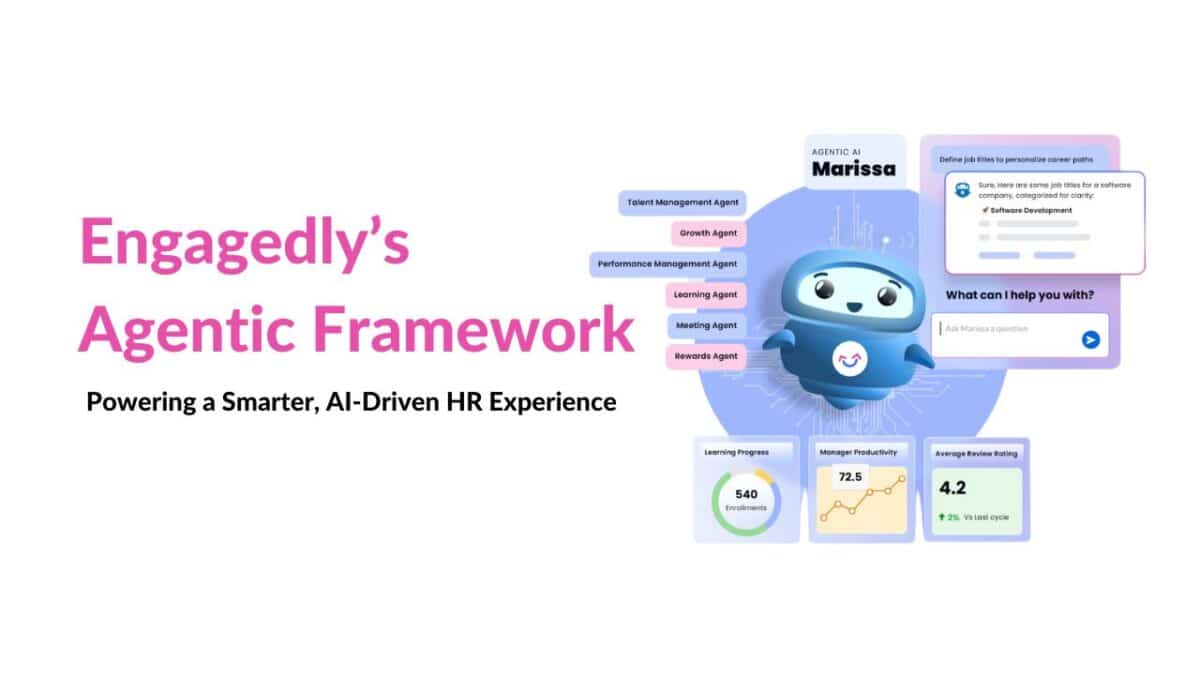
Powered by Marissa, our AI SuperAgent, Engagedly will translate your strategic intent into intelligent actions—guiding you like a seasoned talent management consultant would.

No more searching for buttons and menu links, or complex configuration screens or endless forms. Instead, leaders can have natural, research-backed conversations with Marissa to bring your people strategy to life, quickly and effectively.

 This Agentic approach will transform every stage of the employee journey:

  • Onboarding,
  • Culture-building
  • Goal alignment
  • Performance development
  • Upskilling
  • Mobility, and recognition

—driven by YOUR VISION and YOUR STRATEGY.

Most importantly, our AI will not replace the role or agency of People Leaders or Employees. Your leadership, judgment, and human connection remain central—now amplified with tools to act faster, smarter, and more personally at scale.

With Engagedly, you’re not just using AI—you’re will be leading with it.


Srikant Chellappa
CEO & Co-Founder, Engagedly

Democratizing AI for Talent Management – A defining moment in the evolution of work.

AI Agents in HR: Real-World Examples Driving Efficiency and Experience

The use of artificial intelligence in HR is no longer a futuristic concept—it’s a fast-growing reality. Valued at USD 3.25 billion in 2023, the global AI in HR market is projected to grow at a staggering 24.8% CAGR between 2024 and 2030. This explosive growth reflects how rapidly organizations are turning to AI to transform their HR operations.

But what exactly are AI agents in HR? Think of them as intelligent digital coworkers—smart, goal-oriented assistants that handle everything from onboarding and performance management to employee engagement and compliance. These tools don’t just automate tasks—they elevate the HR function with speed, consistency, and precision.

So, how are AI agents really making an impact in the workplace? In this blog, we’ll explore real-world tools and use cases that show how AI is actively enhancing efficiency, improving the employee experience, and supporting strategic HR decision-making.

What Are AI Agents in HR?

AI agents in HR are intelligent digital tools powered by artificial intelligence, designed to streamline, automate, and optimize a wide range of everyday HR functions. Think of them as virtual HR team members that work around the clock to enhance both efficiency and employee experience.

These AI agents are capable of handling tasks across several key areas, including:

  • Payroll Management
  • Performance Management
  • Compliance and Policy Adherence
  • Employee Experience & Engagement
  • Talent Acquisition & Recruitment
  • Learning and Development (L&D)


Unlike traditional HR tools, AI agents use natural language processing (NLP) and machine learning (ML) to understand user inputs, draw insights from large datasets, and perform tasks with minimal human intervention.

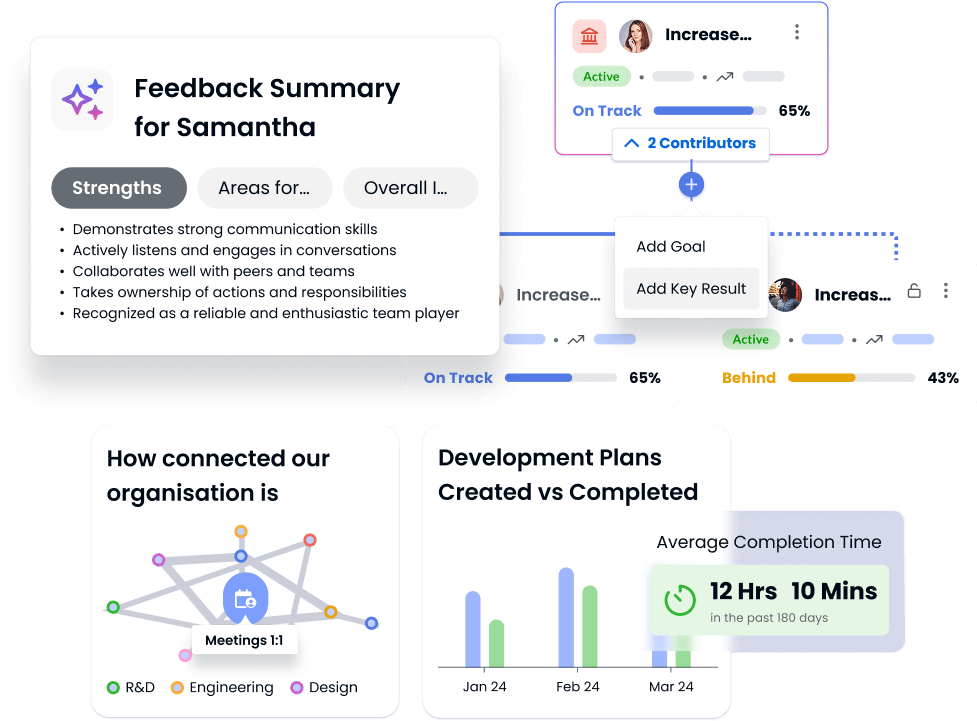
Take Marissa AI by Engagedly, for example. It analyzes real-time data from 360-degree feedback surveys to deliver personalized insights and development nudges to both employees and HR teams—helping them make smarter, data-driven decisions quickly.

In essence, AI agents don’t just support HR—they elevate it by combining speed, personalization, and intelligence. Discover how Engagedly’s AI powered platform streamlines HR processes, elevates performance outcomes, and enhances every stage of the employee lifecycle.

Benefits of Employing AI Agents in HR

Employees using traditional self-service technologies have to go through preset menus or FAQs because they only provide static responses. AI agents are transforming the way HR teams operate by introducing an agile, goal-oriented strategy, going beyond what generative AI can typically handle.

Here, we have listed some of the top real-life benefits of AI agents in HR.

1. Enhanced Talent Acquisition

From reviewing resumes to drafting offer packages, AI agents can expedite nearly every step of the talent acquisition process. AI agents can help with candidate evaluation, set up interviews, sift through enormous application pools, and interact with prospects.

A prime example is Paradox, an AI-powered hiring assistant utilized by businesses such as Unilever and McDonald’s.

Paradox’s conversational AI “Olivia” interacts with candidates, responds to their inquiries, and pre-screens resumes in real-time, relieving recruiters of the task of manually going through dozens of applications.

It has reduced time-to-hire by 75% at Uniliver. Thereby, boosting efficiency and saving time.

2. Personalized Employee Experience

According to a KPMG poll, 85% of participants said that the organization’s most essential HR skill is employee experience and engagement.

AI agents can personalize employee engagement and development initiatives. For instance, Marissa AI can provide customized nudges, like recommending training courses, chances for professional advancement, or health advice, that speak to each employee’s particular requirements.

Similarly, Walmart employs AI to help staff members select the best healthcare providers for their needs.

3. Data-Driven Decision Making

As per a Deloitte poll, 70% of businesses said they used data analytics to help with HR decision-making.

AI’s capacity to reveal predictive insights gives HR directors the ability to take proactive, calculated actions. AI agents can examine past data to find trends that can point to attrition concerns or talent shortages in teams.

By identifying these early indicators, HR can reduce the expensive effects of turnover by putting in place focused retention plans or upskilling initiatives.

Additionally, AI agents can help with workforce planning by evaluating future talent requirements based on corporate growth projections.

4. Better Compliance & Bias Reduction

AI reduces unconscious biases in hiring by using structured data to improve fairness and compliance.

For instance, HireVue promotes diversity and inclusion by using structured interview algorithms that concentrate on candidate skills rather than personal opinions. It also results in a 50% decrease in cost per interview.

Johnson & Johnson used Textio, an AI-powered writing tool, to find unintentional bias in their job postings. When they noticed that many of their job posts had a masculine slant, they made some AI-driven changes that resulted in a 9% increase in the number of female candidates.

Additionally, AI-generated decision pathways produce visible audit trails, ensuring that HR procedures comply with legal requirements such as GDPR and EEOC. In addition to lowering legal concerns, this transparency increases employee and candidate trust.

5. Simplified Onboarding & Training

According to Forbes, an effective onboarding procedure can boost retention by up to 82%.

AI HR assistants like Talla automate common questions about policies and system access to streamline the recruitment experience.

These chatbots lessen reliance on HR staff and speed up the onboarding procedure by offering 24/7, instant responses.

6. Improved Employee Retention

According to a Gallup poll, 85% of workers are not engaged at work. Given that 63% of employees would think about quitting their jobs within two years if they weren’t succeeding professionally.

Glint’s AI pulse surveys and other AI technologies track employee engagement levels in real time. AI detects early indicators of disengagement in teams by examining behavioral data and survey responses.

HR and managers can then take targeted actions to address issues proactively, including:

  • Recognition programs
  • Workload diversification
  • Career conversations

5 Real-World AI Agent Examples in HR

While there are numerous justifications for utilizing HR AI technologies, the most effective ones simplify hiring managers’ and HR assistants’ departmental procedures.

Let’s look at some of the real-world AI agent examples transforming the HR domain!

1. Engagedly’s Marissa™ AI – The Ultimate HR Super-Agent

1. Engagedly’s Marissa AI

Marissa™ AI is a smart, AI-powered HR assistant that automates routine tasks and addresses key HR challenges across:

  • Employee engagement – gathering and summarizing pulse surveys, sentiment, and feedback
  • Performance management – providing real‑time feedback, 360° review synthesis, and unbiased insights
  • Feedback delivery – generating objective feedback aligned with the SBI framework
  • Talent acquisition & description creation – crafting tailored job, survey, training-course and IDP descriptions

🔍 Key Use Cases

  1. Personalized Feedback (SBI-ready)
    Marissa crafts objective, balanced feedback using the Situation‑Behavior‑Impact model—ensuring clarity and fairness.
  2. Instant Recognition Templates
    Input a few details and get personalized praise instantly to lift team morale.
  3. Automated 360° Summaries & Nudges
    Marissa consolidates 360-degree feedback into actionable summaries and reminds managers proactively.
  4. Smart Development Plans (IDPs + Milestones)
    Generate customized Individual Development Plans with clear milestones; paired with learning recs to match career aspirations.
  5. Compelling Course & Job Descriptions
    Produce engaging summaries for training, surveys, jobs, and IDPs in seconds to streamline rollout and boost adoption.
  6. Unified AI-Powered Agentic Framework
    Since March 11, 2025, Marissa acts as a “Super Agent” within Engagedly’s Agentic AI framework—delegating requests (e.g., career advice, goal-setting, talent analytics) to specialist AI agents behind the scenes

2. IBM Watson in HR

IBM Watson in HR

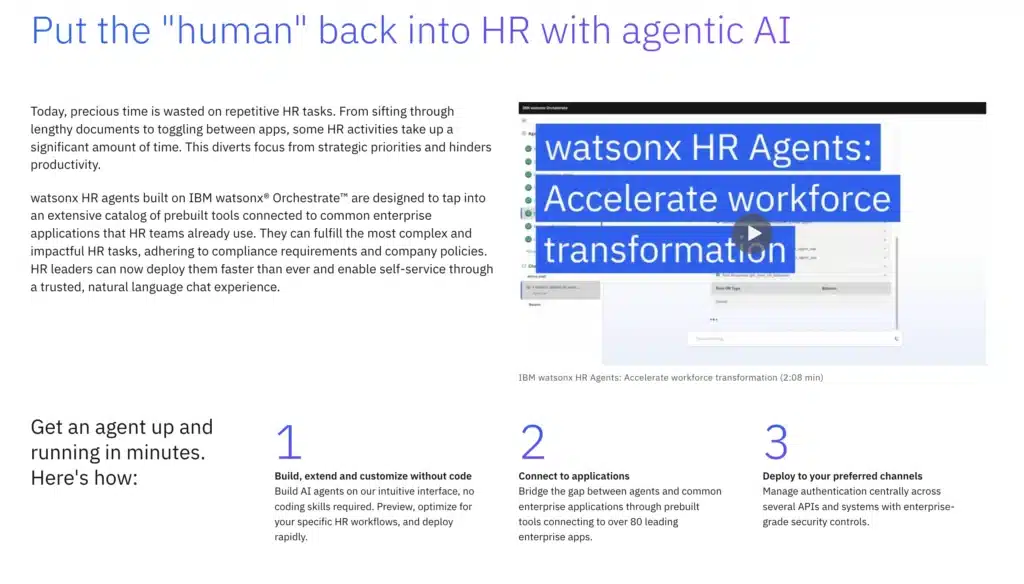
IBM incorporates AI into its HR operations to give its employees better competence. For example, Watson, an AI virtual assistant, provides individualized responses and speeds up response times to IBM employees’ inquiries regarding everything from technical support to business policy.

Use Cases

  • Talent Acquisition: IBM Watsonx HR agents can draft offer bundles, find the best candidates, set up interviews, and issue job requisitions. Talent acquisition teams can make better hiring decisions when they have access to AI.
  • Employee Onboarding: Watsonx HR Agents can increase employee engagement. In addition to offering personalized advice, including pre-employment screenings, learning recommendations, onboarding profile creation, and IT request generation, these agents respond in real time to FAQs by employees.
  • Employee Satisfaction: Automate HR processes and streamline information availability. Watsonx HR Agents with generative AI can manage payroll, time off, in addition to administering benefits, including healthcare, retirement plans, and possibilities for professional advancement.

3. Talla AI Chatbot

Talla AI-powered chatbot uses machine learning to specialize in HR knowledge management. The platform is very flexible to current processes due to its smooth integration with Confluence, Slack, Microsoft Teams, and SharePoint.

Use Cases

  • HR Helpdesk Automation: Talla AI Chatbot streamlines HR support by addressing employee questions about leave policies or payroll issues.
  • Benefits Queries: Talla provides accurate, up-to-date information on health insurance, retirement plans, or other benefits
  • Onboarding Assistance: Talla guides new hires through onboarding processes. It answers common questions about company policies and training schedules.
  • Compliance Information: The chatbot delivers essential compliance updates and guidelines to help employees adhere to company and regulatory standards.

4. HireVue AI Interviews

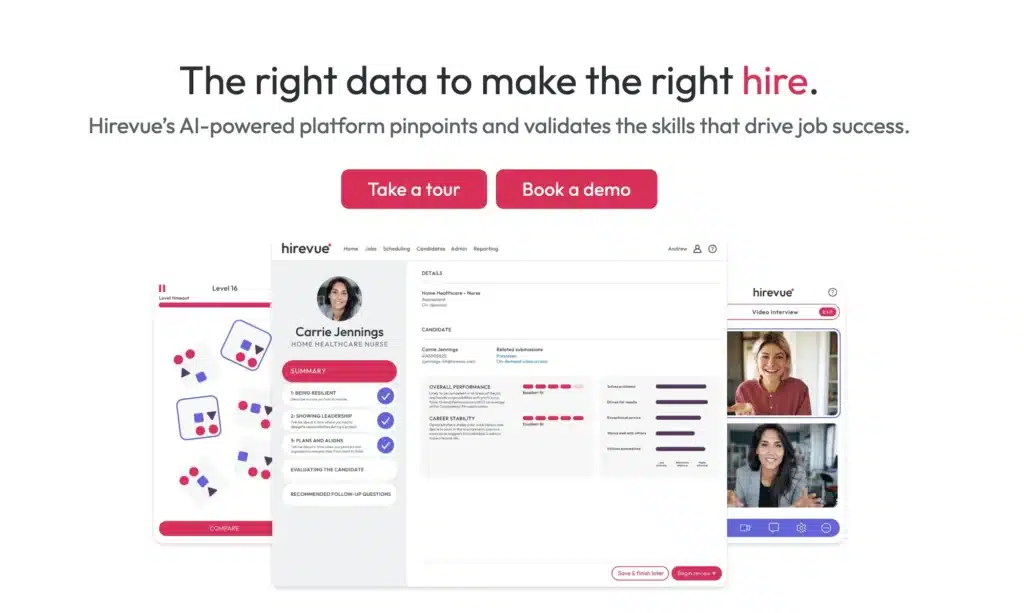
HireVue

With HireVue AI interviews, candidates record video answers to pre-formulated questions. AI then evaluates the candidates’ skills and attributes. To provide a score and offer feedback, the AI analyzes both spoken and nonspoken indicators, such as

  • Body language
  • Facial expressions
  • Speech patterns

Investment banks like J.P. Morgan, Goldman Sachs, and multinational companies like Unilever, Vodafone, and  Delta Air Lines have used HireVue in their recruitment processes.

ICON, a multinational healthcare company, increased candidate satisfaction by 17% by employing HireVue’s AI interviews. Additionally, HireVue’s AI interviews ensured a more gender-diverse workforce for Unilever.

Use Cases

  • Video Interviewing: Makes it possible for HR teams to perform live and on-demand video interviews. This increases the flexibility and accessibility of the hiring process.
  • AI-Driven Evaluations: Make use of sophisticated algorithms to gauge applicants’ talents and capabilities beyond their resumes.
  • Integration Competencies: Streamlines hiring procedures by integrating easily with Applicant Tracking Systems (ATS) and other HR technologies.

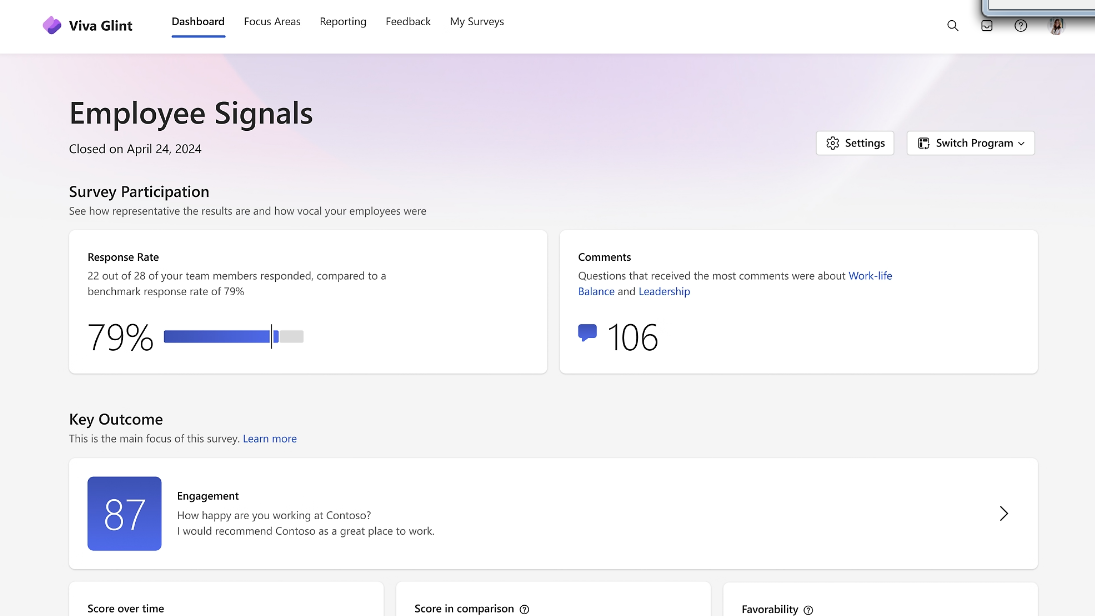
5. Glint’s AI-Powered Surveys

Microsoft Viva Glint, formerly known as Glint’s AI-powered surveys, is a tool for measuring workplace culture and engagement.

It uses artificial intelligence (AI) to evaluate survey data and give businesses useful information about employee satisfaction and performance patterns.

source

Use Cases

  • Teams Integration: Improve notifications and nudge capabilities by facilitating simple communications in the day-to-day flow of work
  • 360 Feedback: Provide employees with a more thorough understanding of their talents and areas for improvement from a variety of perspectives, resulting in improvements to both personal and business performance.
  • Survey Tool: Businesses can utilize Viva Glint’s customisable questionnaires to get detailed input on diversity and inclusion, staff involvement, onboarding, and exit procedures.

Transformative Power of AI Agents in HR

Answering FAQs by employees, including “How do I check my PTO balance?” “What is the procedure for leave approval?” or “What wellness plans are offered to employees?” is an instance where HR teams invest a significant amount of effort. 

AI agents can swiftly address these queries and contribute to effective workplace communication. May it be strategic decision-making or enhancing employee experience, AI agents are culminating in a smart, data-centric approach in HR.

Learn how companies can take control of their employee management journeys using Engagedly’s agentic approach. The intelligent elements of Engagedly, such as the MarissaTM AI assistant, are powered by this architecture. It makes HR operations faster, smarter, and accurate! See how Engagedly brings AI into core people operations to simplify workflows, support data-informed decisions, and optimize talent management.

Don’t just take our word for it—explore the full suite of Engagedly’s talent management products!

FAQs

How are AI agents used in the recruitment process?

AI agents expedite the hiring process by automating resume screening, candidate outreach, and interview scheduling. Additionally, they use data analysis to find the top talent more quickly.

Can AI agents help with employee onboarding?

Yes, AI agents like Talla automate onboarding, answer FAQs, and deliver policy documents, creating a smooth and consistent new hire experience.

What are some real-world companies using AI in HR?

Firms like Walmart, IBM, Unilever, and LinkedIn use AI in various HR operations.

What benefits do AI agents bring to HR teams?

AI agents offer several key benefits:

  • Reduced time-to-hire
  • Personalized employee development
  • Real-time engagement monitoring
  • Bias-free hiring decisions
  • Streamlined onboarding
  • Improved compliance and audit readiness
  • Enhanced productivity by reducing manual HR tasks

What’s the future of AI in HR?

The AI in HR market is growing rapidly (projected 24.8% CAGR from 2024 to 2030). As AI agents become more sophisticated, they’ll increasingly shape HR into a data-driven, employee-first function—enhancing everything from recruitment to retention.

How do AI agents differ from traditional HR chatbots?

AI agents use advanced machine learning and natural language understanding to respond dynamically, whereas traditional chatbots often rely on static rules and scripted responses.

Do AI agents need training before deployment?

Yes, AI agents typically need to be trained on company-specific data, HR policies, and workflows to ensure relevance and accuracy.

Can AI agents be integrated with existing HR tools like SAP or Workday?

Many AI HR solutions offer APIs or pre-built integrations for popular HRIS, ATS, and LMS platforms, allowing for seamless workflows.

Top 6 LMS Solutions for Growing Companies

Growing companies face unique challenges: scaling operations, onboarding new talent, and upskilling employees—all while keeping costs under control. This is where a Learning Management System (LMS) becomes indispensable. The right LMS can help you streamline training, enhance productivity, and support growth without stretching your budget thin.

But not all LMS solutions are built with growing businesses in mind. You need an option that’s affordable, flexible, and robust enough to adapt to your evolving needs.

Whether you’re onboarding new employees or rolling out company-wide training programs, the right LMS will empower your team and fuel your company’s success. Let’s explore the top six affordable LMS solutions designed to help your business grow smarter, not harder.

Why Affordable LMS Solutions Matter for Growing Companies

For growing companies, every dollar counts. Tight budgets often mean making tough choices, but compromising on employee training shouldn’t be one of them. Affordable LMS solutions bridge the gap between cost and quality, empowering businesses to deliver exceptional training without breaking the bank. Think of it as finding a designer outfit at a thrift store—great value without sacrificing quality.

Purchasing an LMS is a big step, in a way. Some might ask: “Isn’t traditional training good enough? Think of it like this: Traditional training is the flip phone in the era of smartphones. It works, but man, you are missing out!

In 2025, the global LMS market is projected to hit $28.6 billion, with a strong shift toward solutions that offer scalability and tangible value for smaller budgets (Research.com). Remote and hybrid learning models have become the norm, driving demand for platforms that deliver solid functionality without premium pricing (Skill Lake).
Affordable LMS options today are not just “budget-friendly” — they are strategic enablers for workforce upskilling, agility, and competitiveness in a rapidly changing business landscape.

The Ripple Effect of Good Training

Investing in quality training doesn’t just benefit your employees—it transforms your entire organization. When workers feel confident and empowered, their performance improves, leading to happier customers and a stronger reputation for your brand. It’s a domino effect of success, all sparked by a smart investment in an affordable LMS. With the right tools, training becomes more than an expense; it becomes the foundation for growth, satisfaction, and long-term success.

Criteria for Selecting the Best Affordable LMS

1. Key Features to Look For

Before we get into the best choices, let’s talk about what makes an LMS worth your time (and money). Here are some key features you should consider:

  • User-Friendly Interface: No one wants to wrestle with a complicated system.
  • Customization Options: Your training should reflect your unique brand.
  • Robust Analytics: Leverage data to track team performance and make better decisions.
  • Mobile Compatibility: Modern training means learning on the go.
  • Scalability: Choose an LMS that grows with your company.

2. Hidden Costs to Watch Out For

Beware of LMS platforms that appear affordable but hide costs in the fine print.

Watch for:

  • Setup Fees: Charges for system setup, data migration, or configuration.
  • Customer Support: Extra fees for premium support like 24/7 assistance or dedicated account managers.
  • Add-On Features: Costs for advanced tools like detailed analytics, integrations, or additional storage.
  • Per-User Fees: Pricing that increases as your team grows.
  • Upgrades and Maintenance: Unexpected charges for updates or system upkeep.

Remember, an affordable LMS should be transparent about pricing.

The Top 6 Affordable LMS Solutions

Drum roll, please! Let’s unveil the stars of the show.

TalentLMS

TalentLMS

TalentLMS is literally the all-in-one gadget you never knew you needed. Simple and efficient by design and ideal for any company growing faster than a meme- cat video!

Key Features

    • Customization: Personalize the platform with your brand colours, logos, and even custom domains.
    • Ease of Use: Easy to navigate and grandma-approved. Honestly, if they can use Facebook, they can use Talent LMS.
    • Integrations: Works perfectly with Zapier and slack as well as e-commerce platforms too.

Pricing

TalentLMS allows up to 5 users and 10 courses for free. Plans begin at $59/month for a maximum of 40 users. Need more? They have scalable plans, so it stays an affordable LMS option as you grow.

Why Choose Talent LMS?

TalentLMS is a great choice if you need an easy setup and a platform that scales with you. And their customer support is like having a tech-savvy friend on call.

Moodle

Moodle Interface

Moodle, the LMS open-source champion! Moodle offers flexibility and for those who love technology, it can become your ideal companion. Think of it as the Lego of LMS platforms — you can create anything you want.

Key Features

  • Open-Source: Free for everyone to use and modify. That’s right, it’s free!
  • Community Support: A rich ecosystem of plugging/extensions and forums for questions (and answers!)
  • Scalability: Scales as your organization grows with no added license expense

Pricing

With Moodle being an open-source platform it is free to use but you will have hosting and maintenance costs. If you’ve got an IT crew, they could do it internally. However, you also have the option to go with their hosted solution, Moodle Cloud, starting at approximately $110/year for 50 users. An affordable LMS nonetheless by any means.

Is Moodle Right for You?

For high-level customization and if you don’t mind some extra technical configuration, Moodle is great for flexibility. This is the holy grail of LMS for the DIY freak.

iSpring Learn

iSpring Learn

In the LMS world, iSpring Learn is the sleek sports car—quick, functional, and sexy. Great for organizations who want something quick, without sacrificing functionality! Think of it as the LMS version of “get in and drive”.

Key Features

  • Rapid Deployment: Setup and ready to run in a single day. Your LMS will be up and running before tomorrow’s lunch break.
  • Mobile App: On-the-go learning made easier. For both IOS and Android.
  • Detailed Reporting: When you need to know how your team is doing in detail analytics

Pricing

Pricing begins at $2.82/user/month for 100 users, billed annually. They also have custom pricing for larger teams, but still within the cost-effective LMS territory.

Standout Feature

iSpring Learn is part of the iSpring Suite authoring unicorn toolkit. If your jam is creating interactive courses, this is peanut butter and jelly.

Litmos

litmos LMS

Litmos — this one’s comparable to a Swiss Army knife, versatile and equipped with tools. This is a definite bonus for industries governed by compliance training, and it is where it shines brightest.

Key Features

  • Content Library: Wide array of courses on compliance, sales, customer service, etc.
  • Gamification: Use Badges, Points, and Leader boards to make it Fun! (Who said training had to be boring?)
  • API Integration: Integrates with your existing systems, from HR platforms to CRM tools.

Pricing

The pricing is quote-based, but it is known to be competitive; that is why it’s affordable for most of the growing companies. There is also a 14-day trial free, so lots of time to try it out.

Case Study: How RetailCo Boosted Sales with Litmos

Meet RetailCo, a mid-sized retail company struggling with inconsistent sales training across their stores. They adopted Litmos to standardize training modules, resulting in a 15% increase in sales within six months. Employee turnover also decreased by 10% and who doesn’t love such a success story!

ProProfs LMS

ProProfs LMS is like the neighbour who lends you sugar and gives the best advice. Easy to use and suitable for them novice companies in the LMS market!

Key Features

  • Easy Course Creation: You don’t need a computer science degree — just drag and drop!
  • Quizzes and Surveys: Increase interaction with your Learners and gather feedback to enhance your courses.
  • Multi-Language Support: Suitable for worldwide teams — hula, bonjour, hello!

Pricing

Monthly plan starting at $1.97/user, billed annually. Less than your daily cup of coffee: A truly low-cost LMS.

Why ProProfs LMS Shines

Their customer support is best, available 24/7. In addition, they have tons of templates to help you get started too!

LearnUpon

LearnUpon LMS

LearnUpon is the customer success LMS. You get top-notch customer support, which maximises the platform offerings. It is your personal trainer for the LMS journey.

Key Features

  • Blended Learning: Provide a mix of online and offline training for a holistic approach.
  • Certification Management: Maintain compliance using certification management.
  • E-Commerce Integration: Integrate with E-Commerce to open a new stream of revenue if you choose to.

Pricing

Plans are for up to 100 users and billed annually, starting from $599/month. It sounds expensive, but for the features, functionality, and support you receive you really get a whole lot of value for a fairly affordable LMS price.

The LearnUpon Difference

With their customer success-centric model, they provide lots of on boarding and admin training. You’re getting more than just software, you gaining a partner.


Why These LMS Platforms Are Affordable (Updated for 2025)

In 2025, affordability in LMS solutions extends beyond a low monthly subscription fee:

  • Annual plan discounts: Many vendors now offer 10–20% savings when billed annually versus monthly (Careervira).
  • Usage-based pricing models: Rising AI integration costs are pushing more LMS providers toward hybrid pricing tiers — blending a predictable base subscription fee with pay-as-you-go credits (Business Insider).
  • Scalable entry plans: Affordable LMS vendors like TalentLMS and LearnWorlds are introducing entry-level packages that can expand seamlessly as teams grow.

The Rise of Retail LMS Solutions

The retail sector is thrilling but also has a high turnover rate among employees. A retail LMS facilitates fast hiring of new employees, and introduces already-working employees to product changes. You don’t want your staff stammering when someone inquires about the latest product!

Features Specific to Retail LMS

  • Microlearning Modules: Specific, time-efficient training great for a busy schedule.
  • POS Integration: Training that is linked to a POS system, for real-time updates.
  • Multi-Store Management: Training can centralize for all locations, providing consistency.

Case Study: Boutique Mart’s Success with a Retail LMS

Boutique Mart, a chain of boutique stores, implemented a retail LMS to streamline employee training. Within three months, customer satisfaction scores improved by 20%, and sales of new products increased by 25%. Now that’s what we call a return on investment!

The Affordable LMS for Retail—Which One to Choose?

Litmos and ProProfs LMS are fantastic examples of retail LMS since they provide features that pertain specifically to retail characteristics. They combine cost-effectiveness with tools tailored for the industry.

Making the Most of Your Affordable LMS

Tips and Tricks

  • Engage Learners: Use videos and quizzes to make learning fun.
  • Monitor Progress: You should always keep an eye on analytics to know what you can improve on. Data doesn’t lie!
  • Gather Feedback: Don’t be afraid to encourage your team to tell you what they feel is working and what isn’t. It Allows You To Refine Your Training Programs

Common Pitfalls to Avoid

  • Overcomplicating Courses: Keep It Simple, information overload makes things counterproductive.
  • Ignoring Mobile Users: Make sure, your LMS is mobile-friendly. This is non-negotiable in this day and age.
  • Neglecting Updates: Update your content regularly to keep it relevant.

How to Find the Most Cost-Effective LMS in 2025

Practical Steps to Maximize ROI:

  • Use LMS directories like GetApp to instantly compare features, reviews, and pricing models (educate-me.co).
  • Calculate Total Cost of Ownership (TCO): Include licensing, setup, training, ongoing support, and potential scaling costs.
  • Negotiate annual plans: Commit to long-term use for lower per-user rates and 10–20% savings.
  • Explore usage-based or hybrid models for flexibility when your learning needs fluctuate.
  • Consider WordPress LMS plugins if you already operate on WP — they can offer enterprise-level features at a fraction of the price.

Small-business-first features – Streamlined onboarding, clear pricing, and simplified administration make tools like TalentLMS and LearnWorlds ideal for smaller organizations (LearnWorlds, thirst.io).

Market expansion fuels options – The affordable LMS segment is expected to reach $31.3 billion in 2025, bringing more competition and choice (Research.com).

DIY and plugin solutions – WordPress LMS plugins like Tutor LMS and Masteriyo are cost-effective alternatives for businesses already operating on WP infrastructure (TechRadar).

AI-assisted personalization at low cost – Entry-level LMS packages now include AI-based recommendations without enterprise pricing.

Conclusion

Finding the right LMS doesn’t have to be complicated or expensive. These six affordable options offer the features growing businesses need without unnecessary costs.

Take a moment to think about what your team really needs—ease of use, scalability, or mobile access—and pick the one that fits best. A good LMS isn’t just about saving money; it’s about setting your team up for success as your business grows.

FAQs

Is an affordable LMS worth it?

Of course! An affordable LMS is all about delivering essential training features at a bare minimum price without hefty costs. It’s all about the right balance between cost and functionality.

Can I customize courses in these LMS platforms?

Yes. Companies, such as TalentLMS and ProProfs LMS, offer a platform that can easily be customized according to your company requirements.

What is a retail LMS?

Retail LMS is a learning management system that focuses particularly on the retail industry. It specifically deals with the high rate of turnover and the fast deployment of training required in the retail setting.

How do I choose the best LMS for my company?

Consider ease of use, scalability, features, and obviously, affordability. Don’t forget to take advantage of free trials!

Are there hidden costs in affordable LMS platforms?

Always read the fine print. Sometimes, a low-cost LMS will hide setup fees or charge more for premium features. Transparency, in this case, is the key, so pay attention to just what you are signing up for.


Best Talent Management Statistics HR Needs to Know

In the dynamic realm of Human Resources, staying ahead of the curve is not just advantageous; it’s essential. With the evolving nature of work and the changing expectations of employees, having a finger on the pulse of talent management is crucial. That’s where Talent Management Statistics come into play, serving as the compass guiding HR professionals toward more informed, strategic decisions.

In this article, we explore Talent Management Statistics essential for HR leaders. Whether you aim to refine recruitment, enhance employee development, or boost retention, these stats offer valuable insights. They cover areas like diversity’s impact on performance and current trends in remote work and engagement, providing a glimpse into talent management’s future.

Get ready to delve into this data-rich world. These statistics will inform your HR strategies, helping you create a workplace where talent flourishes, propelling your organization to new heights of success. Your journey to HR enlightenment starts here.

Why Talent Management Stats Matter Even More in 2025

In 2025, navigating talent challenges means relying on data more than ever. According to SHRM, addressing talent acquisition, retention, and workforce upskilling will be HR’s top priorities this year. AI-driven regulation and new workplace norms have made data-informed decisions mission-critical.
McKinsey finds that organizations optimizing talent yield stronger shareholder returns, confirming that talent metrics aren’t optional, they’re strategic.”

Also Read: Why Your Business Needs This Talent Management Framework
Talent Management Statistics
Also Read: A Complete Overview of Talent Management in a Changing Global Workplace

Talent Management Software

Updated 2025 Talent Management Stats You Need to Know

  • Only 29% of employees feel their companies truly support their well-being—highlighting a glaring gap in talent management efforts (ClearCompany Blog, Teamflect).
  • Just 44% of companies believe their performance management systems improve performance—and only 40% provide consistent upskilling opportunities (ClearCompany Blog).
  • 71% of organizations struggle to find quality candidates, and 20% of employees plan to look for new jobs within the next year (Paycor).
  • Employees who are fully engaged perform 20% better and are 87% less likely to quit, underscoring how vital engagement is to talent retention (Wikipedia).
  • Companies excelling at talent management see 2.2× revenue growth and 2.1× profit rates, along with better leadership development and performance outcomes (Talentech Blog).

How AI & Analytics Are Transforming Talent Management

AI and analytics are revolutionizing talent decisions in 2025. Cutting-edge talent analytics—powered by big data and automation—enable real-time insights and strategic workforce planning.
This integration is driving:

(Sources: arXiv, Mercer, McKinsey & Company)


Frequently Asked Questions

Q1. How can HR help with talent management?

Ans. HR can help with talent management by identifying and attracting top talent, implementing effective onboarding and development programs, fostering a positive workplace culture, and continuously monitoring and optimizing talent strategies to align with organizational goals.

Q2. What data are collected in talent management?

Ans. In talent management, various types of data are collected, including candidate resumes, performance evaluations, skills assessments, employee engagement surveys, turnover rates, and succession planning information. This data helps organizations make informed decisions about recruitment, development, and retention of their workforce.

Q3. What is talent management & HR analytics?

Ans. Talent management and HR analytics refer to the use of data analysis and metrics to gain insights into an organization’s workforce. It involves measuring and optimizing various HR processes, such as recruitment, performance management, and employee development, to make data-driven decisions that improve talent acquisition, retention, and overall HR effectiveness.

How to Develop an Effective KPI Review System for Organizational Success

Imagine having a clear dashboard that shows exactly how well your team is performing and whether you’re on track to achieve your business goals—just like a GPS guiding you to success. That’s exactly what a well-designed KPI system offers.

By focusing on specific goals and using KPIs (Key Performance Indicators) to measure progress, organizations can ensure they’re moving in the right direction and scaling effectively.

KPIs help quantify employee productivity and ensure alignment with business objectives, making them essential tools for driving performance. In this article, we’ll guide you through developing a KPI system for performance reviews, setting key metrics, and implementing them to build high-performing teams.

Why KPI Performance Review Matters More Than Ever in 2025

In 2025, performance reviews are evolving—teams that focus feedback on strengths are 8.9% more profitable and 12.5% more productive than those that emphasize weaknesses (SelectSoftware Reviews). Yet, despite this potential, trust in review systems remains low—only 6% of organizations believe their process effectively uses data while also building trust (Deloitte).

This is why modern KPI performance reviews must go beyond metrics—they must combine data-driven insights with meaningful, human-centered feedback to create reviews that employees trust and act on.

What are the KPIs for Employees?

KPIs, or Key Performance Indicators, are just a fancy way of saying measurable goals that show how well employees are helping the company hit its targets. They’re used to track performance across different departments—whether it’s sales, marketing, HR, or customer service—and help ensure that everyone is contributing to the overall success of the business.

Take a sales team, for example. One of their KPIs might be the number of new clients they bring in each month. If the goal is 20 new clients, and they’re only hitting 15, it’s a clear sign that something needs adjusting, whether it’s offering more training or tweaking the sales pitch.

KPIs can vary depending on the department. In sales, it could be revenue growth; in HR, it might be something like “time-to-hire.” If it’s taking 45 days to fill a position when the industry average is 30, that KPI can highlight the problem and prompt HR to streamline the hiring process.

What makes KPIs so important is that they give you a quick snapshot of how things are going. They show you where you’re doing well and where there’s room for improvement. You can even set individual KPIs to measure personal performance and see where employees might need some extra support or training.

In short, KPIs are like a report card for your business, helping you keep track of what’s working and what needs a bit of fine-tuning.

When selecting KPIs for performance reviews, organizations are prioritizing metrics that align with both business outcomes and employee engagement.

Top trending metrics include:

  • Goal Achievement Rate – Tracks progress against individual or team objectives.
  • Work Quality – Assesses accuracy, attention to detail, and adherence to standards.
  • Productivity Efficiency – Measures output relative to resources and time.
  • Engagement Scores – Monitors motivation, satisfaction, and commitment to the organization.

Organizations that emphasize continuous feedback—rather than only annual reviews—report 31% lower turnover and higher engagement when managers conduct frequent check-ins.

AI-Enhanced Performance Reviews: Smarter, Fairer, Faster

Artificial Intelligence is reshaping how KPI performance reviews are conducted.

  • Better Articulation of Achievements – AI tools help employees describe their accomplishments more clearly.
  • Bias Reduction – Algorithms can minimize unconscious bias, especially critical for diversity and equity in evaluations.
  • Adoption & Preference – 75% of knowledge workers already use AI tools, and 89% of Oracle employees preferred AI-assisted reviews when introduced (Business Insider).

By integrating AI into KPI reviews, companies can speed up the process, improve fairness, and support more objective decisions—all while maintaining a human oversight layer.

Examples of KPI Reviews for Employee Performance

There are a variety of Key Performance Indicators that can measure employee performance. Below are four examples:

KPI for Engineering

The KPI of Engineering is typically measured as a Cost Performance Indicator (CPI). Engineering KPIs are like analytics and tell engineers how they’re doing at a specific moment. A product may have one or several KPIs depending on your situation and where your company is in its life cycle.

Some of the important engineering KPI metrics are given below: 

  • Engineering-on-Time Delivery
  • Cost Performance Indicator (CPI) 
  • Schedule Performance Indicator (SPI) 

This will tell you a lot about key performance indicators (KPIs) that you can use when assessing how well your company’s engineering department is functioning.

KPI for Sales

A Sales Key Performance Indicator (KPI) or metric can act as a performance monitoring system often used by the sales team and the company’s top management to track the effectiveness of relevant sales strategies, tactics, and activities. With these indicators or metrics, it’s possible to optimize sales performance, funnel, and cycle length. 

Some of the Important Sales KPI metrics include:

  • Earnings before taxes, depreciation, and amortization (EBITDA)
  • Profit before taxes (how much revenue the company retains after deducting the production cost )
  • Profit after taxes (how much revenue the company owns after paying taxes, expenses, etc.)

Based on these KPI metrics, companies set their sales strategies and further course of action.

KPI for HR

An HR KPI is a measurable value that helps track pre-defined organizational goals of human resources management. HR departments use KPIs to optimize recruitment processes, employee engagement programs, opportunities for professional development, etc.

Some of the significant examples of HR KPIs include:

  • The number of new recruitments
  • Cost per hire
  • The rate of absenteeism (to determine how much productivity has been lost due to employee sick or personal days)
  • Attrition rate
  • Cost Per employee

KPI for Product Design

Every business owner has a set of data points upon which the business is evaluated upon, especially in the case of Product Design. It’s essential to track these KPIs for many reasons, but the main one is assessing if products deliver effectively to get the expected outcomes or results.

  • Per-project lead time The time it takes for a project to go from request to completion is lead time.
  • Estimated vs. Actual Project Time
  • Client Satisfaction Ratings. Client satisfaction ratings can be measured with a short post-project survey.

As 2025 progresses, KPI-driven reviews are becoming more continuous, human-centered, and coaching-focused:

  1. Performance as an Ongoing Conversation – Annual reviews are being replaced by micro-goals and nudges throughout the year.
  2. Managers as Coaches – The role of managers is shifting from “judge” to “coach,” backed by peer insights and feedback prompts rather than top-down evaluation.

How Should You Evaluate the Performance of Your Employees?

Evaluating employee performance goes beyond just looking at KPIs. Here are a few important pointers to keep in mind when reviewing an employee’s performance:

  • Don’t Rely Solely on KPIs: While KPIs give you measurable insights, they shouldn’t be the only factor. It’s crucial to consider other aspects like job experience, level, and past performance to get a more complete picture.
  • Balance Qualitative and Quantitative Feedback: Numbers are important, but they don’t tell the whole story. A well-rounded performance review includes both quantitative metrics (like KPIs) and qualitative feedback (such as communication skills, teamwork, and problem-solving abilities).
  • Collaborate with Employees: Instead of just setting annual targets and waiting until the end of the year, work with employees throughout the review period. Involving them in the process gives them clarity on where they can improve and helps them feel more engaged.
  • Consider Individual Differences: Each employee is unique, and their strengths may vary. One-size-fits-all evaluations don’t work. Tailor the performance review process to reflect the employee’s specific role, skills, and growth trajectory.
  • Look Beyond the Numbers: KPIs show progress toward goals, but they don’t explain how someone can improve. A thorough evaluation digs into the why behind the numbers and provides actionable insights.
  • Context Matters: Different roles and organizations place varying weight on different metrics. Be sure to adjust the emphasis on specific KPIs or qualitative factors based on the job and the company culture.

What Makes a Great KPI Review?

Think of KPIs like a fitness tracker for your business. If you’re not tracking those steps (or sales, or project completions), how will you know whether you’re crushing it or need to pick up the pace?

Here’s what makes a good KPI review:

Just like you wouldn’t use a fitness tracker that only gives you vague hints (“maybe you walked today”), a good KPI review needs to be clear and precise.

  • Measurable: The KPI should provide clear, quantifiable data so you can easily gauge progress. If you can’t measure it, you can’t manage it.
  • Relevant: The KPI must be directly tied to the company’s objectives. It should reflect a critical part of the business goal, not just a general performance metric.
  • Timely: A good KPI allows for real-time feedback or frequent assessment. This ensures that performance is tracked regularly and can be adjusted before it’s too late.
  • Actionable: If a KPI shows that performance is off track, it should provide insights into what needs to change. A good KPI doesn’t just point out problems—it helps create solutions by being adaptable and providing actionable insights.

How to Create a KPI System for Performance Reviews?

KPI is often interpreted as a critical performance indicator. As a leader, it’s in your best interest to find out how well your company or team is performing. The effectiveness of using various KPIs is driven by how much they can affect the business outcomes. 

The right KPI system for performance review helps you align your business goals through structured OKRs and goal tracking, and it’s essential to make sure the KPIs are related to performance metrics.

1. To the point and be specific

A KPI must be specific and denote an actual value that can be measured to track the performance metrics. Like “Customer Satisfaction to be increased” has to be replaced by “Customer Satisfaction survey should result in a 10% increase by the end of Q3”.

2. Measurable 

A good Recipe needs quality ingredients like the key performance indicator (KPI) itself should be specific, measurable, and attainable. The best point in time to define what those KPIs are is when discussing your initial goals and objectives.

A perfectly measurable KPI for employees is always better than those which are not specific and measurable.

3. Relevant for the role

It is important to note that all KPIs should be aligned with a larger key business objective. When setting Key Performance Indicators for a team, it’s essential to ensure that each employee is working on an appropriate set of KPIs.

It’s essential to ensure that each employee is working on an appropriate set of KPIs. If the sales team has KPIs unrelated to their role and the sales process, it will be hard for them to stay motivated and work on the correct metrics. Each employee has to be assigned proper metrics appropriate for them and to help them understand how to achieve them. 

4. Specific and time-bound

A realistic amount of time has to be set to measure the progress of a specific KPI for employee performance and a KPI system for performance reviews.

For example, you have set a goal to achieve a recurring product sale of 30% for every month. Here you have set a specific time of one month for achieving a specific goal.

Setting a specific time limitation lets us measure a key parameter more effectively. Any need for improvement can be implemented quickly and effectively.

Implementing a KPI System for Performance

Developing and implementing KPI system performance are the final and most important objectives of the organization to analyze the health of the organization and check whether the business is running towards its actual desired direction. 

As an essential tool to establish and implement a system of performance system, performance management, and KPIs is among the most critical performance systems to measure the efficiency and effectiveness of a company or an organization. 

It is used to measure an entity’s performance level and then improve the business performance levels. Given that, an organization’s overall objectives should be the organizational health analysis and business direction analysis. The most crucial objective is to develop and implement the KPI system to monitor the performance and analyze the health of an organization.

To successfully implement and measure a KPI system for performance reviews, consider the following key steps:

  1. Identify Key Areas to Evaluate: Determine which aspects of business performance you want to track and which parameters will be most relevant to your goals.
  2. Set Clear Benchmarks: Establish the optimal targets or benchmarks for each KPI, ensuring they align with your overall objectives.
  3. Compare Actual Performance to Targets: Regularly measure current performance against the goals you’ve set to assess progress and identify gaps.
  4. Analyze Performance Trends: Review recent changes in performance to spot patterns, improvements, or declines.
  5. Define Review Intervals: Set a consistent time interval for reviewing each KPI to ensure timely feedback and adjustments.

Conclusion

Data, when used effectively, can offer valuable insights and reduce uncertainty by providing a clear focus for improvement. In the same way, a well-implemented KPI system helps organizations track performance, understand workforce productivity, and identify areas for improvement.

With key performance indicators, both organizations and individuals can monitor progress and ensure alignment with broader business goals. For employees, knowing how their performance stacks up helps them refine their strategies and contribute more efficiently to company objectives.

When used thoughtfully, KPIs become a powerful tool for informed decision-making, boosting both individual and organizational performance. Ultimately, well-designed KPIs lead to smarter business decisions, improved productivity, and long-term success. If you’re looking to build a more structured, data-driven performance system, it may be worth requesting a demo to explore how KPIs, feedback, and development can be unified.

Performance Reviews

Frequently Asked Questions (FAQs)

What is a KPI-based performance review and how does it work?

A KPI-based performance review is a structured evaluation method that measures employee performance using predefined, measurable indicators tied to business goals. Instead of relying on subjective opinions alone, managers assess outcomes such as productivity, quality of work, goal completion, or engagement scores. These KPIs are reviewed at regular intervals—monthly, quarterly, or continuously—to track progress and identify gaps. When combined with qualitative feedback, KPI-based reviews provide clarity, fairness, and actionable insights that help employees understand expectations and improve performance in a focused, data-driven way.

How do you choose the right KPIs for employee performance reviews?

Choosing the right KPIs starts with aligning metrics to business objectives and specific job roles. Effective KPIs should be relevant, measurable, and within the employee’s control. For example, sales roles may track revenue or conversion rates, while HR roles may focus on time-to-hire or retention. It’s also important to limit the number of KPIs to avoid overload and ensure clarity. The best KPI sets balance output metrics (results) with behavior or quality indicators, creating a well-rounded and motivating performance framework.

Why should KPI performance reviews go beyond just numbers?

KPIs provide valuable data, but numbers alone don’t explain context, effort, or growth potential. A strong KPI performance review combines quantitative metrics with qualitative insights such as communication skills, collaboration, adaptability, and problem-solving. This balanced approach helps managers understand the “why” behind results and provide meaningful coaching. Employees are more likely to trust and act on feedback when reviews acknowledge challenges, learning curves, and individual circumstances—making KPI reviews more human, fair, and development-focused.

How often should KPI performance reviews be conducted?

In 2025, organizations are moving away from annual-only reviews toward more frequent, continuous KPI check-ins. Quarterly or monthly reviews allow managers and employees to course-correct early, set micro-goals, and respond to changing priorities. Frequent reviews also reduce anxiety and improve engagement by turning performance management into an ongoing conversation rather than a one-time judgment. The ideal cadence depends on the role and business pace, but consistency and regular feedback are more important than long review cycles.

How can AI improve KPI-based performance reviews?

AI enhances KPI-based performance reviews by making them more objective, efficient, and insightful. AI tools can analyze performance trends, highlight achievements, and reduce unconscious bias in evaluations. They also help employees articulate accomplishments more clearly and support managers with data-backed insights and coaching prompts. By automating data collection and analysis, AI allows leaders to focus on meaningful conversations and development planning—making KPI reviews faster, fairer, and more actionable while still maintaining human oversight.

What Is ‘Volunteer Time Off (VTO)’: All You Need To Know

Volunteering is an important way for many people to give back to their community and help those in need. However, many who wish to volunteer full-time are limited by job responsibilities and other commitments.

In recent years, some companies have sought to address this issue by introducing “Volunteer time off,” or VTO, policies that allow employees to take paid leave for volunteer work.

This emerging employee benefit is gaining traction as more employers recognize the personal and professional value of volunteering. By examining what volunteer time off entails and exploring how companies are implementing these programs, this article aims to provide insight into this growing trend and its potential to encourage greater civic engagement while supporting workforce happiness and well-being.

Why Volunteer Time Off Matters in 2025

In 2025, Volunteer Time Off (VTO) is no longer just a “feel-good” perk—it’s a strategic driver of engagement, retention, and brand equity. Today’s workforce is driven by authenticity, flexibility, and purpose. VTO fosters all three while making a tangible impact on communities.

Industry leaders like Cisco and American Express integrate VTO into their core culture, recognizing that community engagement fuels morale, strengthens loyalty, and enhances employer branding. Organizations that embrace VTO are better positioned to attract top talent in a values-driven job market.

60% of companies now offer paid VTO, with 21% planning to introduce it soon. (Donorbox)

On average, organizations grant 20 hours (2.5 days) of paid volunteer time per employee annually. (Double the Donation)

Companies offering VTO see ~7% higher employee engagement and 13% higher productivity. (Lucet)

Organizations that actively track and promote VTO participation report up to 2x higher retention rates. (Percent Pledge)

What is Volunteer Time Off?

Volunteer time off (VTO) is a paid leave allowing employees to support approved charitable organizations. This benefit enables organizations to attract potential employees by giving them the freedom to make a positive impact outside of work while still receiving their regular pay.

Employee time-off requests, volunteering activity standards, and how employees can gain permission for their requests must all be included in the Volunteer Time Off Program or policy. The organization must select Employee Volunteering Policy specifics that align with the organization’s objectives.

A small business may enable employees to use one day of vacation time each year to volunteer at a shelter, clean a roadway or beach, or work at a food bank. Larger companies may enable employees to take up to five days of voluntary time off per year.

Why Should a Company Implement VTO?

Our family, friends, society, and community provide us with so much. As a result, there is always time to contribute meaningfully to the community. It could take any shape, such as serving at a local voting station or a child’s school. The only thing that matters is that the employees work hard to make the community a better place.

Employees nowadays expect more from their jobs than just a good salary. A chance to make a tiny difference in the world goes a long way toward retaining outstanding talent.

According to a study by Core Communications, over 75% of employees will stay with a firm that offers Paid volunteer time off policy to work for the greater good.

As a result, the desire to work for a socially responsible firm has taken hold, and employees are looking for companies where their personal ambitions fit with the companies. It also contributes to lower staff turnover.

Benefits of Providing Volunteer Time Off

Implementing the Employee Volunteer Program Policy has many advantages for a firm, including attracting and keeping top personnel in the industry. It enables employees to contribute back to the community while also improving their emotional and physical well-being.

Here are some of the most important advantages of Volunteer Time Off Best Practices.

1. Enhances mental well-being

Many businesses have embraced Volunteer Time Off Guidelines and put them in place to reap the benefits. It also helps in the betterment of their employees’ physical and emotional well-being.

According to a study, after implementing Volunteer Time Off, a larger percentage of employees reported a happier mood and lower stress levels.

Employees who volunteer have been shown to have a higher feeling of overall happiness. It also keeps them motivated, which shows up in their work results. Volunteering employees have also stated that their blood pressure is under control, indicating that they are in good cardiovascular health.

2. New Skills Acquisition

Employees have the chance to learn new skills outside of the workplace. They gain hands-on experience in a new field, which helps them do their job perfectly in an organization. Employees who oversee or manage a volunteer training program are deemed to improve their leadership and communication abilities.

3. Gives a Sense of Direction

Volunteering offers employees a sense of purpose and allows them to see how their efforts are making a difference in people’s lives. It gives them a sense of belonging, achievement, and self-assurance. This feel-good effect boosts their mood and allows them to live happy lives.

If you’re wondering how to use volunteer time off, it’s a paid vacation during which employees are rewarded for hours spent volunteering in a community or nonprofit organization. As a result, this paid volunteer time off policy allows employees to conduct some good work for the community without losing their jobs.

How to Write a Successful Volunteer Time Off Policy?

One of the simplest policies to write is a VTO policy.

Step 1: Define your goals.

When you have an idea of what you want to do, you can start there and build your program around it.

Step 2: Obtain Management and Leadership Support

This is a crucial step that occurs twice: first when you create the policy and again when an employee requests VTO.

Managers may appreciate the requirement of a request form in advance. This gives them the information they need to alter their workload or fill in for shifts. As a team-building activity, offer that teams to take a half-day of VTO to perform a charitable project together.

Step 3: Make Time Tracking Official

Use a documented time-tracking mechanism, as you do for PTO or sick leave, to eliminate the possibility of abuse. Keep the time in its bank (whether it’s all given at the start of the year, on a service anniversary, or accrued throughout the year), so it doesn’t get mixed up with other time banks.

Decide how much VTO you’re willing to provide in hourly, half-day, or full-day increments.

Step 4: Create a Comprehensive Policy

Make the policy comprehensive and easy to grasp. Include:

Who may take part? (Are they required to be full-time employees? Is there a limited length of time they must have spent at your company? Are employees who are members of a union eligible?)

How much time is available?

What types of organizations are permitted and which are prohibited (For-profit corporations are prohibited, but do you allow VTO in political organizations?)

Are disciplined employees eligible?

What type of screening process (if any) do you need to evaluate the organization before approving VTO?

What kind of auditing (if any) would you do to ensure that VTO was utilized appropriately and in the permitted amount?

What kind of record-keeping is required, and who handles it?

Is there a form with the policy? Is it necessary to get VTO approval ahead of time? Who is it?

Best Practices to Frame Paid Volunteer Leave Policy

Before rolling out a VTO program, businesses need to consider a few key factors.

1. Eligibility: Who Qualifies?

Should both full-time and part-time employees be eligible for VTO? Will factors like rank, tenure, or performance be considered? For instance, would an employee on a Performance Improvement Plan still have access to this benefit, or should they meet specific performance criteria first?

2. Organization Eligibility: Which Causes Qualify?

Can employees choose any organization to volunteer for, such as spending a day helping at their child’s school? Or should the company provide a list of pre-approved nonprofits?

What about political organizations—are they allowed? It’s essential to think about whether the chosen causes align with the company’s values. For example, volunteering for a controversial organization could spark internal or public conflict.

3. Type of Volunteer Work: What Activities Qualify?

Does the volunteer work need to be tied to a specific event, or can ongoing tasks like food distribution at a local food bank qualify? Additionally, can employees volunteer in areas aligned with their professional skills?

For instance, could someone in marketing help a nonprofit with their social media strategy? Be mindful of potential conflicts of interest, especially if the volunteer work mirrors their day-to-day job responsibilities.

4. Leave Allocation: How Much Time is Granted?

Will VTO be part of the general PTO pool, or will it have a separate allowance? For instance, will employees be given 8 hours or 2 days specifically for volunteer work, and will it need to be accrued over time? Should the policy allow employees to earn more volunteer time after reaching certain milestones?

5. Tracking Time: What’s the Calendar Structure?

Is the VTO granted based on the calendar year or fiscal year? What’s the most efficient way for employees to log their volunteer hours? For example, should they report their hours monthly, or can they use a digital tool for real-time tracking?

6. Request Process: How Do Employees Apply?

Is the process similar to regular PTO requests, or does it require additional information about the volunteer organization? For example, do employees need to provide details on the group and their specific volunteer role?

Also, consider how far in advance requests must be made. Will there be blackout periods during high-demand times like holidays, and how will you manage coverage if many employees request VTO simultaneously?

Volunteer Time Off (VTO) Policy Examples

One of the best ways to create a VTO policy that suits your company is by exploring examples from other organizations. Below are six examples of how companies have structured their VTO programs:

Silicon Valley Community Foundation (SVCF)

SVCF’s Entrepreneur’s Foundation offers a robust VTO policy template that not only guides how to implement a program but also clearly outlines what qualifies for VTO. It serves as an excellent blueprint for conveying VTO benefits to employees.

North Texas Entrepreneurs

This VTO policy is cleverly integrated with the company’s overall business guidelines, ensuring seamless alignment with broader corporate values, making it a practical solution that addresses two needs at once.

United Way

United Way’s VTO policy includes a helpful request form template that employees can use when applying for volunteer time, offering a clear and structured process for approval.

Thomson Reuters

The company’s VTO policy features an innovative “Dollars for Doers” initiative, where they match employees’ volunteer hours with up to $1,000 in monetary donations, adding a unique incentive to encourage participation.

San Mateo Community

Although complex, with elements like fact sheets and reference cards, this VTO policy is comprehensive, showing how detailed a policy can be, offering employees all the information they need in one place.

Markit IHS

This is a standout example of a well-rounded VTO policy, covering everything from the program’s goals to time allocation, eligibility, and time-off tracking, making it a great reference for those seeking a detailed approach.

Digital & micro-volunteering – Bite-sized virtual volunteer opportunities, like online mentoring and translation projects, are ideal for hybrid teams.

AI-powered volunteer matching – Platforms now match employees to causes based on skills, interests, and availability, boosting participation.

Data-driven CSR – Companies measure VTO outcomes, tracking community impact, participation rates, and ESG alignment.

Global collaboration – Cross-border volunteering initiatives foster cultural awareness and global citizenship.

Key Takeaways on Volunteer Time Off

Feedback, as with any HR program, is really valuable. If you’re just getting started, ask your team members what they would like to see in your volunteer time off program.

Then, regularly check to learn about the program’s benefits and identify opportunities for improvement. This is especially true among millennials, who desire to contribute comments, ideas, and solutions to help companies improve their corporate social responsibility activities.

Find out if they have any specific organizations in mind or if they’d like some suggestions to begin. Inquire about their preferred structure for the VTO program. For example, should you volunteer for a full day or for a shorter time?

Flexible vacation time to help their own charity or go on team service trips? Find out which people on your staff are most enthusiastic about volunteering and urge them to establish a committee to help you expand the program internally. We hope that this blog has answered all your queries and doubts.

Conclusion

Volunteer Time Off is a powerful, purpose-driven benefit that enriches employee experience, strengthens company culture, and amplifies social impact. In 2025, the most successful VTO programs follow the ATAL modelAnytime, Tailored, Anywhere, and Linked to measurable outcomes. By combining clear policies, engaging promotion, and tech-enabled volunteer matching, organizations can turn VTO into a cornerstone of their employee value proposition.

360-degree Feedback

Frequently Asked Questions (FAQs)

What is Volunteer Time Off (VTO) and how does it work?

Volunteer Time Off (VTO) is a paid leave policy that allows employees to take time away from work to support approved nonprofit or community organizations. Unlike traditional PTO, VTO is specifically designated for charitable activities and typically ranges from 8 to 40 hours per year.

Companies usually require:

  • Pre-approval from managers
  • Volunteering with eligible nonprofit organizations
  • Proper time tracking through HR systems

VTO programs align corporate social responsibility (CSR) goals with employee engagement, allowing staff to contribute to causes they care about without sacrificing income.

Why are more companies offering paid volunteer leave?

Paid volunteer leave has shifted from a perk to a strategic retention and employer branding tool. Modern employees prioritize purpose-driven work, flexibility, and alignment with company values. Research shows organizations offering VTO report higher engagement, productivity, and retention rates.

Additionally, companies are linking VTO participation to ESG goals and CSR reporting. With digital volunteer tracking tools and AI-powered cause matching, businesses can now measure impact more effectively, making VTO both socially meaningful and strategically measurable.

How much volunteer time should employers offer?

Most organizations offer between 8 and 20 hours (1–2.5 days) of paid volunteer time annually, though larger enterprises may provide up to five days per year. The right amount depends on company size, budget, and CSR strategy.

When determining allocation, employers should consider:

  • Workforce coverage and operational needs
  • Alignment with employee engagement goals
  • Whether VTO is separate from PTO

Best-in-class programs also allow flexible increments (hourly, half-day, full-day) and may include team-based volunteering options to strengthen collaboration.

What should be included in a strong VTO policy?

A strong Volunteer Time Off policy clearly defines eligibility, time allocation, approval processes, and permitted organizations. It should outline:

  • Who qualifies (full-time, part-time, tenure requirements)
  • Approved nonprofit categories and exclusions
  • Request and documentation procedures
  • Time tracking and compliance measures

Clear guidelines prevent misuse while maintaining flexibility. Many organizations also specify whether political organizations qualify and whether performance status affects eligibility. Transparent communication ensures fairness, accountability, and smooth implementation.

How can companies measure the impact of a VTO program?

Companies can measure VTO success using engagement metrics, retention rates, and participation data. Key indicators include:

  • Employee engagement scores (eNPS improvements)
  • Participation percentage across departments
  • Retention comparisons between participants and non-participants
  • CSR or ESG impact reporting

Modern HR platforms like Engagedly help track engagement trends and workforce sentiment alongside VTO participation. By combining data analytics with employee feedback, organizations can ensure their volunteer programs drive both community impact and measurable business value.


Want to know how Engagedly can help you manage your hybrid employees better? Request us for a demo.

Request A Demo

How Can Your Organization Develop and Keep High Potential Technical Talent?

Layoffs have become common in the post-pandemic world. In 2023, US tech companies laid off 160,000 workers. The economic downturn has also compelled businesses to implement hiring freezes, leaving several technical positions unfilled. Moreover, there is a persistent shortage of skilled talent. In many parts of the United States, job openings outnumber available candidates, making it challenging to find, hire, and retain qualified technical personnel.

This shortage of talent is not limited to the United States but is a global issue. There is a high demand for tech talent, yet the supply remains low. This shortage affects all IT sectors, including computing infrastructure and security, thereby hindering organizations’ ability to compete effectively. More concerning is the projection that the talent shortage will continue to worsen.

Given this increased demand for tech candidates, how can organizations address the talent gap and find the skilled professionals they need to grow and stay competitive? But before discussing that, let us delve into the concept of tech talent and the key factors that influence their acquisition and retention.

What Does High-Potential Tech Talent Look Like?

Core Traits & Indicators:

  • Emotional Intelligence – Navigates team dynamics and conflict with empathy and self-awareness.
  • Learning Agility & Growth Mindset – Embraces new challenges, feedback, and continuous upskilling.
  • Adaptability & Pressure Resilience – Thrives in ambiguous, high-pressure situations,
  • Strategic Thinking & Drive for Results – Looks ahead and converts goals into impactful outcomes

How to Assess High-Potential Tech Talent

Skills Assessments & Competency Mapping – Use tailored assessments to evaluate both technical and leadership capabilities.

360° Feedback & Behavioral Interviews – Gather diverse perspectives and situational responses to reveal potential beyond performance metrics.

Stretch Projects & Simulations – Observe initiative, adaptability, and problem-solving in real-world challenges.

High-Performance & Engagement Analytics – Analyze performance KPIs, engagement surveys, and leadership assessments (e.g., via Talent Analytics).

Developing & Retaining High-Potential Tech Talent in 2025

Personalized Learning Paths & Upskilling in Emerging Tech – Emphasize AI, cloud, cybersecurity, and advanced dev skills.

Mentorship, Coaching & Cross-Function Exposure – Foster strategic thinking and internal mobility through structured guidance.

Succession Planning & Internal Talent Pipelines – Involve HiPos in leadership discussions and ensure readiness for advancement.

Employee Engagement, Autonomy & Recognition – Promote value alignment and ownership to deepen loyalty

What Is Tech Talent?

Tech talent comprises individuals with knowledge and expertise in technology-related areas. This workforce is skilled in software development and programming, computer support, database systems, engineering, and computer and information systems. In today’s world, with technology seeping into every aspect of businesses, finding high-potential technical talent can help businesses stay ahead, save money, and drive growth.

Benefits of Hiring and Retaining Top Tech Talent

Organizations are expected to experience an even larger impact from integrating technology in the future. The need for the correct technological skills will only grow as organizations rely on technology for communication, productivity, and gaining competitive advantage. Here are three ways the right tech talent proves vital to an organization:


  • Organizations Can Adapt to Changing Technologies with the Right Tech Talent


In today’s rapidly evolving world, having the right tech talent is crucial for organizations to stay ahead of the curve. As new technologies like artificial intelligence, 5G, cloud computing, blockchain, and virtual/augmented reality continue to emerge, businesses face significant integration challenges.

In high-tech industries, the pressure to foster a tech-enabled culture is especially high, given the ever-changing landscape of competition and business models. To keep up with the growing competition from startups and tech companies, businesses must prioritize building a highly skilled workforce.

  • The Right Technology Experts Reduce Costs and Boost Profit


Mismanaged technologies can turn into a major financial strain. The right tech talent team can help organizations avoid expensive mistakes. With the skills and knowledge to effectively use technology, tech talent can help save costs and drive revenue.

By implementing streamlined and efficient tech solutions, organizations can not only reduce operational costs but also position themselves for long-term financial success. Tech experts play a crucial role in identifying opportunities for automation and optimization, leading to enhanced productivity and resource utilization. Their proactive approach ensures that technology aligns seamlessly with business objectives, fostering a cost-effective and profit-boosting technological landscape.


  • The Right Tech Talent Can Help Organizations Attract and Retain Top Talent


Tech trends have undoubtedly permeated every aspect of HR processes, influencing the entire employee life cycle from recruitment to retirement. The recruitment process itself has experienced a revolution thanks to technology, with AI tools and predictive analytics empowering recruiters to enhance efficiency and convenience.

Interestingly, a staggering 90% of Fortune 500 companies now utilize recruitment software. Moreover, a recent survey unveiled that 68% of recruiters firmly believe in harnessing the power of new technology to bolster recruiting efficiency.

Beyond these advantages, tech talent brings numerous benefits to businesses. With the rise of quiet quitting and the great resignation, the battle to attract and retain top performers has become more challenging yet crucial than ever before. According to the Bureau of Labor Statistics (BLS), the average annual labor force turnover rate sits at 57%. Consequently, companies must reimagine their employee engagement and retention strategies in order to continuously attract and retain top talent for the long haul.

Also Read: Automate Summaries and Descriptions with Engagedly’s Marissa AI

Rethink Employee Experience: Hiring and Retaining High-Potential Talent 

There is a significant shortage of talent in the IT and tech sectors globally, with a staggering 78% gap. As companies face the challenge of sourcing, recruiting, and retaining the best technical talent, it becomes crucial to reimagine the employee experience for sustainable business growth. Offering competitive pay alone is no longer sufficient. To attract and retain high-performing individuals, companies must grasp the evolving priorities of employees and meet their expectations. Here are the key practices that companies should consider to shift their emphasis toward recruiting and retaining top tech talent.


  • Offer More Learning and Development Opportunities


Tech talent thrives on continuous learning and growth. With rapid technological advancements, staying current is crucial to prevent skills from becoming obsolete. A well-designed career advancement framework empowers employees to proactively acquire new skills and knowledge, ensuring they remain valuable assets to the organization.

Beyond simply offering promotions, organizations should embrace a comprehensive career pathing approach. This involves implementing transparent, objective, and personalized succession policies. Understanding what motivates and inspires your tech talent is key to fostering engagement and maximizing their potential. Blindly promoting individuals without proper guidance can lead to disengagement and hinder overall productivity.

Here are some pro tips for providing effective learning opportunities to your tech team:

  • Offer challenging assignments that extend beyond their daily tasks. This hands-on experience fosters growth and allows them to apply their skills in new contexts.
  • Equip them with diverse training resources. Consider online courses, conferences, workshops, and internal knowledge-sharing initiatives to cater to different learning styles and preferences.
  • Promote transparency and open communication. Share organizational challenges, future direction, and strategic goals to foster a sense of purpose and ownership among your team.
  • Create a platform for open discussions and feedback loops. This allows employees to voice concerns, share ideas, and contribute to the overall direction of the team and organization.
  • Provide access to coaching and mentoring programs. Pairing experienced individuals with new hires or high-potential employees can accelerate learning and provide valuable guidance and support.
  • Help them visualize their contribution to the bigger picture. Clearly demonstrate how their individual growth and skill development ultimately benefit the organization and contribute to achieving its objectives.                                  

  • Offer Flexibility


A global study conducted by EY reveals that 74% of workers actively seek work flexibility in their current job roles. Workers are looking for organizations that understand and meet their expectations, which may include flexible working hours, telecommuting, or other work arrangements. Another study by PayScale supports this notion by stating that, in addition to fair compensation, employees find flexible schedules, remote work options, and dedicated paid time off (PTO) appealing in a job role.

It is important to note that flexibility can vary among individuals, as not all candidates are interested in hybrid arrangements or flexible work hours. For instance, some candidates may prioritize job locations that offer a conducive environment for their families. In such cases, recruiters should emphasize the benefits of the new job location, such as family-friendly neighborhoods, high-quality schools, and favorable taxation policies. Additionally, offering a relocation package can help the candidate and their family settle into the new location more comfortably.


  • Design a Robust Rewards and Recognition Policy 


A supportive work environment is crucial for fostering employee engagement and loyalty. Recognizing and rewarding employees for their contributions not only motivates them but also turns them into valuable brand ambassadors for the company. A study conducted by Gallup Wellbeing and Workplace Study reveals that when employees’ efforts are acknowledged, their connection to the organization becomes significantly stronger, leading to increased productivity.

In addition to recognition and rewards, companies should prioritize diversity and inclusion in their talent acquisition strategies. Research shows that 39% of workers would decline a job offer if an organization did not promote inclusivity. Therefore, businesses must consider the unique value proposition for their employees and recognize the importance of job flexibility and modern technology. Investing in diversity and inclusion efforts will further enhance the work culture and attract top talent

Also Read: How to Use AI Ethically in Human Resource Management

Summing Up

In a challenging post-pandemic landscape with layoffs and talent shortages, retaining high-potential tech talent is critical. The right tech experts not only prevent financial strains but also drive innovation and cost-effective solutions. Attracting and retaining top tech talent ensures organizational resilience in the face of evolving technologies. To bridge the talent gap, companies must reimagine the employee experience with continuous learning, flexibility, and robust rewards. Embracing these practices ensures organizational success in a competitive landscape driven by high-potential technical talent.

If you are an organization seeking assistance in creating an attractive and engaging work culture, Engagedly can help! Engagedly offers cloud-based solutions to cater to all your HR and related processes, streamlining the organization’s functioning to create a high-performance culture. Book a demo today!

Talent Management Software

Frequently Asked Questions

What role does technology play in attracting and retaining top talent, especially in the current job market?

Technology plays a crucial role in attracting and retaining top talent by influencing HR processes, enhancing recruitment efficiency, and fostering a tech-enabled culture. In a job market marked by the great resignation, tech talent is essential for sustaining workforce quality.

What does the concept of stretch assignment refer to in tech talent management?

A stretch assignment in the tech world refers to a job that requires advanced skills and knowledge. A temporary or permanent job assignment helps employees find new challenges and grow beyond their current capabilities and skills.

What is the technology skill gap?

The technology ability gap refers to the difference between what a company needs regarding knowledge and skills within its staff and their actual capabilities. An organization should periodically analyze the talent gap across different levels, from individual to business enterprise-wide.

What is a 9 Box Talent Review? Tactics for Effective Implementation in Your Organization

Did you know that 73% of business executives expect talent shortages over the next few years ? In 2025’s competitive talent landscape, organizations that master the 9 box talent review process are 3x more likely to retain top performers and build successful succession pipelines.

In this comprehensive guide, you’ll learn:

  • How to implement a 9 box talent review system from scratch
  • Free downloadable templates and assessment tools
  • 2025-specific adaptations for hybrid and remote work environments
  • Real case studies and ROI measurements
  • Advanced calibration techniques to eliminate bias

Reading time: 12 minutes | Includes downloadable resources

The 1970s GE model inspired the 9-box grid, which rates employees based on their potential and performance. This strategy helps companies find future leaders and create career paths to keep a strong pipeline of qualified candidates – but the 2025 version addresses modern workplace challenges like remote performance evaluation and AI-assisted talent analytics..

What is a 9-Box Talent Review?

Human resources evaluate and map out employees’ performance and potential using the dynamic 9-box talent review framework. A 3×3 matrix representation of this grid is necessary for effective talent management. It helps managers distinguish between employees based on their past contributions and future potential.

The 9-box model also known as the 9-box review essentially graphs nine potential employee types based on potential and performance, two crucial aspects. While performance measures how successfully an employee meets and exceeds job criteria, potential measures an individual’s ability to take on more significant responsibilities in the future.

The 9 Box Talent Review Grid Visualized

[Insert visual 9-box grid image with clear labeling]

Understanding Each Quadrant:

HIGH PERFORMANCE AXIS (Right Side):

  • Stars (High Potential, High Performance): Your future leaders
  • Specialists (Low Potential, High Performance): Expert contributors
  • Strong Contributors (Moderate Potential, High Performance): Solid performers ready for growth

MODERATE PERFORMANCE AXIS (Center):

  • Emerging Leaders (High Potential, Moderate Performance): Need development
  • Core Team (Moderate Potential, Moderate Performance): Reliable workforce
  • Consistent Performers (Low Potential, Moderate Performance): Steady contributors

LOW PERFORMANCE AXIS (Left Side):

  • High Potentials (High Potential, Low Performance): Diamonds in the rough
  • Question Marks (Moderate Potential, Low Performance): Require intervention
  • Underperformers (Low Potential, Low Performance): Need improvement or transition

Components of the 9-Box Review

Components of the 9-Box Review

Source

  1. Performance Axis: This axis assesses a worker’s performance in their current position, considering output, work quality, and skill proficiency.
  2. Potential Axis: This determines a worker’s ability to advance and take on more demanding and senior-level responsibilities.
  3. The Grid: The nine boxes are organized from top right (high potential, high performance) to bottom left (low potential, low performance). Each box offers special features that help managers make informed decisions.

The Nine Boxes of the 9-Box Talent Review

The Nine Boxes of the 9-Box Talent Review provide a comprehensive overview of each individual’s development and contribution level. They represent an intentional synthesis of employee performance and potential. Below is a summary of each box:

Nine Boxes of the 9-Box Talent Review

1. Low Potential, Low Performance

Employees who require assistance in their existing roles hesitate to take on more difficult jobs.

Action Plan:

  • Consider transferring to more relevant tasks.
  • Develop specific skills.
  • Keep an eye on any changes to ensure they improve.

2. Low Potential, Moderate Performance

Dependable workers with little room for advancement but who perform effectively in their current positions.

Action Plan:

  • Promote dependability and consistency.
  • Provide programs for improving skills.
  • Acknowledge efforts to raise spirits.

3. Low Potential, High Performance

Effective performers are unlikely to ascend to leadership positions despite their value as specialists.

Action Plan:

  • Reward and laud great performance to increase morale.
  • Create a distinct career path without leadership as a main priority.
  • Consider how you can gain specific information.

4. Moderate Potential, Low Performance

Workers with potential who are currently performing below expectations because of a mismatch in positions or a lack of support.

Action Plan:

  • Use coaching to address performance concerns.
  • Short-term goals can help you improve your performance.
  • Examine the help requirements and role compatibility.

5. Moderate Potential, Moderate Performance

Solid performers with growth potential, good candidates for development.

Action Plan:

  • Encourage developmental assignments.
  • Provide mentorship opportunities.
  • Develop skills pertinent to future roles.

6. Moderate Potential, High Performance

High achievers with some potential to take on more significant responsibilities in the future.

Action Plan:

  • Prepare for higher responsibility roles.
  • Increase leadership training.
  • Foster skills that support long-term growth.

7. High Potential, Low Performance

Employees with significant potential who still need to perform at expected levels are often new to their roles.

Action Plan:

  • Investigate reasons behind underperformance.
  • Offer tailored coaching and feedback.
  • Realign expectations and objectives.

8. High Potential, Moderate Performance

Employees who show leadership promise but have yet to perform at high levels may need more challenges.

Action Plan:

  • Tackle obstacles in high-impact projects.
  • Enhance your leadership development programs.
  • Increase visibility with senior leadership.

9. High Potential, High Performance

The best candidates for succession planning are top performers capable of taking on leadership roles and who thrive in their current roles.

Action Plan:

  • Make succession planning a priority.
  • Assign positions of strategic leadership.
  • Participate in executive development programs.

The Importance of 9-Box Talent Reviews in Modern HR Practices

The 9-box talent review is a strategic tool for modern HR operations, not just an evaluation tool. It is the foundation of effective HR management in the following ways:

1. Enhanced Succession Planning

The 9-box review assists in the critical work of good succession planning, which is necessary for long-term business success, by identifying potential leaders early on. It is more difficult than ever to fill key positions since there are many more job openings than candidates—10.9 million vs. 6.3 million.

2. Complying with Business Goals

The 9-box model’s strategic needs directly impact the organization’s personnel performance and potential. This ensures that HRM programs support and improve corporate goals and OKRs, allowing businesses to grow and change successfully.

3. Identifying Future Leaders

The 9-box talent review is critical for identifying high-potential people who are well-suited to leadership positions. Organizations may establish a strong pipeline of qualified leaders by proactively recognizing them and preparing them to step into critical positions as opportunities arise.

4. Tailored Development Programs

Businesses must make the most of their current staff, as 44% of workers indicate no interest in returning to traditional jobs. HR directors may ensure that talent is prepared for present and future problems in a competitive labor market by using the 9-box review. This will help them establish focused development plans based on employee performance and potential.

5. Workplaces with Hybrid Environment

Evaluating performance in a hybrid setting is difficult since employees work an average of 3.2 days per week, and workplace attendance is 30% lower than before the pandemic.

HR teams, on the other hand, may effectively manage and extend the talent management process in hybrid models thanks to the standard framework provided by the 9-box talent evaluation for assessing performance and potential.

How to Conduct a 9-Box Talent Review

The 9-box talent review is an essential tool for strategic talent management. It provides an organized method for identifying and nurturing organizational talent.

However, effective implementation of this evaluation necessitates thorough planning, cautious execution, and deliberate follow-up. Here is a detailed guidance on how to carry out each stage.

Preparation: Steps to Prepare for a Review Session

Step 1: Communicate the Purpose and Process

To promote transparency and buy-in, inform all stakeholders about the goals and methodology of the 9-box review. This includes clarifying how the data will be used and the potential outcomes for employees.

Step 2: Educate Assessors Completely

Conduct training sessions for managers and HR specialists participating in the review procedure to guarantee uniformity in comprehension and implementation of the 9-box grid standards.

Step 3: Schedule Reviews Strategically

Organize review sessions during periods of low operational pressure to ensure that all participants are focused and undistracted. Consider multiple short sessions over a single lengthy session to reduce fatigue.

Execution: Best Practices During the Assessment Process

  • Ensure Consistency: Use the same evaluation standards for all employees to prevent bias and ensure fairness across the organization.
  • Facilitate Open Dialogue: Encourage managers to discuss their assessments with each other to gain multiple perspectives and refine their evaluations. This collaborative approach can help achieve a more balanced view of each employee.
  • Document Insights and Decisions: Maintain detailed records of discussions and decisions to provide a reference for future reviews and to track employees’ progress.
  • Utilize Multiple Assessors: Involve more than one evaluator per employee, particularly for high-stake decisions, to minimize personal biases and enhance the objectivity of the review.

Follow-up: Actions to Take Post-Review to Ensure Effectiveness

  • Communicate Outcomes: Clearly articulate the review results to both management and employees to ensure everyone understands their next steps and the expectations going forward.
  • Develop Individualized Action Plans: Tailor development plans for each employee based on their specific placement in the 9-box grid, focusing on enhancing their strengths and addressing areas for improvement.
  • Monitor and Adjust Development Progress: Regularly review the progress of development plans and make adjustments as necessary based on feedback and changing business needs. This can involve additional training, new assignments, or changes in career paths.
  • Schedule Regular Review Updates: Plan for periodic follow-up reviews to reassess employee placement on the 9-box grid and update development plans accordingly. This ensures the talent management strategy adapts to personal growth and evolving organizational goals.

Common 9 Box Talent Review Mistakes to Avoid

Top 7 Implementation Pitfalls:

1. Recency Bias in Performance Evaluation

  • Problem: Overweighting recent performance over annual contributions
  • Solution: Use structured data collection across the full review period

2. Potential vs. Performance Confusion

  • Problem: High performers automatically assumed to have high potential
  • Solution: Separate assessment criteria and multiple evaluator input

3. Forced Distribution Errors

  • Problem: Trying to fill each box equally regardless of actual talent distribution
  • Solution: Let natural distribution emerge from objective assessments

4. Lack of Calibration Between Managers

  • Problem: Inconsistent standards across different departments
  • Solution: Mandatory calibration sessions with examples and benchmarks

5. Insufficient Follow-Through

  • Problem: Conducting reviews without actionable development plans
  • Solution: Link each placement to specific development actions and timelines

6. Transparency Issues

  • Problem: Employees unaware of their placement or development focus
  • Solution: Clear communication protocols and development conversations

7. Static Annual Reviews Only

  • Problem: Treating 9 box as a once-yearly checkbox exercise
  • Solution: Quarterly mini-reviews and continuous development tracking

Tactics for Effective Implementation of 9-Box Talent Reviews

Effective implementation of the 9-box talent review process requires strategic tactics that ensure evaluation accuracy and that the process is dynamic and integrative with organizational practices. Below are key strategies to enhance the effectiveness of your 9-box reviews.

Training for Managers: Importance of Training Evaluators

  • Comprehensive Understanding: Ensure all evaluators fully understand the 9-box model’s dimensions, performance, and potential.
  • Assessment Consistency: Train managers to apply evaluation criteria consistently to avoid biases and ensure fairness.
  • Decision-Making Skills: Focus on enhancing managers’ ability to make informed decisions about talent development and placement.
  • Scenario-Based Training: Use real-life scenarios during training to help managers practice applying the 9-box model effectively.

Regular Updates and Feedback: How Continuous Feedback Enhances the Process

  • Real-Time Adjustments: Provide real-time feedback to employees, allowing for immediate developmental adjustments.
  • Motivation and Engagement: Continuous feedback keeps employees motivated and engaged by showing progress and areas for improvement.
  • Performance Trends: Regular updates help track performance trends over time, providing a deeper insight into employee development needs.
  • Feedback Loops: Establish feedback loops between employees and managers to foster a culture of open communication and continuous improvement.

Integration with HR Software: Leveraging Technology for Efficient Reviews

  • Automated Data Collection: HR software powered by talent analytics can automate the gathering and analysis of performance data.
  • Visualization Tools: Implement tools that visually map out the 9-box grid, making it easier to understand and use.
  • Accessibility and Updates: Ensure the 9-box data is easily accessible to authorized personnel and can be updated in real-time.
  • Integration with Other HR Functions: For a holistic approach, connect the 9-box system with other HR processes, such as training programs and performance appraisals.

9 Box Talent Review Success Stories and ROI

Case Study 1: Tech Company Transformation

Challenge: 40% annual leadership turnover, poor succession planning
Implementation: Comprehensive 9 box system with quarterly reviews
Results:

  • 60% reduction in leadership turnover within 18 months
  • 85% of promotions filled internally (up from 30%)
  • $2.3M saved in external recruitment costs

Case Study 2: Manufacturing Organization

Challenge: Aging workforce, knowledge transfer concerns
Implementation: 9 box focused on succession and knowledge retention
Results:

  • 95% successful leadership transitions
  • 40% improvement in employee engagement scores
  • Zero critical knowledge loss during retirements

Measuring 9 Box ROI in Your Organization:

Key Metrics to Track:

  • Internal promotion rate (target: 70%+)
  • Leadership turnover reduction (target: 50%+)
  • Employee engagement improvement (target: 25%+)
  • Time to fill critical roles (target: 50% reduction)
  • External recruitment cost savings (typical: 30-50%)

Conclusion

In this discussion, we’ve explored the 9-box talent review system, a powerful tool for assessing and developing organizational talent. The benefits are clear, from understanding its basic framework and significance in aligning HR practices with business objectives to implementing it. The 9-box review identifies potential leaders and ensures a strategic approach to talent management.

If you haven’t incorporated the 9-box review into your talent management strategy, or if it’s time for a reassessment, consider the insights shared here. Embrace this model to enhance your organization’s ability to develop a robust leadership pipeline and maintain competitive advantage.

Start today by assessing your current practices and plotting your path forward with the 9-box system. To bring structure and consistency to your talent reviews, consider requesting a demo to explore how performance, feedback, and development workflows can be unified.


FAQs

1. What is the ideal frequency for conducting 9-box talent reviews?

Conduct 9-box reviews annually to align with performance evaluation cycles, allowing for timely updates and adjustments to development plans.

2. How do you handle discrepancies in assessments during a 9-box review?

Address discrepancies through calibration meetings where managers discuss and align their assessments to ensure a consistent approach and understanding.

3. Can the 9-box model be adapted for small businesses?

Yes, small businesses can scale the model to fit their size by simplifying the criteria or focusing on key roles critical to business success.

4. What are the common challenges when implementing a 9-box talent review?

Challenges include ensuring evaluator training, maintaining unbiased assessments, and integrating the review outcomes with actionable development plans.

5. How should feedback from a 9-box review be communicated to employees?

Feedback should be direct and constructive and include specific developmental advice to help employees understand their current positioning and potential growth paths.

Team-building Activities for Your Team in 2025

In 2025’s evolving workplace landscape, team building activities have become more crucial than ever. With 42% of companies operating in hybrid models and employee engagement at an all-time low, strategic team building isn’t just nice-to-have—it’s essential for business survival. Whether you’re managing a small startup team, leading a large corporation, or coordinating remote workers across time zones, the right team building activities can transform your workplace culture and boost productivity by up to 12.5%. One of the crucial factors that contribute to a business’s success is how efficiently and effectively its employees work together. 

A recent Gallup report shows that companies that concentrate on team-building activities have a 12.5% higher productivity rate. The report also states that team managers are important in facilitating this and should focus on the strengths and weaknesses of every individual in a group.

Another survey among US employees supports this: of the surveyed employees, 25% feel ignored and 40% are disengaged. But after managers started focusing on individual employees’ strengths, active disengagement fell to almost 1%.

It is evident then that managers play a crucial role in improving performance management and encouraging team building. 

In this article, we will look at some creative team-building activities managers can undertake to improve team engagement and performance.

What Do You Understand By Team Building?

team-building activities

Team building involves building strong bonds between members, embracing differences, and sharing opinions to achieve a common goal. Team building can happen through daily interaction when employees work together for a common need. It can also be done by organizing specific team-building activities for employees.

Unfortunately, the COVID-19 pandemic has resulted in a great shift in what team-building entails. Most employees are engaged in working in hybrid or remote environments. So, when companies are planning a team-building strategy, they have to think of a combination of virtual and in-person activities. 

Why is Employee Team-building Important?

The main purpose of employee team-building activities is to increase communication, motivate employees, and focus on employee collaboration and planning skills through fun activities.  

But which activities are effective in engaging employees and boosting performance management

Whether you are the HR manager or owner of a startup, the selected activities in an event will influence its success. Consider the desired outcome to decide on the type of activities. Some reasons to include team-building activities with your employees include:

  • Networking and socializing
  • Teamwork boosts team performance 
  • Celebration, team spirit, and motivation
  • Collaboration and fostering of creativity
  • Communicating while working together
  • Enhances organization culture
  • Employee appreciation
  • Unlock leadership potential
  • Enhanced employee morale and engagement 
Also Read: 21 Best Employee Engagement Activities Your Team Will Actually Love

Team-Building Activities 

Whether you want to up productivity, increase communication amongst team members or just provide your employees with a great opportunity to bond, these activities are fantastic for corporate team-building.

Team-building Activities for Small Groups

Small teams work closely, focusing on each other with effective communication. The activities designed to strengthen the interpersonal relationship and communication skills in small groups are as follows:


  • Human Knot 


Human knot is an excellent game that encourages employees to work as a team to solve problems. It requires cooperation and leadership to solve a puzzle. It focuses on problem-solving and takes 5 to 10 minutes to complete. 

In this, players have to stand in a circle, facing inwards. Players must join their right hand with the person opposite them and do the same with their left hand. The main goal is to unravel the knot without releasing each other’s hands. The game should end with the players standing in a circle with their hands joined. It requires players to twist, turn, and pass through each other hands, maintaining communication simultaneously.  

  • Blind Retriever


If you are to improve communication among small groups, plan for this game. It’s a fun game that boosts listening skills and hardly takes 5 to 10 minutes. 

In this game, form teams, and one person in each team is blindfolded. Directed by a teammate, the blindfolded person has to retrieve the object before the other team does. 

  • Team Lunch 


This is a passive team-building activity that succeeds in building interpersonal relationships. It also boosts team morale and strengthens relationships. The team goes out to a restaurant or the company gets lunch catered at the office for team lunch.


  • Two Truths and a Lie


A classic icebreaker where each team member shares three statements about themselves—two true, one false. Others guess the lie. Perfect for building personal connections and improving communication in small teams.

  • The Marshmallow Challenge


Teams receive spaghetti, tape, string, and a marshmallow. Goal: build the tallest freestanding structure with the marshmallow on top. Develops creative problem-solving and iterative thinking.

  • Speed Networking


Pair team members for 3-minute conversations before rotating partners. Include conversation starters like “What’s your hidden talent?” or “Describe your ideal weekend.” Builds interpersonal relationships quickly.

  • Story Building


One person starts a story with a sentence, the next person adds a sentence, and so on around the circle. Creates collaboration, active listening, and often generates lots of laughter.

  • Desert Island Scenario


Teams discuss what 5 items they’d bring to a desert island and must reach consensus. Encourages communication, compromise, and understanding different perspectives.

  • Memory Wall


Team members write favorite work memories on sticky notes and create a collaborative memory wall. Builds positive team culture and reminds everyone of shared successes.

  • Would You Rather


Present thought-provoking “Would you rather” questions related to work preferences, travel, or life choices. Helps team members learn about each other’s values and decision-making processes.


Team Building Activities for Large Groups

  • Scavenger Hunt 


office activities

It is a fantastic activity that brings a team together. It allows employees to learn more about the company and the organization they work for. Considering this option can be daunting for an organizer but don’t be deterred from it. Plan something out-of-the-box that encourages critical thinking, problem-solving, and teamwork. 

It will take 1 to 2 hours, and the game’s setup requires large office space. 

The game is about finding hidden objects. Once the team gets the item, they will have a clue for the next phase in the game. The team that completes the challenge first wins. 

Here, small teams should play to start the clue, and they have to be creative to solve the riddle.  

  • Community Service


Other than games and activities, a team-building exercise can also do some real good, like volunteering staff for community service. It boosts company culture and pride. 

  • Murder Mystery 


Murder Mystery is a fun team-building activity that alerts employees in an office of a sudden crime. This creative game is a great way to develop relationships with the team. 

If you don’t know how to plan for the game, you can seek assistance from event companies to arrange it for your team. It is about building relationships via problem-solving among teammates and takes 2 to 3 hours. 

Start by picking a theme for the party. Try to plan for the murder story, retaining the suspense and excitement factor like James Bond, Sherlock Holmes, and Scooby-doo. Costumes and props can bring a real feel to the game when employees play specific roles. 

  • Community Service


Other than games and activities, a team-building exercise can also do some real good, like volunteering staff for community service. It boosts company culture and pride.


  • Amazing Race Office Edition

    Create multiple challenge stations around the office or venue. Teams race to complete tasks like trivia questions, physical challenges, or creative problems. Promotes friendly competition and collaboration.


  • Human Bingo

    Create bingo cards with traits like “Has traveled to 3+ continents” or “Speaks two languages.” Team members mingle to find colleagues matching each square. Excellent for large group networking.


  • Charity Build Challenge

    Teams work together to assemble care packages, build furniture for charity, or create items for local nonprofits. Combines team building with community service for meaningful impact.

  • Office Olympics

    Set up multiple game stations with activities like paper airplane contests, desk chair races, or typing competitions. Rotate teams through stations for maximum engagement.

  • Innovation Tournament

    Present real business challenges and have teams brainstorm solutions. Include pitch presentations and voting for best ideas. Combines problem-solving with strategic thinking.
  • Time Capsule Creation

    Large teams collaborate to create a company time capsule with predictions, current team photos, and messages to future employees. Builds long-term thinking and shared identity.


Team-building Activities for Remote Groups

Remote groups are common in this new hybrid model of work. Some interesting activities to boost performance management are as follows: 

  • Sharing a Goal 


Formal policies aren’t enough to build a trustworthy team. A strong team builds on the foundation of support and trust. So, encourage colleagues to share non-work goals with one another, to strengthen and deepen bonds. Staff can then ask one another about the progress of their goals and keep motivating one another.

Introvert people are less likely to open up about their dreams. However, friends and colleagues close to them can encourage them to speak their hearts out. This is how a whole team can be each other’s support to speak up their minds.  

Also Read: All You Need to Know About Virtual Icebreaker Activities
  • Starting a ‘Good News’ Conversation 


Working in remote mode can get lonely, and a little non-work conversation or good news is significant to brighten your day. So, create a ‘good news’ conversation channel and invite team members to share recently happened news that has made them happy. It can be any little thing in life that makes you smile or boosts your mood. 

Whatever the news be, sharing can be a great conversation starter and bring teams closer, allowing each to celebrate success even when working remotely.   

  • Send Daily Snapshots


Sharing daily snapshots is a simple way to bring teams closer. Encourage team members to post something daily, whether it’s the lunch photo, the dress they are wearing, or anything new in life, and make collages of these shared moments.

As teams start to comment on the snapshots, it starts a conversation. It is how non-work and simple daily chat can strengthen the team bond through better insight into their lives. However, not everyone in a team has to share pictures every day. It is about team engagement and generates talking points among the members. You might get excited about what the other member is going to post as it becomes a routine activity. 

  • Virtual Escape Rooms


Use online platforms like Breakout or The Escape Game for digital escape room experiences. Teams solve puzzles together via video call, promoting problem-solving and communication.

  • Online Cooking Class


Send ingredient kits to team members’ homes and cook the same recipe together via video call. Creates shared experience and casual conversation opportunities.

  • Digital Scavenger Hunt


Create lists of items team members must find in their homes within time limits. Include categories like “something blue,” “childhood photo,” or “favorite book.”

  • Virtual Book Club


Select business or personal development books for monthly discussions. Rotate discussion leadership to give everyone presentation practice and engagement opportunities.

  • Online Game Tournaments


Organize tournaments using platforms like Kahoot, Jackbox Games, or online board games. Create leaderboards and prizes to maintain engagement over time.


  • Show and Tell Sessions


Organize tournaments using platforms like Kahoot, Jackbox Games, or online board games. Create leaderboards and prizes to maintain engagement over time.

  • Virtual Coffee Chats


Pair different team members weekly for 15-minute informal video calls. Provide conversation starters and rotate pairings to ensure everyone connects.


Activities to Boost Your Team’s Creativity

  • Escape Rooms 


Escape rooms are a popular team-building activity that can be played in office space. Though employees cannot get a professional escape event setup, an exciting storyline can be fascinating for players, followed by challenges and puzzles. This 1 to 2 hrs of the game boosts critical thinking, communication, teamwork, and problem-solving ability. 

The game starts with a storyline that is engaging and guides players through many challenges. It is easy to start with the final objective to develop the challenges and puzzles for the game. The players should start to game as a mission together. 

Try to inspire players to complete the challenge faster by luring them with extra credits to complete a challenge. A creative and fun escape game is fruitful for everyone taking part in it. 

  • Shout Outs 


activities in the workplace

Shout Outs are simple games to encourage employees to acknowledge others’ achievements. The game is interesting to incorporate into the working schedule, without hampering work productivity. It boosts the appreciation of coworkers in public.

 In this, one person will call out their recent achievement along with one of their colleague’s achievements. It is an effective means to boost appreciation and positivity in the office. 

  • The Perfect Square 


Make your group sit in a circle. Each member then put on a blindfold. Next, take a long rope and tie its end together. Every person should have the rope in their hands. Now leave the circle, and instruct members to form a square using the rope and without removing the blindfold. If the team assumes they have formed the square, ask them to remove the blindfold and see what they accomplished.  

The creative game boosts leadership styles and communication. Once you start the game, there will be team members who want to give directions and who want to take charge. However, the team has to work together to create the ultimate square. It requires each of them to communicate when being blindfolded. 

  • Classify This 


Collect a variety of objects and put them on a center table. With a broader array, the game can become thought-provoking. Pick jewelry, dinnerware, office supplies, game pieces, toys, and others. Try to include at least 20 different items. Collect the items first. 

Break the teams playing into groups; each group should have a pen and paper. The team members should get a clear view of every item picked for the game. Then, ask them to classify the items into four groups and list them on the sheet. They should list it on their own, without letting other groups know. Then, the spokesperson from each group should reveal how they classify the objects and the reasons behind them. It can depend on the materials it is made of or the functions it performs.  

The exercise encourages creative thinking and teamwork, where the team also rethinks how they classify everyday objects and looks for commonalities in otherwise unconnected objects. It leads to a discussion on how to think of out-of-the-box solutions and fix problems. 

Final Thoughts 

Start planning for the above-listed activities that boost team building, promotes creative thinking, instill team trust, and encourage communication. Building an efficient team is an essential part of an organization, whether in hybrid or virtual mode. In addition, a better chance to know each other in a team professionally and personally, and communicate outside office work is a great way to encourage engagement among team members. Knowing little details about each other can make team members feel they are in the same space. Now, go ahead, plan, and bond.

Frequently Asked Questions (FAQs)

What are team building activities and why are they important?

Team building activities are structured exercises designed to improve collaboration, communication, and trust among employees. They are especially important due to hybrid work models and declining employee engagement levels.

Research shows companies investing in structured collaboration initiatives can see productivity increases of up to 12.5%. These activities strengthen workplace culture, reduce disengagement, and help managers identify individual strengths. In remote and hybrid environments, intentional bonding replaces the informal interactions that once happened naturally in offices.

How do team exercises improve productivity and employee engagement?

Team exercises improve productivity by aligning employees around shared goals and enhancing communication. When employees feel connected and valued, engagement increases and performance improves.

Key mechanisms include:

  • Strength-based collaboration driven by managers
  • Improved problem-solving through group challenges
  • Higher morale from recognition activities like shout-outs
  • Reduced workplace silos

Gallup data suggests focusing on employee strengths can significantly reduce active disengagement. Structured team development directly supports performance management outcomes and organizational culture.

What are the best team activities for hybrid and remote teams?

The best activities for hybrid and remote teams combine flexibility with interaction. Virtual escape rooms, digital scavenger hunts, online game tournaments, and virtual coffee chats are highly effective.

For distributed teams, consider:

  • Asynchronous “good news” channels to boost morale
  • AI-powered collaboration platforms
  • Virtual book clubs for ongoing engagement
  • Cross-timezone pairing systems

These activities foster connection without requiring physical presence, making them ideal for companies operating across multiple locations and time zones.

How do you choose the right group bonding activities for your team size?

Choosing the right approach depends on team size, goals, and desired outcomes. Small groups benefit from icebreakers like Two Truths and a Lie or problem-solving games such as the Marshmallow Challenge. Large groups may thrive with scavenger hunts, innovation tournaments, or office Olympics.

Before selecting an activity, define your objective:

  • Improve communication
  • Build leadership skills
  • Encourage creativity
  • Strengthen culture

Aligning activities with performance metrics ensures measurable impact rather than one-time entertainment.

What measurable results can organizations expect from structured collaboration initiatives?

Well-planned collaboration programs can deliver tangible business outcomes. Companies that prioritize structured team development report:

  • Up to 12.5% higher productivity
  • Lower disengagement rates
  • Improved cross-functional alignment
  • Stronger employee morale and retention

Beyond engagement surveys, metrics such as project completion speed, internal mobility rates, and peer recognition frequency can help measure success. When managers consistently reinforce collaboration and strengths-based leadership, team performance becomes more sustainable and scalable.


The 4 Stages of Performance Management Cycle

A performance management cycle is the ongoing process of planning goals, monitoring progress, developing employees, and reviewing and rewarding performance. When done right, it creates clarity, accountability, and a rhythm of continuous improvement across the organization.

While many companies still follow a traditional annual appraisal model, modern organizations are shifting to shorter, more agile cycles—supported by frequent feedback and clear goal alignment.

Here’s a simple snapshot of the cycle:

Plan → Monitor → Develop & Review → Rate & Reward → Restart

These stages are typically formalized through structured performance reviews. This article breaks down each stage, compares traditional vs modern approaches, and shows how Engagedly strengthens every step with powerful, easy-to-use performance tools.

TL;DR Summary:

  • A Performance Management Cycle helps organizations plan, monitor, develop, and reward employee performance to align with business goals.
  • It consists of 4 stages: Planning, Monitoring, Developing & Reviewing, and Rating & Rewards.
  • This cycle improves engagement, reduces turnover, identifies issues early, and boosts overall performance.
  • Tools like Engagedly support each stage with SMART goal setting, continuous feedback, personalized learning, and transparent reviews.
  • Engagedly enhances engagement, alignment, and decision-making with data-driven insights and integrated recognition systems.
  • The cycle is evolving from annual reviews to agile, feedback-driven systems for continuous growth and organizational success.

What is a Performance Management Cycle?

The performance management cycle is an ongoing process that involves planning, implementing, measuring, and analyzing employee performance. Its goal is to achieve comprehensive performance management by aligning employee success with that of the organization. The right performance management systems make this alignment easier by connecting goals, feedback, and outcomes in one place.

What is a Performance Management Cycle

Traditionally, the performance management cycle lasted a year, with companies often using a yearly appraisal sample to guide the process. However, in today’s labor market, focused on feedback, employee engagement, and experience, companies are increasingly adopting a more agile approach to performance appraisal.

This shift has prompted organizations to embrace shorter performance appraisal cycles, often quarterly or semi-annually, along with a culture of frequent feedback.

Traditional vs Modern Performance Management Cycles

Traditional Performance Management Cycle (The Old Model)

For years, companies relied on a very structured and predictable performance cycle — the classic once-a-year review. It usually looked like this:

  • Annual goal-setting at the beginning of the year
  • Very few (or sometimes zero) mid-year check-ins
  • A big annual review meeting at the end of the year
  • Compensation or rating decisions tied directly to that one meeting

On paper, this seemed organized. But in reality, it came with major drawbacks.

Why the old model struggled:

  • Feedback came too late. By the time issues surfaced, months had already passed.
  • Goals became outdated fast. Business priorities shift, but annual goals often didn’t.
  • Employees felt blindsided. With minimal check-ins, yearly reviews felt like surprise report cards.
  • Managers were overwhelmed. One massive review at year-end created stress and inconsistency.
  • Development stalled. Coaching became an event — not an ongoing conversation.

The result? Slow growth, frustrated employees, and a system that didn’t match today’s fast-moving work environment.

Modern Performance Management Cycle (Current Best Practice)

High-performing organizations have moved away from the old “set goals once and review them at the end of the year” mindset. Instead, they use a more flexible, continuous, and employee-centered cycle that mirrors how work really happens today.

Here’s what the modern model includes:

  • Quarterly or monthly goal refreshers
    Teams revisit goals regularly so they stay aligned with shifting priorities, new projects, and market changes.
  • Frequent check-ins and ongoing coaching
    Instead of waiting months for feedback, employees get timely guidance that keeps them moving in the right direction.
  • Real-time feedback loops
    Managers, peers, and cross-functional partners can provide input as work happens — not long after it’s done.
  • Development-focused conversations
    The emphasis has shifted from “evaluation” to “growth,” helping employees build skills and prepare for future roles.
  • Agile goal adjustments
    As business priorities shift, goals evolve with them. Nothing stays static — and that’s the point.

Why this modern model matters

The modern cycle works because it reflects the pace of today’s work environment. It ensures:

  • Employees stay aligned with changing goals and expectations
  • Managers spot risks and performance blockers early
  • Teams move faster thanks to clearer priorities
  • Employees feel more supported, which boosts engagement and retention
  • Organizations gain real-time visibility into performance, not just an annual snapshot. Leadership teams often rely on CXO insights to interpret these trends.

In short, the modern cycle replaces stress and uncertainty with clarity, consistency, and continuous improvement — which is exactly what fast-moving teams need.

Why is a Performance Management Cycle Important?

So the next burning question to ask is why are performance management cycles important to a business? Well, there are a few of them, and we will look at some in this segment.

Builds Strong Relationship

One of the objectives of implementing a performance management cycle is to ensure that employees, throughout the performance cycle, see the bigger picture of their goals. Being part of the planning process and being constantly given feedback improve engagement. This can help build trust and foster a stronger relationship between employees and management.

Keep Employees Engaged

According to an article by Gallup, employees whose managers held them accountable for their work are 2.5 times more likely to be engaged. This aspect is particularly significant in a world where employees demand better and more frequent feedback from their employers.

Also read: Do These 8 Things To Improve Employee Engagement

Reduce Turnover

High employee turnover is always a nightmare situation for employers. It costs employers to hire a new person, and the vacant space can also lead to a potential loss of revenue.

Adopting a performance management cycle plan will help because there will be defined goals, regular feedback, support for career development, rewards and incentives, and a career path within the organization. All of this will give employees the idea of an organization that cares.

Help Detects and Fix Problems Faster

The monitoring aspect of the performance management cycle helps organizations find problems faster and potentially solve them. The problem may be an underperforming employee, an overbearing manager, or the unrealistic nature of a set goal.

If left unsolved, it can affect the productivity of an employee or a team. The performance appraisal cycle can help nip the problem sooner rather than later.

Improves Performance

Businesses with laid-out objectives and plans always set themselves up to achieve them. The performance appraisal cycle allows organizations to plan, monitor, and review their set goals and achieve them.

Employees have to take regular feedback and continuously improve themselves to keep up with their objectives. Doing this helps them stay in line with the organizational goal, which improves performance.

Performance Management Cycle Examples + Mini Templates

Theory is useful — but real-world examples make the performance cycle feel concrete and easy to apply. These short templates help managers and employees visualize exactly what a successful cycle looks like from start to finish.

Example 1: Quarterly Performance Cycle (Most Common in Modern Teams)

This is the simplest and most effective rhythm for fast-moving teams. It keeps performance conversations active without overwhelming managers.

January: Set clear SMART goals for the quarter
February–March: Hold monthly check-ins, share feedback, adjust goals as needed
April: Conduct the end-of-quarter review → discuss wins, challenges, ratings, and rewards

Why this works:
Employees get real-time clarity, managers can course-correct early, and goals stay relevant as priorities shift.

Example 2: SMART Goal Template (Ready-to-Use)

A simple template managers can copy into any review process:

  • Goal: Improve customer response time
  • Specific: Respond to support tickets within 4 hours
  • Measurable: Track resolution time via helpdesk analytics
  • Achievable: Supported by new training and workflow updates
  • Relevant: Direct impact on churn reduction and customer satisfaction
  • Time-bound: Achieve this by the end of Q2

This format eliminates vague goals and ensures every objective is measurable and meaningful.

Example 3: Appraisal Comment Examples (Manager-Friendly)

Not all managers know how to phrase feedback. These sample comments help set the right tone:

  • “Consistently meets deadlines and proactively removes roadblocks.”
  • “Needs additional support in prioritization and time management.”
  • “Has shown strong growth in cross-functional collaboration this quarter.”

These examples make reviews feel constructive and balanced.

Example 4: Mini Review Template

A short, scannable template teams can plug into any review tool:

  1. Goals Completed:
  2. Strengths Demonstrated:
  3. Development Areas:
  4. Training or Support Needed:
  5. Goals for the Next Cycle:

This format keeps reviews structured, objective, and action-focused.

4 Stages of the Performance Management Cycle


The concept of the performance management cycle first originates in Peter Drucker’s 1954 book called ‘Management by Objects.’ His book explained how management must break organizational goals into smaller individual and team goals that are also definite.

The most commonly cited performance management cycle is by Michael Armstrong in his book ‘Handbook of Performance Management.’ In it, he described the four stages of a performance appraisal cycle. They are plan, act, track, and review. Over the years, it has been refined to tailor to the demand for the present needs of the organization.

The performance management cycle definition encompasses the following four stages:

  • Planning  
  • Monitoring 
  • Developing and Reviewing
  • Rating and Rewards

The specifics of these stages are covered in the section below:

1. Planning

Planning is the first act an organization will have to undertake. Management must first strategize on the goals the company wants to meet in the first place before meeting with employees and other team members to assign goals to them. After there is clarity on the pact of the organization, then management can set personal goals, targets, and specific objectives for teams and employees. 

Employee goal setting process

In setting goals for the team and employees, it’s best to plan alongside them. A meta-analysis by Cawly, Keeping & Levy (1998) shows that involving employees in setting their goals allows them to perceive fairness because they see the reason behind it. Also, there is a sense of belonging and satisfaction when you include them in such activities. 

Aside from involving the employees in setting their goals, both parties will also discuss the training and development goals for the cycle. Creating a training and development schedule is necessary to show employees you are interested in their personal growth and career and not only meeting organizational goals.

While planning employees’ goals, managers can apply the SMART framework for efficient goal-setting. 

  • Specific: The goal should be well-defined. It should be clear and not ambiguous.
  • Measurable: The goal should have measurable indicators to help the employees monitor their progress. There should also be a clear start and an end.
  • Achievable: While it’s good to challenge employees when setting goals, it’s wise to make the goals reasonably obtainable. It may mean taking employees through a training and development program to equip them. 
  • Relevant: The goal must apply to the individual’s job and the organization’s goals. 
  • Time-bound: The goal must have a deadline. It’s not a goal if there is no set deadline to achieve the required result.

Also read: 7 Reasons Why Goal Setting Is Important

Thus, planning is a crucial part of the performance management cycle, if done right, the other stages flow well.

2. Monitoring

Planning and not following up with it is a recipe for failure. Managers and supervisors are to monitor the goals continuously throughout the performance cycle to ensure progress and alignment.

In the past, managers followed up once or twice a year, but as we now know, this can be ineffective. To ensure the employees are on target to achieve their goals throughout the performance cycle. There needs to be constant follow-up and feedback to iron out any issues and provide support.

Monitoring strategies

Ideally, monthly or quarterly meetings will take place. Some organizations have even opted for weekly or bi-weekly sessions. It should also be possible to adjust deadlines to accommodate unforeseen circumstances or unaccounted variables, for example, a pandemic or a new law in place.

Another reason to monitor continuously is that long-term goals may intimidate and not motivate employees. Managers and supervisors can help by breaking them into monthly or quarterly goals. Spotting problems early on and providing adequate support will only work effectively under a continuous feedback system.

3. Developing and Reviewing

Towards the end of the cycle, the management does a review. If the manager or supervisor worked well with the employee in the first two cycles, then the third one should be nothing more than a formality between the manager and employees. Development entails looking at the cycles before and asking these questions:

  • If the employee had the required skill set to perform their duty.
  • How much had they learned from their experience?
  • Was the training assigned at the beginning of the cycle of use in completing the task? 
  • What other skills should they look to learn? 

The aim of the development aspect of the performance cycle is to gauge how well they have developed and what further training they will need to improve.

Also read: Best Performance Review Tips You Will Read This Year

The review aspect of the cycle focuses on how well the employee or the team did in achieving their goals. It will cover questions like:

  • Did they underachieve or overachieve?
  • What enabled them to either underachieve or overachieve?
  • Did the organization provide adequate support for them? 
  • Are the processes used the very best, or could they be improved? 
  • Was the original goal realistic?

These questions will help the management and employees properly analyze their performance. The third performance management cycle is also when the employee can give their perspective on their performance and receive comprehensive feedback from management.

4. Rating and Rewards

This stage is where management gives its ratings to teams and employees. Management should take appropriate action against employees who don’t meet their goals. It may be a warning, a fine (if such an agreement exists), or termination if it would be impossible to work together. On the other hand, for employees who either meet their targets or overachieve, it is crucial to reward them fairly. 

Rating and Rewards

This action sends the message that the company values those who put in the work and get results. It also signals to employees that the organization appreciates their input. This last stage of the performance cycle is essential because not acknowledging your employees can demotivate them, and the worst-case scenario leads to resignation. It can also reduce productivity, knowing that management will not reward their efforts.

After completing a cycle, it’s time to come together again and begin a new one. 

Also read: Recognition At Work: The Virtual Edition

How Engagedly Supercharges Performance Management at Every Stage

Performance management is a continuous cycle, not a once-a-year event. It’s about ongoing communication, feedback, and development that empowers employees to thrive and organizations to achieve their goals. Engagedly’s performance management platform streamlines and amplifies every stage of this cycle, turning it into a powerful engine for growth.

1. Planning & Goal Setting

  • Align Individual and Team Goals: Engagedly fosters goal alignment by cascading organizational objectives down to individual levels. Employees understand how their contributions directly impact the bigger picture, boosting motivation and engagement.
  • Set SMART Goals: The platform guides employees in setting Specific, Measurable, Achievable, Relevant, and Time-bound (SMART) goals, ensuring clarity, focus, and a roadmap for success.
  • Continuous Goal Tracking: Progress bars and real-time updates keep employees informed about their performance against set goals, allowing for course correction and adjustments as needed.

2. Monitoring & Feedback

  • 360-Degree Feedback: Engagedly’s feedback tools go beyond traditional manager-to-employee evaluations. Peers, clients, and even self-assessments provide a holistic view of strengths and areas for improvement.
  • Continuous Performance Conversations: The platform encourages ongoing dialogue between managers and employees, fostering a culture of open communication and regular feedback that drives development.
  • Pulse Surveys: Quick, targeted surveys gauge employee sentiment and identify potential roadblocks or areas for improvement in real-time, enabling proactive intervention.

3. Development & Coaching

  • Personalized Learning Paths: Based on individual goals and skill gaps, Engagedly recommends relevant learning resources, training programs, and coaching opportunities, empowering employees to take ownership of their development.
  • Mentorship Programs: Connect experienced employees with mentees to facilitate knowledge sharing, guidance, and support, accelerating growth and fostering a culture of collaboration.
  • Performance Support Tools: Engagedly provides access to job aids, knowledge bases, and other resources that equip employees with the tools and information they need to perform their best.

4. Rating & Rewards

  • Fair and Transparent Performance Reviews: Performance data gathered throughout the cycle informs objective and transparent reviews, eliminating biases and fostering trust.
  • Rewards & Recognition: Engagedly offers a variety of recognition tools, from badges and shout-outs to gamified incentives, to celebrate achievements and reinforce desired behaviors.
  • Compensation Alignment: Performance data can be seamlessly integrated with compensation decisions, ensuring fair and motivating reward systems.

Engagedly’s impact extends beyond individual performance, driving organizational success through:

  • Improved employee engagement and retention: A focus on employee development, recognition, and open communication fosters a positive work environment, leading to happier and more engaged employees who are less likely to leave.
  • Enhanced alignment and goal achievement: Clear goal setting, regular feedback, and ongoing development ensure everyone is working towards the same objectives, increasing the likelihood of organizational success.
  • Data-driven decision-making: Performance data collected throughout the cycle provides valuable insights that can be used to inform strategic decisions, talent management initiatives, and continuous improvement efforts. Many organizations connect this with talent analytics and mobility to track growth and movement.

By streamlining and amplifying every stage of the performance management cycle, Engagedly transforms it from a bureaucratic chore into a powerful tool for growth and success.

Conclusion

Peter Drucker built the concept of the performance management cycle on the traditional form of appraising employees. Organizations can tailor it to fit into the budding perception of continuous feedback. The structure it presents has made it timeless, ensuring organizations get it right in maximizing employee performance. To bring this cycle to life with consistency and visibility, you can request a demo and see how it works in practice.

Performance Management System

Frequently Asked Questions

What does performance management cycle mean?

A performance management cycle is a continuous process for setting goals, tracking progress, developing employees, and reviewing results.

A performance management cycle is a structured process used to plan, monitor, develop, and evaluate employee performance over time.
It typically includes four core stages:
Planning goals and expectations
Monitoring progress through check ins and feedback
Developing skills and reviewing outcomes
Rating performance and rewarding results
Unlike a one time annual appraisal, a modern cycle is ongoing and more agile. Many organizations now use quarterly or monthly check ins to keep goals relevant and improve accountability. This approach helps employees stay aligned with business priorities while giving managers better visibility into performance, support needs, and growth opportunities.

What are the 4 stages of performance management?

The main stages are planning, monitoring, developing and reviewing, then rating and rewarding employee performance.

The performance management process usually follows four main stages that create a repeatable rhythm for employee growth and accountability.
Planning: set SMART goals and clarify expectations
Monitoring: track progress through regular check ins and feedback
Developing and reviewing: assess strengths, gaps, and support needs
Rating and rewards: evaluate outcomes and recognize contributions
These stages work best when they are connected, not treated as separate events. For example, strong planning makes monitoring easier, while frequent feedback improves the final review. Many high performing companies now run this cycle quarterly to keep goals aligned with changing business priorities and reduce year end surprises.

Why do companies prefer continuous feedback?

Continuous performance management is better because it provides timely feedback, keeps goals current, and helps managers address issues earlier.

Continuous performance management improves on annual reviews by making feedback and goal alignment part of everyday work.
Key advantages include:
Faster course correction when performance issues appear
More relevant goals as priorities change
Better employee engagement through regular conversations
Less pressure and bias than one large year end review
In the traditional model, feedback often arrives too late to be useful. In a continuous model, managers can use monthly or quarterly check ins, pulse surveys, and real time feedback tools to keep employees supported. This creates a more agile performance management process and often leads to stronger productivity, trust, and retention.

How often should performance reviews happen?

Most organizations review the performance cycle quarterly, with monthly check ins to keep goals, feedback, and development on track.

A performance cycle should be reviewed often enough to keep goals relevant and employees supported.
A practical rhythm is:
Quarterly reviews for goal progress, development, and overall performance
Monthly check ins for coaching, blockers, and course correction
Real time feedback when important behaviors or results happen
For fast moving teams, waiting until year end can make reviews outdated and less effective. Shorter cycles help managers spot risks early, adjust objectives, and improve accountability. Many organizations also use performance management software to track progress, document feedback, and connect reviews to learning, recognition, and business outcomes.

How do you make performance management more effective?

Companies improve the cycle by setting SMART goals, giving frequent feedback, supporting development, and rewarding performance fairly.

Companies can strengthen each stage of the performance management cycle by making the process more consistent, measurable, and employee focused.

Best practices include:
Use SMART goals during planning
Schedule regular check ins for monitoring
Offer coaching, learning paths, and skill development during reviews
Base ratings on documented performance data
Link rewards and recognition to clear outcomes
Performance management tools can make this easier by centralizing goal tracking, feedback, review templates, and analytics. When organizations connect goal alignment, development, and recognition in one system, they improve employee experience and get better insight into performance trends, engagement levels, and leadership readiness.

Engagedly Acquires hiringtool.co, a Next-Gen AI Applicant Tracking Platform (ATS), in Strategic Acquisition

St. Louis, MO, May 6th 2025: Engagedly, an AI-powered talent management suite, today announced the acquisition of hiringtool.co, a GenAI-driven applicant tracking system purpose-built for modern recruiters at startups and SMEs. This move marks a major step in Engagedly’s mission to deliver an Agentic AI-powered, end-to-end talent experience—from hiring and onboarding to performance, development, and retention.

With this strategic acquisition, Engagedly becomes one of the only platforms on the market to combine deep learning-based hiring intelligence with integrated employee engagement and development tools under a single roof. This acquisition further strengthens Engagedly’s commitment to advancing the use of artificial intelligence in HR, creating smarter, data-driven talent experiences across the employee lifecycle.

“hiringtool.co stood out to us not just for its speed and usability—but because it was clearly designed by HR professionals who understand the realities of modern hiring,” said Sri Chellappa, Co-Founder and CEO of Engagedly. “Its AI-matching engine, intuitive workflows, and branded career portals align perfectly with our Agentic AI vision—where HR teams operate with clarity, speed, and autonomy.”

Loved by a new generation of hiring managers, hiringtool.co has received recognition on platforms like Product Hunt for reimagining what applicant tracking should feel like. Built for speed, simplicity, and flexibility, its core features include:

  • AI Scoring Engine – Instantly identifies top-fit candidates
  • No-Code Career Portals – Easily customizable to reflect company branding
  • 5-Minute Setup – Rapid onboarding with minimal training required
  • Customizable Pipelines – Tailored workflows for every hiring team
  • Email Sync & Communication Tracking – Stay organized without switching tools

Designed to help recruiters cut through the noise and hire with confidence, HiringTool.co challenges the complexity of traditional ATS systems with a modern, GenAI-first approach.

“Great products outlive their creators. Passing hiring tool with its AI core, to Engagedly means the story continues under people who chase the ‘insanely great’ at every turn.” said Mehmet Perk, CEO and Co-Founder of hiringtool.co.

About Engagedly

Engagedly is an AI-powered talent management suite helping organizations build high-performing teams through smarter technology. Central to its platform is the Agentic AI framework—an approach that enables HR to act with intelligence, speed, and autonomy. With tools spanning employee engagement, learning, performance, and career development, and powered by MarissaAI, Engagedly delivers real-time insights that drive alignment, accountability, and business success. Discover how Engagedly’s AI powered platform streamlines HR processes, elevates performance outcomes, and enhances every stage of the employee lifecycle.

Know more about engagedly.

About hiring tool

hiring tool is a GenAI-first applicant tracking platform designed for startups and SMEs. Built for speed and simplicity, it combines intelligent candidate matching, customizable workflows, branded portals, and communication tools into a seamless hiring experience. Loved by modern hiring managers, it’s everything recruiters need—up and running in under 5 minutes.

Know more about hiringtool.co.

Engagedly’s Agentic Framework: Powering a Smarter, AI-Driven HR Experience

Employees today don’t want to dig through menus or wait for answers—they expect quick, personalized support from their tools. Engagedly’s new Agentic Framework is designed to meet this need by infusing intelligent AI “agents” throughout the platform.

This framework is the engine behind Engagedly’s smart features (like the Marissa™ AI assistant) and is transforming how employees and HR teams interact with the system. In this blog, we’ll break down what the Agentic Framework is, how it works, and why it makes user interactions smarter, faster, and more personalized.

What is the Agentic Framework?

At its core, Engagedly’s Agentic Framework is a network of AI-driven agents working together to assist users across different HR functions. Instead of a single monolithic AI, Engagedly uses multiple specialized agents (for goals, learning, performance, etc.) coordinated by a “Super Agent”. The Super Agent acts as the face of the AI – think of it as Engagedly’s virtual assistant (Marissa AI) that the user interacts with directly. 

When you ask Engagedly’s assistant a question or give it a task, that Super Agent doesn’t do everything itself – it delegates the request behind the scenes to the right expert agent in the framework, then brings the answer back to you.

This design allows each agent to be an expert in its domain (for example, one agent knows all about the Goals module, another specializes in Learning, and so on) while the Super Agent orchestrates the conversation. The result is an AI assistant that can help with career planning, goal setting, learning, performance reviews, HR questions, and more – all through one chat interface, powered by a team of cooperating agents. 

Engagedly’s Agentic Framework is what makes this possible, enabling the system to handle a wide variety of queries autonomously and intelligently​.

Now, let’s dive into the key components of this framework and how they work together to answer your questions.

Marissa Super Agent and User Interaction

The Super Agent is the primary point of contact for the user. In Engagedly’s case, this is the role of Marissa AI, the AI-powered HR assistant. From the user’s perspective, Marissa is who they chat with – whether it’s through a chat window or voice interface. 

You might ask, for example, “Hey, what’s the status of my current goals?” or “Enroll John Doe in the Leadership 101 course.” 

The Super Agent receives these queries in natural language. Its job is to understand the request (using natural language processing) and then figure out which behind-the-scenes agent should handle it. Think of the Super Agent as a smart receptionist: it greets you, listens to what you need, and then routes you to the right specialist internally.

Importantly, the Super Agent stays with the conversation from start to finish. It might ask follow-up questions if something is unclear, and once the specialized agent returns with an answer or result, the Super Agent presents that answer back to you in an easy-to-understand way. 

This means you, as the user, always interact with one friendly AI persona, unaware of the complex teamwork happening in the background. The experience is seamless – you ask Marissa AI anything related to Engagedly’s HR suite, and it responds with the information or action, no matter which module or data source it had to tap into. 

This greatly simplifies user interaction: you don’t need to know which part of the software to navigate to; the Super Agent takes your request and does the heavy lifting by delegating it internally. Discover how Engagedly’s AI powered platform streamlines HR processes, elevates performance outcomes, and enhances every stage of the employee lifecycle.

Engagedly’s Fleet of Specialized Agents

Now, who are these specialized agents we’ve been talking about? Engagedly’s platform covers a broad range of HR functions – and for each major area, there is an AI agent ready to help. Here are the key agents in Engagedly’s Agentic Framework and how they relate to core Engagedly modules:

1. Talent Management Agent: 

This agent focuses on high-level talent management insights and actions. It assists admins in building and maintaining a complete talent framework—including job titles, skills, competencies, and career paths. By keeping these foundational elements up to date, the agent enables effective workforce planning and supports employee growth and career progression across the organization.

In the future, this agent will be able to support strategic queries from HR leaders—such as, “Identify top performers who are ready for leadership roles,” or “Do we have any skill gaps in our engineering department?” These capabilities will help organizations make more informed, data-driven talent decisions.

2. Learning Agent: 

Aligned with Engagedly’s Learning Experience Platform, this agent is the expert on employee learning and development. Users can interact with it to find courses, get recommendations, or manage their learning activities. 

For example, an employee could ask, “Find me a course on project management,” or “What compliance trainings do I still need to complete?” In the current phase, the agent focuses on individual user needs. In future phases, it will evolve to handle team- and organization-level queries—such as identifying pending trainings for a team or surfacing skill development opportunities across departments.

The Learning Agent would use Engagedly’s learning module data to answer. It can help enroll users in courses, suggest learning paths, or fetch progress reports. Essentially, it makes the vast learning resources easier to navigate by simply asking the assistant.

3. Goals Agent: 

This agent corresponds to Engagedly’s OKRs & Goals module. It helps users discover the goals they need to work on and suggests new goals aligned with their organization, department, or business unit—leveraging Engagedly’s built-in “Goals Suggest” tool. Instead of navigating through the interface, users can simply ask questions like, “What goals should I prioritize this quarter?” or “Show me my active goals.”

In future iterations, the agent may also assist in creating and updating goals conversationally—making goal management more intuitive and aligned across the organization.

4. Employee Growth Agent: 

Centered around Growth & Development, this agent helps with career planning and personal development – an area Engagedly supports through its Growth Hub (Individual Development Plans, competencies, and mentorship). 

An employee could ask, “What skills should I develop to advance to a Senior Engineer?” or “Show me my growth plan for this year.” 

The Employee Growth Agent would access information like the employee’s development plan, available growth resources (Engagedly’s Resources library), and even role competencies. It might suggest learning activities, mentoring opportunities, or track progress on an Individual Development Plan

In short, this agent is like a career coach embedded in the platform, guiding employees on growth opportunities and tracking their progress.

5. Review Assistant Agent: 

This agent is all about performance reviews and feedback cycles, tying into Engagedly’s Performance Review module (which includes 360 feedback, continuous feedback, etc.). It can help managers and employees during the review process. 

For example, a manager could say, “Summarize Jane’s performance feedback for this quarter,” and the Review Assistant could compile key points from various feedback and analytics. It might also help write review comments or give tips, using AI to draft evaluations based on data (always with human oversight). 

Another use: an employee can ask, “What feedback have I received from my peers?” and it can pull that from the 360-feedback module. By leveraging AI, this agent can even help eliminate bias by focusing on objective data. It essentially acts as a smart assistant during reviews, making the process less laborious and more insightful.

6. HR Assistant Agent: 

This is an evolution of the traditional HR helpdesk bot – and in fact, Engagedly’s Marissa AI began in this role. The HR Assistant Agent can answer common HR questions and assist with HR-related tasks. 

Think of things like “How many vacation days do I have left?”, “What is the process to refer a candidate?”, or “Add a new employee record for our new hire.” 

This agent draws on company HR policy documents (for answering policy questions) and on Engagedly’s core HRIS-like functions or integrations (for employee data management). It can execute actions such as creating or updating user profiles (for example, adding a new employee would use a tool corresponding to User Create in the system, updating user info would use User Update, etc.). 

In general, the HR Assistant is there to handle day-to-day HR inquiries and tasks in a conversational way, freeing up HR teams from repetitive questions and giving employees quick answers.

Each of these agents is specialized, but thanks to the Agentic Framework, they don’t operate in isolation. They are all accessible through the single interface of Marissa AI (the Super Agent). The Agent Classifier and Orchestrator make sure your query finds the right one. From an end-user’s perspective, it feels like talking to one AI that knows everything about the HR platform. 

Internally, it’s a whole team of AIs each handling their specialty. This design not only makes the AI’s responses more accurate (since each agent is focused on a specific area of expertise), but it also means Engagedly will develop and improve each agent separately without affecting others. New agents will be added as new features roll out, and existing ones will be fine-tuned with more knowledge of their domain over time.

Benefits of Engagedly’s Agentic Framework

Why go through all this complexity? Because the payoff is enormous for the user experience and HR outcomes. Here are some key benefits that Engagedly’s Agentic Framework brings to the table:

1. Smarter Answers and Actions: 

The multi-agent approach means each query is handled by a domain expert. This leads to more accurate and insightful answers. The AI isn’t just parroting generic info – it’s pulling from real, up-to-date data in the Engagedly system (your goals, your company’s feedback records, learning catalog, etc.) via the appropriate tools. 

It also understands context better by using AI (LLMs) at multiple decision points. The result is an assistant that can answer complex questions (“What training should I take to improve in my current role based on my performance reviews?”) with intelligent, data-driven responses rather than one-size-fits-all advice.

2. Faster Problem Solving: 

From an end-user standpoint, getting things done in Engagedly becomes much faster. Instead of manually navigating through different modules (Goals, Learning, Feedback, etc.) and figuring out where to find information, a user can simply ask the AI and get an answer or have an action performed. 

The Agentic Framework handles the multi-step process in seconds – what might take an employee 15 minutes clicking around the platform, the AI can do in a fraction of that time. This speed is especially valuable for managers or HR folks who need quick insights across systems. 

For example, preparing for a one-on-one meeting might involve checking an employee’s goals, recent feedback, and training status – the AI can fetch all that in one consolidated response when asked. In short, the framework boosts efficiency and saves time for everyone.

3. Personalized and Context-Aware Interaction: 

Because of the Agent Memory and the context it provides, conversations with Engagedly’s AI feel much more personalized. The assistant can remember that you asked about a specific project or person earlier and use that context in follow-up answers. It can also tailor its responses based on who is asking – an employee vs. a manager might get answers scoped to their team or permissions. 

These agents are designed to simplify the user experience by offering quick, relevant responses based on existing system data. While they don’t learn from past interactions today, future enhancements may explore deeper personalization. For now, the focus is on delivering consistent, accurate support that helps users get things done faster and with less friction.

For HR departments, this means employees are more likely to actually use the tools available to them, because interacting with the system is as easy as having a conversation with a knowledgeable colleague.

4. Holistic HR Support in One Place:

Because the Agentic Framework spans across all the major functions of the Engagedly platform, it essentially provides a one-stop-shop for HR support. Whether an employee needs help with a personal HR query or a manager needs a strategic insight, they go to the same assistant. This unified approach drives higher adoption of the system’s features. 

It also ensures consistency in answers (the AI will give the same guidance to everyone based on the single source of truth data in the platform). The framework breaks down silos between different HR functions – performance, learning, engagement, etc. – by enabling cross-talk between agents when needed. 

For example, a query about improving performance might involve both the Goals Agent and Learning Agent (goals data + learning recommendations). The orchestrator can facilitate such multi-agent collaboration to deliver a holistic answer. The end result is that organizations can manage talent development, performance improvement, and employee engagement in a more integrated way. See how Engagedly brings AI into core people operations to simplify workflows, support data informed decisions, and optimize talent management.

Experience the Power of Engagedly’s Agentic AI

Engagedly’s Agentic Framework represents a significant leap forward in HR technology. By orchestrating a “team of AI agents” behind a friendly interface, Engagedly is able to provide users with an assistant that is knowledgeable in every facet of talent management.

Managers get to make data-informed decisions faster, employees get timely answers and guidance for their growth, and HR teams can focus on strategic work while routine queries are handled intelligently by the AI. It’s a smarter, faster, and more personalized way to engage with your HR software.

The best part? You don’t have to wait for the future – this is happening now. Engagedly is rolling out these AI capabilities (with Marissa AI at the helm) to help organizations elevate their performance and development processes. If you’re excited about the possibilities of AI in talent management, now is the time to experience Engagedly’s Agentic Framework in action.

Ready to transform your HR experience with intelligent agents? Reach out to Engagedly for a demo or consultation. See firsthand how Marissa AI and the Agentic Framework can empower your workforce and drive better engagement and performance. Don’t miss the opportunity to bring a cutting-edge AI co-pilot to your HR team – get in touch with Engagedly and let these smart agents start working for you!

Frequently Asked Questions (FAQs)

What is an Agentic Framework in HR software?

An Agentic Framework is a multi-agent AI architecture where specialized AI agents collaborate under a central “super agent” to complete tasks and answer queries. Instead of relying on a single chatbot, this framework uses domain-specific agents for goals, learning, performance, and HR operations.

In practice, users interact with one assistant interface, while the system delegates requests to the appropriate expert agent behind the scenes. This structure improves accuracy, context awareness, and automation across talent management workflows, making HR platforms more intelligent and responsive.

How does a multi-agent AI system improve the employee experience?

A multi-agent AI system enhances employee experience by delivering faster, personalized, and context-aware support across HR functions. Instead of navigating multiple modules, employees can simply ask questions in natural language.

The system can:

  • Retrieve goal progress and feedback summaries
  • Recommend learning paths based on skill gaps
  • Answer HR policy or leave balance queries
  • Support career development planning

By reducing friction and manual searching, AI-driven HR platforms improve usability, boost adoption, and increase engagement with talent management tools.

How can AI agents support performance management and goal tracking?

AI agents support performance management by aggregating data from goals, feedback, and reviews to provide actionable insights. For example, a manager can request a performance summary, identify strengths and development areas, or align team OKRs without manually compiling reports.

Goal-focused agents can also suggest priorities, surface alignment gaps, and provide progress updates instantly. This reduces administrative effort while enabling data-informed decisions. When AI integrates learning and performance data, it creates a continuous feedback loop that supports measurable employee growth.

What makes agent-based HR automation different from traditional HR chatbots?

Traditional HR chatbots typically answer FAQs using predefined scripts or static knowledge bases. Agent-based HR automation goes further by executing tasks, accessing live system data, and collaborating across modules.

Instead of just answering “How many leave days do I have?”, an agent-based system can update records, enroll users in training, summarize review data, and generate recommendations. This shift from reactive support to intelligent task orchestration increases efficiency, reduces manual workload, and enhances strategic HR operations.

Is AI-powered talent management software worth investing in?

AI-powered talent management software is valuable for organizations seeking efficiency, scalability, and data-driven decision-making. By embedding intelligent agents across learning, performance, and workforce planning, companies can automate routine tasks while improving strategic visibility.

Benefits include:

  • Faster access to insights
  • Reduced HR administrative burden
  • Personalized career development support
  • Improved alignment between goals and performance

For growing organizations, AI-enabled HR platforms provide a competitive advantage by integrating automation with employee engagement and development initiatives.

The Top Talent Retention Challenges in Business

Talent Retention Challenges: Navigating the Workforce Puzzle

In today’s job market, keeping good employees has become quite a puzzle for businesses. It’s not just about hiring; it’s about making sure people want to stay and work with you. This is what we call talent retention challenges.

This infographic dives into the world of talent retention, showing you the main problems and how you can deal with them. From the moment someone applies for a job with you to the day they decide whether to stick around or look for another job, there are lots of things that can influence their choice.

Problems often begin when someone starts a new job. If the job isn’t what they expected, they might leave soon after starting. As they work with you, things like not having a chance to grow, not having a good work-life balance, or not getting recognized can make them think about quitting.

This infographic is here to help. We’ll talk about these problems and more, and give you practical advice and facts to help you keep your best employees happy and committed to your company. So, let’s dive into the world of Talent Retention Challenges and see how you can become a pro at keeping your top talent.


Also Read: 10 Best Employee Retention Strategies to Keep Your Best Talents
The Top Talent Retention Challenges in Businesses-pageAlso Read: Guide to Employee Engagement and Retention in Financial Services Industry
Talent Management Software


Frequently Asked Questions

Q1. What are the challenges of talent retention?

Ans. Attracting, satisfying, and keeping the best employees can be tricky. Challenges include finding the right fit, offering growth opportunities, and creating a balanced work-life environment.

Q2. Why retaining top talent is more difficult than ever?

Ans. Retaining top talent is tougher than ever because today’s job market is highly competitive. Employees seek more than just a job; they want a fulfilling career. Finding a balance between work and life is vital, and businesses must adapt to these changing expectations to keep their best people.

Q3.Why do companies fail to retain talent?

Ans. Companies often struggle to retain talent due to various reasons. Common pitfalls include inadequate career development, lack of recognition, and not addressing work-life balance. Understanding and tackling these issues can help businesses keep their valuable employees.

10 Ways AI is Transforming Talent Management

Artificial Intelligence (AI) is rapidly reshaping how organizations manage their people, bringing new efficiency and insight to every stage of the employee lifecycle. HR professionals across industries – from tech and finance to retail and manufacturing – are leveraging AI to attract, develop, and retain talent in smarter ways than ever before. 

In fact, about 45% of organizations currently use AI in HR functions, and a staggering 92% of companies plan to increase AI investments in HR over the next three years. This surge in adoption isn’t just about automating routine tasks; it’s about transforming the talent management paradigm. 

AI tools can enhance candidate and employee experiences, reduce bias, improve decision-making with data, and even predict future workforce trends. 

As we look at both current trends and the future outlook, here are 21 ways AI is revolutionizing talent management – spanning recruiting, onboarding, performance, learning and development, diversity and inclusion, workforce planning, employee engagement, and more.

1. Intelligent Candidate Sourcing and Outreach

AI is dramatically improving how organizations source talent. Advanced algorithms can scan millions of online profiles, resumes, and social media data to identify promising passive candidates who match a role’s requirements, moving beyond traditional generative AI systems.

Instead of waiting for applicants, recruiters can proactively target talent using AI-driven recommendations. For example, talent intelligence platforms use machine learning to find candidates with the right skills and even predict cultural fit by analyzing online footprints. The result is a wider, more qualified talent pool at the top of the funnel. 

Companies are seeing tangible benefits: 44% of organizations now use AI for recruitment, and AI-driven tools have been shown to cut recruitment costs by up to 30% while reducing time-to-hire by 50%. In practice, this means roles are getting filled faster with better-matched candidates, giving organizations across industries a competitive edge in the war for talent. Discover how Engagedly’s AI powered platform streamlines HR processes, elevates performance outcomes, and enhances every stage of the employee lifecycle.

2. Automated Resume Screening and Shortlisting

One of the earliest and most widespread uses of AI in talent acquisition is automating resume screening. AI-powered Applicant Tracking Systems (ATS) can automatically filter and rank incoming resumes based on predefined criteria – such as skills, experience, and keywords – far faster than any human. 

This dramatically speeds up the initial selection: 75% of recruiters say AI tools help screen resumes faster, and organizations report that AI filtering can weed out about 40% of job applications before a human ever reviews them. By eliminating obvious mismatches, recruiters can focus their time on the most promising candidates. 

Moreover, modern AI screening tools are getting smarter at evaluating soft skills and potential by analyzing writing style or even video introductions. The current trend is moving beyond simple keyword matching to more nuanced “fit” scoring. For HR teams drowning in applications, these AI screeners have become invaluable for handling volume without sacrificing quality. 

Looking ahead, as algorithms improve, we can expect even more accurate shortlists and perhaps AI systems that provide a rationale for why each candidate is a good match – enhancing transparency in the hiring process.

3. AI-Augmented Interviews and Assessments

AI is transforming how organizations assess candidates through interviews and testing. A prominent example is the rise of AI-powered video interviews: candidates record responses to preset questions on camera, and AI algorithms evaluate their answers (both words and, in some cases, facial expressions or tone) to gauge traits like communication skills, empathy, and problem-solving. 

Companies have started to trust these tools at scale. About 58% of companies now use AI for video interview analysis, harnessing AI to increase hiring accuracy by identifying subtle cues and patterns humans might miss. The impact can be remarkable – Unilever, for instance, reinvented its early-career hiring by having applicants play neuroscience-based games and complete video interviews, which were then analyzed by AI. 

This approach allowed Unilever to filter out 80% of candidates automatically and focus on the top 20%. The results? A 90% reduction in time-to-hire, £1 million in annual savings, and a 16% increase in diversity of hires

Across industries, AI-driven assessments (including game-based assessments and online tests scored by AI) are making hiring more data-driven. These tools can predict job performance with greater objectivity, and as they evolve, we expect interviews to increasingly become a human-AI collaboration – AI offering data insights while human managers make the final judgment calls.

4. Chatbots for Candidate Engagement and Recruiting

Recruiting doesn’t stop at sourcing and screening – maintaining communication with candidates is crucial. Here, AI chatbots have emerged as game-changers in talent acquisition. 

AI HR assistants and recruiting chatbots can handle routine inquiries, provide application status updates, and even schedule interviews, all through natural conversational interfaces available 24/7. This always-on engagement significantly enhances the candidate experience. 

Applicants get instant answers (for example, details about company culture or benefits) without waiting for a recruiter’s email. These chatbots can also nudge candidates to complete forms or assessments, keeping the pipeline flowing. The majority of candidates are on board with this technology: 

62% of job seekers are comfortable interacting with AI in the hiring process, and in one study 73% of candidates couldn’t even tell they were interacting with a bot rather than a human. 

Real-world use spans many industries – from high-volume retail hiring where bots pre-screen and schedule store associate interviews, to tech companies where chatbots help woo hard-to-get software engineers by answering technical role questions. 

By handling thousands of candidate conversations simultaneously, AI chatbots ensure no applicant falls through the cracks, and recruiters can focus on building relationships with the most interested and qualified talent. 

It’s a trend that’s only growing: by some predictions, 75% of job seekers may prefer AI-driven interactions for the initial stages by 2025, due to the faster feedback 

5. Streamlined Onboarding with Virtual Assistants

Once a candidate becomes a new hire, AI continues to add value in the onboarding process. Joining a new company typically involves heaps of paperwork, training modules, and FAQs. AI-powered onboarding systems and virtual HR assistants are making this transition smoother and more personalized. 

For example, many organizations now deploy chatbots or digital assistants that guide new employees through orientation step-by-step – setting up IT accounts, explaining benefits enrollment, and introducing company policies in an interactive manner. 

These assistants are available around the clock for questions like “How do I set up direct deposit?” or “Where do I find the org chart?”, providing instant answers that would otherwise tie up HR staff. It’s no surprise that 92% of HR departments now direct new employees to chatbots or other AI tools for information during onboarding

The benefits are twofold: new hires feel supported (no question is too small to ask the bot), and HR teams are freed from answering repetitive queries. AI can also tailor the onboarding journey based on role or experience level – for instance, suggesting specific training modules if the system knows a hire lacks certain skills. As a result, employees reach productivity faster and with less first-week frustration. 

The future of onboarding is likely to see more personalized “learning paths” for each new hire crafted by AI and predictive check-ins (e.g., the system might flag if a remote new hire hasn’t engaged with certain materials and alert HR to intervene). Overall, AI makes onboarding more engaging and efficient, ensuring new talent feels welcomed and equipped from day one.

6. Personalized Learning and Development Programs

Learning and development (L&D) is another core aspect of talent management being revolutionized by AI. Traditional one-size-fits-all training is giving way to AI-driven personalized learning. Modern Learning Management Systems (LMS) leverage AI to recommend courses, articles, or stretch assignments tailored to an individual’s role, skill gaps, and career goals. 

For example, if an employee in marketing wants to develop data analytics skills, an AI-enabled platform might suggest specific data science courses, relevant webinars, or even connect them with a data mentor internally. This personalization keeps employees more engaged in L&D because the content is relevant and pitched at the right level. 

The impact on engagement and retention is significant – organizations using AI in training report a 72% increase in employee engagement with learning content and improved knowledge retention by 60%. AI doesn’t just push content; it also adapts in real-time. Think of an AI tutor that notices where a learner struggles in an online module and then provides additional practice or simplifies the explanation accordingly. 

Industries like finance and healthcare are using these adaptive learning systems to keep their workforce’s skills up-to-date in fast-moving fields. Moreover, AI can analyze skill inventories across the company to identify talent gaps and then prompt targeted development programs to fill them. 

As we approach the future, experts predict the majority of corporate training programs will be AI-driven by 2025, meaning most employees will have a “personal learning assistant” guiding their ongoing development. For HR, this results in a more skilled workforce and better ROI on L&D spend, as training is efficient and impactful. See how Engagedly brings AI into core people operations to simplify workflows, support data informed decisions, and optimize talent management.

7. AI-Driven Career Pathing and Internal Mobility

In the past, mapping out career paths or finding internal candidates for new roles was often an informal or manual process. AI is changing that by enabling intelligent internal mobility. Companies are deploying AI platforms (sometimes called talent marketplaces) that analyze employees’ skills, experiences, and interests and then match them with internal job openings, stretch assignments, or mentorship opportunities. 

This means instead of an employee having to network or rely on chance, they can receive proactive recommendations: “Your profile matches this new project team” or “There’s a marketing analyst opening that fits your skills growth.” 

Such AI-driven career pathing not only helps employees grow within the company but also significantly boosts retention – when people see a future for themselves at the organization, they’re more likely to stay. 

Data backs this up: personalized, AI-guided career development plans have been shown to increase retention by up to 20%, and AI-powered internal mobility tools can reduce employee attrition by 35% by ensuring talent finds new challenges internally instead of leaving for external opportunities. 

A real-world example is IBM, which uses an AI career assistant to recommend next roles to employees and even suggest what training they’d need for those roles, effectively charting out career moves. Other companies partner with platforms like Gloat or Eightfold.ai to power internal job marketplaces. 

In all industries – whether a bank encouraging tellers to pursue HQ roles, or a tech firm helping engineers move into product management – AI is making career progression more transparent and data-driven. This transforms talent management by breaking down silos and unlocking the full potential of the workforce already on board.

8. Continuous Performance Management and Feedback

AI is reinventing performance management from the old annual review model to a more continuous, data-rich process. Today’s performance management systems increasingly incorporate AI to monitor objectives, gather feedback, and even coach employees in real time. 

For instance, AI can analyze an employee’s work output (sales figures, project deliverables, customer feedback scores, etc.) and compare it against goals or peer benchmarks to provide instant insights. 

Managers might get alerts like, “This salesperson is 10% below target this quarter; here are suggested actions,” or an employee might receive automated nudges: “You’ve completed 3 of 5 training goals for this year, keep going!” These systems can also digest feedback from multiple sources – peer reviews, client comments, etc. – and summarize patterns for managers. 

Importantly, AI helps remove bias: it can be programmed to ignore irrelevant demographic data and focus purely on performance metrics, and it can flag language in feedback that might indicate bias.

Research shows AI can reduce bias in performance evaluations by about 25%, supporting a fairer review process. Adoption is growing fast: 58% of organizations now use AI for performance management, and 65% of HR professionals believe it makes the process more efficient and objective. 

Some companies have even introduced AI “coaches” – for example, an app that listens (with consent) to sales calls and then gives the employee tips on how to improve communication or product knowledge. While managers and HR still play a critical role in mentoring and decision-making, AI provides a powerful assist by crunching the data continuously in the background. 

The future likely holds performance dashboards that can predict an employee’s trajectory, identify who might be promotion-ready, and suggest personalized development plans to maximize everyone’s potential.

9. Data-Driven Succession Planning and Leadership Development

Succession planning – identifying and grooming future leaders – has traditionally been a mix of gut feeling and manual tracking of high performers. AI is elevating this to a more scientific approach. By analyzing a wide range of data (performance history, personality assessments, 360-degree feedback, career progression, etc.), AI can help predict which employees have high leadership potential and what gaps they need to fill to assume larger roles. 

For example, an AI system might learn that successful leaders in a company often have a mix of cross-functional experience and certain behavioral competencies; it can then scan the workforce to flag individuals who fit that success profile but maybe haven’t been noticed. 

In practice, this has proven effective – AI-based evaluations have been able to predict leadership potential with up to 80% accuracy according to some HR analytics studies. This kind of insight allows HR to be proactive: instead of scrambling when a senior person leaves, companies have a data-backed bench of successors and targeted development plans for them long beforehand. 

A case in point: PepsiCo used an AI-driven talent analytics tool to identify future leaders earlier in their careers and then created tailored training programs for them, resulting in a stronger leadership pipeline. AI can also simulate scenarios – e.g. “If X VP left tomorrow, who are the best internal candidates ready now, and who could be ready in a year with some mentoring?” – providing actionable succession roadmaps. 

As organizations become more data-rich, expect AI to play an even bigger role in leadership development, perhaps even using predictive analytics to suggest not just who could lead, but what style of leadership might be effective given trends in the company or industry. This ensures continuity and that the next generation of leaders is prepared in alignment with the company’s future needs.

10. Predictive Retention and Turnover Analytics

Employee turnover is costly and disruptive – and AI is now giving HR an upper hand in predicting and preventing it. Predictive analytics for retention involves AI algorithms analyzing factors that correlate with employees leaving, such as tenure in role, promotion wait times, pay relative to market, engagement survey scores, manager quality, and even sentiments expressed in internal communication (where appropriate and privacy-compliant). 

By crunching these disparate data points, AI can generate “flight risk” scores for employees and identify those who might be likely to resign in the near future. Armed with this knowledge, HR and managers can intervene with retention strategies (career discussions, adjustments in role or salary, etc.) before it’s too late. 

The accuracy of these models is impressive – in some cases, they can anticipate employee turnover with nearly 87% accuracy. One famous example is IBM: using its Watson AI, IBM claims it can predict which employees are likely to leave with 95% accuracy, a program that reportedly helped save the company around $300 million in retention costs by enabling timely interventions. 

This kind of AI-driven insight is applicable across industries: a hospital might use it to retain nurses by identifying early signs of burnout; a software firm might catch engineers who feel stuck in their roles. The future of retention analytics might integrate even more data (perhaps analyzing external job market trends or social media indicators of job search activity) to give a holistic view of retention risk. 

For HR professionals, these predictive tools transform retention from a reactive task to a proactive strategy, allowing them to focus efforts on key individuals or teams and address issues (like workload, lack of advancement, or compensation) that the AI has flagged as drivers of attrition. In short, AI is helping companies keep their talent by seeing the warning signs well in advance.

Conclusion

AI is no longer a futuristic concept in HR—it’s a present-day game changer. From recruitment and onboarding to performance management and retention, AI is driving a fundamental shift in how organizations attract, engage, and grow their people. It’s enabling HR teams to move beyond manual, one-size-fits-all processes and toward smarter, data-driven, and deeply personalized talent strategies.

The numbers speak for themselves: faster hiring, lower costs, improved engagement, and better retention outcomes. But beyond the metrics, AI empowers HR to focus more on the “human” in human resources—spending less time on administrative work and more time on building culture, supporting people, and driving business impact.

As AI continues to evolve, the companies that invest in these technologies today will be the ones shaping the future of work tomorrow. Talent management is being redefined—and with AI, HR leaders are better equipped than ever to lead that transformation.

Frequently Asked Questions (FAQs)

How is artificial intelligence transforming talent management?

Artificial intelligence is transforming talent management by automating repetitive HR tasks and enabling data-driven decisions across recruiting, onboarding, performance, and retention.

AI tools can:

  • Source and screen candidates faster
  • Personalize learning and development programs
  • Analyze performance data objectively
  • Predict employee turnover risks

Instead of relying solely on manual processes, HR teams use machine learning and predictive analytics to gain real-time insights. This shift improves hiring quality, reduces bias, enhances employee engagement, and allows HR professionals to focus more on strategic workforce planning and culture building.

How does AI improve recruitment and hiring processes?

AI improves recruitment by accelerating sourcing, screening, and candidate engagement. Intelligent algorithms can scan large talent pools, match skills to job requirements, and rank applicants based on fit. Automated resume screening reduces manual workload, while AI-powered chatbots answer candidate queries and schedule interviews instantly.

Video interview analysis and skill-based assessments further enhance hiring accuracy by identifying communication patterns and competencies. The result is shorter time-to-hire, lower recruitment costs, and improved candidate experience—especially in high-volume or competitive hiring environments.

Can AI reduce bias in hiring and performance evaluations?

Yes, AI can help reduce bias when properly designed and monitored. By focusing on objective data—skills, experience, performance metrics—AI systems minimize the influence of unconscious human bias in decision-making.

In hiring, structured algorithms can standardize candidate screening criteria. In performance management, AI can flag biased language in reviews and highlight inconsistencies in ratings. However, ethical AI governance is critical. Organizations must regularly audit algorithms, ensure diverse training data, and maintain human oversight to avoid reinforcing systemic biases.

How does AI support employee retention and workforce planning?

AI supports retention through predictive analytics that identify employees at risk of leaving. By analyzing engagement scores, career progression, compensation trends, and performance data, AI models generate insights that help HR intervene early.

For workforce planning, AI forecasts skill gaps, succession needs, and leadership readiness. This enables proactive talent development and internal mobility strategies. Instead of reacting to turnover or capability shortages, organizations can build data-backed retention and succession plans aligned with long-term business goals.

Is investing in AI-powered HR technology worth it for growing organizations?

Investing in AI-powered HR technology is often worthwhile for organizations seeking scalability and efficiency. AI reduces administrative workload, enhances talent acquisition accuracy, improves learning personalization, and strengthens performance analytics.

For growing companies, these tools provide:

  • Faster hiring cycles
  • Smarter internal mobility decisions
  • Data-informed leadership development
  • Better retention forecasting

While implementation requires thoughtful change management and ethical oversight, AI-driven HR systems create measurable ROI by aligning people strategy with business outcomes and future workforce demands.

10 Proven Workplace Training Programs That Drive Real Results

Given the highly competitive work environment, everyone wants to find job prospects where they have growth prospects. Additionally, companies also prefer employees who are developing. That’s why it’s crucial for companies to have effective training programs to help workers get better and stay ahead in the market.

Training isn’t just about ticking off HR checklists; it’s crucial for employee engagement, productivity, and better business results.

Did you know that companies with strong learning cultures are 52% more productive and see a 30–50% increase in employee retention?

So, if you want to build a skilled, efficient, and prepared team to face challenges, keep reading. This blog post will detail ten successful workplace training programs that deliver positive results.

1. Onboarding and Orientation Training

Joining a new organization can be taxing for any person. Fitting into new work cultures, getting new assignments, and trying to understand all the strange acronyms that might initially be troubling. An effective onboarding training program ensures that new employees not only get through the initial stages but also excel and succeed.

Effective Onboarding Transforms New Employee Experience

Check out this blog on Product-led onboarding training.

Why it matters:

  • Structured onboarding improves new hire retention by 82%.
  • It cranks up productivity because when people know what they’re doing, they actually do it better.

What a great onboarding program looks like:

  • A warm welcome that goes beyond the usual paperwork.
  • Clear expectations and goals from day one.
  • A buddy system—because everyone needs a go-to person.
  • Ongoing check-ins to avoid that “lost in the wilderness” feeling.

Nobody likes feeling confused on their first working day. A powerful onboarding program makes sure that doesn’t happen.

2. Leadership Development Training

Have you ever experienced working with a bad manager? It can be tough. Nevertheless, the good news is that impactful leadership aptitudes can be learned, and when executed correctly, they can make a favorable impact on both individuals and teams as a whole.

Impact of Leadership Development Training

Why leadership training is a game-changer:

What leadership training should cover:

  • Decision-making under pressure
  • Emotional intelligence
  • Conflict resolution
  • Mentorship skills

Investing in leadership isn’t just about one day; it’s about securing a stronger future.

3. Diversity, Equity, and Inclusion (DEI) Training

Diversity, equity, and inclusion are not just some trending terminologies in human resources – they are imperative for ensuring that everyone in the organization feels welcomed. In addition, companies that support diversity, equity, and inclusion don’t just feel good; they actually perform better.

Why DEI training is a must:

What makes DEI training effective?

  • Addressing unconscious bias
  • Creating an inclusive culture that celebrates differences
  • Promoting honest conversations without worrying about judgment
  • Setting clear guidelines to ensure fairness across the board

4. Technical Skills Training

Technology is moving forward quickly, and workers must keep up to date to avoid falling behind. It is important to stay informed about the latest software and learn how to use new digital tools.

Importance of Technical Training

Why technical training matters:

What technical training should include:

  • Industry-specific tools
  • Cybersecurity 101
  • Automation and AI
  • Basic coding for non-tech roles

Tech is no longer an IT department problem—it’s everyone’s business.

5. Soft Skills Training

Hard skills might get you hired, but soft skills keep you there. Whether it’s communicating clearly, handling pressure, or just being a great team player, soft skills make all the difference.

Importance of Soft Skills

Why soft skills training is invaluable:

What should be in the mix:

  • Effective communication
  • Emotional intelligence
  • Time management
  • Adaptability

Soft skills create a work environment where people collaborate, innovate, and thrive.

6. Compliance Training

Nobody enjoys compliance training, but we can’t ignore it. Knowing the rules on data privacy and workplace safety helps businesses avoid fines and scandals.

The Importance of Compliance Training

Why compliance training is critical:

  • Regulatory violations can cost businesses millions in fines.
  • 53% of companies report compliance breaches every year.

What needs to be covered:

  • Workplace safety protocols
  • Data protection rules
  • Anti-harassment policies
  • Environmental policies

Staying compliant is less about ticking boxes and more about building trust.

7. Sales Training

Sales teams are the lifeblood of any business, and giving them the right training can mean the difference between closing deals and missing opportunities.

Why sales training is non-negotiable:

What great sales training should include:

  • Understanding customer pain points like a pro
  • Handling objections without breaking a sweat
  • Building long-term client relationships
  • Mastering CRM tools to keep things organized

A well-trained sales team doesn’t just sell—they build loyalty.

8. Customer Service Training – Because First Impressions Matter

Good customer service can either build up or destroy a brand. If customers have a negative experience, they may leave. Teaching employees how to give excellent service helps to retain clients.

Why it’s essential:

Key elements of customer service training:

  • Active listening
  • Problem-solving on the spot
  • Maintaining a positive attitude
  • Product knowledge

Happy customers become loyal customers, and loyal customers bring growth.

9. Health and Safety Training

Ensuring the workplace is safe goes beyond just obeying the rules; it’s also about showing your employees they matter and their opinions count. Offering safety training, whether it’s for emergencies or ergonomics, safeguards both the employees and the company’s money.

Impact of Workplace Safety Training

Why it’s important:

What should be included:

  • Fire safety and evacuation drills
  • First aid and emergency response training
  • Ergonomic best practices for desk workers
  • Mental health awareness

A healthy and safe workplace leads to happier and more productive employees.

10. Remote Work Training

Remote work is not a fading trend—it is the future of corporate working. However, working remotely comes with considerable challenges, and every workforce requires suitable tools and resources to remain productive.

Why remote work training is crucial:

What remote work training should cover:

  • Effective virtual communication
  • Cybersecurity for home offices
  • Time management strategies
  • Building team spirit across screens.

Remote work is here to stay; good training ensures success from anywhere.

Final Thoughts

To sum up, good workplace training programs improve skills and promote growth, creativity, and long-term success. Giving your employees the right information boosts their drive, engagement, and productivity, keeping your business competitive in a fast-changing world. Whether it’s improving leadership, technical abilities, or supporting diversity, investing in training helps employees perform better and stay loyal.

Looking to enhance your organization’s learning initiatives? Engagedly offers smart, tailored learning solutions that align with your business goals and employee needs. Discover how Engagedly can help you build impactful training programs and empower your workforce for lasting success.

FAQs on Workplace Training Programs

1. What are workplace training programs?

Workplace training programs are organized learning opportunities created to help employees improve their skills, knowledge, and performance in order to achieve business objectives and boost productivity.

2. Why are workplace training programs important?

Workplace training programs help the workforce remain updated with industry trends, improve job satisfaction, and boost overall business efficiency and competitiveness.

3. How often should employee training programs be conducted?

Training should be conducted regularly, with refresher courses at least annually, to keep employees informed and skilled in evolving workplace demands.

4. What are the most effective types of workplace training programs?

Onboarding, leadership development, technical skills, and compliance training are among the most effective programs for organizational success.

5. How can companies measure the effectiveness of training programs?

Effectiveness can be measured through employee feedback, performance improvements, and key business metrics such as productivity and retention rates.

6. What are the common challenges in implementing training programs?

Challenges that people face include not being very involved, not having enough time, limits on how much money can be spent, and finding it hard to keep track of how well things are going.

Compliance Training Decoded: 8 Essential Types Every Workplace Needs

Nowadays, workplaces aren’t simply about work meetings and deadlines. They are shifting into vibrant institutions where ethics, security, and legal obligations intersect. Compliance training becomes a key element in this process, ensuring that the workforce remains aware of organizational regulations and follows them religiously.

Think of compliance training as the secret weapon for business success—it might not be thrilling, but it is crucial. Neglecting compliance training can lead to legal issues, financial losses, and harm to a company’s image.

Businesses lose an average of $14.82 million annually due to non-compliance. However, this can be avoided with the right training. In this blog post, we will discuss the 8 types of training that all organizations should use for success.

What Do We Mean by Compliance Training?

Source

When people hear the words compliance training, they often picture tedious slide decks and long-winded legal jargon. But the reality is far from it.

In simpler terms, compliance training is the extensive process of educating the workforce on the laws, regulations, and organizational policies they must follow in their roles. It equips them with the knowledge to act responsibly, ethically, and in accordance with legal standards.

But compliance training is not just about “doing what’s required”—it’s about fostering a culture of trust, responsibility, and awareness. A Gartner report states that organizations with effective compliance training programs are 50% less likely to face legal disputes than those without them.

8 Compliance Training Programs To Add To Your Onboarding Process

Now that we know what compliance training is, let’s examine the eight most prominent compliance training programs that you should include in your onboarding process.

1. Workplace Ethics Training: More Than Just a Rulebook

If a company’s culture is its heartbeat, then ethics training is its moral compass. It’s about building an environment where employees don’t just know the rules but live by them. Ethics training goes beyond policies—it’s about integrity, respect, and doing the right thing, even when no one’s watching.

Why it matters:

  • 56% of employees say they’ve witnessed unethical behavior at work, but only 37% report it to HR. Why? Lack of training and fear of retaliation.
  • Companies with strong ethical cultures experience 40% lower misconduct rates.

Key topics covered:

  • Workplace harassment and discrimination prevention
  • Conflict of interest handling
  • Social media ethics (because one tweet can tank your reputation!)
  • Reporting violations without fear

And no, it’s not only about watching another HR video—it’s about maintaining meaningful interactions that can have a positive effect.

2. Anti-Harassment Training: Creating Safe Workspaces

Workplace harassment is a definite no-no. However, it continues to be a problem that costs companies a lot of money in legal fees and decreased work output. A good compliance training program helps ensure that everyone knows what harassment is and, most importantly, how to stop it.

Did you know?

Essential elements of anti-harassment training:

  • Defining harassment
  • Real-world case studies to help employees identify subtle signs
  • Bystander intervention techniques (empowering employees to step in)
  • How to report incidents confidentially

Building a harassment-free culture isn’t a one-time effort; it’s an ongoing commitment.

3. Data Privacy & Cybersecurity Training: Lock It Down

A leaked email can quickly damage a person’s reputation and cause extensive harm. Cyber threats affect everyone, not just the IT domain. Employees are usually at the highest risk, so everyone must receive cybersecurity compliance training to remain safe.

Scary but true:

What should employees learn?

  • Spotting phishing attempts before they click
  • Password hygiene (spoiler alert: “123456” won’t cut it!)
  • Managing confidential client data with care
  • Knowing regulatory provisions like GDPR and CCPA

A strong cybersecurity culture starts with awareness—every click counts.

4. Diversity, Equity, and Inclusion (DEI) Training: Not Just a Buzzword

Diversity isn’t just about hiring people from different backgrounds; it’s about fostering an environment where everyone feels valued and heard. Diversity, Equity, and Inclusion (DEI) training helps workplaces stay welcoming, respectful, and unbiased.

Why it’s crucial:

Key takeaways from DEI training:

  • Recognizing and eliminating unconscious bias
  • Encouraging open conversations about diversity
  • Promoting equal opportunities for all
  • Building inclusive leadership strategies

When done right, DEI isn’t just a compliance box to check—it’s a competitive advantage.

5. Occupational Health & Safety Training: Because Safety First

Every workplace, whether it’s a factory or an office, has its dangers. Health and safety training is not just about avoiding accidents; it’s about building a culture where employees feel secure and appreciated.

Here are some stats that might surprise you further:

Key areas covered:

  • Determining workplace hazards (from wet floors to ergonomic issues)
  • Emergency assistance protocols
  • Proper use of safety equipment
  • Reporting incidents without hesitation

Safety isn’t expensive; it’s priceless.

6. Code of Conduct Training: Your Company’s Moral DNA

Every company has its own set of values and standards. Training on the code of conduct helps employees know what is okay and what is not, whether it’s about how to dress, how to write emails, or how to handle private information.

Why it matters:

  • A well-defined code considerably reduces compliance violations.
  • Employees who understand the code of conduct are likely to be more engaged.

Topics that should be covered:

  • Workplace behavior expectations
  • Conflict resolution strategies
  • Confidentiality and data protection
  • Reporting unethical behavior

When the code is clear, confusion disappears.

7. Regulatory Compliance Training: Stay Legally Sound

Rules and regulations are constantly evolving, and businesses must stay ahead to avoid hefty fines and legal troubles. Whether it’s labor laws, tax compliance, or environmental regulations, this type of training keeps employees up to speed.

Some eye-openers:

  • Regulatory non-compliance can cost businesses an average of $14.82 million annually.
  • Most companies face regulatory fines due to a lack of awareness.

Regulatory compliance training should include:

  • Industry-specific regulations (finance, healthcare, manufacturing, etc.)
  • Record-keeping best practices
  • Understanding penalties and consequences
  • Ethical decision-making under regulatory pressure

Staying compliant isn’t an option; it’s a business imperative.

8. Anti-Bribery & Corruption Training: Playing Fair, Always

Bribery and corruption can quietly erode an organization’s reputation and financial stability. Businesses need solid training programs to ensure employees understand the legal and ethical implications of such acts.

Why it’s critical:

Key aspects to cover:

  • Recognizing the red flags of bribery and corruption
  • Whistleblower policies and protections
  • International anti-bribery laws (FCPA, UK Bribery Act)
  • Transparency and accountability measures

Integrity isn’t negotiable—it’s a way of doing business.

Making Compliance Training Engaging (Yes, It’s Possible!)

Source

We understand that not everyone enjoys compliance training. However, it doesn’t have to be boring. Here are some fun ways to make it more interesting:

  • Gamification: Think quizzes, leaderboards, and rewards.
  • Scenario-based training: Real-world stories make it relatable.
  • Microlearning modules: Bite-sized content for easy consumption.
  • Interactive workshops: Get employees involved, not just watching slides.

When compliance training feels meaningful, it sticks.

Why Compliance Training is More Than Just a Requirement

Let’s be real—compliance training is often viewed as just another corporate checkbox. Something employees “have to do” rather than something they “want to do.” But what if we told you that compliance training is actually one of the most powerful tools in your business arsenal?

Here’s why compliance training should be seen as an opportunity, not an obligation.

1. It Builds a Strong Workplace Culture

Following rules is not the sole compliance aspect; it usually comprises building a culture of accountability and respect. When employees understand what is expected of them and their duties, they are more likely to contribute to creating a positive work environment.

Think about it—employees who feel safe, respected, and appreciated tend to be more productive and involved in their work.

A strong compliance culture leads to:

  • Greater employee satisfaction.
  • A stronger sense of belonging.
  • Reduced workplace conflicts and misunderstandings.

According to Forbes, organizations with a strong compliance culture see up to 40% higher employee engagement rates.

Non-compliance is highly expensive. Failing to follow the legal regulations can result in hefty fines, lawsuits, and even business shutdowns.

For instance, data privacy infringements under laws like GDPR can cost businesses millions of dollars in penalties.

How compliance training helps:

  • Educating employees on legal obligations.
  • Reducing the risk of human errors.
  • Ensuring that company policies align with regulatory requirements.

It’s not just about remaining compliant; it’s about staying profitable and sustainable.

3. It Enhances Employee Confidence

Unclear policies can lead to hesitation and fear among employees. Nobody wants to break the rules or face disciplinary action unintentionally.

Effective compliance training empowers employees to perform their roles confidently. They know exactly what is expected of them and how to navigate challenges.

Confident employees mean fewer mistakes and better results.

4. It Boosts Customer Trust

Customers these days are more conscious than ever. They want to do business with organizations that are ethical, transparent, and accountable.

Strong compliance programs show customers that your company values integrity and professionalism.

A solid reputation for compliance can:

  • Increase customer loyalty.
  • Attract investors and partners.
  • Differentiate your brand from competitors.

A recent survey found that 73% of consumers prefer to buy from businesses that demonstrate compliance and ethical practices.

5. It Ensures Long-Term Sustainability

Companies that comply with regulations succeed in a constantly changing regulatory environment. Compliance training helps businesses adapt to new laws and industry changes, ensuring they remain strong and prepared for the future.

Long-term sustainability means:

  • Staying competitive in the market.
  • Avoiding costly legal disruptions.
  • Attracting top talent who value ethical workplaces.

Compliance isn’t just about today; it’s about securing tomorrow.

How to Administer Compliance Training During Employee Onboarding?

Onboarding is the perfect opportunity to introduce employees to compliance training in a way that feels less like a burden and more like an essential part of their journey. But let’s face it—bombarding new hires with pages of policies is overwhelming and ineffective.

Here’s how to get it right.

1. Start Small, But Stay Consistent

New hires are already taking in a lot of information. Instead of overwhelming them with everything at once, introduce compliance training in bite-sized chunks.

  • Start with the most critical policies—workplace safety, anti-harassment, and data privacy.
  • Gradually introduce more complex regulations over time.
  • Use reminders and refreshers to reinforce concepts later on.

2. Make It Engaging and Interactive

Traditional compliance training methods can be dull, leading to low retention rates. Spice things up with engaging training methods such as:

  • Interactive modules with real-world scenarios.
  • Gamification to reward progress and participation.
  • Role-playing exercises to simulate challenging compliance situations.
  • Video storytelling to bring policies to life.

Companies that incorporate interactive elements into compliance training see an 85% increase in employee engagement.

3. Personalize Training to Different Roles

A “one-size-fits-all” approach rarely works. Instead, tailor training based on job roles to make it relevant and practical.

This targeted approach ensures employees get the right information relevant to their day-to-day responsibilities.

4. Create an Open Dialogue

Compliance training shouldn’t always be one-way. Encourage the team to ask questions, share concerns, and get their doubts clarified.

Strategies to promote open communication:

  • Regular check-ins with HR or compliance officers.
  • Anonymous Q&A platforms to address sensitive concerns.
  • Interactive compliance forums for peer discussions.

5. Reinforce Compliance Beyond Onboarding

Training shouldn’t stop after onboarding. Keep compliance top of mind by adding it into the company’s culture through:

  • Regular refresher courses.
  • Monthly compliance newsletters.
  • Recognition programs for employees who uphold compliance values.

Continuous reinforcement ensures that compliance stays a core part of daily operations.

Final Thoughts: Compliance Is an Ongoing Journey

Compliance isn’t a one-and-done deal; it’s an ongoing procedure that requires consistent attention. Investing in suitable compliance training programs ensures your organization remains safe, ethical, and lawfully sound while increasing employee confidence and trust.

So, whether you’re a leader, a human resource manager, or an employee, remember that compliance isn’t about regulations—it’s about doing what’s right.

FAQs on Compliance Training

1. How often should compliance training be conducted?

Businesses should conduct compliance training at least once a year, with additional sessions added whenever regulatory or organizational policies change. Periodic refreshers help strengthen knowledge and ensure employees remain compliant.

2. What happens if an employee fails to complete compliance training?

Completing compliance training late can result in penalties, legal repercussions, or even compliance infringements. Organizations usually provide reminders and extra assistance to ensure everyone finishes their training.

3. Can compliance training be customized for different departments?

Absolutely! Tailoring compliance training based on job roles makes it more relevant and effective. Different departments face unique risks, so personalized training helps address their specific challenges.

4. Is online compliance training as effective as in-person sessions?

Indeed, when done properly, online training has the potential to be just as impactful as in-person classes or even more convenient. Interactive online lessons, quizzes, and real-life simulations can help achieve this.

5. What are the key challenges in implementing compliance training?

Employee disengagement,  data overload, and maintaining updated content are prevalent challenges. The key thing is to build engaging and easily digestible training that is regularly assessed to remain relevant.

What Employee Empowerment Really Means and Why It Matters for Success

“A company is only as good as the people it keeps.” – Mary Kay Ash

This timeless adage sums up the core of employee empowerment—a management approach that goes beyond simple delegation to include releasing potential. Empowerment provides skills, confidence, and authority to make significant contributions to your company.

Today’s workplaces demand more than passive participation. They require proactive, involved staff members who feel appreciated and trusted. Here is when employee empowerment starts to revolutionize things. With a 2023 Gallup survey showing organizations with high employee engagement experience 23% more profitability, this shows its transforming power.

Why is empowerment so important? It raises workplace satisfaction, increases output, and stimulates innovation, producing a workforce that is strong and forward-looking. Empowering staff members is a means for success and a must for leaders to be competitive in an always-changing environment.

This article explores the actual meaning of employee empowerment, why it’s crucial, and how companies could apply it successfully. We will review what you need to know, from practical ideas to overcome obstacles to metrics measuring its performance to build an empowering culture in your company.

What Is Employee Empowerment?

Employee Empowerment

At its core, employee empowerment is about trust. It’s about giving you the autonomy to make decisions within your area of expertise while providing the necessary tools, support, and accountability structure. Empowerment shifts the traditional top-down management style into one that values collaboration, creativity, and innovation.

Key Components of Empowerment

  • Authority: You’re given the right to make decisions that affect your work, fostering ownership.
  • Autonomy: Freedom to approach tasks in a way that suits your strengths and creativity.
  • Accountability: With empowerment comes responsibility—owning the outcomes of your decisions.
  • Support: Providing you with resources, training, and guidance to succeed.

Why Employee Empowerment Matters for Organizational Success

Employee Recognition

Employee empowerment is directly linked to critical business outcomes such as productivity, innovation, and retention. Let’s break this down:

1. Improves Job Satisfaction

You feel appreciated when you know you can make decisions, which greatly raises morale. 84% of respondents in Deloitte’s 2023 Well-being at Work survey said they wanted to prioritize their well-being; 74% of them said this was more important than furthering their professions. Empowerment helps employees find direction and increases their work engagement and job satisfaction.

2. Promotes Productivity

By making judgments on the fly without waiting for administrative clearance, empowered employees help simplify processes and reduce the chances of unnecessary delays in workflows.

3. Sparks Creativity

When you feel free to try without regard to failure, innovation blossoms. Empowerment helps you forward audacious ideas, which results in ground-breaking inventions. Businesses that prioritize empowerment find a two-fold increase in efforts at creative problem-solving.

4. Reduces Staff Turnover

According to Gallup, 42% of turnover is preventable but often ignored. Empowerment creates an environment in which one feels trusted and respected, which ultimately promotes loyalty. 

5. Strengthens Organizational Resilience

In today’s ever-changing world, adaptability is essential. Employees who are empowered help firms grow stronger and more adaptable because they are better able to manage interruptions and seize opportunities.

Key Elements of Employee Empowerment

Employee Success

To create a culture of empowerment, organizations need to focus on several foundational elements:

1. Open Communication

Open communication guarantees that you really know your position, objectives, and how your efforts affect the company. Clarity helps employees and trust, thereby guiding their decisions.

2. Continuous Learning

Empowerment devoid of the means to achieve might backfire. Training programs help you to be ready for changing roles and give you the confidence to face fresh challenges.

3. Inclusive Leadership

Under leaders who guide rather than control, empowered employees flourish. Excellent leadership sets the scene where your ideas are appreciated.

4. Resource Accessibility

Employees need the correct tools and knowledge to be really empowered. Empowerment turns from an empty promise without these tools.

5. Recognition and Rewards

Appreciation helps employees realize that their efforts count. Whether it’s a formal award or a simple thank you, appreciation inspires dedication and drive.

6. Diversity and Inclusion

Inclusive workplaces magnify attempts toward empowerment. Diverse teams show the junction of empowerment and inclusion since they are 87% more effective in decision-making.

Strategies to Foster Employee Empowerment

Creating an empowered workplace requires deliberate, strategic actions. Here are actionable steps organizations can take:

1. Define Boundaries Clearly

Empowerment does not mean doing away with all structure. Clearly defined expectations and constraints guarantee that choices support business goals.

2. Train for Success

Training helps your staff members be competent and confident, reducing uncertainty and advancing growth.

3. Promote Ownership

Dealing with their own projects and decisions makes staff members more accountable and proud. Instead of micromanaging, managers should provide actual responsibility to enable staff members to create their own work rhythms and boost work efficiency.

4. Promote Collaboration

Cooperation sharpens empowerment. The company gains from different points of view when you are urged to cooperate across teams, share ideas, and help achieve group goals.

5. Offer Insightful Feedback

One cannot grow without feedback. Frequent, constructive comments support your ability to hone your abilities and subsequently raise performance, therefore strengthening empowerment. Implement 360-degree feedback to get a better overall idea of employee standings.

6. Celebrate Achievements

Celebrating achievements in public inspires individuals as well as the whole staff. Acknowledgment helps link empowerment with involvement.

Challenges to Employee Empowerment

Though it serves as a great tool, empowerment isn’t always easy to apply. Here are some typical challenges companies run across:

1. Resistance to Change

The encouragement of an empowered environment might be challenging if staff members grow accustomed to traditional management styles. Anxiety over increased responsibilities is another reason people object.

2. Lack of Trust

Efforts at empowerment will fail if teams lack trust in the corporate process.

3. Insufficient Resources

Empowerment devoid of appropriate tools and knowledge can create discontent and lower output.

4. Fear of Accountability

Greater independence comes with more responsibility, which might scare employees worried about the fallout from mistakes.

5. Inconsistent Implementation

Empowerment has to be used constantly on every team. Unequal application might breed resentment and compromise its potency.

Overcoming Challenges to Empowerment

To overcome these barriers, organizations should focus on these solutions:

1. Build a Culture of Trust

Empowerment is rooted in trust. Building trust requires open communication, fair policies, and continuous leadership.

2. Start Small

Start empowerment slowly by assigning less important decisions first, then increasing responsibility. This helps you to gain confidence and fit into the new surroundings.

3. Provide the Right Tools

Give staff members the tools they will need to be successful. The correct tools are crucial for anything from technology to mentoring to training.

4. Honor Progress

Acknowledge small successes to inspire more involvement. Celebrating development helps to build momentum and emphasizes the need for empowerment.

Measuring the Success of Employee Empowerment

Tracking important performance indicators (KPIs) helps companies evaluate the success of empowerment projects. Measures include:

  • Engagement Levels: Employ insightful job satisfaction survey questions to know how involved and satisfied employees are with their work.
  • Turnover Rates: A decline in turnover indicates increased loyalty and contentment.
  • Productivity Measures: Determine how teams are producing work.
  • Innovation Output: Track the number of ideas or projects originating from empowered teams.
  • Employee Feedback: Regular one-on-one meetings provide qualitative insights into empowerment’s impact on employee engagement, especially in remote environments.

According to Gallup, only 20% of the world’s workers were engaged in 2022, demonstrating the value of monitoring corporate metrics for evaluating overall employee engagement and satisfaction.

Conclusion

Employee empowerment is a commitment to fostering a culture where employees feel trusted, valued, and motivated to contribute their best. As organizations navigate the complexities of modern work environments, leaders must prioritize empowerment to create workplaces that attract and retain top talent. By integrating autonomy, recognition, and support into your culture, you cultivate a workforce that drives meaningful change.

To build an empowered and engaged workforce, you need tools that align with your vision. That’s where Engagedly comes in, which is a leading employee engagement and performance management platform designed to help you empower your teams through intuitive tools for feedback, collaboration, and goal setting.

Ready to transform your workplace? Book a demo today and unlock the full potential of your employees.

FAQs

1. What is employee empowerment?

It’s a management strategy that gives you autonomy, authority, and resources to make decisions while holding you accountable for the outcomes.

2. Why is employee empowerment important?

Empowerment drives productivity, innovation, and satisfaction, ultimately contributing to organizational success.

3. How can organizations empower employees?

By providing training, fostering collaboration, recognizing contributions, and ensuring access to resources.

4. What are the challenges of empowerment?

Common challenges include resistance to change, lack of trust, insufficient resources, and inconsistent application.

5. How do you measure empowerment’s success?

Through metrics like engagement scores, turnover rates, productivity levels, and employee feedback.

Engagedly Launches Agentic AI framework Led by Talent Super Agent MarissaAI

Engagedly’s AI agents will help with career planning, goal setting, strategic alignment, workforce planning, and talent assessment, improving clients’ efficiency.

St. Louis, MO, March 11, 2025: Engagedly, an AI talent management software, is making significant changes to its platform embracing the Agentic AI framework. This transformation centers on using an Agentic AI framework with a coordinating super-agent called Marrisa AI.

This move aims to revolutionize how organizations manage their talent, offering new tools for both employees and HR teams.

The transformation builds upon the current HR helpdesk agent Marissa AI, which celebrates its 2-year anniversary, and which has already shown promise in simplifying HR tasks. Looking ahead, Engagedly plans to roll out a comprehensive suite of agents beginning in Q2 2025.

These agents will focus on key areas:

✅ Helping employees plan their careers and identify growth opportunities.

✅ Assisting with setting and tracking goals aligned with company strategies.

✅ Ensuring employee objectives align with organizational goals.

✅ Providing HR with data-driven insights for workforce planning, including identifying skill gaps and top performers.

✅ Assessing the talent pool to suggest development paths for high-potential employees.

Engagedly's AI agents focus

This suite will be powered by Agentic AI, allowing the agents to operate autonomously, learning from interactions, and adapting over time. Marrisa AI will be acting as the central hub, coordinating these agents to ensure a seamless experience for users. Discover how Engagedly’s AI powered platform streamlines HR processes, elevates performance outcomes, and enhances every stage of the employee lifecycle.

Sri Chellappa, CEO of Engagedly, expressed enthusiasm for this shift, stating, “We are excited to announce our transformation into an AI-led talent management platform. The agents will empower employees to plan their careers, set and achieve goals aligned with company strategies, and provide HR teams with powerful tools for workforce planning and talent assessment. This is a pivotal moment for Engagedly and our clients.”

The full set of these agents will be launched in Q2 2025. With rapid advancements in AI, the future will provide better insights and efficiency in talent management practices in the coming year.

About Engagedly Inc.

Engagedly is a leading provider of AI talent management software, dedicated to helping organizations build high-performing teams through innovative technology. With a focus on employee engagement, learning & development and performance management, Engagedly offers a comprehensive suite of tools designed to enhance the employee experience and drive business success.

To learn more about Engagedly, visit: www.engagedly.com

The People, Process, and Technology Framework: A Guide for HR Leaders

Organizational success is reliant on the effective use of advanced tools and a skilled workforce. Achieving this accomplishment is significantly influenced by the effectiveness of the People, Process, and Technology (PPT) framework, which aligns personnel, workflows, and technical improvements to provide meaningful results.
The PPT framework is more than a theory; it is a purposeful strategy for ensuring company-wide harmony.

To an HR executive, this framework comprises fostering a collaborative culture, improving processes, and experimenting with new technology in order to efficiently fulfill business objectives.

In this blog, we will look at the People, Process, and Technology framework, including its components, history, and practical applications, as well as how it may revolutionize your HR strategy.

What Is the People, Process, and Technology Framework?

The People, Process, and Technology (PPT) framework is a strategic approach that helps firms balance and integrate three important factors of success:

  • People: Employees, leaders, managers, and stakeholders in charge of achieving organizational goals.
  • Process: The workflows, policies, operations, and systems that ensure the efficient completion of tasks.
  • Technology: The tools, technologies, advancements, and innovations that support and enhance people and processes.

The History of the PPT Framework

In the early 1960s, Harold Leavitt, a specialist in business management, presented the People, Process, and Technology framework in his article “Applied Organization Change in Industry.” The four components of Leavitt’s diamond model were initially people, structure, tasks, and technology.

It did not, however, take into consideration how these elements interacted with one another. People were the workers in this concept, structure was the way they were arranged, jobs were the things they did, and technology was the equipment they used.

Today, the PPT framework is widely applied in the domains of HR, IT, and project management. This allows organizations to steer through challenges that come with increasing digitalization and globalization.

The Essence of the People, Process, and Technology Framework

This framework focuses more on reality; business success depends on cutting-edge technology, operational systems, and skilled employees, and how all three work in a harmonious process.

With these three elements people, processes, and technology – organizations can find innovation, be efficient, and achieve business goals without a hassle.

Let’s look into each aspect closely:

1. People – The Driving Force Behind Success

People are the foundation of any organization. They are the creative and dedicated forces who contribute using their experience and expertise. In the PPT framework, people refer to the employees, leadership, stakeholders, and even customers who all work toward an organization’s objectives.

Why Do People Matter So Much?

It is simply because even the most sophisticated processes and technologies cannot function properly without motivated and competent employees. People build culture, implement strategies, and spur innovation.

The human skills market is expected to grow to USD 47.16 billion by 2027. And according to a World Economic Forum report, problem solvers, analytical thinkers, and innovators will be in high demand in 2025.

Engaging Questions that you can ask to ensure a people-oriented organization:

  • Are your employees aligned with your organization’s vision?
  • Are there periodic training and development programs?
  • How do you manage to keep the employees engaged and satisfied?

2. Process: The Blueprint for Efficiency

Processes are the organized flows, procedures, and approaches that guarantee repeatable and effective activities. An efficient process minimizes errors, reduces redundancy, and increases productivity.

Why Are Processes Important?

They create a guide toward achieving goals, so that teams work together in an integrated manner, hence, without waste. Processes also protect quality and compliance.

According to the Journal of Small Business Management, 71% of the fastest-growing organizations depend on an effective strategic planning process.

Another survey claims that 89% of employees report that an effective onboarding process enhances engagement at work.

Engaging Questions to ensure you have streamlined processes within the organization:

  • Do your workflows optimize efficiency?
  • Do your processes evolve with change?
  • How often do you update and perfect your operations?

3. Technology: To Empower People and Processes

Technology serves as an enabler in the PPT framework. It increases human effort while automating, analyzing data, and using superior tools to improve the process.

Why Is technology indispensable?

In today’s digital age, technology brings scalability and accuracy that no human effort can realize. It also equips with precision and data-driven decision-making in real-time. AI tools help automate repeating tasks and enable employees to spend more time on critical initiatives and even add creativity.

Nearly 9 out of 10 organizations worldwide are planning to increase their IT budgets in 2025. Of this, 51% of IT spending is projected to shift from traditional technologies to cloud-based infrastructure. Additionally, 58% of organizations have adopted IoT for automation in 2024, up from 38% in 2021.

Engaging Questions to ensure your organization is well-equipped with advancing technologies:

  • Are you realizing technology to its fullest potential?
  • Do your tools integrate seamlessly with your existing systems?
  • How do you ensure your technology investments deliver ROI?

Business Use Cases of People, Process, and Technology Framework

Here are some business use cases that depict how the people, process, and technology framework is implemented:

Issue 1: Attracting and Retaining Customers

Source

  • People: Engage your sales force in strong relationships with customers through the enhancement of soft skills, active listening, and empathy. Reward exceptional service to your customers for excellent service.
  • Process: Have a standard procedure for bringing a customer on board that does not confuse the customer or mistrust the system.
  • Technology: Use CRM systems to track customer interactions, provide personalized experiences using AI, and accurately forecast client needs using data analytics.

Issue 2: Meeting Project Deadlines

  • People: Provide employees with training on time management and productivity so that they are better able to deliver results by deadlines without sacrificing quality.
  • Process: Develop well-defined, actionable workflows that account for people’s roles and realistic timelines of deliverables.
  • Technology: Utilize tools and software to track progress, assign tasks, and automate reminders.

Issue 3: Improving Employee Response to Training

  • People: Engage employees by encouraging them to design training programs in which they are likely to take an interest and commit.
  • Process: Use feedback tools to obtain employee input regarding the effectiveness of training and continually incorporate improvements.
  • Technology: Implement e-learning on interactive and gamified platforms to make it more engaging and easily accessible.

Issue 4: Resolving Internal Conflicts

  • People: Train the managing officers and team leaders in conflict resolution techniques so that they can mediate their teams’ disputes effectively.
  • Process:There should always be crystal-clear communication channels and policies about grievances.
  • Technology: Use tools for collaboration to ensure there is always open communication and no misunderstandings.

What Are the Challenges of Using the People, Process, and Technology Framework?

HR leaders often encounter the following challenges:

  • Natural Resistance from People: Introducing new processes or technologies often triggers resistance as employees fear job disruption and redundancy, which is a natural response to change.
  • Lack of Competence: Introducing new technology has its own skills. One would have to train or recruit people to integrate AI-based HR solutions.
  • Increasing Costs: Leveraging the PPT model could be capital-intensive. The use of advanced HR software can cost an arm and a leg, where return on investment expectations are not well defined.
  • Over-Reliance on Technology: Technological enablers can be misused to excess, leading to a neglect of the human factor and, therefore, reducing employee engagement and satisfaction.

Advantages of Leveraging the People, Process, and Technology Framework

Despite its difficulties, the PPT Framework presents transformational benefits to the HR leaders:

1. Improved Productivity

Source

Through simplification and adoption of technology, the process involved in the operations of human resources gets quicker and error-free. Automation in applicant tracking systems minimizes effort and saves time while recruiting.

2. Enhanced Employee Experience

An approach based on people focuses on valuing the employees. Learning platforms customized according to individual aspirations promote employee morale and retention.

3. Scalability

The PPT framework offers a strong structure for growth. Expanding teams or global operations becomes hassle-free.

4. Data-Driven Decision-Making

With technology empowering real-time analytics, HR leaders can make better decisions. Predictive analytics might identify potential risks of attrition before they manifest.

5. Alignment of Goals

Processes ensure that people and technology coexist in harmony, which further aligns HR objectives with broader organizational goals.

Best Practices to Implement the People, Process, and Technology Framework

Best practices for HR leaders to successfully implement the PPT framework include the following:

1. Assess Organizational Needs

Conduct a thorough analysis to understand where the organization stands today and where it wants to go. Engage stakeholders to understand priorities and formulate a strategy that considers important aspects of the organization.

2. Prioritize People

The human element should be at the forefront of the framework. Employees should be involved in the planning stages and provided with the necessary training to embrace changes. Also, make sure to foster a culture of open communication where feedback is encouraged and valued, ensuring that employees feel supported and empowered throughout the transition.

3. Rationalize Existing Processes

Optimize existing processes to eliminate inefficiencies and document all workflows. Applications used for process mapping can be very helpful here. By leveraging these tools, you can visualize current workflows, identify bottlenecks, and implement improvements that enhance overall efficiency and alignment with organizational objectives.

4. Technology Investment

Constitute technologies that can grow with the organization. For instance, cloud-based HR technologies have more scalability than onsite technologies.

Consider technologies that align with the organization’s long-term goals and support its future growth. Choose tools that can evolve alongside the business, allowing for flexibility and adaptation as needs change.

5. Continuous Feedback

Set mechanisms for frequent feedback from employees and stakeholders. Use surveys, focus groups, and one-on-one interviews to gather considerable insights.

To Wrap Up

The PPT framework represents the roadmap to achieve sustainable growth and organizational excellence.

Prioritizing your people, optimizing processes, and embracing appropriate technologies can create an agile, resilient, and responsive organization. This can enhance employee engagement, manage project completion within deadlines, and even mitigate internal conflict situations.

As an HR leader, the next step is to implement the PPT framework in a manner that complements the company’s objectives, vision, mission, and goals.

At Engagedly, we specialize in helping an organization experience the power of the PPT framework. From innovative tools to expert guidance, we will help you empower your workforce, enhance efficiency, and harness technology to the fullest extent. Book a demo with us to learn more!

FAQs

How would the people, process, and technology framework handle hybrid work issues?

The people, process, and technology framework aids hybrid work, as it establishes remote-friendly procedures and collaborative tools and trains employees to successfully orient themselves within digital spaces.

Is the people, process, and technology framework easily manageable for small organizations?

Small businesses can easily adopt the PPT framework. They need to focus on important areas, streamline processes, and deploy cost-effective platforms.

How does AI play a role in the people, process, and technology framework?

AI automates routine tasks, provides predictive analytics for decision-making, and allows for personalization of employee experiences, such as customized career paths.

How would the people, process, and technology framework enhance DEI?

Organizations can align people-centric processes with technology to encourage the use of data-driven insights. These insights help identify biases and address equitable practices.

How Positive Performance Indicators Drive Workplace Productivity

Productivity at work is more than just getting things done. It’s about making a place where people and groups do well, where participation, health, and development are important.

The usual measures, like goals or sales numbers, don’t always consider all the things that help a company succeed in the long run. This is where positive performance indicators (PPIs) are essential. They assess the aspects that contribute to improving productivity in a way that cannot be evaluated in numbers.

This blog post will discuss how good performance indicators can allow you to boost productivity and encourage the workforce to perform to the best of their capacity.

The Rise of Positive Performance Indicators (PPIs)

Source

Think of the conventional workplace as a well-oiled machine, with metrics like deadlines, tasks done, or units produced serving as the nuts and bolts.

While these classic indicators offer a glimpse into the machine’s functioning, they don’t tell us much about how the gears work together, how well the machine is maintained, or how the people working on it feel. This is where positive performance indicators are the game-changers.

PPIs don’t just measure results; they measure the processes, people, and culture behind those results. They capture the essence of how employees work, how they’re feeling, and how they’re growing within the organization.

PPIs center on behaviors like collaboration, engagement, employee satisfaction, and leadership, which directly impact a company’s overall success.

The Shift from Traditional Metrics to PPIs

In most workplaces, traditional key performance indicators (KPIs) have only looked at the output—how much work is done and how fast. Although this is crucial, it doesn’t consider the human side.

Positive performance indicators are different because they focus on what is really important: how employees feel about their work and how these feelings affect their performance.

Rather than simply measuring what gets done, PPIs measure how it gets done—focusing on aspects such as:

  • Employee engagement
  • Leadership support
  • Team collaboration
  • Professional development
  • Work-life balance

By concentrating on these positive drivers, organizations can foster an environment that nurtures individual and collective success.

Why Positive Performance Indicators Are Crucial

Source

Changing to PPIs marks a significant change in how we view success. Now, it’s not just about finishing tasks; it’s about creating a happy and motivating work atmosphere that leads to long-term achievements.

This is why PPIs are essential for boosting productivity in the workplace.

1. Building a Positive Work Culture

Businesses must have a positive work environment for growth. When employees believe they are part of a helpful team that collaborates, they feel more motivated to stay on track and do well.

Key performance indicators (KPIs) are important in creating this environment by promoting respect, good communication, and teamwork. Businesses can track how effectively the workplace culture promotes cooperation and creativity by assessing team accomplishments, open communication, and helping each other.

Additionally, as per various studies, organizations with a happy workforce have fewer missed days and enjoy increased productivity. This highlights the significance of building a positive work atmosphere to increase employee engagement and motivation.

Boosting Employee Satisfaction and Well-Being

PPIs allow companies to measure the output and the well-being of their employees. A workplace that cares about employee satisfaction fosters better engagement, leading to better productivity. Employees who feel valued and supported are more motivated to give their best.

By prioritizing factors such as work-life balance, mental health assistance, and ensuring employees are happy, organizations help workers complete tasks and succeed. Businesses are now offering flexible work time and health benefits because they understand that a happy employee is more productive.

Besides, employees who feel good about themselves are likely to be productive. This exhibits how well-being and productivity are closely linked.

Promoting Continuous Feedback and Development

In traditional performance reviews, employees receive feedback only once or twice a year. However, PPIs advocate for a culture of continuous feedback, helping employees stay on track with their goals while encouraging personal and professional growth. Employees receive feedback regularly to help them adjust to changes promptly and stay focused on achieving company objectives.

By establishing consistent opportunities for feedback, employees are motivated and empowered to continue improving, whether by learning new skills or enhancing teamwork. This continuous growth not only benefits individual success but also contributes to overall progress within the organization.

Sustaining Long-Term Productivity

Although it’s simple to increase productivity rapidly, it’s crucial to use a sustainable method for lasting success.

PPIs concentrate on keeping your employees healthy, balanced, and developing, all of which are vital for maintaining high productivity levels in the long run. By keeping an eye on things like preventing burnout, managing stress, and ensuring job satisfaction, businesses can stop fatigue and disengagement from becoming problems. This enables employees to keep working at their best for a long time.

PPIs focus on creating a work setting where productivity is not a short race but a long-lasting effort. This helps employees maintain their energy and drive sustainably, resulting in steady performance and achievements.

A study by SHRM (Society for Human Resource Management) found that companies that focus on both employee well-being and performance have less turnover and higher job satisfaction.

Key Components of Positive Performance Indicators

Organizations must concentrate on primary elements to better execute positive performance indicators. These core elements maintain productivity while building a cheerful, engaged workforce.

Employee Engagement

Engagement is among the key facets of PPIs. An engaged workforce is also emotionally more invested in their work and contributes creatively.

In addition, PPIs can assess engagement by measuring employee participation in business initiatives, survey replies, and employee involvement in decision-making. Engaged employees are the backbone of productivity, and PPIs help to quantify this engagement.

Work-Life Balance

Experts who maintain a healthy work-life balance pay attention to how employees manage their work and personal goals.

Moreover, companies can assess if they are supporting their employees’ overall health by looking at things like flexible work hours, vacation policies, and how employees feel about their workload.

Collaboration and Teamwork

Working collectively with others is important in workplaces, and performance assessments that promote teamwork encourage employees to work together towards common objectives.

Monitoring projects that need input from multiple divisions, taking input from colleagues, and celebrating accomplishments as a team are imperative for fostering a culture of collaboration.

Recognition and Feedback

Employees should know that their hard work is recognized. Recognition programs, feedback surveys from employees, and peer recognition all play a role in making sure employees feel valued for their efforts. This acknowledgment creates a sense of belonging and encourages employees to do their best.

Leadership Support

Having good leadership is really important for a workplace to do well. PPIs can check leadership skills by seeing how well managers help their team members, how open communication is, and how managers help employees reach their personal goals.

When leaders give guidance, resources, and support, employees are more likely to stay motivated and work well.

Overcoming Common Challenges with PPIs

Using positive performance indicators can be difficult for organizations that are used to traditional metrics. Organizations may encounter some challenges, but they can overcome them with the right approach.

Resistance to Change

Employees and leaders who are accustomed to traditional KPIs might not be open to the idea of switching to PPIs. To address this resistance, it is vital to communicate clearly about the advantages of PPIs and how they support the organization’s long-term goals. Get employees involved and show them how PPIs can help them both personally and in their careers.

Balancing Metrics

It’s easy to fall into the trap of measuring too many things simultaneously. Focusing on too many positive performance indicators can overwhelm employees and dilute their impact. Select the most meaningful indicators that directly contribute to workplace culture and productivity.

Avoiding Micromanagement

PPIs should not be used to micromanage employees. Instead, they should empower employees to reach their full potential. Focus on providing guidance and support rather than dictating every action. When done correctly, PPIs allow employees to thrive without feeling suffocated.

Enhancing Employee Experience with Positive Performance Indicators

Source

When employees feel valued and respected, they are more likely to be motivated, creative, and dedicated to their jobs. Companies can improve the employee experience by concentrating on positive performance indicators, which help employees feel supported, acknowledged, and empowered.

Employee Empowerment

When companies switch from using only traditional metrics to a more complete approach that focuses on well-being, personal growth, and teamwork, they show that their employees are important.

Empowering employees with PPIs involves giving them chances to learn, make decisions on their own, and receive regular feedback that helps them grow both personally and professionally.

Moreover, organizations that empower employees through development opportunities see higher profitability and productivity. By investing in people, companies can yield impressive results across various metrics.

Alignment with Organizational Goals

One of the challenges in any organization is ensuring that employees’ individual goals align with the broader company objectives.

Positive performance indicators help measure this alignment by tracking key behaviors such as goal setting, contributions to company-wide initiatives, and adherence to the company’s core values. Employees who see that their work contributes directly to organizational goals are more likely to be engaged and productive.

Additionally, the alignment of personal and organizational objectives cultivates a sense of ownership in employees, motivating them to work harder and with greater dedication. The connection between individual effort and company success becomes clearer, encouraging a sense of purpose in daily tasks.

Promoting Work-Life Integration

In this competitive era where work-life balance is highly valued, positive performance indicators can be a strong tool for companies to ensure that employees don’t feel overworked.

By assessing how well employees can handle their work obligations alongside individual commitments, businesses can execute policies that promote flexibility. This can comprise things like remote working choices, flexible working hours, or paid time off for self-care. When employees feel they can keep a healthy work-life balance, they are more likely to be productive and loyal.

Incorporating these flexible options into PPIs reinforces the notion that productivity isn’t just about working longer hours—it’s about ensuring employees work smarter, feel supported, and maintain their well-being.

Conclusion

Workplaces these days do much more than push employees to complete targets—it’s about fostering an atmosphere where they are encouraged, supported, and engaged.

Positive performance indicators offer a unique perspective on productivity, contracting on the human factors that lead to long-term success. By tracking and promoting positive behaviors, companies can build a culture where employees succeed, collaborate, and remain engaged.

Want to build a workplace where your employees genuinely love what they do? With Engagedly, you can focus on positive performance indicators that promote engagement, teamwork, and real growth. Let’s build a culture where your employees feel valued, supported, and ready to give their best every day. Book a demo with Engagedly and see the difference!

FAQs

1. What are positive performance indicators (PPIs)?

PPIs are metrics that look at how employees interact, work together, and feel at work, instead of just focusing on things like money or finished assignments.

2. How do PPIs differ from traditional performance indicators?

Traditional measures look at outcomes like sales goals, but PPIs highlight the people and cultural factors that lead to those outcomes, such as working together as a team, feeling happy with your job, and developing professionally.

3. Can positive performance indicators improve workplace productivity?

By promoting a supportive and engaging environment, PPIs boost motivation, lower burnout, and improve cooperation, leading to sustainable productivity.

4. What are examples of PPIs in action?

Examples include tracking employee engagement scores, measuring participation in team projects, monitoring feedback frequency, and assessing work-life balance metrics.

5. Why should organizations adopt positive performance indicators?

Using PPIs in the workplace makes it more focused on people, which helps keep employees longer, boosts morale, and improves business results in the long run.


Master Managing Up: How to Boost Your Career in 2025

Managing up is a crucial skill that helps professionals improve their relationships with leaders. It helps them align their career goals and positively influence organizational performance.

Here are some workplace stats that should be seriously looked into:

These facts indicate the significance of mastering the ‘managing up’ skill in 2025, especially considering the extremely demanding and competitive environment.

What is Managing Up?

Managing up is creating a constructive relationship with your immediate manager or higher-level colleagues. It means adapting to their expectations and working style and understanding their goals, pressures, and preferences. Important elements of managing up are:

  • Understanding the challenges your boss faces and empathizing with organizational leaders.
  • Customizing your communication and work style to complement their preferences.
  • Anticipating needs and presenting solutions before issues arise.
What Managing Up Is Not

While managing up is a valuable skill, it is often misunderstood or misused. Here’s what it doesn’t involve:
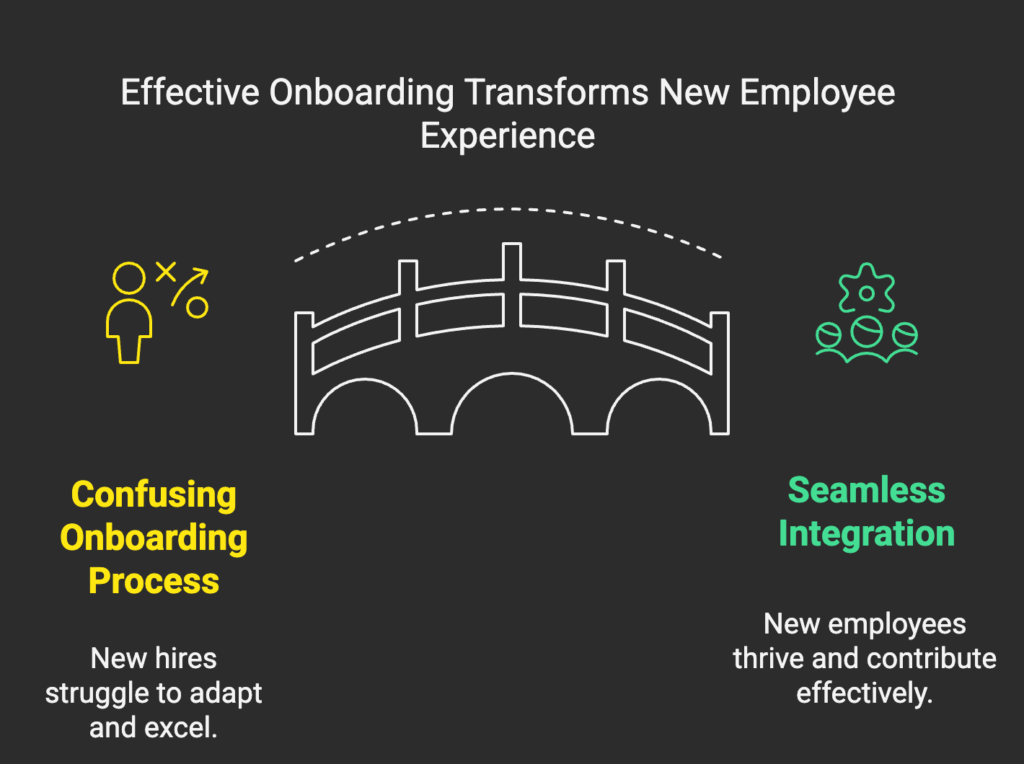
  • Reporting problems without suggesting solutions. This creates tension rather than teamwork.
  • Focusing only on your work without considering managerial priorities.
  • Not keeping your manager informed of progress or challenges. This can create distrust.
  • Waiting for instructions instead of taking the initiative.
  • Acting beyond your role or undermining authority.

Why is Managing Up Important?

Managing up doesn’t revolve around simply pleasing your boss. It relates to an excellent workplace, where employees are recognized for all their contributions despite leadership challenges. It is about understanding the leader’s leadership style and projecting efforts toward organizational priorities.

Not ‘managing up’ can lead to poor communication, missed opportunities, and stagnation in career development. This guide will help you with key strategies for managing up, along with practical examples and risks to avoid.

Guidance on Knowing Who You’re Working For

Before you learn how to ‘manage up,’ you need to know your boss’s leadership style and what he or she expects from you. Begin by asking:

  • What leadership style do they exhibit?
  • Are they supportive or authoritarian?
  • Do they like to collaborate or control?
  • How do they react to stress?
  • Do they stay calm or shift the blame?
  • How do they prefer communication?

The Primary Principle of Managing Up – Shared Objectives

Organizations have witnessed a 72% reduction in attrition, and employees are delighted with their managers.

The first step to ‘managing up’ is to learn about your boss’s priorities. This is knowing what he or she wants to achieve, what challenges the leader faces, and what vision he or she has for the team.

Here’s how to do that:

  1. Ask the right questions and communicate effectively: Two-way, clear communication reduces misunderstandings and increases efficiency. Effective communication helps team members stay connected, and it enhances productivity by 25%.
  2. Be proactive: Helping your boss succeed puts you in a position where you are seen as an essential part of the team.
  3. Focus on results: Ensure contributions directly impact key objectives.
  4. Demonstrate initiative, reliability, and leadership potential: Prioritize your boss’s success to climb the career ladder.

Challenges Associated with Managing Up

Managing up may have its pitfalls. Some of the key challenges are:

1. Miscommunication Risk

Misaligned communication can create misunderstandings and friction. The best way to avoid this is to confirm the understanding of tasks and expectations regularly.

2. Overstepping Boundaries

Taking too much initiative may lead to surpassing your manager’s responsibilities. Seek a middle ground and try to get approval when entering the unknown.

3. Creating Dependency

If managed poorly, managing up may result in the manager relying so much on your flexibility that it can kill your independence. It is important to establish boundaries for independence.

4. Neglecting Peer Relationships

Focusing just on upward relations might isolate teammates. Balance is essential; excellent peer relationships generate teamwork and victory.

Winning at Managing Up – Advance Your Career Using These Critical Techniques

Let us dive into the best practices and key strategies that will master managing up:

1. Build and Maintain Trust

Trust is the foundation for any effective working relationship. How to build it – show up, deliver what you promise, and be transparent about what you’re doing. Teams that have higher trust levels also experience 50% higher productivity.

This means that if you are honest and dependable, you become an essential player in the success of your manager. Here are some key actions that you can take:

  • Follow through on commitments without being reminded to do so
  • Over-deliver on the most important projects possible.
  • Don’t withhold bad news, no matter how adverse it is.

2. Communicate Effectively and Proactively

Effective communication is such that the manager will never be left in the dark. Share updates frequently, and use clear and crisp language while making sure that possible risks are raised early on. Important tips:

  • Schedule regular meetings to discuss the progress and roadblocks
  • Use concise summaries for complex updates.
  • Identify potential problems early so that they can be addressed proactively.

3. Give Constructive Feedback

Giving feedback to your manager is not easy, but it is necessary for a healthy relationship. Do this with respect and tact. For instance, you could say, “Should we try a different approach for better results?” Constructive feedback is more likely to be accepted and appreciated. Here are some things you can try:

  • Ask for permission before sharing feedback (e.g., “Would you mind if I shared an idea?”).
  • Focus on solutions rather than problems.
  • Use examples, facts, or stats to support your feedback and keep it specific.

4. Adapt to the Leader’s Working Style

Everyone works differently, and managers are no exception. Some like detailed updates, while others appreciate high-level overviews. The better you understand their style, the better you will communicate and collaborate with them. Over time, you will strengthen your relationship. Key steps:

  • Observe their preference for communication and imitate it.
  • Ask them directly what their preference is for receiving updates.
  • Be flexible and change your style as per requirement.

5. Respect Confidentiality

Trust and professionalism should never be compromised. Divulging privileged information can severely damage your reputation and your working relationship with your manager. Follow these tips:

  • Conduct confidential talks as private conversations unless otherwise directed.
  • Never misuse confidential information to gain goodwill with others.
  • Assure the manager of confidentiality when they have confided in you.

6. Advocate for Team Insights

As someone close to the team, you’re uniquely positioned to share valuable insights with your manager. Highlight trends or concerns, such as morale issues or skill gaps, that they may not see directly.

  • Provide regular updates on team dynamics.
  • Offer actionable recommendations to address identified issues.
  • Use data to back up your insights for credibility.

Best Practices that Can Help in Managing Up

Here are some tips and best practices that you must follow to ‘manage up’ effectively:

1. Know Their Priorities

Knowing what your manager values most enables you to work toward their objectives. This way, you are working toward their success. You must make an effort to discuss their top priorities and be on the same page with their changing priorities.

2. Take Initiative

Managers like employees who take responsibility and solve problems ahead of time. For example, instead of just pointing out a delay, present a new timeline and explain the changes required to achieve it. Take responsibility for your tasks without being told to do so and offer to take on difficult tasks to demonstrate initiative.

3. Plan Regular Sessions

Indulge in progress discussion, current updates, and advice during integral check-ins. Always prepare an agenda before the check-in and handle action-type items to make the session productive. You must also send a summary email or Minutes of the Meeting that captures important points.

4. Seek and Act on Feedback

Regularly soliciting feedback is the mark of an individual dedicated to growth. 72% of managers believe seeking constructive feedback about work is desirable. Implement feedback and demonstrate improvements.

5. Maintain Paper Trail

Record your critical discussions, holding yourself and others accountable to avoid miscommunication. This is specifically beneficial for people working in different geographies or hybrid scenarios.

6. Show Empathy and Emotional Intelligence

Acknowledge the challenges of your manager and thus have a closer relationship. Basic gestures of empathy, such as showing them their workload, would go a long way in the rapport. Show empathetic language during stressed moments, for example, “I understand this must be challenging”. Be willing to share some workload and avoid taking negative reactions personally.

7. Be a Positive Influence

Be the team player who lifts others. Report team morale and share your observations about what should be actioned. Promote coordination and cooperation on the part of team members. You must also address workload disproportion ahead of imbalances arising.

Case Studies and Examples of Managing Up

Here are some examples that demonstrate what managing up is and how it is done!

1. Determining What Motivates Micromanagers

In a case study, an employee resolved the problem posed by a micromanager on wasted time through a change of strategy. Here are key initiatives taken by the employee:

  • He kept the manager informed and updated him on projected timelines.
  • He shared meeting agendas before the discussion for easier conversations.
  • The outcome was better trust and decreased unnecessary interventions.

2. Pulling Clarity from Vague Bosses

Use Peter Drucker’s Management by Objectives (MBO) structure when dealing with bosses who give out vague instructions. You can draft a short letter that captures objectives and standards as they are. Present the draft and seek the leader’s opinions to converge into actionable steps. This will give you greater clarity on goals and mutual responsibility.

3. Managing Multiple Bosses with Organization Tools

In another example, an employee handling two managers’ work used a weekly to-do list to:

  • Break down tasks and deadlines.
  • Maintain transparency of progress.
  • Streamline workflows and manage expectations.

4. Using an Engagement Survey

Nuspire is one of the global leaders in managed security services with more than 1,000 employees. The organization experienced low employee morale and engagement. In 2022, Nuspire partnered with Engagedly to implement the E10 Engagement Survey. The survey revealed overall gaps in morale, loopholes in performance management, and lack of employee recognition.

Within three years, Nuspire realized a 15% increase in employee engagement. Automated processes by Engagedly have replaced manual work, allowing leaders and employees to focus on strategic initiatives rather than mundane administrative tasks. Initiatives based on survey insights created a boost in morale and empowered employees to engage actively in personal development.

5. Presenting Solutions, Not Problems

When pointing out inefficiencies, bring a proposed solution to your manager. For example:

  • Point out bottlenecks in project workflows and suggest alternative processes.
  • Offer to implement the solution, showing initiative. This helps build trust and positions you as a problem-solver.

Conclusion

Managing up is not merely a career booster-it is one of the most important skills that can transform your profession and career. Managing up can be described in one word – understanding.

You must understand your leaders’ needs, goals, and challenges and proactively align your efforts to better support them. The relationship encourages mutual growth and success.

Managing up can be your new source of opportunities in your career development. It can boost your reputation as a dependable and resourceful team member and can contribute to a better work environment in general.

At any stage of your career, you must enhance collaboration and leadership through integral tools and resources. Using such professional help and expertise can advance your professional development.

Visit Engagedly for innovative solutions designed to empower you. The platform will help you thrive in your career and master the art of managing up.

FAQs

1. What does it mean to manage up and across?

Managing up and across requires collaboration, which means working not just with your boss but also with colleagues on other teams. It requires developing trust and mutual objectives toward improved efficiency within a team.

2. How should you initiate managing up with your leaders?

You can bring up a substantial subject, challenge, or task from a team and suggest proactive solutions. You can also emphasize improving how things are done better, with mutual benefits.

3. How does managing up help your career?

‘Managing up’ shows leadership, communication, and problem-solving skills. These characteristics make you more valuable to your organization. Thus, it can help in increasing your chances of career advancement.

4. What tools are helpful in effectively managing up?

Use organizational tools such as project management software, employee mentoring tools, or communication aids that can help streamline the workflow. You must ensure that such resources comply with organizational policies and fit into your manager’s preferences.